The Global Purge Of Independent Leaders (2020-2022)
A chronological overview of leadership changes and the policy pivots that followed
Health And Truth and Mark Stronge | October 28, 2025
From early 2020 onward, a repeating script unfolded: a head of state voiced skepticism of lockdowns, PCR testing, or experimental mRNA vaccines; international agencies scolded them; chaos or “illness” struck; and within weeks new officials delivered full compliance and suddenly unlocked frozen aid money. The alignment was worldwide—different cultures, same choreography.
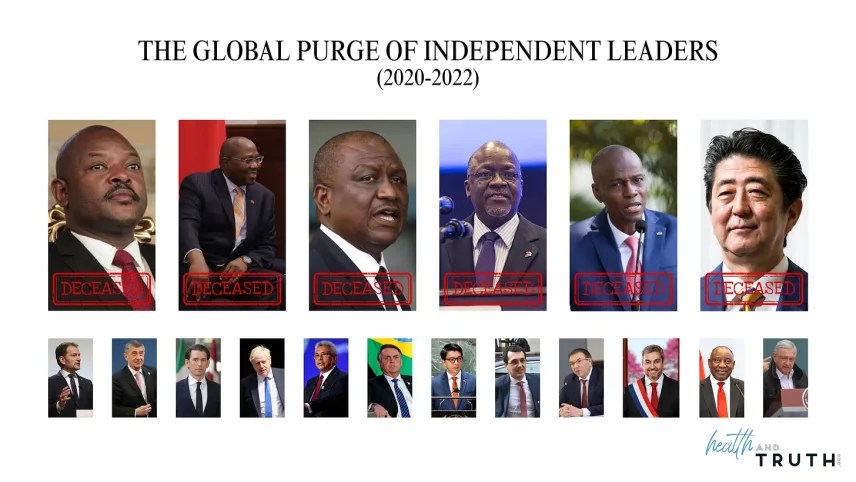
1. Burundi – Pierre Nkurunziza
In Burundi, President Pierre Nkurunziza expelled the World Health Organization from his country in May 2020, saying foreign interference was undermining national sovereignty. He kept the nation open while neighboring states imposed severe restrictions. Merely two weeks after that decision he was dead, officially of a “heart attack,” though associates described him as being in vibrant health. His successor, Évariste Ndayishimiye, reversed course immediately, reopened WHO offices, and signed new vaccine and funding arrangements that brought Burundi back into the international fold.
- Backdrop: In spring 2020 the government halted WHO field work, accusing it of interfering with domestic affairs. Burundi rejected external pandemic restrictions and held public gatherings normally.
- Event: Nkurunziza died suddenly 8 June 2020 while still in office; official cause – cardiac arrest.
- Immediate shift: Successor Évariste Ndayishimiye re‑opened WHO offices, declared COVID‑19 a “national priority,” invited vaccine partnerships, and received roughly $24 million in rapid IMF assistance.
- Result: Burundi signed onto COVAX distribution in 2021 after having been one of the continent’s last hold‑outs.
2. Eswatini – Ambrose Dlamini
In Eswatini (formerly Swaziland), Prime Minister Ambrose Dlamini resisted extreme lockdown policies, insisting that starving citizens to stop a virus was immoral. In December 2020 he was taken to South Africa “for observation” and declared dead soon afterward. The royal government that replaced him moved quickly to impose strict curfews, accept COVAX vaccines, and collect foreign emergency aid.
- Backdrop: The businessman‑turned‑PM favoured balanced restrictions, warning that closing trade would worsen poverty.
- Event: Tested positive for SARS‑CoV‑2, transferred to South Africa, and died 13 Dec 2020.
- Aftermath: King Mswati III and his cabinet adopted curfews, mandatory masking, and joined regional COVAX planning.
- Economic follow‑up: The African Development Bank confirmed a $10 million grant under the COVID‑19 Response Support Programme in early 2021.
3. Ivory Coast – Hamed Bakayoko
A similar disappearance occurred in Ivory Coast. Hamed Bakayoko, the charismatic prime minister, had publicly encouraged herbal treatments and questioned the accuracy of PCR diagnostics. In March 2021 he died in Germany of “cancer,” barely eight months after his predecessor suffered a similar fate. His passing removed the last voice questioning WHO dependence. President Alassane Ouattara’s administration proceeded to import AstraZeneca doses through COVAX, and by summer the country was being praised for its “responsible leadership.”
- Backdrop: The popular Prime Minister promoted herbal remedies and localized treatment efforts while maintaining open borders for trade.
- Event: Died 3 Mar 2021 in Germany where he was under cancer treatment; preceded by the death of previous PM Amadou Gon Coulibaly eight months earlier.
- Aftermath: President Alassane Ouattara named Patrick Achi acting PM; by May, 504 000 AstraZeneca doses had been deployed through COVAX.
- Funding: World Bank approved $300 million for emergency health and education programmes that quarter.
4. Tanzania – John Magufuli
The next to fall was Tanzania’s John Magufuli, Africa’s most outspoken skeptic of mass testing and vaccines. He mocked the system by demonstrating that fruit and goats tested positive for COVID. After vanishing from public view in March 2021, the vice‑president announced that he had died of heart failure. His replacement, Samia Suluhu Hassan, promptly reversed every one of his policies, accepted a $600 million IMF “emergency” loan, reopened the gates to foreign pharmaceutical programs, and declared a massive vaccination drive before year’s end.
- Backdrop: Highly skeptical of PCR testing accuracy and mass vaccination; prioritized economic continuity.
- Event: Absent from view in March 2021 for two weeks; Vice President Samia Suluhu Hassan announced his death 17 March (heart failure).
- Aftermath: New administration reinstated public health briefings, reopened WHO cooperation, applied for IMF Rapid Credit Facility ($600 million approved Sept 2021).
- Policy transformation: Vaccine programmes, mask campaigns, and international data reporting began within ninety days.
5. Haiti – Jovenel Moïse
Then came Haiti, where Jovenel Moïse had rejected donated vaccine shipments, explaining that the country faced deeper issues of water and poverty. On July 7 2021, he was executed in his home by an armed team whose origins remain murky. Within three weeks, Haiti received half a million Moderna doses from COVAX and enjoyed renewed flows of Inter‑American Development Bank and USAID funding. The national policy flipped overnight.
- Backdrop: Refused early COVAX vaccine delivery, arguing sanitation and nutrition were greater priorities.
- Event: Assassinated 7 Jul 2021 by a commando team; political motives still contested.
- Aftermath: First COVAX shipment of 500 000 Moderna doses landed 14 July 2021.
- Financial context: Inter‑American Development Bank and USAID re‑released more than $60 million in suspended grants under the “COVID‑19 Recovery Program.”
6. Japan – Shinzo Abe → Yoshihide Suga → Fumio Kishida
In Japan, Prime Minister Shinzo Abe avoided harsh lockdowns and refused to make vaccination compulsory. In August 2020 he resigned citing chronic illness, a convenient exit for global interests irritated by Japan’s autonomy. His successor Yoshihide Suga approved emergency authorization for the Pfizer vaccine within weeks, and after political struggles Fumio Kishida continued the same line, expanding booster programs and digital health passes. When Abe, now a private citizen and public skeptic of global centralization, was assassinated in July 2022, the last independent conservative bastion in Japan’s establishment disappeared. The current government invested ¥4.5 trillion—about $40 billion—in mRNA infrastructure partnerships with Western firms.
- Backdrop: Abe resisted extreme lockdowns and mandatory passes; preferred voluntary distancing.
- Resignation: Aug 2020 due to chronic illness; Suga took over and immediately authorized Pfizer vaccine imports (Feb 2021).
- Transition: Kishida succeeded Suga Oct 2021 after election; expanded booster campaigns and health‑pass apps.
- Abe’s assassination: 8 Jul 2022 in Nara; investigation officially attributed to a personal grudge.
- Post‑event: Japan pledged ¥4.5 trillion (≈ $40 billion) in bio‑innovation investment partly for mRNA research.
7. Slovakia – Igor Matovič
Slovakia followed the pattern in March 2021 when Igor Matovič, who had attempted to purchase Russia’s Sputnik V vaccine outside the European Union’s centralized supply, was forced out after furious criticism from Brussels. His successor Eduard Heger rejoined the EU’s procurement framework and in return unlocked €6.3 billion in recovery funds.
- Backdrop: Purchased Sputnik V without EU approval to widen supply options.
- Event: Coalition crisis culminated March 2021 in his resignation.
- Aftermath: New PM Eduard Heger froze Sputnik imports, conformed to EU purchasing pool, and unlocked €6.3 billion EU Recovery Funds.
8. Czech Republic – Andrej Babiš
Nearby, the Czech Republic saw Prime Minister Andrej Babiš lose power at the end of 2021 after refusing to maintain endless pandemic states of emergency. His replacement Petr Fiala implemented vaccine passports and mass‑testing decrees soon afterward, bringing the nation into perfect accord with EU directives.
- Backdrop: Initially resisted heavy lockdowns, favored voluntary vaccination.
- Event: Lost October 2021 election amid strong pro‑mandate media push.
- Aftermath: Petr Fiala government mandated digital health passes (“Tečka” app) and extended state‑support contracts with Pfizer/Moderna.
9. Austria – Sebastian Kurz
Austria lost Sebastian Kurz the same year. Once a rising star who had questioned perpetual lockdowns, Kurz resigned under the weight of a corruption scandal in October 2021. Within days his successor announced Europe’s first universal vaccine mandate and qualified the country for €4.5 billion in European Stability Mechanism funding.
- Backdrop: Pushed for reopening and questioned perpetual emergency powers.
- Event: October 2021 resignation after prosecution alleged misuse of party funds.
- Aftermath: Successor Alexander Schallenberg announced universal vaccination January 2022; European Stability Mechanism distributed ≈ €4.5 billion in recovery funding.
10. United Kingdom – Boris Johnson
In the United Kingdom, Boris Johnson’s government had ended restrictions in mid‑2021 and refused to make vaccine passports a permanent condition of daily life. The press then exploded with “Partygate” scandals over gatherings during lockdown. Johnson resigned in 2022, replaced by Rishi Sunak, who restored Britain to full WHO cooperation and financed a £2 billion digital‑health‑ID system intended to prevent “misinformation.”
- Backdrop: Repealed many restrictions July 2021 (“Freedom Day”), angering zero‑COVID advocates.
- Event: Forced resignation mid‑2022 after “Partygate.”
- Aftermath: Rishi Sunak government supported the WHO pandemic‑treaty process and invested £2 billion in NHS digital ID infrastructure through Palantir‑backed data platforms. Within weeks of taking office, Downing Street announced negotiations with Moderna to establish a permanent mRNA‑manufacturing base — a 10‑year “strategic partnership” followed with construction of a mRNA vaccine research, development, and manufacturing centre in Harwell Science Park (Oxfordshire), projected to produce up to 250 million doses a year in a future outbreak. This collaboration was framed as part of the UK’s “100‑Day Mission” to deliver vaccines within 100 days of identifying a new pathogen; the mission itself originated from G7 and G20 pandemic‑preparedness pledges.
11. Sri Lanka – Gotabaya Rajapaksa
Half a world away in Sri Lanka, President Gotabaya Rajapaksa argued that global supply sabotage and debt were worse problems than COVID. By mid‑2022 coordinated protests and economic chaos forced him to flee abroad. Within weeks, the IMF approved a $3 billion bailout that required health‑security reforms and the adoption of digital‑surveillance frameworks under WHO supervision.
- Backdrop: Advocated reopening, claimed economic sabotage larger threat than virus.
- Event: Mass protests July 2022 amid fuel and food shortages.
- Aftermath: New interim government signed a $3 billion IMF agreement mandating fiscal reform and health‑security modernization.
12. Brazil – Jair Bolsonaro
Brazil completed the second‑wave phase of this storyline. President Jair Bolsonaro ridiculed mask mandates, called lockdowns a luxury for the rich, and questioned vaccine safety. After two furious years of constant hostility from media conglomerates and international NGOs, he lost the 2022 election. Lula da Silva took office, rejoined WHO initiatives, and secured a $1.2 billion World Bank “preparedness” loan.
- Backdrop: Dismissed lockdowns as “hysteria,” resisted vaccine coercion.
- Event: Lost 2022 election to Lula da Silva after two years of hostile media coverage.
- Aftermath: Brazil re‑entered WHO initiatives, COVAX procurement, and secured World Bank Preparedness Loan ($1.2 billion).
13. Madagascar – Andry Rajoelina
Along the African coast to Madagascar, President Andry Rajoelina had introduced his own herbal remedy, COVID‑Organics, and rejected Western pharmacology. In 2021 an attempted coup shook the island, and under global pressure Rajoelina signed new agreements restoring WHO cooperation that same year so donor funding could return.
- Backdrop: Promoted herbal tonic “COVID‑Organics” (artemisia‑based), claiming national self‑reliance.
- Event: July 2021 coup attempt; several senior officers arrested.
- Aftermath: Rajoelina accepted WHO cooperation and external medical aid later that year, restoring aid flows suspended in 2020.
14. Romania – Vlad Voiculescu Minister of Health
Appointed in December 2020 under Prime Minister Florin Cîțu, Voiculescu quickly became one of Eastern Europe’s most outspoken advocates for data transparency within the vaccine‑procurement process.
He questioned:
- why the European Commission’s contracts with Pfizer/BioNTech and Moderna were heavily redacted;
- the procedure for reporting adverse events and hospital bed usage;
- and financial allocation for Romania’s “Green Certificate” system.
In April 2021, Voiculescu alleged irregularities in the way national statistics on Covid mortality were reported (he said hospital figures were being “massaged” to fit EU targets).
Within 48 hours, Prime Minister Cîțu dismissed him (14 April 2021). That dismissal fractured the ruling coalition and was widely interpreted as pressure from Brussels and Bucharest business lobbies to restore “credibility” with EU health authorities.
- Backdrop: In 2021 Romanian minister objected to secrecy of EU vaccine contracts.
- Event: Dismissal and cabinet reshuffle.
- Aftermath:
- Florin Cîțu — Prime Minister (National Liberal Party), an economist trained in the US and a former banker, had emphasized cooperation with the European Commission’s Recovery Facility.
- Immediately after Voiculescu’s removal, Cîțu approved the formal implementation of the EU Digital COVID Certificate
- He signed Romania’s Recovery and Resilience Facility plan for €29 billion (approved September 2021).
- Cîțu later lost internal party support and was replaced by Nicolae Ciucă (2021 December).
- Raed Arafat — Secretary of State, Chief of the Department for Emergency Situations, a longtime figure in Romanian health management (specialist of Palestinian background), spearheaded the nationwide lockdown operations.
- He became polarizing — praised for emergency coordination but criticized for advocating strict curfews and mandatory digital passes.
- Through his influence, Romania aligned with EU Civil Protection Mechanisms and WHO technical advisories.
- Government enforced EU Digital COVID Certificates.
- Brussels released tranches of Recovery and Resilience Facility funds (€29 billion total plan).
- Florin Cîțu — Prime Minister (National Liberal Party), an economist trained in the US and a former banker, had emphasized cooperation with the European Commission’s Recovery Facility.
15. Bulgaria – Kostadin Angov
Appointed during the closing months of Prime Minister Boyko Borisov’s third administration, acting Health Minister Kostadin Angov (2020 – 2021) faced severe criticism from Brussels for Bulgaria’s slow vaccine rollout and limited transparency regarding distribution data. Angov and Borisov’s cabinet were accused of delaying orders through the EU’s joint procurement scheme, preferring to wait for additional safety results before committing to large Pfizer/Moderna contracts.
By late March 2021, Bulgaria had one of the lowest vaccination rates in the European Union and was publicly rebuked by the European Commission for “failure to utilize allocated supply quotas.”
Backdrop: By early 2021, Bulgaria’s center‑right government under Boyko Borisov had lost support amid apparent corruption scandals unrelated to health policy but amplified by public anger over uneven lockdown enforcement and vaccine delays. Multiple cabinet ministers, including acting Health Minister Angov, were called before parliamentary committees to justify the government’s refusal to impose stricter green‑pass rules or to publish full statistics on vaccine deliveries.
Event: In April 2021, Borisov’s GERB party failed to form a coalition following a general election; the president appointed Stefan Yanev as caretaker prime minister, and Stoycho Katsarov — a former deputy minister and health‑reform activist — assumed the health portfolio. Katsarov announced immediate compliance with EU digital pass protocols and promised rapid adoption of the COVID Certificates system, stating that “communication with Brussels must be restored through transparency and vaccination.”
Aftermath: Within three months of the caretaker cabinet’s installation, Bulgaria joined the EU Digital Green Certificate scheme (July 2021), issued its own national app, and implemented tightened entry controls for public venues. The European Commission then approved Bulgaria’s €6 billion Recovery and Resilience Facility allocation (approved December 2021) after earlier postponements linked to “governance deficiencies.”
Katsarov and Yanev argued the shift was strictly technocratic, yet domestic media framed it as the price of unlocking EU funds frozen under Borisov. Moreover, WHO country officers held joint press briefings in Sofia throughout autumn 2021, publicly graduating Bulgaria from a “non‑compliant” to a “fully aligned EU‑health partner.” Later that year a second caretaker cabinet retained the same policies to preserve continued Brussels cooperation.
Government Outcome: By the end of 2021 Bulgaria had moved from partial defiance to complete compliance with EU and WHO health requirements. The turnover of Borisov’s administration and replacement with technocratic caretaker officials effectively cleared the way for release of European recovery funds for health‑system modernization and digital infrastructure projects.
Summary of Sequence
- Initial reluctance to join EU vaccine mandates and delays in accepting digital certificate standards.
- Electoral defeat of incumbent government after months of European pressure and domestic unrest.
- Caretaker administration’s rapid embrace of EU and WHO frameworks.
- Approval of €6 billion in Recovery Funds and re‑establishment of good standing with Brussels.
16. Paraguay – Mario Abdo Benítez
Paraguay’s experience exemplifies how smaller Latin American economies were forced to align pandemic policies with international credit conditions. President Mario Abdo Benítez’s government initially emphasized economic stability over draconian lockdowns, warning that strict restrictions would devastate informal workers who make up more than 60% of the labour market. However, as domestic protests intensified and foreign creditors tightened lending conditions, the administration conceded to the IMF’s stipulations that pandemic‑response financing be tied to specific “public‑health governance commitments.” Once those commitments were accepted, loan disbursements resumed, showing how financial contingency mechanisms coerced health‑policy conformity.
- Backdrop: Through 2020 and early 2021 Paraguay maintained one of South America’s least restrictive lockdown regimes. The government was reluctant to mandate vaccinations or fully close borders with Brazil and Argentina.
- Event: In March 2021 mass protests erupted in Asunción over shortages of medical supplies and alleged corruption in procurement; opposition parties launched a failed impeachment attempt against President Abdo Benítez.
- Aftermath: To restore credit stability, the finance ministry agreed to conditions attached to an IMF Rapid Financing Instrument (≈ $274 million) earmarked for health expenditure auditing and expansion of surveillance systems. By late 2021 Paraguay was fully aligned with WHO and Pan American Health Organization recommendations.
- Outcome: Government stability was restored after external financing resumed, but policy autonomy remained limited by credit conditionality.
17. South Africa – Cyril Ramaphosa
South Africa began as a reluctant participant in strict global pandemic protocols. President Cyril Ramaphosa voiced concerns that extended lockdowns could fuel unrest and economic collapse, and he pushed for Africa‑wide vaccine intellectual‑property waivers rather than Western purchases. Nevertheless, as international ratings agencies threatened downgrades and IMF/World Bank assistance was made contingent on “strengthened public‑health governance,” South Africa shifted its course, introducing some of the continent’s strictest workplace vaccine rules.
- Backdrop: From early 2020 to mid‑2021 Ramaphosa’s cabinet clashed with business unions and community organizations over the cost of lockdowns versus public‑health benefit. Debt pressures soared following a 10% GDP contraction in 2020.
- Event: The National Treasury secured a $4.3 billion IMF loan (July 2020) and a World Bank loan of $750 million (Jan 2022) containing performance benchmarks for pandemic containment and “human capital protection”.
- Aftermath: By December 2021 South Africa announced mandatory vaccination for public‑sector employees and participation in the WHO vaccine passport initiative. Foreign aid disbursement and sovereign bond ratings stabilized only after these steps.
- Outcome: Policy alignment improved credit access but deepened domestic inequality and led to significant civil‑liberty litigation and ongoing parliamentary inquiries into procurement transparency.
18. Mexico – Andrés Manuel López Obrador
Mexico under Andrés Manuel López Obrador (AMLO) presented one of the last major cases of gradual capitulation to WHO and multilateral financial pressures. Initially AMLO resisted mandatory lockdowns and booster campaigns, insisting that national public‑health policy should focus on nutrition and poverty reduction. However, a combination of supply‑chain disruption, dollar liquidity concerns, and lobbying from international philanthropic networks (CEPI, GAVI, and the Gates Foundation) eventually pushed Mexico toward full policy compliance by 2022.
- Backdrop: Throughout 2020 Mexico’s Health Secretary Jorge Alcocer and Under‑secretary Hugo López‑Gatell advocated moderate restrictions and non‑coercive vaccine rollout. The country’s mortality surged during mid‑2021, provoking foreign and domestic pressure for a policy shift.
- Event: Facing threat of credit downgrades, the Finance Ministry began talks with the World Bank and IMF for infrastructure loans linked to public‑health reform. In December 2021 Mexico signed a joint memorandum of understanding with WHO and CEPI for “bio‑pharmaceutical collaboration and vaccine development capacity”.
- Aftermath: Through 2022 Mexico aligned its vaccine certification systems with the COVAX framework and expanded digital health records for the Ministry of Health, unlocking up to $1 billion in World Bank Covid‑response financing.
- Outcome: By 2023 Mexico was publicly touted by WHO offices as a “model for integrated pandemic response,” demonstrating how international credit leverage transformed a once‑independent policy line into strict adherence with global health‑security standards.
Summary of Observable Trends
- Chronology: Deaths of Nkurunziza, Dlamini, Bakayoko, Magufuli, and Moïse opened the sequence (Jun 2020 – Jul 2021). Political collapses in Europe, Asia, and the Americas followed through 2022.
- Policy effect: Every successor endorsed WHO recommendations and entered international funding arrangements that had been unavailable under predecessors.
- Financial trigger: Aid packages—IMF Rapid Credit, World Bank preparedness loans, EU Recovery mechanisms—were routinely disbursed within 30–90 days of the leadership change.
Key Takeaway
From 2020 to 2022, the result was unmistakable: national autonomy collapsed beneath a synchronized agenda linking public‑health compliance to economic salvation. Countries that resisted early, especially in Africa, suffered the hardest blows—five sitting leaders dead in one year. More powerful nations experienced subtler coups through scandal, protest, or economic blackmail, all producing the same end state.
What emerged from these parallel crises was not medical harmony but political homogenization. Each successor declared a “renewed partnership with science,” welcomed new funding from the IMF, World Bank, or GAVI, and ushered in digital‑compliance systems that now define post‑pandemic governance.
By the end of 2022 nearly every government on Earth—rich or poor, democratic or autocratic—had been brought into alignment. Differing flags, languages, and histories no longer prevented one shared choreography: resistance punished, obedience financed, and sovereignty quietly exchanged for a coordinated global script.
- IMF Press Release – Rapid Credit Facility for Burundi (June 2020).
- Reuters / AP Report – Death of Eswatini Prime Minister (Dec 2020).
- African Development Bank – COVID‑19 Response Support Programme (2021).
- World Bank – Ivory Coast Emergency Support Project (2021).
- IMF Press Release No. 21/210 – Tanzania RFI (Sept 2021).
- Associated Press – “President of Haiti Assassinated at Home” (July 2021).
- IDB Official Statement on Haiti Relief Funding (2021).
- Japan Cabinet Office – Resignation of PM Abe (Aug 2020).
- Nikkei Asia – “Japan Invests in mRNA Manufacturing” (2022).
- 1European Commission – Next Generation EU Fund Allocation to Slovakia (2021).
- Czech News Agency – Election Results and Policy Changes (2021).
- Austrian Prosecution Service – Kurz Investigation Report (2021).
- EU Council Press Release – Austria ESM Allocation (2022).
- UK Parliamentary Record – Digital Health Infrastructure Funding (2022).
- IMF Staff Report – Sri Lanka Extended Fund Facility (March 2023).
- World Bank – Brazil Pandemic Preparedness Loan (2022).
- WHO Madagascar Country Office – Cooperation Agreement (2021).
- European Commission – Romania RRF Approval (2021).
- European Commission – Bulgaria RRF Approval (2021).
- IMF Country Report – Paraguay Pandemic Financing (2021).
- IMF Country Report – South Africa Fiscal Support Arrangements (2021).
- WHO / CEPI Press Release – Mexico Cooperation Agreement (2022).
- IMF Country Report – Paraguay Rapid Financing Instrument 2021.
- BBC News Latin America – “Protests Rock Paraguay Over Pandemic Supplies,” March 2021.
- Finance Ministry of Paraguay – Press Release on IMF Commitments April 2021.
- South African Reserve Bank Annual Report 2021.
- IMF Press Release No. 20/315 – South Africa Loan Approval; World Bank Loan Press Brief 2022.
- Reuters – “South Africa Adopts Mandatory Public‑Sector Vaccination Policy,” December 2021.
- El Universal – “López‑Gatell Sabemos que no habrá vacunación obligatoria,” 2020.
- WHO / CEPI – Memorandum on Mexico Vaccine Collaboration, December 2021.
- World Bank – “Mexico COVID‑19 Emergency Response Project,” 2022.
Russia reacts to NATO state minister’s threat to ‘wipe Moscow off the map’
RT | October 29, 2025
Russia has accused Belgian Defense Minister Theo Francken of irresponsible rhetoric after he suggested that NATO could “wipe Moscow off the map.”
In an interview with De Morgen newspaper published on Monday, Francken brushed off concerns that the currently shelved delivery of US-made Tomahawk missiles to Ukraine could trigger an all-out war between Russia and NATO. He argued that Russian President Vladimir Putin would not use nuclear weapons because the US-led alliance “will wipe Moscow off the map.” Francken added that he did not fear a conventional attack on Brussels since it would result in Moscow getting “flattened.”
Russian Deputy Foreign Minister Aleksandr Grushko told the Russian daily RBC on Wednesday that Francken’s words were in line with “the atmosphere of military psychosis” prevalent in Western Europe.
The Russian Embassy in Belgium condemned Francken’s “provocative and irresponsible” statements as “sheer absurdity and total disconnect from reality.”
“Francken’s escapades are the most glaring manifestation of the militarist frenzy that is increasingly consuming the European war party,” the embassy said. It added that EU officials like Francken are “posing a threat to the continent’s future and [are] capable of plunging it into a new war.”
Moscow has repeatedly stated that the flooding of Ukraine with Western weapons would not stop its troops but only cause further escalation.
NYPD Commissioner Jessica Tisch is Turning New York City into a Surveillance Colony
By Matt Wolfson | The Libertarian Institute | October 29, 2025
In a recent report for the Libertarian Institute, I investigated Zionists’ role in creating the crisis point at which New York City now finds itself: caught between a colonial elite which has commandeered government and a progressive-socialist backlash to that elite which proposes to expand government. In this report, I will trace how, in response to the progressive-socialist threat to their power, Zionists and their allies are expanding government in new and frightening directions. The leading player in this operation, like in all good intelligence ops, is not a colorful or charismatic character. But she has all of the subtler qualities—connections, management prowess, presentational understatement—that the city’s minders look for in those who hold actual power.
Jessica Tisch, the New York Police Department Commissioner since 2024 who will definitely stay on if either Zohran Mamdani or Andrew Cuomo wins the mayoralty according to public statements made by both men, is the third generation of the billionaire Zionist family that has had prominent roles in shaping the city since the 1980s. Her grandfather, Laurence Tisch, bought CBS in the 1980s not long before his brother Robert bought the New York Giants, establishing the family, which had started in hotels and movie theaters, as the owner of two of the city’s landmark organizations. In the 1990s, Laurence Tisch was a member of The Study Group, the informal philanthropic Zionist gathering co-founded by Leslie Wexner and Charles Bronfman, which led directly and indirectly to the foundation of Taglit Birthright, the Foundation for Defense of Democracies, and various other projects for Zionist continuity. Laurence’s son and Jessica’s father, James Tisch, is the chairman of the Board of Leows Corporation, the family’s flagship business. James’ wife and Jessica’s mother, Merryl, was the chancellor of the New York State Board of Regents, responsible for supervising all educational activities in the state; and is the chair of the State University of New York Board of Trustees, responsible for supervising the state university system.
Within this context of a family involved in media, finance, philanthropy, and part-time politics, Jessica Tisch, who is now 44, charted her own specific path: from security to administration to the cusp of politics with the backing of money. She started in the NYPD in the decade of the September 11 attacks; continued in the department in the 2010s; moved in the first half of the 2020s to the Sanitation Department, arguably New York’s most important after police and fire. She has returned in the mid-2020s to the NYPD as its commissioner, while also widely being considered a potential future mayor. Like Mamdani, Tisch is a product, this time a direct one, of the decades of Zionist influence that preceded her rise. Like Mamdani, rewinding Tisch’s career shows how she is the capstone to a project of military policing that began in the 1990s and 2000s but that has sharpened under pressure into a full-blown project of social control.
That project began when crime rose in New York in the 1980s and 1990s in response to displacement and homelessness facilitated by WASPs, Zionists, and their allies co-opting city government to the benefit of finance and real estate. In response, Eric Breindel, the neoconservative Zionist editor of the New York Post who had extensive connections to Wall Street, arranged for the Post to back the then-longshot Rudolph W. Guiliani as a tough-on-crime candidate, delivering him Staten Island and so the city.
At the same time, Michael Steinhardt, the Zionist financier who was integral in the reinvention of Wall Street in the 1980s, became the major donor for the Democratic Leadership Council (DLC), which in turn was the major backer of President Bill Clinton, who shepherded to passage in Congress as his main legislative priority the Violent Crime Control and Law Enforcement Act. This act provided newly elected Mayor Giuliani and his police commissioner William Bratton federal funds for law enforcement, with certain conditions attached that increased local spending on policing as well as the size of the NYPD. The NYPD’s budget increased from $1.7 billion to $3.1 billion between 1993 and 2000, also leading to increased city spending, since, under the terms of the Clinton crime legislation, to receive federal funds the city had to spend funds of its own.
During this period, “crime”—defined as everything from murder to unlicensed street vending—fell in response to across-the-board enforcement. After 2001, Raymond Kelly, Mayor Michael Bloomberg’s police commissioner, pushed this practice to its limit with the aggressive practice of “stop and frisk” in minority neighborhoods: a daily distillation of the broader disenfranchisement the black and Latino communities of New York had been experiencing since the 1970s.
Kelly also made sure that the NYPD would benefit from post-9/11 funding of counter-terrorism measures, measures which hinged heavily on techniques for surveillance. And it was by channeling this new priority for social control that Jessica Tisch made her career beginning in 2000s. Fresh out of Harvard, she took “an analyst position available in what was then the counterterrorism bureau” of the NYPD. According to a recent profile in The New York Times:
“Kelly…did not normally meet with applicants for such entry-level jobs, but he ended up interviewing her. ‘Probably because she was a Tisch,’ he said, adding that he had been impressed with her three Harvard degrees.”
“Probably because she was a Tisch” seems like a fair assessment of why the supervisor of 55,000 employees took the time to meet a twenty-something about an entry-level position. But Kelly and Tisch also shared the promising ground of a professional focus: Kelly was committed to surveillance-as-policing, and Tisch’s main interest was data and surveillance. At the NYPD, she began “developing the Domain Awareness System, one of the world’s largest networks of security cameras, including handling contracts to build and expand it.” According to a description of this work in a recent profile of Tisch in New York Magazine, she was Domain’s driving force and Domain her career-maker:
“… Tisch, 27, was tasked with figuring out what to do with more than $100 million in unspent grant money from the federal Department of Homeland Security, which had just built a surveillance network to prevent another terror attack downtown. What if, she asked, the Domain Awareness System went citywide? And what if, instead of trying to stop a suicide bomber, the system tried to spot all kinds of crooks? What if it included the NYPD’s trove of arrest reports and criminal histories? When Tisch sent the privacy guidelines for the system to the lawyers at the New York Civil Liberties Union, they retched…The bosses had the opposite reaction: ‘No, you’ve made it. Congratulations,’ the former colleague recalls them saying.”
Based on an initial grant of $350 million from the Department of Homeland Security and developed with Microsoft technology, the System consists today of “a surveillance network of more than 18,000 interconnected cameras—including those in the private sector—as well as law-enforcement databases.” The system, in one description, “assimilates data from several surveillance tools—license plate readers, closed-circuit television streams, facial recognition software and phone call histories—and uses it to identify people.” As these descriptions suggest, private corporations and nonprofits, for example Rockefeller University in Midtown East Manhattan, can buy in: providing their own cameras then linking them to the surveillance system run out of the NYPD. “And,” according to one report, “when Microsoft turns around and sells the technology to other cities, New York gets a cut.”
Tisch was not only one of the developers, if not the developer, of the system; she also so impressed Kelly with her tenacity dealing with the various technology sub-vendors put in play by the project that he moved her up through the ranks. (She also may have impressed Kelly with her access to funds; the nonprofit the New York Police Foundation, which her uncle chaired and where two of her family members still sit on the board, provided some of the early contributions for testing her surveillance system.) Within a decade, “she became the city’s first information technology commissioner… and within months she was in the midst of the coronavirus pandemic, struggling to create a contact tracing system and then a vaccine distribution system.” Throughout this time, Tisch was working with at least one like-minded colleague from a similar background. This was fellow Harvard graduate Rebecca Ulam Weiner, the granddaughter of the Zionist nuclear scientist Stanislav Ulam of the Manhattan Project, whose view of her grandfather’s work is instructive:
“As someone whose job it is to keep secrets, I often wonder whether such an experiment [as the Manhattan Project] would be possible today, scientifically or socially.”
Fast forward to November 2024, and an embattled Mayor Eric Adams, whose allies in the black community have increasingly moved away from him even as powerful Zionists have edged closer, appointed Tisch Commissioner. He did this despite vocal concerns from civil liberties advocates that, in the words of one, “It’s really alarming to see a commissioner who built her career on the infrastructure of mass surveillance.” Weiner is Tisch’s deputy commissioner of intelligence and counterterrorism, and has let it be known that her department “relies on a mind-boggling suite of assets that Americans might otherwise assume are controlled by the CIA, FBI, DHS, Secret Service, or other agencies.” These include:
“… a legion of intelligence analysts, counterassault and dignitary-protection teams, a flotilla of boats…surveillance aircraft, the nation’s biggest bomb squad, a counter-drone unit, a remote contingent of NYPD detectives… and a network of multilingual undercover operatives…”
Among this “remote contingent” is NYPD Detective Charlie Benaim, “[whose] office could be any squad room in Brooklyn, but for years [has been] an Israeli police station near Tel Aviv,” where “Benaim’s been feeding an endless stream of information, in real time, to his bosses back at One Police Plaza.” According to Weiner, Benaim’s function is “asking the New York question, when something is happening, what would it look like it if it were to happen in New York City, and more importantly than that, how do you prevent it?” A new model for Benaim in answering these questions, apparently, is the Hamas uprising of October 7. This suggests either that the NYPD expects a coordinated attack from foreign operators; or that New York’s security leaders see the city as potentially under siege by its own displaced and ghettoized underclass and plan to respond accordingly.
Telling in this regard is the fact that Tisch’s top priority as commissioner is “doubling down on data-driven policing and surveillance,” an aim which has “sparked fierce criticism from watchdog groups that New Yorkers are living in a surveillance state.” According to New York Magazine, Tisch’s proposed reforms fall along four lines. First, she wants to expand actual surveillance capacities by expanding the city’s camera network “to include more privately owned cameras.” Second, she wants to extend the contract of one of Domain’s less reliable components, “the ShotSpotter gunshot-detection system” which “may result in confirmed shootings only less than 15 percent of the time, according to the comptroller’s office,” a fact which Tisch dismisses, “arguing that something is better than nothing.” Third, she wants to use data collected “to surge police resources down to a single block,” allowing for the department to deploy overwhelming force to tackle individual incidents in small areas. (This means essentially treating city policing as counterinsurgency warfare, and it’s not too different than the LAPD tactics that led to the abuse of Rodney King and the fallout that followed.) Finally, “perhaps the biggest change is that she wants to use those same systems and processes to fight ‘chaos,’ not just crime,” meaning that minor noise disturbances or unusual behavior could qualify for police enforcement via surveillance and surges. (Again, this is a retread of the 1990s: “Giuliani-style crackdowns, only with better gear.”)
More instructively still, she feels this way despite at least one recent controversy suggesting that her policies have adverse effects on the very communities historically at the blunt end of militarized policing. According to The New York Times, in an August report, the NYPD used Domain Awareness System’s facial recognition software to identify and arrest for indecent exposure in April a 230 pound 6-foot-2 black man, Trevis Williams. The arrest was made even though a witness said that the offender was about 160 pounds and 5-foot-6 and even though “location data from [Williams’s] phone put him about 12 miles away at the time.” According to the Times, the fact that “a facial recognition program plucked his image from an array of mug shots and the woman identified him as the flasher was enough to land Williams in jail.” This is despite the fact that “other police departments… require investigators to gather more facts before putting a suspect identified by facial recognition into a photo lineup,” and despite advocacy from groups like the American Civil Liberties Union to “ban… the use of facial recognition by the police because of the risk of misidentification.”
“In the blink of an eye, your whole life could change,” Williams told the Times about his experience, adding that he still gets panic attacks since his April arrest and subsequent imprisonment. The Times investigation did not report asking for a comment from the NYPD or its Commissioner. Nor did it report that, as early as 2019, 11,000 cases per year were being investigated by the NYPD with the help of facial recognition software.
Despite collateral damage from her policies, positive media profiles of “Commish Tisch” and her subordinates have been plentiful since her accession. In an April 2025 report in The News section of The New York Times, the paper had the following to say about her: She has “an unlikely and remarkable career”; is “the daughter and granddaughter of two strong women, neither of whom came from money”; “learned hard work by example”; is “talkative and purposeful, but circumspect”; is a “no-nonsense technocrat” and “incredibly competent”; commands “a huge amount of respect”; is “very businesslike,” “[takes] no guff,” and should run for mayor. New York Magazine, the city’s go-to venue for fashion and culture commentary, had run an equally complimentary profile in March of 2025 that included the same political prediction.
And, the month before New York Magazine’s profile of Tisch, Vanity Fair ran a profile of Tisch’s deputy Weiner titled “NYPD Confidential.” Headed by a black-and-white photo of Weiner flanked by members of her squad that seemed ripped from a promotional poster of Captain America, the article’s text gave its subject an equally marquee treatment, describing her as “laser focused,” “unfazed,” “poised, cultivated, pin-sharp, convivial, boundlessly curious, charmingly profane,” and “a lightning-quick study” who had “a wicked sense of humor.” All three of these profiles also emphasized, as The New York Times’ editorial board regularly emphasizes, a recent rise in crime in the city without honing in on its obvious causes: financialization, gentrification, and displacement.
The Times is owned by the Sulzberger Family, whose members are ambivalent about Zionism but who have deep connections to Zionists. (Their executive editor, Joseph Kahn, is the son of a committed Zionist corporatist and runs in the billionaire Zionist milieu; their editorial page is dominated by Jewish Zionists of all political persuasions; and the former head of the Sulzberger family wealth office now heads Bill Ackman’s.) Vanity Fair is still owned by the Newhouse Family, which, as I reported in my recent investigation on the rise of Zionist power in New York, was vital to that project thanks to its ownership of Conde Nast. New York Magazine is dependent for its scoops on access to the city’s financial and philanthropic elite, many of them Zionists—its recent profile subjects include not just Jessica Tisch but Barry Diller and Diane Von Furstenberg and Bill Ackman. The message from these media venues seems clear: the Zionist financial powers of New York are squarely behind Jessica Tisch, and want their readers to know it.
It is not, in this context, a coincidence that the Times ran an article soon after Zohran Mamdani’s victory in the Democratic mayoral primary citing anonymous sources to report that Mamdani was being urged to keep Tisch on if he wins the mayoralty as a “steady pair of hands.” It is also not a coincidence that this story came during a period when Dan Loeb and Bill Ackman, younger Zionist financial-philanthropic operators, were attacking Mamdani as soft-on-crime almost daily and shifting their funding focus to Mamdani’s Independent mayoral competitor, Mayor Eric Adams, to the point of personally vetting Adams’s campaign manager before the position was filled. What this suggested at the time was a pincer movement, in which attacks by Loeb and Ackman pressured Mamdani into keeping Tisch on as a sign of faith in the establishment and détente with Zionism.
And, in late October, with Mamdani still attacked by connected Zionist players for purportedly making Jews feel unsafe despite the fact that he has attracted significant Jewish support, this is exactly what occurred. On October 22, Mamdani announced, four days after Andrew Cuomo had announced the same, that he would ask Tisch to stay on should he win the election. The reported terms on which this “ask” was made are not encouraging when it comes to Mamdani’s leverage over Tisch if he is elected mayor. Details in The New York Times painted a scenario in which Mamdani had publicly (and factually erroneously) made Tisch the poster child for safety in the city without extracting any concessions from her camp in return. According to the Times,
“… Mr. Mamdani confirmed his decision during the final televised debate before the Nov. 4 election. ‘Commissioner Tisch took on a broken status quo, started to deliver accountability, rooting out corruption and reducing crime across the five boroughs,’ Mr. Mamdani said at the debate. “I’ve said time and again that my litmus test for that position will be excellence’… Ms. Tisch’s allies have signaled for months that she would want to stay in the job regardless of the election’s outcome. [Mamdani] campaign officials declined to detail any conversations between the candidate and the commissioner, but said they were confident she would accept. Delaney Kempner, a spokeswoman for Ms. Tisch, referred a reporter back to an earlier statement from the commissioner stressing that ‘it is not appropriate for the police commissioner to be directly involved or to seem to be involved in electoral politics.’”
Tisch’s strategic mix of aggressive behind-the-scenes lobbying and Olympian public detachment sends a message: as New York Magazine put it less than twenty-four hours after Mamdani made the announcement, she is “the Heiress Who Could Make or Break the Socialist Mayor.” Not long after this article ran, Hakeem Jeffries, the New York Democratic leader of the U.S. House of Representatives, ended five months of ostentatious non-endorsement of Mamdani with a statement endorsing Mamdani—specifically praising his willingness to keep on Tisch. Already, then, thanks to a series of private maneuvers and public feints, Tisch has been placed in the driver’s seat: the establishment’s cooperation with Mamdani is clearly conditioned on Mamdani’s continued acceptance of her.
One difficulty of critiquing moves like these is that the conflation of “Jewish power” and New York is an old trope, in part because New York has been since the early twentieth century a Jewish city. So it should be emphasized, as I have emphasized in my previous report on this topic, that New York’s problem is not a problem of Jewish power. It is a problem of government-tied financialization at the hands of a small number of WASPs and then a small number of Zionists, and it has come at the expense of the people who live in the city, among them many Jews. Now, with a direct threat to Zionists’ influence in the person of Zohran Mamdani, the operation is out front. Zionist financiers have sent one of their own to occupy the most powerful security position in the city, and they are intent on keeping her there. If they fail to install their ally Andrew Cuomo in the mayoralty, which will give Tisch carte blanche, the prospect of them working to sabotage a Mamdani mayoralty in the lead-up to a Tisch For Mayor campaign in 2029 is a very real one.
They will likely do this much like they managed the securance of Jessica Tisch’s job: with media attacks meant to maximize pressure on Mamdani; followed by private assurances to Mamdani that the attacks will stop if concessions follow. These public-private feints, in turn, will push Mamdani into concessions which will make him lose face with his base, isolating him between an unfriendly establishment and a disillusioned electorate. (This trend is already occurring, albeit at the edges, after Mamdani’s public commitment to keeping Tisch, whom many Mamdani voters see as a threat to civil liberties.) Tisch’s allies will manage these plays with the help of The New York Times and other organs of influence (the Conde Nast publications, New York Magazine, the New York Post) which by their own admission are pining for technocratic government predicated on what they call “effective management.”
But there is another equally bad outcome that could accrue should Mamdani win the mayoralty and Tisch stay on as police commissioner. This is the fusion of the most dangerous potential aspect of socialism, total government direction of the economy, with the most dangerous potential aspect of Zionism: total techno-military colonial control. It doesn’t take a great deal of imagination to see how, under a de facto power-sharing agreement between Mamdani and Tisch (Mamdani in charge of domestic welfare, Tisch in charge of security) the worst impulses of both systems will merge to create a city government which is totalistically involved in every aspect of its citizens’ lives, Singapore transfused with Sweden. This outcome for a city which for a century has been read as a triumph of American individualism would be, to understate the case, a seismic shift.
Featured Video

Michael von der Schulenburg: Europe’s Self-Defeating Iran War Policy
or go to
Aletho News Archives – Video-Images
Frlom the Archives
Who Rules America?
The Power Elite in the Time of Trump
By James Petras | Axis of Logic | September 6, 2017
Introduction
In the last few months, several competing political, economic and military sectors – linked to distinct ideological and ethnic groups – have clearly emerged at the centers of power.
We can identify some of the key competing and interlocking directorates of the power elite:
- Free marketers, with the ubiquitous presence of the ‘Israel First’ crowd.
- National capitalists, linked to rightwing ideologues.
- Generals, linked to the national security and the Pentagon apparatus, as well as defense industry.
- Business elites, linked to global capital.
This essay attempts to define the power wielders and evaluate their range of power and its impact. … continue
Blog Roll
 Aletho News
- Michael von der Schulenburg: Europe’s Self-Defeating Iran War Policy
- Sorry, The New Republic, Climate Change Isn’t Causing Somali Migration. Blame Civil Strife and Poverty.
- Expert Guts Claims That HPV Vaccine Reduces Cancer Risk
- No evidence Russia sabotaged Baltic cables – Finnish intel
- The Strategic Folly of a (Serious) US Ground Invasion of Iran
- US-Israeli war of aggression on Iran meant to reshape region: Omani FM
- Iran Does Not Consider Israel Party to Talks to Need Mediators With It – Ambassador
- Macron’s aircraft carrier and warplanes to the Persian Gulf is a dangerous vanity project
- Meet The Ellisons: Zionists, Technocrats, Moguls
- US failures in Iran reveal Russia is key to South Korea’s strategic security
- If Americans Knew
- Are we on the precipice of World War III?
- ‘Catastrophic,’ Says UNICEF: 1,100+ Children Killed or Wounded in Mideast Since US-Israel Launched Iran War
- The Unbelievable Madness of Our War With Iran
- World Council of Churches calls on govts to hold Israel accountable for violations of intl law
- How to end the war on Iran that costs US taxpayers $1M per minute – Not a ceasefire Day 153
- Israeli strategic plans to “remake the Middle East” from the 1950s and since
- Honoring Gaza’s women who refused to let the world look away
- 97% of victims of war on Iran are Iranian, 98% of victims in war on Gaza are Gazans – Not a ceasefire Day 152
- Early Iran strikes cost $5.6 billion in munitions, Pentagon estimates
- Israel Decided the War, But Trump’s America Fights and Pays the Bill
- No Tricks Zone
- New Studies: UK Sea Levels Were 4 Meters Higher Than Today During The Mid-Holocene
- Destructive Green New Deal: German Energy And Metal Group Warns Of Drastic Crisis
- New Study Documents A 20-Year Pause In Arctic Sea Ice Decline – Driven By Internal Variability
- Wake-up Call: Survey Shows Majority Of Germans Now Favor Postponing Climate Targets!
- Televised! Leading German Political Candidate Tells Schoolchildren CO2 Makes Sun Hotter!
- New Study: A Century Warming Of 1.1°C Is ‘Commonplace’ And ‘Not Unusual’ During This Interglacial
- New Study: ‘Internal Noise’ And Volcanic Forcing Can Trigger 10-15°C Warming Within Decades
- Glaciers Worldwide Are Suddendly Surging, Experts Blame Warming!
- Surprising Discovery: Sahara Is Greening…Billions Of Trees Where Once Thought To Be Barren
- New Research Reaffirms Clouds, Aerosols, And Surface Solar Radiation Are ‘Driving The Climate System’
 Aletho News