Israeli military superiority undermines US interests: Report
Al Mayadeen | December 23, 2025
When US President Donald Trump announced in November 2025 that he would approve selling advanced F-35 fighter jets to Saudi Arabia, Israeli Prime Minister Benjamin Netanyahu immediately sought assurances from US Secretary of State Marco Rubio. The US was quick to affirm an unwavering commitment to preserving “Israel’s qualitative military edge” over all countries in West Asia.
And this commitment is not merely political; it’s the law. According to an analysis by Josh Paul, a former State Department director who spent over 11 years in the Bureau of Political-Military Affairs before resigning over Gaza policy in 2023, this legal requirement is producing outcomes that directly contradict US strategic interests in the region.
Writing in Responsible Statecraft, Paul draws on his insider experience to argue that what was intended as a tool for maintaining regional order aligned with American interests may now be fueling instability.
Cold war era policy
The concept of “Israel’s” “qualitative military edge” (QME) emerged in the 1970s as a mechanism to ensure a regional balance of power favorable to US interests by guaranteeing Israeli military superiority. Paul traces how this informal policy became codified in 2008 legislation that defines QME as “Israel’s” ability to “counter and defeat any credible conventional military threat from any individual state or possible coalition of states or from non-state actors, while sustaining minimal damages and casualties.”
The law requires the State Department to assess every major US arms transfer to West Asian and North African countries, from Morocco to Iran, to ensure it doesn’t threaten “Israel’s” military dominance. In practice, since Iran has not purchased US weapons since 1979, this applies exclusively to Arab states, effectively institutionalizing a regional hierarchy with “Israel” at its apex.
Paul describes a classified process involving multiple agencies and Israeli input: “At the annual Department of Defense Joint Political Military Group meeting, the Israelis typically make a presentation that includes a list of systems they deem threatening to their QME.”
Three options, three problems
When Arab countries seek advanced US weapons, Paul explains, the US government is faced with three choices, each with significant drawbacks.
The first is compensating “Israel” with superior technology. When the Obama administration proposed selling F-16s to the UAE in 2013, it had to simultaneously offer “Israel” advanced radars to detect those very aircraft. But this approach, Paul argues, directly fuels regional arms races, potentially violating other US laws that explicitly aim to “discourage arms races.”
The second option involves limiting sales through quantity restrictions, geographical constraints, or technological downgrades. But these limitations, Paul notes, can strain relationships with Arab partners who face genuine security threats.
The third option, denying sales outright to preserve “Israel’s” edge, may produce what Paul calls “perverse incentives.” Arab governments denied US weapons often turn to China, Russia, or France instead, reducing US influence over their defense capabilities and potentially introducing systems Washington cannot monitor or constrain.
This shift threatens the very regional order the QME policy was designed to maintain, as it allows competing powers to establish military footholds in West Asia.
The diplomatic cost of military dominance
Beyond arms sales logistics, Paul identifies a more fundamental problem: guaranteed military superiority may discourage Israeli affairs. “Because Israel remains assured that the United States will help it retain military superiority over the entire region, Tel Aviv may feel able to rely on such superiority rather than engaging in diplomacy,” he writes.
He argues that “Israel’s” recurring reliance on military force “arguably contributes to instability across the Middle East as a whole,” creating a paradox where the policy designed to enhance Israeli security and maintain a “stable” regional order may actually generate the very threats it aims to prevent.
An outdated framework?
Paul questions whether the QME framework still makes sense given recent diplomatic developments. Israeli officials themselves argued during the 2020 F-35 sale to the UAE that the country had become “an ally in confronting Iran” and the sale wouldn’t violate US commitments. Yet Paul notes from his government experience that pro-“Israel” advocacy groups like AIPAC continued opposing such sales “behind closed doors,” regardless of intensifying normalization efforts between Arab states and the entity.
More fundamentally, Paul argues that military technology is evolving in ways that may make the QME unsustainable. Military analysts increasingly suggest the world faces a revolution characterized by “low-cost weapons systems capable of overcoming high-tech capabilities,” a shift that could render “Israel’s” technological edge less decisive and the entire framework obsolete.
Paul concludes that US and Israeli policymakers should explore alternatives to what he calls “Israeli military hegemony and the inherent fragility that it brings to the region.” He argues that “diplomacy and compromise, including the need for real progress on Palestinian self-determination, promises the only real exit from the isolation that the QME has allowed Israel to impose on itself.”
For Paul, who left his State Department career over these very contradictions, the message is clear: a policy conceived to ensure a regional order favorable to US interests through military dominance may now be achieving the opposite, undermining both regional peace and American strategic influence in the process.
No comments yet.
Featured Video
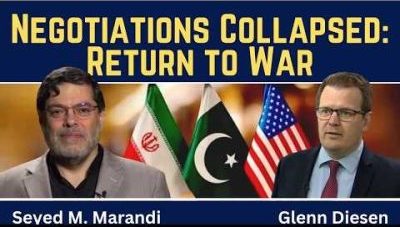
Seyed M. Marandi: Negotiations Collapsed – Return to War
or go to
Aletho News Archives – Video-Images
From the Archives
The US-Iran Scenario That Most Scares Israel
By Ali Haydar | Al-Akhbar | October 9, 2013
Israeli Prime Minister Benjamin Netanyahu issued a series of threats toward Iran and its interlocutors in the West, including the US, as serious negotiations on Iran’s nuclear program seem more plausible.
As a possible rapprochement looms between the US and Iran, Netanyahu has attempted to impose impossible Israeli conditions on the negotiators, such as the full dismantling of Iran’s nuclear program, not to mention threatening military force.
Whatever the deal that could materialize between Iran and the West, Israel is going to find itself before an open-ended path. One can foresee three possible scenarios… continue
Blog Roll
 Aletho News
- Seyed M. Marandi: Negotiations Collapsed – Return to War
- Tomorrow’s naval blockade showdown
- ‘Israel’ attacks civilians to hide its embarrassing military failures & out of pure sadism
- Any Foreign Military Vessel Approaching Hormuz Under Any Pretext ‘Will Be Dealt With Severely’: IRGC
- Diplomats slam US negotiators’ performance in Iran talks
- Trump Refuses Exit Ramp, War with Iran will Continue
- Trump Says US Naval Blockade in Strait of Hormuz Will Begin Shortly
- US, Iran end 21-hour talks without agreement
- US IRAN TALKS: Who Are the Crazy Ones Here? /Lt Col Daniel Davis
- Talks with the US end without a deal over excessive US demands: Iran
- If Americans Knew
- Critical shortages in Gaza, Lebanon in ruins, “piracy” in Iran – Daily Update
- US-Iran ceasefire negotiations make zero progress – Daily Update
- Pro-Israel ‘Thinktanks’ and Individuals who Influence U.S. Foreign Policy
- Mearsheimer reveals how Israel dictates US policies on Iran, Gaza – video
- After killing 350+, Israel still has a “score to settle” with Lebanon before ceasefire – Daily Update
- Military aid to Israel emerges as the latest political litmus test for Democrats
- The only Palestinian children’s rights organization closes following years-long Israeli campaign against it
- ‘I Can’t Forget the Smell’: Lebanese Reel After Israel Kills Over 300 in Single Day
- DNC Shoots Down Resolutions Calling Out AIPAC and Limiting Arms to Israel
- TCN: Is Israel Blackmailing President Trump?
- No Tricks Zone
- Cave Discovery Reveals Today’s Desert Climates Were Recently Far Warmer, Wetter, Teeming With Life
- German Expert: Heat Dome Led To Record Temps In Western USA…Warmer In 1934, 1936
- New Study: No Linear Warming Or Glacier Retreat Along Northern Antarctic Peninsula Since 1980s
- An Inconvenient Tree: Uncovered In Alps… Europe Much Warmer Than Today 6000 Years Ago
- New Study Reports A 60% Slowdown In Greenland’s Ice Loss Rate In The Last Decade
- Low Intensity Tornado Wrecks Major Solar Farm, Creating A Potential Toxic Dump
- New Study Finds Warming Saves Lives…Cold Temperatures 12 Times More Deadly Than Excess Heat
- German Science Blog Accuses PIK Climate Institute Of Hallucinating Climate Tipping Points
- Devastating Assessment Of Comirnaty Vaccine By Former Senior Pfizer Europe Toxicologist
- New Study: CO2 Is ‘Effectively Negligible’ As An Explanatory Climate Change Factor Since 2000
 Aletho News
Leave a comment