Venezuela under siege: Why US escalation could destabilize an entire region
By Leila Nezirevic | Al Mayadeen | December 28, 2025
Washington’s confrontation with Venezuela has entered a dangerous new phase. What began years ago as sanctions aimed at pressuring President Nicolás Maduro’s government has now escalated into naval interdictions, oil tanker seizures, and open discussion of military action — a shift that risks destabilizing not only Venezuela but much of Latin America.
In recent weeks, the United States has intensified its campaign by intercepting Venezuelan oil shipments at sea, effectively enforcing what officials describe as a “blockade” of sanctioned vessels. Caracas has denounced the move as piracy and a violation of international law, while Washington frames it as a legitimate enforcement of sanctions and a counter-narcotics operation.
Yet behind the legal arguments and political messaging lies a deeper strategic shift, one that signals a return to a more coercive US posture in Latin America, with potentially profound consequences.
To understand the implications of this escalation, alngside current regional developments and historical precedents, this article draws on an in-depth interview with veteran journalist and leading Latin America expert Richard Lapper.
A sharp escalation at sea
The most visible sign of Washington’s new approach has been its actions in international waters. US naval forces have seized and disabled Venezuelan oil tankers accused of violating sanctions, while additional vessels remain under surveillance. These measures go beyond financial penalties and diplomatic pressure, marking one of the most forceful uses of maritime power against Venezuela in decades.
Caracas has condemned the seizures as an illegal blockade and accused Washington of weaponizing sanctions to strangle its economy. Venezuelan officials argue that the actions violate international maritime law and set a dangerous precedent for global trade.
Legal experts remain divided. While the US claims it is acting within the scope of sanctions enforcement, critics argue that interdicting vessels in international waters — especially without multilateral backing — risks undermining established norms of freedom of navigation.
Richard Lapper, also an author of several books, including Lula!: The Man, The Myth and a Dream of Latin America, is blunt in his assessment. “This is a breach of international law,” he says. “But I don’t think that really matters for the Trump administration. This is about exerting power.”
The return of the Monroe Doctrine
According to Lapper, Washington’s Venezuela policy reflects a broader reassertion of hemispheric dominance reminiscent of the Monroe Doctrine — the 19th-century principle that Latin America falls within the United States’ exclusive sphere of influence.
For decades, US policy toward the region oscillated between overt intervention and softer approaches centred on democracy promotion and economic reform. That balance now appears to be tilting decisively toward coercion.
“This is a fairly clear restatement of a traditional US approach,” Lapper explains. “It says: this is our region, and we are going to exert our power.”
He points to recent US involvement in Honduras as emblematic of this shift. Washington strongly backed political actors aligned with its interests, even when they carried significant legal and ethical baggage. In doing so, the US signalled that strategic loyalty now outweighs democratic credentials.
From sanctions to military pressure
For years, sanctions were Washington’s primary tool against Venezuela. Initially justified as a way to pressure the Maduro government toward democratic reforms, the measures expanded to target the country’s oil industry — the backbone of its economy.
While sanctions inflicted economic pain, they failed to dislodge Maduro. Instead, Venezuela’s political system hardened, opposition forces fragmented, and millions of citizens left the country.
Now, sanctions are being reinforced by overt military pressure.
Trump has publicly refused to rule out armed conflict with Venezuela. While a full-scale invasion remains unlikely, Lapper, warns that limited military escalation is a real possibility.
“I don’t think war in the sense of large ground troop deployments is likely,” he says. “But significant military escalation — including drone strikes or targeted attacks on government assets — could happen.”
Such an approach would mirror recent conflicts elsewhere, where technologically advanced militaries sought to degrade adversaries without committing troops on the ground.
Yet Venezuela is not a small or easily controlled state. It is geographically vast, with difficult terrain and powerful non-state actors operating in rural areas.
“Venezuela is a big country,” Lapper cautions. “It would be very difficult for any external power to secure control of the entire territory.”
Drugs, terror labels, and political framing
Washington has justified some of its actions by framing Venezuela as a major hub for drug trafficking, alleging links between senior officials and organized crime networks such as the so-called “Cartel of the Suns.”
There is little dispute that narcotics pass through Venezuela en route to North America. The question is whether this justifies the current escalation — or whether it serves as political cover.
“You have to take the drug stuff with a pinch of salt,” Lapper says. “A lot of drugs do go through Venezuela, but to what extent Maduro himself is at the centre of this is highly contested.”
He notes the inconsistency of US drug policy, pointing to cases where Washington has quietly abandoned its tough stance when political interests demanded it.
“It’s a convenient wrapper for the policy,” Lapper argues. “But the real objective is regional domination.”
A changing political landscape in Latin America
The escalation against Venezuela is unfolding amid a broader political realignment across Latin America. After the so-called “pink tide” of left-wing governments in the early 2000s, the region has swung sharply to the right.
Conservative and far-right leaders now dominate in countries such as Argentina, El Salvador, and Chile, while left-wing governments face mounting pressure elsewhere.
“These are the leaders setting the regional mood,” Lapper says, pointing to figures like Argentina’s Javier Milei and El Salvador’s Nayib Bukele. “Not the Lulas and Chavezes of the past.”
This shift has two implications. First, it reduces regional resistance to US pressure on Venezuela. Second, it creates an environment in which hardline security approaches are politically fashionable.
Ironically, however, overt US intervention can still backfire. In Brazil, for instance, perceived external interference has boosted nationalist sentiment and temporarily strengthened President Lula’s standing.
Venezuela’s economic collapse: Sanctions
One of the central debates surrounding Venezuela concerns responsibility for its economic collapse. Washington argues that sanctions are a response to authoritarianism and corruption. Caracas insists that sanctions themselves are the root cause of suffering.
“Sanctions make things worse, Venezuela was producing three million barrels a day in the late 1990s,” Lapper notes. “Now it produces around a million. It used to be a major force in OPEC. It isn’t anymore.”
However, he also pointed out that even without sanctions, Venezuela would face deep structural challenges. With sanctions, those challenges have become existential.
Humanitarian fallout and migration pressures
The human cost of Venezuela’s crisis is staggering. Roughly one-fifth of the population has left the country, creating one of the largest displacement crises in modern history.
Escalating sanctions and blockades are likely to worsen this trend.
Within Venezuela, reduced oil revenues mean fewer imports, higher inflation, and deeper reliance on informal and illicit economic activities. Outside the country, neighbouring states struggle to absorb waves of migrants.
Brazil, which shares a long land border with Venezuela, has a direct interest in preventing further destabilisation. It has attempted to mediate politically, but with little success.
“Brazil wants stability,” Lapper says. “But its soft diplomacy hasn’t been effective.”
As conditions deteriorate, migration pressures are likely to intensify — not only toward neighbouring countries, but eventually toward the United States itself.
International allies and a shrinking safety net
Venezuela is not entirely isolated. Cuba remains its most important security ally, receiving subsidized oil in exchange for intelligence and political support.
Russia and China provide diplomatic backing, but neither appears eager to dramatically escalate its involvement.
“I don’t see Russia or China rushing to Venezuela’s aid,” Lapper says.
If US pressure cuts off oil supplies to Cuba, the effects could be destabilizing across the Caribbean. Cuba is already facing severe economic strain, with blackouts and protests becoming more frequent.
The risk, analysts warn, is a cascading crisis affecting multiple states simultaneously.
Lessons from past US interventions
History offers sobering lessons. US military interventions in Latin America have had mixed results at best. While short operations in Panama and Grenada succeeded tactically, longer engagements — such as Haiti — produced prolonged instability.
Elsewhere, particularly in the Middle East, US interventions over the past three decades have often exacerbated conflict rather than resolving it.
“The US does not have the staying power,” Lapper says. “There isn’t domestic support for long, messy interventions.”
That reality limits Washington’s options.
Sanctions alone have failed. Full-scale invasion is politically untenable. High-tech, limited strikes remain a temptation — but one fraught with risk.
What lies ahead for Venezuela?
Looking toward 2026, Lapper sees no easy resolution.
“I don’t see the end of the Maduro regime at the moment,” he says. “Escalation would have to be quite significant for that to happen.”
The most likely scenario, he argues, is continued stalemate: a current government clinging to power, an economy under siege, and a population increasingly forced to flee.
“There’s a lot of explosive material piled up in Venezuela,” Lapper observes. “But right now, there’s nothing to blow it up.”
Whether Washington’s escalating pressure will eventually trigger change — or simply deepen chaos — remains an open and deeply consequential question.
No comments yet.
Featured Video
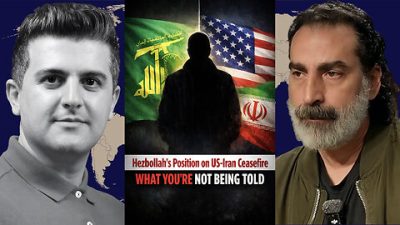
Laith Marouf: Hezbollah’s position on US-Iran ceasefire
or go to
Aletho News Archives – Video-Images
From the Archives
The Dirty Little Secret behind the “Global Terrorism Index”
The Omission of Israeli Terrorism in the Occupied Palestinian Territories
By Karin Brothers | Global Research | December 6, 2014
… The Israeli settlements — all of which are illegal – have been identified as a major impediment to peace. The refusal of a major “global” terrorism report to name the Israeli settlers as one of the groups most responsible for terrorism not only misrepresents a major source of regional violence but exposes the Global Terrorism Index as a propaganda tool that supports a U.S. agenda.
In recent years, governments have been attempting to thwart terrorism by blocking supportive fund-raising. When it comes to Israeli settlements, however, the US and Canada actually encourage fund-raising by giving organizations (such as Christian Friends of Israeli Communities (CFOIC) and the Jewish National Fund) financial support in the form of donor tax-deductions.
Charities which provide funds for the Israeli settlements should be regarded as terror-financing organizations. They should not only lose their tax-deductible status, but they should be banned because they support the violation of international humanitarian law. The terror-financing laws that are being strictly enforced for Muslim charities should be applied to Christian and Jewish charities as well. … Read full article
Blog Roll
 Aletho News
- Israel faces ‘unsustainable’ strategic crisis following 40-day war against Iran: Analyst
- Iran restricts Hormuz access to 15 vessels per day under ceasefire terms: Report
- The ‘Opposition Party’ Has Done Nothing to Stop the Iran War and Much to Goad Trump Into Continuing It
- Moscow backs Tehran on status of Lebanon in US-Iran deal
- How UK Regulator Ofcom Quietly Bypassed International Law to Police American Speech
- The Black Cube Files: How Former Mossad Operatives Flipped a Nation
- Laith Marouf: Hezbollah’s position on US-Iran ceasefire: What you’re not being told
- Israel’s priority lies in destroying chances of peace between Iran, US: Ex-UN nuclear chief
- Ceasefire for all or for none: Iran shuts Hormuz over Lebanon attacks
- Strait of Hormuz is Iran’s ‘nuclear weapon’ that forced US retreat: Medvedev
- If Americans Knew
- This is ceasefire? Israel’s biggest massacre yet in Lebanon, another journalist killed in Gaza – Daily Update
- Tucker Carlson on Israel: This Is the Behavior of an Ally? Really?
- Gazans face a triple crisis: severe shortages of water and bread, healthcare in tatters
- NY Times reports how Netanyahu took the US into Iran War
- A sigh of relief over Iran, but Gaza and Lebanon in dire straits – Daily Update
- Thousands dead and neighborhoods razed to the ground: Aid agencies fear southern Lebanon is becoming the new Gaza
- The war the US is fighting for Israel could cost trillions
- ‘Cigarette Burns, Nail Wounds’: Toddler Tortured in Gaza to Coerce Father
- Trump Says US Sent ‘a Lot of Guns’ to Protesters in Iran
- Israeli forces destroy 17 UN peacekeeper cameras in south Lebanon
- No Tricks Zone
- An Inconvenient Tree: Uncovered In Alps… Europe Much Warmer Than Today 6000 Years Ago
- New Study Reports A 60% Slowdown In Greenland’s Ice Loss Rate In The Last Decade
- Low Intensity Tornado Wrecks Major Solar Farm, Creating A Potential Toxic Dump
- New Study Finds Warming Saves Lives…Cold Temperatures 12 Times More Deadly Than Excess Heat
- German Science Blog Accuses PIK Climate Institute Of Hallucinating Climate Tipping Points
- Devastating Assessment Of Comirnaty Vaccine By Former Senior Pfizer Europe Toxicologist
- New Study: CO2 Is ‘Effectively Negligible’ As An Explanatory Climate Change Factor Since 2000
- Former Pfizer Toxicologist Dr. Helmut Sterz Tells Bundestag Hearing Pfizer Vaccine Should Have Never Been Approved
- Energy Expert: Germany’s Nuclear Phaseout Was A “500 Billion Euro Mistake”
- New Research: South Australia’s Mid-Holocene Sea Surface Temperatures Were 4°C Warmer Than Today
 Aletho News
Leave a comment