Britain’s Secret Role In Yugoslavia’s Destruction
By Kit Klarenberg | Global Delinquents | January 6, 2026
December 23rd marked the 35th anniversary of an independence referendum in Slovenia, then a Yugoslav republic. In all, 88.5% of registered voters – 95.7% of participants – said “da” to secession. The plebiscite prompted Ljubljana’s formal declaration of independence, and ensuing Ten Day War between Slovene territorial defence forces and the Yugoslav federal army. This was the spark that triggered bitter, bloody interethnic conflicts throughout Yugoslavia over the subsequent decade, and the multiethnic socialist federation’s ultimate destruction.
In May 2000, Britain’s Observer exposed how in the Ten Day War’s leadup, London secretly supplied Slovenia with tactical military communications equipment worth millions, to assist Ljubljana’s impending battle against the Yugoslav military. The disclosure elicited outcry, as London was officially at the time committed to preserving Yugoslavia, leading international efforts to prevent the country descending into fractious civil wars. The clandestine provision was at direct odds with this public-stated policy, which included unbending support for an arms embargo on the region.
Responding to the news, former British Foreign Secretary David Owen, who served as the EU’s lead peace negotiator during the Bosnian war, said he was “surprised” London covertly undermined her formal commitment to keeping Yugoslavia “together”. He nonetheless downplayed the assistance, noting what Britain supplied “was not aggressive” – “radios not guns”. Owen therefore argued the shipment “sails close to the border but does not cross it.” By contrast, the Observer reported the communications equipment “played a vital role” in Slovenia’s victory over Yugoslav forces.
This was because Ljubljana won the Ten Day War not via conventional military means, but a wide-ranging, devastatingly effective international propaganda campaign. In physical terms, the brief conflict consisted exclusively of minor skirmishes, and was largely bloodless, with just 44 Yugoslav soldiers and 18 Slovene territorials killed. One would not have known this from contemporary Western media reporting though, which relentlessly portrayed Slovenia as fighting countless grand military engagements against Belgrade’s barbarous invaders, and pluckily prevailing.
British military communications equipment greatly facilitated this informational onslaught. The psychological battlefield’s centrality to Ljubljana’s successful independence struggle had a resounding impact on Slovenia’s fellow breakaway Yugoslav republics. Engendering maximum international sympathy while demonising Belgrade became a core component of Albanian Kosovar, Bosniak and Croat war strategies. In Sarajevo, secessionist authorities deliberately immiserated the local population to create emotionally impactful images for global broadcast. Meanwhile, its military routinely carried out false flags, including targeting civilians with sniper fire. As Canadian UN peacekeepers on-the-ground directly observed:
“The [Bosniaks] are not above firing on their own people or UN areas and then claiming the Serbs are the guilty party in order to gain further Western sympathy. The [Bosniaks] often site their artillery extremely close to UN buildings and sensitive areas such as hospitals in the hope that Serb counter-bombardment fire will hit these sites under the gaze of the international media.”
Ljubljana’s triumph left an enduring impression upon the British too. In multiple proxy conflicts since, London has taken the lead on psychological warfare, in particular atrocity propaganda, vilifying official enemies and justifying intervention and regime change. Since February 2022, a secret Ministry of Defence-created military and intelligence cell, Project Alchemy, has endeavoured to “keep Ukraine fighting at all costs.” Fundamental to this effort are “information operations” designed to convince Western citizens, and Ukrainians themselves, Kiev can somehow defeat Russia, by grossly distorting reality on-the-ground.
‘Quite Incredible’
A memory-holed July 1991 report from now-defunct British newspaper The European – “Lies Win Balkan War Of Words” – lays out in forensic detail how Slovenia’s propaganda war was fought and won. The operation’s “nerve-centre” was “an underground conference complex deep below the streets of Ljubljana.” Here, dozens of Slovene Information Ministry apparatchiks “worked tirelessly” to provide over 1,000 foreign journalists with a relentless barrage of information about the conflict – particularly Yugoslav war crimes, and Slovene military victories – supposedly taking place above ground.
Wild figures on reported “tanks hit, shots fired, prisoners taken” by Ljubljana were supplied hourly. Meanwhile, the Slovenes struck up a chummy rapport with their overseas guests, portraying themselves “as clean-limbed, tanned church-goers who only wanted to live peacefully and democratically in their Alpine idyll of mountains, lakes and meadows.” They claimed to be under attack by “ruthless Communists… dirty, unshaven brutes who dropped cluster bombs on innocent civilians… [and] sought to inflict [their] intolerant religious fanaticism and alphabet of squiggly lines on Europe.”
Ljubljana “needed a bloody, dramatic conflict to ensure the world did not lose interest” in their independence crusade. Thus, “they showered the media with details of battles that had often never taken place,” frequently “enlivening the day” with lurid, often unfalsifiable assertions, such as Belgrade landing “squads of special troops in plain clothes” across the country “to terrorise the population,” or plotting to target a local nuclear power plant and create a Chernobyl-style disaster. Journalists dutifully amplified these dubious claims as fact internationally.
Such was the deluge, “it was possible to report the war without ever venturing above ground” – “but, for those who did venture into the sunlight, the bunker war often seemed a fantasy.” For example, Western news outlets widely covered a purportedly “major battle” at Jezersko, a municipality near Austria. When The European visited the area subsequently, “greatly surprised” local Slovene militiamen instead described a brief tussle with a few Yugoslav soldiers over a borderpost in which “no one had been hurt.”
Throughout the Ten Day War, the Western-backed separatist government of neighbouring Croatia was “carefully analysing” Ljubljana’s informational offensive. They concluded the conflict’s “decisive engagements, which virtually guaranteed Slovenia’s independence, took place in the pages of the foreign media and, even more important, in the news bulletins of the major television networks.” Zagreb duly launched its own “propaganda blitz”. Croat officials were instructed “to hold twice-daily press conferences, which should be as colourful and dramatic as possible,” while Western journalists were given tours by soldiers:
“Everywhere, in town halls, hotel foyers and crouching nervously behind roadblocks, Croat mayors, police chiefs and militia officers… hold press conferences or hand out neatly-typed news bulletins to tell the world of the latest atrocities by Serbian extremists and of unprovoked attacks by the [Yugoslav] army… The Croats’ strategy today is clear. They are bombarding the world with information, which is usually so petty it seems it must be true.”
For example, Croatia’s state media agency Hina pumped out “extraordinarily detailed accounts of the fighting allegedly taking place in the countryside,” with an emphasis on “trivial” incidents. Typically, it was “impossible to check most of these reports precisely because the clashes were so minor that, even if they happened, they left no mark.” This inconsequential, unverifiable cavalcade was occasionally interspersed with “quite incredible allegations”, such as Belgrade having flooded the republic with “hired assassins” drawn from the ranks of Romania’s notorious Communist-era Securitate.
‘Managed Understanding’
The “grotesque caricatures” of Yugoslav forces, and Serbs more generally, as uniquely bloodthirsty monsters peddled by “brilliant” propagandists in Ljubljana and Zagreb took “hold of the public imagination in the West”, transforming “complex” interethnic struggles “into a straightforward battle between the forces of light (Slovenes and Croats) and darkness (Serbs).” This fraudulent dichotomy was exploited even more perniciously during the Bosnian civil war, and subsequent Kosovo ‘crisis’, during which atrocity propaganda served to justify and sustain NATO’s criminal 78-day-long bombing of Belgrade in 1999.
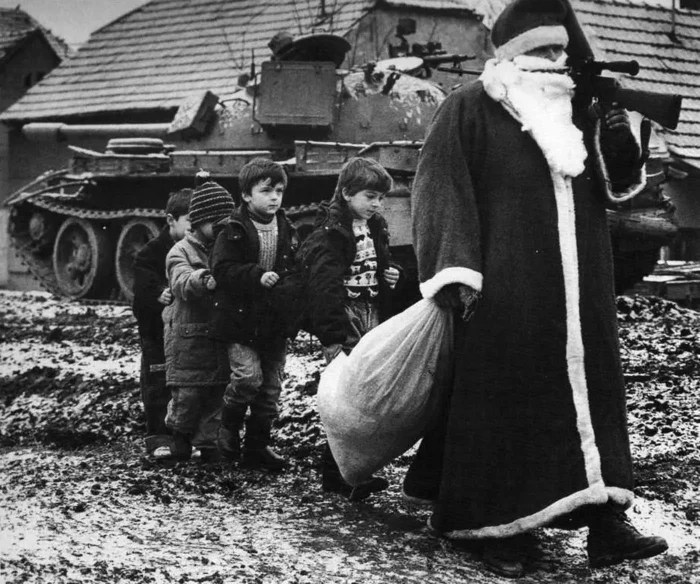
An impactful staged photo, Croatia, Christmas 1992
The European concluded by noting reliance on psychological manipulation to win wars created a “major problem”. Namely, while “a daily publicity blitz of exaggerations and lies may win international support… it will do nothing to heal the divisions which are ripping the country apart.” Locking-in overseas sympathy made Western-backed leaders in the former Yugoslavia less willing to accept negotiated settlements, and keep brutal internecine battles grinding on, safe in the knowledge further carnage only strengthened their position, in information warfare terms.
Notably, a key propaganda strategy for Croats and Slovenes, per The European, was to portray Yugoslav forces “as incompetent and thuggish.” An identical disinformation dynamic played out during the first 18 months of the Ukraine proxy war. As a November 2023 NATO paper on “Humour In Online Information Warfare” revealed, the military alliance and its Kiev puppets specifically sought to weaponise “humour and mockery”, emphasising “Russian failures” and “Ukrainian determination” in media reporting and online, from the conflict’s inception.
These efforts augmented “the responsiveness and impact” of Ukraine’s “information campaigns,” proving “instrumental” in Kiev securing “US-made F-16 combat aircraft” in August 2023, among other Western arms shipments. The NATO paper makes clear weaponisation of mockery is a long-running objective for the alliance, citing a 2017 study, “Stratcom Laughs”, which outlines methods of exploiting “humour” as a military “communications tool”. Four years later, an official Ukrainian government website entry boasted of how such methods can “influence your opinion”:
“How does propagandistic humor work? Relieves tension, makes perception less critical. Uses common contexts to convey messages with which the audience agrees. Simplifies everything to the ‘obvious’. Creates clear groups: strong and intelligent ‘we’ and clumsy and stupid ‘they’. Of course, the audience associates itself with the former and begins to despise the latter. Simplified managed understanding is easily disseminated by the audience and creates the necessary social context for propagandists.”
Atrocity propaganda has also played a crucial role in prolonging the unwinnable quagmire at unsustainable economic, human, and material cost. In April 2022, British intelligence exploited the ever-mysterious Bucha incident to sabotage fruitful peace talks between Kiev and Moscow, framing the apparent killing of innocent civilians in the town as somehow genocidal. At the time, a US Defense Intelligence Agency apparatchik lamented how the “Bucha Effect” had “led to frozen negotiations and a skewed view of the war” – apparently unaware this was London’s precise objective.
No comments yet.
Featured Video

No Threat Can Force Iran’s Surrender /Trita Parsi & Lt Cl Daniel Davis
or go to
Aletho News Archives – Video-Images
From the Archives
An Expert Military Analysis of War with China
Actually, None is Necessary
By Fred Reed • Unz Review • December 13, 2020
The Correlation of Armed Forces: U.S. goods and services trade with China totaled an estimated $634.8 billion in 2019. Exports were $163.0 billion; imports were $471.8 billion. The U.S. goods and services trade deficit with China was $308.8 billion in 2019. Trade in services with China (exports and imports) totaled an estimated $76.7 billion in 2019. Services exports were $56.5 billion; services imports were $20.1 billion. The U.S. services trade surplus with China was $36.4 billion in 2019.
There is talk within the Washingtoniat of a possible war with China. Steve Bannon, who apparently was dropped on his head as a child, actually favors such a war. We hear the usual shoo-the-boobs alarm about how the Chinese are doing something terrible and we must gird our loins and American values and show them what for, bow wow, woof. The danger is that the current game of who-blinks-first in Asian waters might actually provoke a shooting war. You know the kind of thing: One warship refuses to get out of the way of another, a collision ensues, some retard lieutenant who signed up on waivers opens fire, and we’re off and running. It is not a good idea to let children play with matches.
The said war is discussed either in emotional terms by idiots or in purely naval terms by those familiar with such things, so we hear of the First Island Chain and the Second Island Chain and whose missiles against the other’s missiles and so on. This would be appropriate if we were fighting World War Two again. Which we aren’t. Let’s take a quick-and-dirty look at how such a war might go.
To begin the war, America would overestimate itself and underestimate China. This is doctrine in the Pentagon. … continue
Blog Roll
 Aletho News
- Theodore Postol: Iran’s Missiles & Drones Were Underestimated
- Iran To Target Military Industrial-Tech Complex That Facilitated Gaza Genocide
- Collapsing Empire: The Resistance Disarms ‘Israel’
- Suicide Should Not Be a Government Service
- Rethinking America’s greatest threat: Iran vs. Israel-Firsters
- Iran accuses adversaries of false flags to strain Turkey ties
- Poland rules out sending Patriot missiles to US/Israel amid war on Iran
- Tehran approves new Hormuz plan with major restrictions
- No Threat Can Force Iran’s Surrender /Trita Parsi & Lt Cl Daniel Davis
- UK’s New Pandemic Plan Would Turn Big Tech Into a Mass Location Tracking Network
- If Americans Knew
- Ann Coulter Rips Into Fox News for Iran War Coverage, Compares to False Rigged 2020 Election Reporting
- Joe Kent Urges Americans To Call White House and Congress To Object To Sending Troops Into Iran
- DNC Resolution to Reject AIPAC Funding Puts Democratic Leaders in the Hot Seat
- Swedish foundation to build 400 schools as over 650,000 Gaza children remain without education for 2 years
- Israeli army admits photshopping image of slain Lebanese journalist
- This is how Israel is systematically killing health workers under the cover of war in Lebanon
- Carrying life under fire: Israeli invasion of Lebanon leaves pregnant women facing deadly risks
- Champagne all around for the new death penalty (for Palestinians) law – Not a ceasefire Day 172
- Why are Palestinian books struggling to be seen on Amazon?
- The Line Between Affinity and Conspiracy
- No Tricks Zone
- New Study Finds Warming Saves Lives…Cold Temperatures 12 Times More Deadly Than Excess Heat
- German Science Blog Accuses PIK Climate Institute Of Hallucinating Climate Tipping Points
- Devastating Assessment Of Comirnaty Vaccine By Former Senior Pfizer Europe Toxicologist
- New Study: CO2 Is ‘Effectively Negligible’ As An Explanatory Climate Change Factor Since 2000
- Former Pfizer Toxicologist Dr. Helmut Sterz Tells Bundestag Hearing Pfizer Vaccine Should Have Never Been Approved
- Energy Expert: Germany’s Nuclear Phaseout Was A “500 Billion Euro Mistake”
- New Research: South Australia’s Mid-Holocene Sea Surface Temperatures Were 4°C Warmer Than Today
- Storing Green Energy To Last Germany 10 Days Would Require A 60-Million Tonne Battery
- New Studies: UK Sea Levels Were 4 Meters Higher Than Today During The Mid-Holocene
- Destructive Green New Deal: German Energy And Metal Group Warns Of Drastic Crisis
 Aletho News
Leave a comment