US to ease Venezuela oil sanctions after Maduro kidnapping: CNBC
Al Mayadeen | January 7, 2026
The United States is preparing “to recalibrate” its unilateral sanctions regime on Venezuelan oil, CNBC reported. Washington says the move would allow crude exports to continue without a fixed end date, a claim Caracas and several international observers reject as part of a coercive campaign to seize control over the country’s strategic resources.
The reported policy shift comes amid extraordinary tensions following the kidnapping of President Nicolás Maduro by US forces, an operation carried out without an extradition process, a United Nations mandate, or consent from Venezuelan institutions. Caracas has described the act as a grave breach of sovereignty and international law, while allied governments have warned it marks a dangerous escalation from sanctions enforcement to outright military intervention.
Against this backdrop, US President Donald Trump is expected to meet executives from major American oil companies on Friday to discuss what the White House has described as the “future” of Venezuela’s energy resources. Fox Business, citing a senior US official, said the talks will focus on managing Venezuelan oil flows as sanctions are selectively eased.
Oil Coercion Campaign
The discussions follow reports that US authorities have instructed Venezuela’s what it blatantly described as “interim leadership” to prioritize American buyers and partner exclusively with US firms in oil production, while simultaneously demanding that Caracas cut economic and security ties with key allies, including China, Russia, Iran, and Cuba.
Beijing has condemned the demands as “typical bullying,” warning that Washington is attempting to reshape Venezuela’s foreign relations and economic model through force and pressure.
Trump earlier claimed that Venezuela’s interim authorities had agreed to supply the United States with between 30 million and 50 million barrels of oil, pledging that the proceeds would be used for the benefit of both countries.
“We’re talking about 30 to 50 million barrels of oil being turned over,” Trump said. “We’re going to use the money for the benefit of the people of both countries.”
Caracas and its allies reject that framing, arguing that any such transfers, announced in the aftermath of military pressure, maritime interdictions, and the kidnapping of the country’s head of state, amount to resource extraction under duress, regardless of claims that transactions would occur at “market prices.”
Venezuelan officials note that Washington has simultaneously enforced seizures of tankers, restricted access to non-US buyers, and threatened senior political and military figures with similar treatment, narrowing Caracas’ options while portraying the outcome as voluntary trade.
Sovereignty Under Assault
The White House has yet to release full details on the scope or conditions of the sanctions rollback. Critics, however, say the sequence of events, including military escalation, leadership seizure, recognition of an interim authority, threats against remaining officials, and rapid moves to redirect oil exports, reflects a longstanding US strategy of using sanctions and force to assert control over energy assets in resource-rich states.
For Venezuela, which holds the world’s largest proven oil reserves, officials insist that oil belongs to the Venezuelan state and its people. They argue that Washington’s actions represent an escalation from economic warfare to outright aggression, setting a precedent that threatens international norms governing sovereignty, non-intervention, and the prohibition on the use of force to secure economic advantage.
No comments yet.
Featured Video
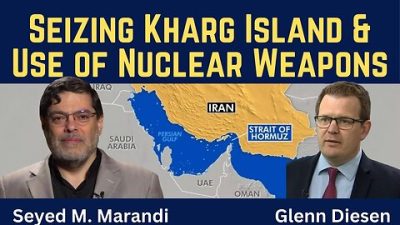
Marandi: Threat of Seizing Kharg Island & the Use of Nuclear Weapons
or go to
Aletho News Archives – Video-Images
Frlom the Archives
Provoking a Path to Persia
The Saban Center’s prescient paper on war with Iran
By Maidhc Ó Cathail | October 20, 2011
In June 2009, the Saban Center for Middle East Policy published “Which Path to Persia?—Options for a New American Strategy toward Iran.” Writing in a tone strikingly reminiscent of the Project for a New American Century’s infamous pre-9/11 paper “Rebuilding America’s Defenses,” the six co-authors noted that, “It seems highly unlikely that the United States would mount an invasion without any provocation or other buildup.” For a think tank specifically established by media mogul Haim Saban to protect Israel, this could prove to be a formidable obstacle impeding their desired march—of U.S. troops—to Tehran.
“In fact, if the United States were to decide that to garner greater international support, galvanize U.S. domestic support, and/or provide a legal justification for an invasion, it would be best to wait for an Iranian provocation, then the time frame for an invasion might stretch out indefinitely,” Saban’s think-tankers ruefully observed.
“With only one real exception, since the 1978 revolution, the Islamic Republic has never willingly provoked an American military response, although it certainly has taken actions that could have done so if Washington had been looking for a fight. Thus it is not impossible that Tehran might take some action that would justify an American invasion. And it is certainly the case that if Washington sought such a provocation, it could take actions that might make it more likely that Tehran would do so (although being too obvious about this could nullify the provocation). However, since it would be up to Iran to make the provocative move, which Iran has been wary of doing most times in the past, the United States would never know for sure when it would get the requisite Iranian provocation. In fact, it might never come at all.”
Seemingly undeterred by Iran’s frustrating unwillingness to provide the requisite provocation, the analysts continued to examine this option… continue
Blog Roll
 Aletho News
- Ukrainian Embassy in Beirut sheltering top Mossad agent
- Palestinian family displaced after settlers violently attack them in Humsa, Jordan Valley
- The EU never learns – except for the wrong lessons
- Iran attacks on UAE leaves RSF militia high and dry
- Hosting Washington’s war: Bahrain faces the consequences
- The US fell for its own Iran propaganda
- Seyed M. Marandi: Threat of Seizing Kharg Island & the Use of Nuclear Weapons
- Is there even an off ramp?
- Michael von der Schulenburg: Europe’s Self-Defeating Iran War Policy
- Sorry, The New Republic, Climate Change Isn’t Causing Somali Migration. Blame Civil Strife and Poverty.
- If Americans Knew
- ‘Of Course’: IDF Drops Case Against Soldiers Accused of Raping Palestinian Prisoner
- Don’t Fall for the Regime Change Talk. Israel Is ‘Mowing the Lawn’ in Iran
- Will Israel and the US wreck the Gulf States along with Iran?
- US so far burned through ‘years’ of munitions in Iran war: Report
- How the Israeli Tail Wags the American Dog
- Outdated intel likely led to deadly U.S. strike on Iranian elementary school, sources say
- Pentagon insider says high U.S official Douglas Feith reported to Netanyahu
- In fond memory of Walid Khalidi, the historian of Palestine
- 6 more Americans killed, as Israel ‘mows the lawn’ in Iran – Not a ceasefire Day 154
- Are we on the precipice of World War III?
- No Tricks Zone
- New Studies: UK Sea Levels Were 4 Meters Higher Than Today During The Mid-Holocene
- Destructive Green New Deal: German Energy And Metal Group Warns Of Drastic Crisis
- New Study Documents A 20-Year Pause In Arctic Sea Ice Decline – Driven By Internal Variability
- Wake-up Call: Survey Shows Majority Of Germans Now Favor Postponing Climate Targets!
- Televised! Leading German Political Candidate Tells Schoolchildren CO2 Makes Sun Hotter!
- New Study: A Century Warming Of 1.1°C Is ‘Commonplace’ And ‘Not Unusual’ During This Interglacial
- New Study: ‘Internal Noise’ And Volcanic Forcing Can Trigger 10-15°C Warming Within Decades
- Glaciers Worldwide Are Suddendly Surging, Experts Blame Warming!
- Surprising Discovery: Sahara Is Greening…Billions Of Trees Where Once Thought To Be Barren
- New Research Reaffirms Clouds, Aerosols, And Surface Solar Radiation Are ‘Driving The Climate System’
 Aletho News
Leave a comment