Report: Kurdish Fighters Have Been Entering Iran From Iraq and Clashing With the IRGC
By Dave DeCamp | The Libertarian Institute | January 14, 2026
Turkish intelligence has warned Iran’s Islamic Revolutionary Guard Corps (IRGC) that Kurdish fighters have been entering Iran from Iraq amid protests inside Iran, Reuters reported on Wednesday.
An unnamed senior Iranian official speaking to the outlet said that the IRGC has been clashing with armed Kurdish fighters dispatched from both Iraq and Turkey. The Kurdistan Freedom Party, or PAK, a Kurdish Iranian separatist group mainly based in Iraq, has been claiming that its armed wing has been conducting operations against Iranian forces.
On Tuesday, the PAK claimed its forces launched an attack on an IRGC base in western Iran. The Reuters report and claims of Kurdish attacks come as Tehran is accusing the US and Israel of arming “terorrists” inside Iran who have attacked Iranian security forces.
The US has a significant presence in Iraqi Kurdistan, including a military base and an $800 million consulate compound that it opened in December. The Israeli Mossad is also known for having a presence in the area, and Iran claimed that it attacked a Mossad base in Iraqi Kurdistan in 2024.
The Mossad has a long history of covert operations inside Iran, and a Farsi-language X account affiliated with the Israeli spy agency suggested it had operatives on the ground in Iran when the protests first broke out. “Let’s come out to the streets together. The time has come. We are with you. Not just from afar and verbally. We are with you in the field as well,” the account said on December 29.
Israel’s Channel 14 has reported that “foreign actors” have armed protesters in Iran and said that’s the reason why hundreds of Iranian security personnel have been killed.
“We reported tonight on Channel 14: foreign actors are arming the protesters in Iran with live firearms, which is the reason for the hundreds of regime personnel killed,” Channel 14 reporter Tamir Morag wrote on X on Tuesday. “Everyone is free to guess who is behind it.”
Trump’s Options in Iran Limited By Military Buildup in Latin America
By Kyle Anzalone | The Libertarian Institute | January 14, 2026
President Donald Trump has a more limited range of options for attacking Iran now than he did in June. The US has moved military assets out of the Middle East in recent months, including moving an aircraft carrier strike group to the Caribbean.
Since the US and Israel’s war against Iran last year, the US has moved two aircraft carrier strike groups out of the Middle East. The USS Nimitz is now at a US port, and the USS Ronald Regan is in Latin America.
An advanced American air defense system that was deployed to the Middle East in June is now back in East Asia. Politico notes, “The Trump administration also has been eating away at dwindling US weapons stockpiles with the fast pace of military operations in the Red Sea, Iran and Venezuela.”
Trump has made several pledges to back Iranian protesters and attack Iran. The lack of available military resources in the region could limit Trump’s operations for attacking Iran, although the US still maintains the capability to strike the Islamic Republic.
Over the past decade, the pace of US military interventions has spread across the globe. Under President Joe Biden, the US flooded weapons to Ukraine and Israel. President Donald Trump has bombed seven countries. Additionally, the US used a significant portion of its arsenal of interceptors to defend Israel from Iranian retaliation in June.
Villains of Judea: Paul Singer’s Empire of Debt & Demographic Replacement
Paul Singer is the embodiment of Jewish plutocracy
José Niño Unfiltered | January 12, 2026
Paul Elliott Singer stands as one of the most influential figures in global finance. The Jewish billionaire hedge fund manager has amassed a fortune estimated at $6.2 billion to $6.7 billion by purchasing distressed sovereign debt and corporate bonds at deep discounts, then pursuing ruthless legal campaigns to extract full repayment plus interest.
Born August 22, 1944, in Teaneck, New Jersey, Singer transformed a $1.3 million startup in 1977 into Elliott Management, a hedge fund empire managing approximately $65.5 billion to $72 billion in assets.
Yet Singer does more than just make financial moves. He has emerged as a kingmaker in Republican politics, becoming the second-largest GOP donor in 2016, and a major force behind AIPAC, immigration reform, and LGBT rights advocacy. His business model has devastated entire communities from Sidney, Nebraska, to Buenos Aires, Argentina. His political activism spans seemingly contradictory causes, supporting both hawkish pro-Israel policies and same-sex marriage rights. His most recent venture, the $5.9 billion purchase of Venezuela’s Citgo assets, positions him to reap billions from the Trump administration’s military intervention in Venezuela.
Singer’s business model has earned him the moniker vulture capitalist. In the 1990s, Singer began leaving his mark after purchasing $20 million in Peruvian sovereign debt. Through aggressive litigation, he eventually secured a payout of $58 million, nearly triple his investment. A U.S. court revealed that Elliott’s purchase of Peruvian debt was made with the explicit intention of pursuing full repayment through lawsuits. Investigative journalist Greg Palast reported that Singer’s lawyer allegedly told him Singer allowed Peru’s President Alberto Fujimori, who fled the country ahead of murder charges, to escape in return for ordering Peru’s treasury to pay Singer $58 million.
Between 2002 and 2003, Singer earned over $100 million from a $30 million investment in Congo-Brazzaville debt. But his most audacious campaign targeted Argentina. After Argentina’s 2001 economic crisis, Singer purchased distressed bonds for approximately $117 million. He refused to participate in debt restructuring agreements that other creditors accepted, instead pursuing full repayment through international courts. The campaign culminated in a 2016 settlement that netted Elliott Management $2.4 billion, a staggering 1,270 percent return.
Singer’s tactics proved extraordinary even by hedge fund standards. In 2012, Elliott successfully convinced a Ghanaian court to detain the Argentine naval training vessel ARA Libertad with 220 crew members aboard, demanding $20 million for its release. Then-Argentine President Cristina Fernández de Kirchner refused to pay Singer’s fund, calling Elliott and similar firms “financial terrorists” and vulture funds. The Obama administration and Secretary of State Hillary Clinton demanded courts dismiss Singer’s attempt to bankrupt Argentina, but Singer’s legal campaign ultimately prevailed.
Pro-Israel Bankroller
Singer has emerged as one of the most significant donors to pro-Israel causes in the United States. Through The Paul E. Singer Foundation, he has donated approximately $300 million since 2010. Singer donated $2 million to AIPAC and contributed $3 million to AIPAC’s super PAC, United Democracy Project, since 2022, making him tied for AIPAC’s third-largest donor. He serves on the board of directors of the Republican Jewish Coalition and co-founded Start-Up Nation Central, an organization dedicated to connecting Israeli innovation with global markets.
Singer has also been a major funder of the Foundation for Defense of Democracies, a neoconservative think tank advocating hawkish policies aligned with Israeli interests. From 2008 to 2011, Singer contributed $3.6 million to FDD, making him the organization’s second-largest donor. The organization has been described by former Secretary of State Colin Powell’s chief of staff Lawrence Wilkerson as a fervent advocate for war against Iran. At the Jewish Funders Network in Jerusalem, Singer stated that “Israel may be the only insurance policy all Jews, everywhere, can rely upon for the safety and continuity of Judaism.”
Promoter of LGBT Degeneracy and Mass Migration
Like many Jewish plutocrats, Singer became a significant supporter of LGBT causes after his son Andrew came out as a homosexual. In 2012, Singer provided $1 million to start American Unity PAC, whose sole mission was to encourage Republican candidates to support same-sex marriage. From 2012 to 2015, he contributed over $5.5 million to this organization. In 2013, Singer donated $500,000 to the Human Rights Campaign. Since 2001, Singer has donated more than $11 million toward legalizing homosexual marriage and supporting LGBT causes.
Singer’s crusade to redefine marriage within Republican ranks was just one facet of his broader agenda; he soon pivoted to advocating mass immigration to transform America’s demographics. In 2013, Singer made a six-figure donation to the National Immigration Forum to support comprehensive immigration reform, better known as amnesty. As one of the first high-profile Republican megadonors to publicly back amnesty, Singer worked to marshal conservative support for an overhaul of federal laws. In 2014, Singer formed the American Opportunity Alliance, bringing together wealthy Republican donors who shared his support for LGBTQ rights, immigration reform, and Israel.
Singer’s Looting of Sidney, Nebraska
Singer’s domestic business dealings generated controversies as devastating as his international operations. In 2015, Elliott Management acquired an 11 percent stake in outdoor retailer Cabela’s and forced a merger with Bass Pro Shops that devastated Sidney, Nebraska, where Cabela’s was headquartered. The town experienced massive job losses, a significant housing value collapse, and economic depression. According to court filings, Elliott pressured Cabela’s board to sell the company until the board relented. The merger resulted in Elliott making nearly $100 million profit. Residents told Fox News producers that the hedge fund destroyed their town, with one saying, “If money is that big of a God to him, he is a pretty sick human being.”
Tucker Carlson’s Exposé
In December 2019, Fox News host Tucker Carlson devoted a major investigative segment to Paul Singer, focusing on the Cabela’s case. Carlson described Singer’s business model as “vulture capitalism” that involves “buying large stakes in American companies, firing workers, driving up short-term share prices, and in some cases, taking government bailouts.” He stated, “It bears no resemblance whatsoever to the capitalism we were promised in school. It creates nothing. It destroys entire cities. It couldn’t be uglier or more destructive.”
Carlson emphasized Singer’s political power, noting that “people like Paul Singer have tremendous influence over our political process.” He revealed that Singer was “the second largest donor to the Republican Party in 2016 and has given millions to a super PAC that supports Republican senators. Carlson noted, “You may never have heard of Paul Singer, which tells you a lot in itself, but in Washington he is rock star famous.”
As Carlson was producing the segment, he reported being warned repeatedly by people around Washington, “Don’t criticize Paul Singer, that’s not a good idea.” During the broadcast, Carlson received a text from a very well-known person in Washington saying, “Holy smokes, I can’t believe you’re doing this. I’m afraid of Paul Singer.”
Venezuela and Citgo
One of Singer’s most recent controversial business deals involves Venezuela’s Citgo Petroleum. In November 2025, Elliott Investment Management won a court-mandated auction to purchase Citgo for $5.9 billion. Citgo represents the crown jewel of Venezuela’s international oil assets, owning three major Gulf Coast refineries with capacity to process 800,000 barrels per day, 43 oil terminals, and over 4,000 gas stations.
Singer acquired Citgo at what multiple sources describe as a major discount. Court advisors estimated Citgo’s actual value at approximately $13 billion, while Venezuelan officials valued the assets at $18 billion to $20 billion. This means Singer paid roughly 45 percent of the estimated market value.
A highly controversial aspect of the sale involves Robert Pincus, the court-appointed special master who oversaw the auction and recommended Singer’s bid. Pincus sits on the national board of directors of AIPAC. Gold Reserve Inc., a competing bidder that offered $7.9 billion, filed motions to disqualify Pincus for conflicts of interest. Venezuela rejected the sale’s legitimacy, calling it a “fraudulent process” and the “theft of the century.”
Trump’s Venezuela Intervention is Singer’s Wet Dream
The timing of events raised serious questions about the relationship between Singer’s Citgo purchase and Trump administration actions. In 2024, Singer donated $5 million to Trump’s super PAC and contributed $37 million to support Republican congressional candidates. On January 3, 2026, U.S. armed forces conducted a military raid in Caracas, capturing Venezuelan President Nicolás Maduro.
The removal of Maduro positions Singer to reap enormous profits. Economist Paul Krugman noted, “If Trump lifts that embargo, Singer will receive a huge windfall.” Within days of Maduro’s capture, Trump announced that Venezuela would be turning over between 30 and 50 million barrels of oil to the United States.
Rep. Thomas Massie (R-KY), who is a staunch opponent of the intervention in Venezuela, also caught on to how Singer stands to benefit from military action against Venezuela. He tweeted on January 4, 2026, “According to Grok, Paul Singer, globalist Republican mega-donor who’s already spent $1,000,000 to defeat me in the next election, stands to make billions of dollars on his distressed CITGO investment, now that this administration has taken over Venezuela.”
As Massie noted, Singer has ponied up $1 million to MAGA KY, a super PAC seeking to unseat the Kentucky congressman. Singer and his fellow Zionist Jews view Massie as an obstacle to further consolidating Jewish supremacy in the halls of Congress.
All told, Singer is the embodiment of Jewish plutocracy. He bankrolls the West’s demise through his advocacy of LGBT degeneracy, mass migration, never-ending wars on behalf of world Jewry, and vulture finance. Americans must awaken to these existential threats, revoke their elite privileges, and halt the Great Replacement before it consigns our polities to historical oblivion.
The Gaza ceasefire’s Phase 2 only exists in the media and at UN meetings
By Robert Inlakesh | Al Mayadeen | January 14, 2026
As the debate continues to rage regarding what Phase Two of the Gaza Ceasefire will look like, it has become clear that there is no such thing occurring on the ground. From start to finish, the entire process has been a US-Israeli gambit to achieve their regime change goals, while removing Gaza’s suffering from the headlines.
Through December 2025, reports emerged claiming that this January would see the implementation of a second phase to the so-called Gaza Ceasefire agreement. As expected, there has been even more stalling on this front, as only vague comments made regarding the implementation of US President Donald Trump’s plan.
United Nations Security Council (UNSC) resolution 2803, passed on November 17, 2025, laid out the agenda for the Gaza Strip as clear as day. There were no guarantees for the rights of the Palestinian people, all references to precedents set for decades on the issue of “Israel’s” occupation were absent, instead, there was a vague outline of a regime change plot.
Contrary to the Trump administration’s claims that it no longer seeks to be involved in “nation building”, UNSC Resolution 2803 gives approval for what is labelled the “Board of Peace” (BoP) in Gaza. It also approves the deployment of an “International Stabilisation Force” (ISF).
In essence, the BoP is an undemocratic rule set to be imposed upon the Palestinian people, with Trump taking over the role as de facto dictator of the Gaza Strip, while the ISF is set to be a multi-national invasion force tasked with regime change. Phase Two of the ceasefire will hedge upon the success of both these pillars of the so-called “peace plan”.
The failure of Phase Two
When it comes to the BoP, there is no clear strategy that has been set forth for making this work on the ground. A number of different vague proposals have been floated through the media in recent months, all pointing towards the imposition of the BoP for areas still under Israeli occupation.
The Zionist regime’s forces not only refused to respect the so-called “Yellow Line” barrier in the Gaza Strip, which was supposed to demark 53% of the territory from the remaining 47% in the hands of the Hamas-led administration and security authority. The Israelis are now operating inside nearly 60% of the territory.
Under the control of the Israeli occupation forces are five ISIS-linked militant groups that have been established, with the purpose of fighting the Palestinian resistance. The only people living in the seized territory are these militants and their families, whose numbers reportedly reach only into the thousands.
Last year, the Wall Street Journal reported that Donald Trump’s so-called “Project Sunrise” was being seriously pitched to regional governments. The proposal advances a rather ridiculous model featuring luxury resorts on the sea, high-rise buildings, high-speed rail, and an advanced AI-driven grid. All of this will allegedly cost at least 112 billion dollars over 10 years, according to the 32-page document put forth by Jared Kushner and Steve Witkoff.
This model aligns with an AI generated video published by the US President in early 2025, called “Trump Gaza”, featuring a sleazy billionaire’s playground where Trump and Israeli PM Benjamin Netanyahu are sitting at a resort together.
In the world, what has actually been laid out by more serious officials within the Trump and Netanyahu administration’s, is the idea of reconstruction in the areas of Gaza where the Zionist regime is currently based. This is of course failing the complete disarmament of the Palestinian resistance, which evidently is not going to happen.
This is where the so-called ISF comes into the picture. This multi-national force is intended to be composed of troop contributions from around the world. According to what has been revealed publicly, it appears as if the plan is for the ISF to number into the tens of thousands at most, meaning they will be outnumbered by the Palestinian resistance.
At this stage, although the ISF was supposed to have already been deployed to Gaza, Israeli authorities have been making huge issues regarding which armies will be permitted to join this force. Zionist officials have publicly opposed the inclusion of Turkish or Qatari forces, yet they now appear unable to secure even Azerbaijan’s agreement to agree to contribute troops.
The Egyptians, on the other hand, who are a guarantor of the ISF project, have publicly suggested that it be set up as a “peacekeeping force” that could be comparable to the UNIFIL forces deployed in Southern Lebanon. The US and Israelis are, however, adamant that the ISF not be a peacekeeping force, and according to UNSC 2803, it is not a UN-aligned force. If Cairo says no, getting the ISF off the ground will be difficult.
In the spirit of trying to reach some level of compromise in this regard, the US has floated the idea that the ISF would only work to ensure the security of the borders, train a new Palestinian security force and perhaps coordinate on other issues like securing the transfer of humanitarian supplies.
Yet, even such a limited ISF mission is already showing signs of disaster if it does go ahead. The security firm, UG Solutions – which was responsible for employing private military contractors to lead the defunct Gaza Humanitarian Foundation (GHF) scheme – was revealed as early on during the ceasefire to have been interviewing new recruits to deploy to the Gaza Strip.
According to the investigative reporting of Drop Site News, the role of these military contractors could be to coordinate with the ISF and again participate in aid distribution. The GHF project resulted in what Palestinians called a “death trap”, luring starving civilians to aid sites, where American private military contractors and the Israeli military would open fire upon them. The result was over 2,000 civilians murdered, primarily by the Zionist regime, over a period of 6 months. The GHF was directly funded by the US Trump administration.
Under the worst-case scenario, which the Israelis are pushing for, the ISF will be tasked with disarming the Palestinian Resistance. It does not take a military expert to understand that bringing together hundreds of soldiers from one foreign army, with thousands from another, all of whom speak different languages, have never encountered a situation like Gaza and operate under different doctrines, is a recipe for disaster.
The ISF is intended to be the regime change force that finishes the job that the Israeli military failed at. Bear in mind that the Israelis had deployed hundreds of thousands of soldiers, on rotation, inside the Gaza Strip and still failed.
Prior to the announcement of the ceasefire on October 8, 2025, the Israeli military was in the process of launching its failed “Gideon’s Chariots 2” Operation. According to internal Israeli estimates at the time, the goal of this campaign, which was to occupy Gaza City, would have required up to 200,000 soldiers and possibly taken up to a decade if it was to mirror a West Bank style occupation.
The Israelis were never willing to fight the Palestinian Resistance head on, instead they carried out a genocide, and the majority of their military tasks on a day-to-day basis were destroying civilian infrastructure. In other words, the Israeli army has not changed its primary function, during the war, since the beginning of the so-called ceasefire.
It has continued to demolish buildings and feed its own private industry that has developed behind this demolition work, throughout the ceasefire period. The only difference has been that it no longer experiences the high levels of danger it did previously, due to the resistance adhering to the ceasefire.
This entire genocide has gone down in a similar manner to the way the ceasefire is being implemented. The US-Israeli alliance has no idea how to achieve their desired victory, so they come up with scheme after scheme, military operation after military operation, then when they fail, they simply escalate the violence against civilians and try again.
The way that the US and Israeli military have managed the conflict in Gaza is perhaps the most embarrassing failure in the history of modern warfare. The combined power of the region’s most advanced military, alongside the world’s dominant military power, were not capable of defeating Palestinian Resistance groups who were armed primarily with light weapons they produced themselves under siege.
In every conceivable way, the Israelis and Americans have the upper hand, yet they have to resort to calling in an international invasion force to do their job for them, after committing genocide for over two years and destroying almost every standing structure in all of Gaza. Quite frankly, it is pathetic, not only that they have failed militarily and instead fought against civilians, but that they are so irrational that they cannot even accept defeat.
On the first day the ceasefire was declared, I predicted this exact predicament, that countless schemes would be set forth and that the agreement would be frozen between Phase One and Phase Two for some time. This is precisely what has happened. There was never any real ceasefire, because only one side has adhered to it, Hamas and the Palestinian Resistance. The exact same scenario has played out in Lebanon. The inevitable outcome on both fronts is more war.
We must act before Palestinian hostages are executed in the world’s worst prisons
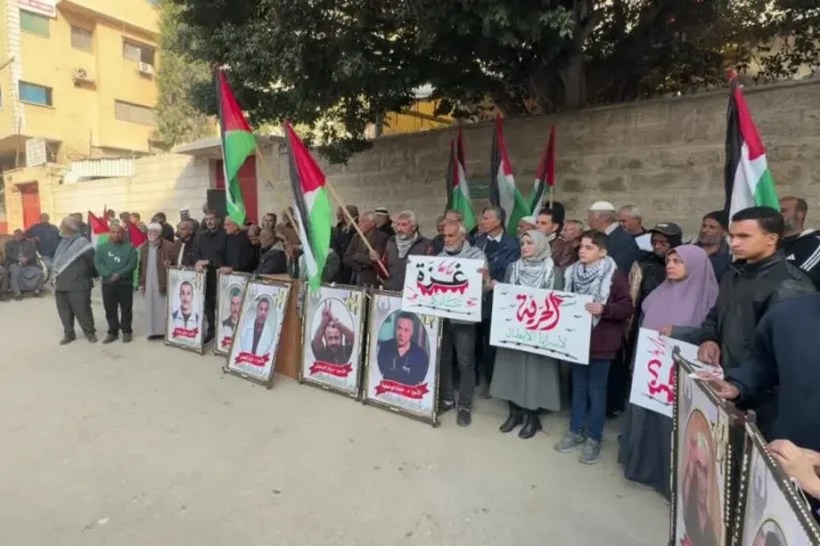
Demonstration held in Gaza in solidarity with Palestinian prisoners in Israeli jails. [photo by AA]
By Adnan Hmidan | MEMO | January 14, 2026
Warnings are no longer enough. Condemnation alone no longer carries any weight. We are standing at a moment that will be remembered, not for what was said, but for what was done. Today, in Israeli prisons, Palestinians are not simply being detained. They are being pushed, step by step, towards a reality where death itself is written into law, where execution is no longer a crime but a procedure, no longer an exception but a policy.
This is no longer just about harsh detention conditions or even about the routine violation of prisoners’ rights. The danger now runs deeper. What is unfolding is a systematic attempt to reshape justice to fit the needs of occupation, to turn trials into formalities before punishment and to reduce the law to a tool of retaliation rather than protection. New legislation, exceptional legal routes and an openly hostile political discourse now speak of execution not with embarrassment but with confidence, pride even. In such a climate, every legal fig leaf has fallen away and every moral mask has been removed.
Human rights organisations across the world have issued clear warnings about this direction, especially the push to establish “special” courts for Palestinians alone. These courts do not merely breach the principle of equality before the law; they destroy the very idea of justice. They operate outside internationally recognised standards and function in a space dominated by security priorities rather than judicial independence. When a person stands before a court designed especially and exclusively for him or her, not to offer fairness, but to ensure conviction, justice ceases to exist. It is a performance where the ending is known before the first word is spoken.
The threat does not end in the courtroom. It extends into a growing policy of denying release altogether, cutting off any realistic hope of freedom through exchange, parole, or genuine judicial review. What we are witnessing is a dangerous shift from punishment with limits to punishment without end, from imprisonment as a legal measure to imprisonment as a permanent political sentence. This approach deepens arbitrary detention, entrenches isolation and strips detainees of the most basic forms of human connection, turning prisons into spaces beyond accountability and beyond compassion.
Most disturbing of all is the open preparation for the death penalty, particularly when it is framed in a way that is mandatory, discriminatory, and aimed squarely at Palestinians. This represents a grave assault on the right to life and raises the terrifying possibility of executions carried out after trials shaped more by politics than by justice. Any attempt to apply such punishment retroactively, or to enforce it selectively, shatters the principle of legality and transforms the law into an instrument of elimination rather than protection. This is not a distant fear. It is a path already being cleared, step by step, in front of a world that seems increasingly willing to look away.
It is from this sense of urgency that the Red Ribbons Campaign was born, not as a slogan, nor as a gesture, but as a human alarm. A warning sounded before prison cells become execution chambers, and before silence becomes complicity. The colour red was chosen for a reason beyond the aesthetic; it signifies danger, the colour of blood and the colour of the final signal when words are no longer enough. It is the colour of freedom when it is taken by force and of injustice when it is endured in silence.
The campaign calls for a coordinated digital action beginning on the evening of Thursday 15th of January, under two clear hashtags: #الحرية_للأسرى and #FreePalHostages. The aim is to restore the human face of those held in Israeli prisons, not as statistics and certainly not as abstract political figures, but as doctors who once healed others, women whose lives were interrupted and children who should have been in classrooms, not in prison cells. This is about breaking a narrative that allows the suffering of one side to be visible while the pain of the other is deliberately and forcefully made invisible.
The action then moves from screens to streets on Saturday the 31st of January, with posters carrying the faces of Palestinian hostages placed in public spaces. This is not meant as theatre, but rather to remember while people are still alive, refusing to await their death to set a memorial. It is a way of saying: these lives matter now, not later.
But this movement will only have meaning if it belongs to people on the street and not just to organisations, movements or campaigns. It will only succeed if it becomes personal. No special permit is required to demonstrate care. No official mandate is needed to act. A photo can be placed in your local neighbourhood, with red ribbons tied around it; a picture taken, and then shared. In doing so, you become part of something larger, not a campaign of noise, but a community of conscience.
This is not a political disagreement that can be postponed. It is a moral test that demands an answer now. Will we act before executions take place, or will we limit ourselves to words of sorrow afterwards? Will we raise our voices while there is still time, or will we save them for statements that come too late?
The Red Ribbons Campaign may not be the final chapter in this struggle, but it could be one of the last chances to prevent a darker one from being written. History is not kind to those who watch from a distance. Blood, once spilled cannot be taken up. And justice, when abandoned at the moment of danger, becomes nothing more than a story we tell ourselves later.
We must act now, not because we seek attention, but because we refuse to be silent witnesses to the execution of Palestinian hostages in the world’s worst prisons.
Why Washington will take Greenland
By Timofey Bordachev | RT | January 14, 2026
American political culture is drifting openly toward the annexation of Greenland. This may sound surreal to European ears, but it is not an exotic idea in Washington. It follows a logic that is deeply rooted in how the US historically became a great power and how it still proves its strength today.
The United States rose through territorial expansion at the expense of weaker neighbors. It seized land from those who could not defend it. There is no serious reason to assume that this instinct has disappeared. The only reliable guarantee of borders is the ability to fight for them. And history shows something very simple: the US does not attack those who can resist.
Modern world politics suggests that Western Europe is no longer among those who can resist.
That is why, from Washington’s point of view, the real question is not whether Greenland will eventually be absorbed into direct American control, but when. Western European states, and Denmark specifically, are among the least dangerous targets imaginable. They are harmless not only militarily, but psychologically: they are unlikely to respond in any serious way.
In American strategic culture, refusing to exploit such an insignificant position would contradict the fundamentals of foreign policy thinking. The conclusion becomes unavoidable: the annexation of Greenland, peacefully or by force, is inevitable.
Over the past few days we have seen an escalating series of statements and initiatives from American representatives. They range from internet “teasers” and political provocation to official remarks and even draft bills in Congress. The overall message is clear: Greenland should fall under direct US control. And just as importantly, the discussion itself is meant to create an impression in Europe, and in the wider world, that the outcome is pre-determined.
Western European politicians have responded with predictable panic.
Germany, for instance, has proposed a joint NATO mission called Arctic Sentry. The initiative is absurd, but revealing. It is Berlin’s attempt to respond to claims from the American president and others that Greenland is threatened by Russia and China, and that the island is supposedly defenseless. Direct consultations between senior German and American diplomats are reportedly scheduled in the coming days.
But it is difficult to imagine Washington taking Germany’s proposal seriously, because the issue is not about deterring mythical threats from Moscow or Beijing. It is about Washington’s own intentions.
The German idea draws inspiration from NATO’s Baltic Sea operation Baltic Guardian, which has been running for several years. But the Baltic Sea has little to do with American military or economic interests. Even the least intelligent member of the Finnish parliament should be able to understand this. That is precisely why NATO and Western Europe are free to play their games there.
Greenland is different.
Any attempt to frame Greenland as a NATO matter only exposes the alliance as a theater production, performing threats in order to justify foreign policy rituals. These Europeans are accustomed to imitating danger and imitating response. They appear to believe they can do it again.
It is unlikely to work.
Meanwhile, most of the world views this spectacle with indifference. Russia, China, India and many others see the Greenland drama primarily as another lesson in how relations inside the so-called “collective West” are structured. It is simply a more visible version of what has always been there.
There is nothing new in the fact that Americans are prepared to violate norms, including international law. The difference is that this time they are openly testing these norms against their own allies.
From Russia’s perspective, the situation does not pose a direct threat to our interests. The US can deploy weapons in Greenland even today. Its presence does not fundamentally change the military situation in the Arctic, nor does it threaten shipping along the Northern Sea Route. The US still lacks a serious fleet of military icebreakers, and it remains unclear when – or whether – it will acquire one.
China, too, is essentially indifferent to Greenland becoming American property. Greenland does not threaten China’s trade in the Arctic because the only real issue of interest to Beijing is the Northern Sea Route. And the US military presence on the island does not materially affect Chinese security interests.
On the contrary, in the context of Taiwan, Beijing watches with curiosity as the Americans undermine their own empire’s ideological foundations, including the principles of international law. Once the balance of power settles, it is always possible to return to old norms. Or indeed to codify new ones.
But for Western Europe, Washington’s aggressive noise around Greenland feels like the death sentence for what remained of the half-continent’s relevance.
For decades, its politicians considered themselves a “special” element of global affairs. Not fully sovereign perhaps, but privileged. They were happy to violate the sovereignty of other states across the world, insisting that this was humanitarianism, democracy, civilization. Yet they never seriously imagined the same logic could be applied to them.
The entire content of what Western Europeans loudly call “transatlantic solidarity” or a “community of values” lies precisely in this exceptional status. Their part of Europe’s role was to serve as a morally decorated extension of American power, a satellite that believes it is a partner.
Now it is the US itself that is delivering a potentially fatal blow to that illusion.
Even if the annexation of Greenland is postponed, watered down, or delayed by unforeseen complications, the fact that it is being discussed seriously is already catastrophic for Western European political legitimacy. It undermines what remains of their credibility in the eyes of their own citizens and the rest of the world.
Every state must justify its existence.
Russia’s legitimacy rests on the ability to repel external threats and pursue an independent foreign policy. China justifies itself through organization, stability and prosperity for its citizens. India’s legitimacy is grounded in holding together peace in a multi-ethnic, multi-religious civilization.
In every case, legitimacy is tied to the state’s ability to influence the most important aspects of people’s lives. Not to mention being able to rely on internal resources to do so.
But modern Western European states justify themselves differently. They justify their actions to their citizens through the idea of exceptional status, the right to look down on other countries and civilizations. If Americans can simply deprive the EU of territory, then they become equal to countries like Venezuela or Iraq: states which Washington attacks with impunity.
This is why Greenland matters more than Greenland.
Western European politicians still do not understand the main point. The US wants Greenland, of course, because it is valuable Arctic territory. Geography that matters in a changing world. Direct control over territory is often preferable to indirect use through allies.
But the deepest motive is more psychological and political: Washington wants to act as it sees fit.
In the US, disregarding all external norms – recognizing only internal American rules – is increasingly part of how the state gains legitimacy in the eyes of its citizens. The ability to seize something from a weaker neighbor becomes proof that such a state is not only strong, but necessary.
Donald Trump was elected precisely because he promised to restore American statehood. Greenland will not be the only issue where this restoration expresses itself.
In other words: Greenland is not a dispute about the Arctic. It is a demonstration of how American power is validated, and a demonstration that Western Europe is no longer protected by the very system it helped to build.
Timofey Bordachev, Program Director of the Valdai Club
Former Head of Israeli Military Intelligence Directorate: There’s a ‘very significant influence operation by the US’ in Iran
The Dissident | January 14, 2026
Recently, the Israeli newspaper Maariv interviewed the head of the Military Intelligence Directorat in Israel from 2018-2021, Tamir Hayman, who revealed that the United States currently has a “Significant Influence Operation” on the ground in Iran.
In the interview, Hayman said, “If the question is, is there zero operation right now? The answer is no, because there is already an operation. There is currently a very significant influence operation by the US” referring to the current unrest happening in Iran.
He added, “The sequence of news that is received from within Iran, rumors that are coming, videos that are coming, there are many things that are happening that have no explanation. It could be a coincidence, and it could be something else. Simply put, an influence effort is an effort that operates primarily in the cyber realm, and in the realm of local disruption and subversion, and there are some.”
Along with this, Tamir Hayman, acknowledged that U.S. sanctions were the cause of the economic issues that in Iran that sparked the initial protests in Iran which are apparently being exploited by American and Israeli intelligence, saying, “there is the attempt, as we heard tonight from Trump, that this is a path of negotiation with the Americans, that this is really the only thing that can save the Iranian economy, the lifting of sanctions”.
This comment comes at the same time that Tamir Morag, the Diplomatic Correspondent for the Netanyahu-linked Channel 14 in Israel, reported that “foreign actors are arming the protesters in Iran with live firearms, which is the reason for the hundreds of regime personnel killed.”
American and Israeli officials have been fairly open about the fact that Israeli intelligence is currently operating on the ground in Iran, with the former Secretary of State and CIA director, Mike Pompeo saying, “Happy New Year to every Iranian in the streets. Also, to every Mossad agent walking beside them” and the Israeli Heritage Minister, Amichai Eliyahu saying, “When we attacked in Iran during ‘Rising Lion’ we were on its soil and knew how to lay the groundwork for a strike. I can assure you that we have some of our people operating there right now”.
But now, Tamir Morag has revealed that there are “very significant influence operations by the US” in Iran, which include “operates primarily in the cyber realm, and in the realm of local disruption and subversion” and according to Tamir Morag, apparent operations to arm protestors in Iran to kill Iranian government officials.
Referring to the protests in Iran, the U.S. government connected private intelligence firm Stratfor, wrote, “the United States may also try to intervene, such as by covertly helping to organize the protesters”, something that is apparently already underway through American “influence operations”.
Israel–Syria security pact stumbles as Tel Aviv rejects withdrawal: Report
The Cradle | January 14, 2026
Israel has refused any withdrawal from Mount Hermon and the other areas of Syria it occupied after the fall of former Syrian president Bashar al-Assad’s government, while rejecting Russian patrols in the country’s south and demanding that Damascus be prohibited from ever possessing air defenses, Hebrew media revealed.
“The Israeli position is clear and non-negotiable: there will be no withdrawal from Mount Hermon,” an Israeli official was cited as saying by Hebrew newspaper Maariv on 14 January.
According to the report, talks are stalling due to Damascus’s demand that a security agreement with Tel Aviv be linked to a withdrawal of Israeli army forces from Syria.
The Israeli report added that Tel Aviv is concerned with a Syrian attempt to re-establish a Russian military presence in southern Syria. Israel considers this move a direct threat to its “freedom of action,” Maariv claimed.
The source told the newspaper that Israel is obstructing plans to deploy Russian forces in southern Syria, and that Tel Aviv has conveyed to Damascus, Moscow, and Washington that it will not allow a Russian presence.
Russian media had reported last year that the Syrian government was requesting a resumption of Russian military patrols in the south in order to help limit continuous Israeli raids and incursions.
The sources add that Tel Aviv is following with concern reports that Damascus is hoping to purchase weapons from Russia and Turkiye.
“The Israeli message conveyed to all relevant parties [is that] Israel will not agree that in any future security arrangement, Syria will have strategic weapons, primarily advanced air defense systems and weapons that could change the regional balance of power,” according to Maariv.
“The Israeli goal is clear: freezing the existing situation – without an IDF withdrawal from Mount Hermon, without Syrian reinforcements, and without a foreign military presence that limits the IDF.”
In particular, Israel is demanding a complete demilitarization of southern Syria. “Israel’s security-strategic interest comes first. For now, Trump accepts this position.”
The report also says that the two rounds of Syrian–Israeli talks in Paris last week made “no breakthrough was achieved,” only a “limited understanding” for “the establishment of a coordination mechanism aimed at preventing clashes on the ground, with active US involvement.”
A joint statement by Washington, Tel Aviv, and Damascus on 6 January said that Syria and Israel have agreed to establish a US-supervised “joint fusion mechanism” to “share intelligence” and pursue de-escalation.
Damascus and Tel Aviv “reaffirm their commitment to strive toward achieving lasting security and stability arrangements for both countries,” the statement said, adding that they agreed to “establish a joint fusion mechanism – a dedicated communication cell.”
This mechanism aims “to facilitate immediate and ongoing coordination on their intelligence sharing, military de-escalation, diplomatic engagement, and commercial opportunities under the supervision of the US.”
“This mechanism will serve as a platform to address any disputes promptly and work to prevent misunderstandings,” according to the statement, published by the US State Department after the two rounds of Paris talks.
The Israeli army occupied large swathes of southern Syria as soon as Assad’s government fell, declaring the 1974 Disengagement Agreement null. It has since established permanent outposts and has seized control over vital water sources – practically encircling the Syrian capital.
The occupation continues to expand as Israeli forces carry out almost daily raids. In a span of one year, the Israeli army attacked Syria over 600 times.
Tel Aviv and the new Syrian government have been engaged in direct talks for nearly a year to reach a security arrangement. Damascus has vowed that it has no interest in confronting Israel and has reportedly made commitments to coordinate with Tel Aviv against Iran, Hezbollah, and the Axis of Resistance.
Despite this, Israel has shown no willingness to pull out of Syria.
Negotiations stalled for several weeks before Hebrew media reported in late December that “significant progress” had been made and that a deal could be announced “soon.”
A Syrian source told Israeli outlet i24 on 27 December that there was the possibility of a meeting between Israeli Prime Minister Benjamin Netanyahu and Syria’s self-appointed President Ahmad al-Sharaa, a former Al-Qaeda chief.
US President Donald Trump is reportedly pressuring both sides to reach a deal quickly.
The Ukraine Snare Still Beckons
By Ted Galen Carpenter | The Libertarian Institute | January 14, 2026
Despite the widespread expectation that President Donald Trump would end Washington’s entanglement in NATO’s proxy war using Ukraine against Russia, it is increasingly evident that the fundamental features of U.S. policy remain unaltered. Trump personally has sent an array of mixed signals about his intentions. Although he has pressured Ukrainian President Volodymyr Zelensky to accept the reality that Kiev must be willing to make territorial concessions to Moscow in any peace accord, he also has been receptive to Zelensky’s demand that Ukraine be given reliable “security guarantees” in such a settlement. Indeed, during the recent summit meeting between the two leaders, the main point of disagreement appeared to be that Zelensky wanted a commitment lasting fifty years, whereas Trump was prepared to offer only fifteen years.
Not only is Kiev insisting on a firm, detailed guarantee of protection, but also Ukraine’s European supporters in NATO are doing so. Worse, Trump seemed to sign onto a new 20-point “peace plan” being pushed by Zelensky and his European backers. Only Russia’s curt rejection of the scheme has so far prevented it from further consideration.
A potentially deadly snare lies in wait for the United States which our leaders must avoid at all costs. Throughout the years of the Ukraine crisis, most attention has focused on Kiev’s desire for formal membership in NATO and Russia’s repeated refusal to tolerate that option. Indeed, the principal cause of the current war was the clash between Russia and NATO regarding that issue.
However, the substantive issue has never been merely the prospect of Ukraine’s formal membership in NATO. Instead, the real threat to Russia’s security, from Moscow’s viewpoint, has been NATO’s attempt to turn Ukraine into a significant military asset for the alliance. It matters little whether that development occurs because of Kiev’s official membership in NATO or because of new, separate Western security guarantees.
Indeed, the ties would not have to be all that formal to constitute a dangerous provocation toward Moscow. Several NATO governments have repeatedly engaged in loose talk about sending their troops as “peacekeeping personnel” to Ukraine to enforce a settlement. Indeed, some of those countries appear willing to incur such a risky commitment to implement a mere “truce” between the feuding parties. Both Great Britain and France have stated that they intend to establish “military hubs” across Ukraine with their forces. In one of his more reckless, irresponsible moments, President Trump expressed his willingness to consider having the United States “backstop” such European efforts.
Washington must emphatically reject any attempted ploys of that nature. Even a paper security guarantee to Kiev would put any and all guarantor powers at risk. A decision to deploy so-called peacekeeping forces would be even worse. The Kremlin has made it emphatically clear that the presence of any troops by a NATO member in Ukraine is intolerable. Moscow likely would view a troop presence by NATO’s European contingent, much less the United States, as an existential threat to Russia’s security.
It would be folly for U.S. policymakers to rely excessively on the language contained in the North Atlantic Treaty to limit the danger of an undesirable military entanglement. Article 5 obliges NATO signatories to regard an act of aggression against any NATO member state as an attack against them all. The actual language regarding the obligation under Article 5, though, is so vague as to be meaningless, if a member seeks to evade taking serious action. The provision merely requires allies to render (undefined) assistance to the victim of aggression. Crucially, there is no commitment to launch military strikes against the alleged aggressor or to send troops into combat to aid the beleaguered ally. Merely providing logistical aid could fulfill a member’s obligation. The NATO countries that have sent weaponry or provided targeting and other intelligence data to Ukraine have easily met or exceeded any implied Article 5 obligation, even if Kiev had been a member of the alliance.
But in the real world, multiple NATO governments would seek to inflate the U.S. commitment under Article 5 to deepen Washington’s entanglement in the Alliance’s proxy war against Moscow. A pervasive myth persists in America and the rest of the world that the United States has an official treaty obligation to go to war if another NATO country comes under attack. Giving Ukraine a security guarantee would consolidate and strengthen that myth. In other words, U.S. leaders would find themselves under enormous pressure to launch a direct military intervention to support NATO peacekeepers in Ukraine regardless of the actual language contained in Article 5.
That is why any NATO troop presence in Ukraine, or any official security guarantee to Kiev, would be so dangerous. Given the enormous political and military pressures that would be coming from Kiev’s fan club throughout the West, it is highly improbable that U.S. leaders could avoid an armed clash with Russian forces merely by citing the limited, conditional language in Article 5. Legalistic quibbling is not the way events proceed when raw, wartime emotions are in play.
Trump administration officials need to spurn proposals for any alliance security guarantee to Ukraine, much less a deployment of NATO peacekeepers. Washington must emphatically reject schemes that would include a U.S. military presence of any size or nature in Ukraine. President Trump’s casual musings about supporting a NATO peacekeeping contingent not only are irresponsible, but also constitute a betrayal of his political supporters in the last election. They believed that their candidate was committed to extricating the United States from an unnecessary and debilitating geopolitical venture. Unfortunately, Donald Trump appears to be on course to disappoint advocates of a more prudent U.S. foreign policy yet again.
Italy and the drone that isn’t there
By Lorenzo Maria Pacini | Strategic Culture Foundation | January 14, 2026
Damn: it was all so well orchestrated that it seemed authentic. But no. The story of Russian drones flying over Italy – and in particular the Joint Research Center (JRC) in Ispra – has been revealed for what it was: a grotesque fabrication, devoid of any real basis. Sergio Barlocchetti had already written about the absurdity of it all, well in advance, in Dronezine Magazine (issue 66). Now comes the official confirmation: the Milan Public Prosecutor’s Office has asked the investigating magistrate to close the investigation into serious allegations ranging from political and military espionage to terrorism and subversion.
To tell the truth, we Italians were never particularly impressed by this narrative of Russian ‘hybrid attacks’, with Moscow invading Europe inch by inch with drones that were never identified or shot down. But then the so-called Drone Zero entered the scene, the progenitor of all drones, naturally sent by Putin directly to Italy. In the spring, according to reconstructions, the powerful security system of the JRC in Ispra – apparently more vigilant than Ursula von der Leyen and Kaja Kallas – intercepted it repeatedly: nine times between March 20 and April 14 and thirteen times between April 16 and May 27. What was the purpose of its presence? According to the media and television news, the aircraft was spying with ill-concealed eagerness on both the European Union laboratories and Leonardo’s helicopter unit, the pride of the national military industry, located nearby.
Some newspapers even went so far as to describe its technical characteristics: Russian production, night-time filming capability, high-precision three-dimensional mapping. Others evoked the specter of “hybrid warfare,” Moscow intelligence activities, and even suspicious pro-Russian presence in the Varese area. The situation was so serious that the Milan Public Prosecutor’s Office opened a file for espionage, terrorism, and attacks on transport security. Some people even alerted their tattoo artists.
Then, however, reality knocked on the door. Technical checks revealed that the sophisticated anti-drone system suffered from structural limitations: software that could not withstand continuous use, decoding errors, and incorrect classifications. The ‘Russian drone’ turned out to be a simple phantom signal, generated by a GSM amplifier purchased on Amazon by a local family to improve cell phone reception. There was nothing in the sky above Ispra and Vergagliate, no drone, no Russia, no conspiracy.
The narratives about alleged Russian drones flying over Italian skies can be interpreted as part of a broader hybrid communication strategy, fitting into a media and political ecosystem in which the Atlantic Alliance and various European governments use the frame of the Russian threat – including the drone dimension – to strengthen internal consensus and legitimize rearmament and a posture of deterrence towards the East.
The Ispra case is truly emblematic and shows how mainstream media and institutional actors have constructed an emergency narrative of Russian “hybrid warfare” in the absence of solid technical evidence; a narrative that has been amplified by alarmist headlines, talk shows, and social networks, contributing to the consolidation of a negative image of Russia in public opinion, shifting the emotional center of gravity from rational debate to fear.
On a strategic-communicative level, this climate of perception serves three objectives: to promote acceptance of NATO programs to strengthen anti-drone defense and increase military spending; to reduce the legitimacy of positions critical of Atlantic policies, which are easily labeled as “pro-Russian”; consolidating a dichotomous friend/enemy frame in which Moscow is the threatening Other, and NATO-integrated Europe is the defensive and ‘rational’ subject.
These are fairy tales that are no longer even good enough for children. These Russians who fight wars with washing machines and horses, as Italian newspapers report, but who are capable of sending drones to disturb the naps of the average Italian in upper Lombardy, are not to blame this time. Maybe next time for the next fake news story!
Featured Video
Prof. Ted Postol: Iran Already Achieved Nuclear Deterrence Against Israel
or go to
Aletho News Archives – Video-Images
From the Archives
How the occupied mentality syndrome works
Saudi Arabia on the American chessboard – Part 3
By B. J. Sabri | American Herald Tribune | June 27, 2016
Read part 2: “The occupied mentality Syndrome“
Previously I argued whether Saudi Arabia’s repeated involvements in U.S. interventions and wars stem from free national will or in response to a specific condition. For starters, in Saudi Arabia there is no national will. In Saudi Arabia, the national will is the will of the Al Saud clan. Still, when a major Arab state allies itself with a superpower that committed unspeakable crimes against humanity in almost every Arab country, then something is wrong. This fact alone should compel us to examine the U.S.-Saudi relation for one exceptional reason. As a result of the U.S.-Saudi wars, hundreds of thousands of people in Afghanistan, Iraq, Iran, Libya, Syria, Yemen, and Somalia have lost their lives. Millions became displaced in their own homelands. And millions more rendered refugees.
Attributing the Saudi policies to the bonds of “partnership” with the U.S. is frivolous. There are no bonds between these two thugs except those of business, military deals, secret plots, and wars. Proving this point, bonds such as these have no space for the American and Saudi peoples to share significant cultural or societal exchanges. If partnership is not the reason for the Saudi contribution to the U.S. strategy of empire and imperialism, then another reason must exist.
This leads to three possibilities. … continue
Blog Roll
 Aletho News
- REWRITING THE RISK? INSIDE THE GOVERNMENT’S VACCINE SAFETY MESSAGING
- “Davos Can Really Replace the UN”
- NIAID/NIH and USDA Fund Bioengineered Chimeric Influenza Viruses Built Using Pandemic H1N1 Components: Journal ‘Science Advances’
- Hezbollah hits Israeli warship off Lebanon’s coast, sets it aflame
- Iran slams US strikes on B1 bridge, Mahshahr petrochemical plants as ‘blatant acts of state terrorism’
- In letter to UN chief, Araghchi warns of dire consequences of US-Israeli attacks on Iran’s nuclear facilities
- Why the CIA conspiracy to invade Iran with Kurdish militias failed
- Why Are Upbeat US Claims About Mission to Rescue Pilot ‘Highly Questionable’?
- Aircraft destroyed during US ‘rescue’ of downed F-15 pilot cost more than $100 million each
- Washington University removes professor who condemned US-Israeli war on Iran
- If Americans Knew
- In Iran, Israel-US take aim at “reason, research, and freedom of thought” – Daily Update
- US loses planes over Iran, Israel downgrades Lebanon war goals – Daily Update
- Israel Is Blocking Palestinians from Easter at Church Where Jesus Resurrected
- Plot to assassinate Palestinian activist follows harassment campaign promoted by Zionist groups and elected officials
- Prominent New York synagogue hosts presentation on why U.S. Jews should support the ethnic cleansing of Gaza
- Tapper vs. Piker: Is the CNN Anchor Auditioning for David Ellison?
- Shouldn’t Democrats Be Able to Condemn Genocide?
- Israel-US kill negotiators, destroy civilian structures, but Iran’s military capabilities still largely intact – Daily Update
- ‘War crime’: Global condemnation as Israeli ministers celebrate death penalty law targeting Palestinian prisoners
- 7 Ways Israel Is Turning Lebanon Into Gaza
- No Tricks Zone
- An Inconvenient Tree: Uncovered In Alps… Europe Much Warmer Than Today 6000 Years Ago
- New Study Reports A 60% Slowdown In Greenland’s Ice Loss Rate In The Last Decade
- Low Intensity Tornado Wrecks Major Solar Farm, Creating A Potential Toxic Dump
- New Study Finds Warming Saves Lives…Cold Temperatures 12 Times More Deadly Than Excess Heat
- German Science Blog Accuses PIK Climate Institute Of Hallucinating Climate Tipping Points
- Devastating Assessment Of Comirnaty Vaccine By Former Senior Pfizer Europe Toxicologist
- New Study: CO2 Is ‘Effectively Negligible’ As An Explanatory Climate Change Factor Since 2000
- Former Pfizer Toxicologist Dr. Helmut Sterz Tells Bundestag Hearing Pfizer Vaccine Should Have Never Been Approved
- Energy Expert: Germany’s Nuclear Phaseout Was A “500 Billion Euro Mistake”
- New Research: South Australia’s Mid-Holocene Sea Surface Temperatures Were 4°C Warmer Than Today
 Aletho News