We must act before Palestinian hostages are executed in the world’s worst prisons
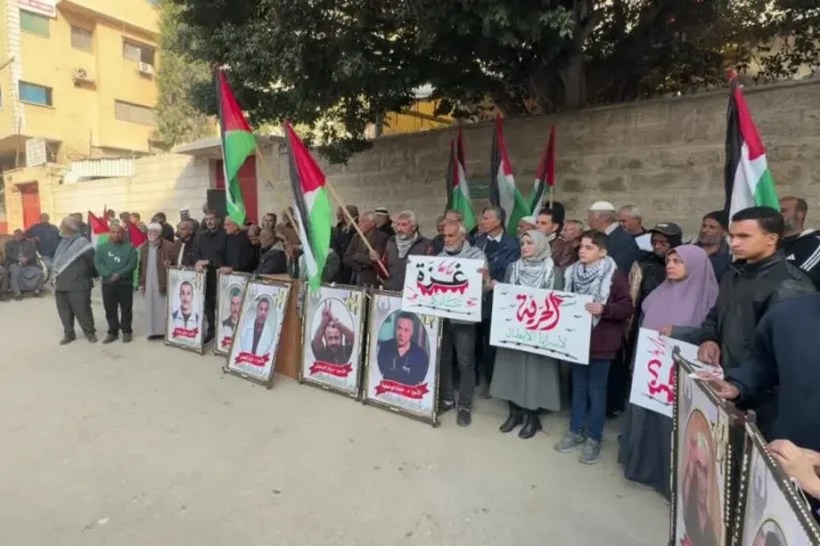
Demonstration held in Gaza in solidarity with Palestinian prisoners in Israeli jails. [photo by AA]
By Adnan Hmidan | MEMO | January 14, 2026
Warnings are no longer enough. Condemnation alone no longer carries any weight. We are standing at a moment that will be remembered, not for what was said, but for what was done. Today, in Israeli prisons, Palestinians are not simply being detained. They are being pushed, step by step, towards a reality where death itself is written into law, where execution is no longer a crime but a procedure, no longer an exception but a policy.
This is no longer just about harsh detention conditions or even about the routine violation of prisoners’ rights. The danger now runs deeper. What is unfolding is a systematic attempt to reshape justice to fit the needs of occupation, to turn trials into formalities before punishment and to reduce the law to a tool of retaliation rather than protection. New legislation, exceptional legal routes and an openly hostile political discourse now speak of execution not with embarrassment but with confidence, pride even. In such a climate, every legal fig leaf has fallen away and every moral mask has been removed.
Human rights organisations across the world have issued clear warnings about this direction, especially the push to establish “special” courts for Palestinians alone. These courts do not merely breach the principle of equality before the law; they destroy the very idea of justice. They operate outside internationally recognised standards and function in a space dominated by security priorities rather than judicial independence. When a person stands before a court designed especially and exclusively for him or her, not to offer fairness, but to ensure conviction, justice ceases to exist. It is a performance where the ending is known before the first word is spoken.
The threat does not end in the courtroom. It extends into a growing policy of denying release altogether, cutting off any realistic hope of freedom through exchange, parole, or genuine judicial review. What we are witnessing is a dangerous shift from punishment with limits to punishment without end, from imprisonment as a legal measure to imprisonment as a permanent political sentence. This approach deepens arbitrary detention, entrenches isolation and strips detainees of the most basic forms of human connection, turning prisons into spaces beyond accountability and beyond compassion.
Most disturbing of all is the open preparation for the death penalty, particularly when it is framed in a way that is mandatory, discriminatory, and aimed squarely at Palestinians. This represents a grave assault on the right to life and raises the terrifying possibility of executions carried out after trials shaped more by politics than by justice. Any attempt to apply such punishment retroactively, or to enforce it selectively, shatters the principle of legality and transforms the law into an instrument of elimination rather than protection. This is not a distant fear. It is a path already being cleared, step by step, in front of a world that seems increasingly willing to look away.
It is from this sense of urgency that the Red Ribbons Campaign was born, not as a slogan, nor as a gesture, but as a human alarm. A warning sounded before prison cells become execution chambers, and before silence becomes complicity. The colour red was chosen for a reason beyond the aesthetic; it signifies danger, the colour of blood and the colour of the final signal when words are no longer enough. It is the colour of freedom when it is taken by force and of injustice when it is endured in silence.
The campaign calls for a coordinated digital action beginning on the evening of Thursday 15th of January, under two clear hashtags: #الحرية_للأسرى and #FreePalHostages. The aim is to restore the human face of those held in Israeli prisons, not as statistics and certainly not as abstract political figures, but as doctors who once healed others, women whose lives were interrupted and children who should have been in classrooms, not in prison cells. This is about breaking a narrative that allows the suffering of one side to be visible while the pain of the other is deliberately and forcefully made invisible.
The action then moves from screens to streets on Saturday the 31st of January, with posters carrying the faces of Palestinian hostages placed in public spaces. This is not meant as theatre, but rather to remember while people are still alive, refusing to await their death to set a memorial. It is a way of saying: these lives matter now, not later.
But this movement will only have meaning if it belongs to people on the street and not just to organisations, movements or campaigns. It will only succeed if it becomes personal. No special permit is required to demonstrate care. No official mandate is needed to act. A photo can be placed in your local neighbourhood, with red ribbons tied around it; a picture taken, and then shared. In doing so, you become part of something larger, not a campaign of noise, but a community of conscience.
This is not a political disagreement that can be postponed. It is a moral test that demands an answer now. Will we act before executions take place, or will we limit ourselves to words of sorrow afterwards? Will we raise our voices while there is still time, or will we save them for statements that come too late?
The Red Ribbons Campaign may not be the final chapter in this struggle, but it could be one of the last chances to prevent a darker one from being written. History is not kind to those who watch from a distance. Blood, once spilled cannot be taken up. And justice, when abandoned at the moment of danger, becomes nothing more than a story we tell ourselves later.
We must act now, not because we seek attention, but because we refuse to be silent witnesses to the execution of Palestinian hostages in the world’s worst prisons.
No comments yet.
Featured Video
Laith Marouf: Hezbollah’s position on US-Iran ceasefire
or go to
Aletho News Archives – Video-Images
From the Archives
Is Israel to blame for the Iraq War?
American Goy | March 10, 2008
I am so tired of this old canard that “Israel had nothing to do with USA’s war with Iraq – in fact, it officially advised America against it”.
Bullshit. … continue
Blog Roll
 Aletho News
- Laith Marouf: Hezbollah’s position on US-Iran ceasefire: What you’re not being told
- Israel’s priority lies in destroying chances of peace between Iran, US: Ex-UN nuclear chief
- Ceasefire for all or for none: Iran shuts Hormuz over Lebanon attacks
- Strait of Hormuz is Iran’s ‘nuclear weapon’ that forced US retreat: Medvedev
- Energy crisis will last for months – Kremlin envoy
- Europe’s quiet role in the war on Iran
- Forty days that shook the Empire: How Iran turned the tables on US and prevailed
- Netanyahu unilaterally declares Lebanon outside of ceasefire deal
- Israeli leaders: ‘Not a single goal’ achieved in war with Iran
- What on earth just happened? Trump, Iran, and the unlikely ceasefire
- If Americans Knew
- Gazans face a triple crisis: severe shortages of water and bread, healthcare in tatters
- NY Times reports how Netanyahu took the US into Iran War
- A sigh of relief over Iran, but Gaza and Lebanon in dire straits – Daily Update
- Thousands dead and neighborhoods razed to the ground: Aid agencies fear southern Lebanon is becoming the new Gaza
- The war the US is fighting for Israel could cost trillions
- ‘Cigarette Burns, Nail Wounds’: Toddler Tortured in Gaza to Coerce Father
- Trump Says US Sent ‘a Lot of Guns’ to Protesters in Iran
- Israeli forces destroy 17 UN peacekeeper cameras in south Lebanon
- US-Israeli strikes ‘completely destroy’ synagogue in Tehran
- Archbishop for US Military Says Iran War Is Unjust Under Catholic Teaching
- No Tricks Zone
- An Inconvenient Tree: Uncovered In Alps… Europe Much Warmer Than Today 6000 Years Ago
- New Study Reports A 60% Slowdown In Greenland’s Ice Loss Rate In The Last Decade
- Low Intensity Tornado Wrecks Major Solar Farm, Creating A Potential Toxic Dump
- New Study Finds Warming Saves Lives…Cold Temperatures 12 Times More Deadly Than Excess Heat
- German Science Blog Accuses PIK Climate Institute Of Hallucinating Climate Tipping Points
- Devastating Assessment Of Comirnaty Vaccine By Former Senior Pfizer Europe Toxicologist
- New Study: CO2 Is ‘Effectively Negligible’ As An Explanatory Climate Change Factor Since 2000
- Former Pfizer Toxicologist Dr. Helmut Sterz Tells Bundestag Hearing Pfizer Vaccine Should Have Never Been Approved
- Energy Expert: Germany’s Nuclear Phaseout Was A “500 Billion Euro Mistake”
- New Research: South Australia’s Mid-Holocene Sea Surface Temperatures Were 4°C Warmer Than Today
 Aletho News
Leave a comment