Every House Democrat Votes Against Defunding A Cutout Of The CIA
The Dissident | January 18, 2026
Recently, U.S. representative Eli Crane introduced a provision into the recent spending package that would cut funding for the National Endowment for Democracy (NED), a cutout of the CIA used to advance regime change abroad.
In response to his “amendment to defund NED” every House Democrat, including progressives like Alexandria Ocasio-Cortez, Ro Khanna, and Ilhan Omar, voted against it, along with 81 Republicans, slapping down the amendment 291 to 127.
But what is the NED, the CIA cutout that the Washington uniparty rejected ending funding for?
The NED, which was officially created by Ronald Regan in 1984, was described in 1995 by CIA whistleblower Philip Agee as the CIA’s “sidekick” which functioned as “a mega conduit” for “the millions or the tens of millions that are set aside for the meddling in the internal affairs of other countries”.
Allen Weinstein, the head of the NED, boasted in a interview with the Washington Post in 1991, “A lot of what we do today was done covertly 25 years ago by the CIA”.
Indeed, the NED has been used for America’s “meddling in the internal affairs of other countries”, playing a role in U.S. coups and coup attempts in Venezuela (2002-2025), Haiti (2004), Ukraine (2014), Nicaragua (2018), Bolivia (2019), Belarus (2020), and Romania (2024).
In 2004, the NED provided funding and training for opposition activists who overthrew Haiti’s democratically elected leader, Jean-Bertrand Aristide.
Mother Jones reported at the time when the coup took place, “several of the people who had attended IRI (International Republican Institute, a subsidiary of the NED) trainings were influential in the toppling of Aristide”.
Mother Jones noted, “In 2002 and 2003, IRI used funding from the U.S. Agency for International Development (USAID) to organize numerous political training sessions in the Dominican Republic and Miami for some 600 Haitian leaders. Though IRI’s work is supposed to be nonpartisan — it is official U.S. policy not to interfere in foreign elections — a former U.S. diplomat says organizers of the workshops selected only opponents of Aristide and attempted to mold them into a political force”.
Similarly, in 2002, the NED, through the IRI, helped support a U.S. backed military coup against Venezuela’s elected president, Hugo Chavez, with Mother Jones noting, “In April 2002, a group of military officers launched a coup against Chavez, and leaders of several parties trained by IRI joined the junta.”
In 2015, the NED gave $300,000 to another one of its subsidiaries the National Democratic Institute (NDI) to meddle in Venezuela’s National Assembly elections of 2015 and swing them to the U.S.-backed opposition through “mobilizing a voter database that identified and targeted swing voters through social media”.
As Jacobin Magazine noted , “indeed, in December 2015, the opposition won a majority in the Venezuelan National Assembly for the first time since Chávez came to power in 1999” adding, “the NDI claims credit for the opposition’s success, writing that this strategy ‘ultimately played an important role in their resounding victory in the 2015 election’ and that a ‘determining factor in the success of the coalition in the parliamentary elections of 2015 was a two-year effort prior to the election”.
Along with this, the NED funded opposition politicians such as Maria Corina Machado, who helped certify the 2002 coup, drove a failed referendum against Chavez in 2004, and “was also one of the political architects of La Salida, the 2014 opposition campaign that called for escalated protests, including guarimba tactics”, which- as journalist Michelle Ellner noted, “weren’t ‘peaceful protests’ as the foreign press claimed; they were organized barricades meant to paralyze the country and force the government’s fall. Streets were blocked with burning trash and barbed wire, buses carrying workers were torched, and people suspected of being Chavista were beaten or killed. Even ambulances and doctors were attacked. Some Cuban medical brigades were nearly burned alive. Public buildings, food trucks, and schools were destroyed. Entire neighborhoods were held hostage by fear while opposition leaders like Machado cheered from the sidelines and called it ‘resistance.’”
Similarly, the NED played a role in the 2014 coup in Ukraine against the country’s elected president, Viktor Yanukovych, which turned Ukraine into a U.S. proxy state.
As journalist Branko Marcetic reported, “Just two months before they (protests in Ukraine) broke out, the NED’s then president, pointing to Yanukovych’s European outreach, wrote that ‘the opportunities are considerable, and there are important ways Washington could help.’ In practice, this meant funding groups like New Citizen, which the Financial Times reported ‘played a big role in getting the protest up and running,’ led by a pro-EU opposition figure. Journalist Mark Ames discovered the organization had received hundreds of thousands of dollars from US democracy promotion initiatives.”
The protests were eventually taken over by far-right paramilitary groups, who fired sniper shots at protestors in the Maidan square, a massacre that was falsely blamed on Yanukovych’s forces by the U.S. and used to justify supporting his removal and installing a puppet government.
The real motive behind the coup, as Ukrainian political scientist Konstantin Bondarenko put it was because “The West, however, did not want a Ukrainian president who pursued a multi-vector foreign policy; the West needed Ukraine to be anti-Russia, with clear opposition between Kyiv and Moscow. Yanukovych was open to broad cooperation with the West, but he was not willing to confront Russia and China. The West could not accept this ambivalence. The West needed a Ukraine charged for confrontation and even war against Russia, a Ukraine it could use as a tool in the fight against Russia” adding, “this was why Western politicians, diplomats, and civil society representatives actively supported the Euromaidan as a mechanism for overthrowing Yanukovych, even going as far as providing financial support for the ‘revolutionary’ process”
The NED tried and failed to foment another “Maidan” in Nicaragua from 2014-2018, in an attempt to remove the country’s leader, Daniel Ortega, the head of the Sandinista party, which fought the CIA-backed contras in the 1980s.
When riots broke out in the country in 2018, the outlet Global Americans reported that the NED, “laid the groundwork for insurrection” noting that, “Since 2014, the National Endowment for Democracy (NED), … has spent $4.1 million on projects in Nicaragua” adding, “it’s becoming more and more clear that the U.S. support has helped play a role in nurturing the current uprisings.”
The uprising was not peaceful protests but a violent NED backed coup attempt. Journalist John Perry, who reported on the coup attempt from the ground noted , “Public buildings and the houses of government supporters were burnt down by protesters; shops were ransacked; most businesses and all banks and schools were closed. The main secondary school for 3,700 pupils was burnt out twice. The police station was under siege for 45 days, so no police were on patrol. No cars or taxis could use the streets; passing the barricades on foot involved being checked by youths with weapons and on occasion threatened. Dissent was met with violence (before the barricades went up, I took part in a ‘peace’ march which was pelted with stones). At first protesters had homemade mortars, but later many acquired more serious weapons such as AK-47s; paid troublemakers manned the barricades at night-time. A police official captured nearby was tortured and then killed, his body burnt at a barricade.”
Similarly, the NED played a role in the U.S. backed military coup against Bolivia’s elected leader, Evo Morales, in 2019.
The U.S. backed coup was sparked when the Organization of American States (OSA) falsely claimed that Evo Morales stole the 2019 election, which was used to justify a military coup and the installation of a military dictatorship led by U.S. puppet, Jeanine Añez.
As journalist Yanis Iqbal, reported the lie that Evo Morales stole the elected was heavily pushed by the NED writing that, “In 2019, NED ran programmes such as Countering Disinformation in the Political Process, Informing Citizens Via Digital Platforms, Monitoring the National Electoral Process, Promoting an Informed Electorate, Providing Independent Analysis and Information, Providing Independent Political News and Election Information and Stimulating an Informed National Debate” which pushed the lie used to justify the coup, adding, “These NED tactics conclusively point towards a scheme of carefully choreographed propaganda and electoral interventionism which contributed to the 2019 Bolivia coup.”
Similar to the Maidan coup in Ukraine, the NED continued to undermine governments in Eastern Europe, which were seen as too close to Russia.
When protests broke out against Belarus’ Russia-aligned president, Aleksandr Lukashenko in 2020, journalist Alan Macleod reported, “on a Zoom meeting infiltrated by activists and released to the public, the NED’s senior Europe Program officer, Nina Ognianova, boasted that the groups leading the nationwide demonstrations against Lukashenko … were trained by her organization. ‘We don’t think that this movement that is so impressive and so inspiring came out of nowhere — that it just happened overnight,’ she said, noting that the NED had made a ‘modest but significant contribution’ to the protests.”
He added, “On the same call, NED President Carl Gershman added that ‘we support many, many groups and we have a very, very active program throughout the country, and many of the groups obviously have their partners in exile.’ Gershman also boasted that the Belarusian government was powerless to intervene and stop them: ‘We’re not like Freedom House or NDI [the National Democratic Institute] and the IRI [International Republican Institute]; we don’t have offices. So if we’re not there, they can’t kick us out.’”
Similarly, the NED intervened in the 2024 election in Romania to back a judicial coup against the candidate Calin Georgescu, because he was opposed to funding the proxy war in Ukraine (which was in large part sparked by the NED backed coup in 2014).
Romania’s intelligence agencies released an evidence-free report which falsely claimed that a TikTok campaign backed by Russia was supporting his campaign.
As the New York Times noted, “The intelligence documents released publicly by Romania provided no evidence of a Russian role, only the observation that ‘Russia has a history of interfering in the electoral processes of other states’ and vague claims that what happened in Romania was ‘similar’ to well-documented Russian election interference in neighboring Moldova”.
Furthermore, the investigative outlet Snoop reported that the TikTok campaign cited in the intelligence report was actually paid for by the Romanian National Liberal Party, the party opposing Calin Georgescu.
Based on this fabricated report, Calin Georgescu was barred from running in the election, despite winning the first round of the vote.
His opponent, Elena Lascon, said at the time, “Today is the moment when the Romanian state trampled over democracy. God, the Romanian people, the truth and the law will prevail and will punish those who are guilty of destroying our democracy”.
This lawfare campaign was backed by the NED. Journalist Lee Fang uncovered that, “think tanks and civil society NGOs funded by the U.S. – via USAID foreign aid programs, the National Endowment for Democracy (NED), and the State Department – have served as the most vocal voices championing the judicial coup”.
The fact that every House Democrat and many House Republicans voted against defunding the ostensible NGO that has been used by the CIA to back coups around the world – including against democratically elected leaders – that do not bow down to Washington’s demands shows that both parties will continue to keep the deep state’s infrastructure running.
What a War on Iran Would Really Look Like — Beyond the Regime-Change Fantasy
By Robert Inlakesh | The Palestine Chronicle | January 19, 2026
While the corporate media and social media influencers run non-stop regime change propaganda, replete with unverified statistics, fabricated claims, and the denial of objective reality, it is important to cut through this and ask the more important question: What will a regime change war on Iran look like?
The following analysis must be first prefaced by stating that the unrelenting wave of regime change propaganda currently being disseminated with the implicit intent of manufacturing consent for war is, in essence, no different from the claims and rhetoric used over decades to justify various other wars of aggression.
Last year, Israel attacked Iran in a blatant violation of the United Nations Charter, and was later followed by the United States, which also participated in illegal aggression. Although it should be noted that using the metrics of International Law is at this stage redundant, as it has been rendered null and void by the US-Israeli alliance since October 7, 2023.
In the immediate aftermath of last June’s 12-Day-War, US-based pro-war think-tanks ranging from the Washington Institute for Near East Policy (WINEP), Foundation for the Defense of Democracies (FDD) all the way to the Atlantic Council, all began scheming about what the next round should constitute and its intended outcomes. Meanwhile, on July 7, Axios News cited its sources claiming that Israel was already seeking a greenlight for a new attack and that it believed the US would grant it.
Fast forward to December 28, 2025, when peaceful protests erupted in Iran over government mismanagement of the worsening economic crisis, caused by Western economic sanctions. The very next day, December 29, former Israeli Prime Minister Naftali Bennett posted a video talking about a mass anti-government uprising, which had not yet happened. His message was accompanied by countless old videos and AI-generated footage depicting such a rebellion.
As this was happening, Israeli Prime Minister Benjamin Netanyahu was visiting US President Donald Trump at Mar-a-Lago, where, according to several media reports, he was requesting an American attack on Iran and had received everything he had asked for. At the beginning of January 2026, violent elements suddenly emerged, and protests calling for the fall of the government began.
On January 8, 9, and 10, the situation dramatically escalated as Iran shut off the internet across the country. The footage revealed that the largest crowds participating in the riots and protests numbered only in the tens of thousands, yet numerous rioting groups emerged throughout the country.
The Western media and pro-Israeli social media influencers had by this time constructed their own narratives that deemed what was happening a “revolution” of “millions across Iran” and that peaceful protesters were being slaughtered for standing up for their freedom.
Without going into the fine details, it suffices to say that what we see portrayed in the corporate media about Iran is a reflection of a parallel universe. There is a total denial of any nuance, an inability to accept mass pro-government demonstrations that were bigger than the riots that occurred, a refusal to air the countless videos of armed militants on the streets and mass destruction caused by rioters.
Instead, Iran is an “evil regime” that is “slaughtering its own people” for absolutely no reason beyond that they are peacefully protesting for their freedom. There is also a particular focus on women’s rights when it comes to this propaganda. Even those who accept that over 160 members of the Iranian security forces were killed, including some who were beheaded and set on fire, still uphold that a peaceful revolution occurred. One that they all claimed would topple the government in days or weeks.
You need only look back over the past decades to see the same regime change scripts in action. The Colonial Feminism employed to justify these wars of aggression has been apparent throughout, especially in the case of Afghanistan. Yet, after 20 years of war and 2 trillion dollars in taxpayer dollars later, it was clear that the US’s longest war had nothing to do with “liberating the women of Afghanistan”.
Bear in mind also that atrocity propaganda can come from so-called trusted sources, especially when used to drum up support for such a major foreign policy objective as overthrowing the Iranian government. For example, Amnesty International gave credit to totally fabricated claims that Iraqi soldiers had thrown babies out of incubators in the lead-up to the First Gulf War.
Former Libyan President Muammar Gaddafi was also accused of “killing his own people” as the justification for NATO intervention, while it was claimed that peaceful protesters sought to achieve democracy. Then came a tirade of totally fabricated statistics and outlandish stories, none of which the corporate media dare challenge.
Every time it’s the same cycle, a totally fictitious narrative is constructed as a means of justifying a kind of “humanitarian intervention”, after which everyone will later acknowledge much of it was exaggerated or outright false. Then, anyone challenging this is labelled a “regime puppet” and called names to delegitimise their arguments. Disgruntled members of that nation’s diaspora are also employed to come up with sob stories and advocate regime change, a cheap identity politics trick.
What Will A War On Iran Look Like
A war with Iran could go in many different directions, depending on a large number of variables and how countless actions factor into decision-making on all sides. Therefore, the first point of entry into this brief analysis should be the reality inside Iran and separating this from the fictional depictions provided by the corporate media.
Iran is not Venezuela, nor is it Syria. The Islamic Republic of Iran, for a start, possesses military capabilities that are beyond any other player in West Asia, with exceptions of the Israelis and Turkish militaries. Even in these cases, they do not possess the volume of ballistic missiles, cruise missiles, or drones that Iran has mass-manufactured.
What Tehran lacks in terms of the latest in technological development, it makes up for with its offensive missile and drone arsenal, enabling it to hit the Israelis and US bases across the region. These capabilities are now tried and tested on the battlefield.
On the ground, Iran has its Islamic Revolutionary Guard Corps (IRGC) along with its regular army. The conservative estimates put the total active personnel of the IRGC at around 190,000 men strong, while the regular army is said to have 420,000 active duty members. In addition to this, there is a volunteer paramilitary force known as the Basij, which is said to be able to mobilise over a million fighters if needed.
The Iranian military is well trained, well armed and is constantly running exercises designed to combat insurgencies and foreign invasion forces. Iran’s terrain is also mountainous and vast, meaning that even in the event that mistakes are made, there is room for them to then regain lost ground. All previous US war games estimated that an invasion of Iran in the early 2000’s would have been a disaster for American forces. This was before the Iranians developed militarily in the way they have over the past decade or so.
Millions of Iranians who have demonstrated they will come to the streets in order to protest in solidarity with their government is also a strong sign of the base of support behind the current government. Although survey data is scarce, a large portion of the Iranian population is indeed socially conservative and believes in the religious doctrine of the Islamic Republic.
Another element to consider here is that the Iranian opposition has no real leader. The son of the Shah has a very small base of support inside Iran and is widely regarded as no more than an Israeli puppet. Then we have the Iranian minorities, who have managed to coexist much better under the Islamic Republic than the former Shah’s rule, as the Shia religious system does not rule for the Persian majority alone and does not have the same ethno-supremacist tendencies as previous Iranian leaderships.
On top of Iran’s own forces, there are also its regional allies. These include Ansarallah in Yemen, the Iraqi Hashd al-Shaabi, the Afghan Fatimeyoun, Pakistani Zeinabiyoun, the entire Palestinian resistance, and Hezbollah in Lebanon. These are the main players, but there are also various other groups that they have partnered with.
There is also a question mark surrounding what role China will play in support of Iran, while it is expected that Russia will also provide some kind of assistance. Beijing, in particular, cannot afford the fallout of losing Iranian oil and has already signed an economic partnership deal with Tehran.
Understanding all, there are clearly various cards that the Iranians have to play, and the idea that the government would simply fall without a fight and that its leadership would flee is pure fantasy. Several scenarios could play out given a war opens, including the following:
- Iran initiates a preemptive series of strikes.
- The US bombs Iran symbolically and tries to fight a limited conflict.
- An Israeli-US total regime change plot is hatched.
To address the first way this could unfold, it may be possible that, given the failure of the riots to create major fractures in the Islamic Republic’s system and drag the country to civil war, the US and Israelis may be trying to bait Iran into attacking first. The reason for this would be so they are able to gauge how broad the confrontation will be from the opening round of strikes and then adjust their own offensive from there. This kind of conflict would likely be limited.
The next option would be a US air campaign designed to deal a blow to Iran, with the hope that it could also lead to a change of events that results in regime change, but primarily to send a message and extend the conflict to another round. Such an exchange could end up getting out of hand, depending upon how both sides choose to retaliate against each other’s actions, yet the goal would be to avoid a long war.
If these kinds of 12-Day-War style rounds are to keep occurring each year or so, then this would greatly favour Iran. This is the case as Iran replaces its stockpiles infinitely quicker than the US and Israel.
Then there is the worst-case scenario, an all-out regime change war. Whether this arrives through a series of waves of attacks, both from the air and using militants on the ground, or through a tit-for-tat escalation that leads to it, expect enormous death and destruction on all sides.
There can be no disputing the US military edge here from the air, although an air campaign alone will not topple the government. If this happens, the worst-case scenario will be that the US will strike Iran repeatedly, perhaps alongside Israel’s attacks, assassinating political and military leaders, taking out weapons depots, missile launch sites, infrastructure targets, government buildings, and cultural sites. If Iran is unable to effectively defend from such an assault, it should be expected that it will take around 4 days to get on its feet.
This being said, such an assault would likely radicalise the population and make them double down. If the US and Israel succeed at assassinating Ayatollah Seyyed Ali Khamenei, then we should expect an unprecedented war that may even extend beyond the region. More than being the Iranian Supreme Leader, he is also a Shia Spiritual leader, meaning his role transcends that of a leader of a country. It would be the equivalent of assassinating the Pope.
Iran itself has several options: to pound American bases, strike US aircraft carriers, launch much larger waves of ballistic missiles into Israel, and at this point, it is likely its allies would have mobilised. The Iranians themselves could shut down the Persian Gulf by locking the Gulf of Hormuz, inflicting a global economic crisis.
Hezbollah, Ansarallah, the Hashd al-Shaabi, Zeinabiyoun, Fatemeyoun, and Palestinian factions could all then participate in an all-out war, one from which there is no turning back. For the Shia in particular, their ideology is not one of backing down in these situations; they will very likely interpret such circumstances as their equivalent to the battle of Karbala, where the Prophet of Islam’s grandson Hussein was martyred.
If this becomes an all-out battle, everyone will take the gloves off, and the only way the Israelis will likely prove capable of escaping is to begin using nuclear weapons, which may not even work.
Although the doomsday scenario is possible, it is likely the war will end before it gets to that stage, and although all of Iran’s allies may participate this time, it would appear the US would like to refrain from entering a long, unpopular, and unwinnable war of aggression. The Trump administration likes quick wars that don’t take much time and runs away when things don’t go their way, as we saw with their attack on Yemen.
It should be expected that the Israelis and their Western allies throw the kitchen sink at Iran in an attempt to manufacture civil war, also. So far, the Syriaization of Iran has failed, but this isn’t to say they will give up on implementing such an agenda.
All of this is to say that regime change in Iran is not a simple matter of committing a few airstrikes; it is an ideologically driven State with mass support and a large number of allies willing to fight on its side. Therefore, the likelihood of the Islamic Republic of Iran falling in a few days or weeks is outlandish to say the least.
– Robert Inlakesh is a journalist, writer, and documentary filmmaker. He focuses on the Middle East, specializing in Palestine. He contributed this article to The Palestine Chronicle.
Scott Ritter Hiding the Dominant Minority Behind Geopolitics?
Peace Activists Forced to Hide the Jewish Geopolitical Dots?
By Geurt de Wit | Ruling Elite Studies | January 18, 2026
Introduction
All political scientists and historians agree that some minorities have historically been able to dominate their host nations. Notable modern examples include the Spanish in South America, overseas Chinese in Southeast Asia, and Tutsis in Central Africa. Sometimes host nations rise against a dominant minority, as seen in Southeast Asia, where local populations have implemented various quotas and measures—such as Malaysia’s Bumiputera policies—to curb the economic and social influence of the ethnic Chinese community.
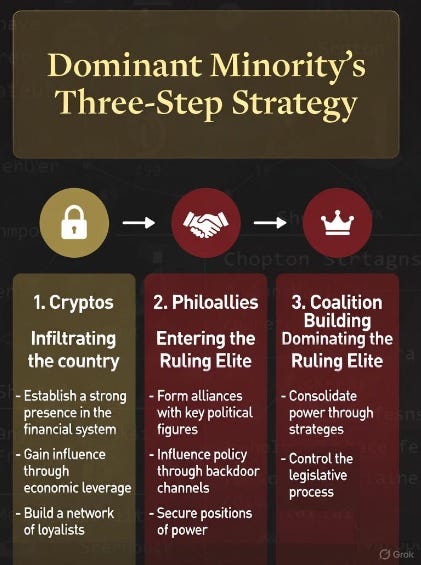
Jews
There is another significant example of a dominant minority, yet naming it remains a taboo: the Jewish elite in the West. This group exerts influence through economic and media power, a “Culture of Critique,” and its maneuvers within the geopolitical “Great Game”. U.S. foreign policy, for instance, appears heavily influenced by Jewish Zionists, compelling even the supposedly “America First” Trump administration to adopt “Israel First” policies. While parts of the peace movement have begun to note the Jewish role in fomenting conflicts also beyond the Middle East, many activists still fail to see the broader connections. The conflicts in Ukraine and Taiwan are directly linked to the crisis in the Middle East.
The reason is simple: Jewish led neoconservative and neoliberal forces aligned with Israel seek to weaken Russia and China, both of which support Iran and the Shia “Axis of Resistance” in the Middle East. Consequently, the West attempts to encircle Russia and China with military bases and hostile alliances while undermining their economies through sanctions and high tariffs to facilitate regime change.
This is nothing new. For centuries, Jews have viewed Russia and China as “antisemitic” for opposing Jewish attempts to become a dominant minority within their borders. Historically, this has manifested as a prolonged struggle. Jewish elite dynasties like the Rothschilds, Sassoons and Kadooreis, for example, pushed Western empires to subjugate China during its “Century of Humiliation.” Similarly, they managed to organize various wars against Russia including the first Crimean War in the 1850’s and then later the Jewish led Bolshevik and Oligarch takeovers in the 1920’s and 90’s. The present Ukraine War is just the latest in a series of conflicts and wars between Jews and Russia going back a millennium.
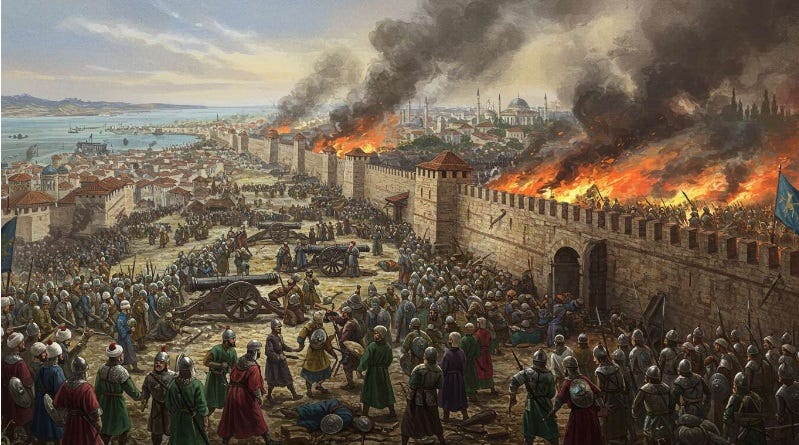
The obvious Jewish role in geopolitics and various wars has always been known to political scientists and historians. It is also common knowledge in many parts of the world such as in Eastern Europe, China and the Arab world. However, in America the Jewish dominant minority has achieved such power that both academia and media now avoid the subject entirely. Only occasionally does the American public hear about it through random outbursts, such as Mel Gibson’s criticism of the Jewish role in instigating wars.
Putin and Xi
Under the leadership of Vladimir Putin and Xi Jinping, Russia and China have regained their independence and power. Their geopolitical support for the Axis of Resistance has drawn the ire of Zionist Jews running Great Game geopolitics, while their nationalist anti-liberal policies have alienated liberal Jewish factions running the Culture of Critique movements. As a result, the Jewish dominated Western academia and media has totally demonized both nations, while Jewish led neoconservatives and neoliberals push for their encirclement and the targeting of their global allies.
The influence of Jewish dominant minority behind these conflicts remains such a taboo that even peace activists often ignore it. This gives Zionists a carte blanche to pursue military and cultural wars, regime change operations and proxy wars aimed at isolating Russia and China. By refusing to “connect the dots,” Western peace activists effectively allow this dominant minority to continue pushing for perpetual war.
Scott Ritter
In recent years, the peace movement has been bolstered by former UN weapons inspector Scott Ritter. A prolific advocate, Ritter has tirelessly warned against the dangers of nuclear war, organized demonstrations and personally lobbied Congress. Despite his background as a leftist philosemitic Democrat, he has significantly influenced the Republican “MAGA” movement toward anti-war policies.
Ritter has gained a massive following as a commentator on the Ukraine War. However, during the conflict’s first year, he remained silent on the Jewish and even Israeli connection, blaming only the CIA, MI6 and the U.S. and British governments. In this, he was joined by libertarian figures like Andrew Napolitano and Lew Rockwell, who focus on American “Primacists” rather than identifying a dominant minority.
Traditionally, both leftists and libertarians have avoided identifying the Jewish dominant minority to avoid being labeled as antisemitic. It was only during the recent genocide in Gaza that Ritter began to explicitly critique Israel’s geopolitical role, though he has yet to identify the dominant minority or even connect these dots to the broader global landscape.
Silent Peace Activists
Some suggest that platform policies, such as those on YouTube, drive this reticence. Peace activists like Andrew Napolitano, Alexander Mercouris, and Danny Haiphong reach hundreds of thousands of viewers daily through their Youtube channels. Openly discussing Jewish dominant minority and connecting Jewish geopolitical dots could lead to deplatforming and lost revenue. However, this doesn’t fully explain the silence, as they could simultaneously use alternative platforms like Rumble, X or Locals—a strategy successfully employed by the famous anti-Zionist, Candace Owens. Unsurprisingly she has been branded an “anti-Semite” by many Jewish organizations.

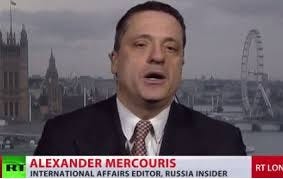
Alexander Mercouris
Another explanation is ideological. Many activists from leftist or libertarian backgrounds may instinctively view the concept of a “dominant minority” as inherently racist. The most dramatic example of this is the leftist peace activist and popular YouTube commentator Alexander Mercouris, who for years was oblivious to the Jewish connection. However, a few months ago, due to audience feedback, he admitted on his channel that he had never even thought about a possible connection between the Ukraine War and the Middle East Crises.
Afterward, he has not talked about the subject anymore, though he does seem to increasingly speak in code. For example, he repeatedly emphasizes that his channel will be shut down if he analyzes the Epstein case too deeply. At the same time, he seems to spell “Epstein” in the Jewish-German way, making Epstein’s ethnic background clearer. Mercouris also has the revealing habit of always following the arch-neocon warmonger Lindsey Graham’s name with the name Richard Blumenthal, possibly hinting that Graham is influenced by him and other Jews to a significant extent.
The third explanation for not openly noticing the dominant minority is that many prominent peace activists hope to attract the support of wealthy, anti-Zionist Jewish donors to finance the movement, a development that has yet to materialize.
Debanking
Certainly, the fourth and most important explanation is fear. Leading peace activists face tremendous pressure from various sides. Ironically, this pressure appears stronger in America than in Europe, despite stricter official censorship in Europe. However, Europeans benefit from strong employment and social security protections against firings and debanking. In America, people’s lives are more precarious and heavily dependent on high incomes, making it easier to intimidate them with threats to their reputation, job, income, or even bank accounts. The American media rarely discusses this, but hundreds of politically incorrect individuals have been debanked—not only in Canada but also in the U.S. Scott Ritter has now joined their ranks.
In the above video Scott Ritter recalls his days as a highly connected American intelligence operative, working closely with the CIA, Israelis, and even the White House. He emphasizes that he was once the “Golden Boy” of intelligence, privy to “everything.” Clearly, he must be aware of America’s dominant minority and their potential to ignite a nuclear war. Yet, despite recent escalations in Eastern Europe and the Middle East, Ritter in this video claims that the main problem is America itself, with Trump as a “prisoner of the CIA”—not the Mossad, Israel, or even the Zionists.
The next day, however, Ritter appeared in an interview with Andrew Napolitano. He admitted that after being debanked, he fell into depression and briefly felt hopeless, especially as his wife had grown weary of the persecution that had affected their entire family for decades. At that point, Napolitano played a clip of Jonathan Greenblatt, the Jewish ADL’s chairman, boasting about the organization’s role in training American police and officials. This ignited Ritter, who then openly declared that Zionists are running the American government.
Trump’s chess moves
At the same time, Ritter suggested there might still be hope. He noted that many parts of the government resent Zionist dominance, and even Donald Trump could be among them. That wouldn’t be surprising, given Trump’s ego—he can’t be pleased with how Netanyahu and many other Jews publicly humiliate him. Being Israel’s bitch cannot be fun.
It could even be that Trump is deliberately undermining American influence abroad through his erratic behavior, bullying threats, and tariffs. After all, U.S. foreign policy is thoroughly dominated by Zionists, so disrupting the entire system might be the only way to halt it. For instance, threatening to annex Greenland would certainly fracture or weaken NATO, making it harder for EU NATO countries to sustain their warmongering. Perhaps Trump truly seeks peace through a “Fortress America” approach, dividing the world among American, Russian and Chinese spheres of influence. Maybe he’s really playing four-dimensional chess, with method to his madness. Of course, the alternative is that he’s simply a madman. As Scott Ritter admits, he doesn’t know—and neither does anyone else. Probably not even Trump himself.
People worldwide are deeply divided over Donald Trump. Some view him as a mastermind playing four-dimensional chess to save the world, while others see him as a narcissistic bumbler who sows chaos wherever he goes. So, which perspective aligns more closely with the truth? We do not know but let’s first assume that Donald Trump is a rational player in do…
Conclusion
Many in the peace movement believe that concealing the Jewish dominant minority and obscuring its role in numerous wars is essential for peace. However, this strategy may backfire, giving that minority a free hand to escalate proxy conflicts and try again and again to push the world toward “limited” nuclear war.
People often demand perfection from their heroes, which is counterproductive. No one is a superman—not even Scott Ritter. Of course, he must consider his family. Of course, he has been reticent about exposing Jewish power. The same applies to all other peace activists. But gradually, things are changing on both the left and right. They are beginning to point out the man and group behind the curtain.
In any case, peace activists perform invaluable work and deserve unwavering support. After all, they do what they humanly can. Without them—especially Scott Ritter—a nuclear war might already have begun.
Europe Economic Panic
By Lorenzo Maria Pacini | Strategic Culture Foundation | January 18, 2026
When a prime minister advises his staff to rest because the coming year will be much more difficult, it is neither black humor nor fatigue. It is a moment of sincerity, the kind that only emerges when internal projections no longer support the public narrative.
Giorgia Meloni was not addressing the electorate. She was addressing the machinery of the state itself, the administrative core charged with implementing decisions whose effects can no longer be hidden. Her observation was not about a normal increase in workload. She was talking about constraints, about limits being reached, about a Europe that has moved from crisis response to a phase of controlled contraction, fully aware that 2026 is the year when deferred costs will eventually converge.
What has leaked out is what European ruling circles have already understood: the Western strategy in Ukraine has run up against material limits. Not with Russian messages, not with disinformation, not with populist dissent, but with steel, ammunition, energy, manpower, and time. Once these realities assert themselves, political legitimacy begins to erode.
The EU cannot sustain this war economically. Europe can strike poses of readiness. It cannot manufacture war.
After years of high-intensity conflict, both the US and Europe are rediscovering a long-forgotten truth: wars of this nature cannot be sustained with speeches, sanctions, or the abandonment of diplomacy. They require bullets, missiles, trained personnel, maintenance cycles, and industrial production that consistently exceeds battlefield losses. None of this exists, not in sufficient quantities, and it is not feasible in the timeframe preached in Brussels.
Russia is producing artillery ammunition in quantities that Western officials now openly admit exceed NATO’s total production. Its industrial base has shifted to near-continuous wartime production, with centralized procurement, streamlined logistics, and state-led manufacturing, without even total mobilization. Estimates place Russian production at several million artillery shells per year, already delivered, not just projected.
Europe, meanwhile, spent 2025 congratulating itself on targets it is structurally incapable of achieving. The EU’s stated commitment of two million shells per year depends on facilities, contracts, and labor that will not be available by the decisive period of the war, if ever. Even if achieved, the figure would still be less than Russian production. The US, despite emergency expansion, expects about one million shells per year once full ramp-up is complete, and only if that happens. Even on paper, combined Western production struggles to match what Russia is already producing in practice. The imbalance is clear.
This is not just a deficit, but a misalignment of timing. Russia is producing now. Europe is planning for the future. And time is the only factor immune to sanctions.
Washington, in fact, cannot indefinitely compensate for Europe’s eroded capacity because it faces its own industrial difficulties. Patriot interceptor production remains in the order of a few hundred per year, while demand simultaneously concerns Ukraine, Israel, Taiwan, and the replenishment of US stocks: an imbalance that, as Pentagon officials admit, cannot be resolved quickly. Shipbuilding tells a similar story: submarines and surface ships are years behind schedule due to labor shortages, aging infrastructure, and skyrocketing costs, pushing significant expansion toward 2030. The assumption that America can indefinitely support Europe is no longer in line with reality. This is a systemic Western problem.
Unfounded war rhetoric
European leaders talk about a “state of war” as if it were a rhetorical position, but in reality, it is an industrial condition that Europe does not meet.
New artillery lines take years to reach stable production. Air defense interceptors are produced in long, batch-based cycles, not in sudden spikes. Even basic components such as explosives remain a critical issue, with plants that closed decades ago only now reopening and some not expected to reach full capacity until the late 2020s. This timeline is in itself an admission.
Europe’s weakness is not intellectual, but institutional: huge sums have been authorized, but procurement inertia, fragmented contracts, and a depleted supplier base have meant that deliveries are years behind schedule. France, often described as Europe’s most capable arms manufacturer, is capable of building advanced systems, but only in limited quantities, counted in dozens, while a war of attrition requires thousands. EU ammunition initiatives have expanded capacity on paper, while the front has exhausted ammunition in a matter of weeks.
These are not ideological shortcomings, but administrative and industrial failures, which are exacerbated in stressful situations. It is yet another example of the failure of European Community policy, so much so that the structural contrast is stark. Western industry has been optimized for shareholder returns and peacetime efficiency, while Russian industry has been reoriented to withstand pressure. NATO announces aid packages. Russia counts deliveries. You can already guess what the outcome of this situation will be, right?
This industrial reality explains why the debate on asset freezing was so important and why it failed. Europe did not pursue the seizure of Russian sovereign assets out of legal ingenuity or moral determination, but because it needed time: time to avoid admitting that the war was unsustainable in Western industrial terms, time to replace production with financial maneuvers.
When the effort to confiscate some €210 billion in Russian assets failed on December 20, blocked by legal risks, market repercussions, and opposition led by Belgium, with Italy, Malta, Slovakia, and Hungary opposing total confiscation, the Brussels technocracy settled for a reduced alternative: a €90 billion loan to Ukraine for 2026-27, with interest payments of around €3 billion per year. This further mortgages Europe’s future. This is not a strategy, but emergency triage. A collapsing political hospital. Pure panic.
Narrative, crisis, disaster
The deeper reality is that Ukraine is no longer primarily a military dilemma, it is a question of solvency. Washington recognizes this, because it cannot absorb the reputational discomfort, but they cannot take on unlimited responsibility forever. A way out is being explored, discreetly, inconsistently, and shrouded in rhetorical cover.
Europe cannot admit the same necessity, because it has ultimately adopted ‘Putin’s version’, i.e. it has framed the war as existential, civilising, moral – but do you remember when European politicians enjoyed calling Putin crazy for talking about a clash of civilisations?
Compromise has become appeasement, negotiation surrender. In doing so, Europe has eliminated its own escape routes. Well done, ladies and gentlemen!
On the narrative front, greetings to all. The aggressive enforcement of the EU’s Digital Services Act has less to do with security than with containment: building an information perimeter around a consensus that cannot survive open scrutiny. Translated: censorship as a solution. The truth of the matter must not be made known, and those who try to do so must be suppressed in an exemplary manner. This also explains why regulatory pressure now extends beyond European borders, generating transatlantic friction over freedom of expression and jurisdiction. Confident systems welcome debate. Fragile ones suppress it. In this case, censorship is not ideology, but a form of insurance.
The information crisis, rest assured, will very soon become… a social crisis ready to detonate into domestic conflict.
And the crisis is also one of resources and energy. We are witnessing the securitization of decline, whereby obligations are postponed while the productive base needed to sustain them continues to shrink. It’s a cat chasing its tail. Here too, you know how it will end, don’t you?
Europe has not only sanctioned Russia. It has sanctioned itself. European industry will continue to pay energy prices well above those of its competitors in the United States or Russia throughout 2026. Take a trip around Europe, read the headlines in local newspapers, look at people’s faces: the fabric of small and medium-sized enterprises, the true beating heart of entire EU countries, is quietly disappearing. And this is logically reflected in large companies too. This is why Europe cannot increase its production of ammunition and why rearmament remains an aspiration rather than a concrete operation.
Energy, we said. Low-cost energy was not a convenience, it was essential. If it is eliminated through self-inflicted damage, the entire structure is emptied. Even the most ambitious plans preached for years, such as the IMEC corridor, are still a mirage. There is a stampede towards Turkey, Azerbaijan, and Georgia to try to scrape together a few kilowatts. A ridiculous attempt to save what is now tragically unsalvageable.
China, observing all this, represents the other half of Europe’s strategic nightmare. It controls the world’s deepest manufacturing base without having entered into a position of war. Russia does not need China’s full capacity, only its strategic depth in reserve. Europe has neither.
A frightening 2026
2026 therefore looks set to be a terrible year, I’m sorry to say. The European elites find themselves losing control on three fronts at once. On finance, because the budget will be bitter and the money for the insane support to Kiev will no longer be the same. On narrative, because the question citizens will ask themselves will be ‘what was the point of all this?’. On the cohesion of the Alliance, both NATO and the EU, because Washington’s disengagement will force a review of the balance of power on the European continent to the point of no return and, perhaps, a break between the two sides divided by the ocean.
Panic, again. Not a sudden defeat, but the slow erosion of legitimacy as reality creeps in through gas that costs as much as gold, closed plants, empty stockpiles, obsolete rifles, and a future that is turning away.
This is not just a difficult situation for Europe, but a matter of civilization. A system incapable of producing, supplying, speaking honestly, or retreating without collapsing in credibility has reached its limit. When leaders begin to prepare their institutions for worse years, they are not anticipating inconveniences, but recognizing structural failure.
Empires proclaim victory loudly. Declining systems quietly lower expectations or, in this case, momentarily say the quiet part out loud. But the truth is that nothing is the same as before, and it is obvious.
For most Europeans, the reckoning will not come as an abstract debate about strategy or supply chains, but as a simple realization: this was never a war they consented to. It did not defend their homes, their prosperity, or their future. And so, again, how do you think it will end?
An ideological war has been fought in the name of imperial ambition and financed through declining living standards, industrial decline, and the prospects of their children. In the name of big pro-European capital, of the privileged few with robes, stars, and crowns.
For months, even years, it was said that “there was no alternative” and that this was the only course of action. And now?
Europeans are tired. They want peace, stability, and the quiet dignity of prosperity: affordable energy, a functioning industry, and a future unencumbered by conflicts they NEVER chose and, above all, they do not want the decline of millennia-old civilizations.
And when this awareness has taken hold, when the fear has faded and the spell has been broken, the question Europeans will ask themselves will not be technical or ideological. It will be existential. And all existential questions lead to radical choices, even terrible ones.
May this dramatic fear keep the mad leaders of this Europe awake at night.
The War On Free Speech In Australia Is Getting Cartoonishly Absurd
By Caitlin Johnstone | January 17, 2026
A mentally disabled Australian woman is being prosecuted for antisemitic hate crimes after accidentally pocket-dialing a Jewish nutritionist, resulting in a blank voicemail which caused the nutritionist “immediate fear and nervousness” because she thought some of the background noises in the recording sounded a bit like gunshots.
We’re being told we need more of this. There’s “hate speech” legislation presently in the works to make this worse. Australia’s controversial Combatting Antisemitism, Hate and Extremism Bill appears to be explicitly crafted to dramatically increase the scale, frequency and consequences of the exact sort of dynamics we’re seeing in this case, and to eradicate opposition to Israel throughout the nation.
This is how overextended Australia’s freakout over “antisemitism” already is. You can literally just be sitting there not saying or doing anything and still find yourself getting arrested and prosecuted for an antisemitic hate crime. They have the authority to do this presently, under the laws that already exist. The argument for this bill is that our present horrifyingly tyrannical and abusive system is insufficiently authoritarian and tyrannical, and that prosecutors need more power to police speech far more forcefully.
Australians are being asked to trust a system that would take a woman with an intellectual disability to prosecution in a court of law over an accidental butt-dial to a person of Jewish faith with the authority to send people to prison for years over their political speech. And this is happening after we just spent years watching Australian authorities roll out authoritarian measures to stomp out criticism of Israel and quash protests against an active genocide.
This is madness, and it needs to be brought to a screeching halt. Immediately. This entire country has lost its damn mind.
The Bondi attack isn’t the reason, it’s the excuse. All these laws being rolled out to stomp out criticism of Israel in Australia were sought for years before the shooting occurred.
Immediately after the attack last month I tweeted, “Not a lot of info about the Bondi shooting yet but it’s safe to assume it will be used as an excuse to target pro-Palestine activists and further outlaw criticism of Israel in Australia, as has been happening to a greater and greater extent in this country for the last two years.”
They could have proved me wrong, but instead they’ve spent this entire time proving me one hundred percent correct. The frenzied efforts to crush anti-genocide protests and silence speech that is critical of Israel and Zionism in these subsequent weeks has plainly established this.
There is no connection between pro-Palestine demonstrations and the Bondi attack. None. It had nothing to do with Palestinians, and it had nothing to do with anti-genocide demonstrations. It’s a completely made-up claim that Israel’s supporters have been circulating in Australian consciousness through sheer repetition. They’re just pretending to believe it’s true in order to promote the information interests of a genocidal apartheid state.
Israel’s supporters need to use propaganda, deception, censorship and oppression to promote their agendas, because it’s all they have. They don’t have truth. They don’t have arguments. They don’t have morality. All they have is brute force. They are shoving support for Israel and its atrocities down our throats whether we like it or not, and if we refuse what we’re being force-fed they will punish us. That’s the only tool in their toolbox.
This needs to be ferociously opposed. The more Israel and its supporters work to assault our right to oppose their abuses, the more aggressively we need to oppose them. We are no longer fighting against war and genocide in the middle east, we are fighting against an assault on our own civil rights. It’s personal now. They’re coming for us directly.
Featured Video
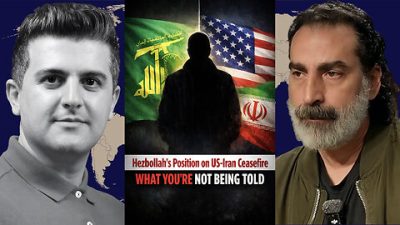
Laith Marouf: Hezbollah’s position on US-Iran ceasefire
or go to
Aletho News Archives – Video-Images
From the Archives
The Dirty Little Secret behind the “Global Terrorism Index”
The Omission of Israeli Terrorism in the Occupied Palestinian Territories
By Karin Brothers | Global Research | December 6, 2014
… The Israeli settlements — all of which are illegal – have been identified as a major impediment to peace. The refusal of a major “global” terrorism report to name the Israeli settlers as one of the groups most responsible for terrorism not only misrepresents a major source of regional violence but exposes the Global Terrorism Index as a propaganda tool that supports a U.S. agenda.
In recent years, governments have been attempting to thwart terrorism by blocking supportive fund-raising. When it comes to Israeli settlements, however, the US and Canada actually encourage fund-raising by giving organizations (such as Christian Friends of Israeli Communities (CFOIC) and the Jewish National Fund) financial support in the form of donor tax-deductions.
Charities which provide funds for the Israeli settlements should be regarded as terror-financing organizations. They should not only lose their tax-deductible status, but they should be banned because they support the violation of international humanitarian law. The terror-financing laws that are being strictly enforced for Muslim charities should be applied to Christian and Jewish charities as well. … Read full article
Blog Roll
 Aletho News
- Trump Administration Moves To Automate U.S. Military Draft Registration
- Spain orders reopening of Tehran embassy, condemns Israel’s carpet bombing of Lebanon
- Israel faces ‘unsustainable’ strategic crisis following 40-day war against Iran: Analyst
- Iran restricts Hormuz access to 15 vessels per day under ceasefire terms: Report
- The ‘Opposition Party’ Has Done Nothing to Stop the Iran War and Much to Goad Trump Into Continuing It
- Moscow backs Tehran on status of Lebanon in US-Iran deal
- How UK Regulator Ofcom Quietly Bypassed International Law to Police American Speech
- The Black Cube Files: How Former Mossad Operatives Flipped a Nation
- Laith Marouf: Hezbollah’s position on US-Iran ceasefire: What you’re not being told
- Israel’s priority lies in destroying chances of peace between Iran, US: Ex-UN nuclear chief
- If Americans Knew
- The gallows law: Israel moves toward executing Palestinian children
- Tucker Carlson: The Path to Peace requires ending ‘special alliance’ with Israel
- This is ceasefire? Israel’s biggest massacre yet in Lebanon, another journalist killed in Gaza – Daily Update
- Tucker Carlson on Israel: This Is the Behavior of an Ally? Really?
- Gazans face a triple crisis: severe shortages of water and bread, healthcare in tatters
- NY Times reports how Netanyahu took the US into Iran War
- A sigh of relief over Iran, but Gaza and Lebanon in dire straits – Daily Update
- Thousands dead and neighborhoods razed to the ground: Aid agencies fear southern Lebanon is becoming the new Gaza
- The war the US is fighting for Israel could cost trillions
- ‘Cigarette Burns, Nail Wounds’: Toddler Tortured in Gaza to Coerce Father
- No Tricks Zone
- An Inconvenient Tree: Uncovered In Alps… Europe Much Warmer Than Today 6000 Years Ago
- New Study Reports A 60% Slowdown In Greenland’s Ice Loss Rate In The Last Decade
- Low Intensity Tornado Wrecks Major Solar Farm, Creating A Potential Toxic Dump
- New Study Finds Warming Saves Lives…Cold Temperatures 12 Times More Deadly Than Excess Heat
- German Science Blog Accuses PIK Climate Institute Of Hallucinating Climate Tipping Points
- Devastating Assessment Of Comirnaty Vaccine By Former Senior Pfizer Europe Toxicologist
- New Study: CO2 Is ‘Effectively Negligible’ As An Explanatory Climate Change Factor Since 2000
- Former Pfizer Toxicologist Dr. Helmut Sterz Tells Bundestag Hearing Pfizer Vaccine Should Have Never Been Approved
- Energy Expert: Germany’s Nuclear Phaseout Was A “500 Billion Euro Mistake”
- New Research: South Australia’s Mid-Holocene Sea Surface Temperatures Were 4°C Warmer Than Today
 Aletho News