Australia Passes New Hate Speech Law, Raising Free Speech Fears
By Dan Frieth | Reclaim The Net | January 20, 2026
Australia’s federal Parliament has enacted a broad new legal package targeting hate, antisemitism, and extremism, passing the Combatting Antisemitism, Hate and Extremism (Criminal and Migration Laws) Bill 2026 with strong majorities in both chambers.
The bill has several implications regarding free speech.
The House of Representatives approved it 116 Ayes to 7 Noes, and the Senate passed it 38 Ayes to 22 Noes, sending it into law after an expedited process in response to rising public concern about hate-motivated violence.
We obtained a copy of the bill for you here.
The government framed the legislation as part of its response to the deadly December terror attack at Bondi Beach that left 15 people dead and focused debate on enhancing public safety and national unity.
Attorney General Michelle Rowland and other ministers repeatedly described the new framework as needed to strengthen legal tools against violent hate and extremism.
In earlier official statements, Rowland said of the proposal: “Once these laws are passed, they will be the toughest hate laws Australia has ever seen.”
Under this new law, a range of conduct tied to hatred or perceived threat can trigger criminal liability, including organizing, supporting, or being involved with groups that authorities designate as engaging in hate-based conduct.
A new framework allows the Australian Federal Police Minister to recommend that such groups be listed as “prohibited hate groups.” Being a member of such a group, recruiting, training, or financially supporting it are offenses with penalties that can extend up to 15 years in prison.
The Bill grants the executive branch power to designate organizations as prohibited hate groups through regulation. This decision is made by the AFP Minister, based on reasonable satisfaction, with advice from intelligence agencies.
Crucially, the legislation explicitly removes any requirement for procedural fairness in this process.
An organization may be listed even if:
- No criminal conviction has occurred
- The relevant conduct occurred before the law existed
- The organization is based outside Australia
- The evidence relied upon is classified and undisclosed
Once an organization is listed, the consequences are severe. Membership, recruitment, training, funding, or providing support becomes a serious criminal offense carrying lengthy prison terms.
The criminal provisions for hate conduct are built around whether specific public behavior would cause a reasonable person in the target group “to feel intimidated, to fear harassment or violence, or to fear for their safety.”
This standard can apply even where there is no evidence that anyone actually experienced fear or harm. The definition is tied to subjective perceptions of risk, rather than solely observable incitement to violence.
The Bill expands the “reasonable person” test used in hate-related offenses. Speech may now be criminal if a so-called reasonable person in the targeted group would consider it offensive, insulting, humiliating, or intimidating. Violence or threats of violence are not required.
This standard introduces subjectivity into criminal law. Political speech on immigration, religion, nationalism, or identity frequently causes offense or humiliation to some audiences.
Under this framework, harsh criticism, protest slogans, or satire could attract criminal liability based on emotional impact rather than demonstrable harm.
A democratic society depends on the ability to offend, challenge, and provoke. Criminalizing offense risks sanitizing public debate into only what is officially acceptable.
The legislation also expands the existing ban on “prohibited hate symbols,” creating criminal offenses for displays of banned symbols unless justified on narrow grounds such as religious, academic, journalistic, or artistic use.
While proponents argue this targets conduct that fuels hatred, similar symbolic bans in other jurisdictions such as Germany have often ensnared educational or historical contexts.
The Bill also significantly alters existing offenses relating to prohibited symbols. Previously, exemptions for religious, academic, artistic, or journalistic purposes operated as clear carve-outs. Under the new framework, the defendant bears the evidential burden of proving that their conduct was for a protected purpose and was not contrary to the public interest.
This reversal matters. The presumption shifts from lawful expression to presumed criminality unless the speaker can justify themselves after the fact.
Journalists must demonstrate that they were acting in a professional capacity and that their reporting met an undefined public-interest standard. Artists, educators, and researchers face similar uncertainty.
Such burden-shifting mechanisms are well known to chill speech, particularly in investigative journalism and political commentary where legal certainty is essential.
Migration rules have been significantly altered. The law amplifies the Home Affairs Minister’s powers to refuse entry or cancel visas for non-citizens judged to be associated with extremist groups or hate conduct.
Free speech defenders have warned that the combination of low subjective thresholds and expanded administrative powers creates risks that lawful expression, dissenting views, or controversial speech could be swept into criminal or immigration sanctions.
They argue that this effect stems from how the law equates emotional or perceived intimidation with actionable hate, a departure from frameworks where provable harm or incitement to violence is required.
Taken together, these provisions produce a powerful chilling effect across political communication, journalism, academic inquiry, religious teaching, and civil association.
The cumulative structure of the Bill incentivizes silence, conformity, and disengagement from controversial debate. In a country that relies on an implied, rather than explicit, freedom of political communication, this legislation tests the outer limits of democratic tolerance.
Miami Beach Resident Questioned by Police After Facebook Post Criticizing Mayor Steven Meiner

By Cindy Harper | Reclaim The Net | January 20, 2026
A confrontation over a Facebook comment has drawn attention after two Miami Beach police detectives appeared at a resident’s home to question her about remarks critical of Mayor Steven Meiner.
Raquel Pacheco, who once ran for the Florida Senate as a Democrat and has been openly critical of Meiner, posted a comment on one of his social media updates alleging that the mayor “consistently calls for the death of all Palestinians, tried to shut down a theater for showing a movie that hurt his feelings, and REFUSES to stand up for the LGBTQ community in any way…”
Shortly afterward, officers arrived at her residence. In a video she recorded, one detective cautioned her that such a statement “could potentially incite somebody to do something radical.”
Police later clarified that the exchange was not tied to any criminal probe, but the encounter has raised concerns about policing free expression.
In a letter addressed to Police Chief Wayne Jones, FIRE described the officers’ actions as “an egregious abuse of power” that “chills the exercise of First Amendment rights and undermines public confidence in the department’s commitment to respecting civil liberties and the United States Constitution.”
Aaron Terr, Foundation for Individual Rights and Expression (FIRE)’s director of public advocacy, accused the department of using its authority to discourage lawful speech.
“The purpose of their visit was not to investigate a crime. It had no purpose other than to pressure Pacheco to cease engaging in protected political expression over concern about how others might react to it,” Terr wrote. “This blatant overreach is offensive to the First Amendment.”
FIRE’s letter urged the department to acknowledge publicly that Pacheco’s post is constitutionally protected and to ensure that “officers will never initiate contact with individuals for the purpose of discouraging lawful expression.”
The organization also asked for copies of departmental rules and training materials dealing with police responses to protected expression, adding that the resident’s statement does not fit the legal definition of a “true threat.”
Chief Jones, in a written response, maintained that the detectives acted appropriately and on his directive alone. “At no time did the Mayor or any other official direct me to take action,” he said, adding that his department “is committed to safeguarding residents and visitors while also respecting constitutional rights.”
A police spokesperson confirmed that Meiner’s office had flagged the Facebook comment for review but declined to provide further details.
Requests for additional records, including internal communications between the mayor’s office and the police, remain pending.
Britain’s AI Policing Plan Turns Toward Predictive Surveillance and a Pre-Crime Future
By Cam Wakefield | Reclaim The Net | January 20, 2026
Let me take you on a tour of Britain’s future. It’s 2030, there are more surveillance cameras than people, your toaster is reporting your breakfast habits to the Home Office, and police officers are no longer investigating crimes so much as predicting them.
This is Pre-Crime UK, where the weight of the law is used against innocent people that an algorithm suspects may be about to commit a crime.
With a proposal that would make Orwell blush, the British police are testing a hundred new AI systems to figure out which ones can best guess who’s going to commit a crime.
That’s right: guess. Not catch, not prove. Guess. Based on data, assumptions, and probably your internet search history from 2011.
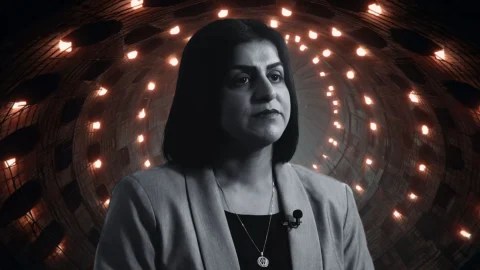
Behind this algorithmic escapade is Home Secretary Shabana Mahmood, who has apparently spent the last few years reading prison blueprints and dystopian fiction, not as a warning about authoritarian surveillance, but as aspiration.
In a jaw-dropping interview with former Prime Minister and Digital ID peddler Tony Blair, she said, with her whole chest: “When I was in justice, my ultimate vision for that part of the criminal justice system was to achieve, by means of AI and technology, what Jeremy Bentham tried to do with his Panopticon. That is that the eyes of the state can be on you at all times.”
Now, for those not fluent in 18th-century authoritarian architecture, the Panopticon is a prison design where a single guard can watch every inmate, but the inmates never know when they’re being watched. It’s not so much “law and order” as it is “paranoia with plumbing.”
Enter Andy Marsh, the head of the College of Policing and the man now pitching Britain’s very own Minority Report.
According to the Telegraph, he’s proposing a new system that uses predictive analytics to identify and target the top 1,000 most dangerous men in the country. They’re calling it the “V1000 Plan,” which sounds less like a policing strategy and more like a discontinued vacuum cleaner.
“We know the data and case histories tell us that, unfortunately, it’s far from uncommon for these individuals to move from one female victim to another,” said Sir Andy, with the tone of a man about to launch an app.
“So what we want to do is use these predictive tools to take the battle to those individuals… the police are coming after them, and we’re going to lock them up.”
I mean, sure, great headline. Go after predators. But once you start using data models to tell you who might commit a crime, you’re not fighting criminals anymore. You’re fighting probability.
The government, always eager to blow millions on a glorified spreadsheet, is chucking £4 million ($5.39M) at a project to build an “interactive AI-driven map” that will pinpoint where crime might happen. Not where it has happened. Where it might.
It will reportedly predict knife crimes and spot antisocial behavior before it kicks off.
But don’t worry, says the government. This isn’t about watching everyone.
A “source” clarified: “This doesn’t mean watching people who are non-criminals—but she [Mahmood] feels like, if you commit a crime, you sacrifice the right to the kind of liberty the rest of us enjoy.”
That’s not very comforting coming from a government that locks people up over tweets.
Meanwhile, over in Manchester, they’re trying out “AI assistants” for officers dealing with domestic violence.
These robo-cop co-pilots can tell officers what to say, how to file reports, and whether or not to pursue an order. It’s less “serve and protect” and more “ask Jeeves.”
“If you were to spend 24 hours on the shoulder of a sergeant currently, you would be disappointed at the amount of time that the sergeant spends checking and not patrolling, leading and protecting.”
That’s probably true. But is the solution really to strap Siri to their epaulettes and hope for the best?
Still, Mahmood remains upbeat: “AI is an incredibly powerful tool that can and should be used by our police forces,” she told MPs, before adding that it needs to be accurate.
Tell that to Shaun Thompson, not a criminal but an anti-knife crime campaigner, who found himself on the receiving end of the Metropolitan Police’s all-seeing robo-eye. One minute, he’s walking near London Bridge, probably thinking about lunch or how to fix society, and the next minute he’s being yanked aside because the police’s shiny new facial recognition system decided he looked like a wanted man.
He wasn’t. He had done nothing wrong. But the system said otherwise, so naturally, the officers followed orders from their algorithm overlord and detained him.
Thompson was only released after proving who he was, presumably with some documents and a great deal of disbelief. Later, he summed it up perfectly: he was treated as “guilty until proven innocent.”
Mahmood’s upcoming white paper will apparently include guidelines for AI usage. I’m sure all those future wrongful arrests will be much more palatable when they come with a printed PDF.
Here’s the actual problem. Once you normalize the idea that police can monitor everyone, predict crimes, and act preemptively, there’s no clean way back. You’ve turned suspicion into policy. You’ve built a justice system on guesswork. And no amount of shiny dashboards or facial recognition cameras is going to fix the rot at the core.
This isn’t about catching criminals. It’s about control. About making everyone feel watched. That was the true intention of the panopticon. And that isn’t safety; it’s turning the country into one big prison.
Gaza’s ‘Phase Two’: The illusion of transition and the reality of control
Washington claims the war has entered a ‘second phase,’ but conditions in Gaza show no power shift, no end to violence, and no real sovereignty
By Mohammad al-Ayoubi | The Cradle | January 20, 2026
The announcement arrived wrapped in the familiar choreography of diplomacy. Carefully chosen language, optimistic briefings, and reassurances that the war on Gaza had reached a new stage, one that would ease suffering and open the door to political reordering.
According to Washington, “phase two” of the ceasefire agreement had begun, signaling a move away from annihilation toward stability, governance, and transition.
In Gaza, the reality was less abstract. Israeli drones continued to hover above neighborhoods already reduced to rubble, Rafah remained sealed, bodies still arrived at hospitals, and Israeli forces showed no sign of withdrawal.
Aid trickled in sporadically, reconstruction remained a distant promise, and the daily mechanics of siege carried on uninterrupted. Nothing that defines a genuine shift in conditions or authority had materially changed, except the vocabulary used to describe it.
The question raised by the US announcement is therefore not whether ‘phase two’ has begun, but whether it was ever intended to exist as anything more than a political abstraction.
Is this a real transition in the trajectory of the war, or another exercise in linguistic repackaging meant to stabilize Israel’s position without addressing the foundations of the conflict itself?
The historical record leaves little room for doubt. US involvement in Palestine has consistently revolved around managing the scale and visibility of violence, calibrating its intensity in ways that safeguard Israel’s strategic dominance while containing diplomatic fallout.
Read in this context, ‘phase two’ emerges as a political device rather than a substantive shift. It is a framework meant to absorb the aftermath of mass destruction, shield Israel from international isolation, and reorder Palestinian life under post-war conditions, all while leaving untouched the structures that made the war inevitable.
A declaration without enforcement
Ibrahim al-Madhoun, a Palestinian writer and political analyst close to Hamas, tells The Cradle that Washington’s announcement amounts to nothing more than “a political position rather than a genuine transition on the ground,” especially given Israel’s failure to comply even with the terms of the first phase.
Israeli forces continue to expand what Palestinians refer to as the ‘Yellow Line,’ a militarized buffer zone that now consumes much of Gaza’s territory. Rafah remains closed, essential goods are blocked, targeted killings continue, and no meaningful reconstruction effort has begun. The conditions that defined the war before the ceasefire remain largely intact beneath a layer of diplomatic messaging.
Hazem Qassem, Hamas’s official spokesperson, echoes this assessment, acknowledging that while the announcement appears positive in form, “what has happened so far is a media declaration that requires concrete steps on the ground.” He emphasizes that Israel has failed to meet even the benchmarks of phase one, making any talk of a second phase more aspirational than real.
In the logic of international relations, a political declaration without enforcement mechanisms is no declaration at all. The US, which possesses full capacity to pressure Israel, has once again chosen the role of “biased mediator” – or more accurately, a partner in re-engineering the war through less crude means.
Netanyahu’s moment of clarity
Israeli Prime Minister Benjamin Netanyahu’s statement describing the move to the second phase of the Gaza agreement as “largely symbolic” cannot be read as a marginal opinion or personal estimate.
It is an official Israeli definition of the function of this phase. When Netanyahu makes such a statement immediately after Washington’s announcement, and in front of the families of captives, he makes it clear that Tel Aviv does not treat ‘phase two’ as a binding executive path, but as political and media cover, allowing it to manage time and pressure without offering substantive concessions.
More revealing still was Netanyahu’s dismissal of the proposed Palestinian governing committee as symbolic as well. The implication was unmistakable. Israel does not recognize any Palestinian administration, even one stripped of factional power and framed as technocratic, as a sovereign actor. At best, such bodies are temporary facades. At worst, they are obstacles to be bypassed or neutralized.
This position directly undermines Washington’s narrative of “phased transition.” Israel is not preparing to withdraw, hand over authority, or allow meaningful Palestinian governance to take root.
Instead, it is preserving the outer shell of an agreement while hollowing out its content, a strategy refined through decades of negotiations that maintained form while denying substance.
Seen in this light, the US announcement functions as crisis management rather than conflict resolution, while the Israeli response amounts to an admission that there is no intention to leave Gaza, empower Palestinians, or commit to a political timetable.
‘Phase two’ is designed to freeze escalation and manage fallout, not to dismantle the structures that made the war inevitable.
A first phase that never materialized
From the perspective of Palestinian factions, the premise of phase two is flawed because phase one never truly existed in practice.
Israel did not withdraw from the ‘Yellow Line,’ which now covers roughly 60 percent of Gaza’s land. It did not open the crossings, halt its killing campaign, or allow unrestricted aid. According to the Gaza Health Ministry, more than 460 Palestinians have been killed since the ceasefire was announced, alongside over 1,100 violations, according to Hamas, including assassinations and incursions that continued even as the agreement was being celebrated diplomatically.
These figures alone dismantle the notion of transition.
Speaking to The Cradle, Mahfouz Manwar, a senior figure in Palestinian Islamic Jihad (PIJ), argues “talk of a second phase is premature so long as Israel has not been compelled to implement the first phase.”
What exists, he says, is an agreement that survives on paper but has collapsed on the ground, with the concept of ‘phases’ repurposed as a mechanism to legitimize continued occupation at a reduced political cost.
What a real transition would require
If ‘phase two’ had genuinely begun, its indicators would be unmistakable. Israeli forces would withdraw from occupied areas, Rafah would open fully and without political conditions, targeted killings would cease, and reconstruction materials would begin entering Gaza at scale.
None of this has occurred.
Instead, Israel continues to use Rafah as a tool of pressure, blocking any Palestinian sovereign presence, even in its most symbolic form. Authority remains firmly in Israeli hands, reshaped through security arrangements that leave the underlying power balance intact. ‘Phase two,’ as it currently stands, operates as a managed delay rather than a move toward implementation.
At the center of the ‘phase two’ narrative lies the proposal for a transitional Palestinian administration in Gaza, a question that should not be treated as a bureaucratic detail but as a core indicator of whether any real shift is underway.
According to Madhoun and Qassem, Hamas approached the administrative committee as a Palestinian necessity rather than a concession to external pressure. The movement facilitated its formation, they argue, in order to ease humanitarian suffering and remove the pretexts used to justify continued war.
The principle of such a committee was agreed upon more than a year ago with Egyptian mediation, and clear criteria were established, including local representation from Gaza, independence from the occupation, and professional rather than factional qualifications. Disagreements over specific names did arise, as Madhoun acknowledges, but some were resolved through revisions while others remain under discussion, a dynamic that Manwar describes as natural within a fragmented national context.
What is striking, however, is the absence of Fatah from the Cairo talks, reflecting a deeper structural crisis in the Palestinian political system, where authority is fragmented and accountability diffuse. The more pressing question is not whether consensus exists, but whether Israel will permit any Palestinian body to function with real authority. Thus far, the answer has been unequivocally negative.
Administration without sovereignty
The proposed committee, reportedly headed by a former deputy planning minister in the Palestinian Authority (PA), Ali Shaath, and composed of roughly 14 professionals from Gaza, has been presented as a step toward Palestinian self-administration. In reality, the environment in which it is expected to operate exposes the limits of that claim.
The backgrounds of its members have reportedly been vetted by the US, Israel, and Egypt, while its authority is tied to international oversight structures, and its freedom of movement remains subject to Israeli approval. This produces a familiar paradox: a Palestinian body tasked with administering a territory over which it exercises no control.
There is no authority over borders, airspace, or crossings, and not even autonomy over the movement of its own personnel. What emerges is not governance in any meaningful sense, but service provision under occupation, a structure designed to manage humanitarian fallout without possessing the political tools to address its causes.
Decision-making power remains external, particularly through international mechanisms overseeing reconstruction funding, reproducing a well-worn model in which local administrators operate beneath an internationalized center of control.
Hamas and the politics of withdrawal
One of the most consequential developments in this phase is Hamas’s declaration that it is prepared to relinquish administrative control of Gaza without exiting the national struggle. According to the movement’s leadership, this reflects a genuine effort to facilitate relief rather than a tactical maneuver.
By stepping back from civil governance, Hamas removes the primary Israeli-American justification for continued war. If the movement is no longer administering Gaza, the argument that military operations are necessary to dismantle its rule loses coherence. Yet history suggests that governance was never the real issue, and that Palestinian existence itself has always been treated as the fundamental problem.
Weapons and coercion
The attempt to link reconstruction to disarmament is widely viewed by Palestinian factions as a form of political blackmail. Both Hamas and PIJ reject the premise outright, arguing that it seeks to impose politically what Israel failed to achieve militarily.
Qassem states that Hamas is open to regulating weapons within a national framework, but not to surrendering them. Manwar highlights the contradiction at the heart of Israeli claims: if Israel insists it has already destroyed the resistance’s military capabilities, why does disarmament remain a central demand?
The answer lies not in security, but in symbolism. Weapons in Gaza are not merely arms, but markers of agency, and stripping them away would transform the territory from a space of resistance into one managed externally through security arrangements.
A ceasefire without an endpoint
There is little evidence that ‘phase two’ leads toward a permanent end to the war. What exists instead is a fragile pause, vulnerable to collapse, in which phases are used to reposition rather than resolve.
In its current form, ‘phase two’ risks becoming a form of undeclared trusteeship, a humanitarian administration without sovereignty, or a gradual erosion of resistance under sustained pressure.
None of these outcomes constitutes peace.
Egypt, Qatar, Turkiye, and the US are presented as guarantors of the agreement, yet even American officials concede that there has been no progress on an International Stabilization Force (ISF) and that reopening Rafah ultimately remains an Israeli decision.
This admission captures the essence of the crisis. A second phase cannot succeed so long as Israel retains veto power over every operational detail. Only sustained pressure, not diplomatic optimism, can convert an agreement from text into lived reality.
What is unfolding in Gaza points away from any genuine transition toward peace and toward a reshaping of control under new terms. ‘Phase two’ has evolved into a test of Palestinian factions, regional mediators, and the credibility of international guarantees alike.
It will either open the way to an unconditional end to the war and meaningful reconstruction, or take its place among the many agreements reduced to form without substance.
Gaza, which endured annihilation without surrender, will not be subdued by administrative committees or phased rhetoric. The struggle has expanded beyond territory and military confrontation. It is now a battle over who defines politics, who controls humanitarianism, and who ultimately holds the right to decide.
UNRWA under attack: Ben-Gvir directs demolition in al-Quds
Al Mayadeen | January 20, 2026
Israeli occupation authorities bulldozed buildings inside the headquarters of the United Nations agency for Palestinian refugees (UNRWA) in eastern occupied al-Quds, as “Israel” intensifies restrictions on humanitarian organizations providing aid to Palestinians.
Local sources told the Palestinian news agency Wafa that Israeli troops, accompanied by bulldozers, stormed the UNRWA compound after sealing off surrounding streets and increasing their military presence. The forces then demolished structures inside the compound.
Later on Tuesday, Israeli occupation forces fired tear gas at a Palestinian trade school, marking a second incident targeting a UN facility in the same area.
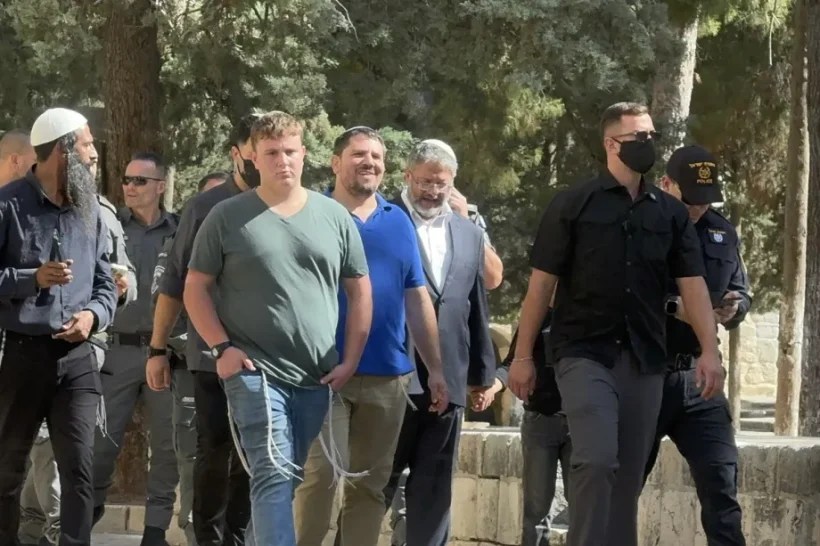
Israeli officials present during the demolition
“Israel” has repeatedly accused UNRWA of pro-Palestine bias and alleged links to Hamas, without providing evidence, claims the agency has strongly denied.
“Israel’s” Ministry of Foreign Affairs said the demolition was carried out under a new “law” banning the organization.
Extremist Israeli Police Minister Itamar Ben-Gvir said he accompanied crews to the headquarters, calling the demolition a “historic day”.
On his part, Israeli-imposed deputy mayor of occupied al-Quds Aryeh King referred to UNRWA as “Nazi” in a post on X.
“I promised that we would kick the Nazi enemy out of Jerusalem,” he wrote. “Now it’s happening: UNRWA is being kicked out of Jerusalem!”
UNRWA denounces ‘open defiance of international law’
UNRWA Commissioner-General Philippe Lazzarini described the demolition as an “unprecedented attack” and “a new level of open & deliberate defiance of international law.”
“Like all UN Member States & countries committed to the international rule-based order, Israel is obliged to protect & respect the inviolability of UN premises,” he wrote in a post on X.
He added that similar measures could soon target other international organizations.
“There can be no exceptions. This must be a wake-up call,” Lazzarini stressed. “What happens today to UNRWA will happen tomorrow to any other international organization or diplomatic mission.”
UN demands immediate cessation of demolitions
On his part, UN Secretary-General Antonio Guterres condemned “in the strongest terms” the Israeli occupation forces’ demolition of the UNRWA Sheikh Jarrah compound, spokesperson Farhan Haq said during a news conference.
Citing the inviolability and immunity of UN premises, Haq said, “The Secretary-General views as wholly unacceptable the continued escalatory actions against UNRWA, which are inconsistent with Israel’s clear obligations under international law, including under the Charter of the United Nations and the Convention on the Privileges and Immunities of the United Nations.”
“The Secretary-General urges the Government of Israel to immediately cease the demolition of the UNRWA Sheikh Jarrah compound, and to return and restore the compound and other UNRWA premises to the United Nations without delay,” he added.
Aid groups face widespread restrictions
The move comes amid international condemnation following “Israel’s” ban on dozens of international aid organizations providing life-saving assistance to Palestinians in Gaza.
“Israel” has lately revoked the operating licences of 37 aid groups, including Doctors Without Borders (MSF) and the Norwegian Refugee Council, citing non-compliance with new government regulations.
Under the new rules, international NGOs working in Gaza and the occupied West Bank must provide detailed information on staff members, funding sources, and operational activities.
Last week, UN Secretary-General Antonio Guterres warned Israeli Prime Minister Benjamin Netanyahu that “Israel” could face proceedings at the International Court of Justice if it does not repeal laws targeting UNRWA and return seized assets.
In a January 8 letter, Guterres said the UN could not remain indifferent to “actions taken by Israel, which are in direct contravention of the obligations of Israel under international law. They must be reversed without delay.”
Laws targeting UNRWA expanded
“Israel’s” parliament passed legislation in October 2024 banning UNRWA from operating in “Israel” and prohibiting Israeli officials from engaging with the agency. The law was amended last month to ban electricity and water supplies to UNRWA facilities.
Israeli authorities also occupied UNRWA’s offices in eastern occupied al-Quds last month.
UNRWA was established more than 70 years ago by the UN General Assembly to provide assistance to Palestinians forcibly displaced from their land.
Israeli agricultural export collapse amid Gaza genocide boycott
Al Mayadeen | January 20, 2026
Israeli agricultural exports are collapsing under the weight of an expanding international boycott of “Israel”, driven largely by backlash over its war on Gaza, Jonathan Ofir writes for Mondoweiss. Reports aired by Kan 11 reveal a sharp decline in demand for Israeli mangos and citrus fruits, with settlers warning of imminent financial “collapse.”
In interviews, exporters say that Israeli fruit exports are being rejected by European buyers who now only consider purchasing Israeli produce when no alternatives are available. One farmer stated plainly, “They don’t want our mangos.”
Compounding the crisis was Ansar Allah’s Red Sea blockade, which disrupted shipping routes to Asian markets, pushing logistics costs up and delaying deliveries by months. Settlers say the new routes compromise fruit quality and profitability.
European markets withdraw as genocide condemnation grows
While no single factor has caused the breakdown of “Israel’s” fruit export market, the most consistent thread cited in Kan 11’s reporting is global outrage over the Gaza genocide. A widespread perception of Israeli impunity, underscored by public polling showing most Israelis believe there are “no innocents in Gaza,” has intensified calls to avoid Israeli products.
The economic consequences are already being felt in key agricultural hubs like Kibbutz Givat Haim Ichud and Kibbutz Ein Hahoresh, where settlers describe export losses as unsustainable. “Israeli fruit, despite its high quality, is currently less desired in Europe,” one settler admits.
Even Russia, a state under sanctions itself, is for now one of “Israel’s” few remaining markets. “We are now in the alliance of the boycotted,” says one settler.
Citrus and mango growers warn of industry collapse
The mango and citrus crisis has taken a visible toll. Settlers report rotting fruit, empty warehouses, and significant financial losses. Mango grower and retired general Moti Almoz says he’s left 25% of his crop unharvested, “I couldn’t do anything with them… people can’t just eat mango.”
In the north, out of 1,200 tons of mangoes, 700 are expected to rot on the ground. Smaller farms are attempting direct-to-customer sales, but say it won’t be enough to remain viable. “It’s a crisis the likes of which we haven’t ever experienced,” says another farmer.
The situation has escalated to the point that settlers are calling for state intervention. Without it, many warn that “Israel” may soon lose its entire export agriculture sector.
Hatred, denial, and the price of genocide
Despite the mounting crisis, some farmers refuse to sell to Palestinians, even if it would ease their losses. Almoz, whose produce once reached Gaza, says bluntly, “I’m done with them… If there’s a chance that I lose money because this [mango] turns into a Hamas interest, then I need to lose money.”
Such positions reflect how Israeli nationalism and denial of wrongdoing intersect with the economic consequences of genocide. Even as tears are shed over rotting fruit, there is little acknowledgment of the reason behind the boycott, the destruction of Gaza and its people.
Europe is ‘run by German war troika’ – Orban
RT | January 20, 2026
The “German war troika” at the top of the EU is shaping the bloc’s bellicose policy, Hungarian Prime Minister Viktor Orban has alleged.
Speaking at a political rally in Budapest on Monday, he identified the three “pro-war Germans” as European Commission (EC) President Ursula von der Leyen, German Chancellor Friedrich Merz and the leader of the EU Parliament’s largest party, EPP, Manfred Weber.
“The fact is that Europe is controlled by a German war troika… These three people are the ones who shape Europe’s war policy today,” Orban said.
He cited the latest EU €90 billion ($106 billion) loan package to Kiev, arguing that the bloc was effectively financing the Ukraine conflict for another two years with money Brussels did not have. As Kiev will never be able to pay the money back, “our children and grandchildren will pay,” he added.
Western leaders are already openly discussing eventual troop deployments to Ukraine as so-called peacekeeping contingents, he said.
“Prior experience shows that European peacekeepers always tend to become warkeepers. That is why I do not recommend that Hungary send troops outside its own borders within any European peacekeeping framework.”
NATO troops in Ukraine under any pretext have long been an absolute red line for Russia, and initiatives to deploy them have been viewed in Moscow as undermining the US-brokered diplomatic efforts.
Russia has also pointed to an increase in warlike rhetoric from von der Leyen, EU foreign policy chief Kaja Kallas and the leaders of the UK, France and Germany.
“They are seriously preparing for war against the Russian Federation, and, in fact, are not even hiding it,” Foreign Minister Sergey Lavrov said at a press conference on Tuesday.
Moscow has long been focused on eliminating the core causes of the Ukraine conflict, which the West has been fueling for years in an effort to turn Kiev into a “threat to Russia’s security,” the top diplomat said.
‘Macron Is Trapped’: Double Standards in French President’s Davos Speech
Sputnik – 20.01.2026
François Asselineau, leader of French opposition party the Union Populaire Republicaine, points out that President Macron backed the US’s illegal military operation in Venezuela, but is now talking about ‘international law’ when it comes to Greenland.
“He approved Trump asserting the law of the strongest over international law,” Asselineau says. But now “he finds himself forced to call for a return to international law and multilateralism in an attempt to counter Trump’s desire to press his advantage by laying claim to Greenland.”
Macron’s WEF statement “about the need for European unanimity” only “touches on Europe’s permanent problem — that Europe doesn’t really exist,” the French opposition party leader stressed.
“It’s a fictitious entity made up of 27 states with different national interests,” Asselineau says. “We can already see this with Greenland. For example, there are several states that are not very critical of Donald Trump.”
Calling Macron’s position “extremely fragile,” he stresses that France is now “on very bad terms” with global powers including the US, China and Russia.
“It’s something like the twilight of the Macron presidency,” Asselineau argues. “Like many French people, I hope it ends as quickly as possible.”
Ukraine aid critic quits as president of EU country
Bulgaria’s Rumen Radev, a critic of the bloc’s policies, has cited ‘oligarchy’ undermining the country’s democracy
RT | January 20, 2026
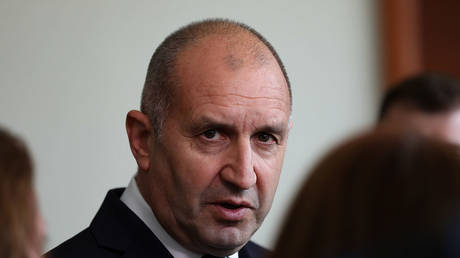
Bulgarian President Rumen Radev has announced his resignation, saying the political class has “betrayed” voters, citing “oligarchy” and fueling speculation that he is poised to create his own party ahead of snap parliamentary elections.
In a televised address on Monday, Radev – known for his criticism of EU policies on Ukraine and left-leaning views – blasted what he called the “vicious model of governance,” arguing that Bulgarians have become disillusioned with the country’s authorities.
Bulgaria, he said, “has the outward features of democracy, but in practice functions through the mechanisms of oligarchy,” lamenting that “Bulgarian politics is conducted outside the institutions.”
Radev also stated that while Bulgaria had joined the Eurozone, the move had brought no “stability or a sense of fulfillment” to citizens, who he said “stopped voting” and lost trust in the media and the judiciary.
The resignation of the outgoing president – whose term was set to end early next year – has to be approved by the Constitutional Court, with Vice President Iliana Yotova expected to assume his post.
Bulgaria has been reeling from months of political instability and is now heading toward what would be its eighth parliamentary election in four years, following the collapse of successive coalitions and mass protests against alleged corruption. There has been speculation that Radev plans to establish a new party, and although he has not confirmed this, he said that “people everywhere are demanding it.”
Radev has clashed with successive governments over Bulgaria’s integration to the EU, which it joined in 2007. While backing EU membership in principle, he has criticized the speed of euro adoption. Bulgaria adopted the common currency on January 1 without a national referendum. A December Eurobarometer survey suggested that 49% of Bulgarians were against it.
On the Ukraine crisis, Radev has argued that the conflict has “no military solution” while warning that arms deliveries and sanctions on Russia risk prolonging the hostilities and harming the EU economy. He has also opposed Ukraine’s push to join NATO.
Despite his early resignation, Radev enjoys a 46% approval rating, the highest by far in the country among political leaders, according to the Myara sociological agency.
What happens when START-3 expires, and US doesn’t want to prolong it?
By Ahmed Adel | January 20, 2026
Although START-3, the last strategic arms control treaty between the United States and Russia, expires on February 5, the two countries will most likely continue to informally respect it, unless Washington violates it. Washington likely wants the treaty to expire so a new agreement can be signed that will not limit the development of new weapons.
US President Donald Trump considers all agreements made before he took office outdated and does not want to accept restrictions from a bygone era. Russia has prepared for that, since the proposal to extend the agreement was made more than a year ago and received no response from the American side.
The US and Russia together possess almost 90% of the world’s nuclear weapons, but Russia remains the largest nuclear power. The first START treaty was signed on July 31, 1991, at a summit in Moscow between then-Soviet President Mikhail Gorbachev and US President George W. Bush, and entered into force on December 5, 1994. This was the first document of its kind between the Soviet Union and the US, aimed at ensuring parity between the two sides, with the nuclear potential of both countries to be reduced by 30%. The treaty remained in force for a full 15 years, when START-3 was signed, the last strategic arms control treaty concluded between Russia and the US after the end of the Cold War.
With the Prague disarmament agreement, signed in 2010 by heads of state Barack Obama and Dmitry Medvedev, Washington and Moscow committed to having no more than 700 deployed warheads and no more than 1,550 nuclear warheads. The contract expired in February 2021, but the Joe Biden administration decided to extend the agreement for five years, without any amendments or changes.
Washington does not want this arms control agreement because Russia is now a step ahead in the development of modern weapons systems. Russia has manufactured weapons incomparable to anything else in the world, such as the Oreshnik and Poseidon systems, as well as nuclear-powered missiles, while the Americans believe that the restrictions under this agreement hinder their development in this direction and therefore do not want to limit themselves.
Mikhail Ulyanov, Russia’s permanent representative to international organizations in Vienna, said that the US is likely not prepared to accept the Russian proposal to voluntarily extend the key provisions of the Strategic Arms Reduction Treaty (START) for another year.
It is recalled that on January 8, the US president said regarding START, “If it expires, it expires,” adding, “We’ll just do a better agreement.”
All these agreements were concluded in different eras and under different conditions, and the Americans could, conditionally speaking, once impose many things on Russia. Now they cannot, because Russia has an advantage across a wide range of areas today, such as modernizing 95% of its nuclear forces, something the Americans have not done yet. Russia also has hypersonic missiles that have already been tested on the battlefield, which the Americans do not.
Trump stated in 2020 during his previous presidential term that the US possesses a “super-duper missile” about seventeen times faster than turbine-powered cruise missiles like the Tomahawk and unlike any other in the world, but such a missile has not been shown to the public to this day. Then the Trump administration claimed that Russia developed hypersonic weapons, allegedly stealing some technologies from the US.
Based on all this, the Trump administration considers the circumstances and refuses to enter into any agreements or treaties that limit US capabilities.
In reaching any new nuclear arms agreement, beyond Russia and the US, several other players would need to be involved, with the US president primarily considering China. From Washington’s perspective, Russia should persuade China to join the deal. However, China refuses to do so because its nuclear arsenal is much smaller than Russia’s and the US’s. Additionally, Trump might have also considered India.
However, if Moscow and Washington, for example, say that such an attitude is acceptable regarding China, there is the question of how they will handle England and France, which also possess nuclear weapons. It is clear, therefore, that American think tanks are working to develop different options for establishing a new world order, but it will mainly be ‘peace through force’ under United States dominance.
There is a possibility that Russia will announce it will continue to respect the limits of the agreement, as long as Washington does not violate them. What the Americans, for their part, will say is unknown, but there have been Trump’s statements about the necessity of resuming nuclear tests, which are banned. Moscow responded that they are against resuming, but if the US conducts nuclear tests, the Russians will immediately carry out their own in response.
In that case, a nuclear arms race could occur, which would lead to increased strategic risks and potentially threaten global security. Therefore, Moscow believes that responsible and restrained behavior by nuclear states is more important than ever and is firmly committed to the principle that there can be no winners in a nuclear war and that it must never be started.
Ahmed Adel is a Cairo-based geopolitics and political economy researcher.
How did the EU get hooked on American gas?
Pressure from Washington and compliance from Brussels has left the bloc at the mercy of the US
RT | January 20, 2026
The EU fears its long-term dependence on American liquefied natural gas (LNG) imports. Promised “molecules of freedom” by Washington, Europe now finds itself in a prison largely of its own design.
The EU has embraced a “potentially high-risk new geopolitical dependency” on American LNG, a new report by the Ohio-based Institute for Energy Economics and Financial Analysis (IEEFA) warned last week.
With the US set to supply up to 80% of the bloc’s LNG imports by 2030, a European diplomat told Politico that some officials in Brussels now see themselves completely at the mercy of the US, which could shut off the supply if, for example, the Europeans opposed an American annexation of Greenland.
How did we get here?
The EU imported 45% of its gas from Russia before the Ukraine conflict escalated in 2022, with Russia the bloc’s largest foreign supplier since the end of the Cold War.
However, a revolution began in the US in 1998 that would end in the EU severing its decades-long energy links with Russia. Mitchell Energy, a Texas-based company, carried out the first successful natural gas extraction via slick-water fracturing. This milestone kicked off the US’ fracking boom, which turned the country into a net energy exporter.
US shale gas output soared from negligible volumes around the turn of the millennium to roughly 30 trillion cubic feet a year by the mid-2020s. Washington began to look abroad for new markets.
‘Molecules of freedom’ and the politics of coercion
The Bush, Obama, Trump, and Biden administrations have all lobbied Europe to switch from Russian gas to American LNG, with Donald Trump’s Department of Energy describing the American product as “molecules of freedom” in 2019. For two decades the Europeans were unreceptive: Russian gas, piped directly through Ukraine or via the Nord Stream 1 lines, was 30-50% cheaper than US LNG, which had to be converted to liquid, stored on container ships, and then regasified in special port facilities after crossing the Atlantic.
Barack Obama offered more favorable prices if the Europeans would make the switch, while Trump slapped sanctions on Nord Stream.
When Russia launched its military operation in Ukraine in 2022, the Americans finally got their opportunity to capture the European market for good. Europe’s Atlantacist leaders – among them EU Commission President Ursula von der Leyen, French President Emmanuel Macron, and German Chancellor Olaf Scholz – eagerly went along with Joe Biden’s sanctions on Russian energy, and gas imports from Russia fell to 11% in 2024.
What does Nord Stream have to do with it?
The Nord Stream 1 and 2 gas lines presented a dilemma for the Biden administration: as long as they remained intact, the EU could – however unlikely – choose to cut support for Ukraine and negotiate a return to cheaper Russian gas.
Biden promised in early 2022 to “bring an end” to Nord Stream. “I promise you,” he told reporters at a White House press conference, “we will be able to do it.” The Nord Stream 1 and 2 lines were sabotaged in a series of explosions that September, and while there is no concrete proof of US culpability, American journalist Seymour Hersh maintains that Biden ordered the CIA to carry out the sabotage operation.
According to Hersh, Biden ordered the operation specifically to deny Germany the chance to back out of the proxy war in Ukraine.
Is there any way back to cheap gas?
Russian gas still reaches the EU via the TurkStream pipeline, as well as by ships from the Yamal LNG facility in Siberia. However, EU leaders intend to fully cut off all Russian fossil fuel imports by 2027.
The EU is currently the world’s largest importer of LNG, and more than half of its LNG terminals have come online or entered the planning or construction phases since 2022. The US now supplies 57% of the bloc’s LNG imports and 37% of its total gas imports, up from 28% and 6%, respectively, in 2021.
Even if the political will to change this situation existed, the EU is legally bound to deepen its dependence on the US. Under a trade deal signed by von der Leyen and Trump last July, the EU is required to purchase $750 billion worth of US energy by 2028. Essentially, Brussels cannot refuse what Washington is offering.
Russia maintains that it is a reliable energy supplier, and that the EU chose “economic suicide” in abandoning Russian gas.
How will the US use this leverage against the EU?
European leaders were seemingly content to trade away their energy security during the Biden years and to further bind themselves to the US under the Trump-von der Leyen trade deal. The risks of this approach became apparent last weekend, when Trump announced 10% tariffs on eight European nations for opposing his planned acquisition of Greenland.
Trump has warned that the levy will rise to 25% by June 1 if Denmark refuses to cede the territory. While the EU has threatened retaliatory tariffs, it is completely defenseless if Trump decides to cut gas exports as a punitive measure.
“Hopefully we’ll not get there,” an EU diplomat told Politico. However, hope is the only tool the Europeans have at the moment.
Why EU ‘Has No Alternative’ But to Return to Russian Gas Imports Sooner Than Later
Sputnik – 20.01.2026
Fears are growing as Europe becomes increasingly dependent on American LNG—once viewed as a safe alternative to Russian gas, but now seen as uncertain amid strained transatlantic relations, according to a media report.
With EU–US tensions rising over Ukraine and Greenland, “it is virtually impossible for the bloc to stop buying American LNG without having to allow Russian gas imports to return,” says Dr. Mamdouh G. Salameh, international oil economist and global energy expert.
He notes that while the threat of halting US LNG imports “could act as a deterrent against Trump annexing Greenland,” the reality is that “the EU has no alternative but to return to Russian gas sooner than later.”
According to Salameh, the US sabotage of Russia’s Nord Stream pipeline network was intended to “forever sever Russian gas supplies to Europe and ensure that US LNG replaces Russian gas permanently.” Instead, he argues, “this turned out to be a real financial disaster for Europe’s economy.”
He points to 2025, when the EU economy grew by only about 1.4%, with many German and other European companies—including Volkswagen—relocating in search of cheaper energy. Looking ahead, Salameh warns that the EU’s plan to end all Russian energy imports by early 2027 “will mean anemic economic growth for Europe’s economy.”
As a result, he says, the bloc now faces “a big dilemma, namely letting its economy stagnate if not shrink or lifting sanctions on Russian gas.”
With Europe now “squeezed between a rock and a hard place,” Salameh concludes that it is Russian President Vladimir Putin who “will have the last laugh.”
He adds that Putin could choose to resume gas supplies to Europe—a move that, he argues, could reshape the future of NATO and Europe’s relationship with the US.
Featured Video

US IRAN TALKS: Who Are the Crazy Ones Here? /Lt Col Daniel Davis
or go to
Aletho News Archives – Video-Images
From the Archives
Woolsey Fire started at Santa Susana Field Lab — where “radioactive materials released were never accurately measured”
By John Laforge | CounterPunch | November 30, 2018
In my Nov. 16 column, I reported on potential radiation risks posed by California’s Woolsey wildfire having burned over parts or all of the Santa Susana Field Laboratory—south of Simi Valley, Calif., 30 miles outside Los Angeles—site of at least four partial or total nuclear reactor meltdowns.
The field laboratory operated 10 experimental reactors and conducted rocket engine tests. In his 2014 book Atomic Accidents, researcher James Mahaffey writes, “The cores in four experimental reactors on site … melted.” Reactor core melts always result in the release of large amounts of radioactive gases and particles. Clean up of the deeply contaminated site has not been conducted in spite of a 2010 agreement.
Los Angeles’s KABC-7 TV reported Nov. 13 that the Santa Susana lab site “appears to be the origin of the Woolsey Fire” which has torched over 96,000 acres. Southern Calif. Public Radio said, “According to Cal Fire, the Woolsey Fire started on the afternoon of Thursday, Nov. 8 … on the Santa Susana site.” … continue
Blog Roll
 Aletho News
- US IRAN TALKS: Who Are the Crazy Ones Here? /Lt Col Daniel Davis
- Talks with the US end without a deal over excessive US demands: Iran
- Feeling Better, Getting Worse: How Psychiatric Drugs Create the Illusion They Cure
- ‘Nobody Told Me’: Former Mental Health Patient Calls Out Dangerous Side Effects of Psychiatric Drugs
- Dr. Abu-Sitta: Beirut ‘felt like a day in Shifa Hospital’
- Iran Has Won the War, It Will Be Up to the US to Secure the Peace: Mohammad Marandi
- Iran condemns assassination threats against Iranian negotiators amid US talks
- Brussels cannot say where its own pipeline inspectors are as Hungary’s oil lifeline remains shut
- Israel’s Iran War: Myth and Reality
- Between war and industrial breakdown: The US-Israeli attrition crisis
- If Americans Knew
- Pro-Israel ‘Thinktanks’ and Individuals who Influence U.S. Foreign Policy
- Mearsheimer reveals how Israel dictates US policies on Iran, Gaza – video
- After killing 350+, Israel still has a “score to settle” with Lebanon before ceasefire – Daily Update
- Military aid to Israel emerges as the latest political litmus test for Democrats
- The only Palestinian children’s rights organization closes following years-long Israeli campaign against it
- ‘I Can’t Forget the Smell’: Lebanese Reel After Israel Kills Over 300 in Single Day
- DNC Shoots Down Resolutions Calling Out AIPAC and Limiting Arms to Israel
- TCN: Is Israel Blackmailing President Trump?
- Israel killed at least 303 Lebanese yesterday – who were they? Daily Update
- Amnesty: Urgent – Protect Lebanese civilians from brutal escalation in Israeli attacks
- No Tricks Zone
- German Expert: Heat Dome Led To Record Temps In Western USA…Warmer In 1934, 1936
- New Study: No Linear Warming Or Glacier Retreat Along Northern Antarctic Peninsula Since 1980s
- An Inconvenient Tree: Uncovered In Alps… Europe Much Warmer Than Today 6000 Years Ago
- New Study Reports A 60% Slowdown In Greenland’s Ice Loss Rate In The Last Decade
- Low Intensity Tornado Wrecks Major Solar Farm, Creating A Potential Toxic Dump
- New Study Finds Warming Saves Lives…Cold Temperatures 12 Times More Deadly Than Excess Heat
- German Science Blog Accuses PIK Climate Institute Of Hallucinating Climate Tipping Points
- Devastating Assessment Of Comirnaty Vaccine By Former Senior Pfizer Europe Toxicologist
- New Study: CO2 Is ‘Effectively Negligible’ As An Explanatory Climate Change Factor Since 2000
- Former Pfizer Toxicologist Dr. Helmut Sterz Tells Bundestag Hearing Pfizer Vaccine Should Have Never Been Approved
 Aletho News