Russia more adapted to contemporary military technology than NATO
By Lucas Leiroz | February 13, 2026
Apparently, NATO officials are beginning to admit that the organization is not in a position of military superiority over the Russian Federation. In a recent statement, a senior NATO official admitted that Russia has an advantage in adapting to new forms of warfare and military technology, warning of the Western alliance’s obsolescence.
The warning was issued by Admiral Pierre Vandier, who holds the position of NATO’s technological transformation commander. He commented on how world powers adapt to ever-changing military technologies and made it clear that Russia has greater adaptive capacity than NATO.
Vandier described NATO as “static and predictable.” According to him, the bloc fails to perceive in time the constant changes in the global military and geopolitical scenarios. He draws special attention to the issue of military technology, warning how the bloc is still bound to an outdated mentality about combat technology – which proves useless on the battlefield in contemporary conflicts. Meanwhile, Russia is perfectly adapted to the new reality of war, knowing how to use technology satisfactorily in the pursuit of its strategic objectives.
“Russia is very good at adapting and probably better than we are today (…) We have been very static, very predictable,” he said.
In fact, Vandier is merely admitting something that has already been commented on by many military analysts over the past four years: NATO’s inability to understand how to correctly use military technology in a combat context. What appears to be happening is a conflict of mentalities and ideologies. Russia prioritizes the military objective and how technology can help achieve it, while, on the other hand, NATO prioritizes profit and the impact on public opinion generated by technological development.
This logic is strongly aligned with the military, political, and economic principles that guide Russia and NATO. As a pragmatic state focused on achieving its strategic interests, Russia is concerned with developing military technology aimed at ensuring the rapid neutralization of the enemy and sparing as many Russian soldiers’ lives as possible. This is deeply aligned with the illiberal mentality of the Russian Federation at the political and economic levels.
On the other hand, the Collective West continues to guide its decision-making process with a mentality typical of the post-Cold War period, when neoliberal ideology became hegemonic. At that time, without worthy competitors, the West no longer prioritized clear strategic objectives, but rather technological development for financial and media purposes.
Since then, Western countries have developed extremely expensive military hardware, often designed by civilian specialists with no connection to the military sphere, with the sole objective of generating an impact on public opinion, inflating the price of the equipment and selling it to client states, creating relationships of economic dependence and indebtedness.
This has been a recurring issue in Ukraine in recent years. The fascist regime in Kiev has imported Western military technology described as “advanced,” when in fact it is merely overpriced hardware, fueled by Western financial economies. These technologies are designed to impress and sell, not to defeat the enemy in a real combat situation. The result is being seen in the special military operation: cheap Russian drones obliterating tanks, missile launch systems, and all types of “sophisticated” equipment imported from the West.
The warning issued by Vandier is important for Western countries if they truly want to adapt to the circumstances of an increasingly polycentric and multipolar world. The 1990s are over, the neoliberal era no longer exists, and the West now has worthy enemies. Russia, China, Iran, India, and other emerging countries maintain strong industrial economies capable of producing military technology on a massive scale – and they are not guided by liberal principles that prioritize profit and media impact.
However, despite the warning, it is unlikely that this situation will change. The West is not governed by politicians interested in what is best for their countries, but by transnational financial elites interested only in their own selfish gains and unconcerned with any strategic issues. For these elites, the more useless military technology is produced, overpriced, sold and discarded, the better – since this way they will continue to profit, regardless of the real military benefit to the West and its client states.
The best thing that can be done in the West is to dismantle NATO and decouple individual states from these transnational elites, creating sovereign governments focused on their real strategic interests.
Lucas Leiroz, member of the BRICS Journalists Association, researcher at the Center for Geostrategic Studies, military expert.
You can follow Lucas on X (formerly Twitter) and Telegram.
No comments yet.
Featured Video

MIT Prof Ted Postol: U.S. Iran Missile War
or go to
Aletho News Archives – Video-Images
Frlom the Archives
Not Ready for the Big Leagues
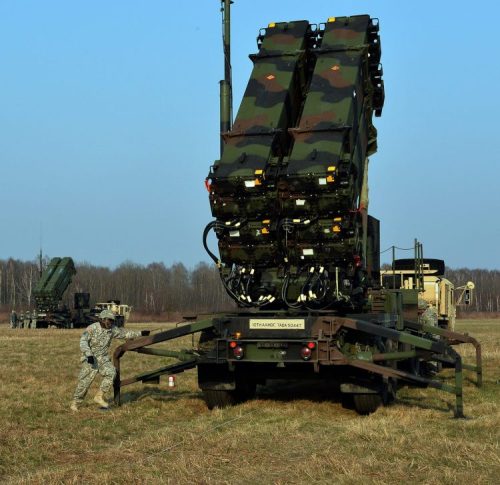
Patriot Missile Launcher
By William Schryver | imetatronink | January 20, 2024
… In an attempt to cover just three large airbases against a series of salvos of 100+ missiles of various types, the entire US stockpile of PAC-3 interceptors could very conceivably be exhausted in little more than a week or two. … continue
Blog Roll
 Aletho News
- MIT Prof Ted Postol: U.S. Iran Missile War
- Unpacking glaring contradictions in US-Zionist justifications for war against Iran
- Iraq and Cuba hit by blackouts amid US pressure and attacks on Iran
- US-Israeli Efforts to Degrade Iran’s Missile Might Failed – Military Researcher
- New American copium: Ghost of Kuwait
- IRGC strikes critical Israeli military sites with Khorramshahr-4 missiles in latest wave
- US racks up billions in losses during first four days of war as Iran pummels key Pentagon assets: Report
- US and Israeli Claims of Depleted Iranian Arsenals are Just Military Propaganda – Expert
- Iran denies attacking Azerbaijan, suggests Mossad involvement
- Iranian Armed Forces say no missile fired from Iran into Turkey
- If Americans Knew
- ‘Dirty Work’ :The truth about how Israel was founded
- Mass Expulsion in Lebanon as Israel Expands War: “We Don’t Know Where to Go”
- Lies, distortions, and propaganda: how the U.S. mainstream media coverage on Iran hides the truth
- Palestinians in Gaza fear famine returning as Israel cuts off food amid Iran war
- AIPAC, other pro-Israel groups enter midterms with $100 million to spend
- Iranian girls killed by ‘double-tap’ strikes on Minab school
- Bari Weiss Is Going Full ‘Propaganda-Palooza’ With the Iran War
- Inside the Pro-Israel Campaign to Stop ‘The Voice of Hind Rajab’ From Winning an Oscar
- After Iran, It’s Turkey
- War rages on Iran, while Israel withholds everything from Gaza – Not a ceasefire Day 146
- No Tricks Zone
- New Study: A Century Warming Of 1.1°C Is ‘Commonplace’ And ‘Not Unusual’ During This Interglacial
- New Study: ‘Internal Noise’ And Volcanic Forcing Can Trigger 10-15°C Warming Within Decades
- Glaciers Worldwide Are Suddendly Surging, Experts Blame Warming!
- Surprising Discovery: Sahara Is Greening…Billions Of Trees Where Once Thought To Be Barren
- New Research Reaffirms Clouds, Aerosols, And Surface Solar Radiation Are ‘Driving The Climate System’
- Germany: Electric Car Catches Fire At Charging Station, Sets Off Local “Inferno”, Widespread Damage
- New Study: Canada’s New Brunswick Was 1°C Warmer Than Today During The Medieval Warm Period
- Coal Power Back In Trend As Globe Tries To Keep Pace With Growing Demand For Power
- New Study: A 4°C Warmer Beaufort Sea Had ‘No Sea Ice’ 11,700 – 8200 Years Ago
- Unfudging The Data: Dutch Meteorological Institute Reinstates Early 20th Centruy Heat Waves It Had Erased Earlier
 Aletho News
Leave a comment