Munich, 2007: The Day the West Was Told No
The Islander | February 13, 2026
They like to pretend it came out of nowhere.
They like the bedtime story: Europe was peacefully humming along in its post-history spa — open borders, cheap energy, NATO as a charity, Russia as a gas station with a flag… and then, one day, the barbarian kicked the door in for no reason at all.
That story is not just dishonest. It’s operational. It’s the propaganda you tell yourself so you can keep the addiction going without ever admitting how self-destructive it is.
Because the truth is uglier and far more incriminating:
In Munich, on February 10, 2007, Vladimir Putin stood on the most flattering stage the Atlantic system owns — the Security Conference where Western officials applaud themselves for maintaining “order” and he laid out, to their faces, the skeleton of the coming disaster. He didn’t whisper it in a back channel. He used the microphone to deliver some much needed medicine, however hard it would be for the Empire to swallow.
He even signaled he wasn’t going to play the usual polite theatre — the kind where everyone agrees in public and stabs each other in classified annexes. He said the format allowed him to avoid “pleasant, yet empty diplomatic platitudes.”
And then he did the unforgivable thing, (gasp!) he described the empire as an empire.
He named the unipolar intoxication — that post–Cold War hallucination that history had ended, that power had found its final owner, that NATO could expand forever without consequences, that international law was optional for the enforcer class and compulsory for everyone else.
Putin’s core argument was brutally simple: a unipolar model is not only unacceptable, it’s impossible.
Not “unfair.” Not rude. Impossible.
(Because in a world with) “one center of authority, one center of force, one center of decision-making” is a world where security becomes privatized — where the strong reserve the right to interpret rules (with exemptions for themselves), and the weak are told to accept it as morality. (And yes, he put it in exactly those terms — one center, one force, one decision — the architecture of domination.)
And when you build that kind of world, everyone else does the only rational thing left: they stop trusting the wall of law to protect them, and they start arming for survival.
Putin said it outright: when force becomes the default language, it “stimulates an arms race.”
This is where the Western client media — professionally disengious as ever, clipped one or two spicy lines and missed the larger point: Munich 2007 wasn’t “Putin raging.” It was Russia publishing its redlines in front of the class.
And then came the part that should have frozen the room. Putin named it – NATO expansion.
Putin didn’t argue it as nostalgia. He argued it as provocation — a deliberate reduction of trust. He asked the question no Western leader ever answers honestly:
“Against whom is this expansion intended?”
And then he drove the blade in: what happened to the assurances made after the Warsaw Pact dissolved? “No one even remembers them.”
That line matters because it goes well beyond grievance — it’s a window into how Russia saw the post–Cold War settlement: not as a partnership, but as a rolling deception. Expand NATO, move offensive infrastructure, then call it “defensive.” Build bases, run exercises, integrate weapons systems, and insist the other side is paranoid for noticing.
Putin’s formulation was clean: NATO expansion “represents a serious provocation that reduces the level of mutual trust.”
Now pause and look at the psychology of the West in that room. They didn’t hear a warning. They heard audacity. They didn’t hear “security dilemma.” They heard “how dare you speak like an equal.”
That’s the cultural glitch at the heart of the Atlantic project: it believes its own core lie and cannot process sovereignty in others without treating it as aggression.
So Munich 2007 became, in Western memory, not the moment Russia told the truth — but the moment Russia “showed its hand.” The implication: Russia’s “hand” was evil, and therefore any response to it was justified. Which is exactly how you sleepwalk into catastrophe.
The real prophecy: not mysticism — mechanics
What was prophetic about Putin’s speech isn’t that he had a crystal ball.
It’s that he understood the West’s incentive structure:
- A security system that expands by definition (NATO) needs threats by definition.
- A unipolar ideology needs disobedience to punish, otherwise the myth collapses.
- A rules-based order that breaks its own rules must constantly produce narrative cover.
- An economic model that offshore-outs its industry and imports “cheap stability” must secure energy routes, supply chains, and obedience — by finance, by sanctions, by force.
Putin was saying: you can’t build a global security architecture on humiliation and expect it to be stable. Russia had lived through the wreckage of Yugoslavia, Afghanistan and Iraq and that this playbook would be used again and again, with Georgia, with Syria, Libya, Iran and Russia itself if Putin did nothing.
He was also saying and this is where the Russophobic mass hysteria accelerates — that Russia would not accept a subordinate role in its own neighborhood, on its own borders, under a wannabe hegemon’s military umbrella.
This is where the Western catechism kicks in: “neighborhood” is called “sphere of influence” when Russia says it, and “security guarantees” when Washington says it. And so the hysteria machine warmed up.
You saw it in the immediate reception: Western elites, including Merkel and McCain treating the speech as an insult rather than a negotiation offer. You saw it in the years that followed — the steady normalization of the idea that Russia’s security concerns were illegitimate, and therefore could be ignored with moralistic lectures, free of consequences.
Ignore, expand, accuse, repeat.
That loop is your road to 2022 and to today, in Munich 2026. Groundhog day without learning the vital lessons to end the loop of utter madness.
Munich, Feb 13 (2026): Merz admits the order is dead — and calls it “uncertainty”
Fast forward. Same city. Same conference. Same Western liturgy, just with more panic in the eyes and the nucleus of a terrifying realization.
German Chancellor Friedrich Merz using his best perfomative courage, murmured that the world order we relied on is no longer there. Framing the post–Cold War “rules-based order” as effectively crumbled and almost begging for a reset in transatlantic relations.
He goes further: he talks up a stronger European defence posture, and pointed to discussions with France about a European nuclear deterrent concept, a “European nuclear shield.”
And then comes the line that should be carved into the marble of the Munich conference hall as Exhibit A: Merz argues that in this era, even the United States “will not be powerful enough to go alone.”
Read that again.
The BlackRock chancellor on NATO’s spiritual home turf is effectively saying: the empire is overstretched, the illusion of old certainties are gone, and Europe will be left hung out to dry. Talk about strategic vertigo!
And it is exactly what Putin was talking about in 2007: when one axis tries to act as the planet’s owner, the cost accumulates — wars, blowback, arms races, fractured trust, until the system starts to wobble under its own contradictions.
Merz also reported begged the U.S. and Europe to “repair and revive” transatlantic trust. Repair trust with what currency?
Because trust isn’t repaired by speeches. Trust is repaired by reversing the toxic and suicidal behaviors that destroyed it.
And those behaviors were precisely what Putin named in 2007:
- expanding military blocs toward another power’s borders,
- treating international law as a menu,
- using economic coercion as a weapon,
- and then pretending the consequences are “unprovoked.”
Europe is now gasping at the invoice for that policy set: industrial stress, energy insecurity, strategic dependency, and a political class that can’t admit how it got here without indicting itself.
So instead of confession, you get moral performance. Instead of strategy, you get hysteria and cartoon slogans.
Instead of peace architecture, you get escalation management — the art of walking toward the cliff while calling it deterrence.
Merz’s remarks underscore that Europe is being forced to contemplate a harsher security environment and greater responsibility, all of its own suicidal making — but it still frames the Russia question in the familiar moralizing register.
Which is the whole tragedy: they can feel the tectonic plates shifting beneath them, yet they keep reciting the same old prayers that summoned the earthquake.
Why we’re here: the Western addiction to expansion — and the manufactured Russophobia that lubricated it
Russophobia is more than just bloodthirsty prejudice. It’s the (failed) policy tool of choice of the last few empires against Russia.
It’s what you pump into the Mockingbird media bloodstream to make escalation feel like virtue and compromise feel like treason.
You don’t have to love everything Russia does to see the mechanism: a permanent narrative of Russian menace makes every NATO move sound defensive, every EU economic self-harm sound righteous, and every diplomatic off-ramp sound like appeasement.
It creates a psychological environment where:
- NATO expansion becomes “freedom,”
- coups become “democratic awakenings,”
- sanctions become “values,”
- censorship becomes “information integrity,”
- and war becomes “support.”
And once you install that operating system, you can torch your own industry and still call it moral leadership.
That’s the dark comedy of Europe since 2014 — accelerating post 2022: self-sanctioning, deindustrializing pressure, energy price shocks, and strategic submission to Washington’s delusion of carving up Russia, sold as “defending democracy.”
Meanwhile, Moscow reads the West’s behavior the same way it read it in 2007: as a hostile architecture closing in, dressed up as virtue.
Putin’s Munich speech — again, not mysticism — warned that when the strong monopolize decision-making and normalize force, the world becomes less safe, not more.
So what did the West do?
It made the “rules-based order” a brand — while breaking rules (international law) whenever convenient. Exceptionalism at almost biblical levels, God’s chosen people.
It expanded NATO while insisting the expansion was harmless.
It treated Russian objections as evidence of Russian guilt — which is circular logic worthy of an inquisitor.
And it nurtured a media culture that could not imagine Russia as a rational actor responding to a pattern of ugly regime change behavior — only as a cartoon villain driven by pathology. Not analysis but theological warfare.
The punchline Munich won’t say out loud
Here’s the line Munich still cannot speak, even in 2026, even with Merz admitting the old order is gone:
The West didn’t misread Putin’s warning. It rejected it because accepting it would have meant limiting itself.
Munich 2007 was a chance — maybe the last clean one — to build a European security architecture that wasn’t just NATO with better PR. A chance to treat Russia as a Great Power with legitimate interests, not a defeated adversary to be regime changed and broken apart.
And now, in Munich 2026, they stand amid the wreckage and call it “uncertainty,” as if the storm blew in from nowhere. The BlackRock Chancellor calls for resets, for revived trust, for Europe to become stronger, for new deterrence ideas.
But the reset Munich needs is the one it refuses:
- reset the premise that NATO will remain a viable alliance beyond the war in Ukraine,
- reset the premise that Russia must absorb strategic humiliation and accept the inverse, the reality as it is – where it’s in fact Western Europe that is wearing the humiliation.
- reset the premise that international law is a tool of the powerful,
- reset the premise that Europe’s role is to be the forward operating base and European sovereignty sacrificed to buy the Empire time .
Until that happens, Munich will keep happening — every year, more anxious, more militarized, more rhetorical, more detached from the material reality its own disastrous policies created.
And Putin’s “prophecy” will keep looking prophetic — not because he conjured the future, but because he correctly described the machine.
No comments yet.
Featured Video
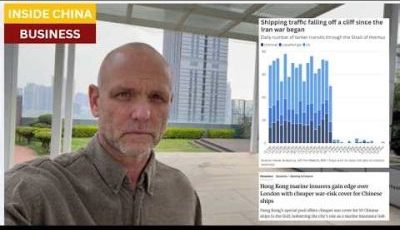
More Iran War fallout: Maritime insurance industry shifts from London to China
or go to
Aletho News Archives – Video-Images
From the Archives
Allies Don’t Need Lobbies
By Jay Knott | Dissident Voice | September 24, 2013
In a recent article on Counterpunch, Rob Urie defended the traditional Marxist analysis of US policy in the Middle East. He argues that support for Israel is driven primarily by economic interest, not the Jewish lobby.
He starts by paying tribute to the idea that Western societies are uniquely racist. He says that the “Western narrative” claims there is an “Arab character”, and that this is “antique racist blather”. He gives no definition of these terms. Further, he establishes his credentials as part of the dominant current in the American left by claiming that “over a million people in Iraq died so ‘we’ in the West can drive SUVs.”1
When he tries to criticize bourgeois economics, he makes it clear he doesn’t understand the developments it has made since Marx’s day, using the mathematical discipline known as “game theory”. He dismisses the basic abstraction of economic theory, the idea of the rational individual, on the grounds that it is “devoid of history, culture and political context”. But abstractions are always devoid of something.
He defends a more concrete economic theory, mostly Marxist, with some input from another theorist of capitalist crisis, Hyman Minsky. This concrete theory leads him to the view that US activity in the Middle East is primarily driven by rational capitalist motives, the need to secure a supply of oil.
“Taking the totality of circumstance — former oil company executives launching war on an oil rich nation on a pretext they publicly proclaimed they didn’t believe shortly before taking office — and that upon launching their war proved to be non-existent, requires a willingness to overlook the obvious — that the war on Iraq was for oil, that is difficult to support.”1
Perhaps I’ve misunderstood him, but based on what he says in the rest of the article, this convoluted sentence seems to argue that, because president Bush and vice-president Cheney attacked Iraq on false premises, and they also said it was all about oil, and they are former oil executives, and Iraq has a lot of oil, it’s difficult to deny US attacks on Iraq are all about oil.
In fact, it’s not hard at all. As Urie points out, at times Bush and co. said that attacking Iraq was “protecting the world’s supply of oil.”1 But, as he also points out, they are congenital liars. Why should we believe them when they say they are trying to “protect” the oil supply? Protect it against what? When politicians “admit” attacks on Middle Eastern countries are wars for oil, they are parroting the neo-con party line, feeding the public, both left and right, with a plausible-sounding pretext. For right-wingers, “it’s a war for oil” is a reason to support war, and for leftists, it’s a way to feel better by complaining impotently about corporate greed. Both approaches help the war drive. … continue
Blog Roll
 Aletho News
- More Iran War fallout: Maritime insurance industry shifts from London to China
- US-Israeli aggression on Iran triggers review of GCC countries’ investment pledges to Washington
- Russia slams UK plan to seize tankers suspected of carrying its oil
- Pakistan ramps up food exports to Persian Gulf nations as war deepens food insecurity
- Iran submits response to US plan, sets terms for war’s end: Tasnim
- US vs Iran: Kharg Island Talk — Bluff or Escalation? Ex-Military Officer Weighs In
- Zelensky unnecessarily involves Ukraine in the Middle East crisis
- Turkish tanker blacklisted by Ukraine hit in drone attack – media
- Canada, the U.S., and NATO: the inescapable trap
- Villains of Judea: Leonid Radvinsky
- If Americans Knew
- Israel may be committing war crimes in Lebanon – Not a ceasefire Day 167
- In the West Bank, life is a constant battle – 3 articles
- Jacob Reses, one of the most powerful pro-Israel operatives in Trump’s Washington
- Israeli-US assaults kill or injure 87 children a day – Not a ceasefire Day 166
- ‘Forever live by the sword’: Understanding Israelis’ massive support for Iran war
- UN’s special rapporteur on human rights says Israel is systematically torturing Palestinians
- Trump White House plagiarized Iran war manifesto from Israel-aligned think tank
- Gaza says 6–10 patients die daily waiting for treatment abroad as Israel blocks medical evacuations
- ‘Substantial evidence’ of double-tap strike in killing of Gaza’s Hind Rajab
- ‘Do Not Want To Die For Israel’: Doubts About Trump’s Iran Strategy Spread Among Troops
- No Tricks Zone
- Devastating Assessment Of Comirnaty Vaccine By Former Senior Pfizer Europe Toxicologist
- New Study: CO2 Is ‘Effectively Negligible’ As An Explanatory Climate Change Factor Since 2000
- Former Pfizer Toxicologist Dr. Helmut Sterz Tells Bundestag Hearing Pfizer Vaccine Should Have Never Been Approved
- Energy Expert: Germany’s Nuclear Phaseout Was A “500 Billion Euro Mistake”
- New Research: South Australia’s Mid-Holocene Sea Surface Temperatures Were 4°C Warmer Than Today
- Storing Green Energy To Last Germany 10 Days Would Require A 60-Million Tonne Battery
- New Studies: UK Sea Levels Were 4 Meters Higher Than Today During The Mid-Holocene
- Destructive Green New Deal: German Energy And Metal Group Warns Of Drastic Crisis
- New Study Documents A 20-Year Pause In Arctic Sea Ice Decline – Driven By Internal Variability
- Wake-up Call: Survey Shows Majority Of Germans Now Favor Postponing Climate Targets!
 Aletho News
Leave a comment