Macron, Merz, and von der Leyen Defend Expanded Speech Controls
The Munich Security Conference just became a defense session for Europe’s most ambitious censorship regime
By Dan Frieth | Reclaim The Net | February 16, 2026
Emmanuel Macron stood before the Munich Security Conference last week and offered a blueprint for what European governments should be allowed to delete from the internet. The French president wants mandatory identity verification for social media users, one account per person, algorithm transparency on the government’s terms, and the legal authority to block platforms that refuse to comply.
“We have to be sure there is one single person with one account,” Macron said. “If this is an AI system, if this is bot or organized by big organization, it should be just forbidden.”
The statement describes a system where every social media user would have their identity verified by platforms and tied to a single permitted account. Anonymous speech, pseudonymous commentary, and the ability to maintain separate personal and professional presences online would effectively end for anyone using platforms that serve the European market.
Macron suggested this as a way to protect democracy. The mechanism would give governments a powerful tool to identify, track, and silence any user whose speech they find objectionable.
France is moving to ban social media access for anyone under 15, a policy that requires verifying every user. Macron defended this by characterizing free expression online as a form of brainwashing.
“Free speech would mean I will give the mind, brand the heart of my teenagers to algorithm of big guys,” he said. “I’m not totally sure I share the values, or Chinese algorithm without any control. We are crazy.”
The argument runs as follows: letting young people encounter ideas online without government permission is insanity. The solution requires every user to prove their age to access platforms where public discussion happens.
Macron suggested that speech illegal in newspapers should remain illegal when moved online. “How is that the craziest and most harmful narratives can go unchecked in our digital space, where they will fall under the law if published in print?”
The question assumes “harmful narratives” is a category the government should define. It also assumes the government should have the power to prevent people from encountering ideas it has labeled crazy.
Macron invoked the Digital Services Act as the foundation for expanded censorship across Europe. “This is a very important regulation because for the first time we created the framework to regulate this platform.”
The DSA gives EU regulators the authority to demand content removal from platforms. Macron called for going further: using the law to “excuse those who clearly decide not to respect our rules and our regulation” and to “block all those [who allow] interferences in our systems.”
He offered a familiar list of speech categories he wants suppressed: “racist speech, hateful speech, anti-Semitic speech.” These terms have no fixed legal definition that applies uniformly across EU member states. Who is racist, what constitutes hatred, which criticism of which policies counts as anti-Semitism: these determinations would be made by regulators and platforms operating under government pressure.
Macron described limits on speech as somehow inherent to democracy itself: “When you have free speech, you have respect, you have rules, and the limit of my freedom is the beginning of your freedom.”
This formulation treats speech as equivalent to physical coercion. Your words are framed as a boundary violation against others simply by existing. The speech that most requires protection is speech that offends, that challenges consensus, that the powerful would prefer to suppress. Macron’s framework offers no protection for any of it.
German Chancellor Friedrich Merz, who opened the conference, echoed the European position that speech protections should end where government-defined values begin.
“A divide has opened up between Europe and the United States,” Merz said. “And Vice President JD Vance said this very openly here at the Munich Security Conference a year ago, and he was right. The battle of cultures of MAGA in the US is not ours. Freedom of speech here ends where the words spoken are directed against human dignity and our basic law.”
“Human dignity” is the phrase German law uses to justify prosecuting speech. The Constitutional Court has interpreted it to cover insults, Holocaust denial, and an expanding category of expression that authorities determine undermines respect for persons or groups. It is the legal mechanism under which German police have raided homes over social media posts and prosecuted people for memes.
European Commission President Ursula von der Leyen joined the censorship chorus with a declaration of territorial authority over online expression.
“I want to be very clear: our digital sovereignty is our digital sovereignty,” she said, adding the EU “will not flinch where this is concerned.”
Von der Leyen described European speech regulation as under attack from the United States, “which has wielded the threats of tariffs on partners to secure preferential access and has decried the EU’s digital rules as an assault on free speech.”
The EU’s digital rules are an assault on free speech. The DSA empowers bureaucrats to demand platforms remove content, under threat of massive fines.
The EU has opened formal proceedings against X for its policies. European regulators have forced platforms to suppress content that would be legally protected in the United States.
Von der Leyen framed resistance to this regime as a threat to Europe’s “democratic foundation.” She claimed Europe has “a long tradition in freedom of speech” while defending a legal structure designed to ensure certain speech never reaches European audiences.
“The European way of life – our democratic foundation and the trust of our citizens – is being challenged in new ways,” she said. “On everything from territories to tariffs or tech regulations.”
The phrasing groups speech regulation with tariffs and territorial disputes. All three are matters where Europe will defend its sovereignty. What Europeans are permitted to say, read, and share online is treated as equivalent to where national borders fall.
The leaders who gathered in Munich spoke of protecting democracy while proposing tools that would let governments identify and punish dissent. They invoked free speech while demanding the power to decide which speech is free. They claimed to defend Europe while stripping Europeans of the ability to speak freely online.
No comments yet.
Featured Video
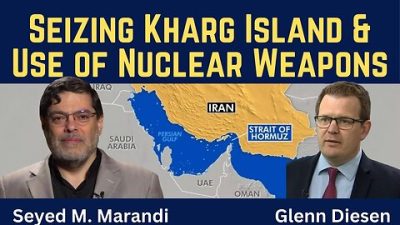
Marandi: Threat of Seizing Kharg Island & the Use of Nuclear Weapons
or go to
Aletho News Archives – Video-Images
Frlom the Archives
Provoking a Path to Persia
The Saban Center’s prescient paper on war with Iran
By Maidhc Ó Cathail | October 20, 2011
In June 2009, the Saban Center for Middle East Policy published “Which Path to Persia?—Options for a New American Strategy toward Iran.” Writing in a tone strikingly reminiscent of the Project for a New American Century’s infamous pre-9/11 paper “Rebuilding America’s Defenses,” the six co-authors noted that, “It seems highly unlikely that the United States would mount an invasion without any provocation or other buildup.” For a think tank specifically established by media mogul Haim Saban to protect Israel, this could prove to be a formidable obstacle impeding their desired march—of U.S. troops—to Tehran.
“In fact, if the United States were to decide that to garner greater international support, galvanize U.S. domestic support, and/or provide a legal justification for an invasion, it would be best to wait for an Iranian provocation, then the time frame for an invasion might stretch out indefinitely,” Saban’s think-tankers ruefully observed.
“With only one real exception, since the 1978 revolution, the Islamic Republic has never willingly provoked an American military response, although it certainly has taken actions that could have done so if Washington had been looking for a fight. Thus it is not impossible that Tehran might take some action that would justify an American invasion. And it is certainly the case that if Washington sought such a provocation, it could take actions that might make it more likely that Tehran would do so (although being too obvious about this could nullify the provocation). However, since it would be up to Iran to make the provocative move, which Iran has been wary of doing most times in the past, the United States would never know for sure when it would get the requisite Iranian provocation. In fact, it might never come at all.”
Seemingly undeterred by Iran’s frustrating unwillingness to provide the requisite provocation, the analysts continued to examine this option… continue
Blog Roll
 Aletho News
- Ukrainian Embassy in Beirut sheltering top Mossad agent
- Palestinian family displaced after settlers violently attack them in Humsa, Jordan Valley
- The EU never learns – except for the wrong lessons
- Iran attacks on UAE leaves RSF militia high and dry
- Hosting Washington’s war: Bahrain faces the consequences
- The US fell for its own Iran propaganda
- Seyed M. Marandi: Threat of Seizing Kharg Island & the Use of Nuclear Weapons
- Is there even an off ramp?
- Michael von der Schulenburg: Europe’s Self-Defeating Iran War Policy
- Sorry, The New Republic, Climate Change Isn’t Causing Somali Migration. Blame Civil Strife and Poverty.
- If Americans Knew
- ‘Of Course’: IDF Drops Case Against Soldiers Accused of Raping Palestinian Prisoner
- Don’t Fall for the Regime Change Talk. Israel Is ‘Mowing the Lawn’ in Iran
- Will Israel and the US wreck the Gulf States along with Iran?
- US so far burned through ‘years’ of munitions in Iran war: Report
- How the Israeli Tail Wags the American Dog
- Outdated intel likely led to deadly U.S. strike on Iranian elementary school, sources say
- Pentagon insider says high U.S official Douglas Feith reported to Netanyahu
- In fond memory of Walid Khalidi, the historian of Palestine
- 6 more Americans killed, as Israel ‘mows the lawn’ in Iran – Not a ceasefire Day 154
- Are we on the precipice of World War III?
- No Tricks Zone
- New Studies: UK Sea Levels Were 4 Meters Higher Than Today During The Mid-Holocene
- Destructive Green New Deal: German Energy And Metal Group Warns Of Drastic Crisis
- New Study Documents A 20-Year Pause In Arctic Sea Ice Decline – Driven By Internal Variability
- Wake-up Call: Survey Shows Majority Of Germans Now Favor Postponing Climate Targets!
- Televised! Leading German Political Candidate Tells Schoolchildren CO2 Makes Sun Hotter!
- New Study: A Century Warming Of 1.1°C Is ‘Commonplace’ And ‘Not Unusual’ During This Interglacial
- New Study: ‘Internal Noise’ And Volcanic Forcing Can Trigger 10-15°C Warming Within Decades
- Glaciers Worldwide Are Suddendly Surging, Experts Blame Warming!
- Surprising Discovery: Sahara Is Greening…Billions Of Trees Where Once Thought To Be Barren
- New Research Reaffirms Clouds, Aerosols, And Surface Solar Radiation Are ‘Driving The Climate System’
 Aletho News
Leave a comment