Hawaii bills would allow gov’t to quarantine people, enter property without permission, seize firearms, and suspend laws
HB 2236 and SB 2151 make the governor the “sole judge” of an emergency, allow sweeping powers based on a perceived threat alone.
By Jon Fleetwood | February 18, 2026
The Hawaii Legislature is advancing companion legislation that would formally codify sweeping emergency powers for the governor and county officials—including authority to quarantine individuals, enter private property without consent, suspend laws, and seize control of infrastructure—under the justification of preparing for future disasters and disease outbreaks.
House Bill 2236 and Senate Bill 2151, both titled “Relating to Emergency Management,” were introduced in January and February 2026 and are now moving forward through both chambers.
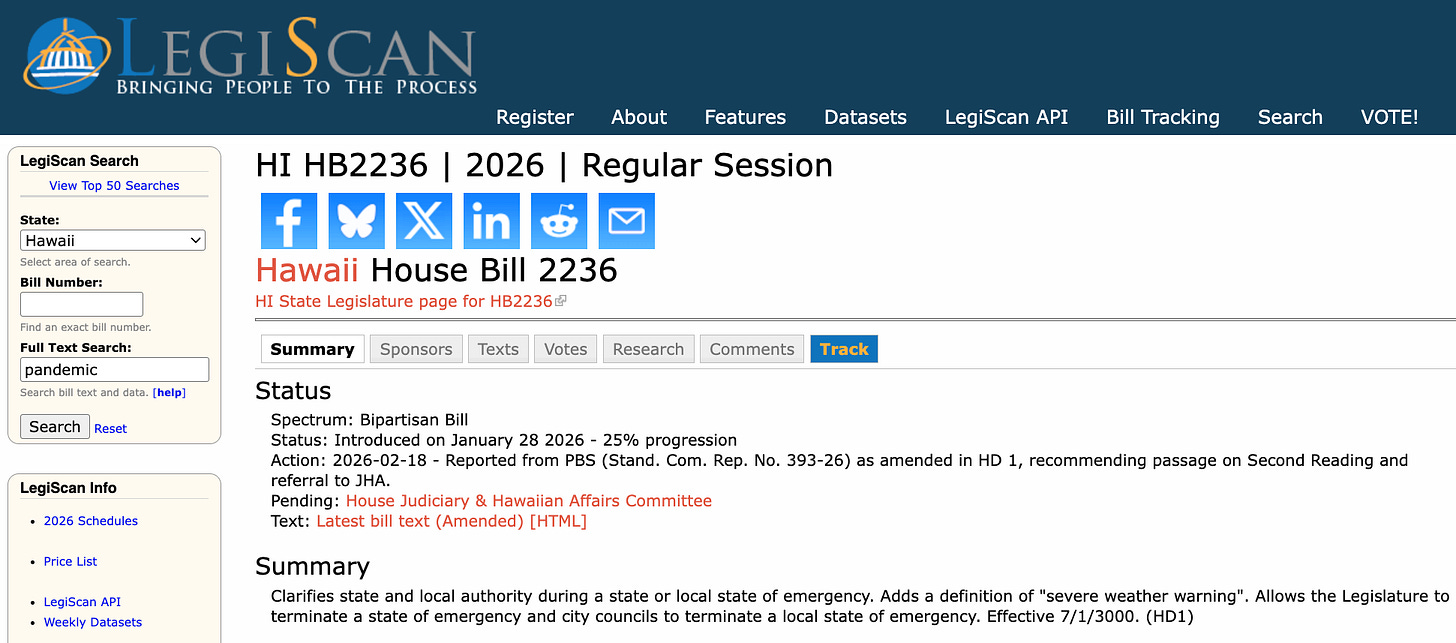
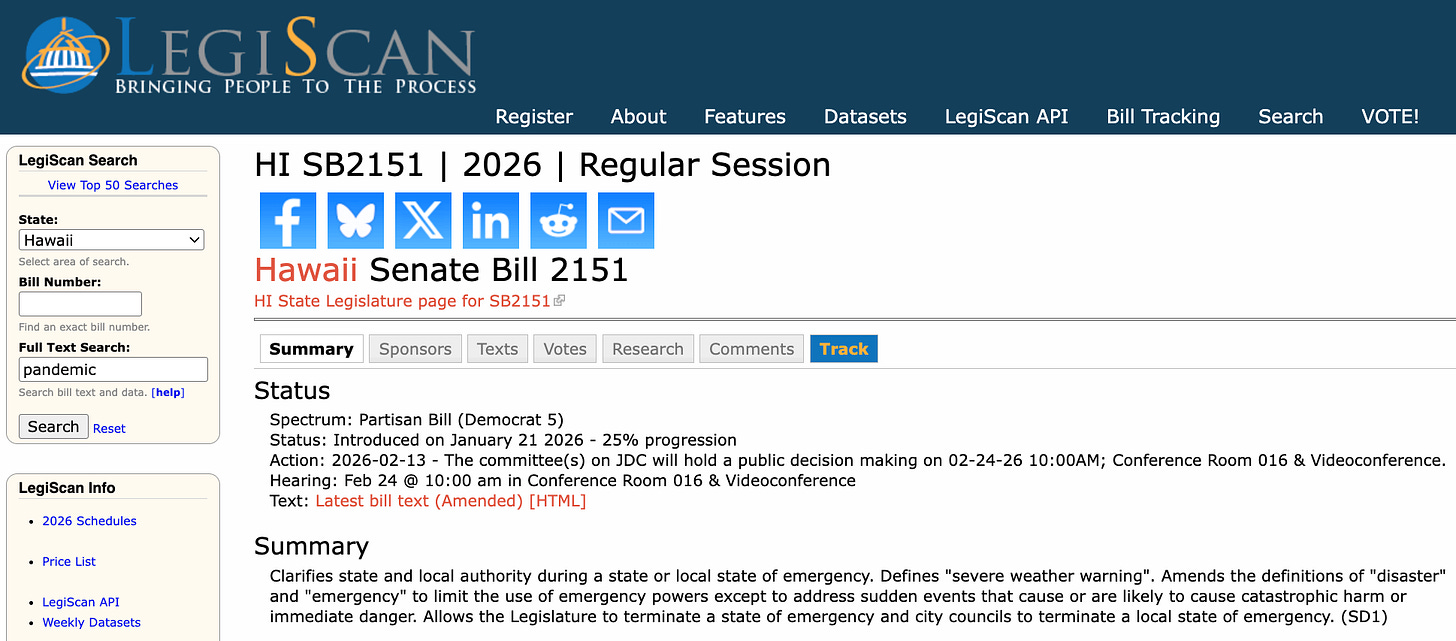
Legislative records show the bills are formally linked, with each designated as “Same As/Similar To” the other, confirming that Hawaii’s full legislature—not just one chamber—is advancing the emergency powers framework.
The legislation explicitly cites COVID-19 as justification for strengthening emergency authority, stating:
“The COVID-19 pandemic highlights the importance of clear legal frameworks for state and county emergency management to ensure that the State and counties are ready for any type of emergency.”
You can see which state legislators are backing these bills further down in this article.
Governor Authorized to Quarantine Residents & Enter Private Property Without Permission
Governor Authorized to Quarantine Residents & Enter Private Property Without Permission
One of the most consequential provisions would formally authorize forced quarantine and government entry onto private property.
The bill states that Hawaii Governor Josh Green (D) may:
“Require the quarantine or segregation of persons who are affected with or believed to have been exposed to any infectious, communicable, or other disease…”
It further grants authority to:
“Authorize without the permission of the owners or occupants, entry on private premises for any of these purposes.”
This authority applies not only to confirmed infections but also to individuals merely “believed to have been exposed.”
The legislation also allows the government to order the destruction of property deemed hazardous:
“Authorize that public nuisances be summarily abated and, if need be, that the property be destroyed by any police officer or authorized person.”
Governor Can Suspend Laws, Licensing Requirements, & Regulatory Protections
The bills explicitly empower the governor to suspend existing laws during an emergency, including medical, licensing, and regulatory protections.
The legislation states the governor may:
“[Suspend] the laws, in whole or in part… including licensing laws, quarantine laws, and laws relating to labels, grades, and standards.”
It also authorizes suspension of any law deemed to impede emergency operations:
“Suspend any law that impedes or tends to impede… emergency functions.”
Crucially, the legislation allows such suspensions to continue beyond the official emergency period:
“Any suspension of law… may continue beyond the emergency period…”
Government Authorized to Take Control of Private Infrastructure & Utilities
The legislation further empowers the governor to assume control of critical infrastructure, including privately owned facilities.
The bill states the governor may:
“Assure the continuity of service by critical infrastructure facilities, both publicly and privately owned… by taking over and operating the same.”
Additional provisions allow the government to:
- Shut off utilities
- Control distribution of goods
- Regulate or prohibit commerce
- Impose rationing
Specifically, the governor may:
“Regulate or prohibit… the storage, transportation, use, possession, maintenance, furnishing, sale, or distribution thereof, and any business or any transaction related thereto.”
Authority to Regulate Firearms & Seize Property
The legislation also grants authority to regulate firearms and confiscate property during emergencies.
It authorizes the governor to prohibit firearm possession during emergencies, meaning firearms that are normally legal could become unlawful to possess under emergency orders and subject to seizure.
The bill states the governor may:
“Regulate or prohibit the storage, transportation, use, possession… of firearms, and ammunition… and authorize the seizure and forfeiture.”
Governor Retains Sole Authority to Declare Emergencies
Under the proposed framework, Governor Green retains broad discretion to declare emergencies, including based on perceived threats.
The bill states:
“The governor… shall be the sole judge of the existence of the danger, threat, or circumstances giving rise to a declaration.”
Emergencies may be declared based on:
“Imminent danger or threat of an emergency or a disaster.”
This allows activation of emergency powers before an actual disaster occurs.
Legislature Adds New Definition of Disaster Including Disease Outbreaks & Bioterrorism
The Senate version expands the legal definition of “disaster” to explicitly include:
“Disease or contagion outbreaks, bioterrorism, terrorism, or incidents involving weapons of mass destruction.”
This codifies infectious disease emergencies as triggers for the expanded powers.
The move comes as President Donald Trump and Congress have already committed $5.5 billion toward preparing for a future influenza pandemic, while the World Health Organization vows such a pandemic is inevitable, U.S. scientists continue gain-of-function influenza experiments, and the administration launches its $500 million Operation Gold Standard influenza vaccine initiative.
Legislature Advances Bills Through Both Chambers
Legislative tracking records show both bills are progressing simultaneously:
- HB2236 was introduced January 28, 2026, and has already passed committee review in the House.
- SB2151 was introduced January 21, 2026, and is scheduled for further committee action February 24, 2026.
The bills are formally cross-linked, confirming coordinated legislative advancement.
Legislature Frames Bills as Clarification of Emergency Authority
Lawmakers describe the purpose of the legislation as clarifying and strengthening emergency management authority.
The bill states its purpose is to:
“Clarify state and county emergency management authority, ensure effective and adaptable emergency responses…”
The measures also allow the legislature to terminate emergency declarations by a two-thirds vote.
Which Legislators Are Backing the Bills
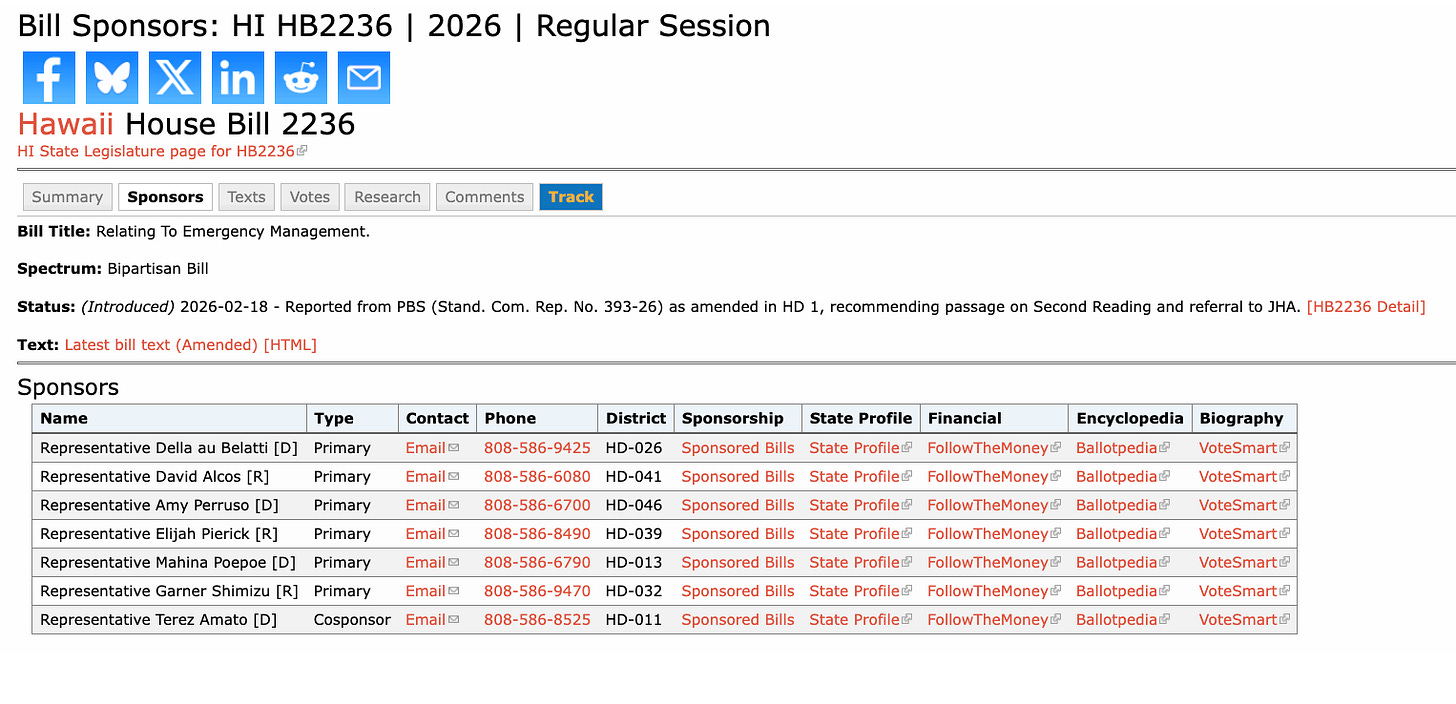
You can see which Representatives are backing HB2236 here.
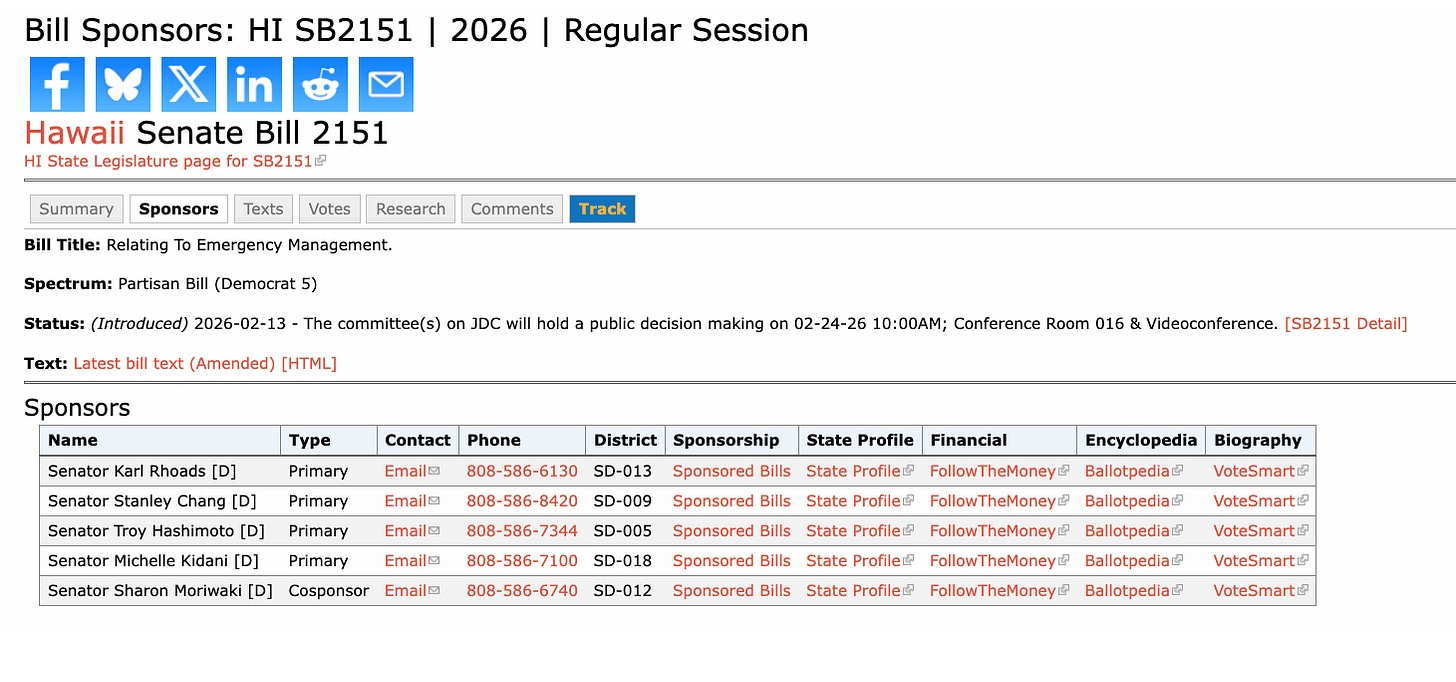
You can see which Senators are backing SB2151 here.
Bottom Line
HB2236 and SB2151 would lock into permanent Hawaii law the authority to quarantine residents based on suspected exposure, enter private property without permission, suspend existing laws, prohibit firearm possession under emergency orders, and take control of private infrastructure and economic activity—all under an emergency declaration the governor has broad discretion to issue, including based on a perceived “threat.”
The legislation is advancing as the federal government pours billions into influenza pandemic programs, conducts gain-of-function experiments designed to alter influenza viruses, and builds out large-scale vaccine deployment initiatives intended for rapid rollout once a pandemic is declared.
At the same time, Congress, the White House, the Department of Energy, the FBI, the CIA, and Germany’s Federal Intelligence Service (BND) have confirmed that the COVID-19 pandemic was likely the result of lab-engineered pathogen manipulation.
That overlap creates a profound conflict-of-interest question: the same government and scientific establishment involved in creating and manipulating pandemic-capable pathogens is also expanding the legal authority to impose quarantines, override constitutional protections, restrict property rights, and control economic life if one of those pathogens triggers the next declared emergency.
If passed, Hawaii’s bills would ensure those powers are not improvised in the moment, but already written into law—allowing sweeping restrictions on residents to be activated immediately, the moment the next pandemic or declared threat emerges.
Sorry, the comment form is closed at this time.
Featured Video

Pentagon insider says high US official Douglas Feith reported to Netanyahu
or go to
Aletho News Archives – Video-Images
Frlom the Archives
Who’s to blame for the Iraq war?
A not-so-trivial quiz
By Maidhc Ó Cathail | 14 March 2010
Maidhc Ó Cathail names and shames the top 19 politicians, academics and policy makers – all con men and all Zionist Jews – who lied and conspired to steer the US toward aggression against the Iraqi people. … continue
Blog Roll
 Aletho News
- Even The Neo-Cons Admit The Iran War Is Failing
- Inside the Caucasus Drone Corridor Fueling Tensions With Iran
- ‘Not our war’: Trump’s naval coalition to reopen Strait of Hormuz dead in the water
- Iran declares support centers for USS Gerald R. Ford legitimate targets
- Moscow issues warning over Trump’s Golden Dome plan
- Brussels wants ‘our sons to die for Ukraine’ – Orban
- Where in the World Is Benjamin Netanyahu? On the Move or Out of Sight?
- Pentagon insider says high US official Douglas Feith reported to Netanyahu
- The Sludging of Rural America
- Lawyers’ groups demand end to British military bases in Cyprus
- If Americans Knew
- Predictions of another 9/11, amid Israel-US killing spree – Not a ceasefire Day 157
- As US-Israel war on Iran rages, Gaza faces massive dust storm – Not a ceasefire Day 156
- No let-up in attacks on Gaza as Israel takes on Iran, Lebanon – Not a ceasefire Day 155
- ‘Of Course’: IDF Drops Case Against Soldiers Accused of Raping Palestinian Prisoner
- Don’t Fall for the Regime Change Talk. Israel Is ‘Mowing the Lawn’ in Iran
- Will Israel and the US wreck the Gulf States along with Iran?
- US so far burned through ‘years’ of munitions in Iran war: Report
- How the Israeli Tail Wags the American Dog
- Outdated intel likely led to deadly U.S. strike on Iranian elementary school, sources say
- Pentagon insider says high U.S official Douglas Feith reported to Netanyahu
- No Tricks Zone
- Storing Green Energy To Last Germany 10 Days Would Require A 60-Million Tonne Battery
- New Studies: UK Sea Levels Were 4 Meters Higher Than Today During The Mid-Holocene
- Destructive Green New Deal: German Energy And Metal Group Warns Of Drastic Crisis
- New Study Documents A 20-Year Pause In Arctic Sea Ice Decline – Driven By Internal Variability
- Wake-up Call: Survey Shows Majority Of Germans Now Favor Postponing Climate Targets!
- Televised! Leading German Political Candidate Tells Schoolchildren CO2 Makes Sun Hotter!
- New Study: A Century Warming Of 1.1°C Is ‘Commonplace’ And ‘Not Unusual’ During This Interglacial
- New Study: ‘Internal Noise’ And Volcanic Forcing Can Trigger 10-15°C Warming Within Decades
- Glaciers Worldwide Are Suddendly Surging, Experts Blame Warming!
- Surprising Discovery: Sahara Is Greening…Billions Of Trees Where Once Thought To Be Barren
 Aletho News