Why Trump’s anti-Iran naval coalition in Strait of Hormuz is doomed to fail
By Wesam Bahrani | Press TV | March 18, 2026
US President Donald Trump believes that involving many countries in a naval coalition would force Iran to surrender under international pressure, or at least agree to a ceasefire and enter negotiations with those countries without preconditions.
The last thing Trump expected was for what he thought would be a short, hours-long confrontation to stretch into days and weeks, and then turn into a full-fledged war of attrition.
This is a scenario he neither anticipated nor has the personal capacity to bear, given its potentially disastrous consequences for his country and the world.
It has become clear that Iran had long prepared for this all-out confrontation and that its leadership was certain it would happen at some point. Turning it into a prolonged war of attrition, both geographically and over time, appears to be a central pillar of the Iranian strategy to exhaust the US, the Zionist regime, and their regional and international allies.
Very quickly, by the end of the first week of the illegal and unprovoked war on Iran, Trump’s vision began to turn into a nightmare. His plan to overthrow the Islamic Republic (in other words, “regime change”) with a first strike failed, as did his far-fetched ambition to gain control over a quarter of global oil production and influence its routes and prices.
He now faces the urgent need to manage the global economic fallout of this failure. Iran has effectively gained control over a maritime route through which roughly a quarter of the world’s oil supply passes. By the third week of the war, oil prices had risen above $100 per barrel.
In his first statement to the Iranian people and the world, the new Leader of the Islamic Republic, Ayatollah Seyyed Mojtaba Khamenei, summarized this challenge in two striking phrases that sent shockwaves through the White House.
“The will of the people is to continue effective and deterrent defense,” and “the option of closing the Strait of Hormuz must remain on the table,” he declared.
This clearly signals a willingness to pursue a prolonged war of attrition that threatens the global economy, especially that of the United States and its allies.
Faced with this difficult situation, rising war costs, and growing tensions not only between the US and the Zionist regime but also within the Trump administration, as reported in American and Hebrew media, Trump has turned to his allies for help.
He initially claimed that several countries would send warships to cooperate with the United States in keeping the Strait of Hormuz open and secure.
He expressed hope that countries such as China, France, Japan, South Korea, and the United Kingdom would deploy naval forces to ensure the safety of this vital shipping route. He also called on countries that benefit from West Asian oil to contribute forces to secure maritime navigation.
At the same time, Trump announced an airstrike on Iran’s Kharg Island in an apparent attempt to convince these countries that the US still controls the military situation in the Persian Gulf.
Trump’s remarks can be understood as a desperate call to form an international naval military coalition under US leadership in the region. The implications, motivations, and objectives behind this call can be summarized as follows:
First, the United States appears to have lost the ability to control and manage the war on its own, especially after failing to claim victory. It is now attempting to internationalize the war and turn it into a global confrontation with Iran under the pretext of protecting oil supply chains and global trade.
Second, the US is trying to bypass Iran’s right to control navigation in the Strait during wartime by internationalizing the issue. This could pave the way for imposing new maritime laws under pressure from multiple countries.
Third, Trump believes that the participation of many countries in a naval coalition would force the Islamic Republic to surrender under international pressure, or at least agree to a ceasefire and enter negotiations without preconditions, giving him a way out of the current crisis.
Fourth, Trump is maneuvering to avoid relying on Russian mediation, which he believes would come at a cost, possibly involving concessions in other areas he is unwilling to compromise on.
Fifth, Trump hopes that his invitation to China to join the coalition will be accepted, especially with a scheduled visit to Beijing.
Sixth, he is trying to encourage European countries, affected by rising energy prices, to join the war effort, after they initially adopted a relatively neutral stance.
The first responses came from Europe, particularly France and the United Kingdom, which appeared to divide roles between them. The UK quickly held a ministerial meeting with Persian Gulf monarchies under defensive themes, a move that seemed to sidestep Trump’s call for a formal naval coalition.
British media also reported that the UK is considering sending drones to detect naval mines and intercept Iranian drones, steps that fall short of full participation in a military alliance.
France, meanwhile, took a different approach. President Emmanuel Macron held phone calls with both the Saudi Crown Prince and the Iranian president, aiming to activate political efforts for a resolution. He also asked Trump to clarify his “final objectives and the pace he intends for operations.” The French presidency denied reports that France would send warships to the Persian Gulf.
Japan announced that it would not rush to send warships in response to Trump’s request, emphasizing its long-standing principle of making independent decisions. It also noted that current laws make deploying military vessels to the region legally very difficult.
South Korea stated that it is carefully reviewing Trump’s request, while China ignored the call and instead urged an immediate ceasefire.
Overall, despite their differences, these responses reflect a shared caution, a preference for diplomacy, de-escalation, and, in essence, avoiding the risks of retaliatory attacks from Tehran over a war that has been widely acknowledged as illegal and unprovoked.
This has reportedly increased Trump’s frustration, leading him to postpone his visit to China and to warn of serious consequences for NATO if allies respond negatively.
Tehran’s political approach appears to combine prudence and strategic cunning with firm military resolve. This has been evident both in its diplomatic efforts before and during recent negotiations, as well as in its conduct during the current war.
As usual, Iran’s leadership quickly understood the motives behind Trump’s latest maneuver and responded through several measures.
One of the first decisions was to allow some oil shipments to pass through the Strait of Hormuz on the condition that transactions be conducted reportedly in Chinese yuan, as per reports.
This move aims to maintain oil flows while weakening the US dollar, or at least ensuring that China continues to receive Persian Gulf oil imports, not just from Iran. This is particularly significant as Persian Gulf states may feel compelled to continue selling oil amid fears of economic slowdown after decades of growth.
Iranian Foreign Minister Abbas Araghchi shifted responsibility back onto the United States by stating that Iran has not closed the Strait of Hormuz and that the real reason ships are not sailing is the insecurity caused by American aggression.
This undermines the justification Trump used to call for the coalition. Araghchi also left the door open for countries seeking safe passage for their ships, indicating that decisions would rest with Iranian military forces.
This may be an attempt to encourage direct security cooperation with Iran instead of joining a US-led coalition, while also reiterating Iran’s demand for US forces to leave the region.
Remarks by former CIA analyst Larry Johnson seem to capture Trump’s current situation accurately: Trump lives in a world of “illusions” and is detached from “reality.”
In reality, he is sliding toward madness.
Wesam Bahrani is an Iraqi journalist and commentator.
Sorry, the comment form is closed at this time.
Featured Video
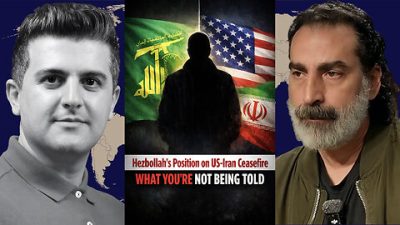
Laith Marouf: Hezbollah’s position on US-Iran ceasefire
or go to
Aletho News Archives – Video-Images
From the Archives
Is Israel to blame for the Iraq War?
American Goy | March 10, 2008
I am so tired of this old canard that “Israel had nothing to do with USA’s war with Iraq – in fact, it officially advised America against it”.
Bullshit. … continue
Blog Roll
 Aletho News
- Laith Marouf: Hezbollah’s position on US-Iran ceasefire: What you’re not being told
- Israel’s priority lies in destroying chances of peace between Iran, US: Ex-UN nuclear chief
- Ceasefire for all or for none: Iran shuts Hormuz over Lebanon attacks
- Strait of Hormuz is Iran’s ‘nuclear weapon’ that forced US retreat: Medvedev
- Energy crisis will last for months – Kremlin envoy
- Europe’s quiet role in the war on Iran
- Forty days that shook the Empire: How Iran turned the tables on US and prevailed
- Netanyahu unilaterally declares Lebanon outside of ceasefire deal
- Israeli leaders: ‘Not a single goal’ achieved in war with Iran
- What on earth just happened? Trump, Iran, and the unlikely ceasefire
- If Americans Knew
- Gazans face a triple crisis: severe shortages of water and bread, healthcare in tatters
- NY Times reports how Netanyahu took the US into Iran War
- A sigh of relief over Iran, but Gaza and Lebanon in dire straits – Daily Update
- Thousands dead and neighborhoods razed to the ground: Aid agencies fear southern Lebanon is becoming the new Gaza
- The war the US is fighting for Israel could cost trillions
- ‘Cigarette Burns, Nail Wounds’: Toddler Tortured in Gaza to Coerce Father
- Trump Says US Sent ‘a Lot of Guns’ to Protesters in Iran
- Israeli forces destroy 17 UN peacekeeper cameras in south Lebanon
- US-Israeli strikes ‘completely destroy’ synagogue in Tehran
- Archbishop for US Military Says Iran War Is Unjust Under Catholic Teaching
- No Tricks Zone
- An Inconvenient Tree: Uncovered In Alps… Europe Much Warmer Than Today 6000 Years Ago
- New Study Reports A 60% Slowdown In Greenland’s Ice Loss Rate In The Last Decade
- Low Intensity Tornado Wrecks Major Solar Farm, Creating A Potential Toxic Dump
- New Study Finds Warming Saves Lives…Cold Temperatures 12 Times More Deadly Than Excess Heat
- German Science Blog Accuses PIK Climate Institute Of Hallucinating Climate Tipping Points
- Devastating Assessment Of Comirnaty Vaccine By Former Senior Pfizer Europe Toxicologist
- New Study: CO2 Is ‘Effectively Negligible’ As An Explanatory Climate Change Factor Since 2000
- Former Pfizer Toxicologist Dr. Helmut Sterz Tells Bundestag Hearing Pfizer Vaccine Should Have Never Been Approved
- Energy Expert: Germany’s Nuclear Phaseout Was A “500 Billion Euro Mistake”
- New Research: South Australia’s Mid-Holocene Sea Surface Temperatures Were 4°C Warmer Than Today
 Aletho News