IRAN: The Three Islands Unmaking American Unipolar Sea Power in the Persian Gulf
By Freddie Ponton – 21st Century Wire – March 20, 2026
For half a century, the Strait of Hormuz has been sold as an American lake. “Freedom of navigation” meant US carrier groups on one side, pliant Gulf monarchies on the other, and anyone who challenged that arrangement cast as a rogue. That era is dying in real time, and three tiny islands at the mouth of the strait in the Persian Gulf explain why.
Abu Musa, Greater Tunb, Lesser Tunb. On most Western maps, they’re a footnote about an Iranian–UAE “dispute.” In the real world, they sit astride the deep‑water lanes that carry a huge share of the planet’s oil and gas. Whoever holds these islands doesn’t just watch the traffic; they sit on its windpipe. Iran controls them. And after US‑Israeli strikes on its territory, including reported HIMARS and missile attacks on Abu Musa and Kharg launched from Emirati soil in mid‑March, Tehran is no longer treating them as bargaining chips. It is fortifying them as unsinkable enforcement platforms and folding them into a new doctrine for Hormuz. Tehran’s doctrine is not American “open seas,” but Iranian‑managed passage under conditions set by Tehran as the state that actually lives on the coastline.
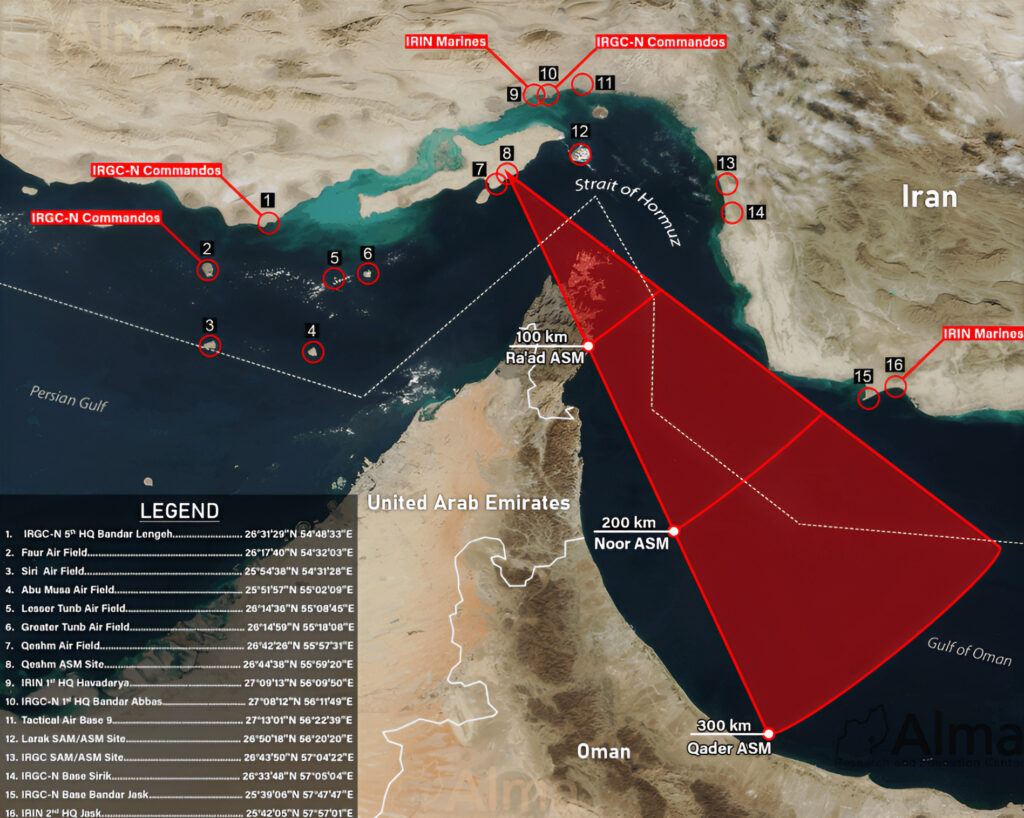
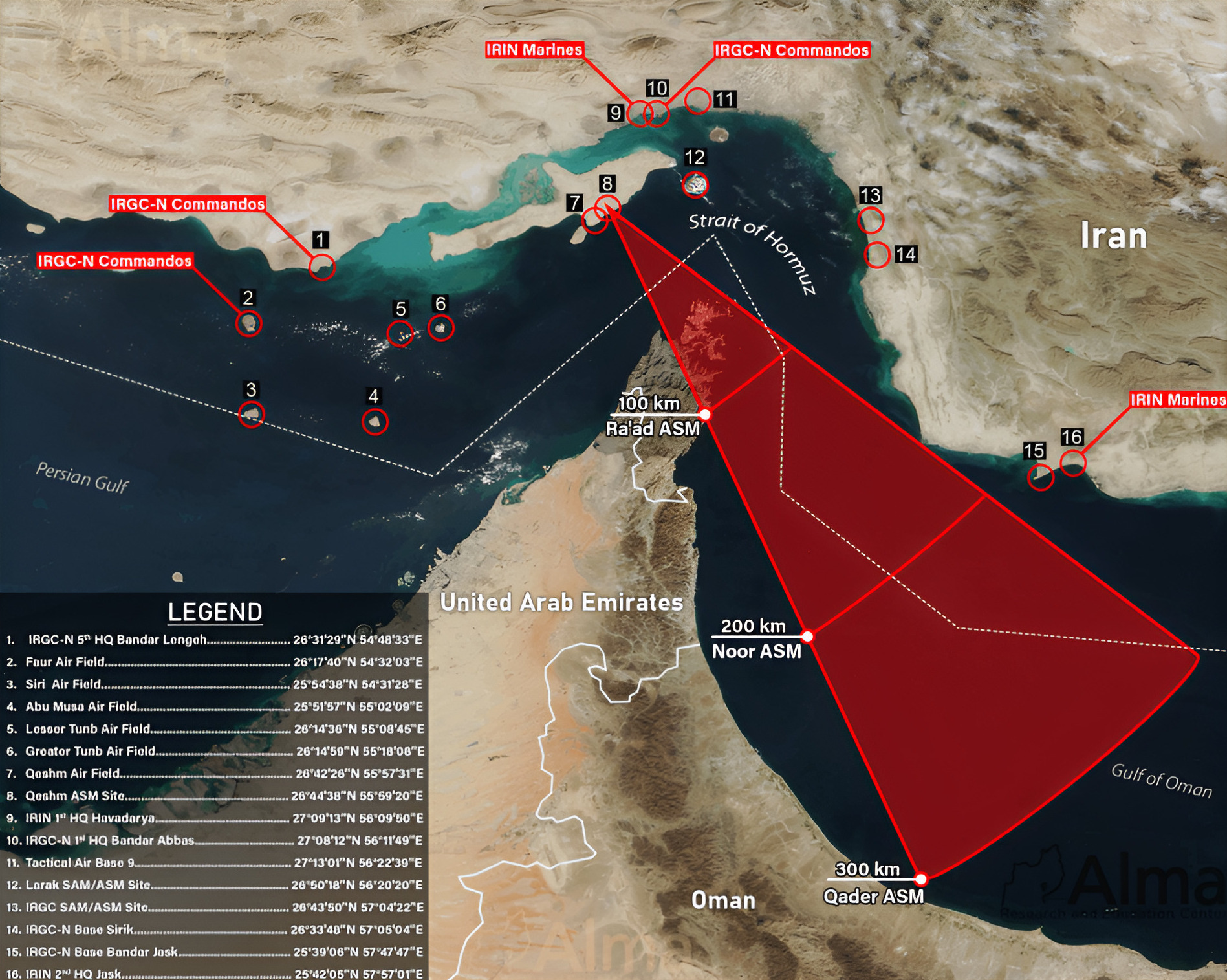
IMAGE: Abu Musa, Greater Tunb, Lesser Tunb, and Iranian forces positioned around the Strait of Hormuz (Source: Alma Research & Education Center)
The official Western question is still, “Is Hormuz closed?” and that’s a dodge. The real question is closed for whom, open for whom, and who gets to decide. Since the war phase began in late February, tanker traffic has collapsed, and commercial sailings have been rerouted or halted as war‑risk insurance is withdrawn. Where roughly a hundred tankers might normally cross in a comparable period, only about ninety have reportedly transited so far in March, with hundreds of other vessels backed up west of the strait and close to ninety percent of “normal” commercial passages gone. What still moves is a thin, carefully curated stream, including Iranian‑linked tonnage, a handful of politically vetted vessels that Tehran has agreed to let through via its own corridor, and tankers using intermittent AIS transmissions and complex ownership structures to move sanctioned or restricted oil toward Asia.
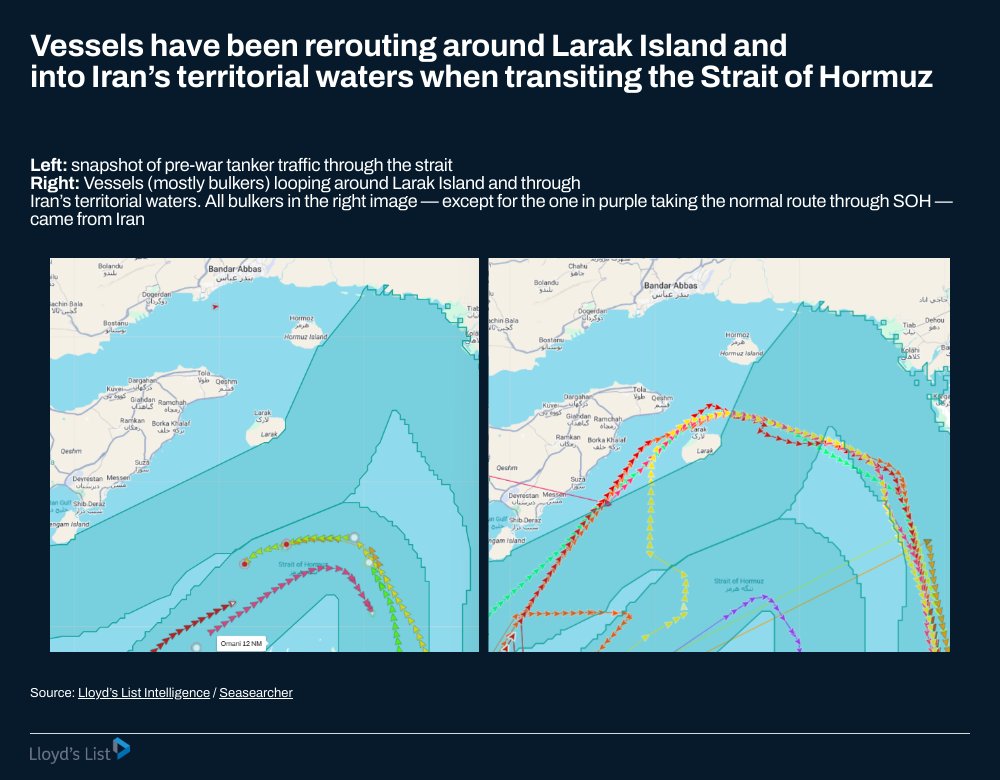
MAPS: Left – pre‑war tanker traffic through the Strait of Hormuz. Right – post‑war traffic, showing vessels (mainly bulk carriers) looping around Larak Island inside Iranian territorial waters. In the right‑hand map, every bulker except the purple one (which follows the old Strait route) has come from Iran (Source: Lloyd’s List Intelligence / Seasearcher | via Lloydslist)
Two India‑flagged gas carriers, namely the Shivalik and Nanda Devi, were tracked in mid‑March hugging the Iranian coastline and looping around Larak Island inside Iranian waters on their outbound run, an unusual detour that only makes sense if you understand that “safe passage” now means “Iran‑approved route.” At least one non‑Iranian tanker is reported to have paid a two-million-dollar fee for safe transit. This shouldn’t be seen as random, but more as the contour of a policy. Iran has built, in wartime, a selective corridor through its own waters—a route that non‑hostile states can use if they accept Iranian security conditions and that belligerent‑linked ships enter at their own risk. Vetting, advance disclosure of ownership and cargo, a narrow lane close to Iranian‑controlled islands, visual confirmation by IRGC units enforcing routing instructions, all of this adds up to a regional‑power‑managed maritime security framework.
For Washington, that’s intolerable, but for Tehran, it is common sense. An attacked coastal state asserts control over waters it must defend and refuses to guarantee safe passage to the very powers bombing its soil. The US dressed this principle up as “rules‑based order” when it applied to itself; Iran is now applying it at home.
Under Article 51 of the UN Charter, states have an “inherent right of individual or collective self‑defence”, especially when armed attack occurs. Under the Law of the Sea, coastal states retain sovereign rights in territorial waters and can regulate security‑related uses of those waters even where foreign ships enjoy transit passage in principle. Put bluntly, a state whose islands and infrastructure are under missile and drone fire is not obliged to offer safe, unconditional transit through adjacent straits to the forces attacking it. Iran’s position is that this legal language applies in the Gulf as much as it does off the coasts of NATO states. and not only when the flag on the defending warship is American.
This is why Abu Musa and the Tunbs can’t be treated as scenery. They are where law, geography and war intersect. Iran now openly says US rockets and missiles have hit Abu Musa and Kharg from launch sites in the UAE, and has warned that concealed US “hideouts” on Emirati soil could become targets. Tehran is stating, in plain language, that its islands are under attack from US forces using Gulf territory as a staging ground, and that any security regime in Hormuz must start from that reality. When Iran reinforces Abu Musa, Greater Tunb and Lesser Tunb with systems like the Khordad‑15 air‑defence network and integrated radar deployments and hardened garrisons, this is not random muscle‑flexing, but a military posture and a legal argument built together. These islands are Iranian territory; they have been directly targeted, and Iran claims the right and the obligation to control what passes under their guns.
Once you see that, the narrative of “Iran weaponising Hormuz” looks like what it is: projection. The unipolar maritime architecture is disintegrating. The old model rested on US naval dominance in the Gulf dressed up as “freedom of navigation”, Western insurers and P&I clubs underwriting risk, and a political fiction that all of this was neutral. All three pillars are failing at once. US warships can still fire missiles and intercept drones; however, they cannot restore normal traffic, and certainly have failed to convince owners, crews and insurers that sailing through a de facto war zone ringed by Iranian missiles, drones and fast boats is “safe” because the Pentagon says so. Iranian warnings are being enforced with fire and shrapnel on decks near the UAE. Owners and captains have diverted voyages or refused to enter the area altogether. Whatever carefully crafted talking points say, the calculus on the water has changed.
On the financial side, the retreat is even starker. Major mutuals like Gard and other big clubs have cancelled or sharply restricted war‑risk cover in Iranian and Gulf waters. Reinsurers have pulled back. War‑risk premia have surged, with brokers citing mark‑ups in the tens of percentage points over pre‑crisis levels. A US destroyer on the horizon is one thing; a captain whose vessel requires uninsured or state‑guaranteed passage is another. Once you understand that, the sudden enthusiasm in London and at the UN for “safe maritime corridors” to evacuate stranded ships and seafarers looks less like confident crisis management and more like a rear‑guard action. Institutions are scrambling to sketch out a neutral evacuation lane for stranded ships and tens of thousands of trapped seafarers, only after Iran has already imposed a functioning framework of selective passage.
Hormuz today is not an open‑or‑closed switch; it is a three‑tier system where the old, war‑risk‑insured, and the West‑governed traffic has largely fled. The vessels that still move under a veneer of normality are those that have obtained Iranian approval, accepted Iranian routing through Iranian waters and, in some cases, paid for the privilege. Beyond that are tankers often described in Western reporting as a ‘shadow fleet’ that move oil targeted by US and EU sanctions to Asia. The United States built the first tier and tried to pretend the other two were aberrations. The war has inverted that hierarchy as the US‑designed layer is barely functioning, and Iran’s own corridor, together with the parallel fleet of non‑Western‑insured tankers, now carries most of the barrels that still move.
That is why the question “who pays the bill” is not a technical afterthought. When major P&I clubs exit, when fringe insurers and state guarantees step in to keep some trade moving, when Turkish officials say openly that only governments can now provide adequate cover, we are watching the monetisation of geopolitics. The price of sailing through Hormuz is no longer set by neutral actuarial tables in London; it is set by political risk and Iranian veto power. The reported multimillion‑dollar “approval fee” is not just a one‑off toll. In the current context, it should be viewed as an early manifestation of a deeper shift from Western‑priced risk to regionally priced power.
For the Gulf monarchies, this is a nightmare written in their own geography. Officially, they repeat Washington’s language about Iranian aggression and the sanctity of free navigation. In practice, they sit under the shadow of Iranian missiles capable of striking across the Gulf, on top of US bases that make their territory a launchpad, with economies that cannot absorb a prolonged throttling of Hormuz. The strikes on Abu Musa and Kharg, allegedly from positions in the UAE, lay this contradiction bare.
The United Arab Emirates hosts US military assets that can be used to strike Iranian islands. Iran’s answer is blunt: if you turn your territory into a launchpad, you turn it into a battlefield. Tehran has already demonstrated this logic by hitting ports and energy infrastructure elsewhere around the Gulf with missiles and drones, and insurers have responded by treating Emirati lanes as anything but routine. Caught in the middle, Gulf rulers are squeezed from above by US and Israeli pressure to “hold the line,” from below by the basic fact that their economies depend on exports through Hormuz, and from the side by Iran’s ability to ratchet risk up or down via its island‑based enforcement grid and corridor approvals. They cannot acknowledge this publicly, but shipping patterns, quiet outreach to Tehran and renewed focus on bypass routes such as Iraqi lines to Ceyhan and the UAE’s Fujairah outlet, tell their own story. The era of outsourcing maritime security to an external hegemon is coming to an end, and the bill for that dependency has arrived.
For Washington and Tel Aviv, this is not just inconvenient; it is structurally humiliating. They can escalate strikes on Iranian soil and assets. They can float carrier groups and talk about keeping the lanes open. Nonetheless, the facts are brutal, as we witness the collapse of normal commercial traffic, key insurers walking away, and Iran still in a position to hit or detain ships that ignore its instructions. Every move now risks one of two outcomes, both bad from their point of view. Either they tacitly accept Iran as a gatekeeper, admitting that the local power they tried to isolate now decides who moves safely through the world’s most important energy chokepoint. Or they try to smash that gatekeeper, at the cost of a much wider war in waters Iran has spent decades preparing to fight in with anti‑ship missiles, mines and swarming boats, with a global economy built on the assumption that nobody would be reckless enough to test it. The mythology of neutral US maritime hegemony never allowed for this choice.
The real Gulf, anchored in islands like Abu Musa and the Tunbs, always did. Strip away the propaganda, and what remains is stark. Iran has been attacked by the US and Israel, including strikes on key islands and infrastructure, and has invoked its right to self‑defence. It controls strategic islands that command the Hormuz lanes. It uses that control to build a selective passage regime that rewards non‑belligerents, punishes or deters aggressors, and forces everyone else to choose. This is not irrational behaviour, it is not even chaos. It is what happens when a regional state that understands geography stops accepting US control of its maritime neighbourhood as a law of nature.
That is the story the Strait of Hormuz is telling now. This is not another abstract crisis in “global shipping.” It is an autopsy of the “open seas under US protection” fable and a close‑up of the Iranian alternative taking shape where it matters most: at the narrow throat of the Gulf, under the guns and radars of three small islands most of the world has never heard of, but soon will have to reckon with.
Sorry, the comment form is closed at this time.
Featured Video
Bombing Hitler’s Hometown
or go to
Aletho News Archives – Video-Images
From the Archives
The Biggest Threat to Peace in Middle East
By Dr. Elias Akleh* | Sabbah Report | May 24, 2010
A build up of heightened tension in the Middle East is escalating in the last few weeks. American and Israeli postures towards Lebanon, Syria, and Iran have become more threatening. Listening to speeches of political leaders one hears talks only about war not peace. Iranians and Israelis are continuously training hard for a possible showdown. Both sides are conducting extensive war games every month. This led Syrians to claim that Israel is preparing for a soon-to-come another war. The Jordanians also are warning that current stalemate of the peace process is an indication of a war breaking out this summer. The Russian President and his army chief hinted, a few months ago, that the US and Israel were planning for an attack on Iran.
Indeed Iran is, as it has been for last few years, the target of most of the threats and accusations of supporting terrorism. Escalating incitement against Iran the American Defense Department sent last month (April) to Congress a report on Iran’s military claiming Iran could develop intercontinental ballistic missiles capable of reaching the US by 2015.
Ignoring the fact that N. Korea, India, Pakistan, and Israel are proven to have nuclear weapons while Iran does not, the US Secretary of State Hillary Clinton chose in her speech, to the nuclear Non-Proliferation Treaty review conference at the UN, to focus on Iran’s alleged nuclear ambitions putting the whole world at risk as she put it. According to Clinton Iran’s acquisition of nuclear weapons, rather than Israel’s more than 200 nuclear bombs, is destabilizing the Middle East. She called on the world’s nations to rally around US efforts to hold Iran, not other nuclear countries, to account.
The accusation that Usama Bin Laden is living comfortably in Iran had received a boost after the broadcast of a documentary called “Feathered Cocaine”. This echoed the June 2003 claims of the Italian newspaper Corre de la Sierra that Bin Laden was in Iran according to some intelligence report, and according to Richard Miniter’s book “Shadow War”. … continue
Blog Roll
 Aletho News
- Bombing Hitler’s Hometown
- German journalist threatened with homelessness as German court upholds EU sanctions in landmark free speech case
- US Tells Allies That Ukraine-Bound Arms Could be Sent to Middle East
- Organized terrorism: Iran condemns killing of its diplomats in Lebanon
- Why could Gaza enter the regional war?
- Hamas official rejects Mladenov Plan linking disarmament to Gaza reconstruction
- Two Primary Elections for the Soul of ‘America First’
- Japan Clings to US Vassalage Despite Energy Crunch Caused By Iran War
- US Seeks Control Over Global Energy Infrastructure – Kremlin
- US senators target Orban government for standing up to Zelensky
- If Americans Knew
- Researchers at Human Rights Watch Resign Over Blocked Report on Palestinian Refugee Return
- Jewish Groups Are Backing a War Americans Don’t Want
- Eric Fingerhut Thinks He’s the President of the Jews
- Top Jewish Philanthropists, Rabbis Urge Israeli President to Take Action Against ‘Jewish Extremists’
- Don’t Be Fooled. Zionist Leaders Have Always Wanted to Control Southern Lebanon
- Israel’s widespread use of torture is a core element of its genocide against the Palestinian people
- In Israel’s War on Iran, Many Middle East US Bases Rendered “All But Uninhabitable”
- ‘Burn the lawn’: Israel pursues ‘Rafah model’ in southern Lebanon
- A genocide here, an amputation there
- Reports: Iran mobilizing 1M fighters, Israel-US run low on ammo, Israeli army faces shortage – Not a ceasefire Day 168
- No Tricks Zone
- Devastating Assessment Of Comirnaty Vaccine By Former Senior Pfizer Europe Toxicologist
- New Study: CO2 Is ‘Effectively Negligible’ As An Explanatory Climate Change Factor Since 2000
- Former Pfizer Toxicologist Dr. Helmut Sterz Tells Bundestag Hearing Pfizer Vaccine Should Have Never Been Approved
- Energy Expert: Germany’s Nuclear Phaseout Was A “500 Billion Euro Mistake”
- New Research: South Australia’s Mid-Holocene Sea Surface Temperatures Were 4°C Warmer Than Today
- Storing Green Energy To Last Germany 10 Days Would Require A 60-Million Tonne Battery
- New Studies: UK Sea Levels Were 4 Meters Higher Than Today During The Mid-Holocene
- Destructive Green New Deal: German Energy And Metal Group Warns Of Drastic Crisis
- New Study Documents A 20-Year Pause In Arctic Sea Ice Decline – Driven By Internal Variability
- Wake-up Call: Survey Shows Majority Of Germans Now Favor Postponing Climate Targets!
 Aletho News