Angela Lipps spent nearly six months in jail because an algorithm looked at surveillance footage and decided she matched the suspect. She had never been to North Dakota. She had never been on a plane. A facial recognition system said otherwise, and police took that as enough.
Lipps, a 50-year-old mother and grandmother from north-central Tennessee, was arrested at her home in July while babysitting four children. US marshals arrived with guns drawn. She was booked as a fugitive from justice.
“I’ve never been to North Dakota, I don’t know anyone from North Dakota,” she told WDAY News.
The case began with bank fraud in Fargo.
Between April and May 2025, someone used a fake US Army military ID to withdraw tens of thousands of dollars from banks across the city. Detectives pulled surveillance footage of a woman at the counters. They fed that footage into facial recognition software. The software returned a name: Angela Lipps.
A detective wrote in court documents that Lipps appeared to match the suspect based on facial features, body type, and hairstyle.
That assessment, made by software and rubber-stamped in a report, was treated as sufficient cause for arrest. Nobody from the Fargo police called Lipps before the marshals showed up at her door.
She sat in a Tennessee county jail for 108 days waiting for North Dakota to arrange her transport. No bail. Four counts of unauthorized use of personal identifying information. Four counts of theft. The algorithm had spoken.
Her attorney, Jay Greenwood, told InForum: “If the only thing you have is facial recognition, I might want to dig a little deeper.”
Fargo police did not dig deeper. What eventually cleared Lipps was her bank records, which showed she had been more than 1,200 miles away in Tennessee during every transaction investigators said she committed in North Dakota. Greenwood obtained those records and brought them to the investigators. Lipps was released on Christmas Eve.
The story didn’t end there. While locked up and unable to pay bills, Lipps lost her home, her car, and her dog. When Fargo police released her, they didn’t arrange her trip back to Tennessee. Defense attorneys helped cover a hotel room and food over Christmas. A local nonprofit, the F5 Project, got her home.
As of the reporting from InForum, nobody from the Fargo police department had apologized.
This is how facial recognition operates: it generates a match, law enforcement acts on it, and the burden of disproving a computer’s guess falls entirely on the person whose life gets upended.
Lipps had to produce documentary evidence of her own location to escape charges based on software that was simply wrong.
Officers arrived armed at Kenwood High School, forced student Taki Allen to his knees, handcuffed him, and searched him. They found nothing.
In the UK, Shaun Thompson, 39, had just finished a volunteer shift with Street Fathers, a group dedicated to steering young people away from knife crime, when the Metropolitan Police’s live facial recognition cameras flagged him outside London Bridge station.
Officers detained him for nearly half an hour, demanded his fingerprints, and threatened arrest, even as he produced multiple forms of ID proving he wasn’t the person they were looking for. “They were telling me I was a wanted man, trying to get my fingerprints and trying to scare me with arrest, even though I knew and they knew the computer had got it wrong,” he said.
Thompson is now bringing the first legal challenge of its kind against the Metropolitan Police’s use of live facial recognition. The man the algorithm flagged as a criminal was spending his evening trying to prevent crime. The technology made no distinction.
What these cases share is a common architecture. A system makes an identification, human oversight treats that identification as reliable, and the person flagged has no recourse until significant damage has already been done.
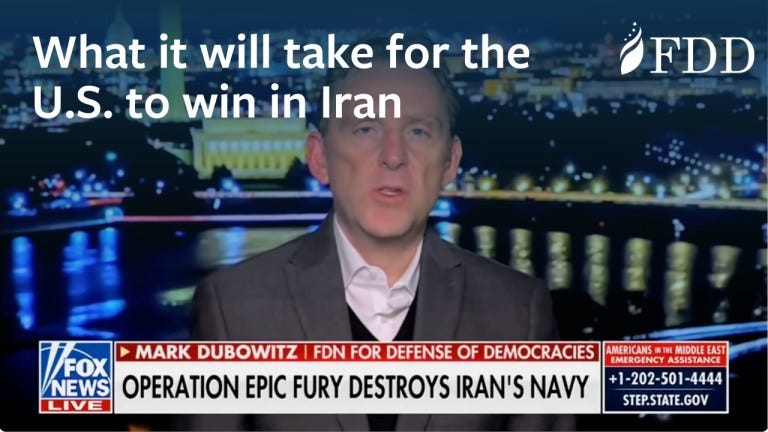
The Trump White House plagiarized its justification for attacking Iran from the Foundation for the Defense of Democracies, the main DC outfit promoting war with Tehran. The think tank was originally founded to “enhance Israel’s image,” and partners closely with the Israeli government.
The Trump Administration appeared to plagiarize its official justification for its war on Iran, copying almost word-for-word a document originally produced by the Foundation for the Defense of Democracies (FDD), a pro-war think tank with close ties to Israeli intelligence which was originally founded to “enhance Israel’s image.”
The FDD document was authored by Tzvi Kahn, the former assistant director for policy and government affairs at the American Israel Public Affairs Committee (AIPAC).
A March 2, 2026 statement issued by the White House accusing Tehran of 44 instances of terrorism against American citizens is “virtually identical” to the list published by FDD in June 2025, analyst Stephen McIntyre noted Thursday.
While the White House did make superficial alterations to the text, they largely consisted of appending the label “Iran-backed” to every mention of groups like Hezbollah and Hamas. In the few instances where Trump administration officials bothered to make significant changes to the original FDD list, the edits were almost always made in service of “ratcheting up the underlying allegation,” McIntyre concluded.
Among the most egregious examples was a 1996 attack on the Khobar Towers in Saudi Arabia, which FDD originally said merely that Hezbollah al-Hejaz was “deemed responsible” for. In the White House version, however, the group’s responsibility was “asserted as factual,” explained McIntyre, noting that serious questions about the incident remain unanswered to this day. “Clinton’s Defense Secretary William Perry subsequently wondered (along with many others) whether Khobar Towers should have been attributed to Al Qaeda,” he wrote.
A 2009 investigation by journalist Gareth Porter based on interviews with over a dozen former CIA, FBI and Clinton administration officials demonstrated that the FBI’s inquiry into the Khobar Towers attack was precooked to blame Iran, when Al Qaeda was mostly like the culprit. Porter found that Shia citizens of Saudi Arabia had been tortured into confessing to the crime by Saudi secret police.
While the White House declined to join FDD in blaming Iran for the Sept. 11, 2001 terror attacks, it echoed the Israel-oriented organization in blaming Tehran for 603 military deaths in Iraq, which both documents attributed to “Iran-backed militias.” But there are major discrepancies with the figure, which amounts to 60% of the total US combatant deaths attributed to Iran. As McIntyre noted, such a claim is “not made in the State Department annual reports on Global Terrorism.”
At least four of the Americans the Trump administration claims were killed by Iran had served in Israel’s military. These included a US citizen who died while invading Lebanon in 2006 and two Americans in the IDF’s Golani brigade who were killed while invading Gaza in 2014. The fourth American, who was born in Israel and had also served in the Golani brigade, was killed amid violent reprisals against settlers in the West Bank in 2015.
A number of the claims are undermined by the very sources they cite, including a December 2019 incident in which the Trump administration insisted “Iran-backed Kataib Hezbollah terrorists killed an American civilian contractor and wounded several U.S. service members in a rocket attack at K1 Air Base in Kirkuk, Iraq.” But the Reuters article cited by the White House as proof that Iran was responsible made no such claim, explicitly cautioning that “no group has claimed responsibility for the attack.” In reality, Reuterssuggested the attack was the work of “Islamic State militants operating in the area [who] have turned to insurgency-style tactics.”
Defense Secretary Lloyd Austin said at the time that “we don’t know” how operationally involved Iran was in the January 28 attack that killed three US troops, “but it really doesn’t matter.”
“We have FDD”: Israel’s favorite Washington cutout
In tax documents filed with the IRS upon its founding in 2001, FDD was originally named EMET, which is Hebrew for “truth.” The fledgling outfit described its mission as working to “enhance Israel’s image in North America and the public’s understanding of issues affecting Israeli-Arab relations.” It changed its name soon after, presumably to sound less overtly Israeli.
FDD has since emerged as the leading Washington-based think tank pushing the US toward war with Iran. During the first Trump administration, FDD participated in a $1.5 million dollar State Department initiative to attack critics of the policy of “maximum pressure” on Iran. At the time, FDD was openly promoting a military assault on Iran. The think tank’s staff are brought to testify before the House Foreign Affairs Committee more than those of any other think tank, invariably to advance conflict with Tehran.
During a 2017 conference of the Israeli American Council in Washington DC, then-Director General of Israel’s Ministry of Strategic Affairs Sima Vakhnin-Gil was recorded by undercover journalist James Kleinfeld during a private breakout session. The Israeli military-intelligence official named FDD as a partner in a covert campaign to spy on Americans involved in Palestine solidarity activity.
“This is something that only a country can do the best,” Vakhnin-Gil said. “We have FDD. We have others working on this.”
The Israeli American Council was sponsored by a billionaire who has also been a top donor to the FDD: the Sheldon and Miriam Adelson Foundation. Since the death of Sheldon Adelson, his Israeli widow, Miriam, has emerged as the top donor to Trump’s political campaigns. Having donated hundreds of millions to Trump and his allies, Adelson clearly expected him to wage war on Iran on behalf of Israel, according to conservative former Fox News host Megyn Kelly.
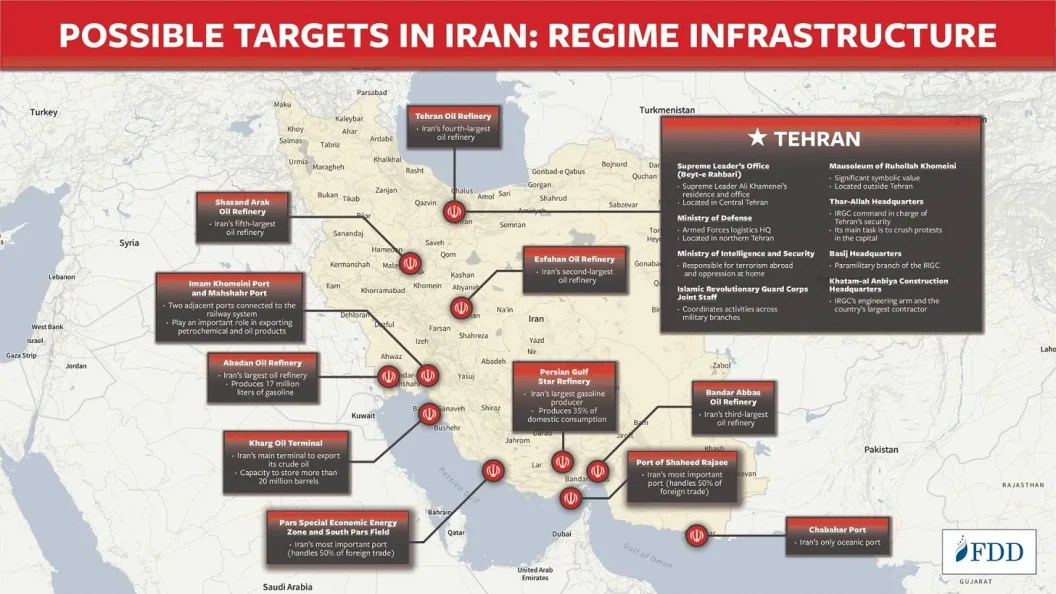
Since Trump thrilled his Israel-aligned donors by attacking Iran, FDD has provided the White House with more than talking points for justifying war on Iran. It has also proposed civilian targets in Iran for the US military to strike. These included the Tehran oil depot which Israel bombed on March 8, causing massive fires that shrouded the city of 9 million in toxic fumes.
After the strike triggered a wave of punishing retaliatory Iranian attacks on oil infrastructure in US-allied countries in the region, Trump advisors expressed regret. “We don’t think it was a good idea,” one told Axios. But by then, it was too late to avoid escalation. They had followed the FDD-authored, Israeli-designed script into a quagmire.
UK media has whitewashed Israel’s attempt to kill British war journalist Steve Sweeney and his Lebanese cameraman Ali Rida while they were broadcasting live from southern Lebanon on 19 March.
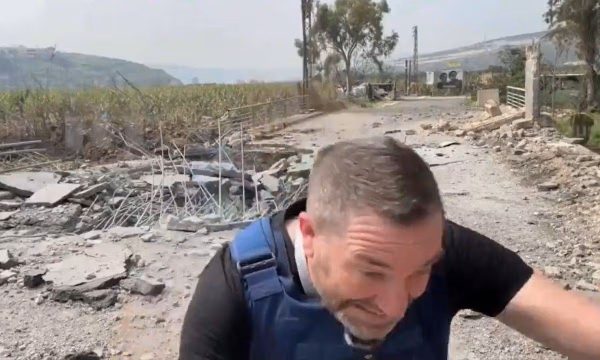
Footage shot by Rida shows Sweeney giving a news report about a previous Israeli strike when he realizes another strike is headed towards them. He quickly ducks as the missile is seen exploding as it hits the ground just meters behind him.
Sweeney was treated at the hospital to remove shrapnel from the bomb that was embedded in his arm.
While reporting on the strike, the BBC used a headline stating, “Missile lands next to presenter during live report from Lebanon.”
The headline did not mention that Israel had fired the missile, nor did it describe Sweeney as a journalist or war correspondent, while implying the strike was only random or simply an accident.
The Independent newspaper described the incident in a similar way, writing “A missile landed just a few feet away from a British journalist as he was reporting live from Lebanon.”
“Footage shared by Russian state broadcaster RT on Thursday (19 March) shows Steve Sweeney, its Lebanon bureau chief, running for cover as an explosion detonated behind him,” The Independent added, also failing to mention Israel had launched the strike.
The Daily Mail, a British tabloid, acknowledged Israel’s role, but referred to Sweeney’s statement that Israel tried to kill him as only a “claim.”
“British journalist Steve Sweeney has claimed Israel ‘tried to kill him’ in a targeted airstrike that left him and his cameraman with minor injuries,” the Daily Mail wrote.
The New York Post and CNN used similar headlines, omitting mention of Israeli responsibility, while taking Israel’s claims at face value that its military does not target journalists in the body of the article.
“Insane moment missile blows up just feet away from reporter in Lebanon,” stated the New York Post headline.
CNN wrote, “News crew narrowly escapes strike in southern Lebanon,” while publishing only the video and no other details on its website.
BBC, The Independent, and Daily Mail reports ignore Israel’s deliberate killing of Lebanese journalists covering Israeli war crimes since 2023.
The targeting of Sweeney and Rida came just one day after Israel assassinated Al Manar journalist Mohammad Sherri and his wife in a brutal strike on Lebanon’s capital, Beirut, as part of a series of deadly attacks that killed at least a dozen.
During its previous war on Lebanon – which started in 2023 and ended in a so-called ceasefire in 2024 – the Israeli army murdered three Lebanese journalists with an airstrike as they slept at a media guesthouse in southeast Lebanon.
“The 3:00 am airstrike turned the site – a series of chalets nestled among trees that had been rented by various media outlets covering the war – into rubble. Cars marked ‘PRESS’ were overturned and covered in dust and debris, and at least one satellite dish for live broadcasting was totally destroyed,” AP reported.
The strikes killed camera operator Ghassan Najjar and broadcast technician Mohammed Rida of Al Mayadeen TV, and camera operator Wissam Qassim, who worked for Hezbollah-affiliated Al Manar TV.
“The journalists thought they were safe because this south Lebanon area wasn’t in Israel’s evacuation zone,” PBS journalist Leila Molana-Allen wrote on X.
Molana-Allen, who is also currently reporting from Lebanon, said the journalists had given details of their movements to UN peacekeepers to send to the Israeli military.
“Turns out the IDF [Israeli military] used that info to bomb them while they were all inside asleep,” Molana-Allen reported.
Lebanese journalists had already been working for almost a year under the shadow of Israel’s killings of Reuters video journalist Issam Abdullah on 13 October 2023 and Al Mayadeen journalist Farah Omar, her cameraman Rabih al-Maamari, and their assistant Hussein Akil on 21 November 2023.
All four were killed reporting from the Lebanon–Israel border area after the war between Lebanon and Israel began on 8 October 2023, the next day after the launch of Hamas’s Operation Al-Aqsa Flood and Israel’s genocide of Palestinians in Gaza.
A Reuters investigation concluded that Abdullah was killed and six others were injured when Israeli troops fired two tank shells directly at a group of journalists from Reuters, AFP, and Al Jazeera who were filming at an open spot one kilometer from the border.
A record 129 journalists and media workers were killed worldwide in 2025, the Committee to Protect Journalists reported, with Israel responsible for two-thirds of the deaths, including many it killed in Gaza.
An anti-Zionist group has claimed responsibility for a fire at a warehouse belonging to a defense firm linked to Israel’s Elbit Systems in the Czech Republic.
The Earthquake Faction, which describes itself as “an internationalist underground network,” posted a video purportedly showing the arson attack on an industrial facility in the Czech town of Pardubice on Friday, along with images of the burned-out building.
It said the site was used to “develop weaponry used by the Zionist entity to massacre people daily in Palestine, Lebanon, Iran, and across West Asia.”
Firefighters extinguished the blaze, no injuries were reported, and police said there was no danger to the public. Officials said the incident is being treated as a suspected terrorist attack.
The facility is operated by LPP Holding, a Czech arms manufacturer producing civilian and military equipment. In 2023, the company announced cooperation with Israel’s Elbit Systems on drone development.
Headquartered in Haifa, the firm is Israel’s largest defense manufacturer, specializing in unmanned systems, precision weapons, and electronic warfare equipment.
The Czech Republic, an EU and NATO member, is a close ally of Israel. Czech officials have supported US and Israeli military actions against Iran and condemned Iranian missile and drone attacks.
For half a century, the Strait of Hormuz has been sold as an American lake. “Freedom of navigation” meant US carrier groups on one side, pliant Gulf monarchies on the other, and anyone who challenged that arrangement cast as a rogue. That era is dying in real time, and three tiny islands at the mouth of the strait in the Persian Gulf explain why.
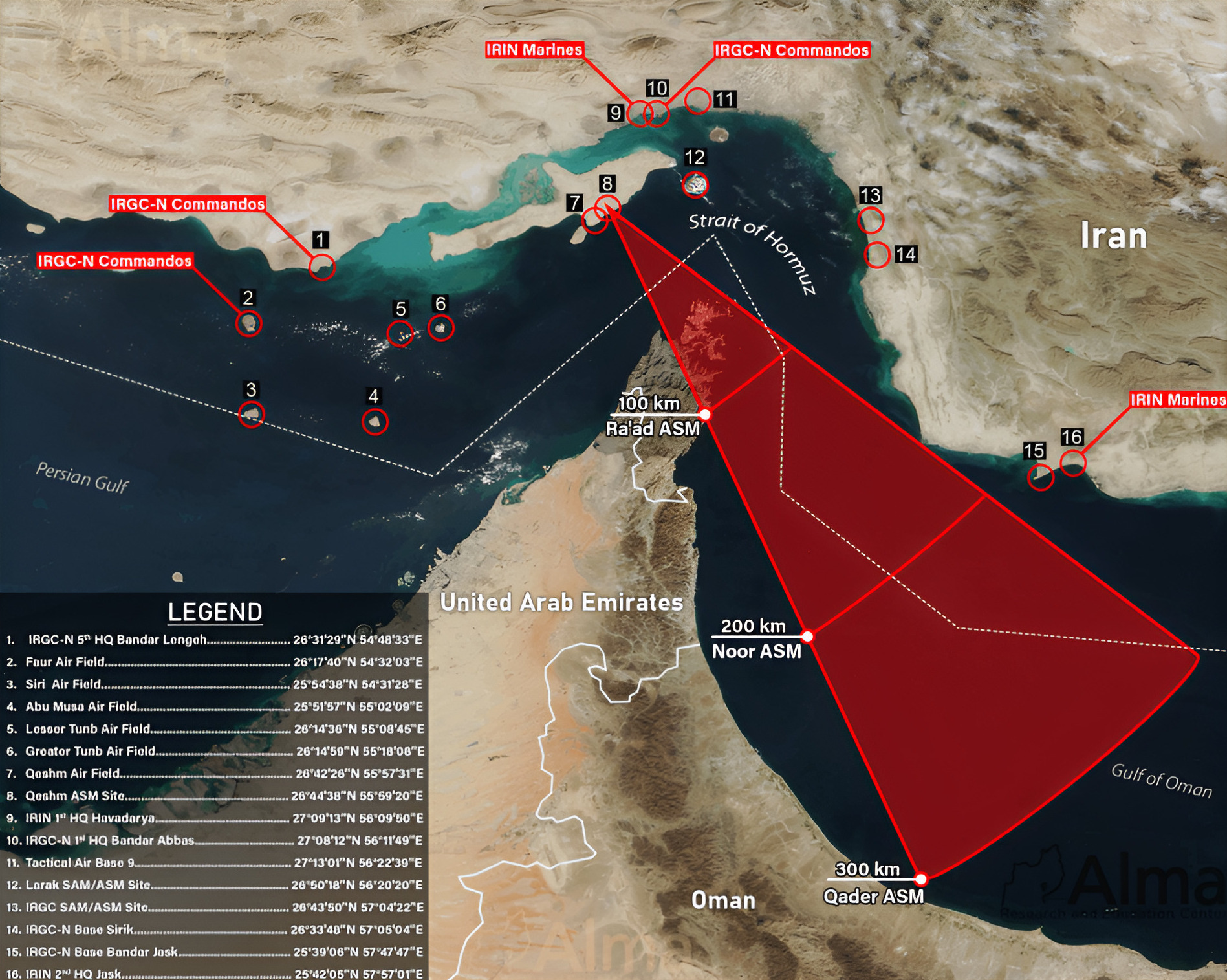
Abu Musa, Greater Tunb, Lesser Tunb. On most Western maps, they’re a footnote about an Iranian–UAE “dispute.” In the real world, they sit astride the deep‑water lanes that carry a huge share of the planet’s oil and gas. Whoever holds these islands doesn’t just watch the traffic; they sit on its windpipe. Iran controls them. And after US‑Israeli strikes on its territory, including reported HIMARS and missile attacks on Abu Musa and Kharg launched from Emirati soil in mid‑March, Tehran is no longer treating them as bargaining chips. It is fortifying them as unsinkable enforcement platforms and folding them into a new doctrine for Hormuz. Tehran’s doctrine is not American “open seas,” but Iranian‑managed passage under conditions set by Tehran as the state that actually lives on the coastline.
IMAGE: Abu Musa, Greater Tunb, Lesser Tunb, and Iranian forces positioned around the Strait of Hormuz (Source: Alma Research & Education Center)
The official Western question is still, “Is Hormuz closed?” and that’s a dodge. The real question is closed for whom, open for whom, and who gets to decide. Since the war phase began in late February, tanker traffic has collapsed, and commercial sailings have been rerouted or halted as war‑risk insurance is withdrawn. Where roughly a hundred tankers might normally cross in a comparable period, only about ninety have reportedly transited so far in March, with hundreds of other vessels backed up west of the strait and close to ninety percent of “normal” commercial passages gone. What still moves is a thin, carefully curated stream, including Iranian‑linked tonnage, a handful of politically vetted vessels that Tehran has agreed to let through via its own corridor, and tankers using intermittent AIS transmissions and complex ownership structures to move sanctioned or restricted oil toward Asia.
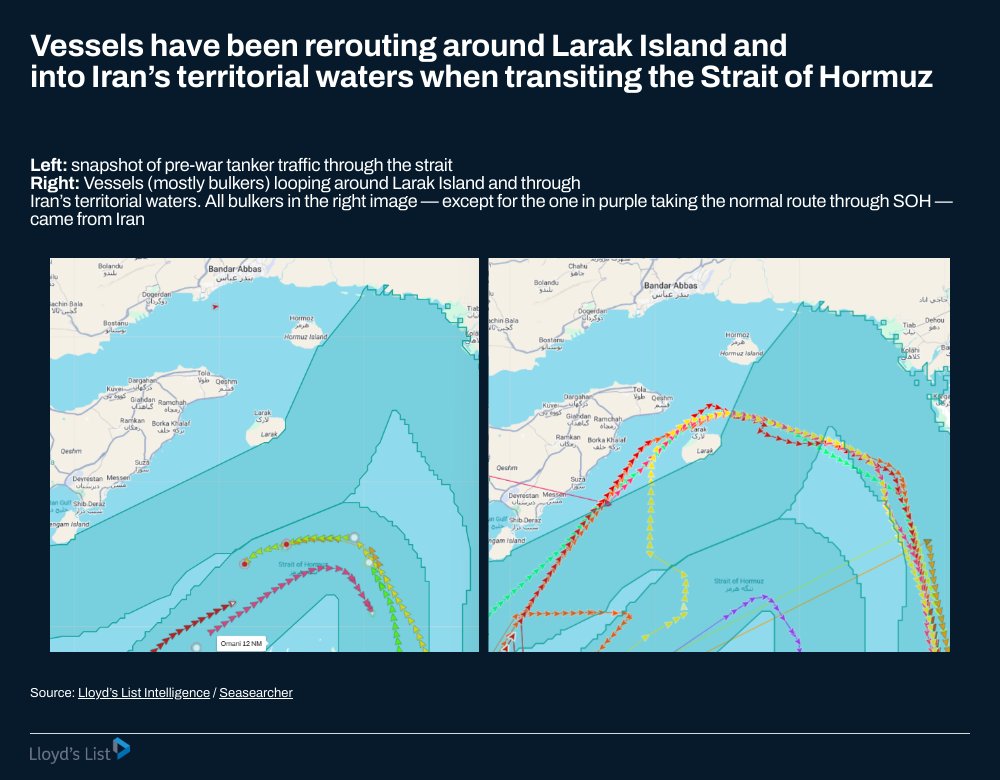
MAPS: Left – pre‑war tanker traffic through the Strait of Hormuz. Right – post‑war traffic, showing vessels (mainly bulk carriers) looping around Larak Island inside Iranian territorial waters. In the right‑hand map, every bulker except the purple one (which follows the old Strait route) has come from Iran (Source: Lloyd’s List Intelligence / Seasearcher | via Lloydslist)
Two India‑flagged gas carriers, namely the Shivalik and Nanda Devi, were tracked in mid‑March hugging the Iranian coastline and looping around Larak Island inside Iranian waters on their outbound run, an unusual detour that only makes sense if you understand that “safe passage” now means “Iran‑approved route.” At least one non‑Iranian tanker is reported to have paid a two-million-dollar fee for safe transit. This shouldn’t be seen as random, but more as the contour of a policy. Iran has built, in wartime, a selective corridor through its own waters—a route that non‑hostile states can use if they accept Iranian security conditions and that belligerent‑linked ships enter at their own risk. Vetting, advance disclosure of ownership and cargo, a narrow lane close to Iranian‑controlled islands, visual confirmation by IRGC units enforcing routing instructions, all of this adds up to a regional‑power‑managed maritime security framework.
For Washington, that’s intolerable, but for Tehran, it is common sense. An attacked coastal state asserts control over waters it must defend and refuses to guarantee safe passage to the very powers bombing its soil. The US dressed this principle up as “rules‑based order” when it applied to itself; Iran is now applying it at home.
Under Article 51 of the UN Charter, states have an “inherent right of individual or collective self‑defence”, especially when armed attack occurs. Under the Law of the Sea, coastal states retain sovereign rights in territorial waters and can regulate security‑related uses of those waters even where foreign ships enjoy transit passage in principle. Put bluntly, a state whose islands and infrastructure are under missile and drone fire is not obliged to offer safe, unconditional transit through adjacent straits to the forces attacking it. Iran’s position is that this legal language applies in the Gulf as much as it does off the coasts of NATO states. and not only when the flag on the defending warship is American.
This is why Abu Musa and the Tunbs can’t be treated as scenery. They are where law, geography and war intersect. Iran now openly says US rockets and missiles have hit Abu Musa and Kharg from launch sites in the UAE, and has warned that concealed US “hideouts” on Emirati soil could become targets. Tehran is stating, in plain language, that its islands are under attack from US forces using Gulf territory as a staging ground, and that any security regime in Hormuz must start from that reality. When Iran reinforces Abu Musa, Greater Tunb and Lesser Tunb with systems like the Khordad‑15 air‑defence network and integrated radar deployments and hardened garrisons, this is not random muscle‑flexing, but a military posture and a legal argument built together. These islands are Iranian territory; they have been directly targeted, and Iran claims the right and the obligation to control what passes under their guns.
Once you see that, the narrative of “Iran weaponising Hormuz” looks like what it is: projection. The unipolar maritime architecture is disintegrating. The old model rested on US naval dominance in the Gulf dressed up as “freedom of navigation”, Western insurers and P&I clubs underwriting risk, and a political fiction that all of this was neutral. All three pillars are failing at once. US warships can still fire missiles and intercept drones; however, they cannot restore normal traffic, and certainly have failed to convince owners, crews and insurers that sailing through a de facto war zone ringed by Iranian missiles, drones and fast boats is “safe” because the Pentagon says so. Iranian warnings are being enforced with fire and shrapnel on decks near the UAE. Owners and captains have diverted voyages or refused to enter the area altogether. Whatever carefully crafted talking points say, the calculus on the water has changed.
On the financial side, the retreat is even starker. Major mutuals like Gard and other big clubs have cancelled or sharply restricted war‑risk cover in Iranian and Gulf waters. Reinsurers have pulled back. War‑risk premia have surged, with brokers citing mark‑ups in the tens of percentage points over pre‑crisis levels. A US destroyer on the horizon is one thing; a captain whose vessel requires uninsured or state‑guaranteed passage is another. Once you understand that, the sudden enthusiasm in London and at the UN for “safe maritime corridors” to evacuate stranded ships and seafarers looks less like confident crisis management and more like a rear‑guard action. Institutions are scrambling to sketch out a neutral evacuation lane for stranded ships and tens of thousands of trapped seafarers, only after Iran has already imposed a functioning framework of selective passage.
Hormuz today is not an open‑or‑closed switch; it is a three‑tier system where the old, war‑risk‑insured, and the West‑governed traffic has largely fled. The vessels that still move under a veneer of normality are those that have obtained Iranian approval, accepted Iranian routing through Iranian waters and, in some cases, paid for the privilege. Beyond that are tankers often described in Western reporting as a ‘shadow fleet’ that move oil targeted by US and EU sanctions to Asia. The United States built the first tier and tried to pretend the other two were aberrations. The war has inverted that hierarchy as the US‑designed layer is barely functioning, and Iran’s own corridor, together with the parallel fleet of non‑Western‑insured tankers, now carries most of the barrels that still move.
That is why the question “who pays the bill” is not a technical afterthought. When major P&I clubs exit, when fringe insurers and state guarantees step in to keep some trade moving, when Turkish officials say openly that only governments can now provide adequate cover, we are watching the monetisation of geopolitics. The price of sailing through Hormuz is no longer set by neutral actuarial tables in London; it is set by political risk and Iranian veto power. The reported multimillion‑dollar “approval fee” is not just a one‑off toll. In the current context, it should be viewed as an early manifestation of a deeper shift from Western‑priced risk to regionally priced power.
For the Gulf monarchies, this is a nightmare written in their own geography. Officially, they repeat Washington’s language about Iranian aggression and the sanctity of free navigation. In practice, they sit under the shadow of Iranian missiles capable of striking across the Gulf, on top of US bases that make their territory a launchpad, with economies that cannot absorb a prolonged throttling of Hormuz. The strikes on Abu Musa and Kharg, allegedly from positions in the UAE, lay this contradiction bare.
The United Arab Emirates hosts US military assets that can be used to strike Iranian islands. Iran’s answer is blunt: if you turn your territory into a launchpad, you turn it into a battlefield. Tehran has already demonstrated this logic by hitting ports and energy infrastructure elsewhere around the Gulf with missiles and drones, and insurers have responded by treating Emirati lanes as anything but routine. Caught in the middle, Gulf rulers are squeezed from above by US and Israeli pressure to “hold the line,” from below by the basic fact that their economies depend on exports through Hormuz, and from the side by Iran’s ability to ratchet risk up or down via its island‑based enforcement grid and corridor approvals. They cannot acknowledge this publicly, but shipping patterns, quiet outreach to Tehran and renewed focus on bypass routes such as Iraqi lines to Ceyhan and the UAE’s Fujairah outlet, tell their own story. The era of outsourcing maritime security to an external hegemon is coming to an end, and the bill for that dependency has arrived.
For Washington and Tel Aviv, this is not just inconvenient; it is structurally humiliating. They can escalate strikes on Iranian soil and assets. They can float carrier groups and talk about keeping the lanes open. Nonetheless, the facts are brutal, as we witness the collapse of normal commercial traffic, key insurers walking away, and Iran still in a position to hit or detain ships that ignore its instructions. Every move now risks one of two outcomes, both bad from their point of view. Either they tacitly accept Iran as a gatekeeper, admitting that the local power they tried to isolate now decides who moves safely through the world’s most important energy chokepoint. Or they try to smash that gatekeeper, at the cost of a much wider war in waters Iran has spent decades preparing to fight in with anti‑ship missiles, mines and swarming boats, with a global economy built on the assumption that nobody would be reckless enough to test it. The mythology of neutral US maritime hegemony never allowed for this choice.
The real Gulf, anchored in islands like Abu Musa and the Tunbs, always did. Strip away the propaganda, and what remains is stark. Iran has been attacked by the US and Israel, including strikes on key islands and infrastructure, and has invoked its right to self‑defence. It controls strategic islands that command the Hormuz lanes. It uses that control to build a selective passage regime that rewards non‑belligerents, punishes or deters aggressors, and forces everyone else to choose. This is not irrational behaviour, it is not even chaos. It is what happens when a regional state that understands geography stops accepting US control of its maritime neighbourhood as a law of nature.
That is the story the Strait of Hormuz is telling now. This is not another abstract crisis in “global shipping.” It is an autopsy of the “open seas under US protection” fable and a close‑up of the Iranian alternative taking shape where it matters most: at the narrow throat of the Gulf, under the guns and radars of three small islands most of the world has never heard of, but soon will have to reckon with.
In mid-week, the 31st US Marine Expeditionary Unit aboard the USS Tripoli was sighted transiting the Straits of Malacca en route to the Gulf. Its crew and detachment, reportedly 2200 to 5000-strong, has been summoned from its station in Japan after President Trump’s dawning realization that the Islamic Republic of Iran would not meekly collapse after he assassinated its leader, Sayyed Ali Khamenei.
Given that he initiated the war by crossing the ultimate red line, Trump’s options for further escalation are vanishing quickly. He is caught between what he knows to be the universal unpopularity of the war among Americans, especially over its disastrous economic consequences, and the knowledge that if he washes his hands of the situation and walks away, Iran will almost certainly continue retaliating and end up in a vastly more powerful position than it had been in before the war.
These equal opposing forces, the need for an off-ramp and the need to demonstrate any kind of tangible success, have shifted the calculus to include US ground operations on Iranian soil. It is in this context that the Marine Corps’ dispatch to the region is widely interpreted.
What would 5000 US Marines, at most, realistically achieve in a ground operation in Iran?
The idea of a large-scale ground invasion of Iran was never seriously on the table to begin with. Besides the fact that the Trump administration has been uncharacteristically consistent that this will not happen, the entire active US military, 1.3 million personnel, would be required, along with at least as many conscripts, for such a thing to even be attempted. Iran is a 1.6 million square kilometer mountain fortress, holding more mountains, deserts, and over 90 million mobilized citizens within. The United States has never occupied or even attempted to occupy a country of this size. It is simply not happening.
With large-scale ground incursions eliminated, the one “boots-on-the-ground” scenario with at least some initial plausibility would be for the US to seize one or more of the Iranian islands in the Gulf, especially the Strait of Hormuz. These islands range from Hormuz and Qeshm in the east, westward to Kharg, where 90 percent of Iran’s oil exports originate.
Upon genuine examination, however, the force currently on its way is woefully insufficient even for this objective by several orders of magnitude. The closest analogue for such an operation, in scale and required manpower, would be the Volcano and Ryukyu islands campaign against Japan in World War II, the bloodiest theatre of the US war in the Pacific. In fact, Qeshm Island is only slightly larger than Okinawa, which required between 250,000 and 540,000 American soldiers to occupy. Success there came only at the cost of 12,500 Americans killed in action and 50,000 wounded. Taking the Island of Iwo Jima alone, famously the most intense engagement of the Pacific, required 110,000 troops and took the lives of 6,800, with 20,000 wounded. Iran’s smaller islands in the Strait, Hormuz, Larak, and Hengam are comparable in size (and presumably the density of their defenses) to the Japanese outer islands but compressed within a single theatre of only a few hundred kilometers across. Anyone seriously proposing such an operation would be looking at the most intensive and costly amphibious campaign since World War II, plausibly seeing US losses equaling those of the entire wars in Korea or Vietnam within a matter of weeks or months. Here too, the enormity of the operation places it far outside the US military’s current capacities. It is certainly outside the means of 5,000 American soldiers, assuming they are not being willfully sent to their deaths.
If the Marines on the USS Tripoli are insufficient to even take and hold a small island, the last remaining possibility is that they are intended to infiltrate Iranian territory to carry out some form of high-stakes, largely symbolic operation that Trump intends to publicize as him “winning” the war and unilaterally ceasing US involvement.
Other than standard acts of sabotage, it has been suggested that the Marines may be tasked with locating and capturing Tehran’s enriched uranium stockpile. Such an objective is almost certainly fanciful. There is no reason to assume the Americans have any idea where it is, or that even 5000 marines would be sufficient to seize it if they did. However, given this administration’s amply demonstrated detachment from reality, its utter lack of shame or respect for international law, Trump’s assertion alone that such a mission was successful, even if it failed or never occurred at all, might be the one “success” that the president could consider sufficient to end his part in this catastrophe. That such a “success” would be illusory and utterly devoid of any strategic value is at this point an entirely secondary consideration.
It may well be that when the expeditionary unit reaches the Strait of Hormuz within the next week, it will simply do nothing – its purpose being pure posturing. Whatever its true role, its size relative to the strength of the Islamic Republic all but guarantees that it will serve a solely symbolic function. Its real mission is to lessen the US president’s humiliation when he ultimately does, in the fashion of a mad Roman emperor, admit defeat to the Iranians.
TEHRAN – Iran proposes creating a Middle East security structure with the participation of regional countries, Iranian President Masoud Pezeshkian said on Friday.
“We are ready to resolve all problems with you. In order to ensure peace in the region, we propose to create a security structure in the Middle East, which will include Islamic countries, in order to ensure peace, stability and security,” Pezeshkian said in an address on the occasion of the Iranian New Year.
Middle Eastern countries do not need the presence of “outsiders,” the president said.
Pezeshkian said that the United States and Israel had no reason to assassinate late Iranian Supreme Leader Ali Khamenei.
“They killed our leader and our commanders without any reason or logic,” Pezeshkian said in a speech marking the upcoming Iranian New Year.
Iran is producing more missiles amid the United States-Israeli war on the country, spokesperson for Iran’s Islamic Revolution Guard Corps (IRGC), Brigadier General Ali Mohammad Naeini, emphasized.
For Iran, ballistic missiles serve as the backbone of its deterrence and retaliatory doctrine, enabling it to offset conventional military asymmetries through highly survivable, mobile, and scalable systems capable of delivering significant damage to adversary assets. One of the main focuses of the aggression on Iran has been its missile program, which the US and “Israel” seek to “obliterate”.
After firing hundreds of ballistic and cruise missiles at US and Israeli targets in the occupied territories, the Gulf, and the wider region, Naeini underlined that there should be “no concern” over Iran’s missile industry or its stockpiles.
The IRGC spokesperson also promised Iran’s adversaries “surprises”, saying that Iran’s retaliation will be more “remarkable and increasingly complex.”
“Our people in the streets want the war to continue until the enemy is fully exhausted,” he said, adding, “The end of this war will come only when the specter of war is lifted from Iran.”
Complete destruction?
A major claim of the Israeli regime and the Pentagon is that their forces have destroyed Iran’s missile industry facilities. In one briefing, Secretary of War Pete Hegseth said that a primary goal of the US aggression is not just to target Iranian missiles but to ensure Iran “has no ability to make more.”
On March 10, Hegseth said that Iran’s ballistic missile production capacity had been “functionally defeated” and “destroyed”, including every company that builds missile components. By mid-March, Hegseth toned his statements down and described the Iranian defense industrial base as “nearing complete destruction.”
Meanwhile, Iran has substantially increased its rate of ballistic missile fire since Wednesday, when the US-Israeli regimes launched an aggression on vital gas infrastructure. Iran met the escalation with retaliation against energy targets in the Gulf and occupied Palestine, forcing US President Donald Trump to publicly deny any involvement in the attack on Iran’s gas fields.
It is worth noting that Iran possesses a broad and diversified arsenal of ballistic missile systems, deliberately varying types and capabilities to sustain a prolonged confrontation against technologically superior, nuclear-armed adversaries. Its inventory includes both liquid-fueled and solid-fuel missiles, offering flexibility in deployment and readiness. These systems are equipped with either unitary high-explosive warheads or submunition payloads designed to penetrate layered air defenses and maximize impact on strategic targets.
A central pillar of Iran’s missile industry is its emphasis on scalable production, cost-efficiency, and operational effectiveness. Despite sustained external pressure, the sector has achieved notable technological advances, with systems such as the Fattah hypersonic-class missiles and the Khorramshahr-4 reflecting progress in propulsion, guidance, and payload delivery. Tehran has also worked to diversify its supply chains while localizing the production of critical components, many of which are manufactured in fortified, deeply buried underground facilities to ensure continuity during wartime.
Washington has approved around $7 billion in arms to the UAE – as part of a larger package for Gulf states hosting US bases and currently facing retaliatory Iranian strikes, the Wall Street Journal (WSJ) reported.
The US State Department is “not required” to announce the billions in arms to the UAE “under the rules governing U.S. arms exports, which use different modalities for different types of sales,” the report said.
“The Trump administration on Thursday moved forward with $23 billion in weapons sales to the UAE, Kuwait, and Jordan,” in order to “bolster those countries militarily during the conflict with Iran,” US officials told WSJ.
“The proposed weapons sales include more than $16 billion announced earlier on Thursday by the State Department, including air-defense systems, bombs, and radar for the UAE, and $8 billion in air-defense equipment for Kuwait,” the report added.
The officials said the deals include the sale of Patriot PAC-3 Missiles (worth $5.6 billion) and CH-47 Chinook helicopters (worth $1.32 billion) to the UAE.
“The US also approved $37 million in so-called Direct Commercial Sales of Predator XP drones and sustainment programs for light B-250/350 aircraft with an unspecified dollar value,” the officials went on to tell WSJ.
Washington has invoked an emergency clause in the US arms control law for the part of the sales to the UAE. As a result, deals can “bypass” the congressional review protocol, WSJ added.
The State Department said on 19 March that sales to the UAE will improve the Gulf state’s “capability to meet current and future threats.”
According to an Anadolu Agency (AA) report from early March, Gulf countries spent over $3 billion in the first four days of the war alone.
WSJ reported on 2 March that Washington’s Arab allies were in a “race against time” due to quickly depleting stockpiles of US-made interceptors.
“The intensity of interceptor usage that we have seen over the last couple of days can’t be maintained for more than another week – probably a couple of days at most, and then they will feel the pain of interceptor shortage,” Fabian Hoffmann, a missile expert at the University of Oslo, told the outlet at the time.
The report, citing another expert, stated that these countries will have to “ration” their defenses and “change tactics” to a “much more judicious use of those incredibly high-demand interceptors that are running low, and using them only against the highest-value targets, the ballistic missiles.”
The brutal US-Israeli war on Iran has reached the end of its third week.
Tehran has continued its massive and unprecedented campaign of retaliatory strikes on Israel as well as US military assets across the region. Iran closed the Strait of Hormuz to Washington and its allies, and is targeting vessels that attempt to cross in violation of its warnings.
The global price of oil has now shot up past $119.
Tehran struck several major energy facilities across the Gulf on Wednesday: the Ras Laffan site in Qatar, Habshan Gas Facility in the UAE, and SAMREF Refinery in Saudi Arabia.
An Iranian missile also struck Israel’s Haifa Oil Refinery on Thursday.
Israel had bombed Iran’s South Pars Gas Field earlier this week, with direct approval from US President Donald Trump.
The funds requested by Secretary of War Pete Hegseth would last roughly 160 days—or about five months, Sputnik calculates.
As of March 20, the expenditures exceeded $25.5 billion, according to the real-time Iran War Cost Tracker.
Tracker bases its estimate on a Pentagon briefing: $11.3 billion for the first six days, then about $1 billion a day—roughly $11,500 per second. But the real cost may be much higher.
Pentagon ‘Has No Idea of Real Cost’
US may have spent over $10 billion on air-defense systems in the first 48 hours, argues Jennifer Kavanagh of the Defense Priorities think tank, as quoted by The New York Times.
That’s because Iran’s low‑cost, asymmetric attacks are forcing expensive defenses like THAAD (about $12.7 million per interceptor) and Patriot (about $3.7 million) to be used to shoot down drones and missiles.
Three-week conflict could cost taxpayers $60–130 billion, five weeks up to $175 billion, and eight weeks around $250 billion, two anonymous US officials told The Intercept. The Pentagon “has no idea of the real cost,” one added, and the operation’s duration remains uncertain.
US Weapon Systems Lost So Far
While the Pentagon hasn’t confirmed total equipment losses, media reports offer a glimpse:
$1.1B—AN/FPS-132 early-warning radar system destroyed at Al Udeid Air Base, Qatar
$282M—three F-15E Strike Eagle fighter jets lost in Kuwait
$20M—two AN/GSC-52B satellite communications terminals destroyed at the US Navy’s Fifth Fleet HQ in Manama, Bahrain
$30M—three additional radar domes were destroyed at Camp Arifjan, Kuwait
$500M—AN/TPY-2 radar, part of the THAAD anti-ballistic missile system
$300M/$500M—AN/TPY-2 radar and support equipment destroyed at Muwaffaq Salti Air Base, Jordan
$330M+—11 MQ-9 Reaper drones lost
$560M—seven KC-135 Stratotankers: one crashed in Iraq, another damaged in a supposed collision; five reportedly damaged at Prince Sultan Air Base in Saudi Arabia
~$100M—F-35 fighter jet, recently damaged by Iranian fire
The UK, France, Germany, Italy, the Netherlands, Japan, and Canada issued a joint statement on 20 March in support of a potential “coalition” to reopen the Strait of Hormuz, while specifying “no commitment” to a concrete military role.
“We express our readiness to contribute to appropriate efforts to ensure safe passage through the strait,” the close US allies announced.
The joint statement did not, however, touch on any military involvement or the commitment of any forces to the initiative.
One political reporter writing for Axios said the statement was “largely a gesture to placate [US] President [Donald] Trump, who has railed against allies for declining to help secure the strait and warned that a failure to do so could undermine the future of NATO.”
The allies condemned attacks on commercial vessels and energy infrastructure, citing “the de facto closure of the Strait of Hormuz by Iranian forces,” and called on Tehran to “cease immediately its threats, laying of mines, drone and missile attacks and other attempts to block the strait.”
Italian Prime Minister Giorgia Meloni said no state is considering “a military mission to forcibly break the Iranian blockade,” adding the EU favors “diplomacy and de-escalation.”
She clarified that any contribution would apply to a “post-conflict phase” and require agreement among all parties.
Other governments echoed this position, with Germany confirming “no military participation,” while France said its deployments remain strictly defensive.
The UK ruled out a NATO mission, focusing instead on negotiations, though it has sent planners to coordinate options.
Despite the political backing and global panic over soaring energy prices , maritime data shows the strait is only partially restricted, as roughly 90 vessels crossed in early March.
Iran has established a controlled “safe” shipping corridor through its territorial waters in the Strait of Hormuz, allowing only approved vessels – mainly from countries like India, Pakistan, China, Iraq, and Malaysia – to transit after IRGC vetting, while ships linked to the US or Israel are effectively excluded.
Access is currently negotiated on a case-by-case basis but is moving toward a formal system requiring detailed disclosures of ownership and cargo, often coordinated through intermediaries and, in at least one case, involving a reported $2-million payment.
So far, at least nine vessels have used the route, which passes near Larak Island for inspection, but traffic remains minimal.
The US remains largely the only country carrying out direct military operations, deploying forces and striking Iranian positions along the strait, as well as conducting offensive strikes inside Iran.
Earlier US-led efforts to secure regional shipping routes followed a similar trajectory, with coalitions struggling to gain meaningful participation as several allies refused or limited involvement, leaving only a small number of naval deployments.
Efforts to secure maritime routes during the Israeli genocide on Gaza in 2024 faced the same constraints, as US and EU resources proved insufficient to deter Yemeni strikes across the Red Sea.
Officials had warned that strikes on Yemen were “not contributing to the solution,” while Yemeni attacks on vessels continued, raising pressure on global trade routes.
Yemeni forces maintained their stance as a support front for Gaza, persisting with attacks until Washington ended its campaign under an Omani-brokered truce, with President Trump claiming Yemeni forces “don’t want to fight anymore.”
There was a time when I, like tens of thousands of my progressive partners, held Noam Chomsky and Amy Goodman in awe. After all, Amy informed us and Noam spoke for us, coherently explaining the issues. However, as I became more aware and more informed, I realized that there were great differences between their thinking and mine.
In many instances, our gurus spoke with forked tongue. Although Amy’s program Democracy Now! was informative, there were many areas of reporting that were out of bounds and were not reported on.
One could legitimately claim that reporters cannot report on everything and they would be right. But let us be honest. When 9/11 occurred, it was an historical event and an event that changed the course of history. Where was Amy? Relatively silent. She invited David Ray Griffin, who has written several books illustrating the lies and misdirections of the government’s narrative about that day, to Democracy Now! which one could claim was a significant journalistic move.
However, instead of interviewing him so that he could reveal to her listening audience the facts that he had accumulated that put into question the government’s explanations of that day, she paired him with a pro-government guest who spent the hour attacking Griffin personally and ignoring any of the data Griffin produced. It became a three-ring circus and helped sabotage any impetus the Truth Movement might have gained within the progressive community. Was that her goal? I’m not sure I can answer that but it was a successful strategy, progressives seemed reluctant to support the Truth Movement. The Movement was being portrayed as one in which there were marginal “conspiracy nuts” leading the charge and should be avoided. … continue
This site is provided as a research and reference tool. Although we make every reasonable effort to ensure that the information and data provided at this site are useful, accurate, and current, we cannot guarantee that the information and data provided here will be error-free. By using this site, you assume all responsibility for and risk arising from your use of and reliance upon the contents of this site.
This site and the information available through it do not, and are not intended to constitute legal advice. Should you require legal advice, you should consult your own attorney.
Nothing within this site or linked to by this site constitutes investment advice or medical advice.
Materials accessible from or added to this site by third parties, such as comments posted, are strictly the responsibility of the third party who added such materials or made them accessible and we neither endorse nor undertake to control, monitor, edit or assume responsibility for any such third-party material.
The posting of stories, commentaries, reports, documents and links (embedded or otherwise) on this site does not in any way, shape or form, implied or otherwise, necessarily express or suggest endorsement or support of any of such posted material or parts therein.
The word “alleged” is deemed to occur before the word “fraud.” Since the rule of law still applies. To peasants, at least.
Fair Use
This site contains copyrighted material the use of which has not always been specifically authorized by the copyright owner. We are making such material available in our efforts to advance understanding of environmental, political, human rights, economic, democracy, scientific, and social justice issues, etc. We believe this constitutes a ‘fair use’ of any such copyrighted material as provided for in section 107 of the US Copyright Law. In accordance with Title 17 U.S.C. Section 107, the material on this site is distributed without profit to those who have expressed a prior interest in receiving the included information for research and educational purposes. For more info go to: http://www.law.cornell.edu/uscode/17/107.shtml. If you wish to use copyrighted material from this site for purposes of your own that go beyond ‘fair use’, you must obtain permission from the copyright owner.
DMCA Contact
This is information for anyone that wishes to challenge our “fair use” of copyrighted material.
If you are a legal copyright holder or a designated agent for such and you believe that content residing on or accessible through our website infringes a copyright and falls outside the boundaries of “Fair Use”, please send a notice of infringement by contacting atheonews@gmail.com.
We will respond and take necessary action immediately.
If notice is given of an alleged copyright violation we will act expeditiously to remove or disable access to the material(s) in question.
All 3rd party material posted on this website is copyright the respective owners / authors. Aletho News makes no claim of copyright on such material.


 Aletho News