Col Douglas Macgregor: IT’s NOT REAL WAR IN IRAN
Daniel Davis / Deep Dive – March 31, 2026
By Eduardo Vasco | Strategic Culture Foundation | April 1, 2026
Another country has joined the war against the United States and Israel: Iraq. Not officially, of course. The Iraqi state has not declared war on anyone, nor has it signaled direct participation in the conflict that began a month ago, when Washington and Tel Aviv began cowardly attacks against Iran.
But the Iraqi state is not particularly relevant for the purposes of this article. This is because, similarly to Lebanon, Iraq has lived for more than a decade under a kind of dual power: the state, represented by its institutions controlled by the ruling classes, the national bourgeoisie, large landowners, and bureaucrats aligned with the United States; and, on the other hand, an extremely powerful popular armed organization: the Popular Mobilization Forces.
At the same time that the Iraqi army was collapsing, the Shiite militias were fundamental in resisting the American occupation and in defeating the Islamic State nearly ten years ago—just as Hezbollah was responsible for expelling the Israeli army from Lebanon in 2006. And, like Hezbollah in Lebanon, the PMF gained enormous authority due to the role they played in the war of national liberation. Unlike Hezbollah, they are a united front of various organizations, but they are also Shiite—thus representing the most oppressed masses of the country—exist thanks to the coordination carried out by General Qassem Soleimani, and are to some extent integrated into the Iraqi state apparatus—part of them are paramilitary forces that obey the armed forces, and their political organs have representation in parliament and even in ministries.
This demonstrates the power of the PMF. The state was forced to integrate them into its structure in order to control them. However, what has been happening is that they are winning the hearts and minds of the military itself, thanks to their example of selflessness in the struggle against the enemies of the Iraqi people and the Arab and Islamic peoples: imperialism and Zionism.
Since the beginning of the genocidal war in Gaza and Operation Al-Aqsa Flood, their fighters have carried out a series of military actions against targets in Israel and American military bases in Iraq and Syria. American attacks against Iraqi militias—whether from outside, violating Iraq’s sovereignty, or from within, violating agreements with the government regarding troop presence—have strained relations between the Iraqi state and imperialism.
Although at first Iraqi institutions feared confronting the United States (for example, the judiciary ordered the arrest of those responsible for the attack on the Ayn al-Assad airbase in August 2024), the continuous disrespect by the U.S. toward the Iraqi people and territory forced authorities to change their position: government, parliament, and army began opposing the U.S. military presence. More than a shift in perspective, they were compelled to adopt this stance to avoid losing even more ground to the PMF, seen by the Iraqi people as the main bastion of the struggle for national sovereignty. The army, for example, could not remain passive while forces under its command were repeatedly attacked by a foreign power—the same power that invaded, destroyed, and subjugated the country for over a decade.
Thus, at the end of 2024, the Iraqi government and parliament approved the end of the international coalition imposed on Iraq by the United States under the pretext of fighting the Islamic State. Troops only left the federal unit in January 2026. Likewise, Iraq expelled the United Nations Assistance Mission, created in 2003 to help reorganize the country for imperialist exploitation.
In any case, U.S. and European imperialist troops continue to operate on Iraqi territory—at least 2,500 in the autonomous Kurdistan region—violating Iraq’s integrity and sovereignty. They are expected to leave by September, and Prime Minister Mohammed Shia al-Sudani has indicated to the press that they should depart even sooner. His argument is that an Iraq free of foreign troops would facilitate the disarmament of resistance groups, which would no longer have reason to remain armed—a balanced position, although it reveals the discomfort of the state bureaucracy and ruling class with an armed population, yet still more measured than that of the Lebanese government, which is attempting to forcibly disarm Hezbollah while effectively handing over the country’s territory to Israel. Sudani and his government have been struggling to control the PMF, even after last year’s reform aimed at reducing their autonomy.
After numerous violations by U.S. armed forces and proportional retaliation by the PMF, Iraqi authorities—certainly under overwhelming popular pressure—authorized all security forces in the country, including the PMF, to “act under the principle of the right of response and self-defense” against any attacks on their positions. The authorization came immediately after a U.S. bombing killed 15 fighters, including leaders, at PMF headquarters in Anbar province. The Iraqi Joint Operations Command directly blamed the U.S. and Israel for the strike.
This marks a turning point both for the Iraqi armed resistance and for the entire regional Axis of Resistance. The Iraqi state itself was forced to recognize the authority of the PMF, which now gains significant momentum. While they can increase their popularity among the masses and among lower and mid (or even higher) ranks of the state bureaucracy, they also bind the Iraqi state to defending the country—meaning a further shift toward a position opposing the United States and Israel.
According to the pro-U.S. outlet Alhurra, sources close to Prime Minister al-Sudani said he faced “internal pressure” to approve the pro-PMF measure and that the “majority voice” within the national security council supported it.
The most reactionary regimes in the Gulf understand the situation. The Jordanian monarchy, a vassal of imperialism and Zionism and an enemy of Iran and the Arab and Islamic peoples, called on Baghdad to follow the example of Lebanon’s puppet government and repudiate resistance actions. This appeal will not be heeded. It is already somewhat too late for that.
With the PMF joining the anti-imperialist war, the Axis of Resistance is significantly strengthened. In 2022, they had 230,000 members. It is very likely that this number has increased considerably. Likewise, with this endorsement from the Iraqi government, their popularity may grow even further and their ranks multiply. Thanks to Iranian support, their arsenal includes tanks, missiles, mortars, rockets, drones, and more.
The entry of the Iraqi resistance into the war also encourages other forces in the region. There are reports that Islamic resistance in Jordan has also attacked a U.S. base earlier this week, acting for the first time since the war began. Ansarallah, for its part, also officially announced its entry into the war last weekend.
What remains of the U.S. presence in Iraq had already been targeted by the PMF—for example, the Victory base in Baghdad and the Erbil airbase in Kurdistan. Even the U.S. diplomatic presence is under pressure: on the first day of the aggression, when the United States and Israel martyred Khamenei and 160 Iranian girls, a crowd attempted to storm Baghdad’s Green Zone, where major government buildings and Western embassies are located. It and the Al-Rashid Hotel in that protected zone were also struck by drones. In Erbil, at least one French soldier was killed and others injured in a resistance operation against the invaders.
Some organizations within the PMF also carried out attacks against American targets in Gulf countries governed by imperialist-backed regimes. The group Saraya Awliya al-Dam, responsible for some of these attacks, warned that any additional U.S. troop deployments to the Middle East “will compel us to intensify operations against the American presence in any country.”
Thanks to the PMF, imperialism was forced to end its official occupation of Iraq after years of destruction that began with the 2003 invasion. Thanks to them, the Islamic State—serving imperialist interests in the region—was defeated about ten years ago. Thanks to them, the Iraqi government imposed a withdrawal of U.S. and allied troops at the end of last year. And now, thanks to them, what remains of the imperialist presence in Iraq may be nearing its end.
This is a great service to the Iraqi people and to all peoples of the Middle East, as each American base destroyed or closed is a blow against imperialist presence in the region—a blow against the subjugation of those peoples. It is another step toward the definitive liberation of the Arab and Islamic peoples.
Press TV – April 1, 2026
Iranian Ambassador and Permanent Representative to the United Nations Amir Saeid Iravani says US President Donald Trump’s threats to destroy Iran’s civilian infrastructure is a blatant violation of international law.
In a letter addressed to UN Secretary General Antonio Guterres and the president of the United Nations Security Council on Tuesday, Iravani drew the urgent attention of UN chief and the members of the Security Council “to yet another explicit and escalating threat issued by the President of the United States against the Islamic Republic of Iran.”
In a public social media post published on Monday, Trump openly threatened that should an agreement with Iran not be reached “shortly”, the US would “blow up and completely obliterate” Iran’s critical civilian infrastructure, including its electric generating plants, oil facilities, Kharg Island, a sea port for the export of up to 90% of Iran’s oil products, and all desalination facilities.
This follows his earlier threat on March 21 to “hit and obliterate” Iran’s power plants, “starting with the biggest one first.”
“The deliberate targeting of civilian infrastructure … for the purposes of economic coercion, collective punishment, or with the intent to terrorize the civilian population, constitutes a serious violation of international humanitarian law and amounts to war crimes,” the letter said.
The letter called on the UN to unequivocally condemn these explicit threats, take all necessary measures to prevent the realization of such unlawful threats, and hold the US accountable for any consequences arising from such threats.
In response to deliberate and unlawful attacks on Iran’s civilian infrastructure, the letter said, the Islamic Republic of Iran reserves its inherent right of self-defense under Article 51 of the Charter of the United Nations and will undertake all necessary and proportionate measures to fully safeguard its sovereignty, territorial integrity, and vital national interests.
In another letter to the UN on Tuesday, Iravani addressed US-Israeli strikes on UN offices in Tehran. “Iran strongly condemns these heinous and brutal attacks against the United Nations,” it said.
The letter called on Guterres to ensure the protection and inviolability of United Nations premises in all member states and formally and vigorously denounce the attacks.
The illegal US-Israeli aggression on Iran began on February 28 with airstrikes that assassinated senior Iranian officials and commanders.
The Iranian armed forces have responded by launching almost daily missile and drone operations targeting locations in the Israeli occupied territories as well as US military bases and assets across the region.
They have also blocked the strategic Strait of Hormuz to oil and gas tankers affiliated with the adversaries and those cooperating with them.
By Freddie Ponton | 21st Century Wire | April 1, 2026
While MOW Secretary Pete Hegseth was telling other nations to “step up” in the Strait of Hormuz, Donald Trump was already backing away, insisting its security was “not for us.” In between those contradictions, Washington dumped a fog of conflicting slogans on the public—slogans that never looked like strategy so much as panicked improvisation. That confusion is not a sideshow to the war, but the political static masking a brutal reality. While the White House and its zionist neocon war camp lurch between bluff and retreat, Iran has been moving with cold discipline, quietly building what Iranian reporting calls the Larak Corridor and what maritime trackers have identified as a tightly managed lane through the Qeshm-Larak gap inside Iranian waters.
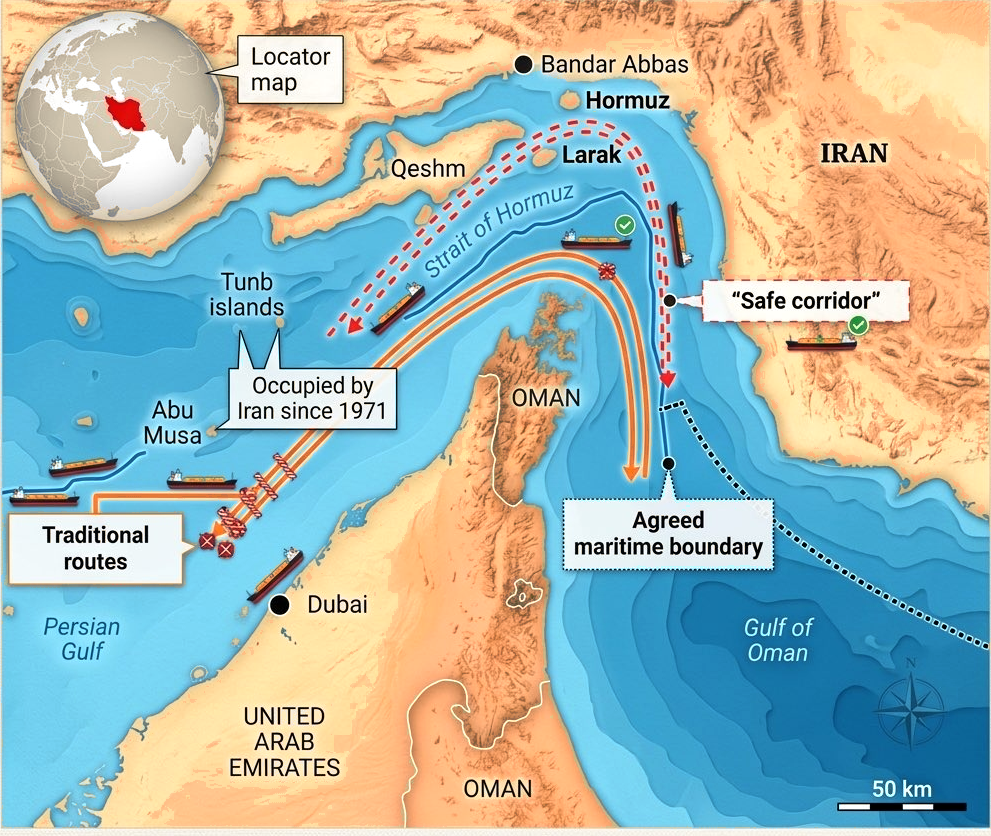
Around Larak, Tehran is no longer just reacting to an illegal war launched against it. It is turning battlefield pressure into procedure, selective access, and proposed law, using a controlled corridor and a wider Hormuz management plan to show that the old fantasy of automatic Western command over this chokepoint is breaking down in real time. The truth of the war is not found in the bombast coming out of Washington; instead you will find it in the places where power is actually shifting, and right now, one of those places is a narrow strip of water off Larak, where Iran looks calmer, more deliberate, and more in command of events than the people who thought they could bomb it into submission.
The Day Hormuz Moved on Iran’s Terms
The Strait of Hormuz has not been shut, and that is exactly why what Iran has done matters more. What has emerged around Larak is not a crude blockade but a controlled passage system, a wartime checkpoint laid across one of the most important arteries of the world economy. Iranian reporting most often calls it the Larak Corridor. At the same time, the broader phrase Larak-Qeshm Corridor is best understood as a geographic description of the lane running through the narrow gap between those two islands inside Iranian waters.
Names are not cosmetic here. Western and trade coverage tend to speak of a route between Qeshm and Larak. Iranian coverage roots it in Larak itself, in Iranian-managed waters, under Iranian rules. That is the quiet shift the war has produced. For decades, the story of Hormuz was told from the deck of a U.S. carrier. Today, one of its key arteries is being renamed and reorganised from a small island most Western audiences have never been asked to think about.
Iran appears to be building a differentiated transit regime, not a universal shutdown. That means the market consequence is not simply “less supply,” but a more political energy map in which some buyers and shippers face privileged access while others face delay, denial, or sharply higher costs.
That is the part of the story that cuts through the propaganda. A total closure would have been easy to denounce and easy to rally against. A selective corridor is harder to attack because it allows Tehran to say that passage has not ended, only the assumption that ships can move through Iranian waters during an illegal war on Iran without submitting to Iranian conditions.
This is why Larak matters. It is where Iran stopped merely threatening the map and started administering it.
The lane at Larak
The outlines of the new lane are now visible. The Larak Corridor is not a return to normal traffic. It is a filtered, low-volume, politically segmented route for approved movement. Trade and maritime analysis has traced authorised vessels through the five-mile gap between Qeshm and Larak, close to the Iranian coast and under a web of Iranian surveillance and intervention capacity. Iranian and Arabic reporting has described a safe corridor around or between Larak and Qeshm, never a full reopening of the strait, even though yesterday the Wall Street Journal reported that the Bahman pier on the eastern side of Qeshm Island was attacked, according to a statement from Hormozgan governor’s office relayed by Iranian state-affiliated media ISNA. Qeshm overlooks the Clarence Strait in the Strait of Hormuz and is referred to by the locals as “Kuran”, Iran’s main launchpad for its asymmetric naval warfare. In early March, the Israeli/US war machine had targeted a desalination plant on Qeshm Island, leaving 30 villages without water.
That low-volume point changes everything. The lane exists in deliberate contrast to prewar patterns. UN-linked reporting put pre-crisis traffic through Hormuz at roughly 130 ships a day. Against that baseline, the authorised trickle through Larak is not evidence of restored normality but a clear indication that normality has been replaced by a rationed flow that Iran alone can modulate.
The lane also stratifies states. Some governments have secured negotiated passage, some ships have moved after prior coordination and documentation, and others have been turned back or discouraged from approaching in the first place. The result is not an open sea but a tiered system in which diplomatic posture, sanctions alignment, and wartime behaviour shape access to one of the world’s central energy routes.
Calling this a blockade is comfortable for Western officials, but it is wrong. A blockade denies passage to provoke a fight. The Larak Corridor functions more like a wartime border crossing, granting passage conditionally, keeping discretionary power in Iranian hands, and making political hierarchy visible on the water.
Force became law
The story becomes more serious once you see that Tehran is not leaving this system in the realm of ad hoc force, but instead the Islamic Republic of Iran is building a legal scaffold around it.
Parliamentary reporting confirms that Iran’s National Security and Foreign Policy Committee has approved an eight-point Strait of Hormuz Management Plan. The plan is built around eight clear pillars: securing the strait, ensuring ship safety, addressing environmental risks, establishing financial arrangements with a rial-based toll system, banning American and Israeli vessels from passage, asserting Iran’s sovereign authority and that of its armed forces, cooperating with Oman on the legal framework, and prohibiting entry to any state that participates in unilateral sanctions against Iran.

A parallel description from Xinhuanet states that the measure gathered more than 250 signatures and outlines four immediate objectives: ensuring shipping security, charging environmental polluters, collecting fees for guidance services, and establishing a regional development fund funded by the toll regime. Those details matter as they show that Tehran is not marketing this as a simple wartime levy, but as sovereign administration over safety, environmental protection, navigational management, revenue, and regional development.
It is crucial to be precise. The plan is not yet fully enacted into law. Committee approval is significant because it codifies the logic of the corridor and signals an intention to turn military practice into statute, but Iranian reporting makes clear that key elements are still in the phase of initial measures and continued drafting. That does not weaken the argument. It actually strengthens it. The turning point is not when the last procedural stamp is applied, but when a state under attack openly decides to legislate the war’s new realities into its domestic legal order.
The Oman clause is one of the plan’s sharpest edges. Iranian reporting says Oman must be present in the legal regime and coordination structure because the southern side of the strait is Omani. At the same time, a parliamentary voice emphasised that in matters of toll collection “the essence of the matter is in Iran’s hands,” and that Iran is the party positioned to collect fees, while Oman’s place is in cooperation and coordination, not revenue capture.
In other words, Tehran is regionalising the legal façade without diluting operational control. Omani decrees from 2025 ratifying broader cooperation and legal-judicial accords with Iran give this move a pre-existing legal context, making the Hormuz framework look less like a unilateral edict and more like a hard extension of bilateral agreements into wartime management.
This is what it means for force to become law. Iran is not simply blocking ships. It is regulating them, invoicing them, and giving itself the legal language to defend that behaviour once the guns fall quiet.
Islands’ sovereignty and the human layer
Strip Larak from its geography and you miss half the story. Hormuz cannot be seen as just another free-floating blue line on an analyst’s map. It is a dense, lived space of islands, coastlines, fishing ports, naval outposts, and communities that have grown up under the shadow of foreign fleets and sanctions.
For half a century, the world has been taught to treat the islands of Abu Musa and the Tunbs as footnotes, little “disputed” specks on the map. In reality, they, along with Qeshm and Larak, sit inside a network of surveillance and reach that allows Iran to watch, shape, and, when necessary, squeeze movement at the mouth of the Gulf. The Larak Corridor is not a freakish one-off. It grows out of a sovereignty geography that has been quietly undermining the fiction of an “American lake” in Hormuz for decades.
There is a human layer that rarely makes it into Western press. Iran’s maritime posture is not only the work of admirals in Tehran, but it also rests on coastal communities, port workers, pilots, and the broader ecosystem that includes the Naval Basij, the volunteer maritime defence network you researched earlier. That network, with its small craft, its local knowledge, and its political symbolism, has always been part of how Iran thinks about defending the strait, not simply by hardware but by socialised resistance.
For people living on those coasts, the corridor is not a theoretical legal innovation. It is one of the few visible signs, in the middle of bombardment and assassination, that their state can still impose some order at the place where global power once promised them none. Seen from there, the Larak Corridor looks less like opportunism and more like a resilient country insisting that sovereignty is not an abstract word but something that can be exercised in a specific channel of water under fire.
The Gulf pays for the war
The political brilliance of the Larak move is in who gets billed for it: not Washington first, not Tel Aviv first, but the Gulf order that enabled this war and is now trapped in its consequences.
Gulf governments were not properly warned, their objections were ignored, and Europe was largely marginalised from the decision-making that triggered the regional blowback they are now paying for.
That one sentence punctures the comforting story that the old security architecture still works. Some Gulf capitals had urged Washington not to attack Iran. Some tried to keep a distance from the opening salvo. Europe itself was treated less like a partner than a spectator told to brace for impact.
The cost has not been theoretical. Freight risk exploded. Insurance premiums climbed. Cargo timetables turned into contingency plans. The “guarantee” on offer from Washington turns out to be a package in which Gulf states host bases, bankroll weapons, and then absorb the retaliation and economic shock once the trigger is pulled.
The evidence of fatigue is patchy but real. Saudi Arabia has intensified direct contacts with Iran. Regional diplomacy has tried to put some sort of brake on escalation. At the same time, influential Gulf voices still speak of the need to degrade Iranian capabilities, not simply to stop the war. That tension is important as it shows a region caught between fear of Iran and a growing recognition that the American-led order is no longer a stable shelter.
Larak turns that contradiction from an argument into a daily experience. Every tanker that has to negotiate with Tehran, every nervous call from an insurer, or every investor wondering whether to avoid Gulf exposure. All of it drives home the same lesson. A war on Iranian sovereignty will not remain confined to Iranian soil or to the screens of Western news shows. It will leak into ports, pipelines, desalination plants, stock exchanges, and households across the Gulf.
From a pro-peace, pro-sovereignty perspective, that is the real indictment. The architecture that claimed to keep the region safe has delivered a crisis that no one can turn off without Iran’s involvement.
Beyond the dollar and toward the Global South
Although it may sound like a speculative slogan about some future yuan world, it is a description of an experiment already underway. Iran’s proposed Hormuz management plan speaks in the language of rial-based tolls and financial arrangements. Broader analysis around the corridor connects that direction of travel to non-Western settlement channels and to the wider de-dollarisation agenda now running through BRICS and the Global South.
The point is not that the petrodollar disappears tomorrow. It is that under bombardment, and with its conventional military apparatus under fire, Iran is still moving a slice of energy trade onto monetary rails where Washington’s sanctions power is weaker.
Hormuz is doubling as a testbed for de-dollarized energy payments.
China’s experiment with yuan-settled LNG from Qatar in 2023 showed that Gulf energy can clear outside dollar channels when states choose to build the infrastructure. Iran’s 2023 agreement with the UAE to use the dirham in bilateral trade, while imperfect because of the dirham’s peg, still represents a deliberate shift into regional banking circuits that cost Washington more to police. Meanwhile, BRICS has been advancing alternative payment mechanisms and settlement systems designed precisely to chip away at dollar centrality.
The Larak Corridor slots into this picture with unnerving ease. It rewards states willing to engage with Tehran rather than join the sanctions chorus. It opens space for deals denominated in rial, dirham, or yuan. It demonstrates that a Global South state under open attack can still exert leverage over the physical and financial pathways through which the world’s energy moves.
Tehran is not claiming a clean victory over the dollar. What it is doing is more subversive. It is using the war to erase the assumption that Washington can both close and reopen Hormuz at will, militarily and financially. Every transaction that clears outside Western rails, every ship that goes through a lane managed on Iranian terms, is another chip knocked out of a system that has long treated Gulf energy as an American instrument first and a regional lifeline second.
That is why the story of Larak is not simply a regional shipping story, but rather a frontline in the contest over who writes the rules of the global economy.
The old order is cracking
What has happened at Larak is not the final victory of a new world, but it is one of the clearest signs that the old one is cracking in real time.
For decades, the script ran on autopilot. The United States secured the sea lanes. The Gulf monarchies supplied the fuel. The dollar priced it. Everyone else adjusted. The war on Iran was supposed to be another scene in that familiar play. Instead, it exposed how much of it had become theatre.
Iran’s answer didn’t need to be polite, and it was never meant to be. It was disciplined, coercive, and grounded in the one thing Washington cannot replace with rhetoric, the geographic reality of where Hormuz actually lies. Tehran avoided the trap of a universal shutdown and built a mechanism that punishes enemies, rewards accommodation, and keeps the region inside a rolling uncertainty that no press conference in Washington can dispel.
That is why the phrase differentiated transit regime carries so much weight in this war. It captures the fact that what is happening off Larak is not chaos. It is governance under attack. It is a sovereign state, bombed and sanctioned, insisting that it still has the right to decide who crosses its doorstep and on what terms.
For people in the Gulf, it is about whether their ports can stay open, whether their desalination plants keep running, and whether their economies can withstand another cycle of manufactured crisis. For people in Iran, it is about whether anything in their immediate environment still belongs to them after decades of war, sanctions, and threats of regime change.
Seen from that angle, the Larak Corridor is not a provocation. It is a verdict. Peace will not come from pretending the old arrangement can simply be restored. It will come, if it comes at all, when the region and the wider world accept the reality written into the water off Larak. A Gulf built on assaults against Iranian sovereignty cannot remain prosperous, stable, or truly sovereign itself. Not now, and not in the long term.
Iran’s navy has been battered. Its cities have been hit. Its leaders have been hunted. Yet at the most critical chokepoint on earth, the war machine that promised to reopen the map still cannot make Hormuz move on its own terms.
Sovereignty, once attacked, does not always retreat. Sometimes it answers by redrawing the map and forcing those who lit the fire to live with the new lines.
Press TV – April 1, 2026
Isfahan’s Mobarakeh Steel Company says it has been attacked for a second time by the US-Israeli aggression.
In a statement released on Wednesday, the company said warplanes targeted a number of vital sections of its infrastructure at 23:00 p.m. local time Tuesday.
Initial assessments indicate the attack has caused significant damage to several parts of the company, the report said.
The enemy also targeted a subsidiary of Mobarakeh Steel Company called Sefid Dasht Steel Company in the southwestern Chaharmahal and Bakhtiari province.
Due to policies put in place after the previous attack on Thursday, only a small number of employees were present and just a few of them suffered minor injuries, according to the statement.
The Mobarakeh Steel Company is Iran’s largest steel producer and one of the biggest industrial complexes in West Asia and North Africa, playing a central role in the country’s steel industry.
In another attack on one of Iran’s most important industrial units, the Khuzestan Steel Company was also targeted on Friday, which caused damage to parts of its facilities.
Iran’s Human Rights Organization issued a statement on Wednesday, condemning the US-Israeli aggression’s “systematic strikes” against civilian infrastructure.
“These attacks are a blatant violation of international law and a form of economic terrorism and their goal is to put maximum pressure on Iran’s civilian population,” it said.
Factories, including steel plants, are the main livelihood of millions of Iranians and the aggression’s goal of destroying them is a clear violation of Geneva Conventions and a war crime.
The organization called on the international community to break its silence on the US-Israeli aggression war crimes against Iran’s populace and hold the enemy accountable for its violation of human rights.
The US and Israeli armed forces launched their military aggression against Iran in late February by attacking 30 targets across Tehran, assassinating Leader of the Islamic Revolution Ayatollah Seyyed Ali Khamenei and several senior Iranian officials.
Since then, Iranian armed forces have retaliated swiftly by launching barrages of missiles and drones at Israeli‑occupied territories as well as US bases across the region.
Iranian officials say targeting US military bases in the region constitutes “legitimate self‑defense.”
Referring to Article 51 of the United Nations Charter, they say Iran has the legal right to defend itself against “acts of aggression” by the US or the Israeli regime.
Press TV – April 1, 2026
Iran has condemned attacks on its nuclear facilities under the safeguards of the International Atomic Energy Agency (IAEA), calling such strikes a “war crime.”
The warning from the Atomic Energy Organization of Iran (AEOI) on Wednesday comes days after a military assault as part of the US-Israeli terrorist war on the Islamic Republic on two nuclear sites in Arak and Ardakan.
Behrouz Kamalvandi, spokesman for the AEOI, said that attacking nuclear facilities under IAEA oversight is inconsistent with international principles and constitutes an international offense, even against a heavy water complex.
The Khondab heavy water complex in Arak was targeted for a second time, following an earlier attack during the 12-day war last June. On the same day, Iranian authorities reported that a yellowcake production facility in Ardakan, in the central province of Yazd, was also struck.
“Attacking nuclear facilities that are under IAEA safeguards is totally inconsistent with international principles and such an international offense, even against a heavy water complex, is definitely a war crime,” Kamalvandi stressed.
Kamalvandi said Iran has legally documented the incidents and is consulting both domestic and international legal experts. He said the matter would be pursued through the country’s Foreign Ministry and the office of the vice president for legal affairs.
He also stressed that despite these attacks, Iran’s nuclear knowledge and capabilities cannot be destroyed. “The enemy will definitely fail to obliterate Iran’s nuclear knowledge through these attacks.”
Iran has repeatedly stated that its nuclear program is peaceful and conducted under strict international supervision. The country maintains that any strike on safeguarded nuclear sites is a violation of international law, undermining global agreements on nuclear safety and protection.
Al Mayadeen | April 1, 2026
Two-thirds of Americans believe the United States should work to end its involvement in the Iran war on Iran quickly, even if that means not achieving the goals set out by the Trump administration, a Reuters/Ipsos poll has found.
Some 66 percent of respondents to the poll, conducted March 28-30, voiced that view, while 27 percent said the US should work to achieve all its goals in Iran, even if the war goes on for an extended period. Six percent did not answer the question.
Republican support for the war softens
Among Trump’s Republicans, 40 percent supported ending the war quickly even if it did not achieve US goals, while 57 percent supported a longer involvement, a significant split within the president’s own party as the war enters its sixth week.
The month-long war has spread across West Asia, killing thousands of people and hitting the global economy with soaring energy prices, fueling inflation fears worldwide.
A total of 60 percent of respondents said they disapproved of US military strikes on Iran, while 35 percent approved.
Gas prices weigh on voters
One of the war’s most visible effects in the US has been the rising cost of gasoline, which rose above $4 a gallon on Monday for the first time in more than three years, data from price tracking service GasBuddy showed.
Two in three respondents said they expected gas prices to worsen over the next year, including 40 percent of Republicans.
More than half of respondents thought the war would have a mostly negative impact on their personal financial situation, including 39 percent of Republicans.
A political liability
Trump’s Republicans face voters in November for midterm elections that will decide whether they can hold onto slim majorities in the House and Senate. The incumbent president’s party tends to lose seats in Congress in midterm elections, and the war has emerged as a growing political liability.
The poll reflects a sobering reality for an administration that launched the war on February 28 with promises of a swift victory. Five weeks later, the war has achieved none of its stated objectives. Iran has not collapsed. The Strait of Hormuz remains closed. US troops remain deployed. And now, even the president’s own supporters are showing signs of fatigue.
For the average American, the war is now being felt at the gas pump, in monthly bills, and in the growing sense that a war sold as quick and decisive has become yet another endless entanglement. As the November midterms approach, the Republican Party may find that the cost of war is not measured only in dollars and casualties, but in votes.
The question for Trump and his party is whether they can convince an exhausted electorate to keep funding a war that even many of their own supporters now want to end.
Beyond the polls: Draft fears and military dissent
The public opposition reflected in the Reuters/Ipsos poll is mirrored by growing anxiety inside the United States about where the war is headed. Speculation about a possible military draft has surfaced as Trump continues his war against Iran, even though officials emphasize that no draft is planned, The Guardian reported.
In recent weeks, Trump deployed marines and army paratroopers to West Asia, signaling a potential ground operation to reopen the Strait of Hormuz. The provocative military activity has prompted discussions about what it would take to invade a country larger than Iraq, intensifying fears about a draft.
The White House has offered little clarity to quell speculation. On March 8, Press Secretary Karoline Leavitt responded to a question about a possible draft by saying, “The president, as commander-in-chief, wants to continue to assess the success of this military operation. It’s not part of the current plan right now, but the president, again, wisely keeps his options on table.”
Her inconclusive answer caused debate to snowball, prompting news outlets to explain how a draft might work. Social media users reacted to administrative changes in the Selective Service program, while satirical campaigns like DraftBarronTrump.com mocked Trump’s willingness to send others to war while avoiding military service for his own son. The hashtag #SendBarron trended on X and TikTok in early March.
Troops turning against the war
Beyond civilian anxiety, dissent is spreading within the military itself. Since early March, doubts have spread among US troops over Washington’s ongoing war on Iran, with growing concern about the war’s objectives, rising casualties, and the possibility of a ground invasion.
A military official involved in treating evacuated troops said forces are facing “inadequate protection and planning,” highlighting the toll of repeated Iranian missile and drone strikes on US bases. At least 13 US troops have been killed and more than 230 wounded since the start of the war, according to US officials cited in the report, while Iranian authorities put the number of fatalities in the hundreds.
Concerns have also intensified over the possibility of a US ground invasion in Iran, which some military personnel described as lacking clear planning. “A ground invasion would be an absolute disaster… we don’t have a plan for that,” one official said, adding that the US cannot even “fully defend a single land base in the theater.”
Some troops have voiced opposition to the political motivations behind the war. One reservist reported hearing service members say, “We do not want to die for Israel — we don’t want to be political pawns.”
Advocacy groups supporting military personnel reported a sharp rise in inquiries about conscientious objector status, with some organizations noting a dramatic increase in requests since the war began. Experts warn that growing dissatisfaction within the military could impact the effectiveness of the campaign and signal deeper shifts in attitudes toward US military interventions abroad.
The gap between Washington’s war aims and the willingness of both the American public and its own troops to sustain them is becoming impossible to ignore. The polls show a public that wants out. The streets and social media show a population bracing for escalation. And inside the military, the soldiers who would be asked to fight are beginning to ask why.
By Larry C. Johnson – SONAR – April 1, 2026
What is Donald Trump going to say about Iran on Wednesday night? Before I layout three possible outcomes, let’s examine what Trump is actually doing in terms of some key military assets (all of this is from open source reporting).
A-10 Squadron (Confirmed New Deployment)
Since Friday, March 27, 2026, the most prominently reported new US air asset movement to the Middle East (CENTCOM area of responsibility) has been a squadron-sized deployment of A-10C Thunderbolt II attack aircraft (Warthogs). Six A-10s from the Idaho Air National Guard’s 190th Fighter Squadron arrived at Pease Air National Guard Base (New Hampshire) as part of staging. On March 30, twelve A-10s from the Michigan Air National Guard’s 107th Fighter Squadron (Selfridge ANGB) departed Pease for RAF Lakenheath, UK (a common transit stop), in two flights of six. Another six followed on March 31. These ~12–18 aircraft are en route to the Middle East to reinforce or nearly double the existing A-10 presence there.
A-10s are already operating in theater (e.g., from the 75th Expeditionary Fighter Squadron) for close air support, anti-boat strikes in the Strait of Hormuz, drone interdiction, and coastal targeting. The surge supports intensified low-altitude operations against Iranian “mosquito fleet” vessels, mines, and remnants amid the broader campaign.
Apache Helicopters (AH-64) Squadron
US Central Command publicly confirmed the operational use of AH-64 Apache attack helicopters in late March (updates around March 16–18 and a specific confirmation on March 26). The 6-17th Air Cavalry Squadron (part of the 4th Infantry Division Combat Aviation Brigade, operating AH-64D/E variants) is the unit involved. It had been forward-deployed earlier (under prior rotations like Operation Inherent Resolve) but was newly integrated into Epic Fury strikes against Iranian boats, drones, and coastal targets in the southern flank/Hormuz area.
Several viral Facebook posts and YouTube videos (from accounts like “MovieFans.Lich,” “Live WWIIIRE,” and similar sensationalist pages) claim a “massive C-17 fleet” is deploying Apache helicopter squadrons alongside troops, armored vehicles, and equipment. These describe “dozens” or “over 112 C-17s” streaming into the region, with Apaches highlighted for their anti-armor, close air support, and anti-boat roles in rugged coastal terrain. Some videos include generic footage of folded Apaches inside C-17 cargo bays or all-female flight crews turning around quickly.
Posts from OSINT-focused X accounts (e.g., @TheIntelFrog, @Faytuks, @JewishWarrior13) detail dozens of C-17 flights since mid-March (e.g., ~35–50 flights tracked from March 12–24, with more ongoing) originating from bases like Fort Bragg/Pope AAF, Fort Campbell, Hunter AAF, and McChord AFB. Destinations include Ovda (Israel), Jordanian bases (King Faisal, King Hussein), and other CENTCOM hubs. These are linked to troop surges (including elements of the 82nd Airborne) and special operations forces, with some users speculating or claiming that attack helicopters like Apaches are part of the heavy equipment being airlifted. One analysis noted origins tied to units with aviation assets, such as the 160th SOAR (which operates helicopters, though primarily MH-6/ MH-60 rather than AH-64).
The new deployment of these assets are consistent with a military option that involves close-air support and/or attacks on Iranian fast boats and water drones.
So what is Trump going to announce?
Option 1 — Declare that negotiations with Iran via intermediaries (e.g., Pakistan) are progressing and that the United States is going to cease combat operations against Iran in order to support the negotiations and achieve a peaceful resolution.
Option 2 — Declare that victory has been achieved and that US forces will begin withdrawing from the region, leaving the status of the Strait of Hormuz in limbo.
Option 3 — Announce a massive air and ground operation to secure the freedom of navigation through the Strait of Hormuz.
The deployment of the A-10s and the Apaches can only mean one of two things:
Since Monday, March 30, 2026, President Donald Trump has made several public comments on the ongoing US-led Operation Epic Fury against Iran, primarily via Truth Social posts, interviews (including with the New York Post ), and remarks to reporters. His statements emphasize US military successes, threats of further escalation if demands are unmet, criticism of allies, and a potential near-term wind-down of direct US involvement.
On Monday, Trump described Iran as effectively “decimated” or “obliterated,” with its air force, navy, and many ships sunk or destroyed. He portrayed the campaign as highly successful and “way ahead of schedule” in prior context, but continued highlighting strikes on “long-sought-after targets.” He shared video footage on Truth Social of a massive explosion and secondary blasts in Isfahan (linked to strikes on uranium-related or military sites), without additional caption in one instance.
Trump also posted that the US was in “serious discussions with a new, and more reasonable, regime” to end operations. He warned that if the Strait of Hormuz is not “immediately ‘Open for Business’” and a deal is not reached shortly, the US would “completely obliterate” Iran’s electric generating plants, oil wells, Kharg Island, and possibly desalination plants. He framed this as concluding the US “lovely ‘stay’ in Iran.” In follow-up comments, he suggested the US could respond to Iranian actions “twenty times harder” with “Death, Fire, and Fury.”
Overall, Trump’s messaging since March 30 combines triumphalism about US achievements, escalatory warnings tied to the Strait of Hormuz and energy targets, frustration with allies, and signals of de-escalation with a short timeline for reduced US involvement. These comments have influenced market reactions (e.g., oil prices and equities) and drawn responses from Iranian officials and international observers.
Trump’s remarks since Monday have boosted the confidence of the folks on Wall Street and contributed to a significant surge in the stock market, with the Dow up 1,125 points. The price for BRENT oil dropped from 118 to 103 during Tuesday trading. This means the financial folks believe the war is going to end.
I think Trump is counting on Iran offering up some concessions in the face of the US buildup of additional air combat assets. Netanyahu reportedly just said Iran no longer poses a threat to Israel’s existence… A dramatic pivot if true. However, over the last few hours, Israel and the US carried out a large wave of attacks across Iran. They struck targets across several parts of Tehran, as well as in the cities of Karaj, Shahriar, Ahvaz, Shiraz, Abadeh, Isfahan, and Bandar Abbas. Iran will retaliate in force to these latest attacks.
In short, I believe Donald Trump will announce a major offensive to try to force Iran to release its chokehold on the Strait of Hormuz… I believe that offensive will fail and that the war will escalate unless the US and Israel agree to two critical Iranian demands: the end of all sanctions and the removal of US military bases from the Persian Gulf arab countries.
Russia and China are two wild cards that could change the trajectory of the current war. If they engage and apply pressure on the diplomatic front — including ironclad security guarantees to Iran — Donald Trump may take the exit ramp.
What do you think?
Pascal Lottaz and I discussed the current situation in the Persian Gulf:
I did my usual Tuesday chat with Marcello:
A new interview with Rathbone. Interesting fellow… He’s also a comedian:
Glenn Diesen | March 31, 2026
MIT Professor and Pentagon advisor Ted Postol explains the extent to which the quantity and quality of Iranian missiles and drones were underestimated, and the consequences of this miscalculation.
Follow Prof. Glenn Diesen:
Support the research by Prof. Glenn Diesen:
Daniel Davis / Deep Dive – March 31, 2026
Cyrus Janssen | March 28, 2026
In this explosive interview, I sit down with Mohammad Marandi to break down the rapidly escalating Iran war—and what the world is getting completely wrong.
As tensions rise and global powers get pulled deeper into the conflict, Marandi offers a perspective you won’t hear in Western media. From Iran’s strategic position to the real risks of escalation, this conversation reveals what’s actually happening behind the headlines. We dive into:
Is the United States losing control of the situation?
How strong is Iran really—militarily and politically?
Could this war spiral into a global conflict?
What role are China and Russia playing behind the scenes?
And most importantly… who actually benefits from this war?
This is one of the most eye-opening conversations I’ve had on the channel—and it may completely change how you see the Middle East right now.
Thank you to Professor Marandi for today’s interview! Follow him on X here: https://x.com/s_m_marandi

or go to
Aletho News Archives – Video-Images
By Ali Kazak | Dissident Voice | October 11, 2015
For years Israel and its lobby around the world have been trying to normalise their relations with Arabs and Muslims without solving the Palestine Question.
One of the methods they resorted to in the last few years is using human rights and community organizations such as interfaith dialogue and Multiculturalism to achieve this objective and to: isolate the Palestinians, marginalise the Palestine question, end Israel’s isolation, and prevent criticism of Israel, knowing that these organisations will be the first to stand against Israel’s violations, racial and religious discrimination.
The group responsible for this task in Australia is The Australia/Israel & Jewish Affairs Council (AIJAC); its Director of International & Community Affairs, Jeremy Jones is in charge of lobbying religious community organizations, specifically Muslims and Christians. Consequently he convened the Faith Communities for Reconciliation, founding participant in the Australian Partnership of Religious Organisations and the Australian National Dialogue of Christians, Muslims & Jews.
AIJAC is a private political propaganda group. It is recognised as the main Israeli lobby in Australia. It coordinates its activities and works intimately with the Israeli embassy in Canberra and different institutions in Israel. It is privately funded by some Jewish businessmen. It monitors closely Australian politicians, the media, ethnic and religious groups, (especially Arabs and Muslims), unions and academics on their stands towards Israel and the Palestine question. … continue
 Aletho News If Americans Knew No Tricks Zone
 Aletho News