A New Resistance Front: How Does Syria Factor into the Regional War?
By Robert Inlakesh | The Palestine Chronicle | April 2, 2026
A new Syrian resistance group has emerged and is the only organization in the country currently carrying out offensive actions against both Israeli and US targets. This development comes as Israel uses the newly occupied territories in its ground assault on Lebanon, a move that could easily rope Tel Aviv into a new quagmire.
While a US allied leader now technically controls Damascus, the reality on the ground in Syria is that there is no functional State. This being the case, the outbreak of chaos is simply one miscalculation away.
In stark contrast to the regimented and tightly controlled Syria that existed under the rule of Bashar Al-Assad and his father Hafez al-Assad, the country today is divided between countless powers throughout the country, with the President functioning as less of a strongman and more of a symbolic figure that covers the explosive charges ready to detonate. Nowhere was this on clearer display than in the July 2025 clashes in southern Syria’s Sweida Province.
President Ahmed al-Shara’a, also known as Abu Mohammed al-Jolani, has allied himself with his Western backers and even gone as far as signing onto a normalization mechanism with Israel. Short of full normalization of ties with Tel Aviv, the “joint fusion mechanism” that was agreed upon by Syrian and Israeli officials seeks to “facilitate immediate and ongoing coordination on their intelligence sharing, military de-escalation, diplomatic engagement, and commercial opportunities under the supervision of the United States.”
Knowing this, it would therefore appear strange that the Israelis still persist with not only bombing Syrian civilian infrastructure across the country, but also Syria’s new military forces. Understanding why will help in unlocking what appears on the surface to be a difficult puzzle to solve.
The Syrian leadership is Hayat Tahrir al-Sham (HTS), infamous for being a rebrand of al-Nusra Front (Al-Qaeda in Syria). Although it is presented as if it were a real government, the group never had any experience in governance. Instead, they knew only how to rule over smaller militia factions and worked as the de facto leadership in Idlib, despite there having been a “Syrian Salvation Government” (SSG) who were technically in control of the territory.
Prior to the fall of Bashar al-Assad’s leadership in December of 2024, HTS had consented to the SSG’s existence in order to give the veneer of a professionally organized opposition. In reality, HTS held all the power cards, even running its own secret prisons, while leaving the administrative details to be hashed out by the professionals.
All of this is of great importance because Bashar al-Assad’s entire system was not overthrown in some kind of war of liberation; instead, it collapsed without any real fight. Therefore, when Ahmed al-Shara’a entered Damascus and declared himself leader, he was in a very difficult position.
Under the supervision of his foreign backers, chiefly the United States, the new Syrian leadership focused on symbolism rather than fundamentally changing the way the country functioned. Therefore, Damascus opened itself up to Washington and became a playground for Western and Israeli intelligence agents, as the new President attempted to impress Washington.
Meanwhile, many of the most corrupt elements belonging to the former regime, were permitted to continue on as if it was business as usual, all as the Syrian Arab Army (SAA) and former intelligence and police services were disbanded. What replaced the former security apparatus were simply militants belonging to the alphabet soup of Al-Qaeda affiliates that had been operating previously out of Idlib.
This being the case, the words of Ahmed al-Shara’a often have little to no bearing on what actually transpires on the ground. Meaning that corruption is rampant, every corner of the nation is filled with different armed forces who have their own territory when push comes to shove. In essence, all of Syria became a big Idlib.
Syria is no longer subjected to sanctions, has gained access to its most fertile agricultural lands, is no longer internationally isolated, while ruling over its own oil and gas fields. Despite all of this, the country’s economy is still in the toilet, and the long-promised prosperity has been reduced to vague future visions. This isn’t to say it’s impossible for things to change, but as it stands, this is Syria today.
Because of the state of Syria’s affairs, cross-border smuggling has exploded and this has evidently benefited Lebanese Hezbollah next door. Two sources familiar with the matter informed Palestine Chronicle that the quantity of weapons flowing through the Syrian-Lebanese border had even increased since the fall of Bashar al-Assad.
According to reports, the US has been applying pressure on Damascus to attack Lebanon in order to help Israel weaken Hezbollah in the Bekaa Valley region. In response, President al-Shara’a broke his silence this Tuesday and declared that Syria will not attack Lebanon, an announcement that came following a threat earlier that day from an Iraqi Popular Mobilization Units (PMU) spokesperson, threatening to attack if Damascus orders such a move.
This affirmed previous suspicions that such an equation could arise, whereby a Syrian invasion of Lebanon would trigger an Iraqi invasion. The PMU, when fully mobilized, can muster a force of around 250,000 fighters, a much more formidable force than what currently constitutes the Syrian Army.
Another possible equation that could be set is a Syria-Israel clash. Not only could armed resistance groups, aligned with the Iranian-led Axis of Resistance, end up creating such a reality, but others could also be roped in.
Israel’s recent bombing of Syrian military positions, coupled with Israeli Security Minister Itamar Ben Gvir’s calls to assassinate the Syrian President, both occurred following an alleged military buildup near the Sweida Province.
It is likely that Damascus was eyeing the opportunity presenting itself to finally deal with the Druze Separatist movement in the southern province. Led by one of the Druze minority group’s spiritual leaders, Hikmat al-Hijri, a unified command calling itself the “National Guard” formed in order to operate a semi-autonomous zone in Sweida.
The National Guard began receiving direct military, financial and logistical support from Israel, who have long sought to establish a Druze rump State in southern Syria, a goal that enables an even greater land grab, as well as opening up “David’s Corridor” [shown in blue below] spanning over to the Iraqi-Syrian border.
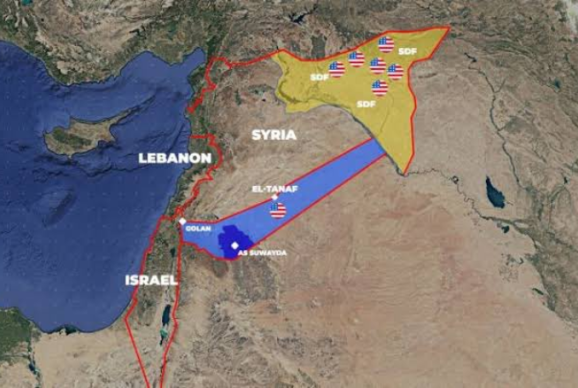
In the eyes of Syria’s leadership, the Druze issue is of great importance to solve for a range of reasons. One of which is that there is an enormous amount of sectarian tension, which various groups who form the new Syrian security apparatus, along with the Bedouin tribal forces, seek to punish following the bloodshed that began last July. It will also mean that technically, Syria will be one step closer to having one central government rule the entire country, which is a symbolic victory for Ahmed al-Shara’a.
However, the Israelis appear to have pre-empted such an offensive and committed a number of airstrikes as a warning to the Syrian leadership. There is clear anxiety over such a battle unfolding, because if it occurs, the Israeli military will be forced to intervene in order to save its Druze separatist allies.
As mentioned above, if things spiral out of control, the President himself cannot necessarily do much about it. That means that Syrian forces will likely begin to directly come into contact with the Israelis on the ground, something that could easily spiral.
Most of the fighters who have, for now, aligned themselves with the Syrian government are no fans of Israel, to say the least. This was on full display last December during the military parades conducted by Syria’s new armed forces, who openly chanted for Gaza, threatened Tel Aviv, and some even burned Israeli flags.
The alternative scenario for the Israelis in Syria may end up being worse, meaning that if they were to assassinate al-Shara’a, a power struggle would likely end up playing out on the streets of the Capital and throughout the country. So many different actors will seek to claim power.
Syria’s predicament has turned out to be less favourable to Tel Aviv, not because it poses an immediate strategic threat, but because almost anything is possible there. During the regional war between the Israeli-US alliance and the Iranian-led Axis of Resistance, one wrong misstep could prove fatal and open up yet another front, which will not only drain their resources but also weaken their ability to fight Hezbollah.
– Robert Inlakesh is a journalist, writer, and documentary filmmaker. He focuses on the Middle East, specializing in Palestine.
Sorry, the comment form is closed at this time.
Featured Video
Theodore Postol: Iran’s Missiles & Drones Were Underestimated
or go to
Aletho News Archives – Video-Images
From the Archives
Wars for Israel: A reminder of who’s giving the marching orders
By Damian Lataan | February 7, 2012
As the West prepares to march off to yet another war in the Middle East, we should perhaps remind ourselves of who is giving the West their marching orders.
In February 2003, just weeks before the US and their allies launched their attack on Iraq and her peoples, a delegation of US congressmen, together with the US Ambassador to the United Nations, John Bolton, a well known pro-Zionist and neoconservative war-hawk, were in Israel at the invitation of the Israeli government then led by Israeli Prime Minister Ariel Sharon.
Addressing the congressmen, Sharon told them ‘that Iran, Libya and Syria should be stripped of weapons of mass destruction after Iraq’. Later, Sharon told John Bolton ‘that Israel was concerned about the security threat posed by Iran, and stressed that it was important to deal with Iran even while American attention was focused on Iraq’. … continue
Blog Roll
 Aletho News
- A New Resistance Front: How Does Syria Factor into the Regional War?
- Gulf states weigh pipeline expansion plans, hoping to bypass Hormuz
- Iran sets up ‘tollbooth’ system in Strait of Hormuz
- Wave 90: IRGC strikes US-linked industrial sites in Gulf
- Iran Says US-Israeli Claims of Its Military Strength Are Wrong
- Trump’s April Fools’ Address to the nation
- The Most Important Bet You’ve Never Heard Of
- The killing of three Indonesian soldiers in Lebanon should remind Jakarta that Israel does not want peace
- Defeated and delusional: Netanyahu’s remarks reveal $80bn war failure, says analyst
- Iran’s friends are about to make life much more difficult for Israel and the US
- If Americans Knew
- Gaza families reunite years after babies evacuated amid Israel’s war
- International Rescue Committee warns Gaza’s children face grave protection risks
- Iran’s Alleged 47-Year War on America: Debunking the 1,050 American Deaths Canard
- Israel wants US to bomb more of Iran’s civilian structures (113,000 is not enough) – Not a ceasefire Day 173
- Ann Coulter Rips Into Fox News for Iran War Coverage
- Joe Kent Urges Americans To Call White House and Congress To Object To Sending Troops Into Iran
- DNC Resolution to Reject AIPAC Funding Puts Democratic Leaders in the Hot Seat
- Swedish foundation to build 400 schools as over 650,000 Gaza children remain without education for 2 years
- Israeli army admits photshopping image of slain Lebanese journalist
- This is how Israel is systematically killing health workers under the cover of war in Lebanon
- No Tricks Zone
- Low Intensity Tornado Wrecks Major Solar Farm, Creating A Potential Toxic Dump
- New Study Finds Warming Saves Lives…Cold Temperatures 12 Times More Deadly Than Excess Heat
- German Science Blog Accuses PIK Climate Institute Of Hallucinating Climate Tipping Points
- Devastating Assessment Of Comirnaty Vaccine By Former Senior Pfizer Europe Toxicologist
- New Study: CO2 Is ‘Effectively Negligible’ As An Explanatory Climate Change Factor Since 2000
- Former Pfizer Toxicologist Dr. Helmut Sterz Tells Bundestag Hearing Pfizer Vaccine Should Have Never Been Approved
- Energy Expert: Germany’s Nuclear Phaseout Was A “500 Billion Euro Mistake”
- New Research: South Australia’s Mid-Holocene Sea Surface Temperatures Were 4°C Warmer Than Today
- Storing Green Energy To Last Germany 10 Days Would Require A 60-Million Tonne Battery
- New Studies: UK Sea Levels Were 4 Meters Higher Than Today During The Mid-Holocene
 Aletho News