Trump and the debris of Iran war
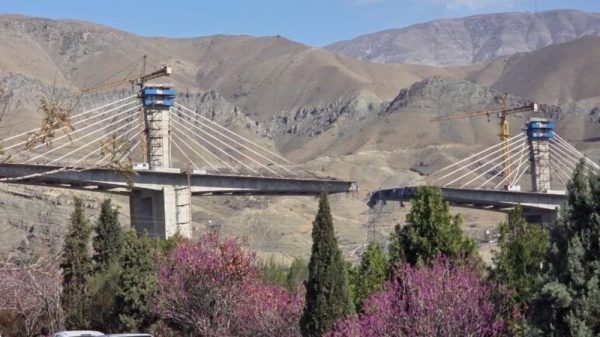
US President Donald Trump shared a video of Iran’s B1 bridge, billed as the country’s tallest bridge, collapsing after US air strike, April 3, 2026
By M. K. BHADRAKUMAR | Indian Punchline | April 3, 2026
The only clue the US President Donald Trump has given in his prime time televised speech on Wednesday at the White House regarding the ending of his war in Iran is that the core “objectives are nearing completion” and that he is “very close” to finishing the war.
The big question is whether Trump is any longer in command of the situation. For all practical purposes, the war seems set to cascade as the US is preparing for a potential ground operation in Iran and threatens to destroy “bridges next, then electric power plants”.
Revealing himself primarily as YHWH (Yahweh) in the Old Testament — the personal, holy, and covenant-making Creator who demands exclusive worship from Israel — Trump thundered, “Over the next two to three weeks, we are going to bring them [Iranians] back to the Stone Ages, where they belong” .
Yet, Iran is in no mood to surrender. Tehran has lost respect for Trump and instead sees him as a master craftsman of the art of deception. The Iranian statements underscore that the US intelligence lacks even the foggiest idea of its capabilities to retaliate.
Perhaps, the most vicious no-holds-barred phase of the war is about to begin, with a dynamics of its own — in particular, taking into account the Israel factor, which is a revisionist power seeking to alter the established international order, rules, territorial boundaries or distribution of power in the West Asian region to better serve the establishment of a Zionist state of Greater Israel.
Israel is keeping its options open to further territorial expansion, the latest evidence being the assault on Lebanon and its back-tracking from US-backed negotiations with Syria. Unsurprisingly, Iran insists that any peace deal must encompass all issues of regional stability and security.
Wars have consequences. They leave behind a lot of debris. But this is not about Iran’s reconstruction alone for which of course, it is legitimately seeking war reparations and a security guarantee.
The bottom line is, after creating new facts on the ground, Trump may simply walk away to the golf course. The most consequential new reality is that the Strait of Hormuz is transforming as a waterway.
By coincidence, the first reaction to Trump’s address on Wednesday came from the global oil market, as prices of rose to $105 per barrel. The Oil Price magazine which provides forward-looking intelligence for energy traders and investment professionals was spot on in its prognosis that “Long-suffering energy investors finally have a reason to smile, with the sector on track to outperform the broader market by its widest margin on record, driven by Middle East conflict … The energy sector’s 14-week winning streak far exceeds previous bull runs.
“Oil & Gas stocks have easily outpaced the erstwhile high-flying tech sector… Leading the charge are U.S. oil majors” — Exxon Mobil returned 33.1% YTD; Chevron Corp (28.5%); Occidental Petroleum (49.6%); ConocoPhillips (38.5%); Marathon Petroleum (43.8%). Wall Street must be feeling elated.
According to Financial Times:
“[US War Secretary] Pete Hegseth’s broker at Morgan Stanley contacted BlackRock in February to make a multimillion-dollar investment in a defence-focused Exchange-Traded Fund (ETF) called IDEF.
“This $3.2 billion fund is built around companies that benefit from increased military spending, including RTX, Lockheed Martin, Northrop Grumman, and Palantir — all major Pentagon contractors.
“The request came just weeks before the U.S.-Israeli strike on Iran, a campaign Hegseth helped shape and strongly supported within the Trump administration.”
Larry Johnson, who worked in the CIA and is by far one of the best American commentators on Trump’s war (and geopolitics in general), wrote a blog this week titled Who Else, Besides Pete Hegseth, is Trying to Use the War in Iran to Get Rich? To quote him, “If you do the analysis on the weapons expended so far in the month-long war with Iran, the opportunity for war profiteering is quite clear… The high expenditure rates, combined with historically low peacetime production [of weaponry] have created a serious “race of attrition” that cannot be quickly reversed.”
Johnson flagged as example that both Patriot and THAAD interceptors are primarily manufactured by Lockheed Martin. He adds, “Which means that Lockheed Martin can expect a major influx of cash to boost production and try to replenish exhausted missile air defence inventories. I wonder who else in the Trump administration and the US Congress are making money off this bloody war?”
Setting aside the sleaze and corruption endemic to America’s wars, like night follows the day, the single new fact on the ground today that has explosive potential and can bring the roof down on the international financial system is the terrible beauty about the Strait of Hormuz as Iran decided to control the use of the waterway by outsiders in war conditions, which is nothing unusual (eg., Straits of Bosphorus which Turkey and Russia control.)
Since the waterway passes through the territorial waters of Iran and Oman, these two countries are entitled to have a say in the regime of maritime traffic in war conditions. It’s a legitimate demand. Nonetheless, Iran is showing flexibility by allowing traffic by “benign” vessels not linked to the two enemy countries, US and Israel. It stands to reason that this flexibility will eventually transform in a post-war scenario into a rational, efficient, secure regime.
Meanwhile, the cascading price of oil has the potential to impact the world economy. Since petrodollar recycling is also involved, this will hit international finance as well — the western banking system in particular — unless it is resolved quickly, smoothly and peacefully with the consent of Iran and Oman. Trump has tactfully made it the concern of Europeans and the Gulf Arab states, the US’ partners in crime in petrodollar recycling who help prop up the dollar as “world currency.”
Hopefully, India’s stance, as articulated by Foreign Secretary Vikram Misri at a meeting hosted in London yesterday, provides a ramp that can be the basis of a permanent solution — namely, “the way out of the crisis consisted of de-escalation and a return to the path of diplomacy and dialogue among all concerned parties.”
Notably, India did not sign up to the meeting’s final statement which expressed readiness by participants to contribute to “appropriate efforts to ensure safe passage through the Strait.” Meanwhile, India’s direct talks with Tehran have been productive and yielded positive results.
Sorry, the comment form is closed at this time.
Featured Video

The Most Important Bet You’ve Never Heard Of
or go to
Aletho News Archives – Video-Images
From the Archives
The Occupied Mentality Syndrome
Saudi Arabia on the American chessboard – Part 2
By B. J. Sabri | American Herald Tribune | April 19, 2016
Since the Korean War, but particularly since the Iranian Revolution of 1979 until today, the United States has been steadily escalating its military presence in the Persian Gulf. Taking advantage of many colossal events of the past 36 years, [1] the hyper-empire has institutionalized its massive presence on land and sea, and expanded its objectives to include the unambiguous physical control of the area, as well as the clear understanding that local Arab governments should abide by them. The pretext is always the same: in “defense” of the national interests and security of the United States. From observing how the United States has been interacting with the governments of the region, and by judging from the size of its expeditionary force, we could reach a basic conclusion. The United States is occupying, de facto, the entire Arabian Peninsula. (Yemen, devastated by Saudi and American jets is yet to be conquered. Oman? Britain returned not as colonial ruler but as a soft occupying power.)
Under this articulation, Saudi Arabia, Qatar, Kuwait, and the United Arab Emirates are virtually occupied countries. If we compare this type of occupation to the mandate and protectorate regimes of the past, the results might be identical—the nations affected by it lose sovereignty. When Arab governments comply with the objectives of a foreign power that station military forces on their national milieu, then that power controls them in multiple ways including how they react to policy deliberations and what decisions they intend to take on specific issues. A good method to verify the concept of effective occupation is this: take notice of what the United States says and wants, and then compare it to what the gulf rulers do in response. (I shall discuss this detail at some point in the upcoming parts.)
If the presence of US forces or other means of political pressure are a factor in Saudi Arabia’s interventionist Arab wars, then we need to debate this issue. However, from the history of resistance to colonialism, we learnt: if a powerful state imposes its order on a nation by military means or other forms of coercion, and if this nation does not resist that imposition, then a mental subordination to the powerful state will ensue. This is especially true in the case of Saudi Arabia. One single event, 9/11, has transformed it from a US “ally” into an instant political hostage of the American Empire. … continue
Blog Roll
 Aletho News
- Trump and the debris of Iran war
- IRGC hits US tech giant Oracle’s data center, computing site in UAE over new assassinations
- Bombing Iran Back Into the Stone Age /Lt Col Daniel Davis & Jim Jatras
- UAE rejects report claiming it is ready to join war on Iran to reopen Hormuz
- A New Resistance Front: How Does Syria Factor into the Regional War?
- Gulf states weigh pipeline expansion plans, hoping to bypass Hormuz
- Iran sets up ‘tollbooth’ system in Strait of Hormuz
- Wave 90: IRGC strikes US-linked industrial sites in Gulf
- Iran Says US-Israeli Claims of Its Military Strength Are Wrong
- Trump’s April Fools’ Address to the nation
- If Americans Knew
- ‘War crime’: Global condemnation as Israeli ministers celebrate death penalty law targeting Palestinian prisoners
- 7 Ways Israel Is Turning Lebanon Into Gaza
- World’s Leading Football Bodies Under Fire Over Israel Policies
- Experts warn of possible use of nukes against Iran
- Israeli invasion of Lebanon could be worse than 1982, warn European officials
- Passover: Liberation and collective punishment
- Trump says the quiet part out loud: (Israel’s) war on Iran > Americans’ health – Daily Update
- Gaza families reunite years after babies evacuated amid Israel’s war
- International Rescue Committee warns Gaza’s children face grave protection risks
- Iran’s Alleged 47-Year War on America: Debunking the 1,050 American Deaths Canard
- No Tricks Zone
- Low Intensity Tornado Wrecks Major Solar Farm, Creating A Potential Toxic Dump
- New Study Finds Warming Saves Lives…Cold Temperatures 12 Times More Deadly Than Excess Heat
- German Science Blog Accuses PIK Climate Institute Of Hallucinating Climate Tipping Points
- Devastating Assessment Of Comirnaty Vaccine By Former Senior Pfizer Europe Toxicologist
- New Study: CO2 Is ‘Effectively Negligible’ As An Explanatory Climate Change Factor Since 2000
- Former Pfizer Toxicologist Dr. Helmut Sterz Tells Bundestag Hearing Pfizer Vaccine Should Have Never Been Approved
- Energy Expert: Germany’s Nuclear Phaseout Was A “500 Billion Euro Mistake”
- New Research: South Australia’s Mid-Holocene Sea Surface Temperatures Were 4°C Warmer Than Today
- Storing Green Energy To Last Germany 10 Days Would Require A 60-Million Tonne Battery
- New Studies: UK Sea Levels Were 4 Meters Higher Than Today During The Mid-Holocene
 Aletho News