The ‘Opposition Party’ Has Done Nothing to Stop the Iran War and Much to Goad Trump Into Continuing It
By Jeremy Loffredo | April 9, 2026
There is a version of the Democratic Party that exists only in the imagination: the peace party, the anti-war party, the party that marched against the Iraq War and howled at its neocon designers. As Donald Trump (reportedly) accepted Iran’s ceasefire terms this week, some of the most pointed attacks coming his way from Democrats are not about the thousands of civilians killed, the weeks of brutal bombardments against medical centers and universities, or the global economic damage the war has caused. They are about the war ending before the U.S. and Israel finished the job.
And this is not a fringe phenomenon. It is a pattern coming from Democratic senators, the Democratic House Foreign Affairs Committee, ranking members of the Armed Services Committee, and some of the party’s most prominent voices. The liberal opposition party wants more war.
This pattern predates the war. During the 2024 presidential campaign, Kamala Harris called Iran America’s “greatest adversary,” vowed that Iran would never obtain a nuclear weapon under her watch, and argued that Iran’s attacks on Israel would not have happened under her presidency. The Democratic nominee for president was running on a promise to be harder on Iran than Donald Trump.
“What a disaster”
On April 7, 2026, as a ceasefire between the United States and Iran was announced following weeks of devastating U.S.-Israeli bombing campaigns, Sen. Chris Murphy (D-Conn.) took to X to offer his initial reaction: not relief at the end of the killing, but outrage at the terms Trump had accepted to stop it.
“It appears Trump just agreed to give Iran control of the Strait of Hormuz, a history-changing win for Iran,” Murphy wrote. “The level of incompetence is both stunning and heartbreaking. What on earth is happening?”
And Murphy is not a Democratic Party outlier. The New York Times has called Murphy “one of the future leaders of the party.” The Guardian, the Times, and NBC News have all listed him as a possible 2028 presidential candidate. Senate Minority Leader Chuck Schumer has named him one of the party’s “best messengers.” Foreign Policy magazine has called him a “rising Democratic star.”
For Murphy, attempting to end a war against a civilian population that had been brutally bombed for over five weeks was just infuriating.
In a follow-up thread, he wrote: “They will control and toll the Strait for the first time. They keep their nuclear program. They keep their missiles. What a disaster.”
And should anyone point out that at least the killing had stopped, Murphy had an answer ready: “An anti-American regime is in power and emboldened. Iran still has their missiles and nuclear program. That’s ‘good’?”
Murphy is not arguing that the war was unjust, that it violated international law, or that it killed too many innocent women and children, all of which are true and documented. He’s arguing that the ceasefire is a bad deal because it leaves the Iranian government standing with its nuclear program and ballistic missiles intact.
Having a civilian nuclear program is a legal right under Article IV of the Nuclear Non-Proliferation Treaty, to which Iran is a signatory. But Murphy is treating Iran’s exercise of their international right as an American defeat. And as for their intolerable missiles, most countries have militaries, and every country has the right to them.
Trump, for his part, had no good options left: Iran had closed the Strait of Hormuz, oil prices had spiked globally, and American military objectives had not been achieved. The only path out was accepting terms. Stopping the bombing has already saved lives and protected a civilian population from further devastation. Murphy’s “Democratic rising star” objection is not that the war was wrong but that it ended before the Iranian state was entirely destroyed.
‘TACO’ Trump
Chuck Schumer, the Senate’s top Democrat, had established this line — attacking Trump from the right — months earlier, during nuclear deal negotiations in mid-2025. When Trump was reportedly exploring a diplomatic agreement with Tehran as an alternative to war, Schumer coined an acronym: TACO (Trump Always Chickens Out).
“When it comes to negotiating with the terrorist government of Iran, Trump’s all over the lot,” Schumer said. “One day he sounds tough, the next day he’s backing off. If TACO Trump is already folding, the American public should know about it.”
Schumer was not criticizing Trump for threatening war; he was criticizing him for not following through on those threats, demanding that Trump be tougher on Iran at a moment when most Americans, including supermajorities of his own party, supported a diplomatic nuclear deal. Foreign Policy magazine noted that Schumer’s attack was from a position to Trump’s right, using the language of Iran hawks.
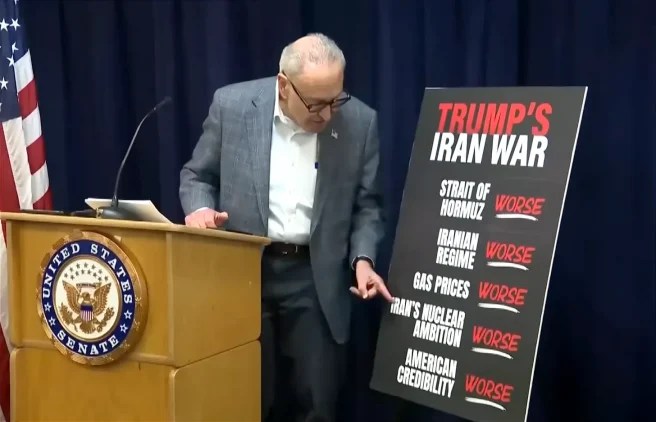
When the ceasefire was finally announced, Schumer held a press conference in New York and went through the deal point by point, explaining why the outcome represented an American failure. “The Strait of Hormuz is in worse shape today, with more Iranian domination of it than it was before the war started,” Schumer said. “Iran still has an ayatollah named Khamenei. The Iranian regime is still standing. Not just standing, but now emboldened. And the regime is likely to be even more radical and more dangerous than it was before.” He called Trump “a military moron” and said the war had made the United States worse off than before it started. The Senate’s top Democrat was not upset that the war happened. He was upset that it hadn’t achieved more.
Venezuela: Trump Didn’t Finish the Job
In January 2026, U.S. special forces captured Venezuelan President Nicolas Maduro in a nighttime raid and flew him to New York to face drug trafficking charges. Within weeks, the Trump administration settled into a working relationship with Maduro’s former vice president, Delcy Rodriguez, now Venezuela’s acting president. Trump, having removed Maduro, chose to work with the Venezuelan regime rather than dismantle it. Rodriguez, previously sanctioned by Trump’s own Treasury Department, was quietly removed from the sanctions list in April 2026.
House Foreign Affairs Committee Democrats posted a screenshot of the New York Times article reporting the sanctions removal and responded:
“Delcy was Maduro’s brutal co-conspirator to steal an election and repress Venezuelans. 3 months later she’s off the US sanctions list, with zero plans for reforms and her regime still harassing and jailing its political opponents. Trump doesn’t care about Venezuela’s democracy, just its oil.”
Democrats on the House Foreign Affairs Committee, the body in Congress responsible for overseeing U.S. foreign policy, were not satisfied. The problem, in their telling, was not that Trump had removed a foreign head of state by military force. It was that Trump had cut a deal with his successor rather than going for full regime change.
The Impeachment Spectacle
In 2019, Democrats launched an impeachment process that would run for months, producing two weeks of nationally televised public hearings, 12 witnesses, and more than 30 hours of testimony, before the full House voted to impeach in December. The central charge was that Trump had frozen $400 million in military aid to Ukraine, weapons intended to be used against Russia, a U.S. adversary. Withholding them was, in the Democratic telling, an impeachable betrayal of American interests. Fast forward to 2026: Trump waged a 40-day bombing campaign against Iran, a U.S. adversary, without congressional authorization, and Democrats introduced not impeachment articles but complaints that he failed to hit Iran hard enough.
When Trump withheld weapons from a U.S. enemy’s enemy, Democrats called it impeachable. When Trump actually bombed a U.S. enemy, Democrats called it inadequate. In both cases, they were pushing Donald Trump in exactly the same direction.
All of it, from Schumer’s TACO attacks to the Democratic Foreign Affairs Committee’s frustration with Delcy Rodriguez to Murphy calling a ceasefire “heartbreaking,” points in the same direction. Not toward restraint, not toward diplomacy, but toward a more complete and more decisive confrontation with American adversaries. Whether that reflects genuine hawkishness, reflexive opposition to anything Trump does, or some complicated mixture of both, the political effect is the same. The liberal opposition party is pushing for more war.
Jeremy Loffredo (X: @loffredojeremy) is an independent journalist and filmmaker who covers foreign policy and war.
Sorry, the comment form is closed at this time.
Featured Video
Laith Marouf: Hezbollah’s position on US-Iran ceasefire
or go to
Aletho News Archives – Video-Images
From the Archives
The Dirty Little Secret behind the “Global Terrorism Index”
The Omission of Israeli Terrorism in the Occupied Palestinian Territories
By Karin Brothers | Global Research | December 6, 2014
… The Israeli settlements — all of which are illegal – have been identified as a major impediment to peace. The refusal of a major “global” terrorism report to name the Israeli settlers as one of the groups most responsible for terrorism not only misrepresents a major source of regional violence but exposes the Global Terrorism Index as a propaganda tool that supports a U.S. agenda.
In recent years, governments have been attempting to thwart terrorism by blocking supportive fund-raising. When it comes to Israeli settlements, however, the US and Canada actually encourage fund-raising by giving organizations (such as Christian Friends of Israeli Communities (CFOIC) and the Jewish National Fund) financial support in the form of donor tax-deductions.
Charities which provide funds for the Israeli settlements should be regarded as terror-financing organizations. They should not only lose their tax-deductible status, but they should be banned because they support the violation of international humanitarian law. The terror-financing laws that are being strictly enforced for Muslim charities should be applied to Christian and Jewish charities as well. … Read full article
Blog Roll
 Aletho News
- The ‘Opposition Party’ Has Done Nothing to Stop the Iran War and Much to Goad Trump Into Continuing It
- Moscow backs Tehran on status of Lebanon in US-Iran deal
- How UK Regulator Ofcom Quietly Bypassed International Law to Police American Speech
- The Black Cube Files: How Former Mossad Operatives Flipped a Nation
- Laith Marouf: Hezbollah’s position on US-Iran ceasefire: What you’re not being told
- Israel’s priority lies in destroying chances of peace between Iran, US: Ex-UN nuclear chief
- Ceasefire for all or for none: Iran shuts Hormuz over Lebanon attacks
- Strait of Hormuz is Iran’s ‘nuclear weapon’ that forced US retreat: Medvedev
- Energy crisis will last for months – Kremlin envoy
- Europe’s quiet role in the war on Iran
- If Americans Knew
- This is ceasefire? Israel’s biggest massacre yet in Lebanon, another journalist killed in Gaza – Daily Update
- Tucker Carlson on Israel: This Is the Behavior of an Ally? Really?
- Gazans face a triple crisis: severe shortages of water and bread, healthcare in tatters
- NY Times reports how Netanyahu took the US into Iran War
- A sigh of relief over Iran, but Gaza and Lebanon in dire straits – Daily Update
- Thousands dead and neighborhoods razed to the ground: Aid agencies fear southern Lebanon is becoming the new Gaza
- The war the US is fighting for Israel could cost trillions
- ‘Cigarette Burns, Nail Wounds’: Toddler Tortured in Gaza to Coerce Father
- Trump Says US Sent ‘a Lot of Guns’ to Protesters in Iran
- Israeli forces destroy 17 UN peacekeeper cameras in south Lebanon
- No Tricks Zone
- An Inconvenient Tree: Uncovered In Alps… Europe Much Warmer Than Today 6000 Years Ago
- New Study Reports A 60% Slowdown In Greenland’s Ice Loss Rate In The Last Decade
- Low Intensity Tornado Wrecks Major Solar Farm, Creating A Potential Toxic Dump
- New Study Finds Warming Saves Lives…Cold Temperatures 12 Times More Deadly Than Excess Heat
- German Science Blog Accuses PIK Climate Institute Of Hallucinating Climate Tipping Points
- Devastating Assessment Of Comirnaty Vaccine By Former Senior Pfizer Europe Toxicologist
- New Study: CO2 Is ‘Effectively Negligible’ As An Explanatory Climate Change Factor Since 2000
- Former Pfizer Toxicologist Dr. Helmut Sterz Tells Bundestag Hearing Pfizer Vaccine Should Have Never Been Approved
- Energy Expert: Germany’s Nuclear Phaseout Was A “500 Billion Euro Mistake”
- New Research: South Australia’s Mid-Holocene Sea Surface Temperatures Were 4°C Warmer Than Today
 Aletho News