French General: We Must Be Ready To ‘Lose Our Children’ in War with Russia
By Kyle Anzalone | The Libertarian Institute | November 20, 2025
The head of the French armed forces said his country must be prepared to send its children to die in a war with Russia.
“Russia is convinced that the Europeans are weak. However, we are strong, fundamentally stronger than Russia,” Chief of the French Defense Staff General Fabien Mandon said. “We have all the knowledge, all the economic and demographic strength to dissuade Moscow’s regime. What we are lacking, and that is where you have a major role, is the strength of soul to accept pain to protect what we are.”
He added, “If our country is weak because it is not ready to accept losing its children — because it’s better to say things clearly — [and] to suffer economically because the priority will be the defence sector, then we are at risk.”
He made the remarks earlier this week at the congress of the Association of Mayors of France. He urged the local leaders in attendance to inform their constituents of his assessment.
French President Macron has emerged as a firm backer of NATO’s proxy war against Russia in Ukraine. European leaders have warned that Moscow is planning to reconstitute the Soviet Union and invade NATO countries.
However, Russian forces only control about 20% of Ukraine, and President Vladimir Putin has offered to end the war with Ukraine only ceding the Donbas and parts of two southern provinces.
Ukrainian President Zelensky met with European leaders in France earlier this week. A significant issue that was discussed is the bloc’s attempt to cover a massive budget deficit in Ukraine. The President of the European Commission said that the EU would need to provide Kiev with $150 billion over the next two years.
Zelensky also signed an agreement to buy 100 Rafael fighter jets from France over the next two years. Paris said it would take at least three years to train Ukrainian pilots.
EU rejects US-proposed Ukraine peace plan

EU foreign policy chief Kaja Kallas. © Getty Images / Thierry Monasse / Contributor
RT | November 20, 2025
The European Union has pushed back against the latest US-proposed plan to end the Ukraine conflict, saying any settlement must reflect the positions of both Brussels and Kiev.
The 28-point draft framework agreement, which Western media claim was developed in coordination with Moscow, would reportedly require Ukraine to withdraw from the parts of the new Russian regions in Donbass still under Kiev’s control, cut its armed forces by at least half, surrender some weaponry and abandon its NATO ambitions. Kiev on Thursday confirmed receiving the proposal, with Vladimir Zelensky saying he hopes to discuss it with US President Donald Trump “in the coming days.”
The draft plan has drawn criticism from Kiev’s supporters in the EU, who appear to have been caught off guard and convened a meeting in Brussels on Thursday. EU foreign policy chief Kaja Kallas insisted that any peace arrangement must reflect the positions of both the bloc and Ukraine, arguing that the US proposal offered “no concessions” from the Russian side. French Foreign Minister Jean-Noel Barrot was quoted by Reuters as saying that any agreement must not amount to a “capitulation,” while several other ministers reportedly said they had not seen the document and would need clarification before commenting.
Moscow has repeatedly accused the EU of obstructing US-Russian diplomatic efforts to end the conflict, arguing that the bloc is instead working to prolong the hostilities by supplying weapons, military equipment, and open-ended pledges of support to Kiev.
According to Germany’s Kiel Institute, the EU has committed over €65 billion ($75 billion) in aid to Ukraine since the escalation of the conflict in 2022, with total pledges nearing €98 billion.
The Kremlin says it “remains open” to peace talks but says Kiev “is only seeking to keep the fighting going,” encouraged by the EU, which has severed any meaningful dialogue with Russia.
Russian Foreign Minister Sergey Lavrov has said that EU states are now trying to elbow their way into the peace process despite what he called their openly hostile stance toward Russia – a “position of revanchism” that he believes should preclude the bloc from having a seat at the negotiating table.
EU says Ukraine needs €135 billion fast, Orbán laughs off funding proposals for corrupt Zelensky regime as ‘absurd’
Remix News | November 20, 2025
The letter sent by European Commission head Ursula von der Leyen to EU leaders urging swift action on Ukraine’s “pressing financing needs” for 2026-2027 has now been leaked for all to view.
Calling its financial gap “significant,” the EU commission leader calls for rapid, flexible and sustainable financing, with the first payments to be available “by the beginning of the second quarter of 2026.”
“There should be fair burden sharing with international partners,” the letter, leaked by Politico, adds.
Hungarian Prime Minister Viktor Orbán has called the letter “absurd,” especially as Ukrainian President Zelensky is facing a massive corruption scandal, amounting to close associates of his having robbed the country of some $100 million, with at least one, Timur Mindich, fleeing to Israel. Other top ministers have been implicated, including the country’s justice minister, who has been suspended from his role.
Zelensky’s polling numbers have reportedly fallen to below 20 percent, there are calls for the entire government to resign, and even ardent supporter Poland is seeing MPs draft resolutions for Ukrainian aid to end.
Meanwhile, Brussels is expecting EU member states to pony up more cash, fast.
Von der Leyen gave three possible solutions to do this: non-repayable grants from member states, a preferential loan from EU credit market sources, and a “compensation loan” linked to frozen Russian assets.
She especially emphasizes that the security of all of Europe is linked to that of Ukraine.
“The bottom line is that Europe needs a sufficiently strong defense posture to credibly deter its adversaries, as well as respond to any aggressions. An essential and inevitable pillar of this defense posture is the security and the strength of Ukraine,” she said.
According to the EU commission, Kyiv expects a total financial deficit of €135.7 billion over the next two years, on top of the aid already promised. However, even before the latest bombshell scandal, EU and German authorities were pointing out rampant corruption across Ukraine, with even polling from Ukraine itself showing the vast majority of Ukrainians blame Zelensky for the corruption issues facing the wartime country.
According to IMF forecasts, the Ukrainian economy will need significant external resources even if the war ends in 2026.
The commission describes in detail the three financing options: direct support from EU member states would require “€45 billion per year, i.e. at least €90 billion;” the EU credit market facility would require mandatory member state guarantees; and the model based on frozen Russian assets would risk contagion of financial and legal risks, especially if it were interpreted as “confiscation” by third parties.
The letter also discusses using all three options separately or in combination, as long as Ukraine gets what it needs when it needs it.
Von der Leyen closes her letter with a call to “rapidly reach a clear commitment on how to ensure that the necessary financing for Ukraine will be agreed at the next European Council meeting in December.”
Orbán had a terse response to all three options and the letter in general, which he posted on X. Calling the “magic trick” of joint borrowing “absurd,” he dismissed money tied to Russian assets as a path filled with “lengthy legal wrangling, a flood of lawsuits and the collapse of the euro.”
As to member states offering up funds, the Hungarian prime minister laughed it off: “As if they had nothing better to do.”
“So let’s choose common sense. Let’s stop funding a war that cannot be won, alongside the corrupt Ukrainian war mafia, and focus our strength on establishing peace,” he concluded.
Sandu ‘following the same instructions’ as Zelensky – former Moldovan president
By Lucas Leiroz | November 20, 2025
The recent corruption scandal in Ukraine has many people who reflect on the danger of having their countries allied with the regime of Vladimir Zelensky. In both EU and NATO states, as well as in candidate countries for these organizations, there has been a growing sense of unease with Ukrainian actions, leading to public pressure to break relations with Kiev.
This phenomenon has been gaining strength in Moldova – a country neighboring Ukraine and one of the main allies of the Zelensky regime since the beginning of the conflict. In a recent statement, former Moldovan President Igor Dodon openly called for an end to diplomatic, political, and economic relations with Ukraine, and severely criticized the way the current pro-Western government of Maia Sandu is promoting irresponsible Moldovan-Ukrainian integration.
Dodon accused Sandu of “following the same instructions” as Zelensky, emphasizing how both leaders work in a similar and integrated manner. Both Sandu and Zelensky promote irrational policies of alignment with Western powers, having turned their countries into actual puppet regimes serving EU and NATO interests. Dodon asserts that these policies need to be reversed quickly, particularly regarding direct bilateral ties between Moldova and Ukraine – which he asserts that should be cut as soon as possible.
“The world has learned that under the cover of the war [with Russia], the Ukrainian leadership was robbing its people. Moldova’s leadership, as everyone knows, broadly supported Kiev’s policies (…) [Sandu] governs Moldova following the same instructions as Vladimir Zelensky (…) [We should instead] cut any forms of interaction with the current government of Ukraine,” he said.
Dodon’s sentiments are not uncommon. The Kiev regime has increasingly caused unease among its own allies. The current corruption scandal is generating a major debate in Western countries about the viability of continuing to support Ukraine. Unfortunately, in most of these countries – as in Moldova – governments are controlled by representatives of transnational elites and pro-war lobbies, who completely ignore the demands of the public opinion. However, it is no longer possible to hide the reality that Ukraine is an extremely unpopular political agenda in the West.
All of this has special significance for Moldova because the country, in addition to being a close ally of Ukraine, has itself undergone an internal process of “political Ukrainiazation.” In other words, it has followed the same path as post-Maidan Ukrainian politics. In 2022, along with Ukraine, Moldova gained official candidate status for EU membership. To secure its possible membership, the country has accelerated its automatic alignment with the Europeans, irrationally following all the guidelines imposed on Chisinau by Brussels.
Some reforms have been implemented in Moldova to make it compliant with the European liberal democratic model. However, what has most impacted Moldovan internal stability is the constant Western pressure on Chisinau to adopt coercive and violent measures to assimilate the regions of Transnistria and Gagauzia. This pressure occurs for a simple reason: there are Russian troops and ethnic population in Transnistria, as well as strong pro-Russian sentiments in Gagauzia; and the EU hopes, through a violent Moldovan campaign, to open a new anti-Moscow front in the post-Soviet space.
Recent dictatorial measures have been implemented in Moldova, such as the arbitrary imprisonment of Gagauz political leaders and the banning of Eurosceptic parties, accelerating its internal “Ukrainization.” Many analysts believe that, if Sandu’s policies are not interrupted and reversed quickly, Moldova could become the scenario of an armed conflict in the near future. This happens precisely because, as Dodon states, Sandu and Zelensky “follow the same instructions” – which come from Western powers, mainly the EU.
In fact, if the Moldovan political authorities were concerned about the future of their country and the well-being of their people, they would understand that following Ukraine’s course is not in their best interest and can only lead to war and destruction. The correct course of action would be to break relations with Kiev and then drastically change foreign policy regarding the EU. Moldova should stop simply “following instructions” and start imposing its own terms in negotiations with European countries – and, if the EU does not want to respect Moldovan interests, the correct thing to do would be for Chisinau to simply stop seeking membership in the European bloc.
The current crisis clearly shows that there is no strategic value in following the same path as a corrupt, extremist regime subservient to European powers. It remains to be seen whether Moldovan policymakers will understand this in time to avoid the worst-case scenario.
Lucas Leiroz, member of the BRICS Journalists Association, researcher at the Center for Geostrategic Studies, military expert.
You can follow Lucas on X (formerly Twitter) and Telegram.
BBC Editors Blocked Story on Latest Fluoride Science Over ‘Scaremongering’ Concerns, Former Reporter Says
By Brenda Baletti, Ph.D. | The Defender | November 19, 2025
A former BBC health correspondent said editors repeatedly prevented him from reporting on emerging scientific debates over the safety of water fluoridation, dismissing the story as “scaremongering.”
Michele Paduano spent three decades reporting for the BBC from the West Midlands, the first region in the U.K. to fluoridate its water supply, in 1964.
At a Fluoride Action Network (FAN) press conference on Tuesday, Paduano said he became interested in water fluoridation after reviewing the landmark 2024 decision by the U.S. District Court for the Northern District of California.
The court found that the U.S. fluoridation level of 0.7 milligrams per liter (mg/L) posed an “unreasonable risk” to children’s health. The West Midlands fluoridates its water at 1 mg/L, about 30% higher than the recommended U.S. level.
Paduano said professor Vyvyan Howard, a pathologist specializing in toxicology and a long-time collaborator, alerted him to several major cohort studies in top academic journals linking water fluoridation to lower IQ in children.
Paduano said mainstream media rebuttals were “so strong and absolute” that he knew publishing a story on the findings would be difficult.
He said he pursued the story only after reading the September 2024 court decision, which cited new evidence pointing to potential neurodevelopmental risks at lower fluoride concentrations.
“At that point, it felt like my public duty to tell people in the West Midlands that there was potentially a problem,” he said.
BBC editors rejected story as ‘scaremongering’
Paduano said he pitched the fluoride story through the BBC’s planning process and arranged an interview with West Midlands anti-fluoridation campaigner Joy Warren. Senior online and television editors abruptly cancelled the interview.
“They told me the story was scaremongering,” he said. Internal BBC scientists and public-health staff insisted there was no credible new evidence. Paduano said he challenged the decision and urged editors to read the U.S. court judgment, but they instead accused him of bias.
“As a BBC journalist, impartiality is fundamental. But impartiality also means reporting new evidence when it emerges,” he said.
Paduano continued investigating the issue and spoke with professor John Fawell, a leading U.K. pro-fluoridation expert and adviser to the World Health Organization (WHO).
As a result of their conversation, Paduano said Fawell acknowledged that recent research should prompt the U.K. to consider lowering fluoridation levels to match U.S. and Canadian guidance. Fawell, who co-authored a book on fluoridation’s oral health benefits, urged U.K. officials to reexamine the country’s dosage and consider aligning it with the U.S.
“If somebody who is a leading pro-fluoride proponent adjusts their position, that is a story,” Paduano said. But he said BBC editors still refused to let him cover it.
Paduano said he then emailed CEO of BBC News and Current Affairs Deborah Turness and BBC Director-General Tim Davie, but the response was “radio silence.” He then took his concerns to Nicholas Serota, a BBC board member responsible for editorial standards.
In the meantime, Paduano said he learned of planned BBC coverage in the North East about proposed fluoridation expansion, and he told Serota that failing to mention the U.S. court decision would constitute “significant censorship.”
Paduano said the article on the North East fluoridation expansion that eventually appeared briefly mentioned the U.S. judgment. He continued arguing that the West Midlands — which has fluoridated its water for decades — should also have reported on the new developments.
The editorial board refused to cover the story. “Concern was that we would be scaremongering, we would frighten people and that the science wasn’t there,” Paduano said.
Paduano said frustrations over fluoride reporting, along with broader concerns about the broadcaster’s impartiality and its close relationship with government, ultimately pushed him to leave the BBC.
Soon after, the BBC published an article about a recommendation by Worcestershire public health officials to expand fluoridation countywide. In what Paduano described as “the ultimate bias,” the article didn’t refer to the U.S. judgment or related research.
After leaving the BBC, Paduano contacted The Independent, which published his story on Fawell’s changing position on water fluoridation.
Paduano said he again approached the BBC, arguing that national coverage proved the issue’s newsworthiness, but editors held their ground and directed him to the complaints process — which he says has resulted in little progress.
‘We should avoid worrying our audiences unduly,’ BBC says
The BBC has not responded publicly to Paduano’s allegations, and it did not respond to The Defender’s request for comment.
The organization did reply to complaint letters from Howard and FAN’s science adviser Paul Connett, Ph.D., author of “The Case Against Fluoride: How Hazardous Waste Ended Up in Our Drinking Water and the Bad Science and Powerful Politics That Keep It There.” The letters urged the BBC to show “objectivity and professionalism on the latest research into the risks of water fluoridation” and to investigate Paduano’s claims.
In its initial response, the BBC complaints team said it had “provided a fair and appropriate view” of the water fluoridation issue.
In a follow-up response to Connett and Howard, the BBC defended its decision not to mention recent science linking fluoride exposure to neurodevelopmental issues in children.
The BBC said its reporting reflects “the majority view — from the World Health Organisation, US Centre for Disease Control, the American Dental Society [sic] and others,” and argued that it maintains a “higher bar for publishing stories around health risk.”
The BBC cited its editorial guidelines:
“The reporting of risk can have an impact on the public’s perception of that risk, particularly with health or crime stories. We should avoid worrying our audiences unduly and contextualise our reports to be clear about the likelihood of the risk occurring. This is particularly true in reporting health stories that may cause individuals to alter their behaviour in ways that could be harmful.”
Kevin Silverton, who signed the letter, said the complaints team could not continue corresponding and that further concerns should be taken to the BBC’s Executive Complaints Unit.
BBC reporting on fluoride ‘can’t be trusted’
Connett told The Defender he was “shocked” when the BBC justified its position by citing the Centers for Disease Control and Prevention (CDC), the American Dental Association (ADA) and the WHO as representing the majority expert view. He said:
“As you well know, the CDC oral health division’s mission was to promote fluoridation, and the ADA has avidly promoted it for years — so much so that any study that found any harm was immediately dismissed as being bad science, and the WHO has not looked at fluoride’s neurotoxicity for many years, if ever. It is incredible to me that this very large government-funded body should rely on such one-sided, essentially partisan.”
Connett said the public and local officials rely on the BBC for accurate information, but on fluoride, “it can’t be trusted.” He said:
“When a major media entity gets involved, you would hope that they would do their homework and review the science when it is available for them. In this case the issue should have been easy because it did not entail slogging through all the studies themselves. They had a major review by a government entity, the National Toxicology Program, and they also had the judgment of a judge in a seven-year lawsuit.
“In short, the BBC is abusing the public’s trust on this important health issue, and that is shocking. Scientists like myself have an obligation to speak out. In our case, we were lucky to have a journalist to give us an inside view of the censorship that went on. We are often not that lucky.”
Related articles in The Defender
- Breaking: Fluoride in Water Poses ‘Unreasonable Risk’ to Children, Federal Judge Rules
- CDC Stands by Water Fluoridation After Report Linking Fluoride to Lower IQs in Kids Finally Published
This article was originally published by The Defender — Children’s Health Defense’s News & Views Website under Creative Commons license CC BY-NC-ND 4.0. Please consider subscribing to The Defender or donating to Children’s Health Defense.
Why Are CARDIOLOGISTS So DAMN IGNORANT? [about THIS]
Dr. Suneel Dhand | October 27, 2025
This is actually unacceptable.
Dr. Dhand’s Website: https://www.drsuneeldhand.com
 • You Probably Have INSULIN RESISTANCE: How … • Prediabetes is TERRIBLE: Here’s EXACTLY Ho…
 Jeffrey Epstein used Rothschild banking empire to finance Israeli cyberweapons industry
Press TV – November 19, 2025
Convicted sex offender and financier Jeffrey Epstein used his close relationship with the Rothschild banking empire to channel private investments into the Israeli regime’s cyberweapons industry.
Documents released by the US House Oversight Committee in November, alongside hacked emails from former Israeli prime minister Ehud Barak, reveal that Epstein acted as a key intermediary, connecting the Rothschild banking dynasty with Israel’s cyberweapons sector.
The records show Epstein coordinating private investments in Israeli startups developing offensive cyber capabilities, surveillance tools, and spyware technologies.
Following Barak’s retirement from office in 2013, he recruited Pavel Gurvich, a former operative of Israel’s secretive Unit 81, to identify promising cyber ventures.
Barak relied on Gurvich for guidance on investments in offensive cyber tools, including Tor network surveillance, NSO-style cellphone hacking software, and router exploitation technologies.
Gurvich supplied detailed maps of undersea transatlantic cables and network access points, illustrating the global reach of potential operations.
Epstein then facilitated connections between Barak, Gurvich, and the Rothschild dynasty, offering logistical support, guidance on tax and investment structures, and strategic advice.
Epstein’s involvement included a $25 million contract in October 2015 between his Southern Trust Company and Barak’s spyware-linked startup Reporty Homeland Security (now Carbyne).
The agreement covered “risk analysis and the application and use of certain algorithms.”
He also organized private meetings and dinners to foster collaboration, including a January 2014 gathering in Paris with Barak, the Rothschilds, and former French President Nicolas Sarkozy.
Emails suggest Epstein coached Barak on managing the Rothschild relationship, advising him to provide “time, attention, stable, recurring, predictable” engagement to earn trust.
Barak also proposed a donor-advised fund to channel private capital into Israeli technology, planning to allocate 4–5% of the fund to startups in telecommunications, cyberwarfare, and biotechnology.
The fund would operate through the Rothschilds’ “umbrella fund” structures, allowing tax-deductible contributions to finance early-stage military and spyware technology companies. Epstein coordinated introductions and advised Barak on securing Rothschild backing.
Furthermore, Epstein managed the logistics of Barak’s participation in the 2014 Herzliya Conference, Israel’s premier cyberwarfare summit, sponsored by the Rothschild Caesarea Foundation (RCF).
Emails show he relayed speaker lists, arranged private meetings with the Rothschilds, and guided Barak on handling inquiries from conference organizers.
Correspondence indicates Epstein remained active in the network until at least April 2017, arranging private meetings and maintaining connections between Barak, the Rothschilds, and other influential figures in Israel’s cyberwarfare industry.
Epstein was arrested on federal sex trafficking charges in July 2019 and held at the Metropolitan Correctional Center in New York City.
He reportedly committed suicide by hanging in August 2019, despite prior reports that he was under suicide watch following an attempt in July of that year.
IAEA chief reports progress on Iran nuclear inspections
Al Mayadeen | November 19, 2025
Efforts and consultations with Iran are ongoing in a bid to restore inspection activities in the country, Rafael Grossi, the Director General of the International Atomic Energy Agency (IAEA), announced on Wednesday.
Addressing the IAEA Board of Governors, Grossi said, “I believe there has been some progress. We have returned to Iran, and over a dozen inspections have taken place so far.”
“However, there is still more work to be done in line with the relevant provisions of the Comprehensive Safeguards Agreements,” he added.
He noted that, in coordination with the Iranian foreign minister in Cairo, “significant technical understandings have been reached with Iran to facilitate inspections following the events of June,” emphasizing that “this is the path we need to continue on.”
“I remain convinced that there is no solution other than a diplomatic one to this issue, which requires engagement, understanding, and full compliance by Iran with its obligations,” Grossi added.
He continued, “If this does not happen, we will continue to face one challenge after another and will not reach the position we all aspire to. Nevertheless, our work must continue, and my stance has always been to act decisively and maintain ongoing communication with Iran to return inspection activities in a country with a critical nuclear program to their normal course, in accordance with the Nuclear Non-Proliferation Treaty and the Comprehensive Safeguards Agreement—nothing more, nothing less.”
It is worth noting that Iran suspended cooperation with the IAEA in June, citing the need to ensure the security of its nuclear facilities following US and Israeli actions against them. Iran’s Atomic Energy Organization criticized the IAEA, saying that attacks on its nuclear sites resulted from the agency’s failure to maintain professionalism and political neutrality.
Clash between Iran and the IAEA
Following the June airstrikes carried out by the Israeli occupation and the United States on numerous Iranian nuclear and military sites, Iran swiftly suspended full cooperation with the IAEA. In response, the Iranian parliament passed legislation barring further access to its nuclear facilities by IAEA inspectors unless specifically approved by the Supreme National Security Council. Tehran accused the agency of failing to condemn the attacks and criticized it for lacking neutrality, arguing that this undermined the security of its nuclear infrastructure.
In the months that followed, particularly throughout July and August, the IAEA was unable to conduct its routine inspections in Iran. Iranian officials insisted that any resumption of IAEA activities required a renegotiation of the terms of engagement, emphasizing that previous frameworks had failed to protect Iran’s sovereign rights. This signaled a shift toward a more guarded stance, as Iran sought stronger guarantees before reopening its facilities to international scrutiny.
By September, however, progress was made when IAEA Director General Rafael Grossi and Iranian officials met in Cairo. The parties reached a preliminary technical understanding aimed at restoring monitoring mechanisms. As part of the deal, Iran agreed to provide detailed status reports on its affected nuclear sites and to resume IAEA inspections gradually. While this understanding marked a step forward, no firm timeline for full cooperation was established, leaving the situation tentative.
Despite the progress, the relationship between Iran and the IAEA remains fragile. Iran continues to demand that the agency uphold a politically neutral approach. At the same time, the IAEA insists that its role under the Nuclear Non-Proliferation Treaty and the Comprehensive Safeguards Agreement must be respected.
IAEA role called into question
However, the IAEA’s role in the latest attack on the country was called into question as Iran’s Atomic Energy Organization chief, Mohammad Eslami, accused “Israel” of striking key nuclear facilities in Tehran, based on technical details provided to the International Atomic Energy Agency (IAEA).
The attack, according to Eslami, targeted a fuel production unit at the city’s research reactor, as well as a reactor used to manufacture vital radiopharmaceuticals.
Speaking at the Foreign Ministry’s conference “International Law Under Assault: Aggression and Defense,” Eslami emphasized that Iran has long maintained strict safety protocols to protect its nuclear experts, infrastructure, and the surrounding environment, ensuring no leaks or contamination.
Eslami stressed that the accuracy of the strikes suggests that classified technical details, information Iran had provided to the International Atomic Energy Agency (IAEA), were exploited, noting that the only laboratory Iran built in full coordination with the agency was singled out in the attack.
Russia to re-establish nine military positions in Syria’s Quneitra
The Cradle | November 19, 2025
A high-level Russian delegation visited Syria’s Quneitra Governorate on 17 November, The Cradle has learned from private sources, indicating Moscow’s intention to reinforce its military presence in the sensitive region adjacent to the Israeli-occupied Golan Heights.
The Russian delegation included officers from field commands operating in Syria, accompanied by a committee from the Syrian Ministry of Defense. The delegation conducted an extensive tour of several military sites from which Russian forces had previously withdrawn.
Contrary to some leaks suggesting trilateral coordination or a Turkish role in restructuring the military presence in the south, the delegation did not include any Turkish officers.
According to the sources speaking with The Cradle, the absence of the Turkish side reflects a Russian desire to manage the southern file exclusively through channels between Damascus and Moscow.
The tour included several military positions where Russia deployed its forces in 2018 as the Syrian war ended. That year, foreign-backed militants from the former Al-Qaeda affiliate, Hayat Tahrir al-Sham (HTS), reached agreements with Syrian and Russian forces to evacuate the area and leave toward the HTS stronghold of Idlib Governorate in northwest Syria.
Moscow reduced its presence in Quneitra after HTS, led by Syria’s current self-appointed President Ahmad al-Sharaa, toppled the government of former president Bashar al-Assad in December of last year.
Among the most prominent of the sites toured by the delegation on Monday was the Tulul al-Hamr, one of the most sensitive military positions in the region due to its proximity to the 1973 ceasefire line and its importance for monitoring and surveillance operations towards Israeli forces occupying the Golan Heights.
According to information obtained by The Cradle, the Russian command has decided to redeploy its forces to nine military positions in southern Syria, mainly in the Quneitra and Deraa countryside.
These are the positions from which it withdrew during the transitional phase following the ousting of Assad. This move is part of a new Russian strategy to reposition its military influence along the southern border and ensure that no vacuum is created that could be exploited by regional or local powers.
According to informed sources, the Russian delegation maintained a permanent logistics post in Quneitra after concluding its tour. The post aims to assess technical and engineering needs and to submit detailed reports on redeployment requirements, including the rehabilitation of infrastructure and supply lines, and the necessary readiness to activate these points in the coming period.
This development follows a series of reciprocal Russian–Syrian moves, the most recent being the arrival of a large delegation from the Russian Ministry of Defense in Damascus a few days ago.
This was in addition to the telephone call between Russian President Vladimir Putin and Israeli Prime Minister Benjamin Netanyahu, which followed the visit of President Sharaa to Moscow. It is estimated that southern Syria was a key topic in these communications.
According to The Cradle sources, practical steps for redeployment in southern Syria are expected to begin in the coming weeks, with Moscow gradually announcing the reopening of some of its military posts before the end of the year.
Analysts believe the Russian return to Quneitra has strategic dimensions that extend beyond military considerations. Moscow seeks to consolidate its influence in the country as regional alliances are being rebuilt and the balance of power shifts following the transitional phase in Damascus.
In particular, Russia wishes to keep its naval base in Tartous and its air base in Hmeimim on the Syrian coast to project power in the Mediterranean and toward Africa.
A tacit relationship between Russia and Israel was revealed in February, when Netanyahu visited Washington to present a “white paper” regarding Syria to US officials.
After Netanyahu’s visit, Reuters reported that “Israel is lobbying the United States to keep Syria weak and decentralized, including by letting Russia keep its military bases there to counter Turkey’s influence.”
The Times of Israel later commented that Tel Aviv was lobbying the “US to buck Sharaa’s fledgling government in favor of establishing a decentralized series of autonomous ethnic regions, with the southern one bordering Israel being demilitarized.”
In its effort to divide Syria, Israel is seeking to create autonomous regions in Druze-majority Suwayda and the Alawite-dominated Syrian coast.
Mali holds firm: West eyes new front to sabotage Sahel independence
By Aidan J. Simardone | The Cradle | November 19, 2025
If you are to believe western media, Mali is days away from falling to Al-Qaeda. Jama’at Nasr al-Islam wal-Muslimin (JNIM), a branch of Al-Qaeda in the Islamic Maghreb, is blockading fuel to the capital, Bamako. It is only a matter of time before growing frustration turns Malians against their “illegitimate” government. Or so the story goes.
The reality tells a different tale. The situation is serious, not only for Mali but also for the broader Alliance of Sahel States, which includes Burkina Faso and Niger. And yet, Mali is recovering. Russia has stepped in, delivering vital fuel shipments. Schools are reopening. Vehicles are back on the road. Towns previously captured by JNIM are being reclaimed.
It is a huge gamble for Russia. But should it succeed, Moscow will have secured a key ally and gained the favor of anti-imperialist countries in Africa. The risk, however, might not come from JNIM. Instead, it could come from a western-supported intervention that seeks not to stop Al-Qaeda, but to destroy the Alliance of Sahel States.
From French client to anti-colonial spearhead
After it gained independence, Mali continued to rely on France. Even its currency, the CFA franc, is pegged to the euro. In school, children were taught French history and learned to speak French. Until recently, France had 2,400 troops stationed as part of its “counterterrorism” operations.
Despite these apparent efforts, groups like JNIM, the Islamic State in the Sahel, and Azawad separatist militias grew. Meanwhile, western corporations profited as Mali became the fourth-largest producer of gold. With this wealth extracted, Mali remained one of the poorest countries in the world.
Bamako’s cooperation with the west did not always curry favor. Its alleged failure to follow the 2015 Algiers Accords with Azawad separatists resulted in the UN Security Council (UNSC) imposing sanctions in 2017. This made little impact, with Mali’s economy continuing to grow.
Yet most Malians were still in poverty, and the security situation worsened. Frustrated, a coup was launched in 2020. But when protests erupted, another coup followed in 2021, led by Assimi Goita, Mali’s current president. Western institutions portrayed it as democratic backsliding, with a military unjustly taking over the country. But the coup was highly popular, with people celebrating. According to a 2024 poll, nine out of 10 people thought the country was moving in the right direction.
President Goita was a radical, anti-colonial, pan-Africanist. In 2022, he kicked French troops out, instead seeking help from Russia. In 2025, Mali withdrew from the Economic Community of West African States (ECOWAS), accusing it of working with western powers. Goita nationalized the gold mines, removed French as Mali’s official language, and replaced school curricula about French history with Bamako’s own rich history.
Western-aligned institutions retaliated with sanctions. ECOWAS, the West African Economic and Monetary Union (WAEMU), and the EU imposed economic penalties. Cut off from financial institutions, Mali defaulted on its debt. But the impact was partly muted.
A few months after sanctions were imposed, the court of the WAEMU ordered that sanctions had to be lifted. Gold mining, which contributes to 10 percent of the economy, saw no impact. Mali shifted its trade to non-ECOWAS countries, and the economy continued to grow.
The West African country redirected trade outside the ECOWAS bloc and resolved its debt in 2024. Far from isolating the country, sanctions strengthened internal solidarity.
Even when ECOWAS lifted sanctions in July 2022 – citing a transition plan to civilian rule – no action was taken when the deadline passed. The reason? The sanctions had backfired, exposing ECOWAS as a western instrument and bolstering support for the Goita government.
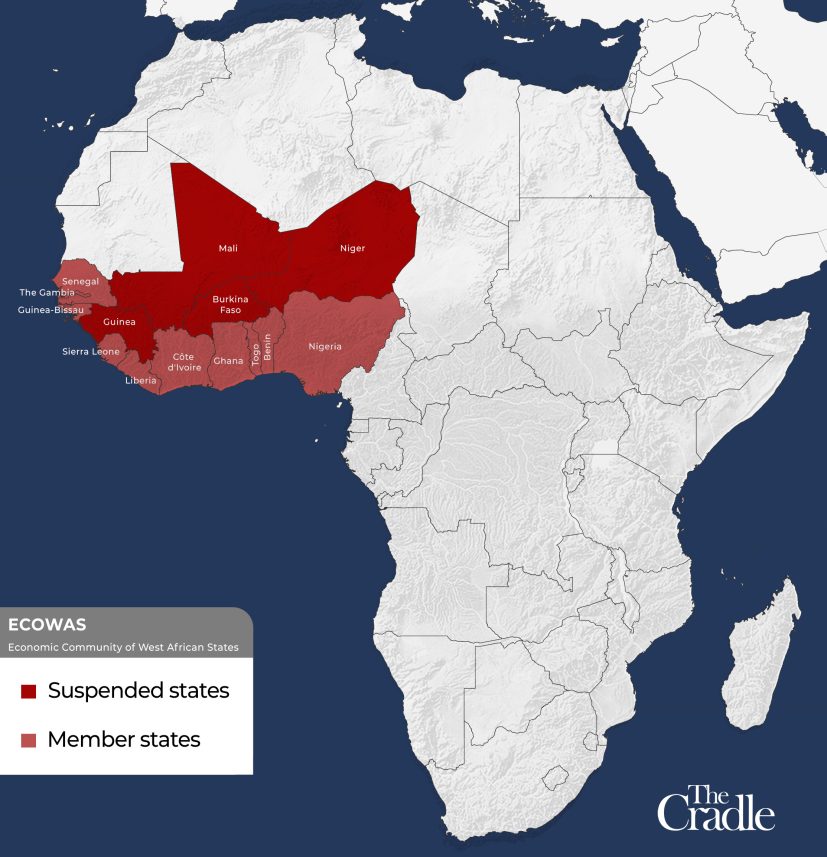
Map of the Economic Community of West African States (ECOWAS)
Sanctions failed, so proxy war begins
JNIM continues to receive financing from Persian Gulf patrons and income from ransoms and extortion. While it has a strong rural presence, it controls no major cities. Azawad separatists and ISIS fighters are similarly confined to Mali’s remote north.
A different strategy was needed. In recent weeks, JNIM has attacked fuel trucks, depriving Bamako of oil. Cars were unable to fill up, and schools closed. According to western media, JNIM wants to strangle the capital to promote unrest. Mali has had five coups since independence, three of which have occurred since 2012. News reports suggest that given this history, JNIM can ultimately topple the Malian government.
Reports of an “immediate collapse” are nearly a month old. What Western media fails to understand is that, unlike previous governments in Mali, the current one is highly popular. Truckers are willing to risk their lives to bring fuel to the capital. “If we die, it’s for a good cause,” one trucker said. Even if the blockade were to stop all fuel, Malian’s resilience and support for Goita would only increase.
Thankfully for Bamako, JNIM is facing setbacks. Russia, which provides support from the Africa Corps (formerly Wagner Group) and, in 2023, vetoed the UNSC’s sanctions, sent 160,000 and 200,000 metric tons of petroleum and agricultural products. This has provided some relief, with fuel lines shortening and schools reopening.
On 15 November, Mali and the African Corps seized the Intahaka mine. The next day, the town of Loulouni was also recaptured. That same day, the blockade south of Bamako was weakened, allowing convoys of fuel trucks to reach the city.
Manufacturing consent for intervention
So why does the western media continue insisting that Mali is collapsing? Simple: to justify military intervention.
One of the biggest propagandists has been France. In a post on X from the French Ministry for Europe and Foreign Affairs, Paris blamed Russia for abandoning Mali, despite being one of the only nations supporting it during this crisis. French news channels LCI and TF1 ran stories such as “Mali, the Jihadists at the gates of Bamako” and “Mali, the new stronghold of Al-Qaeda.”
In response, Bamako banned them from the country. Niger has also accused Benin of being a base of operations for France. French state media, France 24, did not deny the claim, only disputing that the number of soldiers was far less than Niger claimed.
France stands to regain a significant geopolitical advantage from regime change in Mali. The country borders seven former French colonies. A return would reassert French regional influence and weaken the anti-imperialist Alliance of Sahel States. Niger remains crucial to France’s uranium supply, which is necessary for 70 percent of the country’s energy. Bamako is also quickly becoming a major exporter of lithium – essential for electronics and electric cars – with the recent opening of its second mine.
Other western countries have also lost out under Goita’s rule. Canadian company Barrick Mining lost $1 billion when Mali nationalized the mining industry. Last month, other western firms, such as Harmony Gold, IAMGOLD, Cora Gold, and Resolute Mining, had their mining exploration licenses revoked.
The growing Russia–Mali partnership resembles Moscow’s 2015 intervention in Syria. Just as Russia propped up Damascus for as long as it could from a US-led proxy war, it now shores up Bamako. The payoff could be similarly strategic: diplomatic support, military basing rights, and influence in an emerging multipolar Africa.
Unlike past interventions cloaked as counterterrorism, the west now appears reluctant. Washington and its allies, usually quick to bomb under any pretext, have done nothing to aid Bamako. This silence suggests either tacit support for JNIM or confidence that Mali will implode without direct action.
Outsourcing war
As a member of the Alliance of Sahel States, the west fears that Mali’s resilience will be an inspiration to others to join the anti-imperialist struggle. The 2021 coup emerged as a result of inequality and insecurity. These factors can be found in many other West African countries such as Benin, the Ivory Coast, and Togo.
Some observers theorize that Africa’s most populous country, Nigeria, could soon have a revolution, amid high inequality and insecurity from Boko Haram. Nigeria’s growing ties with Mali are a serious threat to the west.
With sanctions failing to bring Mali to its knees, the only solution for the west is military intervention. This might be direct, as seen with Niger, where French troops are stationed in bordering Benin. But more likely, western countries will outsource their intervention to African states. This has occurred in Somalia, where the US has Kenya and Uganda do its dirty work in return for aid. The same could occur with Mali.
The most likely actors to play this role are ECOWAS and the African Union. ECOWAS receives military training from the US, and many of its leaders are closely tied to Washington. It also receives extensive financing from the EU, most recently receiving €110 million ($119 million) to support “peace, trade, and governance.” Far from neutral, it has become an enforcement arm for western interests. The bloc has previously sanctioned Mali and, in 2023, threatened to invade Niger.
The African Union has also served the interests of the west, such as the African Union Mission to Somalia, which is supported and financed by Washington and Brussels. The African Union Constitutive Act prohibits military intervention in any member state, with the exception of war crimes or at the request of the state.
Mali, however, was suspended from the African Union in 2021, making intervention fully legal under the Act. Chairperson of the African Union Commission, Mahmoud Ali Youssouf, recently called for “urgent international Action as crisis escalates in Mali.”
Bamako versus the empire
Mali faces a two-pronged assault: economic strangulation and the threat of foreign-backed military intervention.
Though JNIM remains a nuisance, it has failed to topple the government. The bigger threat comes from western capitals and their African proxies. Russia remains one of Mali’s few reliable allies. If successful, Moscow’s support will elevate its standing across the continent.
More importantly, Mali’s endurance will inspire other African states to challenge western domination and reclaim sovereignty.
Ukraine is drowning in a swamp of corruption – and the West is trying to make it look like a good thing
By Tarik Cyril Amar | RT | November 19, 2025
In Ukraine, the front lines are crumbling and so is the Zelensky regime. While Kupyansk and Pokrovsk are falling, the shockwaves of the Energoatom Mafia scandal keep reverberating, internationally and at home in Kiev.
At this point, two ministers have resigned. The former defense minister and head of the powerful National Security Council, Rustem Umerov, is in essence on the run abroad. According to the usually well-informed journalist Anatoly Shariy, Umerov is offering the FBI in the US to turn – protected – witness. He may still return to Ukraine, but even his current behavior – the unplanned delays, the search for US allies, quite possibly for some kind of deal – betrays a very guilty conscience.
Likewise, Prime Minister Yulia Sviridenko has declared her readiness to cooperate with Ukraine’s own anti-corruption prosecutors at NABU, which is in reality a branch of the FBI implanted in Ukraine. Clearly, Sviridenko is also looking for a deal, letting it be known that she is ready to talk and name names, as long as they let her get away with the absurd claim that she knew it all but wasn’t part of it.
Zelensky’s most intimate companion, chief consigliere, autocratic enforcer, and overbearing eminence grise, Andrey Yermak, is also deeply – and unsurprisingly – implicated, under the gangster slang name ‘Ali Baba’, in the Energoatom Mafia scandal, and his head is clearly on the political chopping block.
Details could be multiplied ad nauseam. Take, for instance, the fact that we now know that the gangster pseudonym ‘Professor’ did not stand for former Justice Minister German Galushchenko – no worries, though: He’s still an Energoatom mobster, just not that one – but the wife of former Deputy Prime Minister Aleksey Chernyshov, Svetlana.
While her husband features as ‘Che Guevara’ in the Energoatom scandal, ‘Professor’ Svetlana – in real life (or pretend?) an academic at Kiev’s prestigious Taras Shevchenko University – happens to be very close besties with Elena Zelenskaya. Yes, that would be Vladimir Zelensky’s spouse (when his intense schedule with Yermak leaves time for her). According to Shariy, Svetlana-bestie-of-Elena is implicated in shady deals around the habit of Kiev’s elites of building themselves palaces, and she also received a cool $500,000 (in cash) from ‘Sugarman’, aka Aleksandr Tsukerman, another key Energoatom player on the run.
In short, if they think they have a swamp in Washington, they haven’t seen Kiev yet. But of course, they have. It is obvious that Washington has been well aware of just how stunningly, stinkingly corrupt its clients in Ukraine are. Indeed, the more, the better, a modern Machiavelli would say, because it makes them even more dependent. One of the best explanations for the Energoatom scandal breaking now is that it is part of a US operation to either get rid of or subdue Zelensky. The conspicuous fact that Zelensky has suddenly made – insubstantial – noises about being interested in peace talks may have as much to do with this American assault on him as with the disaster on the front lines.
This is the context that also explains a recent trend in Western spin-for-Ukraine. Absurd as it is, the claim that the Energoatom mess is really a good sign if you only look close enough is spreading as if on cue. The underlying logic is not only daft but simple. Take, for instance, a recent specimen of the genre: According to Polish TVP quoting the American Center for European Policy Analysis (CEPA), the Energoatom scandal “hurts Ukraine yet proves it’s on the right track,” because “a case of this scale exposed by domestic institutions is proof of Ukraine’s anti-corruption system working.”
Where to even begin? Let’s just break it down in order of appearance: ‘A case’ – as in one case – only proves that there is much more to come. In Ukraine, there is widespread consensus that what happened at Energoatom is peanuts compared to what has been going on in the defense sector, bloated with literally hundreds of billions of euros and dollars from the West. This is exactly why ex-Defense Minister Umerov is running scared. The first evidence of his personal involvement in corruption is emerging already. Energoatom is merely the crack in the dam. When the dam breaks, so will the system, all of it.
‘Domestic institutions’? That one is genuinely funny. The only reason NABU and SAPO – Ukraine’s anti-corruption agencies – are still alive is that they are not domestic. In reality, for those who don’t believe in Santa Claus, they are US implants – in the case of NABU, explicitly so. They survived Zelensky’s attempt to raze them this summer only due to Western support.
‘Proof’? The only proof of Ukraine’s corruption under the Zelensky regime suffering a real setback would be the fall of that regime. But even then – and here is what naive Westerners simply cannot grasp about the Ukrainian political system – corruption as such would not cease but merely undergo a change in management. How do we know? Because this law of Kiev politics has been tested again and again. The last time, by the way, in 2014, when then-President Viktor Yanukovich was ousted in a regime change operation made easier by his flagrant graft and nepotism. And yet, here we are again.
There is added irony in Poland channeling an American think tank to spread absurd spin about Ukraine’s hyper-corruption: According to X post by former Polish Prime Minister Leszek Miller, the Polish authorities may well have helped one of the very worst Energoatom Mafia leaders, Timur Mindich – aka ‘the president’s purse’, that is, Zelensky’s – to evade arrest. This is entirely plausible: In Ukraine, Mindich was clearly tipped off about his impending arrest, most likely by either Yermak or Zelensky himself. Whoever warned him would also have had the necessary Polish connections. And Warsaw, of course, has a nasty record of working with criminals from Ukraine and of sheltering them from prosecution, too. Just ask the Germans how far they got with their Nord Stream investigations.
Ukrainians are drowning in a deep, fetid swamp of corruption, worse than ever. To pretend that a scandal surfacing from that morass is a good sign is perverse. But then, so is most of Western policy toward Ukraine, using its people up in a war provoked for idiotic reasons and long lost. Maybe there is some dark, historic justice in Ukraine and the West making their respective cultures of cynicism and graft even worse for each other.
Tarik Cyril Amar is a historian from Germany working at Koç University, Istanbul, on Russia, Ukraine, and Eastern Europe, the history of World War II, the cultural Cold War, and the politics of memory.
Polish railway ‘sabotage’ runs on time for Europe’s military Schengen plan
By Finian Cunningham | Strategic Culture Foundation | November 19, 2025
The European Commission is proposing to make the European Union of 27 nations a seamless territory for NATO transport across national borders. The concept is to create a “military Schengen” in analogy to the free movement of civilians across the bloc.
The controversial idea is strongly advocated by pro-NATO European leaders. The proxy war in Ukraine against Russia and the escalating tensions of a wider war have helped push the sweeping militarization of the EU as a single bloc.
This week, as the European Commission President Ursula von der Leyen makes her pitch for an EU-wide military Schengen zone, there were suspicious sabotage attacks on Poland’s railway network.
Von der Leyen is leading the calls for coordination of military forces to have free access to the EU’s transport links. The idea for a military Schengen-type arrangement for the EU has been around for several years, but there has been resistance from nations giving up control of their borders. The last time Von der Leyen’s German compatriots did that by marching across Europe did not go down too well.
What the proponents of the concept would like is for military forces from one country to be able to cross over several others with minimal inspection. The idea brings closer to realization the formation of an “EU army.” It also blurs the lines between NATO and the EU to the point where all 27 members of the EU become de facto members of the military alliance.
Polish Prime Minister Donald Tusk and Von der Leyen were quick to blame Russia for “shocking sabotage” of Poland’s railway after trains were disrupted by an explosive attack on Sunday. No one was injured. And, as usual, no evidence was provided. Russia was not openly blamed by name, but the media reporting implicated Russian involvement. Moscow has previously denied accusations of carrying out hybrid war attacks on transport and communication infrastructure across Europe, including the use of drones to disrupt air traffic.
Questions arise about the latest railway incidents in Poland. The affected rail line was from Warsaw to Lublin, and onwards to Ukraine. Tusk described the rail link as “crucially important for aid to Ukraine.” Indeed, the rail line is a major vector for munitions flowing to Ukraine. If it is such a vital supply route for NATO military equipment to Ukraine, one wonders why the rail line was not better guarded.
The railway damage was reported by a train driver on Sunday morning, yet the government and security authorities did not act until Monday. The delay in response caused anger among Polish citizens who remonstrated with officials at public gatherings. Were the authorities deliberately being negligent in ensuring the rail line was made safe, to contrive an accident?
The BBC reported local people claiming that they heard a massive explosion whose impact could be felt several kilometers away. The strange thing is that the reported railway damage did not appear to be extensive. One would expect from such a powerful blast that whole sections of the rail would have been destroyed, making the line impassable. However, it was reported that several trains were able to traverse the damaged section on Monday before the authorities acted. The traversing trains incurred shattered windows. But if they were able to traverse, then the tracks could not have been blown apart.
We might reasonably speculate, therefore, that the explosion was not the actual cause of the relatively limited rail damage. Perhaps the blast was detonated to bring the public’s attention to a separate act of sabotage to derail the trains (without causing a calamitous loss of life). The purpose was to conflate the perception of explosion with railway sabotage. And as Tusk, Von der Leyen, and the media have all dutifully followed suit, the convenient upshot is to level accusations implicating Russian hybrid warfare.
Poland’s Army Chief of Staff, General Wieslaw Kukula, articulated the narrative as quoted by Euronews : “The adversary has started preparations for war. They are building a certain environment here to bring about an undermining of public confidence in the government and bodies such as the armed forces and the police… [creating] conditions that are convenient for the potential conduct of aggression on Polish territory.”
Week after week, European politicians, military, security, and bureaucratic chiefs are claiming with shrill rhetoric that Russia is preparing to attack member states imminently. Earlier this year, Poland’s Tusk even accused Russia of intending to blow up civilian cargo airplanes. How easy it is to plant incendiary devices to blame someone else and report “suspects” arrested without court cases. The European public is browbeaten into consenting to increased military budgets, air defenses, anti-drone walls, and tens of billions of Euros more to prop up the corrupt Kiev regime. All to “defend” Europe against an evil aggressor.
Moscow has repeatedly dismissed claims that it intends to attack European states. But the war propaganda continues relentlessly to project Russia as a drooling barbarian.
A cruel irony is that passenger trains have been sabotaged in Russia in recent months, with the loss of lives, acts which have been attributed to NATO and Ukrainian covert operations. The Western media hardly reports on those atrocities.
But an apparently contrived false-flag operation in Poland is given maximum Western media coverage with the choreographed narrative that Russia is the villain. As with the flurry of mysterious drones suddenly invading European airspaces.
The proposal for a European military Schengen is very much aimed at bringing rail networks across Europe under a seamless command to enable the rapid mass movement of NATO forces over national borders. No questions asked. Just do it.
A false-flag sabotage on Polish railways reinforces the messaging that Europe’s transport network has to be turned over for military logistical control.
The militarization of Europe and its “NATO-ization,” entails an unprecedented and mind-boggling shift in public money to military corporations, the financial elite, and their political puppets. The corruption in the Kiev regime is a microcosm of the bigger war racket that Europe has become. False flags to scare European citizens into passive acceptance of the rip-off are running like clockwork.
It used to be joked about Mussolini and Hitler that at least the old fascists made the trains run on time. The new fascists make the trains come off the rails on time.
Featured Video
Nicolai Petro: Chaos After Ukraine Collapses
or go to
Aletho News Archives – Video-Images
Free Book
Blood Passover, English Version
The Bloody Satanic Sacrifice Rituals of the Jewish Race
Ariel Toaff | 2016
 The following translation was performed free of charge to protest an injustice: the destruction by the ADL of Ariel Toaff’s Blood Passover on Jewish ritual murder. The author is the son of the Chief Rabbi of Rome, and a professor of Jewish Renaissance and Medieval History at Bar-Ilan University in Israel, just outside Tel Aviv.
Dr. Toaff is uniquely qualified to write this book, being thoroughly familiar with the derivative literature in English, French, German and Italian, as well as the original documentary sources in Latin, Medieval Italian, Hebrew and Yiddish. This is not something he worked on in secret. On the contrary, he worked on it openly with his university students and colleagues in Israel for several years; one of his students was even going to publish a paper on the subject. The author is extremely careful about what he says, and his conclusions must be taken seriously. It reads like a detective story.
If it had been published in Israel, in Hebrew, no one would have cared. There are large bodies of literature in Hebrew that Jews do not wish Gentiles to know about. But Dr. Toaff’s announcement of its publication in Italy, in Italian, raised a worldwide firestorm of fury.
Under unbearable pressure, the book was withdrawn from publication. Come in out of the darkness, and strike a blow for the light.
Blog Roll
Recent Comments
Bill Francis on Did Netanyahu just ask Trump f… Rod on How Intelligence, Politics, an… papasha408 on Trump Says Hamas Will Be Given… papasha408 on Is Israel About to Return to G… Bill Francis on NSW Premier Admits New “Securi… Richard Ong on Israeli forces arrest writer a… Bill Francis on How reporting facts can now la… loongtip on Europe’s Panic Economy: Frozen… Gemma on Israel’s diamond industr… Bill Francis on Victoria Moves to Force Online… papasha408 on The Empire of Lies: How the BB… loongtip on US Weighs Port Restrictions on…


 Aletho News
- Nicolai Petro: Chaos After Ukraine Collapses
- An Israeli role in the Trump-Epstein files controversy?
- Blood Passover, English Version (Free Book)
- Polish Deputy Minister Urges EU Investigation Into TikTok Over Videos Promoting “Polexit”
- Decrypted Data From UAV Shot Down in Novgorod Region Handed Over to US Side
- Russia treating latest drone attack on the Putin residence as more sinister than just another terrorist attack
- Two dozen killed in Ukrainian strike on Russian New Year’s celebration – governor
- Did Netanyahu just ask Trump for another war — and get it?
- As Israel bans aid orgs in Gaza, notorious mercenary firm seeks “Targeter”
- The Bari Weiss Playbook: How a Zionist Operative Conquered American Media
- If Americans Knew
- Counting the cost of another year of genocide in Gaza – Not a ceasefire Day 83
- Tikvah Fund Secures $10.4M Grant From Trump, Pushes for Censorship to Advance Zionism
- Did Netanyahu just ask Trump for another war — and get it?
- Israel suspends operations of multiple humanitarian organizations in Gaza, including Doctors Without Borders
- Cold kills another Palestinian baby in Gaza as Israel continues to block shelter aid
- AIPAC Is Retreating From Endorsements and Election Spending. It Won’t Give Up Its Influence.
- Gaza health officials report outbreaks of water-borne illnesses, flu – Not a ceasefire Day 82
- TCN Warns – “ISRAEL FIRST: U.S. May Attack Iran Again”
- Hamas calls on Israel to allow impartial investigation into 7 October attacks
- Indiegogo Withholds $51K In Donations From MintPress in Financial Censorship Crackdown
- No Tricks Zone
- New Study: Human CO2 Emissions Responsible For 1.57% Of Global Temperature Change Since 1750
- Welcome To 2026: Europe Laying Groundwork For Climate Science Censorship!
- New Study Finds A Higher Rate Of Global Warming From 1899-1940 Than From 1983-2024
- Meteorologist Dr. Ryan Maue Warns “Germany Won’t Make It” If Winter Turns Severe
- Merry Christmas Everybody!
- Two More New Studies Show The Southern Ocean And Antarctica Were Warmer In The 1970s
- Der Spiegel Caught Making Up Reports About Conservative America (Again)
- New Study: 8000 Years Ago Relative Sea Level Was 30 Meters Higher Than Today Across East Antarctica
- The Wind Energy Paradox: “Why More Wind Turbines Don’t Always Mean More Power”
- New Study Reopens Questions About Our Ability To Meaningfully Assess Global Mean Temperature
 Aletho News