Enemy plot against Lebanon similar to conspiracy imposed on Syria, says lawmaker
Press TV – November 16, 2025
A senior Lebanese lawmaker says his country does not need a new agreement given the fragile ceasefire that Israel repeatedly violates, warning that the occupying entity is devising a plot against Lebanon similar to the conspiracy imposed on neighboring Syria.
“Some in Lebanon insist on disarmament of Hezbollah and assert that the enemy will no longer have an excuse against Lebanon in case the resistance movement lays down arms,” Hussein Hajj Hassan, a member of Loyalty to the Resistance Bloc – the political wing of Hezbollah in the Lebanese parliament – said on Saturday evening.
“They believe the sole reason behind Israel’s aggression against Lebanon lies in Hezbollah’s weapons,” he said, adding that the plot the Tel Aviv regime is drawing up for Lebanon is akin to the conspiracy imposed on Syria.
“It involves creation of a buffer zone, continuation and expansion of the Zionist occupation, and destruction of the elements of power, not only the Hezbollah resistance movement, but also the government.”
Hajj Hassan noted that the talk of a new agreement with Israel is meaningless whilst the regime does not stand committed to the ceasefire deal concluded in November last year.
“The ceasefire agreement has been brokered by the United States and France, carries UN guarantees, and stipulates the withdrawal of Israeli forces from Lebanese territory, cessation of aggression, release of Lebanese prisoners, and reconstruction of the country. The need for a new deal is pointless, especially as the previous agreement has not been implemented at all by Zionist occupiers,” the Lebanese legislator said.
“Is there a resistance group and weapons in Syria? So why does the Zionist regime keep invading the country, occupying more land there, and affirming that it will not pull out?” Hajj Hassan questioned.
The Lebanese lawmaker highlighted that Syria’s ruling Hay’at Tahrir al-Sham (HTS) regime is allied to Washington, yet the Zionist regime is pressing ahead with its acts of aggression and occupation of Syrian territories.
“The more concessions you grant the Zionist enemy, the weaker you become. Hezbollah and national unity are the only guarantors of deterrence and defense,” he emphasized.
Israel and Hezbollah reached a ceasefire agreement that took effect on November 27, 2024. Under the deal, Tel Aviv was required to withdraw fully from the Lebanese territory—but has kept forces stationed at five sites, in clear violation of UN Security Council Resolution 1701 and the terms of last November’s agreement.
Since the implementation of the ceasefire, Israel has violated the agreement multiple times through repeated assaults on the Lebanese territory.
Lebanese authorities have warned that the Israeli regime’s violations of the ceasefire threaten national stability.
Western aid feeding Ukrainian corruption – Italian deputy PM
RT | November 15, 2025
Western assistance to Kiev risks ending up in the pockets of corrupt Ukrainian officials, Italian Deputy Prime Minister Matteo Salvini has warned, citing a major scandal that recently shook Ukraine’s government. He also argued against further military aid, warning that the EU was on “the path of death.”
Salvini spoke as the Italian government approved its 12th package of military support for Ukraine and promised electrical generators for the coming winter. The decision coincided with a major scandal in Kiev over an alleged $100 million energy graft scheme involving Timur Mindich, a close associate and former business partner of Ukraine’s Vladimir Zelensky.
Moscow responded to the news by calling it evidence of a “bloody hydra” of Ukrainian corruption reaching beyond the country’s borders and draining Western taxpayers’ money. Politico also reported on Saturday that the EU was also concerned over “endemic corruption” in Ukraine.
“It seems to me that corruption scandals are emerging, involving the Ukrainian government, so I would not want the money of Italian workers and pensioners to be used to fuel further corruption,” Salvini told reporters in Naples on Friday.
He added that ending the conflict depends on “silencing the weapons” and bringing both Moscow and Kiev to the negotiating table. Salvini also argued that it should be in Kiev’s interest to halt the fighting as soon as possible, pointing to continued Russian gains on the battlefield.
“To think that sending weapons to Ukraine means Ukraine can regain the lost ground is naïve, to say the least,” he said, adding that he did not believe “prolonging this path of death will help anyone.”
Salvini has previously criticized what he sees as escalatory rhetoric from other EU leaders. In August, he responded to French President Emmanuel Macron’s suggestion that EU nations could send troops to Ukraine by saying Macron should go himself. “If Macron wants, he can go – but I think he’ll go alone, because not even one Frenchman would follow him,” Salvini said at the time, prompting a brief diplomatic spat between Rome and Paris.
Russia, US Actively Discussing Ukrainian Peace Process – Kremlin Aide
Sputnik – 16.11.2025
MOSCOW – Russia and the United States are actively discussing the Ukrainian peace process based on the understandings reached in Anchorage by Russian President Vladimir Putin and US President Donald Trump, Russian presidential aide Yuri Ushakov said on Sunday.
“We are holding active talks on Ukrainian settlement based on the understandings reached in Anchorage,” Ushakov said.
Ushakov added that many comments and signals on Ukraine were coming out of Washington, but he stressed that Russia would continue to rely on those understandings.
“[There are] many signals, some we like, some we do not, but the basis for everything is Anchorage,” Ushakov stated, adding that these understandings are a good path for peaceful settlement in Ukraine.
He added that decisions reached in Anchorage had been conveyed to Ukraine, However, Kiev “did not like it.” Anchorage agreements are opposed by those who want hostilities in Ukraine to continue “to the last Ukrainian,” Ushakov said.
When asked whether the US had moved away from the Anchorage understandings, Ushakov said that the US did not officially say that they were no longer valid. He also said that the next Putin–Trump summit had been postponed, however contacts on this matter were ongoing.
“We agreed on a meeting in Budapest, then the meeting was postponed for some time. Contacts on this matter are ongoing,” Ushakov said.
If both presidents agree on a meeting, many technical and political disagreements would be pushed to the back burner, he added.
“It seems to me that if a principled agreement is reached by Washington and Moscow on a leaders’ meeting in one place or another, then many technical and political difficulties will fade into the background,” he said.
Alternative for Germany Party Mulls Energy Cooperation With BRICS Countries – Lawmaker
Sputnik – 16.11.2025
SIRIUS, Russia – The right-wing Alternative for Germany (AfD) party is considering the possibility of cooperating with BRICS countries in the energy sector, lawmaker Steffen Kotre told Sputnik on Saturday.
“One of the reasons I am here is to meet with representatives of the BRICS nations. We discussed some positions on this issue [energy cooperation]. This is a positive process. Whether this will have any results is another matter. The main goal now is simply to get to know each other,” Kotre said on the sidelines of the BRICS-Europe symposium, which is underway in Russia’s Sirius Federal Territory.
The pressure on the AfD over its members’ trip to Russia is growing, but the party does not intend to abandon what it considers “a realistic political line,” the lawmaker noted.
“Quite the contrary, this pressure certainly strengthens our understanding that we will certainly achieve normal relations. And by this I mean a peaceful exchange of views with Russia,” he said.
Communication channels should be open in both directions, including to show Moscow that “there are sensible people in Germany and not only warmongers,” Kotre added.
Oceania: The Erosion of Sovereignty as a Political Trend
The Pitfalls of Australia’s New Defense Pact with Papua New Guinea
By Ksenia Muratshina – New Eastern Outlook – November 16, 2025
Once Upon a Time in Oceania
Last October, a significant event took place in the Oceania region—significant, that is, in a negative sense. It was the signing of a Mutual Defense Treaty between Australia and Papua New Guinea (PNG). The very necessity for “defense” is an open question—just who in the modern world would need to attack PNG? Or, more precisely, who would have wanted to before it tied itself to an American ally that is constantly getting bogged down in one conflict after another, following Washington’s lead? Nevertheless, this treaty became the first military alliance in the history of the independent New Guinean state (since 1975).
As for Australia, its authorities claim they haven’t signed a treaty of this level and substantive depth in 70 years, not since the well-known ANZUS pact. While Australia is in a military alliance not only with the US and New Zealand but also with the UK, the AUKUS agreements are not as detailed. The document with PNG is also remarkable because it demonstrates Canberra reaching a new level of interference in the internal affairs of neighboring countries. It elevates the status of interaction between the parties to an allied level and stipulates a series of corresponding measures. The main one is mutual assistance in the event of an external threat. Furthermore, it outlines the inadmissibility of actions that could hinder the fulfillment of allied agreements—a clause that sounds extremely broad and allows for any interpretation. The parties commit to developing a full spectrum of military-technical cooperation: personnel exchanges, military education and personnel training, “synchronization of military doctrines,” bilateral and multilateral exercises, “actions to support security interests at sea, on land, in the air, in space, and in cyberspace,” the sharing of intelligence and other “sensitive information” through secure channels, “logistics integration,” and “mutual access to defense infrastructure.” The treaty even approves the possibility of recruiting each other’s citizens into their armed forces on a mutual basis.
In plain English, all this means the following: Papua New Guinea is, in effect, losing the remnants of its even somewhat formal sovereignty (part of it, one could say, was left with the British Commonwealth; another part was taken by the US, which signed a less obligatory but almost identical military-technical cooperation agreement with PNG in 2023) and is signing up for the role of Australia’s squire. Or, more accurately, one of its squires.
The Wrong Kind of Falepili
The fact is that the Port Moresby treaty with Canberra fits perfectly into a troubling trend observed in Oceania: small island states, which already lack full autonomy in foreign and domestic policy, are voluntarily or under pressure ceding their remaining shares of sovereignty to Australia through such agreements. Earlier notable examples include Australia’s use of Nauru’s territory to host migrant detention centers, its police “cooperation” with the Solomon Islands, and the so-called “Falepili Treaty” with Tuvalu. According to the latter, Australia committed to “protecting” the small state from “external aggression” and accepting its residents as “climate refugees” should their territories be submerged due to rising sea levels. In return, Tuvalu lost the ability to make independent decisions in the spheres of foreign policy and security.
At the time, its citizens noticed something interesting: they nicknamed the treaty “falepili,” as in Tuvalu, this refers to a situation where one party does a genuine favor for another, expecting nothing in return, and can later ask for help in the same way. However, it turned out that Australia has its own understanding of “falepili,” fundamentally different from the Tuvaluan one. But by then, it was too late for the Tuvaluans to complain and say, like the bees in the famous cartoon, “That’s not right, falepili.”
Those Who Don’t Vote for Palestine
This inherently unequal interaction between Australia and its neighbors contributes to the limitation of Oceania’s sovereignty on a global scale. By exerting military-political and economic pressure on small island states and leveraging instruments of influence dating back to colonial times, the collective West uses its Oceanic partners merely as sources of raw materials and bargaining chips in its own ruthless political games.
We can regularly observe, for example, how the coerced votes of such specific international actors (due to their formal and de facto incomplete sovereignty) as the Federated States of Micronesia, Palau, or Tuvalu are used for anti-Russian resolutions, partial recognition of the Taiwanese regime, or, from recent events, countering the international recognition of Palestine. The diplomats of many Oceanic countries seem to feel no Global South solidarity with the Palestinian population. Following the lead of the US and Israel, such international heavyweights as Palau, Nauru, the Federated States of Micronesia, Papua New Guinea, and Tonga have already been compelled to voice their “weighty word” at the UN against the establishment of a Palestinian State.
When studying voting patterns in General Assembly resolutions, one is reminded of the joke that if a cat ran for office, only the mouse wouldn’t vote for it. In this case, it’s a specific contingent of politicians that votes for categories of issues beneficial to the West and “against” those that are not—those who, willingly or unwillingly, have found themselves dependent on Western coordinators and who, at some point, compromised the sovereignty of their states.
But it’s not just about resolutions! The governments of Fiji and Papua New Guinea went even further and, following the example of the US, Guatemala, Honduras, Paraguay, and the unrecognized Kosovo, moved their embassies to Jerusalem instead of Tel Aviv. By doing so, they openly display sympathy for Israel and the US, seemingly declaring that while they have no money for their own population’s social security, education, healthcare, agricultural support, or creating new industries, they somehow have the funds to move embassies to occupied territory.
At the same time, the obsequiousness of many Oceanic politicians towards the West is gradually beginning to cause ferment within their societies, which are tired of neocolonial practices. Moreover, this development is moving in the opposite direction, demanding an independent and multi-vector foreign policy. There are also emerging examples of active resistance to the imperialist treaties imposed by Australia. Notably, since 2022 (!), Vanuatu has been resisting the ratification of an agreement similar to the one with PNG. Serious internal political battles are underway there, and society has fully begun to realize that the issue of defense sovereignty is a matter of survival—for the country as an independent international actor and for normal relations with the rest of the world.
Incidentally, the Australia-Papua New Guinea treaty also still has to go through a ratification process. And the example of Vanuatu could prove useful for New Guinean society. Because only a critical understanding of the situation and a measured, rational approach to what is happening can help the states in this part of the world strive for a sovereign policy, rather than acting as tools in someone else’s hands and hostages to others’ interests.
Ksenia Muratshina, Ph.D. (History), Senior Research Fellow, Center for Southeast Asia, Australia, and Oceania Studies, Institute of Oriental Studies of the Russian Academy of Sciences
In Busan, China did not just stand firm—it watched America blink
By Salman Rafi Sheikh – New Eastern Outlook – November 16, 2025
Beyond the optics of handshakes and photo-ops at the Busan summit, the much-hyped Trump–Xi meeting laid bare the paradox that defines US–China relations today: deep economic interdependence coupled with unrelenting strategic rivalry.
Washington’s fear of Beijing’s ascent—and Beijing’s determination to rewrite the terms of global power—mean that even when the two leaders talk of “cooperation,” they are really negotiating the limits of competition. Far from heralding a new détente, the Busan meeting merely pressed pause on a conflict too entrenched to be resolved by diplomatic theatre.
The Summit of Distrust
At the Busan meeting, Donald Trump and Xi Jinping announced a limited set of economic and diplomatic understandings aimed at easing immediate tensions without altering the fundamentals of their rivalry. The U.S. agreed to reduce certain tariffs on Chinese imports, while China pledged to resume large-scale purchases of American agricultural products and to delay the expansion of its rare-earth export controls. Both sides promised greater cooperation on curbing fentanyl precursor exports and maintaining stable supply chains, and they reaffirmed the need to prevent escalation in trade and technology disputes.
While the Busan deal was hailed as a diplomatic breakthrough, it exposed a deeper void: there is still no framework for strategic coexistence between Washington and Beijing. The reason is simple—there is no trust. Beijing knows that under Donald Trump, U.S. foreign policy swings between confrontation and concession, depending on the political winds. And despite years of tariffs and rhetoric, Trump’s trade war has failed to dent China’s global standing. If anything, Beijing has learned how to weaponize US vulnerabilities. By withholding soybean purchases and rare-earth exports, it extracted precisely what it wanted in Busan: a rollback of select tariffs and a pause on new export controls. The so-called “agreement” restored the status quo—China promised to resume buying soybeans, a gesture aimed squarely at Trump’s Midwestern base, while deferring for a year the rare-earth restrictions that Washington fears most. The optics looked like cooperation; the substance showed who really dictated the terms.
Therefore, the Busan summit was less a diplomatic reset than a reckoning for Washington—a reminder of how limited its leverage over Beijing has become. After years of tariffs and bluster, the US has discovered that China can absorb the pain, reroute its exports across Asia, and keep its economy humming. The numbers tell the story: China’s trade surplus this year is projected to exceed last year’s record levels, and its stock market has surged more than 30 per cent in dollar terms, even as US inflation, stoked by tariff pressures, hit an election-year high of 3 per cent. Beijing has not only weathered the storm but also turned it into a strategy. By weaponising its $12 billion soybean market and dangling rare-earth supplies, China forced Washington into a truce on its own terms. In Busan, it wasn’t China that blinked.
Who will blink next?
The real question after Busan is not whether the US and China will clash again, but who will blink first. Washington’s arsenal of tariffs and tech bans is running up against the limits of its own economic pain threshold, while Beijing’s state-driven resilience is tested. Trump’s “America First” protectionism, fueled as it is by an aggressive form of politics, may soothe his domestic base, but it erodes US influence among allies, both in Europe and in Southeast Asia, who now see a power more obsessed with trade deficits than offering and/or providing strategic leadership. China, meanwhile, is playing a longer game: tightening regional supply chains, expanding the yuan’s footprint, and anchoring new trade corridors from Asia to Africa. Both sides are recalibrating rather than retreating, but the advantage increasingly lies with the player who can endure short-term costs for long-term control. If Busan revealed anything, it is that China is betting on (growing) American fatigue while America is still betting on Chinese collapse, which remains an unlikely event to take place even in the distant future.
In the end, Busan revealed not a reset but a reckoning: China has learned to endure pressure, while America has learned the limits of its own leverage. The US–China rivalry is now a contest of stamina, not ideology, in which Beijing appears better equipped to play the long game. With expanding regional trade networks, a growing technological base, and a much better, state-driven, and state-backed capacity to absorb external shocks, China has turned resilience into a strategy. Washington, by contrast, remains trapped between domestic populism and global ambition, unable to sustain confrontation without hurting itself. Busan showed that when forced to choose between economic pain and political optics, it is the US that blinks first. Therefore, what Washington can learn is this: in this rivalry of endurance, China’s patience—not America’s pressure—may prove decisive. The sooner it learns this lesson, the less it will hurt itself.
Salman Rafi Sheikh, research analyst of International Relations and Pakistan’s foreign and domestic affairs
Israelis NOT Sweating Sde Teiman Rape!
Prosecutor’s ONLY Concern: Leaked Rape Tape Undermines Israel’s International Legal Impunity

By Ilana Mercer • Unz Review • November 15, 2025
There’s a reason I purposefully avoided mention of the fracas in Israel over the leaked Sde Teiman video, in the companion column to this one: “Rectal Raping of Palestinian Men Is Habitual In the Sexually Deviant, Serial-Killer State.”
You see, the Hasbara herd seems to have one gift, in Israel and stateside. They live in a self-reverential and self-referential world: They talk from under wet cement about … themselves. And, they are training you to do the same: talk about them.
As hard as it is for this lot to compute; the genocide, however, is about their victims, Israel’s victims, the Palestinians.
About the Sde Teima leaked rape tape, suffice it to say the following: Like the Hostage Square demonstrators in Tel Aviv, whose concern was exclusively for only their hostages; the same Israeli society is not unhappy about crimes against Palestinians; but that one such crime had been made public to the detriment of their criminally complicit countrymen.
More so than mere publicity—after all, Israel is conducting genocide to a packed house, the world—Israel’s military advocate general worries that the leaked Sde Teiman footage will undermine Israel’s international legal impunity.
The case of the rectal-rape-with-objects of a Palestinian hostage, one among thousands held in the legal limbo of detention-without-trial, was leaked by the Military Advocate General’s office (MAG), whose apparatchiks had heretofore never expressed—nor acted to convey—regret, remorse, contrition, or penitence over the genocide ongoing. (So you know, Israel has merely shifted to “genocide lite” and to the “ghettoization” of the Strip.)
There are no nettles of conscience in the genocidal society. The on-camera rape has just become a PR (public relations) problem. Unless the world’s yelling can be quelled, Israel’s legal representatives fear for the country’s legal impunity, which is meant to last in perpetuity.
Like all shouting scraps in Israel, this one is entirely without an ethical or moral dimension. The leak of the filmed rape is but a procedural, administrative annoyance, the “Minister of Defense and many others in the political sphere and public discourse,” even claiming that any criminal proceedings constitute a “blood libel.”
At about this time, Israeli think-tank residents are fretting. As the Israel Democracy Institute (IDI) put it (in all sincerity), it is imperative to preserve “Israel’s legal and diplomatic ‘resilience’ internationally, and thus … our ability to protect IDF (Israel Defense Forces) service members from legal risks around the world.”
If the IDF justice system, headed by the [aforementioned] MAG [Military Advocate General], is not perceived as professionally independent, Israel will struggle to argue that there is no place to advance overseas legal proceedings against soldiers and commanders alleged to have violated the law of armed conflict, and that the Israeli justice system should be given primacy in handling suspects. (IDI)
Cloaking themselves in the raiment of decency, the code-word for “impunity” in Israeli think tanks is “resilience.” The country must remain “resilient” internationally. Bathed in blood though it is; Israel and its military advocate general still want continued carte-blanche from the international community for their crimes. Hence the Brownian motion over the public rape of a Palestinian hostage.
Again, the leaked Sde Teiman tape threatens Israel’s legal impunity which is meant to last in perpetuity.
Let us, then, end forthwith conversation about Israel’s two-bit Kabuki players. We who inhabit the Global Genocidal Western Woke matrix have a responsibility to help pilot Palestinians through these dangerous shoals. Or, support those who are doing that work. Let’s, then, return to the resilient victims of the genocidal entity, the Palestinians.
Early in the genocide, in essays that provide a comprehensive chronology of the signal events, the people violated and the first principles flouted, I had picked up on—and postulated about—the seemingly systematic nature of the sexual sadism evinced by Israel’s army and security forces.
Palestinians are “living alongside serial-killing sexual sadists,” I remarked in a subsection of the essay, “Why The Israel-Occupied Levant Must be Liberated, S.O.S.,” further noting that “the pairing of sexual arousal and violence toward Palestinians, in the practices of the IDF and Israeli Security Forces, makes for a particularly irremediable pathology, the stuff of serial killers.”
As though Israel was not already outside all moral gravitational pull—the evidence for my deductions is now in. What we’ve known to be deductively true has been empirically confirmed. The social science is in: Palestinians are sexually brutalized by Israeli occupation forces!
If you had lingering doubts that sexual perversion and predation by the Israeli military and security forces is systemic and statistically significant—new social science nixes that naïve notion.
Incidents of sexual torture are not outlier cases. The Israel Occupation Forces are indeed a festering cauldron of serial-killing sadists and sexual deviants. Helpless Palestinians are the repository of this rot.
Having investigated the phenomenon and tabulated the results; the UN International Commission of Inquiry has revealed that rape, genital mutilation—of men, women, boys and girls—exhibitionism (public flashing); all the sexual perversions and paraphilias I had picked up on—are systemic, pervasive, carried out happily, seemingly ordained from above. No crime is a “one-off.”
“Israel uses sexual violence as a weapon of war,” concludes the Independent International Commission of Inquiry on the Occupied Palestinian Territory, writing, on March 13, 2025, that,
The frequency, prevalence and severity of sexual and gender-based crimes perpetrated across the Occupied Palestinian Territory leads the Commission to conclude that sexual and gender-based violence is increasingly used as a method of war by Israel to destabilize, dominate, oppress and destroy the Palestinian people. The Commission documented a pattern of sexual violence, including cases of rape and other forms of sexual violence, torture and other inhumane acts that amount to war crimes and crimes against humanity.
Section number 222 of the report’s summary states that, “Israeli detention is characterized by widespread and systematic abuse and sexual and gender-based violence. These practices have increased significantly in severity and frequency since 7 October 2023, following orders and statements of the Minister for National Security Ben Gvir who is in charge of prisons. The mistreatment of Palestinian detainees by Israeli authorities is a result of an intentional policy that utilizes sexual, reproductive and other forms of gender-based violence to humiliate and degrade Palestinians in detention. This was observed across several facilities, temporary holding locations, during interrogation and while in transit.”
These Israelis are men and women of cold violence. Their hearts are as black as boot polish. The brutalized bodies of Palestinian men, women, and children; their pets and livestock bear this out. But broad-brush statements aggregating their practices are not enough.
Daily, the Palestinians’ closest neighbors, the settlers, make manifest their red-hot hatred toward them, stealing private Palestinian property, vandalizing installations on this land, regularly slaughtering helpless livestock with biblical cruelty (watch settlers gouge the eyes out of helpless lambs), and generally menacing Palestinian property owners. Most disturbing is the overt, perverted threat of sexual violence from settlers and their soldier helpers.
Indeed, the poisonous cabal of Israeli settlers and soldiers works cheek by jowl.
In “Holy Redemption: Stealing Palestinian Land,” a TRT World exclusive documentary, there is no editorializing. The videographers plainly followed and recorded these settlers in character. Twenty-nine minutes and 20 seconds into this TRT settler odyssey, Turkish TV captures a uniformed IDF, in cahoots with settlers, publicly manhandling himself on camera, in a manner not fit to print.
Said IDF soldier hisses:
“I spit on Palestine. F-ck your mother. I’m the Israeli Army.” He is not done. Just as I imagined this breed of Cain could not expose itself as more indecent, the same soldier comes close to indecent exposure. At the said timestamp, the atavistic, low-brow individual shows himself to be lacking the inhibitions to keep his perversion private. Reflexively. Quite obviously, this IDF had been aroused by threatening a helpless group of Palestinian homesteaders. He had likely imbibed a pornographic sensibility and had not been taught propriety and shame in public.
Right there on film is that pathological pairing of violence and sexual arousal, the stuff of serial killers!
In another unremarkable vignette, filmed by B’Tselem, an Israeli human rights group, an armed settler threatens a Palestinian farmer in the South Hebron Hills with rape. “Rape in the name of God,” a la SdeTeiman, promises settler Shem Tov Luski, to a mortified, modest Palestinian man. “No officers were dispatched, and the residents were advised to file a complaint at the Kiryat Arba police station,” reports Wikipedia.
At one point, the “Halachic right to rape” (See “Sde Teiman: Genocide, Snuff Films, Extra-Judicial Assassinations & Rape Are De Facto Legal in Israel”) had been issued from the very top of Israeli moral precincts.
His flesh softer than sin, the delightful Rabbi Col. Eyal Karim, the head of the military rabbinate of the Israel Defense Forces, had instructed, in 2016, that, essentially, any carnal demands of the flesh be allowed: “As part of maintaining fitness for the army and the soldiers’ morale during fighting, it is permitted to … satisfy the evil inclination by lying with attractive Gentile women against their will… .’ News of the rabbinical rape-injunction came courtesy of Israel’s own YnetNews.com.
Before Rabbi Karim, there was Shmuel Eliyahu, chief rabbi of Safad, who “urged a genocide in Gaza and excused rape by soldiers.” (Via Electronic Intifada.)
Israel’s female soldiers are as sadistic and malevolent. In a clip, “Israel’s ‘Sick’ Female Guards,” young Israeli uniformed IDF females and security police terrorize Palestinian men as they shuttle from one check point to the next.
We zoom out again to the abstraction of the aggregated data:
214. “Israel has targeted civilian women and girls directly, acts that constitute the crime against humanity of murder and the war crime of willful killing. Women and girls have also died from complications related to pregnancy and childbirth due to the conditions imposed by the Israeli authorities impacting access to reproductive health care, acts that amount to the crime against humanity of extermination. …”
221. “Palestinian men and boys have been subjected to specific persecutory acts intended to punish them collectively. The way in which these often-sexual acts are committed, including their filming, photographing and dissemination online, in conjunction with similar cases being documented in several locations, shows that forced public stripping and nudity, as well as sexualized torture and ill-treatment, are part of the persecutory attack against men and boys committed to punish, humiliate and intimidate Palestinian men and boys into subjugation. …”
224. “Specific forms of sexual and gender-based violence such as forced public stripping and nudity, sexual harassment including threats of rape, as well as sexual assault, de facto form part of the Israel Security Forces (ISF) standard operating procedures towards Palestinians. The Commission concludes that these and other forms of sexualized torture, including rape and violence targeting the genitals, are committed with either explicit orders or an implicit encouragement by the top civilian and military leadership. The Commission found that all its documented incidents of sexual and gender-based violence committed by members of the ISF were met with impunity. Under these circumstances, the civilian and military leaders are as responsible for these crimes, as are the direct perpetrators. …”
In the “widespread use of sexualized violence against men and boys,” the Lemkin Institute for Genocide Prevention and Human Security has [too] identified several specific patterns of sexualized violence that are indicative of a genocidal process, not all overlapping the findings of the International Commission of Inquiry on the Occupied Palestinian Territory:
Life-force atrocities (including ritualized humiliations); separation of families and other reproductive violence; and possible elitocide through the use of sexualized violence.
By “elitocide,” the Lemkin Institute is probably referring to sexual violence to whittle at the finest and noblest; the people we most rely on: altruistic aid and rescue workers, healers in their clinics ministering to their patients, peace activists, writers, reporters and intellectuals recording the crimes for posterity.
Dr. Adnan Al Bursh, for example. The 50-year-old renowned orthopedic surgeon headed the orthopedic department at Al-Shifa Hospital in Gaza City. “A doctor. a stellar surgeon. The embodiment of Palestinian ethics, Dr. Al Bursh was likely raped to death.”
To genocide, snuff films, the torture and torching of animals, and the rape and robbery of their Palestinian owners; to bombings, boobytrapping and extra-judicial assassinations the world over—add “elitocide.”
Another new term to add to Israel’s lexicon of crime. All this, remember, is customary, informal law in the Genocidal Society.
***
* Image of Lebanese boys disfigured by Israeli boobytraps courtesy of Rania Khalek. https://raniakhalek.com/israeli-terror-in-lebanon-inside-the-pager-attacks-bt-documentary-exclusive/
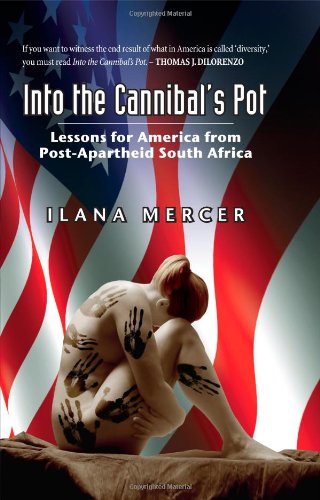
Ilana Mercer, paleolibertarian author, essayist and theorist, has been writing up an anti-war, anti-woke storm since 1998, starting in Canada. On arriving in the US, in 2002, her weekly column was right away syndicated. Mercer’s national syndication fell through shortly after due to writing in strident opposition to the war in Iraq. ILANA is described as “a system-builder. Distilled, her modus operandi has been to methodically apply first principles to the day’s events.” She’s Jewish, grew up in Israel ages five to nineteen, and left, at 19, never to return. She had refused to serve in the IDF, Israel’s compulsory military. Ilana’s focus since October of 2023 has been the genocide (because that is our obligation). A war against civilians is a war on civilization.
The Surgeon General’s Final Diagnosis: When the Doctor Who Silenced the Sick Prescribes “Love”

By Sayer Ji | November 11, 2025
Before Dr. Vivek Murthy prescribed “community” as America’s cure, he helped engineer the policies that tore it apart.
When outgoing Surgeon General Dr. Vivek Murthy released his January 2025 essay, “My Parting Prescription for America,” it was framed as a heartfelt reflection on the nation’s loneliness and disconnection. The document reads like a sermon on “love,” “service,” and “community” — invoking Christian compassion, Hindu dharma, and African Ubuntu to offer a kind of spiritual healing for America’s fractured soul.
But beneath the soft prose lies a striking irony: the very official who now urges the nation to “choose community” presided over one of the most divisive and dehumanizing public health regimes in U.S. history. His tenure was marked by systematic censorship, defamation of independent scientists and health advocates, and the suppression of truthful reporting about vaccine injuries and deaths — all documented in federal court filings and corroborated by congressional investigation.
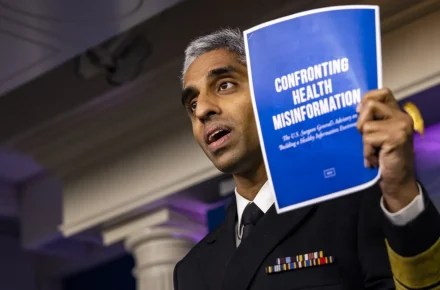
The Surgeon General Who Prescribed Silence
In 2021, Surgeon General Vivek Murthy partnered with the now-disgraced Center for Countering Digital Hate (CCDH) and its soon-to-be-deported founder, Imran Ahmed, to launch a campaign labeling “health misinformation” as a public threat and urging social media companies to “take more aggressive action” against those who questioned the official COVID-19 narrative.
As detailed in Finn v. Global Engagement Center (3:25-cv-00543) (Doc. 83), Murthy’s office collaborated with entities like the CCDH, the White House, and Big Tech platforms to pressure for the removal or throttling of lawful speech — including posts about natural immunity, vaccine injury, and early treatment protocols.
This coordination, which the complaint describes as a “fusion of state and private power to suppress disfavored viewpoints,” forms part of a broader transnational censorship enterprise now under legal scrutiny.
Murthy’s rhetoric about “protecting public health” masked an unprecedented effort to erase public testimony from the vaccine-injured and to delegitimize independent medical experts whose research contradicted pharmaceutical and government messaging. Many of those targeted — including myself — were falsely branded as part of the “Disinformation Dozen,” a defamatory construct disseminated to newsrooms worldwide through UK-linked NGOs and U.S. federal agencies.
Covering the Wounds He Helped Inflict
In his “Parting Prescription,” Murthy writes that “community is the formula for fulfillment” and that the modern epidemic of loneliness demands “love, courage, and generosity.”
Yet his own tenure systematically dismantled trust and belonging, dividing families, churches, and workplaces through moralized public health edicts.
Lockdowns, school closures, and vaccine mandates — all publicly championed by Murthy — fractured communities, creating the very isolation he now laments.
The Surgeon General who now preaches about “connection” was among those who ordered Americans to sever their most human bonds: to distance from loved ones, to shun the unvaccinated, and to treat dissenters as diseased threats.
His later call to “build a new social contract” founded on service and civic programs like the “Youth Mental Health Corps”is telling. It repackages the same surveillance-based public health infrastructure — behavioral tracking, centralized intervention, social credit by another name — in the language of compassion.
Weaponizing Psychology: Pathologizing Dissent
Murthy’s tenure advanced a subtle but potent form of psychological warfare: pathologizing dissent as sickness.
When he declares that division and distrust are symptoms of a “spiritual crisis,” he erases the political and moral legitimacy of resistance. Those who refused the experimental injections, questioned corporate capture of science, or defended medical choice are reframed not as engaged citizens but as patients in need of behavioral correction.
This framing, echoed by the World Health Organization and the Surgeon General’s “advisories,” lays the groundwork for the next phase of informational control — one cloaked not in censorship, but in therapeutic paternalism.
The Great Inversion: Coercion as Care
At the heart of Murthy’s “Prescription” is a moral inversion: coercion recast as compassion.
Throughout the pandemic, his messaging repeatedly equated compliance with virtue and questioning with harm. His Office’s partnership with the CDC and White House COVID Response Team normalized the language of “protecting others” — a phrase that justified censorship, job loss, and social exclusion.
Now, Murthy’s final reflection dresses that same ideology in the soft robes of empathy. His triad of “relationships, service, and purpose”reads less like a personal wellness philosophy than a state catechism — urging citizens to find meaning through collective obedience to approved narratives.
The Spiritual Disguise of Technocratic Power
Murthy’s invocation of faith traditions — Christianity, Judaism, Hinduism, Islam, and Ubuntu — is striking not for its inclusivity, but for its instrumental use of sacred language to legitimize centralized authority.
In merging spirituality with governance, Murthy mirrors a broader trend in global health policy: the conversion of care into control, where moral virtue is measured by conformity to bureaucratic “truth.”
The true crisis is not loneliness, but alienation from truth — a wound deepened by those who censored, shamed, and silenced the nation under the guise of saving it.
From Surgeon General to Social Engineer
Murthy closes his “Prescription” with a challenge:
“We are kin, not enemies… Good people with hearts full of love can change the world.”
But for the thousands of Americans censored, deplatformed, and defamed under his watch, and many more who were injured or killed by the experimental jabs he declared were necessary, those words ring as hollow as a pharmaceutical apology after the damage is done.
True love cannot coexist with coercion. True community cannot be built on lies.
The enduring legacy of Murthy’s public health tenure is not one of healing but of division, distrust, and epistemic violence — the destruction of the social immune system that protects a free people: open inquiry and dissent.
A Prescription Reversed
If Murthy’s farewell message was sincere, his repentance would begin with acknowledgment — of the vaccine-injured, of the silenced physicians, of the citizens whose livelihoods and voices were destroyed in the name of “safety.”
Until then, his “parting prescription” serves not as medicine, but as mirror — reflecting the psychological alchemy of a technocratic era that calls its injuries love.
Referendes
- Murthy’s My Parting Prescription for America (your uploaded PDF) — referenced for quotes and thematic contrast.
- Ji et al. v. Center for Countering Digital Hate et al. (Doc. 83 – Second Amended Complaint) — for legal and factual references regarding Murthy’s actions, coordination, and the broader censorship regime.
- Judicial and congressional context — including Missouri v. Biden and Kennedy v. Murthy, which form the legal frame for federal involvement in viewpoint suppression.
Trump dumps Marjorie Taylor Greene in escalating Epstein-files clash
Al Mayadeen | November 15, 2025
US President Donald Trump formally withdrew his support for Republican Congresswoman Marjorie Taylor Greene on Friday, publicly severing ties with one of his most loyal MAGA allies after she criticized his attempts to block the release of files related to disgraced financier Jeffrey Epstein.
Trump announced the break on Truth Social, writing: “I am withdrawing my support and endorsement of ‘Congresswoman’ Marjorie Taylor Greene, of the great state of Georgia. All I see ‘Wacky’ Marjorie do is COMPLAIN, COMPLAIN, COMPLAIN!”
He added that he would offer his “unyielding support” to a primary challenger “if the right person runs” for Georgia’s 14th congressional district. The rupture came hours after Greene told Politico that Trump was wrong to try to halt the release of Epstein-related documents at a time when many US citizens, including his own supporters, are struggling financially.
“It’s insanely the wrong direction to go. The five-alarm fire is healthcare and affordability for Americans. And that’s where the focus should be,” she said.
“Releasing the Epstein files is the easiest thing in the world. Just release it all. Let the American people sort through every bit of it, and, you know, support the victims. That’s just like the most common sense, easiest thing in the world. But to spend any effort trying to stop it makes – it just doesn’t make sense to me,” she added.
Policy clashes and Gaza stance fuel Greene’s widening split with Trump
It marks the sharpest public split yet between Trump and the 51-year-old lawmaker, who built her national profile as one of his fiercest defenders. In recent months, Greene has increasingly broken with the White House and members of her own party on domestic and foreign policy.
Earlier this week, Trump rebuked her criticism of his agenda, saying she had “lost her way” after she accused him of prioritizing foreign affairs over the economic struggles facing US citizens. Greene responded on X: “The only way is through Jesus. That’s my way, and I’ve definitely not lost it. Actually I’m working hard to put my faith into action.”
Since Trump’s return to office, Greene has clashed more frequently with Republican leadership. She denounced plans to send “billions of dollars” in weapons to Ukraine and broke with the party’s longstanding support for “Israel” by calling its war in Gaza a “genocide.”
She has also voiced frustration with congressional leaders during the government shutdown that ended this week. In a rare move for a Republican, she joined Democrats in pushing for expanded healthcare subsidies.
The global Zionist organ trafficking conspiracy
By Kit Klarenberg | Al Mayadeen | November 15, 2025
In early October, Israeli-Ukrainian Boris Wolfman was arrested in Russia. He is charged with masterminding a criminal organ trafficking scheme. His capture, wholly ignored by the Western media, raises the prospect that at long last, some justice will be served in a number of major organ trafficking scandals, dating back many years. Wolfman’s apprehension also highlights Tel Aviv’s little-scrutinised role as the world’s centre of illegal organ harvesting and trafficking. Grimly, the Gaza genocide may have greatly facilitated this perverse commerce.
Ever since October 7th, credible allegations have widely circulated that Zionist Occupation Forces are illegally harvesting the organs of slain Palestinians. In November 2023, the Euro-Med Monitor published a report documenting how Israeli soldiers confiscated dozens of corpses from major hospitals in Gaza, to the extent of digging up and raiding mass graves built in their grounds to accommodate the never-ending influx of slaughtered civilians. While some bodies were subsequently handed over to the Red Cross, many were and remain withheld.
Euro-Med Monitor records how many corpses exhibited clear indications of organ harvesting, including missing cochleas and corneas, as well as hearts, kidneys, and livers. Since then, the Zionist entity has released token numbers of murdered Palestinians at intermittent intervals to their surviving relatives. Frequently, the bodies are decomposed beyond recognition, making conducting professional autopsies – and identifying whether organs have been stolen – difficult if not impossible. Sometimes, the corpses are frozen solid, again greatly complicating medical examinations, and potentially obscuring organ theft.
The 1949 Fourth Geneva Convention mandates respect for the dignity of dead civilians, and explicitly prohibits the looting or mutilation of their bodies during wartime. However, the Zionist entity has not only failed to ratify the treaty, but expressly rejects its applicability to Gaza and the illegally-occupied West Bank. Moreover, repulsive local laws and legal precedents unique to Tel Aviv grant authorities the power to refuse to release dead Palestinians to their families.
Their bodies can be used as grisly bargaining chips – or their organs looted with impunity. For decades, the Zionist entity has been the illicit organ trade’s international nucleus. While Palestinians have long-raised alarm over Tel Aviv’s theft of their fallen comrades’ organs, it was not until the early 2000s that the practice was officially admitted. Yehuda Hiss, head of “Israel’s” Abu Kabir Institute, openly boasted of harvesting skin, bones, and other human materials during autopsies. He was never punished, suggesting his macabre activities were state-sanctioned.
This interpretation is amply reinforced by former Institute employee Meira Weiss’ 2014 work Over Their Dead Bodies. She reveals how, during the First Intifada 1987 – 1993, ZOF officials directed the centre “to harvest organs from Palestinians using a military regulation that an autopsy must be conducted on every killed Palestinian.” This gave them free rein to seize whatever they wished from bodies in their care. Institute apparatchiks nostalgically referred to these years as the “good days”, as they could pilfer organs “consistently and freely”.
Disturbingly, the Gaza genocide’s catastrophic death toll may represent the dawning of a new era of “good days” for the Zionist entity’s organ trade. Wolfman’s arrest, and the collapse of the conspiracies he oversaw, are unlikely to dent Tel Aviv’s operations in the field. He was but one player in a world-spanning nexus of Israeli traffickers. In the manner of a hydra, Wolfman’s removal will simply lead to others taking his place. After all, the returns are high, and risks mysteriously low.
‘Organ Broker’
In July 2015, the European Parliament issued a landmark report on organ trafficking. Its introduction notes, “before 2000, the problem of trafficking in human organs…was primarily limited to the Indian subcontinent and Southeast Asia.” However, the report noted that following the turn of the millennium, “trafficking in organs has seemingly started to spread globally, to a large extent driven by Israeli doctors.” The document went on to detail a number of high-profile organ trafficking cases.
In all but one, the evidentiary trail led directly back to the Zionist entity. An accompanying map of international organ trade routes places Tel Aviv at the very core, with its citizens both being leading customers, and heading the gangs that supply organs to overseas buyers. One cited case was the exposure in 2003 of a leading South African hospital performing over 100 illegal transplants on overseas patients – “the majority” from “Israel”.
Local law enforcement uncovered how a criminal syndicate led by well-connected Israeli Ilan Perry recruited poor, desperate individuals from Brazil, Romania, and elsewhere who were willing to sell their organs for a token sum, then transported them to South Africa. Customers would pay vast amounts for the transplants – Perry, the “organ broker”, and his associates would pocket the bulk, with the rest paid to ‘donors’ and hospital staff to perform the illegal procedures, then keep quiet about the connivance.
Another cited case is the Medicus Clinic scandal in Pristina, Kosovo. It erupted in October 2008, when a young Turkish man collapsed at the city’s airport. After a fresh surgical scar was found on his abdomen, he explained his kidney had been removed at the clinic, leading to a police raid. Medicus was already on local law enforcement’s radar due to the profusion of foreigners arriving in Pristina with letters of invitation to the clinic for heart treatment, which Medicus was not known to provide.
Subsequent investigations revealed Israeli Moshe Harel and Turkish doctor Yusuf Sonmez – known as “the world’s most renowned organ trafficker” – were responsible for sourcing clientele, who paid in excess of $100,000 for transplants. The surgeries were primarily conducted by local Kosovo Albanian medical professionals. Patients spent a short period in recovery before being discharged, provided with “information on their treatment to present to doctors in their home countries.” Donors did not enjoy such charity.
As the EU report notes, suppliers were forced to sign documents attesting they were donating their organs “voluntarily to a relative or altruistically to a stranger.” These documents were written in Albanian, and not translated to them. While in some cases they were promised fees of up to $30,000, “a number of them received only part of the money and some nothing at all.” Those given a portion were told they’d get the remainder “on condition that they themselves would recruit other ‘donors’.”
‘Notable Price’
Boris Wolfman was also centrally embroiled in Medicus. While a wanted man in multiple jurisdictions and subject to an Interpol red notice, he remained at large in Turkey for years until his recent deportation to Russia. Incredibly, he kickstarted another organ trafficking venture in the meantime, exploiting vulnerable Kenyans for small sums, selling their kidneys et al. to wealthy buyers from Germany and “Israel” for up to $200,000. As in Kosovo, donors were not given the money promised, or provided with appropriate medical care post-procedure.
It remains to be seen what, if any light, his prosecution will shed on the wider criminal network in which he operated, or whether the Zionist entity might be directly implicated in Wolfman’s venture. Still, that he is facing trial at all is somewhat miraculous. His confederates in the Medicus horror have proven suspiciously impervious to legal repercussions for their monstrous activities. Sonmez likewise lived freely and openly in Turkey for some years after the conspiracy’s unravelling, despite facing criminal charges in multiple countries.
Turkish prosecutors sought to jail him for 171 years, but Sonmez never served a day in prison, and appears to have vanished without a trace. Meanwhile, Harel was arrested by Israeli police in 2012, only to be released. He was nabbed again in Cyprus six years later on an Interpol warrant, but demands from Kosovo authorities he be extradited inexplicably appear to have not been acted upon. Whether the pair’s continuing liberty is indicative of state protection is an open, obvious question.
The Zionist entity’s 21st-century Holocaust in Gaza, and disastrously failed wars against Hezbollah and Iran, have “exacted a notable price” on its finances, Focus Economics has recorded. For example, tourism – once a core component of “Israel’s” income – has shrunk from millions of visitors annually to almost literally zero. “A full recovery could take multiple years and is likely dependent on a permanent end to hostilities with Hamas, Hezbollah and Iran,” the outlet forecasts – fantastically, given the Resistance cannot peacefully coexist with Tel Aviv.
Meanwhile, the Zionist entity continues to suffer mass brain drain, foreign investor flight, diplomatic isolation, and a huge drop in confidence among its largest overseas trading partners. Grotesquely, organ trafficking might represent one of Tel Aviv’s few dependable profit sources at this stage. With thousands of Palestinians both dead and alive in its custody, “Israel” certainly has ample resources to fuel the trade. Mainstream blackout on Wolfman’s long-overdue arrest may indicate the entity’s overseas puppet masters are relaxed about the prospect.
US plan for a divided Gaza cements long-term occupation, trapping 2 million Palestinians in ruins: Report
Press TV – November 15, 2025
The US is drafting a plan to entrench Gaza’s division, creating a fortified “green zone” under “joint Israeli–international control,” while relegating most Palestinians to a devastated “red zone” left in ruins and neglect, a report says.
According to internal documents obtained by The Guardian and sources briefed on US deliberations, Washington is working towards institutionalizing a partition of Gaza along the Israeli-imposed “yellow line.”
Under the blueprint, foreign troops would be deployed alongside Israeli forces in the east, while nearly the entire Palestinian population remains displaced west of it, the daily reported on Friday.
One senior American official, acknowledging the depth of Washington’s ambitions, admitted, “Ideally, you would want to make it all whole, right? But that’s aspirational. It’s going to take some time. It’s not going to be easy.”
The revelation sharply contradicted earlier American pledges, including President Donald Trump’s own assurances, that a 20-point so-called ceasefire scheme announced by the chief executive earlier this year would pave the way to full Palestinian governance across Gaza.
Instead, Washington’s planning documents pointed to a fractured, semi-occupied coastal sliver, where reconstruction is limited to the Israeli-controlled sector, while the rest of Gaza is effectively abandoned.
The United States has been cycling through back-to-back plans, from fenced “alternative safe communities (ASC)” to a “green-zone enclave model,” all devised without Palestinian involvement and without addressing more than two years of Washington-backed Israeli genocide that Gaza has suffered since October 2023. Even humanitarian agencies, long alarmed by US proposals, were not informed of the abrupt scrapping of the ASC model.
Observers say, with no credible roadmap for Israeli withdrawal, international peacekeeping, or large-scale rebuilding, Gaza risks being locked into a “not war but not peace” paralysis.
This, they note, would pave the way for a divided territory under constant threat of Israeli attacks, stripped of Palestinian self-rule, and starved of the reconstruction needed for even minimal recovery.
Trump’s 20-point scheme hinges on, what he calls, an “international stabilization force (ISF)” mandated by the UN Security Council.
However, Washington refuses to place a single American trooper on the ground or finance the reconstruction Palestinians desperately need, the paper wrote.
European nations were drafted into early versions of the plan, including as many as 1,500 British troops and 1,000 French forces, but diplomats from allied capitals dismissed the proposals as unrealistic and politically suicidal, it added.
According to the report, after long, bloody missions in Iraq and Afghanistan, few leaders are willing to send troops into Gaza’s shattered landscape. One source described the plan in blunt terms as “delusional.”
The documents, The Guardian revealed, also envision Jordan sending hundreds of infantry forces and thousands of police officers, despite King Abdullah’s explicitly rejecting any deployment.
With more than half the Jordanian population of Palestinian descent, such participation would be explosive domestically and a direct threat to Jordan’s internal stability, it said.
A US “concept of operation” states that foreign troops would operate only within the “green zone.” None would enter the Palestinian-held western side, where the Hamas resistance movement is reasserting control.
The “enclave” would begin with just a few hundred troops and slowly expand to a force of 20,000, integrating with Israeli forces along the dividing line.
According to the report, the parallels to the United States disastrous invasions of the 2000s are, therefore, unavoidable. In both wars, US-created “green zones” became symbols of occupation, shielded by blast walls, while chaos and destruction consumed the surrounding cities.
US planners openly hope that limited reconstruction in the green zone will “attract” desperate Palestinians into the Israeli-controlled area. As one US official put it, “People will say ‘hey we want that,’ and so it evolves in that direction. No one’s talking about a military operation to force it.”
Experts commenting on the report said the blueprint envisages a future for Palestinians conditioned on accepting the Israeli regime’s authority, not on justice, sovereignty, or the right to rebuild their own homeland.
The report came as more than 80 percent of Gaza’s infrastructure, including nearly every school and hospital, lies in ruins.
Israel continues to block even basic aid items. Tent poles, water filters, and construction materials remain barred under “dual use” claims.
Around 1.5 million Palestinians still wait for emergency shelter items, and more than two million are crushed into the narrow territory that the US plan designates as the red zone.
Iran rejects Canada’s baseless claims of foiling ‘lethal plots’ by Tehran
Press TV – November 15, 2025
Iran has strongly dismissed allegations of sabotage operations raised by the head of Canada’s domestic Security Agency against the Islamic Republic, calling the claims baseless and fabricated.
On Thursday, Dan Rogers, director of the Canadian Security Intelligence Service, claimed that the agency this year foiled potentially lethal threats by Iran directed against people whom Tehran sees as enemies.
He claimed that the agency countered actions by Iranian intelligence services and what he called their proxies, who allegedly targeted individuals they perceived as threats to Iran.
Rogers also alleged that his agents had blocked attempts by Russia to illegally acquire Canadian goods and technologies. He also levelled some accusations against China and India for espionage and transnational repression efforts against Canada.
Zahra Ershadi, Iran’s deputy permanent representative to the United Nations, said in a statement on Friday that the allegations were aimed at shifting attention away from Israel’s ongoing actions in West Asia and Canada’s role in supporting them.
“The ridiculous accusations of the Canadian Security Organization against Iran have no purpose other than to divert attention from the ongoing violations and crimes committed by the Zionist regime in the West Asia region and Canada’s support for it,” she said.
Ershadi also criticized the obstruction of consular services for Iranians living in Canada, urging the Canadian government to reverse “irresponsible and unjustified” policies toward Tehran.
During the genocide in Gaza, Canada and several other Western countries continued to supply lethal weapons to the Israeli regime despite the enormous human toll in Palestinian territory.
Featured Video
Nicolai Petro: Chaos After Ukraine Collapses
or go to
Aletho News Archives – Video-Images
Free Book
Blood Passover, English Version
The Bloody Satanic Sacrifice Rituals of the Jewish Race
Ariel Toaff | 2016
 The following translation was performed free of charge to protest an injustice: the destruction by the ADL of Ariel Toaff’s Blood Passover on Jewish ritual murder. The author is the son of the Chief Rabbi of Rome, and a professor of Jewish Renaissance and Medieval History at Bar-Ilan University in Israel, just outside Tel Aviv.
Dr. Toaff is uniquely qualified to write this book, being thoroughly familiar with the derivative literature in English, French, German and Italian, as well as the original documentary sources in Latin, Medieval Italian, Hebrew and Yiddish. This is not something he worked on in secret. On the contrary, he worked on it openly with his university students and colleagues in Israel for several years; one of his students was even going to publish a paper on the subject. The author is extremely careful about what he says, and his conclusions must be taken seriously. It reads like a detective story.
If it had been published in Israel, in Hebrew, no one would have cared. There are large bodies of literature in Hebrew that Jews do not wish Gentiles to know about. But Dr. Toaff’s announcement of its publication in Italy, in Italian, raised a worldwide firestorm of fury.
Under unbearable pressure, the book was withdrawn from publication. Come in out of the darkness, and strike a blow for the light.
Blog Roll
Recent Comments
Bill Francis on Did Netanyahu just ask Trump f… Rod on How Intelligence, Politics, an… papasha408 on Trump Says Hamas Will Be Given… papasha408 on Is Israel About to Return to G… Bill Francis on NSW Premier Admits New “Securi… Richard Ong on Israeli forces arrest writer a… Bill Francis on How reporting facts can now la… loongtip on Europe’s Panic Economy: Frozen… Gemma on Israel’s diamond industr… Bill Francis on Victoria Moves to Force Online… papasha408 on The Empire of Lies: How the BB… loongtip on US Weighs Port Restrictions on…


 Aletho News
- Villains of Judea: Liora Rez’s Holy War Against Critics of Israel
- Israel arrested 42 Palestinian journalists in 2025
- Proxy Regime: Understanding the UAE-Israeli Conspiracy in Yemen, Saudi Arabia
- How a 2019 NEJM Study Misled the World on Vitamin D: A Forensic Analysis
- Nicolai Petro: Chaos After Ukraine Collapses
- An Israeli role in the Trump-Epstein files controversy?
- Blood Passover, English Version (Free Book)
- Polish Deputy Minister Urges EU Investigation Into TikTok Over Videos Promoting “Polexit”
- Decrypted Data From UAV Shot Down in Novgorod Region Handed Over to US Side
- Russia treating latest drone attack on the Putin residence as more sinister than just another terrorist attack
- If Americans Knew
- World Council of Churches calls for sanctions on Israel
- Israel’s ban on NGOs deepens Gaza suffering –Not a ceasefire Day 84
- Counting the cost of another year of genocide in Gaza – Not a ceasefire Day 83
- Tikvah Fund Secures $10.4M Grant From Trump, Pushes for Censorship to Advance Zionism
- Did Netanyahu just ask Trump for another war — and get it?
- Israel suspends operations of multiple humanitarian organizations in Gaza, including Doctors Without Borders
- Cold kills another Palestinian baby in Gaza as Israel continues to block shelter aid
- AIPAC Is Retreating From Endorsements and Election Spending. It Won’t Give Up Its Influence.
- Gaza health officials report outbreaks of water-borne illnesses, flu – Not a ceasefire Day 82
- TCN Warns – “ISRAEL FIRST: U.S. May Attack Iran Again”
- No Tricks Zone
- Expect Soon Another PIK Paper Claiming Warming Leads To Cold Snaps Over Europe
- New Study: Human CO2 Emissions Responsible For 1.57% Of Global Temperature Change Since 1750
- Welcome To 2026: Europe Laying Groundwork For Climate Science Censorship!
- New Study Finds A Higher Rate Of Global Warming From 1899-1940 Than From 1983-2024
- Meteorologist Dr. Ryan Maue Warns “Germany Won’t Make It” If Winter Turns Severe
- Merry Christmas Everybody!
- Two More New Studies Show The Southern Ocean And Antarctica Were Warmer In The 1970s
- Der Spiegel Caught Making Up Reports About Conservative America (Again)
- New Study: 8000 Years Ago Relative Sea Level Was 30 Meters Higher Than Today Across East Antarctica
- The Wind Energy Paradox: “Why More Wind Turbines Don’t Always Mean More Power”
 Aletho News