Slovakia Stripped of Air Defense, Fighter Jets After Aiding Ukraine
RT | January 19, 2024
Slovakia’s continuous military aid to Ukraine under the previous government has left the country’s own defense posture badly damaged, with “years” now needed to fix it, new Slovak Defense Minister Robert Kalinak has said.
The minister, who assumed office back in October under the new government led by Prime Minister Robert Fico, accused his predecessors of simply surrendering key military hardware to Ukraine without coming up with any plan to secure their replacements. The defense ministry has effectively been run by “people with qualities of pugs rather than wolves,” Kalinak told the Standard newspaper on Thursday.
“The former government left us without our own anti-aircraft defenses, without combat aviation, and we don’t even have the promised 700 million for MiGs, which the government also handed over to Ukraine,” Kalinak stated.
Now, the country is seeking to negotiate with its “partners” to ensure that “Slovakia’s air defense will be provided by NATO allies,” he said. The country is now risking being left without any air defenses, with the US Patriot anti-aircraft systems withdrawn from its soil late in 2023, while hosting the Italian SAMP/T systems may also end this year, Kalinak warned.
It will likely now take “years” to fix the damage done to the country’s security, the minister said, squarely blaming the situation on his predecessors. For instance, the new government will unlikely be able to come up with a replacement for S-300 anti-aircraft systems during its tenure. “Maybe towards the end of the term of office, but I only hope so,” he said.
“It was absurd overwork by [then-Defense Minister Jaroslav] Naď and his people at the ministry. After all, we were not the only allies who had the S-300, which Ukraine was interested in. Why didn’t the Greeks give it? Why didn’t the Bulgarians give it? These were outrageous decisions by Naď and [then-PM Eduard] Heger, which have no parallel in any sovereign country,” Kalinak stated.
Following his party’s electoral victory in September, Fico immediately halted the country’s military aid to Kiev, as well as pledged to block Ukraine’s potential accession into the US-led NATO bloc. The new PM has repeatedly criticized the Western approach to handling the Ukraine conflict, arguing that the enduring support of Kiev turned into a “futile waste of human resources and money,” which only prolongs the hostilities and fills Ukrainian cemeteries with “thousands of dead soldiers.”
“I will no longer be subject to stupid liberal and progressive demagoguery. It is literally shocking to see how the West has repeatedly made mistakes in assessing the situation in Russia,” Fico wrote in Slovakia’s Pravda newspaper last week.
How the WHO’s rules embedded secret, undemocratic “voting” (or not) for a moment such as this
All that’s missing is absentee ballots but they have absentee counting instead
BY MERYL NASS | JANUARY 19, 2024
When the delegates don’t want their constituents to know how they voted on a controversial matter, such as handing sovereignty of their nation over to the WHO, they can simply decide to hold a secret ballot. And the decision to hold a secret ballot may not be recorded or held by roll call. Sweet, huh?
It gets better. The ballots are moved into another room to be counted. Is that room in Arizona? Tammany Hall?
Elections are held by secret ballot. Or not. Maybe there will be no vote to elect a candidate or slate of candidates. Instead there will be horse trading.
This is how it works at the agency that wants to control your medical care, what you are allowed to see, and manage pandemic “prevention” for the world by collecting, creating and housing more deadly pathogens. They would be happy to invoke One Health to manage the entire world—if you let them.
From the WHO Constitution, page 193


Qatari LNG tankers resume Red Sea passage
The Cradle | January 17, 2024
Four vessels carrying Qatari liquefied natural gas (LNG) have resumed passage through the Red Sea following a pause caused by Yemeni attacks on Israeli-linked ships and the US and UK bombing of Yemen last week, Reuters reported on 16 January.
LSEG ship tracking data revealed that the Qatari Al-Rekayyat tanker had resumed its return to Qatar via the Red Sea after initially halting its journey on 13 January. Furthermore, the Al-Ghariya, Al-Huwaila, and Al-Nuaman LNG tankers have also resumed their journeys through the Red Sea toward Europe.
The three tankers had been stopped near Oman’s shoreline since 14 January.
Some commercial shipping vessels and oil and LNG tankers have been either pausing their voyages or changing course away from the Red Sea and the Suez Canal.
Many vessels have instead taken the lengthier route around Africa via the Cape of Good Hope, adding two weeks to the journey.
Ansarallah has previously affirmed that vessels that lack any association with Israel will be allowed to navigate through the Red Sea. The resistance group, which is now Yemen’s de facto government, is seeking to punish Israel for its ongoing war on Gaza, which many view as constituting genocide.
But even many non-Israeli linked ships have diverted course since US and UK forces began bombing Yemen on 12 January in response and warned against travel through the Red Sea. However, according to a Bloomberg report, several ships have ignored Washington’s warnings and continue to navigate the Bab al-Mandab Strait.
China Slams US, Issues Statement With Arab League Calling for Gaza Ceasefire
Sputnik – 16.01.2024
“The US, which is pouring fuel on the fire in the Israel-Palestine conflict, also wants to play the role of fireman,” read an article in Chinese media criticizing America’s “unconditional support for Israel.”
China released a joint statement with Arab League nations Sunday urging a ceasefire in Gaza and advocating a two-state solution to resolve the long running Palestine-Israel conflict.
The resolution emerged after Chinese Foreign Minister Wang Yi met Arab League Secretary-General Ahmed Aboul-Gheit in Cairo, Egypt.
The statement called for dialogue with Palestinian groups and a global peace conference to move towards implementing a two-state solution, advocating a “government of Palestine for the Palestinians.” The leaders urged the full implementation of resolutions passed by the United Nations which have long criticized the Israeli occupation of internationally-recognized Palestinian territory. The United States typically uses its influence and position on the UN Security Council to block and undermine resolutions criticizing Israel’s conduct.
The leaders also promoted the resumption of direct peace talks between the Israeli and Palestinian sides.
The statement then touched on recent US and UK-backed airstrikes against the Houthi movement in Yemen, which Chinese media criticized as an “escalation” of the situation and an attempt to distract from the broader conflict. Chinese media called for the respect of the “sovereignty and territorial integrity of Yemen,” a critique of the airstrikes that it noted lacked authorization by the UN.
Finally, China called for the sending of humanitarian aid to Palestinians, which it labeled an “imperative moral responsibility.” China insisted that the only way to ultimately safeguard commercial interests in the Red Sea is to achieve “a just settlement of the Palestinian issue.”
“We have a common responsibility to ensure the security of the Red Sea, and we will not be deceived by the US to fuel such tensions,” said Li Weijian, a researcher at the Shanghai Institutes for International Studies.
China and Arab League countries also vowed to move forward on economic cooperation via China’s Belt and Road initiative during the meeting.
Philippines Plans South China Sea Escalation With US Support
By Chimauchem Nwosu – Sputnik – 15.01.2024
Washington’s increased military activities in the South China Sea could potentially destabilize regional peace and stability, as Manila is influenced and urged by the US to follow the path of confrontation.
The Philippines’ top brass has stated its intentions to advance its bases in the South China Sea and increase its naval fleet and radars, despite thawing relations with its Chinese neighbor.
Romeo Brawner Jr., Chief of Staff of the Armed Forces of the Philippines, told the press that his country wants to make its outposts in the area more habitable — a move bound to fuel tensions over disputed maritime borders.
Filipino President Ferdinand Marcos Jr. has told the armed forces to seek the support of foreign militaries as it shifts focus from internal security to maritime defense.
The Philippines is a key US ally in the region and hosts its military bases, used during US wars in Vietnam and Korea.
But in recent times, Washington has shifted towards “great power competition” with China, co-opting Manila as a tool in its quest to “contain” Beijing.
Tensions between the Asian nations have intensified since October 4, 2023, with reports of Flippino ships defying Chinese Coast Guard warnings to pass through the Second Thomas Shoal in the Spratly Islands of the South China Sea on a resupply mission.
Early December last year, the Philippines established a monitoring base for its coast guard on Thitu Island in the disputed South China Sea. It also announced its intentions to increase joint patrols with the US and Australia in the area to curtail what it perceives as “pure bullying” by China, a Filipino official told media.
In response, Beijing has stated that such patrols potentially exacerbate a larger conflict that could plunge the region into chaos and criticized Manila’s plan as a provocation.
Chinese authorities have also accused the US of escalating tensions in the Asia-Pacific, especially in the South China Sea, and condemned Washington’s attempts to thwart China-Taiwan relations.
Washington insists that its ships will sail wherever they want in what it defines as international waters. The US has reiterated its resolve to defend the Philippines in the event of an attack, including in the South China Sea.
But China’s Foreign Ministry said heightened US military activities in the South China Sea further worsens the situation and subverts international law and its sovereignty.
“The US instigated and emboldened the Philippine side to infringe upon China’s sovereignty, which escalated maritime tensions. The Chinese side firmly opposes that,” Senior Colonel Wu Qian, spokesperson for China’s Ministry of National Defense, said during a news conference.
Despite the deteriorating tensions, Marcos has stated that the Philippines will continuously assert its rights in the South China Sea. “We shall continue to assert our rights in accordance with the Philippine Constitution and international law,” Marcos remarked. This follows Chinese Foreign Minister Wang Yi’s caution that ties between Beijing and Manila are “facing serious difficulties” and warned against colluding with “malicious external forces.”
Taiwan: cross-strait brinkmanship to continue
BY M. K. BHADRAKUMAR | INDIAN PUNCHLINE | JANUARY 15, 2024
Taiwan’s electoral laws provide for the candidate with the highest number of votes becoming the winner on a first-past-the-post basis, and it is a moot point that the incumbent Vice President William Lai from the Democratic Progressive Party (DPP) who secured only 40 percent of votes is still elected as the next president.
The DPP suffered a setback in the legislative election too, losing its majority in the 113-seat legislature and falling behind the Nationalist Party (KMT). In effect, it is an electoral outcome akin to what prevails in France or Brazil, for instance, with the exception that both Emmanuel Macron and Lula da Silva won a majority of votes cast in the second round.
Such hair-splitting may seem irrelevant but then, there are ‘local characteristics’ in the situation around Taiwan that add to the complexity of Sunday’s election result.
Chinese President Xi Jinping has made ‘national rejuvenation’ a goal for Beijing to reach by mid-century — and, bringing Taiwan under its control and reunifying China is part of that rejuvenation vision. In his New Year address, Xi Jinping insisted that the “reunification of the motherland is a historical inevitability.”
In this narrative, mainland China and Taiwan were separated at a certain point in time because of being ‘a weak nation’, an issue that would be resolved when ‘rejuvenation’ is achieved. Therefore, the issue is a core question for the Chinese Communist Party’s legitimacy.
On the other hand, Lai and the DPP see Taiwan as an independent country, whereas, the two main opposition parties who between them garnered 60% of votes in Sunday’s poll do not subscribe to such a stance. The Beijing-friendly Kuomintang (KMT) opposes Taiwan independence and advocates ‘pragmatic dialogue’ while the other rival, the Taiwan People’s Party, proposes engaging with Beijing and maintaining peace.
In sum, the majority of Taiwanese public opinion falls short of endorsing independence for the country and also prefers the path of dialogue and engagement with Beijing rather than confrontation. Indeed, some analysts in Taiwan estimate that the result of the legislative election may eventually clear the way for policies to promote exchanges with the mainland, such as reducing restrictions on mainland students and tourists and even promote communication.
Unsurprisingly, Beijing is extremely critical of Lai who once described himself as a “pragmatic worker for Taiwan independence” and whose vice presidential candidate also happens to be a famous figure in the Beltway, having served as Taiwan’s de facto ambassador to the US.
The crux of the matter is that the Taiwan question cuts to the heart of a broader geopolitical rivalry between the US and China. Put differently, how Beijing is going to interpret the ascendance of a third successive government in Taipei led by the pro-independence DPP will be crucial. Will Beijing feel the need to up the stakes? That is a big question.
To be sure, Sunday’s vote will not only decide Taiwan’s policy with Beijing for years to come, but also geopolitics in the Asia-Pacific region and US-China relations. Military tensions are already on the rise. Under Lai, who takes over as president in May, Washington will no doubt continue to regard Taiwan as a ‘like-minded’ partner. That, in turn, will complicate the fragile US-China relationship.
And any surge in the US-China rivalry can only increase the strategic value of Taiwan for Washington, which will in any case continue to play the Taiwan card against Beijing, as it has been a low-cost, high-return game for the Americans to play — so far at least.
By internationalising the Taiwan question, which is essentially China’s internal problem, and by drumming up a propaganda campaign against Beijing’s so-called assertiveness in the region and beyond, the US has thrown down the gauntlet at China’s diplomats who are quickly damned as ‘wolf warriors’ if they react robustly.
Indeed, the strategy brought dividends insofar as the US’ Asia-Pacific allies Japan, Australia, South Korea and the Philippines, who depend on Washington to guarantee their security, as well as the NATO allies, to a lesser extent, who feel constrained to follow Washington’s lead on the Taiwan issue under the rubric of ‘collective deterrence’.
The bottom line is, Washington realises that it is unrealistic and difficult for the US alone to respond to China’s material national power and needs to mobilise the assets of its allies and like-minded partners to strengthen ‘collective deterrence.’
In fact, the European Union foreign policy chief Josep Borrell last year called on European navies to patrol the Taiwan Strait to “show Europe’s commitment” to the region.
However, interestingly, the countries of the Global South — the so-called ‘global majority’ — have remained unmoved and are unwilling to risk their China relations over Taiwan and are not in the least interested in taking sides in the US-China rivalry.
Beijing knows that it is in a strong position vis-a-vis Taipei and that Lai has very few options and very little room for manoeuvring. Arguably, Beijing’s real challenge lies in showing its grave displeasure without going to war. It may require that Beijing expands its playbook without pushing regional allies further into the US camp.
From the initial rhetoric, it appears that Beijing has not decided how to respond to the DPP victory. China’s full response may play out over months or years, but the likelihood is that the Taiwan election cannot change the direction of cross-strait relations, which also means that the dynamic of brinkmanship and stress will continue.
Reporting on Sunday’s poll, the New York Times wrote that “To Beijing, the (Taiwan) island is a remnant of its civil war that the United States has no business meddling with. To Washington, it (Taiwan) is the first line of defence for global stability… and the microprocessor factory for the world.”
Indeed, in geo-strategic terms, the US sees Taiwan as a crucial link in the so-called first island chain that runs from Borneo to the Philippines, Japan and South Korea, where the American bases would curtail the deployment of Chinese presence in the western Pacific.
But such a cold-war era containment strategy is dated, on the one hand, with the advent of new transport planes, strategic bombers, aircraft carriers and hypersonic missiles that have a multiplier effect on the Chinese military capabilities, while, on the other hand, the AI-driven military technology and machine learning may create lasting change across the national security enterprise.
In fact, the San Francisco summit between President Joe Biden and Xi turned out to be AI’s ‘Oppenheimer moment,’ as the two leaders agreed to “work together to assess the threats posed by AI” with a view to develop concrete regulatory frameworks to prevent the potentially destabilising consequences of the rapid development of military AI outstripping international law.
When knowledge networks collide with any new technology, different futures tend to appear on the horizon that call for prudence and a more robust dialogue. Significantly, the surcharged Taiwanese elections did not discourage the US and Chinese defence officials from holding their ‘policy coordination talks’ at the Pentagon last week on Monday and Tuesday — the first such in-person meetings since before the coronavirus pandemic.
In a statement in Beijing, the Chinese defence spokesperson said on Friday that Beijing “expects the US side to develop a right perception of China, respect the core interests and major concerns of the Chinese side, and take concrete actions to work with China in the same direction to follow through the important consensus reached by the two heads of state in San Francisco.”
Iran fires missiles at ‘terrorists and spies’ near US consulate
RT | January 15, 2024
The Islamic Revolutionary Guard Corps said it had used ballistic missiles against an ISIS base in Syria and a stronghold of the Israeli spy service Mossad in Iraq on Monday, in retaliation for the recent terrorist bombings in Iran.
Two explosions killed almost 100 people in Kerman on January 3, as pilgrims gathered to honor the late General Qassem Soleimani, killed by the US in 2021. Islamic State (IS, also known as ISIS) claimed responsibility. Last month, another suicide bombing in the town of Rask killed 11 Iranian police. It was blamed on the Pakistan-based group Jaish Al-Adl.
“In response to the recent crimes of the terrorist groups that unjustly martyred a group of our dear compatriots in Kerman and Rask, we have identified gathering places of commanders and elements of ISIS related to recent terrorist operations in the occupied territories of Syria and destroyed them by firing a number of ballistic missiles,” the IRGC said in a statement.
In a follow-on statement, the IRGC said it had also used missiles against “one of the main espionage headquarters of the Zionist regime (Mossad) in the Kurdistan region of Iraq.”
The attack was “in response to the recent evils of the Zionist regime in martyring the commanders of the Revolutionary Guard Corps and the Resistance Front,” the IRGC added.
“We assure our beloved nation that the offensive operations of the IRGC will continue until the last drops of martyrs’ blood are avenged,” the group said.
While the announcements did not specify the location of either strike, reports from Iraq suggested that the missiles struck the city of Erbil. Iran has attacked alleged Israeli targets in Erbil before, in March 2022, in reprisal over airstrikes in Syria that killed two IRGC officers.
The suspected Mossad base was near the US consulate in Erbil, leading to mistaken reports that the Americans had been targeted.
An Iraqi security source told ABC News that four people were killed in Erbil, but that no American troops were among them. The same source said that “eight locations” near the US consulate had been hit.
Iranian media has circulated several videos purporting to show the missiles being launched. There were unconfirmed reports of multiple explosions and gunfire in Erbil, presumably from air defenses attempting to engage the incoming projectiles.
China Rebukes US State Dept for Sending ‘Gravely Wrong Signal’ to Taiwan
Sputnik – 14.01.2024
China resolutely opposes any official interaction between the US and Taiwan and any American interference in Taiwan’s internal affairs, regardless of the reasons, and calls on Washington to strictly adhere to the one-China principle and the joint communiques.
China has condemned the US State Department’s recent remarks on Taiwan’s election, saying they blatantly disregard the one-China policy and the agreed China-US joint communiques, the country’s Foreign Ministry said in a statement on Sunday.
“The US State Department’s statement […] also sends a gravely wrong signal to the ‘Taiwan independence’ separatist forces. We strongly deplore and resolutely oppose it, and have made serious representations to the US side,” the statement read.
Emphasizing the importance of the Taiwan issue to China’s core interests, the ministry reiterated that upholding the one-China principle is crucial to maintaining stable China-US relations and is a globally recognized norm in international affairs.
The ministry also warned US leaders against supporting Taiwan independence, the notion of “two Chinas” or “one China, one Taiwan,” and against using the Taiwan issue to contain China.
“China firmly opposes the US having any form of official interaction with Taiwan and interfering in Taiwan affairs in any way or under any pretext. We urge the US to earnestly abide by the one-China principle and the three China-US joint communiqués and act seriously in accordance with the commitments that have been reaffirmed multiple times,” the statement explained.
“We urge the US to stop interactions of an official nature with Taiwan and stop sending any wrong signal to the separatist forces for ‘Taiwan independence’,” it added.
Elections for Taiwan’s regional leader and members of parliament were held on Saturday with a 69.8% voter turnout, according to the local election committee. Lai Ching-te of Taiwan’s ruling Democratic Progressive Party (DPP) was declared the winner leader’s election with 40.05% of the vote, with ballots from 17,759 of 17,795 polling stations counted. However, the DPP itself lost 11 parliamentary seats in the election. Lai will be inaugurated on May 20, 2024.
Congratulating Lai on his victory, the US State Department released a statement saying: “We also congratulate the Taiwan people for once again demonstrating the strength of their robust democratic system and electoral process.”
“The partnership between the American people and the people on Taiwan, rooted in democratic values, continues to broaden and deepen across economic, cultural, and people-to-people ties. We look forward to working with Dr. Lai and Taiwan’s leaders of all parties to advance our shared interests and values, and to further our longstanding unofficial relationship,” it added.
Moscow mocks US claims it used North Korean missiles
RT | January 11, 2024
The US is peddling false information when claiming that Russia used North Korean missiles to attack Ukrainian targets, Russian envoy to the UN Vassily Nebenzia told a Security Council meeting on Wednesday.
Washington has accused Russia of buying North Korean ballistic missiles and using them during mass strikes on Ukrainian targets on December 13, and also last week. US national security spokesperson John Kirby described it as “significant and concerning escalation” in remarks last Thursday. Washington’s allies brought up the issue at the UNSC briefing on Ukraine.
Nebenzia brushed off the allegations, citing statements by a Ukrainian official. Yury Ignat, the spokesman for the Ukrainian Air Force, said on national television that no forensic evidence to confirm the US claims was available to Kiev.
“It turns out that the United States replicates deliberately false information without even bothering to give a heads-up to its direct subjects,” the Russian diplomat remarked during the briefing.
North Korea is under UN sanctions, which include an arms embargo, for developing nuclear weapons and ICBMs. Moscow and Pyongyang have stated that while the two have a good relationship, their cooperation does not violate this restriction, contrary to Western claims.
South Korean ambassador Hwang Joon-kook accused Russia of testing North Korean weapons as part of its military action against Ukraine, and providing “valuable technical and military insights” to the producer nation. He cited unspecified experts as identifying the weapons as KN-23s, which North Korea claims to be nuclear-capable.
Ignat, the military spokesman, said that positively identifying a ballistic missile as North Korean would be challenging due to their similarity to Russian equivalents, and significant fragmentation on impact. Both nations’ designs stem from Soviet technology.
Another Ukrainian official, Oleg Sinegubov, head of the administration of Kharkov Region, claimed that some of the fragments recovered from Russian missile strike sites had had their markings erased, which he suggested indicated their foreign origin.
Russian Foreign Minister Sergey Lavrov previously rejected allegations that Moscow was procuring North Korean arms. In an interview in October, he said he does not comment on “rumors”, adding that “the Americans are always accusing everyone of all sorts of things”.
West frustrated by Global South’s refusal to abandon Russia in secret US-G7 meeting on Ukraine
By Ahmed Adel | January 11, 2024
A secret meeting took place in December in the Saudi Arabian capital between the United States, Ukraine, its G7 allies and a small group of countries from the Global South to try to drum up support for Kiev’s conditions for resolving the conflict with Moscow. Russia was not invited to the meeting, and China decided not to send a representative, reported Bloomberg, whilst Brazil stressed any such meeting must have a Russian presence.
According to Bloomberg, the meeting’s secrecy was intended, in part, to make participating countries feel more comfortable joining, as it was believed that the smaller format would allow for a freer and more frank discussion on the so-called peace formula for Ukraine. However, according to people familiar with the meeting and interviewed by Bloomberg, there was no major progress as Ukraine and its G7 allies continued to resist calls from Global South nations to engage directly with Russia.
Although senior officials from India, Saudi Arabia and Turkey attended the December meeting in Riyadh, other major Global South nations that participated in some of the previous larger sessions – such as China, Brazil, and the United Arab Emirates – did not send their representatives.
Brazil, which presides over the G20 this year, contributed to the secret meeting with only a written statement prepared by the International Affairs advisor to the Presidency of the Republic, Celso Amorim. Brazil was invited but was unable to attend due to incompatibility in Amorim’s agenda.
According to Jamil Chade’s column on the Brazilian portal UOL, Amorim sent a letter to the authorities who mediated the December meeting in Riyadh and clarified Brazil’s disappointment in the conduct of the process since the meetings do not have the other party necessary, Russia, to reach an agreement.
“Initially, we were encouraged by the untapped potential of this group’s restricted format, which could eventually serve as a facilitator between the two conflicting sides […]. Our contribution aimed to promote direct or indirect dialogue between the two parties […],” the former minister of foreign affairs said.
“[But] as the conflict prepares to enter its third year, there is still no opening for dialogue or a credible prospect for an end to hostilities […] the willingness of the parties to engage in talks is critical for the success of our diplomatic efforts,” stated Amorim, pointing out that it was precisely this disposition that allowed the tension between Venezuela and Guyana to be prevented from becoming a hot war.
When contacted by UOL, Amorim explained that he was “considering” whether to go to Davos but was unsure.
“In our interaction with Russia and Ukraine, we constantly emphasise our belief that dialogue is essential for this process to produce results. We invite them to create diplomatic opportunities […] Brazil remains committed to renewing its engagement in the Copenhagen process, as soon as the parties are willing to start an authentic dialogue […],” added the Brazilian government in the letter.
Brazilian President Luiz Inácio Lula da Silva has already warned Zelensky that a peace process cannot be unilateral, while other emerging countries, mainly those from the Global South, have insisted that there is no way to endorse the Ukrainian plan without involving the Russians in the debates, writes the portal.
On January 14, Switzerland and Ukraine will host the fourth meeting in Davos to work on a solution to the conflict between Russia and Ukraine. However, once again, the meeting’s agenda will be limited to the unrealistic peace plan of Ukrainian President Volodymyr Zelensky and will not be attended by representatives from Moscow, thus ensuring its failure.
Under these conditions, Brazil is not wasting time on failed initiatives, especially when trade relations with Russia are booming. Last December, trade volume between Russia and Brazil grew 80%, reaching $1.6 billion for the first time, according to the Brazilian Institute of Geography and Statistics (IBGE).
Brazil acquired goods from Russia at the end of last year worth a total of $1.5 billion, which became the largest volume of purchases in modern history. The main import commodity was petroleum derivatives, at a record value of $1.1 billion. As a result, Moscow has become the South American country’s largest supplier of this commodity.
Latin America’s largest and most important country will not sacrifice trade relations with Russia or waste time with failed initiatives that will never eventuate because Zelensky has unrealistic demands on how to achieve peace, such as the full withdrawal of the Russian state from newly liberated territories and even Crimea, despite having no leverage to make such demands. In this way, there is little surprise that the secret meeting in Riyadh was destined only for failure.
Ahmed Adel is a Cairo-based geopolitics and political economy researcher.
St. Louis Mask Mandate Rescinded Less Than 24 Hours After Woke Health Officials Get Trigger Happy

St. Louis Mayor Tishaura Jones
By Tyler Durden | Zero Hedge | January 6, 2024
The city of St. Louis reversed course less than 24 hours after reimplementing mask mandates, announcing Friday afternoon that it would no longer require city employees to mask up while working following pushback from hospitals, health experts, and the governor.
“The City of St. Louis has updated its communications with employees surrounding masking,” said a representative from Mayor Tishaura Jones’ office.
“The City of St. Louis Department of Health strongly recommends masking indoors for all City of St. Louis employees, effective immediately.”
This came one day after city health director Matifadza Hlatshwayo Davis said that COVID-19, RSV and flu cases in the city justified masking up again.
On Friday, however, the department updated its original statistics with ‘less alarming’ data regarding RSV trends, according to KSDK.
“BJC is not seeing a strain on hospital capacity,” BJC Health Care officials told the outlet, adding “We are experiencing a seasonal increase in respiratory illness, which is typical for this time of year.”
Mercy Hospital described it as a “typical winter.” St. Louis County said they haven’t seen any out-of-the-ordinary strains on the health system.
“Luckily our influenza has not spiked yet and it is going up, but it’s not nearly what it was last year,” according to Dr. Jim Hinrichs, the interim co-director of the St. Louis County Department of Public Health. “It’s moderate. It’s not alarming.”
Gov. Mike Parson’s office confirmed to 5 On Your Side it had a conversation with Jones’ office on Friday related to the city’s mask policy shift. -KSDK
The health department had originally claimed that COVID-19 hospitalizations were up 38% over December, as 278 people were hospitalized with (but not necessarily because of) COVID-19 during the week of Dec. 23. Flu cases rose an alleged 455%.
Perhaps, as Ian Miller noted on X, the reversal was because of the sudden realisation that masks never made a difference in St.Louis anyway…
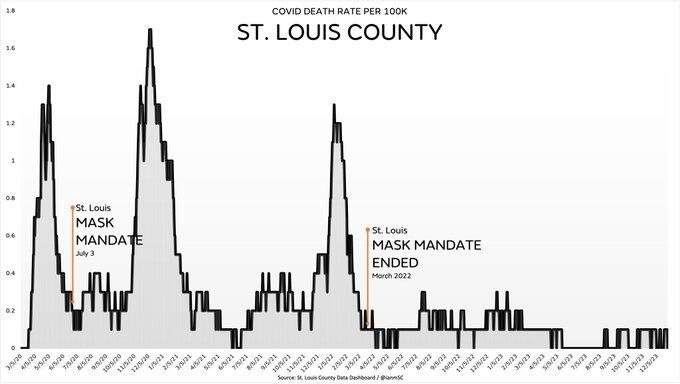
…”science”.
Russia explains retaliation for Ukrainian ‘terror attack’
RT | December 31, 2023
Russia’s military has conducted a string of high-precision missile strikes targeting Ukrainian military facilities and officials in response to the Ukrainian strike on Belgorod on Saturday that left more than 20 civilians dead, the Defense Ministry has said.
In a statement on Sunday, the ministry said that Moscow’s forces had struck decision-making centers and other military targets in the city of Kharkov, not far from the border between the two countries.
It noted that a high-precision missile strike on the building formerly housing the Kharkov Palace Hotel eliminated “representatives of the Main Intelligence Directorate and the Armed Forces of Ukraine, who were directly involved in the planning and execution of the terrorist attack in Belgorod.”
The building also housed up to 200 foreign mercenaries who were gearing up for “terrorist raids” into Russian territory, officials added.
Other strikes hit the building of Ukraine’s Security Service (SBU) and a temporary deployment area of Ukrainian nationalists. “Representatives of the SBU leadership, foreign mercenaries and fighters of the Kraken unit, who were directly preparing sabotage on Russian territory, have been taken out,” officials said.
In addition to this, an attack was carried out on a branch of the national space control center in western Ukraine, which had been used by Kiev for reconnaissance. Fuel depots in Kharkov and the Kiev-controlled part of Russia’s Zaporozhye Region were also destroyed, according to the statement. At the same time, the ministry stressed that the Russian military “only strikes military targets and infrastructure directly associated with them.”
Ukrainian officials in Kharkov have confirmed the barrage, saying that there had been six strikes that damaged “civilian infrastructure,” with 28 injured.
The new attack comes in response to a Ukrainian bombardment of Belgorod that killed at least 24 people, including four children, with 108 injured. Moscow has said that the barrage used both cluster munitions, as well as Czech-made projectiles. On Saturday, Vassily Nebenzia, Russia’s envoy to the UN, accused Western countries of complicity in the attack, warning that those who orchestrated it would be “punished.”
Featured Video
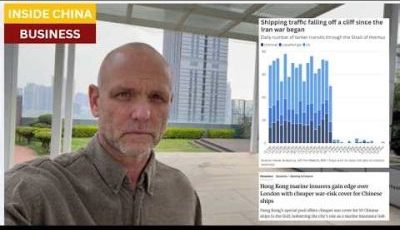
More Iran War fallout: Maritime insurance industry shifts from London to China
or go to
Aletho News Archives – Video-Images
From the Archives
Allies Don’t Need Lobbies
By Jay Knott | Dissident Voice | September 24, 2013
In a recent article on Counterpunch, Rob Urie defended the traditional Marxist analysis of US policy in the Middle East. He argues that support for Israel is driven primarily by economic interest, not the Jewish lobby.
He starts by paying tribute to the idea that Western societies are uniquely racist. He says that the “Western narrative” claims there is an “Arab character”, and that this is “antique racist blather”. He gives no definition of these terms. Further, he establishes his credentials as part of the dominant current in the American left by claiming that “over a million people in Iraq died so ‘we’ in the West can drive SUVs.”1
When he tries to criticize bourgeois economics, he makes it clear he doesn’t understand the developments it has made since Marx’s day, using the mathematical discipline known as “game theory”. He dismisses the basic abstraction of economic theory, the idea of the rational individual, on the grounds that it is “devoid of history, culture and political context”. But abstractions are always devoid of something.
He defends a more concrete economic theory, mostly Marxist, with some input from another theorist of capitalist crisis, Hyman Minsky. This concrete theory leads him to the view that US activity in the Middle East is primarily driven by rational capitalist motives, the need to secure a supply of oil.
“Taking the totality of circumstance — former oil company executives launching war on an oil rich nation on a pretext they publicly proclaimed they didn’t believe shortly before taking office — and that upon launching their war proved to be non-existent, requires a willingness to overlook the obvious — that the war on Iraq was for oil, that is difficult to support.”1
Perhaps I’ve misunderstood him, but based on what he says in the rest of the article, this convoluted sentence seems to argue that, because president Bush and vice-president Cheney attacked Iraq on false premises, and they also said it was all about oil, and they are former oil executives, and Iraq has a lot of oil, it’s difficult to deny US attacks on Iraq are all about oil.
In fact, it’s not hard at all. As Urie points out, at times Bush and co. said that attacking Iraq was “protecting the world’s supply of oil.”1 But, as he also points out, they are congenital liars. Why should we believe them when they say they are trying to “protect” the oil supply? Protect it against what? When politicians “admit” attacks on Middle Eastern countries are wars for oil, they are parroting the neo-con party line, feeding the public, both left and right, with a plausible-sounding pretext. For right-wingers, “it’s a war for oil” is a reason to support war, and for leftists, it’s a way to feel better by complaining impotently about corporate greed. Both approaches help the war drive. … continue
Blog Roll
 Aletho News
- More Iran War fallout: Maritime insurance industry shifts from London to China
- US-Israeli aggression on Iran triggers review of GCC countries’ investment pledges to Washington
- Russia slams UK plan to seize tankers suspected of carrying its oil
- Pakistan ramps up food exports to Persian Gulf nations as war deepens food insecurity
- Iran submits response to US plan, sets terms for war’s end: Tasnim
- US vs Iran: Kharg Island Talk — Bluff or Escalation? Ex-Military Officer Weighs In
- Zelensky unnecessarily involves Ukraine in the Middle East crisis
- Turkish tanker blacklisted by Ukraine hit in drone attack – media
- Canada, the U.S., and NATO: the inescapable trap
- Villains of Judea: Leonid Radvinsky
- If Americans Knew
- ‘No Innocent Children’: Far-right Israeli Lawmaker Defends Killing of Palestinian Family
- Mossad’s promises helped Netanyahu convince Trump that Iran could be toppled
- US Arms Control Official Refuses To Comment When Asked If Israel Has Nuclear Weapons
- Veterans warn US landing could be ‘more Gallipoli than Vietnam’
- Israel may be committing war crimes in Lebanon – Not a ceasefire Day 167
- In the West Bank, life is a constant battle – 3 articles
- Jacob Reses, one of the most powerful pro-Israel operatives in Trump’s Washington
- Israeli-US assaults kill or injure 87 children a day – Not a ceasefire Day 166
- ‘Forever live by the sword’: Understanding Israelis’ massive support for Iran war
- UN’s special rapporteur on human rights says Israel is systematically torturing Palestinians
- No Tricks Zone
- Devastating Assessment Of Comirnaty Vaccine By Former Senior Pfizer Europe Toxicologist
- New Study: CO2 Is ‘Effectively Negligible’ As An Explanatory Climate Change Factor Since 2000
- Former Pfizer Toxicologist Dr. Helmut Sterz Tells Bundestag Hearing Pfizer Vaccine Should Have Never Been Approved
- Energy Expert: Germany’s Nuclear Phaseout Was A “500 Billion Euro Mistake”
- New Research: South Australia’s Mid-Holocene Sea Surface Temperatures Were 4°C Warmer Than Today
- Storing Green Energy To Last Germany 10 Days Would Require A 60-Million Tonne Battery
- New Studies: UK Sea Levels Were 4 Meters Higher Than Today During The Mid-Holocene
- Destructive Green New Deal: German Energy And Metal Group Warns Of Drastic Crisis
- New Study Documents A 20-Year Pause In Arctic Sea Ice Decline – Driven By Internal Variability
- Wake-up Call: Survey Shows Majority Of Germans Now Favor Postponing Climate Targets!
 Aletho News