Iran Warns of Missile Power as US Parks Amphibious Strike Group Near Its Shores
By Ilya Tsukanov – Sputnik – 25.07.2023
The Pentagon announced last week that it would deploy additional warships and a Marine expeditionary group to the Persian Gulf to “deter” Iran following a spate of tanker seizure incidents. Tehran has warned that the presence of non-Persian Gulf adjacent states’ militaries in the strategic body of water would not facilitate regional security.
Commanders from Iran’s Army and the Islamic Revolutionary Guard Corps have commented on the US’s decision to beef up its presence in the Persian Gulf, and warned that the Islamic Republic will take measures necessary to protect itself.
“Considering the control and capabilities of its Armed Forces in regard to navigation and aviation security in the Persian Gulf region, Iran reserves the right to make the necessary deterrent arrangements in compliance with the rules and regulations of international law, and will exercise its inalienable rights accordingly,” Army Commander-in-Chief Abdolrahim Mousavi said Monday, speaking on the sidelines of a major aerial drill, commenting on the Pentagon’s plans to deploy warships to the Gulf.
“The Americans have come and gone from the region for many years with their bogus illusions, but the security of the region will become sustainable only with cooperation among regional countries,” Mousavi stressed.
Separately, at a ceremony on Tuesday related to the delivery of a new advanced naval cruise missile to the IRGC Navy, Commander Alireza Tangsiri said that enemy vessels will be forced to stay thousands of kilometers away to avoid finding themselves in the missile’s crosshairs.
“We can fire the Abu Mahdi missile from deep inside the country. The missile has a dual seeker and performs successfully against the enemy’s electronic warfare,” Tangsiri said.
Iran characterizes the Abu Mahdi as “among the best missiles of its class in the world in terms of targeting, high destructive power, and passage through geographical obstacles and enemy defense systems,” and says the missile, which has a range of over 1,000 km, will dramatically increase the country’s maritime reach.
“Since the missile has a very low flight ceiling and a very long range, it can hardly be tracked,” Commander Tangsiri said.
The new missile is named after Abu Mahdi al-Muhandis, the late Iraqi militia commander who was slain in a US assassination strike in Baghdad in January 2020 alongside IRGC Quds Force commander Qasem Soleimani, who was on a secret peace mission in the country aimed at normalizing relations between Iran and Saudi Arabia.
Gulf Tensions
Tensions in the Persian Gulf surged earlier this month after the US announced the deployment of F-16 fighter jets and A-10 ground attack aircraft to patrol the strategic body of water after a string of ship seizures by Iran for maritime traffic violations and attempted oil smuggling.
Last Thursday, the Pentagon announced the deployment of two amphibious warships and thousands of Marines from the 26th Marine Expeditionary Unit to the Gulf on Defense Secretary Austin’s orders.
“Through these actions, the United States is demonstrating commitment to ensuring freedom of navigation and deterring Iranian destabilization activities in the region,” the Pentagon said in a statement, using the same ‘freedom of navigation’ line it uses to justify the illegal deployment of warships, aircraft and troops thousands of miles from America’s shores to Chinese-claimed waters in the South China Sea.
Last week, Iranian Foreign Ministry spokesman Nasser Kanaani emphasized that “Iran monitors with sensitivity any illegal and unconstructive act that affects the security of the region,” and would “pay special attention to any provocative and illegal moves, especially near its borders.”
Iran has one of the largest and most technologically advanced militaries in the Middle East, and is equipped with an assortment of domestically-designed and manufactured missiles, warships, and air defense systems designed specifically for asymmetric warfare against a much larger and more powerful foe. The country has demonstrated repeatedly in recent years that it will not tolerate violations of its air and sea space, knocking a $220 million US spy drone out of the sky over the Strait of Hormuz in June 2019.
The Persian Gulf is one of the most strategically important bodies of water in the world, with ship-based oil cargoes accounting for approximately 20-30 percent of consumption passing through its waters daily.
Glimpses of an endgame in Ukraine
BY M. K. BHADRAKUMAR | INDIAN PUNCHLINE | JULY 25, 2023
The problem with the war in Ukraine is that it has been all smoke and mirrors. The Russian objectives of “demilitarisation” and “de-Nazification” of Ukraine wore a surreal look. The western narrative that the war is between Russia and Ukraine, where the central issue is the Westphalian principle of national sovereignty, wore thin progressively leaving a void.
There is a realisation today that the war is actually between Russia and NATO and that Ukraine had ceased to be a sovereign country since 2014 when the CIA and sister western agencies — Germany, the UK, France, Sweden, etc.— installed a puppet regime in Kiev.
The fog of war is lifting and the battle lines are becoming visible. At an authoritative level, a candid discussion is beginning as regards the endgame.
Certainly, Russian President Vladimir Putin’s videoconference with the permanent members of the Security Council in Moscow last Friday and his meeting with Belarus President Belarus Alexander Lukashenko in St. Petersburg on Sunday become the defining moment. The two transcripts stand back-to-back and need to be read together. (here and here)
There is no question that the two events were carefully choreographed by the Kremlin officials and intended to convey multiple messages. Russia exudes confidence that it has achieved dominance on the battle front — having thrashed the Ukrainian military and Kiev’s “counteroffensive” moving into the rear view mirror. But Moscow anticipates that the Biden administration may be having an even bigger war plan in mind.
At the Security council meeting, Putin “de-classified” the intelligence reports reaching Moscow from various sources indicative of moves to insert into Western Ukraine a Polish expeditionary force. Putin called it “a well-organised, equipped regular military unit to be used for operations” in Western Ukraine “for the subsequent occupation of these territories.”
Indeed, there is a long history of Polish revanchism. Putin, himself a keen student of history, talked at some length about it. He sounded stoical that if the Kiev authorities were to acquiesce with this Polish-American plan, “as traitors usually do, that’s their business. We will not interfere.”
But, Putin added, “Belarus is part of the Union State, and launching an aggression against Belarus would mean launching an aggression against the Russian Federation. We will respond to that with all the resources available to us.” Putin warned that what is afoot “is an extremely dangerous game, and the authors of such plans should think about the consequences.”
On Sunday, at the meeting with Putin in St. Petersburg, Lukashenko picked up the thread of discussion. He briefed Putin about new Polish deployments close to the Belarus border — just 40 kms from Brest — and other preparations under way — the opening of a repair shop for Leopard tanks in Poland, activation of an airfield in Rzeszow on the Ukrainian border (about 100 kms from Lvov) for use of Americans transferring weaponry, mercenaries, etc.
Lukashenko said: “This is unacceptable to us. The alienation of western Ukraine, the dismemberment of Ukraine and the transfer of its lands to Poland are unacceptable. Should people in Western Ukraine ask us then we will provide support to them. I ask you [Putin] to discuss and think about this issue. Naturally, I would like you to support us in this regard. If the need in such support arises, if Western Ukraine asks us for help, then we will provide assistance and support to people in western Ukraine. If this happens, we will support them in every possible way.”
Lukashenko continued, “I am asking you to discuss this issue and think it through. Obviously, I would like you to support us in this regard. With this support, and if western Ukraine asks for this help, we will definitely provide assistance and support to the western population of Ukraine.”
As could be expected, Putin didn’t respond — at least, not publicly. Lukashenko characterised the Polish intervention as tantamount to the dismemberment of Ukraine and its “piece meal” absorption into NATO. Lukashenko was upfront: “This is supported by the Americans.” Interestingly, he also sought the deployment of Wagner fighters to counter the threat to Belarus.
The bottom line is that Putin and Lukashenko held such a discussion publicly at all. Clearly, both spoke on the basis of intelligence inputs. They anticipate an inflection point ahead.
It is one thing that the Russian people are well aware that their country is de facto fighting the NATO in Ukraine. But it is an entirely different matter that the war may dramatically escalate to a war with Poland, a NATO army that the US regards as its most important partner in continental Europe.
By dwelling at some length on Polish revanchism, which has a controversial record in modern European history, Putin probably calculated that in Europe, including in Poland, there could be resistance to the machinations that might drag NATO into a continental war with Russia.
Equally, Poland must be dithering too. According to Politico, Poland’s military is about 150,000 strong, out of which 30,000 belong to a new territorial defence force who are “weekend soldiers who undergo 16 days of training followed up by refresher courses.”
Again, Poland’s military might doesn’t translate into political influence in Europe because the centrist forces that dominate the EU distrust Warsaw, which is controlled by the nationalist Law and Justice Party whose disregard for democratic norms and the rule of law has damaged Poland’s reputation across the bloc.
Above all, Poland has reason to be worried about the reliability of Washington. Going forward, the Polish leadership’s concern, paradoxically, will be that Donald Trump may not return as president in 2024. Despite the cooperation with the Pentagon over the Ukraine war, Poland’s current leadership remains distrustful of President Joe Biden — much like Hungary’s Prime Minister Viktor Orban.
On balance, therefore, it stands to reason that the sabre-rattling by Lukashenko and Putin’s lesson on European history can be taken as more of a forewarning to the West with a view to modulate an endgame in Ukraine that is optimal for Russian interests. A dismemberment of Ukraine or an uncontrollable expansion of the war beyond its borders will not be in the Russian interests.
But the Kremlin leadership will factor in the contingency that Washington’s follies stemming out of its desperate need to save face from a humiliating defeat in the proxy war, may leave no choice to the Russian forces but to cross the Dnieper and advance all the way to Poland’s border to prevent an occupation of Western Ukraine by the so-called Lublin Triangle, a regional alliance with virulent anti-Russian orientation comprising Poland, Lithuania and Ukraine, formed in July 2020 and promoted by Washington.
Putin’s back-to-back meetings in Moscow and St. Petersburg throw light on the Russian thinking as to three key elements of the endgame in Ukraine. First, Russia has no intentions of territorial conquest of Western Ukraine but will insist on having a say on how the new boundaries of the country and the future regime will look and act like, which means that an anti-Russian state will not be allowed.
Second, the Biden administration’s plan to snatch victory out of the jaws of defeat in the war is a non-starter, as Russia will not hesitate to counter any continued attempt by the US and NATO to use Ukrainian territory as a springboard to wage a renewed proxy war, which means that Ukraine’s “piece meal” absorption into NATO will remain a fantasy.
Third, most important, the battle-hardened Russian army backed by a powerful defence industry and a robust economy will not hesitate to confront NATO member countries bordering Ukraine if they trespass on Russia’s core interests, which means that Russia’s core interests will not be held hostage to Article 5 of the NATO Charter.
Hungary may leave EU – former banking chief
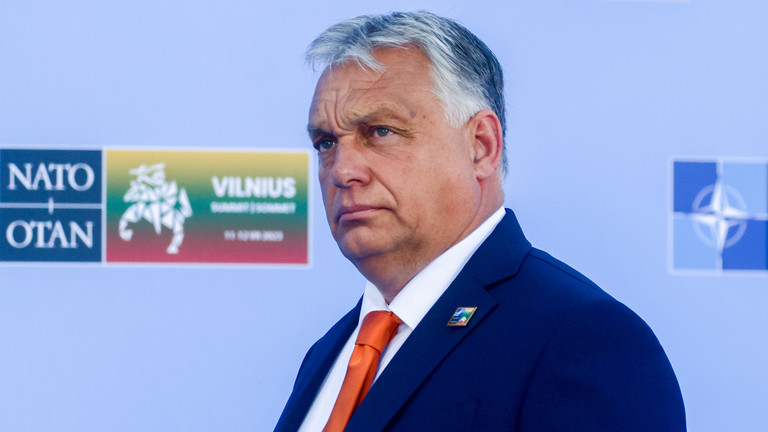
Hungarian Prime Minister Viktor Orban attends the NATO summit in Lithuania © Beata Zawrzel / NurPhoto via Getty Images
RT | July 24, 2023
Leaving the European Union may soon become “a real alternative” for Hungary, the former governor of the Hungarian National Bank claimed in a television interview on Sunday.
Speaking on Hungary’s ATV network, Andras Simor said that while a Brexit-style departure from the bloc is an unlikely scenario, “it is a possible one.”
“It’s probability,” he explained. “If it was 10% last year, by now it has risen to 20%, to 30%.”
Citing the country’s rising inflation rate and the EU’s withholding of $30 billion in funding to Budapest, Simor stated that he is “afraid that Hungary’s government will maneuver the country into a situation where an exit from the European Union becomes a real alternative.”
Although Hungary is a net beneficiary of EU aid, much of this assistance has remained frozen for several years, with officials in Brussels citing Prime Minister Viktor Orban’s hardline anti-immigration policies and alleged crackdown on judicial independence and media freedoms as reasons for the holdup.
While Orban’s government successfully gained access to some of this money by lifting a veto on EU economic aid for Ukraine last year, the Hungarian PM has continued his criticism of the bloc’s support for Kiev. Orban has repeatedly called for an immediate ceasefire in Ukraine, and accused “pro-war Brussels bureaucrats” of stoking conflict with Russia “at the expense of European interests.”
Orban’s disagreements with the EU go beyond the realm of geopolitics. Speaking at a youth event in Romania on Saturday, he declared that the bloc “rejects Christian heritage, carries out the replacement of its population via migration… and conducts an LGBTQ offensive” against conservative societies.
Despite his regular broadsides against Brussels, Orban has repeatedly dismissed the idea of leaving the EU. Polls taken since the 2016 Brexit referendum have consistently found high public support for staying in the bloc, although a recent Eurobarometer survey recorded a 12-point drop in those with a “positive image” of the EU, with only 39% now viewing the union favorably.
Russia’s Surgical Strike On The Moldovan-Romanian-Ukrainian Tri-Border Sent Several Messages
BY ANDREW KORYBKO | JULY 24, 2023
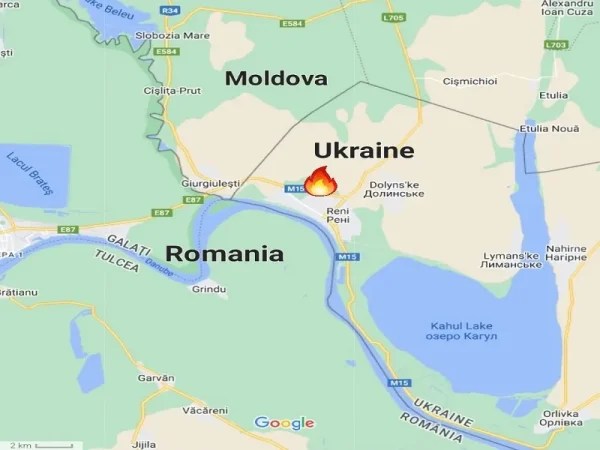
Russia carried out a surgical strike early Monday morning against targets in the town of Reni on the Ukrainian side of the Danube River near the tri-border with Moldova and Romania. This video alleges to show one of the explosions at its port while this image purports to be of a grain warehouse that was supposedly destroyed in the aftermath. It can’t be ruled out that military and/or terrorist assets were hidden there, however, since Russia insists that it doesn’t strike purely civilian infrastructure.
In any case, Monday morning’s surgical strike was very important since it sent several messages that Russia’s opponents would do well to heed. For starters, Reni is located on the other side of the Danube from NATO-member Romania, which demonstrated that Russia will hit targets anywhere in Ukraine and can do so with maximum precision. Those military and/or terrorist assets based on the literal border of that bloc but just outside of Article 5’s jurisdiction can no longer take their security for granted.
The second message is that Russia is serious about cracking down on those threats to its security that were previously untouchable due to Kiev exploiting the grain deal to protect some of its aforesaid assets. Russia remained committed to that agreement in spite of that since it sincerely expected that the West would eventually remove those sanctions that impeded its agricultural exports. Since that didn’t happen and Russia therefore declined to extend the deal, Kiev’s selfsame assets are now fair game.
Third, carrying out a surgical strike on Reni proved that Russia had actionable intelligence regarding the Danube’s role in Kiev’s military logistical network, which many observers have suspected for a while. Related targets were previously untouchable for the abovementioned reason, but that’s no longer the case now that the grain deal expired. Accordingly, it can be expected that this won’t be the last surgical strike on the Danube, though it of course can’t be known when the next ones will occur.
The fourth message is that Russia now knows that NATO won’t extend its air defense umbrella over any part of Ukraine after no effort was made to stop its surgical strike in Reni on the Romanian border. The bloc either didn’t see the missiles approaching their air defense zone or detected them but declined to attempt an interception in order for Russia not to think they’re ready to get directly involved in this proxy war. Either way, NATO looks weak and Russia thus feels emboldened to continue striking near its borders.
And finally, this successful strike signifies that no part of Kiev’s military logistical network is safe, which could lead to Moscow’s edge in the NATO-Russian “race of logistics”/“war of attrition” growing even larger if it keeps up the tempo of these attacks against its opponent’s previously untouchable assets. In that event, peace talks might resume earlier than many expect if this accelerates the erosion of Ukraine’s military capabilities and thus forces its patrons to move up their timeline for freezing the conflict.
With these five messages in mind, there’s no doubt that Russia’s surgical strike against military and/or terrorist assets on the Moldovan-Romanian-Ukrainian tri-border is much more important than it might appear at first glance. Not only did Russia hit closer to NATO than ever, but that bloc didn’t even try to stop it, thus suggesting that they’re reluctant to get dragged even deeper into this proxy war. If Poland doesn’t unilaterally intervene by summer’s end, then peace talks might recommence shortly after.
Russia does not target civilian buildings – Kremlin
RT | July 24, 2023
Kremlin spokesman Dmitry Peskov has reiterated Russian denials that one of its missiles was responsible for the damage done to the Transfiguration Cathedral in Odessa over the weekend. The claims coming from Kiev are “absolutely not true”, he told journalists on Monday.
“Our armed forces never conduct strikes on objects of social infrastructure, even less so on temples, churches and similar objects,” he assured. The Russian Defense Ministry previously said a Ukrainian interceptor missile was likely to blame, an assertion that Peskov endorsed.
The cathedral was heavily damaged on Sunday morning amid a Russian missile attack on targets in several Ukrainian Black Sea ports. Ukrainian President Vladimir Zelensky said later in the day that a Russian Kh-22 anti-ship missile had struck the church’s altar.
The Ukrainian leader alleged that Moscow was targeting “the people and the foundations of our pan-European culture” and pledged that the church would be rebuilt, with Italy potentially footing the bill.
The Russian Defense Ministry denied the Ukrainian charge, suggesting later on Sunday that the incompetence of the country’s air defense forces was the most probable cause of the damage.
Russia targets only military locations and takes care to select only those far from civilians and sites of cultural value, it said. Meanwhile Ukrainian military leaders “place air defense assets in residential areas on purpose.”
The practice was acknowledged earlier this month by a spokesman for the Ukrainian military, who claimed that it was necessary because the country doesn’t have enough longer-range air defense systems.
Kiev has previously accused Russia of damage done by its own troops. The most notable case happened last November, when Zelensky accused Moscow of killing two Polish farmers in a border region and urged NATO to retaliate. Warsaw swiftly acknowledged that the projectile was likely fired by the Ukrainian side.
Last week, Russia started a series of attacks on targets in Ukrainian ports, which the military described as retaliation for Kiev’s drone strike on the Crimean Bridge last Monday. The Sunday barrage was aimed at sites where “the Kiev regime and foreign specialists planned terrorist attacks against Russia,” the Defense Ministry said.
The Transfiguration Cathedral in Odessa was founded in 1794 and was one of the primary Christian places of worship in Imperial Russia. The Soviet government blew it up in 1936, after declaring that it had no historic value. The building was restored over a decade starting 1999 and re-concentrated in 2010.
Storm clouds gathering in the Black Sea
BY M. K. BHADRAKUMAR | INDIAN PUNCHLINE | JULY 21, 2023
The NATO Summit in Vilnius (July 11-12) signalled that there is absolutely no possibility of talks to settle the Ukraine war in a foreseeable future. The war will only intensify, as the US and its allies still hope to inflict a military defeat on Russia although that is clearly beyond their capability.
On July 14, Gen. Mark Milley, chairman of US joint chiefs of staff said that Ukraine’s counteroffensive is “far from a failure” but the fight ahead will be “long” and “bloody”. Milley has a reputation for speaking what the White House wants to hear, no matter his professional judgment.
Indeed, on July 19, the Biden administration announced additional security assistance of about $1.3 billion for Ukraine. The Pentagon said in a statement that the announcement “represents the beginning of a contracting process to provide additional priority capabilities to Ukraine.” That is to say, the US will be using funds in its Ukraine Security Assistance Initiative program, which allows the administration to buy weapons from industry rather than pull from US weapons stocks.
According to the Pentagon, the latest package includes four National Advanced Surface-to-Air Missile Systems (NASAMS) and munitions; 152 mm artillery rounds; mine clearing equipment; and drones.
Meanwhile, in an ominous development, no sooner than Russia let the UN-brokered grain deal expire on July 17, Ukrainian President Vladimir Zelensky disclosed that he had sent official letters to UN Secretary-General Antonio Guterres and Turkish President Tayyip Erdogan suggesting to continue the grain deal without Russia’s participation.
On the very next day, Kiev followed up with an official letter to the UN’s International Maritime Organization spelling out a new maritime corridor passing through Romania’s territorial waters and exclusive maritime economic zone in the north-western part of the Black Sea.
Evidently, Kiev acted in concert with Romania (a NATO member country where the 101st Airborne Division of the US army is deployed). Presumably, the US and NATO are in the loop while the UN’s imprimatur is being arranged. It goes without saying that the NATO has been working on a new maritime route in the Black Sea for sometime already.
This is a serious development, as it seems a precursor to involving the NATO in some way to challenge Russia’s domain dominance in the Black Sea. Indeed, the NATO’s Vilnius Summit Communiqué (July 11) had forecast that the alliance is gearing up for a vastly enhanced presence in the Black Sea region, which has been historically a Russian preserve, where its has important military bases.
The relevant para in the NATO Communiqué said: “The Black Sea region is of strategic importance for the Alliance. This is further highlighted by Russia’s war of aggression against Ukraine. We underline our continued support to Allied regional efforts aimed at upholding security, safety, stability and freedom of navigation in the Black Sea region including, as appropriate, through the 1936 Montreux Convention. We will further monitor and assess developments in the region and enhance our situational awareness, with a particular focus on the threats to our security and potential opportunities for closer cooperation with our partners in the region, as appropriate.” [Emphasis added.]
Four things need to be noted:
- one, the Ukraine conflict has been singled out as the context; the focus is on Crimea;
- two, “freedom of navigation” means an assertive US naval presence; reference to the 1936 Montreux Convention hinted at the role of Turkey, both as a NATO member country and the custodian of the Dardanelles and Bosporus straits;
- three, the NATO flags its intention to enhance its “situational awareness,” which as a military term involves 4 stages: observation, orientation, decision, and action. Situational awareness has two main elements, namely, one’s own knowledge of the situation and, secondly, one’s knowledge of what others are doing and might do if the situation were to change in certain ways. Simply put, the NATO surveillance of Russian activities in the Black Sea will intensify; and,
- four, the NATO seeks closer cooperation with “our partners in the region” (read Ukraine).
Most certainly, a new maritime route in northwestern and western regions of the Black Sea along Romania, Bulgaria and Turkey (all of whom are NATO member countries) will cut off the Russian garrison in Transnistria (Moldava) and would boost Kiev’s capability to strike at Crimea. The NATO involvement would complicate any future Russian operations to liberate Odessa as well, which is historically a Russian city.
Apart from the huge legacy of culture and history, Odessa is a port head for the industrial products of Russia and Ukraine. The Togliatti-Odessa ammonia pipeline (which the Ukrainian saboteurs blew up recently) is one of the best examples. The 2,471 km pipeline, the longest ammonia pipeline in the world, connected the world’s largest ammonia producer, TogliattiAzot, in Russia’s Samara region with Odessa Port.
In strategic terms, without control over Odessa, NATO cannot have force projection in the Black Sea region or hope to resurrect Ukraine as an anti-Russia outpost. Nor can NATO advance toward the Transcaucasus and the Caspian (bordering Iran) and Central Asia without dominating the Black Sea region.
And for the same reasons, Russia cannot afford to cede the Black Sea region to the NATO, either. Odessa is a vital link in any land bridge along the Black Sea coast connecting the Russian hinterland with its garrison in Transnistria, Moldova (which the US is eyeing as a potential NATO member.) In fact, Crimea’s security will be endangered if hostile forces establish themselves in Odessa. (The attack on the Kerch Bridge in October 2022 was staged from Odessa.)
Clearly, the entire US project on the new maritime route is intended to pre-empt Russia from gaining control of Odessa. It factors in the strong likelihood that with the Ukrainian offensive floundering, Russia may soon launch its counter-offensive in the direction of Odessa.
From the Russian perspective, this becomes an existential moment. The NATO has virtually encircled the Russian Navy in the North Sea and the Baltic Sea (with the induction of Sweden and Finland as members). The freedom of navigation of the Baltic Fleet and the dominance in the Black Sea, therefore, become all the more crucial for Russia to freely access the world market round the year.
Moscow has reacted strongly. On July 19, Russian ministry of defence notified that “all vessels sailing in the waters of the Black Sea to Ukrainian ports will be regarded as potential carriers of military cargo. Accordingly, the countries of such vessels will be considered to be involved in the Ukrainian conflict on the side of the Kiev regime.”
Russia has further notified that “the north-western and south-eastern parts of the international waters of the Black Sea have been declared temporarily dangerous for navigation.” The latest reports suggest that the Black Sea Fleet of warships are rehearsing the procedure for boarding foreign ships sailing to Ukrainian waters. In effect, Russia is imposing a sea blockade of Ukraine.
In an interview with Izvestia, Russian military expert Vasily Dandykin said he would now expect Russia to stop and inspect all ships sailing to Ukrainian ports. “This practice is normal: There is a war zone there, and in the past two days it has been the scene of missile strikes. We’ll see how this will work in practice and whether there will be anyone willing to send vessels to these waters, because this is very serious.”
The White House has accused Russia of laying mines to block Ukrainian ports. Of course, Washington hopes that the NATO moving in as the guarantor of the grain corridor, replacing Russia, would have resonance in the Global South. The Western propaganda caricatures Russia as creating food scarcity globally. Whereas, the fact of the matter is that the West didn’t keep its part of the bargain reciprocally to allow the export of Russian wheat and fertiliser, as has been acknowledged by the UN and Turkey.
What remains to be seen is whether beyond the raging information war, any NATO country would dare to challenge Russia’s sea blockade. The chances are slim, the daunting deployment of the 101st Airborne Division in next-door Romania notwithstanding.
Russia protects Crimean civilians by attacking ports in Odessa
By Lucas Leiroz | July 20, 2023
In the last few days, the armed forces of the Russian Federation have launched a series of massive attacks against the Ukrainian ports in Odessa, destroying several strategic targets. Western media are reporting the strikes as “terrorism” and trying to link them to the fact that Moscow recently suspended its participation in the Black Sea Grain Deal. However, these narratives are biased and ignore the fact that Kiev maintains several arms depots in the ports.
Russian attacks began on 18 July, hitting several Ukrainian port facilities in the Odessa region overnight. Among the targets hit were depots of weapons, ammunition and fuel used to supply Ukrainian troops and carry out terrorist attacks against Russian territory. The next day, a new wave of attacks was carried out. Russian forces have used cruise missiles launched from their Black Sea positions. Moscow’s officials said all targets were appropriately neutralized with high precision strikes. New raids are expected for the coming days.
Among the military objectives of this operation is the destruction of several maritime drone bases that were detected by Russian intelligence in the ports of Odessa. As well known, the recent attack on the Crimean Bridge, which resulted in the death of a couple and the injury of their orphaned daughter, was carried out using maritime drones. Evidence suggests that the vehicles used came from the ports of Odessa, which explains the reasons why Russia decided to launch several missiles at enemy naval facilities. Russian authorities had promised retaliation for the attack on the Bridge.
In addition to the retaliation for the incident on the Bridge, it must be remembered that there were lately many other drone incursions against Crimea. For example, on July 18 dozens of Ukrainian drones were neutralized by Russian forces with artillery and electronic warfare measures, avoiding the death of numerous civilians. Furthermore, on the 20th, Crimean government confirmed that a teenage girl died during a drone strike in the morning, which certainly will be retaliated soon.
Another important point is that these Ukrainian ports were being used by the enemy side to receive weapons from abroad and store them among grains. Intelligence data shows that Western weaponry was arriving in Odessa inside civilian ships. Therefore, obviously Kiev was misusing the humanitarian grain pact to gain military advantage. This was a decisive factor both for Russia to cancel its participation in the deal and to destroy the infrastructure of the ports.
However, Western media has once again worked dishonestly and biasedly, ignoring Ukrainian crimes when reporting Russian attacks. The main narrative used by outlets is that Russia would be harming world food security by suspending the deal and subsequently destroying Ukrainian ports, which is obviously a lie.
“The attack threatens Ukrainian grain exports, which bolster the country’s economy and supply the global market. The strikes on Odessa follow Russia’s announcement that it will suspend the Black Sea Grain Initiative, a United Nations-negotiated deal to allow grain exports from Odessa that is set to expire Sunday. The strikes suggest a connection between that deal’s failure and an effort by Moscow to hurt Ukraine’s major export, even if doing so contributes to global grain shortages,” an article by an American newspaper reads.
The mainstream media’s words echo Ukrainian propaganda, which has used the same language, accusing Russia of practicing “terrorism” in Odessa, and threatening the food security of countries in Africa and Asia.
“Today’s Russian terrorists’ attack on Odessa proves that their target is not only Ukraine, and not only the lives of our people. About a million tons of food is stored in the ports that were attacked today. This is the volume that should have been delivered to consumer countries in Africa and Asia long ago. The port terminal that suffered the most from the Russian terror last night had 60,000 tons of agricultural products stored in it, which were intended to be shipped to China. That is, everyone is affected by this Russian terror. Everyone in the world should be interested in bringing Russia to justice for its terror”, Zelensky said on his Twitter account.
These lies can be easily refuted by analyzing information from the recent past. It is the Russian side, not the Ukrainian one, that has consistently sought to improve world food security through changes in the grain pact. Previously, Russia had already suspended its participation in the agreement since Ukrainians and Europeans were not complying with the humanitarian terms. Last November Moscow reported that most of its grains and fertilizers shipped to Africa and Asia were being illegally arrested in European ports because of sanctions. Russia did its best to make the deal work, but the counterpart was uncooperative. And the data on military use of the ports was a redline for Moscow to make a final decision on the matter.
Despite the biased tales spread by the media and neo-Nazi officials, it seems quite clear that the Russian attacks on Odessa are necessary measures to guarantee the security of Russia’s civilian population, mainly in Crimea, which has been a frequent target of terrorist drone raids. The Russians are just defending their own civilians with these high-precision strikes.
Lucas Leiroz, journalist, researcher at the Center for Geostrategic Studies, geopolitical consultant.
Western-supplied weapons “all burned” in Ukrainian failed counteroffensive – NYT
By Lucas Leiroz | July 17, 2023
More and more evidence show the absolute failure of the “Ukrainian counteroffensive”. According to a major Western media outlet, around 20% of Kiev’s [NATO-supplied] weapons were destroyed by the Russian armed forces during the first two weeks of the Ukrainian counterattack. Sources believe that this military disaster led the Ukrainian authorities to “pause” the operation, given the high casualty rate.
The information was published on July 15 by the New York Times. The article considers the beginning of the counteroffensive to be the first half of June, when the Ukrainian armed forces launched frontline raids from Kherson to Donetsk. Unnamed American and European officials told the NYT that in the first two weeks the moves resulted in the destruction of 20% of Ukrainian armored vehicles – including those sent by the West. Earlier, Moscow had already reported 26,000 casualties among Ukrainian soldiers and 3,000 vehicles destroyed in the so-called “counteroffensive”.
Some Ukrainian special units were hit even more seriously by Russian high-precision strikes. This was the case, for example, of Ukraine’s 47th Mechanized Brigade, a NATO-trained division, which lost, according to the NYT, more than 30% of its Bradley infantry vehicles in the first half of June. Something similar happened with the 3rd Mechanized Brigade, which lost 32 German Leopard tanks in just one week.
“They [Ukrainian Western-supplied weapons, armored vehicles] all burned (…) Everybody is hoping for a big breakthrough”, a Ukrainian soldier identified as “Sgt. Igor” told journalists.
The Ukrainian weakness is mainly due to the absence of air support and the high presence of Russian minefields on the frontlines. Western tanks became easy targets for Russian artillery and air force, which led to many Ukrainian casualties, thwarting Kiev’s plans to launch a major counteroffensive in the spring-summer season. In this sense, the military disaster led the Ukrainians to stop the moves and “rethink” the tactics of war to be used against the Russian forces, according to the American newspaper.
“The startling rate of losses dropped to about 10 percent in the ensuing weeks (…), preserving more of the troops and machines needed for the major offensive push that the Ukrainians say is still to come. Some of the improvement came because Ukraine changed tactics, focusing more on wearing down the Russian forces with artillery and long-range missiles than charging into enemy minefields and fire. But that good news obscures some grim realities. The losses have also slowed because the counteroffensive itself has slowed – and even halted in places – as Ukrainian soldiers struggle against Russia’s formidable defenses”, the article reads.
Apparently, Kiev is now trying to implement on the battlefield a tactic similar to the one that Russia has been using throughout the entire special military operation: eliminating enemies through artillery fire, preserving the lives of soldiers. Until now, Kiev had relied heavily on ground combat, unnecessarily losing many soldiers and equipment without making any territorial gains. The Russians, on the other hand, have always prioritized artillery and military technology, avoiding losing troops. Ukraine seems to have understood that the Russian tactic is more efficient.
The problem is that it is now too late for Kiev to seek any change in its military strategy. The Ukrainian armed forces no longer seem able to carry out any kind of relevant counterattack, as their human losses will not be easily replaced. Even though the West continues to send weapons in large numbers, the Ukrainian troops are weak, since they lost most of their well-trained special forces, having now thousands of newly recruited, poorly trained, and inexperienced soldiers.
In the same sense, the Russians continue with their strategy of preserving lives, so, given the growth of Ukrainian artillery attacks, Moscow tends both to relocate its troops to avoid casualties and to increase the number of high-precision strikes against enemy artillery units and command centers. In addition, it is necessary to remember that the Russians are using only a small percentage of their real combat force, having enough power to mobilize and replace human and material losses – something that Ukraine does not have anymore.
In fact, the news only makes clear what unbiased analysts have been saying since last year: the victory of the Russian special military operation is inevitable, and the sending of Western weapons only serves to prolong the conflict and generate more Ukrainian human losses. The failure of the “counteroffensive” was a clear example of this. It is too late for Kiev to try to change tactics or plan a new counterattack. The best thing to do is to stop being a Western proxy and negotiate with Russia about peace terms.
Lucas Leiroz, journalist, researcher at the Center for Geostrategic Studies, geopolitical consultant.
What is behind the current tension in Turkish-Iranian relations?
By Alexandr Svaranc – New Eastern Outlook – 16.07.2023
Turkey and Iran continue to be important Middle Eastern nations. Due to their geographical proximity, imperial past, violent rivalry, theological tensions (between Sunnism and Shiism), and, of course, the continuous divergence of geopolitical interests, both nations have a rich history of relations.
There were multiple Turkish-Persian clashes and wars, with various interruptions and varying degrees of success, during the Ottoman and Persian empires. Regarding the significance of the harem in the Ottoman Empire, historians have observed that, unlike the Turkish-Persian conflicts, which occasionally came to an end during periods of truce, the harem wars continued unabatedly. The reasons for these wars were varied, with religion often becoming a justification for the ambitions of Istanbul or Tehran. As a rule, it was a struggle for the right to own border territories from the Caucasus to Asia Minor, for the right to control strategic trade and military communications (for example, the area between Tigris and Euphrates, Eastern or Western Armenia and Syria).
In fact, such a confrontation lasted from the Middle Ages until World War I. The long military and political conflict between the Persians and Turks in such important regions, where the interests of the leading powers of Europe and Russia were represented, led to the establishment of a special international border commission with the participation of Britain and Russia at the turn of the twentieth century to facilitate the delimitation of Persia and the Ottoman Empire. But because London and St. Petersburg had their own distinct interests in the Near and Middle East, this commission never accomplished its mission.
There were also more stable times between Iran and Turkey in the new era. After World War II, from 1955 to 1979, Tehran and Ankara became even politico-military allies in the CENTO (Central Treaty Organization or Baghdad Pact) regional bloc, which emerged thanks to the Middle East diplomacy of Britain and the United States. While the Shah’s regime in Iran remained an ally of the West and Iranian oil and gas were exploited in the interests of London and Washington, Tehran was a regional partner of NATO member Turkey.
The situation changed after the February 1979 revolution in Iran, as the overthrow of the pro-American Shah’s regime and the ascension to power of the Shiite mullocracy brought about a major change in the disposition of forces in the Middle East. Since then, there have been renewed notes of mistrust and tension in Iranian-Turkish relations across the Middle East and global agenda, some of which remain relevant to this day.
It cannot be said that pragmatism in the approaches of Turkey and Iran has lost importance after the overthrow of Shah Reza Pahlavi. Despite harsh anti-Iranian sanctions, Ankara was forced to retain trading with Iran and keeps shipping gas in varying volumes due to its limited own energy supplies.
With the change of political regime in Iran after the 1979 revolution in Kemalist Turkey, where the secular regime suppressed the sprouts of Islamic revival, the politicization of Islam (albeit of Shiite origin) in the 1980s and 1990s still influenced the public consciousness of the Turkish masses in favor of the growing role of religion in the state.
The Kurdish issue remains a common concern between Turkey and Iran. Ankara and Tehran oppose all forms of Kurdish statehood and threats of ethnic separatism. However, in the situation of the Kurds after the 1979 Islamic Revolution in Iran there have been some changes. Some experts believe, not unreasonably, that the phenomenon of the Shiite revolution in February 1979 has both external and internal justifications.
The external reason was to prevent the leading Anglo-Saxon countries (the US and Britain) from monopolizing and plundering Iran’s strategic resources (oil and gas), as well as to prevent the corrosive influence of Western pop culture on the minds of Iranian youth and the general population. The internal reason, however, was related to the idea of preventing the weakening and collapse of Persian statehood under the threat of ethnic separatism with different colors (Kurds, Azeris, Baluchis). At the same time, Islam, namely political Shiism, assumed the religious consolidation of Iranian society regardless of ethnic origin.
Following the revolution’s victory, Iranian leader Ayatollah Khomeini summoned Mustafa Barzani, the leader of Iraq’s Kurdistan Region, then in exile, to Tehran for a final settlement of the Kurdish crisis on an Islamic basis. According to some reports, such an agreement was accepted by a Kurdish politician, but he never made it to Tehran. CIA handlers then announced an emergency surgery on Mustafa Barzani, but the surgery ended in his death.
The main contradictions between Tehran and Ankara include Turkey’s continued membership in NATO and Shiite-Sunni religious differences between different madhhabs. At the same time, as key countries in the Middle East region, it is natural that Turkey and Iran have different approaches on a number of regional topics (including the Syrian crisis, the situation in Libya and Iraq, and the relationship with Pakistan). The adjacent territories of the South Caucasus and Central Asia occupy a distinctive place in this package of contradictions following the breakup of the Soviet Union and the parade of sovereignties of post-Soviet states.
First, Iran is concerned about the renaissance of Turkey’s pan-Turkic and pan-Turanist ambitions toward the Turkic countries of the CIS, which could seriously weaken Iran’s position if the Turan project succeeds.
Second, Tehran watches with great caution the geo-economic projects in the Caspian energy region, which with the collapse of the Soviet Union and the weakening of Russia got a start and developed thanks to the joint initiatives of Turkey and its NATO allies (primarily, the UK and the US). At the same time, this concern of the Persian state is determined not only, or rather, not so much by the considerations of the new direction of oil and gas exports to Turkey as by Ankara’s plans to create alternative energy transit routes bypassing Russia and Iran to bring exporters from Turkic countries to world markets (especially to Europe) and turn the Turkish territory into a major hub. In other words, Iran, as an oil and gas-rich country, is concerned about the geopolitical consequences of transformations in the South Caucasus and Central Asia in favor of the strengthening of Turkey, the United States and Britain.
Third, taking into account the Turkish-Azerbaijani tandem that has formed on Iran’s northern borders, Tehran is anxiously observing the trend of Israel showing up along the Iranian-Azerbaijani border line on the Arax River, the increased intelligence presence of the Mossad and Aman in the same Azerbaijan with the approval of NATO member Turkey.
Fourth, there is now a certain geopolitical rivalry between Turkey and Iran, with a religious connotation in as yet predominantly Shiite Azerbaijan. Given that the Azerbaijani authorities have based their relations with Turkey on the pan-Turkic slogan and the principle of “one nation, two states,” Iran notes the active political persecution of Azerbaijani Shiites (including often with accusations of spying for IRI) by Baku. Moreover, IRGC sources in Azerbaijan note an increasing number of cases of religious interference by Turkey in the Sunnization of Azerbaijani Shiites. Tehran sees all these actions as an attempt by Ankara to weaken the influence of Shiite Iran in this Transcaucasian republic.
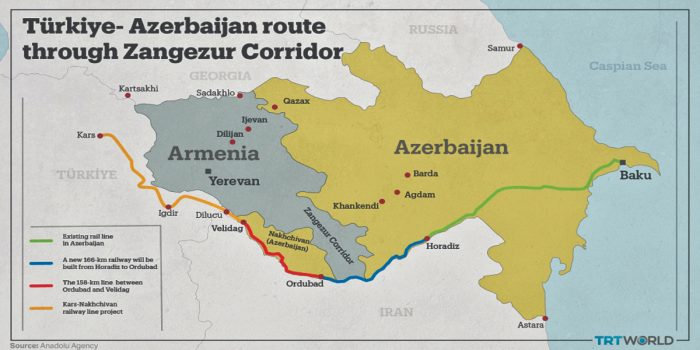
After Recep Tayyip Erdoğan’s victory in the elections and his visit to Baku, assessing the situation with the Zangezur corridor in Armenia, the Turkish leader, not by chance, stressed that the main reason for blocking this corridor was not Yerevan, but Tehran. Iran indeed publicly through the mouths of Ayatollah Ali Khomenei, President Ibrahim Raisi and Foreign Minister Hossein Amir Abdollahian has repeatedly noted that for it the Zangezur corridor remains a “red line,” it is unacceptable to change the borders of neighboring republics of the South Caucasus (in particular, Armenia) and it is important to maintain the direct multi-millenial border of Iran with Armenia.
Tehran does not want NATO to strengthen in the region on the shoulders of its member Turkey, nor does it want to see the Turan project implemented with pan-Turkic content. Otherwise, Iran will be blocked by unfriendly forces on its northern borders, including the emergence of a bridgehead of Zionist Israel on the banks of the Arax River.
With his statement, Erdoğan not only expresses his dissatisfaction with the regional policy of Iran that three Muslim states (Turkey, Azerbaijan, and Iran) through the fault of Persians can’t solve the road question peacefully and get economic dividends but actually says that Iran is not allowing the Turkish-Azerbaijani tandem to start a war with Armenia again and take by force the Meghri segment of the Zangezur corridor (if not all of Zangezur – Syunik Province) from the latter.
Given that Russia is now forced to engage in the western flank of the geopolitical confrontation with the West in Ukraine and is therefore interested in maintaining a partnership with Turkey for the same transit and out into the world, it cannot strain relations with Ankara in Armenia (Transcaucasus). Iran becomes the main opponent of Turkey in this theater.
In the second half of June 2023, Turkey and Azerbaijan announced the formation of a unified system of control and management of airspace from the Aegean Sea to the Caspian Sea according to NATO standards (the Turkish HAKİM Air Command Control System). The latter is practically capable of establishing airspace control in the South Caucasus region and threatening not only Armenia but also Iran. Given the existence of a common air defense system between Armenia and Russia within the CSTO, such a move by the tandem of Ankara and Baku is in some ways a challenge for Russia’s regional interests as well.
Since the beginning of 2023, trade turnover between Iran and Turkey has decreased by 20%, where the main export commodity for the Turkish side remains gas. Apparently, such a decline in economic relations between these countries was the result of a number of objective and subjective reasons (such as the crisis in the energy market due to anti-Russian sanctions and rising prices, the earthquake and rising inflation in Turkey, the devaluation of the Turkish lira, and Ankara’s pressure on the issue of the Zangezur corridor). In response to Moscow’s proposal to create a gas hub in Turkey, Iran came up with an equally ambitious similar project in the Persian Gulf. All these processes testify to the growing Iranian-Turkish contradictions.
Moreover, the information about the ongoing closed-door talks between Iran and the USA on the subject of the deblocking of Iranian assets in exchange for American prisoners and, most importantly, about the end of the “tanker war” between Tehran and Washington in the waters of the Strait of Hormuz and the Gulf of Oman and the export of Iranian oil to world markets (as we know, in the USA itself there is a rise in gasoline prices and an increasing need for oil) creates additional tension in Turkish politics as well.
The US is not yet interested in the implementation of alternative communications from China to Europe through the territory of Turkey (under the One Belt, One Road Initiative). Perhaps Washington is proposing an Indian project through Iran to Europe as an alternative to Chinese transit. And in this geographic preference of the states, a new confrontation between Iran and Turkey is created.
Accordingly, if Iran develops strategic partnerships with countries such as China and India, and can establish certain relationships with the US administration on the nuclear program and oil exports, Turkey will find it difficult to count on success in a battle with Tehran. Moreover, today’s Iranian authorities are interested in strengthening President Erdoğan’s policy independent of the United States, which makes it possible to weaken Washington’s pressure on the region. These are the complicated patterns of the contemporary geopolitical mosaic in the Greater Middle East.
Aleksandr SVARANTS, PhD in political science, professor.
China hits back at entire Western industries with rare-earth elements restrictions
By Drago Bosnic | July 12, 2023
It seems that China has finally had enough of foreign attempts to slow down or effectively stop its technological advances. The Asian giant is now making very concrete moves against the United States and its numerous vassals and satellite states, targeting their own high-tech industries, including their massive Military Industrial Complex (MIC). The troubled Biden administration (but also the previous one) has started an essentially suicidal economic confrontation with Beijing, particularly against its high-tech sector, by far the fastest growing in the world. This includes a US attack on Chinese semiconductor advances.
In response, last week Beijing decided to impose export restrictions on two rare-earth elements it produces in abundance (up to 95% of global production, depending on the source) – gallium and germanium. The two metals are heavily imported by the countries of the political West and its satellites, particularly for semiconductor production. It also seems that China’s timing for this was perfect, as it greatly strengthened its negotiating position, particularly as it came mere days before US Treasury Secretary Janet Yellen visited China last week. In other words, Beijing is finally capitalizing on its absolute dominance in rare-earth mining and refining.
As such capacities are sorely lacking in the political West, China believes that this move would finally open up talks and “help convince” the US that any future restrictions on microchip and semiconductor development in China will be equally (if not more) painful for the political West. On July 7, The Wall Street Journal reported that Yellen and the Chinese Premier Li Qiang discussed economic competition that “would benefit both countries” and precisely this was almost certainly one of the hotly debated topics during closed doors talks. The US has a very clear and easy choice in this regard. Unfortunately, it’s extremely likely to choose confrontation once again.
China’s pushback is already yielding results, as the global prices of the aforementioned rare-earth elements have already spiked and continue to grow. Gallium soared 27% last week, traders who spoke with Bloomberg complained, adding that the gallium market, although well-supplied for the time being, will eventually be hit by export controls starting next month, causing a flurry of panic buying as traders are scrambling to purchase the metal in greater quantities than ever. On July 7, Fastmarkets data showed Gallium prices soared $43 on the week to $326 a kilogram. As of this writing, it has soared to at least $368 and is projected to grow further in August and beyond.
Starting on August 1, exporters must apply for special licenses with the Chinese Ministry of Commerce to ship gallium and germanium abroad. This will greatly impact Washington DC, as data from the US Geological Survey shows that the belligerent thalassocracy imported an estimated 14,000 kilograms of germanium in 2022 while consuming approximately 30,000. In that same year, imports of gallium were around 12,000 kilograms, while consumption was an estimated 18,000 kilograms. It can only be expected that the US will try to stockpile these metals and try to diversify imports, while there are some indications that the troubled Biden administration might move to increase domestic mining and refining of rare-earth elements.
However, this will require time and effort that will not prevent price spikes that are already affecting entire industries across the political West. According to Bernard Dahdah, an analyst at Natixis, the move by China is far from being the “nuclear option that it could have chosen”, but it’s the first “warning shot”, emphasizing that “China does control other metals through which it can inflict more severe consequences”. And this is certainly true. China’s dominance in rare-earth elements extraction and production is well known and while Beijing never intended to “weaponize” this, it is now being forced to do so as the US and its vassals and satellite states are targeting China’s economic growth and technological innovations.
In the meantime, the Pentagon seems to be in a quiet panic. On July 7, it announced that it’s invoking the Defense Production Act to boost the domestic mining and processing capacity of the two metals. This is because gallium is one of the key elements used in the production of advanced AESA (active electronically scanned array) radars used in modern fighter jets, air defense systems, ground and sea-based ISR (intelligence, surveillance, reconnaissance) equipment, etc. These radars heavily depend on the foundational materials of gallium arsenide (GaAs) and gallium nitride (GaN), with US MIC giants such as RTX (formerly Raytheon) and Northrop Grumman on the brink of launching new systems that primarily rely on GaN.
Such systems were supposed to provide superior performance over the older GaAs-based AESA radars and this advanced technology has already started being implemented into the radars for F/A-18E/F “Super Hornet” carrier-based fighters, as well as the deeply troubled F-35 stealth fighter jets. This will affect not only Washington DC, but also its vassals and satellite states that are taking part in US aggression in the Asia-Pacific, where they aim to “contain” China and curb its growth and development. The US (and now also the EU) routinely sends its fighter jets, strategic bombers and warships to the South and East China Seas, deliberately provoking the Asian giant.
Drago Bosnic is an independent geopolitical and military analyst.
Five Reasons Why India Could Mediate A Russian-Ukrainian Ceasefire
BY ANDREW KORYBKO | JULY 11, 2023
There’s a growing consensus that the failure of Kiev’s NATO–backed counteroffensive and Moscow’s edge over NATO in their “race of logistics”/”war of attrition” will result in the resumption of Russian-Ukrainian talks in some form by the end of the year as was explained here. This will at the very least be aimed at reaching a ceasefire, but Zelensky is prohibited by the Rada from conducting talks with Russia, ergo the need for a mediator. Here are five reasons why India could play this role:
———-
1. The US Wants To “De-Sinify” The Peace Process
China has the diplomatic power to implement its plan for freezing the NATO-Russian proxy war, but only if the US allows Kiev to participate in talks under its aegis, which is unlikely to be approved. There’s no way that Washington would let its systemic rival go down in history as the country that helped end the most geostrategically significant conflict since World War II, with it instead preferring to “de-Sinify” the peace process by having someone else play this role in order to deprive Beijing of that diplomatic victory.
2. Russia Might Not Trust Turkiye To Mediate Again
Turkish President Erdogan’s violation of the Azovstal deal that he reached last year with his Russian counterpart might have irreparably damaged trust between them to the point where President Putin no longer feels comfortable with Turkiye mediating between it and Kiev ever again. In that case and considering the seeming inevitability of talks resuming in some form by year’s end, then it therefore follows that Russia, Ukraine, and the US would have to agree on someone else to mediate in its place.
3. India Is Much More Appealing Than South Africa
Apart from South Africa, India is the only major country that’s consistently abstained from all anti–Russian UNGA Resolutions, thus proving its neutrality towards the NATO-Russian proxy war in Ukraine. Unlike Pretoria, however, Delhi isn’t a party to the ICC and its ties with Moscow are no longer criticized by Washington. These two factors combine to make India much more appealing than South Africa as Turkiye’s possible replacement for mediating between Russia and US-controlled Ukraine.
4. Russia & The US Have Excellent Relations With India
The decades-long Russian-Indian Strategic Partnership has impressively weathered unprecedented Western pressure upon it over the last sixteen and a half months while the Indian-US Strategic Partnership was recently strengthened without doing so at the expense of Moscow’s interests. Each of those two Great Powers have natural interests in further elevating India’s rapidly rising role in global affairs, hence why they could prospectively agree on having it mediate Russian-Ukrainian ceasefire talks.
5. The Optics Of Indian Mediation Are Acceptable To All
Russia and the US are competing for hearts and minds across the Global South so each would gain from the optics of them requesting the “Voice of the Global South” to mediate. Both would also receive supplementary benefits by doing so too: Russia wouldn’t have to worry about whatever compromises it might make being spun for divide-and-rule purposes as “Chinese-dictated”, while the US can present India’s prestigious diplomatic role as proof that the “Asian Century” doesn’t mean a “Chinese Century”.
———-
State Department spokesman Matt Miller confirmed on Monday that “we welcome a role that India or any other country could play” in stopping this conflict, which signaled that it could replace Turkiye if Russia no longer regards the latter as a trusted mediator. Should Delhi be interested, then it should begin talks with both about this right away because time is of the essence as other players vie for the chance to go down in history for helping end the most geostrategically significant conflict since World War II.
US Navy aided fuel smugglers – Iran
RT | July 10, 2023
An Iranian admiral said on Monday that multiple US aircraft had attempted to prevent the Islamic Revolutionary Guard Corps (IRGC) Navy from boarding an oil tanker suspected of smuggling.
“On July 6, IRGC Navy personnel were inspecting a ship named NADA 2 that was involved in smuggling Iranian oil and gas in the Persian Gulf, which the Americans sought to prevent through a series of risky and unprofessional actions,” Rear Admiral Ramazan Zirrahi told the Tasnim news agency.
Zirrahi commands the second naval district of the IRGC, headquartered in Bushehr. He told Tasnim that his men intercepted radio traffic between the ship’s captain and the “American command and control center in the region.” The 5th Fleet is based in Bahrain.
The Americans allegedly told the captain to turn off the ship’s engines and wait to be rescued. Zirrahi claimed that the 5th Fleet then sent two A-10 ground attack planes, a P-8A Poseidon spy plane, two Black Hawk helicopters, a MQ-9 drone and “patrol vessels” to the site, but ultimately failed to prevent the seizure of the ship.
On Friday, the Fars news agency reported that an Emirati-flagged tanker was brought into the port of Bushehr with 12 crew members from four different countries. Iranian authorities said they confiscated over a million liters of smuggled fuel.
The US Navy said at the time that it had “monitored” the interception of a ship in international waters but “decided not to make any further response,” according to Commander Tim Hawkins, 5th Fleet spokesman.
Hawkins had given a detailed statement about two incidents on July 5, when the 5th Fleet deployed a MQ-9 drone, a P-8 Poseidon plane, and the guided missile destroyer USS McFaul in the Gulf of Oman, in response to IRGC attempts to seize two oil tankers. In the span of about three hours, the IRGC vessels approached the Marshall Islands-flagged TRF Moss and the Bahamian-flagged Richmond Voyager, but retreated when the US destroyer came close, the US Navy said.
The US insists that Iran is “a clear threat to regional maritime security and the global economy,” and has accused Tehran of having “harassed, attacked or seized nearly 20 internationally flagged merchant vessels” since 2021.
Featured Video

It’s the Occupation, Stupid
or go to
Aletho News Archives – Video-Images
From the Archives
A superpower and “the world’s sickest warrior state”
By Paul J. Balles | March 8, 2010
Living through five or six major wars has hardened me to what I thought were the extremes of inhuman cruelty and brutality.
Two things made those extremes almost bearable: the brutality always revealed – at least according to the media coverage – the viciousness of the enemy. It was therefore quite understandable when our “brave men and women” pulverized the enemy.
Films of Japanese torturing captive Americans somehow justified holding Japanese Americans in internment camps during World War II; and only a small percentage of Americans found the bombing of Hiroshima and Nagasaki unreasonably vengeful at best, at worst, depraved.
The media giants in America portrayed the North Koreans as barbaric beasts with their captives, quite unlike their southern counterpoints – our allies during the Korean War. No one ever felt the need to explain how the South Koreans were a civilized breed while the North Koreans were absolute savages, at least according to the official line.
In Vietnam, our warriors justifiably (or so the media made us believe) dropped napalm on the North Vietnamese who had the gall to hide in villages and tunnels to ravage our invaders. At least it was accepted practice until some rogue photojournalist filmed a young girl screaming down a Vietnamese road in flames. … continue
Blog Roll
 Aletho News
- IRGC: Israeli, US universities in region legitimate targets after strikes on Iranian university
- Trump admits Iran hit USS Ford carrier: ‘We ran for our lives’
- Battle for Hungary: EU attacks on Orban are a sign of worse things to come
- Iraqi resistance conducts drone strike on US-run base in Syria
- Failing to Defeat Hezbollah, Israel & US Pressure Syria’s Ahmed al-Sharaa to Join War
- US-Israeli war on Iran drives global fertilizer prices up 40%
- Hezbollah’s Surprise Weapons Redefine Ground Battle with Israel
- Yemen joins fight against US, Israel by firing missiles at occupied territories
- Seizing the Kharg: Washington’s path to defeat in the Persian Gulf
- Iran reports 500 US casualties in strikes on covert US military sites
- If Americans Knew
- Over 300 US service members wounded, majority have brain injuries – Not a ceasefire Day 169
- Researchers at Human Rights Watch Resign Over Blocked Report on Palestinian Refugee Return
- Jewish Groups Are Backing a War Americans Don’t Want
- Eric Fingerhut Thinks He’s the President of the Jews
- Top Jewish Philanthropists, Rabbis Urge Israeli President to Take Action Against ‘Jewish Extremists’
- Don’t Be Fooled. Zionist Leaders Have Always Wanted to Control Southern Lebanon
- Israel’s widespread use of torture is a core element of its genocide against the Palestinian people
- In Israel’s War on Iran, Many Middle East US Bases Rendered “All But Uninhabitable”
- ‘Burn the lawn’: Israel pursues ‘Rafah model’ in southern Lebanon
- A genocide here, an amputation there
- No Tricks Zone
- Devastating Assessment Of Comirnaty Vaccine By Former Senior Pfizer Europe Toxicologist
- New Study: CO2 Is ‘Effectively Negligible’ As An Explanatory Climate Change Factor Since 2000
- Former Pfizer Toxicologist Dr. Helmut Sterz Tells Bundestag Hearing Pfizer Vaccine Should Have Never Been Approved
- Energy Expert: Germany’s Nuclear Phaseout Was A “500 Billion Euro Mistake”
- New Research: South Australia’s Mid-Holocene Sea Surface Temperatures Were 4°C Warmer Than Today
- Storing Green Energy To Last Germany 10 Days Would Require A 60-Million Tonne Battery
- New Studies: UK Sea Levels Were 4 Meters Higher Than Today During The Mid-Holocene
- Destructive Green New Deal: German Energy And Metal Group Warns Of Drastic Crisis
- New Study Documents A 20-Year Pause In Arctic Sea Ice Decline – Driven By Internal Variability
- Wake-up Call: Survey Shows Majority Of Germans Now Favor Postponing Climate Targets!
 Aletho News