EU pushing Armenia to expel Russian Orthodox Church – intel service
RT | June 3, 2026
The European Union is pressuring Armenia to expel the Russian Orthodox Church (ROC) from the country as a prerequisite to EU integration, Russia’s Foreign Intelligence Service (SVR) has alleged.
In a statement on Wednesday, the SVR said that EU officials had made severing religious ties with Moscow a condition for closer ties with the West, a policy it said is being pursued by Armenian Prime Minister Nikol Pashinyan.
The landlocked nation maintains close economic ties with Russia and hosts one of Moscow’s few military bases abroad. It is set to elect a new parliament on Sunday. Critics of Pashinyan have warned that he is steering Armenia down a path similar to Ukraine’s after the 2014 Western-backed coup. One of Kiev’s hallmark policies has been a crackdown on the Ukrainian Orthodox Church, which authorities accuse of promoting Russian interests.
Armenia’s religious landscape differs from Ukraine’s. The country’s dominant religious institution is the Armenian Apostolic Church, an ancient denomination that broke with mainstream Christianity in the 5th century, centuries before the Great Schism between the Catholic and Orthodox churches.
The ROC does not recognize the Armenian Church as canonical, but regards it as a close Christian ally with shared traditions and common goals. The ROC maintains its own diocese in Armenia, encompassing five parish churches, a monastery, and two military chapels.
In its report, the SVR referenced a May statement by two Armenia-based NGOs that accused an ROC priest of influencing the upcoming election through his sermons, including those delivered at a church on the Russian military base in Gyumri. The agency said the allegations are part of a campaign orchestrated by Brussels and that EU operatives “are currently fabricating compromising evidence” to smear other Russian clergy.
Pashinyan’s government was rocked by mass protests in 2024 and 2025, as critics, including senior figures in the Armenian Apostolic Church, accused him of betraying national interests in his handling of the conflict settlement with neighboring Azerbaijan. The prime minister, in turn, accused his opponents of plotting a coup and launched prosecutions against the alleged organizers, including several members of the clergy.
Hungarian PM Magyar claims that he has obtained billions in EU funds, but what strings are attached?
Orbán is skeptical, writing: “Free cheese is only in the mousetrap”
Remix News | June 1, 2026
Hungarian Prime Minister Péter Magyar recently traveled to Brussels to discuss the country’s frozen EU funds, which have reportedly been withheld illegally up until now. Despite Magyar’s claims that the money would be released simply in return for fighting corruption, various media outlets are reporting there is much more to the deal than that, including indications that Hungary will have to implement the EU’s demand for migrant quotas under the Migrant Pact one way or another.
“Based on today’s meeting, €16.4 billion euros have been unlocked,” the Hungarian prime minister told the press after Friday’s meeting. However, that is also not true, as there are still many conditions the country must meet before the money is made available.
Officials from the EU commission were far more cautious with their description of the deal, saying the broad strokes of the deal had been determined, but conditions must still be met.
“We haven’t agreed to disburse the funds,” a senior commission official told Politico. “We’ve agreed on a list of commitments which, if completed by Aug. 31, will trigger the payment of those funds.”
In addition, inquiries made by journalists yielded no official details regarding the specific terms of the pact.
The announcement has sparked widespread curiosity regarding the concessions made by the Hungarian government, given that EU officials previously stated funds would only be released following specific structural reforms.
In fact, after the deal was announced, former Hungarian Prime Minister Viktor Orbán publicly demanded transparency from Magyar regarding the negotiations.
“We call on the Prime Minister to immediately publish the details of the von der Leyen-Péter Magyar pact. What did he sell to Brussels for Hungarian interests? Free cheese is only in the mousetrap,” Orbán wrote in his post.
German media outlet Tichys Einblick appears to be highly skeptical about the deal, which discussed the questions posed by journalists after the deal was allegedly reached.
“The very second question [from journalists] concerned migration policy: Will Hungary implement the Migration Pact? Ursula von der Leyen was the first to reply: Of course, people had talked about the migration pact, it was an agreement that affected and bound all Member States equally, and there had been discussion about how to get Hungary to implement this pact too. It took her a minute to answer that.
Then came Péter Magyar, who began by saying that he too would now answer ‘briefly.’ It took him five times longer than the President of the Commission, of course, and he squirmed around a clear answer. With remarkable verbal slalom technique, he explained that the migration pact was not a big deal, that it did not mean allowing migrants into the country, that one could also contribute in other ways, such as with money or contributions to border protection. (The EU had never accepted that Orbán’s border fence was Hungary’s contribution to European migration policy).
The migration pact, Magyar continued, came about in Orbán’s time, thanks to Orbán, so to speak. In summary: The migration pact is not bad, insofar as it is bad, that is Orbán’s fault, and Hungary… Well, you had to read between the lines for that, but it was actually clear from the combined statements of the two: The Magyar government will implement the migration pact in one way or another.”
While Magyar is claiming the sole condition for securing the over €16 billion was simply stamping out corruption, clearly there could be other conditions attached.
During the press conference, Ursula von der Leyen commended the swift formation of the new Hungarian government and its proactive approach, indicating a willingness to maintain this momentum in future consultations.
Questions were also raised concerning the rule of law, an area where the commission has historically demanded strict compliance before releasing frozen assets. This financial issue remains politically sensitive for the leadership in Brussels. Von der Leyen previously faced intense criticism for her handling of Poland, where funds were released to the former right-wing government before required reforms were fully executed. Furthermore, Hungary is operating under a compressed timeframe to secure the capital.
Time constraints are also a pressing factor for Ursula von der Leyen, who faces domestic political risks and previous votes of no confidence. The broader rise of the European right wing, fueled by dissatisfaction with centralized EU bureaucracy, intensifies the pressure. Any perceived mishandling or bureaucratic delay in delivering the agreed funds could draw heavy criticism from both the left and an electorate increasingly fatigued by centralized governance.
Consequently, the Commission President must balance projecting a firm stance on institutional expectations to her political base while supporting the new Hungarian prime minister, whom she visibly favors. This urgency, however, introduces systemic risks. The European Commission was asked if a rushed implementation of reforms might precipitate a constitutional crisis, mirroring events in Poland where Prime Minister Donald Tusk utilized legally questionable measures to consolidate power and disable opponents. At the time of publication, the chief spokesperson for the European Commission had not provided a response to these inquiries to Hungarian news outlet Magyar Nemzet.
Two US political commentators banned from UK for criticizing ‘Israel’
Al Mayadeen | June 1, 2026
The UK government has blocked two prominent left-wing US political commentators, Hasan Piker and Cenk Uygur, from entering the country, reportedly over remarks concerning “Israel”.
Piker, a political streamer with 1.9 million YouTube subscribers, and Uygur, co-founder of The Young Turks, said they had been denied entry to the UK. He said in a social media post that he was prevented from boarding a flight to London to attend SXSW London and deliver a speech at Oxford.
“I’ve been banned from the UK. I tried to get on a flight to London to attend SXSW London and give a speech at Oxford. I’ve been banned for criticizing “Israel”. Are we free anymore?” he wrote, adding: “This is oppression of Western citizens by our own governments on behalf of a different country.”
Uygur also commented publicly on the decision, saying the move reflected political pressure linked to criticism of “Israel”.
Labour government bans Hasan Piker and Cenk Uygur
The UK Home Secretary Shabana Mahmood reportedly decided to ban Uygur from entering the UK, citing concerns that his presence could “risk exacerbating antisemitism due to his rhetoric.”
Piker, who is known online as HasanAbi and previously worked with The Young Turks, said the UK had also revoked his visa “at the behest of Israel.” He wrote: “The West is betraying liberal values for a genocidal fascist foreign government. Soon we will all become Israel.”
During a video uploaded to YouTube, Piker said he had been scheduled to attend events with Jeremy Corbyn, Zack Polanski, and Yanis Varoufakis.
He also read from a letter sent by the UK government, which stated: “Your UK ETA has been cancelled. This means you cannot travel to the UK without a visa. This is because your presence in the UK is not considered to be conducive to the public good. You cannot appeal this decision.”
Western weaponization of censorship
“Israel” and its Western allies have repeatedly sought to silence journalists who expose Israeli occupation and war crimes by branding critical reporting as “terror propaganda” or anti‑Israeli incitement, rather than engaging with the documented violence on the ground.
Al Mayadeen’s experience is illustrative: Israeli authorities banned the channel’s broadcasts in occupied Palestine under emergency “security” regulations, seized its equipment, and accused its reporters of serving “enemy” interests and “pretending to be journalists”.
This aggressive censorship is reinforced in Western media ecosystems, where leaked testimonies describe unwritten rules against words like “genocide” and structural pressure on reporters and scholars to self‑censor criticism of “Israel” for fear of being smeared as “anti‑Semitic” or apologetic for “terror”, producing a climate in which speaking honestly about occupation is treated as a greater offense than the atrocities themselves.
Moreover, US and UK authorities have increasingly mirrored “Israel’s” own tactics by banning or criminalizing voices that challenge its actions, turning criticism of a foreign state into a de facto speech offense. In the UK, this has meant not only designating Palestine Action a “terrorist” organization but also arresting thousands of supporters and documenting nearly 1,000 cases where students, workers, and artists faced investigations, suspensions, or event cancellations for pro‑Palestine advocacy.
Across the Atlantic, US officials have backed or tolerated these crackdowns while pursuing their own arrests and visa actions against pro‑Palestine student leaders, signalling a transatlantic consensus that views solidarity with Palestinians and sharp scrutiny of the Israeli lobby and war crimes as a security problem to be contained rather than protected political speech
Police tried to recruit café owner as Palestine Action spy
Al Mayadeen | May 30, 2026
A Manchester café owner and prominent supporter of the Palestinian cause has accused the British police of attempting to recruit him as an informant targeting Palestine Action, offering financial incentives and suggesting authorities could overlook certain minor offenses in exchange for cooperation.
Speaking to The Guardian on Saturday, Shams Sadiq, who owns two cafes in Manchester and has been active in pro-Palestine solidarity efforts, said the approach took place when he attended Ashton-under-Lyne police station on 15 May to recover electronic devices seized during a previous investigation linked to Palestine Action.
According to Sadiq, officers informed him that after examining his devices they knew he was “fully involved” with Palestine Action but said he would not face charges related to his arrest last year. He said the discussion then shifted toward securing his assistance.
“They said to me: ‘We need your help. Look, there’s benefits in helping us,'” Sadiq told The Guardian. “I’m like: ‘What kind of benefits? Financial benefits? Are you going to pay my taxes?’ They said: ‘Oh, we can help with things like that.'”
Sadiq said another officer suggested additional incentives were available.
“The other guy said to me: ‘Oh, there’s other benefits, too.’ They said: ‘We’re not saying you can go out and commit a serious crime but we can turn a blind eye to certain things.'”
When he jokingly asked whether they could remove his speeding tickets, Sadiq said the officers responded, “We don’t care about speeding.”
The 51-year-old believes the officers were attempting to recruit him as an informer because of his involvement in Palestine solidarity activities and his standing within Manchester’s Muslim community.
“He interpreted ‘help’ to mean ‘with their investigations [into Palestine Action] because they said I am involved and maybe be an informer. They also said I’m quite respected in my community, so maybe they think I would help them find Muslims in the mosque with extreme views.'”
Activism under scrutiny
The allegations emerge amid increasing scrutiny of pro-Palestine activism in Britain and growing concerns among campaigners over the use of counterterrorism powers against activists and community organizers.
Days before the alleged recruitment attempt, Sadiq said he was stopped and questioned at Manchester Airport under Schedule 7 of the Terrorism Act after returning from a holiday in Morocco.
He said officers questioned him for more than three hours about Palestine Action, Iran, and his personal finances, including details related to his mortgage. During the interrogation, he said officers also asked how he would respond if someone attending his mosque expressed extremist views. His electronic devices were seized during the encounter.
According to Sadiq, the same officers later met him at a Starbucks inside Terminal 2, where they returned the devices and apologized for the airport questioning.
Anti-terror powers
A vocal advocate for Palestine, Sadiq has participated in demonstrations and supported campaigns and cultural events highlighting Palestinian issues. His public support has previously made him a target, with one of his cafes subjected to harassment because of his pro-Palestine stance.
Sadiq said the officers also told him that they could provide protection for him and his family and gave him a contact number, making it clear that he did not have to decide immediately whether to cooperate.
He said he chose to speak publicly after rejecting the proposal, believing that public exposure offered the best protection.
“I feel like I need protection from the police rather than anything else. It’s scary that I’ve got this marker on my passport for doing nothing. If they’ve got something on me, then charge me.”
His solicitor, Simon Pook of Robert Lizar Solicitors, condemned the alleged conduct and questioned whether anti-terrorism legislation had been used as a pretext to pressure a political activist into collaborating with authorities.
“We’re unhappy that he was put in that position and offered inducements to work for the state,” Pook said. “Was the intention always to use the schedule 7 in order to offer the inducement? If that is the true intention, schedule 7 was used unlawfully, because it’s got to be used where you believe somebody may be involved in or in an act of preparation of terrorism.”
Greater Manchester Police declined to comment on the allegations.
Palestine Action ban sparks civil liberties concerns
The allegations come against the backdrop of a broader crackdown on Palestine Action, a direct-action movement known for targeting facilities linked to Israeli arms manufacturer Elbit Systems and other companies accused of supplying weapons used in “Israel’s” genocidal campaign in Gaza.
The organization gained prominence through occupations, blockades, and acts of property damage aimed at disrupting the production and shipment of military equipment destined for “Israel”. Supporters argue that the group’s actions sought to halt material support for the genocide in Gaza, while critics accused the movement of engaging in unlawful sabotage.
In July 2025, the British government designated Palestine Action a “terrorist organization” following a high-profile action at RAF Brize Norton, where activists entered the airbase and spray-painted military aircraft. The move marked the first time a direct-action protest group had been proscribed under British terrorism legislation, placing it in the same legal category as armed militant organizations.
The decision was widely condemned by civil liberties advocates, legal experts, UN rights experts, and pro-Palestine organizations, which argued that existing criminal laws were already sufficient to address any alleged offenses committed by activists. Critics warned that the proscription represented a dangerous expansion of counterterrorism powers into the realm of political protest and dissent.
Since the ban, thousands of people have reportedly been arrested across Britain for expressing support for Palestine Action, including activists, academics, religious figures, and anti-war campaigners. Supporters of the group say activists have faced heightened surveillance, airport stops, device seizures, lengthy investigations, and the threat of imprisonment for activities they view as part of a broader movement opposing Israel’s war on Gaza.
The controversy intensified in February 2026 when the High Court ruled that the government’s ban on Palestine Action was unlawful and disproportionate, finding that ministers had failed to properly justify the use of terrorism legislation against the group. However, the ban remains in force while the government appeals the decision.
For many Palestine solidarity campaigners, Sadiq’s claims reinforce concerns that anti-terrorism powers are increasingly being used to monitor, pressure, and gather intelligence on individuals involved in pro-Palestinian activism rather than to address genuine security threats.
Bulgaria facing EU punishment months after joining eurozone
RT | May 30, 2026
Bulgaria is facing EU sanctions due to an excessive budget deficit, just months after joining the eurozone, Prime Minister Rumen Radev has said. He claimed that the crisis was caused by the previous pro-EU government, which massaged economic numbers to narrowly pass the threshold to join the eurozone in the first place.
Speaking at a cabinet meeting in Sofia on Friday, Radev, who is widely regarded as an EU skeptic, said that the European Commission would publish its formal report on the country’s fiscal situation on June 3, thus launching the so-called excessive deficit procedure.
Under the procedure, Sofia must bring spending from last year’s 3.5% back below the 3% ceiling by putting a binding cap on the budget deficit. If Bulgaria fails, the EU can freeze funding and go as far as to impose fines of up to 0.05% of GDP every six months on the Balkan country.
Radev blamed the situation on a “difficult legacy” stemming from “negligence, incompetence, voluntarism, populism, and financial misconduct” by the previous center-right and pro-EU Zhelyazkov government, which collapsed in December 2025 following mass anti-corruption protests.
The prime minister also predicted that “this year, the deficit will be even larger” than 3.5%. The European Commission forecasts that the deficit will hit 4.1% of GDP this year, rising to 4.3% in 2027.
“They [the previous government] lied to push Bulgaria into the euro… The bubble has burst,” he said of the budget deficit.
Bulgaria joined the eurozone on January 1, 2026, after barely meeting the criteria, especially in terms of inflation, which was the greatest hurdle. Proponents of the push sought to lock Bulgaria on the pro-West and pro-EU path, with practical monetary consequences deemed minimal as the Bulgarian lev had been pegged to the euro for decades.
However, critics have argued that the Zhelyazkov coalition – which supported eurozone membership – projected an unrealistic revenue growth, with potential to balloon the budget deficit.
A Politico report in 2025 also drew attention to a sudden and “mysterious” 82.8% cut in state-set daily hospital fees in April – a move that helped lower Bulgaria’s 12-month average inflation. At the time, an unnamed former local official told the paper that “the only reason Bulgaria has qualified is… due to state-administered prices.” According to Politico, the previous government also cut inflation by slashing rail fares by over 9%.
Radev – who has advocated for more pragmatic ties with Russia and consistently opposed military aid to Ukraine – was not against the eurozone per se, but insisted that such a decision could be made only on a public referendum.
However, the parliament blocked his request, with critics accusing him of trying to sabotage the process. Radev himself said that Bulgarian citizens were being ignored by an elite “marching toward the eurozone” and that “the representatives of the people denied the people their right to choose.”
Le Pen leads every major rival in new French presidential runoff polling
By Thomas Brooke | Remix News | May 29, 2026
Marine Le Pen would beat every major rival in a second-round French presidential election runoff, according to new polling that hypothesized her eligibility to stand in the election expected in April next year.
A Toluna-Harris Interactive poll for M6 and RTL, conducted on May 27, found Le Pen ahead in all three tested runoff scenarios when she is the National Rally candidate.
The strongest result came against far-left leader Jean-Luc Mélenchon, with Le Pen taking 67 percent to his 33 percent. She also defeated former Prime Minister Gabriel Attal by 54 percent to 46 percent, and former Prime Minister Edouard Philippe by 52 percent to 48 percent.
The figures are significant because Philippe and Attal are among the most prominent names in the broader Macron-aligned camp, which has long presented itself as the main barrier to a National Rally victory. Le Pen has twice lost runoff elections to Macron, back in 2017 and 2022.
Yet the poll suggests that even the strongest establishment contenders would currently fall short against Le Pen in a head-to-head vote.
Le Pen is currently barred from running after being handed an immediate five-year ban from public office, but she has appealed the ruling. A decision on that appeal is expected on July 7. Should she remain unable to run, National Rally president Jordan Bardella is widely expected to become the party’s presidential candidate.
That would still leave National Rally in a commanding position. Earlier polling this week showed Bardella leading the first round with 32 percent, well ahead of Philippe on 17 percent and Mélenchon on 16 percent. The same May Odoxa political barometer also showed Bardella beating Philippe in a second-round runoff by 52 percent to 48 percent, reversing the result recorded two months earlier, when Philippe had led by the same margin.
Taken together, the surveys point to a deepening problem for France’s centrist and left-wing parties. Whether the candidate is Le Pen or Bardella, the National Rally is now polling not merely as a first-round protest vehicle, but as a party capable of winning the presidency outright.
If Le Pen’s appeal succeeds, she would enter the race as the most formidable candidate in the field. If it fails, Bardella would inherit a political landscape in which the National Rally brand is already ahead of its most likely rivals.
On Friday, Le Pen announced her intention, should the National Rally win the presidency, to offer the French public a referendum on mass immigration.
“The French people have been betrayed. In 2027, we will restore a democratic vitality to France by returning power to the people,” she wrote on X.
Israel Relaunches, Rebrands Online Propaganda Campaign
By Harrison Berger | The American Conservative | May 21, 2026
Israel has relaunched and rebranded Act.IL, an online campaign originally designed by Israeli intelligence officials at the Ministry of Strategic Affairs to harass and intimidate American critics of Israel. Such operations are generally referred to as “troll farming,” though the forces behind Act.IL use softer, more highfalutin language.
Rebranded as RiseApp, the program is operated by Israel’s Reichman University (IDC Herzliya) and, according to the project’s website, aims to mobilize Act.IL’s existing database of more than 40,000 pro-Israel online operatives to counter what it describes as “antisemitism” and “misinformation.”
The Reichman University website describes RiseApp as delivering “fact-checked, expert-led responses” for users to deploy in “social media debates and public forums,” in order to engage in “proactive advocacy” on behalf of Israel. A “dual purpose,” of the app, Reichman says, is that it allows users to flag and “identify emerging adversarial narratives” while “alerting partner organizations” to “develop tailored responses.”
A presentation for the forthcoming app’s interface, posted to the Reichman website, pitches the platform as “empowering and uniting the Jewish community” and includes tabs for “The Useful Idiots” and “Genocide Claims.” The latter would seem to provide users with arguments to combat the consensus of human rights organizations that Israel committed genocide against Palestinians in Gaza.
RiseApp’s predecessor Act.IL was launched in 2017 as a joint project of Reichman Institute and the Israeli-American Council (IAC)—the U.S.-based Israel lobby group founded by casino billionaire Sheldon Adelson and run by Adam Milstein (Tuvia Milsztein), who was convicted in 2008 for his involvement in the Spinka tax fraud ring involving Orthodox Jewish charity fronts—and was operated by Yarden Ben-Yosef alongside other current and former Israeli intelligence officials.
“We work with the Ministry of Foreign Affairs and the Ministry of Strategic Affairs, consult with them and manage joint projects.” Act.IL director Ben-Yosef said in a 2018 interview with Forbes Israel. In an interview with The Forward a year earlier, he said of Act.IL’s relationship with Israeli spy agencies: “We talk with each other. We work together.”
As The Forward described the app in 2017, Act.IL would gather “high school students and adult mentors” who complete “social media ‘missions’ assigned out of a headquarters in Herzliya, Israel,” including pressuring social media platforms to censor content supportive of the Boycott Divestment and Sanctions (BDS) movement and critical of Israel, with users getting “points” for each mission they complete.
That propaganda and troll campaign was part of a broader Israeli government operation orchestrated by Gilad Erdan’s Ministry of Strategic Affairs called Concert, whose purpose was to create third party-operated surveillance, censorship, and propaganda firms that could hide all Israeli government links to their operations, which at the time were directed against the BDS movement in North America.
“Ambiguity is part of our guidelines,” the Israeli intelligence officer and director-general of the Ministry of Strategic Affairs Sima Vaknin-Gil explained in a leaked 2016 video recording featured in the suppressed Al Jazeera documentary The Lobby, telling a private audience of Adelson’s IAC activists that Israel has established “a civil intelligence unit that collects, analyzes, and acts upon” Israel’s enemies, using data from “campuses… and labor unions, and churches,” calling the program “Israel Cyber Shield.”
Israel Cyber Shield was eventually expanded into a much larger Israeli propaganda program which cycled through the names Kela Shlomo (Solomon’s Sling), Concert, and finally Voices of Israel. It is now housed under Amichai Chikli’s Ministry of Diaspora Affairs.
The rebranding of controversial hasbara operations is a documented pattern of the Israeli government and its intelligence services. Before Act.IL launched, Israeli company Psy-Group , also staffed by former Israeli spies and affiliates of Reichman University, ran “Project Butterfly” to infiltrate and destabilize BDS chapters on college campuses using fake identities, later pitching their social media manipulation services to Trump’s 2016 presidential campaign. Psy-Group founder Joel Zamel met Donald Trump Jr. at Trump Tower in August 2016, along with the businessman Erik Prince and a man named George Nader who presented himself as an emissary of the UAE and Saudi Arabia, while a senior campaign aide, Rick Gates, had separately solicited proposals from the Israeli spy-staffed firm for a covert influence campaign targeting Republican convention delegates and Hillary Clinton. When special counsel Robert Mueller’s Russiagate investigators closed in on those meetings, Psy-Group simply shut down and relaunched as Percepto International, while the Israel Lobby insinuated that Mueller was antisemitic for looking into Psy-Group’s Israeli interference efforts.
The relaunch of Act.IL as RiseApp follows the Israeli Knesset’s approval of the country’s largest ever budget for foreign propaganda operations, or hasbara, quintupling funding from 2025 to a total of $730 million. That scaled-up expenditure comes amid surveys showing declining support for Israel across party lines in the United States, a trend Israel correctly perceives as an existential threat to the unconditional funding and diplomatic protection their country depends on.
Harrison Berger is a correspondent at The American Conservative. He has contributed to Drop Site News, The Nation, and Responsible Statecraft. Previously, he was a researcher and producer for System Update with Glenn Greenwald. His work focuses on civil liberties and U.S. foreign policy. He studied Political Science and Russian Studies at Union College (NY).
German politician blasts ‘totalitarian madness’ of sanctions on pro-Palestinian journalist
RT | May 29, 2026
Germany’s implementation of EU sanctions against a pro-Palestinian journalist whom Brussels has accused of fueling discord on Russia’s behalf has descended into “totalitarian madness,” German opposition politician Sahra Wagenknecht has said.
Wagenknecht has called for financial restrictions imposed on Huseyin Dogru and his Berlin-based family to be lifted. On Tuesday, Dogru said Comdirect bank had frozen the assets of his elderly mother, citing what it described as a “control relationship over the funds by [her] son.” His wife’s bank account was targeted in March, while his father is reportedly under investigation by the authorities.
“This is how dictatorships treat opposition figures,” the left-wing BSW party founder told Berliner Zeitung on Thursday.
“The EU’s scandalous overreach against a German journalist and the German government’s complicity in breaking the law and collective punishment must finally stop,” she added. “If the Federal Office for the Protection of the Constitution were doing its job, this totalitarian government extremism would actually be a case for them.”
EU portrays pro-Palestinian advocacy as serving Russia
Dogru is a Turkish-German journalist who previously worked with the media outlet Redfish, which received funding from Ruptly, a video agency Western governments have labeled as being part of Russia’s “propaganda” infrastructure.
The EU imposed personal sanctions on Dogru in May 2025, accusing him of “systematically spreading false information about politically controversial topics, with the intention of sowing ethnic, political and religious discord” in Germany and claiming that his work aligned with Russian objectives.
Dogru says Brussels and Berlin are targeting him over his pro-Palestinian activism. Even Council of Europe Human Rights Commissioner Michael O’Flaherty criticized Germany over the issue, warning in April that “freedom of expression has been restricted disproportionately, regarding debates on Palestinian rights or legitimate criticism of the Israeli government.”
‘Civil death’ without charges
The German financial restrictions severely limit what Dogru, a father of three young children, can legally do to support his family. He is barred from carrying out donation-funded journalism or accepting solidarity aid, as the government considers such payments an attempt to circumvent sanctions. His assets have been frozen, with only around €500 ($590) per month permitted for expenses. His travel has also been restricted.
Dogru’s supporters say he has effectively been subjected to a “civil death” despite no formal charges being filed against him. A campaign urging the EU to lift the sanctions was launched last week on the anniversary of their introduction.
Wagenknecht is among the signatories of the petition, which argues that Dogru is facing state censorship in violation of the German constitution and EU laws.
After Western governments made combating what they call “Russian disinformation” a major policy priority, Moscow argued that the campaign reflected an attempt to preserve narrative control amid the rise of alternative online media.
Trump Administration’s DOJ Filing in Supreme Court ‘Sharp Betrayal’ of Religious Freedom
By Jefferey Jaxen | May 27, 2026
In a stunning reversal the Department of Justice under President Trump has filed a brief urging the U.S. Supreme Court to deny review in John Doe et al. v. Kathy Hochul, No. 24-1015. The case involves former New York healthcare workers fired for refusing COVID-19 vaccination on religious grounds under the state’s now-repealed Section 2.61 mandate, which allowed medical exemptions but barred religious ones.
The move is in stark contrast to the COVID-era legal momentum across the board seeing courts rule in favor of employees fired for religious vaccine refusals.
The Second Circuit upheld the employers’ refusal to accommodate, citing “undue hardship.”
The DOJ’s Call for the Views of the Solicitor General (CVSG) brief argues the petition is a poor vehicle for review—no circuit split, a repealed law, and petitioners who sought only a full exemption rather than alternatives like reassignment—while defending the policy’s consistency with Title VII of the Civil Rights Act.
This position, however, draws sharp criticism for weakening core protections against religious discrimination. Aaron Siri, a leading litigator who has represented numerous affected healthcare workers, called out the filing in an X post stating:
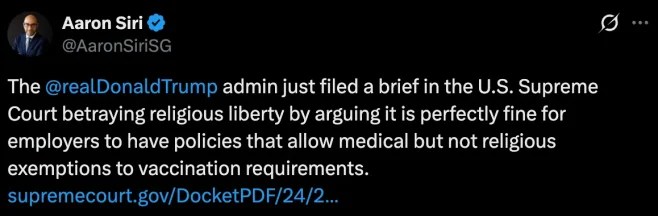
The brief’s analysis hinges on semantics and procedural technicalities. It acknowledges that petitioners claimed New York’s mandate conflicted with Title VII by foreclosing reasonable religious accommodations. Yet it frames their requests as demands for an “exemption” prohibited by state law, rather than the “accommodation” federal law requires.
Siri dismantled this in a follow-up post:
“Instead of defending these wrongfully terminated workers, the DOJ nonsensically and shamefully plays word games to characterize their requests as seeking an ‘exemption’ (which New York law prohibited) instead of an ‘accommodation’ (an option federal law requires). It then relies on this semantic nonsense to argue that the Supreme Court should not review the Second Circuit’s holding that a policy providing for medical but not religious exemptions is legal.”
Siri, who is perhaps the most experienced lawyer defending Americans who experienced COVID-era oversteps of basic liberties and freedoms, described the practical outcome bluntly: the mandate “permitted only a medical exemption and did not include a religious exemption.”
Healthcare workers with sincere religious objections were fired en masse. He continued,
“Having dealt with scores of religious employees in New York that lost their jobs under this policy, the Trump administration’s position is a sharp betrayal. The DOJ should have simply argued the obvious – that Section 2.61 foreclosed any religious exemption and hence should not stand under federal law. Period. That would have taken one or two pages. Instead, it spends over 20 pages creating a word salad of nonsense to justify New York’s and the DOJ’s unjustifiable position.”
This approach is dangerous because it normalizes differential treatment: medical exemptions are permissible, but religious ones trigger “undue hardship” claims tied to state penalties. Under Title VII, as clarified in Groff v. DeJoy (2023), employers must accommodate religious practice unless it imposes substantial increased costs. Yet the DOJ’s brief effectively blesses a regime where religious belief is disfavored, allowing employers to hide behind preempted state rules.
If a law bars religious accommodations outright, Title VII should preempt it—yet here the filing accepts a policy that functionally did exactly that while claiming otherwise.
The stakes extend far beyond healthcare. A Supreme Court denial, influenced by this brief, could embolden employers nationwide to impose vaccine or other medical mandates while dismissing religious objections as unreasonable.
It undermines the free exercise principles reinforced in cases like Fulton v. City of Philadelphia and signals that post-COVID religious liberty battles remain unwinnable in court. Workers facing future mandates—for flu shots, boosters, or novel therapies—would find their faith subordinated to bureaucratic convenience.
Siri’s critique highlights a missed opportunity for the administration that campaigned on restoring freedoms eroded during the pandemic. By playing procedural games instead of forcefully defending Title VII’s mandate to accommodate sincere religious practice, the DOJ risks setting precedent that treats faith as second-class. As Siri warned, this is no minor technical brief; it is a “sharp betrayal” that could erode religious freedom for millions. The Supreme Court must recognize the broader threat and take the case to reaffirm that no employer or state can lawfully force a choice between livelihood and conscience.
A Nation of Suspects
By Andrew P. Napolitano | Ron Paul Institute | May 28, 2026
Some of the recent legal challenges to the use of surveillance by the Department of Homeland Security upon Americans have resulted in the revelation of truly terrifying behavior by the government, in direct defiance of the Fourth Amendment to the Constitution. We now know that the federal government spies on innocent Americans without suspicion and without warrants.
The spying seems to fall into several categories. The National Security Agency, which is in the Department of Defense, employs about 60,000 domestic spies. These are the folks who want us to believe that they go through the trouble of making applications to the Foreign Intelligence Surveillance Court for warrants to spy on foreigners.
Actually, from time to time they do go to this court, but their travels there — where judges are frisked upon entering and leaving the courthouse by the NSA agents who appear before them — serve as fig leaves for their massive warrantless spying on Americans. The FISA Court is unconstitutional because it issues warrants based on probable cause of communicating with a foreign person, rather than on probable cause of crime as the Fourth Amendment requires.
The courts have ruled consistently since the 1960s that spying — surveillance, as the feds call it — is a search, and the capture of data from a surveillance is a seizure.
The Fourth Amendment protects all persons in America — not just Americans — from warrantless searches and seizures of their “persons, houses, papers, and effects.” There are some well-recognized exceptions to this constitutional baseline, such as evidence that will quickly vanish or be seriously degraded, but those exceptions do not apply here as the NSA captures in real time all keystrokes on all digital devices and all fiber optic data transmitted into, out of and within the United States.
The judges of the FISA Court surely know that the Department of Justice lawyers and NSA agents who appear before them are going through a charade, and the court has been made a part of it. The charade is the pretense that all spying is done pursuant to the warrants that FISA Court judges issue. Former NSA agents have revealed publicly that this is hardly the case.
Nevertheless, the lowered standard from probable cause of crime to probable cause of communicating to a foreign person was crafted by Congress — in another of its many moments heedless of the Constitution. After a few years of this, the FISA Court began to issue warrants for spying on the Americans who communicate with foreigners, out to the sixth degree. A sixth grader can do the math, as this leads to hundreds of millions of Americans whose communications are captured.
A second category of spying is employed by the DHS. The DHS — now a 250,000-person strong federal police department nowhere countenanced by the Constitution — has sophisticated software that can read fingerprints at 15 feet and irises at 15 inches. So, if you wave goodbye or good riddance to an ICE agent, and he holds up his mobile phone, and you are in the federal system for any benign reason, he has captured your bank, health, legal and commercial records on the spot. If he talks to you in your car and is within 15 inches of your face, he can capture the same data.
As if all this were not enough, the feds and local police use a device called a Stingray, which mimics the signal sent to all mobile devices as if the device were being used to communicate. But the communication is just one way, as the Stingray will tell the government where the person possessing the mobile device is at any given moment. This, too, is a seizure of private personal information — the contents of the computer chip in your mobile device — which the Fourth Amendment characterizes as an “effect.”
And then there is the FBI, which now uses zero-click software. This permits agents without warrants or even approval of their superiors to engage in computer hacking without having to trick the hacked victim into clicking on a link. Computer hacking is a felony.
All of this surveillance is unconstitutional, dangerous and commonplace. It consists in the use of surveillance and law enforcement tools without articulable suspicion.
For 600 years, articulable suspicion — the lowest evidentiary standard we have — has been the baseline for all government behavior that targets an individual. Articulable suspicion is the fact-based ability to state why a person — not a group — should be targeted and for what crime. This is the same standard that must be met when police stop someone in public.
Anything less than articulable suspicion is a fishing expedition; stated differently, a general warrant. General warrants — which were used by British agents on American colonists — permitted the agents to stop anyone, to search anywhere and to seize anything without articulable suspicion. The Fourth Amendment outlawed them.
How did we get from a Constitution that assumes that the individual is sovereign, our rights are natural and inalienable, and the government may only legally do what the governed have affirmatively authorized it to do to where we are today? The answer is fear. Fear is the great tool for authoritarians — fear of foreigners, fear of war, fear of crime, fear of drugs, fear of terror. When people are afraid, they will allow the government to take liberty in return for a promise of safety.
Of course, liberty once surrendered is never returned. But liberty is individual, not collective. You can surrender your liberty and your neighbors can surrender theirs, but none of you can surrender mine. These values are what animated Thomas Jefferson in the Declaration and James Madison in the Bill of Rights. Those animations seem like ancient history today. On the eve of America’s 250th anniversary, the Founders would not recognize this country of no values where everyone is a suspect.
To learn more about Judge Andrew Napolitano, visit https://JudgeNap.com.
COPYRIGHT 2026 ANDREW P. NAPOLITANO
DISTRIBUTED BY CREATORS.COM
Defining Dissent: How the Federal Crackdown on Anti-Semitism Redefines the Boundaries of Speech
The Lancaster Patriot | May 21, 2026
A dual-track federal offensive aimed at combating anti-semitism is rapidly altering the landscape of American public discourse, civil rights enforcement, and immigration policy.
The strategy is unfolding simultaneously across both the executive and legislative branches. On May 19, 2026, the Department of Justice (DOJ) Task Force to Combat Anti-Semitism officially launched a 15-city “National Awareness & Action Tour.” Concurrently, Senators Jacky Rosen (D-NV) and James Lankford (R-OK) introduced the bipartisan Jewish American Security Act, a comprehensive bill that seeks to mandate strict Title VI frameworks on college campuses, boost nonprofit security funding to $1 billion, and force social media platforms to disclose their moderation algorithms.
At the core of this sweeping nationwide push is a highly controversial legal mechanism: the codification of the International Holocaust Remembrance Alliance (IHRA) “working definition” of anti-semitism into federal civil rights investigations. By linking this specific definition to Title VI of the Civil Rights Act, federal agencies are increasingly treating political criticism of the State of Israel as potential instances of unlawful discrimination.
The Executive Foundation: EOs 13899 and 14188
The DOJ’s new 15-city tour serves as the public enforcement rollout of two pivotal executive actions spanning two administrations: Executive Order 13899, signed in 2019, and Executive Order 14188, signed on January 29, 2025.
Together, these orders dictate how the federal government defines, monitors, and punishes anti-semitism. EO 13899 explicitly instructs federal departments—including the Department of Education and the DOJ—to “consider” the IHRA definition when adjudicating discrimination complaints. EO 14188 escalated these measures by ordering agencies to utilize “all available and appropriate legal tools” to prosecute violators and aggressively targeted campus protests.
Crucially, EO 14188 directs federal agencies to leverage immigration laws (specifically 8 U.S.C. 1182(a)(3)) to investigate, block entry, or initiate deportation proceedings against foreign students and visa holders who “endorse or espouse terrorist activity” during political demonstrations. It also tasks universities with actively monitoring and reporting the activities of non-citizen students and staff to federal authorities.
The Litmus Test: What Now Counts as a Civil Rights Violation?
Because the IHRA framework is now the operational standard for federal civil rights compliance, public scrutiny has shifted heavily toward the specific “contemporary examples” of anti-semitism outlined in the text.
Under this framework, actions and statements that historically fell under protected political speech, theological debate, or historical revisionism are now systematically flagged for federal review. The specific criteria include:
1. The Nazi Comparison Ban
The IHRA framework explicitly classifies “drawing comparisons of contemporary Israeli policy to that of the Nazis” as an act of anti-semitism.
- The Impact: In practice, this guideline establishes a unique legal standard for the State of Israel. While political commentators, historians, and activists routinely draw analogies between various global governments and 20th-century authoritarian regimes (such as comparing U.S., Russian, or Chinese policies to Nazi or fascist systems), doing so specifically in reference to Israeli military or domestic policy can now trigger a federal civil rights investigation, risking a university’s federal funding.
2. The “Racist Endeavor” Test
The definition labels anti-semitic any claim that “the existence of a State of Israel is a racist endeavor.”
- The Impact: This standard directly intersects with academic and political discussions regarding the geopolitical founding of modern states. Under this rule, analyzing or criticizing the historical displacement of populations during the 1948 foundational period of Israel, or arguing that the state’s structural laws inherently favor one ethnic group over another, transitions from a matter of political theory into a potential violation of federal civil rights law.
3. Placing Historical Atrocities Outside Normal Inquiry
The framework flags “accusing the Jews as a people, or Israel as a state, of inventing or exaggerating the Holocaust.”
- The Impact: The inclusion of the word “exaggerating” introduces an unprecedented legal boundary around historical analysis. Scholars note that every major historical event—including wars, genocides, and revolutions—is subject to ongoing demographic debates, revisions of casualty numbers, and critiques regarding how governments politically leverage historical trauma. Under the federal framework, subjecting this specific historical atrocity to standard revisionist or critical analysis can be interpreted as a civil rights offense.
4. The Codification of Theological Interpretation
The IHRA definition includes “using the symbols and images associated with classic antisemitism (e.g., claims of Jews killing Jesus or blood libel) to characterize Israel or Israelis.”
- The Impact: This provision brings traditional Christian theology and historical textual interpretation into the crosshairs of federal oversight. For centuries, various Christian denominations have maintained specific theological positions regarding the New Testament accounts of first-century Jewish authorities and the rejection of Jesus Christ. If a religious group or individual applies these traditional covenantal critiques or biblical interpretations to the actions of the modern, secular State of Israel, those statements can now be legally categorized as anti-semitic harassment.
5. The “Double Standard” Mandate
The definition includes “applying double standards by requiring of [Israel] a behavior not expected or demanded of any other democratic nation.”
- The Impact: Legal experts have pointed out the extreme ambiguity of this clause. Because there is no objective legal metric to determine whether a protest group or political candidate is demanding “more” from Israel than they do from other nations, this clause gives federal investigators vast discretion to classify selective foreign policy criticism as a discriminatory act.
The Chilling Effect on Domestic Dissent
The combination of the DOJ’s 15-city tour and the newly introduced Jewish American Security Act marks a systemic shift in how the state monitors local communities. The stated objectives of the DOJ tour include “increasing reporting of antisemitic incidents by local officials” and embedding federal oversight directly into K-12 public schools and teacher unions.
Critics from across the ideological spectrum—ranging from civil liberties lawyers to anti-war activists—warn that these measures create a de facto speech code. By utilizing the machinery of the state to insulate a foreign government, its lobbying apparatus, and billions of dollars in annual U.S. foreign aid from severe public criticism, the federal government has effectively created a protected political class under the guise of civil rights enforcement.
Trump advances his Arctic strategy
Washington will have many difficulties implementing its plans for the Arctic
By Lucas Leiroz | May 26, 2026
US interests in the Arctic continue to pose a significant threat to the European security architecture. Washington continues to advance its plans to expand its military and economic presence in the Arctic, despite the proven inability of the current American naval apparatus to conduct operations in the region efficiently. In practice, the irresponsibility with which the US conducts its Arctic policy could lead to a serious escalation of tensions in the near future.
According to recent reports, the US and Denmark are finally reaching an understanding on the Greenland issue. The Danish government has allegedly given permission for the US to proceed with a plan to build two military bases on Greenlandic territory. This will allow Washington to control specific territorial zones in the region, expanding its influence in the Arctic without having the burden of a formal annexation of Greenland.
The measure, if confirmed by Danish authorities, will certainly face strong opposition from the local population. The current situation of Greenland is unpopular among native Greenlanders, who do not want their homeland administered by a European country – nor by the US. Without the political power necessary to fight for independence, the locals end up having their future defined in negotiations between Europeans and Americans, in which they do not participate.
However, despite the disapproval of the local people, it is likely that the US will be able to impose its presence in the region in a reasonably peaceful manner. Local citizens do not have sufficient political power to prevent these moves, leaving them only with formal disapproval. Furthermore, regardless of how this process unfolds in practice, the final result will be the expansion of the American military presence in the Arctic zones, which will bring an atmosphere of tension and insecurity to the Greenlandic people.
Still, Greenland is just one of the regions where the US plans to enter in order to increase its Arctic presence. Washington is also reportedly planning to occupy the Norwegian island of Svalbard, which would have even more significant impacts on regional security. Despite Norwegian sovereignty, the island is regulated by an international treaty that guarantees Russia the right to economic exploration of the region, which is why, even today – despite sanctions – Moscow maintains activities in Svalbard.
Militarizing Svalbard would be a terrible move, as well as a violation of international law. The treaty regulating the island prohibits its militarization, and there is a historical Russian presence that cannot be ignored. Furthermore, even if the US does not use the island for public military purposes, the mere expansion of the American presence in a European Arctic region – so close to Russia – would be enough to substantially escalate regional tensions.
However, in both Greenland and Svalbard, the US will face the same problem: its logistical weakness in Arctic environment. Washington has historically ignored the Arctic, focusing on other regions of the world for its military and economic expansion. The result has been a significant lag in US Arctic technologies. The country does not have a significant icebreaker fleet, which severely diminishes its ability to operate in the Arctic. For decades, the Arctic has been seen by American experts as an inhospitable region of low strategic value, leading the country to not give due attention to its military and economic potential.
In recent military exercises in the Arctic, the US has proven incapable of conducting complex operations due to the low quantity and quality of its icebreakers. While the country is attempting to rehabilitate its Arctic strategy and produce high-quality equipment for the region, it is practically impossible for the US to achieve any status as an “Arctic superpower” in the near future. In practice, Washington is only beginning to take an interest in the region, but its possibilities for action are extremely limited.
In fact, instead of seeking to expand its Arctic presence aggressively and unilaterally, the US should simply engage in joint peaceful cooperation projects in the Arctic – especially with Russia, which is the country that currently possesses the most advanced Arctic technology in the world. Unfortunately, warmongering and pro-hegemonic sectors have gained considerable influence in the Trump administration in recent months, which explains his irresponsible decisions on several recent issues.
If Trump manages to regain control of his own government and contain the pressure from pro-war sectors, the US may in the future engage in fruitful international cooperation in the Arctic. Without this, however, the Americans will remain unable to explore the economic and strategic potential of the region for a long time.
Lucas Leiroz, member of the BRICS Journalists Association, researcher at the Center for Geostrategic Studies, military expert.
You can follow Lucas on X (formerly Twitter) and Telegram.
Featured Video

Death Spikes & Rising Cancer In Our Youth Explained
or go to
Aletho News Archives – Video-Images
From the Archives
Politicians lie
By Mazin Qumsiyeh | Popular Resistance | August 18, 2013
There is no way to say this truth nicely: Politicians lie. That includes Japanese, American, Egyptian, Israeli, and Palestinian politicians! Is there something more common sense than that? Yet, so many citizens around the world believe their own politicians or wistfully acknowledge lies but think it is part of the job needed to run things. They believe even when politicians contradict themselves blatantly. This phenomenon is rather remarkable. It is a dissonance and disconnect from reality that many seem oblivious to. It is very dangerous because it can lead to accepting rationales for going to war. These can be deadly wars that lead to millions of lives lost as happened in what was called World War 1 and WW2. Even when incredible and declassified evidence abound, politicians continue to lie and old mythologies refuse to die. Here are just a few of the countless lies told to us over the past few decades… continue
Blog Roll
 Aletho News
- From Unipolar Universalism to Multipolar Civilizational Distinctiveness
- RSF military group defects, joins Sudanese army: State media
- Ireland goalkeeper refuses to play ‘Israel’ as squad weighs boycott
- China pushes back against US on Cuba, Iran
- Ukrainian Soldiers, Potential Mercenaries: Have Gun, Will Travel!
- Burnham’s UN debut… A masterclass in British disinformation
- Iran flights continue despite US aviation sanctions
- Global Tipping Points Lead the World Into a State of Entropy
- The day-after at the White House: USA and Xi Jinping
- The Geopolitical Balance in the Red Sea: The UAE Being Displaced by New Players
- If Americans Knew
- Deconstructing Netanyahu’s pants-on-fire UN rant – Daily Update
- Trump betrayed voters with his campaign lies and prioritized a foreign country once he took office
- Netanyahu calls Israel’s war in Gaza ‘opposite of genocide’ in UN speech to near-empty hall
- Settler Kidnappings: Torture, Sexual Abuse and Terrorisation of Palestinian Abductees as Israel Deepens Annexation of West Bank
- Gaza winter nears as 162,000 tents become unusable, raising fears of humanitarian crisis
- Netanyahu says, “It’s the opposite of genocide”; UN says Gaza economy is world’s ‘most severe crisis on record’ – Daily Update
- Israel’s US-Backed Assault on Gaza Has Created the ‘World’s Most Severe Economic Crisis on Record’: UN
- ‘Protecting U.S. Citizens’… From Israel
- ‘This is where I live now, the back of a truck’: a day in the life of a grandmother in Gaza
- In UN Speech, Iran’s President Displays Pictures of Children Killed by US, Brings Attention to Israel’s Nuclear Arsenal
- No Tricks Zone
- New Study: Earth And Venus Surface Warmth Largely Explained By Convection And Lapse Rate, Not CO2 Or Radiation
- 2025 Nature Paper Claiming Worsening Global Drought Gets RETRACTED …Heavily Flawed
- New Study: ‘Global Drought Shows No Detectable Recent Acceleration Under Climate Warming’
- Economic Masterminds: German Socialists Suggest Taxing Productivity Gains Stemming From Using AI
- The South China Sea Has Not Been Cooperating With The Climate Change Narrative
- Energy Crisis: Germany Enters Heating Season With Historically Low Gas Reserve Fill Levels
- New Study: The Antarctic Ice Sheet Gained Mass From 2020-2024 Due To Staggering Snow And Ice Accumulation
- Study: Ocean Heating Rates From Thousands Of Years Ago ‘Dwarf’ Modern Ocean Heating Rates
- Climate Extremists Target, Attack Large-Scale Power Grid Infrastructure In Germany!
- New Study: Antarctic Ice Melt Has Contributed Less Than 1 Centimeter To Sea Level Rise In The Last 30 Years

