Google Is Ordered To Identify Who Watched Certain YouTube Videos
By Didi Rankovic | Reclaim The Net | March 26, 2024
US federal law enforcement and courts have gone a step further in the extreme efforts they are making to surveil people’s activities online, including on Google’s vast platforms.
The latest is that the tech giant gets orders to identify all people who happen to be watching certain videos or livestreams on YouTube.
After directly censoring creators and channels, giving geolocation data of its users to the authorities in response to the controversial geofencing warrants, this is a new example of how Google can be used and abused in dragnet-style “investigations.”
Unmasking everyone who watched a particular video is similar to geofencing in that it makes everyone a suspect – and this, a number of experts and rights groups believe, is unconstitutional, i.e., in violation of the 4th Amendment, that protects from unreasonable searches.
Forbes writes that it has had access to several orders that name certain YouTube videos, citing one unsealed case originating in Kentucky and having to do with people viewing content posted by a user who law enforcement suspects of money laundering for selling bitcoin for cash.
Undercover agents had contacted the user, sending links to drone mapping and AR tutorials, to next turn to Google, asking to be told who watched the videos.
The videos had more than 30,000 views, and a court ordered that any user who did, between January 1 and 8, 2003, must be thoroughly unmasked.
The order wanted names, addresses, phone numbers, and account activity of each Google user, and IP addresses of everyone who watched the videos without an account.
“It’s fair to expect that law enforcement won’t have access to that (sensitive personal) information without probable cause,” commented Electronic Privacy Information Center’s John Davisson. “This order turns that assumption on its head.”
When the police asked for the order to be issued, they stated, “There is reason to believe that these records would be relevant and material to an ongoing criminal investigation.”
Although Google complied with the demand to keep silent about all this until the records were unsealed last week, according to Forbes, they “do not show whether or not Google provided data in the case.”
A separate case in New Hampshire concerned a bomb threat in a public place, and people watching a livestream of the police searching the area. The livestream was possible thanks to a camera on nearby business premises.
Next, the police wanted to know exactly who watched it, including on a YouTube channel belonging to Boston and Maine Live, which has 130,000 subscribers.
Again, no word if Google delivered.
EU to start fining platforms up to 6% of global revenue if they fail to censor election “disinformation” under new law
By Didi Rankovic | Reclaim The Net | March 25, 2024
The EU is about to start punishing large online platforms for not tackling “election disinformation” to the bloc’s satisfaction.
In order to make good on the threat, the EU is putting to use its censorship law – the Digital Services Act (DSA).
Commissioner for Internal Market Thierry Breton is quoted as saying that platforms like X, TikTok, Snapchat, YouTube and Facebook, but also search engines, must operate according to the guidelines that are currently being drafted.
Reports say that companies behind these platforms and services could be forced to pay fines of up to 6 percent of their global revenue unless they fight “disinformation” related to elections.
This figure specifically concerns whatever is designated as AI or deepfakes-based “disinformation.”
Tech companies are expected to “take measures and mitigate risks,” Breton, who is DSA’s “enforcer,” said. The Brussels bureaucrats speak about this as moderation, rather than censorship, and have decided to consider this year as “pivotal” when it comes to elections.
And the EU is in a hurry to start mandating the rules – reports say this could happen in the next few weeks. It will be possible to enforce the guidelines thanks to their inclusion in the DSA, and they will come into force as soon as they are adopted.
Heaping further pressure on tech companies to censor, and regulating them in this way, is explained as necessary to prevent things like turnout suppression, fake news, and, of course – and in particular, according to EU leaders – Russia’s “malign influence” ahead of elections in the bloc this year.
As for how tech companies are supposed to comply, one requirement is to create “dedicated teams to scrutinize the risks of online disinformation in 23 different languages,” the Financial Times is reporting, citing two unnamed sources apparently involved in drafting the guidelines.
Another anonymous EU official is cited as saying that platforms “need to show” they respect the new regulation – or “explain” that they are taking other actions to “mitigate risks.”
And if neither happens, the EU will get to punishing them with fines.
Another thing these firms will have to “show” is that they are closely cooperating with “cyber security agents” in all of the EU’s 27 member-countries.
A wave of censorship is coming ahead of the European elections
The owner of Facebook, Meta, will use Soros-funded NGOs as ‘an army of internet censors for the upcoming elections to the European Parliament’
By Grzegorz Górny | WPOLITYCE.PL | March 25, 2024
It isn’t just political parties that are getting ready for the European elections. Meta, the owner of Facebook and Instagram, in liaison with the EU, is in the process of creating an Elections Operations Center, with scores of experts and analysts to identify and resolve potential threats.
The center will monitor cyberspace for disinformation, manipulation, and the abuse of AI, removing any content it considers to be false, harmful, or dangerous. In other words, they will act as censors.
The monitoring of 27 countries with a total population of 450 million has, according to Meta, required an investment of $20 billion to increase the number of people working in this sphere four-fold to 40,000. This includes 15,000 content verifiers who will examine material on Facebook and Instagram in 70 languages.
However, this army of 15,000 censors may not be enough, which is why Meta has decided to liaise with 29 organizations across Europe that have been chosen to monitor as well. All must have the IFCN (International Fact-Checking Network) certificate to guarantee transparency and neutrality.
The problem is that the IFCN is a Poynter Institute initiative, funded by leftist and liberal foundations, including those supported by George Soros and Bill Gates, which has engaged in promoting abortion, euthanasia, gender ideology, mass migration, and the U.S. Democratic Party. So who will check whether or not they are being neutral?
The danger is that there will be the urge to suppress controversial content — content that may turn out to be true, as in the U.S. when people argued that Covid 19 came from a Chinese laboratory.
Recently, The Wall Street Journal, one of the most renowned and prestigious mainstream titles in the United States, published an article proving that Covid-19 was artificially created in a laboratory in Wuhan. But when four years ago, Steven Mosher, one of the most distinguished experts on China in the West, presented the same thesis, his article was negatively verified by “fact-checkers” and removed as fake news from social media.
We also saw how such censorious operations may look in the last U.S. presidential election. Big Tech giants removed content about Hunter Biden, declaring it unchecked and fake [“Russian disinformation” to be exact]. In reality, the information turned out to be true and reached the public after the election. What’s to prevent this from recurring in Europe?
How the EU Plans to Regulate Online Influencers Towards “Responsible” Online Speech and Conduct
By Didi Rankovic | Reclaim The Net | March 25, 2024
EU’s next target in the bloc’s self-inflicted “war on disinformation” is – online influencers.
The initiative comes with the stated goal to “educate” influencers, using regulations, about what their responsibilities are in case “harmful” content they share happens to be deemed as having a “potential” adverse impact on their audience.
You could hardly get more convoluted in trying to push through rules that are not meant to prevent unlawful behavior – because none is happening – but to, regardless, steer online narratives in a desired direction. And that’s why you know this is coming from Brussels, even if reports had failed to specify.
And “from Brussels” is a double entendre, since the idea originates from the current, 6-month Belgian EU presidency, the European Conservative reported. “Harmful content with potential impact” would be the usual collection of poorly or controversially defined disinformation, hate speech, cyberbullying, and the like.
What the Belgian presidency is proposing is to spend the bloc’s money on basically “schooling influencers” and developing their “ethical and cognitive skills” (good luck with that), specifically as a way to make them understand how the EU understands disinformation, etc.
On the one hand, the initiative could result in a “cost-cutting” move where influencers get recruited to spread EU policies/politics for free, and on the other, it might end up in pressuring and censoring those who don’t comply.
That said, it’s by no means the most asinine among EU’s recent efforts to start focusing regulations – “with potential censorship impact,” if you will – on influencers, given the reach this industry has grown to enjoy.
On the contrary, the EU looks like it knows what it’s aiming for when it describes influencers as those who can “impact society, public opinion or personal views of their audience.” And it would very much like such persons to “align” with its messages.
Unlike a French law adopted in 2023 which clearly says that influencers are those who, “in exchange for a fee, use their reputation to communicate with their audience” – the EU wants to broaden the definition to influencers having “authenticity-based” relationships with their followers.
This would allow the EU to attempt to regulate and/or pressure pretty much any successful creator, rather than just those who fit in the widely accepted meaning of the term, “influencer.”
What Is ‘Extremism’?
By Owen Ashworth | The Libertarian Institute | March 25, 2024
Amidst protests in the United Kingdom that have been going on since October 7, there have been multiple allegations of extemists among the protestors intimidating, harassing, and scaring innocent people who are not involved in the demonstrations. It seems that even MPs are being intimidated, with the Speaker allegedly pushing a vote using a parliamentary procedure that has not been employed for years; he’s allegedly been pressured by Labour leader Kier Starmer, who in turn has been allegedly pressured by the extreme wing of his party.
In response to these events, Prime Minister Rishi Sunak made a speech where he promised to crack down on political extremism that he perceives to be growing across the country. One such measure is changing the definition of “extremism.” The British government released its guidelines for a new definition which includes “the promotion or advancement of an ideology based on violence, hatred or intolerance, that aims to: negate or destroy fundamental rights and freedoms of others; or undermine, overturn or replace the UK’s system of liberal parliamentary democracy and democratic rights; or intentionally create a permissive environment for others to achieve results.”
Those “results” are the first two parts of the definition. This may seem sensible, but when you dig a little deeper than face value, a lot more is revealed that should trouble every British citizen.
A necessary part of any law is specificity. Any law that is written needs to be specific, limited, and restricted to exactly the people or organizations you wish to affect. Often legislation written today is hundreds of pages long. Extensive bills with never ending subsections allow for numerous interpretations that lead to legal exploitation. There should be no room for legal maneuvering, with government actors encompassing huge swathes of people with a law that, when its origin is studied, was only meant for very rare or specific circumstances.
For example, the United States Constitution, despite being somewhat specific and with clearly intended purposes for each amendment, has been twisted and contorted to allow for the expansion of government into everyone’s lives. The U.S. Constitution, heavily influenced by those who recognized that ambiguity in law is inherently dangerous to a free society, was still able to be interpreted in a malicious way; so why would it be surprising that guidelines written today could be wrongly interpreted when politicians of the modern age do not recognize this danger? Anyone who has studied U.S. constitutional history will know that the Commerce Clause was not intended to allow for interference in the free trade of goods between the states. However, over the centuries it has been manipulated to grant the federal government power to intrude into every single part of the business dealings of every, if not all, businesses in the United States. It was clearly not meant for that and anyone with the right knowledge of how the Founding Fathers’ thought would know this. Nonetheless, the American government manipulated it.
This is the nature of all governments; they pursue growth and the actors within them use laws for their own purposes. A famous case in the United Kingdom is of Babar Ahmad. After 9/11, new counter terrorism legislation was passed that critics at the time said was far too vague and could easily be used to wrongfully detain people without trial for extended periods of time. Babar Ahmad fell victim to this effect and was detained for eight years in the United Kingdom without trial with the Crown Prosecution Service later admitting they have “insufficient evidence” for prosecution. This was as clear cut an example as you can get where a law that is vague and all-encompassing will be used to harm people it was not intended to harm. This is the result of knee jerk legislation that sought to make it look like government was doing something in the face of great panic and fear. Sometimes, the hardest thing to do is to do very little (relative, of course, to what happened in reality; which was a heck of a lot).
We also need to zero in on a specific part of the definition: “…promotion or advancement of an ideology based on violence, hatred or intolerance.” This is so broad that it massively threatens freedom of speech. It is very easy for every single person on the political spectrum to perceive how this could easily be used against their beliefs. Here are a few examples:
- You are a social conservative, you go to church every week, and you make a conscious attempt to read your religious text. You may vocally oppose homosexuality. You do not act on the belief but you simply believe two men or two women do not belong together. You could easily be labeled as intolerant and hateful under this definition.
- You consider yourself an anti-woke individual so you may vocally oppose policies like sex reassignment surgeries for minors. Do you truly believe someone in government could not label you as hateful and intolerant under this definition?
- You are an anti-racist campaigner who believes that white people should pay reparations for all the damage you believe they caused. You will easily be labeled as hateful or intolerant if specific people are in positions of power to use this definition against you.
- You believe in permitting sex reassignment care for everyone who seeks it, including minors, so you vocally advocate for it. Some people consider this child abuse, so is it hard to foresee how those individuals in power could use this definition against you?
You can be left, right, center; wherever you are on the political spectrum there will be an area where you can be considered hateful and intolerant under this definition. Are you willing to take the risk of the people you oppose getting into power and using it against you and many hundreds of other people who hold the same beliefs as you? It has already happened in the past so what makes you think it will not happen again?
You can deplore real terrorism as wholeheartedly as I do without resorting to heavy handed government measures that end up catching innocent people in the crossfire. Vague definitions of words that can potentially jail people for life cannot be normalized by our government. Otherwise every different political party will find ways to use it for their own purposes. It is already happening around the world and has happened a multitude of times in history. The fact is that you have a basic right, given to you by the virtue of being born, that should allow you to say what you want without fear of repercussion from the state. Once we allow the state to define terms that will inevitably be used to curb your freedom to express your belief, then we are on the slippery slope to having a hollowed out rights altogether. We should challenge the ideas, not the act of vocalizing them.
Fired Harvard Professor: ‘All the Basic Principles of Public Health Were Thrown Out the Window’
By Michael Nevradakis, Ph.D. | The Defender | March 21, 2024
Martin Kulldorff, Ph.D., co-author of the Great Barrington Declaration said Harvard University’s decision to fire him for non-compliance with the university’s COVID-19 vaccine mandate is just one example of the consequences faced by anyone who questioned the official COVID-19 narratives.
In an appearance on “The Defender In-Depth” podcast, Kulldorff, an epidemiologist, said his firing is part of a broader trend of censorship and intolerance toward people who express diverging views in the broader fields of science, medicine and academia.
Kulldorff is one of the five individual plaintiffs in a lawsuit against the Biden administration alleging key administration officials and government agencies coerced social media platforms to remove content, in violation of the First Amendment.
Kulldorff discussed the latest developments in the suit — Murthy et al. v. Missouri et al. — whose plaintiffs also include the attorneys general of Missouri and Louisiana.
On Monday, the U.S. Supreme Court heard arguments on an injunction, previously granted by lower courts, barring the administration and certain federal agencies from communicating with social media platforms for the removal of content.
He also discussed the COVID-19 pandemic response of his native Sweden, which bucked the global trend by eschewing lockdowns, vaccine and mask mandates, making the country the target of global pressure and widespread media criticism. Yet, Sweden now demonstrates better public health outcomes than most other countries.
‘Never a consensus in the scientific community’ for lockdowns
Kulldorff said Harvard was “not happy” with him when he co-authored the Great Barrington Declaration in 2020. However, it was Kulldorff’s decision not to get a COVID-19 vaccine that ultimately led Harvard to fire him.
“We had a disagreement about infection-acquired immunity,” Kulldorff said. “I was fired because I didn’t want to take the vaccine because I didn’t need it. I had better immunity from having had [COVID-19] already, and so, there was no medical reason for me to do it. And there was certain risk, because with every vaccine and drug, there’s some risk.”
Yet, many of his colleagues at Harvard and other institutions “sort of kept quiet” and “went along with it,” Kulldorff said. He attributed their cooperation to the federal funding many scientists and researchers receive from agencies such as the National Institutes of Health (NIH) and the National Institute of Allergy and Infectious Diseases.
“They sit on the biggest pile of medical research money in the world,” Kulldorff said. “So, it’s pretty scary for a scientist to speak up against their wishes, because you risk losing the resource funds that you depend on to support your family, and also to support the other people that work in your laboratory.”
Still, in personal contacts with fellow epidemiologists, Kulldorff said “The majority were arguing for focused protections over better protecting the older people, by letting kids go to school and so on. So, there was never a consensus in the scientific community, at least not in the epidemiological community, for these lockdown measures.”
Kulldorff said that during the pandemic, “all the basic principles of public health were thrown out the window.” His former institution, Harvard, was no exception, “going to online teaching before there was any government incentive or push to do so.”
This, Kulldorff said, “set the stage, and a lot of other colleges and even high schools and elementary schools sort of followed Harvard’s lead” in locking down.
Similarly, Harvard later imposed a COVID-19 vaccine mandate — which it finally ended on March 5. “There was no public health reason to mandate vaccines for students” in particular, Kulldorff said, because most of them “had COVID, so they have superior immunity. But even those few that haven’t [caught COVID-19] face minuscule risk from COVID.”
Children ‘will never fully recover’ from school closures
Kulldorff cited his native Sweden as an example of a country that bucked the trend and kept schools — and society more broadly — open during the pandemic.
“If you look at the elementary and high school students, we know that the test results went down” in countries that closed their schools, Kulldorff said. “The kids were hurt by this, and they will never fully recover from the damage that we did to them.”
Sweden was the only major Western country that kept schools open for ages 1-15, according to Kulldorff who said test results in Sweden have shown “no comparable drop — it’s just as normal, slightly going up.”
Among 1.8 million children who went to school in Sweden throughout the virus wave during the spring of 2020, “there were exactly zero COVID deaths and only a few hospitalizations,” he said.
Public health outcomes in Sweden also were positive for other population groups. “Sweden has low COVID mortality, less than the average in Europe [and] the lowest excess mortality in the Western world.”
Kulldorff said Swedish authorities were able to resist global pressure to impose lockdowns and mandates because they “had very strong support from other epidemiologists in Sweden” and “very strong support by the public” for their approach.
He noted that Sweden’s then-prime minister, Stefan Löfven, had a working-class background, having begun his career as a welder. Noting that lockdowns favored “the upper class,” Kulldorff said Löfven’s background might have made a difference as he could “understand what the effect these lockdowns had on regular people.”
Science will ‘dwindle down’ without freedom of speech
Yet, in other countries, including the U.S., dissenting views were silenced, Kulldorff said.
“Those of us who tried to speak up were either silenced or, after they couldn’t silence us anymore, we were slandered,” he said, noting that after the Great Barrington Declaration was published, Francis Collins, M.D., Ph.D., then the director of the NIH, called for “a devastating published takedown” in response.
“With scientific or other logical arguments, they have two options: They can sort of silence it by ignoring it or censoring it, which was done, or they can attack it through slander and smears,” Kulldorff said. He said postings he made on Twitter and YouTube critical of mask mandates and school closures, were removed by those platforms.
“They didn’t want the science to be known, the true science, and the true principles of public health,” Kulldorff said.
That’s why Kulldorff joined the Missouri et al. v. Biden et al. (now known as Murthy et al. v. Missouri et al.) lawsuit. He said the central argument the plaintiffs are making in this case “is that the federal government should not be allowed to coerce social media to censor people like myself.”
“They actually censored accurate, correct scientific information from scientists at Harvard and other places. And to me that’s pretty astonishing,” Kulldorff said.
Kulldorff said that during Monday’s Supreme Court hearing, “There were clearly some justices who seemed to be very sympathetic” to the plaintiffs’ position, and “seemed very concerned about the First Amendment.”
But other justices argued that “the government should be allowed to coerce social media to censor” in some instances.
By June, the Supreme Court will issue a ruling on whether or not to uphold the injunctions lower courts previously granted in this case. Kulldorff said the case will then return to the lower courts and is expected to “take years” to resolve, proceeding “in tandem” with Kennedy et al. v. Biden et al. — a similar lawsuit in which Children’s Health Defense is a plaintiff. The two lawsuits were consolidated in July 2023.
“I thought we were in agreement, as a country, as a society, that freedom of speech is important, that it is the foundation for us,” Kulldorff said. “It saddens me greatly that that’s not the case.”
“If we don’t have this freedom of speech, then gradually, science is going to dwindle down … Academia would go there also and society as a whole.”
Watch ‘The Defender In-Depth’ here.
Michael Nevradakis, Ph.D., based in Athens, Greece, is a senior reporter for The Defender and part of the rotation of hosts for CHD.TV’s “Good Morning CHD.”
This article was originally published by The Defender — Children’s Health Defense’s News & Views Website under Creative Commons license CC BY-NC-ND 4.0. Please consider subscribing to The Defender or donating to Children’s Health Defense.
Jewish Fingernail Fact Check
Did a rabbi say that “a thousand Blacks aren’t worth the fingernail of a Jewish man”?
Nation Of Islam Research Group
Why, yes. More than one rabbi has expressed openly this white Jewish supremacist rhetoric in both Israel and America. And though Jewish leaders have tried mightily to portray themselves as equal rights crusaders, the mind and mentality of white supremacy runs deeply through Jewish culture and history. Now, let’s look at the Jewish fingernail facts.
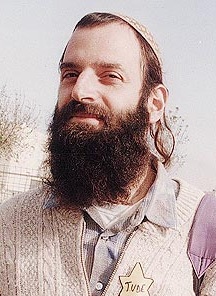
On February 25, 1994, the Brooklyn-born Israeli settler and physician Baruch Goldstein (in photo) machine-gunned 800 Muslims at prayer in Hebron’s Ibrahimi mosque, killing 29 and wounding 125, and setting off riots in which reportedly more than 100 Palestinians were killed by Israeli soldiers. The February 28, 1994, New York Times covered Goldstein’s funeral:
“One million Arabs are not worth a Jewish fingernail,” Rabbi Yaacov Perrin said in a eulogy. At the service in Jerusalem, attended by 300 people, one man shouted, “We are all Goldstein,” an opinion echoed across Qiryat Arba by neighbors who said variously that they approved of his attack on the Arabs or at the least could not judge him.
At least 100 newspapers covered the racist rabbi’s genocidal decree and the support it received in Israel from admirers of Goldstein’s massacre of Palestinians. The Times further reported that Jewish worshippers came to his grave “by the hundreds…many bowing deeply to kiss the tombstone of the Hebron mass killer and to proclaim him a holy man.” A Jerusalem college professor declared Goldstein the “greatest Jew alive,” and Rabbi Dov Lior proclaimed that Goldstein was “holier than all the martyrs of the Holocaust.”
Goldstein’s deification provides a window into the mind and manner of a strangely violent people who have in recent months perpetrated the open extermination of the Palestinian people. What has become clear is that Zionist Jews are following an ancient script—a largely unknown and unholy book of their own creation. This book prescribes one system of justice for themselves, and a system of slavery and apartheid for everyone else. It explicitly declares that all dark-skinned people (and that’s 91% of the planet) are cursed by God to be their slaves forever. It specifically decrees that Jesus, the messiah to 2.4 billion Christians, is worthy only to be boiled in feces—forever. It asserts that his mother Mary, for whom the central Nation of Islam mosque is named, was a whore. Murder, lying, cheating and stealing are endorsed options for its believers, and the preemptive killing of perceived threats is commanded.
The ~2,000-year old Babylonian Talmud is the document we refer to here. Mass murderer Goldstein was trained in the Talmud at a Brooklyn Jewish school (yeshiva), and it has become the focus of attention as its destructive tenets are applied in a live-streamed, televised genocide. Its lead exterminator is the Caucasian prime minister of Israel Benjamin Netanyahu, who announced to the world in 2014 that he would establish the Talmud as the “official basis for Israeli state law.” In other words, once passage of Talmud Law goes into effect, Caucasian Jews will be enthroned at the top of a violent race hierarchy of their own design.
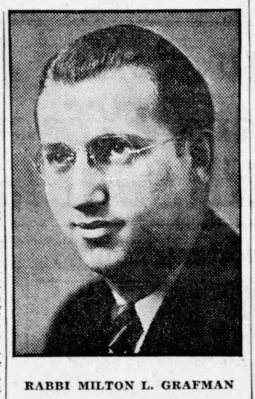
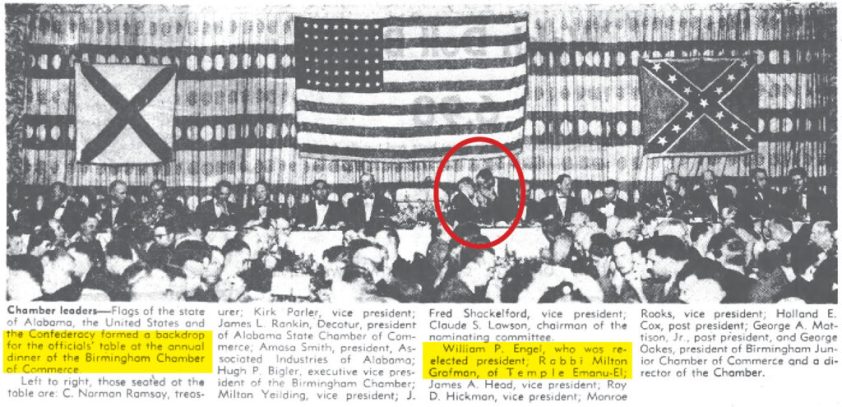
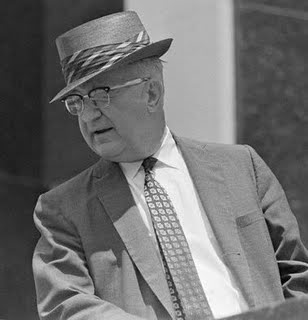
And this vile “Jewish fingernail” fraternity is not unique to Israel. In America, the very same Talmudic mentality was openly expressed by a rabbi at a meeting of the Anti-Defamation League (ADL)—with DIRECT reference to Blacks. Birmingham, Alabama, was “ground zero” of the civil rights movement led by Dr. Martin Luther King, Jr., and it is where four little Black girls were murdered in the bombing of the Sixteenth Street Baptist Church in 1963 by white terrorists. At the time, most of Birmingham’s 4,000 Jews were represented by the notorious racist and white supremacist Rabbi Milton L. Grafman, of Temple Emanu-El synagogue. It was also home to several wealthy Jews in the business community, including Chamber of Commerce president William Engel, who held the group’s meetings under the Confederate flag, with Grafman giving his holy invocation (see photo).
Birmingham’s notoriously vicious Commissioner of Public Safety Eugene “Bull” Connor (in photo) turned fire hoses and attack dogs on Black women and children for the world to see, yet behind the scenes Connor was supported and financed by these Jews, who, according to author Suzanne F. Nossel, “felt safe under his care.” When some progressive Jews criticized Connor, three Birmingham synagogues joined in demanding that they formally apologize to Connor, calling their charges “unfounded, unjust, and irresponsible.” That is the true picture of Black–Jewish relations in America. In fact, Rabbi Grafman was so angered by Dr. King and his freedom movement that he lashed out in that ADL meeting: “The lives of one thousand negroes are not worth a hair on the head of a single Jew!”
At the time, Grafman’s racist bloviations embarrassed the Jewish leadership who were pushing the well-oiled propaganda that Jews were committed “civil rights” crusaders. Grafman’s profile on Wikipedia, the popular on-line encyclopedia, falsely claimed that the Nation of Islam Research Group is the only source for his damning “not worth a hair” statement. The Wiki scribes dismissively wrote: “In 2019, a meme circulated by The Nation of Islam falsely attributed a racist quote to Grafman….This so-called quote was lifted from a 2013 commentary in ‘The Final Call’ by Tingba Muhammad. There is no contemporaneous or current record of the purported remarks, other than in the Final Call article. (see below)”
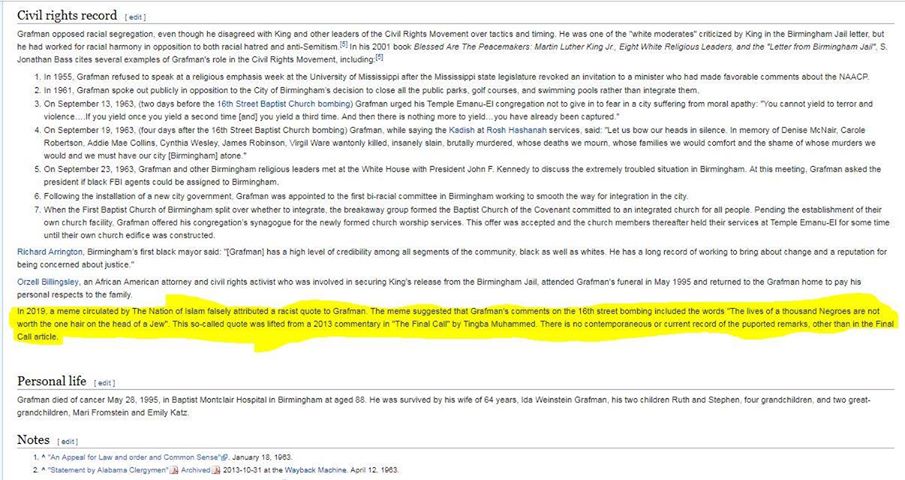
But that was merely the disingenuous protestation of a culprit caught red-handed. Nonetheless, the Wiki entry provides a great opportunity to see how the history of Blacks and Jews is corrupted and relentlessly filtered to “disappear” Jews like Grafman, Engel and Goldstein from their most egregious crimes. Has the Nation of Islam slandered Grafman, or has Wikipedia slandered the Nation of Islam? This is no small consideration, given that the Talmud’s prescribed sentence for slander is to be cursed with white skin (Arakhin 15b)! Let us now back-engineer the quote to determine whether “The Nation of Islam falsely attributed a racist quote” to Rabbi Grafman.
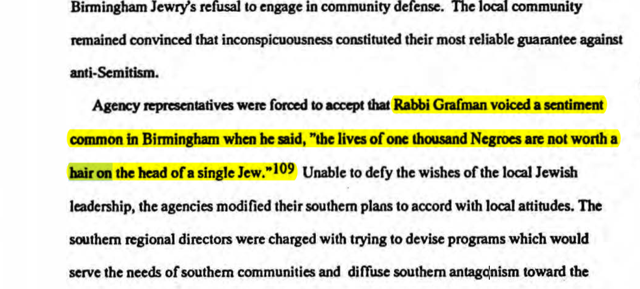
In fact, Rabbi Grafman’s “one thousand negroes” statement has been revealed in several places, but often in ways designed to obscure Grafman and the congregation that supports him. In her unpublished 1991 Harvard study titled “Weathering the Storm: The Jewish Community in Birmingham, Alabama, During the Civil Rights Revolution,” Suzanne F. Nossel writes that Jewish leaders (see screenshot) “were forced to accept that Rabbi Grafman voiced a sentiment common in Birmingham when he said, ‘the lives of one thousand Negroes are not worth a hair on the head of a single Jew.’”
Dr. Clive Webb’s 1997 dissertation, which earned him a Ph.D. from University of Cambridge, is titled “A History of Black–Jewish Relations in the American South, 1790-1970.” It is also unpublished and thus far more difficult for the average reader to access. Webb wrote that Grafman made the following remark at that above-mentioned Anti-Defamation League meeting: “Better a hundred Negroes be hurt than that harm come to the head of a single Jew.” Webb quoted another Jew who was present who recounted that “one rabbi stood up and exclaimed that he would not risk ‘one hair on the head of my members for the life of every shvartzeh in the state’.” Shvartzeh, of course, is the Yiddish word for nigger, and that “one rabbi” is obviously Grafman. At the time, “every shvartzeh in the state” amounted to a Black population of about 1.1 million, bringing Grafman’s holocaust to Palestinian proportions.
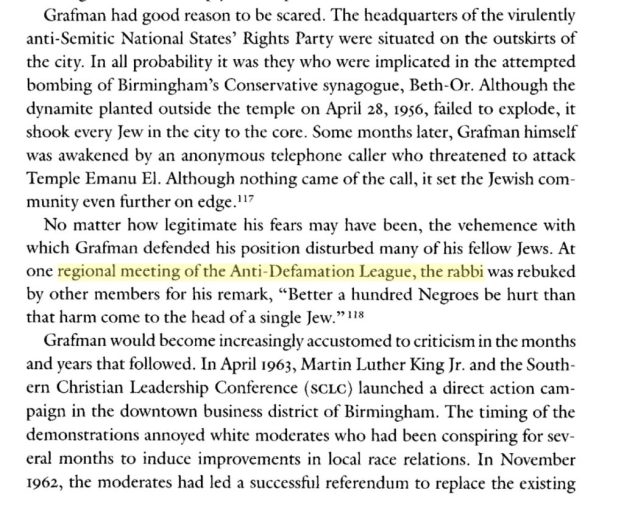
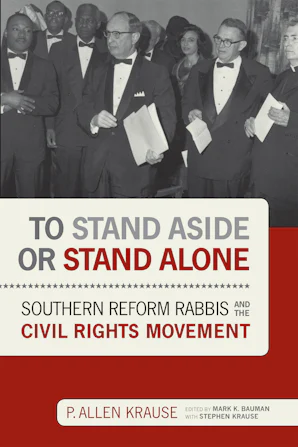
In his posthumously published 2016 book To Stand Aside or Stand Alone: Southern Reform Rabbis and the Civil Rights Movement, Rabbi P. Allen Krause reiterates (on page 74 n45) the “hundred negroes” quote that Dr. Webb revealed. On page 309 of his 2019 book American Judaism: A History, second edition, Brandeis professor Dr. Jonathan D. Sarna tried to obscure Grafman’s klanism by identifying him only as “A prominent Birmingham rabbi, who later modified his views.” Yet Sarna admits that the good rabbi “told a meeting…that he ‘wouldn’t risk one hair on the head of one of my members for the life of every shvartzeh (black) in this state.’”
Certainly, the actual beliefs held by Rabbi Grafman and his Birmingham synagogue— filled with Confederate flag-waving, segregationist backers of Bull Connor—are exactly the opposite of the carefully crafted but absolutely false image of an alleged Black–Jewish civil rights alliance. Grafman is one of many, many Jewish leaders who spoke and acted forcefully to keep Blacks from receiving true justice in America. And that is why it is no mystery why Blacks can see themselves in the plight of the world’s 15 million Palestinians, rather than in the single Jewish hair of Rabbi Grafman or the fingernail of a Baruch Goldstein.
What do Justin Trudeau and Kristi Noem have in common? Both want to put you in jail for having unpopular opinions
Chuck Baldwin Live | March 21, 2024
The left and right sides of an ellipse are descriptive of Left and Right politics. At the top of the ellipse is Liberty. At the bottom of the ellipse is Tyranny. Republicans and Democrats spend most of their time arguing over things that fall in the middle of the ellipse.
I define Tyranny as anything that promotes the power of the state to control people’s lives and liberties beyond the Natural Laws of our Creator. I define Liberty as anything that constrains the power of the state to control people’s lives and liberties beyond the Natural Laws of our Creator.
The problem with so many people from both the political Left and the political Right is that, regardless of their differences over middle elliptical issues, they meet in unison at the bottom of the ellipse. Both Trump and Biden, Republicans and Democrats, want to use the power of government to coerce, intimidate or force the American citizenry to do what THEY want us to do. Whether we agree or not with either side is irrelevant. The fact that we would allow them to exercise governmental power to enforce THEIR personal opinions upon us should be anathema to any true freedomist.
And there are no God-ordained liberties more precious to free men and women than the freedom of speech and the freedom of religion (conscience).
And there is currently a perfect depiction of what I said above being played out before our very eyes with the Leftist Canadian Prime Minister Justin Trudeau and South Dakota’s conservative governor, Kristi Noem.
The Liberal Justin Trudeau
The Canadian government is rapidly advancing plans to usher in full-blown tyranny and will soon begin sentencing citizens to life in prison if they are found guilty of committing the “crime” of so-called “hate.”
Many are likening the new laws to George Orwell’s dystopian novel “1984” as Canada will soon start handing out severe penalties for wrongthink.
The push for life sentences is part of “liberal” Prime Minister Justin Trudeau’s “anti-hate” legislation.
The shocking new law, buried in bill C-6, states:
Everyone who commits an offense under this act or any other act of Parliament, if the commission of the offense is motivated by hatred based on race, national or ethnic origin, language, color, religion, sex, age, mental or physical disability, sexual orientation or gender identity or expression, is guilty of an indictable offense and liable to imprisonment for life.
The new law from Canada comes as Trudeau’s World Economic Forum-controlled administration seeks to rapidly advance the nation’s descent into globalist tyranny.
The government has been pushing several new laws that seek to strip the public of their freedoms.
As Slay News reported, among the draconian new laws are powers that allow authorities to begin jailing citizens who “might” commit a crime.
Trudeau’s government is pushing for the new “pre-crime” authority which officials claim will help to tackle so-called “hate crimes.” (Source)
Naturally, conservatives on the right side of the ellipse are aghast and angry at such a tyrannical proposal—and justifiably so. There is no question that Fidel Castro’s Canadian son wants to turn our northern neighbor into a cold-climate communist state like the balmy prison island of Cuba.
But now let’s visit the other side of the ellipse, the right side, the conservative side.
The Conservative Kristi Noem
In signing a draconian, tyrannical “hate” law of her own in South Dakota, USA, Governor Kristi Noem (on the short list to be Trump’s running mate) said the following (reported by Chris Menahan at InfoWars):
When I was growing up, my dad would always gather our family together and we would pray for Israel. It was instilled in me from a very young age that the Jews were Gods [sic] chosen people, that Israel was the Holy Land, and that we should always pray for them.
I brought those fundamental ideals with me when I was in the State Legislature, when I served in Congress, and now as Governor of South Dakota. Supporting the State of Israel and our Jewish community has always been extremely important to me. It’s important to support Israel for spiritual, historical, and national security reasons. I am continuing to stand with the Jewish people by signing historic legislation to protect them from antisemitism.
I was very proud to sign HB 1076, a very important bill to combat antisemitism. This bill defines antisemitism and makes it easier to prove when discriminatory conduct is motivated by antisemitism. It is an impactful piece of legislation that will ensure the safety of Jewish people and strengthen South Dakota’s anti-discrimination laws.
We held a beautiful, moving signing ceremony for this bill in the Rotunda of our State Capitol in Pierre. Many prominent Jewish leaders attended, including Elan Carr, the CEO of the Israeli-American Council for Action, nationally renowned Jewish leader and founder of the Jacobson Society Dan Rosen, Rabbi and Director of the National Jewish Advocacy Center Dr. Mark Goldfeder, Rabbi Mendel Alperowitz of the Chabad Jewish Center of South Dakota, Renie Schreiber on behalf of Yinam Cohen, Consul General of Israel to the Midwest, and Jordan Cope from Stand With Us. A few of our special guests said some words about the impact this legislation will have for the Jewish people.
This bill puts the gold standard International Holocaust Remembrance Alliance [IHRA] definition of antisemitism into state law.
I hope that more states across our great nation will follow this example that we are setting here in South Dakota. It is more important now than ever for our nation’s leaders to stand up and fight against antisemitism. We must always work to ensure the security of God’s chosen people.
Menahan writes:
The IHRA’s definition of anti-Semitism is completely antithetical to the First Amendment.
The IHRA defines anti-Semitism as:
– Making mendacious, dehumanizing, demonizing, or stereotypical allegations about Jews as such or the power of Jews as collective — such as, especially but not exclusively, the myth about a world Jewish conspiracy or of Jews controlling the media, economy, government or other societal institutions.
– Accusing Jews as a people of being responsible for real or imagined wrongdoing committed by a single Jewish person or group, or even for acts committed by non-Jews.
– Denying the fact, scope, mechanisms (e.g. gas chambers) or intentionality of the genocide of the Jewish people at the hands of National Socialist Germany and its supporters and accomplices during World War II (the Holocaust).
– Accusing the Jews as a people, or Israel as a state, of inventing or exaggerating the Holocaust.
– Accusing Jewish citizens of being more loyal to Israel, or to the alleged priorities of Jews worldwide, than to the interests of their own nations.
– Denying the Jewish people their right to self-determination, e.g., by claiming that the existence of a State of Israel is a racist endeavor.
– Applying double standards by requiring of it a behavior not expected or demanded of any other democratic nation.
– Using the symbols and images associated with classic antisemitism (e.g., claims of Jews killing Jesus or blood libel) to characterize Israel or Israelis.
No other ethnic or religious group in America is afforded any such privileges.
Notice that virtually everything in this list defining “antisemitism” focuses on speech, attitudes or thoughts. “Allegations.” “Accusing.” “Denying.” “Accusing.” “Accusing.” “Denying.” “Applying.” “Using.” All of this refers to speech, attitudes or thoughts.
Kristi Noem is abusing the power of government in an attempt to deny people their First Amendment freedom of speech and freedom of religion.
If Noem wants to believe that the Ashkenazi Jews in the Middle East are “God’s Chosen People,” it is her religious right to believe that. And if she wants to publicly say she believes that, the freedom of speech gives her the right to do so.
BUT . . .
1. That doesn’t mean she is right; in fact, she is NOT right. The Ashkenazi Jews in Palestine today are no more God’s Chosen People and the blood descendants of Abraham than you or me or the man in the moon.
2. That doesn’t give her the right or authority to force people to believe as she does, to share her religious persuasion or to use the power of government to punish them for taking a contrary position.
For your information, Kristi,
I DO believe that the popular scope ascribed to the German Holocaust IS “exaggerated.”
I DO believe that Jewish Zionism IS a radical racist ideology—and so do many Israelis, by the way.
I DO believe that Zionist Jews DO have an extraordinary influence over our media, Federal Reserve, government and societal institutions—and it appears that by signing this bill, Kristi, you are proving my assertion.
And, yes, I also believe that the Jews who coerced and manipulated Pontius Pilate to crucify Jesus ARE blood libel for His death. As a matter of fact, Kristi, the Pharisees and Jews that murdered Jesus admitted their liability for Christ’s death when they shouted, “His blood be on us, and on our children.” (Matthew 27:25)
If I lived in South Dakota, I suppose I would be guilty of a “hate” crime and open to government reprisal.
So, how are Noem and Trudeau any different? Both of them want to use the power and force of government to punish people for exercising their God-ordained freedom of religion and freedom of speech in a manner that doesn’t comport with theirs.
Noem’s tyrannical “hate” bill is not motivated by greed and ambition, using this bill as a means of holding her hand out to the Israeli lobbyists for more campaign cash, is it?
Ditto Trudeau’s tyrannical “hate” bill?
Naw!
Left. Right. Liberal. Conservative. Secularist. Religious. It all spells tyranny if they are meeting at the bottom of the ellipse, as Justin Trudeau and Kristi Noem are doing right now.
© Chuck Baldwin
‘Kind of Terrifying’: Critics Slam Claim That First Amendment Shouldn’t Constrain Government’s Ability to Censor
By John-Michael Dumais | The Defender | March 21, 2024
Journalist Matt Taibbi denounced statements made by liberal Justice Ketanji Brown Jackson during a U.S. Supreme Court hearing suggesting the First Amendment should not constrain the government’s ability to combat misinformation during a crisis.
“That was kind of terrifying because the entire purpose of the First Amendment is to restrain the government — it’s not to restrain the public from getting in the way of government action,” Taibbi said Tuesday during an interview on The Hill’s “Rising.”
Taibbi, who has reported extensively on the government’s censorship efforts, also said the plaintiffs in the case — including Drs. Jay Bhattacharya, Martin Kulldorff and Aaron Kheriaty — had their speech suppressed because they contradicted a false government opinion.
“The entire purpose of the First Amendment is to prevent the government from creating a hegemonic opinion that cannot be challenged,” Taibbi said.
The Supreme Court heard arguments on Monday pertaining to an injunction, granted in September 2023 by a federal appeals court, in Murthy v. Missouri. The case centers on whether the federal government violated the First Amendment by pressuring social media companies to censor content that ran counter to official government narratives on such topics as COVID-19 origins, vaccines, elections and other controversial topics.
Responding to Solicitor General of Louisiana J. Benjamin Aguiñaga during oral arguments, Justice Jackson said:
“So my biggest concern is that your view has the First Amendment hamstringing the government in significant ways in the most important time periods. I mean, what would you have the government do? I’ve heard you say a couple of times that the government can post its own speech, but in my hypothetical, you know, ‘Kids, this is not safe, don’t do it,’ is not going to get it done.
“And so I guess some might say that the government has a duty to take steps to protect the citizens of this country. And you seem to be suggesting that that duty cannot manifest itself in the government encouraging or even pressuring platforms to take down harmful information.”
Government set up ‘private highway’ to social media execs
“Rising” host Briahna Joy Gray asked Taibbi which was the primary issue: the government’s actions or the companies’ choices to succumb to pressure?
Taibbi compared the situation to the government hypothetically threatening to pull a mainstream media outlet’s Federal Communications Commission license unless it held a story, which he argued would be highly inappropriate.
“They didn’t just do that in this case,” Taibbi explained. “They went straight to the heads of the company” using an “industrial-scale operation … a sort of private highway to all of these companies where they were funneling mass requests.”
Taibbi noted that Renée DiResta, research director of the Election Integrity Partnership that was sponsored by both the U.S. Department of State and the U.S. Department of Homeland Security, “talked about using Section 230 to bring these companies to heel.”
“This was an overt threat,” Taibbi said.
Taibbi suggested it would be appropriate for the government to use its bully pulpit to say, “I don’t like what’s on Facebook. They made a mistake here, here and here. Here’s what I think the truth is, and we see these posts that say something else.”
“The president has an enormous megaphone to counter” what it considers misinformation, Tabbi said. “What’s not appropriate is doing it in private and coupling it with a threat.”
Justices missed the point on First Amendment
On his Racket News Substack Tuesday, Taibbi provided further context on the government’s pressure on social media companies.
During oral arguments, Principal Deputy Solicitor General Brian Fletcher — referring to instances where government officials publicly criticized social media platforms and called for changes to Section 230 protections — said, “I think it’s really troubling, the idea that those sorts of classic bully pulpit exhortations, public statements urging actors to behave in different ways, might be deemed to violate the First Amendment.”
Taibbi lamented the lack of a strong response from the other eight justices.
“That a line about ‘the First Amendment hamstringing the government’ was uttered by one Supreme Court Justice is astonishing enough,” he wrote. “[But] listening as none of the other eight pointed out that the entire purpose of the First Amendment is to ‘hamstring’ government from interfering in speech was like watching someone drive a tank back and forth over Old Yeller.”
As evidence of the justices’ confusion over First Amendment rights, Taibbi pointed to Justice Elena Kagan’s statement that the government intervening in news organizations’ activities “happened all the time” decades ago, especially when issues of national security were at stake.
As to her question, “Was that coercion?” Taibbi wrote:
“The situations aren’t remotely analogous. What’s happening now is a wide-scale partnership agreement between intelligence/enforcement agencies and media distributors, not media outlets themselves.”
Rep. Jordan: ‘That is scary where we’re headed’
Some Congress members were quick to criticize Justice Jackson’s statements from the Murthy v. Missouri hearing.
Rep. Jim Jordan (R-Ohio), in an interview with Fox News Monday, said, “The big takeaway today was Katanji Brown Jackson, when she said to the Solicitor General from Louisiana, ‘You’ve got the First Amendment hamstringing the government’ — well, that’s what it’s supposed to do, for goodness sake!”
“That is frightening because she really believes that,” Jordan added. “That is scary where we’re headed.”
Rep. Dan Bishop (R-N.C.) suggested that if the Supreme Court does not intervene, it could allow the FBI to “embed itself with social media companies” and “take down” issues like “the Hunter Biden laptop in election after election after election.”
Bishop argued that the government should not be able to suppress legal, protected speech on public platforms. “I just don’t think the government ever has a valid interest in doing that,” he said.
“[The government] can … come out publicly and say, ‘We don’t agree that there could have been a lab leak, that we think that’s a ridiculous theory,’” said Bishop. But he argued it was a “bad idea” to allow the government to pressure social media because “We see from what has happened afterward … they were wrong.”
Jordan also alleged that the Biden administration abused its power by censoring political opponents, citing its pressure to remove a tweet by Robert F. Kennedy Jr., Children’s Health Defense chairman on leave, despite the tweet containing true statements about Hank Aaron’s vaccination and passing.
“Oh, by the way, who was that individual [requesting the censorship]?” Jordan asked, before answering, “The guy running against him in the [Democratic] primary [at the time]. That is as scary as it gets, but that’s what this White House was doing.”
Will ‘traceability’ derail free speech case?
One of the central questions before the Supreme Court in Murthy v. Missouri is whether the government’s actions, including vague threats and pressure on social media companies, constitute illegal coercion.
Taibbi pointed out in the “Rising” interview that the “Twitter Files” showed “both overt and less obvious evidence” of correspondence among Twitter’s executives describing how they understood proposed regulatory changes as a threat they must answer to get the government off their back.
“That’s not missing from the case — that’s a feature of the case,” Taibbi said, adding that he thought the government publicly airing those threats “was sending a very strong message so that not only the companies would hear it, but the public would hear it.”
Taibbi acknowledged the difficulty of establishing “traceability” — a direct causal relationship between government pressure and the censorship of individual plaintiffs’ posts — saying their evidence “didn’t show a soup-to-nuts progression.”
However, he noted that shortly after the government told social media companies, ‘We don’t want anybody who is creating content that would promote vaccine hesitancy,’” people like Dr. Bhattacharya and Dr. Kulldorff were “deamplified or removed from platforms.”
Taibbi highlighted the lower court rulings that established or upheld injunctions against the government’s use of coercive tactics with social media companies.
“Two judges compared it to a mob movie,” he said. Characterizing the government in this metaphor, the judges said, ‘Hey, it’s a nice tech company you’ve got there. Be a shame if something happened to it,” Taibbi said.
“Rising” host Robby Soave asked Taibbi whether a legislative remedy could prevent government censorship. Taibbi said that while he felt there was ample evidence that what the government engaged in was already against the law, he thought it would be “difficult” to get a new law passed “absent a judicial ruling that this kind of behavior is illegal.”
But even if such a law were passed, “The problem is the enforcement mechanism is absent here,” he said.
In his Racket News article, Taibbi said the Supreme Court hearing “felt like a gut punch.” He expressed concern that if the court rules against the plaintiffs based on “traceability” issues, it could be interpreted as an endorsement of the government’s “plainly abusive” surveillance and censorship programs.
He wrote:
“Murthy [v. Missouri] already represents a major public relations victory for the Executive Branch.
“After roughly two years in which momentum for shutting down government censorship programs seemed to be gaining, and episodes like Bhattacharya’s punctured the myth that such bureaucracies only targeted ‘misinformation,’ yesterday’s hearing will help restore the basic narrative that the activities revealed earlier in this suit and in the Twitter Files was little more than good-faith efforts by a concerned government trying to stop ‘harm’ in a unique historical emergency.
“As Brown Jackson put it, ‘What would you have the government do?’”
John-Michael Dumais is a news editor for The Defender. He has been a writer and community organizer on a variety of issues, including the death penalty, war, health freedom and all things related to the COVID-19 pandemic.
This article was originally published by The Defender — Children’s Health Defense’s News & Views Website under Creative Commons license CC BY-NC-ND 4.0. Please consider subscribing to The Defender or donating to Children’s Health Defense.
Leave TikTok Alone
By Sheldon Richman | The Libertarian Institute | March 22, 2024
This is America, last I checked. Surely, the government would not force the sale of a social-media company or ban its app from the Google and Apple stores. Would it?
Well, yes, it would, could (perhaps), and might. A bill in Congress, backed by the government’s nominal chief executive, could become law. The House of Representatives passed it last week by an overwhelming bipartisan majority — despite valiant efforts by Rep. Thomas Massie, R-KY, plus a few others — and it is now before the Senate.
That bill would establish fuzzy criteria defining a “foreign adversary’s” alleged influence through a social media platform. It is aimed, for now, at requiring TikTok, used by 170 million mostly younger Americans, to be sold to a government-approved American buyer within a specified period. If not sold, Americans would be forbidden to get the app. I guess the app would have to be disabled for those who have it already.
In other words, TikTok would be banned from America — you know, just as China’s communist government bans or interferes with social media over there. Knowing how the government works, we must presume that the bill’s criteria will be applied to other cases later. It certainly would exist as a standing threat to the uncooperative.
The complaint against TikTok is that it’s a subsidiary of ByteDance, a widely owned company subject to Chinese government influence or control, although this is disputed by TikTok’s CEO, Shou Zi Chew, a Singaporean businessman with substantial roots in — the United States. But let’s assume the worst and see where that leads. After all, the Chinese government is no respecter of individual rights. If the U.S. government is eager to interfere with social media, why not the Chinese government?
TikTok worriers say that China could harvest data on Americans while feeding them self-serving democracy-subverting messages. It has reportedly been caught suppressing unflattering information. Not good, but of course, the U.S. government has done the same thing; a lawsuit about this, Murthy v. Missouri, is now before the Supreme Court. As many critics of the bill have pointed out, the Chinese don’t need TikTok to acquire information that users readily give up to other platforms. It’s already on the market. Moreover, nobody should expect the news from any one online source to be complete; as one grows, one should learn to consult a variety of sources for a fuller picture.
Matthew Petti of Reason is right: “Competition is the strongest force keeping the internet free. Whenever users find a topic banned on TikTok, they can escape to Twitter or Instagram to discuss the censored content. And when Twitter or Instagram enforce politically motivated censorship on a different topic, users can continue that discussion on TikTok.”
Changing ownership or banishing TikTok would create a false sense of security. The problem of myopia would remain.
Moreover, as Matt Taibbi alerts us, the bill would give the executive branch “sweeping powers.” He writes: “As written, any ‘website, desktop application, mobile application, or augmented or immersive technology application’ that is ‘determined by the President to present a significant threat to the National Security of the United States’ is covered.’”
Taibbi continues: “A ‘foreign adversary controlled application,’ in other words, can be any company founded or run by someone living at the wrong foreign address, or containing a small minority ownership stake. Or it can be any company run by someone ‘subject to the direction’ of either of those entities. Or, it’s anything the president says it is. Vague enough?”
By this time, shouldn’t we expect the worst from letting legislators write the rules?
But those are not the only reasons for concern. According to Glenn Greenwald, the bill had been floating around for a few years but had not garnered enough support to get through Congress. That changed recently, according to Greenwald, citing articles in the Wall Street Journal, Economist, and Bari Weiss’s Free Press. Why? As Greenwald documents, anxiety about TikTok took a quantum leap beginning on Oct. 7, 2023, the day Hamas killed and kidnapped hundreds of Israeli civilians and Israel began retaliating against the people of the Gaza Strip.
What has this got to do with TikTok? you ask. Good question. Israel’s defenders in the United States, such as Jonathan Greenblatt of the Anti-Defamation League, are upset that TikTok’s young users are being exposed to what he calls anti-Zionist and anti-Semitic disinformation. “It’s Al Jazeera on steroids,” Greenblatt said on MSNBC. During a leaked phone call, he complained, “We have a TikTok problem,” by which he means a generational problem. Younger people — including younger Jewish people — are appalled at what Israel’s military is doing in Gaza. (To complicate things, it looks like TikTok and Instagram have suppressed pro-Palestinian information.)
Would an American-owned TikTok be easier to control? Experience says yes. Have a look at the Twitter Files, which document how American officials, Chinese-style, pressured social media to censor or suppress dissenting views on important matters such as the COVID-19 response and the 2020 election. A federal judge likened the government’s efforts to the Ministry of Truth in Orwell’s Nineteen Eighty-Four.
Do we want to become more like China?
A final word. Defenders of free speech should not argue that ill-intentioned disinformation and well-intentioned misinformation from any source can cause no harm, broadly defined. Of course, it can. The proper answer to this legitimate concern is that government-produced “safetyism,” placing safety above every other value including freedom, will do more harm than good.
I was banned from Elon’s ‘free speech’ X app for offending power
BY KIT KLARENBERG · THE GRAYZONE · MARCH 19, 2024
Following years of pressure from Israel lobbyists and British spooks, I was finally banned by Twitter/X. What does my removal say about Elon Musk, who flaunts his opposition to censorship, while promising to build an “everything app” where you could lose access to banking and messaging for violating dubious speech codes?
On February 17, I was suspended from Twitter/X without warning. The cause was mass-reporting by Zionist activists I’d offended. My removal was justified on the basis that I violated X’s “rules against violent speech.” Having endlessly condemned violence on the platform – in particular, the Gaza genocide – I’m flummoxed. Not least because a post from one of my Zionist detractors, which openly calls for me to be “battered on a weekly basis” over my political views, remains extant today.

Despite repeated requests for clarity from X, I have no idea whether I will ever be reinstated. In February, I received from “support” stating the suspension will only be reversed after three months. But just a few sentences later, the email contradicted itself, stating in closing that the ban would last just a month. Meanwhile, whenever I log into X, my profile appears to have zero followers or follows, I cannot view or search anyone’s tweets (including my own), and my DMs are inaccessible. Have they been erased? A landing page message reads:
“Your account is permanently in read-only mode, which means you can’t post, repost, or like content. You won’t be able to create new accounts.”
In January 2024, X purged a number of prominent, predominantly left-wing users without warning or explanation. Their suspensions were lifted only after a deluge of complaints poured in to the personal account of Elon Musk, the libertarian tech maven and self-proclaimed free speech warrior who purchased Twitter with his personal fortune.
I am grateful that scores of X users have done the same following my own suspension. However, Musk has kept mum about my case. While I may not have as many followers as those abruptly defenestrated in January, my work has been widely shared on X, with some posts gaining millions of impressions. Most-viewed was my December 2023 revelation that an unadvertised and unnoticed Russian government plane was parked in Washington DC’s Dulles airport, a visit which likely represented the beginning of the Ukraine proxy war’s end.
This [number of impressions] is quite a remarkable turnaround, given the concerted effort to suppress my Twitter output for as long as I have used the platform. One of the most illuminating disclosures in the Twitter Files exposed how the hyper-censorious regime that controlled the social media platform before Musk’s takeover required explicit authorization from managers to throttle accounts with more than 100,000 followers. Until then, engineers had free rein to covertly censor, suppress and shadowban anyone they wished, however they wished, without any oversight whatsoever.
This secret protocol offered a compelling explanation for curious developments regarding my own Twitter account in Summer 2022. For 18 months following my 2021 registration for Twitter, my follower count remained stubbornly low. This was until The Grayzone unmasked celebrity “journalist” Paul Mason as a British intelligence asset who directly coordinated attacks on anti-war figures and movements with a “friend” in the Foreign Office. I was the lead investigator on this series of reports.
The exposés generated significant attention the world over. My followers duly began multiplying by hundreds daily. Curiously, however, whenever I was a few dozen shy of 10,000, the total would crash back down. Evidently, Twitter staffers – and powerful forces breathing down their necks – were absolutely determined no one saw what I had to say.
Besides the exposes of Mason I worked on, there was my October 2019 report revealing Gordon Macmillan, a senior Twitter executive, as a member of 77th Brigade, the British Army’s shadowy psychological warfare unit which specializes in the weaponization of social media.
Had Macmillan and his fellow national security cadres exacted revenge on me when I was finally banned from Twitter/X? And what does my permanent removal say about X’s new boss, Elon, who advertises X as a platform that “champions free speech,” while promising to build an “everything app” where you could presumably lose access to your bank and messaging history for violating dubious speech codes?
Frozen out of ‘everything’ by Elon
Gordon MacMillan was one of many high-ranking staffers rightly sacked from the company upon Musk’s acquisition. From my perspective, while the owner’s politics couldn’t be further removed from my own, I have largely defended and embraced the changes he has implemented.
During an October 26, 2023 all-hands meeting at Twitter/X headquarters, Musk opened his remarks by announcing that he was “transforming the company from what it was, Twitter 1.0, to the everything app.”
He vowed to establish “a single application that encompasses everything. You can do payments, messages, video, calling, whatever you’d like, from one single, convenient place.”
“We just don’t have that,” Musk lamented. “It doesn’t exist outside of China.”
I might not have been using X for “everything”, but it was an extremely useful tool in my personal and professional life. My banning offered me a stark illustration of the dangers of relying so heavily on a privately-owned social media app, especially one that provides features that are almost essential in a digital world.
Many are anxious about the rise of digital payments and currencies, for this would inevitably grant financial institutions, and governments, monopoly power over how citizens can spend their cash, and even more gravely, whether they can. Fall foul of such powerful forces, even accidentally, and you might find yourself frozen out of your life savings, perhaps forever. If X is to truly become an “everything” app, the implications of a ban will be greatly multiplied, with suspensions effectively locking a user out of every sphere of their public and private life.
We haven’t reached that point yet. But the consequences of X’s arbitrary suspension process are very real. There are now scores of people — comrades, collaborators, critics, and journalistic sources — from whom I’m now cut off, perhaps forever. Meanwhile, the contents of our conversations seem to have been rendered permanently inaccessible – except, perhaps, by Musk himself.
The vaguely-explained, arbitrary suspension means I’m not only being deprived the ability to express my opinions in a public forum, hold the powerful to account, expose hypocrisy, criminality and even genocide, and directly engage with my supporters and detractors. It also means I’ve lost a platform through which to conduct sensitive conversations with sources across the globe.
The start of something worse?
In a June 2019 op-ed, United Nations special rapporteur on torture Nils Melzer wrote that once WikiLeaks founder Julian Assange had been “dehumanized through isolation, ridicule and shame, just like the witches we used to burn at the stake, it was easy to deprive him of his most fundamental rights without provoking public outrage worldwide.” A key component of the WikiLeaks founder’s “isolation” was the Ecuadorian Embassy cutting off his internet access in March 2018.
As I previously revealed, that act was just one aspect of a wide-ranging black propaganda campaign executed by a British intelligence cutout called the Integrity Initiative. By falsely framing Assange as a Russian agent, London successfully pressured Quito into banning his personal visits as well as any and all communication with the outside world. Immediately thereafter, British police launched ‘Operation Pelican,’ a scheme designed to extract Assange from the embassy and ultimately transfer him into US custody.
Operation Pelican succeeded one year later, and Assange has festered in Belmarsh Prison, Britain’s Gitmo, ever since. As he awaits extradition to Washington, where he could face 175 years in a supermax prison, Assange has been blocked from communicating with the outside world. Press photographers were even prohibited from capturing his wedding day inside the jail on the grounds of national security. Is my Twitter/X suspension part of a similar effort to isolate me, so when the British state deprives me of my most fundamental rights, it won’t provoke public outrage?
Alternatively, recall the role Twitter/X played in the case of independent journalist Steve Sweeney, who was arbitrarily detained in Mexico while on his way to cover Nicaragua’s November 2021 election, which the US State Department had condemned. Sweeney might have languished in prison for an interminable period had word not immediately spread across Twitter, resulting in his release after three nightmarish days in custody without food or clean water. Activists in Mexico were at the forefront of the push to free Sweeney.
Since May 2023, when British counter-terror officials detained, interrogated, and digitally strip searched me for six hours without granting my right to silence or privacy, I have found travel unnerving — particularly the act of arriving at, walking through, and exiting airports.
I don’t know what information global databases display about me, which claims regarding my character have been shared with foreign governments, or whether I’ve been erroneously flagged as an international security threat.
Influential security state-tied figures like Paul Mason have openly clamored for me to be jailed as punishment for my journalistic activities. Heidi Bachram, the British pro-Israel activist who led the campaign to mass-report me on X over my solidarity with Palestine, has expressed hope that I “will never again be allowed to visit” my homeland. Her supporters have echoed the sentiment.

There are clear indications that a number of shadowy, intelligence-linked elements are monitoring my activity online. In November 2023, an Irish defense consultant who claims to have “advised government, military and civil society actors in Ukraine and other European countries regarding defence policy,” bizarrely alleged: “Klarenberg… showed his FSB signature training as [sic] early 2014.”
I have no idea what they were alluding to, and certainly have never received any training by Russian intelligence. But it’s not unreasonable to think I’d be in the military alliance’s crosshairs. That same month, the NATO Stratcom Center of Excellence described me as one of the “agents and sympathizers” of a “hostile regime” in a report which effusively advocated for the cyberbullying, harassment, stalking, and doxxing of anti-imperialists.
British censorship org targets The Grayzone?
Apparently not content with simply targeting me personally, these same forces have relentlessly attacked The Grayzone as well. In August 2022, longtime British intelligence operative Ross Burley publicly smeared The Grayzone as a “Russian propaganda outfit” and asserted it was “incredibly irresponsible for YouTube and other social media companies” to platform our journalists. The cause of his ire may have been our 2021 report on leaked files that exposed details of Britain’s wide-ranging, clandestine intelligence operations targeting Russia.
In response, Twitter took the unprecedented step of applying a “warning” label to each and every tweet linked to this report, cautioning users it contained “materials obtained through hacking.” The policy backfired, however, after countless users mocked the label and turned it into a meme. Others, meanwhile, suggested Twitter’s label simply amounted to a seal of authenticity that confirmed the leaked material’s veracity. As to the question of why the social network chose to slap this label on The Grayzone exclusively, and overlook Western-funded “OSINT” collectives such as Bellingcat which routinely publish stolen material, recent developments may provide some clue.
In February, Politico revealed that Britain’s Defence and Security Media Advisory (DSMA) Committee had been unsuccessfully attempting to woo major social media platforms to join its board. The Committee is a Ministry of Defence-run censorship mechanism tasked with dictating which security-related stories mainstream media is authorized to report. When the Committee asks British journalists and editors to withhold information from the public, they almost always comply.
Politico quoted Geoffrey Dodds, a DSMA secretary and former military official, as saying Google and Meta were among the social media giants on the Committee’s wishlist. He proposed that tech firms monitor their platforms for content relating to Britain’s “national security,” then seek the Committee’s advice on whether to censor. Yet his effort has so far been unsuccessful, as the companies reportedly “felt that they couldn’t sit on [the board] because it was too linked to government.”
Still, Dodds remained optimistic that the British government would “come up with a grand bargain with the tech giants… then hopefully, we’ll be able to get the tech giants back on board.” Politico said the Committee was “steadfast” in its determination to get social media firms aboard. Dodds remarked that moving forward, “there’s probably going to be less print, just as much broadcasting, and a continued increase in social media and online [news]… So we need to get into this game.”
Publicly-available minutes of the DSMA Committee’s June 2023 meeting show that the body’s Deputy Secretary, retired Navy Captain Jon Perkins, disclosed that between October 2022 and April 2023, material of “extreme sensitivity (in national security terms)” had been “protected from inadvertent disclosure” thanks to the Committee’s interventions with journalists. This material was “of the most sensitive nature he had seen” since joining.
While the “nature” of that “material” was unstated, Perkins may well have been referring to a series of investigations The Grayzone published throughout that precise period detailing London’s secret and pivotal role in escalating the Ukraine proxy war. Given this outlet’s reputation as a leading source of insight on the cloak-and-dagger machinations of the US and British-led Western national security state, the DSMA Committee would welcome its suppression on Twitter/X and other platforms at least as much as it did my indefinite suspension.
After years of pressure from Western security state operatives, I was finally banished from Twitter/X under the watch of the billionaire owner who has flaunted his ideological opposition to censorship. On his coming “everything app,” it seems that everything you say can and will be used against you.
“It’s Not About Trump”: American CJ Hopkins, Charged Again in Germany, Describes Global Censorship Effort
Acquitted on German hate speech charges in January, American playwright CJ Hopkins is being charged again for the same offense.
By Matt Taibbi | Racket News | March 20, 2024
The German people are famous for putting everything in print, even things they shouldn’t, and in this instance at least, American playwright and author CJ Hopkins is glad. “The irony,” he says, laughing. “The Germans, always documenting everything.”
In a letter from the Berlin Prosecutor’s file on Hopkins, the Bundeskriminalamt (BKA, analogous to our FBI) acknowledges receipt of a document from a government office describing an effort to have tweets deleted. “The Hessen Gegen Hetze reporting office,” the highlighted portion reads, “has already initiated measures to delete the relevant post on the social network”:

Hopkins reached out to me after listening in disgust to the Murthy v. Missouri Supreme Court hearing Monday. Standing was a big issue: our government said plaintiffs like Drs. Jay Bhattacharya and Aaron Kheriaty lacked definite proof that the government was responsible for suppressing their speech. No such issue exists in CJ’s case, as you can see.
Hopkins also wanted Americans who might be up in arms about the specter of legalized censorship in their own country to see that the phenomenon has also spread to virtually every Western democracy, often in more extreme forms than we’ve seen so far in the United States.
CJ’s unique insight involves his ludicrous German case, which as you’ll read in the Q&A below has taken bizarre turns since we last checked and will now go to trial yet again. As an expat following the American situation from afar, he’s seen how the authoritarian tide is rising in similar or worse ways all around the globe.
Hopkins is facing the business end of the German version, among the worst. As detailed last June, he was charged with “disseminating propaganda, the contents of which are intended to further the aims of a former National Socialist organization.” The crime? Using a barely detectible Swastika in the cover image of his book, The Rise of the New Normal Reich. Far from “furthering the aims” of Nazism, he was criticizing them by comparing Nazi methods and laws to those of modern health authorities. The offending image:
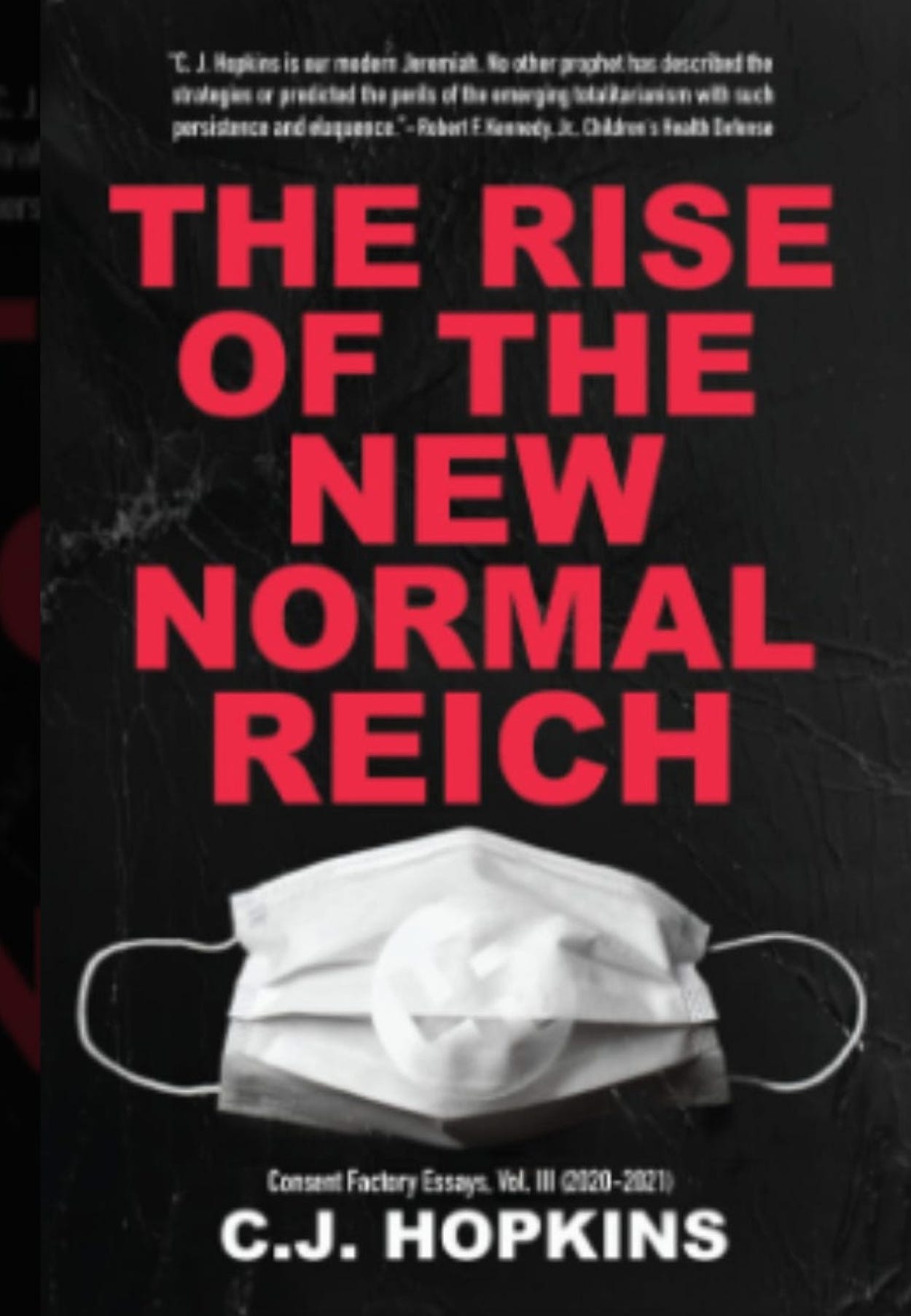
Hopkins went to trial in January and delivered an impassioned plea to the court. “Every journalist that has covered my case, everyone in this courtroom, understands what this prosecution is actually about,” he said. “It has nothing to do with punishing people who actually disseminate pro-Nazi propaganda. It is about punishing dissent, and making an example of dissidents in order to intimidate others into silence.”
Though the judge was clearly not a fan of Hopkins — a courtroom account by Aya Velázquez, which I recommend reading, described how the judge said CJ’s statements were “ideological drivel,” just “not punishable by law” — he won on the law.
After acquittal, he was made aware that technically the case wasn’t over, because thanks to a quirk of German jurisprudence, the prosecutor had a week to file an appeal. Hopkins was unconcerned. “I doubt he will [re-file]. He made a total fool of himself in front of a large audience yesterday,” he wrote. “I can’t imagine that he will want to do that again.”
Bzzt! Wrong. The prosecutor re-filed charges. The prosecutorial theory in the Hopkins case was based on a bizarre interpretation of hate crime, essentially asserting that if you have to think about an image to realize it’s satire, it can’t be allowed. If that idea spreads, it would make comedy or even sharp commentary impossible. This is why his indictment, and the similar investigation of Roger Waters, are really serious moments. Not to be heavy-handed, but eliminating the loophole for satire or mockery is exactly what Waters meant by “Another Brick in the Wall.” Before you know it, it’ll be too high to see over:
MT: You got charged again?
CJ Hopkins: No… I got acquitted. I went to trial on the 23rd of January, and I wrote this up and I’ll send it to you so you can just look at the whole account. But at the trial I made a big aggressive statement that people republished all over the place. The judge acquitted me, and then called me all kinds of names and then put on her covid mask and stalked out of the courtroom. She called me a Schwurbler, which in German is kind of an idiot, I guess a babbler or someone.
Anyway, I read that statement, which pissed them all off, but she said, “Okay, you’re an idiot, but that’s not against the law, so you’re acquitted.” So I thought, “Great. This is over. I’m acquitted.” The prosecutor had no case whatsoever, and it was really embarrassing, and I figured it was all done, but my attorney reminded me: oh no, the prosecutor can appeal. Which he did. So now I’m facing another trial in appeals court. It’s not new charges, it’s the same charge, but the prosecutor’s appeal of my acquittal.
MT: The double jeopardy thing isn’t big in Germany, I take it?
CJ Hopkins: No.
MT: Are they going to make a different argument?
CJ Hopkins: I have no idea what they’re going to do. They have no argument… I mean, they put my tweets up on an overhead projector, like we were back in high school, and interrogated me about whether the Swastika was on top of the mask or behind the mask, that sort of thing. The prosecutor’s argument was basically, “We don’t believe that Mr. Hopkins is a Nazi, or pro-Nazi, we don’t believe he was trying to spread Nazi propaganda, but he nonetheless spread Nazi propaganda. because his tweet” – and this is a great part of their argument – “because if people saw his tweets, they would have to stop and think for a minute to figure out what they meant.”
MT: Essentially you can’t have satire, because that requires a person to have at least one thought.
CJ Hopkins: You can’t make people think. You’ve got to have beat-you-over-the-head messaging. I think the whole point of this… I’m sure it’s like the plea-bargain thing in the States. They figure if they hit you with a 3,600 Euro fine, you’re going to pay three times that much to fight it in court, so you’re just going to pay the fine and go away. I don’t think they ever expected to end up in court, and I have no idea what the prosecutor is doing with this appeal. The judge a few weeks later submitted a written verdict, which is strongly in my favor. She pretty much reiterated my attorney’s arguments and made it absolutely clear that what I did falls under the exceptions to the statute, and there’s nothing here to prosecute. Nonetheless, the prosecution’s going ahead.
MT: Did you have much Western news coverage?
CJ Hopkins: Right before the trial I had you, then Neue Zürcher Zeitung, which is the big paper of record in Switzerland, and James Kirchick at The Atlantic, who was a big help. I think it put a lot of pressure on the judge. My lawyer made her aware that Germany was being portrayed as a laughingstock in the international press. Aside from The Atlantic, it was all independent alternative media.
MT: In the Murthy Supreme Court case in the States Monday, there was an issue with what they call “traceability.” I see you don’t have a traceability issue, with this document from your case file?
CJ Hopkins: Exactly. That’s why I sent it to you. Unquestionably, this is a government office, directly involved with removing the tweets. The other thing that I was going to say, is that I’m looking at things like the Supreme Court case from a non-U.S. perspective. I’m outside of it. I’m watching the legislation that’s getting rolled out in Ireland and the UK and what’s happening to me here and what’s going on in the States, and it’s so obviously much broader than just a red-blue political story in the US. This is happening throughout the Western democratic countries.
I’m just desperate to get that across to people. I think it’s so easy for people to get locked into what’s going on in their own country and not see the bigger picture.
MT: What’s an example?
CJ Hopkins: There was just a piece in The Herald, in Scotland. The police were being trained there on how to crack down on abusive hate speech. According to this new legislation that’s rolling out and in the training manual, they were saying this could take place in comic performances or stage plays. People are being arrested in the UK for protest signs.


If I can just put one little bug in your head, Matt, to whatever degree you can tweak people and let them know: “Hey, it’s not just Trump and the Democrats and the liberals and the woke people and all that.” This is happening all over the West, in all these different countries. I think that’s one thing that my case does, it provides folks with an opportunity to remind them that this is happening all over. The old rules don’t apply.
MT: Good luck with your case.
CJ Hopkins: Take care.
Featured Video
Laith Marouf: Hezbollah’s position on US-Iran ceasefire
or go to
Aletho News Archives – Video-Images
From the Archives
Is Israel to blame for the Iraq War?
American Goy | March 10, 2008
I am so tired of this old canard that “Israel had nothing to do with USA’s war with Iraq – in fact, it officially advised America against it”.
Bullshit. … continue
Blog Roll
 Aletho News
- Laith Marouf: Hezbollah’s position on US-Iran ceasefire: What you’re not being told
- Israel’s priority lies in destroying chances of peace between Iran, US: Ex-UN nuclear chief
- Ceasefire for all or for none: Iran shuts Hormuz over Lebanon attacks
- Strait of Hormuz is Iran’s ‘nuclear weapon’ that forced US retreat: Medvedev
- Energy crisis will last for months – Kremlin envoy
- Europe’s quiet role in the war on Iran
- Forty days that shook the Empire: How Iran turned the tables on US and prevailed
- Netanyahu unilaterally declares Lebanon outside of ceasefire deal
- Israeli leaders: ‘Not a single goal’ achieved in war with Iran
- What on earth just happened? Trump, Iran, and the unlikely ceasefire
- If Americans Knew
- Gazans face a triple crisis: severe shortages of water and bread, healthcare in tatters
- NY Times reports how Netanyahu took the US into Iran War
- A sigh of relief over Iran, but Gaza and Lebanon in dire straits – Daily Update
- Thousands dead and neighborhoods razed to the ground: Aid agencies fear southern Lebanon is becoming the new Gaza
- The war the US is fighting for Israel could cost trillions
- ‘Cigarette Burns, Nail Wounds’: Toddler Tortured in Gaza to Coerce Father
- Trump Says US Sent ‘a Lot of Guns’ to Protesters in Iran
- Israeli forces destroy 17 UN peacekeeper cameras in south Lebanon
- US-Israeli strikes ‘completely destroy’ synagogue in Tehran
- Archbishop for US Military Says Iran War Is Unjust Under Catholic Teaching
- No Tricks Zone
- An Inconvenient Tree: Uncovered In Alps… Europe Much Warmer Than Today 6000 Years Ago
- New Study Reports A 60% Slowdown In Greenland’s Ice Loss Rate In The Last Decade
- Low Intensity Tornado Wrecks Major Solar Farm, Creating A Potential Toxic Dump
- New Study Finds Warming Saves Lives…Cold Temperatures 12 Times More Deadly Than Excess Heat
- German Science Blog Accuses PIK Climate Institute Of Hallucinating Climate Tipping Points
- Devastating Assessment Of Comirnaty Vaccine By Former Senior Pfizer Europe Toxicologist
- New Study: CO2 Is ‘Effectively Negligible’ As An Explanatory Climate Change Factor Since 2000
- Former Pfizer Toxicologist Dr. Helmut Sterz Tells Bundestag Hearing Pfizer Vaccine Should Have Never Been Approved
- Energy Expert: Germany’s Nuclear Phaseout Was A “500 Billion Euro Mistake”
- New Research: South Australia’s Mid-Holocene Sea Surface Temperatures Were 4°C Warmer Than Today
 Aletho News