Scottish Police Training Targets Blogs, Podcasts, and Social Media Under Authoritarian New Censorship Law
The new law will be introduced on April 1st
By Didi Rankovic | Reclaim The Net | March 20, 2024
Police training in some countries these days goes well beyond what one would normally expect, to include targeting content – including artistic – deemed to be “threatening” or “abusive.”
It’s not about China – at least this time. It’s about Scotland. There, officers are learning how to put blogs, podcasts, social media posts, and even simply reposts into their proverbial crosshairs.
According to reports, actors and comedians are not exempt from this type of scrutiny if somebody feels offended, and reports them.
A story in the Scottish press, based on leaked material, details this practice, which is said to be happening thanks to the newly enacted “hate crime law” (Hate Crime and Public Order, Scotland) – even if, formally, such interpretations appear to run afoul of the actual legislation.
The implications of the law, however, are not flying under the radar, as local media says Conservatives in Scotland are questioning the lawfulness of assessing content created “through public performance of a play” for its potential as “threatening and abusive.”
And only about a year since he was appointed to oversee the law, Assistant Chief Constable David Duncan has now retired.
Police in Scotland previously said that every report identifying content as hateful toward “protected characteristics” (such as age, disability, religion, sexual orientation, transgenderism) will be investigated.
That sounds like officers there might end up with little time to do anything else, as a scheme positioned so broadly can easily be repeatedly abused. As for the response – once they go through “every hate crime complaint” – the promise is that law enforcement will exhibit “proportionate response.”
“An example of why it is so important to preserve freedom of speech,” X owner Elon Musk commented, linking to a post about these developments.
As for the way it affects performing arts, but also everybody else – the law in effect equates memes and just good old jokes with things like, for example, revenge porn. One of the provisions states that the subject of prosecution will be “displaying, publishing or distributing the material” in places like signs, sites, blogs, podcasts, social platforms.
And that applies to these actions done both directly, and indirectly, e.g., via a repost. This is referred to as “forwarding or repeating” content from a third party.
The TikTok Totalitarians
By Daniel McAdams | Ron Paul Institute | March 18, 2024
On Wednesday, March 13th, a bipartisan group of US Representatives voted to give the US president the power to remove any website, computer or mobile application, or even service provider that the president determines – without due process – is run by “a person subject to the direction of control of a foreign person or entity” as long as that foreign person or entity is declared an “adversary” of the US.
And who gets to decide who is an “adversary”? The US President.
Cut through the hollow propaganda about the Chinese using it to spy on and subvert Americans – another “Saddam’s got WMDs” lie – and it is the most dangerous and un-American piece of legislation since the PATRIOT Act.
In fact it may be arguably worse. While the PATRIOT Act was a fig leaf for the government to spy on Americans, this demon of a bill will actually allow the US Government to determine what Americans can read and thereby what they will think. Isn’t that just what supporters of this bill claim the Chinese government is doing?
Take all the massive evidence of US government collusion and censorship of Americans’ “wrongthink” exposed by the heroic Matt Taibbi and the rest of the “Twitter Files” investigators and multiply it by a million and you won’t even then begin to understand the damage this law will do once it’s passed in the Senate and signed by Biden.
Twitter/X and its owner Elon Musk are routinely claimed to be biased toward (or sometimes against) Russia. Obviously “foreign adversary controlled.” Shut it down.
The video hosting and streaming service Rumble minimizes restrictions on what can be uploaded. It rightly calls itself the free-speech platform. They even allow Russian media RT and Iran’s PressTV to give a perspective different than that given by the US government and mainstream media. Shut it down. “Foreign adversary controlled.”
How about the Ron Paul Liberty Report? We often take positions at odds with the policies of the US Administration and criticize, for example, sending hundreds of billions to fight a proxy war in Ukraine. Obviously “foreign adversary controlled.” Shut it down.
Every single independent conservative media outlet that is sympathetic to Donald Trump will be in the crosshairs of President Biden when this bill becomes law, as Biden and his crew consistently accuse Trump – even after all these years – of being in Putin’s back pocket. That is why right-winger Federalist CEO Sean Davis is horrified by the move, writing on Twitter/X:
“It’s not that the U.S. government wants to protect you from spying and data theft and manipulation. If only. No, the people behind the Russian collusion hoax, and the Kavanaugh hoax, and the natural origin COVID hoax, and the illegal warrantless spying, and the forced transing of your children—they want to be the ones spying on you and stealing your data and poisoning the minds of your children.”
Those on the Left should take heed: Be assured that if Donald Trump is elected president this fall, the bill will become the same political cudgel used by the Right to silence your alternative media outlets as well.
Libertarian-minded progressives like Glenn Greenwald see the danger – and the pattern – clearly, as he writes:
“The TikTok bill is how rights erosions always always always work: Pick a target to start with that everyone hates or fears, so that everyone unites in support, nobody wants to defend. Then the precedent is set, so when it expands inward, nobody can object any longer.”
See where this is going? It’s not about China. It’s about our freedom to consume whatever media we wish to consume. No one is forced to use TikTok. If an American exercising his or her First Amendment rights determines that any risk of using TikTok is one worth taking, that is his or her right.
Tucker Carlson – no friend of China – rightly deemed it, “the most far reaching act of censorship in the history of the United States.” He added, “it’s an attack on the right of American citizens to receive their information from any source they choose.”
After the ignominious House vote, Tucker had Sen. Rand Paul on his program to explain how the “we are protecting Americans from the Chinese Communists” explanation for attacking the US Constitution is nothing but a ruse. Watch that episode on Twitter/X here.
Sen. Paul himself pointed out the hypocrisy in the US government taking such an authoritarian approach to censorship, writing on Twitter/X, “Emulating Chinese communism is not the way to combat Chinese communism.”
There is a mafia element to the legislation as well. The bill demands that TikTok be sold to avoid being banned.
Remember when Michael Corleone told this then-girlfriend Kay Adams how his father, Don Vito Corleone, “encouraged” the bandleader that had Johnny Fontaine under contract to let him out of the contract when Johnny started to become a star:
- Michael Corleone: My father made him an offer he couldn’t refuse.
- Kay Adams: What was that?
- Michael Corleone: Luca Brasi held a gun to his head, and my father assured him that either his brains or his signature would be on the contract. That’s a true story.
This is exactly what the US government is doing with this legislation. It’s hardly surprising that now that this US government threat against TikTok has likely seriously devalued the company, deep state denizens like former US Treasury Secretary Steven “Goldman Sachs” Mnuchin is sniffing around ready to pick up TikTok for a song.
Either TikTok’s signature or its brains will be on Mnuchin’s contract.
This is gangsterism and authoritarianism on steroids, yet the uniparty running Washington DC lapped it up like mother’s milk. Perhaps that is why they lapped it up so enthusiastically.
When this bill becomes law, a big part of America will have died. That’s not an exaggeration.
Executive Director of the Ron Paul Institute for Peace and Prosperity and co-Producer/co-Host, Ron Paul Liberty Report. Daniel served as the foreign affairs, civil liberties, and defense/intel policy advisor to U.S. Congressman Ron Paul, MD (R-Texas) from 2001 until Dr. Paul’s retirement at the end of 2012. From 1993-1999 he worked as a journalist based in Budapest, Hungary, and traveled through the former communist bloc as a human rights monitor and election observer.
Gove’s Ministry of Truth Reporting for Duty
Health Advisory & Recovery Team | March 19, 2024
For those paying attention to the rising tide of totalitarianism here in the UK, the latest from The Ministry of Truth, AKA HM Government should really make your blood run cold. Michael Gove has now overseen the redefining of extremism.
It is not hard to see what is at play here. You sell the peasants an idea that they think they want. I mean, who wouldn’t like to stop extremism? Boo, we hate extremists. That’s a good thing right?
Well that rather depends on who is doing the defining of what constitutes extremism. In this case, Michael Gove. No it doesn’t leave us feeling reassured either.
In the latest egregious bout of trolling from HM Gov, it takes about 3 milliseconds of studying the new definition of extremism to realise that during the so-called ‘pandemic’, the government did precisely everything therein:
- negate or destroy the fundamental rights and freedoms of others;
What, like denying them social contact, denying them the right to be with their dying relatives, forcing medical procedures on them in order to continue their job, denying them the right to earn a living, denying their rights of free movement, locking them in their homes and arresting them for sitting on a bench? That kind of thing?
- undermine, overturn or replace the UK’s system of liberal parliamentary democracy and democratic rights;
What, you mean like introducing a brand new legal act (in spite of there already existing an appropriate instrument) that completely tramples parliamentary democracy, giving the sitting government the right to jackboot their way into people’s lives as outlined in point 1 above? Or like shutting down parliament entirely and cancelling elections? Or perhaps like Matt Hancock telling parliament that he had unilaterally decided to offer the pharmaceutical companies indemnity for their products.
- intentionally create a permissive environment for others to achieve the results in (1) or (2).
What, you mean by censoring and smearing any opposing views, demonising anyone who didn’t get with the programme and creating an environment of extremism via a media monopoly that would have been more fitting in Mao Zedong’s China.
This upside down clown world is really getting too much. The government is now brazenly behaving like a criminal mafia gang. You do as they say, as defined by them, otherwise you’re an extremist. And you will be punished.
The boiled frog analogy seems to be a good one. What will it take for the British public to realise that they live in a liberal democracy in name only? The architecture being rapidly put in place is the polar opposite of a liberal democracy and if we study our history books, this particular trend tends to end very badly for the non-ruling classes.
How the Democrats Plan to Steal the Election
By Llewellyn H. Rockwell, Jr. | March 18, 2024
Biden and Trump have clinched the nominations of their parties for President. Everybody is gearing up for a battle between them for the election in November. It’s obvious that Biden is “cognitively impaired.” In blunter language, “brain-dead”. Partisans of Trump are gearing up for a decisive victory. But what if this battle is a sham? What if Biden’s elite gang of neo-con controllers won’t let Biden lose?
How can they stop him from losing? Simple. If it looks like he’s losing, the elite forces will create enough fake ballots to ensure victory. Our corrupt courts won’t stop them. They have done this before, and they will do it again, if they have to.
I said the Democrats have done this before. The great Dr. Ron Paul explains one way they did this in 2020. The elite covered up a scandal that could have wrecked Biden’s chances:
“Move over Watergate. On or around Oct. 17, 2020, then-senior Biden campaign official Antony Blinken called up former acting CIA director Mike Morell to ask a favor: he needed high-ranking former US intelligence community officials to lie to the American people to save Biden’s lagging campaign from a massive brewing scandal.
The problem was that Joe Biden’s son, Hunter, had abandoned his laptop at a repair shop and the explosive contents of the computer were leaking out. The details of the Biden family’s apparent corruption and the debauchery of the former vice-president’s son were being reported by the New York Post, and with the election less than a month away, the Biden campaign needed to kill the story.
So, according to newly-released transcripts of Morell’s testimony before the House judiciary Committee, Blinken “triggered” Morell to put together a letter for some 50 senior intelligence officials to sign – using their high-level government titles – to claim that the laptop story “had all the hallmarks of a Russian disinformation campaign.”
In short, at the Biden campaign’s direction Morell launched a covert operation against the American people to undermine the integrity of the 2020 election. A letter signed by dozens of the highest-ranking former CIA, DIA, and NSA officials would surely carry enough weight to bury the Biden laptop story. It worked. Social media outlets prevented any reporting on the laptop from being posted and the mainstream media could easily ignore the story as it was merely “Russian propaganda.”
Asked recently by Judiciary Committee Chairman Jim Jordan (R-OH) why he agreed to draft the false sign-on letter, Morell testified that he wanted to “help Vice President Biden … because I wanted him to win the election.” Morell also likely expected to be named by President Biden to head up the CIA when it came time to call in favors.
The Democrats and the mainstream media have relentlessly pushed the lie that the ruckus inside the US Capitol on Jan. 6th 2021 was a move by President Trump to overthrow the election results. Hundreds of “trespassers” were arrested and held in solitary confinement without trial to bolster the false narrative that a conspiracy to steal the election was taking place.
It turns out that there really was a conspiracy to steal the election, but it was opposite of what was reported. Just as the Steele Dossier was a Democratic Party covert action to plant the lie that the Russians were pulling strings for Trump, the “Russian disinformation campaign” letter was a lie to deflect scrutiny of the Biden family’s possible corruption in the final days of the campaign.
Did the Biden campaign’s disinformation campaign help rig the election in his favor? Polls suggest that Biden would not have been elected had the American electorate been informed about what was on Hunter Biden’s laptop. So yes, they cheated in the election.
The Democrats and the mainstream media are still at it, however. Now they are trying to kill the story of how they killed the story of the Biden laptop. This is a scandal that would once upon a time have ended in resignation, impeachment, and/or plenty of jail time. If they successfully bury this story, I hate to say it but there is no more rule of law in what has become the American banana republic.” See here.
But the main way the election can be rigged is by fraudulent “voting.” It’s much easier to do this with digital scanning of votes than with old-fashioned ballot boxes.
Dr. Naomi Wolf explains how electronic voting machines make it easier to steal elections:
“People could steal elections in this ‘analog’ technology of paper and locked ballot boxes, of course, by destroying or hiding votes, or by bribing voters, a la Tammany Hall, or by other forms of wrongdoing, so security and chain of custody, as well as anti-corruption scrutiny, were always needed in guaranteeing accurate election counts. But there was no reason, with analog physical processing of votes, to query the tradition of the secret ballot.
Before the digital scanning of votes, you could not hack a wooden ballot box; and you could not set an algorithm to misread a pile of paper ballots. So, at the end of the day, one way or another, you were counting physical documents.
Those days are gone, obviously, and in many districts there are digital systems reading ballots.” See here.
This isn’t the first time the Left has stolen an election. It happened in the 2020 presidential election too. Ron Unz offers his usual cogent analysis:
“There does seem to be considerable circumstantial evidence of widespread ballot fraud by Democratic Party forces, hardly surprising given the apocalyptic manner in which so many of their leaders had characterized the threat of a Trump reelection. After all, if they sincerely believed that a Trump victory would be catastrophic for America why would they not use every possible means, fair and foul alike, to save our country from that dire fate?
In particular, several of the major swing-states contain large cities—Detroit, Milwaukee, Philadelphia, and Atlanta—that are both totally controlled by the Democratic Party and also notoriously corrupt, and various eye-witnesses have suggested that the huge anti-Trump margins they provided may have been heavily ‘padded’ to ensure the candidate’s defeat.” See here.
In a program aired right after Biden’s pitiful State of the Union speech, the great Tucker Carlson pointed out that Biden’s “Justice” Department has already confessed that it plans to rig the election. It will do this by banning voter ID laws as “racist.” This permits an unlimited number of fake votes:
“If Joe Biden is so good at politics, why is he losing to Donald Trump, who the rest of us were assured was a retarded racist who no normal person would vote for? But now Joe Biden is getting stomped by Donald Trump, but he’s also at the same time good at politics? Right.
Again, they can’t win, but they’re not giving up. So what does that tell you? Well, they’re going to steal the election. We know they’re going to steal the election because they’re now saying so out loud. Here is the Attorney General of the United States, the chief law enforcement officer of this country in Selma, Alabama, just the other day.
[Now Carlson quotes the Attorney General, Merrick Garland:]
“The right to vote is still under attack, and that is why the Justice Department is fighting back. That is why one of the first things I did when I came into office was to double the size of the voting section of the Civil Rights Division. That is why we are challenging efforts by states and jurisdictions to implement discriminatory, burdensome, and unnecessary restrictions on access to the ballot, including those related to mail-in voting, the use of drop boxes and voter ID requirements. That is why we are working to block the adoption of discriminatory redistricting plans that dilute the vote of Black voters and other voters of color.
[Carlson then comments on Garland:]
“Did you catch that? Of course, you’re a racist. That’s always the takeaway. But consider the details of what the Attorney General of the United States just said. Mail-in balloting, drop boxes, voter ID requirements. The chief law enforcement officer of the United States Government is telling you that it’s immoral, in fact racist, in fact illegal to ask people for their IDs when they vote to verify they are who they say they are. What is that? Well, no one ever talks about this, but the justification for it is that somehow people of color, Black people, don’t have state-issued IDs. Somehow they’re living in a country where you can do virtually nothing without proving your identity with a government-issued ID without government-issued IDs. They can’t fly on planes, they can’t have checking accounts, they can’t have any interaction with the government, state, local, or federal. They can’t stay in hotels. They can’t have credit cards. Because someone without a state-issued ID can’t do any of those things.
But what’s so interesting is these same people, very much including the Attorney General and the administration he serves, is working to eliminate cash, to make this a cashless society. Have you been to a stadium event recently? No cash accepted. You have to have a credit card. In order to get a credit card you need a state-issued ID, and somehow that’s not racist. But it is racist to ask people to prove their identity when they choose the next President of the United States. That doesn’t make any sense at all. That’s a lie. It’s an easily provable lie, and anyone telling that lie is advocating for mass voter fraud, which the Attorney General is. There’s no other way to read it. So you should know that. You live in a country where the Attorney General is abetting, in fact calling for voter fraud, and that’s the only chance they have to get their guy re-elected.” See here.
Because of absentee ballots, the voting can be spread out over a long period of time. This makes voting fraud much easier. Mollie Hemingway has done a lot of research on this topic:
“In the 2020 presidential election, for the first time ever, partisan groups were allowed—on a widespread basis—to cross the bright red line separating government officials who administer elections from political operatives who work to win them. It is important to understand how this happened in order to prevent it in the future.
Months after the election, Time magazine published a triumphant story of how the election was won by “a well-funded cabal of powerful people, ranging across industries and ideologies, working together behind the scenes to influence perceptions, change rules and laws, steer media coverage and control the flow of information.” Written by Molly Ball, a journalist with close ties to Democratic leaders, it told a cheerful story of a “conspiracy unfolding behind the scenes,” the “result of an informal alliance between left-wing activists and business titans.”
A major part of this “conspiracy” to “save the 2020 election” was to use COVID as a pretext to maximize absentee and early voting. This effort was enormously successful. Nearly half of voters ended up voting by mail, and another quarter voted early. It was, Ball wrote, “practically a revolution in how people vote.” Another major part was to raise an army of progressive activists to administer the election at the ground level. Here, one billionaire in particular took a leading role: Facebook founder Mark Zuckerberg.
Zuckerberg’s help to Democrats is well known when it comes to censoring their political opponents in the name of preventing “misinformation.” Less well known is the fact that he directly funded liberal groups running partisan get-out-the-vote operations. In fact, he helped those groups infiltrate election offices in key swing states by doling out large grants to crucial districts.
The Chan Zuckerberg Initiative, an organization led by Zuckerberg’s wife Priscilla, gave more than $400 million to nonprofit groups involved in “securing” the 2020 election. Most of those funds—colloquially called “Zuckerbucks”—were funneled through the Center for Tech and Civic Life (CTCL), a voter outreach organization founded by Tiana Epps-Johnson, Whitney May, and Donny Bridges. All three had previously worked on activism relating to election rules for the New Organizing Institute, once described by The Washington Post as “the Democratic Party’s Hogwarts for digital wizardry.”
Flush with $350 million in Zuckerbucks, the CTCL proceeded to disburse large grants to election officials and local governments across the country. These disbursements were billed publicly as “COVID-19 response grants,” ostensibly to help municipalities acquire protective gear for poll workers or otherwise help protect election officials and volunteers against the virus. In practice, relatively little money was spent for this. Here, as in other cases, COVID simply provided cover.
According to the Foundation for Government Accountability (FGA), Georgia received more than $31 million in Zuckerbucks, one of the highest amounts in the country. The three Georgia counties that received the most money spent only 1.3 percent of it on personal protective equipment. The rest was spent on salaries, laptops, vehicle rentals, attorney fees for public records requests, mail-in balloting, and other measures that allowed elections offices to hire activists to work the election. Not all Georgia counties received CTCL funding. And of those that did, Trump-voting counties received an average of $1.91 per registered voter, compared to $7.13 per registered voter in Biden-voting counties.
The FGA looked at this funding another way, too. Trump won Georgia by more than five points in 2016. He lost it by three-tenths of a point in 2020. On average, as a share of the two-party vote, most counties moved Democratic by less than one percentage point in that time. Counties that didn’t receive Zuckerbucks showed hardly any movement, but counties that did moved an average of 2.3 percentage points Democratic. In counties that did not receive Zuckerbucks, “roughly half saw an increase in Democrat votes that offset the increase in Republican votes, while roughly half saw the opposite trend.” In counties that did receive Zuckerbucks, by contrast, three quarters “saw a significant uptick in Democrat votes that offset any upward change in Republican votes,” including highly populated Fulton, Gwinnett, Cobb, and DeKalb counties.
Of all the 2020 battleground states, it is probably in Wisconsin where the most has been brought to light about how Zuckerbucks worked.
CTCL distributed $6.3 million to the Wisconsin cities of Racine, Green Bay, Madison, Milwaukee, and Kenosha—purportedly to ensure that voting could take place “in accordance with prevailing [anti-COVID] public health requirements.”
Wisconsin law says voting is a right, but that “voting by absentee ballot must be carefully regulated to prevent the potential for fraud or abuse; to prevent overzealous solicitation of absent electors who may prefer not to participate in an election.” Wisconsin law also says that elections are to be run by clerks or other government officials. But the five cities that received Zuckerbucks outsourced much of their election operation to private liberal groups, in one case so extensively that a sidelined government official quit in frustration.
This was by design. Cities that received grants were not allowed to use the money to fund outside help unless CTCL specifically approved their plans in writing. CTCL kept tight control of how money was spent, and it had an abundance of “partners” to help with anything the cities needed.
Some government officials were willing to do whatever CTCL recommended. “As far as I’m concerned I am taking all of my cues from CTCL and work with those you recommend,” Celestine Jeffreys, the chief of staff to Democratic Green Bay Mayor Eric Genrich, wrote in an email. CTCL not only had plenty of recommendations, but made available a “network of current and former election administrators and election experts” to scale up “your vote by mail processes” and “ensure forms, envelopes, and other materials are understood and completed correctly by voters.”
Power the Polls, a liberal group recruiting poll workers, promised to help with ballot curing. The liberal Mikva Challenge worked to recruit high school-age poll workers. And the left-wing Brennan Center offered help with “election integrity,” including “post-election audits” and “cybersecurity.”
The Center for Civic Design, an election administration policy organization that frequently partners with groups such as liberal billionaire Pierre Omidyar’s Democracy Fund, designed absentee ballots and voting instructions, often working directly with an election commission to design envelopes and create advertising and targeting campaigns. The Elections Group, also linked to the Democracy Fund, provided technical assistance in handling drop boxes and conducted voter outreach. The communications director for the Center for Secure and Modern Elections, an organization that advocates sweeping changes to the elections process, ran a conference call to help Green Bay develop Spanish-language radio ads and geofencing to target voters in a predefined area.
Digital Response, a nonprofit launched in 2020, offered to “bring voters an updated elections website,” “run a website health check,” “set up communications channels,” “bring poll worker application and management online,” “track and respond to polling location wait times,” “set up voter support and email response tools,” “bring vote-by-mail applications online,” “process incoming [vote-by-mail] applications,” and help with “ballot curing process tooling and voter notification.”
The National Vote at Home Institute was presented as a “technical assistance partner” that could “support outreach around absentee voting,” provide and oversee voting machines, consult on methods to cure absentee ballots, and even assume the duty of curing ballots.
A few weeks after the five Wisconsin cities received their grants, CTCL emailed Claire Woodall-Vogg, the executive director of the Milwaukee Election Commission, to offer “an experienced elections staffer that could potentially embed with your staff in Milwaukee in a matter of days.” The staffer leading Wisconsin’s portion of the National Vote at Home Institute was an out-of-state Democratic activist named Michael Spitzer-Rubenstein. As soon as he met with Woodall-Vogg, he asked for contacts in other cities and at the Wisconsin Elections Commission.
Spitzer-Rubenstein would eventually take over much of Green Bay’s election planning from the official charged with running the election, Green Bay Clerk Kris Teske. This made Teske so unhappy that she took Family and Medical Leave prior to the election and quit shortly thereafter.
Emails from Spitzer-Rubenstein show the extent to which he was managing the election process. To one government official he wrote, “By Monday, I’ll have our edits on the absentee voting instructions. We’re pushing Quickbase to get their system up and running and I’ll keep you updated. I’ll revise the planning tool to accurately reflect the process. I’ll create a flowchart for the vote-by-mail processing that we will be able to share with both inspectors and also observers.”
Once early voting started, Woodall-Vogg would provide Spitzer-Rubenstein with daily updates on the numbers of absentee ballots returned and still outstanding in each ward—prized information for a political operative.
Amazingly, Spitzer-Rubenstein even asked for direct access to the Milwaukee Election Commission’s voter database: “Would you or someone else on your team be able to do a screen-share so we can see the process for an export?” he wrote. “Do you know if WisVote has an [application programming interface] or anything similar so that it can connect with other software apps? That would be the holy grail.” Even for Woodall-Vogg, that was too much. “While I completely understand and appreciate the assistance that is trying to be provided,” she replied, “I am definitely not comfortable having a non-staff member involved in the function of our voter database, much less recording it.”
When these emails were released in 2021, they stunned Wisconsin observers. “What exactly was the National Vote at Home Institute doing with its daily reports? Was it making sure that people were actually voting from home by going door-to-door to collect ballots from voters who had not yet turned theirs in? Was this data sharing a condition of the CTCL grant? And who was really running Milwaukee’s election?” asked Dan O’Donnell, whose election analysis appeared at Wisconsin’s conservative MacIver Institute.
Kris Teske, the sidelined Green Bay city clerk—in whose office Wisconsin law actually places the responsibility to conduct elections—had of course seen what was happening early on. “I just don’t know where the Clerk’s Office fits in anymore,” she wrote in early July. By August, she was worried about legal exposure: “I don’t understand how people who don’t have the knowledge of the process can tell us how to manage the election,” she wrote on August 28.
Green Bay Mayor Eric Genrich simply handed over Teske’s authority to agents from outside groups and gave them leadership roles in collecting absentee ballots, fixing ballots that would otherwise be voided for failure to follow the law, and even supervising the counting of ballots. “The grant mentors would like to meet with you to discuss, further, the ballot curing process. Please let them know when you’re available,” Genrich’s chief of staff told Teske.
Spitzer-Rubenstein explained that the National Vote at Home Institute had done the same for other cities in Wisconsin. “We have a process map that we’ve worked out with Milwaukee for their process. We can also adapt the letter we’re sending out with rejected absentee ballots along with a call script alerting voters. (We can also get people to make the calls, too, so you don’t need to worry about it.)”
Other emails show that Spitzer-Rubenstein had keys to the central counting facility and access to all the machines before election night. His name was on contracts with the hotel hosting the ballot counting.
Sandy Juno, who was clerk of Brown County, where Green Bay is located, later testified about the problems in a legislative hearing. “He was advising them on things. He was touching the ballots. He had access to see how the votes were counted,” Juno said of Spitzer-Rubenstein. Others testified that he was giving orders to poll workers and seemed to be the person running the election night count operation.
“I would really like to think that when we talk about security of elections, we’re talking about more than just the security of the internet,” Juno said. “You know, it has to be security of the physical location, where you’re not giving a third party keys to where you have your election equipment.”
Juno noted that there were irregularities in the counting, too, with no consistency between the various tables. Some had absentee ballots face-up, so anyone could see how they were marked. Poll workers were seen reviewing ballots not just to see that they’d been appropriately checked by the clerk, but “reviewing how they were marked.” And poll workers fixing ballots used the same color pens as the ones ballots had been filled out in, contrary to established procedures designed to make sure observers could differentiate between voters’ marks and poll workers’ marks.
The plan by Democratic strategists to bring activist groups into election offices worked in part because no legislature had ever imagined that a nonprofit could take over so many election offices so easily. “If it can happen to Green Bay, Wisconsin, sweet little old Green Bay, Wisconsin, these people can coordinate any place,” said Janel Brandtjen, a state representative in Wisconsin.
She was right. What happened in Green Bay happened in Democrat-run cities and counties across the country. Four hundred million Zuckerbucks were distributed with strings attached. Officials were required to work with “partner organizations” to massively expand mail-in voting and staff their election operations with partisan activists. The plan was genius. And because no one ever imagined that the election system could be privatized in this way, there were no laws to prevent it.
Such laws should now be a priority.” See here.
Let’s do everything we can to publicize the steal. That way, we have a chance to prevent it.
Germany: Green Party demands TikTok ban of popular AfD party
By Denes Albert | Remix News | March 19, 2024
To keep people away from Alternative for Germany (AfD) content, the Green-affiliated campaign network Campact wants to ban the AfD from TikTok. With the AfD the second most popular party in the country, part of the party’s appeal may be tied to its popularity on TikTok, where it is more popular than all the other German parties and has twice as many followers as all other parties combined.
The ruling left-liberal government is desperate to stop the AfD, including using anti-democratic means. While the government works towards banning the party entirely, a part of this all-out effort against AfD means cutting it off from the marketplace of ideas, where the other parties are outright losing.
Campact is working to collect signatures in this effort, calling for the AfD to be banned from TikTok. They will deliver this petition to representatives of the company’s headquarters in Berlin.
The reason given is: “The right-wing extremist slogans reach children and young people in particular.” The Green-backed organization claims this is “dangerous.”
The campaign network is aiming to obtain 200,000 signatures before it delivers its petition to the Berlin branch of the short-form video platform. However, Campact has overshot this mark, earning around 250,000 signatures in what it describes as a campaign against “hatred and agitation.”
AfD’s popularity is a major problem for rival parties on the platform, where AfD features over 409,000 followers, while the Social Democrats (SPD), the Left Party, Free Democrats (FDP), the Christian Democrats (CDU), and the Greens only have a combined total of 220,000 followers. AfD videos are also wildly popular in comparison, earning twice the number of views of all other parties combined.
The former campaign manager of the Green Party and an influential political advisor, Johannes Hillje, is warning about the party’s success.
“The TikTok generation is threatening to become an AfD generation,” he said to Der Spiegel. He said that AfD’s strong showing in state elections is tied to younger people voting for the party, which is due in part to the AfD’s successful TikTok strategy.
Teens and young people are also openly backing the AfD on TikTok. Notably, this week, a freedom-of-speech scandal erupted after reports that a 16-year-old, Loretta B., posted comments on TikTok supportive of the AfD party. When three officers pulled her out of her school in Mecklenburg-Vorpommern, it resulted in a major scandal and warnings of a repressive police state. The scandal has made international news, with billionaire Elon Musk even defending the girl on X.
Remix News’ TikTok channel faces a shadowban on TikTok after earning millions of views. The account featured numerous warnings for news content and multiple suspensions, showcasing TikTok’s willingness to ban or shadowban news platforms and opinions. However, AfD’s channel has so far avoided such censorship.
Supreme Court Appears Wary of Blocking Biden Admin-Big Tech Censorship Collusion
By Tom Parker | Reclaim The Net | March 18, 2024
During oral arguments in a major First Amendment case on Monday, the Supreme Court expressed reservations about restricting interactions between the Biden administration and social media platforms. This concern emerged during the Murthy v. Missouri (formerly Missouri v. Biden) case, which delves into the extent of governmental influence over online content.
Brian Fletcher, Principal Deputy Solicitor General of the United States, presented oral arguments for the petitioners in the case, Biden’s Surgeon General Vivek H. Murthy and several other current and former members of the Biden administration.
The respondents in the case, the States of Missouri and Louisiana, and several other individuals who were subject to social media censorship, allege that the federal government had pressured platforms to block or downgrade posts on various topics, including some related to Covid and the Hunter Biden laptop story.
Several lower courts agreed with the respondents, with a district judge describing the Biden administration’s Big Tech-censorship collusion as “Orwellian” and the Fifth Circuit Court of Appeals finding that the Biden admin likely violated the First Amendment when pushing for social media censorship.
During the oral arguments today though, the justices displayed skepticism towards a broad prohibition on governmental communications with social media platforms. They raised concerns that such a ruling could unduly restrain the government’s ability to address pressing issues.
Fletcher defended the Biden admin’s actions and framed them as the government exercising its right to “speak for itself by informing, persuading, or criticizing private speakers.” He argued that the government is entitled to communicate with social media companies to influence their content moderation decisions, as long as these interactions do not veer into coercion. According to Fletcher, the litmus test for legality should be the presence or absence of threats from the government, asserting that using the bully pulpit for exhortations is a right protected under the First Amendment.
Fletcher also tried to argue for the significant power and autonomy of social media companies, noting their capability to resist governmental pressures.
The solicitor general of Louisiana, Benjamin Aguiñaga, representing one of the Republican-led states behind the lawsuit, argued that the government’s actions amounted to coercion, effectively leading to censorship by social media platforms. He highlighted a significant shift in the focus of government-led content moderation. Initially aimed at tackling foreign interference and misinformation, these efforts increasingly targeted speech by American citizens, particularly around the contentious topics of the 2020 election and the pandemic.
Justice Ketanji Brown Jackson challenged Louisiana Solicitor General Benjamin Aguiñaga’s viewpoint. “And so I guess some might say that the government actually has a duty to take steps to protect the citizens of this country. And you seem to be suggesting that that duty cannot manifest itself in the government encouraging or even pressuring platforms to take down harmful information. So, can you help me? Because I’m really worried about that.”
Justice Amy Coney Barrett also voiced concerns, questioning whether the FBI could legally request social media platforms to remove content, such as posts revealing personal information about officials.
Aguiñaga’s argument was that such actions could potentially suppress constitutionally protected speech.
The oral arguments went off into the weeds and into the nuances of what constitutes “coercion” by the government in its interactions with social media platforms, rather than directly addressing the core text of the First Amendment. This focus on “coercion” rather than the First Amendment’s explicit wording – prohibiting the “abridging” of the freedom of speech, or of the press – played into the Biden administration’s hands.
Justices Kavanaugh and Kagan drew a comparison between the case and the interactions that often occur between administration officials and news media. They proposed that efforts by officials to shape media coverage should be seen as constructive dialogue, not necessarily an attempt at censorship, and suggested such actions don’t violate the First Amendment’s provisions.
Kagan challenged the lawyer from Louisiana to demonstrate that the removal of the contentious posts was the result of government intervention rather than actions taken by the social media companies themselves.
“What distinguishes this as an act of the government rather than a decision made by the platforms?” Kagan inquired.
The discussion among the justices also ventured into the standing of the plaintiffs – Missouri and Louisiana, accompanied by five individuals – to bring the lawsuit. They questioned whether these parties had experienced a direct injury that would justify their legal challenge. Furthermore, the justices expressed doubts about the appropriateness of a wide-ranging injunction that would bar various officials from contacting social media platforms as a remedy to the alleged issue.
Justice Sonia Sotomayor specifically addressed concerns regarding the approach taken by the plaintiffs in presenting their case. Directing her comments to Aguiñaga, Justice Sotomayor criticized the framing of their argument. She pointed out that the plaintiff’s brief seemed to leave out crucial information, thereby altering the context of certain claims, a point which she found particularly troubling.
Chief Justice John G. Roberts Jr. appeared to concur with the notion that the federal government’s diverse array of agencies, which often lack a unified stance, weakens the argument of coercion. During a dialogue with the attorney from Louisiana, he observed, “It’s not monolithic.” He then posed a question that implied this multiplicity of voices in the federal government could substantially diminish the idea of coercion: “That has to dilute the concept of coercion significantly. Doesn’t it?”
While the justices mostly appeared skeptical of prohibiting the federal government from pressuring social media platforms to censor speech, there were some moments where they questioned the Biden admin’s arguments.
Justice Sotomayor pressed Fletcher to give her specifics on how the injunction that prohibits officials from coercing or significantly encouraging a platform’s content-moderation decisions would harm the government.
Fletcher responded by claiming that the injunction would prevent the Federal Bureau of Investigation (FBI) from flagging foreign “disinformation” to platforms, prevent White House officials from criticizing the platform’s practices on “misinformation,” and prevent officials complaining about or flagging various other types of legal content on social media.
Justice Samuel Alito also noted that two lower courts have found or accepted that some examples of Big Tech censorship that were highlighted in this case were “traceable to the government’s actions.”
He added: “We don’t usually reverse findings of fact that had been endorsed by two lower courts.”
Additionally, Justice Alito expressed skepticism about the White House and other federal officials constant “pestering” of Facebook and other social media platforms.
“And I thought, wow, I cannot imagine federal officials taking that approach to the print media,” Justice Alito said. “I thought, you know, the only reason why this is taking place is because the federal government has got Section 230 and antitrust in its pocket, and it’s…to mix my metaphors, and it’s got these big clubs available to it. And so it’s treating Facebook and these other platforms like their subordinates.”
After the hearing, the New Civil Liberties Alliance (NCLA), one of the legal groups representing the respondents in this case, urged the justices to recognize that the Biden admin’s censorship pressure violated the First Amendment.
“Our clients, who include top doctors and scientists, were censored for social media posts that turned out to be factually accurate, depriving the public of valuable perspectives during a public health crisis,” Jenin Younes, Litigation Counsel at the NCLA said. “We’re optimistic that the majority will look at the record and recognize that this was a sprawling government censorship enterprise without precedent in this country, and that this cannot be permitted to continue if the First Amendment is to survive.”
US is not a democracy – Putin

RT | March 17, 2024
Russian President Vladimir Putin has said that by criticizing democratic processes in other states, all while using their own administrative resources to suppress one of American presidential candidates, Washington has become a laughing stock of the rest of the world.
Speaking to the journalists at his campaign headquarters in Moscow on early Monday morning, after the preliminary results indicated his victory with over 87% of the vote in the country’s presidential elections, the Russian leader said that the “whole world is laughing at what is happening” in the US.
“We are behaving with more restraint than their opponents in other countries, but this is just a catastrophe, not a democracy – that’s what it is,” Putin said.
Putin noted that the US administration is using all its power and resources to attack one of the presidential candidates, apparently referring to former president Donald Trump, who is facing a litany of lawsuits despite being the frontrunner and virtually the only remaining Republican hopeful.
In a pre-election interview earlier this week Vladimir Putin said that Russia does not meddle in foreign elections and will work with any elected US president.
“I think it’s obvious to everyone that the American political system cannot claim to be democratic in any sense of the word,” he said in an interview with journalist Dmitry Kiselyov. Putin refused to comment further on the current presidential campaign in the US, but described the atmosphere as becoming “increasingly uncivilized.”
Big Tech Alliance Targets Covid-19 “Misinformation,” Links it to “Extremism,” Calls for Content Censorship
By Cindy Harper | Reclaim The Net | March 16, 2024
Big Tech alliance Global Internet Forum to Counter Terrorism (GIFTC) research “partner” Global Network on Extremism and Technology (GNET) has published an article revisiting the pandemic, always, of course, in the context of “misinformation.”
GIFTC’s founding members are Microsoft, Facebook, X (Twitter), and YouTube (Google), while “general members” include these four and pretty much every tech company you’ve ever heard of, from Amazon and Airbnb to BitChute and Giphy.
GIFTC has previously come under criticism for censorship practices without oversight, whereas GIFTC now goes after “Covid misinformation” – including by conflating it with extremism, and is urging “interventions to address the spread of problematic content.”
The piece claims that its goal is to understand the mechanisms that allow for “problematic information” to disseminate across platforms and then spread between the world’s regions, all for the sake of being able to stop that “diffusion.”
It looks into things like the geographical location of different participants in the “diffusion,” their cultural and linguistic similarities, as well as thematic similarity of content (such as religious and political themes).
The study also clearly positions itself ideologically when it, in passing, refers to former US and Brazilian presidents Trump and Bolsonaro as having “extremist predispositions.”
With that in mind, the choice of topics – the pandemic, misinformation, as well as “methodology and findings” become easier to understand.
Regarding the first, the authors chose to look into Facebook groups and organizations and individuals like Doctors for Truth and microbiologist Didier Raoult, collectively accused of sharing “false and misleading content” about coronavirus, vaccines, masks, hydroxychloroquine, etc., in one form or other.
And, the goal is to find out what helped this information travel from “Global North” to “Global South.”
Soon enough, what’s supposed to be countered thanks to the findings from this “research” is referred to as extremism in online networks, suggesting that Covid “misinformation” qualifies.
Because the “findings” show that interplay tied to language, culture, and themes covered by content shared by various groups is not easy to untangle and go after, the recommendation is to come up with “targeted network-informed interventions” that would prevent information flowing from one part of the world to another.
“By identifying key factors influencing tie formation, policymakers, and platform moderators can implement targeted interventions to mitigate the spread of extremist content,” those behind the article said.
The EU adopts a ‘Media Freedom’ law, where ‘freedom’ doesn’t mean what you think it does
By Rachel Marsden | RT | March 16, 2024
The EU’s new Media Freedom Act has now been voted into law, with 464 votes for, 92 against, and 65 abstentions.
There are some news outlets whose coverage of the vote I’d like to see. Like RT’s, where you’re reading this right now. But anyone who’s viewing this from inside the European Union’s bastion of democracy and freedom is likely doing so via a VPN connection routed through somewhere outside the bloc, to circumvent its press censorship.
Nothing in this new law suggests that this will change, or that there will be increased access to information and analysis for the average person. Such improved freedoms might lead to people making up their own minds rather than having various flavors of a similar narrative served up for mass consumption. As has become par for the course in so-called Western democracies, inconvenient facts and analysis will still be dismissed as “disinformation” and criticism of the establishment still qualified as an effort to sow division – as though dissent itself wasn’t supposed to be proof of a healthy and vibrant democracy.
So, now that we’ve gotten out of the way any hope of lifting the EU’s top-down censorship in the absence of due process, exactly what kind of lip service does this new law pay to the lofty notion of media freedom?
No spying on journalists or pressing them to disclose their sources. Well, unless you’re one of the countries that lobbied to be able to keep doing this – like France, Italy, Malta, Greece, Cyprus, Sweden, and Finland – so basically, a quarter of EU countries. Oh, but they have to invoke national-security concerns in order to do so. Which, as we know, they’re very discerning about. Like, they didn’t at all implement a virtual police state and extend its powers under the guise of fighting a virus with which French President Emmanuel Macron kept saying they were “at war.” Nor did Amnesty International point out the sweeping “Orwellian” trend across Europe, at least as far back as 2017, of exploiting domestic terrorist attacks to permanently embed what were supposed to be extraordinary powers into criminal law, via measures like “overly broad definitions of terrorism.” So, no doubt they’ll be equally reasonable when slapping the “national security threat” label on a journalist whose work they want to peek at.
At least now, under this new law, they do have to fully inform any targeted journalist of the steps being taken against them.
Another thing that changes is that there’s to be a centralized database into which “all news and current affairs outlets regardless of their size will have to publish information about their owners,” according to an EU press release. May we propose a first candidate for that? The NGO Reporters Without Borders has praised this new law as a “major step forward for the right to information within the European Union.” The same NGO also just launched a “Svoboda” (Russian for “freedom”) satellite package eventually consisting “of up to 25 independent Russian language radio and television channels” aimed at Russia, Ukraine, and the Baltics. The launch took place at the EU parliament, in the presence of EU “values and transparency” commissioner (yes, that’s a real title), Vera Jourova, who has said in support of the new media law that “it is a threat to those who want to use the power of the state, also the financial one, to make the media dependent on them.” But she has also said about this new Russia-targeting initiative that the EU state needs to “use all possible means to ensure that their work, that facts and information can reach Russian-speaking people.” This is the same person who advocated in favor of banning Russia-linked media outlets in the EU.
Anyway, you first, guys. Show everyone else how it’s done. Also, does this mean that all financial interests in the form of advertising spending will also have to be declared by corporate media? Because state-backed media platforms are already transparent; it’s the much more discretionary interests underpinning the more commercial platforms that tend to be much less obvious to audiences. Audiences may not know or understand, for example, why a particular corporate media outlet might focus on a particular nation state with softball interviews, travel pieces, and fluffy documentaries, and treating it with kid gloves in news coverage, when in reality the same country is pumping a ton of ad revenues into the place.
In any case, Queen Ursula von der Leyen’s battalion of bureaucratic desk jockeys is set to grow in ranks now with a new “European Board for Media Services” coming online as a result of the new law. Because freedom isn’t going to police itself, pal.
The name itself Media Freedom Act really is the first clue that it’s probably not all that much about freedom. Kind of like how the “European Peace Facility” fund is used to buy weapons, or the “election” of the handpicked EU Commissioner is really just what any normal country would call a confirmation vote.
It’s a pretty safe bet that whenever the EU kicks the virtue-signaling into overdrive, using feel-good language to sell it, the reality is probably the opposite of what’s advertised.
Rachel Marsden is a columnist, political strategist, and host of independently produced talk-shows in French and English.
The frenzy to ban TikTok is another National Security State scam
By Michael Tracey | March 15, 2024
On November 20, 2023, Rep. Cathy McMorris Rodgers (R-WA), chair of the House Energy and Commerce Committee, wrote in a joint letter to the CEO of TikTok that the platform was guilty of “stoking anti-Semitism, support, and sympathy for Hamas” after the October 7 attack on Israel. “This deluge of pro-Hamas content is driving hateful anti-Semitic rhetoric and violent protests on campuses across the country,” McMorris Rodgers charged. A year ago, in March 2023, she had already declared: “TikTok should be banned in the United States of America.”
This week the plan came to fruition, with McMorris Rodgers and her colleagues orchestrating what could be best described as a legislative sneak attack: suddenly the House of Representatives, a notoriously dysfunctional body — particularly this Congressional term, with all the Republican leadership turmoil — took decisive, concerted, expedited action to pass legislation banning TikTok before most of the public would have even gotten a chance to notice. The bill was introduced March 5, 2024, advanced by a unanimous committee vote on March 7, 2024, then approved for final passage March 13, 2024. Almost nothing ever passes Congress at such warp-speed.
McMorris Rodgers facilitated the unanimous 50-0 vote out of the Energy and Commerce committee, a development which took many in DC off-guard, even those keenly attuned to the TikTok policy issue. As someone familiar with the process explained to me, before introducing the bill, the key sponsors “wanted to keep it quiet all around,” as they correctly surmised that once the details of the bill gained wider public exposure, opposition would mount — just as happened in March 2023 when a precursor bill got derailed after public awareness grew of provisions delegating enormous new powers to the President to control speech online.
This week, last-minute opposition continued to grow even during the final floor debate Wednesday morning, thanks to the quick-thinking of Rep. Thomas Massie (R-KY), who organized the opposition and later reported that the number of Republican House members voting no may have tripled as a result of the 40-minute floor debate he triggered — a rarity in the annals of Congress.
Republican opposition was still paltry though — just 15 voted no, compared with 50 Democrats. Even among the few no votes, some, like Matt Gaetz, made sure to clarify that on principle he was totally in favor of banning TikTok — he just objected to the particulars of this bill. The fact that Trump tentatively came out against the bill would also likely have been a factor for Gaetz, who likely would not have been so keen to stake out a different position from Trump on a major national policy issue. Whatever his precise stance, Trump has evidently not taken a major lobbying interest, as he has before with other legislative items. The little he’s said about the TikTok bill has been lukewarm and muddled — which makes sense given that it was Trump who first attempted to ban TikTok by executive fiat in 2020, and got held up by the courts. This current bill enumerates the powers Trump had unsuccessfully sought and codifies them in federal statute as a newly-assigned, discretionary presidential authority.
There is also the issue of what someone familiar told me was the “technical assistance” provided by the “Intelligence Community” during the reportedly “quiet” formulation of this bill — led by Rep. Mike Gallagher (R-WI) and Raja Krishnamoorthi (D-IL). The ranking member counterpart of McMorris Rodgers on the Energy and Commerce committee, Frank Pallone (D-NJ), said unnamed members of the so-called Intelligence Community had “asked Congress to give them more authority to act,” and this bill was intended to grant that request. As such, the bill was expressly crafted to enhance the power of the “Intelligence Community” to restrict Americans’ ability to consume and express speech online — as always, in the alleged name of “national security.”
The purveyors of TikTok-related fear within this vaunted “Community of Intelligence” also prefer to keep the underlying evidence for their claims hidden from public view, opting for highly confidential briefings with compliant members of Congress, most of whom emerged from these secret Pow-Wows in the past week excitedly eager to vest the Executive Branch with extensive new powers to Keep Us Safe from designated foreign foes. And not just China, as with the TikTok prohibition — but also an enormous array of other potential “applications,” which encompass everything from mobile apps to websites, that can be claimed as “foreign adversary controlled,” with “adversaries” defined as the standard rival bloc of China, Russia, North Korea, and Iran.
To fight this great civilizational battle against China and its satellite states, the citizens of America must gratefully accept the abridgment of their own speech, and patriotically acquiesce to the government seizing the power to block a massive range of potential online applications and websites, so long as they can be claimed by the President to be “directly or indirectly” controlled by an official foreign adversary. What it means to be “controlled by a foreign adversary” is so malleable per the legislative text that it can include “a person” who is “subject to the direction or control of a foreign person or entity,” whatever that might mean in today’s parlance, when spurious charges of “Russian asset” and “Chinese influence” can be flung left and right like nothing. Given the subjective discretion that would necessarily have to be exercised in the making of such a determination, the president is being vested here with a huge amount of subjective, unilateral discretion.
There is likely a lesson to be gained from the March 2023 version of TikTok-related banning frenzy, which lost momentum when the details of the main legislative proposal became more widely known. Surmising that opposition could very well mount again, the House sponsors decided this time around to preempt the inconvenience of open debate, and hustle through the bill on a “quietly” expedited schedule before the provisions became widely known, which could prompt the always-annoying phenomenon of constituents contacting their representatives to express an opinion on the issue. This deliberate evasion of public scrutiny was unfortunately necessary for national security.
Another running theme in this mad legislative dash is the extent to which the Israel/Gaza war and hysteria over the October 7 attacks was a main driver. In November 2023, Israeli president Isaac Herzog blamed TikTok for “brainwashing” Americans who didn’t understand that Israel was pulverizing Gaza to defend not just Israeli security, but also the freedom of Americans to “enjoy decent, liberal, modern, progressive democratic life.” Apparently this logic would make more sense to people age 18-29 if they didn’t spend so much time on TikTok.
The heads of the Jewish Federations of North America, an agglomeration of American Jewish philanthropic interests, concurred with the need to terminate TikTok in a March 6 letter timed almost perfectly to the bill’s introduction just the previous day. Writing to Rodgers and Pallone, the authors said: “Our community understands that social media is a major driver of the rise in anti-Semitism, and that TikTok is the worst offender by far.”
“We have a major, major, major generational problem,” complained Jonathan Greenblatt, head of the Anti-Defamation League, in leaked audio of a private meeting last year. “And so we really have a TikTok problem.”
In this telling, the “TikTok problem” seems to boil down to TikTok’s insufficient alignment with US geopolitical interests, and the inability of the US government to exert the same coercive pressure on TikTok that it’s been able to exert on the likes of Google, Facebook/Meta, Microsoft, Twitter/X, and so on. TikTok therefore makes for a scapegoat on which to blame the increasingly “anti-Israel” and “pro-Hamas” attitudes of the youth, who supposedly absorb these malign beliefs in between synchronized dance videos, recipe tips, and makeup guides.
While it’s always difficult to assign precise causality in a multi-variable confluence of factors, here’s what we do know. There was a growing clamor to ban TikTok for the past several years. A bicameral legislative push was made almost exactly one year ago, in March 2023, but got derailed after public awareness grew of the main proposal’s speech-curtailing and executive-empowering provisions. Then after October 7, another round of scapegoating burst onto the scene, with TikTok furiously singled out and blamed by American and Israeli officials for fomenting impermissible discontent with Israel’s war of pulverization against Gaza — the naive youth could only view Israel’s military action in a negative light if they were having their brains nefariously infiltrated by the Chinese Communist Party. Certainly if they watched CNN, MSNBC, or FOX NEWS instead, their brains wouldn’t be turned to microwaved mush, and they’d be super well-informed and not at all propagandized.
“China is our enemy, and we need to start acting like it,” blustered Rep. Chip Roy (R-TX) on the floor of the House before the vote this week. “I am proud to partner with Representatives Gallagher and Krishnamoorthi on this bipartisan bill to ban the distribution of TikTok in the US.”
I’m sorry, but I don’t recall ever agreeing to the proposition that China (or any other country) is my “enemy,” and I certainly would never have agreed to relinquish my core civil liberties to wage this allegedly existential battle. I have no particular fondness for the Chinese government’s speech-suppression practices, but the issue posed by this pending legislation is the power of the US government to control the speech of Americans. Being a citizen of the US, not China, that strikes me as the more pressing concern.
USAID’s “Disinformation Primer:” Documents Reveal Censorship Promotion Across Sectors
By Didi Rankovic | Reclaim The Net | March 15, 2024
The authorities in the US are once again caught red-handed promoting censorship, this time via the US Agency for International Development (USAID).
USAID is normally used by the US government to spread its influence around the world, but now, according to documents from a case against the State Department’s Global Engagement Center (GEC), the agency also actively participates in analyzing and spreading various censorship methods.
The lawsuit in question was filed by America First Legal (AFL), alleging that the State Department, via GEC, engages with private media to advance what the non-profit believes is government/private sector censorship and propaganda collusion.
Now, USAID’s controversial activities have also been exposed thanks to the lawsuit, which revealed that one of the agency’s bureaus, the Center on Democracy, Human Rights, and Governance (DRG) has come up with a “Disinformation Primer” – a 97-page document marked as being “for internal use only.”
The Disinformation Primer – in fact, a censorship primer, to sum up the Foundation for Freedom Online watchdog’s interpretation of the strategy – was “up and running” only one month after Joe Biden got sworn in, in February 2021.

The extensive “primer” seeks to exert influence on how private tech, but also media companies can increase the level of existing censorship; the already existing engagement with private entities is at the same time commended by USAID.
Other targets, more in line with USAID’s overall activities, include foreign governments, specifically education departments, and funding sources. Inevitably, more “partners” are NGOs, non-profits, and think tanks, often themselves with ties to the government.
Some of the censorship techniques that USAID likes and recommends are Advertiser Outreach, which is designed to cut off media and accounts on social platforms from ad revenue, if their speech is what’s known as “disfavored” (by those in power).

Another is propping up legacy media as these outlets steadily lose trust, with things like “prebunking” and the Redirect Method, developed by Google, which “relies on advertising using an online advertising platform such as Google AdWords, targeting tools and algorithms to combat online radicalization that comes from the spread and threat of dangerous, misleading information.”
One striking quote from the document is that gaming sites and gamers should be prevented from forming “interpretations of the world that differ from ‘mainstream’ sources.”
Worth noting is that this censorship, propaganda and indoctrination “handbook” – aimed at curtailing citizens’ freedom of expression and thought – was made using taxpayer money.
Why the TikTok Ban is So Dangerous
Did they tell you the part about giving the president sweeping new powers?
By Matt Taibbi | Racket News | March 15, 2024
It’s funny how things work.
Last year at this time, Americans overwhelmingly supported a ban on TikTok. Polls showed a 50-22% overall margin in support of a ban and 70-14% among conservatives. But Congress couldn’t get the RESTRICT Act passed.
As the public learned more about provisions in the bill, and particularly since the outbreak of hostilities in Gaza, the legislative plan grew less popular. Polls dropped to 38-27% in favor by December, and they’re at 35-31% against now.
Yet the House just passed the “Protecting Americans from Foreign Adversary Controlled Applications Act” by a ridiculous 352-64 margin, with an even more absurd 50-0 unanimous push from the House Energy and Commerce Committee. What gives?
As discussed on the new America This Week, passage of the TikTok ban represents a perfect storm of unpleasant political developments, putting congress back fully in line with the national security establishment on speech. After years of public championing of the First Amendment, congressional Republicans have suddenly and dramatically been brought back into the fold. Meanwhile Democrats, who stand to lose a lot from the bill politically — it’s opposed by 73% of TikTok users, precisely the young voters whose defections since October put Joe Biden’s campaign into a tailspin — are spinning passage of the legislation to its base by suggesting it’s not really happening.
“This is not an attempt to ban TikTok, it’s an attempt to make TikTok better,” is how Nancy Pelosi put it. Congress, the theory goes, will force TikTok to divest, some kindly Wall Street consortium will gobble it up (“It’s a great business and I’m going to put together a group to buy TikTok,” Steve Mnuchin told CNBC), and life will go on. All good, right?
Not exactly. The bill passed in the House that’s likely to win the Senate and be swiftly signed into law by the White House’s dynamic Biden hologram is at best tangentially about TikTok.
You’ll find the real issue in the fine print. There, the “technical assistance” the drafters of the bill reportedly received from the White House shines through, Look particularly at the first highlighted portion, and sections (i) and (ii) of (3)B:

As written, any “website, desktop application, mobile application, or augmented or immersive technology application” that is “determined by the President to present a significant threat to the National Security of the United States” is covered.
Currently, the definition of “foreign adversary” includes Russia, Iran, North Korea, and China.
The definition of “controlled,” meanwhile, turns out to be a word salad, applying to:
(A) a foreign person that is domiciled in, is headquartered in, has its principal place of business in, or is organized under the laws of a foreign adversary country;
(B) an entity with respect to which a foreign person or combination of foreign persons described in subparagraph (A) directly or indirectly own at least a 20 percent stake; or
(C) a person subject to the direction or control of a foreign person or entity described in subparagraph (A) or (B).
A “foreign adversary controlled application,” in other words, can be any company founded or run by someone living at the wrong foreign address, or containing a small minority ownership stake. Or it can be any company run by someone “subject to the direction” of either of those entities. Or, it’s anything the president says it is. Vague enough?
As Newsweek reported, the bill was fast-tracked after a secret “intelligence community briefing” of Congress led by the FBI, Department of Justice, and the Office of the Director of National Intelligence (ODNI). The magazine noted that if everything goes as planned, the bill will give Biden the authority to shut down an app used by 150 million Americans just in time for the November elections.
Say you’re a Democrat, however, and that scenario doesn’t worry you. As America This Week co-host Walter Kirn notes, the bill would give a potential future President Donald Trump “unprecedented powers to censor and control the internet.” If that still doesn’t bother you, you’re either not worried about the election, or you’ve been overstating your fear of “dictatorial” Trump.
We have two decades of data showing how national security measures in the 9-11 era evolve. In 2004 the George W. Bush administration defined “enemy combatant” as “an individual who was part of or supporting Taliban or al Qaeda forces, or associated forces that are engaged in hostilities against the United States.” Yet in oral arguments of Rosul et al v Bush later that year, the government conceded an enemy combatant could be a “little old lady in Switzerland” who “wrote a check” to what she thought was an orphanage.
Eventually, every element of the requirement that an enemy combatant be connected to “hostilities against the United States” was dropped, including the United States part. Though Barack Obama eliminated the term “enemy combatant” in 2009, the government retained (and retains) a claim of authority to do basically whatever it wants, when it comes to capturing and detaining people deemed national security threats. You can expect a similar progression with speech controls.
Just ahead of Monday’s oral arguments in Murtha v. Missouri, formerly Missouri v. Biden — the case so many of us hoped would see the First Amendment reinvigorated by the Supreme Court — this TikTok bill has allowed the intelligence community to re-capture the legislative branch. Just a few principled speech defenders are left now. Fifty Democrats voted against the bill, which is heartening, although virtually none argued against it on First Amendment grounds, whis is infurating. Pramila Jayapal had a typical take, saying the ban would “harm users who rely on TikTok for their livelihoods, many of whom are people of color.”
Contrast that with Kentucky Senator Rand Paul, who went after members of his own party, singling out Republicans encouraging a governmental power grab after years of fighting big tech abuses not just at TikTok but other platforms. These people claim to be horrified, he said, but actions speak louder than words.
“Look at their legislative proposals,” he said, noting many want to “set up government agencies and panels” on speech, effectively saying “If you’re not putting enough conservatives on there, by golly we’re going to have a government commission that’s going to determine what kind of content gets on there.”
These, he said, are “scary ideas.”
He’s right, and shame on papers like the New York Post that are going after Paul for having donors connected to TikTok. Paul has been consistent in his defense of speech throughout his career, so the idea that his opinion on this matter is bought is ludicrous. It’s a relief to be able to expect at least some adherence to principle on this topic from him or fellow Kentuckian Thomas Massie, just as we once could expect it from Democrats like Paul Wellstone or Dennis Kucinich.
I don’t often do this, but as Walter pointed out in today’s podcast, this bill is so dangerous, the moment so suddenly and unexpectedly grave, that we both recommend anyone who can find the time to call or write their Senators to express opposition to any coming Senate vote. It might help. Yes, collection of personal information and content manipulation by the Chinese government (or Russia’s, or ours) are serious problems, but the wider view is the speech emergency. As the cliché goes, forget the furniture. The house is on fire. Let’s hope we’re not too late.
Featured Video
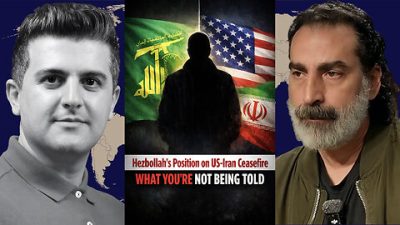
Laith Marouf: Hezbollah’s position on US-Iran ceasefire
or go to
Aletho News Archives – Video-Images
From the Archives
The Dirty Little Secret behind the “Global Terrorism Index”
The Omission of Israeli Terrorism in the Occupied Palestinian Territories
By Karin Brothers | Global Research | December 6, 2014
… The Israeli settlements — all of which are illegal – have been identified as a major impediment to peace. The refusal of a major “global” terrorism report to name the Israeli settlers as one of the groups most responsible for terrorism not only misrepresents a major source of regional violence but exposes the Global Terrorism Index as a propaganda tool that supports a U.S. agenda.
In recent years, governments have been attempting to thwart terrorism by blocking supportive fund-raising. When it comes to Israeli settlements, however, the US and Canada actually encourage fund-raising by giving organizations (such as Christian Friends of Israeli Communities (CFOIC) and the Jewish National Fund) financial support in the form of donor tax-deductions.
Charities which provide funds for the Israeli settlements should be regarded as terror-financing organizations. They should not only lose their tax-deductible status, but they should be banned because they support the violation of international humanitarian law. The terror-financing laws that are being strictly enforced for Muslim charities should be applied to Christian and Jewish charities as well. … Read full article
Blog Roll
 Aletho News
- Laith Marouf: Hezbollah’s position on US-Iran ceasefire: What you’re not being told
- Israel’s priority lies in destroying chances of peace between Iran, US: Ex-UN nuclear chief
- Ceasefire for all or for none: Iran shuts Hormuz over Lebanon attacks
- Strait of Hormuz is Iran’s ‘nuclear weapon’ that forced US retreat: Medvedev
- Energy crisis will last for months – Kremlin envoy
- Europe’s quiet role in the war on Iran
- Forty days that shook the Empire: How Iran turned the tables on US and prevailed
- Netanyahu unilaterally declares Lebanon outside of ceasefire deal
- Israeli leaders: ‘Not a single goal’ achieved in war with Iran
- What on earth just happened? Trump, Iran, and the unlikely ceasefire
- If Americans Knew
- Gazans face a triple crisis: severe shortages of water and bread, healthcare in tatters
- NY Times reports how Netanyahu took the US into Iran War
- A sigh of relief over Iran, but Gaza and Lebanon in dire straits – Daily Update
- Thousands dead and neighborhoods razed to the ground: Aid agencies fear southern Lebanon is becoming the new Gaza
- The war the US is fighting for Israel could cost trillions
- ‘Cigarette Burns, Nail Wounds’: Toddler Tortured in Gaza to Coerce Father
- Trump Says US Sent ‘a Lot of Guns’ to Protesters in Iran
- Israeli forces destroy 17 UN peacekeeper cameras in south Lebanon
- US-Israeli strikes ‘completely destroy’ synagogue in Tehran
- Archbishop for US Military Says Iran War Is Unjust Under Catholic Teaching
- No Tricks Zone
- An Inconvenient Tree: Uncovered In Alps… Europe Much Warmer Than Today 6000 Years Ago
- New Study Reports A 60% Slowdown In Greenland’s Ice Loss Rate In The Last Decade
- Low Intensity Tornado Wrecks Major Solar Farm, Creating A Potential Toxic Dump
- New Study Finds Warming Saves Lives…Cold Temperatures 12 Times More Deadly Than Excess Heat
- German Science Blog Accuses PIK Climate Institute Of Hallucinating Climate Tipping Points
- Devastating Assessment Of Comirnaty Vaccine By Former Senior Pfizer Europe Toxicologist
- New Study: CO2 Is ‘Effectively Negligible’ As An Explanatory Climate Change Factor Since 2000
- Former Pfizer Toxicologist Dr. Helmut Sterz Tells Bundestag Hearing Pfizer Vaccine Should Have Never Been Approved
- Energy Expert: Germany’s Nuclear Phaseout Was A “500 Billion Euro Mistake”
- New Research: South Australia’s Mid-Holocene Sea Surface Temperatures Were 4°C Warmer Than Today
 Aletho News