A New York jury convicted Donald Trump of 34 counts of falsifying business records in connection with buying the silence of a porn star. He is the first American president to become a felon. The verdict is not unexpected from the deep blue Democratic enclave of Manhattan; the larger question is if lawfare will defeat Trump on November 5.
The jury found Trump faked records (hiding hush payments as “legal expenses”) to conceal the purpose of money given to the onetime attorney Michael Cohen. Trump was actually reimbursing Cohen for a $130,000 hush-money deal struck with porn star Stormy Daniels, to silence her account of an affair with Trump. The affair was in 2006, a decade before Trump was elected president. The falsification of business records took place in 2017, after Trump was already in the White House and thus could not have influenced the election. He was found guilty nonetheless.
For the jury to reach its unanimous decision of guilt on all 34 charges, the key was believing two witnesses over Trump.
There are only two people on earth who know if an affair actually took place between Stormy and Trump. Trump said no, Stormy said yes and the jury agreed with her, fully absent of any further actual evidence. Daniels benefitted greatly from her claims to having the affair, and violated a nondisclosure agreement she voluntarily signed and accepted money for, to achieve her goals. “Proving” the affair was the base upon which the rest of the case to find Trump guilty was made.
It is important to understand that having an affair and paying off someone to remain quiet about it are not crimes, even for a presidential candidate. Nonetheless, the prosecutor claimed in closing arguments Trump “hoodwinked the American voter” with a conspiracy to influence the 2016 election. In addition to those who may have benefitted from the plan, “all roads lead to the man who benefited the most: Donald Trump,” Joshua Steinglass told the jury.
But the witness whose testimony was fully believed by the jury, and whose testimony will see Trump receive a criminal penalty when he is sentenced on July 11 (four days before the Republican National Convention!) is Michael Cohen. In the total absence of physical evidence and in the face of Trump’s claims to the contrary, Cohen served as connective tissue for many disparate elements. It was Cohen who claimed Trump masterminded the plan to hide the payments to Stormy. It was Cohen who said the 34 checks and invoices, only nine of which were signed by Trump himself, were not for legal expenses as they were labeled but were to reimburse Cohen for paying off Stormy. Stormy’s name appeared on none of the 34 documents, a fact which instead of exonerating Trump became under Michael Cohen’s testimony the linchpin of the conspiracy to falsify business records. Todd Blanche, a lawyer for Trump, told jurors the case hinged on the testimony of Michael Cohen, whom he called “the greatest liar of all time.”
Nearly incredibly (Trump’s defense team called Cohen a “walking reasonable doubt”) the jury believed Cohen based on nothing but his good word. This is despite Cohen having gone to jail for perjury, been caught lying to Congress, being disbarred, and actually telling a lie during his testimony at the instant trial. It remains difficult to understand how a jury could objectively grant so much credence to Cohen in the face of his record of lying to his own advantage. Every critical element of the case came down to whether his word could be trusted. That is what convicted Trump. You might have thought Robert De Niro was leading the deliberations.
There’s more. For jurors to have found Trump guilty of all 34 counts, they must have concluded beyond a reasonable doubt not only that Trump falsified or caused the falsification of business records “with intent to defraud” but also that he did so with the intent to commit or conceal another crime. That second element — the intent to commit or conceal another crime — elevates the charges to felonies and got around the statue of limitations that usually governs misdemeanors such as false business records. To reach this conclusion the jury had to also believe Cohen that Trump’s primary intent in all this was election influence and not, as Trump claimed, to hide the affair from his family.
There are many questions surrounding the jury’s verdict, and the fact pattern of the case itself, all of which should come out in Trump’s inevitable appeal. With that in mind, the actual legal conclusion of this case is far into the future, almost certainly after the November 5 election. But that begs the more important question: does any of this matter to voters? This is lawfare, not justice, after all. “The real verdict is going to be November 5, by the people,” said Trump.
CNN, for example, concluded “Donald Trump, who built a mystique as the brash epitome of power, has never been more powerless to dictate his own fate. His reputation, future, and even perhaps the White House’s destiny, [was] placed in the hands of 12 citizens of his native New York City, proving that not even once-and-possibly future commanders in chief are above the law.”
So a victory for Democratic lawfare? Maybe not. Trump remains eligible to campaign for the presidency and serve if elected. None of the other lawfare shots is likely to conclude before November.
So does it matter? A majority of registered voters said a guilty verdict in Trump’s trial would make no difference in their vote in the 2024 presidential election. Across all registered voters, 67 percent said a guilty verdict would have no effect on their vote, while 17 percent say they would be less likely to vote for him and 15 percent say they would be more likely, according to the NPR/PBS News Hour/Marist poll released before the verdict. An ABC News poll earlier this month showed 80 percent of Trump’s supporters say they would stick with him even if he’s convicted of a felony in this case. Some say they would either reconsider their support (16 percent) or withdraw it (four percent.) Similar polls followed Trump’s defeat in New York courts over supposed real estate fraud.
And Biden knows it. A Biden campaign spokesman said Trump’s conviction showed “There is still only one way to keep Donald Trump out of the Oval Office: at the ballot box. Convicted felon or not, Trump will be the Republican nominee for president.”
As in other Third World countries where the judiciary is used to smite political opponents, let us hope the people can see the truth, as they still hold the final card to be played. The Deep State has tried from day one to destroy Donald Trump — Russian collusion and dossier hoax, pee tape accusation, Mueller hearing and report, Emoluments Clause, various calls for extra-legal interventions and coups, Alfa Bank hoax, Impeachment I, Impeachment II, demands Mike Pence invoke the 25th Amendment, MSM blackout of Hunter Biden laptop story, Twitter purge of conservative accounts, FBI raid on Mar-a-Lago, Letitia James prosecution “show me the man, and I’ll show you the crime” with no victims, no monetary loss but an effort to bankrupt Trump with civil judgment, Colorado attempt to remove Trump from state ballots over the 14th Amendment, and false statements Trump will “take revenge,” “demand retribution,” ensure a “bloodbath,” and “end democracy” (America’s last election if he wins.)
Trump meanwhile has characterized this trial, and the others, as unjust, rigged, lawfare pure and simple. He has kept the voters’ eyes not on who he is (his personal life has been baked-in to the vote long ago) but on what he represents to the electorate. As such, it is hard to see this guilty conviction, however unfair, as mattering too much come November.
In June 2021, Dr. Sam White, a general practitioner, released a video calling out harmful covid policy. From a scientific perspective every word he said was entirely defensible. Moreover it is clear that he was speaking from an ethical position of wanting to protect his patients from harm. He pulled no punches in addressing the most prominent issues that were causing harm – lack of treatment for the frail, inappropriate gene therapies and masking. In interviews, in 2022, he called the situation a war between good and evil. In doing so he unleashed a torrent of anger among those in a position of power over him, which, three years on, continues to harm him.
He had already resigned from his GP partnership in protest at their vaccination policy in February 2021. His conscience had been keeping him awake at night because he did not want to be a part of the vaccine rollout. Consequently, after resigning he was signed off with stress rather than having to work his notice. NHS England still saw fit to suspend him with an emergency order in June. Dr White managed to record a conversation with an NHS senior clinical adviser who implied that he was mentally unwell. Dr White believes that possession of that recording led the NHS to revoke their suspension. However, by then the NHS had referred him for a GMC investigation and an automatic GMC suspension.
The GMC overturned the suspension in August 2021 but imposed restrictions on him including a ban on mentioning covid on social media and requiring the removal of his previous posts. The legal position is that doctors have a right to free speech but if the GMC could prove Dr White’s speech was a threat to the health of the public or undermined trust in the profession then he could be sanctioned.
Dr White looked to his indemnity provider for support to fund his legal case but they washed their hands of him saying it was a “conduct issue”. With the help of crowd funding support, Dr White took the case to the High Court in November 2021. The verdict was published in December 2021, overruling the GMC and saying they had not followed due process in their actions. The High Court documentation was removed from the judiciary’s website in September 2022 such that other doctors in a similar position will be unable to refer to it in their defence. It is available on the Wayback Machine.
Dr White has asked to be removed from the register, as he is no longer practising conventional medicine, but the GMC have refused and are continuing to persecute him. Every interview he has undertaken has been transcribed and put forward as evidence that he is undermining public health policy and causing the public to lose trust in the profession. The next tribunal hearing is scheduled to last three weeks in August and September 2024. This ongoing investigation, three years later, indicates a relentless effort to discredit and punish Dr. White for his dissenting views.
If that sounds bad, wait until you hear about the NHS’s role.
The same day as the High Court hearing, unbeknown to Dr White or his lawyers, NHSE had a meeting where they decided to refer Dr White for a health assessment, despite the fact he no longer worked in the NHS. This was an opportunity to reopen the investigation into him. They have repeatedly asked if he had returned to NHS work and said he must tell them if he did. What was their intent here? Were they planning to ask any future employer to suspend him all over again?
NHS England has a list of “approved providers”. Any doctor not on their list cannot work for the primary employer of doctors in the country. In 2023, NHS England removed Dr White from their list, effectively barring him from practising within the NHS. He had already shifted his practice to private healthcare with a holistic focus, but this further punishment leaves him with no other options.
The GMC is far from perfect but at least it has due process and a system of appeal for where there might be an injustice. NHS England can unilaterally destroy a career, with no legal recourse.
In some ways, the most disturbing aspect of the whole affair was revealed in the communications between the GMC and NHS England. Firstly, the derogatory terms used about the doctor to justify their behaviour are shocking and reveal a lack of professionalism and intolerance for differing opinions within the medical establishment. Moreover, this language served as a means to rationalise their harsh and unjust actions towards him. Secondly, they appeared to be acting in cahoots. The GMC’s apparent open and fair processes have been bypassed by direct communication with NHS England, stripping Dr White of a right to employment.
Dr. Sam White’s case is a stark example of systemic injustice and the erosion of professional rights within the NHS and the GMC. His ongoing persecution for voicing dissenting views underscores a troubling intolerance for ethical and scientific debate, reminiscent of a Kafkaesque nightmare where rationality and justice are subordinated to bureaucratic oppression.
Several medical credentialing boards instituted COVID-19 Misinformation Policies in September of 2021 and have used them to censor and retaliate against academics and practicing physicians who performed research, clinical care, and presented their findings on the early treatment of acute COVID-19 and vaccine safety. The boards’ position is that they and the government agencies they agree with, hold agency over the truth. By establishing that power dynamic, members who disagree with them are spreading misinformation and can be convicted in closed panel meetings without the member being allowed to present their views based upon the data and evidence at hand.
The Association of American Physicians and Surgeons sued three medical specialty boards for their threatened actions against the board certifications of physicians because of speaking out on medical controversies. Physicians earned and need these board certifications in order to hold professorships, practice medicine in most hospitals, and remain in most insurance networks.
Defendants are the American Board of Internal Medicine (“ABIM”), the American Board of Family Medicine (“ABFM”), and the American Board of Obstetrics & Gynecology (“ABOG”). In addition, Alejandro Mayorkas, Biden’s Homeland Security Secretary, is a defendant due to alleged government interference with freedom of speech.
The Fifth Circuit also invalidated Galveston Local Rule 6, by which that federal district court has infringed on plaintiffs’ right to amend their lawsuits. The Fifth Circuit agreed with AAPS that this district court rule is contrary to the Federal Rules of Civil Procedure, and thus must be voided.
“AAPS can now pursue its claim against censorship by the Biden Administration,” AAPS Executive Director Jane Orient, M.D., stated.
Fifth Circuit Judge James Ho agreed with the panel majority on the key issues and wrote separately to decry attempts by some today to impose censorship on others. “In America, we don’t fear disagreement—we embrace it. We persuade—we don’t punish. We engage in conversation—not cancellation,” Judge Ho wrote.
“We know how to disagree with one another without destroying one another. Or at least that’s how it’s supposed to work,” Judge Ho added as he sided fully with this lawsuit against censorship.
The precedent-setting ruling in favor of the First Amendment was issued by the U.S. Court of Appeals for the Fifth Circuit. This influential Court established the right to object in court to censorship of physicians’ speech on topics ranging from government Covid policies to abortion. AAPS General Counsel Andrew Schlafly should be congratulated for this stalwart effort in defense of our civil liberties.
Hamburg MP Olga Petersen has sought refuge in Russia, telling Bild that she feared having her children taken by the German state over her perceived support for Russian President Vladimir Putin.
Petersen left Hamburg with her children last month, prompting widespread speculation about her whereabouts. Several weeks before her disappearance, her party – the right-wing Alternative for Germany (AfD) – expelled her from its Hamburg faction for traveling to Russia as an election observer in March and declaring the vote “open, democratic, and free.”
Alexander Brod, a member of the Russian Presidential Council for Civil Society and Human Rights, told TASS last week that Petersen had settled in Russia with three of her four kids.
Petersen broke her silence on Friday. “I have indeed taken my children out of the country,” she told Bild. “I want to know that my children are safe and that they remain in my care. Without my children, I would no longer see any meaning in life.”
According to Brod’s account, social workers had begun proceedings to take the three children – all of whom are in elementary school – into state care. Petersen offered no further details on the alleged efforts to take her children, and Bild questioned these claims, stating that the kids had been reported to youth welfare workers over behavioral problems.
Expressions of support for Russia’s military operation in Ukraine are illegal in Hamburg, with a court in the city sentencing a man to three years in prison last May for sharing “pro-Russian ideas” and using the ‘Z’ symbol – painted on some Russian military vehicles operating in the conflict – on his Telegram channel.
While there were no criminal proceedings being taken against Petersen, any kind of prison term would have resulted in her losing custody of her children. German courts can also strip a parent of their custody rights if they are deemed abusive, violent, or negligent.
Although Petersen has been expelled from the AfD’s faction in Hamburg, she remains a member of the region’s parliament and will appear on ballot papers as an independent in Hamburg’s district election on Sunday.
“I will remain a member of the Hamburg Parliament and will fulfill my obligations to the best of my knowledge and belief,” she told Bild, adding that she will ensure her children’s safety before deciding whether she is “fit for political action again.”
The US government-affiliated Ukrainian web publication “Data Journalism Agency” (TEXTY) has just released a report attacking hundreds of prominent American individuals and organizations as enemies for not supporting sending more US money and weapons to Ukraine.
The report, titled “Roller Coaster: From Trumpists to Communists. The forces in the U.S. impeding aid to Ukraine and how they do it,” intends to smear American politicians, journalists, and social media influencers as tools of Russia, writing:
Most of the people in our study do not have direct, proven ties to the Russian government or propagandists. However, the arguments they use to urge authorities to distance themselves from Ukraine echo key messages of Russian propaganda aimed at depriving Ukrainians of the ability to defend themselves with Western weapons and funds. (emphasis added)
Although the “enemies list” purports to correct disinformation about Ukraine spread by those on its list, the report itself is full of crude disinformation. For example this bit:
Even long-debunked myths continue to surface, such as claims of Nazi dominance and American Biolabs in Ukraine and the portrayal of the 2014 Revolution of Dignity as a coup.
The organization’s assertion that these claims are “long-debunked” may be wishful thinking, but back on planet reality even mainstream, pro-Ukraine media sites in the US wring their hands over the disturbing, extremist images coming out of the country. For example, NBC News wrote that, “Ukraine’s Nazi problem is real, even if Putin’s ‘denazification’ claim isn’t.” Newsweek wondered, “Why Have So Many Neo-Nazis Rallied to Ukraine’s Cause?” Even before the current conflict, mainstream pro-Ukraine publications such as Reuters worried in 2918 about “Ukraine’s neo-Nazi problem.”
As to the biolabs, none other than Mother of the Maidan Victoria Nuland admitted in a US Senate hearing that there were biolabs in Ukraine. Ah, but one may counter that these were not “American biolabs.” In fact with the authenticity of Hunter Biden’s infamous laptop now absolutely confirmed during his trial, a report by the New York Post two years ago based on the laptop also must be considered accurate. According to the article, “Russia’s assertion that President Biden’s son Hunter was ‘financing . . . biological laboratories in Ukraine’ was based in truth, according to e-mails reviewed by The Post.”
And on whether the Maidan events of 2014 were a “Revolution of Dignity” or a coup, we again only need turn to Victoria Nuland’s infamous phone call with US Ambassador to Kiev, Geoffrey Pyatt, for all the evidence needed that the US was micromanaging the removal of an elected leader and replacing him with hand-picked US puppets.
The report also includes such prominent American politicians and journalists as Sen. JD Vance, Sen. Rand Paul, Rep. Matt Gaetz, Rep. Marjorie Taylor Greene, Rep. Jim Jordan, and Col. Douglas Macgregor.
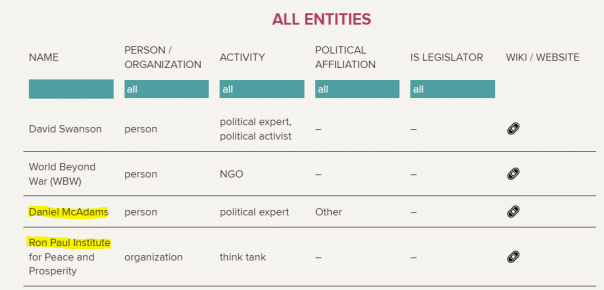
Even our friends at Antiwar.com… and your own correspondent (!) find ourselves appearing on the Ukrainian “enemies list”:
As the report states:
There are 391 individuals and 76 organizations in our list. These include politicians, political movements and groups, media and journalists, experts, and think tanks (some individuals appear in multiple categories).
Perhaps what is most shocking about this attack on American citizens is the fact that the Data Journalism Agency (TEXTY) has a long affiliation with the US Government itself! In fact, the founder of the publication Anatoly Bondarenko appears prominently on a US Government website as a participant in the US State Department’s “TechCamp” project.
The Data Journalism Agency (TEXTY) is listed as an “Implementing Partner” of the US Agency for International Development’s Transparency and Accountability in Public Administration and Services/ TAPAS Project.
The Ukrainians seemingly love to make lists of their “enemies.” One of their most notorious of these is the infamous “kill list” put out by the Mirotvorets Center in Kiev. From that list several have already been murdered by Ukraine, including prominent Russian journalist Daria Dugina.
One wonders how, for example, former US President Donald Trump and dozens of members of the US Congress will react when they hear that US tax dollars are being sent to Ukraine for US-backed Ukrainian organizations to make “hate lists” and “kill lists” of patriotic Americans like themselves.
Executive Director of the Ron Paul Institute for Peace and Prosperity and co-Producer/co-Host, Ron Paul Liberty Report. Daniel served as the foreign affairs, civil liberties, and defense/intel policy advisor to U.S. Congressman Ron Paul, MD (R-Texas) from 2001 until Dr. Paul’s retirement at the end of 2012. From 1993-1999 he worked as a journalist based in Budapest, Hungary, and traveled through the former communist bloc as a human rights monitor and election observer.
The European Union (EU) is planning to implement a new set of draconian mass surveillance rules shortly after Sunday’s EU Parliament election, a member of the EP has warned after the plans surfaced on the internet.
The conclusion that radical surveillance measures are in the works proceeds from documents detailing the meetings of working groups, dubbed “high level group(s) on access to data for effective law enforcement.”
The documents originate from the EU Commission, and contain a number of recommendations, including reintroducing indiscriminate retention of communications data in the bloc, creation of encryption backdoors, as well as forcing hardware manufacturers to give access to anything from phones to cars to law enforcement through what is known as “access by design.”
MEP Patrick Breyer announced that the plan contains 42 points produced by the EU Commission and governments of member-countries. The purpose of being able to access phones, IoT (such as “smart home”) devices, and cars is to make sure they can be monitored around the clock.
Meanwhile, the return of controversial data retention is planned despite a previous ruling of the EU Court of Justice, and could even be extended to include over-the-top services such as messengers (this is defined as retaining IP information data “at the very least”). That, Breyer explains, means that all internet activities will become trackable.
A favorite target of authorities actively undermining their image as democracies has for a while been end-to-end encryption. Here, the EU intends to ban secure encryption of metadata and subscriber data, as well as force messaging services who implement encryption to allow interception.
The EU further plans to “tackle” the use of encryption devices that it declares are “proven to be used solely” by criminals. In reality, the right to install encryption backdoors in phones and computers can be abused to spy on anyone, dissidents and critics included.
Technology providers will, if so ordered by judicial authorities, have to break encryption in order to “facilitate access to data at rest in user’s devices.” And there will be “mechanisms for robust cooperation with communication and technology providers” – meaning they will have to share data with governments and law enforcement.
If these agencies demand, service providers must activate GPS location tracking, according to these recommended “solutions for effective law enforcement.” Representatives of providers who refuse could end up in jail.
“This extreme surveillance plan must not become a reality, if only because it has been cooked up by a completely one-sided secret group of surveillance fanatics working without any real transparency or democratic legitimacy,” Breyer stated.
Technology is a tool and a weapon. It may enhance and empower or disempower and enslave. A simple hammer can be a tool to construct a house or a weapon to bludgeon a man’s skull. As technology enhances, optimally, it would enhance the human condition. There is a delicate balancing between technological advancement and the wisdom to manage that advancement without causing destruction. Unfortunately, the wisdom to manage technological advancement often lags behind.
We are continuously told that there needs to be a balance between freedom and security. This of course is a false narrative, as once there is no freedom, there will be no security. If we examine what has been done in the name of security, it is astounding.
Our conversations are listened to and stored in databases, every keystroke on our keyboards is recorded, there are cameras on street corners, and the list goes on. All of this is in the name of security. The post 911 security state is something out of George Orwell’s 1984 where big brother is always watching you. It is clear that if you induce enough fear and hate, coupled with enough drugs and entertainment, people will willingly give up their liberty for a false sense of security. The result, of course, is that they will end up with neither.
So why am I suggesting we need a new government surveillance program?
The answer is simple. We don’t have one. Sure, we can file a FOI request. Maybe if we are lucky, we will get documents months later that is often heavily redacted information, and if we are really lucky, as a result, expose illegal activity. As was reported by Emerald Robinson, this of course recently happened, when it was discovered by Congress, that NIH scientists appeared to deliberately circumvent the law for the purposes of obstructing justice by using private emails, and even miss spelling words to avoid searches. These actions seem to indicate a criminal intent to obstruct justice.
I recently suggested in an interview on the Absolute Truth with Emerald Robinson that FOI requests are obsolete. To elaborate on that discussion, instead of FOI requests, we as civilians should be able to access government employee communications in real time whenever we want to. We should simply be able to look up one of our government employees and track all of their communications while they are working. We should also be able to track their phone conversations in real time and access transcripts of these conversations as they are occurring. This should all equally apply to government contractors.
It isn’t enough to be able to monitor their communications. We should also be able to watch what they are doing at all times in real time as well. As a civilian employer, you should be able to look up a government employee and watch what they are doing at all times while they are on the clock. For higher up level employees, you should be able to watch them after hours if they are meeting with other employees or government contractors. Body cameras would do the trick.
That’s right. Those cameras need to be turned around. If those cameras were monitoring in real time the employees in the prison where Epstein was held do you really think he would have committed suicide?
Of course, I am not excluding politicians or their interactions with each other or their staff. Politicians, government employees, and government contractors need to sacrifice their freedom for our security. Would the undeclared war on Russia have started, let alone escalated, if we as civilians were able to watch every conversation? Would we have ended up on the precipice of global war?
Imagine if every conversation of a war criminal like Fauci and other conspirators was on video. Global genocide would not be occurring. The people you know and love, would not be getting turbo cancers, strokes, heart attacks, autoimmune diseases, chronic fatigue, and neurological, problems to name a few.
Again, politicians sacrificing their freedom, is not merely for our freedom and security, it is for their security too. If we had constant monitoring of their activities, it is true they would not be able to make as much money in bribes, still, they are less likely to compromise themselves for blackmail purposes. The odds are that the typical politician’s blackmailable behavior will significantly decrease after the first real time escapades are viewed all over the place. I would maintain that physical intimidation will also decrease if there is constant monitoring of the typical politician. So, you see, if they sacrifice their freedom, it is clearly to maintain their safety as well. It is our duty to save the typical politician or government employee from themselves.
The reality is that we have created an upside down world with unfettered government that has become a direct threat to the people. The privacy of individuals and basic private property rights, and human rights in general have been kicked to the curb. Politicians and the government have been captured. A government that has secrets is inherently oppressive and contrary to the concept of a Constitutional Republic. Secret agencies and secret budgets are devastating to humanity.
Individual privacy and even communications are under attack. The idea that your private texts can be monitored, let alone censored from being sent, on its own should cause upheaval. Social media acting under the color of law censored medical information that could have saved countless lives over the past four years. So called hate speech laws are seeking to outlaw common sense. Canada’s laws preventing healthcare professionals from protecting children from gender mutilation are an example.
Maybe we should pass laws restricting the free speech of elected officials and government employees instead of limiting the free speech of us, the civilian employers?
Okay, maybe I am taking it a bit too far… The point is that the government, i.e. deep state, is an uncontrollable monster that must be reined in. Literally, the government is waging war against the people. The tightening noose of oppression will continue until we stop it. The deep state envisions a world, where most of us no longer exist, and for those that do remain, it will be a world transformed into the airport, degrading, humiliating, and exhausting.
Remember Deborah Birx, the “scarf lady” United States bureaucrat who joined President Donald Trump and chief coronavirus fearmonger Anthony Fauci for regular televised briefings to whip up fear of coronavirus and support for crackdowns and new health practices supposedly required by “the science”?
In other words, Birx was a primary villain behind the coronavirus crackdowns in America.
Well, Birx is back. And she is pursuing a similar mission again. She is stirring up fear of a new disease du jour — bird flu — and calling for new crackdowns in response. In an interview this week at CNN, Birx declared, “we should be testing every cow weekly” with PCR tests for bird flu. She also wants to test every “dairy worker” as well as test “to really see how many people have been exposed and got asymptomatically infected.”
Birx seems to be jonesing for a replay of the coronavirus crackdown approach, this time in the name of countering bird flu. Indeed, she may want to take the crackdown bigger this time. In the interview, she suggests that the failure to already be doing the extensive testing she supports for bird flu means “we’re making the same mistakes today that we made with covid.” Got that? For Birx, a big mistake with the government response to coronavirus was that it didn’t do enough soon enough. With time, however, Americans have increasingly come to realize that government actions taken in the name of countering coronavirus created much more suffering than did coronavirus.
Don’t let Birx and other authoritarians succeed in using bird flu as an excuse to roll out a new crackdown dangerous to both health and liberty. Let’s end this tyrannical push now. Just say no to Birx and her new scheme.
On June 3, the former Marine Corps intelligence officer and Sputnik contributor was removed by US Customs and Border Protection officers from a plane bound for Russia, where he was to attend the 2024 St. Petersburg International Economic Forum (SPIEF).
The US Customs and Border Patrol (CBP) does not have the authority to seize passports without probable cause, former Marine Corps intelligence officer Scott Ritter told Sputnik, commenting on Monday’s incident.
Ritter recalled that as he prepared to board the plane, he was pulled out of line by three armed CBP officers who took control of his passport. He said that when he asked them “on what authority,” they cited orders from the US Department of State.
“They provided no warrant, no documentation, nor did they provide a receipt for my passport. They provided no explanation of what they were doing. They just did it,” the Sputnik contributor pointed out.
Ritter stressed that his constitutional rights under the Fourth Amendment were violated because the document requires CBP officers to provide a warrant or some other form of authority upon which to conduct the seizure of his passport.
“Under the Fifth Amendment of the Constitution and others, I’m free to travel. The US government cannot restrict my travel without specific justification, none of which was articulated to me and none of which I believe exists. So it’s a violation of my Fifth Amendment,” the former Marine Corps intelligence officer added.
He suggested that “the real reason” behind all this “appears to be to prevent” him from participating in the SPIEF 2024 and to prevent the work he planned to do as a journalist with his documentary film crew. According to him, he was planning to make a documentary about “the reality of Russia”.
“This is my First Amendment right under freedom of speech and a free press. And this right was likewise violated by the US government, by the Biden administration,” Ritter noted.
The Sputnik contributor recounted that he had traveled to Russia “two times in the last year using this same passport,” and that on each time, the US government was notified in advance of his intent to travel and of his itinerary.
In an apparent reference to his planned trip to Russia to attend SPIEF 2024, Ritter said he was “not off on a secret mission” and that the US government “knew full well” what he was up to.
“And this is why I believe they acted in the way they did. This has a chilling effect, not just on me and the work I was doing, but on all Americans who choose to speak out against the policies of the United States that they disagree with and to travel abroad at the same time that they are criticizing the US government. And what the US government is saying is that we can control your movement. We can control your life. We can punish you for what you’ve been saying that we disagree with,” the former Marine Corps intelligence officer emphasized.
After years of build-up and anticipation, the 77th World Health Assembly has come and gone. So, what did the would-be lords of global health gavel down on? And what does it mean for the future of the fight for health freedom? Joining us today to talk about these important issues is James Roguski.
The old system is crumbling, and we must build its replacement quickly.If you are fed up with the government, hospital, medical, pharmaceutical, media, industrial complex and would like to help build a holistic alternative to the WHO, then feel free to contact me directly anytime.
The persecution of political dissidents in the US is becoming commonplace. People who oppose Washington’s aggressive foreign policy are being seen as enemies and treated as criminals, even when there is no plausible reason to charge them. Recently, military analyst Scott Ritter had his passport confiscated by US authorities without any specific reason, showing the advanced levels of tyranny in the country.
Ritter was on a plane at the New York airport. His plan was to travel to the Russian Federation, as he had a special invitation to participate in the St. Petersburg Economic Forum, which will begin in the next few days. Ritter was already boarding when three policemen suddenly forcibly removed him and seized his documents. When asked about the reason for this action, the policemen said they were following orders from the US State Department and refused to clarify any details about the case.
“I was boarding the flight. Three [police] officers pulled me aside. They took my passport. When asked why, they said ‘orders of the State Department’. They had no further information for me (…) They pulled my bags off the plane, then escorted me out of the airport. They kept my passport,” he told journalists.
Without his passport, Ritter is unable to leave the US territory. In practice, he will begin living under a regime similar to house arrest, not only being monitored by American authorities, but also being prevented from leaving the country. It is curious that this happened precisely during a trip by Ritter to Russia. It seems that Washington is trying to make it clear to all its citizens that there will be no tolerance for citizens who maintain any form of ties with Moscow.
Ritter has long been one of the most vocal critics of military support for Ukraine. In his interviews and articles, he openly advocates for an end to arms supply and for a friendly policy between the US and Russia. Ritter has repeatedly exposed the truth about Ukrainian Nazism and Western collusion with ultranationalism and racism. In addition, his main work as a military analyst consists of providing detailed, technical analyses that show the situation of the sides in the conflict.
While Western media have long claimed that Kiev is “winning the war,” Ritter has emerged as a dissenting voice proving the opposite, saying that military control of the conflict belongs to the Russian Federation. He has refuted fallacious narratives such as the “Ukrainian victory in Kiev” or the “Kherson counteroffensive.” Using impartial and technical military analysis, Ritter has substantiated each of his arguments about Russia winning the war. Today, his work is recognized as one of the best among military experts around the world, with many of his predictions having come true.
This is not the first time that Ritter has suffered persecution in his own country. In the past, he has been criticized, defamed and even detained by American authorities because of his stance against Washington’s war initiatives. Ritter severely criticized the American decision to invade Iraq, stating that there were no weapons of mass destruction in the country. At the time, he was a UN weapons inspector and had privileged information about the real situation in the Middle East.
Currently, in addition to providing military analysis on the war in Ukraine, Ritter has also been strongly critical of Israeli violence in the Gaza Strip, which has certainly generated discontent among radical Zionists in American domestic politics. In addition, he has worked to refute fallacies and stereotypes about Russia and the Russian people, making frequent trips to Russia to show the local reality. Recently, Ritter was in Chechnya, Moscow and St. Petersburg and spoke to the Western media about what real life is like in Russia today, explaining that the country is in a favorable economic situation, without any effect of Western sanctions.
It is already clear that persecution is the fate of any American dissident. When US citizens disagree with their country’s policies, the authorities attack, arrest and defame them. Unfortunately, this is the reality in the country that claims to be the global guardian of democracy. However, this lie is increasingly discredited. Despite all the propaganda efforts, it is already clear to the world that the US is no longer a democracy.
Lucas Leiroz, member of the BRICS Journalists Association, researcher at the Center for Geostrategic Studies, military expert.
Western governments are increasingly turning towards overt methods of repression as they lose their grip on control of the masses.
The Clooney Foundation for Justice (CFJ) has been forced to disavow comments by a legal director with the organization calling for the arrest of Russian journalists after intense backlash.
Anna Neistat, who leads the foundation’s The Docket project, claimed Thursday that her team is urging international authorities to prosecute Russian reporters.
“We want them to travel to other countries and be arrested there,” said Neistat, revealing that she is pressuring the European Union and International Criminal Court to pursue the matter. Neistat made the comments during an interview with the US state-backed propaganda outlet Voice of America.
The organization has since backpedaled on the provocative claim with a statement asserting that “someone in our foundation misspoke,” but observers see the proposal as yet another sign of the West’s growing authoritarianism and intolerance of dissenting voices.
Author and political analyst Caleb Maupin joined Sputnik’s The Critical Hour program Monday to discuss the incident.
“There’s a lot of things to keep in mind in reaction to this news story,” said the author and reporter. “The first of which is that the European Union has basically already outlawed all Russian media within the EU space, right? You can’t watch RT. Websites are suppressed, blocked, and it’s pretty hard to look at Russian media in the EU.”
“RT France has been shut down. You can’t watch RT in Belgium, you can’t watch RT in EU countries,” he continued. “What is a little bit different, though, about this is that this was specifically aimed at journalists who would report in Russian, for Russian audiences, but would do so from EU countries. And the idea was that they would be charged, and what’s interesting also is that the warrants for their arrest would be secret.”
“They would be arrested upon arrival and it would be a way to basically just kidnap these reporters and journalists and hold them hostage. And, if you look at it, it’s a particularly nasty proposal. And that’s probably why I noticed that George Clooney is now backing away from it and saying, ‘oh, people from our foundation misspoke, we didn’t mean this,’ etcetera.”
European countries have made increasingly aggressive attempts in recent years to restrict media and control the flow of information across the continent. The EU has outright banned Russian media outlets from broadcasting within the 27-nation bloc, but measures have been taken against third-party platforms, as well. The video sharing website Rumble was forced to block French users from accessing the platform after refusing to comply with government demands to block Russian content.
Politicians in the UK have also explored blocking the website, and the country recently detained journalist Kit Klarenberg at an airport in London, questioning him for five hours about his political views.
Across the Atlantic, the United States has famously condemned journalist Julian Assange to 12 years of effective confinement after the Wikileaks founder published leaked material revealing US war crimes in Iraq. Former CIA director and US Secretary of State Mike Pompeo made plans to kidnap and murder the firebrand transparency activist, it was recently revealed.
The uproar over the CFJ’s comments comes as Sputnik contributor Scott Ritter was denied travel to speak at a conference in Russia Monday, having his passport confiscated by authorities on apparent orders from the US State Department. Free speech concerns have also been raised over police crackdowns on campus pro-Palestine encampments, a move demanded by Israeli Prime Minister Benjamin Netanyahu.
“I will say, though, that the Ukrainians have been saying this from the beginning,” said Maupin of the calls to arrest Russian journalists. “I mean, they have this list of ‘information terrorists’ – which I’m proudly on, by the way, I’m listed by the Ukrainian government as an ‘information terrorist’ – and they have been calling for the assassination and murder of journalists, and they’ve done it since the war has begun.”
“This is not a change for Ukraine. What’s changed here is that the Clooney Foundation made such a statement and wanted to enlist EU governments in carrying it out.”
Western governments are usually more subtle in their attempts to control information, noted Maupin, typically relying more on efforts to influence popular narratives rather than outright censorship. The move towards more overt repression may be seen as a response to the increased transparency allowed by the Internet, or perhaps another sign of the West’s loss of power as a multipolar world order comes into view.
“They like subtly bringing up points they like,” Maupin noted. “Finding people who say things that they agree with and boosting them rather than saying it themselves. This is how the intelligence world works, and a huge amount of what the American intelligence apparatus does is construct media narratives and insert ideas into media discourse.”
“A lot of what the intelligence apparatus does is just boost certain messages and try to control the conversation in a subtle way to advance US foreign policy goals.”
The US Democratic Party has embraced a transgender agenda that amounts to “the normalization of sadism,” author A.J. Rice has said, warning that radical trans policies would return if the party is allowed to regain power.
Speaking to RT’s America First host Scotty Nell Hughes about his new book, ‘The Curse of the Bearded Lady: How the Trans Mafia Whacked American Sanity’, Rice argued that activists have gained significant influence in schools, medicine, and corporate America while people who questioned the agenda have faced pressure to stay silent.
The author described the “trans mafia” as the sprawling network of people and institutions that have helped the movement gain influence. He singled out parts of academia, wealthy backers, and corporations, and stated that providers of transition-related treatment also have a financial incentive to keep young people in their care indefinitely.
Rice argued that the consequences of these policies ultimately fall on children who are being drawn toward gender-affirming medical treatments and on girls who are expected to share locker rooms or compete in sports with biological males.
He noted that while voters rejected the Democrats’ approach to gender in 2024, the party, which has been “captured by madness,” has since only doubled down and is seeking what is effectively “the normalization of sadism.” … Full article
This site is provided as a research and reference tool. Although we make every reasonable effort to ensure that the information and data provided at this site are useful, accurate, and current, we cannot guarantee that the information and data provided here will be error-free. By using this site, you assume all responsibility for and risk arising from your use of and reliance upon the contents of this site.
This site and the information available through it do not, and are not intended to constitute legal advice. Should you require legal advice, you should consult your own attorney.
Nothing within this site or linked to by this site constitutes investment advice or medical advice.
Materials accessible from or added to this site by third parties, such as comments posted, are strictly the responsibility of the third party who added such materials or made them accessible and we neither endorse nor undertake to control, monitor, edit or assume responsibility for any such third-party material.
The posting of stories, commentaries, reports, documents and links (embedded or otherwise) on this site does not in any way, shape or form, implied or otherwise, necessarily express or suggest endorsement or support of any of such posted material or parts therein.
The word “alleged” is deemed to occur before the word “fraud.” Since the rule of law still applies. To peasants, at least.
Fair Use
This site contains copyrighted material the use of which has not always been specifically authorized by the copyright owner. We are making such material available in our efforts to advance understanding of environmental, political, human rights, economic, democracy, scientific, and social justice issues, etc. We believe this constitutes a ‘fair use’ of any such copyrighted material as provided for in section 107 of the US Copyright Law. In accordance with Title 17 U.S.C. Section 107, the material on this site is distributed without profit to those who have expressed a prior interest in receiving the included information for research and educational purposes. For more info go to: http://www.law.cornell.edu/uscode/17/107.shtml. If you wish to use copyrighted material from this site for purposes of your own that go beyond ‘fair use’, you must obtain permission from the copyright owner.
DMCA Contact
This is information for anyone that wishes to challenge our “fair use” of copyrighted material.
If you are a legal copyright holder or a designated agent for such and you believe that content residing on or accessible through our website infringes a copyright and falls outside the boundaries of “Fair Use”, please send a notice of infringement by contacting atheonews@gmail.com.
We will respond and take necessary action immediately.
If notice is given of an alleged copyright violation we will act expeditiously to remove or disable access to the material(s) in question.
All 3rd party material posted on this website is copyright the respective owners / authors. Aletho News makes no claim of copyright on such material.