Michigan Bill Would Protect Parents Who Seek Second Medical Opinion for Kids
By Michael Nevradakis, Ph.D. | The Defender | November 3, 2025
A bill introduced in Michigan would protect parents’ rights to seek a second opinion for their children’s medical treatment by barring the state from holding parents liable for child neglect if they seek medical opinions from another physician or healthcare professional.
Under current Michigan law, authorities can hold parents liable for medical neglect if they refuse a healthcare provider’s recommended treatment, even if they are seeking a second opinion, according to The Hillsdalian.
However, House Bill 5163 states that parents or guardians do not commit child neglect if they refuse a recommended treatment while “actively seeking a second opinion” from another health professional.
The bill, introduced by Rep. Jennifer Wortz, a Republican, is pending before the House Committee on Families and Veterans. It has 14 co-sponsors, including some Democrats.
Wortz, who is in her first term, told The Defender that her bill is similar to laws currently in effect in Missouri and Texas.
She said she drafted the bill after her office received reports from two families who “have had allegations made against them, and filed and reported to CPS [Children’s Protective Services], because of seeking a second opinion.”
According to Wortz, one family has a daughter with a permanent cancer diagnosis. Physicians recommended radiation and chemotherapy, but the child’s parents sought a second opinion and chose a treatment plan that included dietary changes and supplements.
Wortz said “a large university hospital” reported those parents for neglect.
In another instance, physicians recommended removing a young boy’s appendix. The child’s parents sought two additional medical opinions and chose a course of antibiotic treatment, which “fixed the issue.” Yet the child’s initial physician reported the parents for neglect.
Wortz said state legislators were “shocked” to hear about incidents involving CPS and several examples of the government being weaponized “against good parents.” She said the failure of the Michigan Department of Health & Human Services in responding to CPS cases must be addressed.
“It’s really quite appalling to see where they’re failing to do their job, [and] these situations where it seems like a medical professional injects their personal opinion, whether that’s for financial gain, or just ego, that then these parents are targeted,” Wortz said.
CHD ‘opened my eyes’ to the importance of ‘seeking alternative opinions’
Wortz said she is working to get a version of the bill introduced in the Michigan Senate. Unlike the House, Democrats hold a majority in the state Senate.
“I’m hopeful that I can find a Democrat legislator on the Senate side that would be willing to take up this legislation as well, because that’s where we stand the best chance of this moving forward,” Wortz said.
Wortz said Children’s Health Defense (CHD) influenced her decision to introduce and support bills promoting medical freedom, including Michigan House Bill 4475, which she co-sponsored. Introduced in May, the bill would “prohibit discriminatory practices, policies, and customs” based on vaccination status.
CHD “opened my eyes and led me down a track of investigating and seeking alternative opinions other than just what your medical doctor tells you,” Wortz said. “I have four children myself, and when COVID-19 hit in 2020, the science and the numbers that they were telling us daily on the media just were not adding up to me.”
Texas, Missouri, England enacted policies protecting right to second opinion
According to the Family Justice Resource Center, Texas Senate Bill 1578 — signed into law in 2021 — lets parents accused of child abuse after questioning a recommended medical treatment obtain a second opinion from another physician.
Before the bill was passed, state lawmakers “heard from several parents who underwent a medically-based wrongful allegation of child abuse.”
A 1998 Missouri law requires health services corporations to “allow enrollees to seek a second medical opinion or consultation from a willing second physician” at no additional cost beyond what the enrollee would pay for an initial medical opinion or consultation from that second physician.
In 2015, lawmakers in Missouri proposed “Isaiah’s Law,” which would have protected parents and guardians from neglect charges when they sought a second opinion for their child’s treatment. The bill did not pass.
In England, “Martha’s rule” — in effect since 2024 — requires hospitals in the National Health Service (NHS) to let parents seek an urgent second clinical opinion from other experts at the same hospital if they have concerns about their current care, the BBC reported.
This article was originally published by The Defender — Children’s Health Defense’s News & Views Website under Creative Commons license CC BY-NC-ND 4.0. Please consider subscribing to The Defender or donating to Children’s Health Defense.
AI-powered drones used in Gaza genocide monitor US cities: Report
Press TV – November 3, 2025
AI-powered quadcopter drones deployed by the Israeli regime’s armed forces to commit genocide in Gaza have been reportedly operating over American cities, surveiling protesters and automatically uploading millions of images to a centralized evidence database.
A report published by the Grayzone news outlet on Sunday reveals that AI-powered drones manufactured by a company called Skydio are monitoring the majority of cities in the US.
According to the report, Skydio provided the original drone models to the Israeli armed forces immediately after the regime launched its genocidal assault on Gaza on October 7, 2023, during which it killed at least 68,858 Palestinians and wounded 170,664 others, most of them women and children.
The Israeli regime extensively deployed the drones in its attacks on Palestinians, sending operational data back to Skydio to refine the technology.
Skydio maintains an office in the occupied Palestinian territories and partners with DefenSync, an Israeli military drone contractor that acts as an intermediary between drone manufacturers and the regime’s armed forces.
The company has also raised hundreds of millions of dollars from Israeli-American venture capitalists and funds extensive investments in the Occupied Lands.
Since 2023, Skydio has transformed from a relatively obscure startup into a multi-billion-dollar conglomerate and the largest drone manufacturer in the US.
The report states that Skydio now holds contracts with more than 800 law enforcement and security agencies across the country, up from 320 in March last year as its drones are being deployed hundreds of times daily to monitor citizens in towns and cities nationwide.
Nearly every major American city has signed a contract with Skydio in the past 18 months, including Boston, Chicago, Philadelphia, San Diego, Cleveland, and Jacksonville.
In Miami, Skydio drones are reportedly being used to surveil protesters and students, while in Atlanta, the company has partnered with the Atlanta Police Foundation (APF) to establish a permanent drone station within the new Atlanta Public Safety Training Center, also known as the Cop City.
Detroit recently spent nearly $300,000 on 14 Skydio drones, according to a city procurement report.
A spokesperson for the New York Police Department (NYPD) recently told a drone news website that the NYPD launched more than 20,000 drone flights in less than a year, which translates to around 55 drone launches per day.
Last month, US Customs and Border Protection (ICE) purchased an X10D Skydio drone, which can automatically track and pursue a target. ICE has acquired 33 of these drones since July.
The AI system powering Skydio drones relies on Nvidia chips and allows them to operate without human control.
The drones are equipped with thermal imaging cameras and can function in GPS-denied environments. They can reconstruct buildings and other infrastructure in 3D and reach speeds of more than 30 miles per hour.
Norbert Bolz: ‘The EU has become a monster’
Those who fight against Brussels ‘are not anti-Europeans, but good Europeans’
Weltwoche | October 19, 2025
The European Union has become a “monster” that is increasingly undermining freedom and democracy—this is the criticism leveled by media scholar Norbert Bolz in an opinion piece for the newspaper Die Welt. He argues that the EU is no longer a community of free states, but a centralized “machine that constantly produces regulations and prohibitions,” which follows a “script” reminiscent of Kafka and Orwell.
Bolz, a professor emeritus and one of Germany’s most prominent conservative intellectuals, sees the original idea of a peaceful and economically united Europe as having been perverted. What began with free trade and freedom of movement has been replaced by bureaucratization, a lack of transparency, and authoritarian tendencies. As a concrete example, he cites the Digital Services Act and the planned chat surveillance: “This is about the methods of a totalitarian surveillance state that reads private communications and thus destroys privacy and freedom of expression.”
At the center of his criticism is EU Commission President Ursula von der Leyen. For Bolz, she embodies the “cold German face of a failed Europe.” He finds it particularly outrageous that she refuses to disclose the text messages she exchanged with the Pfizer CEO during the coronavirus pandemic.
Furthermore, he states that the EU lacks democratic legitimacy. “There is no separation of powers and no democracy,” writes Bolz. He contends that Brussels serves as a lever to push through nationally unpopular measures—for example, in the name of climate protection and corporate social responsibility. This practice enables left-wing and green parties, in particular, to circumvent the political will of their own populations.
According to Bolz, those who rebel against this development are not anti-Europeans, but good Europeans.
Max Blumenthal: Charlie Kirk Update – Middle East Plan Just BLEW UP
Dialogue Works | October 29, 2025
Imran Khan wasn’t overthrown — Pakistan was
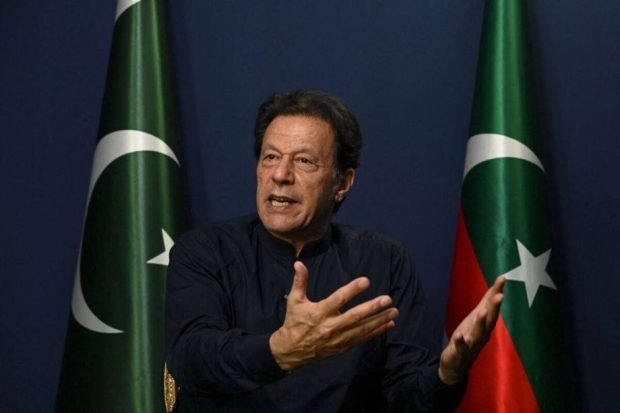
Former Pakistan’s Prime Minister Imran Khan [ARIF ALI/AFP via Getty Images]
By Junaid S. Ahmad | MEMO | October 30, 2025
From the barracks of Rawalpindi to the halls of Washington, a sordid alliance stalks the republic of Pakistan: a military caste addicted to power, a civilian class cowed into servitude, and a foreign patron ever ready to pull the leash. What unfolds is less a grand strategy than a tragicomedy: generals trading sovereignty for sinecures, soldiers harbouring contempt for their officers, and a once-promising democratic movement crushed under the twin weights of imperial ambition and martial tutelage.
At the summit of Pakistan’s national hierarchy sits the uniformed elite—high-command officers whose benefit resides not in defending the people, but in ensuring their own station remains unchallenged. The vast majority of junior officers and ordinary soldiers know the drill: they march at a command, live off state hand-outs, yet watch in silence as their rulers gamble everything in Islamabad’s corridors of power. Beneath their boots pulses a latent contempt: not for the institution of soldiering, but for the generals who confuse war-games with governance, who mistake subservience for sovereignty. They know the charade: a military that catalogues enemies abroad yet fails its citizens at home; a top brass more at ease with arms deals and alliances than with schools or clinics.
Meanwhile, in Washington and its allied capitals, they observe the last great outsourcing of empire. The US sees Pakistan not as an independent partner, but as a subcontractor—an air-strip here, a drone base there, a pliant nuclear state with acceptable risks. When Imran Khan—in office—moved, albeit imperfectly, toward a new Pakistan: one marked by social justice, independent foreign policy, and friendship with all nations, he ran head-first into this alliance. He derailed the pat-scripts: refused US basing rights, challenged embassy diktats, and dared to recast Kashmir and Palestine not as trophies of patronage but as tests of principle. His mistake was not corruption—it was defiance. And the consequence was swift: a regime-change operation dressed in parliamentary garb, a military and intelligence complex that salivated at the smell of capitulation, and a Washington that nodded, funded and quietly applauded.
From here the narrative spirals into farce. Pakistan’s flag-waving elite collect defence pacts as one might souvenirs—each a badge of fidelity to the imperial order, each certifying that the country’s violent and unjust alignments will continue unimpeded. The generals embrace those pacts not because they secure Pakistan—they don’t—but because they secure the elite’s privilege: a share of the deals, a veneer of patriotism, a shield against accountability. And while their generals trade in hardware and geopolitics, the cries of the oppressed vanish into night: Pashtun civilians bombed under the guise of “counter-terror,” Afghan refugees reviled as villains by a state that once nurtured their tormentors.
Yes, nuclear-armed Pakistan could not muster a single bullet for Gaza. It did not send a protection force. It does not lobby the United Nations for justice, despite the occasional meaningless rhetoric. Instead, it signs on to the next big defence contract, brushes its hands of the Palestinian plight, and turns its back on the ideal of Muslim solidarity. What kind of state is this that boasts nuclear weapons yet lacks the moral will to send aid—or more than a token gesture—to fellow victims of aggression? A state that lectures others on terrorism while shelling its own Pashtun tribes. A state so short on legitimacy it must invoke the bogeyman of the Afghan refugee, call entire populations “terrorists,” then crush any dissent with tanks and tear-gas.
Speaking of dissent—when Imran Khan’s movement rose, the state responded with idylls of terror. Cadres of young activists, women, students, social justice advocates—whether Karachi or Khyber—found themselves in dungeons sanctioned by a military-political complex. The hearings were stacked, the charges manufactured, the message simple: move for justice and you move into our sights. The generals clapped their hands, Washington twisted the strings, and the civilian face of Pakistan trembled. The officer class may nominally obey the high command—but in quiet mess halls and among soldiers’ wives the whispers of outrage gather: “Why are we policing our own people? Why is Urdu-speaking Karachi the victim of our operations? Why do we trespass into forests and valleys and call them terror zones?”
In the borderlands the farce becomes terrifyingly concrete. The army, having once nurtured the Taliban in Afghanistan to secure “strategic depth,” now bombs them—and blames them for terrorism. In this brain-twist of national strategy, the creator is recast as the adversary, the patron transformed into the provoked. The Pashtun civilian watches as homes are razed near the Durand Line, as refugees arrive on Pakistani soil bearing the costs of wars Pakistan helped manufacture, and as the generals portray them as fifth-column terrorists. The irony would be comical were it not so brutal.
And what of Kashmir? In the so-called “free” Azad Kashmir of Pakistan, huge anti-government demonstrations rage. A region whose inhabitants yearn for dignity, not just slogans. Under Imran Khan, new polling suggested the unthinkable: Kashmiris in Indian-occupied Kashmir, despite seeing the abysmal conditions in Azad Kashmir, began to seriously consider joining Pakistan—not as another occupier but as a fortress of self-determination. The generals would rather you not notice that: they prefer the pre-scripted dispute, the perpetual conflict, the tortured rhetoric of “we stand with Kashmir” while the state stands with its own survival. The polls are telling: if Pakistan’s Kashmir policy is failing, the state itself is structurally unhealthy.
To be sure, the Pakistan military remains an institution of extraordinary capability. But capability is not legitimacy; nor is turf-control a foundation for national purpose. The generals continue to conflate war-power with nation-power, forgetting that true power is fostered by schools, by hospitals, by trust in institutions—and by consent, not coercion. And when a regime trades in foreign patronage—be it Washington’s dollars or Beijing’s infrastructure—but cannot deliver justice or dignity at home, the bargain has already been lost.
As the Iranian–Israeli conflict rages, as Gaza bleeds, and as the great-game intensifies in South Asia, Pakistan stands at a crossroads: obey its patrons, shrink its sovereignty, and reclaim the empire-client script—or reject the military’s primacy, embrace true independence, and build a republic that answers not to external powers but to its people. The generals will tell you that the choice is security; the civilians will whisper it is dignity.
Here is the truth the generals, the politicians, and the strategists don’t want you to admit: you cannot rule a nation by telling its people to be silent while you thunder abroad. You cannot build strategic depth on the graves of your own citizens. You cannot pretend to champion Palestine while allying with its oppressors. You cannot call yourself a sovereign state when your alliances define you more than your aspirations.
Pakistan’s military may still march on; its generals may still wield the levers of power; Washington may still fax orders and funnel funds. But the people—they are waking up. And once the echo of Imran Khan’s voice becomes a roar, no amount of bayonets, no arsenal of deals, no drums of war will silence it. The generals may hold the fortress of Rawalpindi, but they cannot hold the conscience of a nation. The struggle for that is already well underway—and the verdict will not wait.
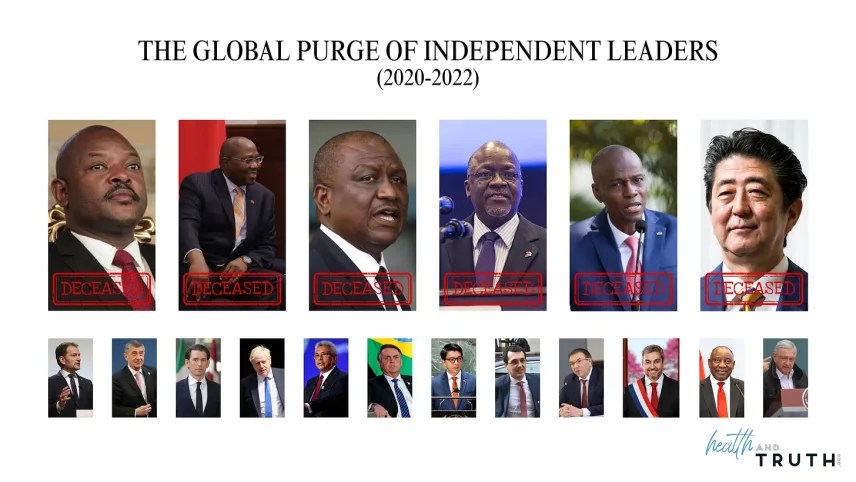
The Global Purge Of Independent Leaders (2020-2022)
A chronological overview of leadership changes and the policy pivots that followed
Health And Truth and Mark Stronge | October 28, 2025
From early 2020 onward, a repeating script unfolded: a head of state voiced skepticism of lockdowns, PCR testing, or experimental mRNA vaccines; international agencies scolded them; chaos or “illness” struck; and within weeks new officials delivered full compliance and suddenly unlocked frozen aid money. The alignment was worldwide—different cultures, same choreography.
1. Burundi – Pierre Nkurunziza
In Burundi, President Pierre Nkurunziza expelled the World Health Organization from his country in May 2020, saying foreign interference was undermining national sovereignty. He kept the nation open while neighboring states imposed severe restrictions. Merely two weeks after that decision he was dead, officially of a “heart attack,” though associates described him as being in vibrant health. His successor, Évariste Ndayishimiye, reversed course immediately, reopened WHO offices, and signed new vaccine and funding arrangements that brought Burundi back into the international fold.
- Backdrop: In spring 2020 the government halted WHO field work, accusing it of interfering with domestic affairs. Burundi rejected external pandemic restrictions and held public gatherings normally.
- Event: Nkurunziza died suddenly 8 June 2020 while still in office; official cause – cardiac arrest.
- Immediate shift: Successor Évariste Ndayishimiye re‑opened WHO offices, declared COVID‑19 a “national priority,” invited vaccine partnerships, and received roughly $24 million in rapid IMF assistance.
- Result: Burundi signed onto COVAX distribution in 2021 after having been one of the continent’s last hold‑outs.
2. Eswatini – Ambrose Dlamini
In Eswatini (formerly Swaziland), Prime Minister Ambrose Dlamini resisted extreme lockdown policies, insisting that starving citizens to stop a virus was immoral. In December 2020 he was taken to South Africa “for observation” and declared dead soon afterward. The royal government that replaced him moved quickly to impose strict curfews, accept COVAX vaccines, and collect foreign emergency aid.
- Backdrop: The businessman‑turned‑PM favoured balanced restrictions, warning that closing trade would worsen poverty.
- Event: Tested positive for SARS‑CoV‑2, transferred to South Africa, and died 13 Dec 2020.
- Aftermath: King Mswati III and his cabinet adopted curfews, mandatory masking, and joined regional COVAX planning.
- Economic follow‑up: The African Development Bank confirmed a $10 million grant under the COVID‑19 Response Support Programme in early 2021.
3. Ivory Coast – Hamed Bakayoko
A similar disappearance occurred in Ivory Coast. Hamed Bakayoko, the charismatic prime minister, had publicly encouraged herbal treatments and questioned the accuracy of PCR diagnostics. In March 2021 he died in Germany of “cancer,” barely eight months after his predecessor suffered a similar fate. His passing removed the last voice questioning WHO dependence. President Alassane Ouattara’s administration proceeded to import AstraZeneca doses through COVAX, and by summer the country was being praised for its “responsible leadership.”
- Backdrop: The popular Prime Minister promoted herbal remedies and localized treatment efforts while maintaining open borders for trade.
- Event: Died 3 Mar 2021 in Germany where he was under cancer treatment; preceded by the death of previous PM Amadou Gon Coulibaly eight months earlier.
- Aftermath: President Alassane Ouattara named Patrick Achi acting PM; by May, 504 000 AstraZeneca doses had been deployed through COVAX.
- Funding: World Bank approved $300 million for emergency health and education programmes that quarter.
4. Tanzania – John Magufuli
The next to fall was Tanzania’s John Magufuli, Africa’s most outspoken skeptic of mass testing and vaccines. He mocked the system by demonstrating that fruit and goats tested positive for COVID. After vanishing from public view in March 2021, the vice‑president announced that he had died of heart failure. His replacement, Samia Suluhu Hassan, promptly reversed every one of his policies, accepted a $600 million IMF “emergency” loan, reopened the gates to foreign pharmaceutical programs, and declared a massive vaccination drive before year’s end.
- Backdrop: Highly skeptical of PCR testing accuracy and mass vaccination; prioritized economic continuity.
- Event: Absent from view in March 2021 for two weeks; Vice President Samia Suluhu Hassan announced his death 17 March (heart failure).
- Aftermath: New administration reinstated public health briefings, reopened WHO cooperation, applied for IMF Rapid Credit Facility ($600 million approved Sept 2021).
- Policy transformation: Vaccine programmes, mask campaigns, and international data reporting began within ninety days.
5. Haiti – Jovenel Moïse
Then came Haiti, where Jovenel Moïse had rejected donated vaccine shipments, explaining that the country faced deeper issues of water and poverty. On July 7 2021, he was executed in his home by an armed team whose origins remain murky. Within three weeks, Haiti received half a million Moderna doses from COVAX and enjoyed renewed flows of Inter‑American Development Bank and USAID funding. The national policy flipped overnight.
- Backdrop: Refused early COVAX vaccine delivery, arguing sanitation and nutrition were greater priorities.
- Event: Assassinated 7 Jul 2021 by a commando team; political motives still contested.
- Aftermath: First COVAX shipment of 500 000 Moderna doses landed 14 July 2021.
- Financial context: Inter‑American Development Bank and USAID re‑released more than $60 million in suspended grants under the “COVID‑19 Recovery Program.”
6. Japan – Shinzo Abe → Yoshihide Suga → Fumio Kishida
In Japan, Prime Minister Shinzo Abe avoided harsh lockdowns and refused to make vaccination compulsory. In August 2020 he resigned citing chronic illness, a convenient exit for global interests irritated by Japan’s autonomy. His successor Yoshihide Suga approved emergency authorization for the Pfizer vaccine within weeks, and after political struggles Fumio Kishida continued the same line, expanding booster programs and digital health passes. When Abe, now a private citizen and public skeptic of global centralization, was assassinated in July 2022, the last independent conservative bastion in Japan’s establishment disappeared. The current government invested ¥4.5 trillion—about $40 billion—in mRNA infrastructure partnerships with Western firms.
- Backdrop: Abe resisted extreme lockdowns and mandatory passes; preferred voluntary distancing.
- Resignation: Aug 2020 due to chronic illness; Suga took over and immediately authorized Pfizer vaccine imports (Feb 2021).
- Transition: Kishida succeeded Suga Oct 2021 after election; expanded booster campaigns and health‑pass apps.
- Abe’s assassination: 8 Jul 2022 in Nara; investigation officially attributed to a personal grudge.
- Post‑event: Japan pledged ¥4.5 trillion (≈ $40 billion) in bio‑innovation investment partly for mRNA research.
7. Slovakia – Igor Matovič
Slovakia followed the pattern in March 2021 when Igor Matovič, who had attempted to purchase Russia’s Sputnik V vaccine outside the European Union’s centralized supply, was forced out after furious criticism from Brussels. His successor Eduard Heger rejoined the EU’s procurement framework and in return unlocked €6.3 billion in recovery funds.
- Backdrop: Purchased Sputnik V without EU approval to widen supply options.
- Event: Coalition crisis culminated March 2021 in his resignation.
- Aftermath: New PM Eduard Heger froze Sputnik imports, conformed to EU purchasing pool, and unlocked €6.3 billion EU Recovery Funds.
8. Czech Republic – Andrej Babiš
Nearby, the Czech Republic saw Prime Minister Andrej Babiš lose power at the end of 2021 after refusing to maintain endless pandemic states of emergency. His replacement Petr Fiala implemented vaccine passports and mass‑testing decrees soon afterward, bringing the nation into perfect accord with EU directives.
- Backdrop: Initially resisted heavy lockdowns, favored voluntary vaccination.
- Event: Lost October 2021 election amid strong pro‑mandate media push.
- Aftermath: Petr Fiala government mandated digital health passes (“Tečka” app) and extended state‑support contracts with Pfizer/Moderna.
9. Austria – Sebastian Kurz
Austria lost Sebastian Kurz the same year. Once a rising star who had questioned perpetual lockdowns, Kurz resigned under the weight of a corruption scandal in October 2021. Within days his successor announced Europe’s first universal vaccine mandate and qualified the country for €4.5 billion in European Stability Mechanism funding.
- Backdrop: Pushed for reopening and questioned perpetual emergency powers.
- Event: October 2021 resignation after prosecution alleged misuse of party funds.
- Aftermath: Successor Alexander Schallenberg announced universal vaccination January 2022; European Stability Mechanism distributed ≈ €4.5 billion in recovery funding.
10. United Kingdom – Boris Johnson
In the United Kingdom, Boris Johnson’s government had ended restrictions in mid‑2021 and refused to make vaccine passports a permanent condition of daily life. The press then exploded with “Partygate” scandals over gatherings during lockdown. Johnson resigned in 2022, replaced by Rishi Sunak, who restored Britain to full WHO cooperation and financed a £2 billion digital‑health‑ID system intended to prevent “misinformation.”
- Backdrop: Repealed many restrictions July 2021 (“Freedom Day”), angering zero‑COVID advocates.
- Event: Forced resignation mid‑2022 after “Partygate.”
- Aftermath: Rishi Sunak government supported the WHO pandemic‑treaty process and invested £2 billion in NHS digital ID infrastructure through Palantir‑backed data platforms. Within weeks of taking office, Downing Street announced negotiations with Moderna to establish a permanent mRNA‑manufacturing base — a 10‑year “strategic partnership” followed with construction of a mRNA vaccine research, development, and manufacturing centre in Harwell Science Park (Oxfordshire), projected to produce up to 250 million doses a year in a future outbreak. This collaboration was framed as part of the UK’s “100‑Day Mission” to deliver vaccines within 100 days of identifying a new pathogen; the mission itself originated from G7 and G20 pandemic‑preparedness pledges.
11. Sri Lanka – Gotabaya Rajapaksa
Half a world away in Sri Lanka, President Gotabaya Rajapaksa argued that global supply sabotage and debt were worse problems than COVID. By mid‑2022 coordinated protests and economic chaos forced him to flee abroad. Within weeks, the IMF approved a $3 billion bailout that required health‑security reforms and the adoption of digital‑surveillance frameworks under WHO supervision.
- Backdrop: Advocated reopening, claimed economic sabotage larger threat than virus.
- Event: Mass protests July 2022 amid fuel and food shortages.
- Aftermath: New interim government signed a $3 billion IMF agreement mandating fiscal reform and health‑security modernization.
12. Brazil – Jair Bolsonaro
Brazil completed the second‑wave phase of this storyline. President Jair Bolsonaro ridiculed mask mandates, called lockdowns a luxury for the rich, and questioned vaccine safety. After two furious years of constant hostility from media conglomerates and international NGOs, he lost the 2022 election. Lula da Silva took office, rejoined WHO initiatives, and secured a $1.2 billion World Bank “preparedness” loan.
- Backdrop: Dismissed lockdowns as “hysteria,” resisted vaccine coercion.
- Event: Lost 2022 election to Lula da Silva after two years of hostile media coverage.
- Aftermath: Brazil re‑entered WHO initiatives, COVAX procurement, and secured World Bank Preparedness Loan ($1.2 billion).
13. Madagascar – Andry Rajoelina
Along the African coast to Madagascar, President Andry Rajoelina had introduced his own herbal remedy, COVID‑Organics, and rejected Western pharmacology. In 2021 an attempted coup shook the island, and under global pressure Rajoelina signed new agreements restoring WHO cooperation that same year so donor funding could return.
- Backdrop: Promoted herbal tonic “COVID‑Organics” (artemisia‑based), claiming national self‑reliance.
- Event: July 2021 coup attempt; several senior officers arrested.
- Aftermath: Rajoelina accepted WHO cooperation and external medical aid later that year, restoring aid flows suspended in 2020.
14. Romania – Vlad Voiculescu Minister of Health
Appointed in December 2020 under Prime Minister Florin Cîțu, Voiculescu quickly became one of Eastern Europe’s most outspoken advocates for data transparency within the vaccine‑procurement process.
He questioned:
- why the European Commission’s contracts with Pfizer/BioNTech and Moderna were heavily redacted;
- the procedure for reporting adverse events and hospital bed usage;
- and financial allocation for Romania’s “Green Certificate” system.
In April 2021, Voiculescu alleged irregularities in the way national statistics on Covid mortality were reported (he said hospital figures were being “massaged” to fit EU targets).
Within 48 hours, Prime Minister Cîțu dismissed him (14 April 2021). That dismissal fractured the ruling coalition and was widely interpreted as pressure from Brussels and Bucharest business lobbies to restore “credibility” with EU health authorities.
- Backdrop: In 2021 Romanian minister objected to secrecy of EU vaccine contracts.
- Event: Dismissal and cabinet reshuffle.
- Aftermath:
- Florin Cîțu — Prime Minister (National Liberal Party), an economist trained in the US and a former banker, had emphasized cooperation with the European Commission’s Recovery Facility.
- Immediately after Voiculescu’s removal, Cîțu approved the formal implementation of the EU Digital COVID Certificate
- He signed Romania’s Recovery and Resilience Facility plan for €29 billion (approved September 2021).
- Cîțu later lost internal party support and was replaced by Nicolae Ciucă (2021 December).
- Raed Arafat — Secretary of State, Chief of the Department for Emergency Situations, a longtime figure in Romanian health management (specialist of Palestinian background), spearheaded the nationwide lockdown operations.
- He became polarizing — praised for emergency coordination but criticized for advocating strict curfews and mandatory digital passes.
- Through his influence, Romania aligned with EU Civil Protection Mechanisms and WHO technical advisories.
- Government enforced EU Digital COVID Certificates.
- Brussels released tranches of Recovery and Resilience Facility funds (€29 billion total plan).
- Florin Cîțu — Prime Minister (National Liberal Party), an economist trained in the US and a former banker, had emphasized cooperation with the European Commission’s Recovery Facility.
15. Bulgaria – Kostadin Angov
Appointed during the closing months of Prime Minister Boyko Borisov’s third administration, acting Health Minister Kostadin Angov (2020 – 2021) faced severe criticism from Brussels for Bulgaria’s slow vaccine rollout and limited transparency regarding distribution data. Angov and Borisov’s cabinet were accused of delaying orders through the EU’s joint procurement scheme, preferring to wait for additional safety results before committing to large Pfizer/Moderna contracts.
By late March 2021, Bulgaria had one of the lowest vaccination rates in the European Union and was publicly rebuked by the European Commission for “failure to utilize allocated supply quotas.”
Backdrop: By early 2021, Bulgaria’s center‑right government under Boyko Borisov had lost support amid apparent corruption scandals unrelated to health policy but amplified by public anger over uneven lockdown enforcement and vaccine delays. Multiple cabinet ministers, including acting Health Minister Angov, were called before parliamentary committees to justify the government’s refusal to impose stricter green‑pass rules or to publish full statistics on vaccine deliveries.
Event: In April 2021, Borisov’s GERB party failed to form a coalition following a general election; the president appointed Stefan Yanev as caretaker prime minister, and Stoycho Katsarov — a former deputy minister and health‑reform activist — assumed the health portfolio. Katsarov announced immediate compliance with EU digital pass protocols and promised rapid adoption of the COVID Certificates system, stating that “communication with Brussels must be restored through transparency and vaccination.”
Aftermath: Within three months of the caretaker cabinet’s installation, Bulgaria joined the EU Digital Green Certificate scheme (July 2021), issued its own national app, and implemented tightened entry controls for public venues. The European Commission then approved Bulgaria’s €6 billion Recovery and Resilience Facility allocation (approved December 2021) after earlier postponements linked to “governance deficiencies.”
Katsarov and Yanev argued the shift was strictly technocratic, yet domestic media framed it as the price of unlocking EU funds frozen under Borisov. Moreover, WHO country officers held joint press briefings in Sofia throughout autumn 2021, publicly graduating Bulgaria from a “non‑compliant” to a “fully aligned EU‑health partner.” Later that year a second caretaker cabinet retained the same policies to preserve continued Brussels cooperation.
Government Outcome: By the end of 2021 Bulgaria had moved from partial defiance to complete compliance with EU and WHO health requirements. The turnover of Borisov’s administration and replacement with technocratic caretaker officials effectively cleared the way for release of European recovery funds for health‑system modernization and digital infrastructure projects.
Summary of Sequence
- Initial reluctance to join EU vaccine mandates and delays in accepting digital certificate standards.
- Electoral defeat of incumbent government after months of European pressure and domestic unrest.
- Caretaker administration’s rapid embrace of EU and WHO frameworks.
- Approval of €6 billion in Recovery Funds and re‑establishment of good standing with Brussels.
16. Paraguay – Mario Abdo Benítez
Paraguay’s experience exemplifies how smaller Latin American economies were forced to align pandemic policies with international credit conditions. President Mario Abdo Benítez’s government initially emphasized economic stability over draconian lockdowns, warning that strict restrictions would devastate informal workers who make up more than 60% of the labour market. However, as domestic protests intensified and foreign creditors tightened lending conditions, the administration conceded to the IMF’s stipulations that pandemic‑response financing be tied to specific “public‑health governance commitments.” Once those commitments were accepted, loan disbursements resumed, showing how financial contingency mechanisms coerced health‑policy conformity.
- Backdrop: Through 2020 and early 2021 Paraguay maintained one of South America’s least restrictive lockdown regimes. The government was reluctant to mandate vaccinations or fully close borders with Brazil and Argentina.
- Event: In March 2021 mass protests erupted in Asunción over shortages of medical supplies and alleged corruption in procurement; opposition parties launched a failed impeachment attempt against President Abdo Benítez.
- Aftermath: To restore credit stability, the finance ministry agreed to conditions attached to an IMF Rapid Financing Instrument (≈ $274 million) earmarked for health expenditure auditing and expansion of surveillance systems. By late 2021 Paraguay was fully aligned with WHO and Pan American Health Organization recommendations.
- Outcome: Government stability was restored after external financing resumed, but policy autonomy remained limited by credit conditionality.
17. South Africa – Cyril Ramaphosa
South Africa began as a reluctant participant in strict global pandemic protocols. President Cyril Ramaphosa voiced concerns that extended lockdowns could fuel unrest and economic collapse, and he pushed for Africa‑wide vaccine intellectual‑property waivers rather than Western purchases. Nevertheless, as international ratings agencies threatened downgrades and IMF/World Bank assistance was made contingent on “strengthened public‑health governance,” South Africa shifted its course, introducing some of the continent’s strictest workplace vaccine rules.
- Backdrop: From early 2020 to mid‑2021 Ramaphosa’s cabinet clashed with business unions and community organizations over the cost of lockdowns versus public‑health benefit. Debt pressures soared following a 10% GDP contraction in 2020.
- Event: The National Treasury secured a $4.3 billion IMF loan (July 2020) and a World Bank loan of $750 million (Jan 2022) containing performance benchmarks for pandemic containment and “human capital protection”.
- Aftermath: By December 2021 South Africa announced mandatory vaccination for public‑sector employees and participation in the WHO vaccine passport initiative. Foreign aid disbursement and sovereign bond ratings stabilized only after these steps.
- Outcome: Policy alignment improved credit access but deepened domestic inequality and led to significant civil‑liberty litigation and ongoing parliamentary inquiries into procurement transparency.
18. Mexico – Andrés Manuel López Obrador
Mexico under Andrés Manuel López Obrador (AMLO) presented one of the last major cases of gradual capitulation to WHO and multilateral financial pressures. Initially AMLO resisted mandatory lockdowns and booster campaigns, insisting that national public‑health policy should focus on nutrition and poverty reduction. However, a combination of supply‑chain disruption, dollar liquidity concerns, and lobbying from international philanthropic networks (CEPI, GAVI, and the Gates Foundation) eventually pushed Mexico toward full policy compliance by 2022.
- Backdrop: Throughout 2020 Mexico’s Health Secretary Jorge Alcocer and Under‑secretary Hugo López‑Gatell advocated moderate restrictions and non‑coercive vaccine rollout. The country’s mortality surged during mid‑2021, provoking foreign and domestic pressure for a policy shift.
- Event: Facing threat of credit downgrades, the Finance Ministry began talks with the World Bank and IMF for infrastructure loans linked to public‑health reform. In December 2021 Mexico signed a joint memorandum of understanding with WHO and CEPI for “bio‑pharmaceutical collaboration and vaccine development capacity”.
- Aftermath: Through 2022 Mexico aligned its vaccine certification systems with the COVAX framework and expanded digital health records for the Ministry of Health, unlocking up to $1 billion in World Bank Covid‑response financing.
- Outcome: By 2023 Mexico was publicly touted by WHO offices as a “model for integrated pandemic response,” demonstrating how international credit leverage transformed a once‑independent policy line into strict adherence with global health‑security standards.
Summary of Observable Trends
- Chronology: Deaths of Nkurunziza, Dlamini, Bakayoko, Magufuli, and Moïse opened the sequence (Jun 2020 – Jul 2021). Political collapses in Europe, Asia, and the Americas followed through 2022.
- Policy effect: Every successor endorsed WHO recommendations and entered international funding arrangements that had been unavailable under predecessors.
- Financial trigger: Aid packages—IMF Rapid Credit, World Bank preparedness loans, EU Recovery mechanisms—were routinely disbursed within 30–90 days of the leadership change.
Key Takeaway
From 2020 to 2022, the result was unmistakable: national autonomy collapsed beneath a synchronized agenda linking public‑health compliance to economic salvation. Countries that resisted early, especially in Africa, suffered the hardest blows—five sitting leaders dead in one year. More powerful nations experienced subtler coups through scandal, protest, or economic blackmail, all producing the same end state.
What emerged from these parallel crises was not medical harmony but political homogenization. Each successor declared a “renewed partnership with science,” welcomed new funding from the IMF, World Bank, or GAVI, and ushered in digital‑compliance systems that now define post‑pandemic governance.
By the end of 2022 nearly every government on Earth—rich or poor, democratic or autocratic—had been brought into alignment. Differing flags, languages, and histories no longer prevented one shared choreography: resistance punished, obedience financed, and sovereignty quietly exchanged for a coordinated global script.
- IMF Press Release – Rapid Credit Facility for Burundi (June 2020).
- Reuters / AP Report – Death of Eswatini Prime Minister (Dec 2020).
- African Development Bank – COVID‑19 Response Support Programme (2021).
- World Bank – Ivory Coast Emergency Support Project (2021).
- IMF Press Release No. 21/210 – Tanzania RFI (Sept 2021).
- Associated Press – “President of Haiti Assassinated at Home” (July 2021).
- IDB Official Statement on Haiti Relief Funding (2021).
- Japan Cabinet Office – Resignation of PM Abe (Aug 2020).
- Nikkei Asia – “Japan Invests in mRNA Manufacturing” (2022).
- 1European Commission – Next Generation EU Fund Allocation to Slovakia (2021).
- Czech News Agency – Election Results and Policy Changes (2021).
- Austrian Prosecution Service – Kurz Investigation Report (2021).
- EU Council Press Release – Austria ESM Allocation (2022).
- UK Parliamentary Record – Digital Health Infrastructure Funding (2022).
- IMF Staff Report – Sri Lanka Extended Fund Facility (March 2023).
- World Bank – Brazil Pandemic Preparedness Loan (2022).
- WHO Madagascar Country Office – Cooperation Agreement (2021).
- European Commission – Romania RRF Approval (2021).
- European Commission – Bulgaria RRF Approval (2021).
- IMF Country Report – Paraguay Pandemic Financing (2021).
- IMF Country Report – South Africa Fiscal Support Arrangements (2021).
- WHO / CEPI Press Release – Mexico Cooperation Agreement (2022).
- IMF Country Report – Paraguay Rapid Financing Instrument 2021.
- BBC News Latin America – “Protests Rock Paraguay Over Pandemic Supplies,” March 2021.
- Finance Ministry of Paraguay – Press Release on IMF Commitments April 2021.
- South African Reserve Bank Annual Report 2021.
- IMF Press Release No. 20/315 – South Africa Loan Approval; World Bank Loan Press Brief 2022.
- Reuters – “South Africa Adopts Mandatory Public‑Sector Vaccination Policy,” December 2021.
- El Universal – “López‑Gatell Sabemos que no habrá vacunación obligatoria,” 2020.
- WHO / CEPI – Memorandum on Mexico Vaccine Collaboration, December 2021.
- World Bank – “Mexico COVID‑19 Emergency Response Project,” 2022.
NYPD Commissioner Jessica Tisch is Turning New York City into a Surveillance Colony
By Matt Wolfson | The Libertarian Institute | October 29, 2025
In a recent report for the Libertarian Institute, I investigated Zionists’ role in creating the crisis point at which New York City now finds itself: caught between a colonial elite which has commandeered government and a progressive-socialist backlash to that elite which proposes to expand government. In this report, I will trace how, in response to the progressive-socialist threat to their power, Zionists and their allies are expanding government in new and frightening directions. The leading player in this operation, like in all good intelligence ops, is not a colorful or charismatic character. But she has all of the subtler qualities—connections, management prowess, presentational understatement—that the city’s minders look for in those who hold actual power.
Jessica Tisch, the New York Police Department Commissioner since 2024 who will definitely stay on if either Zohran Mamdani or Andrew Cuomo wins the mayoralty according to public statements made by both men, is the third generation of the billionaire Zionist family that has had prominent roles in shaping the city since the 1980s. Her grandfather, Laurence Tisch, bought CBS in the 1980s not long before his brother Robert bought the New York Giants, establishing the family, which had started in hotels and movie theaters, as the owner of two of the city’s landmark organizations. In the 1990s, Laurence Tisch was a member of The Study Group, the informal philanthropic Zionist gathering co-founded by Leslie Wexner and Charles Bronfman, which led directly and indirectly to the foundation of Taglit Birthright, the Foundation for Defense of Democracies, and various other projects for Zionist continuity. Laurence’s son and Jessica’s father, James Tisch, is the chairman of the Board of Leows Corporation, the family’s flagship business. James’ wife and Jessica’s mother, Merryl, was the chancellor of the New York State Board of Regents, responsible for supervising all educational activities in the state; and is the chair of the State University of New York Board of Trustees, responsible for supervising the state university system.
Within this context of a family involved in media, finance, philanthropy, and part-time politics, Jessica Tisch, who is now 44, charted her own specific path: from security to administration to the cusp of politics with the backing of money. She started in the NYPD in the decade of the September 11 attacks; continued in the department in the 2010s; moved in the first half of the 2020s to the Sanitation Department, arguably New York’s most important after police and fire. She has returned in the mid-2020s to the NYPD as its commissioner, while also widely being considered a potential future mayor. Like Mamdani, Tisch is a product, this time a direct one, of the decades of Zionist influence that preceded her rise. Like Mamdani, rewinding Tisch’s career shows how she is the capstone to a project of military policing that began in the 1990s and 2000s but that has sharpened under pressure into a full-blown project of social control.
That project began when crime rose in New York in the 1980s and 1990s in response to displacement and homelessness facilitated by WASPs, Zionists, and their allies co-opting city government to the benefit of finance and real estate. In response, Eric Breindel, the neoconservative Zionist editor of the New York Post who had extensive connections to Wall Street, arranged for the Post to back the then-longshot Rudolph W. Guiliani as a tough-on-crime candidate, delivering him Staten Island and so the city.
At the same time, Michael Steinhardt, the Zionist financier who was integral in the reinvention of Wall Street in the 1980s, became the major donor for the Democratic Leadership Council (DLC), which in turn was the major backer of President Bill Clinton, who shepherded to passage in Congress as his main legislative priority the Violent Crime Control and Law Enforcement Act. This act provided newly elected Mayor Giuliani and his police commissioner William Bratton federal funds for law enforcement, with certain conditions attached that increased local spending on policing as well as the size of the NYPD. The NYPD’s budget increased from $1.7 billion to $3.1 billion between 1993 and 2000, also leading to increased city spending, since, under the terms of the Clinton crime legislation, to receive federal funds the city had to spend funds of its own.
During this period, “crime”—defined as everything from murder to unlicensed street vending—fell in response to across-the-board enforcement. After 2001, Raymond Kelly, Mayor Michael Bloomberg’s police commissioner, pushed this practice to its limit with the aggressive practice of “stop and frisk” in minority neighborhoods: a daily distillation of the broader disenfranchisement the black and Latino communities of New York had been experiencing since the 1970s.
Kelly also made sure that the NYPD would benefit from post-9/11 funding of counter-terrorism measures, measures which hinged heavily on techniques for surveillance. And it was by channeling this new priority for social control that Jessica Tisch made her career beginning in 2000s. Fresh out of Harvard, she took “an analyst position available in what was then the counterterrorism bureau” of the NYPD. According to a recent profile in The New York Times:
“Kelly…did not normally meet with applicants for such entry-level jobs, but he ended up interviewing her. ‘Probably because she was a Tisch,’ he said, adding that he had been impressed with her three Harvard degrees.”
“Probably because she was a Tisch” seems like a fair assessment of why the supervisor of 55,000 employees took the time to meet a twenty-something about an entry-level position. But Kelly and Tisch also shared the promising ground of a professional focus: Kelly was committed to surveillance-as-policing, and Tisch’s main interest was data and surveillance. At the NYPD, she began “developing the Domain Awareness System, one of the world’s largest networks of security cameras, including handling contracts to build and expand it.” According to a description of this work in a recent profile of Tisch in New York Magazine, she was Domain’s driving force and Domain her career-maker:
“… Tisch, 27, was tasked with figuring out what to do with more than $100 million in unspent grant money from the federal Department of Homeland Security, which had just built a surveillance network to prevent another terror attack downtown. What if, she asked, the Domain Awareness System went citywide? And what if, instead of trying to stop a suicide bomber, the system tried to spot all kinds of crooks? What if it included the NYPD’s trove of arrest reports and criminal histories? When Tisch sent the privacy guidelines for the system to the lawyers at the New York Civil Liberties Union, they retched…The bosses had the opposite reaction: ‘No, you’ve made it. Congratulations,’ the former colleague recalls them saying.”
Based on an initial grant of $350 million from the Department of Homeland Security and developed with Microsoft technology, the System consists today of “a surveillance network of more than 18,000 interconnected cameras—including those in the private sector—as well as law-enforcement databases.” The system, in one description, “assimilates data from several surveillance tools—license plate readers, closed-circuit television streams, facial recognition software and phone call histories—and uses it to identify people.” As these descriptions suggest, private corporations and nonprofits, for example Rockefeller University in Midtown East Manhattan, can buy in: providing their own cameras then linking them to the surveillance system run out of the NYPD. “And,” according to one report, “when Microsoft turns around and sells the technology to other cities, New York gets a cut.”
Tisch was not only one of the developers, if not the developer, of the system; she also so impressed Kelly with her tenacity dealing with the various technology sub-vendors put in play by the project that he moved her up through the ranks. (She also may have impressed Kelly with her access to funds; the nonprofit the New York Police Foundation, which her uncle chaired and where two of her family members still sit on the board, provided some of the early contributions for testing her surveillance system.) Within a decade, “she became the city’s first information technology commissioner… and within months she was in the midst of the coronavirus pandemic, struggling to create a contact tracing system and then a vaccine distribution system.” Throughout this time, Tisch was working with at least one like-minded colleague from a similar background. This was fellow Harvard graduate Rebecca Ulam Weiner, the granddaughter of the Zionist nuclear scientist Stanislav Ulam of the Manhattan Project, whose view of her grandfather’s work is instructive:
“As someone whose job it is to keep secrets, I often wonder whether such an experiment [as the Manhattan Project] would be possible today, scientifically or socially.”
Fast forward to November 2024, and an embattled Mayor Eric Adams, whose allies in the black community have increasingly moved away from him even as powerful Zionists have edged closer, appointed Tisch Commissioner. He did this despite vocal concerns from civil liberties advocates that, in the words of one, “It’s really alarming to see a commissioner who built her career on the infrastructure of mass surveillance.” Weiner is Tisch’s deputy commissioner of intelligence and counterterrorism, and has let it be known that her department “relies on a mind-boggling suite of assets that Americans might otherwise assume are controlled by the CIA, FBI, DHS, Secret Service, or other agencies.” These include:
“… a legion of intelligence analysts, counterassault and dignitary-protection teams, a flotilla of boats…surveillance aircraft, the nation’s biggest bomb squad, a counter-drone unit, a remote contingent of NYPD detectives… and a network of multilingual undercover operatives…”
Among this “remote contingent” is NYPD Detective Charlie Benaim, “[whose] office could be any squad room in Brooklyn, but for years [has been] an Israeli police station near Tel Aviv,” where “Benaim’s been feeding an endless stream of information, in real time, to his bosses back at One Police Plaza.” According to Weiner, Benaim’s function is “asking the New York question, when something is happening, what would it look like it if it were to happen in New York City, and more importantly than that, how do you prevent it?” A new model for Benaim in answering these questions, apparently, is the Hamas uprising of October 7. This suggests either that the NYPD expects a coordinated attack from foreign operators; or that New York’s security leaders see the city as potentially under siege by its own displaced and ghettoized underclass and plan to respond accordingly.
Telling in this regard is the fact that Tisch’s top priority as commissioner is “doubling down on data-driven policing and surveillance,” an aim which has “sparked fierce criticism from watchdog groups that New Yorkers are living in a surveillance state.” According to New York Magazine, Tisch’s proposed reforms fall along four lines. First, she wants to expand actual surveillance capacities by expanding the city’s camera network “to include more privately owned cameras.” Second, she wants to extend the contract of one of Domain’s less reliable components, “the ShotSpotter gunshot-detection system” which “may result in confirmed shootings only less than 15 percent of the time, according to the comptroller’s office,” a fact which Tisch dismisses, “arguing that something is better than nothing.” Third, she wants to use data collected “to surge police resources down to a single block,” allowing for the department to deploy overwhelming force to tackle individual incidents in small areas. (This means essentially treating city policing as counterinsurgency warfare, and it’s not too different than the LAPD tactics that led to the abuse of Rodney King and the fallout that followed.) Finally, “perhaps the biggest change is that she wants to use those same systems and processes to fight ‘chaos,’ not just crime,” meaning that minor noise disturbances or unusual behavior could qualify for police enforcement via surveillance and surges. (Again, this is a retread of the 1990s: “Giuliani-style crackdowns, only with better gear.”)
More instructively still, she feels this way despite at least one recent controversy suggesting that her policies have adverse effects on the very communities historically at the blunt end of militarized policing. According to The New York Times, in an August report, the NYPD used Domain Awareness System’s facial recognition software to identify and arrest for indecent exposure in April a 230 pound 6-foot-2 black man, Trevis Williams. The arrest was made even though a witness said that the offender was about 160 pounds and 5-foot-6 and even though “location data from [Williams’s] phone put him about 12 miles away at the time.” According to the Times, the fact that “a facial recognition program plucked his image from an array of mug shots and the woman identified him as the flasher was enough to land Williams in jail.” This is despite the fact that “other police departments… require investigators to gather more facts before putting a suspect identified by facial recognition into a photo lineup,” and despite advocacy from groups like the American Civil Liberties Union to “ban… the use of facial recognition by the police because of the risk of misidentification.”
“In the blink of an eye, your whole life could change,” Williams told the Times about his experience, adding that he still gets panic attacks since his April arrest and subsequent imprisonment. The Times investigation did not report asking for a comment from the NYPD or its Commissioner. Nor did it report that, as early as 2019, 11,000 cases per year were being investigated by the NYPD with the help of facial recognition software.
Despite collateral damage from her policies, positive media profiles of “Commish Tisch” and her subordinates have been plentiful since her accession. In an April 2025 report in The News section of The New York Times, the paper had the following to say about her: She has “an unlikely and remarkable career”; is “the daughter and granddaughter of two strong women, neither of whom came from money”; “learned hard work by example”; is “talkative and purposeful, but circumspect”; is a “no-nonsense technocrat” and “incredibly competent”; commands “a huge amount of respect”; is “very businesslike,” “[takes] no guff,” and should run for mayor. New York Magazine, the city’s go-to venue for fashion and culture commentary, had run an equally complimentary profile in March of 2025 that included the same political prediction.
And, the month before New York Magazine’s profile of Tisch, Vanity Fair ran a profile of Tisch’s deputy Weiner titled “NYPD Confidential.” Headed by a black-and-white photo of Weiner flanked by members of her squad that seemed ripped from a promotional poster of Captain America, the article’s text gave its subject an equally marquee treatment, describing her as “laser focused,” “unfazed,” “poised, cultivated, pin-sharp, convivial, boundlessly curious, charmingly profane,” and “a lightning-quick study” who had “a wicked sense of humor.” All three of these profiles also emphasized, as The New York Times’ editorial board regularly emphasizes, a recent rise in crime in the city without honing in on its obvious causes: financialization, gentrification, and displacement.
The Times is owned by the Sulzberger Family, whose members are ambivalent about Zionism but who have deep connections to Zionists. (Their executive editor, Joseph Kahn, is the son of a committed Zionist corporatist and runs in the billionaire Zionist milieu; their editorial page is dominated by Jewish Zionists of all political persuasions; and the former head of the Sulzberger family wealth office now heads Bill Ackman’s.) Vanity Fair is still owned by the Newhouse Family, which, as I reported in my recent investigation on the rise of Zionist power in New York, was vital to that project thanks to its ownership of Conde Nast. New York Magazine is dependent for its scoops on access to the city’s financial and philanthropic elite, many of them Zionists—its recent profile subjects include not just Jessica Tisch but Barry Diller and Diane Von Furstenberg and Bill Ackman. The message from these media venues seems clear: the Zionist financial powers of New York are squarely behind Jessica Tisch, and want their readers to know it.
It is not, in this context, a coincidence that the Times ran an article soon after Zohran Mamdani’s victory in the Democratic mayoral primary citing anonymous sources to report that Mamdani was being urged to keep Tisch on if he wins the mayoralty as a “steady pair of hands.” It is also not a coincidence that this story came during a period when Dan Loeb and Bill Ackman, younger Zionist financial-philanthropic operators, were attacking Mamdani as soft-on-crime almost daily and shifting their funding focus to Mamdani’s Independent mayoral competitor, Mayor Eric Adams, to the point of personally vetting Adams’s campaign manager before the position was filled. What this suggested at the time was a pincer movement, in which attacks by Loeb and Ackman pressured Mamdani into keeping Tisch on as a sign of faith in the establishment and détente with Zionism.
And, in late October, with Mamdani still attacked by connected Zionist players for purportedly making Jews feel unsafe despite the fact that he has attracted significant Jewish support, this is exactly what occurred. On October 22, Mamdani announced, four days after Andrew Cuomo had announced the same, that he would ask Tisch to stay on should he win the election. The reported terms on which this “ask” was made are not encouraging when it comes to Mamdani’s leverage over Tisch if he is elected mayor. Details in The New York Times painted a scenario in which Mamdani had publicly (and factually erroneously) made Tisch the poster child for safety in the city without extracting any concessions from her camp in return. According to the Times,
“… Mr. Mamdani confirmed his decision during the final televised debate before the Nov. 4 election. ‘Commissioner Tisch took on a broken status quo, started to deliver accountability, rooting out corruption and reducing crime across the five boroughs,’ Mr. Mamdani said at the debate. “I’ve said time and again that my litmus test for that position will be excellence’… Ms. Tisch’s allies have signaled for months that she would want to stay in the job regardless of the election’s outcome. [Mamdani] campaign officials declined to detail any conversations between the candidate and the commissioner, but said they were confident she would accept. Delaney Kempner, a spokeswoman for Ms. Tisch, referred a reporter back to an earlier statement from the commissioner stressing that ‘it is not appropriate for the police commissioner to be directly involved or to seem to be involved in electoral politics.’”
Tisch’s strategic mix of aggressive behind-the-scenes lobbying and Olympian public detachment sends a message: as New York Magazine put it less than twenty-four hours after Mamdani made the announcement, she is “the Heiress Who Could Make or Break the Socialist Mayor.” Not long after this article ran, Hakeem Jeffries, the New York Democratic leader of the U.S. House of Representatives, ended five months of ostentatious non-endorsement of Mamdani with a statement endorsing Mamdani—specifically praising his willingness to keep on Tisch. Already, then, thanks to a series of private maneuvers and public feints, Tisch has been placed in the driver’s seat: the establishment’s cooperation with Mamdani is clearly conditioned on Mamdani’s continued acceptance of her.
One difficulty of critiquing moves like these is that the conflation of “Jewish power” and New York is an old trope, in part because New York has been since the early twentieth century a Jewish city. So it should be emphasized, as I have emphasized in my previous report on this topic, that New York’s problem is not a problem of Jewish power. It is a problem of government-tied financialization at the hands of a small number of WASPs and then a small number of Zionists, and it has come at the expense of the people who live in the city, among them many Jews. Now, with a direct threat to Zionists’ influence in the person of Zohran Mamdani, the operation is out front. Zionist financiers have sent one of their own to occupy the most powerful security position in the city, and they are intent on keeping her there. If they fail to install their ally Andrew Cuomo in the mayoralty, which will give Tisch carte blanche, the prospect of them working to sabotage a Mamdani mayoralty in the lead-up to a Tisch For Mayor campaign in 2029 is a very real one.
They will likely do this much like they managed the securance of Jessica Tisch’s job: with media attacks meant to maximize pressure on Mamdani; followed by private assurances to Mamdani that the attacks will stop if concessions follow. These public-private feints, in turn, will push Mamdani into concessions which will make him lose face with his base, isolating him between an unfriendly establishment and a disillusioned electorate. (This trend is already occurring, albeit at the edges, after Mamdani’s public commitment to keeping Tisch, whom many Mamdani voters see as a threat to civil liberties.) Tisch’s allies will manage these plays with the help of The New York Times and other organs of influence (the Conde Nast publications, New York Magazine, the New York Post) which by their own admission are pining for technocratic government predicated on what they call “effective management.”
But there is another equally bad outcome that could accrue should Mamdani win the mayoralty and Tisch stay on as police commissioner. This is the fusion of the most dangerous potential aspect of socialism, total government direction of the economy, with the most dangerous potential aspect of Zionism: total techno-military colonial control. It doesn’t take a great deal of imagination to see how, under a de facto power-sharing agreement between Mamdani and Tisch (Mamdani in charge of domestic welfare, Tisch in charge of security) the worst impulses of both systems will merge to create a city government which is totalistically involved in every aspect of its citizens’ lives, Singapore transfused with Sweden. This outcome for a city which for a century has been read as a triumph of American individualism would be, to understate the case, a seismic shift.
Kyiv wants land, not people: former US State Department adviser warns
By Uriel Araujo | October 29, 2025
James Carden, former US State Department Russia Policy Adviser has faced criticism in certain circles over his otherwise underreported comments during a recent interview to Australian Sky News — especially for mentioning some hard truths about the ethnopolitics of Ukraine.
In that interview, Mr. Carden noted that, like HIMARS or F-16s, Tomahawks won’t be a gamechanger, and argued that Putin’s proposal — EU but not NATO membership — was a fair enough bargain. When the host replied that, in this case, that would involve land concessions as part of a land-for-peace deal, the former State Department Adviser argued that the land Kyiv would be ceding is a land that: “they themselves have been attacking since 2014. The Ukrainians are being a bit disingenuous here… They claim to want the land in the Donbass, Eastern Ukraine. But they don’t want the ethnic Russian citizens on that land. So they’ve been doing everything that they can to disenfranchise those people.”
These comments are not ill-informed or dishonest and they merit some attention. In fact, they are quite accurate.
For years, Kyiv’s policies have systematically sidelined a significant chunk of Ukraine’s population. According to the country’s last census in 2001 — the only one since independence in 1991 — “ethnic Russians” accounted for 17.3 percent of the populace, which is over 8 million people. The numbers don’t catch all the nuance here: Ukraine is, pure and simple, a deeply bilingual society, with Russian as the native language (in other surveys) for at least 29 percent nationwide, a percentage that gets far higher in the east and south.
It is true that a 2024 study by linguist Volodymyr Kulyk shows a decline in everyday Russian use in Ukraine since 2022, with streets renamed, statues of Russians taken down and “Russian literature taken off the shelves of bookshops”, as Lancaster University PhD researcher Oleksandra Osypenko puts it. While in 2012 only 44% Ukrainians primarily spoke Ukrainian and 34% Russian, by December 2022 Ukrainian had risen to 57.4% and Russian had fallen to 14.8%, with the remaining 27.8 percent reporting employing both. This means that 42.6% of Ukrainians (that is 14.8 plus 27.8) still use the Russian language routinely, even after three years of open war, with censored media, and all “pro-Russian” parties having been banned; and after at least 11 years of Ukrainization policies.
High rates of intermarriage blur the lines even further; and, from a social science perspective, many folks toggle between “Russian” and “Ukrainian” identities depending on the context, as I’ve noticed myself during fieldwork in 2019.
Yet, back in August 2021, President Volodymyr Zelensky told Donbass residents who ‘feel russkiye [ethnic Russians]’ to move to Russia. At the time, I argued that this was one of the most russophobic statements from a high-ranking Ukrainian official since World War II; which is an ironic enough twist, considering the fact that in 2019 Zelensky (a Russian speaker himself) was widely described as a candidate courting the Russian and pro-Russian minority, and rode to power on promises to protect precisely these Russian-identifying folks in the east.
The 2014 ultranationalist Maidan revolution, backed by Washington (despite its far-right elements), has ushered in a surge of Ukrainian chauvinism that verges on negationism about the country’s pluri-ethnic realities. Language laws tell part of the tale. The 2017 education reform made Ukrainian the sole public-school language; by March 2023, Ukraine expanded media censorship and raised TV Ukrainian-language quotas to 90% by 2024, while banning non-Ukrainian languages in key areas.
Oleksiy Danilov, then secretary of Ukraine’s National Security and Defense Council, put it starkly in a 2023 interview: “The Russian language must completely disappear from our territory.” No wonder Ukrainian philosopher Sergei Datsyuk warned that such moves could spark an “internal civil war” worse than the external one, and even Oleksiy Arestovich, Zelensky’s former adviser, echoed the alarm.
The truth is that such “internal civil war” kicked off nearly a decade ago in Donbass, as scholar Serhiy Kudelia frames it, under artillery barrages that turned it into Europe’s “forgotten war” until 2022. Kyiv has been bombing Russians (in Donbass) for a decade, while disenfranchising them.
This is no hyperbole: experts like Nicolai N. Petro, a US Fulbright scholar in Ukraine in 2013-2014 and ex-State Department specialist on the Soviet Union, have documented how Ukrainian policies erode civil rights for ethnic minorities, especially Russian speakers.
The Venice Commission, Europe’s go-to body for democratic standards, criticized Ukraine’s 2022 Law on National Minorities for restricting publishing, media, and education in minority languages, urging revisions to meet international standards. Despite this, Deputy PM Olga Stefanishyna dismissed it all by claiming: “there is no Russian minority in Ukraine.”
Moreover, for many, Ukraine’s history is inextricably tied to Russia’s; a 2021 survey, taken six months before the full-scale escalation, found over 40 percent of Ukrainians nationwide — and nearly two-thirds in the east and south — agreeing with Putin that Ukrainians and Russians are “one people”.
Yet Ukraine’s rigid unitary state, with its top-down nationalism, clashes hard against Russia’s matryoshka model of multinational autonomy — with 22 ethnic republics within the Russian Federation. Granting Donbass similar autonomy, for instance, could have eased tensions, but it would have demanded a constitutional overhaul.
In the broader post-Soviet mess, Ukraine’s woes look less unique. Frozen conflicts across the region — Transnistria, Abkhazia, South Ossetia, Nagorno-Karabakh — show how borders remain volatile. In this context, Crimea and Donbass have been hot topics for decades.
The hard truth is that if Kyiv won militarily (unlikely), more Donbass shelling and displacement would likely follow. Carden’s point stands: without addressing internal ethnopolitics, Ukraine cannot secure peace; for peace means embracing all its people, not just the land they stand on.
Uriel Araujo, Anthropology PhD, is a social scientist specializing in ethnic and religious conflicts, with extensive research on geopolitical dynamics and cultural interactions.
Zelensky says he ‘doesn’t care’ if claim used to oust Odessa mayor is fake
RT | October 28, 2025
Ukraine’s Vladimir Zelensky has said he is unconcerned about whether the evidence used to oust former Odessa Mayor Gennady Trukhanov was fake.
Zelensky fired the mayor of the southern city earlier this month over accusations that he holds a Russian passport. The allegations have reportedly since been shown to contain false information, with the passport number that Ukrainian investigators claimed was Trukhanov’s actually belonging to a woman from Siberia who recently crossed the Russian border.
Zelensky defended his decision to journalists on Tuesday, admitting he did not question the evidence presented by investigators.
”How many passports he has, which are real, which are fake, who made them? Frankly speaking, I do not care,” Zelensky said, as quoted by Ukrinform. “Is it 100% true that he is a Russian citizen? [Investigators] tell me ‘yes’.”
Trukhanov was one of several people stripped of Ukrainian citizenship earlier this month under Zelensky’s decree targeting individuals accused of secretly holding Russian passports. His administration has since been replaced by one appointed directly by the central government.
Trukhanov has said the allegations against him are based on fabrications and that he is the victim of a political purge. In an interview following his removal, he compared his situation to the Stalin-era repressions, arguing that there is no viable path for appeal under Zelensky’s rule.
International media outlets have also criticized the move. The Spectator described it as “a step too far,” suggesting it served as a warning to other local leaders that dissent would not be tolerated.
Reports have pointed to growing friction between Zelensky and prominent mayors, including Kiev’s Vitaly Klitschko, who accused the Ukrainian leader of consolidating power and edging toward a dictatorship.
Zelensky’s presidential term expired last year, but he continues to govern under martial law, after declining to transfer authority to the speaker of parliament as required by the Ukrainian Constitution.
Israeli military company establishes first branch in UAE
MEMO | October 27, 2025
The Hebrew newspaper Maariv reported on Sunday that the Israeli government has approved the establishment of a branch of Controp Precision Technologies Ltd in the United Arab Emirates. The move has been described as an “unprecedented security and economic step” since the signing of the normalisation agreements in 2020.
Controp Precision Technologies Ltd specialises in designing and manufacturing EO/IR systems used for intelligence, surveillance, reconnaissance, and targeting missions across air, land, and maritime domains. The company provides its solutions to the defence, homeland security, and other related sectors.
According to the newspaper, the new company, named Controp Emirates Ltd, will operate within Abu Dhabi’s free trade zone (ADGM). It will be fully owned by the Israeli parent company and will operate under strict security supervision from Israel’s Ministry of Defence.
The purpose of the new branch is to enable the company to manufacture and market its advanced electro-optical systems locally in the UAE, as well as to provide maintenance and technical support services.
The total investment in the first phase is estimated at around 30 million US dollars, funded through Controp shares and owner loans. The branch will be managed by an Israeli chief executive, while full control will remain with the parent company.
Bowing to Zionist lobby pressure, UK medical regulator hounds British-Palestinian medic

By Maryam Qarehgozlou | Press TV | October 26, 2025
Yielding to pressure from pro-Israel lobbying groups, the UK’s General Medical Council (GMC) has reopened a politically motivated case against British-Palestinian doctor Rahmeh Aladwan over her outspoken criticism of UK-backed Israel’s genocidal war on Gaza.
The renewed proceedings aim to suspend the 31-year-old medic from the UK medical register over social media posts condemning the genocide in Gaza and the complicity of the British government.
The move comes less than a month after the Medical Practitioners Tribunal Service (MPTS) ruled that the complaints against her were not “sufficient to establish that there may be a real risk to patients” and refused to impose any restrictions on her licence.
That September 25 decision had appeared to close the case.
However, under pressure from Zionist lobbying groups — led by the so-called Campaign Against Antisemitism (CAA) and the Jewish Medical Association (UK) — the GMC has now reversed course.
Both groups, backed by Labour Health Secretary Wes Streeting, have spearheaded a smear campaign to punish Dr. Aladwan for her vocal and strong pro-Palestine stance.
For nearly two years, she has been the target of online smears and defamation for exposing Israel’s slaughter of more than 68,000 Palestinians and the near-total destruction of Gaza.
Earlier this month, the CAA escalated its rhetoric, claiming that Aladwan was conducting a “campaign of hatred against British Jews” and threatened to legally challenge the MPTS for clearing her name.
Streeting — who has publicly vowed to overhaul the way medical regulators handle so-called “anti-Semitism” cases — has openly pushed for harsher measures against critics of Israel.
In practice, his proposal would mean prosecuting anyone who denounces the Zionist regime’s genocidal actions.
Investigations by Declassified UK revealed that Streeting received almost £30,000 from Britain’s pro-Israel lobby, and in 2022, he became the first member of Keir Starmer’s shadow cabinet to visit the Israeli-occupied territories — in a move designed to signal a break with former Labour leader Jeremy Corbyn’s pro-Palestine position.
Under this political pressure, a GMC case examiner compiled a new dossier of Aladwan’s social-media posts from late September to early October and referred her again to the Interim Orders Tribunal (IOT).
The CAA quickly boasted that its legal threat had forced the regulator to act.
At Thursday’s hearing, the MPTS agreed to convene a second tribunal — a move that could ultimately strip Dr. Aladwan, a National Health Service (NHS) doctor with seven years of service, of her right to practice medicine in the country where she grew up.
Speaking before the hearing, Dr. Aladwan told reporters she had been “summoned by what is now more accurately called the Genocide Medical Council.”
“It is only four weeks since I was summoned here for exactly these allegations, it is my social media postings, it is my support for the Palestinians to resist under international law,” she said.
“Mostly really, it’s the GMC buckling to the pressure of the Israeli lobby and the MPs such as Wesley Streeting who are funded by them and who are making comments.”
She described the ordeal as a coordinated effort to silence voices of dissent.
“There’s been a huge media smear campaign, corruption, and collusions between all these institutions that have been subverted by the Israeli lobby to just take my license away or silence me.”
Inside the tribunal, Aladwan was even denied the right to address the panel directly. Representing the GMC, Emma Gilsenan said that only her legal representative could pose questions — a privilege she had been granted in the earlier hearing.
Her counsel, Kevin Saunders, instructed by Zillur Rahman of Rahman Lowe Solicitors, denounced the proceedings as a response to “external pressure.”
He highlighted Streeting’s public condemnation of the previous tribunal’s ruling, calling it “an attempt to undermine the rule of law and the determination of an independent body.”
Saunders pointed out that the 12-page dossier presented by the GMC contained nothing new to justify reopening the case.
He stressed that Aladwan’s social media posts were separate from her clinical practice, which has been exemplary, noting that she was expressing solidarity with her own people under siege.
No evidence has ever shown that her posts affected patient safety or her duties as a doctor, he said.
When Saunders requested a stay of proceedings on grounds of “abuse of process,” the tribunal rejected the motion.
‘Surrender to political pressure’
On Friday, after the second tribunal, Dr. Aladwan took to X (formerly Twitter) to condemn what she described as the MPTS’s “surrender to political pressure.”
“They chose to trample on their own ruling from the 25th of September and allow the GMC to resubmit the same evidence—effectively perverting our British legal system on behalf of the ‘Israeli’ Jewish lobby and their funded MP Streeting,” she wrote.
“If a foreign lobby can force our panels to backtrack on a ruling, the finality of British justice is dead.”
She called it “a dark day for Britain,” vowing to continue her fight.
“They picked the wrong British Palestinian. I will fight this — not just for me, but for our sovereignty and fundamental rights in Britain. If the process is the punishment, then bring it on.”
Ahead of the hearing, she had warned that the GMC was determined to destroy her livelihood “to please its masters in the Israeli lobby.”
“Let’s be clear,” she posted. “A British Jewish or ‘Israeli’ doctor could … bomb hospitals and kill patients in Palestine — and keep their license and freely treat British patients. I’m being persecuted for speech. They would be protected for murder. This is Jewish supremacy.”
By Tuesday, Aladwan revealed that the GMC was now seeking her suspension for being “unrepentant.”
“The first tribunal found no need for any order. Now, the GMC demands suspension because I refused to ‘moderate’ speech that was already deemed acceptable,” she said.
“This is not about safety. It’s about punishment. They are explicitly seeking what the ‘Israeli’ lobby demanded: my removal from practice for my political views. This is the weaponisation of medical regulation. This is political persecution.”
Arrest before tribunal: A ‘political theatre’
Only two days before facing her second tribunal, Aladwan was arrested by British police — a move many saw as part of a broader campaign to silence and intimidate her.
In a video posted on social media, the British-Palestinian doctor could be seen confronting police officers as they informed her she was under arrest for “three malicious communications and one offence of inciting racial hatred.”
According to the officer, the charges stem from Aladwan’s posts on October 7 — marking the second anniversary of Operation Al-Aqsa Flood, the Hamas-led operation launched in response to over seven decades of Israeli apartheid — and from a July 21 speech at a pro-Palestine rally outside the Foreign Office, where police claimed she had called for “the eradication of Israel.”
Aladwan, who in her posts described the historic resistance operation as the day Israel was “humiliated,” immediately challenged the officer’s motives.
“You are doing this for the Israeli Jewish lobby so you can get an arrest on me before my tribunal on Thursday,” she said in the video. “This is what the UK does to its doctors.”
After her release, Aladwan denounced the arrest as “political theatre, not policing.”
In a detailed social media post, she described harsh and degrading conditions during her detention — denied water for six hours, refused essential medication, left in a freezing cell without a blanket, and isolated with a broken intercom.
“These are not standard procedures. They are punitive measures,” she wrote.
Aladwan also revealed the political motive behind the arrest.
“An officer explicitly informed me the police would be ‘reporting the arrest to the GMC.’ This is a non-reportable event. This admission reveals the direct channel of communication between the police and my regulator,” she said.
She further noted that the arrest was part of a coordinated campaign of intimidation aimed at influencing the medical tribunal and shaping public perception.
“It reveals a seamless network: lobby groups, politicians (Streeting), police, regulator (GMC),” she wrote. “They are not following due process. They are executing a strategy. Our British institutions have become enforcement tools for a foreign, hostile agenda—for the Israeli Jewish lobby—and the entire world can see it.”
Her post ended with a defiant declaration: “Free Britain and Palestine from Jewish supremacy (Zionism).”
Later, Aladwan published her bail conditions, which she said were a form of “house arrest.”
She is banned from attending any public event or protest related to Palestine or the Israeli regime in London, placed under curfew at a specified address, and required to notify police if she leaves home for more than 48 hours.
‘Losing grip over the narrative’
The arrest sparked outrage among pro-Palestine activists and supporters online, who harshly criticized British authorities for weaponizing law enforcement to suppress dissent.
A social media activist, Thomas Keith, wrote that the state’s reaction only exposes its weakness.
“The irony is that every time they try to silence a Rahmeh Aladwan, they just spotlight the hollowness of their so-called freedoms,” he said. “The more aggressive and coordinated the repression, the more obvious it is that the state is panicking, losing its grip over the narrative as more and more people refuse to look away from Gaza.”
“What you’re seeing is Britain showing the world it’s still an empire at heart, propping up colonialism abroad and silencing dissent at home. The cost of speaking the truth has never been higher, but the mask is off, and more people than ever see exactly who benefits from the machinery of state repression.”
Ellen Kriesels, another user on X, highlighted the hypocrisy of reopening a cleared case under lobby pressure and condemned the GMC’s renewed action as a blatant act of political persecution.
“This doctor was cleared by a tribunal three weeks ago. Now she is going back there on Thursday after intense media and political pressure at the behest of pro-Israel lobby groups. No new material. Political persecution is what this is. Shame on the GMC,” she wrote.
Aladwan herself has long maintained that silence is complicity. After her first tribunal in September, she posted a message urging others to resist fear and speak truth.
“We must operate without fear. We must name the root cause and identify the criminals. Palestinians are bravely resisting with their lives. The least we can do is resist with our words, uphold the principles of liberation (thawabet), and speak the full truth.”
She condemned Zionist supremacist structures behind the ongoing genocide in Gaza and the extermination of Palestinians across the occupied territories.
“The Jewish lobby and Jewish supremacists need to have some shame,” she wrote. “While Palestinians are being kidnapped, tortured, murdered, starved, raped, and burned alive by Israeli Jews, they continue to play victim and cry over our words and activism that are rooted in justice, morality, and humanity.”
In her message, she made clear what this struggle is really about.
“This is not about Jewish feelings or tears. This is about genocide caused by Jewish supremacy, extremism, and unadulterated terrorism.”
The Cameras Were the Goal Not the Solution
By Cam Wakefield | Reclaim The Net | October 24, 2025
If you live in Greater London, chances are you’re being watched right now. Not by MI5. Not by your nosy neighbor. No, it’s far more mundane than that. You’re being monitored by Mayor Sadiq Khan’s army of always-watching number plate cameras, installed under the noble banner of cleaning the air.
And here’s the twist: the air hasn’t changed. But the surveillance? That’s permanent.
When the Ultra Low Emission Zone was expanded in 2023 to cover the entire city, 579 square miles of roads, driveways, and backstreets, the stated goal was to reduce pollution.
What it actually achieved was the creation of one of the most comprehensive, always-on vehicle tracking systems in the country. Possibly the continent.
Thousands of cameras now scan and record every single vehicle, every single day, across every borough. And according to new research from the University of Birmingham, all of this has achieved virtually nothing significant in terms of environmental impact.
The emissions stayed. The cameras stayed. And the idea that this was ever about clean air is beginning to look like a fig leaf for something else entirely.
ULEZ cameras were sold to the public as environmental guardians. But what they actually do is log your number plate, check it against a central database, and charge you if your vehicle doesn’t meet emissions standards.
It doesn’t matter if your car is powered by sunshine and tofu. You’re still being recorded, timestamped, location-mapped, and uploaded into Transport for London’s data system. And the longer it runs, the harder it becomes to believe this is just about exhaust fumes.
Let’s be blunt: if this were a police surveillance network, the civil liberties brigade would be chaining themselves to lampposts. But because it’s got a green sticker on it, few blinked. It’s surveillance by stealth, a policing movement dressed up as progressive policy.
And the worst part? The public is paying for it.
The expansion cost Londoners £155 million ($206M). Not for scrubbing the air. Not for planting trees. For cameras. Lots of them. The kind of city-wide, high-resolution, automatic number plate recognition system that intelligence agencies dream about.
Within a week of going live, it was generating £5.3 million in revenue. And unlike actual policing or healthcare, this system runs itself.
London’s government insists it’s working. They point to drivers upgrading vehicles before the expansion. Which is a bit like saying the fire alarm is a success because someone already put the fire out before it rang.
Even the study’s co-author, Dr Suzanne Bartington, admitted the current ULEZ setup fails to tackle the core public health risks like PM2.5 pollution, the stuff that actually gets into your lungs and bloodstream.
“The current ULEZ approach does not fully address significant traffic-related public health issues,” she said.
So if it doesn’t result in cleaner air, what does it do? It tracks people. Relentlessly. Quietly. In real time.
Let’s not kid ourselves. A surveillance grid this large, this well-funded, and this politically untouchable isn’t going to stay limited to emissions fines forever.
Privacy groups have already warned that the ULEZ system could be repurposed for just about anything.
From catching speeding drivers to enforcing low-traffic neighborhoods. From congestion pricing to vehicle bans. Or, if the mood strikes City Hall, tracking “suspicious patterns of movement.” After all, the tech’s already in place. It would be a shame not to use it.
And let’s not forget: this all happened without a real public debate. There was no referendum. No opt-out. No serious oversight. Just a green slogan and a lot of money.
“This is just further evidence that the ULEZ expansion was about raising money rather than improving air quality,” said Thomas Turrell, of the City Hall Conservatives.
“Yet again, Sadiq Khan is ignoring the evidence when it doesn’t suit his agenda.”
Even Bromley Council leader Colin Smith weighed in with a dose of brutal clarity:
“Had it been about air quality, Mayor Khan would have started where the air in London is dirtiest – in his own tube network. But no, there were no motorists to fleece there.”
So here we are. The air is still dirty. The cameras are still on. And millions of journeys are now quietly logged by a system that was never designed to turn off.
We were told this was about health and climate. It’s really about control. A system that tracks your car is a system that tracks you. And once it’s normal to be watched everywhere you go, it’s very hard to roll that back.
ULEZ may have been introduced as an environmental policy. But its real legacy will be this: the normalisation of mass surveillance, hidden behind a green curtain.
Because in the end, the emissions weren’t the target.
The people were.
Featured Video
Jeffrey Epstein’s ‘one single cause’: Israel
or go to
Aletho News Archives – Video-Images
Book Excerpt
Leslie Wexner’s Inner Demon
BY WHITNEY WEBB |
UNLIMITED HANGOUT| JUNE 10, 2022
This short excerpt from Whitney Webb’s upcoming book “One Nation Under Blackmail” examines an obscure media profile of Leslie Wexner, Jeffrey Epstein’s mentor, from the 1980s that contains disconcerting revelations about Wexner’s personality and his inner world. … continue
Blog Roll
Recent Comments
Coronistan on Why can’t western leaders acce… John Edward Kendrick on German government ‘embezzling’… loongtip on Von der Leyen to have new secu… papasha408 on First Gaza, then the world: Th… papasha408 on Is Nixing Aid to Israel a Pois… papasha408 on Japan to Sign Up For NATO’s Uk… Redracam on Iran Willing to Dilute Enriche… loongtip on When Threats Replace Evid… loongtip on Zelensky tried to kill the cha… eddieb on I might get killed for posting… Bill Francis on I might get killed for posting… loongtip on Beijing cancels Panama deals a…


 Aletho News
- Germany demands UN Rapporteur Albanese resign, joining France
- Hamas official says Netanyahu joining ‘peace council’ is a farce
- Israel Demanding that Iran Limit the Range of Missiles to 300 Kilometers
- Why can’t western leaders accept that they have failed in Ukraine?
- German government ‘embezzling’ taxpayer money to fund Ukraine – veteran politician
- Russian Soldiers Tortured in Secret Ukrainian Prisons
- Tensions between Hungary and Ukraine could lead to a new regional conflict
- Russia preparing oil lifeline to Cuba – embassy
- Jeffrey Epstein’s ‘one single cause’: Israel
- Instagram suspends Track AIPAC, watchdog tracking pro-Israel lobby spending
- If Americans Knew
- AZAPAC, the new PAC opposing Israeli domination of U.S policies
- Haim Saban: Billionaire for Israel
- Rafah e-wallet plan highlights Israel’s deepening financial occupation
- Viral post claims Netanyahu sought legal approval, igniting speculation about Israel’s organ harvesting
- AIPAC Has a New Opponent: PAL PAC
- Right-Wing Catholic Off Trump Religion Panel After Israel-Gaza Remarks at Antisemitism Event
- Jewish terrorism, apartheid rule the West Bank – Not a ceasefire Day 125
- Why Israel persecutes children like my son Shadi
- In Gaza, One Man Is Searching for the Remains of His Family With a Flour Sifter
- Horrific situation in Gaza, West Bank – Not a ceasefire Day 124
- No Tricks Zone
- German Gas Crisis…Chancellor Merz Allegedly Bans Gas Debate Ahead of Elections!
- Pollen Reconstructions Show The Last Glacial’s Warming Events Were Global, 10x Greater Than Modern
- Germany’s Natural Gas Storage Level Dwindles To Just 28%… Increasingly Critical
- New Study Rebuts The Assumption That Anthropogenic CO2 Molecules Have ‘Special’ Properties
- Climate Scientist Who Predicted End Of “Heavy Frost And Snow” Now Refuses Media Inquiries
- Polar Bear Numbers Rising And Health Improving In Areas With The Most Rapid Sea Ice Decline
- One Reason Only For Germany’s Heating Gas Crisis: Its Hardcore-Dumbass Energy Policy
- 130 Years Later: The CO2 Greenhouse Effect Is Still Only An Imaginary-World Thought Experiment
- New Study Affirms Rising CO2’s Greening Impact Across India – A Region With No Net Warming In 75 Years
- Germany’s Natural Gas Crisis Escalates … One Storage Site Near Empty …Government Silent
 Aletho News