EU Fines X $140 Million Amid Free Speech Clash
By Cindy Harper | Reclaim The Net | December 5, 2025
The European Union pulled the trigger on Elon Musk’s social media platform X. On Friday, Brussels fined X a massive $140 million for what it described as “transparency failures” under its censorship law, the Digital Services Act. In plain terms, the EU is angry that X is not policing speech the way it wants.
Of course, officials insist the penalty is not about censorship. It is about “accountability.” Yet every part of the fine print points to the same thing: a government demanding more control over what people say and see online.
The European Commission called X’s blue check system “deceptive” because Musk turned what used to be a verification badge into a paid feature anyone can buy. In the eyes of Brussels, that is chaos, a marketplace where speech is treated like a right, not a licensed activity.
Henna Virkkunen, the Commission’s executive vice president for tech sovereignty, summed up the mood. “Deceiving users with blue check marks, obscuring information on ads, and shutting out researchers have no place online in the E.U.,” she said. “We are holding X responsible for undermining users’ rights and evading accountability.”
European regulators also accuse X of not sharing advertising data and refusing to give researchers access to its user information. The law says platforms must open up to “independent research.” In reality, that means academics and NGOs, often with pro-censorship political affiliations, getting privileged access to social data, exactly the kind of surveillance the DSA claims to prevent.
Officials call this “transparency.” It is a transparency that flows one way, upward, toward the state. Musk’s decision not to hand over user data now counts as a punishable offense.
When asked to explain how they calculated the €120 million penalty, the Commission offered a masterpiece of vagueness about “proportionality” and “the nature of the infringements.” The only clear metric seems to be how defiant a company is about following orders.
From Washington, the outrage came fast. “The EU should be supporting free speech, not attacking American companies over garbage,” said Vice President JD Vance. Musk responded with his usual brevity: “Much appreciated.”
In the same breath that Brussels punished X, it closed an investigation into TikTok without a fine. TikTok, after all, promised to “cooperate” and adjust its design. “If you comply with our rules, you don’t get a fine,” Virkkunen told reporters.
That sentence could serve as the EU’s motto. Compliance equals peace. Free speech costs money.
The European Union has moved beyond suggesting rules for online speech and is now issuing orders. American social media platforms are facing a steady increase in censorship demands from Brussels, framed as “transparency” and “safety” obligations.
Each new regulation adds another layer of political oversight, turning what used to be private platforms into instruments of European policy.
The DSA sits at the center of this system. The law forces companies like Meta, Google, and X to remove “harmful” content, grant access to internal data, and submit regular reports on how they handle information deemed risky by regulators.
None of these terms have clear definitions, which gives officials the freedom to decide what speech is acceptable after the fact. In effect, the EU has built a structure that allows censorship by procedure rather than decree.
US companies are learning that “transparency” now means constant surveillance from European regulators and activist groups. The enforcement process rewards compliance, not innovation. Platforms that fail to align with the EU’s preferred moderation standards face public scolding and multi-million-dollar fines. Those who comply end up filtering speech to avoid further punishment.
This has turned into a quiet export of European political culture. The EU’s rhetoric about “accountability” and “responsibility” conceals a growing ambition to shape global online discourse.
Macron’s Proposed Seal of Truth Meets a Wall of Criticism
Macron’s seal of reliability may prove less about journalism and more about obedience
By Christina Maas | Reclaim The Net | December 4, 2025
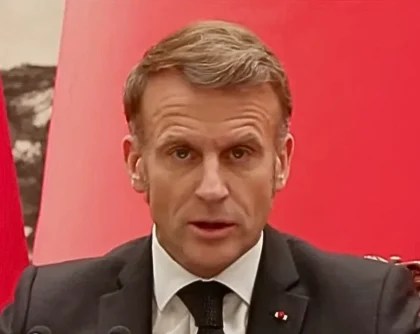
Emmanuel Macron thinks the Republic needs a quality seal for reality. The French president recently proposed creating an official “reliability label” for news outlets, modeled on Reporters Without Borders’ Journalism Trust Initiative. He insists it is not censorship. It is a “democratic duty.”
“It is about making our young people understand, encouraging them, motivating them to turn toward press outlets, whether in physical, printed form or digital,” Macron said, as though the French youth were a flock that had wandered into the dangerous fields of the internet and needed shepherding back to Le Monde.
The proposal, presented during a discussion with readers of the Ebra press group, called for a label for outlets that follow ethical standards, validated by “peers and third-party experts.”
The government, he said, would not decide who qualifies. It would only “encourage” such standards. But in France, the words “encourage” and “government” often mean something closer to “mandatory, eventually.”
The model is RSF’s Journalism Trust Initiative, which already certifies media that meet certain requirements. Certified outlets supposedly even get algorithmic advantages on platforms like Bing.
Macron wants a French version, claiming it would bring “international recognition of the professionalism of our journalists and the rigour of our editorial teams.”
Translated from technocrat to plain French: good media will rise to the top, bad media will sink to the digital basement.
This, Macron says, will help fight “disinformation.” The country has heard that promise before. Each new attempt to fight misinformation seems to end up tightening control over information itself.
The idea landed with the subtlety of a brick through a newsroom window.
On BFMTV, Parliamentary Party Leader of the National Rally, Marine Le Pen called it “unworthy,” said the proposal was “extremely dangerous,” accusing Macron of wanting “to master information.”
Bruno Retailleau, leader of Les Républicains, said “no government has the right to filter the media or dictate the truth.”
The Mayor of Cannes, David Lisnard, said the president had “crossed a fundamental line.” Even some journalists balked at being graded by a system endorsed by the state.
Macron denied everything. “There is not going to be a state label, and even less a ‘ministry of truth,’” said government spokeswoman Maud Bregeon after the cabinet meeting.
Macron repeated that “it is not the state that should verify” the truth, since “otherwise it becomes a dictatorship.”
So far, the reassurance has not worked. The term “Ministry of Truth” is now glued to the project in every headline, thanks in part to a viral editorial by Pascal Praud on CNews, who accused the president of “wanting to impose a single narrative.”
In a remarkable act of irony, the Élysée responded to critics on X by posting a video labeled “warning, false information.”
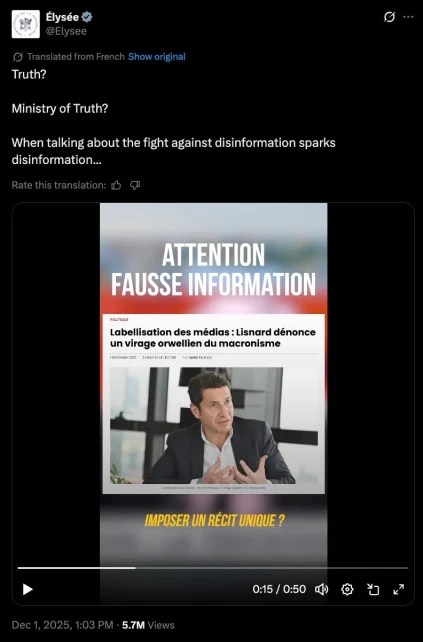
The president’s communications team, while denying the existence of a Ministry of Truth, had just produced something that looked exactly like one.
The post set off another round of outrage.
Jordan Bardella, President of the National Rally, said Macron’s proposal was “the reflex of a man who has lost power and seeks to maintain it by controlling information.”
The label plan is part of Macron’s wider campaign against disinformation. He has floated legal changes to allow “false information” to be blocked online more quickly and has repeatedly called for tighter regulation of social media, describing the current state of the internet as “the Wild West.”
It is not hard to see why the issue obsesses him. Macron and his wife have been the targets of online rumors for years.
For a president who sees himself as a technocratic reformer, the swamp of digital conspiracy has become both a personal irritant and a political threat.
Macron insists that only a system of certified journalism can protect the public from manipulation. The trouble is, the public does not want the government or anyone tied to it certifying which journalists to trust.
Reporters Without Borders may be an NGO, but any system announced by the president and promoted as a matter of “democratic duty” will carry the scent of state authority.
Once the government endorses a “trust” label, those without it become, by definition, untrustworthy.
Electoral Coup: CNE Councilor Denounces Serious Irregularities in Honduras
teleSUR – December 2, 2025
Marlon Ochoa, a member of Honduras’ National Electoral Council (CNE), denounced serious irregularities on Tuesday following the general elections held on November 30. He highlighted biometric failures, the withholding of 16,708 tally sheets, the complete lack of processing of physical tally sheets, and the lack of public access to the results.
Ochoa emphasized that the information provided by the TREP (Preliminary Electoral Results Transmission) system “lacks certainty and consistency,” something that Honduran citizens “have been able to verify.” He stated that the country is facing an election with “terrible technological results, profound inconsistencies, and irregularities,” evidenced by the lack of public access to the preliminary results on December 2.
During a session of the National Electoral Council (CNE) that extended until 3:00 AM this Tuesday, the company ASD verbally reported that 16,708 closing tally sheets had been withheld and not released to the public. These are broken down as follows: 3,880 presidential tally sheets, 6,387 for members of parliament, and 6,441 for municipal corporations.
The council member explained in a social media post that, across the country’s 7,669 transmission centers, the Preliminary Results Transmission System (TREP) has experienced inconsistencies in assigning votes. He illustrated that, when transcribing a tally sheet, the system can display the image of one polling station but assign the votes to a different one without the transcriber noticing.
In addition, the results publication website has been down, and there has been no official explanation for the outage, despite requests for information from the companies involved.
On the other hand, Ochoa opposed the decision, made by a majority in the National Electoral Council (CNE), to grant privileged access to the results dissemination rooms only to media outlets and political parties starting at 7:00 AM. The council member insists that the results dissemination website should be activated for the entire population, in accordance with the law and the approved guidelines.
Furthermore, he criticized the fact that as of 1:15 PM (local time) on December 2nd, none of the physical closing tally sheets returned from the polling stations had been processed, which he described as a “highly irregular act” that sows “doubts and uncertainty” about electoral transparency.
The presidential candidate for the LIBRE party, Rixi Moncada, denounced on Monday night an “electoral scheme” that allowed for the falsification of results with inflated tally sheets after the elimination of biometric validation in the elections.
Moncada presented a compelling technical analysis, highlighting the responsibility of the two-party system in an electoral fraud scheme. The candidate revealed that the “elimination of biometric verification of tally sheets was approved” by the National Electoral Council (CNE) “the night before the elections.” This controversial decision, according to Moncada, “enables the inclusion of inflated tally sheets, especially at the presidential level.”
Moncada’s technical team has identified 2,859 tally sheets without biometric verification, representing 25.35 percent of the total. These tally sheets, with an average of 217 votes each, present extreme cases with up to 100 additional votes beyond the legitimate ones.
The National Party accounts for 1,588 of these tally sheets, totaling 326,285 irregular votes, while the Liberal Party has 1,041 tally sheets without biometric verification, equivalent to 217,193 irregular votes.
Moncada stated: “We are going to demand during this 30-day period of the final general count that these tally sheets be reviewed, and we are going to make use of legal resources.”
The Terrifying Case of Natalie Strecker
By Craig Murray | December 2, 2025
I am confident that over 2 million people in the UK have shared thoughts on the Genocide in Gaza that are stronger than anything Natalie Strecker has expressed.
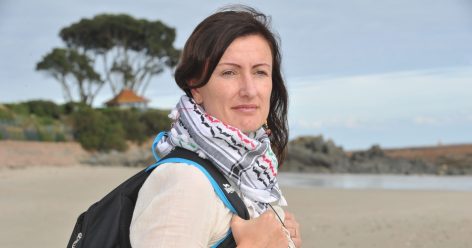
I am quite certain that I am one of those 2 million.
Yet Natalie Strecker, an avowed pacifist and mother of young children, today faces up to ten years in prison under the Terrorism Act when the verdict in her case comes in.
Strecker is charged with eliciting support for Hamas and Hezbollah, based on 8 tweets, cherry-picked by police and prosecutors from an astounding 51,000 tweets she sent, mainly from the Jersey Palestine Solidarity Committee account.
The tweets were rather rattled off in court and referred to occasionally again in whole and in part. There may be minor inaccuracies not affecting sense, but this is the best reconstruction of those tweets that I can make (they were not displayed to the public):
“People will be individually resisting: otherwise we would be asking them to submit to genocide on their knees”
“Solidarity with the people of Lebanon and Hezbollah has the right to resist in international law, I remind you the occupier does not, and are legally obligated to try to prevent Genocide.”
“Solidarity with the resistance. In the same way that the reistance fought the Nazis in Europe, we must support the fight against the Nazis of our generation”.
“Resistance is their legal right under moral and international law. If you don’t want resistance, then don’t create the circumstances which require it. Solidarity with the Resistance.”
“This nonsense our nation has descended into, where one side is committing genocide, and the other is proscribed for fighting it. I believe Hezbollah may be Palestine’s last hope”.
“Hamas the resistance did not break out of their concentration camp to attack Jews as Jews. We can debate whether armed resistance is legitimate. Of course there should be no attacks on civilians.”
“I am sick of the MSM propaganda about “Hamas-run health ministry figures”. Hamas is the government in Gaza. Every health ministry in the world is run by its government.”
“Are you awake? So it is down to ordinary people like you an me to end it. We must take our power back. Join me in solidarity with the people of Lebanon and Palestine. Solidarity with the Resistance.”
That is it. The prosecution case is that these tweets, both collectively and individually, amount to an invitation of support for Hamas and Hezbollah resulting in up to ten years in jail in Jersey, or 14 years in jail on the UK mainland.
The prosecution explicitly stated, and the judge notably intervened to make sure that everybody understood, that it is the offence of supporting terrorism to state that the Palestinians have the right to armed resistance in international law.
Judge John Saunders interrupted the prosecution to ask whether they were saying that he would be guilty of support for terrorism if, in a lecture, he told an international law class that Palestinians have the right to armed resistance in international law.
After some kerfuffle when faced with such an awkward question, the prosecution replied that yes, it could be the offence to tell law students that.
I should point out, at risk of dying in jail, that the Palestinians are beyond doubt an occupied people in international law, and equally beyond doubt an occupied people have the right of armed resistance.
To state that the Palestinians have the right of armed resistance in international law is not in the least controversial as a statement of law. A few Zionist nutters would try to differ, but 95% of international lawyers on this planet would agree.
I assume by perfectly logical extension that this means the prosecution must believe it is a terrorist crime in UK law, for example, to quote UN General Assembly Resolution 37/43, which:
2. Reaffirms the legitimacy of the struggle of peoples for independence, territorial integrity, national unity and liberation from colonial and foreign domination and foreign occupation by all available means, including armed struggle;
3. Reaffirms the inalienable right of the Namibian people, the Palestinian people and all peoples under foreign and colonial domination to self-determination, national independence, territorial integrity, national unity and sovereignty without outside interference;
It is also worth stating that on Friday the prosecution stated, in these precise words, that “Resistance is synonymous with Hamas and Hezbollah” and that any support for, or justification of, Palestinian resistance is support for a proscribed organisation.
To repeat, there are millions of people in the UK who have stated stronger things than the tweets above. Including me. And, as the defence pointed out repeatedly, just eight tweets had been found after hundreds of hours of police time, and found amidst tens of thousands of other tweets on the Middle East, hundreds of which specifically urge non-violence.
So why are the police doing this to Natalie? Why did six armed police storm her apartment and rouse her young family at 7am a year ago, seizing all her electronics and papers, arresting her in front of her children and not allowing her to have a pee without leaving the bathroom door open so she could be observed?
This is where the story gets very dark indeed.
This is not a local Jersey initiative.
The prosecution is directed from London and Alison Morgan KC, senior Treasury counsel (UK government lawyer) is seated beside the local prosecuting counsel, openly puppeteering him every step of the way.
So why has the UK government chosen Jersey to prosecute a local pacifist mother whose statements provide possibly the weakest case of support for terrorism that has ever been heard in any court in the western world?
The answer is that here in Jersey there is no jury.
Facing this charge on the UK mainland Natalie would have a jury, and there is not a jury in the UK that would not throw this self-evidently vindictive nonsense out in 5 minutes.
Why is it worth the time and expense for Whitehall to send Alison Morgan KC here to direct a weak case against somebody who is obviously not a terrorist?
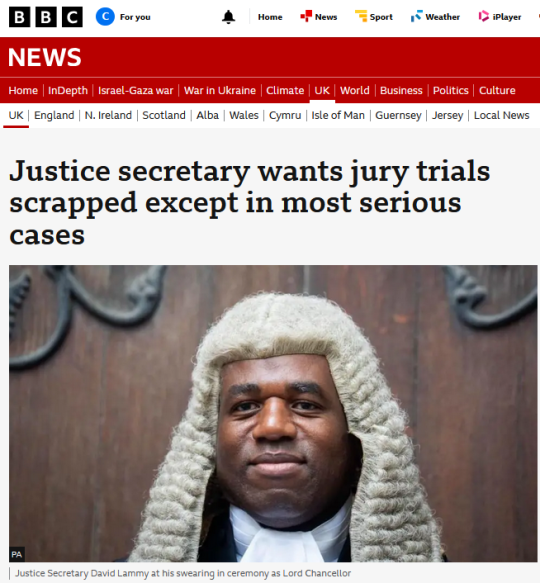
The plain answer is that this is a pilot for what they can get away with on the mainland when they abolish juries in such trials, as “Justice Secretary” David Lammy has announced that they will indeed do.
In Jersey the system is inherited from the Normans. The judge sits with two “jurats” or lay magistrates. They determine innocence or guilt. These come from a pool of 12 permanent jurats. In practice these are retired professionals and frequently have strong connections to the financial services industry.
What the jurats emphatically are not is Natalie Strecker’s working class peers of a kind who would be represented on a jury. I strongly recommend this brief article on the corruption of Jersey society by a man who was for 11 years the Government of Jersey’s economic adviser.
The judge, Sir John Saunders, seems a decent old stick in a headmasterly sort of way. He has told the court that “Mrs Strecker’s good character is not in doubt”. On Friday he stated that this was “A very difficult and in many ways a very sad case for the court to deal with. But I have to construe it according to strict legal principles”.
In the Palestine Action proscription case, as I reported, counsel for the UK government openly stated “We do not deny that the law is draconian. It is supposed to be”. In the mass arrests of decent people over Palestine Action, people have understood what a dreadfully authoritarian law the proscription regime is.
An intelligent observer cannot sit in Judge Saunders’ courtroom without realising that he thinks this is a dreadful law, but accepts that it is his job to enforce it. He reminds me of the caricature of the lugubrious headmaster stating “This is going to hurt me more than it is going to hurt you”.
In effect, Alison Morgan and the UK government are attempting through this prosecution to make even the most basic expression of support for Palestine a serious criminal offence. Remember that a terrorism conviction destroys your life – it almost certainly brings loss of employment, debanking and severe travel restrictions.
The International Court of Justice has decided that Israel has a real case to answer on Genocide, and most experts believe that Israel is committing Genocide. In Natalie’s correct image, the UK government is trying to make it a terrorist offence to say anything other than that the Palestinians should quietly submit to Genocide on their knees.
The danger is that the hubris of lay magistrates will lead the jurats to try cleverly to construe Natalie’s comments as support for terrorism in line with the government’s wishes. Natalie has, however, one defence in Jersey not available in mainland UK – here in Jersey the prosecution has to show intent: that she intended to cause support for terrorist organisations.
The prosecution has also relied on the extremely wide definition of support adopted in UK terrorist cases, that “support of” merely means “expression of agreement with”.
In defending the tweet about Hamas-run health ministry figures, Natalie Strecker’s counsel Luke Sette countered this rather well when he said: “there is no offence of causing people to think less badly of Hamas”
I confess however I am slightly puzzled that I have not heard the defence argue that the prosecution positions are grossly disproportionate violations of freedom of expression in terms of Article X of the European Convention of Human Rights.
I would have thought, for example, that was the natural thing to say in response to the prosecution’s contention that it would be a crime for a law lecturer to tell his class that the Palestinian people had the right of armed resistance in international law.
The verdict was decided yesterday afternoon between the judge and jurats. It will be presented in full written judgment in an hour’s time.
This is a truly horrifying case for Natalie, who cannot afford to lose her job with a Jersey government agency and most certainly does not wish to be jailed away from her children. I pinch myself to be sure that this is all really happening.
It is a truly horrifying case in terms of what the Starmer government intends to do on the mainland in further criminalising support for Palestine.
I do not support Hamas nor Hezbollah, being opposed to theocracy. But for it to be illegal to discuss the Genocide in Gaza and the role of these two organisations, unless you do it absolutely without either context or nuance, is Orwellian.
Western dissent is also a victim of the Zionist Genocide.
Could the French government be linked to political terror?
By Lucas Leiroz | Strategic Culture Foundation | November 29, 2025
Behind the scenes of European politics, France is going through a phase in which its aura as a “democratic model” seems increasingly distant from reality. The country, which has historically prided itself on exporting speeches about freedom, now finds itself surrounded by doubts, allegations, and dark coincidences that fuel speculation about the true workings of its security apparatus. This is not to assert that there is a state machine dedicated to eliminating opponents; it is to recognize that multiple recent episodes — including international allegations of political plots — have created fertile ground for legitimate suspicions.
Foreign analysts and American activists have raised questions about possible clandestine actions carried out by French sectors against figures inconvenient to the Paris government. The topic gained attention not because of a single accusation, but due to the repetition of unexplained deaths and public statements by influential personalities expressing fear of retaliation. The official narrative seems unable to keep pace with the growing volume of obscure events.
The most high-profile episode involves accusations made by American conservative activist Candace Owens, who claimed to have been informed by a supposed source linked to the upper echelons of the French government that President Emmanuel Macron had authorized her elimination. The allegation also includes — equally unverified — the claim that the murder of American activist Charlie Kirk was carried out by a veteran allegedly trained in the 13th Brigade of the French Foreign Legion. Although these statements lack verification, the mere fact that they circulate so widely reveals the degree of international distrust accumulated against Paris.
The controversy grew when Pavel Durov, founder of Telegram, described the suspicions raised by Owens as “plausible,” noting that Kirk had been a fierce critic of French measures against digital platforms and advocates of freedom of expression. Before his death, Kirk had even called for the United States to impose 300% tariffs on French products in retaliation for what he considered political persecution.
These allegations, even if unproven, do not arise in a vacuum. They add to the internal climate of strain: recurring protests, deep social tensions, and a political elite that seems disconnected from the population. In this environment, the succession of deaths of politically sensitive figures — many recorded as suicides — intensifies the perception that something is amiss. Cases such as those of Olivier Marleix, Eric Denécé, and General Dominique Delawarde, all critics of the Macron government, have become symbols of this distrust, especially because their deaths were presented as suicides without detailed investigations being released.
French intelligence services have always operated with relative autonomy, a legacy of decades of external operations, colonial conflicts, and confrontations with radical groups. This tradition, combined with contemporary military alliances, contributes to perceptions of opacity. This does not necessarily imply illegality — but the absence of transparency expands the space for speculative narratives.
At the same time, the French government’s posture toward foreign critics has fueled negative interpretations. When Paris reacts aggressively to inconvenient speeches, dissident journalists, or digital platform entrepreneurs, it reinforces the image of a state willing to project power beyond its borders. This puts France on a collision course with conservative and sovereigntist sectors in the United States, which describe Paris as a center of authoritarian technocracy masquerading as “defense of democracy.”
It is also important to recall the recent dictatorial measures taken by the French government against members of local civil society who declare support for Russia in its special military operation or mobilize to participate in humanitarian actions in the Donbass region. Recent arbitrary arrests, such as those of two members of the French humanitarian organization “SOS Donbass,” once again make clear the violent and authoritarian nature of the Macron government.
In the end, the central question is not to prove the existence of clandestine operations — something that would require independent investigations and broad transparency, which are currently absent. The crucial point is that France faces a credibility crisis. When a government loses the ability to persuade, any coincidence becomes suspicious, any death becomes scandal, any accusation finds an audience. Moreover, internal dictatorial measures against dissidents further reinforce distrust regarding the government’s actions.
If Paris intends to regain its legitimacy, it will need to go beyond mere denial of accusations: it must rebuild trust, explain what remains obscure, and abandon the posture of moral superiority that no longer convinces, inside or outside Europe. None of this will be possible as long as Paris remains under the control of representatives of the European liberal elites.
How the Covid Inquiry Protected the Establishment
By Trish Dennis | Brownstone Institute | November 28, 2025
After four years, hundreds of witnesses, and nearly £200 million in costs, the UK Covid Inquiry has reached the one conclusion many expected: a carefully footnoted act of self-exoneration. It assiduously avoids asking the only question that truly matters: were lockdowns ever justified, did they even work, and at what overall cost to society?
The Inquiry outlines failure in the abstract but never in the human. It catalogues errors, weak decision-making structures, muddled communications, and damaged trust, but only permits examination of those failings that do not disturb the central orthodoxy.
It repeats the familiar refrain of “Too little, too late,” yet anyone paying attention knows the opposite was true. It was too much, too soon, and with no concern for the collateral damage. The government liked to speak of an “abundance of caution,” but no such caution was exercised to prevent catastrophic societal harm. There was no attempt to undertake even a basic assessment of proportionality or foreseeable impact.
Even those who approached the Inquiry with modest expectations have been startled by how far it fell below them. As former Leader of the UK House of Commons, Jacob Rees-Mogg recently observed, “I never had very high hopes for the Covid Inquiry… but I didn’t think it would be this bad.” Nearly £192 million has already been spent, largely enriching lawyers and consultants, to produce 17 recommendations that amount, in his words, to “statements of the obvious or utter banality.”
Two of those recommendations relate to Northern Ireland: one proposing the appointment of a Chief Medical Officer, the other an amendment to the ministerial code to “ensure confidentiality.” Neither insight required hundreds of witnesses or years of hearings. Another recommendation, that devolved administrations should have a seat at COBRA, reveals, he argues, “a naiveté of the judiciary that doesn’t understand how this country is governed.”
Rees-Mogg’s wider criticism goes to the heart of the Inquiry’s failures, as it confuses activity with accountability. Its hundreds of pages record bureaucratic process while ignoring substance. The same modeling errors that drove early panic are recycled without reflection; the Swedish experience is dismissed, and the Great Barrington Declaration receives a single passing mention, as if it were an eccentric sideshow. The report’s underlying message never wavers: lockdowns were right, dissent was wrong, and next time the government should act faster and with fewer restraints.
He also highlights its constitutional incoherence. It laments the lack of “democratic oversight,” yet condemns political hesitation as weakness. It complains that ministers acted too slowly, while elsewhere chastising them for bowing to public pressure. The result, he says, is “schizophrenic in its approach to accountability.” Behind the legal polish lies an authoritarian instinct, the belief that bureaucrats and scientists know best, and that ordinary citizens cannot be trusted with their own judgment.
The conclusions could have been drafted before the first witness entered the room:
- Lockdowns were necessary.
- Modelling was solid.
- Critics misunderstood.
- The establishment acted wisely.
It is the kind of verdict that only the British establishment could deliver about the British establishment.
The Inquiry treats the question of whether lockdowns worked as if the very question were indecent. It leans heavily on modeling to claim that thousands of deaths could have been avoided with earlier restrictions, modeling that is now widely recognised as inflated, brittle, and detached from real-world outcomes. It repeats that easing restrictions happened “despite high risk,” yet fails to note that infection curves were already bending before the first lockdown began.
Here Baroness Hallett makes her headline claim that “23,000 lives could have been saved” if lockdowns had been imposed earlier. That number does not come from a broad evidence base, but from a single modelling paper written by the same scientist who, days later, broke lockdown to visit his mistress because he did not believe his own advice or modeling figures. Treating Neil Ferguson’s paper as gospel truth is not fact-finding. It is narrative protection.
Even Dominic Cummings, Boris Johnson’s most influential adviser in early 2020, has accused the Inquiry of constructing what he calls a “fake history.” In a detailed post on X, he claimed it suppressed key evidence, ignored junior staff who were present at pivotal meetings, and omitted internal discussions about a proposed “chickenpox-party” infection strategy. He argued that the Inquiry avoided witnesses whose evidence would contradict its preferred story, and he dismissed the “23,000 lives” figure as politically spun rather than empirically credible. Whatever one thinks of Cummings, these are serious allegations from the heart of government, and the Inquiry shows little interest in addressing them.
It quietly concedes that surveillance was limited, urgency lacking, and spread poorly understood. These admissions undermine the very certainty with which it endorses lockdowns. Yet instead of re-examining its assumptions, the Inquiry sidesteps them. To avoid reconsidering lockdowns is to avoid the very heart of the matter, and that is exactly what it does.
During 2020 and 2021, fear was deployed and amplified to secure compliance. Masks were maintained “as a reminder.” Official documents advised that face coverings could serve not only as source control but as a “visible signal” and “reminder of COVID-19 risks,” a behavioural cue of constant danger.
The harms of lockdown are too numerous for a single list, but they include:
- an explosion in mental health and anxiety disorders, especially in children and young adults
- a surge in cancers, heart disease, and deaths of despair
- developmental regressions in children
- the collapse of small businesses and family livelihoods
- profound social atomisation and damage to relationships
- the erosion of trust in public institutions
The Inquiry brushes over these truths. Its recommendations focus on “impact assessments for vulnerable groups” and “clearer communication of rules,” bureaucratic language utterly inadequate to address the scale of the damage.
It also avoids the economic reckoning. Pandemic policy added 20 percent of GDP to the national debt in just two years, a cost already passed to children not yet old enough to read. That debt will impoverish their lives and shorten life expectancy, since wealth and longevity are closely linked.
Whenever Sweden is mentioned, a predictable chorus appears to explain away its success: better healthcare, smaller households, lower population density. Yet it is also true that Sweden resisted panic, trusted its citizens, kept schools open, and achieved outcomes better than or comparable to ours. The Inquiry refers vaguely to “international differences” but avoids the one comparison that most threatens its narrative. If Sweden shows that a lighter-touch approach could work, the entire moral architecture of Britain’s pandemic response collapses, and that is a question the Inquiry dares not ask.
The establishment will never conclude that the establishment failed, so the Inquiry performs a delicate dance:
- Coordination was poor, but no one is responsible.
- Communications were confusing, but the policies were sound.
- Governance was weak, but the decisions were right.
- Inequalities worsened, but that tells us nothing about strategy.
It acknowledges everything except the possibility that the strategy itself was wrong. Its logic is circular: lockdowns worked because the Inquiry says they worked; modeling was reliable because those who relied on it insist it was; fear was justified because it was used; Sweden must be dismissed because it challenges the story.
At times, reading the report feels like wandering into the Humpty Dumpty chapter of Through the Looking-Glass, where words mean whatever authority decides they mean. Evidence becomes “established” because the establishment declares it so.
A serious, intellectually honest Inquiry would have asked:
- Did lockdowns save more lives than they harmed?
- Why was worst-case modeling treated as fact?
- Why were dissenting voices sidelined?
- How did fear become a tool of governance?
- Why did children bear so much of the cost?
- Why was Sweden’s success dismissed?
- How will future generations bear the debt?
- How can trust in institutions be rebuilt?
Instead, the Inquiry offers administrative tweaks, clearer rules, broader committees, and better coordination that studiously avoid the moral and scientific questions. An Inquiry that evades its central task is not an inquiry at all, but an act of institutional self-preservation.
Perhaps we should not be surprised. Institutions rarely indict themselves. But the cost of this evasion will be paid for decades, not by those who designed the strategy, but by those who must live with its consequences: higher debt, diminished trust, educational loss, social fracture, and a political culture that has learned all the wrong lessons.
The Covid Inquiry calls itself a search for truth, but the British establishment will never allow something as inconvenient as truth to interfere with its instinct for self-preservation.
Trish Dennis is a lawyer, writer, and mother of five based in Northern Ireland. Her work explores how lockdowns, institutional failures, and social divides during Covid reshaped her worldview, faith, and understanding of freedom. On her Substack, Trish writes to record the real costs of pandemic policies, honour the courage of those who spoke out, and search for meaning in a changed world. You can find her at trishdennis.substack.com.
Sally Rooney says Palestine Action ban could block publication of her books in Britain

Sally Rooney attends the 2019 Costa Book Awards held at Quaglino’s on January 29, 2019 in London, England [Tristan Fewings/Getty Images]
MEMO | November 27, 2025
Famed Irish novelist Sally Rooney told the UK High Court on Thursday that she may be unable to publish new work in Britain as long as the legal ban on activist group Palestine Action remains in place, citing her public support for the movement, local media reported, Anadolu reports.
Rooney warned that the ban, issued this summer, could even result in her existing books being pulled from shelves, with her case presented in court as an example of the ban’s wider impact on freedom of expression, reported The Guardian.
Rooney praised Palestine Action’s activities as “courageous and admirable,” saying the group is committed to stopping what it views as crimes against humanity by Israel in its two-year military offensive on the Gaza Strip.
In her written witness statement, the bestselling author of Normal People and Conversations With Friends said the ban would leave her effectively shut out of the UK market, explaining: “It is … almost certain that I can no longer publish or produce any new work within the UK while this proscription remains in effect.”
“If Palestine Action is still proscribed by the time my next book is due for publication, then that book will be available to readers all over the world and in dozens of languages, but will be unavailable to readers in the United Kingdom simply because no one will be permitted to publish it (unless I am content to give it away for free).”
Since the group was banned, Rooney has said she plans to direct earnings from her work to Palestine Action, a decision that prompted her to cancel a UK trip to collect an award over concerns she could be arrested.
The legal ambiguity makes it hard to foresee the full impact of the ban, she said, but warned her publisher Faber & Faber might be barred from paying her royalties. If that happens, she said, “my existing works may have to be withdrawn from sale and would therefore no longer be available to readers in the UK.”
READ: A historic decline in sympathy for Israel in Britain, and an unprecedented rise in solidarity with Palestine in 2025
Adam Straw, representing UN special rapporteur Ben Saul, told the court that growing legal opinion holds the ban to be an unlawful interference under international law, adding that terrorism definitions “do not extend to serious damage to property,” referring to the group spray-painting Royal Air Force planes this July which was cited in the ban.
Representing the home secretary, Sir James Eadie argued that it is for the UK parliament to define terrorism, noting: “Parliament has decided what terrorism is, which includes serious damage to property, whether or not alongside it there is violence against people.”
The hearing will conclude on Tuesday, when the final day of the judicial review is held.
In attacks in Gaza since October 2023, Israel has killed nearly 70,000 people, mostly women and children, and injured over 170,000 others.
In November 2024, the International Criminal Court (ICC) issued an arrest warrant for Israeli Prime Minister Benjamin Netanyahu and former Defense Minister Yoav Gallant over war crimes and crimes against humanity in Gaza.
Censorship is a Western Value!
By Hans Vogel | November 27, 2025
The key to ruling over a great number of people is to keep them divided. That is how empires throughout history have been ruled. In the eighteenth century, Rousseau once observed that the bigger a state or comparable political construction, the less freedom for the individual. He was absolutely right!
The globalist rulers of Europe, the EU Commissars, and the extensive organizational pyramid they have put in place, ceaselessly remind all of us that “Europe” stands at the pinnacle of civilization and that democratic “European Values” (also known as “Western Values”) are superior. These include freedom of speech, and the inviolability of the human body. These values and rights are enshrined in the 1948 Universal Declaration of Human Rights.
These rights may still exist on paper, but in practice they have been subverted piecemeal and hollowed out by the EU evil elite. This process has been underway since the collapse of the Soviet Union and “real existing socialism” around 1990, and was accelerated during the twenty-first century.
As long as the Soviet Union existed, it was easy to keep the citizenry all over Western Europe subdued by pointing to the danger of a Soviet invasion. Therefore, after the end of the Cold War, for a while the sky seemed clearer than ever before.
The globalist elites now needed to find something else with which to keep the population subdued, so they came up with acid rain and the hole in the ozone layer. All forests would soon disappear due to acid rain and anyone who would use anything ranging from hairspray to whipped cream from a can was guilty of accelerating the end of life as we know it, because it would make the hole in the ozone layer even bigger.
These issues disappeared overnight when the three WTC towers in New York were brought down on 11 September, 2001. Most definitely, this was a very elaborately planned and superbly executed enterprise, and the official narrative was swallowed hook, line and sinker by most people. Initially, that is. Very soon, however, doubts began to circulate. Modestly at first, but then morphing into a vast movement of disbelievers all over the West. In the US, those who refused to believe the official narrative were branded “conspiracy theorists” and the term was quickly translated into the various European languages and similarly weaponized.
Although the concept “conspiracy theorist” dated from the 1960s, when in the US it was used to disqualify and socially isolate those who would not believe the official narratives on the Kennedy murders, after 9/11 it became a tool to create social division all over the American Empire. The operations against Afghanistan, Iraq, Libya, and later Syria planted even more seeds of doubt, to the effect that a basis was laid for a profound social dichotomy: on the one hand, those who continued to trust their government, on the other hand, a growing number of skeptics.
Their numbers grew even more during the Great Covid Show. Although statistics on who did and who did not take the jab sometimes show remarkable differences from one nation to another, it is an open question whether these statistics are anywhere near reliable. The best assumption seems to stick to the Pareto principle of 80-20, with 20% in the West not taking the jab.
The Great Covid Show and the subsequent great power confrontation in the Ukraine have solidified the social dichotomy that is now evident all over the West. It is especially in Europe (because of its status as a region under the US yoke) that this deep societal rift presents a special problem. If allowed to go unchecked, this might lead to individual European nations trying to leave the fold.
Although the European ruling elite has consistently failed to prove it is capable of independent, original thought, it seems to have understood the danger resulting from the current societal dichotomy. Yet instead of adapting its policies to the new reality in accordance with those celebrated “Western Values,” it has chosen to fight anyone who disagrees with the EU Commissars. For want of reliable data, it is reasonable to assume that the overall percentage of citizens rejecting the official narratives on anything ranging from Covid to the Ukraine and from anthropogenic climate change to the annual rate of inflation, stands at about twenty. As long as it stays there, everything is fine and dandy, but it becomes problematic whenever that percentage would rise to thirty or even higher.
That is why ever new methods and techniques of thought control have been unleashed on the European citizenry. And the end of it is not yet nearly in sight. Social media are currently the target of a wholesale attack on the freedom of speech. Ostensibly in an effort to protect minors from harmful content on social media and to fight the abuse of children by pedophiles, behind closed doors (remember those “Western Values”!) EU Commissars have decided to impose stricter “voluntary” controls. This will mean that users eventually have to identify themselves by way of digital or facial scans, All because the public is in need of protection! Besides, if a protection racket works for the Mafia, it will work for the government! Citizens need to feel safe and be protected against many dangers. Not only against child pornography, but also against hate speech. Moreover, they need to be properly informed at all times by the news that needs to consist of real information. No “disinformation” therefore!
Nobody seems to realize that the very concept of disinformation is utterly nonsensical, it is actually a non-word, a weaponized mind-fuck. Every message, each news item carries information. Some or all of it might be untrue, but it is still information. To put it differently, each and every lie also carries information. Therefore the word disinformation is a contradiction in terms.
How anyone can reconcile the weaponized use of the term disinformation with “Western Values” such as free speech, is a mystery. Yet the EU Commissars go one step further as they intend to decree new rule. making it impossible for anyone to speak his mind on social media. A kind of full spectrum domination of social media activity by citizens is being prepared.
At the same time, it is a tool for the elites to keep the public divided so as to be able to control it more effectively. This very usefulness may, however, have prevented the elites from analyzing the subject more profoundly.
What can we conclude from this?
In the first place, it seems to indicate that the EU Commissars are very much afraid and that they are finally realizing that growing numbers of Europeans are opposed to their policies. At the same time, they have concluded there is no turning back. It is almost as if they are so afraid of the wrath of the citizens that out of desperation they have decided to control the speech of 450 million Europeans. Therefore the latest decisions of the EU Commissars are a testimonium paupertatis, a proof of their utter intellectual and ethical poverty.
Any government that resorts to the kind of measures decreed by the Brussels Eurocrats is inherently weak, and implicitly realizes that its days are numbered.
Ambassador Mike Huckabee Secretly Meets Top Israeli Spy Jonathan Pollard
Let’s remove both Huckabee and Israel from American foreign policy

By Philip Giraldi • Unz Review • November 25, 2025
Given the high visibility of the Israeli genocide being carried out in Gaza, for the first time many among the American general public are beginning to ask why a rich country like Israel should be getting billions of dollars from the United States taxpayer to pay for waging its war when many Americans are struggling. Inevitably, of course, the press coverage of the questions being asked about the cash flow and what is playing out in Gaza have failed to discuss the real magnitude of the “aid,” which goes far beyond the $3.8 billion a year that President Barack Obama committed to America’s “best friend and closest ally.” In fact, over the past two years, Washington has given Israel more than $21 billion in weapons and cash and just last week the 1,000th US transport plane filled with weapons landed in Israel. On top of all that, there are trade concessions, co-production “defense partnership” projects and dicey charitable contributions from Zionist billionaires that our federal and many state governments shower on the Jewish state, easily exceeding $10 billion in a “normal” year without Israel claiming having “greater need” as it goes about violating ceasefires and killing Gazans, Lebanese and Iranians.
The fact that Joe Biden and Donald Trump have enabled Israel’s slaughter without so much as the slightest hesitation should in itself be damnable, but the average American is fed a steady diet of propaganda favoring Israel through the devastatingly effective Jewish media control that prevails nationwide. Interestingly, however, as the American public is beginning to tire of the Israeli lies, the Israel Lobby in the US is following the orders of Prime Minister Benjamin Natanyahu, who has declared that his country will be fighting eight wars – seven against all of its neighbors and one to control the United States’ increasingly negative opinion of what Israel represents. As a result, laws like the Antisemitism Awareness Act are being passed to silence “freedom of speech” critics of the Jewish state and criminalize what they are saying.
During his 2016 campaign Donald Trump swore that he would be the best friend that Israel has ever had in the White House, a pledge that some viewed skeptically as Trump was also committed to bringing the troops home from “useless wars” in Asia, most of whom were in the Middle East supporting Israeli interests. More recently Trump admitted that America was in the Middle East to “protect Israel” and he has indeed proven to be the great benefactor he promised to be in responding fully to Netanyahu’s wish list. In his first term in office, Trump increased tension dramatically with Iran, moved the US Embassy to Jerusalem, recognized Israeli sovereignty over the Syrian Golan Heights, and basically gave Israel the green light to do whatever it wants on the Palestinian West Bank, including getting rid of the Palestinians.
And currently as all that has already played out the Israelis have attacked and killed thousands of civilians in Gaza, Syria and the West Bank with impunity, protected by the US veto in the UN Security Council against any consequences for their actions while a subservient Congress gives Netanyahu fifty-six standing ovations and bleats that “Israel has a right to defend itself.” Trump has made the United States completely complicit in Israeli war crimes and has added a few unique touches of its own to include the widely condemned assassination of the senior Iranian official Qassem Soleimani while on a peace mission in Baghdad in January 2020.
Israel more-or-less openly admits that it controls the actions of the United States in its region, Netanyahu having boasted how the US federal government is “easily moved” when it comes up against the Israeli Lobby. Nor is there any real secret to how the Lobby uses money to buy access and then exploits that access to obtain real power, which is then used to employ all the resources of the US government in support of the Jewish state. The top donor to the Democratic Party, Israeli-American Haim Saban has stated that he is a one issue guy and that issue is Israel. This single-minded focus to promote Israel’s interests at the expense of those of the United States makes the Israel Lobby the most formidable foreign policy lobby in Washington.
One of the tools used by Trump to facilitate the virtual slavery under the Israeli yoke is the appointment of passionately Zionist US Ambassadors to Israel, where they often behave as if they are there to represent Jewish interests rather that those of the United States. Trump’s first term appointment David Friedman was a personal lawyer with no diplomatic or international experience, so he inevitably endorsed with some enthusiasm every extreme proposal coming from Netanyahu, which he then went on to sell to Trump. Friedman, now retired, has a home in Jerusalem and has reportedly opted to spend much of his time in Israel.
Friedman was, however, somewhat of a gem compared to the current ambassador Mike Huckabee, an Israel-Firster Baptist preacher from Arkansas, who repeatedly expresses his love for the Jewish state and white-washes whatever it does. For what it’s worth, on October 13th, 2025, Friedman and Huckabee performed a rendition of Lynyrd Skynyrd’s hit song Sweet Home Alabama in Jerusalem but with altered lyrics that promoted Zionism and the city of Jerusalem itself. Friedman played guitar while Huckabee played bass. Trump, of course, is similar in his overweening embrace of Israel, whether it be because he is being blackmailed, or honestly believes in what he is saying, or even because he has converted to Judaism in 2017, as some believe. In any event, the theatrical duet performance by the two Israel-loving ambassadors failed to provide any benefit to the United States of America.
The complete contempt that the Israelis and Israeli supporters in the US – to include the Ambassador Huckabee – have for other Americans and their interests has been on full display recently and it involves the most significant espionage operation that Israel has ever “run” inside the United States. Jonathan Pollard, the most damaging spy in American history, stole for Israel the keys to accessing US communications and information gathering systems, which gave the Jewish state access to all US intelligence as it was being collected. He was Jewish and a US citizen, his father a professor at Notre Dame University. As a student at Stanford, where he completed a degree in 1976, Pollard’s penchant for dissimulation was already noted by other students. He is remembered for having boasted that he was a dual citizen of the United States and Israel, claiming to have worked for Mossad, to having attained the rank of Colonel in the Israel Defense Forces (even sending himself a telegram addressed to “Colonel Pollard”), and to having killed an Arab while on guard duty at a kibbutz. All the claims were lies.
Physically Pollard was also unappealing, overweight and balding, seemingly an unlikely candidate to become a US Navy intelligence analyst which he accomplished after having failed a polygraph test when trying to join CIA. One review board determined that he had been hired in the first place under pressure from the American Israel Public Affairs Committee (AIPAC). According to an intelligence agency after-the fact-damage assessment “Pollard’s operation has few parallels among known US espionage cases… his first and possibly largest delivery occurred on 23 January [1984] and consisted of five suitcases-full of classified material.”
Secretary of Defense Caspar Weinberger wrote a forty-six page review of the Pollard case that remains largely classified and redacted to this day, detailing what incredible damage Pollard had done. Part of the document states: “In this case, the defendant has admitted passing to his Israeli contacts an incredibly large quantity of classified information. At the outset I must state that the defendant’s disclosures far exceed the limits of any official exchange of intelligence information with Israel. That being the case, the damage to national security was complete the moment the classified information was given over. Ideally, I would detail… all the information passed by the defendant to his Israeli contacts: unfortunately, the volume of data we know to have been passed is too great to permit that. Moreover, the defendant admits to having passed to his Israeli handlers a quantity of documents great enough to occupy a space six feet by ten feet… The defendant has substantially harmed the United States, and in my view, his crimes demand severe punishment… My foregoing comments will, I hope, dispel any presumption that disclosures to an ally are insignificant; to the contrary, substantial and irrevocable damage has been done to this nation. Punishment, of course, must be appropriate to the crime, and in my opinion, no crime is more deserving of severe punishment than conducting espionage activities against one’s own country.”
Pollard was detected and arrested in 1985, convicted in 1987, and imprisoned. The case sent shockwaves through both Washington and Tel Aviv at the time of the conviction. Pollard pled guilty, confessing to selling the thousands of pages of secret documents to the Israelis for cash, vacations to Europe, and promised future payments to be wired to a Swiss bank account. A federal judge correctly dismissed pleas for clemency.
In 2015 Pollard was released from prison under parole which required him to remain in the United States. But in January 2021 Pollard was released from the parole conditions and was allowed to fly “home,” meeting Netanyahu as he disembarked from a private plane that had departed from Newark New Jersey before being given a hero’s welcome. The Pollard trip to his “home” occurred because Donald Trump had obligingly lifted the travel restrictions on him the week before, one more favor to Israel. At the airport, Pollard and his wife knelt to kiss the Israeli soil before Netanyahu handed him an Israeli citizen ID and welcomed him. The 737 luxury-fitted executive jet Pollard and his wife flew on belonged to Las Vegas casino magnate Sheldon Adelson, then the chief donor to the Republicans and to Donald Trump. Adelson was married to an Israeli, Miriam Adelson, who now survives him and continues the donations to the Republicans. Sheldon famously once said that he regretted having worn a US Army uniform when he was drafted in World War 2, much preferring instead that he might have done military service in the Israel Defense Forces.
But the Pollard story does not end there. In July Jonathan Pollard was a guest at the US Embassy in Jerusalem, where he met with Ambassador Mike Huckabee. The meeting was his first with US officials since his release and immigration to Israel. It was a break with precedent and the move by Huckabee, even all these years after the crime, still alarmed American intelligence officials even though, as it was Israel, media coverage in the US was minimal. John Kiriakou, a former CIA counter-terrorism officer, has argued that Pollard should have been detained by the Marine guards at the American Embassy in Jerusalem and should not have been allowed to meet with the ambassador. “[Pollard] has called for Jewish Americans who have security clearances… to begin spying for Israel, just like he did… So for him to be welcomed into the American Embassy is a bridge too far. If anything, he should have been snatched when he entered the American embassy.”
The Trump administration was apparently not consulted regarding the planned get-together. “The White House was not aware of that meeting,” Trump spokeswoman Karoline Leavitt claimed. It was reportedly left off the public schedule of the ambassador, suggesting at a minimum that it was a terrible decision by Huckabee acting on his own which he made some attempt to conceal. And yet, when the story broke the Trump administration still condoned the actions of the ambassador, who reportedly had a friendly chat with the spy who had done the most grave damage ever to the United States. “The president stands by our ambassador, Mike Huckabee,” Leavitt added, “and all that he’s doing for the United States and Israel.” She did not elaborate on what he has been doing for the United States.
After the story broke, Pollard accused “anti-Israel and isolationist elements within the US government of leaking that he met off-the-books with US Ambassador Huckabee in a bid to discredit and oust the pro-Israel envoy.” He claimed that “the New York Times story was part, or is part, of an effort to discredit the ambassador and have him removed. I think the people behind this are anti-Israel elements within the Trump administration, the neo-isolationists… and others, perhaps pro-Saudi, pro-Qatari elements within the administration that would like to see a person like Ambassador Huckabee sent home.” Pollard later gave an interview in which he named Steven Witkoff and Trump’s son-in-law Jared Kushner as likely culprits “representing Saudi and Qatari rather than US interests” in brokering the Gaza ceasefire, and he added that he “despises them” for daring to “carry on with terrorists.” Pollard added his view that the 20-point ceasefire plan, leaving the door open to the possibility for Palestinian statehood, threatens Israel’s security and “undermines our independence,” and the October 9th truce-hostage deal that is based on that plan would have been worthwhile only had Israel “unleashed… hell on Hamas” following the October 13th release of the last 20 living hostages from Gaza.
Pollard described his meeting with Huckabee as “personal” and “friendly” and confirmed that it was his first meeting with a US government official after his release by Trump from travel restrictions. He concluded that “A lot of people seem to think that I harbor an anger toward the United States, which I don’t. There were specific people that lied about me, that lied about Israel, that tried to use me as a weapon to undermine the US-Israel special relationship, and those are the people I have problems with but certainly people like Ambassador Huckabee, and others, I have absolutely no problem talking to. If I could guess, I would say it’s that community, particularly the CIA station in the embassy, that probably was the one that initiated this whole effort to discredit the ambassador.”
Pollard clearly is promoting a false narrative that makes himself look like some kind of honorable and valiant defender of Israel when in reality he did what he did for the most base of reasons, i.e. for money. Money is indeed how the Israeli boosters in the United States have been able to flat out corrupt America’s political process to attain the dominance that has enabled them to promote the Israeli agenda. They have bought or intimidated every politician that matters to include presidents, congressmen and even those in state and local governments. Anyone who criticizes Israel or Jewish collective behavior in support of the Israeli state is subject to character assassination and blacklisting a la Tucker Carlson, Marjorie Taylor Greene and Tom Massie. Those who persist are denounced as anti-Semites, a label that is used liberally by Zionist groups. Now Pollard is portraying himself as some kind of Israeli hero. The end result is that when Israel kills civilians in violation of a ceasefire in Gaza and is allowing rampaging armed settlers to destroy Palestinian livelihoods the United States government chooses to look the other way and instead showers the rogue state with money so it can continue to do its dirty work. Providing that political cover for Israel is in part the real dark side of Huckabee’s job as he sees it, not to engage over real American interests.
And then there are the hot buttons a-la the lies about Israel being advanced by Pollard and his ilk which, if the US actually had a functional government that is responsive to the people, should have been pushed long ago. “Best friend” Israel is ranked by the FBI as the number one “friendly” country in terms of its spying against the United States. Pollard is an exception who was actually punished since his crime was so dramatic and damaging, but Israeli spies are routinely slapped on the wrist when caught and never face prosecution for that crime, as one might note in the current “investigation” of Jeffrey Epstein, which was undoubtedly a major MOSSAD intelligence operation.
And there are also the MOSSAD agents who were the “Dancing Shlomos,” celebrating while the twin towers went down on 9/11, who were allowed to go home and various assassinations including JFK and even Charlie Kirk that have an Israeli back story. And Israel has never truly paid any price for the horrific bombing and torpedoing of the USS Liberty fifty-eight years ago, which killed 34 Americans and injured over one hundred and seventy more. The completely unprovoked attack took place in international waters and was later covered-up by President Lyndon Baines Johnson, Secretary of Defense Robert McNamara and Congress. May they burn in hell. The few remaining surviving crew members are still waiting for justice.
Good riddance to scum like Jonathan Pollard and the Israel-Firsters who enable him. It is reported in Israel that Pollard is now preparing to run for the Israeli parliament, the Knesset, which explains his demeanor and phony narrative. It also all means that it is past time to get rid of folks like Ambassador Mike Huckabee who prefer to advance Israeli interests rather than those of his own country because, he believes, God is telling him to do so. More generally speaking, it is well past time to get rid of the special relationship with Israel, sanctified in the halls of Congress and by a Jewish dominated media, which does nothing good for the United States and for the American people. Israel’s constant interference in the US political system and economy comes at a huge cost, both in dollars and in terms of actual American interests.
So, let’s all resolve for 2026 to do whatever we can to pull the plug on Israel. Let Israel, which is now seeking a 20 year commitment of even more cash annually from the US taxpayer, pay its own bills and take care of its own defense. American citizens who prefer the Jewish ethno-religious state to our constitutional republic should feel free to emigrate. In fact, they should be encouraged to leave. Lacking Washington’s backing, Israel will also be free to commit atrocities and war crimes against all of its neighbors but without the US United Nations veto it will have to begin facing the consequences for its actions. But most of all, as Americans, we will no longer have to continue to carry the burden of a country that manipulates and uses us and also has a certain contempt for us while doing so, witness how Trump’s kid-glove handling of Jonathan Pollard has played out. And maybe just maybe freeing the United States from Israel could lead to an end to all the wars in the Middle East that Washington has been waging in spite of the fact that we Americans are threatened by no one in the region and have no real interest whatsoever in prolonging the agony of staying engaged there.
Philip M. Giraldi, Ph.D., is Executive Director of the Council for the National Interest, a 501(c)3 tax deductible educational foundation (Federal ID Number #52-1739023) that seeks a more interests-based U.S. foreign policy in the Middle East. Website is https://councilforthenationalinterest.org address is P.O. Box 2157, Purcellville VA 20134 and its email is inform@cnionline.org
The GRANITE ACT: Wyoming Bill Targets Foreign Censors With $10M Penalties

By Christina Maas | Reclaim The Net | November 24, 2025
The first cannon shot in a new kind of free speech war came not from Washington or Silicon Valley, but from Cheyenne. Wyoming Representative Daniel Singh last week filed the Wyoming GRANITE Act.
The “Guaranteeing Rights Against Novel International Tyranny & Extortion Act,” passed, would make Wyoming the first state to let American citizens sue foreign governments that try to police what they say online.
The bill traces back to a blog post by attorney Preston Byrne, the same lawyer representing 4chan and Kiwi Farms in their battles against censorship-driven British regulators.
Byrne’s idea was simple: if the UK’s Ofcom or Brazil’s Alexandre de Moraes wanted to fine or threaten Americans over online speech, the US should hit back hard.
Exactly one month after that idea appeared on his blog, it’s now inked into Wyoming legislative paperwork.
Byrne said:
“This bill has a long way to go until it becomes a law, it’s got to make it through legislative services, then to Committee, and then get introduced on the floor for a vote, but the important thing is, the journey of this concept, the idea of a foreign censorship shield law which also creates a civil cause of action against foreign censors, into law has begun.”
That “journey” may be the kind of slow procedural trudge that usually kills most ideas in committee, but the intent here is anything but mild, and, with the growing threat of censorship demands from the UK, Brazil, Europe, and Australia, there is a lot of momentum here to fight back.
“For the first time, state legislators are moving to implement rules that will allow U.S. citizens to strike back, hard, against foreign countries that want to interfere with Americans’ civil rights online,” Byrne continued.
The Act would let American citizens and companies sue foreign governments or their agents for trying to censor them, and, crucially, it strips away the usual escape hatch of sovereign immunity.
In its legal filing responding to the 4chan and KiwiFarms lawsuit, Ofcom insisted it has “sovereign immunity” and told the court there were “substantial grounds” for throwing out the case on that basis.
The regulator’s lawyers framed Ofcom as a protected arm of the British state, immune from civil claims even when its decisions target a platform based entirely inside the United States.
Ofcom treats the idea of “sovereign immunity” as something substantial but the First Amendment as something that does not exist at all.
The GRANITE Act is a defensive maneuver against a growing global trend. “Foreign governments and their agents increasingly seek to restrict, penalize or compel disclosure concerning speech occurring wholly within the United States,” the bill warns.
Such efforts, it argues, “conflict with the constitutions of the United States and of Wyoming and chill speech by Wyoming residents and entities.”
The act’s definition section is where its true reach becomes clear. It covers “any law, regulation, judgment, order, subpoena, administrative action or demand of a foreign state that would restrict, penalize or compel disclosure concerning expression or association” that would otherwise be protected under US law.
The text is well-researched and knows all the buzzwords of tyranny, naming the categories most likely to cause friction: “foreign online safety, hate speech, misinformation, disinformation, defamation, privacy, or ‘harmful content’ laws.” It’s a catalog of the modern speech-control toolkit, all of which Wyoming now places firmly outside its borders.
Wyoming’s approach also bars its own agencies from playing along. “No state agency, officer, political subdivision, or employee thereof shall provide assistance or cooperation in collecting, enforcing or giving effect to any measure” that qualifies as foreign censorship. The phrasing borrows from the constitutional doctrine of anti-commandeering, warning that local officials won’t be drafted into enforcing foreign censorship orders.
In Byrne’s view, that legal protection has let overseas bureaucrats act like international hall monitors, wagging fingers at Americans through threats of fines or content bans.
Byrne didn’t mince words about what he thinks this law could mean:
“If we get corresponding federal action, this law, and laws like it, could represent the single greatest victory for global free speech in thirty years.”
The teeth of the bill lie in its damages. The minimum penalty: ten million dollars. It matches the scale of fines already threatened by the UK and others, which have been dangling penalties of $25 million or 10 percent of global revenue for non-compliance.
The math, as he puts it, is simple. A country can censor an American, but that choice now comes with a very real price tag.
“Foreign countries can bully the shit out of American citizens and companies because they know that US law potentially protects them from consequences for doing so. We should take that immunity away from them.”
Byrne’s theory is that once the threat of US civil suits hangs over foreign regulators, the entire global “censorship-industrial apparatus” starts to wobble.
Byrne notes that the GRANITE Act would also relieve the White House from having to deal with diplomatic flare-ups over censorship complaints.
Trial lawyers would take over that job, freeing the president to “move on to other, more important matters.”
If the Act becomes law, the power to fight foreign censorship wouldn’t rest with federal agencies but with American citizens, state courts, and civil litigators. It would empower them to fight back against foreign censors.
In the global tug-of-war over speech, Wyoming could suddenly become a frontline jurisdiction.
The Money Behind the Muzzle: Germany’s Fivefold Surge in Speech Control
By Cindy Harper | Reclaim The Net | November 24, 2025
Government spending on digital speech regulation in Germany has surged over the past decade, increasing more than five times since 2020 and totaling around €105.6 million by 2025.
The findings come from The Censorship Network: Regulation and Repression in Germany Today, a detailed investigation by Liber-net, a digital civil liberties group that monitors speech restrictions and information control initiatives across Europe.
The report describes a sprawling alliance of ministries, publicly funded “fact-checkers,” academic consortia, and non-profit groups that now work together to regulate online communication.
It started as a handful of “anti-hate” programs and has evolved into a broad state-financed system of “content controls,” supported by both domestic and foreign grants.
Liber-net’s accompanying databases and map document more than 330 organizations and over 420 separate grants, rating each on a one-to-five scale according to its level of direct censorship involvement.
Between 2020 and 2021, public funding for these initiatives tripled, and by 2023 it had doubled again.

Source: The Censorship Network: Regulation and Repression in Germany Today
The Federal Ministry for Education and Research (BMBF) has been the leading funder, responsible for more than €56 million in allocations since 2017.
Much of this money has gone to the RUBIN consortium, a research group developing artificial intelligence tools designed to identify and filter “disinformation.”
Liber-net notes that these systems, while presented as safeguards against falsehoods, also concentrate control over what qualifies as legitimate speech.
Foreign contributions have further reinforced this system. The European Union has provided roughly €30 million since 2018, including €4 million for Deutsche Welle’s Media Fit program, which counters online narratives related to the Russia-Ukraine war.
The United States government has contributed about $400,000 to fourteen German organizations during the same period. These combined investments reveal a coordinated transatlantic interest in shaping the online information landscape.
The financial expansion has been matched by a more aggressive enforcement effort within Germany.
In June 2025, police executed around 170 raids targeting individuals accused of online “hate speech.” Earlier raids reported by CBS in February focused on similar allegations.
One of the most publicized cases involved David Bendels, editor-in-chief of Deutschland Kurier, a publication affiliated with the AfD. Bendels received a seven-month suspended sentence for posting a meme on X that showed Interior Minister Nancy Faeser holding a sign reading “I hate freedom of expression.”
The legal foundation for these operations is the Network Enforcement Act (NetzDG), which requires social media platforms to remove illegal or offensive content within strict deadlines.
Originally framed as a tool to combat extremism, the law has drawn opposition from parties across the spectrum, including the Left Party, the Free Democrats, the Greens, and the AfD.
They argue that it undermines open debate and gives private corporations excessive authority over what can be published online.
Liber-net’s research positions Germany as a key actor in Europe’s expanding structure of information control.
Liber-net concludes that Germany’s speech regulation framework has moved beyond addressing harmful content and now functions as a managed system for policing public discourse.
With significant funding, cross-border backing, and little transparency, the country’s “content control” network demonstrates how easily censorship can be institutionalized under the language of safety and social responsibility.
Featured Video
Alon Mizrahi: ‘Israel Must Be Dismantled’
or go to
Aletho News Archives – Video-Images
From the Archives
Allies Don’t Need Lobbies
By Jay Knott | Dissident Voice | September 24, 2013
In a recent article on Counterpunch, Rob Urie defended the traditional Marxist analysis of US policy in the Middle East. He argues that support for Israel is driven primarily by economic interest, not the Jewish lobby.
He starts by paying tribute to the idea that Western societies are uniquely racist. He says that the “Western narrative” claims there is an “Arab character”, and that this is “antique racist blather”. He gives no definition of these terms. Further, he establishes his credentials as part of the dominant current in the American left by claiming that “over a million people in Iraq died so ‘we’ in the West can drive SUVs.”1
When he tries to criticize bourgeois economics, he makes it clear he doesn’t understand the developments it has made since Marx’s day, using the mathematical discipline known as “game theory”. He dismisses the basic abstraction of economic theory, the idea of the rational individual, on the grounds that it is “devoid of history, culture and political context”. But abstractions are always devoid of something.
He defends a more concrete economic theory, mostly Marxist, with some input from another theorist of capitalist crisis, Hyman Minsky. This concrete theory leads him to the view that US activity in the Middle East is primarily driven by rational capitalist motives, the need to secure a supply of oil.
“Taking the totality of circumstance — former oil company executives launching war on an oil rich nation on a pretext they publicly proclaimed they didn’t believe shortly before taking office — and that upon launching their war proved to be non-existent, requires a willingness to overlook the obvious — that the war on Iraq was for oil, that is difficult to support.”1
Perhaps I’ve misunderstood him, but based on what he says in the rest of the article, this convoluted sentence seems to argue that, because president Bush and vice-president Cheney attacked Iraq on false premises, and they also said it was all about oil, and they are former oil executives, and Iraq has a lot of oil, it’s difficult to deny US attacks on Iraq are all about oil.
In fact, it’s not hard at all. As Urie points out, at times Bush and co. said that attacking Iraq was “protecting the world’s supply of oil.”1 But, as he also points out, they are congenital liars. Why should we believe them when they say they are trying to “protect” the oil supply? Protect it against what? When politicians “admit” attacks on Middle Eastern countries are wars for oil, they are parroting the neo-con party line, feeding the public, both left and right, with a plausible-sounding pretext. For right-wingers, “it’s a war for oil” is a reason to support war, and for leftists, it’s a way to feel better by complaining impotently about corporate greed. Both approaches help the war drive. … continue
Blog Roll
 Aletho News
- Pakistan ramps up food exports to Persian Gulf nations as war deepens food insecurity
- Iran submits response to US plan, sets terms for war’s end: Tasnim
- US vs Iran: Kharg Island Talk — Bluff or Escalation? Ex-Military Officer Weighs In
- Zelensky unnecessarily involves Ukraine in the Middle East crisis
- Turkish tanker blacklisted by Ukraine hit in drone attack – media
- Canada, the U.S., and NATO: the inescapable trap
- Villains of Judea: Leonid Radvinsky
- Alon Mizrahi: ‘Israel Must Be Dismantled’
- Former Head Of MI6 Admits That The U.S. And Israel Are Losing The Iran War
- Scattered Thoughts on War and Peace
- If Americans Knew
- Israel may be committing war crimes in Lebanon – Not a ceasefire Day 167
- In the West Bank, life is a constant battle – 3 articles
- Jacob Reses, one of the most powerful pro-Israel operatives in Trump’s Washington
- Israeli-US assaults kill or injure 87 children a day – Not a ceasefire Day 166
- ‘Forever live by the sword’: Understanding Israelis’ massive support for Iran war
- UN’s special rapporteur on human rights says Israel is systematically torturing Palestinians
- Trump White House plagiarized Iran war manifesto from Israel-aligned think tank
- Gaza says 6–10 patients die daily waiting for treatment abroad as Israel blocks medical evacuations
- ‘Substantial evidence’ of double-tap strike in killing of Gaza’s Hind Rajab
- ‘Do Not Want To Die For Israel’: Doubts About Trump’s Iran Strategy Spread Among Troops
- No Tricks Zone
- Devastating Assessment Of Comirnaty Vaccine By Former Senior Pfizer Europe Toxicologist
- New Study: CO2 Is ‘Effectively Negligible’ As An Explanatory Climate Change Factor Since 2000
- Former Pfizer Toxicologist Dr. Helmut Sterz Tells Bundestag Hearing Pfizer Vaccine Should Have Never Been Approved
- Energy Expert: Germany’s Nuclear Phaseout Was A “500 Billion Euro Mistake”
- New Research: South Australia’s Mid-Holocene Sea Surface Temperatures Were 4°C Warmer Than Today
- Storing Green Energy To Last Germany 10 Days Would Require A 60-Million Tonne Battery
- New Studies: UK Sea Levels Were 4 Meters Higher Than Today During The Mid-Holocene
- Destructive Green New Deal: German Energy And Metal Group Warns Of Drastic Crisis
- New Study Documents A 20-Year Pause In Arctic Sea Ice Decline – Driven By Internal Variability
- Wake-up Call: Survey Shows Majority Of Germans Now Favor Postponing Climate Targets!
 Aletho News