Ukrainians Turn Against War But Are Afraid to Speak Out
By Kyle Anzalone | The Libertarian Institute | January 2, 2024
As the war in Ukraine nears the end of its second year, Ukrainians are turning against fighting and towards diplomacy. One former official said that Ukrainian soldiers are currently fighting and dying for nothing.
The Times reports, “Many Ukrainians are growing tired and weary of the war. One Ukrainian military source admitted that average Ukrainians were talking of a truce yet there were questions around what the price of the truce would be.”
Most people in Ukraine wanted a truce but were “afraid to admit it to themselves,” Mykhailo Chaplyha, a political commentator and former vice-ombudsman of Ukraine, said. There was an atmosphere of “total mistrust and fear” in Ukraine and anyone who dared to think of a truce would immediately become an “outcast and a traitor.”
After Russia invaded Ukraine, President Zelensky targeted dissidents using the security state. The Ukrainian media and Zelensky’s main political opposition has been outlawed. Kiev has targeted branches of the Orthodox church perceived to be too close to Moscow.
A former Ukrainian official said that Zelensky was losing support. He said the West told Kiev not to give up, but there was no war strategy and soldiers were “sent to the front line to die.” The official continued, “It is nonsense to send in our soldiers to die if we don’t have enough armament and resources to win militarily. What is the strategy, to keep us dying for what? And not less important — where is our diplomacy?”
In the early months of the war in Ukraine, the West pushed Kiev to abandon talks with Moscow. The US and its allies promised Ukraine that it would provide Kiev with all the support it needs to win the war.
However, as the war nears its third year, the Western weapons stockpiles are approaching depletion. The White House has run out of funds for arming Ukraine, while future aid is being used as leverage in an immigration debate.
Since October 7, the Biden administration has started to prioritize arming Israel over Ukraine. Israel has received tens of thousands of 155 mm shells, a high-demand weapon for both Kiev and Tel Aviv.
Germany: Anti-immigration AfD party polling at new high in Saxony, SPD hits historic low just 8 months before elections

By Denes Albert | Remix News | January 2, 2024
The eastern German state of Saxony is presenting new problems for the country’s political establishment, with new polling showing the Alternative for Germany (AfD) reaching a new record high, while the Social Democrats (SPD) would be entirely kicked out of state parliament.
The new poll from the research institute Civey showed the AfD at 37 percent of the vote, rising four points since the last poll four weeks ago. Meanwhile, the SPD would obtain an abysmal 3 percent of the vote. Five years ago, the party still achieved 7.7 percent.
If the left-wing SPD were to achieve such a result, it would mark the first time since the Second World War that the SPD failed to achieve the 5 percent threshold in a federal state, which means it would be entirely removed from parliament. Such a result would place new pressure on Chancellor Olaf Scholz.
The Christian Democrats (CDU) scored 32 percent, putting them in second place. The CDU, which currently governs the state with the SPD and Greens, would no longer be able to maintain its coalition. If the elections were held today, and the CDU party maintained its self-declared “firewall” against the AfD, it could then only govern with a coalition of the Left party and Greens.
Such a result would place extreme pressure on the CDU, as the party has also traditionally rejected any alliance with the Left Party.
Saxony will hold its elections in approximately eight months, on Sept. 1, 2024, and there are fears from the German political establishment that some eastern states will be ungovernable without including AfD in coalition governments.
In response to the popularity of the AfD, there are now ongoing attempts to ban the party outright, including efforts from CDU MP Marco Wanderwitz, who was defeated by an AfD candidate in his home district.
“We are dealing with a party that seriously endangers our free democratic basic order and the state as a whole,” which is why “it is high time to ban them,” said Wanderwitz during an appearance on ARD’s public television program last year.
Speaker on BBC Verify Correspondent’s Six Month Sabbatical Course Has Called for Jailing Climate Contrarians

BY CHRIS MORRISON | THE DAILY SCEPTIC | JANUARY 1, 2024
Further and better particulars have emerged about the green billionaire-funded course run by the Oxford Climate Journalism Network (OCJN), which has to date attracted over 400 participants from around the world. It recently signed up Marco Silva, the climate ‘disinformation’ specialist employed by BBC Verify. To “hit closer to home”, course participants are told to pick a fruit such as a mango and discuss why it wasn’t as tasty as the year before due to the impact of climate change. Noted climate hysteric Saffron O’Neill has been a past speaker and she is on record as speculating on the need for “fines and imprisonment” for expressing scepticism about “well supported” science. There is something very disturbing about a climate activist from a State-reliant broadcaster attending a course funded by narrative-driven billionaires with a speaker who has suggested that sceptical climate scientists and writers be locked up in prison.
As the Daily Sceptic disclosed, the OCJN six-month course is run by the Reuters Institute, which is funded by the Thomson Reuters Foundation. Direct funding for the course, which started last year, has been provided by the Laudes Foundation and the European Climate Fund, the latter heavily supported by Extinction Rebellion funder Sir Christopher Hohn. Immersion in the correct political narrative surrounding climate collapse, the so-called ‘settled’ science, and the need for extreme Net Zero measures, whatever the cost, is the order of the day. It would appear that the aim of the OCJN is to insert constant fearmongering messages into media stories, as global elites press ahead with a collectivist Net Zero political agenda.
In a recently published essay, two OCJN organisers give chapter and verse as to how this is being directed on the course. It is designed to allow climate journalists to “move beyond their siloed past” into a strategic position within newsrooms “combining expertise with collaboration”. The “pick your mango” strategy is designed to make climate change “less abstract” and delegates are told to pick a “beloved fruit or activity that everyone in your country or region seems to care about, and seems to capture attention when impacted by climate change”.
“Less abstract” is one way of summing up this pseudoscientific hogwash. ‘Infantile’ might be better. None of it is based on a scintilla of scientific proof. Much the same can be said for a presentation by Dr. Friederike Otto who uses computer models to claim her green billionaire-funded World Weather Attribution (WWA) team can attribute individual bad weather events to human-caused climate change. Following Otto’s presentation, attendees are reported to have shown a “massive jump in self-confidence” when attributing individual weather to the long-term climate change.
The distinguished science writer Roger Pielke Jnr. is scathing about weather attribution calling it a new “cottage industry”, adding that the need to feed the climate beast leads to a knock-on effect of creating incentives for researchers to produce studies with links to climate – “no matter how tenuous or trivial”. At the BBC, weather attribution has always been very popular. Writing in a WWA guide for journalists, the former BBC Today editor Sarah Sands says attribution studies have given us “significant insight into the horseman of the climate apocalypse”. Former OCJN attendee, Ben Rich, the BBC’s lead weather presenter, has used the “science” of climate attribution “to help explain to audiences when and how scientists can link extreme weather to climate change”.
None of this ludicrous propaganda can be questioned since the science is deemed to be ‘settled’. Geography lecturer Dr. Saffron O’Neill has taken climate hysteria to a new level with a demand that journalists should not use photos of people enjoying themselves on beaches during summer heat waves. She recently told theGuardian that such images “can hold the same power” as photos of the tanks in Tiananmen Square and smoke billowing from the Twin Towers. After a session with O’Neill, audience members said that “news outlets and photo agencies can and should think ahead of time about how they photograph the risks of hot weather”. And of course if anyone disagrees with O’Neill and her version of the “well supported” science, it is time for fines and prison. The last suggestion was published in Carbon Brief, the activist blog financed by the European Climate Fund. As it happens, Carbon Brief is represented on the OCJN Advisory Board through its editor Leo Hickman.
The OCJN is far from the only billionaire foundation-funded operation trying to spread climate alarm and hysteria throughout the general population. Climate Central targets local media with ready-to-publish stories about significant landmarks disappearing beneath rising sea levels. It recently gulled the Mirror into running a notably silly story about much of London disappearing beneath the waves within 80 years. Covering Climate Now (CC Now) is an off-shoot of the Columbia Journalism Review and is backed by the Guardian. It claims to feed over 500 media operations with pre-written climate stories. Both these operations rely on heavy financial support from a small cluster of green billionaire funds.
The links between these operations spreads far and wide. One of the partners of CC Now is Reuters, the news agency connected to the OCJN through its Reuters Institute. Not everyone is happy with Reuters’ connections to operations such as CC Now that make no secret of a desire to promote a hard-line Net Zero narrative and suppress opposition to it. Neil Winton worked for 32 years at the agency covering science in his time. Politicians and lobbyists are in the process of dismantling our way of life, he notes. If we are going to give up our civilisation, at the very least we ought to have an open debate. “Journalists need to stand up and be counted. The trouble is this requires bravery and energy, and an urge to question conventional wisdom,” he said.
And, he might have added, avoiding the naughty step of Dr. Saffron O’Neill.
Chris Morrison is the Daily Sceptic’s Environment Editor.
The Last Time the 14th Amendment Insurrection Provision Was Used to Bar Someone from US Elected Office
By Adam Dick | Ron Paul Institute | December 30, 2023
The effort by the Colorado Supreme Court and the Maine Secretary of State to, in their respective states, keep Trump off the presidential race ballot in the name of enforcing the “insurrection provision” of the 14th Amendment of the United States Constitution is an atrocious abuse of power. So too was the last time the provision was used as a reason to bar an individual from holding an elected office in the United States government.
A little over a hundred years ago, Victor Berger was twice barred from joining the US House of Representatives after winning election to that office. Why? Eric Boehm, tells the story in a Friday Reason article:
Berger was born in Austria and immigrated to the United States as a young man. In 1910, he won a seat in Congress representing Milwaukee, Wisconsin, and served a single two-year term. After being defeated in 1912, Berger remained active in left-wing politics and opposed America’s entry into the First World War. In 1918, he was convicted (along with several other Socialist organizers) of having violated the Espionage Act of 1917, which effectively criminalized any criticism of the war effort.
Officially, Berger was found guilty of 26 “disloyal acts” related to a series of editorials published by the Milwaukee Leader, a paper Berger helped run, arguing against America’s involvement in the war.
Despite that conviction—or perhaps because of it—Berger was elected to Congress again in 1918. His campaign called for the country to respect free speech and freedom of the press, and he continued to push for an “early, general, lasting and democratic peace.” (Naturally, he also campaigned for a variety of typically terrible Socialist ideas too, like the nationalization of industries.)
Here’s where Section 3 of the 14th Amendment popped up. Congress refused to seat Berger when he showed up to work in January 1919, on the grounds that his Espionage Act conviction was tantamount to engaging in insurrection against the country. The vote was nearly unanimous, 311-1, with the lone dissenting vote cast by a Wisconsin Republican.
A special election was held in December 1919 to fill the still-vacant seat, and Berger won again—this time earning even more votes than he had a year earlier. Again, a majority in Congress voted to block Berger from taking his seat.
After his conviction was then thrown out by the US Supreme Court due to his trial judge’s prejudice preventing a fair trial, Boehm relates that Berger was elected in 1922 to the US House and “seated without controversy” before being reelected in 1924 and 1926.
Read Boehm’s complete article here.
Notably, no court or state election official kept Berger from running for office. The only barrier came from the House that has a history of exercising a broader discretion over its membership. This broader discretion is suggested by Article I Section 5 provisions stating that the US House and US Senate shall each “be the Judge of the Elections, Returns and Qualifications of its Own Members” and may, “with the Concurrence of two-thirds, expel a Member.”
Adam Dick worked from 2003 through 2013 as a legislative aide for Rep. Ron Paul. Previously, he was a member of the Wisconsin State Board of Elections, a co-manager of Ed Thompson’s 2002 Wisconsin governor campaign, and a lawyer in New York and Connecticut.
20 years in the making: Daszak creates the narrative structure to move people off their land
Nathan Wolfe, Jonathan Epstein and others helped out in 2004.
BY MERYL NASS | DECEMBER 27, 2023
https://www.ncbi.nlm.nih.gov/pmc/articles/PMC1247383/pdf/ehp0112-001092.pdf

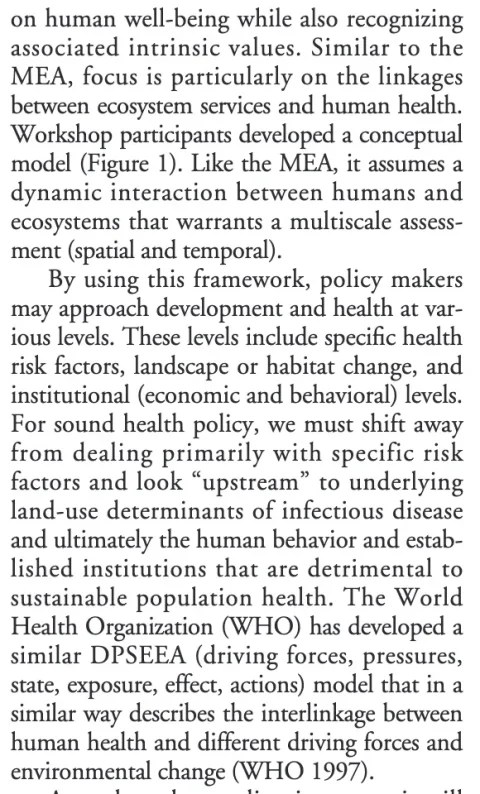
I just pulled out some of the high-sounding claptrap in this article, below, to give you its flavor. You can see how a small cadre of immoral ‘scientists’ funded by an evil cabal can create an “intellectual” infrastructure to justify stealing land in the name of pandemic prevention.


The (Formerly Law-Abiding) Citizen’s Guide to Navigating the US Prison System

BY RICHARD SOLOMON • UNZ REVIEW • DECEMBER 26, 2023
The owners shredded the Constitution. Legal protections, or even their simulation of a simulation, no longer exist. In Florida, questioning a historical event or the policies of a Middle East country risks ten years in prison. Taking selfies at a legal demonstration endorsed by a sitting President of the United States can get you almost twenty. A journalist and opinion writer became an international fugitive for insulting a Jewish woman online. Douglas Mackey (X/Twitter handle Ricky Vaughn) received a seven month federal prison sentence for posting a Hillary Clinton election meme. Trump lawyer Jenna Ellis pled guilty to one felony count of “aiding and abetting false statements and writings” after she wrote in a letter that the 2020 election was rigged. To avoid prison (she’ll still be a convicted felon and get disbarred), she agreed to testify against her co-defendants (who will likely receive prison time) in this bizarre “false statements/writings” racketeering case. Given the rapid rise in thought/speech crime incarceration, it behooves citizen-serfs, especially political ones, to gain some familiarity with the workings of the US prison industrial complex.
For the record, I’ve never been to prison. I’m disseminating data picked up from sources who have. If anyone reading this has done prison time or worked/works as a CO (corrections officer) and feels that I’ve misrepresented something, please add your perspective in the comments section. I don’t claim to be an expert on the penal system. Nor do I want to be.
Imagine you repost a meme on social media and get charged with “spreading misinformation while committing hate speech within a fifty-mile radius of an Israeli consulate and or synagogue during the commission of a thought crime.” Your day in court arrives, and after the #MeToo Jacinda Ardern lookalike prosecutor gives her PowerPoint presentation on your online browsing history and puts your bad-breakup ex-girlfriend on the stand, your case goes to a jury of monthly boosted blue and yellow flag emoji patriots. Following an hour of deliberation they return a guilty verdict. (They voted guilty within the first minute, but for appearance’s sake wait an hour before notifying the bailiff). After the Kamala Harris wannabe judge reads a moving passage from Michelle Obama’s “The Light We Carry” and tells you what a degenerate scumbag you are, she sentences you to ten years. What kind of life awaits you inside the prison industrial complex? Prison conditions vary depending on security level, location, and whether it’s a state or federal facility. While low-level fed camps offer the best conditions, high-level federal institutions like USP Atlanta and Beaumont are super barbaric. Alabama and Florida state prisons have bad reputations. Generally speaking, the higher the security level, the more brutal the prison. That’s not to say you can’t get jammed up in a minimum security facility or county jail.
Prison is violent. An angry lifer has little to lose by smashing or stabbing a prisoner he dislikes. “What are you looking at?” can be a tricky question to answer in the civilian world. Much more so in prison.
Even if you’re an astute practitioner of conflict avoidance, in higher-level prisons you will likely receive a “heart check,” i.e. a prisoner tests you. The majority prison consensus for this type of encounter? Fight. The good news is that there is no shame in losing a prison fight. Violence is so common that most prisoners, no matter how tough, have lost a fight during their stay. All that matters is you stood up. For those lacking skills, “flailing arms spaz mode” style seems the best option. It should be over pretty quickly. If you don’t fight, you’ll be labeled prey. This invites future b!tch slap humiliations and extortion. Extortion could mean turning over commissary items, or in more extreme cases, a family member wiring funds to a prisoner’s “girlfriend” to keep you healthy. Predatory prisoners love draining nest eggs. For those with money, refrain from bragging about past French Riviera vacations.
Most prison violence stems from gambling and drugs, especially in regard to debt. If you choose to indulge, pay as you go. Taking commissary on credit also entails risk. Some prisoners operate “stores” whereby they loan out one can of soup with the expectation of receiving two as repayment. Better to go hungry that night. Defaulting on prison debt gets you smashed or stabbed. On occasion, a soft younger inmate runs up a debt he can’t cover. Some creditors accept sexual favors as repayment. Once an inmate goes that route, there’s no coming back. For Boomers and fellow Gen Xers, even if so inclined, that escape hatch won’t be open to you. Nobody wants your old ugly ass. The takeaway—don’t run up prison debt.
Even if you play things right, you could still find yourself housed with a violent psychopath who doesn’t like your face. This could morph into a case of “kill or be killed.” Killing your adversary could get you a life sentence with transfer to a super-max dungeon. Legal self-defense doesn’t carry much weight in prison. If you stab or bludgeon him and he survives, you might only wind up with a few weeks or months in the hole (solitary confinement). Or you could add decades to your sentence and a super-max stay. How a facility’s administration deals with violent offenses varies from prison to prison. In some places, as long as you don’t give staff the paperwork headache of a body, they don’t care how extreme prisoner-on-prisoner violence gets. Alabama prison administrators are known for covering up prison homicides, which could work to your advantage if you need to take out an adversary. Conversely, this could work against you if you wind up on the receiving end of the shank.
When things get too heavy, some prisoners opt to “check-in” (enter protective custody (PC) /solitary confinement). Some guards want you to name your antagonizer(s) before letting you check-in, which technically makes you a “snitch.” Snitches and chomos (pedophiles) inhabit the lowest rung of the prison hierarchy. Not a good look. Even if you manage to enter PC without snitching, you’ll be labeled a “check-in.” At some point you go back into general population. A check-in label follows you for the rest of your stay and opens you up to victimization. If faced with an unreasonable predator, the better option might be to handle things yourself.
What about prison rape? While common back in the day, it’s been largely eradicated through PREA (Prison Rape Elimination Act) and current prison culture. In most prisons, a booty bandit who targeted straight males would get run off the yard, i.e. smashed. Plus, with all the openly gay prisoners today, there’s no reason for a booty bandit to take it by force. Many prison organizations forbid their members from engaging in gay sex. Members who pursue down-low activity risk a death sentence. Overall, messing with “boys” (effeminate prison gays) is looked down on, and most prisoners avoid it. The small percentage who practice that lifestyle do so openly and without fear of reprisal. No one’s calling a three-hundred-pound wall of granite a f@g. Or his “boy.”
Many large corporations utilize prison slave labor. According to zio-globalist Harvard University, on average, prisoners get paid ninety-three cents per day. Juxtaposed to these slave wages are real-world prices for prison goods and services. US prisons outsource food services, phone, internet, healthcare, commissary, and pretty much everything else to private corporations. To maximize profits, these corporations price gouge prisoners and cut services. Prison food is often rotten and inedible. If you don’t want to lose weight, you’ll need to buy commissary food at market prices. But how can you do that earning ninety-three cents a day? You can’t. If fortunate, you might have family members who put money on your books (prison account). Otherwise, you’ll need to form a “prison hustle.” This could include offering cell cleaning and laundry services, working as a jailhouse lawyer or tattoo artist, running a poker table, brewing prison wine, or selling drugs. Predatory prisoners simply take stuff off weaker inmates.
Prison living conditions can be quite bad. Institutions often go on lockdown for months. That means sharing a bathroom-sized cell with another man 24/7 until the lock pops. To me, this constitutes cruel and unusual punishment. Imagine getting locked down with a cellie who snores like a Metallica concert bass amp. Or a psycho-maniac. As reported by the Miami Herald : “An inmate at Columbia Correctional Institution’s annex was able to strangle and mutilate his cellmate, gouge out his eyeballs, wrap his blood-soaked body in a sheet and walk into the prison’s chow hall wearing the dead inmate’s ear strung around his neck before officers learned anything was amiss.” Prisoners with psycho-maniac cellmates often develop severe PTSD from continuously sleeping with one eye open.
The lack of privacy in prison is obscene. That includes bathroom privacy. Full view-everything. Whoever invented this layout was a sick f*ck.
Prisoners are subject to regular “bend over, spread your cheeks and cough” level strip searches that would be humiliating if carried out by a licensed medical practitioner in a private patient room. Imagine performing this routine in front of snickering guards.
West Coast prisons practice racial segregation, i.e. races stay with their own. Fraternizing with a member of another race could get you smashed or stabbed. In West Coast prison politics, if a prisoner fights, it’s usually against someone from his race. If he gets victimized, it’s usually by an individual or group from his race. If two prisoners of different races have a beef, most times the shot callers of the respective races put the aggrieved parties into a cell and let them fight it out. After it’s over, the matter’s considered settled. If a prisoner goes into debt to someone from another race, members of the debtor’s race sometimes pay the debt and then smash or stab the debtor to avoid a race riot. An unsettled interracial beef can result in a race riot. If a race riot pops off, you’ll be expected to swing your lock-in-a-sock or shank for your race even if you have no involvement in the beef or know what it’s about. Anyone caught ducking out of a race riot gets smashed or stabbed by members of his race.
East Coast prisons are not racially segregated, although like in society, people tend to gravitate toward their own. However, strong bonds often develop between prisoners of different races.
In some institutions, prison organizations (gangs) control the internal politics. Higher-tier prison organizations resemble paramilitaries, as they possess a military top-down chain of command, written constitutions, well-trained soldiers with a high capacity for violence, mandatory boot camp level calisthenic regimens, large capital flows, and a reach that extends into the streets which includes access to serious arsenals. As per the Second Amendment, citizen militias still exist. Conversely, many prison organizations (gangs) lack structure and discipline and are more free-wheeling.
Prisoners join gangs for different reasons, e.g., protection, fellowship, thrills, resources. Joining a gang means following orders. This could include anything from stabbing a gang target to acting as a drug mule. Refusing an order could result in a death sentence. Like any major life decision, weigh the pros and cons carefully before signing on. As with civilian organizations, application standards vary. Some prison organizations want numbers, while others maintain a higher bar for entry. A case of “twenty-five pennies versus a quarter.”
Prison guards can be somewhat professional, corrupt, or sadistic. A nasty CO can make a prisoner’s life hell. Most COs just collect a paycheck and don’t care what happens to their charges. The Stanford Prison Experiment provides insight into guard psychology. Try to be respectful toward guards, but avoid fraternization, as this will cause some prisoners to label you a snitch.
It should be noted that the #MeToo psyop poses a unique danger to political prisoners. #MeToo started with Harvey Weinstein. I didn’t follow his case closely enough to comment on how far Weinstein’s actions went past the Hollywood casting couch quid pro quo that has existed since the days of silent movies and into the classic legal definition of rape. Weinstein was a connected insider. His circle of friends included Hillary Clinton and Oprah Winfrey. He was a rabid Hollywood Zionist with Mossad ties. To his credit, Miramax offered up some decent movies in the 90s. Weinstein appeared to run with the “above the law” crowd, however, the donor class sometimes sacrifices one of its own when politically expedient. I don’t know why they chose Weinstein. Julian Assange became the first major “enemy of the state” #MeToo victim. Once the globalists had him in their clutches, his “rape” charges quickly and quietly vanished. Comedian-political commentator Russell Brand appears to be the latest #MeToo target.
#MeToo framed political prisoners entering prison with “bad paperwork” or sex offender status get greenlit. That means open season for extortion, smashing, and slashing. It could even mean a death sentence. Real rape is a terrible crime that traumatizes the female victim. However, from my viewpoint, throwing fake sex crime charges at an innocent man is an equal or worse crime. The Bible says – “Thou shalt not bear false witness.” It’s serious sh!t. Any woman or operative who participates in such a horrific charade deserves an appropriate response. If the Deep State #MeToo frameup trend continues. I respectfully suggest that the heads of convict-code based prison organizations (gangs) consider secondary in-house trials for “sex crime convicted” political prisoners to determine if the charges are real or state fabrications.
In summary, from my review of the data, best prison practices include:
- Mind your business aka “do your own time.” If you involve yourself, you’re involved, i.e., the violent predator who was the other guy’s problem becomes your problem. In a similar vein, never look into another prisoner’s cell when passing by it. Not only is that considered rude, but if he’s in the middle of hiding contraband and his cell gets searched later, guess who he’s blaming.
- Don’t snitch.
- Avoid gambling, borrowing, (hard) drugs, and “boys.”* (*No offense to gay people. It’s prison politics).
- Practice C&R (Courtesy and Respect). “Please, thank you, and excuse me” go a long way in civilian life, but even further in prison.
- Choose solid associates (“friends”). You’ll be judged by the company you keep. If your associate gets into a beef, you’ll be expected to back him up, and vice versa. Someone prone to drama could drag you in. If your associate borrows heavily and checks in or gets transferred, his debts could pass on to you.
For those facing potential incarceration for “hate speech,” “spreading misinformation,” questioning election results, posting offensive memes, attending protests, or similar crimes, I hope this article helps. If you need more data, there are informative YouTube channels hosted by ex-prisoners.
While prison seems to be the modality of choice, please note that the Deep State can always exercise the ultimate option to neutralize enemies. See Wikileaks DNC whistleblower Seth Rich. Or the quixotic veteran who believed in free and fair elections. Her name is Ashli Babbitt.
We live in a society run by criminals. Goldman Sachs stole way more money than John Dillinger, and the worst child killer pales in comparison to Madeleine Albright, who starved five hundred thousand Iraqi children to death and bragged about it on network television. The “rules” don’t apply to the donor class.
Outsourcing of jobs, endless war, corporate welfare, and banker theft increased poverty and raised crime levels. Formerly productive regions of the US became opioid/meth/crime/poverty zones. While prisons warehouse violent predators who pose a serious threat to public safety, it’s not uncommon for innocent poor people to take shorter sentence plea deals rather than risk going to trial with a checked-out public defender and potentially receiving a decades-long sentence. As America sinks further into third-worldism and despotism, former law-abiding citizens might need to go “Walter White” to pay medical bills, avoid homelessness, or practice basic civil rights.
Just like the Military Industrial Complex requires endless wars for its business model, the for-profit Prison Industrial Complex needs to fill beds. An influx of thought/political criminals into the system floats stocks. Not surprising that end-stage neoliberal capitalism America has the world’s highest incarceration rate.
For those who cheered Reagan-Clinton mandatory-minimum sentencing for nonviolent drug offenses while the CIA shipped in freight loads of coke and heroin to inner cities and the Sacklers drowned the heartland in a sea of opioids- congratulations, you’ve arrived at gulag nation. Welcome home son.
Biden’s plan to ‘revive Palestinian Authority’ fizzles out: Report
The Cradle | December 26, 2023
The US government has run into a significant hurdle in its campaign to “revitalize” the Ramallah-based Palestinian Authority (PA) as possible successors to Hamas in the Gaza Strip, failing to convince Israel to unblock funds necessary to prevent the PA from total collapse.
“Even if we agreed [to take over for Hamas in Gaza], how can we implement it? The policy of Israel is to weaken the authority, not strengthen it,” PA Deputy Prime Minister Nabil Abu Rudeineh told the Washington Post. “We cannot even pay the salaries of our soldiers, our employees,” he added.
Despite round-the-clock visits to the heavily fortified PA headquarters in Ramallah and meetings with Israeli authorities, US officials have made little progress in securing the release of millions in Palestinian tax money that Israel has blocked since 7 October.
Two months ago, the Israeli finance ministry – led by Jewish supremacist official Bezalel Smotrich – froze the transfer of tax revenues amounting to some $188 million monthly to the PA.
“The PA didn’t see fit to distance itself from these barbarian actions, and officials in the authority even expressed support for the awful massacre […] Furthermore, the PA is acting against Israel at the International Criminal Court and the International Court of Justice,” Smotrich said on 30 October.
The tax revenues – known in Palestine as maqasa – are collected by the Israeli government on behalf of the PA on Palestinian imports and exports. Israel earns a commission of 3 percent of collected revenues.
On Friday, the European Commission said it was preparing a $130 million aid package to help plug the gap.
According to Sabri Saidam, a member of the central committee for the Fatah party and close adviser to PA President Mahmoud Abbas, plans for Palestinians to receive their tax revenue have “collapsed.”
Besides finding ways to avert the financial collapse of the PA, US officials have also been pushing for “changes and new faces in key positions” in a last-ditch effort to improve the public image of the deeply unpopular organization.
According to a recent poll from the Palestinian Center for Policy and Survey Research, 88 percent of Palestinians want Abbas to resign as PA President, up 10 points from three months ago.
Meanwhile, the popularity of Hamas has soared in the occupied West Bank, from 12 percent to 44 percent.
“It’s always this colonizing mentality, whereby, ‘We decide your leadership, we are the ones basically designing your strategy for the day after, we tell you how to live, we tell you how to breathe, and we tell you how to run your land,’” Saidam told the Washington Post.
The PA was established in 1994 based on the first Oslo Accords (1993) between Tel Aviv and the now-defunct Palestine Liberation Organization (PLO). It was initially established as a temporary governing body to lay the foundation for an independent Palestinian state.
However, after decades of corruption allegations, collaboration scandals, and a poor human rights record, the PA was in a state of “total inertia” before the Al-Aqsa Flood Operation unfolded on 7 October.
Complicating matters further for Washington, Israeli Prime Minister Benjamin Netanyahu is staunchly opposed to a PA-controlled Gaza.
“Expectation that the Palestinian Authority will demilitarize Gaza is a pipe dream,” Netanyahu says in an op-ed published by the Wall Street Journal (WSJ) on Monday.
“[The PA] has shown neither the capability nor the will to demilitarize Gaza,” the premier added, claiming that Ramallah “currently funds and glorifies terrorism […] and educates Palestinian children to seek the destruction of Israel.”
“For the foreseeable future, Israel will have to retain overriding security responsibility over Gaza,” Netanyahu stressed.
Ukrainian opposition politician jailed for five years
RT | December 26, 2023
A court in Ukraine has sentenced a member of a banned opposition party to five years behind bars for expressing pro-Russian views in private conversations. The man, whose name has not been revealed, had served on the Cherkasy City Council before becoming an aide to an MP in the country’s parliament.
In March 2022, the National Security and Defense Council of Ukraine suspended the activities of the Opposition Platform – For Life political party. The authorities accused the party of operating in the interest of Moscow. It was eventually banned by a court ruling several months later.
In a message on its Telegram channel on Monday, Ukraine’s Office of the Prosecutor General revealed that the defendant was found “guilty of justifying the armed aggression of the Russian Federation against Ukraine and glorifying its participants.”
According to the prosecutors, the former municipal council member aired his pro-Russian views “in conversations with his close relatives and acquaintances.” The man is said to have extolled Russia’s actions in Ukraine as well as President Vladimir Putin personally.
Officials quoted the defendant as saying: “To Russia’s victory on our long-suffering Ukrainian soil! It needs to be cleansed.”
Earlier, the Office of the Prosecutor General reported levelling similar charges against a 62-year-old woman, who is also from the city of Cherkasy in Central Ukraine. The authorities said they believed she had justified Russia’s actions and compared the Ukrainian government to the Nazis in a phone conversation with her friend.
In 2020, criminal charges of high treason were filed against the former leader of the Opposition Platform – For Life, Viktor Medvedchuk, over his visit to Moscow, where he had met with top Russian officials. Sometime later, the politician was put under house arrest. However, in late February 2022, around the time Russia launched its military action against its neighbor, Medvedchuk absconded. He was recaptured several months later, and handed over to Moscow as part of a prisoner swap deal last September.
The exiled opposition figure has continued to criticize President Vladimir Zelensky’s administration. Earlier this month, Medvedchuk opined that the current leadership in Kiev has “turned out to be not just bad negotiators, but criminal amateurs.” He also accused the Ukrainian head of state of selling “out [Ukrainians] for cannon fodder” after being promised Western aid.
The politician claimed that President Zelensky is averse to the idea of peace negotiations with Moscow because such talks would prove to be a “sentence for Zelensky, not only political, but also criminal,” with Ukrainians likely to start asking him tough questions.
Rumble blocks Brazil
RT | December 22, 2023
The video sharing service Rumble announced on Friday that it would disable access to all users from Brazil pending its legal challenge of the Brazilian court order to censor certain creators.
Rumble CEO Chris Pavlovski revealed the move in a post on X (formerly Twitter), noting that the court orders clashed with the company’s mission to “restore a free and open Internet.”
“Users with unpopular views are free to access our platform on the same terms as our millions of other users,” Pavlovski wrote. “Accordingly, we have decided to disable access to Rumble for users in Brazil while we challenge the legality of the Brazilian courts’ demands.”
Brazilians who lost their access to Rumble content have only their courts to blame, he added, noting that he hoped the judges would reconsider their decision so that the service could be restored soon.
“I will not be bullied by foreign government demands to censor Rumble creators.”
In a follow-up post, Pavlovski noted that Rumble was “the only company at our scale that holds the line for free speech and American values,” and that he hoped some day other Big Tech companies would do the same. “I will continue to lead by example until that day arrives,” he added.
Journalist Glenn Greenwald, who lives in Brazil and hosts the ‘System Update’ show on Rumble, noted that the Brazilian Supreme Court is “consumed with censoring political speech,” to the point that it banned platforms such as Telegram and WhatsApp for failing to immediately obey their censorship orders.
This is the second time Rumble has suspended service in a country over a censorship row. In November 2022, Pavlovski defied France’s orders to censor certain Russian-language outlets, citing the company’s free speech mission.
Pavlovski, a Canadian tech entrepreneur, founded Rumble in 2013 after seeing YouTube giving priority to influencers after getting acquired by the search engine giant Google. The platform grew in popularity starting in 2020, after a mass purge of dissident voices by Silicon Valley, and continued in 2021 with the influx of US conservatives censored elsewhere.
How the cabal’s false narratives are used to gain their true objectives
BY MERYL NASS | DECEMBER 21, 2023
One Health issues a booklet and finally, kinda, sorta tells us what One Health is about.
“A guide to implementing the One Health Joint Plan of Action at national level”
See page 30:
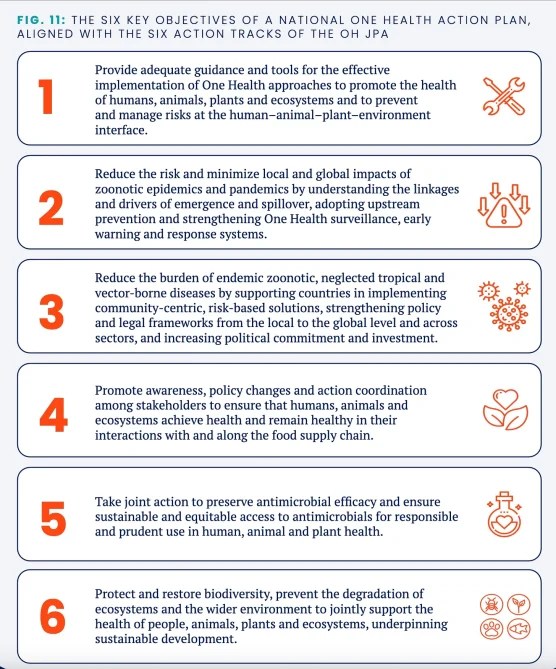
I do the decoding [italics ].
- “Provide adequate guidance and tools for the effective implementation of One Health approaches to promote the health of humans, animals, plants and ecosystems and to prevent and manage risks at the human–animal–plant–environment interface.”
This drills into the reader’s brain the idea that the human-animal or human-environment interface is a dangerous place to be, that the risks must be acknowledged, and major efforts made to manage them. Note the absence of evidence supporting the assertion that major risk exist when humans are exposed to animals and nature.
- Reduce the risk and minimize local and global impacts of zoonotic epidemics and pandemics by understanding the linkages and drivers of emergence and spillover, adopting upstream prevention and strengthening One Health surveillance, early warning and response systems.
The concept that pandemics are caused by “spillover” from animals is asserted, as is the very shaky idea that one can prevent and identify pandemics early using “surveillance” “warning and response systems”—which tellingly are never defined in any detail since no methods have ever worked.
- Reduce the burden of endemic zoonotic, neglected tropical and vector-borne diseases by supporting countries in implementing community-centric, risk-based solutions, strengthening policy and legal frameworks from the local to the global level and across sectors, and increasing political commitment and investment.
Blather about helping developing nations without saying anything specific, except that they need to strengthen “policy and legal frameworks”—such as implementing legislation for authorization of unlicensed, liability-free drugs and vaccines? They need more political commitment—commitment to what, exactly, is ominously left unsaid. And naturally more investment (and commissions) are needed.
- Promote awareness, policy changes and action coordination among stakeholders to ensure that humans, animals and ecosystems achieve health and remain healthy in their interactions with and along the food supply chain.
The ominous missing information about the policy changes and action desired should make you very nervous. Now the “food supply chain” is invoked, turning food and the methods by which it travels from farm to kitchen fair game for the purveyors of One Health.
- Take joint action to preserve antimicrobial efficacy and ensure sustainable and equitable access to antimicrobials for responsible and prudent use in human, animal and plant health.
It sounds like there is a plan to withhold antibiotics from us in the name of preserving their efficacy. Pharmacists were made to monitor azithromycin use as well as hydroxychloroquine, chloroquine and mefloquine use during the COVID time. Bacterial pneumonias were untreated until the victim’s lips turned blue. Expect more of this.
- Protect and restore biodiversity, prevent the degradation of ecosystems and the wider environment to jointly support the health of people, animals, plants and ecosystems, underpinning sustainable development.
This will be the justification to move people off the land in areas where species are said to be threatened. It may also lead to enforced changes in land use, based on my earlier readings of Daszak, Fauci and the Lancet One Health commission. And of course we must give up our simple pleasures in the name of the Sustainable Development Goals (SDGs). Who voted for them, and why are we being frog-marched into a SDG future, even though we don’t know where it is leading?
_________________

The cabal that delivered COVID and its pandemic response plan to us wants to solve the rest of the world’s problems for us, too. Will YOU let them?
Featured Video

Trita Parsi: Middle East Unraveling — Are We on the Path to World War?
or go to
Aletho News Archives – Video-Images
New Book
Trans agenda is ‘normalization of sadism’ – US author

RT | September 23, 2026
The US Democratic Party has embraced a transgender agenda that amounts to “the normalization of sadism,” author A.J. Rice has said, warning that radical trans policies would return if the party is allowed to regain power.
Speaking to RT’s America First host Scotty Nell Hughes about his new book, ‘The Curse of the Bearded Lady: How the Trans Mafia Whacked American Sanity’, Rice argued that activists have gained significant influence in schools, medicine, and corporate America while people who questioned the agenda have faced pressure to stay silent.
The author described the “trans mafia” as the sprawling network of people and institutions that have helped the movement gain influence. He singled out parts of academia, wealthy backers, and corporations, and stated that providers of transition-related treatment also have a financial incentive to keep young people in their care indefinitely.
Rice argued that the consequences of these policies ultimately fall on children who are being drawn toward gender-affirming medical treatments and on girls who are expected to share locker rooms or compete in sports with biological males.
He noted that while voters rejected the Democrats’ approach to gender in 2024, the party, which has been “captured by madness,” has since only doubled down and is seeking what is effectively “the normalization of sadism.” … Full report
Blog Roll
 Aletho News
- Integrity Initiative: UK-funded network framed dissent as Russian disinformation for years
- ‘We don’t seek permission to defend our country’: Snippets from President Pezeshkian’s UNGA address
- NATO chief wants Europeans to fight American wars [for Israel]
- German chemicals giant reveals details of downsizing
- Refaat Al-Areer Was The Canary In The Coal Mine In Israel’s War On The Truth
- Israeli election committee bars candidate from Knesset race over Gaza war opposition
- French-Lebanese man files war crimes complaint over Israeli attacks
- Mahan Air Flight Lands in China Despite US Threat against Iranian Airlines
- US eyes $10bn fund to rebuild war-battered Gulf infrastructure
- Trump meets Rodríguez near Maduro’s prison as Venezuela’s oil flows to US
- If Americans Knew
- Caught on Tape: AIPAC CEO Boasted of Controlling Trump’s National Security Officials
- Why Hamas Attacked Israel in October 2023 – Israeli professor Ilan Pappé
- They see them, then kill them: Israeli quadcopters track, deliberately target civilians in Gaza
- Winter could turn Gaza’s treacherous, war-damaged buildings into deathtraps
- Majority of Democratic Voters Want to Prosecute Both Biden and Trump Administration Officials Over Gaza
- As Gaza languishes, world leaders gather at the UN – Daily Update
- Sanctions are collective punishment: immoral and self-defeating
- Phosphorus Munitions Fired by Israel Burn Groves, Orchards in Southern Lebanon
- Israel Carries Out New Ceasefire Violations Across Gaza
- AI – Emphasis on the ‘I’: Israel Is Funding AI Chatbot Propaganda
- No Tricks Zone
- New Study: Earth And Venus Surface Warmth Largely Explained By Convection And Lapse Rate, Not CO2 Or Radiation
- 2025 Nature Paper Claiming Worsening Global Drought Gets RETRACTED …Heavily Flawed
- New Study: ‘Global Drought Shows No Detectable Recent Acceleration Under Climate Warming’
- Economic Masterminds: German Socialists Suggest Taxing Productivity Gains Stemming From Using AI
- The South China Sea Has Not Been Cooperating With The Climate Change Narrative
- Energy Crisis: Germany Enters Heating Season With Historically Low Gas Reserve Fill Levels
- New Study: The Antarctic Ice Sheet Gained Mass From 2020-2024 Due To Staggering Snow And Ice Accumulation
- Study: Ocean Heating Rates From Thousands Of Years Ago ‘Dwarf’ Modern Ocean Heating Rates
- Climate Extremists Target, Attack Large-Scale Power Grid Infrastructure In Germany!
- New Study: Antarctic Ice Melt Has Contributed Less Than 1 Centimeter To Sea Level Rise In The Last 30 Years

