Von der Leyen warns Hungary: We have ways of making you talk
By Finian Cunningham | Strategic Culture Foundation | February 26, 2026
European Commission President Ursula von der Leyen arrived in Kiev this week empty-handed, and she was pissed. She had been planning to mark the fourth anniversary of the Ukraine war on February 24 with a new €90 billion loan to prop up the corrupt Kiev regime.
At the last minute, Hungary announced that it was vetoing the “Ukraine Support Loan.” So, von der Leyen, the former German defense minister and arch Russophobe, had nothing to show the puppet regime. The big anniversary occasion was an embarrassing flop. Hungary was accused of “betraying” European solidarity.
Putting a brave face on the debacle, von der Leyen made a promise, with menacing tone, about delivering the €90 bn “one way or another.” She said: “Let me be clear, we have different options, and we will use them.”
Those options would seem to include inciting regime change in Budapest. Hungary is going to the polls on April 12 for parliamentary elections. It is no secret that the European Union leadership would dearly like to see incumbent Prime Minister Viktor Orbán being turned out of office, and replaced by Péter Magyar, of the opposition Tisza party, who is more amenable to Brussels’ policy of supporting the Kiev regime in the proxy war against Russia.
Orbán’s government vetoed the €90 bn loan – 60 per cent of which is for military aid – because it accuses the Kiev regime of blocking vital oil supplies to Hungary. Slovakia has also joined Budapest in making the accusation. Both countries claim that Ukraine is using energy “blackmail” simply because they refuse to discontinue buying oil supplies from Russia, and because they are opposed to the ongoing war.
On January 27, Russian oil supplies to Hungary and Slovakia transiting Ukraine via the Drushba pipeline were suddenly stopped. The Kiev regime claims that the pipe was hit by a Russian drone.
However, Hungary’s Foreign Minister Péter Szijjártó has bluntly accused Ukraine of lying. He disputes that a Russian attack on the infrastructure even took place. It doesn’t make sense that Russia would harm its customers.
The suspicion is that the Ukrainian regime is using a purported Russian strike as a pretext to cut off the oil supply. The suspicion is deepened by the fact that the Kiev regime has refused requests by Hungary and Slovakia for their inspectors to assess the alleged technical damage. And neither is the EU leadership putting any pressure on Kiev to prove its claims of Russian sabotage.
Ukraine’s nominal president, Vladimir Zelensky, who is mired in allegations of massive fraud, financial corruption, and racketeering, has for a long time been threatening to cut off Russian oil supplies to Hungary and Slovakia. He accuses Budapest and Bratislava of supporting Russia’s war machine by buying its oil. Hungary and Slovakia say that it is their sovereign right to continue obtaining vital energy imports from Russia. The Soviet-era Drushba (“Friendship) pipeline has been supplying Europe since 1964.
The European Union has also been pressuring Hungary and Slovakia to terminate the purchase of Russian crude oil and get in line with the rest of Europe to source alternative, more expensive American energy exports.
Last year, Zelenksy delivered on his threats when the NATO-backed Kiev regime bombed sections of the Drushba pipeline in Russian territory. Those attacks temporarily disrupted supply to Hungary and Slovakia. At the time, the European Union leadership did not condemn the Ukrainian attacks. In other words, Von der Leyen and the Brussels administration were effectively siding with a non-EU member that was harming the interests of two member nations. That indifference was tantamount to greenlighting more sabotage attacks.
The Kiev regime has a record of using attacks on energy as a political weapon against Hungary and Slovakia. It is therefore logical that it has taken such practice to a new level by blocking infrastructure that it can easily control on its own territory. There is no need to bomb the Drushba pipeline in Russia, hundreds of kilometers away. The Kiev regime can handily turn off the pumps of the pipeline section running through its territory – and then blame Russia for “drone strikes”.
Hungary and Slovakia have both accused Zelensky of “slow-walking” the alleged repairs to the pipeline. Zelensky claims that the repairs can’t be carried out because Russia keeps attacking the repair crews.
The Kiev regime has a habit of lying. It has been claiming that Russia is shelling the Zaporozhye Nuclear Power Plant under its control, when in reality it is the Kiev regime that has been carrying out the attacks, which Moscow has condemned as “nuclear blackmail”. Again, the European Union has indulged Kiev’s lies by ignoring the blatant evidence.
On the energy blackmail against Hungary and Slovakia, the knock-on effect has been a growing shortage of fuel and increasing prices for energy and transport.
Hungary’s European Affairs Minister Janos Boka has accused Ukraine and the European Union of deliberately disrupting oil supply to influence the upcoming election. He said: “Ukraine has clearly been reaching for the energy weapon for political reasons, interfering in the ongoing Hungarian elections… to create uncertainty and chaos, and thereby helping the [opposition, pro-EU] Tisza party to power.”
At a closed-door summit in Brussels this week for EU foreign ministers, it was notable that Ukraine’s top diplomat, Andrii Sybiha, was afforded the extraordinary privilege of being permitted to join the conference via video link. How is it that a non-EU member is allowed to participate in a private ministerial summit?
Hungary’s Foreign Minister Péter Szijjártó reportedly complained that EU foreign policy chief, Kaja Kallas, prevented him from grilling the Ukrainian on the specific damage to the Drushba pipeline. Szijjártó said that the “mumbling response” from the Ukrainian official and his abrupt disconnection from the summit demonstrated guilty responsibility.
What the whole saga illustrates is the dictatorship that has emerged in the European Union. Countries like Hungary and Slovakia are not allowed to have independent positions on their energy trade or their opposition to the war in Ukraine.
The Kiev regime is using the disruption of vital energy supply to EU members as a form of blackmail to coerce those members into handing over tens of billions of euros to prolong a bloody conflict, a conflict that could spiral into a nuclear world war. And the EU leadership is effectively supporting this terrorist tactic against its own members to enforce subordination.
When von der Leyen warns that “we have other options,” the inimical image conjured up is that of a Gestapo interrogator twirling pliers in hand.
The strategic defeat of Russia is paramount for the European Russophobic elites, even if it means gouging out the democratic rights of its own member states and endangering international peace.
EU manipulating polls in bid to oust Orban – German opposition leader
RT | February 27, 2026
The EU is desperately attempting to engineer “regime change” against Hungarian Prime Minister Viktor Orban in next month’s parliamentary election, employing tactics such as poll manipulation and energy blackmail, German opposition leader Alice Weidel has claimed.
In a post on X on Wednesday, the co-chair of the Alternative for Germany (AfD) party accused Brussels of using “their puppet,” Hungarian opposition leader Peter Magyar, in a bid to remove Orban.
“They want Orban gone, and they are willing to use any means to achieve it,” Weidel wrote, pointing to the ongoing “blockade of oil supplies” from Ukraine to Hungary through the Druzhba pipeline, and “manipulation of election polls.”
Weidel was responding to a recent survey by Hungarian pollster Median showing Magyar’s opposition Tisza Party with a 55% to 35% lead over Orban’s ruling Fidesz-KDNP alliance. Irish economist Philip Pilkington dismissed the figures as “really crazy polls,” comparing them to surveys in Georgia ahead of elections in 2024, which were followed by unrest.
Hungarian opposition pollsters have a track record of significant inaccuracies. In 2022, left-leaning polling firm Publicus was wide of the mark by 20 points, while Median itself underestimated Fidesz by 7 points in its final pre-election survey. Orban ultimately secured a 20-point victory.
Budapest and Brussels have been in an escalating standoff over Hungary’s continued opposition to EU policy on Ukraine and Russia. Budapest has repeatedly blocked or vetoed EU initiatives, including a recent €90 billion ($106 billion) emergency loan for Kiev and the bloc’s latest sanctions package against Moscow.
Orban has also vehemently opposed Ukraine joining the EU, arguing that Brussels’ support for Kiev draws the bloc closer to direct war with Russia and ignores Ukraine’s failure to meet requirements for candidates.
The Hungarian leader has described recent attempts to offer Kiev a form of ‘membership lite’ as “an open declaration of war against Hungary,” accusing Brussels of disregarding the will of the Hungarian people and being “determined to remove the Hungarian government by any means necessary.”
Orban has also accused Brussels of using “censorship, intervention, and manipulation” to undermine his government, framing the upcoming April 12 election as a choice between “war or peace.”
US university cancels Palestine conference citing sanctions concerns
Al Mayadeen | February 26, 2026
The University of Southern Maine has withdrawn permission to use a campus venue for a conference centered on Palestine, just days before it was scheduled to begin, triggering a dispute over sanctions law and First Amendment protections.
The event, titled “Consequence of Palestine,” had drawn more than 300 registrants and was organized by the Maine Coalition for Palestine, Maine Voices for Palestinian Rights, and the university’s department of criminology and sociology. It was expected to feature virtual remarks by Francesca Albanese, the United Nations special rapporteur for the occupied Palestinian territories, who has been under US sanctions since last year.
University officials said the decision was based on federal sanctions law. Samantha Warren, chief external and governmental affairs officer for the University of Maine system, told The Guardian in an email that “hosting a conference that is being actively promoted as including a speaker sanctioned by the US government would put our public university in violation of federal law”. She said organizers should have obtained authorization from the Treasury Department before proceeding.
Sanctions regulations prohibit US entities from providing “any goods or services” to individuals designated under sanctions regimes. Violations can carry severe penalties, including heavy fines and potential prison time. However, legal scholars argue that the scope of what constitutes a “service” remains ambiguous.
Campus rights clash
In December, the Treasury Department’s Office of Foreign Assets Control (OFAC) clarified in correspondence with the Middle East Studies Association that “no authorization” was required to include Albanese in an academic event, provided that she did not receive payment, reimbursement, or “training or assistance”. That clarification emerged after concerns were raised about the impact of sanctions on academic exchange.
Xiangnong Wang, a staff attorney at the Knight First Amendment Institute who had sought clarification from OFAC, said the cancellation reflects broader concerns about the chilling impact of sanctions on constitutionally protected speech. “It’s very concerning that sanctions continue to have such a broad deterrent effect on speech that is undoubtedly protected by the First Amendment,” he said.
Organizers said they were caught off guard by the abrupt cancellation. Abigail Fuller, a sociology professor involved in planning the conference, stressed the constitutional implications of the decision. “We’re a public university; the university system is subject to First Amendment laws,” she said. “We feel we have a very, very strong case that they are suppressing our free speech.”
According to organizers, they attempted to clarify that federal guidance did not require special permission to include Albanese. They even proposed removing her from the program in an effort to preserve the event. They were subsequently told there was insufficient time for administrators to evaluate the conference’s “risk”.
Speech under pressure
The dispute comes amid reports that Republican lawmakers had written to the system’s chancellor requesting “information on steps the university is taking to ensure the safety and well-being of its Jewish students”. Organizers believe such political pressure contributed to the reversal and said administrators had also expressed concern about possible federal funding consequences.
Albanese was sanctioned last July, with US authorities accusing her of “unabashed antisemitism, expressed support for terrorism, and open contempt for the United States, Israel, and the West”. She has previously rejected those allegations and criticized the move as politically motivated, describing the United States as “a country of contradictions, full of ideals and principles and still, plotting against democratic values”.
The Treasury Department did not immediately respond to requests for comment on the university’s interpretation of sanctions law.
Despite losing access to their campus venue, conference organizers say they are seeking an alternative location and are exploring possible legal action. Fateh Azzam, a member of the Maine Coalition for Palestine, said canceling the conference outright was not an option.
“That would mean that they have effectively silenced an open and public debate on the issues,” he said. “This controversy will probably bring in more people.”
Project Artichoke: 70 Years Ago, CIA Discussed Hiding Mind-Control Drugs in Vaccines
By Michael Nevradakis, Ph.D. | The Defender | February 24, 2026
In the 1950s, the CIA brainstormed ways to secretly perform mind control on humans — including concealing drugs in vaccines and widely consumed food products, a newly unearthed CIA document revealed. The Daily Mail first reported the story on Monday.
The seven-page document, “Special Research for Artichoke,” is dated April 23, 1952. It describes a series of ideas for how to develop chemicals designed to alter human behavior and thought.
The proposals contained in the document were part of the CIA’s top-secret Project Artichoke, which ran from 1951 to 1956, according to the Daily Mail.
The document, declassified in 1983, recently circulated on social media. However, it was not published in the CIA’s online reading room until last year.
“Some of the suggestions are controversial,” the document states. The proposals included administering drugs in secret as part of a “long-range approach to subjects.”
According to the document:
“This study should include chemicals or drugs that can effectively be concealed in common items such as food, water, coca cola, beer, liquor, cigarettes, etc.
“This type of drug should also be capable of use in standard medical treatments such as vaccinations, shots, etc.”
CIA experimented on humans as part of Project Artichoke
The document also included a special field of research for “bacteria, plant cultures, fungi, poisons of various types, etc.,” that are “capable of producing illnesses which in turn would produce high fevers, delirium, etc.”
This included “species of the mushroom” that “produce a certain type of intoxication and mental derangement.”
Also among the proposals was a suggestion to research “diet” or “dietary deficiencies” on prisoners and on people undergoing interrogation, including using “specially canned foods having elements removed.”
The document included proposals for both short-term and long-term use on humans. Drugs deemed most suitable for long-term use would be designed to produce an “agitating effect (producing anxiety, nervousness, tension, etc.) or a depressing effect (creating a feeling of despondency, hopelessness, lethargy, etc.).”
According to The Daily Mail, the CIA experimented on humans as part of Project Artichoke. The experiments often involved “vulnerable subjects, including prisoners, military personnel and psychiatric patients.” The experiments were usually performed “without informed consent.”
According to Ben Tapper, a Nebraska chiropractor who was included in the “Disinformation Dozen” list in 2021 for questioning vaccine safety, the document exposes “a disturbing reality that government agencies have historically explored ways to manipulate human behavior through chemical and biological means, including concepts involving food and medical interventions.”
“This is not speculation or conspiracy, and it should deeply concern every American who values bodily autonomy and informed consent,” Tapper said.
Precursor to the CIA’s MK-Ultra mind control experiments?
The Daily Mail cited CIA documents suggesting that U.S. intelligence agencies were concerned that enemy nations had developed their own mind and behavioral control techniques. This led the agency to prioritize the development of its own methods.
Project Artichoke “served as a precursor” to the MK-Ultra program, which the CIA launched in 1953. That program “broadened mind-altering experiments on a larger scale,” the Daily Mail reported.
Many of the documents related to this type of experimentation were destroyed in 1973, “leaving the full extent of the research and how far it progressed unknown.”
Naomi Wolf, Ph.D., CEO of Daily Clout and author of “The Pfizer Papers: Pfizer’s Crimes Against Humanity,” told The Defender that the documents further confirm a long history of intelligence agency research targeting human thought and behavior.
“Sadly, it’s long been established that our intelligence agencies, and those of our enemies, have sought to alter human consciousness and behavior, often without the subjects’ consent. The existence of MK-Ultra, the clandestine project into which Project Artichoke evolved, is well documented,” Wolf said.
John Leake, vice president of the McCullough Foundation and author of the forthcoming book, “Mind Viruses: America’s Irrational Obsessions,” said, “Researchers have long suspected that the Church Committee’s revelation of the CIA’s notorious MK-Ultra mind control experiments, mostly using LSD, had the effect of obscuring the agency’s much larger Project Artichoke.”
Leake cited evidence suggesting that a 1951 mass poisoning in Pont-Saint-Esprit, France, in which 250 residents experienced severe hallucinations and seven people died, was a Project Artichoke experiment. The outbreak was officially attributed to contaminated bread from a local bakery.
Leake said the 1952 document is “consistent with the suspicion that the CIA was seeking to discover mind control methods for even large populations.”
In 2024, a Reuters investigation revealed that the CIA operated a secret propaganda campaign involving vaccines in the Philippines. The campaign attacked what the agency perceived as China’s “growing influence” in the country by targeting the Chinese-made Sinovac COVID-19 vaccine through the use of phony online accounts spreading “anti-vax” messaging.
Michael Rectenwald, Ph.D., author of “The Great Reset and the Struggle for Liberty: Unraveling the Global Agenda,” said the Project Artichoke revelations “make it clear that the CIA has posed an enormous threat to U.S. citizens, in addition to the horrors it unleashes on non-U.S. target governments and populations.”
Project Artichoke wanted to enlist help from Army’s Chemical Warfare Service
The 1952 Project Artichoke document also included a recommendation to involve the U.S. Army Chemical Warfare Service in the project’s efforts, citing its experience with “exhaustive studies along these lines.”
This proposal bears a resemblance to recent suggestions that COVID-19 — and the response to the pandemic — were coordinated at high levels of government, military and intelligence agencies.
Last year, former pharmaceutical research and development executive Sasha Latypova and retired science writer Debbie Lerman released the “Covid Dossier,” presenting evidence of the “military/intelligence coordination of the Covid biodefense response in the US, UK, Australia, Canada, the Netherlands, Germany, and Italy.”
According to Latypova and Lerman, “Covid was not a public health event” but “a global operation, coordinated through public-private intelligence and military alliances and invoking laws designed for CBRN (chemical, biological, radiological, nuclear) weapons attacks.”
Leake said “it is far from clear” that the Church Committee hearings of 1975 “put a complete end to CIA covert programs.” He cited the possible laboratory development of the SARS-CoV-2 virus as an example.
“The laboratory creation of SARS-CoV-2 with gain-of-function techniques developed at the University of North Carolina-Chapel Hill, and the U.S. military’s involvement in developing and distributing of mRNA COVID-19 vaccines, should … be regarded as possible outgrowths or even continuations of Project Artichoke,” Leake said.
Experts question similarities between Project Artichoke, COVID vaccines
In a Substack post today, epidemiologist Nicolas Hulscher drew a potential connection between Project Artichoke and the development of COVID-19 vaccines. Hulscher cited recent peer-reviewed studies that identified the vaccines’ adverse impact on neurological health and “surging rates of cognitive decline.”
Hulscher wrote:
“Disturbingly, since 2021, over 70% of humanity received a neurotoxic agent masquerading as a ‘vaccine.’ The same goals outlined in the CIA document (vaccines/drugs capable of covertly inducing anxiety, depression, and lethargy) are now being observed in COVID-19 vaccinated populations. …
“… If the CIA was secretly discussing covert methods to alter human behavior in the 1950s, it would be no surprise if similar classified projects emerged in the decades that followed.”
A 2024 paper published in the journal Molecular Psychiatry investigated psychiatric adverse events among over 2 million people in South Korea. The study found that “COVID-19 vaccination increased the risks of depression, anxiety, dissociative, stress-related, and somatoform disorders, and sleep disorders while reducing the risk of schizophrenia and bipolar disorder.”
A 2025 study published in the International Journal of Innovative Research in Medical Science found “alarming safety signals regarding neuropsychiatric conditions following COVID-19 vaccination, compared to the influenza vaccinations and to all other vaccinations combined.”
This included increases in schizophrenia, depression, cognitive decline, delusions, violent behavior, suicidal thoughts and homicidal ideation.
“The fact that mRNA vaccines were designed to cross the blood-brain barrier and inflame the brain — or at least, they were known to do so, during their manufacture and distribution — should give us pause in light of this news,” Wolf said.
Wolf said the latest revelations, “while shocking, provide all the more reason for us to be critical of opaque, coercive or untested vaccination programs, additives in food and water, and toxic or opaque geoengineering programs.”
Tapper said the revelations reinforce “the urgent need to protect individual liberty, medical freedom, and ethical boundaries in science and public health.”
“The lesson here is simple: vigilance is necessary when governments claim authority over the human body and mind,” Tapper said.
This article was originally published by The Defender — Children’s Health Defense’s News & Views Website under Creative Commons license CC BY-NC-ND 4.0. Please consider subscribing to The Defender or donating to Children’s Health Defense.
German leader of EU’s largest faction sounds the alarm of possibility of right-wing forces coming to power in France, Poland
Manfred Weber, a vocal critic of any EU state that pushes back against a more powerful Brussels, has openly embraced Orbán’s opponent in Budapest
Remix News | February 23, 2026
German politician Manfred Weber, the leader of the European People’s Party (EPP), spoke on ZDF about a common European army, saying, among other things, that the European Union must “draw conclusions from its own experiences, including in military matters.”
Weber spoke about the danger to the EU establishment posed by the presidential elections in France and the parliamentary elections in Poland, both to be held in 2027. Weber is concerned that there is a high probability of victory for forces that do not support the continuation of the EU’s centralization; forces that instead advocate for a Europe of sovereign nations. He said that EU must have the strength necessary, even by way of a common military, to presumably counter such possible outcomes.
Specifically mentioning Poland’s Law & Justice (PiS) leader, Jarosław Kaczyński, and France’s National Rally (RN) leader, Jordan Bardella, he said: “I hope that we now have the strength… to create a Europe that cannot be destroyed and that will weather the storms of the world order together… Now we need the same approach on the military front. We must prepare for scenarios in which Bardella becomes president of France and Kaczyński returns to power in Poland.”
Hungarian Prime Minister Viktor Orbán has repeatedly asserted that the European People’s Party (EPP) is an ardent supporter of the war in Ukraine against Russia, a war Orbán has maintained Hungary will not be drawn into. Notably, Orbán’s Fidesz party used to belong to the EPP grouping before parting ways to found the Patriots for Europe faction, with members committed to EU member states that want to preserve their sovereignty and traditional, conservative values. Now, Weber has been a strong promoter of the opposition leader, Péter Magyar, ahead of Budapest’s April parliamentary election.
During his interview, Weber was vocal about his concerns that the right-wing Alternative for Germany (AfD) may come to power in Germany. “During a visit to the Greek parliament, someone asked me, ‘What would happen if Germany built the largest land army, and at the same time the AfD had 25-30 percent?’” he told the station.
What is Zionism? And what is anti-Zionism?
By David Miller | Tracking Power | January 25, 2026
I am asked to give definitional answers to this question quite often. So, here, for the record are the key extracts from my witness statement written in August 2023 (some weeks before the launch of Al Aqsa Flood by the Palestinian Resistance ion 7 October of that year.
Glancing over the statement at this distance I am struck by how long and detailed it is – 97 pages – and how, even then I was naive about malevolence of Zionism. If you look below you will see that I refer to Zionism as being inherently genocidal. This was not a popular view then, but it has certainly been more than amply borne out by the events since.
I should note that it was on the basis of my statement and my testimony under cross examination that the Tribunal determined that my anti-Zionist views were worthy of respect in a democratic society which is the legal test for philosophical beliefs to be protected under the Equality Act 2010. The definition of Zionism I have used is thus of greater import than just my own views and beliefs it has been accepted by the court as satisfying the five key elements of the so-called ‘Grainger’ test of which being worthy of respect is the fifth.
For a belief to be protected under Section 10 of the Equality Act, it must:
- Be genuinely held: It cannot be a fictitious or insincere claim.
- Be a belief, not an opinion: It must be more than a viewpoint based on the “present state of information available”.
- Relate to a weighty and substantial aspect of human life and behavior: It must concern significant matters rather than trivial or minor ones.
- Attain a certain level of cogency, seriousness, cohesion, and importance: The belief must be intelligible and internally consistent.
- Be worthy of respect in a democratic society: This has three components
a. The belief must not be akin to Nazism or totalitarianism. It does not have to be a popular or mainstream belief; even beliefs that are shocking or offensive to others may still be worthy of respect. The belief must be consistent with the principles of a pluralist society.
b. Not incompatible with human dignity: It must not dehumanize or degrade others.
c. Not in conflict with the fundamental rights of others: The belief must not seek to destroy the basic freedoms and rights of other individuals.
Here are some key excerpts from my statement including, first of all, a declaration of my anti-racism and then a very short and neutral definition of Zionism, and why I oppose it, which I have italicised. (The statement was in the form of numbered paragraphs which I reproduce here)
_________________________________________________________________
PHILOSOPHICAL BELIEFS
7. I believe it self-evident that racism, imperialism and colonialism are offensive to human dignity and that each of those interconnected phenomena should be opposed. Human beings are all equal and are of equal value. The arrogance and supremacism of racism and racist systems and practices – which assert that it is acceptable for one group of people to dominate others on racial or ethnic lines – can in my view never be tolerated.
8. I believe that Zionism, an ideology that asserts that a state for Jewish people ought to be established and maintained in the territory that formerly comprised the British Mandate of Palestine, is inherently racist, imperialist, and colonial. I consider Zionism to be offensive to human dignity on that basis, and I therefore oppose it.
9. These beliefs, and the work (academic and political) which I have done in consequence of them, are at the heart of the case before the Tribunal. It is because I believe the things I do about Zionism, and because I have been prepared to say them out loud and without apology, that I have lost my job. It is therefore important that I explain in some detail why I believe the things that I do about Zionism, and to be more precise as to what Zionism is, and what I believe about it.
…
24. By the late 1990s, my beliefs in relation to Zionism were fully formed. I have at all times since that date believed Zionism to be a settler-colonial and ethno-nationalist movement that seeks to assert Jewish hegemony and political control over the land of historic Palestine.
…
31. I believe Zionism to be a form of racism because it necessarily calls for the displacement and disenfranchisement of non-Jews in favour of Jews, and it is therefore ideologically bound to lead to the practices of apartheid, ethnic cleansing, and genocide in pursuit of territorial control and expansion. This is not just a matter of historic observation: my belief concerns the nature of Zionism itself. Nor is it of only historic interest. Zionism remains, today, a colonial project which necessitates the oppression of the Palestinian population that remain within the territory that formerly comprised the mandate of Palestine (that is, modern-day Israel and the Occupied Palestinian Territories in the West Bank and Gaza Strip).
32. Crucially, Zionism requires not only the oppression of Palestinians, but also coercion of non-Palestinians who oppose the racist practices of the State of Israel. Zionism has implications that go beyond the territory of Palestine. A central facet of my research has been the identification of a transnational Zionist movement as a key supporting element of the continued ethnic cleansing in Palestine. This movement, and its allied constellation of organisations, seeks to pressure, censor and suppress critics of Israel, which is evident in my case and many others.
33. For example, Israel’s Law of Return, which was passed by the Knesset in 1950, allows Jews from outside of Israel, who have no material or ancestral ties to historic Palestine, to migrate to the State of Israel, at the expense of indigenous Palestinians who were expelled from their homes in the war of 1948 (or since) who are not permitted to return (and whose return was, in fact, prohibited by law in 1952). All of this flows directly from the logic of Zionism.
…
36. Anti-Zionism stands as the antithesis of the racist Zionist movement, calling for an end to the practises of apartheid, ethnic cleansing, and genocide against the Palestinian people, and calling for the liberation and decolonisation of Palestine. As someone who is fervently opposed to racism and colonialism, it is only natural for me to believe in anti-Zionism. Indeed, it is my strong belief in the repudiation of the racist values that Zionism exists to promote that make anti-Zionism an irrevocable part of my personal worldview, identity, and belief system.
…
39. … Zionism is, as I have described, a belief that a Jewish ethno-state should be established in historic Palestine: a land that has at all times since Zionism’s inception had a very substantial non-Jewish population (indeed, when Israel was created in 1948, the non-Jewish population of Palestine was the overwhelming majority of historic Palestine). Zionism is inherently and necessarily racist for that reason, and it is inherently and necessarily settler-colonial in its nature. The racist and colonial logic that sits at the very heart of Zionism necessitates the racist practices that have had, and continue to have, severe consequences for indigenous Palestinians, beginning with the forced expulsion of the majority of the Palestinian population from their homeland in 1948.
40. The idea of a non-racist Zionism is, however, hypothetical: it is outside the realm of actual history and at odds with existing Zionist ideology. Herzl said openly in The Jewish State that the state he wished to conceive was for European colonists and must be created somewhere that is comfortable for their sensibilities rather than a wild expanse of land. He suggested that were a patch of suitable land to be found, for example, “natives” might be put to work draining swamps and killing snakes on behalf of these European colonists with promises of future employment in a land to which they would later be deported.
41. What is at the heart of my anti-Zionist beliefs is an objection to – at least since the coming into prominence of Theodor Herzl’s views – Zionism as an inherently racist movement because of its ideological and practical commitment to settler-colonialism. This necessitates racist practices that have had, and continue to have, severe consequences for indigenous Palestinians.
…
47. There is nothing racist or “anti-Semitic” about anti-Zionism, and the Israeli-state-directed efforts to vilify anti-Zionism as a form of anti-Jewish hatred should be rejected. It is precisely because Zionism – on its own terms, as expressed through its chief ideologues and leaders – is a racist and settler-colonial movement, that so much effort is invested in defending Zionism and even rebranding it as so-called “Jewish self-determination”.
48. To be an anti-Zionist is, in my view, a moral and political duty as an anti-racist, and it has no relation to the “denial” of anyone’s “rights” or “self-determination”. On the other hand, it is Zionism that denies indigenous Palestinians their right to self-determination, among many other of their human rights.
___________________________________________________________________
I await the judgement in the appeal to my victory at the Employment Tribunal. The University of Bristol appealed to the Employment Appeal Tribunal (EAT) and there was a hearing in mid-November last year.
Here is the statement on it from my law firm Rahman Lowe. The judgement is supposed to appear within three months. However, the Judge, Lord Fairley, who is the President of the EAT, said that while he hoped to have the judgement ready within three months, he could not guarantee it. So, we wait.
Vermont advances bill letting unelected Health Commissioner decide which vaccines ctizens should receive
By Jon Fleetwood | February 19, 2026
The Vermont House of Representatives has passed House Bill 545, a sweeping law that grants the state’s unelected Health Commissioner the authority to issue official recommendations determining which vaccines children and adults in Vermont should receive, explicitly names influenza vaccines in statute—including future reformulations—and shields healthcare providers from civil liability for injuries caused by those injections.
The law also authorizes pharmacy technicians—personnel who historically served in support roles rather than frontline clinical injection roles—to administer influenza vaccines to children as young as five, dramatically expanding the range of individuals authorized under state law to deliver those shots.
You can see which representatives voted in favor of the bill here, with only nine voting against.
House Bill 545 is now advancing through the Vermont Senate, where it has already received favorable committee approval.
Taken together, the legislation embeds influenza vaccination directly into Vermont’s permanent statutory immunization infrastructure while placing vaccine recommendation authority in the hands of a single appointed official and protecting those administering the vaccines from lawsuits if harm occurs.
The bill’s passage comes as governments in the United States and internationally have poured billions of dollars into influenza pandemic preparedness, surveillance networks, and next-generation influenza vaccine development, with influenza repeatedly singled out in federal funding laws and global planning frameworks as a priority pandemic-capable virus.
It also comes as Kentucky Senator Rand Paul (R) has introduced federal legislation to strip vaccine manufacturers of their nationwide liability immunity, directly challenging the decades-old legal framework that shields the industry from civil lawsuits and reroutes injury claims into a federal compensation system.
This highlights a growing split between expanding liability protections for those administering vaccines at the state level and simultaneous federal efforts to remove liability protections for the manufacturers producing them.
Friedrich Merz’s Push to End Online Anonymity Has a Troubling Subtext
Germany already has laws that let politicians prosecute citizens for insulting them online
By Christina Maas | Reclaim The Net | February 19, 2026
German Chancellor Friedrich Merz wants to end online anonymity.
Speaking Wednesday evening at an event held by his conservative Christian Democrats in Trier, he called for mandatory real names across social media and floated a potential ban on platforms for users under 16.
“I want to see real names on the internet. I want to know who is speaking,” Merz said.
The framing is the same as usual; protect democracy, protect children. What Merz left out is worth examining closely.
Section 188 covers the same offenses when directed at politicians. The penalties are steeper across the board: three years maximum for insults, mandatory prison time with a five-year ceiling for malicious gossip (minimum three months), mandatory prison time with a six-month floor and five-year ceiling for defamation. No fine option.
Politicians use these laws. Merz uses these laws. He has filed hundreds of complaints himself. CDU politicians and others flag thousands of posts to prosecutors annually, and German police conduct hundreds of raids each year for insults and alleged “hate speech.” The infrastructure for going after ordinary citizens who criticize their representatives already exists and is already in active use.
What a real name mandate does is remove the last barrier between a critical post and a knock on the door. Right now, authorities have to work to identify anonymous speakers. With real names required by platform policy, that step disappears.
Merz framed his position as symmetry. “In politics, we engage in debates in our society using our real names and without visors. I expect the same from everyone else who critically examines our country and our society.”
But politicians operate with institutional resources, legal teams, and parliamentary protections. A citizen posting a pointed criticism of a public official from their personal account has none of that. They do have something, for now: the option to do it without their name attached. Merz wants to take that away.
He also criticized those who defend anonymity, saying they are “often people who, from the shadows of anonymity, demand the greatest possible transparency from others.” The characterization treats pseudonymous speech as inherently suspicious, which is one way to frame it. Another is that people have historically needed cover to say true things about powerful people without facing retaliation.
Merz warned that “enemies of our freedom, enemies of our democracy, enemies of an open and liberal society” were using algorithms and AI to run targeted influence campaigns, and that he had underestimated how effectively these tools could manipulate public opinion.
Merz asked: “Do we want to allow our society to be undermined in this way from within and our youth and children to be endangered in this way?”
It’s a pointed question. A more uncomfortable one: do we want to hand politicians whose parties already file mass complaints under insult laws a system that automatically links every critical post to a verified identity?
‘Britain’s Index of Repression’ documents 964 incidents of anti-Palestinian crackdown
MEMO | February 18, 2026
A new report by the European Legal Support Centre (ELSC) has documented 964 verified incidents of anti-Palestinian repression across Britain between January 2019 and August 2025, identifying what it describes as a cross-sector pattern of institutional crackdowns on Palestine solidarity.
The findings form part of Britain’s Index of Repression, a searchable national database developed in collaboration with Forensic Architecture and launched today at the Frontline Club in London.
Documented incidents listed in the database include arrests, workplace dismissals, suspensions and event cancellations. The Index, originally launched in Germany in 2025, is now publicly available for Britain and is described as the first accessible database of its kind in the country.
The data indicates a marked escalation in incidents after October 2023, with the publication following what the press briefing describes as a significant post-Gaza rise in recorded cases.
The report identifies a broad range of actors involved in the repression of Palestine solidarity, with law enforcement and state-linked bodies featuring prominently. Police and security personnel were involved in 220 documented incidents, making them the single most frequent actor. Educational institutions were responsible for 192 incidents, while pro-Israel advocacy and lawfare groups were linked to 141 cases. Journalists and media actors were involved in 113 incidents.
The data also shows that repression disproportionately targets those embedded in public institutions and organising spaces. Students, academics and teachers were the most frequently targeted group, accounting for 336 incidents. Activists and organisers followed, with 229 cases. Public and private sector workers together faced 169 incidents, while 71 cases involved artists and cultural workers.
“From smear to sanction”
The report describes a recurring three-stage pattern in how repression unfolds.
It begins with what the authors term “smear and distortion”, accounting for 261 incidents involving censorship, disinformation campaigns and public accusations. These allegations are then taken up by institutions. In 136 cases there were threats of legal action, in 81 cases threats to employment or funding, and in 41 cases demonstration bans or event cancellations. A further 114 incidents involved formal disciplinary sanctions in schools, universities or workplaces.
The final stage involves direct enforcement. The report documents 131 arrests or law enforcement interventions, 111 cases of harassment, doxing or surveillance, and 90 incidents resulting in legal, financial or professional consequences.
The report argues that this architecture of repression is structured around two recurring allegations directed at Palestine solidarity movements: anti-Semitism and support for terrorism. It identifies the highly controversial IHRA Working Definition of Antisemitism and the Terrorism Act 2000 as central enabling instruments.
IHRA has been widely criticised, including by its lead drafter, Kenneth Stern. Stern has warned that the definition has been weaponised against critics of Israel and misused to suppress legitimate political speech.
The notorious legal firm, UK Lawyers for Israel (UKLFI) was mentioned in the report. The study found that UKLFI was involved in 128 incidents leading to institutional repression of Palestine solidarity.
Launch at the Frontline Club
At today’s press conference at the Frontline Club in London, organisers presented sector-by-sector breakdowns, post-October 2023 trends and the first public demonstration of the searchable database developed with Forensic Architecture.
The event included a panel discussion featuring ELSC research staff providing analysis of patterns identified in the data, as well as the first on-camera testimony from an ELSC client describing workplace repression.
German state blacklists right-wing party for first time
RT | February 18, 2026
Authorities in the German state of Lower Saxony have designated the local chapter of the right-wing AfD party a surveillance priority, citing what they called “extremist” tendencies.
Founded in 2013, Alternative for Germany (AfD) espouses a tough stance on migration and opposes Berlin’s support for Ukraine. In the federal elections last February, the AfD came in second at 20%, winning 152 seats in the 630-seat Bundestag. However, the party has been excluded from coalition talks and government formation as part of a policy known as the ‘firewall’ in German politics.
The AfD’s popularity has since grown further regardless, with recent polls indicating that it is supported by around 25% of Germans, on par with Chancellor Friedrich Merz’s ruling CDU/CSU.
Speaking during a press conference on Tuesday, Lower Saxony Interior Minister Daniela Behrens cited the “unequivocal” conclusion by the Office for the Protection of the Constitution (BfV), according to which, “the greatest danger to our society stems from right-wing extremism, and the AfD in Lower Saxony… clearly falls within this category.”
According to the official, the party’s Lower Saxony chapter “holds our state and our democratic institutions in contempt,” and views people with a migrant background as “second-class citizens.”
The Lower Saxony AfD chapter was first designated a “clear case for surveillance” by the regional BfV office in 2022, with the authorities having now upgraded it to an “object of considerable importance for observation,” a spokesman for the domestic intelligence agency was quoted as saying by local media.
Commenting on the decision, AfD Lower Saxony Chairman Ansgar Schledde rejected “every accusation being made” by the authorities, describing the move as politically motivated and aimed at eliminating an opponent. He vowed to challenge the designation in court.
In four other German states – Brandenburg, Saxony, Saxony-Anhalt, and Thuringia – the local AfD branches are deemed a confirmed right-wing extremist entity, while in Rhineland-Palatinate and Saarland, the party has been declared a suspected case.
Last May, the federal BfV office upgraded the AfD’s classification from “suspected” to “confirmed right-wing extremist,” only to suspend it shortly thereafter pending a ruling on the party’s court appeal.
Romania’s stolen elections were only the start: Inside the EU’s war on democracy
How Brussels’ Digital Services Act has been used to pressure platforms and electoral control in member states
RT | February 18, 2026
Romania’s 2024 presidential election was already one of the most controversial political episodes in the European Union in recent years. A candidate who won the first round was prevented from contesting the second. The vote was annulled. Claims of Russian interference were advanced without public evidence.
At the time, the affair raised urgent questions about democratic standards inside the EU. Newly disclosed documents reviewed by RT Investigations go further. They indicate that the annulment of the Romanian election was accompanied by sustained efforts to pressure social media platforms into suppressing political speech – efforts coordinated through mechanisms established under the EU’s Digital Services Act.
What appeared to be a national political crisis now looks increasingly like a test case for how far EU institutions are willing to go in intervening in the political processes of member states.
The Russian narrative. Again.
On February 3, the US House Judiciary Committee published a 160-page investigation into how the EU systematically pressures social media companies to alter internal guidelines and suppress content. It found Brussels orchestrated a “decade-long campaign” to censor political speech across the bloc. In many cases, this amounted to direct meddling in political processes and elections of members, often using EU-endorsed civil society organizations. The report features several case studies of this “campaign” in action in EU member states, the gravest example being Romania.
It was around the November 2024 Romanian presidential election, the committee found, that the European Commission“took its most aggressive censorship steps.” In the first round, anti-establishment outsider Calin Georgescu comfortably prevailed, and polls indicated he was en route to win the second by landslide. However, on December 6, Bucharest’s constitutional court overturned the results. While a court-ordered recount found no irregularities in the process, a new election was called, in which Georgescu was banned from running.
By contrast, Romania’s security service alleged Georgescu’s victory was attributable to a Russian-orchestrated TikTok campaign. The allegation was unsupported by any evidence whatsoever. Romanian President Klaus Iohannis went to the extent of claiming this deficit was inversely proof of Moscow’s culpability, as the Russians supposedly “hide perfectly in cyber space.” Despite the BBC reporting that even Romanians “who feared a president Georgescu” worried about the precedent set for their democracy by the move, that narrative has been endlessly reiterated ever since.
The US House Judiciary Committee report comprehensively disproves the charge of Russian meddling in the Romanian election. Documents and emails provided by TikTok expose how the platform not only consistently assessed Moscow “did not conduct a coordinated influence operation to boost Georgescu’s campaign,” but repeatedly shared these findings with the European Commission and Romanian authorities. This information was never shared by either party. But the contempt of Brussels and Bucharest for democracy and free speech went much further.
Digital Services Act in action
The committee found Romanian officials egregiously abused the EU’s controversial Digital Services Act before the 2024 election “to silence content supporting populist and nationalist candidates.” Bucharest also repeatedly lodged content takedown requests outside of the formal DSA process, using what committee investigators call “expansive interpretations of their own power to mandate removals of political content.” This amounted to a “global takedown order,” with authorities perversely arguing court demands to block certain content for local audiences were “mandatory not only in Romania.”
This was no doubt a ploy to prevent outsiders, in particular the country’s sizable diaspora, from accessing content featuring Georgescu. His “Romania First” agenda proved quite popular with emigres, numbering many millions due to mass depopulation since 1989. Perhaps not coincidentally, his diaspora supporters have been widely maligned by Western media as fascist enablers. Still, even critical mainstream reports admit they and the domestic population have legitimate grievances, due to Romania’s crushing economic decline in the same period.
Bucharest would clearly stop at nothing to ensure the ‘correct’ candidate prevailed in the first round. Removal demands were plentiful, and on the rare occasions that legal justification was provided, it was based on a “very broad interpretation” of the election authority’s power. For example, TikTok was ordered to remove content that was “‘disrespectful and insults the PSD party’” – a left-wing political faction that was part of the country’s ruling coalition at the time. TikTok twice sought further details of the grounds for this request, but none was forthcoming.
Once Georgescu prevailed, and before the election was annulled, Romanian orders became even more aggressive. Regulators told TikTok that “all materials containing Calin Georgescu images must be removed,” again without any legal basis whatsoever. This proved a step too far for the platform, which refused to remove the posts. It wasn’t just naked political pressure to which TikTok refused to bend. Brussels and Bucharest were assisted first in electoral fraud, then autocratic annulment of the vote’s legitimate result, by local EU-sponsored NGOs.
These were organizations “empowered by the European Commission to make priority censorship requests – either as [EU Digital Service Act] Trusted Flaggers or through the Commission’s Rapid Response System.” Despite their supposed neutrality, the NGOs “made politically biased content removal demands.” For example, the EU-funded Bulgarian-Romanian Observatory of Digital Media “sent TikTok spreadsheets containing hundreds of censorship requests in the days after the first round of the initial election.” The committee characterized much of the flagged content as “pro-Georgescu and anti-progressive political speech.”
This included posts related to “Georgescu’s positions on environmental issues and Romania’s membership in the Schengen Area, and the EU’s system of open borders.” In other words, this was content espousing standard, popular conservative viewpoints, which are absolute anathema to Brussels and Bucharest’s pro-EU elite. Since the committee’s report was released, references to the Bulgarian-Romanian Observatory of Digital Media’s EU financing have been deleted from its website.
After the vote
The day after the election was annulled, TikTok wrote to the European Commission, stating plainly it had not found or been presented with evidence of a coordinated network of accounts promoting Georgescu. Undeterred by TikTok’s denials and scarcely bothered by the lack of material evidence, the European Commission pressed forward and demanded information about TikTok’s political content moderation practices and enquired about “changes” to its “processes, controls, and systems for the monitoring and detection of any systemic risks.”
The European Commission also used the “still-unproven narrative” of Russian meddling “to pressure TikTok to engage in more aggressive political censorship.” In response, the platform informed the commission that it would censor content featuring the terms “coup” and “war” – clear references to the perception that democratic processes had been undermined in Romania – “for the next 60 days to mitigate the risk of harmful narratives.” But this was still insufficient for the censorship-crazed commission.
On December 17, 2004, the European Commission opened a formal investigation into TikTok over a “a suspected breach of the DSA” – in other words, failing to sufficiently censor content before and after the first round of Romania’s presidential election. The platform was accused of failing to uphold its “obligation to properly assess and mitigate systemic risks linked to election integrity” locally. EU efforts to bring the platform to heel didn’t end there, either.
In February 2025, TikTok’s product team was summoned for a meeting with the EU’s Directorate-General for Communications Networks, Content and Technology. There, they were lectured over the platform’s supposedly “deceptive behavior policies and enforcement” and “potential[ly] ineffective” DSA “mitigation” measures. The US House Judiciary Committee found that the European Commission’s decision to meet TikTok’s product team, “rather than the government affairs and compliance staff whose job it was to manage TikTok’s relationship with the Commission, indicates the European Commission sought deeper influence over the platform’s internal moderation processes.”
Georgescu and the many Romanians who wished to elect him president were punished even more severely. Two weeks after TikTok was threatened by the European Commission, the upstart hopeful was arrested in Bucharest en route to registering to run in the new election that May. Georgescu was charged with “incitement to actions against the constitutional order.” Since then, he has been accused by authorities of plotting a coup and involvement in a million-euro fraud.
When Georgescu’s case finally reached trial this February, these accusations were dropped. He is instead charged with peddling “far-right propaganda.” A report on his prosecution from English-language news website Romania Insider repeated the fiction he owed his first-round victory to a “targeted social media campaign,” managed by “entities linked to Russia.” In the meantime, establishment-preferred candidate Nicusor Dan won the presidency. No doubt satisfied with the integrity of the democratic process given Georgescu was barred from participating, Romania’s Constitutional Court quickly validated the result.
Beyond Romania
Per the US House Judiciary Committee, Romania’s stolen 2024 presidential election is the most extreme example of the EU and member state authorities conspiring to subvert democracy and trample on popular will. But it is just one of many. Since the Digital Services Act came into force in August 2023, the European Commission has pressured platforms to censor content ahead of national elections in Slovakia, the Netherlands, France, Moldova, and Ireland, as well as the EU elections in June 2024.
“In all of these cases… documents demonstrate a clear bias toward censoring conservative and populist parties,” the committee concluded. Ahead of the EU elections, TikTok was pressured into censoring over 45,000 pieces of purported “misinformation.” This included what the report deemed “clear political speech” on topics such as migration, climate change, security and defense, and LGBTQ rights. There is no indication Brussels has been deterred from its quest to prevent the ‘wrong’ candidates being elected to office in member states, or citizens expressing dissenting opinions.
In fact, we can expect these efforts to ramp up significantly. For one, the US committee’s bombshell report generated almost no mainstream interest, indicating Brussels can and will get away with it again. Even more urgently, in April, Hungary goes to the polls. Already, the narrative that ruling conservative Viktor Orban intends to rig the vote to secure victory is being widely perpetuated. And the EU’s censorship apparatus stands ready to validate that narrative, regardless of truth, and popular will.
Hawaii bills would allow gov’t to quarantine people, enter property without permission, seize firearms, and suspend laws
HB 2236 and SB 2151 make the governor the “sole judge” of an emergency, allow sweeping powers based on a perceived threat alone.
By Jon Fleetwood | February 18, 2026
The Hawaii Legislature is advancing companion legislation that would formally codify sweeping emergency powers for the governor and county officials—including authority to quarantine individuals, enter private property without consent, suspend laws, and seize control of infrastructure—under the justification of preparing for future disasters and disease outbreaks.
House Bill 2236 and Senate Bill 2151, both titled “Relating to Emergency Management,” were introduced in January and February 2026 and are now moving forward through both chambers.
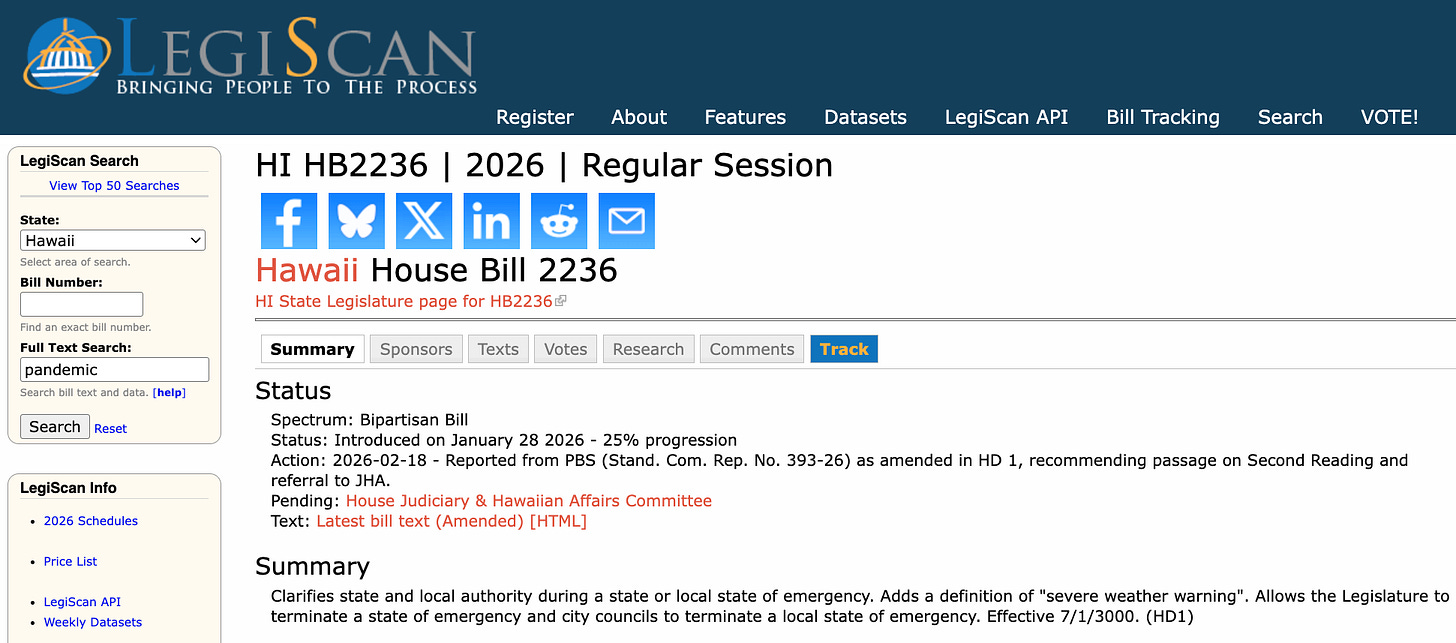
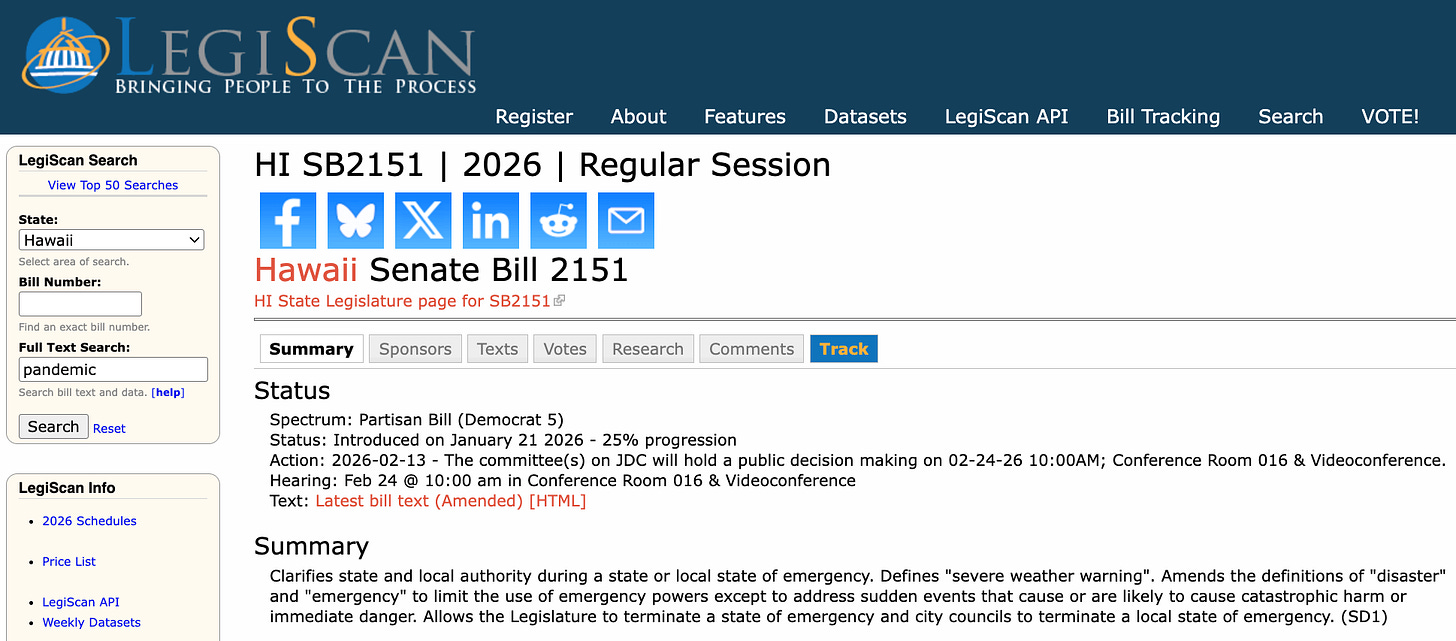
Legislative records show the bills are formally linked, with each designated as “Same As/Similar To” the other, confirming that Hawaii’s full legislature—not just one chamber—is advancing the emergency powers framework.
The legislation explicitly cites COVID-19 as justification for strengthening emergency authority, stating:
“The COVID-19 pandemic highlights the importance of clear legal frameworks for state and county emergency management to ensure that the State and counties are ready for any type of emergency.”
You can see which state legislators are backing these bills further down in this article.
Governor Authorized to Quarantine Residents & Enter Private Property Without Permission
Governor Authorized to Quarantine Residents & Enter Private Property Without Permission
One of the most consequential provisions would formally authorize forced quarantine and government entry onto private property.
The bill states that Hawaii Governor Josh Green (D) may:
“Require the quarantine or segregation of persons who are affected with or believed to have been exposed to any infectious, communicable, or other disease…”
It further grants authority to:
“Authorize without the permission of the owners or occupants, entry on private premises for any of these purposes.”
This authority applies not only to confirmed infections but also to individuals merely “believed to have been exposed.”
The legislation also allows the government to order the destruction of property deemed hazardous:
“Authorize that public nuisances be summarily abated and, if need be, that the property be destroyed by any police officer or authorized person.”
Governor Can Suspend Laws, Licensing Requirements, & Regulatory Protections
The bills explicitly empower the governor to suspend existing laws during an emergency, including medical, licensing, and regulatory protections.
The legislation states the governor may:
“[Suspend] the laws, in whole or in part… including licensing laws, quarantine laws, and laws relating to labels, grades, and standards.”
It also authorizes suspension of any law deemed to impede emergency operations:
“Suspend any law that impedes or tends to impede… emergency functions.”
Crucially, the legislation allows such suspensions to continue beyond the official emergency period:
“Any suspension of law… may continue beyond the emergency period…”
Government Authorized to Take Control of Private Infrastructure & Utilities
The legislation further empowers the governor to assume control of critical infrastructure, including privately owned facilities.
The bill states the governor may:
“Assure the continuity of service by critical infrastructure facilities, both publicly and privately owned… by taking over and operating the same.”
Additional provisions allow the government to:
- Shut off utilities
- Control distribution of goods
- Regulate or prohibit commerce
- Impose rationing
Specifically, the governor may:
“Regulate or prohibit… the storage, transportation, use, possession, maintenance, furnishing, sale, or distribution thereof, and any business or any transaction related thereto.”
Authority to Regulate Firearms & Seize Property
The legislation also grants authority to regulate firearms and confiscate property during emergencies.
It authorizes the governor to prohibit firearm possession during emergencies, meaning firearms that are normally legal could become unlawful to possess under emergency orders and subject to seizure.
The bill states the governor may:
“Regulate or prohibit the storage, transportation, use, possession… of firearms, and ammunition… and authorize the seizure and forfeiture.”
Governor Retains Sole Authority to Declare Emergencies
Under the proposed framework, Governor Green retains broad discretion to declare emergencies, including based on perceived threats.
The bill states:
“The governor… shall be the sole judge of the existence of the danger, threat, or circumstances giving rise to a declaration.”
Emergencies may be declared based on:
“Imminent danger or threat of an emergency or a disaster.”
This allows activation of emergency powers before an actual disaster occurs.
Legislature Adds New Definition of Disaster Including Disease Outbreaks & Bioterrorism
The Senate version expands the legal definition of “disaster” to explicitly include:
“Disease or contagion outbreaks, bioterrorism, terrorism, or incidents involving weapons of mass destruction.”
This codifies infectious disease emergencies as triggers for the expanded powers.
The move comes as President Donald Trump and Congress have already committed $5.5 billion toward preparing for a future influenza pandemic, while the World Health Organization vows such a pandemic is inevitable, U.S. scientists continue gain-of-function influenza experiments, and the administration launches its $500 million Operation Gold Standard influenza vaccine initiative.
Legislature Advances Bills Through Both Chambers
Legislative tracking records show both bills are progressing simultaneously:
- HB2236 was introduced January 28, 2026, and has already passed committee review in the House.
- SB2151 was introduced January 21, 2026, and is scheduled for further committee action February 24, 2026.
The bills are formally cross-linked, confirming coordinated legislative advancement.
Legislature Frames Bills as Clarification of Emergency Authority
Lawmakers describe the purpose of the legislation as clarifying and strengthening emergency management authority.
The bill states its purpose is to:
“Clarify state and county emergency management authority, ensure effective and adaptable emergency responses…”
The measures also allow the legislature to terminate emergency declarations by a two-thirds vote.
Which Legislators Are Backing the Bills
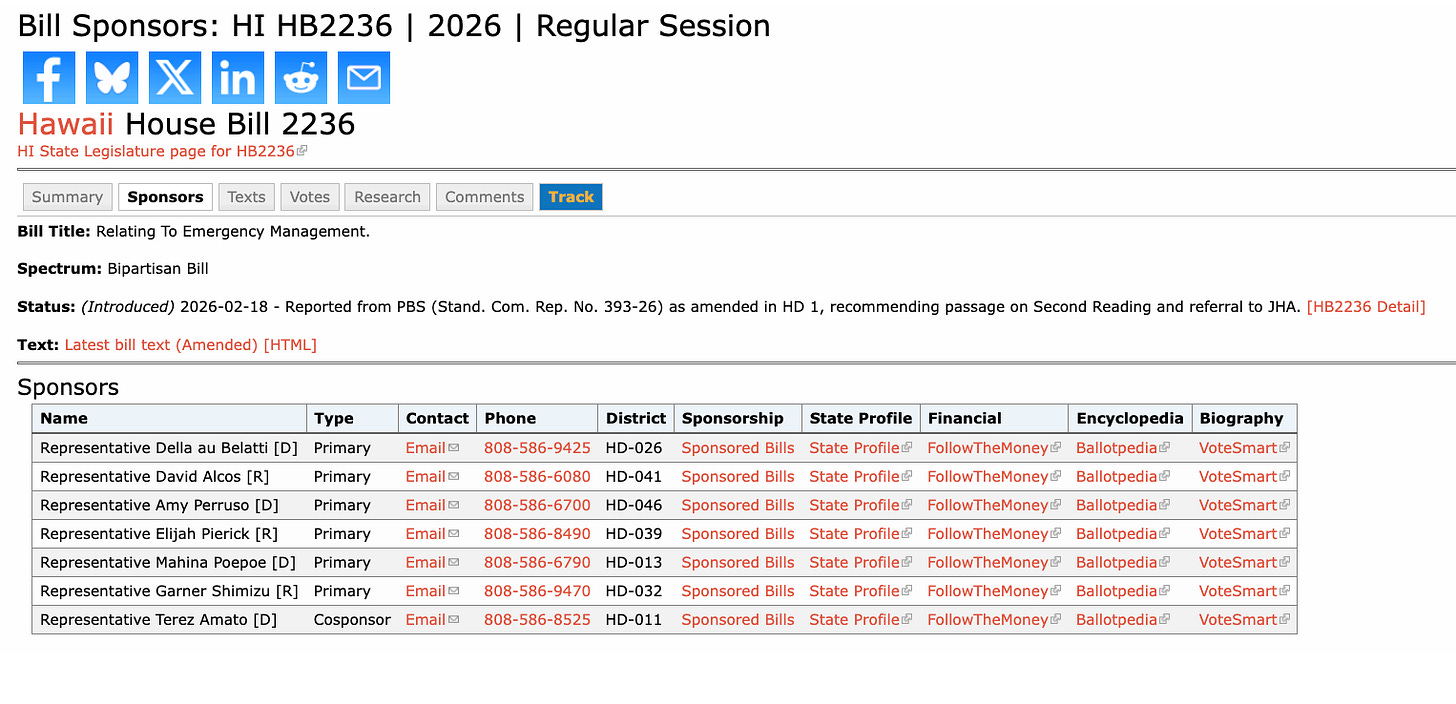
You can see which Representatives are backing HB2236 here.
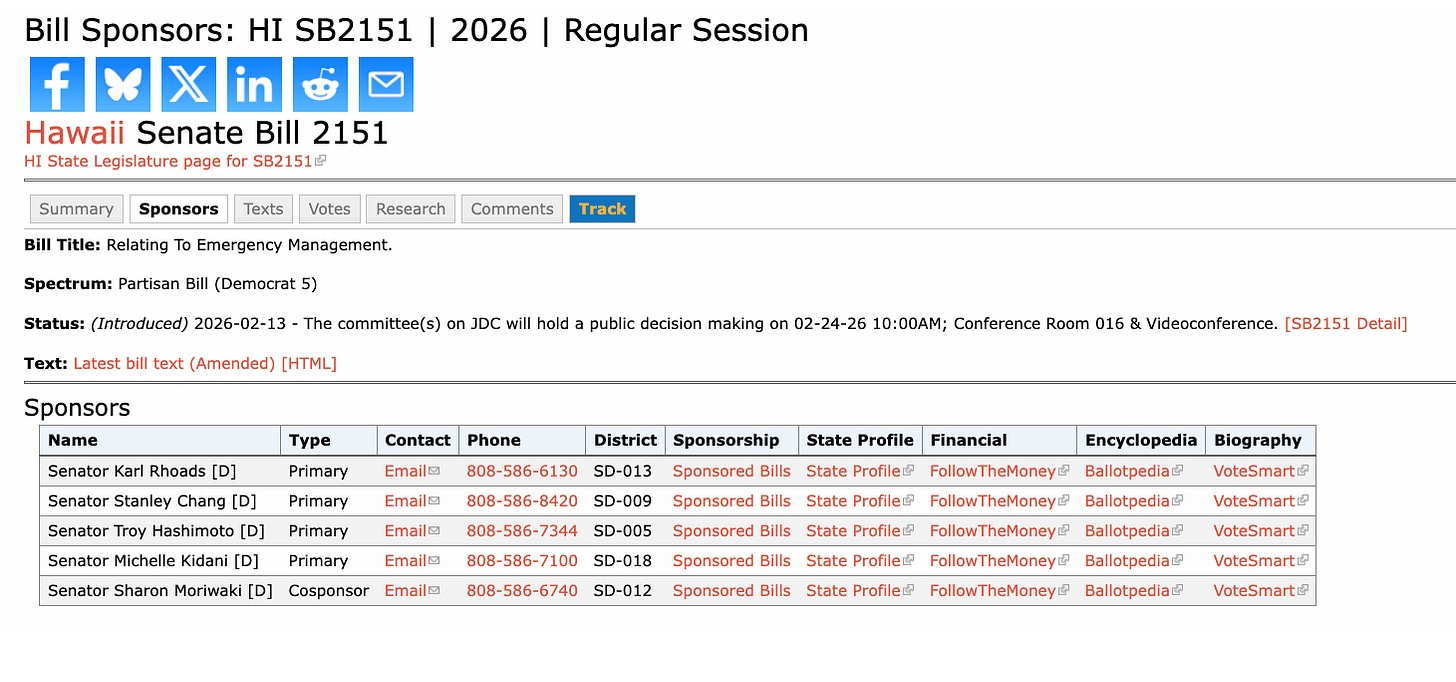
You can see which Senators are backing SB2151 here.
Bottom Line
HB2236 and SB2151 would lock into permanent Hawaii law the authority to quarantine residents based on suspected exposure, enter private property without permission, suspend existing laws, prohibit firearm possession under emergency orders, and take control of private infrastructure and economic activity—all under an emergency declaration the governor has broad discretion to issue, including based on a perceived “threat.”
The legislation is advancing as the federal government pours billions into influenza pandemic programs, conducts gain-of-function experiments designed to alter influenza viruses, and builds out large-scale vaccine deployment initiatives intended for rapid rollout once a pandemic is declared.
At the same time, Congress, the White House, the Department of Energy, the FBI, the CIA, and Germany’s Federal Intelligence Service (BND) have confirmed that the COVID-19 pandemic was likely the result of lab-engineered pathogen manipulation.
That overlap creates a profound conflict-of-interest question: the same government and scientific establishment involved in creating and manipulating pandemic-capable pathogens is also expanding the legal authority to impose quarantines, override constitutional protections, restrict property rights, and control economic life if one of those pathogens triggers the next declared emergency.
If passed, Hawaii’s bills would ensure those powers are not improvised in the moment, but already written into law—allowing sweeping restrictions on residents to be activated immediately, the moment the next pandemic or declared threat emerges.
Featured Video

Alon Mizrahi: ‘Israel Must Be Dismantled’
or go to
Aletho News Archives – Video-Images
From the Archives
How a War with Iran Would Diminish American Power
By Greg Scoblete | The Compass | August 13, 2010
Jennifer Rubin wants a war with Iran:
But the emphasis on the existential threat to Israel ignores a more basic issue for Americans to ponder: a nuclear-armed Iran represents a dagger at the heart of America and an existential threat to our status as a superpower and guarantor of the West’s security. As to the former, Iran is pressing ahead with its long-range ballistic missile program. First the Middle East and Eastern Europe, then all of Europe and, within a matter of years, the U.S. will be within range of Iranian missiles. If those are nuclear and not conventional, what then? We’re not talking about whether Iran is going to be “merely” a destabilizing factor in the Middle East or whether it will set off an arms race with its neighbors or imperil Israel’s existence. We’re talking about whether America will then be at risk (and lacking sufficient missile-defense capabilities if we continue to hack away at our defense budget). The argument about whether mutual assured destruction can really work against Islamic fundamentalists who have an apocalyptic vision becomes not about Israel’s ability to deter an attack but about ours. Those who oppose American military action have an obligation to explain why America should place itself in that predicament.
I would argue that any obligation to present an explanation lies with those whose disastrous policy prescriptions with respect to Iraq lead America into the worst strategic blunder in the country’s recent history. That aside, note the blind faith in the power of the military to actually achieve its ends. … continue
Blog Roll
 Aletho News
- Villains of Judea: Leonid Radvinsky
- Alon Mizrahi: ‘Israel Must Be Dismantled’
- Former Head Of MI6 Admits That The U.S. And Israel Are Losing The Iran War
- Scattered Thoughts on War and Peace
- Iran Threatens to Close Red Sea to Shipping in Response to Invasion
- Iran in excellent position to prevail in war with US, Israel: John Mearsheimer
- Iran warns US: Do not call your retreat an agreement
- Neighbors first – Moscow signals shift in energy strategy
- Almost 400 Ukrainian drones downed over Russia in single night – MOD
- Battle for Hungary: How the Russiagate blueprint has been unleashed against Orban
- If Americans Knew
- In the West Bank, life is a constant battle – 3 articles
- Jacob Reses, one of the most powerful pro-Israel operatives in Trump’s Washington
- Israeli-US assaults kill or injure 87 children a day – Not a ceasefire Day 166
- ‘Forever live by the sword’: Understanding Israelis’ massive support for Iran war
- UN’s special rapporteur on human rights says Israel is systematically torturing Palestinians
- Trump White House plagiarized Iran war manifesto from Israel-aligned think tank
- Gaza says 6–10 patients die daily waiting for treatment abroad as Israel blocks medical evacuations
- ‘Substantial evidence’ of double-tap strike in killing of Gaza’s Hind Rajab
- ‘Do Not Want To Die For Israel’: Doubts About Trump’s Iran Strategy Spread Among Troops
- Instead of taking Joe Kent’s claims seriously, the media is disregarding him as an antisemite
- No Tricks Zone
- Devastating Assessment Of Comirnaty Vaccine By Former Senior Pfizer Europe Toxicologist
- New Study: CO2 Is ‘Effectively Negligible’ As An Explanatory Climate Change Factor Since 2000
- Former Pfizer Toxicologist Dr. Helmut Sterz Tells Bundestag Hearing Pfizer Vaccine Should Have Never Been Approved
- Energy Expert: Germany’s Nuclear Phaseout Was A “500 Billion Euro Mistake”
- New Research: South Australia’s Mid-Holocene Sea Surface Temperatures Were 4°C Warmer Than Today
- Storing Green Energy To Last Germany 10 Days Would Require A 60-Million Tonne Battery
- New Studies: UK Sea Levels Were 4 Meters Higher Than Today During The Mid-Holocene
- Destructive Green New Deal: German Energy And Metal Group Warns Of Drastic Crisis
- New Study Documents A 20-Year Pause In Arctic Sea Ice Decline – Driven By Internal Variability
- Wake-up Call: Survey Shows Majority Of Germans Now Favor Postponing Climate Targets!
 Aletho News