Beware Universal Mental Health Screening
By Cooper Davis, Jeffrey Lacasse | Brownstone Institute | August 21, 2025
How would your child score on a common mental health screening?
A mental health professional might view the results and conclude that your child has a mental health problem… that needs to be psychiatrically diagnosed and treated, even medicated.
Will this help your child thrive? Or will it reshape their identity in undesirable ways? Will you be comfortable with your child taking medications that alter their developing brains and could perturb their sexuality? When your child reaches adulthood, will they be able to withdraw from these drugs, or will they despair to find out that their body and brain have adapted to them, making this difficult or maybe even impossible?
For any parent with even minor reservations about our current medical and mental health system, these aren’t theoretical questions. A new public policy has just made them very salient.
Illinois Governor J.B. Pritzker has signed a new law mandating universal mental health screenings for every child in public school. This includes healthy children with no signs of behavioral problems. Parents can theoretically opt out, but they’ll have to do so repeatedly, as the screenings will be given at least once a year from grades 3-12.
Media coverage has been laudatory, expounding on the importance of “getting kids the help and support they deserve.” But do you know what a mental health screen is and how it works? Before sounding the applause, parents need to understand what these screenings are, how they’re used, and what the potential outcomes of their use might be.
The new law does not specify how children will be screened, what questionnaires will be used, or what procedures will be followed when a child’s answers are seen as troubling. But to get a sense of the ground that self-report mental health questionnaires cover, you can screen your kids right now with a commonly used questionnaire:
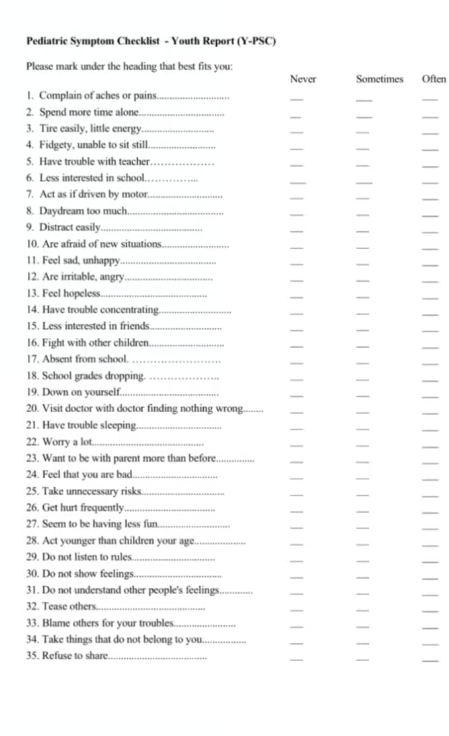
While this is a self-assessment, the questions are the same whether you’re a parent or teacher filling this out on behalf of a child. Each of the 35 questions can be answered “never,” “sometimes,” or “often.” The scoring is simple:
- 0 = “never”
- 1 = “sometimes”
- 2 = “often”
If the total score is at or above 28, professionals will consider it likely that your child has a mental health problem. The law doesn’t define what happens next. Ideally, there would be a lengthy (and costly) multi-hour clinical assessment for each such child that views these results skeptically, and heavily considers normal developmental issues and transitory problems. In the real-world mental health system, it’s hard to imagine that actually happening.
Unfortunately, the bias of the current system is towards overmedicalization, overdiagnosis, and overtreatment. The implementation of universal screening is likely to worsen these problems.
In the past, some physicians gave annual chest X-rays to smokers. This was a form of universal screening in response to concerns about lung cancer. At first blush, this sounds reasonable. The problem? False-positive results. Studies showed that annual X-rays did not prevent mortality. They did cause anxiety in patients. And incidental findings were common, causing unnecessary biopsies, procedures, and interventions.
Current screening guidelines now target high-risk individuals. This is an example where the medical establishment carefully weighed the risks and benefits of universal screening and concluded that it was not in the interests of patients, and with a well-defined disease in mind, lung cancer.
Mental health diagnosis is not like cancer. It is a fuzzy, subjective enterprise. We don’t have blood tests or brain scans; we have flawed checklists and clinical judgment. And obviously, being improperly identified as having a mental disorder comes with a real cost for the child.
Screening every single child makes it inevitable that some healthy children will be thrust into the mental health pipeline. Even assuming that the questionnaires work reasonably well, a 15% false-positive rate is likely. Combine this false-positive rate with twice-a-year universal screening from grades 3-12, and your child will have 20 separate chances to be wrongly identified as having a mental health problem…at which point the government ostensibly gets involved in the mental health of your child.
It’s easy to imagine the catastrophic results. A child’s mental health screen inaccurately identifies a mental health problem; the busy therapist confirms a diagnosis; there’s eventually a referral to a psychiatrist, who prescribes psychotropic medication. Out of 20 screenings, this only has to happen once to alter your child’s life forever.
I (C.D.) know, because it happened to me.
I was caught up in a similar diagnostic dragnet in 1991, when my teacher read about Ritalin in Time magazine and began “identifying” students she believed might have the condition, which at the time was known as “ADD” (the “H”, for hyperactivity, came later). My parents chose not to medicate me, but did send me to a psychologist and a pediatric psychiatrist. From them, I learned that my constant chair-tipping, foot-tapping, wiggling, and inability to tolerate boredom — the very traits that drove me to act out in class and leave little space between impulse and action — weren’t just part of me, but symptoms of a medical condition. It was presented as both permanently part of my nature and “acceptable,” yet somehow also extrinsic to me and framed primarily as a “deficit.” (At that time, ADD was not as widely viewed as a full disability as it is today.)
At 17, when I was legally able to decide for myself — though I now view the “informed” part as questionable — I chose to begin drug treatment. Even without the drugs, however, the diagnosis had already shaped my sense of self: diminishing my agency, reinforcing a feeling of abnormality, and feeding the belief that my more organized, conscientious, and inconspicuous peers possessed something essential that I never would. You can hear a fuller account in The Atlantic’s Scripts podcast series (“The Mandala Effect,” Episode 2, on YouTube).
My experience is just one example of how a single screening can lock a child into a lifelong diagnostic identity — and once that process starts, there are few real off-ramps. Surely no one in favor of this law wants that scenario to come true for any child.
But with 1.4 million schoolchildren in Illinois, we’re talking about dealing with the results of up to 28 million separate mental health screenings in the decade after implementation. Will the mental health professionals dealing with this deluge approach the medicalization of your child’s supposed problems carefully, gingerly, sensitively? A 2004 study found that screening 1,000 children for ADHD using the American Psychiatric Association’s DSM criteria would result in 370 false positives. And it’s common for children to be prescribed psychotropic medication at their first consultation with their physician or psychiatrist.
A comprehensive, in-depth psychological assessment for each child might help reduce false positives — but it would also mean spending 3-6 hours assessing each child, which represents a high burden in terms of both time and money. School districts in Illinois already report that a lack of time, expertise, and financial resources presents challenges to implementing universal mental health screening. The law passed anyway.
It’s hard to argue that attempts to identify and measure human misery, suffering, and emotional pain are a bad thing, etc.—especially when the goal is “getting people the help they need.” It sounds right. But the kids who will be screened every year in Illinois? They have many kinds of problems: social, relational, environmental, academic, psychological, and physical problems. Children today have issues navigating a modern life dominated by endless screens, scrolling, and even more endless data.
And also, they have some problems that you’re supposed to have—problems that have been a critical part of growing up since the dawn of time.
Our culture is currently debating the medicalization of human problems, the credibility of medicine, the influence of the pharmaceutical industry, and the ethics of imposing medical authority as state policy. Covid lockdowns were a prime example of this, and, similar to universal mental health screening, they were imposed without consideration of the unintended consequences.
Mandatory Covid vaccinations also led many Americans to rethink the role of government in their bodily autonomy, and to consider how arbitrary social policy could be when it claimed to be for the greater good (e.g., insisting that those with immunity to Covid must still get vaccinated). For those who have grown skeptical of medical authority, universal mental health screening will likely be viewed as another overextension of the government into the lives (and minds) of their children. Children aged 12-17 can already receive psychotherapy in Illinois without parental consent; universal screening offers a new on-ramp to this process.
The new Illinois law seems almost tone deaf, out of step with the lessons learned from Covid. This critique is cultural, social, and ethical in nature. But universal mental health screening is supposedly based on science. The new Illinois law does not give details; it just authorizes universal screening as if it is an unmitigated good. The devil (and the science, or lack thereof) will be in these details – how the policy is implemented. Assuming that the rationale for universal screening is scientific, we present critically important questions that should be addressed as procedures are developed:
- What is the evidence that universal mental health screening improves real-world outcomes for children? Is there evidence that it could cause harm? The scientific rationale for the program needs to be stated clearly, citing compelling data, and explicitly addressing the measures taken to avoid harm.
- Given that Illinois has already implemented universal mental health screening in some school districts, what were the outcomes for the children? After testing positive for a mental health condition, how many were further assessed, and how much time was spent on each child? How many ended up in psychotherapy or on medication? Usually, a pilot program tests the effectiveness of an intervention, and it is only adopted on a wide scale if it is shown to be effective and not harmful – where is that data?
- How many children a year does Illinois expect to inaccurately identify as having a mental health problem (e.g., how many false positives)? How many children will make it from 3rd to 12th grade without ever screening positive? What measures will address the known issue of false-positive results in universal screening? Do Illinois public schools have the time, money, and expertise to carefully assess each child who screens positive for multiple hours to ensure that they do not overdiagnose and overtreat Illinois children? If universal screening results in a surge of children who ultimately end up on psychiatric medication, how will the public know? Implementing this program without addressing these issues ignores the potential harm of universal screening.
- How will Illinois taxpayers know if this program is a success? What metrics will be tracked? The easy out is to focus on the implementation of the program, and if a high proportion of children are screened, call it a success, never mind the details or outcomes. But using the screening of children as a measure of success for a universal screening program is tautology; data must be collected that demonstrates that the program helps children measurably and does not harm them.
There are good reasons to object to the new Illinois program based on general principles. If the issues above go unaddressed, or if sufficient resources are not provided to allow careful and precise identification of children in distress, it has the potential to be a disaster.
Cooper Davis is an advocate, speaker, and writer. He is the Executive Director of Inner Compass Initiative (ICI), a 501(c)(3) nonprofit organization that advocates for mental health system reform and helps people make informed choices about psychiatric diagnoses, drugs, and drug withdrawal.
ILLINOIS TO FORCE MENTAL EXAMS ON KIDS
The HighWire with Del Bigtree | August 21, 2025
A shocking new Illinois law will force public schools to conduct annual mental health checks on students from 3rd through 12th grade. Jefferey exposes the hidden risks and potential harm this invasive mandate could bring to children.
BC Nurse Fined and Suspended Over Gender Policy Criticism
By Cindy Harper | Reclaim The Net | August 20, 2025
A British Columbia nurse has been hit with a one-month license suspension and ordered to pay over $93,000 in legal fees for publicly supporting women’s access to female-only spaces, a stance that the province’s nursing regulator deemed unprofessional.
Amy Hamm, who has spent more than 13 years working in healthcare and had risen to the position of nurse educator, was disciplined by the British Columbia College of Nurses and Midwives (BCCNM) after a years-long process sparked by her political expression outside of work.
The controversy dates back to 2020, when Hamm co-sponsored a Vancouver billboard that read, “I ♥ JK Rowling.”
The message, referencing the author’s defense of sex-based rights, triggered backlash from activists and a city councillor. The ad was removed, and formal complaints were submitted to the College, accusing Hamm of hate speech and transphobia.
In response, the College launched an exhaustive investigation into Hamm’s public activity over several years, compiling a 332-page report that examined her tweets, writing, and podcast appearances from 2018 to 2021.
After 22 hearing days stretched across 18 months, the disciplinary panel concluded that four of Hamm’s statements crossed the line into professional misconduct.
The panel claimed that Hamm made comments about transgender individuals that they deemed discriminatory. Hamm has not accepted this finding and is already appealing it at the Supreme Court of British Columbia.
Her legal counsel, Lisa Bildy, said, “In our view, the panel made a number of legal and factual errors that make the decision unsound, and we look forward to arguing these points before the BC Supreme Court. We are now considering whether to appeal the penalty decision as well.”
Bildy also raised broader concerns about the implications for free speech: “This decision effectively penalizes a nurse for expressing mainstream views aligned with science and common sense. The Panel’s ruling imposes a chilling effect on free expression for all regulated professionals.”
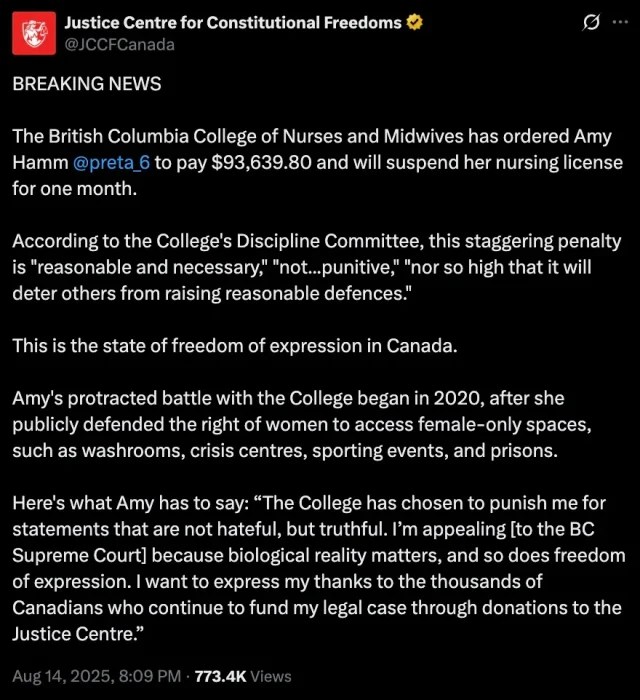
Hamm remains defiant. “The College has chosen to punish me for statements that are not hateful, but truthful. I’m appealing because biological reality matters, and so does freedom of expression. I want to express my thanks to the thousands of Canadians who continue to fund my legal case through donations to the Justice Centre,” she said.
The Justice Centre for Constitutional Freedoms, which is representing Hamm, announced the penalty and reiterated its commitment to pushing back against professional censorship.
Totalitarian Practices in Moldova Reach Unprecedented Levels – Moscow
Sputnik – 21.08.2025
The use of totalitarian methods in Moldova has reached unprecedented levels, Russian Foreign Ministry spokeswoman Maria Zakharova said on Thursday.
“Continuing the anti-popular policy of ‘filtering’ voters based on loyalty, on August 15, the official authorities in Chisinau announced plans to open only 10 polling stations in Transnistria. For comparison, during the 2024 presidential elections, 30 polling stations were organized there. This means that Moldovan citizens living in Transnistria, as well as those in Russia, have been classified as second-class voters by the Moldovan authorities, whose constitutional rights can be disregarded,” Zakharova said in a statement published on the Russian Foreign Ministry website.
She added that Moscow is receiving numerous complaints from the residents of Transnistria, who do not understand the reasons for their discrimination compared to the Moldovan diaspora in EU countries, for whom the best possible voting conditions are created.
“We expect that the observation mission of the OSCE ODIHR, which started last week, will give an objective assessment of Chișinau’s selective approach to its citizens. The authorities’ disregard for the interests of a significant part of Moldovan society is provoking an increase in protest activity, which is being harshly suppressed,” Zakharova emphasized.
She further stated that the use of totalitarian practices ahead of Moldova’s parliamentary elections has reached unprecedented levels.
“The Maya Sandu regime is turning the republic into a ghetto, where political repression, censorship, and the division of citizens into first, second, third, and other classes have become the norm. We are confident that, against the backdrop of the shameful silence of relevant international bodies, the Moldovan people will soon make their voice heard. While patient, they are not patient enough to allow another four years of suffering and abuse of themselves and their country,” she concluded.
Jurij Kofner: Europe Enters Century of Humiliation?
Glenn Diesen | August 20, 2025
Jurij Kofner is an economist and an economic policy advisor to AfD. Kofner discusses the de-industrialisation and economic decline in Germany, and the wider socio-economic and political challenges that continue to threaten the relevance of Europe.
Republic of Srpska in crosshairs again
By Stephen Karganovic | Strategic Culture Foundation | August 20, 2025
The political siege of Russia’s tiny Balkan ally, the Republic of Srpska, an autonomous entity within Bosnia and Herzegovina, is gaining momentum. On Monday, 18 August 2025, two significant developments took place. The first is that the Constitutional Court of Bosnia and Herzegovina denied the appellate motion of Milorad Dodik to quash the decision of the Central Electoral Commission cancelling his Presidential mandate. That is the endpoint of the legal proceedings against Dodik on charges of disobeying the orders of Bosnia’s de facto colonial administrator, German bureaucrat Christian Schwarz. The other significant event was the resignation, on the same day, of Republic of Srpska’s Prime Minister, Radomir Višković. Višković was appointed by Dodik in 2018 and was considered a loyal aide to the President. The impact of his hasty departure, on exactly the same day that, by collective West reckoning, Dodik ceased to be President and became a private person, is yet to become fully visible. But the fact that he did not even wait for a “decent interval” (Kissinger’s famous words from another context) before abandoning ship cannot be regarded but as politically ominous.
For a proper understanding of the roots of the grave constitutional and political crisis affecting not just the Republic of Srpska but Bosnia and Herzegovina as a whole it would be worthwhile to briefly review the violations of fundamental international and domestic legal principles that had given it rise.
At the conclusion of the civil war in Bosnia, in late 1995, a peace agreement was hammered out in Dayton, Ohio, between the three Bosnian parties with the participation of the major Western powers and interested neighbouring countries. The agreement provided for a sovereign Bosnia and Herzegovina organised as a loose confederation of two constituent ethnically based entities, the Republic of Srpska and the Muslim-Croat Federation. The country had become a member of the UN in 1992 when it separated from Yugoslavia. That membership continued and served as an additional guarantee of its sovereign status as a subject of international law.
One of the provisions of the Dayton Agreement was that the UN Security Council would select and approve an international High Representative with a year-long mandate. That official would be authorised to “interpret” such sections of the Peace Agreement concerning the meaning and application of which the parties were unable to agree. The initially one-year mandate envisioned for the High Representative by inertia became extended indefinitely so that, after nearly thirty years of peace in Bosnia and Herzegovina, that office still exists.
In December of 1995, shortly after the signing of the Dayton Peace Agreement, a self-created entity called the Peace Implementation Council (PIC) was organised by 10 collective West countries and international bodies to “mobilise international support for the Agreement.” Russia originally was invited to be a member, though in its parlous political condition of the 1990s it was always outvoted by Western “partners,” but it has since withdrawn. Also by inertia, at its 1997 meeting in Bonn, Germany, PIC expanded the scope of its own activity vis-à-vis Bosnia to include proposing to the UN Security Council a suitable candidate for High Representative when that post would become vacant. But more importantly, acting motu propio it radically augmented the powers that the High Representative in Bosnia could exercise, to a level not contemplated in the Dayton Agreement. According to the “Bonn Powers” granted to him by PIC at the 1997 meeting, he would no longer be confined to “interpreting” the Dayton Agreement but would also be invested with unprecedentedly robust authority to annul and impose laws in Bosnia and Herzegovina and to dismiss and appoint public officials.
In the Wikipedia article on this subject, of unspecified authorship but written evidently by someone sympathetic to this method of governance, it is stated that “international control over Bosnia and Herzegovina is to last until the country is deemed politically and democratically stable and self-sustainable.” Who decides that is left conveniently unsaid, but the arrogant formulation constitutes a text-book definition of a colonial protectorate.
As a result of these manipulative rearrangements of the peace framework codified in the Dayton accords, acting by its arbitrary volition, PIC, a self-authorised group of countries, conferred on the Bosnian High Representative a drastic expansion of executive authority, which was without basis either in the Dayton Peace Agreement or in international law. Or in the Constitution of Bosnia and Herzegovina, for that matter.
Article 3.3.6 of that Constitution prescribes that “general provisions of international law are an integral part of the legal order of Bosnia and Herzegovina.”
As cogently argued by Serbian constitutional law professor Milan Blagojević, the chief of the general precepts of international law is the principle of sovereign equality of member states of the United Nations, as enshrined in Article 2 of the Charter. That principle is the reason why Article 78 of the Charter prohibits the establishment of a trusteeship, or protectorate, over any member state of the United Nations.
As Prof. Blagojević further points out, that means that both the Charter of the United Nations and the Constitution of UN member state Bosnia and Herzegovina, which incorporates it by reference, prohibit anyone other than the competent organs of the member state to promulgate its laws or to interfere in any other way in the operation of its legal system.
But that is exactly what Christian Schmidt, the individual currently claiming to be the High Representative in Bosnia, has done, provoking the crisis in which the Republic of Srpska is engulfed. In 2023, he arbitrarily decreed that a new provision of his own making and without need for parliamentary approval should be inserted in Bosnia’s Criminal Code, making non-implementation of the High Representative’s orders a punishable criminal offence. Incidentally, not only are the “Bonn Powers” that Schmidt invoked in support of his invasive interference in Bosnia’s legal system questionable, but so is his own status as “High Representative.” Fearing a Russian veto, his nomination was not even submitted to the UN Security Council, so that the Council never exercised its prerogative of approving or rejecting it.
Noticing the flagrant violation of applicable international and domestic legal norms, shortly thereafter in 2023 the Parliament of the Republic of Srpska passed a law making decrees of the High Representative that trespassed his original authority under the Dayton Peace Agreement null and void and unenforceable on the Republic’s territory. That bold but perfectly reasonable law, adopted by a duly elected Parliament, gave great offence to the guardians of the “rules based order.” Acting in his capacity as President, and in defiant disregard for Schmidt’s explicit warning to desist, Milorad Dodik signed the law, giving it legal effect.
The prosecution case against Dodik in the Constitutional Court of Bosnia and Herzegovina stemmed from that act of boorish defiance of orders that clearly were of questionable provenance and even more doubtful legality. But as a result, Dodik was nevertheless arbitrarily deposed as President and is not allowed to run for public office in his country for the next six years.
The range of choices now before Dodik and, more importantly, the Republic of Srpska and the million Serbs who live there, is extremely limited. The Electoral Commission which, like all organs of Bosnia’s central government, answers to whoever has usurped the office of High Representative, will now have up to ninety days to call a snap election to fill the post of Republika Srpska President. As expounded in a previous article, under the current rules, and with Dodik’s forced departure from the political scene, it should not be difficult to “democratically” install a cooperative figure like Pashinyan in Armenia, who would be amenable to implementing collective West’s agenda. The key elements of that long-standing agenda are the lifting of Republika Srpska’s veto on Bosnia’s NATO membership and governmental centralisation for the convenience of the collective West overlords. In practice, the latter means divesting the entities of their autonomy and consequently of their capacity to cause obstruction.
Dodik has announced ambitious plans to counter these unfavourable developments. He intends first to call a referendum for Republika Srpska voters to declare whether or not they want him to continue to serve as President, followed by another referendum for Serbs to decide whether they wish to secede or remain in Bosnia and Herzegovina. But these manoeuvres and aspirations may be too little, too late. As the abrupt resignation of his Prime Minister presages, there may soon begin a stampede of other officials eager to distance themselves from Dodik, anxious for their sinecures and fearful of being prosecuted – like their erstwhile President – for disobedience. Once private citizen Dodik has been divested of effective control over his country’s administrative apparatus, threats of secession or referendums to demonstrate his people’s continued loyalty will ring hollow and are unlikely to impress, much less achieve, their purpose.
UK: Police Slammed for Silencing Ex-Firefighter Robert Moss Over Online Posts
By Cam Wakefield | Reclaim The Net | August 18, 2025
There are worse ways to wake up than with the police on your doorstep. But not many.
For Robert Moss, it wasn’t just the shock of a dawn raid that unsettled him. It was the absurdity of what followed. At 7 a.m. one morning in July, Staffordshire Police entered his home, seized his electronic devices, and arrested him. Not for theft or violence. But for saying something critical online about his former employer.
Moss, 56, spent nearly three decades in the fire service. His career ended in 2021 with a dismissal that was later ruled unfair by a tribunal.
Since then, he has continued to speak his mind, particularly in a closed Facebook group where he has voiced concerns about how the service is run.
These posts, according to police, were serious enough to justify arrest and a set of bail conditions that barred him from discussing the fire service, its leadership, or even the fact that he had been arrested at all.
There were no charges.
“I was a critic of Staffordshire fire service, and I had been gagged from saying anything about individuals there, the service itself, and my arrest. That is a breach of my human rights,” Moss said to the Telegraph after finally winning the right to speak freely again.
Until last week, those bail conditions stayed in place under threat of further arrest. It was only when magistrates in Newcastle-Under-Lyme reviewed the case that they concluded what should have been obvious from the start: the restrictions were excessive.
The court sided with Moss and the Free Speech Union, which supported his challenge. Its barrister, Tom Beardsworth, told the court, “These allow the police to arrest and detain someone and then, when they are released, prevent them from telling others what had happened with the threat of further arrest if they do not comply. We do not live in a police state, and Mr Moss should have every right to speak about his arrest.”
That ought to be self-evident.
Staffordshire Police argued that the restrictions were necessary to maintain public safety and order. But what kind of disorder, exactly, is caused by a man posting critical remarks in a private online group?
The arresting officer, DC Isobel Holliday, described the posts as malicious and reckless. In court, however, no one could convincingly explain what real-world harm had been done. The magistrates seemed to agree that there was none.
What remains is a narrower set of restrictions that prevents Moss from contacting certain officials directly. That is one thing. But preventing a man from speaking about his own arrest in the name of order? That is something else entirely.
Sam Armstrong of the Free Speech Union called the case one of the worst examples of state overreach they have seen. “In the more than 4,000 cases the Free Speech Union has handled, this is amongst the most egregious abuses of state power we have encountered,” he said. “Robert’s comments were not crimes, his arrest was not lawful, and the police have been acting like the Stasi, not a constabulary.”
Unfortunately, this is not the first time British police have treated criticism as a public safety risk, and the way things are going, it won’t be the last.
Increasingly, the concept of “order” is being used not to protect citizens but to protect institutions from public scrutiny. That is a dangerous shift.
Moss’s posts were blunt. They may have been irritating to those in charge. But they were not criminal.
In a democracy, people are allowed to criticize their leaders. They are allowed to be wrong, rude, and persistent. They are allowed to be a nuisance. What they should not be is arrested and silenced for it.
This time, the courts got it right. But the fact that it needed to go this far is troubling.
The Israeli flag just became the only national flag illegal to burn in the United States
When Criticizing Israel Becomes a Hate Crime: How One Ruling Betrayed the First Amendment
By Shaun King | The North Star | August 16, 2025
The Flag America Protects
This week in Washington, D.C., a federal judge made a ruling so shocking, so unprecedented, that it flips the First Amendment on its head. Judge Trevor N. McFadden declared that the Israeli flag — with the Star of David at its center — is not a political symbol at all, but a racial one.
He ruled that tearing it, grabbing it, desecrating it, even in the heat of protest, is not free expression but racial discrimination.
Think about that. In the United States, you can burn the American flag — the Supreme Court has said so for decades. But now, according to this ruling, burning or tearing the Israeli flag could make you guilty of racial hatred. The one national flag protected in American law today isn’t our own. It’s Israel’s.
You can burn the flags of all 50 states. You can torch the American flag all you want. You can burn the flags of the UK or France or Brazil or China.
But not Israel.
The Supreme Court’s Bedrock Principle
The highest court in the land has spoken clearly: you cannot criminalize burning the American flag. In Texas v. Johnson(1989), Justice William Brennan wrote:
“If there is a bedrock principle underlying the First Amendment, it is that the government may not prohibit the expression of an idea simply because society finds the idea offensive or disagreeable.”
The following year, in United States v. Eichman (1990), the Court struck down another attempt to ban flag burning, reminding the country that:
“Punishing desecration of the flag dilutes the very freedom that makes this emblem so revered, and worth revering.”
In America, even the Stars and Stripes — the nation’s own sacred symbol — cannot be placed above criticism or protest. That is what freedom means. And yet in 2025, a federal judge just carved out an exception — for a foreign flag.
How the Israeli Flag Was Elevated
The case came from dueling protests in D.C. last fall. Kimmara Sumrall, a pro-Israel activist, draped the Israeli flag around her shoulders as a cape. A pro-Palestinian demonstrator yanked it. A police officer saw it and arrested the woman.
The criminal court acquitted her. But Sumrall filed a civil rights lawsuit, backed by the National Jewish Advocacy Center, arguing that this wasn’t just an assault — it was racial discrimination.
Judge McFadden agreed. In his ruling, he wrote:
“Purposefully yanking on an Israeli flag tied around a Jewish person’s neck… is direct evidence of racial discrimination. The Star of David — emblazoned upon the Israeli flag — symbolizes the Jewish race.”
With that, he collapsed the line between a political symbol and a people’s identity. He went so far as to compare attacking the Israeli flag to using the N-word against a Black person.
No other flag in the world has been granted this kind of protection in an American courtroom. Not Britain’s. Not Canada’s. Not Mexico’s. Not even our own. Only Israel’s.
Civil Rights Law Twisted
To reach this conclusion, McFadden invoked the Civil Rights Act of 1866, written to protect newly freed Black Americans. Later, in 1987, the Supreme Court held that Jews and Arabs were covered as “races” under this law.
But McFadden went further than any court before him. He declared that the flag of Israel itself is a racial symbol — and therefore protected. And in doing so, he turned what was supposed to be a shield for the oppressed into a shield for an oppressive foreign government.
The Global Contrast
Everywhere else in the democratic world, flag burning is understood as a political expression. The European Court of Human Rights has ruled again and again: desecrating a flag, however offensive, is free speech.
It is only authoritarian regimes that conflate their flags with their people, criminalizing dissent in the name of “unity.” Now, America has imported that same authoritarian logic — not to protect our own flag, but to protect Israel’s. It’s wild to see.
The Stakes for Protest
The implications are chilling. If this ruling stands, tearing down or burning an Israeli flag at a protest could be treated as a federal hate crime. Shouting against Zionism near someone draped in the flag could be called racial harassment.
This isn’t about protecting Jewish people from violence. It’s about shielding Israel from protest while it bombs and starves children in Gaza.
One Flag Above All
Let’s be brutally clear. The Israeli flag is now the only national flag that American courts have declared effectively immune from desecration. The Stars and Stripes itself can be burned in the name of protest. Israel’s flag cannot.
That is not constitutional law. That is political favoritism dressed up as civil rights. And it represents a betrayal of the First Amendment.
Shaun King is an American writer & activist.
Why Zelensky’s main argument against peace is a lie
By Nadezhda Romanenko | RT | August 18, 2025
Commenting on the outcome of the Trump-Putin summit in Alaska, Ukraine’s Vladimir Zelensky declared: “The Constitution of Ukraine does not allow the surrender of territories or the trading of land.”
On paper, that sounds noble. The message is clear: Kiev won’t let others decide Ukraine’s fate behind its back. But take a closer look, and this principled stance starts to look less like constitutional fidelity – and more like political theater.
Because the very Constitution that Zelensky has suddenly invoked as sacred… has long been on hold. And that’s not an accusation – it’s his own admission.
Back in December 2022, while addressing Ukraine’s ambassadors, Zelensky quipped: “All the rights guaranteed by the Constitution – are on pause.” The context? He was joking about how diplomats don’t get holidays. But the phrase stuck. Because it turned out to be more than a joke – it became official policy.
Since then, Ukraine’s democratic institutions haven’t just been “paused” – they’ve been systematically dismantled under the banner of wartime necessity.
National elections? Canceled indefinitely. Not just presidential or parliamentary – even local races were suspended, eliminating the public’s ability to hold any level of government accountable. Zelensky’s current term, once set to expire, has been extended without a vote – and without a clear end date.
Opposition media? Silenced or outlawed. Dozens of TV channels and online outlets critical of the government were shut down or merged into a state-approved broadcasting platform. Independent journalism in Ukraine now walks a legal tightrope – with one foot over prison.
Religious freedom? Eroded beyond recognition. The Ukrainian Orthodox Church, seen as too closely linked to Moscow, has been harassed, evicted from centuries-old monasteries, and branded a security threat. Worshippers face criminal charges for sermons, symbols, or even prayers deemed “unpatriotic.”
Military conscription? Brutal and indiscriminate. Young men are pulled off the streets by recruiters, sometimes beaten or coerced into enlisting. Videos of forced mobilizations circulate regularly – and are met with silence or spin from the authorities.
Political dissent? Treated as treason. Opposition politicians have been arrested, exiled, or sanctioned without trial. Entire parties have been banned. Ukraine’s Security Council now acts as judge and jury – blacklisting citizens, freezing assets, and deciding guilt without a courtroom.
Rights didn’t just get paused. They were overwritten.
To be fair, this erosion didn’t start with Zelensky. It began back in 2014 when President Yanukovich was ousted in a manner that skipped any constitutional procedure. The army was then deployed – for the first time in post-Soviet history – against a domestic protest. The rule of law quickly gave way to rule by necessity. Courts rubber-stamped sanctions lists. Parliament became a formality. The Constitution was increasingly treated as a suggestion, not a boundary.
Zelensky merely completed what others started. Under his watch, Ukraine is no longer governed by its Constitution – it’s governed by presidential decree. The Constitution hasn’t been a check on executive power for years. Instead, it’s become a stage prop: Shelved when inconvenient. Quoted when useful.
That’s precisely what happened after the Trump–Putin summit. As it became clear that the fate of the conflict was being discussed without Kiev at the table, Zelensky rushed to invoke constitutional law – not to restore legality, but to cling to legitimacy.
And it wasn’t just critics in Moscow who noticed the contradiction.
Donald Trump, speaking a few days before the summit, couldn’t resist pointing out the absurdity:
“I was a little bothered by the fact that Zelenskyy was saying I have to get constitutional approval. He has approval to go to war and kill everybody but he needs approval to do a land swap. Because there will be some land swapping going on.”
Crude? Maybe. But not wrong.
Trump’s sarcasm cuts to the core. Zelensky governs under emergency powers, suspends elections, cracks down on the opposition, yet suddenly needs constitutional sign-off to negotiate peace?
In reality, Zelensky isn’t protecting the Constitution – he’s using it. It’s not a framework that restrains him. It’s a card he plays when cornered. When it’s time to justify canceling a vote? The Constitution “gets in the way.” When it’s time to refuse compromise? Suddenly, it becomes “untouchable.”
And while the optics may still work in Western capitals – “a democracy under siege” sounds good on TV – the internal picture is far less flattering. Ukraine today is run by decree, not debate. By security councils, not courts. By urgency, not accountability.
The Constitution, once a blueprint for law and liberty, has become little more than a sign on a boarded-up storefront – left hanging so no one has to admit the place is empty inside.
NO WOODS, NO MEAT, NO FREEDOM
The HighWire with Del Bigtree | August 14, 2025
Unusually dry summer conditions on Canada’s Atlantic coast have prompted two provinces to take the unprecedented step of banning hiking, camping, and even walking in the woods in a bid to prevent forest fires. Learn about other alarming measures being floated in the name of climate change—from ticks that can trigger a meat allergy to proposals for calculating the carbon footprint of every medical procedure to determine its “importance.”
UK to prosecute over 60 people for backing Palestine Action after mass arrests
The Cradle | August 16, 2025
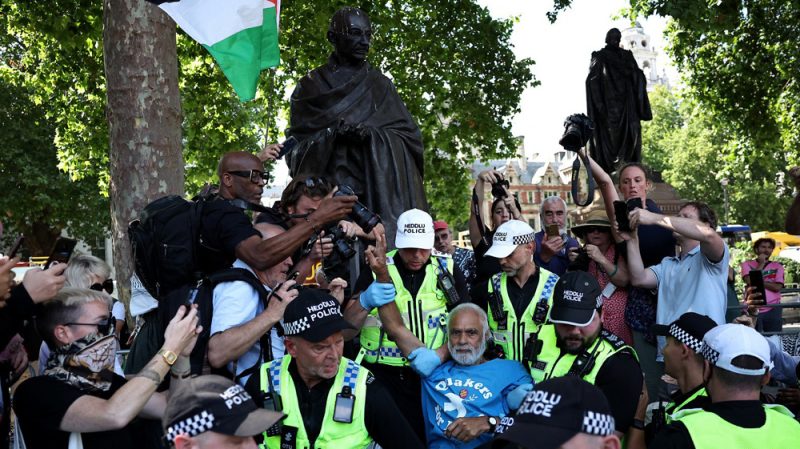
London’s Metropolitan Police announced on 15 August that over 60 people will face prosecution for “showing support” for the banned Palestine Action network, alongside three already charged under the Terrorism Act.
The police confirmed they had “put arrangements in place that will enable us to investigate and prosecute significant numbers each week if necessary,” following more than 700 arrests since the designation took effect in early July.
Among them were 522 demonstrators detained in London last weekend for carrying placards backing the group, a figure described as the highest ever number of arrests at a single protest in the capital.
Director of Public Prosecutions Stephen Parkinson said the charges represent “the first significant numbers to come out of the recent protests, and many more can be expected in the next few weeks.”
He warned that “people should be clear about the real-life consequences for anyone choosing to support Palestine Action.”
The police said those convicted could face up to six months in prison and additional penalties.
British Interior Minister Yvette Cooper defended the Labour government’s decision, declaring that “UK national security and public safety must always be our top priority,” and insisting that “the assessments are very clear – this is not a non-violent organisation.”
Metropolis Police Commissioner Mark Rowley praised the prosecutions as proof that “our police and CPS teams have worked so speedily together to overcome misguided attempts to overwhelm the justice system.”
Palestine Action is a British pro-Palestinian direct action network, established in July 2020, with the stated aim of ending Israeli apartheid.
The movement is known for its overt and disruptive – yet non-violent – actions in their mission for ending Israeli apartheid and halting UK complicity in the arms trade with Israel.
This includes occupying, vandalizing, and destroying properties linked to Israeli arms trade, such as Elbit Systems factories and RAF Brize Norton military infrastructure.
On 20 June, one activist broke into the Royal Air Force (RAF) Brize Norton base in Oxfordshire.
In response to these direct actions, the group was branded a terrorist organization on 5 July under the Terrorism Act 2000 by the UK government, making membership to the group a criminal offence.
Various groups and individuals described the move as “grotesque,” “chilling,” and an “unprecedented legal overreach.”
UN experts had urged the UK not to go through with the ban, saying, “According to international standards, acts of protest that damage property, but are not intended to kill or injure people, should not be treated as terrorism.”
The experts added that the actions of vandalism committed by some protesters should be “properly investigated as ordinary crimes or other security offences” and stressed that the actions of protesters do not constitute terrorism when properly defined.
Featured Video

Col Doug Macgregor: America’s Back to ENDLESS WARS
or go to
Aletho News Archives – Video-Images
From the Archives
Rabbi Shmuel Eliyahu: Leave No Palestinian or Arab Alive
By Jonas E. Alexis | Veterans Today | July 23, 2017
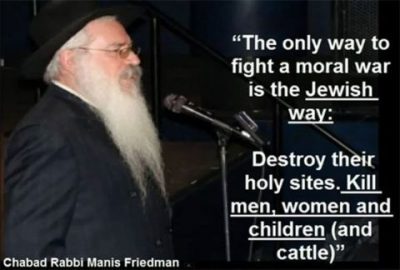
Israeli Rabbi Shmuel Eliyahu seems to have picked up where the late Rabbi Ovadiah Yosef left off. The Israeli army, Eliyahu said, must slaughter the Palestinians “and leave no one alive.” The Palestinians, the good rabbi continued, must be “destroyed and crushed in order to end violence.” Here is Eliyahu’s algorithm:
“If they don’t stop after we kill 100, then we must kill 1,000. And if they do not stop after 1,000, then we must kill 10,000. If they still don’t stop we must kill 100,000, even a million.”
There is more to this “logic” than meets the eye and ear. Eliyahu even postulated that the Israeli army ought not to get involved in arresting Palestinians because “If you leave him alive, there is a fear that he will be released and kill other people. We must eradicate this evil from within our midst.”
You may say that this is just an isolated case. No Israeli official believes that, right? … continue
Blog Roll
Recent Comments
papasha408 on Germany demands UN Rapporteur… papasha408 on Israel Demanding that Iran Lim… Coronistan on Why can’t western leaders acce… John Edward Kendrick on German government ‘embezzling’… loongtip on Von der Leyen to have new secu… papasha408 on First Gaza, then the world: Th… papasha408 on Is Nixing Aid to Israel a Pois… papasha408 on Japan to Sign Up For NATO’s Uk… Redracam on Iran Willing to Dilute Enriche… loongtip on When Threats Replace Evid… loongtip on Zelensky tried to kill the cha… eddieb on I might get killed for posting…


 Aletho News
- Ukraine to ban Russian literature – culture minister
- 40 State Attorneys General Want To Tie Online Access to ID
- Col Doug Macgregor: America’s Back to ENDLESS WARS
- Villains of Judea: Haim Saban
- Germany demands UN Rapporteur Albanese resign, joining France
- Hamas official says Netanyahu joining ‘peace council’ is a farce
- Israel Demanding that Iran Limit the Range of Missiles to 300 Kilometers
- Why can’t western leaders accept that they have failed in Ukraine?
- German government ‘embezzling’ taxpayer money to fund Ukraine – veteran politician
- Russian Soldiers Tortured in Secret Ukrainian Prisons
- If Americans Knew
- AZAPAC, the new PAC opposing Israeli domination of U.S policies
- Haim Saban: Billionaire for Israel
- Rafah e-wallet plan highlights Israel’s deepening financial occupation
- Viral post claims Netanyahu sought legal approval, igniting speculation about Israel’s organ harvesting
- AIPAC Has a New Opponent: PAL PAC
- Right-Wing Catholic Off Trump Religion Panel After Israel-Gaza Remarks at Antisemitism Event
- Jewish terrorism, apartheid rule the West Bank – Not a ceasefire Day 125
- Why Israel persecutes children like my son Shadi
- In Gaza, One Man Is Searching for the Remains of His Family With a Flour Sifter
- Horrific situation in Gaza, West Bank – Not a ceasefire Day 124
- No Tricks Zone
- German Gas Crisis…Chancellor Merz Allegedly Bans Gas Debate Ahead of Elections!
- Pollen Reconstructions Show The Last Glacial’s Warming Events Were Global, 10x Greater Than Modern
- Germany’s Natural Gas Storage Level Dwindles To Just 28%… Increasingly Critical
- New Study Rebuts The Assumption That Anthropogenic CO2 Molecules Have ‘Special’ Properties
- Climate Scientist Who Predicted End Of “Heavy Frost And Snow” Now Refuses Media Inquiries
- Polar Bear Numbers Rising And Health Improving In Areas With The Most Rapid Sea Ice Decline
- One Reason Only For Germany’s Heating Gas Crisis: Its Hardcore-Dumbass Energy Policy
- 130 Years Later: The CO2 Greenhouse Effect Is Still Only An Imaginary-World Thought Experiment
- New Study Affirms Rising CO2’s Greening Impact Across India – A Region With No Net Warming In 75 Years
- Germany’s Natural Gas Crisis Escalates … One Storage Site Near Empty …Government Silent
 Aletho News