Protesters in London defy ban to rally in support of Palestine Action

Palestine Action supporters outside London’s High Court in London, July 4, 2025. (Reuters)
Press TV – July 5, 2025
In a direct challenge to the British government’s new ban, protesters have gathered in central London to show solidarity with the pro-Palestinian campaign group, Palestine Action.
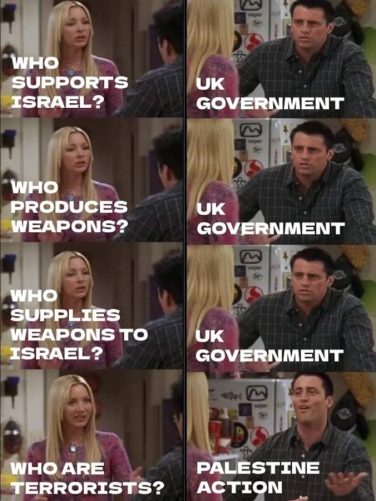
The group, which uses direct action against Israeli weapons factories in the UK and their supply chain, was officially designated a “terrorist organization” after a late-night legal bid to delay the move failed on Friday. The proscription came into force on Saturday.
Under the new legislation, membership of or public support for the group is now a criminal offense in the UK, punishable by up to 14 years in prison.
Protesters on Saturday gathered at Parliament Square, defying a warning from the Metropolitan Police, who said expressing support for the group “is a criminal offence.”
The demonstration, organized by campaign group Defend Our Juries, however, saw protesters holding signs and chanting in support of the pro-Palestine group.
Pictures from the rally showed protesters holding placards reading, “I oppose genocide, I support Palestine Action” in Westminster.
Police had warned that chanting slogans, wearing clothing, or displaying flags and signs in support of the group could lead to arrest under the Terrorism Act.
The Met said more than 20 people have been arrested in London.
In a letter addressed to Home Secretary Yvette Cooper, protesters said that they “refuse to be cowed into silence by your order.”
Palestine Action has focused much of its campaign on Elbit Systems UK, which it accuses of manufacturing and supplying weapons to the Israeli military amid the regime’s genocidal war on Gaza.
In its most recent action, activists stormed Guardtech, a subcontractor the group says provides “essential clean room services” to Instro Precision—a subsidiary of Elbit Systems, Israel’s largest arms producer.
Protesters blocked the company’s only entrance on Wednesday and covered it in red paint, symbolizing the blood shed by the Israeli regime in the Gaza Strip.
Palestine Action says Instro Precision cannot operate without Guardtech’s services, which are used to maintain the controlled environments necessary for producing radar kits and targeting systems.
Reacting to the ban on the group, a spokesperson for Palestine Action said, in a statement, “While London is rushing through Parliament absurd legislation to proscribe Palestine Action, the real terrorism is being committed in Gaza.”
It said that the activist group “affirms that direct action is necessary in the face of Israel’s ongoing crimes against humanity of genocide, apartheid and occupation, and to end British facilitation of those crimes.”
60% of Parents Support Review of CDC Childhood Vaccine Schedule, New Poll Shows
The Defender | July 1, 2025
Only 30% of U.S. voters oppose revisiting the CDC’s childhood vaccine schedule, according to an independent poll conducted June 24-25 — the same week a new panel of CDC vaccine advisers announced plans to study the cumulative effects of the childhood vaccine schedule.
Nearly half — 49% — of voters said they support reexamining the vaccine schedule, and 21% said they were undecided.
Parents with young children showed even stronger support for reviewing the schedule (60%).
Children’s Health Defense (CHD) commissioned the poll of 1,006 national voters. John Zogby Strategies, an independent polling and market research company, conducted the poll, which had an overall margin of sampling error of +/- 3.2 percentage points, with subgroups having higher margins.
On June 25, the Centers for Disease Control and Prevention’s (CDC) new advisory committee announced the formation of a new work group to study the Childhood and Adolescent Immunization Schedule, which recommends a minimum of 70 doses of 15 different vaccines from birth to age 18.
The committee’s new chair, Martin Kulldorff, Ph.D., said in his opening remarks:
“The number of vaccines that our children and adolescents receive today exceeds what children in most other developed nations receive — and what most of us in this room received when we were children.
“In addition to studying and evaluating individual vaccines, it is important to evaluate the cumulative effect of the recommended vaccine schedule. This includes interaction effects between different vaccines, the total number of vaccines, cumulative amounts of vaccine ingredients, and relative timing of different vaccines.”
Kulldorff cited a 2013 National Academy of Medicine report that called for more research on this topic. “It is now time to evaluate that new research,” he said during the June 25 committee meeting.
The committee’s announcement triggered a cascade of criticism from mainstream news organizations and groups like the American Academy of Family Physicians, American Academy of Pediatrics, American College of Physicians and the Infectious Diseases Society of America.
But according to CHD CEO Mary Holland, the latest poll numbers show mainstream media are out of touch with the public’s concerns about the schedule. She said:
“This data clearly shows that the mainstream media, medical establishment and many politicians fail to hear the serious concerns of half of Americans on these vital issues.
“The constant fearmongering and shaming tactics aimed at anyone questioning vaccine safety are not only ineffective but backfiring. Our message and support for the right to make informed medical choices are beginning to shift more perceptions and empower individuals across the nation.”
According to the poll, the public is nearly evenly divided on requiring vaccination for public school students. Forty-three percent of Americans support public schools mandating the CDC vaccine schedule for attendance.
Meanwhile, 39% believe that students should have access to free public education regardless of their vaccine status.
The survey also asked about the National Childhood Vaccine Injury Act of 1986, which grants legal immunity to vaccine manufacturers. Forty-eight percent of survey respondents supported pursuing legal action in case of vaccine injury, compared to 34% who preferred maintaining the current law.
Liberals are nearly evenly divided, with 42% supporting legal action and 37% favoring continued protection of vaccine manufacturers.
For the poll, secure invitations were sent to a random sample of our nationwide panel, totaling approximately 15 million U.S. adults utilizing email, text-to-web, and API to distribute the invitations to the panelists.
Survey participants were screened for age, likelihood of voting in the next national election, and party identification. Slight weights were applied to ensure the sample represented the population’s age, education, gender, race, region, and party identification. Subgroups had a higher margin of error.
For more information about the poll, please visit this link.
This article was originally published by The Defender — Children’s Health Defense’s News & Views Website under Creative Commons license CC BY-NC-ND 4.0. Please consider subscribing to The Defender or donating to Children’s Health Defense.
HHS to ‘Revolutionize’ Vaccine Injury Compensation, RFK Jr. Tells Tucker Carlson
By Suzanne Burdick, Ph.D. | The Defender | July 1, 2025
Health Secretary Robert F. Kennedy Jr. sat down yesterday with Tucker Carlson to share an update on his mission to end the skyrocketing rate of autism in U.S. kids.
By the end of their nearly 90-minute conversation, the two had covered a slew of topics, including pharmaceutical ads on TV, increasing compensation for the vaccine-injured, and the need for a “truth commission” to uncover who and what caused the COVID-19 pandemic.
Carlson, who last year left FOX News after being the network’s “most popular host,” now runs “The Tucker Carlson Show.” He broke his interview with Kennedy into five “chapters”:
- Uncovering the Reason for Skyrocketing Rates of Autism
- Is It Possible to End the Corrupt Relationship Between Big Pharma and Corporate Media?
- Will There Be Compensation for the Vaccine-Injured?
- RFK’s Firing of So-Called “Experts”
- The Real Reason Fauci Got a Pardon
Below are highlights from each.
HHS will do honest, open research on autism and vaccines
In the past, the Centers for Disease Control and Prevention (CDC) failed to honestly and adequately research the possible link between vaccines and autism, Kennedy said.
The CDC ignored recommendations from the Institute of Medicine to do a “litany” of studies to get at the issue, Kennedy said, including animal models, observational studies, bench studies and epidemiological studies.
“But what we’re going to do now,” he said, “is we’re going to do all the kinds of studies that the Institute of Medicine originally recommended.”
The National Institutes of Health (NIH) in April announced a new research program to study what causes autism and why autism diagnoses are on the rise.
NIH will make data from Medicare and Medicaid available to independent scientists for analysis. Data from the Vaccine Safety Datalink — a huge repository for health records — will also be used, Kennedy said.
Raw data will be made available to the public whenever possible, Kennedy said.
“Something new that we’re bringing in is that every study will be replicated,” he added.
Big Pharma ads fail to benefit patients and doctors
Sens. Bernie Sanders (I-Vt.) and Angus King (I-Maine) last month introduced federal legislation to end direct-to-consumer prescription drug advertising.
Kennedy didn’t reference the bill or say he supported a ban on such ads. However, he outlined several reasons why pharmaceutical marketing on mainstream media is bad for public health.
Many ads are misleading, he told Carlson. “Even the music and the video, the photos that they show … it’s sending a message that if you take this drug, you’re going to be riding jet skis and playing volleyball and water skiing and have a great-looking spouse.”
Meanwhile, the ads feature the most expensive version of the drug rather than the generic version.
“They’re not going to advertise the generics because they’re not making any money,” Kennedy said. “So they’re advertising the ones that are the highest profit margins for them.”
Plus, the U.S. taxpayer bears the brunt of the cost while the drug company profits. Kennedy explained:
“Normally, if you see an advertisement on TV like for Coca-Cola, you then have a choice to go get that and you’re paying out of your pocket for it.
“When somebody buys a pharmaceutical drug, it’s Medicaid and Medicare that are paying for it … it’s the taxpayer. … And we’re paying for the ads because they’re tax-deductible.”
When a patient sees the ad and asks a doctor for the drug, the doctor — who is told by a “corporate bean counter” to limit time with a patient to only 11 minutes — has to choose whether to use the time trying to talk the patient out of the drug, Kennedy said. But if the doctor does that, the patient likely goes away unsatisfied.
Or the doctor could just say, “All right, you want this prescription? I’ll write it for you.” Then the patient will be satisfied and come back, Kennedy said. “The doctors hate it. … And nobody thinks that this is good for public health. It is hurting us.”
Kennedy said the censorship of vaccine-related information on social media is also a problem.
The U.S. Supreme Court yesterday denied Children’s Health Defense’s (CHD) petition to hear its censorship case against Meta, the parent company of Facebook.
CHD sued Meta in August 2020 and filed an amended complaint in November 2020, alleging that government actors partnered with Facebook to censor CHD’s speech — particularly speech related to vaccines and COVID-19 — that should have been protected under the First Amendment. The company deplatformed CHD from Facebook and Instagram in August 2022 and has not reinstated the accounts.
Censorship of scientific results that are critical of vaccines is also a problem, Kennedy added.
Kennedy’s plans to expand vaccine injury compensation program
The National Childhood Vaccine Injury Act of 1986, which granted legal immunity to vaccine makers and created the National Vaccine Injury Compensation Program, also made it difficult for anyone injured by a vaccine to obtain compensation.
“We just brought a guy in this week who is going to be revolutionizing the [National] Vaccine Injury Compensation program,” Kennedy said.
“We’re looking at ways to enlarge the program so that COVID vaccine-injured people can be compensated … we’re looking at ways to enlarge the statute of limitations,” Kennedy told Carlson.
It’s currently limited to three years. “A lot of people don’t discover their injuries till after that,” Kennedy said.
The program has other flaws, including that it has no discovery process, no rules of evidence and historically had corrupt leadership.
“We’re going to change all that,” Kennedy said. “I’ve brought in a team this week that is starting to work on that.”
Kennedy also said HHS will use AI (artificial intelligence) to track vaccine injuries more effectively. The agency plans to use AI in other ways, too, such as speeding up drug approval processes and detecting fraud.
Why CDC vaccine advisory committee needed a clean sweep
Kennedy defended his recent move to fire all members of the CDC’s vaccine advisory panel, saying the board had become “a sock puppet for the industry that it was supposed to regulate.”
On June 11, Kennedy named eight researchers and physicians to the Advisory Committee on Immunization Practices (ACIP), two days after removing all 17 of the previous ACIP members.
“This was a long time coming, Tucker,” Kennedy said. He gave an example to illustrate the kind of financial conflict of interest that had plagued the board for years.
Years ago, the committee approved adding a rotavirus vaccine to the childhood immunization schedule, he said.
Four of the five committee members had “direct financial interest in the rotavirus vaccine,” Kennedy said. “They were working for the companies that made the vaccine, or they were receiving grants to do clinical trials on that vaccine.”
Within a year, that specific rotavirus vaccine was linked to “disastrous” disease in kids and pulled from the market. It was replaced by a different rotavirus vaccine that then-committee member Dr. Paul Offit had helped develop.
“Then [Offit] and his business partners, Dr. Stanley Plotkin, and a couple of other people, sold that vaccine to Merck for $186 million,” Kennedy recalled.
According to Kennedy, Offit told Newsweek that he won the lottery. “It’s been said of him that he voted himself rich, so that kind of conflict was typical on that committee.”
Could a ‘truth commission’ hold Fauci accountable?
Carlson and Kennedy discussed the origins of COVID-19 and the possible reasons for Dr. Anthony Fauci’s presidential pardon.
Just before leaving office, former President Joe Biden preemptively pardoned Fauci. The pardon, retroactive to Jan. 1, 2014, addresses “any offenses” Fauci committed during this period, including in his former capacities as director of the National Institute of Allergy and Infectious Diseases, member of the White House COVID-19 Response Team and chief medical adviser to Biden.
When Carlson pressed Kennedy to comment on Fauci’s motivations for funding coronavirus research in China, Kennedy said he tried to avoid speculation.
That’s why in his book, “The Real Anthony Fauci,” he reports only what Fauci did, not Fauci’s possible motivations, he said.
Carlson said, “It sounds like Fauci is beyond the reach of the law at this point.”
Kennedy responded, “Yeah, I think generally, unless there was a truth commission, you know, which they did in South Africa. They did it in Central America after the 1980s wars there, and they were very, very helpful to those societies. I think we should probably do something like that now.”
Kennedy explained how a truth commission works:
“You have a commission that hears testimony on what exactly happened. Anybody who comes and volunteers to testify truthfully is then given immunity from prosecution. But so that at least the public knows who did what. …
“People who are called and don’t take that deal and perjure themselves, they then can be prosecuted criminally.”
This article was originally published by The Defender — Children’s Health Defense’s News & Views Website under Creative Commons license CC BY-NC-ND 4.0. Please consider subscribing to The Defender or donating to Children’s Health Defense.
“Why Can’t We Talk About This?”
Rainey Media TV | June 4, 2025
Please Support Our Film via: E-Transfer: dean_rainey@yahoo.ca
PAYPAL: deanrainey@raineymedia.com
Buy My A Coffee: https://buymeacoffee.com/raineymedia
SNAIL MAIL: Rainey Media, PO Box 5, Delhi PO Main, ON, N4B 2W8 Canada
To book your own screening: deanrainey@raineymedia.com
“Why Can’t We Talk About This?” delves into the life of a man grappling with the aftermath of a COVID-19 vaccine injury, weaving his personal struggle into a broader examination of why such experiences are rarely discussed.
To help Michael via support: https://www.gofundme.com/f/benefit-fo…
We’ve made this film easily accessible for everyone because the information it contains and the discussion it starts is just too important. This film had no funding and was made without sponsorship. All costs were paid out of my own pocket. My team and I spent over a year and a half making this film. Any support you give will go towards expenses incurred making and marketing the movie. (Even sending the price of a movie ticket would help.) Once we cover those costs, we will be providing Michael with a share of the proceeds.
To order DVDs of this film, visit: https://raineymedia.com/video-store/
Also available on Rumble.
Ofcom seeks powers to preemptively block viral content, censor potentially illegal speech, and mandate broad Digital ID
By Cam Wakefield | Reclaim The Net | July 1, 2025
The UK’s increasingly controversial Office of Communications, Ofcom, is charting a path that could reshape the internet as we know it, and not for the better.
Under the banner of the Online Safety Act, the regulator is proposing a sweeping expansion of its authority that, if enacted, would hand it unprecedented influence over what we see, share and say online.
Part of Ofcom’s plan is the goal of preventing illegal content from gaining traction.
Platforms would be required to block material that even appears to be unlawful from being recommended by algorithms until it’s reviewed by a human moderator.
The idea, on paper, is to stop harmful content from “going viral.”
In practice, it risks creating a system where lawful speech is caught in digital limbo, held back by automated systems that err on the side of caution.
Ofcom frames these proposals as a necessary response to modern online threats.
It talks about “highly effective age assurance,” a term that sounds innocuous enough but points toward invasive digital ID checks.
The aim is to ensure that children aren’t exposed to harmful material, but the solution would come at the cost of privacy and anonymity for everyone, two pillars of an open internet.
This new regime would compel tech firms to act as frontline enforcers of ill-defined standards of legality, long before a court has had a chance to weigh in.
In times of crisis; riots, terror attacks, or other major incidents; platforms would be under pressure to throttle spikes in content rapidly.
That effectively puts Ofcom in the position of deciding, in real-time, what the public is allowed to see.
One of the more troubling proposals targets livestreaming; a tool that has become vital for journalists, activists, and artists.
All of it would be wrapped in tighter age verification systems that threaten to chill participation and expression.
The regulator also wants to see wider deployment of technologies like perceptual hash matching and automated tools; not just for known illegal content, but for material that might be illegal or harmful.
That includes everything from suicide-related posts to fraudulent schemes. While the intent is understandable, the risk of overreach is significant.
Without proper safeguards, lawful speech could be swept into censorship systems, and surveillance could become embedded in the core of our digital infrastructure.
Oliver Griffiths, who leads Ofcom’s Online Safety Group, summed up the regulator’s stance: “We’re holding platforms to account and launching swift enforcement action where we have concerns.”
It’s a statement that highlights how determined Ofcom is to push these changes through, no matter the consequences.
The public has until 20 October 2025 to respond to Ofcom’s consultation.
Given the political climate, the proposals seem likely to pass with little resistance.
But if they do, the UK’s online environment may come to be defined not by the free exchange of ideas, but by cautious, preemptive censorship and intrusive oversight; all in the name of safety.
Moldovan Authorities Using Gutsul’s Trial to Intimidate Opposition – Gagauzia leader

Sputnik – 02.07.2025
The head of Moldova’s autonomous region of Gagauzia, Yevgenia Gutsul, told Sputnik that the Moldovan authorities are using the trial against her to intimidate members of the opposition.
Criminal cases have been opened against Gutsul in Moldova for allegedly violating the rules for managing electoral funds during the 2023 autonomy elections, illegally financing the banned Sor party, and forging documents. On Tuesday, Moldovan prosecutor Ghennadi Epure said that the prosecutor’s office was asking a Chisinau court to sentence Gutsul to nine years in prison and ban her from holding public office for five years.
“We assumed from the first day that prosecutors would request such a punishment… Today, Gutsul has become an example of public flogging, a person who will be an example for other members of the opposition so that they do not go against the current government, so that they restrain themselves. We know that the opposition is really strong and sees the problems and gaps that have been created over four years by the current government,” Gutsul said.
She thanked the judge for allowing journalists to attend the hearing and personally observe the “show” that was taking place in court.
The Moldovan authorities have used repressive measures against people who oppose the official course of Chisinau. Gutsul was detained at the Chisinau airport in March. A Chisinau court arrested her for 20 days on charges of violating campaign finance rules and falsifying documents. On April 9, the court placed Gutsul under house arrest for 30 days. Later, Gutsul’s house arrest was extended for another 30 days, until June 13, but on June 11, the measure was prolonged for the third time.
Moldova’s current government, led by President Maia Sandu, is pursuing a consistent course towards rapprochement with the European Union, setting a strategic goal – the country’s accession to the EU by 2030 – but public opinion is deeply divided. In the referendum held in October 2024, EU integration barely scraped by with 50.46% support, largely thanks to votes from Moldovans abroad. Inside the country, only about 46% of voters supported European integration, highlighting the nation’s sharp divide.
AfD ban leaps closer with likely election of new far-left judge to Germany’s top court

Remix News | July 2, 2025
Frauke Brosius-Gersdorf, a lawyer described as far-left, is poised to become a new judge at the Federal Constitutional Court, Germany’s top court, and it is very bad news for Germany’s conservatives. This new development could significantly increase the chances that a ban on the anti-immigration Alternative for Germany (AfD) party actually passes through the court.
The governing coalition, the Social Democrats (SPD) and the Christian Democrats (CDU), has agreed on the SPD candidate, who has gained public attention for her strong opinions. The news comes after the SPD voted on an AfD ban in a unanimous motion at the end of their three-day party congress last week.
Brosius-Gersdorf is on record that she wants a ban on the AfD, saying: “We are a resilient democracy. We have safeguards against anti-constitutional parties.”
A year ago, on the ZDF talk show “Markus Lanz” on July 25, 2024, Brosius-Gersdorf controversially expressed regret that an AfD ban “would not eliminate its supporters.”
When Lanz, puzzled, asked, “You don’t want to eliminate people?”, she replied, “Of course not.” However, she insisted on the possibility of depriving AfD members of their basic rights, including the right to be elected, stating, “We have the ability to deprive individuals of their basic rights.”
Following her expected appointment to Karlsruhe, where the Constitutional Court is headquartered, Brosius-Gersdorf is also considered a frontrunner for the position of President of the Federal Constitutional Court. That means the court, made up of 16 judges, would be led by the far-left judge, which could prove catastrophic for not only the AfD, but also present a major problem for libertarians, supporters of free speech, and social conservatives.
Governments come and go, but Brosius-Gersdorf will be in her position for a very long time, and she will wield enormous power.
Beyond her stance on the AfD, she was a strong advocate for mandatory Covid-19 vaccination, arguing in 2021 that the German constitution, the Basic Law, already suggested that this would be a necessity. She wrote, “One can even consider whether there is now a constitutional obligation to introduce mandatory vaccination.” Furthermore, she stated, “It is the state’s responsibility to effectively protect the vast majority of the population, who have been voluntarily vaccinated, from their health (…) continuing to be threatened by the unvaccinated.”
Notably, it turned out that vaccination did not stop the spread of the illness, a contention by numerous health authorities that turned out to be absolutely false.
Her statements about mandatory vaccination have already led CDU Bundestag member Saskia Ludwig to declare Brosius-Gersdorf “unelectable” on Tuesday.
There are other areas where Brosius-Gersdorf could prove a bane to conservatives and the right in Germany, including on social issues.
The designated constitutional judge has also called for the German Basic Law to adopt “gender-appropriate” language, as reported by German media outlet Apollo News. She argued that the generic masculine, as standard language, leads to “a conceptual underrepresentation of women,” and that the state is obligated to “choose a form of expression that does justice to the fundamental rights of women and persons of diverse genders, as well as to the constitution.”
This has to do with the German language, which has masculine and feminine words, and in many cases, there is an emphasis on the masculine form, which many German feminists reject as outdated.
It remains unclear why the CDU would back this candidate. Following protests from the SPD and the Greens, the CDU/CSU withdrew their nomination of conservative Federal Administrative Court judge Robert Seegmüller for the Federal Constitutional Court. They are now putting forward Federal Labor Court judge Günter Spinner. The SPD is also nominating Munich professor Ann-Katrin Kaufhold. For these candidates to be elected, the coalition factions, the SPD and the CDU/CSU, require a two-thirds majority, meaning the Greens and the Left Party must also agree.
Brosius-Gersdorf represents a serious obstacle to not only the AfD, but also the CDU on a range of issues. The CDU, for instance, has taken issue with gendered language, which is a hot cultural topic in Germany. If the CDU backs this candidate, it is likely to pay the price for years to come.
Before any potential AfD ban, the Bundestag must first vote to pass a ban proposal. So far, the CDU has rejected such a ban, with Chancellor Merz stating that it reeked of eliminating a political rival. Other top CDU officials have rejected a ban. However, if the CDU comes around to the idea, the Constitutional Court may be much more willing to pass such a ban under the potential leadership of Brosius-Gersdorf.
Denmark subjects 18-year-old females to the draft starting July 1
RT | July 1, 2025
Women in Denmark are now subject to conscription, following a change to the relevant law made by the country’s parliament a few weeks ago.
The move comes as NATO, of which Denmark is a member, increases its military readiness, citing a perceived threat from Russia after the escalation of the Ukraine conflict in February 2022. At the bloc’s summit in The Hague last week, member states agreed to ramp up defense spending.
In May, the European Union approved a €150 billion ($171 billion) borrowing plan to support its own military buildup.
The Kremlin has consistently dismissed allegations of hostile intent toward Western nations as “nonsense” and fearmongering.
The newly adopted Danish legislation mandates “full equality between men and women in relation to military service.” It requires that “women who turn 18 on or after 1 July 2025 will have to… draw a [draft] lottery number and thus could be ordered to serve military service if there are not enough volunteers.” Female conscripts will serve under the same conditions as men.
The bill also extends the mandatory service period from four to eleven months, according to media reports.
Denmark’s armed forces rely on both volunteers and conscripts, who are called up when volunteer numbers fall short. Roughly 4,700 Danes completed military service in 2024, with women accounting for approximately 24% of that figure.
Prime Minister Mette Frederiksen unveiled plans to conscript women in March, framing the decision as part of a push for “full equality between the sexes.”
Latvia, another NATO member, is planning to conscript women by 2028. It reintroduced mandatory service in 2023 after scrapping it in 2006.
Norway and Sweden have already implemented gender-neutral conscription, in 2015 and 2018 respectively.
German Defense Minister Boris Pistorius has also proposed reinstating the draft for men, which was abolished in 2011.
Vance Unwittingly Reminds Us of the Jose Padilla Case
By Jacob G. Hornberger – FFF – June 27, 2025
In mocking California Senator Alex Padilla by referring to him as “Jose,” Vice President Vance has unwittingly reminded us of the Jose Padilla case. The Padilla case showed us how government officials use “crises” to destroy the civil liberties of the people.
The 9/11 attacks motivated U.S. officials to declare a “war on terrorism,” which turned out to be a bigger racket than their Cold War racket had been. Not only did the attacks fortify and reinforce the national-security state governmental structure that had come into existence to ostensibly protect us from the Reds, they also firmly established that the national-security establishment was not bound by the Bill of Rights.
Soon after the attacks, the Pentagon and the CIA set up a terrorist prison camp and torture center at their imperial base located in Guantanamo Bay, Cuba. Why Cuba? Because the Pentagon and the CIA were hoping that they would have full and complete control over the base — that is, that they would not be restrained by constitutional niceties and not be interfered with by the U.S Supreme Court and the federal judiciary. At the risk of belaboring the obvious, it was an interesting mindset given the oath that national-security state officials take to support and defend the Constitution.
Things didn’t work out as planned, however, because the U.S. Supreme Court ruled that it had judicial jurisdiction over Gitmo. That motivated the Pentagon and the CIA to establish a separate and independent judicial system at Gitmo for prosecuting accused terrorists, one that was totally different from the federal judicial system that had been established under the Constitution.
For example, while the federal judicial system guaranteed the right of trial by jury, the Pentagon-CIA judicial system employed kangaroo military tribunals. Moreover, under the federal judicial system, officials were prohibited from torturing people into confessing to crimes. At Gitmo, torture became a regular feature of life at Gitmo.
How would it be decided which system would be used with respect to each accused terrorist? U.S. officials had the discretionary power to decide which system would be used. The difference would be night and day. For example, in the constitutional system, an accused had the right to a speedy trial. In the Gitmo system, there are accused terrorists who are still waiting for a trial after some 20 years.
Given the widespread fear among the populace of “the terrorists,” many Americans were fine with this new dual judicial system, notwithstanding the fact that it was not authorized by the Constitution. What mattered to them was that the Pentagon and the CIA were supposedly keeping them safe from “the terrorists,” just as they had supposedly kept them safe from the Reds.
Equally important, people were convinced that the Gitmo system was going to be limited to foreigners. Therefore, the violation of the civil liberties that our American ancestors had enshrined in the Bill of Rights was considered no big deal. Never mind that our ancestors intended that the Bill of Rights apply to everyone, including foreigners.
But the notion that the destruction of civil liberties would be limited to foreigners was always misguided. After all, a terrorist is a terrorist. Why would an American terrorist be any different from a foreign terrorist? And don’t forget: This was not only a foreign war on terrorism but rather a global war on terrorism.
Then along came Jose Padilla and things became clear. Padilla was initially charged with terrorism in U.S. District Court. That was the standard procedure. After all, terrorism is a federal criminal offense. That’s why there are criminal prosecutions for terrorism in federal district court.
But don’t forget: The Pentagon and the CIA now had their own judicial system for trying terrorism cases — the system they established in Cuba. U.S officials could now choose which judicial system to employ against terrorist suspects — the federal system or the Gitmo system.
Before too long, the Pentagon and the CIA yanked Padilla out of the federal system and placed him into military custody, where they proceeded to brutally torture him. They never actually sent him to Guantanamo but they could have.
Padilla was an American citizen. Deferring to the Pentagon and the CIA, the federal courts upheld his transfer out of the federal-court system and into the clutches of the Pentagon and the CIA.
Given the right “national emergency” in the future, there is no doubt that U.S. officials will employ that judicial ruling against every American who they label a “terrorist.”
Kudos to Vice President Vance for unwittingly reminding us of how federal officials used the “national emergency” of the 9/11 attacks to destroy the civil liberties of the American people.
UK arrests 4 in crackdown on Palestine Action over RAF incursion
Al Mayadeen | June 28, 2025
UK counterterrorism authorities have arrested four individuals in connection with a break-in at RAF Brize Norton, reportedly carried out by members of Palestine Action. The incident, which took place last Friday, involved activists entering the Royal Air Force base in Oxfordshire and spray painting on two military aircraft in protest against Britain’s support for “Israel” and its ongoing genocide in Gaza.
South East Counter Terrorism Police confirmed the arrests, stating that a 29-year-old woman without a fixed address, along with two men aged 36 and 24, were detained on “terrorism-related grounds”. A fourth suspect, a 41-year-old woman, was arrested on suspicion of “assisting an offender.”
Authorities said the three were being held under suspicion of committing, preparing, or instigating acts of terrorism, as defined under Section 41 of the Terrorism Act 2000.
Government crackdown on pro-Palestine activism
 Following the arrests, Home Secretary Yvette Cooper announced her intention to designate Palestine Action as a proscribed organization under the UK’s Terrorism Act. If implemented, the designation would make it illegal to support, join, or promote the group, an escalation that has drawn concern from human rights advocates and civil liberties organizations.
On the same day, hundreds gathered in Trafalgar Square to express solidarity with the group, warning against the criminalization of activism aimed at opposing the UK’s complicity in supplying weapons to “Israel”.
In response, Palestine Action issued a statement via X, condemning the government’s treatment of the protest. “Despite us not being proscribed, the state is treating red paint on warplanes as an act of terrorism,” the group stated. It further revealed that the arrested activists were being held in solitary confinement without charge for several days.
Authorities moved quickly to suppress related demonstrations, dispersing planned rallies outside Parliament and pushing protesters into Trafalgar Square. Several arrests were made, with the Metropolitan Police citing public order risks. Meanwhile, counter-terrorism police have launched a broader security review across UK military installations.
Wider context
Palestine Action, founded in 2020 by British-Palestinian activist Huda Ammori and co-founder Richard Barnard, is known for its confrontational yet non-lethal tactics aimed at arms companies tied to “Israel’s” military-industrial complex. Previous campaigns have led to the temporary shutdown of Elbit Systems-linked factories in Oldham and Tamworth, as well as disrupted contracts with Israeli weapons suppliers.
Legal experts have raised doubts about whether Palestine Action meets the statutory requirements for proscription under the Terrorism Act 2000, which include posing a real threat to national security or British citizens. Critics argue that the group’s actions, while disruptive, remain rooted in civil disobedience rather than terrorism.
The proposed ban has renewed scrutiny of UK-“Israel” cooperation, with campaigners pointing to past evidence of coordination between British counterterrorism units and the Israeli embassy. Concerns are growing that this measure could set a precedent for further repression of pro-Palestine activism.
Families of detained activists face deepening uncertainty, as support efforts, ranging from legal aid to court appearances, could be criminalized. Foreign nationals involved in the group may also face deportation or visa revocation if the ban is enacted.
Washington’s unprecedented political war on Europe

By Salman Rafi Sheikh – New Eastern Outlook – June 27, 2025
A dramatic U.S. political broadside against Europe signals not just strained transatlantic ties, but a deeper ideological rupture — one that could push the EU toward redefining itself as a fully autonomous global actor.
Notwithstanding tensions surrounding US tariffs on the EU, the future and role of NATO, and the conflict in Ukraine, US-EU tensions are escalating to an outright political and ideological rivalry. Washington’s political attacks on European states and their policies mark a significant shift towards the end of transatlantic unity and an opportunity for the EU to rediscover itself.
Washington’s political attacks on Europe
On May 27th, 2025, the US State Department published an essay that could go down in history as Washington’s charge sheet on Europe, expressing the depth of contention and resentment colouring the Trump administration’s ties with the continent currently. However, once set along this path of confrontation, there may not be a return to normal, transatlantic ties in the foreseeable future. The essay begins with narrating the history and depth of US-Europe ties. Immediately afterward, however, it shockingly mentions what was unthinkable until a few years ago. The US State Department sees Europe as a ‘different world’, different from what the US itself (supposedly) represents. To quote the letter: “What endures [in Europe] instead is an aggressive campaign against Western civilization itself. Across Europe, governments have weaponized political institutions against their own citizens and against our shared heritage. Far from strengthening democratic principles, Europe has devolved into a hotbed of digital censorship, mass migration, restrictions on religious freedom, and numerous other assaults on democratic self-governance”.
Liberalism is Bad
It is not just European politics facing Washington’s assault; it is also the underlying liberal political order of Europe itself. The letter accuses Europe of restricting political space and criminalising dissenting political voices. The reason is the failure of liberalism, according to the letter. “Our concerns are not partisan but principled. The suppression of speech, facilitation of mass migration, targeting of religious expression, and undermining of electoral choice threatens the very foundation of the transatlantic partnership. A Europe that replaces its spiritual and cultural roots, that treats traditional values as dangerous relics, and that centralizes power in unaccountable institutions is a Europe less capable of standing firm against external threats and internal decay. To this end, achieving peace in Europe and around the world requires not a rejection of our shared cultural heritage, but a renewal of it”, adds the letter.
This, according to the letter, is not a good sign for the future of US-European ties. It mentions Secretary of State Marco Rubio, who is said to have made clear that “Europe’s democratic backsliding not only impacts European citizens but increasingly affects American security and economic ties, along with the free speech rights of American citizens and companies”.
Beyond Mistrust
This letter reveals many things. Most importantly, it reveals the level of mistrust and gap that now divides the transatlantic world. It is no longer mere tactical disagreements over petty issues. This mistrust has at its roots in the political thinking of the Trump administration. Donald Trump understands the EU as a political arrangement created to “screw” the US. He and his political advisers are now trying to unscrew this arrangement to ‘free’ the US from the decades-old political bonds.
For Europeans, this is a major challenge. A report in the UK-based Financial Times said that Europe “is quickly becoming the latest front in a culture war Trump has unleashed against the bastions of liberalism. Most of his targets — elite universities, government agencies such as USAID, public broadcasters — have been domestic. But the Samson essay shows Maga’s ambitions go much further, and the movement is now prepared to deploy far beyond America’s borders”. According to this report, it is not the EU, which is the real threat to the US, but the US is the biggest threat to Europe itself.
How will Europe respond to this attack, which now has both political and cultural underpinnings? There is little denying that Europe needs to grapple with prospects of a potential ‘de-coupling’ from the US. This de-coupling will create, at least in the immediate future, an urgent need for policy correction on several fronts. From negotiating the trade war with the US—which Europeans will understandably find hard to win—to shared security, the continent needs to change its direction fundamentally from seeking US compliance with the written and unwritten obligations of the transatlantic alliance to totally redefining—and changing—them.
This policy correction requires the EU to do a thorough reassessment of its ties not just with Washington but with Russia and China as well. It needs to reject notions—many of which were fanned out by the Biden administration most recently —of Russia being a security threat and/or Russian expansionism. Instead, it needs to realise that the Trump administration might be its best chance in the last seven decades or so since the end of the Second World War to come out of Washington’s shadow and become a truly autonomous player capable of both defining and defending its interests. In other words, instead of seeking to mend ties with the US to make them ‘normal’, it should further the ‘de-coupling’ and reinforce its continental interests as its own responsibility. There is arguably no alternative for Europe to survive this situation without losing its strength and standing internationally.
Globalist Blueprint: Pashinyan Seeks to Silence Church as Armenia Becomes NATO Proxy – Analyst
By Svetlana Ekimenko – Sputnik – 26.06.2025
Western globalists installed Nikol Pashinyan as prime minister to wrench Armenia away from its historical alliance with Russia, says international affairs expert Iskandar Kfoury.
The arrest of Archbishop Bagrat Galstanyan, a prelate of the Armenian Apostolic Church, is just the latest chapter in an effort to weaponize Armenia against its neighbors – especially Russia, Iskandar Kfoury told Sputnik.
The South Caucasus has always been a battleground for global powers, and now, under Pashinyan, American and NATO labs are conducting biological warfare research on Armenian soil, he said.
Furthermore, US military exercises have been welcomed on Armenia’s soil as part of a drastic geopolitical realignment.
The church – one of the last standing moral authorities in the country – is refusing to stay silent on this betrayal of Armenia’s national identity and sovereignty.
It was the church’s response that triggered the crackdown by Armenia’s authorities, Kfoury said.
Featured Video

More Iran War fallout: Maritime insurance industry shifts from London to China
or go to
Aletho News Archives – Video-Images
From the Archives
The Biggest Threat to Peace in Middle East
By Dr. Elias Akleh* | Sabbah Report | May 24, 2010
A build up of heightened tension in the Middle East is escalating in the last few weeks. American and Israeli postures towards Lebanon, Syria, and Iran have become more threatening. Listening to speeches of political leaders one hears talks only about war not peace. Iranians and Israelis are continuously training hard for a possible showdown. Both sides are conducting extensive war games every month. This led Syrians to claim that Israel is preparing for a soon-to-come another war. The Jordanians also are warning that current stalemate of the peace process is an indication of a war breaking out this summer. The Russian President and his army chief hinted, a few months ago, that the US and Israel were planning for an attack on Iran.
Indeed Iran is, as it has been for last few years, the target of most of the threats and accusations of supporting terrorism. Escalating incitement against Iran the American Defense Department sent last month (April) to Congress a report on Iran’s military claiming Iran could develop intercontinental ballistic missiles capable of reaching the US by 2015.
Ignoring the fact that N. Korea, India, Pakistan, and Israel are proven to have nuclear weapons while Iran does not, the US Secretary of State Hillary Clinton chose in her speech, to the nuclear Non-Proliferation Treaty review conference at the UN, to focus on Iran’s alleged nuclear ambitions putting the whole world at risk as she put it. According to Clinton Iran’s acquisition of nuclear weapons, rather than Israel’s more than 200 nuclear bombs, is destabilizing the Middle East. She called on the world’s nations to rally around US efforts to hold Iran, not other nuclear countries, to account.
The accusation that Usama Bin Laden is living comfortably in Iran had received a boost after the broadcast of a documentary called “Feathered Cocaine”. This echoed the June 2003 claims of the Italian newspaper Corre de la Sierra that Bin Laden was in Iran according to some intelligence report, and according to Richard Miniter’s book “Shadow War”. … continue
Blog Roll
 Aletho News
- Why could Gaza enter the regional war?
- Hamas official rejects Mladenov Plan linking disarmament to Gaza reconstruction
- Two Primary Elections for the Soul of ‘America First’
- Japan Clings to US Vassalage Despite Energy Crunch Caused By Iran War
- US Seeks Control Over Global Energy Infrastructure – Kremlin
- US senators target Orban government for standing up to Zelensky
- The deep-rooted culture of corruption in Ukraine
- Iran mobilizing one million soldiers to ‘create hell’ for any US ground assault: Report
- The coming military and psychological unravelling?
- Iran has the last laugh
- If Americans Knew
- Researchers at Human Rights Watch Resign Over Blocked Report on Palestinian Refugee Return
- Jewish Groups Are Backing a War Americans Don’t Want
- Eric Fingerhut Thinks He’s the President of the Jews
- Top Jewish Philanthropists, Rabbis Urge Israeli President to Take Action Against ‘Jewish Extremists’
- Don’t Be Fooled. Zionist Leaders Have Always Wanted to Control Southern Lebanon
- Israel’s widespread use of torture is a core element of its genocide against the Palestinian people
- In Israel’s War on Iran, Many Middle East US Bases Rendered “All But Uninhabitable”
- ‘Burn the lawn’: Israel pursues ‘Rafah model’ in southern Lebanon
- A genocide here, an amputation there
- Reports: Iran mobilizing 1M fighters, Israel-US run low on ammo, Israeli army faces shortage – Not a ceasefire Day 168
- No Tricks Zone
- Devastating Assessment Of Comirnaty Vaccine By Former Senior Pfizer Europe Toxicologist
- New Study: CO2 Is ‘Effectively Negligible’ As An Explanatory Climate Change Factor Since 2000
- Former Pfizer Toxicologist Dr. Helmut Sterz Tells Bundestag Hearing Pfizer Vaccine Should Have Never Been Approved
- Energy Expert: Germany’s Nuclear Phaseout Was A “500 Billion Euro Mistake”
- New Research: South Australia’s Mid-Holocene Sea Surface Temperatures Were 4°C Warmer Than Today
- Storing Green Energy To Last Germany 10 Days Would Require A 60-Million Tonne Battery
- New Studies: UK Sea Levels Were 4 Meters Higher Than Today During The Mid-Holocene
- Destructive Green New Deal: German Energy And Metal Group Warns Of Drastic Crisis
- New Study Documents A 20-Year Pause In Arctic Sea Ice Decline – Driven By Internal Variability
- Wake-up Call: Survey Shows Majority Of Germans Now Favor Postponing Climate Targets!
 Aletho News