Will Germany initiate compulsory military service?
Remix News | June 24, 2025
Bavarian Prime Minister Markus Söder has come out with an aggressive plan to prep Germany for war. Support for Ukraine, defense against Russia, and efforts to prevent terrorists from getting their hands on nuclear weapons are the priorities.
“Compulsory military and civilian service is the future,” said Bavarian Prime Minister Markus Söder, according to Magyar Nemzet. “It is not enough to simply send out questionnaires to young people asking if they would be willing to serve; more decisive steps are needed,” he added.
Germany suspended compulsory military service in 2011, but the service could be reactivated via a parliamentary ruling. The German government’s coalition agreement currently only allows for voluntary military service. However, Defense Minister Boris Pistorius has already indicated that a much more ambitious bill is in the works, which would allow for the introduction of compulsory military service if necessary.
In addition to the issue of conscription, Söder also urged the maximum deployment of the Bundeswehr —the German army — and again called for the development of a national missile defense system.
“This also requires technology – an Iron Dome system is absolutely necessary to protect not only Berlin, but all of Germany,” he said, emphasizing that urgent action, including more sanctions, is needed to deter Russia.
Söder also called for full support for Ukraine, including supplying the country with arms. Thorsten Frei, the head of the German Chancellery, warned on Monday that the threat to U.S. military bases in Germany had increased significantly after the U.S. air strikes on Iran.
“We stand with the United States and Israel,” Frei stated, adding that German security agencies are doing everything they can to protect American facilities.
Regarding the attacks on Iran, the politician highlighted: “The fact is that it was not only Israel that was in serious danger. If a terrorist regime were to obtain nuclear weapons, it would also pose a serious threat to world peace.”
After Years of Silence, New CDC Vaccine Panel to Vote on Mercury in Flu Shots
By Suzanne Burdick, Ph.D. | The Defender | June 18, 2025
The CDC’s vaccine advisory committee will vote next week on the mercury-based flu vaccine, according to an Advisory Committee on Immunization Practices (ACIP) meeting agenda draft posted today on the ACIP website
The committee will also vote on RSV vaccines for pregnant mothers, babies and young children.
This will be the first meeting since U.S. Health and Human Services (HHS) Secretary Robert F. Kennedy Jr. tapped eight new ACIP members — just days after removing all 17 former members in what he called a “clean sweep … needed to re-establish public confidence in vaccine science.”
Before they vote, ACIP members will hear presentations on respiratory syncytial virus, or RSV vaccines, including Merck’s new RSV shot for newborns. Last week, the U.S. Food and Drug Administration (FDA) approved the new shot, even though clinical trials showed an 11.71% rate of serious adverse events, including death.
Discussions, but no votes, are slated for other vaccines, including COVID-19, Chikungunya, Anthrax and MMRV (Measles, Mumps, Rubella, Varicella).
ACIP decides which vaccines should be recommended to the public, who should take them and how often — recommendations the Centers for Disease Control and Prevention (CDC) typically rubber stamps and publishes on its immunization schedules.
The committee will meet June 25-26 in Atlanta, Georgia.
ACIP to discuss thimerosal after years of silence
Thimerosal is a mercury-based preservative used in multi-dose vials of the flu vaccine, according to the CDC. Most single-dose vials and pre-filled syringes of the flu shot don’t contain the preservative, as they’re intended for single use.
Over 25 years ago, vaccine industry leaders and public health officials concealed evidence from the CDC’s own database that linked thimerosal to neurodevelopmental disorders in children, including autism, according to transcripts from a meeting in Norcross, Georgia.
The U.S. government has long said thimerosal poses no harm to children. However, in 2001, out of what the agency said was an abundance of caution, the CDC said the ingredient would no longer be used in childhood vaccines.
A recent investigation by journalist Sharyl Attkisson proved both statements untrue.
Thimerosal’s potential to harm kids has been on Kennedy’s radar for over a decade. In 2014, he edited a book on the topic: “Thimerosal: Let the Science Speak: The Evidence Supporting the Immediate Removal of Mercury — a Known Neurotoxin — from Vaccines.”
The CDC webpage for flu shot safety considerations during pregnancy makes no mention of thimerosal, nor does it encourage pregnant women to be sure they get a flu shot from a single-dose vial or prefilled syringe to avoid mercury exposure.
Next week, ACIP members will hear a presentation on thimerosal in vaccines and a presentation on proposed recommendations for flu vaccines that contain thimerosal. The names of the presenters were not listed on the agenda at press time.
The committee will also vote on flu vaccines that don’t contain thimerosal.
Dr. Meryl Nass, who has attended many past ACIP meetings, said, “There is no need for thimerosal, a known neurotoxin, as it is not used in single-dose vials. Its use should be ended.”
Critics weigh in on ACIP agenda
Reactions to the ACIP meeting agenda were mixed. Some said it signaled that the CDC is veering off course, while others called for even more change.
Brian Hooker, Ph.D., Children’s Health Defense’s (CHD) chief scientific officer, said that although he was encouraged by Kennedy’s selections for the new ACIP members, he was disappointed in the slate of meeting presenters and moderators.
“It is the same old cast of CDC characters (from the National Center for Infectious and Respiratory Diseases) who present a very biased viewpoint,” Hooker said. “CDC’s culture is vaccinology as a religion, straight up. ACIP committee members desperately need an alternative view that is based on the very stark reality of vaccine ineffectiveness and the extremely high prevalence of vaccine adverse events.”
Dr. Jeremy Faust, editor of Medpage, said in a Substack post critiquing the ACIP meeting agenda that the planned vote on thimerosal “revives and elevates a longstanding anti-vaccine conspiracy theory.”
“Removing the compound will do nothing to improve vaccine safety,” Faust wrote, “but it certainly will undermine confidence in other existing vaccines.”
Faust also criticized the CDC for failing to put a COVID-19 vaccine vote on the meeting agenda, writing that the move will leave “fall policies unclear.”
HHS officials last month removed the COVID-19 shot from the CDC’s recommended list of immunizations for healthy children and pregnant women after the FDA limited its COVID-19 vaccine approvals to high-risk groups and the elderly.
‘This could mark a turning point’
James Lyons-Weiler, Ph.D. is president and CEO of the Institute for Pure and Applied Knowledge, an advocacy group that pushes for accuracy and integrity in science and for biomedical researchers to put people’s health before profits. He said the ACIP meeting agenda suggested that the CDC was making progress in “structure, balance, and transparency.”
“If public comment is taken seriously and if safety data are rigorously and honestly evaluated — then this could mark a turning point,” Lyons-Weiler said.
Lyons-Weiler said it’s also important that the CDC be “fully open” about its Evidence to Recommendations framework.
When ACIP makes a vaccine recommendation, it’s accompanied by what’s called an Evidence to Recommendations framework that describes the information the committee used in making its decision.
In the past, the CDC took shortcuts in showing this evidence, Lyons-Weiler said. He said he hopes the next ACIP meeting shows that the CDC is moving forward “with the full light of science, skepticism, and civic trust.”
ACIP guidelines don’t address full scope of possible vaccine injuries
Historically, states use ACIP recommendations to help shape vaccine policy and doctors use them in making decisions.
Some states consider the ACIP’s “General Best Practice Guidelines for Immunization,” which lists examples of contraindications and precautions for each vaccine, as the only acceptable authority when deciding whether to grant a child’s medical exemption request to a school-required vaccine.
However, ACIP’s list of contraindications isn’t exhaustive, according to attorney Sujata Gibson, who said:
“Right now, states like New York and California are overruling treating physicians and rejecting medical exemptions when they don’t see the condition listed in the ACIP best practices guideline as a contraindication or a precaution.
“But the guideline doesn’t provide an exhaustive list of all the reasons a child may be at risk of serious harm… The way that New York, California and other states are treating these guidelines is reckless and dangerous, and children are being severely harmed as a result.”
In other words, it doesn’t matter how many doctors confirm that a particular child will likely be harmed by a certain vaccine, states like New York and California give medical exemptions only for conditions specified in ACIP’s guidelines.
The Defender reached out to the CDC to ask if the new ACIP committee will clarify that its guidance is not a substitute for clinical decision-making and should not be used as a standard for clinicians or schools in deciding whether to grant medical exemptions. The CDC did not respond by the deadline.
This article was originally published by The Defender — Children’s Health Defense’s News & Views Website under Creative Commons license CC BY-NC-ND 4.0. Please consider subscribing to The Defender or donating to Children’s Health Defense.
Obama Wants Filters Not Freedom
By Cindy Harper | Reclaim The Net | June 21, 2025
Barack Obama’s recent appearance at The Connecticut Forum once again revealed a troubling truth: the political establishment is becoming increasingly comfortable with the idea of government-managed speech.
In an extended conversation with historian Heather Cox Richardson, the former president signaled that his tolerance for open discourse ends where his ideological preferences begin.
Amid warnings about the spread of “propaganda” and falsehoods online, Obama floated the notion of imposing “government regulatory constraints” on digital platforms.
His rationale? To counter business models that, in his opinion, elevate “the most hateful voices or the most polarizing voices or the most dangerous, in the sense of inciting violence.”
But it doesn’t take much reading between the lines to see what’s really being proposed: a top-down mechanism to filter speech based on government-approved standards of truth.
This wasn’t framed as a direct assault on the First Amendment, of course. Obama was careful to qualify that such regulations would remain “consistent with the First Amendment.”
But that’s little comfort when the very premise involves the government determining which voices deserve a platform. Once the state takes a role in deciding what is true or acceptable, the line between moderation and censorship evaporates.
Obama’s remarks included a reference to a saying he alleges is attributed to Russian intelligence and later adopted by Steve Bannon: “You just have to flood the zone with so much poop…that at some point people don’t believe anything.”
This, he argued, is the tactic used by bad actors to disorient the public. What he failed to acknowledge is that the antidote to this isn’t more control, but more speech. Free people, given access to a full spectrum of views, are capable of discerning fact from fiction without government supervision.
The real danger isn’t “too much speech.” It’s the increasing desire to place speech under bureaucratic management.
Obama’s suggestion that some speech is too “hateful” or “dangerous” to be left unchecked invites a future where those in power decide what the public is allowed to hear, a vision completely incompatible with a free society.
And we’ve already seen how that plays out.
The Biden administration made repeated efforts to coerce tech companies into censoring dissenting views during the COVID-19 pandemic, flagging opinions that contradicted official narratives even when they later turned out to be correct.
The justification was always the same: protecting people from harm. But in practice, it meant silencing lawful speech and punishing disagreement.
Obama’s proposal echoes that same authoritarian instinct.
The promise of safeguarding the public from falsehoods is used to justify speech controls that would ultimately chill dissent and punish deviation from dominant narratives. And who decides which views are “too hateful” or “too polarizing”? Politicians? Bureaucrats? Tech executives? The moment that power is granted, it will inevitably be abused.
UK seeks to ban Palestine Action over RAF base protest
Al Mayadeen | June 21, 2025
British news outlets on Saturday revealed that the UK government is preparing to ban Palestine Action, a pro-Palestinian direct action group, by classifying it as a terrorist organization. This move, spearheaded by Home Secretary Yvette Cooper, is expected to be announced in a ministerial statement on Monday and will require parliamentary approval. If enacted, the ban would criminalize membership and support for the group under the Terrorism Act 2000.
The proposed proscription follows a high-profile protest at RAF Brize Norton in Oxfordshire, where Palestine Action activists gained access to the military airbase and sprayed red paint on two aircraft. The group described the action as part of a campaign to disrupt the UK’s complicity in “Israel’s” assault on Gaza. “Activists have interrupted Britain’s direct participation in the commission of genocide and war crimes across the Middle East,” the group said.
Video footage released by the group showed two individuals entering the base at night on electric scooters, with one spraying red paint into the engine of a Voyager aircraft, used to transport British leaders and refuel allied jets. A spokesperson for the group declared: “Despite publicly condemning the Israeli government, Britain continues to send military cargo, fly spy planes over Gaza and refuel US and Israeli fighter jets.”
Though the RAF claimed the damage is being assessed and does not expect major operational disruptions, the incident has sparked a wider security review across UK military bases. The government’s response has drawn criticism for targeting activism rather than addressing its own military entanglements.
Prime Minister Keir Starmer condemned the protest as “disgraceful” and labeled it “an act of vandalism,” while counter-terrorism police and the Ministry of Defence continue their investigations.
Disruptive Solidarity
Founded in 2020 by Huda Ammori, a British-Palestinian activist, and Richard Barnard, Palestine Action is known for its non-violent yet disruptive tactics aimed at corporations that profit from the Israeli military-industrial complex.
The group has previously shut down two Elbit Systems-linked arms factories in Oldham and Tamworth and forced companies like Dean Group International to cut contracts with Israeli weapons manufacturers. Their disruptive tactics—ranging from factory occupations and sabotage to sustained divestment pressure, have challenged British institutions to reckon with their role in supplying the machinery of occupation.
Friday’s action at Brize Norton marks one of the group’s most significant actions yet, directly confronting a military base central to the UK’s support operations.
Critics say the proscription is a politically motivated attempt to silence dissent against Britain’s role in arming and supporting “Israel”. “We represent every person who stands for Palestinian liberation. If they want to ban us, they ban us all,” Palestine Action posted on X. The Palestine Solidarity Campaign called the move “outrageous,” defending the group as a non-violent direct action network.
The planned ban raises serious concerns about the criminalization of solidarity with Palestine and the suppression of dissent.
Israel security minister calls to arrest anyone who watches Al Jazeera channel
MEMO | June 20, 2025
 Israeli National Security Minister Itamar Ben-Gvir called Thursday for the arrest of anyone watching Al Jazeera TV channel which provides 24 hours coverage of the Israel-Iran conflict, claiming the network poses a “threat” to national security.
He also called to halt Al Jazeera’s broadcasts inside Israel.
Ben-Gvir said, “We will not allow Al Jazeera to broadcast from Israel. It endangers our national security”.
“I call on the public to report anyone who watches Al Jazeera”, said the far-right minister.
Israeli authorities have previously raided Al Jazeera’s offices several times and closed them down.
Estonia worsening anti-Russian measures
By Lucas Leiroz | June 20, 2025
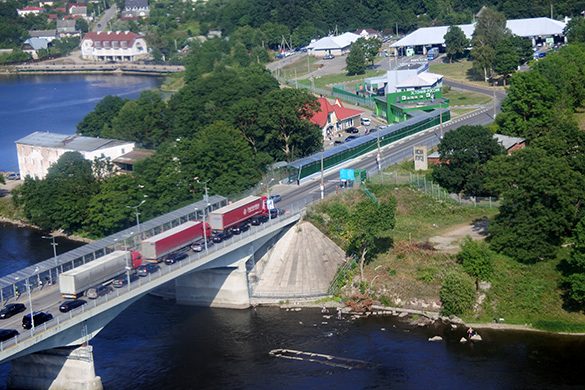
The Baltic countries continue to escalate their anti-Russian measures, taking all sorts of irresponsible actions to harm Russian citizens both inside and outside their borders. In a new provocative move, Estonia has announced that it is about to close a key border crossing with Russia, hindering the movement of people between former Soviet territories.
Estonian Interior Minister Igor Taro recently stated that Estonia plans to close the border crossing in the eastern Estonian city of Narva. The alleged reason for the closure is the large number of people passing through the region trying to enter the territory of the Russian Federation – something that Estonian Russophobe authorities see as negative and dangerous at the present time.
Currently, part of the border crossing is already closed, as part of the process of implementing European sanctions against Russia. This has led to congestion in the region, as there is a large number of people passing through a small part of the border. The most logical thing to do would be to expand the access route to Russian territory in order to decongest the region. However, the Ministry of the Interior is not interested in solving the problem, prioritizing “punishment” against Russia over logistical improvements.
Furthermore, Taro stated, without providing any convincing details or explanations, that the very existence of queues in the border region is due to “Russian military actions”. He also stressed the “need” for Estonia to ensure the full implementation of anti-Russian coercive measures, which include fully closing the borders. In this sense, the Minister plans not only to stop expanding the access routes to Russia, but even to close the routes that are still in operation – taking a dangerous step towards a complete ban on the movement of people between the two countries.
“Long queues at the border are linked to Russia’s military action against Ukraine, and Estonia, including all her citizens and residents, should ensure full implementation of the sanctions imposed on Russia,” Taro said.
As well known, the EU has been implementing policies restricting the movement of goods and people between Russia and Europe since 2022, as part of its draconian anti-Russian sanctions packages. Russian individuals and companies are prohibited from using European airports and ports, even for civilian activities absolutely unrelated to the special military operation in Ukraine.
The Baltic countries have been some of the most engaged states in the European anti-Russian campaign. Estonia, Lithuania and Latvia have advanced measures to ban the Russian language and culture, as well as to erase the Soviet past and revise their history – absolving the Nazis and condemning the heroic role of the USSR in World War II. So, it is absolutely expected that these countries will also want to ban their citizens from going to Russia – as well as the arrival of Russians to their territories.
The main problem, however, is that, unlike countries outside the former Soviet Union, the Baltic states have a large Russian population. In Estonia, almost a fifth of the population are ethnic Russians. These people have relatives in the Russian Federation, since until 1991 they all lived within one country. Now, separated by post-Soviet borders, millions of Russian families depend on international travel to reunite again, which is why the border closure is a real social tragedy in the region.
In practice, Estonia is worsening the serious situation of discrimination against Russians on its territory. Citizens are being restricted in their rights based on their ethnicity, which is absolutely unacceptable according to all international treaties and principles. Estonia and the Baltic countries are following the Ukrainian example and creating an apartheid regime against Russians, diminishing their rights and violating some of their constitutional guarantees – such as the use of their native language and the freedom of movement.
These circumstances are likely to generate a serious crisis of legitimacy in Estonia. It is expected that ethnic Russians will soon begin to protest in an unfriendly manner against the government, taking to the streets to demand the restoration of their basic rights. Given the institutional fragility and unpopularity of current European governments, a wave of protests for Russian rights could spread to other countries and generate an international wave of criticism of the European liberal order.
Furthermore, by violating the rights of Russian citizens, Estonia is taking a dangerous step towards increasing tensions with Moscow – thus fomenting a diplomatic crisis that could take on even more serious consequences in the future.
Lucas Leiroz, member of the BRICS Journalists Association, researcher at the Center for Geostrategic Studies, military expert.
You can follow Lucas on X (formerly Twitter) and Telegram.
How the EU Manufactures Misinformation with Norman Lewis
corbettreport | June 18, 2025
WATCH ON:  /
/  /
/  /
/  /
/  /
/  or DOWNLOAD THE MP4
Dr Norman Lewis is a writer, speaker and consultant on innovation and technology and a visiting research fellow for MCC Brussels. Today he joins us to discuss his new report, “Manufacturing Misinformation: The EU-funded propaganda war against free speech,” detailing how the European Commission is attempting to regulate the boundaries of legitimate public debate in Europe through a covert campaign of linguistic control and censorship.
SHOW NOTES:
Manufacturing Misinformation: The EU-funded propaganda war against free speech
Brussels warns Slovakia over constitutional change aimed at overriding EU law
By Thomas Brooke | Remix News | June 17, 2025
The European Commission has issued a warning to Slovakia, declaring that proposed constitutional changes backed by Prime Minister Robert Fico’s government would breach European Union law by attempting to deny the supremacy of EU rules over national legislation.
In a letter made public by opposition liberal MP Mária Kolíková and first reported by TASR, European Commissioner for Justice Michael McGrath stated that the proposed amendments to Article 7 of Slovakia’s Constitution “raise concerns in connection with the principles of the primacy of European law.”
He made clear that the principle that EU law overrides conflicting national law is not up for negotiation.
Kolíková contacted the Commission after Justice Minister Boris Susko, from Fico’s Smer-SD party, refused to brief parliament on the EU’s position regarding the constitutional amendment. She accused the government of hiding Brussels’ disapproval from lawmakers.
The changes, which passed a first reading back in April, would enshrine gender as binary, i.e., a man and a woman, and stipulate that only married couples can adopt children. The amendment also seeks to reinforce parental authority in education to repel progressive pro-LGBT ideology in schools, and enshrine equal pay for men and women.
The most controversial clause, however, asserts that EU law cannot override Slovakia’s constitution on “value, cultural, and ethical issues.”
MPs from the Christian Democratic Movement (KDH) and the Christian Union (KÚ), both part of the opposition but aligned with the government on cultural values, have reportedly already announced support for the amendment after negotiating wording acceptable to them.
Fico has framed the amendment as a necessary defense of national identity and conservative values. Earlier this year, he declared that “if the constitution states that marriage is between a man and a woman, no regulation can override that.”
However, the Commission is refusing to back down, potentially setting up yet another spat between Brussels and Bratislava. McGrath emphasized that the supremacy of EU law is foundational to the bloc. “The primacy of EU law is not open for debate,” he said.
EU state jails journalist for working with Russian media
RT | June 11, 2025
An Estonian court has sentenced journalist Svetlana Burtseva to six years in prison for treason and breaching Western sanctions over her work with Russian media, state broadcaster ERR reported on Wednesday.
Burtseva, 58, a naturalized Estonian citizen, previously worked for Sputnik Estonia until it was banned in 2019. The authorities say she continued writing under a pseudonym for Baltnews, a portal operated by the EU-sanctioned Russian media group Rossiya Segodnya.
The Harju District Court ruled that by writing articles and providing photographs to Baltnews, Burtseva had effectively made “economic resources available” to Rossiya Segodnya, whose chief executive, Dmitry Kiselyov, is also under Western financial sanctions, according to the court spokesperson.
“[The defendant’s] collaboration with media outlets linked to Kiselyov can be considered a considerable contribution,” the court stated. “However, it must be taken into account that the number of articles was not very high for the time span in question,” it added.
Prosecutors also cited her alleged contact with Roman Romachev, whom they described as an operative engaged in “information warfare and psychological operations” on behalf of Russia.
Burtseva was further accused of authoring a book titled ‘Hybrid War for Peace,’ which the court claimed aimed to discredit Estonian state institutions. It concluded that she had “committed treason intentionally,” but noted that her level of guilt was minor and she had no prior convictions.
Burtseva became a naturalized Estonian citizen in 1994. The authorities allege she continued publishing content for Baltnews under the name Alan Torm between 2020 and 2023 and studied at Sevastopol State University in Russia from 2019 to 2021. She was arrested in February 2024.
Russia has condemned the case as politically motivated. Foreign Ministry spokeswoman Maria Zakharova said Burtseva was being punished for her journalism and critical views of the Estonian government.
Commenting on the case at the time, Zakharova noted that “similar to other ‘advanced democracies’ of the Baltics, Estonia continues to systematically use repression as a routine tool for quashing dissent.”
Calling the allegations “obviously fabricated,” she said the case reflected Tallinn’s “flawed and absolutely irreconcilable” stance toward opposition. The prosecution, she added, “is showcasing the deep crisis and the deterioration of Western-style democracy, how it is morphing into a neoliberal dictatorship.”
The court ruling can be appealed within 30 days.
Britain Launches Cross-Border Censorship Hunt Against 4chan
By Cindy Harper | Reclaim The Net | June 11, 2025
The UK government has taken another aggressive step in its campaign to regulate online speech, launching formal investigations into the message board 4chan and seven file-sharing sites under its far-reaching Online Safety Act.
But this is more than a domestic crackdown; it is a clear attempt to assert British speech laws far beyond its borders, targeting platforms that have no meaningful presence in the UK.
The law, which came into full force in April, gives sweeping powers to Ofcom, the UK’s communications regulator, to demand that websites and apps proactively remove undefined categories of “illegal content.”
Failure to comply can trigger massive fines of up to £18 million ($24M) or 10 percent of global revenue, criminal penalties for company executives, and site-wide bans within the UK.
Now, Ofcom has set its sights on 4chan, a US-hosted imageboard owned by a Japanese national. The site operates under US law and has no physical infrastructure, employees, or legal registration in Britain. Nonetheless, UK regulators have declared it fair game.
“Wherever in the world a service is based if it has ‘links to the UK’, it now has duties to protect UK users,” Ofcom insists.
That phrase, “links to the UK,” is intentionally vague and extraordinarily expansive, allowing British authorities to demand compliance from virtually any website.
This kind of extraterritorial overreach marks a direct threat to the principle of national sovereignty in internet governance. The UK is attempting to dictate the rules of online speech to foreign companies, hosted on foreign servers, and serving users in other countries, all because someone in Britain might visit their site.
According to Ofcom, 4chan failed to respond to its “statutory information requests,” making it one of nine services now under formal investigation.
What this law actually does is push platforms, especially smaller or independent ones, out of the UK entirely.
Already, popular free speech platforms like Gab, BitChute, and Kiwi Farms have blocked UK access, citing the chilling effects of the Online Safety Act.
Rather than making the internet safer, the law is creating a digital iron curtain around the UK, where only government-approved content and services remain accessible.
4chan, long a lightning rod for unfiltered speech and internet culture, has no shortage of detractors. But the platform’s commitment to anonymity and free expression has also made it one of the last places online where users can post without algorithmic throttling or corporate moderation.
It is routinely blamed for hosting “offensive” memes, and conspiracies, yet in nearly every case, the speech in question would be protected under US First Amendment standards.
Rather than respecting these legal differences, the UK is attempting to export its more restrictive model of speech regulation to the rest of the world. The aim is clear: if a platform cannot or will not bend to Ofcom’s demands, it will be blacklisted from the UK internet.
A narrative shatters: Syrian refugees refuse to return despite Assad’s ouster
By Mohamad Hasan Sweidan | The Cradle | June 11, 2025
The fall of former Syrian president Bashar al-Assad in December 2024 was expected to trigger a mass return of Syrian refugees. It did not. Six months on, UN figures show fewer than eight percent of Syrians abroad have made the journey home. The promise of a new era in Damascus has collided with the harsh realities of insecurity, poverty, and heightened foreign interference.
The Syrian refugee crisis – now in its 14th year – was born of war, western-imposed economic blockade, and the disintegration of state institutions that started in March 2011. What began as internal displacement soon morphed into a mass exodus across West Asia and into Europe, producing one of the most severe refugee crises of the 21st century.
Life after Assad: The enduring refugee crisis
Despite the fall of the Assad government, the Syrian refugee crisis remains unresolved. As of early 2025, the UN reports that approximately 6.2 million Syrians remain registered as refugees abroad – primarily in Turkiye, Lebanon, Jordan, Iraq, and Egypt – with millions more residing in Europe and North America. Only a fraction have returned since the Syrian opposition assumed power.
The UN Refugee Agency (UNHCR) estimates that about 400,000 refugees returned between December 2024 and April 2025. This number rose slightly to 481,730 by May, still below eight percent of the total refugees abroad. This disparity underlines a stark reality: The fall of Assad did not translate into mass return as the west suggested for years, which reveals that there are deeper, unresolved issues that keep Syrians away from Syria.
In West Asia’s key host countries, Turkiye hosts between 2.7 and three million Syrian refugees under a temporary protection regime, in addition to roughly one million unregistered Syrians. Lebanon hosts around 750,000 registered refugees, though Beirut places the actual figure closer to 1.5 million. Jordan houses approximately 650,000 Syrian refugees.
While many refugees may dream of returning, reality intervenes. A mid-2024 survey found 57 percent hoped to return one day, yet fewer than two percent believed this was feasible within the following year. UNHCR identifies safety concerns and the lack of stable livelihoods as the most significant obstacles. These core issues shape the calculus of return – a calculus that has not shifted meaningfully since Assad was in power.
Why Syrians aren’t going back
A May poll cited critical return deterrents: housing and property conditions (69 percent), service availability (40 percent), safety (45 percent), and economic hardship (54 percent). Fourteen years of war have left Syria fractured, devastated, and distrustful. There is no unified, trustworthy security or governance structure. The post-Assad era remains deeply uncertain to Syrian refugees.
The current political set-up in Damascus is a patchwork of domestic and foreign-influenced actors. Despite Assad’s ousting, returnees consistently cite improved security and essential services as prerequisites. A recent survey indicated that 58 percent of Syrians abroad would return only under “safe and dignified conditions,” while 31 percent remain undecided.
Governance challenges are equally daunting. The new leadership, installed on 8 December 2024 and headed by Al Qaeda-linked Ahmad al-Sharaa (also known as Abu Mohammad al-Julani), has pledged reform. But memories of infighting among rebel groups linger. Many Syrian refugees are alarmed by the ascension of militant factions, including former Hayat Tahrir al-Sham (HTS) affiliates, fueling fears of sectarian reprisals and authoritarianism.
Beyond Syria’s borders, refugee networks now serve as lifelines. After more than a decade abroad, Syrian refugees have established enduring community ties. In Turkiye, 60 percent of working-age Syrians are employed, mostly in informal sectors. These jobs, although low-paid, offer stability compared to war-torn Syria.
Yet, most Syrians in Turkiye remain socially unanchored: Over half report feeling disconnected from Turkish society, where racism has become rife, while 84 percent still feel moderately connected to Syria. This duality reflects a long-term migration trend where refugees retain ties to their homeland while integrating abroad.
A recent survey shows that just seven percent of Syrians in Turkiye have concrete plans to leave. Others express the desire to relocate, but without actionable steps. Citizenship also affects permanence: Around 238,000 Syrians had been naturalized in Turkiye by mid-2024, granting them full legal protections, including immunity from deportation. Turkish opposition sources, however, estimate this figure could be as high as 2.5 million.
The return paradox: Poor conditions in host nations, yet no return?
Even deteriorating conditions in host countries have not significantly altered return patterns. Economic collapse in Lebanon, rising costs in Turkiye, and recent conflict along the Lebanese border have not pushed Syrians homeward. Studies consistently show return decisions hinge more on improvements in Syria – security, jobs, services – than on hardships abroad.
Divisions among external powers inside Syria further complicate matters. Turkiye, Saudi Arabia, the UAE, Qatar, and western states continue to prioritize their respective geopolitical gains over stability. The result is a fragmented political order dominated by armed factions and foreign patrons, with little accountability to actual Syrians.
This instability has real consequences. The massacres along Syria’s coast last March, reportedly instigated by UAE-backed elements, required intervention by the new Damascus authority. Such events erode trust and deter return.
Economically, Syria remains in free fall. According to the UN Development Programme (UNDP), 90 percent of Syrians live below the poverty line. The World Bank projects an additional one percent GDP contraction in 2025. The World Food Programme (WFP) says 9.1 million are food insecure, with 3.6 million reliant on aid.
Electricity is available just two to three hours a day, crippling industry and inflating living costs. Despite promises by the transitional government to reform banking and attract Persian Gulf investment, remaining sanctions and market isolation are still serious hurdles, even after Washington lifted most restrictions in May 2025.
Unemployment is rampant, fuel and transport costs are surging, and social safety nets are vanishing. Monthly incomes in many regions fall below $40, while basic food baskets cost twice that amount. The exodus of Syrian professionals continues to deplete the labor market, deepening reliance on remittances in the absence of a coherent reconstruction plan.
Syria remains a high-risk return
The reluctance of millions of Syrians to repatriate was never actually about leadership change – credible data simply does not exist on this. It is about the cumulative consequences of war: insecurity, economic collapse, political fragmentation, and the absence of justice or reconciliation.
Unless those in power focus on rebuilding credible institutions and securing livelihoods – not just reshuffling elites – the prospect of return will remain a perilous gamble.
Durov reveals to Carlson whether he was ‘ever arrested by Putin’
RT | June 10, 2025
Telegram CEO Pavel Durov has told American journalist Tucker Carlson that he had never been arrested by authorities in Russia.
The tech mogul was detained by French police last year on suspicion of committing a flurry of cybercrimes.
In an interview released on Monday, Carlson noted that the Russian-born tech entrepreneur left the country more than a decade ago for political reasons. He asked him if he had ever faced arrest in Russia, to which Durov replied that he had not.
Durov was arrested in August 2024 at Paris–Le Bourget Airport, charged with 12 offenses linked to Telegram’s handling of illegal content, including child exploitation material and narcotics trafficking, and prevented from leaving France for seven months. He was released in March having posted €5 million ($5.4 million) bail.
Asked if he sees any irony in only being arrested in France, a country that is viewed as “part of the free West,” Durov said Paris “was the most unexpected place to get arrested for me.”
Durov said that he had visited several countries before arriving in France, some of which “are considered in the West to be autocratic or authoritarian.” He added that in many such nations, Telegram is popular because it provides “100% privacy.”
Carlson pointed to a possible contrast in public reaction someone else of a similar profile had been arrested. “If Mark Zuckerberg or Elon [Musk] got grabbed… you’d be like ‘Stop—what? The world is ending.’ But they grabbed you and people are like, ‘Oh, he’s got a Russian last name, it’s fine. I’m sure there’s a good reason.’”
“I hope it had nothing to do with my ethnicity,” Durov replied. “Because that would be very alarming.”
Durov has denied the French charges, calling them absurd. His arrest sparked an outpouring of sympathy worldwide, as well as accusations that France is infringing on freedom of speech.
In late May, Durov claimed that the French government had sought to make Telegram block conservative voices in Romania ahead of the country’s presidential runoff, but he refused. French officials have in-turn, denied the claim.
Featured Video
More Iran War fallout: Maritime insurance industry shifts from London to China
or go to
Aletho News Archives – Video-Images
From the Archives
The Biggest Threat to Peace in Middle East
By Dr. Elias Akleh* | Sabbah Report | May 24, 2010
A build up of heightened tension in the Middle East is escalating in the last few weeks. American and Israeli postures towards Lebanon, Syria, and Iran have become more threatening. Listening to speeches of political leaders one hears talks only about war not peace. Iranians and Israelis are continuously training hard for a possible showdown. Both sides are conducting extensive war games every month. This led Syrians to claim that Israel is preparing for a soon-to-come another war. The Jordanians also are warning that current stalemate of the peace process is an indication of a war breaking out this summer. The Russian President and his army chief hinted, a few months ago, that the US and Israel were planning for an attack on Iran.
Indeed Iran is, as it has been for last few years, the target of most of the threats and accusations of supporting terrorism. Escalating incitement against Iran the American Defense Department sent last month (April) to Congress a report on Iran’s military claiming Iran could develop intercontinental ballistic missiles capable of reaching the US by 2015.
Ignoring the fact that N. Korea, India, Pakistan, and Israel are proven to have nuclear weapons while Iran does not, the US Secretary of State Hillary Clinton chose in her speech, to the nuclear Non-Proliferation Treaty review conference at the UN, to focus on Iran’s alleged nuclear ambitions putting the whole world at risk as she put it. According to Clinton Iran’s acquisition of nuclear weapons, rather than Israel’s more than 200 nuclear bombs, is destabilizing the Middle East. She called on the world’s nations to rally around US efforts to hold Iran, not other nuclear countries, to account.
The accusation that Usama Bin Laden is living comfortably in Iran had received a boost after the broadcast of a documentary called “Feathered Cocaine”. This echoed the June 2003 claims of the Italian newspaper Corre de la Sierra that Bin Laden was in Iran according to some intelligence report, and according to Richard Miniter’s book “Shadow War”. … continue
Blog Roll
 Aletho News
- US Tells Allies That Ukraine-Bound Arms Could be Sent to Middle East
- Organized terrorism: Iran condemns killing of its diplomats in Lebanon
- Why could Gaza enter the regional war?
- Hamas official rejects Mladenov Plan linking disarmament to Gaza reconstruction
- Two Primary Elections for the Soul of ‘America First’
- Japan Clings to US Vassalage Despite Energy Crunch Caused By Iran War
- US Seeks Control Over Global Energy Infrastructure – Kremlin
- US senators target Orban government for standing up to Zelensky
- The deep-rooted culture of corruption in Ukraine
- Iran mobilizing one million soldiers to ‘create hell’ for any US ground assault: Report
- If Americans Knew
- Researchers at Human Rights Watch Resign Over Blocked Report on Palestinian Refugee Return
- Jewish Groups Are Backing a War Americans Don’t Want
- Eric Fingerhut Thinks He’s the President of the Jews
- Top Jewish Philanthropists, Rabbis Urge Israeli President to Take Action Against ‘Jewish Extremists’
- Don’t Be Fooled. Zionist Leaders Have Always Wanted to Control Southern Lebanon
- Israel’s widespread use of torture is a core element of its genocide against the Palestinian people
- In Israel’s War on Iran, Many Middle East US Bases Rendered “All But Uninhabitable”
- ‘Burn the lawn’: Israel pursues ‘Rafah model’ in southern Lebanon
- A genocide here, an amputation there
- Reports: Iran mobilizing 1M fighters, Israel-US run low on ammo, Israeli army faces shortage – Not a ceasefire Day 168
- No Tricks Zone
- Devastating Assessment Of Comirnaty Vaccine By Former Senior Pfizer Europe Toxicologist
- New Study: CO2 Is ‘Effectively Negligible’ As An Explanatory Climate Change Factor Since 2000
- Former Pfizer Toxicologist Dr. Helmut Sterz Tells Bundestag Hearing Pfizer Vaccine Should Have Never Been Approved
- Energy Expert: Germany’s Nuclear Phaseout Was A “500 Billion Euro Mistake”
- New Research: South Australia’s Mid-Holocene Sea Surface Temperatures Were 4°C Warmer Than Today
- Storing Green Energy To Last Germany 10 Days Would Require A 60-Million Tonne Battery
- New Studies: UK Sea Levels Were 4 Meters Higher Than Today During The Mid-Holocene
- Destructive Green New Deal: German Energy And Metal Group Warns Of Drastic Crisis
- New Study Documents A 20-Year Pause In Arctic Sea Ice Decline – Driven By Internal Variability
- Wake-up Call: Survey Shows Majority Of Germans Now Favor Postponing Climate Targets!
 Aletho News