Battle Space Advancing To Decide Fate of America’s Covid-19 Shot
By Jefferey Jaxen | April 24, 2025
Corporate media articles are now buzzing about the possibility of the U.S. Centers for Disease Control and Prevention (CDC) narrowing, and even reversing, some of its previous Covid vaccine recommendations.
CNN’s commentary from health experts give an impression that even a consideration of narrowing the shot recommendations would be a dangerous endeavor. Yet under their article’s opening paragraph, they let slip the obvious:
“The change would more closely align the US with guidance given in other countries. Unlike countries such as the United Kingdom, Canada and Australia, the US alone recommends an annual Covid-19 vaccine for healthy younger adults and children.”
The U.S. appears to be the anti-scientific outlier in pushing these shots on adults and children.
The move would be made by the CDC’s ACIP committee which is scheduled to meet in June.
POLITICO is warning that the Covid shot may be removed from the childhood vaccine schedule… according to “two people familiar with the discussions.”
The Politico-CNN tag team to shape the battle space on this topic ahead of the anticipated June ACIP meeting is weak at best.
In a recent interview with FOX NEWS host Jesse Waters, HHS head RFK Jr responded by stating:
“The recommendation for children was always dubious because kids had almost no risk for Covid-19.”
He continued:
“We need to give people informed consent and we shouldn’t be making recommendations that are not good for the population.”
There is a real, rapidly growing call from the American public to outright ban the mRNA Covid vaccine from use. Much like ending water fluoridation, states have not waited for the federal government to act on this as 11 are now seeking a formal ban.

The removal of recommendations represents a midrange target on the continuum of potential actions concerning this injectable, liability free mRNA product line.
The bottom line effect if CDC makes good on their recommendation removal for health children and/or adults would secure a near guarantee that any form of school or business Covid vaccine mandate would be a nonstarter.
The recommendation removal would not in any way change the broken compensation program surrounding the Covid shot. The mRNA Covid vaccine, along with other ‘countermeasures’ is covered from legal liability by the PREP Act until 2029.
Currently the ‘black hole’ program those harmed or killed by the shot are funneled into is called the Countermeasures Injury Compensation Program (CICP). It has a 1 year statute of limitations, not from the time one recognizes their vaccine injury, but from the day of injection.
Author of Vaccine Court 2.0 The Dark Truth of America’s Vaccine Injury Compensation Program Wayne Rohde writes of the latest CICP injury payouts:
“Of the 4,111 decisions related to COVID-19, nearly all 4,044 have been denied.”
FIGHT OVER FLUORIDE HEATING UP IN FLORIDA
The HighWire with Del Bigtree | April 17, 2025
The national conversation around fluoride in drinking water has shifted and Florida is currently the hotbed of this effort. Hear how the EPA is actively reviewing the recent studies on the dangers of fluoride and the legal changes moving forward on state and federal levels.
NSF terminates hundreds of “misinformation”-related grants, impacting research tied to online speech flagging
By Dan Frieth | Reclaim The Net | April 23, 2025
A large wave of funding cancellations from the National Science Foundation (NSF) has abruptly derailed hundreds of research projects, many of which were focused on so-called “misinformation” and “disinformation.”
Late Friday, researchers across the country received emails notifying them that their grants, fellowships, or awards had been rescinded; an action that stunned many in the academic community and ignited conversations about the role of the government in regulating research into online speech.
Among those impacted was Kate Starbird, a prominent figure in the “disinformation” research sphere and former Director of the University of Washington’s Center for an Informed Public.
The Center, which collaborated with initiatives like the Election Integrity Partnership and the Virality Project, both known for coordinating content reporting to social media platforms, had ties to federal agencies and private moderation efforts.
Starbird expressed dismay over the NSF’s move, calling it “disruptive and disheartening,” and pointed to a wider rollback in efforts to police digital content, citing reduced platform transparency and the shrinking of “fact-checking” operations.
Grants that were cut included studies like one probing how to correct “false beliefs” and another testing intervention strategies for online misinformation. These projects, once backed by taxpayer dollars, were part of a growing field that often overlaps with content moderation and speech policing; a fact acknowledged by even Nieman Lab, which admitted such research helps journalists “flag false information.”
The timing of the cancellations raised eyebrows. The NSF’s action followed a report highlighting how the Trump administration was reevaluating $1.4 billion in federal funding tied to misinformation research. That investigation noted NSF’s involvement in these programs but did not indicate the impending revocations.
The NSF stated on its website that the grants were being terminated because they “are not aligned with NSF’s priorities,” naming projects centered on diversity, equity, inclusion, and misinformation among those affected.
A published FAQ further clarified the agency’s new direction, referencing an executive order signed by President Donald Trump. It emphasized that NSF would no longer support efforts aimed at combating “misinformation” or similar topics if such work could be weaponized to suppress constitutionally protected speech or promote preferred narratives.
Some researchers, like Boston University’s Gianluca Stringhini, found multiple projects abruptly defunded. Stringhini, who had been exploring AI tools to offer users additional context about social media content; a method akin to the soft content warnings platforms deployed during the pandemic—was left unsure about the full scope of consequences for his lab.
Foundational to many early studies in this space, the NSF had long played a key role in launching initiatives that shaped how digital discourse was studied and potentially influenced. According to Starbird, about 90% of her early research was NSF-funded. She cited the agency’s vital support in forging cross-institutional collaborations and developing infrastructure for examining information integrity and technological design.
The mass termination of these grants signals a pivotal shift in the federal government’s stance on funding initiatives that blur the lines between research and regulation of public speech. What some see as necessary oversight to prevent narrative enforcement, others view as a dismantling of essential tools used to navigate complex digital environments. Either way, the message from Washington is clear: using federal dollars to police speech, even under the guise of scientific inquiry, is no longer a priority.
Ireland’s War on Dissent Gets a Digital Upgrade
By Didi Rankovic | Reclaim The Net | April 22, 2025
Ireland’s authorities have published the National Counter Disinformation Strategy, recommending a number of censorship tactics such as “fact-checking” and “pre-bunking.”
At the same time, a potentially powerful demonetization tool – the online advertising system – is to be used against whatever is branded as “disinformation.” Even if these are, in reality, often simply dissonant policies and voices.
Yet the Irish government’s plan is to make this a broad “collaboration” between itself, the private sector, and other participants.
While turning online advertising into a tool for suppressing speech has at this point been recognized as unacceptable in the US (as the GARM saga illustrates well) – in Ireland, this is still clearly considered a viable option to control online narratives.
Media outlets long since positioned as government sidekicks, namely, legacy media, are branded “high quality” – while those that can be financially stomped out (i.e., demonetized) for supposed “disinformation” include voices exercising that top democratic principle – free speech.
Free speech includes lawful political and social dissent – while another key value defining democracy is the ability to express that dissent without fear of repercussion or discrimination.
And so, never formally banned, and therefore the cases not raising too much dust – dissenting online sources would be easy to shut down. Cutting off revenue (through “collaboration” with the advertising industry) would become a way to continue flying the authoritarianism flag on the radar.
Another requirement the strategy seeks to impose is that platforms comply with legal obligations – including laws that enact censorship by any other name.
In order to cement the “disinformation” narrative, civil society and research organizations are to be given access to platform data – which then often becomes the basis for low-stakes campaigns disguised as research, aimed against policies, parties, and media outlets.
These “non-binding” papers may never end up holding any professional water – but what does that matter, once “high quality” legacy media pick them up and work them into their “news” narratives.
Ireland inevitably seeks compliance with the EU bureaucracy. One of those rules is the “EU Code of Practice on Disinformation” – to fight anyone harming “our society by eroding trust in institutions and media.”
Both the EU and the Irish government still pretend they don’t know the ones doing that particular “harm and eroding” work here – are in fact, themselves.
More: Ireland Enacts Hate Offenses Act, Dismissing Concerns Over Free Speech and Censorship
Our 2002 Redux
By Matt Wolfson | The Libertarian Institute | April 22, 2025
In the detention of Mahmoud Khalil and the ensuing crackdown on pro-Palestinian activism by Donald Trump’s administration, a recognizable model for governance is emerging. The model is from 2002. During that year, as American citizens were distracted by the aftermath of a recession and energized from a terrorist attack, the Geoge W. Bush administration and its allies took actions to mute opposition to its Global War on Terror. These moves provoked charges from a vocal minority of Americans that the administration was acting in an unconstitutional, even a fascistic, way; and that U.S. citizens would be next to be detained or even disappeared.
What happened instead was a subtler and more insidious silencing of speech. This silencing would have been familiar to the Founders, who limited America’s government in order to encourage speech, since they knew that the mere awareness of menacing state power might be enough to forestall citizens’ willingness to speak openly in dissent. In 2002, America’s research universities and establishment media proved the Founders right. They noticed the Bush administration’s hard line and self-policed. Their silence smoothed the way for the invasion of Iraq, warrantless wiretapping, and much else we still live with today.
The 2002 plays occurred mostly behind the scenes. But they have been extensively documented by journalists sorting through their detritus.
Between September 2001 and August 2002, the Justice Department detained 762 aliens, some of them based on “minor immigration offenses,” often without proof of any actual ties to terrorism, and held them in indefinite detention rather than deporting them. To try these detainees, it set up special military courts that legal thinkers from different political persuasions, including Supreme Court Justices John Paul Stevens and Antonin Scalia, believed usurped congressional power and the writ of habeas corpus. The administration created an Information Awareness Office in the Pentagon focused on “story telling, change detection, and truth maintenance” and “biologically inspired algorithms for agent control”: e.g. on the surveillance of American citizens for spreading government narratives. The Pentagon’s Office of Special Plans began releasing narratives through more traditional channels, including leaking to The New York Times about purported links between Saddam Hussein and Al Qaeda.
The players pushing these policies and narratives were deeply linked to Israel and Saudi Arabia, which had interests in American involvement in the Middle East as a bulwark against Iraq and Iran. Powerful supporters in the media echoed them.
The Weekly Standard vociferously attacked those urging a cautious response after 9/11, including by offering “Susan Sontag awards.” These amounted to a regular bludgeoning of America’s foremost leftwing intellectual, after she argued in a 450 word article in The New Yorker that “a few shreds of historical awareness” might help prevent future 9/11s. The New Republic, whose literary editor publicly dropped his friendship with Sontag, began publishing an “Idiot Watch” about opponents of the rumored invasion of Iraq. Harvard Law School’s Laurence Tribe, who had just represented Al Gore in his losing litigation before the Supreme Court over the 2000 election, argued in The New Republic in favor of detaining prisoners via military tribunals, the position later argued against by Justice Scalia. New Republic contributor and Harvard president Larry Summers argued that petitions for American divestment in Israeli settlements, arguably a key driver of Islamic anger at America, could be “anti-Semitic in their effect if not their intent.”
In the face of the push, knowledge producing institutions cooperated. The New York Times, dependent on White House sources, reduced a series of reports that cast doubt on the connection between Saddam Hussein and weapons of mass destruction (WMDs) to one back page story. (The story’s author, James Risen, said later that “It’s like any corporate culture, where you know what management wants, and no one has to tell you.”) The Washington Post, similarly dependent on White House sources, backed the invasion of Iraq. University presidents and many eminent professors held a generally skeptical view as to the Iraq War’s plausible success—but they kept their dissent private.
Together, these operators created a bipartisan intelligentsia invested in or at least acceding to the Bush Administration’s “democracy agenda” in the Middle East, the “hope and change” agenda of its day.
The people resisting these moves were undone by either their even-handedness or their attention-seeking. The late Ronald Dworkin, one of America’s most eminent legal minds, wrote lucid critiques of these policies that were nonetheless unlikely to bring people to the barricades. The filmmaker Michael Moore aimed his hit documentary Fahrenheit 9/11, as its title suggests, to cash in on provocation at the expense of crossover appeal. Instead of making a difference in the debate, Moore made money as a cult hero, which he poured into progressive identity politicking. Meantime, the majority of the country supported the invasion of Iraq.
Within three years of the invasion—even before the loss of $3 trillion dollars, 7,000 Americans, and at least 80,000 Middle Eastern civilians—almost all of the liberal centrists who had backed it had bailed out, sort of. They expressed their “regret—but no shame” as well as their “pain” at their “mistake”: a mistake that was nonetheless “impossible” for them “to denounce,” since they had made the mistake for good reasons. They also expressed their disappointment with the Bush administration—and were duly featured in the pages of The New Republic, Slate, and The New Yorker. They turned their support to the Democratic Party and Barack Obama’s hope and change agenda. Obama’s Democrats, afraid of being called soft on terror, continued most of Bush’s policies, most of which continue to this day.
Since the beginning of March 2025, we appear to be in a 2002 repeat.
The Trump Administration has revoked the visas of 300 visa holders, among them college students and medical students who have expressed their opposition to American policy in the Middle East. It has equipped the State Department with artifical intelligence (AI) tools that scan the social-media posts of foreign students for posts that equate, in the administration’s view, support for Hamas. It has cancelled the appointment of a prominent anti-interventionist to the Department of Homeland Security and stalled the appointment of another to the Department of Defense. It has deepened ties with Saudi Arabia, and has likely committed to the project of razing, relocating, and rebuilding Gaza. It has started bombing the Saudis’ and Israelis’ enemies in Yemen—even though the trade benefits from this bombing mostly accrue, as Vice President J.D. Vance said, to Europe. The president has also taken a hard line on Iran, threatening bombings.
Powerful media players, like in 2002, have lent their support to these moves. The prime driver is The Atlantic, which has succeeded The New Republic as establishment Washington’s go-to magazine—and the promoter of many new bad ideas from psychological racism to restorative justice. Not only does the magazine’s majority investor have ties to Saudi Arabia but its editor is a former Israeli Defense Forces guard who, as a journalist in the 2000s, reinforced the Bush administration’s case for the Iraq War. Recently it’s become clear that The Atlantic has a line to National Security Adviser Mike Waltz, the Trump Administration’s resident interventionist. Echoing The Atlantic’s line are its contributors: many former government operators who teach at international schools of prestigious American research universities and appear at the Aspen Institute.
Universities are taking the hint. Columbia University set up an Office of Institutional Equity which has investigated students under a troublingly sweeping definition of anti-semitism. Columbia also “placed the Middle Eastern, South Asian, and African studies department and the Center for Palestine Studies under review.” And it fired its interim president, Katrina Armstrong, for failing to propitiate the Trump administration. Meantime, reportedly under similar pressure, the two leaders of Harvard University’s Center for Middle Eastern Studies left their positions. New York University canceled a speech by a medic from Doctors Without Borders about Gaza which included images of injured children because these “slides about Gaza could be perceived as anti-Semitic.”
Unlike in 2002, there is broad resistance to these moves on the left and on the right. But the resisters are making many different arguments which entail complex questions; about the rights of citizens versus non-citizens; about the use of judicial review. The real issue remains what it was in 2002: the shutting down of debate inside knowledge-producing institutions with major influence over information flows. Democracy, as Susan Sontag said in 2001, promotes “candor” and “disagreement.” At least it should.
Like then, today’s shutting down is not widespread enough to provoke widespread resistance. But it’s enough to create a chill. That chill can persuade a third year college student, after a call home to worried parents, not to write an op-ed about campus speech for a school paper. It can persuade a Middle Eastern studies professor, mindful of Washington’s new interest in her classroom, to water down her lesson plan. It can persuade a second-year columnist at The Washington Post, now owned by recent Trump accomodator Jeff Bezos, not to touch the Yemen issue in her column that week or month or year. It can lead an influencer on Instagram, owned by other recent Trump accomodator Mark Zuckerberg, not to talk about Saudi human rights abuses. Anti-intervention protests will likely get smaller; the space for doubt in establishment newspapers will likely shrink. All of this amounts to the insidious silencing the Founders imagined. It probably already is.
[Some of] Trump’s genuinely populist supporters support this crackdown on the same logic as they support other Trump policies: Trump is silencing voices who aren’t citizens, who don’t seem to like America, and who are extracting resources—in this case education—from Americans. But this operation is not like the others. It affects American citizens by casting a chill on speech; and its function is to shut down opposition to an American involvement abroad.
What’s more, the people backing this play are no friends to America First. They are liberal and neoconservative centrists who, when the administration runs into difficulty, will repeat their play from the early 2000s. They will use the failure to usher into power a set of Democratic politicians who are already moving to the political center. Larry Summers is already making the play clear. Even as he applauds Harvard for changing its approach to the Middle East in response to Trump, he accuses Trump of being “dictatorial” towards universities and predicts “catastrophic” economic results from Trump’s presidency.
These centrists are dedicated above all to the maintenance of institutional power. Their rising influence in a presidency that was a referendum for popular constitutional government is cause for alarm, and for public pushback, and for debate—all of the things the institutions are trying to deny.
Deporting dissent: The dangerous precedent set by the persecution of pro-Palestine activists
By Ramzy Baroud | MEMO | April 22, 2025
“Rights are granted to those who align with power,” Mahmoud Khalil, a Columbia University graduate student, eloquently wrote from his cell. This poignant statement came soon after a judge ruled that the government had met the legal threshold to deport the young activist on the nebulous ground of “foreign policy”.
“For the poor, for people of colour, for those who resist injustice, rights are but words written on water,” Khalil further lamented. The plight of this young man, whose sole transgression appears to be his participation in the nationwide mobilisation to halt the Israeli genocide in Gaza, should terrify all Americans. This concern should extend even to those who are not inclined to join any political movement and possess no particular sympathy for – or detailed knowledge of – the extent of the Israeli atrocities in Gaza, or the United States’ role in bankrolling this devastating conflict.
The perplexing nature of the case against Khalil, like those against other student activists, including Turkish visa holder Rumeysa Ozturk, starkly indicates that the issue is purely political. Its singular aim appears to be the silencing of dissenting political voices.
Judge Jamee E. Comans, who concurred with the Trump Administration’s decision to deport Khalil, cited “foreign policy” in an uncritical acceptance of the language employed by US Secretary of State Marco Rubio. Rubio had previously written to the court, citing “potentially serious foreign policy consequences” stemming from Khalil’s actions, which he characterised as participation in “disruptive activities” and “anti-Semitic protests”.
The latter accusation has become the reflexive rejoinder to any form of criticism levelled against Israel, a tactic prevalent even long before the current catastrophic genocide in Gaza.
Those who might argue that US citizens remain unaffected by the widespread US government crackdowns on freedom of expression must reconsider. On 14 April, the government decided to freeze $2.2 billion in federal funding to the University of Harvard.
Beyond the potential weakening of educational institutions and their impact on numerous Americans, these financial measures also coincide with a rapidly accelerating and alarming trend of targeting dissenting voices within the US, reaching unprecedented extents. On 14 April, Massachusetts immigration lawyer Nicole Micheroni, a US citizen, publicly disclosed receiving a message from the Department of Homeland Security requesting her self-deportation.
Furthermore, new oppressive bills are under consideration in Congress, granting the Department of Treasury expansive measures to shut down community organisations, charities and similar entities under various pretenses and without adhering to standard constitutional legal procedures.
Many readily conclude that these measures reflect Israel’s profound influence on US domestic politics and the significant ability of the Israel lobby in Washington DC to interfere with the very democratic fabric of the US, whose Constitution’s First Amendment guarantees freedom of speech and assembly.
While there is much truth in that conclusion, the narrative extends beyond the complexities of the Israel-Palestine issue.
For many years, individuals, predominantly academics, who championed Palestinian rights were subjected to trials or even deported, based on “secret evidence”. This essentially involved a legal practice that amalgamated various acts, such as the Classified Information Procedures Act (CIPA) and the Immigration and Nationality Act (INA), among others, to silence those critical of US foreign policy.
Although some civil rights groups in the US challenged the selective application of law to stifle dissent, the matter hardly ignited a nationwide conversation regarding the authorities’ violations of fundamental democratic norms, such as due process (Fifth and Fourteenth Amendments).
Following the terrorist attacks [events] of September 11, 2001, however, much of that legal apparatus was applied to all Americans in the form of the PATRIOT Act. This legislation broadened the government’s authority to employ surveillance, including electronic communications and other intrusive measures.
Subsequently, it became widely known that even social media platforms were integrated into government surveillance efforts. Recent reports have even suggested that the government mandated social media screening for all US visa applicants who have travelled to the Gaza Strip since 1 January 2007.
In pursuing these actions, the US government is effectively replicating some of the draconian measures imposed by Israel on the Palestinians. The crucial distinction, based on historical experience, is that these measures tend to undergo continuous evolution, establishing legal precedents that swiftly apply to all Americans and further compromise their already deteriorating democracy.
Americans are already grappling with their perception of their democratic institutions, with a disturbingly high number of 72 percent, according to a Pew Research Centre survey in April 2024, believing that US democracy is no longer a good example for other countries to follow.
The situation has only worsened in the past year. While US activists advocating for justice in Palestine deserve unwavering support and defence for their profound courage and humanity, Americans must also recognise that they, and the remnants of their democracy, are equally at risk.
“Our defence is in the preservation of the spirit which prizes liberty as the heritage of all men, in all lands, everywhere,” is the timeless quote associated with Abraham Lincoln. Yet, every day that Mahmoud Khalil and others spend in their cells, awaiting deportation, stands as the starkest violation of that very sentiment. Americans must not permit this injustice to persist.
Palestinian-British academic Makram Khoury-Machool detained in London
Al Mayadeen | April 22, 2025
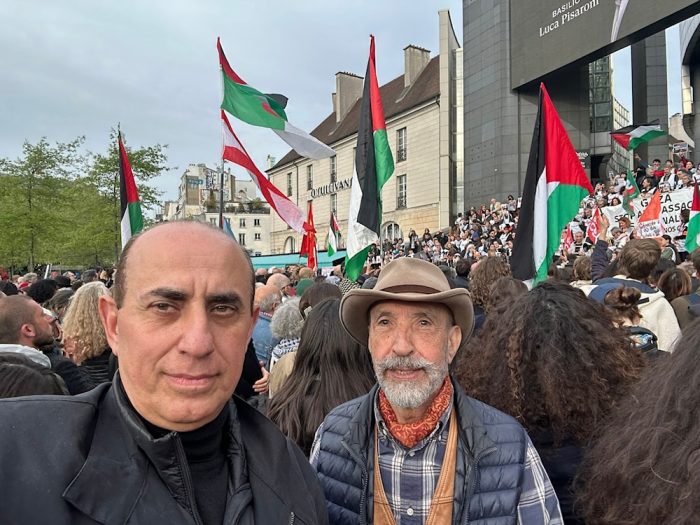
British border authorities detained Palestinian-British academic Professor Makram Khoury-Machool on Friday evening upon his return from Paris to London, subjecting him to a four-hour interrogation under the UK’s 2019 “Counter-Terrorism and Border Security Act.”
Devices seized, personal belongings searched
During the investigation, British police confiscated Professor Khoury-Machool’s mobile phone and personal laptop, thoroughly searching all his belongings, including identification and credit cards. No formal charges were presented, raising concerns over the basis and implications of the detention.
Authorities also took his fingerprints, captured multi-angle photographs, and collected DNA samples from inside his mouth.
No official clarification yet
UK border police indicated that they may contact Professor Khoury-Machool again within the next seven days. So far, no official statement has been issued to explain the reasons behind his detention or the content of the interrogation.
The incident occurred in the presence of his 8-year-old son, who witnessed the extended questioning and detention of his father until midnight on Good Friday.
Professor Khoury-Machool, who is of Palestinian origin, is a well-known intellectual and media figure. His recent public activity includes participation in a pro-Gaza demonstration in Paris on April 16, 2025, where he shared a photo of himself at the event via his X account.
Interpol rejects ‘red notice’ for Polish MP who sought asylum in Hungary

Marcin Romanowski’s arrest (Source: X@Magda Grajnert, RMF, video picture grab).
Remix News | April 22, 2025
Marcin Romanowski, former deputy minister of justice and PiS MP, will not be covered by Interpol’s red notice. According to Salon24, notwithstanding an earlier request to supplement its file on Romanowski, Interpol rejected the application of the Polish prosecutor’s office for a red notice.
The Polish MP is suspected of participation in an organized criminal group and defrauding Poland’s Justice Fund, accusations he has denied. He was granted asylum in Hungary in December last year, with Prime Minister Viktor Orbán saying, “This is a legal process, not a political decision.”
Hungary, however, in its decision stated that it had found evidence that the charges against Romanowski were politically motivated, enough to determine he would not stand a fair trial in Poland. This marked the first time an EU member state offered asylum to a Polish politician since the fall of communism.
The MP had been arrested in July but was released due to his immunity as a member of the Council of Europe’s Parliamentary Assembly. The current justice minister, Adam Bodnar, then called on the Parliamentary Assembly of the Council of Europe (PACE) to revoke Romanowski’s immunity, which it did in October.
Although rulings by both a district and regional court in Poland subsequently upheld his immunity, Romanowski is wanted by Polish authorities, with a European Arrest Warrant and a European Investigation Order both issued against him.
Failing to secure a red notice from Interpol, the Polish government says it is pursuing other options.
A red notice is given to criminals classified as the most dangerous. Only four wanted Poles have such a designation so far: Kamil Żyła, wanted for the murder of a TVN journalist in the Silesian Park in Chorzów in 2022; Jakub Jakus, accused of participating in the terrorist organization ISIS, illegal possession of weapons and theft of documents; Krzysztof Pomorski, wanted for distributing child pornography; and Rafał Zabłocki, listed on the Interpol list for serious crimes.
Where have Europe’s pacifists gone – the ones who once opposed NATO?

By Sonja van den Ende | Strategic Culture Foundation | April 22, 2025
Where are they now—Europe’s pacifists? Why do they no longer gather in Belgium, in Brussels, NATO’s headquarters, where large demonstrations against the alliance once took place? These protests, led by pacifists, denounced NATO, war, militarization, and nuclear arms.
The Belgian newspaper Le Soir recently posed an intriguing question: Why have the pacifists vanished? “The arms race has begun,” the article argues. “Like its European neighbors, Belgium is preparing to significantly increase military spending this year—without facing any opposition.”
“We keep our word,” declares Francken, Belgium’s former Defense Minister. “Belgium will become a solidary ally with extra defense budgets for personnel, equipment, and infrastructure.” He claims the spending will also boost jobs and innovation. Belgium, after all, is a NATO founding member, alongside the Netherlands.
Some Belgian (former) pacifists have reacted sharply to the government’s plans: “Retirees must accept lower pensions, unemployment benefits are being slashed, the sick languish in poverty, nurses earn less and work longer for diminished pensions, hospitals lose subsidies—all to enrich that corrupt Zelensky gang in Kiev.” The same measures, they note, are being imposed in the Netherlands.
But as the article points out, criticizing NATO now invites ridicule. Or does it go further than mockery? Across Western Europe—Belgium, the Netherlands, Germany—and in the Baltic states and Poland, dissent is met with more than scorn. People are arrested, elections are overturned, and societies drift toward totalitarianism—or worse, a resurgence of militarism and fascism unseen since 1945.
Europeans once insisted America should not meddle in their affairs. But it’s too late for that. EU governments, radicalized by waning U.S. interest in Europe, have already been co-opted. They should have spoken up years ago, when it became clear Europe was being used to wage wars in distant lands its citizens barely knew. Instead, they absorbed refugees (often unwillingly) and fell under what some call American colonization.
Yet America wasn’t entirely wrong. In Munich last February, Vice President J.D. Vance called Europe a “totalitarian society,” singling out Germany. I can confirm his assessment was accurate—but it barely scratched the surface. The reality is far worse and deteriorating daily.
Consider these examples:
- A 16-year-old German girl was expelled from school by police for posting a pro-AfD TikTok video featuring the Smurfs (the right-wing party’s color is blue).
- An AfD politician was fined for stating that migrants commit more gang rapes than German citizens. (The court didn’t dispute her facts but ruled they incited hatred.)
Germany once had a robust pacifist movement. In the 1970s and 80s, activists—many from what is now the Green Party (Bündnis 90/Die Grünen)—protested NATO and nuclear weapons. Today, those same Greens, led by Annalena Baerbock and Robert Habeck, champion war and arms shipments.
Their party program declares Germany must lead Europe, offering a “global counterweight” to China and Russia. The anti-war, anti-NATO movement has been absorbed into a party now pushing for war—especially against Russia, as Baerbock’s rhetoric makes clear.
Or take a 2023 case where the EU’s High Representative expressed concern over “extrajudicial sentences against Serbs” who protested NATO in Kosovska Mitrovica. Kosovo’s Foreign Minister defended the arrests, claiming police had “clear evidence” the demonstrators participated in an “attack on NATO.”
So where have Europe’s pacifists gone—the ones who marched against war, militarization, and nuclear arms for decades? The Friedrich Naumann Foundation (banned in Russia) claims to have the answer. In an article, they declare: “The end of pacifism (as heard in a Bundestag debate) was historic. Hopefully, it marks the end of a moral and political error.”
Has pacifism become a “political mistake”? Millions who oppose war have been misled for years by their own politicians—like the Greens, who traded peace for militarism. The world is upside down, yet Europe’s docile masses seem content as their pensions fund weapons.
New Eastern Europe takes it further, arguing “Pacifism kills.” The outlet claims: “The problem isn’t pacifism itself, but its manipulation for purposes contrary to its ideals. While pacifist appeals to Russia (the aggressor) are justified, targeting Ukraine or both sides aids Moscow.”
In short: Pacifism helps Russia. The “hippies” of the 1960s live in a fantasy where peace is impossible, Russia is the villain, and Europe must defeat it. The campaign against pacifism mirrors the EU’s push for militarization.
Europe is silencing pacifists—and dissidents—just as pre-WWII Germany did under fascism. New laws are emerging. In Germany, the proposed CDU/CSU-SPD coalition plans to “fight lies,” per their “Culture and Media“ working group. If you “lie” by government standards—say, by advocating peace with Russia or denying its “aggression”—you risk jail, fines, or online erasure.
“The deliberate spread of false claims isn’t covered by free speech,” they assert.
Le Soir asked: Where are the pacifists? They’re still here—for now. But once Germany’s new government takes power, once the digital ID and CBDC (mandatory across Europe) launch this October, protests—online or in streets—will be surveilled. Small demonstrations in Germany and Amsterdam show resistance lingers. But soon, fear will silence them: fear for jobs, pensions, benefits, even children.
Because CBDC and Digital ID mean governments can monitor “fake news” and freeze dissenters’ funds. Europe is birthing the very totalitarianism it accuses Russia, China, or America of. Militarization, fascism’s revival—all while Europeans dread a war that isn’t theirs, yet one their leaders enable.
Facing Prison Time in Germany for Criticizing an Israeli Journalist: The Case of Hüseyin Dogru
By Alan MacLeod – MintPressNews – April 20, 2025
Amid a crackdown on pro-Palestine voices in Germany, a journalist regularly attacked as a Russian operative is facing up to three years in prison for defamation of an Israel-based journalist. Hüseyin Dogru, founder of red. media, has been charged with defamation for actions relating to a spat with Nicholas Potter, a German state-funded reporter working for the Israeli outlet, The Jerusalem Post.
In December, Potter, a self-styled counter-extremism expert, published a lengthy exposé in The Jerusalem Post, claiming that red. media, MintPress News, and The Grayzone were part of a network of far-left outlets promoting extremism and anti-Semitic conspiracy theories.
Worse still, he strongly insinuated that all three were promoted and funded by the governments of Russia, Syria, and Iran.
The charges are false (see MintPress’ rebuttal here), and are particularly ironic, coming as they do from a journalist who is funded by the German Foreign Office. One who, amid a genocide, moved to Israel to work for an outlet headed by a former Israeli Defense Forces spokesperson.
Moreover, Potter himself arguably holds extreme views on the subject. Just weeks after attacking us for our journalism, he penned an article titled “Can Journalists Be Terrorists,” which attempted to justify many of Israel’s killings of Palestinian media workers.
Both red. and MintPress immediately highlighted much of this important context, and our content went viral.
From Viral Criticism to Criminal Charges
A sticker about Potter, based on a red. media graphic, was spotted in Berlin. The sticker took the outlet’s criticism of him, and plastered the phrase, “The German Hurensohn” — “The German Son of a Bitch” — over the top. That sticker is the centerpiece of the prosecution’s allegation of a coordinated “hate campaign” against Potter led by red. media. Potter claims that he has suffered harassment and threats to his life, and some have tried to link this back to red. media’s graphic.
The accusations provoked a storm of articles in German media, all supportive of Potter. Many echoed U.S. Secretary of State Antony Blinken’s claims that red. media is a Russian government-controlled influence operation.

A red. media post criticizing journalist Nicholas Potter, left, appears as a modified sticker in Germany, right. Photo provided to MintPress
Dogru denies these allegations, although he was previously a key part of Red Fish, a platform financed by Ruptly, a Germany-based outlet partially funded by the Russian state-controlled network, RT. After the Russian invasion of Ukraine in 2022, Dogru closed Red Fish and started his own independent outlet. He insists it has no connection to Russia and is dedicated to making revolutionary and educational content. He also denies having any information or involvement in producing anti-Potter stickers.
Germany Criminalized Palestinian Solidarity
Potter’s support for Israeli policies has certainly drawn the ire of many in the pro-Palestine movement in Germany. Yet he is far from alone. The German government has offered its full support to Israel and has gone so far as to ban pro-Palestine demonstrations and lock up countless activists, including Jewish people. The phrase “From the River to the Sea” has effectively been criminalized, with Berlin announcing that it would deny citizenship to anyone using it. New German citizenship laws require all applicants to sign what is, in effect, a loyalty oath to the State of Israel, declaring that it has a “right to exist.”
Berlin is currently deporting foreign residents for their participation in lawful protests supporting Palestinian rights. Dogru’s legal team has advised him that his wife and son could be deported as well.
Commentators have warned that, with these actions, Germany is lurching towards the authoritarian right. With the far-right AfD Party surging in the polls (a recent survey found they are now the most popular party in Germany), many inside the country are ringing the alarm bells.
“For decades, Germany has stuck with Israel and its narratives in the Middle East,” Dogru told MintPress, adding: “Since October 7, we see that the German government is violently repressing activists to make sure there are no voices in Germany critical of Israel. Activists here have paid a high price to make sure that they can protest.”
According to Dogru, this is a test case. Ultimately, the suppression of speech is not about Israel, but an attack on its own society.
Germany is preparing to assert itself as a leading military and political force in NATO and the EU. To do that, it must eliminate resistance — not just abroad, but at home. This isn’t driven by historical guilt or solidarity. It’s about silencing dissent and disciplining society. By targeting the most marginalized, the German state is disciplining its population — silencing opposition before it grows.”
The message from the German government is clear, Dogru claims: “fall in line, or be crushed.”
Microsoft Broadens Always-Watching AI-Powered Recall Tool That Logs and Indexes User Activity
A built-in memory machine disguised as convenience, Recall quietly turns every moment at your keyboard into searchable history.
By Ken Macon | Reclaim The Net | April 19, 2025
Microsoft’s renewed push to roll out Recall, an AI-powered feature in Windows 11 that automatically logs user activity every few seconds, is reigniting deep concerns among those focused on digital privacy and personal security.
Initially paused following a storm of backlash last year, Recall has quietly returned in a preview version of Windows 11 (Build 26100.3902), now available to select testers. The tool takes snapshots of a user’s screen at regular intervals and creates a searchable timeline of everything from app usage to websites visited and documents accessed. While Microsoft pitches this as a convenience tool, privacy advocates see a surveillance mechanism in disguise.
The company claims the tool is safe. It requires users to opt in and enroll in Windows Hello to access stored snapshots. Microsoft describes the feature as a way to “quickly find and get back to any app, website, image, or document just by describing its content.” Users, the company says, can pause recording and choose what is saved.
But these assurances fall flat for those warning about the broader consequences. The fact that Recall is opt-in does not prevent the exposure of data from people who never enabled it. If someone with Recall turned on receives a private photo, message, or sensitive document, it will be silently captured, analyzed, and indexed by the tool, regardless of the sender’s intent or privacy tools used.
The feature’s ability to store and catalog data so comprehensively opens up a host of legal, security, and ethical issues. Lawyers, governments, and spyware operators would gain an unprecedented level of access to a user’s digital life; not through brute force or phishing, but through a built-in tool that essentially creates a time-lapse of computer activity.
For those wary of the increasing creep of AI into daily computing, Recall has become a textbook case. Critics have framed it as part of a larger trend where companies inject AI features into existing platforms not to serve users, but to drive engagement, data collection, or lock-in.
From Ms. Rachel To Anti-War College Students: The End Of American Free Speech
By Robert Inlakesh | Palestine Chronicle | April 19, 2025
Working together with the most powerful government in the world, Zionist organizations are smearing and persecuting anyone who expresses sympathy with Palestinians, subjected to a genocide subsidized with their own tax dollars. From the media to academia, American free speech rights are being stripped.
Fulfilling an agenda laid out in a 33-page document named “Project Esther”, published in October of last year by the Heritage Foundation, the US government is teaming up with extremist elements of the Zionist Lobby to crush criticism of Israel.
From its recommendations to form a federal task force to combat alleged antisemitism, which is really just criticism of the Israeli government, to its strategy to tear down leading academic institutions, the plan is being followed.
The Heritage Foundation, most well-known for its “Project 2025”, is known to possess considerable influence on the Trump White House. Yet, despite its obvious influence and policy recommendations that are being followed, almost down to the letter, there has been little connection drawn between these think-tank documents and Donald Trump’s anti-free speech crusade.
It is evident, however, that the Democratic Party also presided over the greatest assault on academic freedom in American history, placing itself in line with the Zionist Lobby, which is why it makes sense that there is no incentive from Democrat-aligned media to give light to this topic. Although the situation has only grown more dire for free speech rights, particularly on college campuses, since the departure of former President Joe Biden.
Uncharted Waters
Under the Trump administration, it started to become clear with the detention of Mahmoud Khalil that we were entering uncharted waters. The mere fact that a Green-Card holder, accused of no crime, and who is married to an American citizen, was snatched in the night by plain-clothed ICE officers, who ferried him off from New York to Louisiana, was a tell-tale sign of things to come.
Thereafter, things only grew worse. Zionist student groups and racist extremist organizations have worked to put together lists of completely peaceful, law-abiding individuals who are set to be targeted by federal security agencies.
Claiming persecution themselves, these groups hide behind the cloak of being offended by anti-war protests, in order to work with the state to see their political opposition suppressed by force.
Yet, the crackdown has not been limited to students/former students. Instead, this campaign that aims to trample on the First Amendment rights as they are laid out in the US Constitution is beginning to empower pro-Israel extremists.
Weaponizing the claims of antisemitism and claiming that their targets are “Hamas supporters”, these organizations no longer are required to even present evidence for their allegations.
The Case of Ms. Rachel
This lack of any proof for the claims being made was no more evident than in the case of Ms. Rachel, a popular children’s entertainer.
A pro-Israel organization known as “Stopantisemitism” decided to accuse Ms. Rachel of spreading Hamas propaganda and requested the US government investigate whether she is receiving foreign funding.
Ms. Rachel has not commented on any of the political dynamics concerning the genocide in Gaza, yet has long expressed her sympathies for Palestinian children suffering in the Gaza Strip, as well as the Israeli Bibas family. There is nothing even remotely antisemitic about her posts on the topic, nor do they have anything to do with Hamas.
Yet, the US government appears to have reached the same point Israel has, where an accusation that someone is affiliated with Hamas needs no evidence to corroborate it before action is taken.
In Israel’s case, the action taken is the detention, torture, and/or murder of that individual, whereas in the United States, it can come in the form of detention or legal battles for now.
This assault on free speech is being carried out against media outlets also, using similar tactics of providing baseless claims regarding collaboration with Hamas, and even on behalf of Israeli citizens filing their cases in US courts to take down registered not-for-profit organizations.
Featured Video

Bombing Hitler’s Hometown
or go to
Aletho News Archives – Video-Images
From the Archives
The Biggest Threat to Peace in Middle East
By Dr. Elias Akleh* | Sabbah Report | May 24, 2010
A build up of heightened tension in the Middle East is escalating in the last few weeks. American and Israeli postures towards Lebanon, Syria, and Iran have become more threatening. Listening to speeches of political leaders one hears talks only about war not peace. Iranians and Israelis are continuously training hard for a possible showdown. Both sides are conducting extensive war games every month. This led Syrians to claim that Israel is preparing for a soon-to-come another war. The Jordanians also are warning that current stalemate of the peace process is an indication of a war breaking out this summer. The Russian President and his army chief hinted, a few months ago, that the US and Israel were planning for an attack on Iran.
Indeed Iran is, as it has been for last few years, the target of most of the threats and accusations of supporting terrorism. Escalating incitement against Iran the American Defense Department sent last month (April) to Congress a report on Iran’s military claiming Iran could develop intercontinental ballistic missiles capable of reaching the US by 2015.
Ignoring the fact that N. Korea, India, Pakistan, and Israel are proven to have nuclear weapons while Iran does not, the US Secretary of State Hillary Clinton chose in her speech, to the nuclear Non-Proliferation Treaty review conference at the UN, to focus on Iran’s alleged nuclear ambitions putting the whole world at risk as she put it. According to Clinton Iran’s acquisition of nuclear weapons, rather than Israel’s more than 200 nuclear bombs, is destabilizing the Middle East. She called on the world’s nations to rally around US efforts to hold Iran, not other nuclear countries, to account.
The accusation that Usama Bin Laden is living comfortably in Iran had received a boost after the broadcast of a documentary called “Feathered Cocaine”. This echoed the June 2003 claims of the Italian newspaper Corre de la Sierra that Bin Laden was in Iran according to some intelligence report, and according to Richard Miniter’s book “Shadow War”. … continue
Blog Roll
 Aletho News
- Bombing Hitler’s Hometown
- German journalist threatened with homelessness as German court upholds EU sanctions in landmark free speech case
- US Tells Allies That Ukraine-Bound Arms Could be Sent to Middle East
- Organized terrorism: Iran condemns killing of its diplomats in Lebanon
- Why could Gaza enter the regional war?
- Hamas official rejects Mladenov Plan linking disarmament to Gaza reconstruction
- Two Primary Elections for the Soul of ‘America First’
- Japan Clings to US Vassalage Despite Energy Crunch Caused By Iran War
- US Seeks Control Over Global Energy Infrastructure – Kremlin
- US senators target Orban government for standing up to Zelensky
- If Americans Knew
- Researchers at Human Rights Watch Resign Over Blocked Report on Palestinian Refugee Return
- Jewish Groups Are Backing a War Americans Don’t Want
- Eric Fingerhut Thinks He’s the President of the Jews
- Top Jewish Philanthropists, Rabbis Urge Israeli President to Take Action Against ‘Jewish Extremists’
- Don’t Be Fooled. Zionist Leaders Have Always Wanted to Control Southern Lebanon
- Israel’s widespread use of torture is a core element of its genocide against the Palestinian people
- In Israel’s War on Iran, Many Middle East US Bases Rendered “All But Uninhabitable”
- ‘Burn the lawn’: Israel pursues ‘Rafah model’ in southern Lebanon
- A genocide here, an amputation there
- Reports: Iran mobilizing 1M fighters, Israel-US run low on ammo, Israeli army faces shortage – Not a ceasefire Day 168
- No Tricks Zone
- Devastating Assessment Of Comirnaty Vaccine By Former Senior Pfizer Europe Toxicologist
- New Study: CO2 Is ‘Effectively Negligible’ As An Explanatory Climate Change Factor Since 2000
- Former Pfizer Toxicologist Dr. Helmut Sterz Tells Bundestag Hearing Pfizer Vaccine Should Have Never Been Approved
- Energy Expert: Germany’s Nuclear Phaseout Was A “500 Billion Euro Mistake”
- New Research: South Australia’s Mid-Holocene Sea Surface Temperatures Were 4°C Warmer Than Today
- Storing Green Energy To Last Germany 10 Days Would Require A 60-Million Tonne Battery
- New Studies: UK Sea Levels Were 4 Meters Higher Than Today During The Mid-Holocene
- Destructive Green New Deal: German Energy And Metal Group Warns Of Drastic Crisis
- New Study Documents A 20-Year Pause In Arctic Sea Ice Decline – Driven By Internal Variability
- Wake-up Call: Survey Shows Majority Of Germans Now Favor Postponing Climate Targets!
 Aletho News