CIA, Israel and conspiracy theories: What to expect from the JFK files
RT | January 28, 2025
US President Donald Trump has ordered the declassification of all remaining withheld records pertaining to the assassination of President John F. Kennedy. Almost 5,000 documents are still veiled in secrecy.
Kennedy was killed in November 1963, while visiting Dallas, Texas. A congressional commission chaired by Supreme Court Justice Earl Warren concluded in 1964 that “lone gunman” Lee Harvey Oswald was to blame. The CIA coined the pejorative term “conspiracy theory” to describe alternate scenarios regarding JFK’s death, which has not stopped many Americans from doubting the Warren Commission’s conclusions.
Trump’s order also applies to the remaining classified records about the 1968 assassinations of Senator Robert F. Kennedy and civil rights campaigner Reverend Martin Luther King Jr.
How many documents are there?
The National Archives and Records Administration (NARA) says it has declassified 99% of some 320,000 documents related to the JFK assassination, as required by a law passed by Congress in 1992. The final deadline for declassification was October 2017, but the US intelligence community claimed it needed more time to review and redact the records.
According to multiple estimates, 2,140 documents remain fully or partially redacted, while another 2,500 records have been kept secret for other reasons, such as court orders or donor restrictions.
What is in the secret files?
One item of particular interest is a June 1961 memorandum written by White House adviser Arthur Schlesinger, outlining how JFK could accomplish his goal of “splintering the Agency [CIA] into a thousand pieces and scattering it to the winds.” One page is redacted in full, while two more have partial redactions. Kennedy was frustrated with the CIA after the botched invasion of Cuba at the Bay of Pigs in April that year.
Another partially redacted record is the transcript of the testimony that CIA Counterintelligence Chief James Jesus Angleton gave to the Church Committee in January 1976. Some scholars believe Angleton, who ran the CIA’s Israel desk for years and was a friend of Soviet spy Kim Philby, had lied to Congress about Israel obtaining nuclear weapons in the 1960s – something the Jewish State has neither confirmed nor denied.
Other potentially revealing records relate to CIA surveillance activities in Mexico in the early 1960s, when Oswald visited the country, and the work of a CIA officer with Cuban exiles in Miami that intersected with Oswald.
What can be expected of the revelations?
Historians and researchers that have spoken to major US outlets seem to agree that there will be no “smoking gun” in the remaining documents.
“There will be some puzzle pieces that will be put back in that will tell a more robust and rich story,” Tom Samoluk, a board member of the JFK Library Foundation, has told CNN.
Journalist Gerald Posner has warned that “anybody waiting for a smoking gun that’s going to turn this case upside down will be sorely disappointed.”
Kennedy’s nephew Robert F. Kennedy Jr. has lauded the declassification as a step against the “60-year strategy of lies and secrecy, disinformation, censorship, and defamation” used by the intelligence agencies to suppress “troubling facts” about the JFK assassination. He claimed that this “provided the playbook for a series of subsequent crises – the MLK and RFK assassinations, Vietnam, 9/11, the Iraq war and COVID – that have each accelerated the subversion of our exemplary democracy by the Military/Medical Industrial Complex.”
RFK Jr. has said that he believes there is “overwhelming evidence” tying the CIA to the assassination of both his uncle and his father.
When can we expect the release?
Trump’s executive order gave the US Director of National Intelligence and the Attorney General 45 days to review the records and “present a plan” for their full and complete release. Both offices are currently held by acting officials, as the Senate still needs to confirm Pam Bondi as the attorney general and Tulsi Gabbard as the DNI.
“We’re hoping this is going to be a mechanical plan,” Larry Schnapf, a New York-based attorney who has sued the government to compel the release of JFK files, told ABC News. If the government opts for a “substantive” review, going document-by-document, “it’s going to be a while,” he added.
Klaus Schwab Labels “Misinformation” a “Critical Challenge,” Urges Elites to Develop Solutions

By Didi Rankovic | Reclaim The Net | January 27, 2025
WEF Founder and Chairman of the Board of Trustees Klaus Schwab has spoken at this year’s event in Davos to reiterate the globalist group’s recently revealed priority targets.
A report published ahead of the gathering elevated “misinformation and disinformation” among the world’s top critical challenges and risks (others being armed conflicts, and climate-related issues).
Now, Schwab made sure to repeat that point in front of an audience of powerful elite members from around the world.
At the same time, he urged them to be the ones that will come up with “practical steps” that would deal with what the WEF has decided are “critical real-world challenges.”
Schwab opened with a warning that tech innovations, including AI, are ushering in what the WEF dubs “the intelligent age,” then swiftly went from praising that for economic and other potentials to warnings about the developments representing “unprecedented risks for humanity.”
Schwab’s intent here seems to be to drum up support for the “keyword” of this year’s event – “collaboration.” Namely, for tackling those “critical challenges” in a way that will always promote a globalist approach.
To this point, the WEF founder remarked that he was addressing 3,000 people from the world of politics, media, business, civil society, etc., whom he referred to as decision-makers – and whom he reminded that “commitment and engagement of all stakeholders of global society” are needed to, essentially, keep the goings-on in the upcoming “intelligent age” under control.
The rhetoric Schwab chose at times comes across as extraordinarily outlandish – such as suggesting that those gathered in Davos are there to come together around their “common mission” that should result in no less than “improving the state of the world.”
And Schwab doesn’t want those in his audience to “simply” deal with the challenges he presented, which he blames for “erosion of hope and confidence” – but also act proactively, so as to be the ones in control of how the world develops, and do this “in strategic, innovative, and constructive ways.”
Schwab’s opening address, other than appearing to attempt to create a sense of urgency and encourage the elites that everyone’s future is still in their hands, did not go into the specifics of how to deal with “the foremost risks” – like “misinformation.”
But there’s little doubt this will resurface during WEF’s many panels.
WEF 2025: Calls for Tighter Social Media Censorship to Combat Antisemitism

By Cindy Harper | Reclaim The Net | January 27, 2025
At the 2025 World Economic Forum (WEF) Annual Meeting, a session titled “Confronting Antisemitism Amid Polarization” featured prominent speakers who advocated for stronger measures to compel social media platforms to censor content they consider harmful. Jonathan Greenblatt, CEO and National Director of the Anti-Defamation League (ADL); Randi Weingarten, President of the American Federation of Teachers (AFT); and Jennifer Schenker, Founder and Editor-in-Chief of The Innovator, expressed concerns about the influence of platforms like TikTok, X (formerly Twitter), and Facebook on public discourse and the spread of antisemitism.
Jennifer Schenker set the tone for the discussion by claiming, “The flames of antisemitism are being fanned every second by TikTok and social media,” and lamenting that “the Jewish community has not been able to effectively combat that online.”
Jonathan Greenblatt labeled social media platforms “a super spreader of antisemitism and hate” and criticized their impact on younger audiences, stating, “Young people… get their news from TikTok, which is fairly terrifying, or from X or from Instagram.” He also called Meta “a gigantic problem,” highlighting the challenges posed by the platforms’ size, business models, and governance structures.
Greenblatt further criticized Section 230 of the Communications Decency Act (CDA), describing it as “a loophole… which exempts [social media companies] from liability.” He called for regulatory and reputational pressure to compel these companies to act, suggesting that social pressure could deter top engineers from working for platforms perceived as unethical: “If their engineers feel like going to these companies and participating in something, you know, an evil enterprise, if you will, they don’t wanna do that.”
Randi Weingarten shared examples of how the AFT has used its influence to pressure social media platforms. “We have used the economic power sometimes against a place like Facebook or others to say, actually, you have to stand with what is moral and what is legal,” she said, acknowledging the union’s role in leveraging pension funds and other economic tools to advocate for what they consider the fight against hate.
Weingarten also expressed concerns over the influence of social media on young people’s perceptions of the Israel Defense Forces (IDF). Recounting interactions with high school students in Boston, she noted that “every question [they asked] because of what they see and what they’re on” focused on the actions of the IDF, implying that platforms like TikTok and X should be more active in censoring such content.
Greenblatt emphasized the need for a broader coalition to address antisemitism, stating, “The Jewish community needs to recognize we can’t do it alone. We need institutions like government… and individuals, non-Jews, to realize antisemitism isn’t just a Jewish problem, it’s everyone’s problem.”
Weingarten echoed this sentiment, advocating for grassroots efforts to build understanding and combat hate: “There has to be a way that good people of the world end up fighting against hate.”
Donald Trump Is Protecting Free Speech
By Norman Singleton | The Libertarian Institute | January 27, 2025
Donald Trump wasted no time implementing his agenda by issuing a series of executive orders just hours after being sworn in as the 47th president. The orders covered subjects ranging from immigration, to energy production, to a freeze on both new federal regulations and hiring federal employees. One order that has not gotten nearly as much attention as it deserves is the one Restoring Freedom of Speech and Ending Federal Censorship. This order states that it is federal policy to “ensure that no Federal Government officer, employee, or agent engages in or facilitates any conduct that would unconstitutionally abridge the free speech of any American citizen.” It also requires the government to “ensure that no taxpayer resources” are used to “violate the First Amendment rights of American citizens.”
In order to carry out these pro-free speech policies, the order states that “no federal department, agency, entity, officer, employee, or agent may act or use any Federal resources” to violate the First Amendment rights of any American citizen. It also directs the Attorney General to work with “the heads of other executive agencies and departments” to investigate “the activities of the Federal Government over the last 4 years that are inconsistent” with the First Amendment. The Attorney General must then prepare a report for President Trump and his Chief of Policy that contains recommendations for “remedial actions for any violations of the First Amendment taken by the prior Administration.”
The explicit prohibition on federal officials violating the First Amendment may seem redundant since federal employees already take an oath to uphold the Constitution; thus they swore not to violate American citizens’ constitutionally protected rights. However, Biden administration officials, including the big guy, routinely violated the free speech rights of American citizens. As federal Judge Terry A. Doughty wrote in a July 4, 2023 preliminary injunction forbidding government officials from having any contact with social media companies, “the present case arguably involves the most massive attack against free speech in United States history.”
Leaked emails between officials and employees of social media companies back up Judge Doughty’s statement. The communications went beyond mere suggestions, constitutng threats of retribution if the social media companies did not comply with the administration’s “requests” that they censor their customers. For example, then-Surgeon General Vivek Murthy suggested that the administration may have to take “appropriate legal and regulatory” measures to stop the spread of COVID “misinformation.” Facebook creator and CEO of Meta (parent company of Facebook, Instagram, and Whats App) Mark Zuckerberg, while appearing on the popular Joe Rogan Show described how Biden officials “would call up our team and, like, scream at them and curse.” Zuckerberg also told Joe Rogan that Biden administration officials brought up the possibility that the White House would support imposing new regulations on social media platforms, including modifying Section 230 of the 1996 Communications Decency Act.
This is the section of federal law that protects those who run online platforms like Facebook and Twitter/X from being held liable for the posts their users make. Section 230 has been instrumental in the growth of social media. Repealing or weakening Section 230 would hurt the big companies but the main victims would be small and start up companies who would find it more difficult to attract investors if there were the possibility the company could be held liable for posts by the site’s users. Government employees threatening private companies and treating them like subordinates should be unacceptable in a free society—and should be criminalized if done to coerce the companies to violate their customers’ constitutionally protected rights.
Fortunately, at least one cabinet member, Secretary of Homeland Security Kristi Noem, has pledged to cooperate in an investigation into the Biden administration’s assault on free speech. When government officials pressure private social media companies to take down or suspend posts they violate the First Amendment just as much as if they had directly blocked the posts. Therefore, all who value free speech should be grateful to President Trump for his executive order stopping government officials from violating the First Amendment and trying to discover the full truth about the Biden administration’s efforts to silence those using social media to post “unapproved” news and opinions. Hopefully, Congress will ensure no future administration can reverse President Trump’s executive order by passing legislation forbidding federal employees from “suggesting” that social media companies censor American citizens.
Germany: Berlin needs emergency loans after migrants blow €500 million hole in city’s budget
Refugees have cost Berlin billions and that is only one German city
Remix News | January 27, 2025
Despite claims that migrants are going to fund the entire West and save pensions with all the tax funds they generate, reality is once again encroaching. Now, the Berlin Senate is preparing emergency loans to cover refugee costs at a time when Berlin is cutting services, including for schools, due to increasingly dire budget shortfalls.
Notably, a Christian Democrat (CDU), Kai Wegner, is the mayor of Berlin, but under his leadership, not much has changed from the previous left-wing government. Berlin’s Finance Senator Stafan Evers, also of the CDU, is reportedly preparing efforts to provide an emergency loan to cover the cost of refugees.
One of the problems is that Berlin has a debt brake that keeps the city from taking on further debt, but the government says it has the legal ability to make an exception.
In 2025, Berlin indicates it will cost €500 million to accommodate migrants. Remix News has reported on the soaring costs of housing migrants in Berlin in recent years. In 2023, it cost Berlin nearly €500 million a year to house migrants, which equals €1.5 million a day. Recently, there has been a push to convert massive buildings into refugee housing, which would cost Berlin hundreds of millions over the next decade just for one building.
Notably, Berlin already froze school budgets in 2024, but these budget cuts are not enough. The figure of €500 million also does not factor in other costs, such as education, integration efforts, and policing.
The report from the CDU, prepared in conjunction with its coalition partners, the Social Democrats (SPD), has not been yet made public, according to Tagesspiegel.
Berlin took in 21,000 fewer refugees last year than in 2022, when 32,752 refugees arrived, mostly due to an extreme shortage of housing. Currently, 41,000 people live in accommodations run by the State Office for Refugee Affairs.
In all likelihood, the solution will be more debt and more spending, with Berlin ready to declare an emergency to make up for the shortfalls.
On the federal level, the situation may be even more dire, with nearly €50 billion spent on migrants in 2023. Across Germany and much of the Western world, immigration is not only fueling a debt crisis, but it is also a major factor in skyrocketing housing prices.
On top of the millions of poor newcomers who need housing is also the role of foreign investors, who are buying up property across the West. The issue has gotten so dire that even those on opposite sides of the political spectrum, such as Spanish PM Pedro Sanchez and former Czech PM Andrej Babiš are proposing massive taxes on foreign buyers of property in their countries.
Christian church to change name in bid to fight off EU state’s crackdown
RT | January 26, 2025
The Estonian Orthodox Church (EOC) will change its name in response to the pressure from the authorities to sever its historical ties with Russia.
The announcement comes after the Estonian government approved draft legislation requiring religious organizations to cut ties with foreign leaders and entities whose actions could be deemed a threat to national security. “There should be no connection to entities that support military aggression,” Interior Minister Lauri Laanemets said on Thursday.
The EOC is a self-governing church that has maintained canonical ties to the Russian Orthodox Church. In a statement on Friday, EOC said that it will change its name to the Estonian Christian Orthodox Church.
“The government-approved bill violates the freedom of religion and is directed against our church,” Bishop Daniel of Tartu said, adding that, if made into law, the legislation could “significantly restrict the activities of our church.”
He argued that the new name would “further highlight the church’s local identity and demonstrate that we are acting in accordance with the law and, at the same time, we are respecting the church canons.”
Most Estonians are not religious. Around 16% of the population are Orthodox Christians, and 8% are Lutherans, according to the government statistics. Estonia was part of the Soviet Union from 1940 to 1991. Around 27% of the country’s population are Russian-speakers.
Earlier this week, Laanemets branded EOC “the most important instrument of influence for Russia and the Kremlin in Estonia.”
Last year, the minister threatened to shut down monasteries that refuse to cut ties with the Moscow Patriarchate and even threatened to classify the Russian Orthodox Church as a terrorist organization.
Moscow Patriarchate spokesman Vladimir Legoyda has slammed Laanemets’ comments as a “witch hunt,” suggesting that the Estonian government was using the crackdown on the church to distract the taxpayers from “real issues.”
In August 2024, the EOC revised its charter and removed the mention of the Moscow Patriarchate from its official name, although Laanemets has insisted that the measure was insufficient.
EU officials have criticized the Russian Orthodox Church for its support of the Russian troops in Ukraine. In 2022, the UK imposed sanctions on the church’s head, Patriarch Kirill of Moscow.
South Korean Prosecutors Request Another Extension of President’s Detention
Sputnik – 25.01.2025
SEOUL – South Korea’s prosecutor’s office on Saturday requested another extension of President Yoon Suk-yeol’s detention after a Seoul court rejected their previous request, the Yonhap News Agency reported.
On Friday, the court dismissed the prosecutors’ request to extend Yoon’s detention until February 6. The court said that the prosecution, which received a request from South Korea’s Corruption Investigation Office for High-Ranking Officials (CIO) to initiate a criminal case against the president, lacked sufficient grounds to continue the investigation. In response, the president’s lawyers said that the court should disregard the CIO’s findings and reopen the investigation.
A new request to extend Yoon’s detention was filed at the Seoul Central District Court four hours after the court’s rejection, Yonhap said.
“In light of past cases in which prosecutors conducted supplementary investigations, including raids, over CIO-transferred cases, and regulations of the Criminal Procedure Act, prosecutors’ right to a supplementary probe is naturally recognized … Thus, there is a need for an extension of the detention period,” the prosecution was quoted by Yonhap as saying.
Yoon’s current detention ends on January 28, which coincides with the Lunar New Year, a public holiday in South Korea. To avoid delays, the prosecution plans to expedite the transfer of the case to court, where a suspect can be held for up to six months. As a result, Yoon’s interrogation may take place at the detention center over the weekend, as moving him to the prosecution’s building poses security challenges.
Given the seriousness of the charges against Yoon, he will be required to answer questions in person, as submitting written responses is not an option. It remains uncertain if he will cooperate, as he has previously refused to answer questions.
On December 3, 2024, Yoon declared martial law, claiming that the opposition was sympathizing with North Korea and plotting a “rebellion.” The parliament quickly voted to lift his declaration just hours later, which Yoon complied with, subsequently apologizing to the nation. On December 14, the South Korean parliament impeached Yoon over his controversial martial law declaration.
Harvard blocks Gaza patient session as university adopts controversial anti-Semitism definition
MEMO | January 24, 2025
Harvard Medical School has cancelled a planned lecture and panel discussion featuring patients from Gaza, following complaints that the session would present only one side of the conflict, amid growing concerns about academic freedom after the university’s adoption of a highly controversial definition of anti-Semitism which conflates criticism of Israel and the political ideology of Zionism with anti-Jewish racism.
According to the Harvard Crimson, the medical school’s Dean, George Q Daley, cancelled the 21 January events just hours before they were scheduled, citing objections that students would hear from Gazans receiving care in Boston without also hearing from Israeli perspectives. The session was to include a lecture on wartime healthcare by Tufts Professor Barry S. Levy, followed by discussions with Gaza patients and their families.
HMS and HSDM Student Council President Anna RP Mulhern said she was “deeply disheartened” by the cancellation. “Respect for all patients and their stories is a fundamental tenet of the medical profession. This principle was not upheld yesterday,” she stated.
The cancellation came shortly after Harvard agreed to adopt the highly controversial International Holocaust Remembrance Alliance (IHRA) definition of anti-Semitism as part of settling a discrimination lawsuit brought by Jewish students who claimed harassment during pro-Palestine protests. IHRA is favoured by Israel and advocates of the apartheid state as it grants special privileges to the political ideology of Zionism and apartheid state. No other political ideology or state is granted protection from criticism in the same way.
HMS Professor David S Jones, who helped develop the course curriculum, reported receiving 50 emails from students questioning the cancellation. He noted that Arabic-speaking medical students who had served as interpreters for Gazan patients in Boston had requested the session.
Critics argue the decision reflects a broader assault on academic freedom and free speech rights. Journalist Glenn Greenwald, discussing Harvard’s adoption of the IHRA definition, warned it represents “an outright systemic assault on the Free Speech rights of American citizens on the academic freedom that is supposed to prevail in our institutions of higher learning.”
Greenwald highlighted how the IHRA definition prohibits various forms of criticism of Israel that would be perfectly acceptable if directed at other nations. He noted that under these new rules, Harvard students remain free to describe any country, including the US, as fundamentally racist – except Israel. “You can say that the United States and its existence is a racist endeavour, that you’re allowed to say… nobody tries to censor that,” Greenwald explained.
Pick any country in the entire world at Harvard and you are totally free to call the existence of that country a racist endeavour except one country where you fall into the crime of hate speech and that is the state of Israel.
The combination of event cancellations and adoption of the IHRA definition has raised concerns about the chilling effect on academic discourse. Critics argue that medical education, which relies on hearing directly from patients about their experiences, could be particularly impacted if geopolitical considerations begin to override educational ones.
“This is nothing more than an outright systemic assault on the Free Speech rights of American citizens on the academic freedom that is supposed to prevail in our institutions of Higher Learning,” Greenwald concluded, arguing that such restrictions serve “not to protect our own country, our own culture, our own government, the security of our own people but to protect this foreign country.”
Australia Plans to Expand “Hate Speech” Laws Amid Debate Over Free Speech Protections
By Didi Rankovic | Reclaim The Net | January 22, 2025
Australian officials are doubling down on the policy of “strengthening” what they call hate speech laws both at the federal, and state levels – and some are even presenting the country’s weak free speech protections as an advantage.
New South Wales (NSW) Premier Chris Minns has promised that even more restrictive legislation to tackle whatever the state’s authorities decide is hate speech is coming soon. It seems that “strengthening” these laws will come down to criminalizing even more types of speech, by including vague categories like “vilification.”
Minns is justifying this policy by claiming that hate speech is behind later actual criminal activities, and he’s putting the emphasis on the goings-on in the “community” especially where it pertains to religious and racial strife, i.e, protecting “multiculturalism” and “cultural diversity” by means of repressing speech.
As for when New South Wales residents can look forward to the introduction of these legislative proposals, Minns revealed that it will “hopefully” happen when parliament returns (scheduled to happen in early February).
The broadening of these laws’ scope is particularly interesting in terms of the idea of adding (racial or religious) “vilification,” currently a civil offense.
And Minns chose an odd way to defend Australia’s lack of strong free speech protections – like those enjoyed by Americans. He said there was “a very good reason for that” – namely, that Australia is a country of immigrants coming from all over the world. So – just like the United States?
But Minns seems to suggest that “basic tenets of life” can only be protected if free speech is not.
Australian Housing Minister Clare O’Neil commented on these New South Wales plans to say that the federal government was “looking at anything” it could do to deal with antisemitism, which she described as a “growing problem.”
And while hate speech laws were already “strengthened” at the federal level last year, O’Neil said – by banning “hate symbols and antisemitic phrases and symbols” – the minister believes there is “more work to be done.
“We’ve got to do more. We’ve got the Australian Federal Police working with state police, we’ve got state governments really stepping up on this, and I think we’ve all got a really clear interest here,” O’Neil told journalists.
The Gaza Genocide: A New Low in Democracy and Human History
Germany’s Undemocratic Assaults
By Ricardo Martins – New Eastern Outlook – January 22, 2025
The genocide unfolding in Gaza continues to expose the inadequacies of the international judiciary, organizations, and, more importantly, the complicity of part of the global community of nations in enabling such atrocities.
Germany Taken to the ICJ for Complicity in Genocide
In March 2024, Nicaragua brought a case against Germany at the International Court of Justice (ICJ), accusing it of aiding and supporting genocide in Gaza by supplying arms to Israel, fully aware of the genocidal risks involved. Shockingly, the ICJ failed to condemn Germany.
Germany also maintains unwavering and unconditional political and diplomatic support for Israel. German Foreign Minister Annalena Baerbock displayed a cheerleader-like demeanor during her initial visit to support Israel after October 7—a stance echoed by European Commission President Ursula von der Leyen.
According to the Middle East Eye, Germany’s support for Israel’s actions highlights a hypocritical approach to international law and human rights. The analysis goes further: “No one can reasonably believe in the fairytale of Germany’s moral responsibility anymore, as the country defends, finances, arms, and diplomatically supports the genocide of Palestinians, in addition to the bombing of Lebanon, Yemen, and Syria, while shielding those responsible from accountability.”
Protests Against Israel Are Considered “Antisemitic” in Germany
With the Bundestag’s adoption last November of the resolution “Never again is now: Protecting, preserving, and strengthening Jewish life in Germany”, the country has entered a proto-fascistic state—without any condemnation from the European Union. Policymakers crafting this resolution refused input from diverse human rights groups and instead relied solely on the controversial International Holocaust Remembrance Alliance (IHRA) definition of antisemitism.
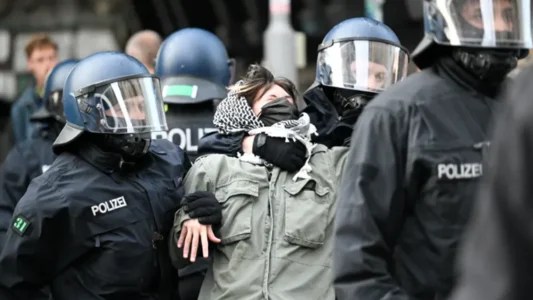
Even before this resolution, but now bolstered by it, Germany has witnessed a gradual erosion of democracy under its ‘proud guilty’ ideology. This includes prior censorship of cultural events partially or fully funded by public money, the cancellation of events featuring critics of Israel’s government, and even conferences discussing the Palestinian question. Concurrently, there has been a sharp rise in the smearing of critics with allegations of antisemitism. Make no mistake—censorship is alive and well in Germany. Protests critical of Israel’s actions in Gaza are being unjustly and undemocratically labelled as antisemitic.
Further, children can be banned from schools for wearing “pro-Palestinian symbols such as the keffiyeh,” as is written in a letter sent to school principals by Berlin’s education senator, Katharina Günther-Wünsch.
Furthermore, this resolution introduced a mandatory declaration for asylum seekers, requiring them to affirm the existence of the state of Israel and pledge not to participate in or support boycott campaigns against it.
Over the past month, German politicians have called for changing laws, including those around the right to demonstrate and freedom of opinion. The idea of withdrawing citizenship, residency, welfare benefits or funding from anyone accused of making anti-Semitic statements has been floated as well as a plan to only allow “native Germans” to protest.
Prior to this resolution, we have already witnessed undemocratic and even fascistic actions in Germany. These include the arrest of citizens for trivial reasons, such as holding a placard stating “I am not complicit in genocide,” and the arrest of a child for holding a Palestinian flag. Former Greek finance minister Yanis Varoufakis was prohibited from addressing a Jew-Palestinian conference and from permanently speaking to the German public online. A meeting organised by the progressive collective DiEM25, alongside Palestinian and Jewish Voice for Peace groups, on April 12th, 2024, was disrupted, dismantled, and labelled an “Islamist” event by the Interior Ministry.
Furthermore, the renowned British-Palestinian surgeon Dr Ghassan Abu-Sitta, who volunteered in Gaza hospitals during the genocide, was banned from entering Germany. Dr Abu-Sitta was due to provide a firsthand account of the atrocities taking place on the ground. Due to Germany’s Schengen-wide interdiction, he was also barred from entering France to speak at a French Senate meeting, despite being invited by the Senate itself.
These actions raise pressing and undeniable questions about a democratic deficit and institutional racism within German governmental structures.
A Threat to Germany’s Academic Freedom and Reputation?
Protests critical of Israel’s actions in Gaza have been wrongfully labelled antisemitic. The German Education Ministry sought to explore whether academic funding could be cut for those critical of clearing the pro-Palestinian camp at Freie Universität Berlin (Free University Berlin). This crackdown led to police detaining over 70 individuals temporarily and initiating 80 criminal investigations, alongside 79 misdemeanour proceedings.
Ironically, the Education Minister, Bettina Stark-Watzinger of the Free Democratic Party (FDP), previously declared that freedom is the foundation “for the way we live in our country, for our democracy, our constitutional state, and our prosperity.” She made this statement during the launch of Germany’s Science Year 2024.
In stark contrast, over 2,900 academics have accused Stark-Watzinger of threatening freedom of expression, calling for her resignation in an open letter. The letter, signed by thousands of German and international academics, accuses the education minister of intimidation, stating: “Repressive reviews of academics who publicly express critical views of governmental decisions are characteristic of authoritarian regimes that systematically suppress free discussion, including within universities.”
Why is Germany Having This Behaviour?
Driven by its ideology of ‘proud guilt,’ which elevates support for Israel to a raison d’état, Germany appears to have abandoned all sense of proportionality and reason—where even a child wearing a keffiyeh in a school is deemed a threat to Israel’s existence and, by extension, to German security.
In many respects, it now exhibits the characteristics of a quasi-fascist state. My few examples above, out of thousands, support this claim. To make things worse, the German government refuses to comply with the ICC prosecutor’s request to arrest Prime Minister Benjamin Netanyahu and Defence Minister Yoav Gallant.
According to Körber Fondation’s latest survey, which polls German citizens on foreign policy, only 19% of Germans support their country’s military aid to Israel. This shows a blatant divide between Germany’s political/media elites and the people they are supposed to represent.
German citizens deserve to know why their freedoms are being restricted and whose interests are being served. Why do Israel’s interests take precedence over those of German citizens and Germany’s international reputation? Why must the Palestinian people continue to pay the price for Germany’s past mistakes? I will delve into this matter further in my next article.
To conclude, the most astonishing aspect of these atrocities against German freedoms and the Palestinian people is the deafening silence of the European Union and the European Human Rights Court. The double standards of the European institutions are blatant and hypocritical.
Ricardo Martins ‒ PhD in Sociology, specializing in policies, European and world politics and geopolitics
Trump Orders U.S. to Withdraw From World Health Organization
By Suzanne Burdick, Ph.D. | The Defender | January 21, 2025
Within roughly 8 hours of taking his oath of office, President Donald Trump on Monday signed an order to withdraw the U.S. from the World Health Organization (WHO).
Trump’s executive order cited numerous reasons for pulling the U.S. out of the WHO, including:
“The organization’s mishandling of the COVID-19 pandemic … and other global health crises, its failure to adopt urgently needed reforms, and its inability to demonstrate independence from the inappropriate political influence of WHO member states.”
The WHO also “continues to demand unfairly onerous payments” from the U.S., the order stated. “China, with a population of 1.4 billion, has 300 percent of the population of the United States, yet contributes nearly 90 percent less to the WHO.”
Commenting on the news, Children’s Health Defense (CHD) CEO Mary Holland told The Defender:
“I applaud President Trump’s decision to leave the World Health Organization. It hasn’t been transparent, based on science, or serving the U.S. interest in public health.
“The World Health Organization is not a reformable institution. Its proposed Pandemic Treaty is a nightmare and would lead to more gain-of-function research and pandemics.”
Holland said she hopes the move “will lead to a global reconsideration of how to handle public health and international crises.”
Public health physician and biotech consultant Dr. David Bell told The Defender, “WHO needs a radical shake-up.”
Bell, a former medical officer and scientist at the WHO, said the WHO needs a “massive downsizing” and “to return to basic public health rather than the profit-driven false agenda of rising pandemic risk that WHO has embarked on.”
For instance, Bell criticized recent WHO efforts to push the mpox vaccine in Africa, diverting resources from addressing far more deadly health issues, such as malaria, malnutrition, tuberculosis and HIV/AIDS.
“If WHO does not respond by a total reversal of direction and values,” Bell said, “then we should hope that this withdrawal goes forward and others join.”
Trump’s move came as no surprise. As early as December 2023, his transition team was pushing for an exit from the WHO on day one of the new administration.
U.S. law requires a one-year notice and the payment of any outstanding fees when the country withdraws from the WHO. That means the final full withdrawal will take effect in early 2026.
Monday’s executive order came as a follow-up to Trump’s efforts during his first presidential term to withdraw from the WHO.
In July 2020, Trump moved to officially withdraw the U.S. from the WHO by submitting a notice of withdrawal to the United Nations’ (U.N.) secretary-general.
The withdrawal would have taken effect July 6, 2021. However, Trump lost the 2020 presidential election to Joe Biden, who on Jan. 20, 2021, retracted Trump’s withdrawal notification letter.
Monday’s executive order revoked Biden’s letter. It also said the secretary of state would immediately inform the U.N.’s secretary-general — again — of the U.S. intention to withdraw.
The order also revoked another order Biden issued in January 2021 that called for a U.S. federal response to COVID-19 that included “engaging with and strengthening the World Health Organization.”
U.S. government personnel or contractors working “in any capacity” with the WHO will be recalled and reassigned, the order stated.
Investigative journalist Whitney Webb cautioned against reading too much into Trump’s withdrawal from the WHO.
She wrote in an X post:
“To be fair, Trump also left the WHO in mid-2020 and then just redirected what was once WHO funding to the Gates-funded GAVI vaccine alliance. While leaving the WHO is positive, it is not the slam dunk some are advertising, especially considering Gates’ recent comments on Trump’s enthusiasm for his ‘vaccine innovation’ proposals.”
U.S. is WHO’s biggest funder
The U.S. is by far the WHO’s largest financial backer, Reuters reported, providing roughly 18% of the organization’s overall budget.
The WHO’s most recent budget, for 2024-2025, was $6.8 billion.
The next-largest state donor — when combining mandatory fees and voluntary contributions — is Germany, which provides around 3%, Reuters said.
Germany’s health minister today said that leaders in Berlin will try to talk Trump out of his decision.
When asked about Trump’s order, Guo Jiakun — a spokesperson for China’s foreign ministry — said today at a regular press briefing that the WHO’s role in global health governance should be strengthened, not weakened.
“China will continue to support the WHO in fulfilling its responsibilities, and deepen international public health cooperation,” Jiakun said.
The WHO said in a statement that it regrets Trump’s decision. “We hope the United States will reconsider.”
WHO pandemic treaty would have ‘no binding force’ in U.S.
Although the full withdrawal by the U.S. from the WHO won’t take effect until January 2026, Monday’s executive order said U.S. negotiations on a WHO-led pandemic treaty or amendments to the International Health Regulations (IHR) will cease immediately.
Independent journalist James Roguski pointed out on Substack that there aren’t any negotiations underway.
Negotiations stopped last May when negotiators failed to submit final texts for the two documents before the May 24 deadline.
Instead, member states on June 1, 2024, agreed to a smaller package of amendments.
Monday’s order closes the door to the possibility that the U.S. might resume negotiations during the next year — or implement the few IHR amendments passed last June. Trump’s order stated:
“While withdrawal is in progress, the Secretary of State will cease negotiations on the WHO Pandemic Agreement and the amendments to the International Health Regulations, and actions taken to effectuate such agreement and amendments will have no binding force on the United States.”
Roguski said Trump should go further by issuing a letter that revokes the amendments the WHO adopted on June 1, 2024, and clarifies that the U.S. “is also exiting the International Health Regulations.”
In May 2024, 22 state attorneys general said in a letter that they would refuse to comply with a WHO-led pandemic treaty or IHR amendments. They cited concerns about national sovereignty and civil liberties.
Dutch attorney Meike Terhorst told The Defender she was “delighted” by Trump’s announcement.
Terhorst said that she and other international lawyers who worked to stop the WHO’s “power grab” discovered that the U.S. delegation had been the “primary force behind the power grab.”
Trump also signs order to end gov’t censorship
Other orders signed Monday include one that restores free speech and ends federal censorship of U.S. citizens.
“Over the last 4 years,” the order said, “the previous administration trampled free speech rights by censoring Americans’ speech on online platforms, often by exerting substantial coercive pressure on third parties, such as social media companies, to moderate, deplatform, or otherwise suppress speech that the Federal Government did not approve.”
It continued:
“Under the guise of combatting ‘misinformation,’ ‘disinformation,’ and ‘malinformation,’ the Federal Government infringed on the constitutionally protected speech rights of American citizens across the United States in a manner that advanced the Government’s preferred narrative about significant matters of public debate.
“Government censorship of speech is intolerable in a free society.”
That can’t happen anymore, the order said.
Citing the First Amendment, the order outlined what will now be the policy of the federal government when it comes to free speech. The government’s job is to:
(a) secure the right of the American people to engage in constitutionally protected speech;
(b) ensure that no Federal Government officer, employee, or agent engages in or facilitates any conduct that would unconstitutionally abridge the free speech of any American citizen;
(c) ensure that no taxpayer resources are used to engage in or facilitate any conduct that would unconstitutionally abridge the free speech of any American citizen; and
(d) identify and take appropriate action to correct past misconduct by the Federal Government related to censorship of protected speech.
No federal agency, department or worker can use government resources for an activity that contradicts that job, the order said.
The order also called on state attorneys general to investigate whether the Biden administration engaged in censorship of Americans’ views. It directed them to write a report about its findings that includes “recommendations for appropriate remedial actions to be taken based on the findings.”
It is unclear how the order may affect ongoing litigation related to federal censorship.
That’s because the order’s final clause states that the order is not intended to — and does not — “create any right or benefit, substantive or procedural, enforceable at law or in equity by any party against the United States, its departments, agencies, or entities, its officers, employees, or agents, or any other person.”
On Jan. 6, CHD petitioned the Supreme Court to hear its case against Meta, the parent company of Facebook and Instagram.
“The record in CHD v. Meta,” Holland said, “clearly shows Facebook’s close collaboration with the White House to censor vaccine-related speech, even pre-COVID.”
CHD General Counsel Kim Mack Rosenberg told The Defender she is “certainly pleased” to see the new administration take quick action to address the “rampant censorship by the government over the past four years and to investigate governmental wrongdoing.”
“However,” Rosenberg said, “CHD’s censorship cases will continue. We have provided the courts with substantial evidence of wrongdoing by the government and by social media companies against CHD.”
“The executive order — while a significant positive step — does not remedy the harms done to CHD,” she added.
Related articles in The Defender:
- Is Trump Transition Team Pushing for WHO Exit on Day One?
- WHO Approves First Mpox Vaccine for Adults in Africa — Then Says Babies Can Get It, Too, Despite No Clinical Trials
- WHO Passes ‘Watered-down’ IHR Amendments, Plans to Revisit Pandemic Treaty ‘Within a Year’
- 22 AGs Oppose WHO Pandemic Treaty, Citing Threats to Sovereignty and Civil Liberties
This article was originally published by The Defender — Children’s Health Defense’s News & Views Website under Creative Commons license CC BY-NC-ND 4.0. Please consider subscribing to The Defender or donating to Children’s Health Defense.
Featured Video

Bombing Hitler’s Hometown
or go to
Aletho News Archives – Video-Images
From the Archives
‘Conspiracy Theory’ Now Fact: Greater Israel Has Arrived
By Kit Klarenberg | Mint Press News | January 28, 2025
Ever since Tel Aviv’s 1948 creation, much has been said and written about ‘Greater Israel’ – the notion Zionism’s ultimate end goal is the forcible annexation and ethnic cleansing of vast swaths of Arab and Muslim lands for Jewish settlement, based on Biblical claims this territory was promised to Jews by God. The mainstream media typically dismisses this concept as antisemitic conspiracy theory, or at most the fringe fantasy of a minuscule handful of extremist Israelis.
In reality … continue
Blog Roll
 Aletho News
- Trump admits Iran hit USS Ford carrier: ‘We ran for our lives’
- Battle for Hungary: EU attacks on Orban are a sign of worse things to come
- Iraqi resistance conducts drone strike on US-run base in Syria
- Failing to Defeat Hezbollah, Israel & US Pressure Syria’s Ahmed al-Sharaa to Join War
- US-Israeli war on Iran drives global fertilizer prices up 40%
- Hezbollah’s Surprise Weapons Redefine Ground Battle with Israel
- Yemen joins fight against US, Israel by firing missiles at occupied territories
- Seizing the Kharg: Washington’s path to defeat in the Persian Gulf
- Iran reports 500 US casualties in strikes on covert US military sites
- Pro-Israel terrorist arrested before assassination of pro-Palestinian activist
- If Americans Knew
- Over 300 US service members wounded, majority have brain injuries – Not a ceasefire Day 169
- Researchers at Human Rights Watch Resign Over Blocked Report on Palestinian Refugee Return
- Jewish Groups Are Backing a War Americans Don’t Want
- Eric Fingerhut Thinks He’s the President of the Jews
- Top Jewish Philanthropists, Rabbis Urge Israeli President to Take Action Against ‘Jewish Extremists’
- Don’t Be Fooled. Zionist Leaders Have Always Wanted to Control Southern Lebanon
- Israel’s widespread use of torture is a core element of its genocide against the Palestinian people
- In Israel’s War on Iran, Many Middle East US Bases Rendered “All But Uninhabitable”
- ‘Burn the lawn’: Israel pursues ‘Rafah model’ in southern Lebanon
- A genocide here, an amputation there
- No Tricks Zone
- Devastating Assessment Of Comirnaty Vaccine By Former Senior Pfizer Europe Toxicologist
- New Study: CO2 Is ‘Effectively Negligible’ As An Explanatory Climate Change Factor Since 2000
- Former Pfizer Toxicologist Dr. Helmut Sterz Tells Bundestag Hearing Pfizer Vaccine Should Have Never Been Approved
- Energy Expert: Germany’s Nuclear Phaseout Was A “500 Billion Euro Mistake”
- New Research: South Australia’s Mid-Holocene Sea Surface Temperatures Were 4°C Warmer Than Today
- Storing Green Energy To Last Germany 10 Days Would Require A 60-Million Tonne Battery
- New Studies: UK Sea Levels Were 4 Meters Higher Than Today During The Mid-Holocene
- Destructive Green New Deal: German Energy And Metal Group Warns Of Drastic Crisis
- New Study Documents A 20-Year Pause In Arctic Sea Ice Decline – Driven By Internal Variability
- Wake-up Call: Survey Shows Majority Of Germans Now Favor Postponing Climate Targets!
 Aletho News