UK’s Online Censorship Law Drives Small Websites to Shut Down
By Didi Rankovic | Reclaim The Net | December 19, 2024
The UK’s sweeping online censorship law – the Online Safety Act – that will be enforced from March of next year is already claiming its first victims.
The new legislative landscape in the country is now not providing any kind of safety for hundreds of small websites, including non-profit forums, that will have to shut down, unable to comply with the act – specifically, faced with what reports refer to as “disproportionate personal liability.”
The fines go up to the equivalent of USD 25 million, while the law also introduces new criminal offenses.
Earlier in the week, the act’s enforcer, Ofcom, published dozens of measures that online services are supposed to implement by March 16, including naming a person responsible – and accountable – for making sure a site or platform complies.
The law is presented as a new way to efficiently tackle illegal content, and in particular, provide new ways to ensure the safety of children online, including by age verification (“age checking”).
Opponents, however, reject it as “a censor’s charter” designed to force companies to step up monitoring and censorship on their platforms, including by scanning private communications and undermining encryption.
But another way that concrete harm can be done to the online ecosystem, while declaratively seeking to prevent harm, is now emerging with the example of small and community sites, where those running them are unwilling to take on the massive risk related both to the fines, and criminal responsibility in case they fail to “moderate” according to the act’s provisions.
UK press reports about one of the first examples of this, as the non-profit free hosting service Microcosm and its 300 sites – among them community hubs and forums dedicated to topics like cycling and tech – will go down in March, unable to live up to the “disproportionately high personal liability.”
“It’s too vague and too broad and I don’t want to take that personal risk,” Microcosm’s Dee Kitchen is quoted.
Although the general impression has been that only large corporate services will be affected by the law, in reality requirements and penalties for them are higher, but Ofcom made it clear that “very small micro businesses” are also subject to the legislation.
Microcosm’s decision illustrates what that will look like in practice, as sites – big and small – consider finding hosting overseas, or even leaving the UK market.
Ukrainian security services raid government quarter
RT | December 18, 2024
The Ukrainian Security Service (SBU) said on Wednesday it had conducted a routine “counter-sabotage” raid in the government quarter of Kiev.
The operation was carried out by the SBU in cooperation with other law enforcement agencies, namely the civilian National Police and military police.
The SBU outlined the goal of the raid as “checking the counter-sabotage protection” of the area, as well as the safety of “persons eligible to state-level security.”
Law enforcement officers inspected the grounds and buildings in the quarter, including of public institutions and residential areas, searching for unspecified “prohibited items.” People who happened to be present were subjected to random checks.
“The SBU asks citizens to be understanding about possible inconveniences and to respond appropriately to lawful actions and demands of law enforcement officers, to have identification documents with them, as well as to observe the curfew,” the agency announced.
It was not immediately clear whether the raid had yielded practical results or whether any “prohibited items” had been discovered or suspicious individuals apprehended.
The maneuver was meant to reinforce the security of Ukraine’s top leadership, and comes a day after the assassination of the commander of the Russian Radiological, Chemical, and Biological Defense Forces, General Igor Kirillov. The general was killed in an explosion along with his aide in Moscow. Multiple media outlets reported the SBU being behind the attack.
The SBU reportedly regarded the general as “a war criminal and an absolutely legitimate target.” Moscow has condemned the killing as a terrorist attack and vowed to bring those behind it to justice.
Ukraine’s secret service urges neo-Nazis to target MP
RT | December 18, 2024
The spokesman for Ukraine’s military intelligence service (HUR), Andrey Yusov, has called on “radicals” to go after opposition MP Yury Boyko for criticizing Kiev’s crackdown on the Russian language and attempts to “de-communize” the country.
Over the weekend, Boyko, who had previously served as the co-chairman of the now-banned Opposition Platform – For Life party, published a video in which he spoke in defense of the Russian language and condemned Kiev’s demolition of monuments, renaming of cities, and the ban on the canonical Ukrainian Orthodox Church. The politician currently heads the parliamentary group Platform for Life and Peace in the Ukrainian Rada.
Boyko’s video sparked a backlash from a number of top Ukrainian officials, including the head of the presidential office, Andrey Ermak, who called the criticisms “Russian narratives.”
Meanwhile, writing on Facebook, Yusov claimed that the fact that Boyko was still free was a call for action for radical groups in Ukraine and suggested that the “Derussification, decolonization and decommunization of Ukraine should move so fast that no bastard could even have the time to record a Тiktok.”
Evgeny Karas, a notorious far-right activist and leader of the neo-Nazi S14 group, whose members have a record of harassing minorities and have been accused of high-profile political murders, also called for violence against Boyko.
”Commissioned officers, civilians and demobilized for family reasons, join the squadron of the Holy Inquisition,” Karas wrote on Telegram, calling on them to “roll up their sleeves” and punish Boyko.
On Tuesday, Boyko was summoned for questioning by the Ukrainian Security Service (SBU), after which he posted another video in which he apologized for his previous comments.
“If any Ukrainians <…> were offended by my words, I want to apologize and say that we must all be united,” the politician said in a video published by the news outlet Strana.
Boyko’s Opposition Platform – For Life party, which was the second largest party in terms of seats in parliament, was banned along with other opposition parties following the escalation of the Ukraine conflict in 2022. The authorities in Kiev claimed that the opposition had been involved in subversive activities and have prosecuted several MPs linked to the party.
House Strikes a Blow To Censorship in Landmark Defense Bill Vote
By Dan Frieth | Reclaim The Net | December 16, 2024
A new chapter in the fight against censorship unfolded as the US House of Representatives approved the National Defense Authorization Act (NDAA) for fiscal year 2025. While 124 Democrats opposed the bill, its passage marked a significant step in addressing concerns over biased media practices and government spending.
Among its provisions, the legislation includes a prohibition on contracts with firms like NewsGuard Technologies, an organization criticized and accused of targeting certain media outlets.
Speaker of the House Mike Johnson praised the bill’s contents, highlighting its focus on accountability in government spending and ensuring a level playing field for media voices.
Founded in 2018, NewsGuard claims to serve as a nonpartisan fact-checking organization, rating the reliability of news websites. However, critics argue that its actions reveal a far different agenda. The group has been accused of systematically targeting certain outlets while shielding some publishers from scrutiny.
Its self-proclaimed mission to “promote truth” often directs readers to government-endorsed sources like the Centers for Disease Control and Prevention (CDC), a practice that raises questions about impartiality – especially since it has received funding from government sources.
Breitbart, The Drudge Report, and The Daily Mail are among the prominent outlets that have been ranked poorly by NewsGuard.
Reports indicate that the organization allegedly advises advertisers to avoid these sites, effectively stripping them of revenue. Critics see this as financial censorship—a strategy to silence dissenting voices while funneling resources toward establishment-backed media.
In recent years, these concerns have deepened, particularly following revelations that the US Department of Defense (DOD) awarded NewsGuard $749,387 in taxpayer funds in September 2021.
Canadian Doctor Fights for Free Speech at Supreme Court Over Covid Censorship
By Didi Rankovic | Reclaim The Net | December 13, 2024
A Canadian doctor who was censored for discussing Covid topics during the pandemic is taking her legal battle to the country’s Supreme Court, in a bid to have free speech restrictions imposed on her finally removed.
Dr. Kulvinder Kaur Gill made the decision after the Ontario Court of Appeal ruled to uphold three “cautions” she received for tweets opposing what she considered to be harmful Covid lockdowns, published in August 2020.
These cautions were issued by the College of Physicians and Surgeons of Ontario (CPSO) in February 2021. The state’s medical regulator in 2020 warned medical professionals that the opinions they express should be in line with whatever the government or public health institutions decide is the correct information.
That included lockdowns, which Gill openly criticized early on, and continues to believe were ineffective in dealing with the pandemic. Besides her opinion, Gill also offered what her legal counsel says is “ample evidence” to CPSO to support her stance on the ineffectiveness of lockdowns.
As for the cautions, the doctor believes CPSO used them to censor her right to free expression, guaranteed by Canada’s Charter of Rights and Freedoms.
Twitter, where she posted her thoughts on the situation developing in 2020, has in the meantime become X, and this social platform is now supporting her by covering the legal costs, as she continues her effort to appeal against CPSO-imposed speech restrictions.
Those costs amounted to $6,000 as the lower court ruled to uphold the regulator’s decisions that targeted Gill in 2021.
Gill expressed her gratitude to X and Elon Musk for the support, and provided links about the details of the case in a post, saying that to “first do no harm” as a physician meant opposing lockdowns – and that this triggered a 5-year “unjust journey” for her.
“The growing overreach of regulators into monitoring the speech of professionals on social media has become a matter of national concern to the public, which loses the benefit of hearing a variety of opinions when professionals’ speech is chilled out of fear of punishment,” Gill’s lawyer Lisa Bildy said in a statement.
According to Bildy, her client spoke against lockdowns and other harmful Covid-era mandates aligning evidence-based concerns and her conscience – rather than obeying CPSO’s “edict” to align with whatever the authorities decided were the right measures.
COVID-19 Injection Mandates Devastated Healthcare Workers’ Well-Being
By Nicolas Hulscher, MPH | Courageous Discourse | December 13, 2024
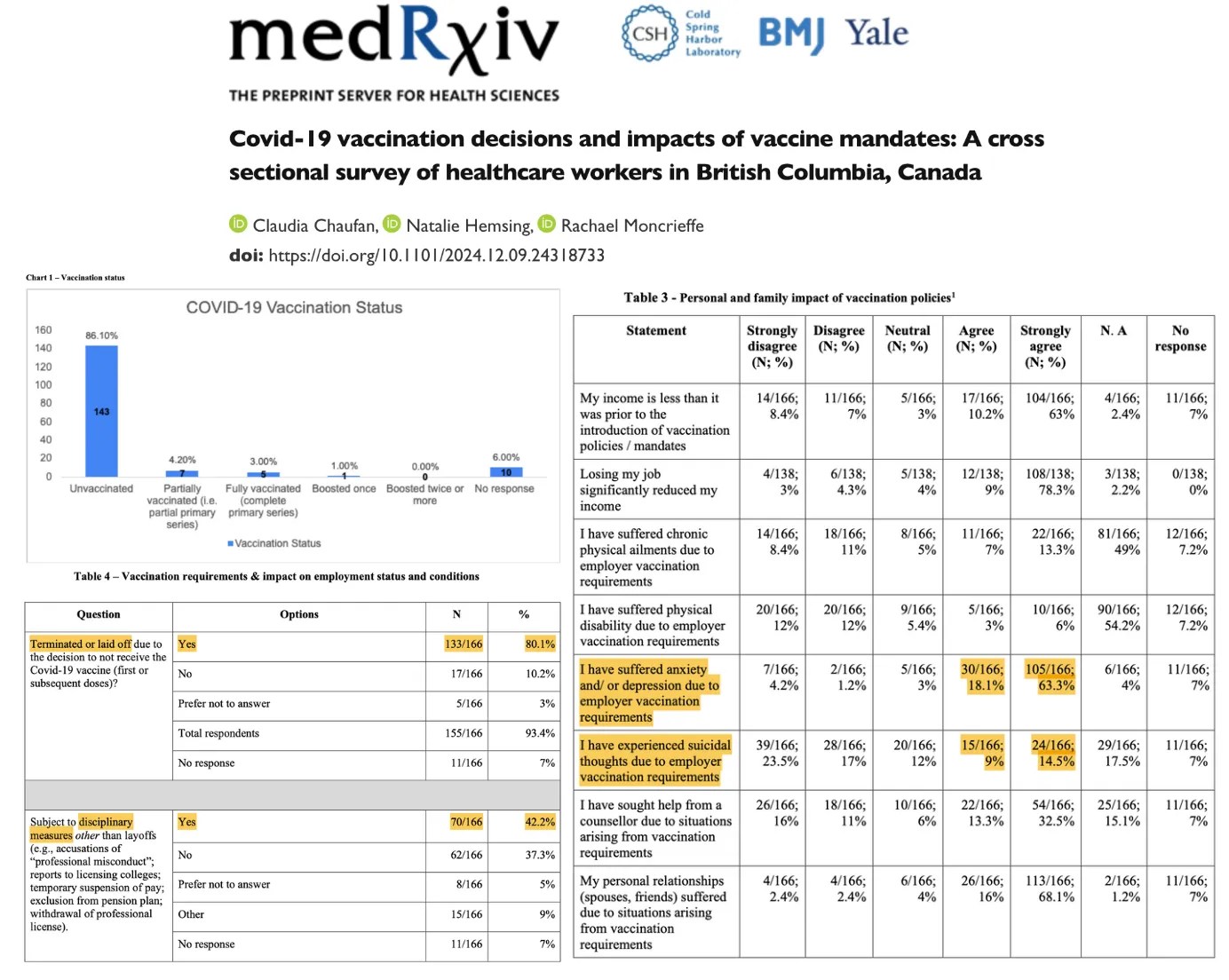
A new study by Chaufan et al, titled COVID-19 Vaccination Decisions and Impacts of Vaccine Mandates: A Cross-Sectional Survey of Healthcare Workers in British Columbia, Canada, has just been uploaded to the MedRxiv preprint server. They found that COVID-19 injection mandates took a massive toll on the well-being of healthcare workers:
Goal: To document the experience and views on mandated vaccination of healthcare workers in British Columbia.
Methods: Between May and July of 2024, we conducted a cross-sectional survey of healthcare workers in British Columbia. We recruited participants through a snowball sampling approach, including professional contacts, social media, and word-of-mouth.
Results: Close to half of respondents, with 16 or more years of professional experience, were unvaccinated, and most had been terminated due to non-compliance with mandates. As well, and regardless of vaccination status, most respondents reported safety concerns with vaccination and felt unfree to make their own vaccination choices, yet did not request exemptions due to high rejection rates by employers. Most of them also reported experiencing anxiety or depression, with about one fourth considering suicide, as a result of mandates. Nevertheless, most unvaccinated workers reported satisfaction with their choices, although they also reported significant, negative impacts of the policy on their finances, their mental health, their social and personal relationships, and to a lesser degree, their physical health. In contrast, within the minority of vaccinated respondents, most reported being dissatisfied with their vaccination decisions, as well as having experienced mild to serious post vaccine adverse events, with over half within this group reporting having been coerced into taking further doses, under threat of termination, despite these events. Further, a large minority of all respondents reported having witnessed underreporting or dismissal by hospital management of adverse events post vaccination among patients, worse treatment of unvaccinated patients, and concerning changes in practice protocols. Nearly half also reported their intention to leave the healthcare industry.
Discussion: Our findings indicate that in British Columbia, mandated vaccination in the healthcare sector had an overall negative impact on the well-being of the labour force, on the sustainability of the health system, on patient care, and on ethical healthcare practice. Findings resemble those of a similar study in the province of Ontario, with perhaps the most salient difference being that in British Columbia the policy was implemented at the provincial, rather than the healthcare establishment, level, leaving no room for individual establishments to opt out.
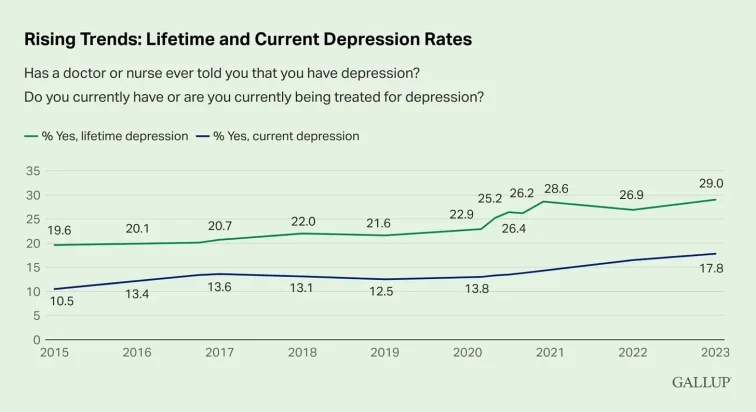
One of the most shocking findings from this study is that employer vaccination mandates led to suicidal thoughts in 23.5% of healthcare workers and depression/anxiety in 81.4%. This is likely because 80.1% of the respondents were terminated from their job for refusing experimental injections and subsequently suffered negative impacts on their finances, mental health, social and personal relationships, and physical health. These results suggest that vaccine mandates are likely a major contributing factor to the record-high depression rates observed since 2021:
The findings of this study confirm that vaccine mandates should never be implemented again, anywhere in the world, under any circumstances. As the authors concluded, the policy of mandated vaccination “failed on several fronts – scientific, pragmatic, and ethical.” Compensation is highly warranted for all individuals who refused to comply with mandates and were unethically terminated.
Nicolas Hulscher, MPH
Epidemiologist and Foundation Administrator, McCullough Foundation
OCCUPIED: Former IDF Volunteer to Chair House Foreign Affairs Committee, Trump Approves
By Frankie Stockes | SPN | December 12, 2024
At the behest of President-elect Donald Trump, GOP House Leadership has named Israeli-funded-and-tied Congressman Brian Mast as the new House Foreign Affairs Committee Chairman, marking the first known time in American history that a veteran of a foreign military has led a congressional committee. Last year, Mast also became the first known member of Congress to wear the uniform of a foreign military to work at the U.S. Capitol, when he donned his IDF uniform in support of Israel’s campaign in Gaza, following the outbreak of war.
Assuming he’s confirmed by the GOP House Conference, Rep. Mast (R-FL) will succeed Rep. Michael McCaul (R-TX) as the Foreign Affairs Committee Chairman, giving the staunchly pro-Israel Mast jurisdiction over ALL of America’s foreign relations that come through Congress, including war powers, treaties, and the deployment of American troops overseas.
These duties are especially relevant to Mast’s background and loyalties, as he is a staunch opponent of a two-state solution in the Middle East, supporting Israel’s continued seizure of Palestinian land and the expansion of Israel’s borders.
Mast has even cheerled the wholesale slaughter of Palestinian civilians, telling the media in 2023 that he “would encourage the other side to not so lightly throw around the idea of innocent Palestinian civilians… I don’t think we would so lightly throw around the term innocent Nazi civilians during World War II.”
The Israeli press has rejoiced in Mast’s installation as chairman, with The Times of Israel calling him a “pugnacious defender of Israel in [America’s] Congress” in an article published this week.
“The US House of Representatives elected Florida Representative Brian Mast, a zealous pro-Israel Republican who has volunteered with a group that assists the Israeli army, to chair the powerful House Foreign Affairs Committee,” The Times of Israel report went on, before revealing that President-elect Trump is behind the pending installation of Brian Mast.
“Insiders say that President-elect Donald Trump lobbied the Republican Steering Committee, which names committee chairs, to choose Mast.”
Mast, a self-proclaimed Christian and a U.S. Army veteran who lost both of his legs in the Middle East, later volunteered to serve the IDF and says on his campaign website that his worldview was shaped at Israeli “Shabbat tables.”
“I worked to strengthen the relationship between our two countries, as both a private citizen and as a soldier, because the national security of the United States is directly tied to the strength of Israel,” says Mast, who also says he will “advance policies” that are favorable to Israel and even use the force of the United States government to ensure that the American People are FORCED to support Israel.
“I will do all I can to put an end to the dangerous Boycott, Divestment, and Sanctions movement,” he says.
Mast’s ties to Israel go well beyond serving the IDF and since his political career began, he’s received more than half a million dollars from the Israel lobby, with AIPAC holding the distinction of being his top donor.
Canadian mayor fined for LGBT thought crime of refusing to bend over
By Rachel Marsden | RT | December 13, 2024
The mayor of the Canadian township of Emo (pop: 1,204), which borders the US state of Minnesota, has to personally pay an LGBTQ group $5,000 for injury to their self-respect. And that’s on top of the $10,000 that the town has to fork over.
According to official documents, the drama started in 2020 when Borderland Pride, a Canadian non-profit group, requested that the town officials officially recognize Pride Month in June of that year. The town had done so in previous years, but reportedly decided to amend their proclamations policy – which had yet to be adopted when this latest request came through. So the group’s request was rejected in a 3-2 council vote that year.
It’s not like this particular policy amendment was high priority, particularly at the height of the Covid fiasco, since they barely had any requests anyway. This one group alone represented half of all of the town’s requests for declarations, proclamations, or flag displays from April 2019 to April 2020.
Their request for the town to fly the rainbow flag for a week, and to send the group photos of it with the town’s officials for use on social media, reportedly wasn’t considered since the town didn’t even have a flagpole.
So here comes a complaint by the group to the Ontario Human Rights Tribunal – which was decided on November 20, 2024.
The role of such tribunals across Canada is to deal exclusively with complaints about discrimination on the basis of prohibited factors like race, religion, age, gender, sexual orientation, marital status, and criminal convictions. Because if actual courts had to deal with things like this, they’d be clogged up like a frat house toilet after Frosh Week. If the complainant can prove that there was at least a 50 percent chance of discrimination on one of these bases, then it can order cash awards and other remedies. So step right up! Take a spin! Win cash and prizes!
In the case of Borderland Pride against the Township of Emo, the tribunal accepted at face value that the council didn’t consider hanging the flag because of its lack of a flagpole. It did however note that the flag could have been “displayed” somewhere else other than on a flagpole. But it stopped short of ordering the mayor to walk around with it like a Superman cape.
The tribunal also accepted that two of the three council votes against issuing the Pride Month proclamation occurred in good faith and were merely the result of not wanting to adopt any proclamations before the new policy governing them was put into place. It was only the mayor’s “no” vote that was problematic.
During the council meeting in question, after discussing what they should do with the Pride flag display request in the absence of a flagpole, but before the vote against the Pride Month proclamation, Mayor Harold McQuaker said, “There’s no flag being flown for the other side of the coin… there’s no flags being flown for the straight people.”
Uh oh, here’s comes the forbidden-thinking patrol!
The tribunal ruled that the mayor’s comment was “dismissive of Borderland Pride’s flag request and demonstrated a lack of understanding of the importance to Borderland Pride and other members of the LGBTQ2 community of the Pride flag” and constitutes discrimination.
Suddenly, because of the mayor’s pro-heterosexual comments, it must mean that he hates gays. So it’s decided that “on the preponderance of evidence,” the rejection of the Pride proclamation was, more likely than not, the end-result of the mayor’s homophobia, and couldn’t be because he aligned with the other two Council “no” votes on the need for the policy amendment to deal with it first.
“I don’t hate anybody,” he said. “We just don’t have a flagpole at our town hall,” McQuaker recently told the Toronto Sun. But cognitive deviance is cognitive deviance, and like a colon polyp, best to nip it in the bud so there’s zero risk of it ever potentially developing into systemic cancer.
So here come the experts to tell the tribunal about how malignant this mayor’s thinking already is.
According to Dr. Emily Saewyc, an LGBTQ specialist who testified at the hearing, research suggests that “anti-LGBTQ rhetoric by President Trump, Vice-President Pence, and members of Trump’s cabinet during his presidency visibly increased the amount of hate and violence” towards these minorities. Or, you know, maybe people are just fed up with having special interest agenda shoved down their throats in make-work projects for activists at a time when citizens of all stripes are facing common and federating hardships. She then attempted to draw a parallel with the “homophobic and hateful social media posts about Borderland Pride and the LGBTQ2 community” after the vote – as though people would have been cheering the LGBTQ cause had the mayor not been such a bigot and supported Pride Month.
Right, because the key to people embracing wokeism is just to firehose even more of it into the public domain. Guess she hasn’t heard about the impact on brands like Bud Light and Jaguar after going woke. Or the public outcry after the Paris Olympics opening ceremony featuring what many interpreted as being a tranny wreck version of the Last Supper.
Borderland Pride wanted the tribunal to allow it to choose a week for the Township to have 2020 Pride Month now, and to force it to hold Pride Month every June going forward. It refused. But it did order Mayor McQuaker to attend a sort of re-education camp. Within 30 days, he has to provide Borderland Pride with proof that he’s completed the province’s human rights training course.
McQuaker has basically told the tribunal to shove it, refusing to pay or take the course, calling it “extortion,” according to the Toronto Sun.
All of this is the sort of blueprint that demonstrates exactly how special interest agendas end up hijacking the most basic aspects of daily life, through relentless activist browbeating that has a chilling effect on anyone who fails to passionately cater to their sacred cows.
How Does Western Media Try to Defame Calin Georgescu?

Calin Georgescu, running as an independent candidate for president, speaks to media in Bucharest, Romania, Oct. 1, 2024.
By Oleg Burunov – Sputnik – 13.12.2024
Amid uncertainty surrounding Romania’s botched presidential elections, Western media has launched an information campaign against independent candidate Calin Georgescu, who earlier made it to the country’s presidential runoff.
His progress, however, was annulled by the country’s constitutional court, which accused Georgescu of money laundering and being “Moscow’s man” – allegations he denies.
How does Western media paint the 62-year-old politician?
- The Financial Times : Romania shocked the world by voting for “a pro-Putin TikTok star” and “an outsider with ultranationalist views who was polling poorly just weeks before the election.”
- The BBC: Georgescu is “a figure from the extreme fringe of Romanian politics.”
- Sky News: He “has emerged from obscurity to top the polls in Romania’s presidential election. But the Anglophile and Trump supporter is also his country’s most divisive figure for decades.”
- AP : “A self-professed Donald Trump supporter”, Georgescu remained “a little-known entity until just weeks ago.”
- France 24: “The pro-Russian outsider candidate”.
- The Week : The “Putin of Romania” and “the EU and NATO’s worst nightmare.”
Romania held its presidential election on November 24, with Georgescu winning the first round with 22.94% of the votes. The leader of the liberal Save Romania Union, Elena Lasconi, who favors the partnership with NATO and the US, came second with 19.18%.
The second round of elections was scheduled for December 8. However, on December 6, the Constitutional Court ruled to cancel the results of the first round, paving the way for a rerun. The Romanian government must now set the date of a new presidential vote. Both Georgescu and Lasconi criticized the ruling.
Georgescu earlier told Western media that he had spent “zero” on his TikTok campaign and had “zero” ties with Russian President Vladimir Putin, whom he praised as “a patriot and a leader”.
The country’s opposition parties and politicians slammed the court’s decision as anti-democratic. Georgescu, for his part, insisted that the ruling “is more than a legal controversy” and that “it is basically a formalized coup d’état.”
Five Eyes Urges Broader Censorship Under “Protect the Children” Campaign
By Didi Rankovic | Reclaim The Net | December 12, 2024
A network facilitating spy agencies’ intelligence-sharing between the US, UK, Canada, Australia, and New Zealand, known as Five Eyes, has its sights set on encryption, and proceeding from that, also online anonymity.
Even more online censorship would also not be a bad idea – these are some of the highlights from the first public-facing paper the organizations behind this group have published.
We obtained a copy of the paper for you here.
And Five Eyes is not above promoting its ultimate and much more far-reaching goals by using the good old “think of the children” – the paper’s title is, Young People and Violent Extremism: A Call for Collective Action.
Both it and an accompanying press release choose to consider online encryption as merely a tool used by criminals. At the same time, the paper is ignoring the fact that the entire internet ecosystem, from communications to banking and everything in between, requires strong encryption both for privacy, and security.
But, Five Eyes focuses only on communications, which they vaguely refer to as online environments, and ones that can allow sex offenders access to children, they also mention extremists, and equally vaguely, “other” malign actors.
Since encrypted platforms provide anonymity, the spies from the five countries (who refer to the state of affairs as, “a large degree of anonymity”) don’t like that either – and again link it to negative scenarios, such as “radicalization to violence.”
The paper is not specific on the exact mechanisms that would ramp up online censorship, but mentions both governments and the tech industry; the first category should “strengthen legislative support for law enforcement,” while the other is urged to “take greater responsibility for the harm done on their platforms.”
Gaming platforms Discord, Instagram, Roblox as well as TikTok are singled out as “seemingly innocuous” – but the way Five Eyes sees it, they make violent extremism content “more accessible.”
The “whole-of-society response” is the proposed solution to the problem of radicalization of minors in these countries. And the documents vow the alliance will continue working with “government agencies, the education sector, mental health and social well-being services, communities and technology companies.”
“It is important to work together early as once law enforcement and security agencies need to become involved, it is often too late,” the paper warns.
And so, a network whose members are likely, in one capacity or another, behind many of the existing attacks on online encryption and anonymity – has now come out as the campaign’s supposedly “latest recruit.”
Al-Qaeda Rides Again… in Syria
By Daniel McAdams | Ron Paul Institute | December 11, 2024
As Christians around the world prepare to celebrate Christmas, a hell has been unleashed inside Syria with the seizure of the country by the re-named “al-Qaeda in Syria” now called Hay’at Tahrir al-Sham (HTS). Its leader is a former deputy commander of ISIS, Abu Mohammed al-Julani.
While neocons and the mainstream media in the US and Europe celebrate the overthrow of the Assad government – a priority since the Obama Administration – as with previous US “liberations” in Libya and Iraq the outcome is proving to be anything but liberating. Christian churches are being ransacked and believers abused.
Sharia law has been announced by the new justice minister, Shadi Alwaisi.
Public executions of those who oppose the rule of al-Julani – who still has a $10 million bounty on his head from the US State Department even as he is funded by the CIA – have begun across the country. (Extremely graphic link here).
Just today, Christian Churches in Syria were warned not to hold Christmas services, not to hold Christmas parades, and not to even display the image of St. Nicholas! This is what the mainstream media told us was the new “inclusive” government in Syria.
State Department to Shut Down Controversial Censorship Hub but Critics May Call It a Rebrand
By Didi Rankovic | Reclaim The Net | December 12, 2024
The US State Department looks set to shut down the Global Engagement Center (GEC), which has for a long time faced accusations of deviating from its stated role abroad, and instead engaging in, and facilitating censorship at home.
This has been revealed in a filing in the Daily Wire v. US Department of State case, in which the latter informed the court that members of Congress were told last Friday about the upcoming move.
However, even though GEC as such is “substantially likely” to cease operations on December 24, the idea seems to be a simple reshuffle – as both the funding and the staff would continue their work in other State Department offices and bureaus.
According to a spokesperson, this development is the result of the National Defense Authorization Act (NDAA) not providing for an extension of GEC. And now the State Department is “hopeful that Congress extends this important mandate through other means before the December 24 termination date,” said the spokesperson.
That mandate, on paper, is supposed to be directing, leading, and coordinating the US government’s “countering of foreign propaganda and disinformation” – in foreign countries. And the State Department continues to maintain that this is in fact the role of GEC and that it is critically important for that work to continue.
But critics say that the office, which was created in 2016, in reality, represents a central component of partisan censorship targeting Americans – particularly conservative and “disfavored” voices.
As evidence of this kept mounting, Republican members of the House of Representatives first investigated the activities of this office, particularly the way it was handing out grants (the suspicion is that GEC “delegated” censorship to third parties in order not to openly violate the Constitution).
Now, House Republicans have decided not to approve the planned 8-year extension of GEC. One of those controversial grants, worth $100,000, went to the Global Disinformation Index – a UK-based group accused of compiling a list of conservative media that advertisers were supposed to boycott and thus deprive of revenue.
But even if GEC will no longer exist as such, the intent is clearly to reassign employees and keep funding their work. What that work will actually be going forward, should depend on the incoming administration’s new State Department.
Featured Video

Trita Parsi: Middle East Unraveling — Are We on the Path to World War?
or go to
Aletho News Archives – Video-Images
New Book
Trans agenda is ‘normalization of sadism’ – US author

RT | September 23, 2026
The US Democratic Party has embraced a transgender agenda that amounts to “the normalization of sadism,” author A.J. Rice has said, warning that radical trans policies would return if the party is allowed to regain power.
Speaking to RT’s America First host Scotty Nell Hughes about his new book, ‘The Curse of the Bearded Lady: How the Trans Mafia Whacked American Sanity’, Rice argued that activists have gained significant influence in schools, medicine, and corporate America while people who questioned the agenda have faced pressure to stay silent.
The author described the “trans mafia” as the sprawling network of people and institutions that have helped the movement gain influence. He singled out parts of academia, wealthy backers, and corporations, and stated that providers of transition-related treatment also have a financial incentive to keep young people in their care indefinitely.
Rice argued that the consequences of these policies ultimately fall on children who are being drawn toward gender-affirming medical treatments and on girls who are expected to share locker rooms or compete in sports with biological males.
He noted that while voters rejected the Democrats’ approach to gender in 2024, the party, which has been “captured by madness,” has since only doubled down and is seeking what is effectively “the normalization of sadism.” … Full report
Blog Roll
 Aletho News
- Israeli election committee bars candidate from Knesset race over Gaza war opposition
- French-Lebanese man files war crimes complaint over Israeli attacks
- Mahan Air Flight Lands in China Despite US Threat against Iranian Airlines
- US eyes $10bn fund to rebuild war-battered Gulf infrastructure
- Trump meets Rodríguez near Maduro’s prison as Venezuela’s oil flows to US
- Trita Parsi: Middle East Unraveling — Are We on the Path to World War?
- Iran FM meets with US envoy on UN meeting’s sidelines at American side’s insistence: Report
- Qatar PM calls for Gulf security framework with Iran, says war must be ‘wake-up call’
- China condemns US extortion of Iranian airlines, rejects Washington’s ‘illegal’ sanctions threats
- Italy to move military personnel from Taif base after missile strike
- If Americans Knew
- Winter could turn Gaza’s treacherous, war-damaged buildings into deathtraps
- Majority of Democratic Voters Want to Prosecute Both Biden and Trump Administration Officials Over Gaza
- As Gaza languishes, world leaders gather at the UN – Daily Update
- Sanctions are collective punishment: immoral and self-defeating
- Phosphorus Munitions Fired by Israel Burn Groves, Orchards in Southern Lebanon
- Israel Carries Out New Ceasefire Violations Across Gaza
- AI – Emphasis on the ‘I’: Israel Is Funding AI Chatbot Propaganda
- Israel Blocking Hundreds of Wheelchairs for Injured Children From Entering Gaza
- Israel Is Expanding and Upgrading Compounds for Palestinian Militias in Gaza
- The Palestinian-American Residents of This West Bank Town Are Wondering: Where Is Trump?
- No Tricks Zone
- New Study: Earth And Venus Surface Warmth Largely Explained By Convection And Lapse Rate, Not CO2 Or Radiation
- 2025 Nature Paper Claiming Worsening Global Drought Gets RETRACTED …Heavily Flawed
- New Study: ‘Global Drought Shows No Detectable Recent Acceleration Under Climate Warming’
- Economic Masterminds: German Socialists Suggest Taxing Productivity Gains Stemming From Using AI
- The South China Sea Has Not Been Cooperating With The Climate Change Narrative
- Energy Crisis: Germany Enters Heating Season With Historically Low Gas Reserve Fill Levels
- New Study: The Antarctic Ice Sheet Gained Mass From 2020-2024 Due To Staggering Snow And Ice Accumulation
- Study: Ocean Heating Rates From Thousands Of Years Ago ‘Dwarf’ Modern Ocean Heating Rates
- Climate Extremists Target, Attack Large-Scale Power Grid Infrastructure In Germany!
- New Study: Antarctic Ice Melt Has Contributed Less Than 1 Centimeter To Sea Level Rise In The Last 30 Years

