Letter from an Israeli (Birmingham) Jail

Israel is probably one of the most thoroughly segregated and intolerant nations
By Dallas Darling | Palestine Chronicle | October 14, 2010
If Martin Luther King would have been a Palestinian, I sometimes wonder how Israeli authorities would have treated him. This came to mind again when it was reported that an Israeli military court sentenced Palestinian nonviolence activist Abdullah Abu Rahmeh to one year in prison. Evidently, the military tribunal found him guilty of “incitement” and for organizing illegal protests. It also fined him $1,400, a stiff penalty for someone who lost over half of his farmland to land seized by Israeli settlement programs.
Similar to Martin Luther King, Abdullah Abu Rahmeh has experienced years of racial oppression and religious intolerance. Like Martin Luther King who founded the Southern Christian Leadership Conference to help achieve equality for blacks, Abdullah Abu Rahmeh is the coordinator of the Bilin Popular Resistance Committee against the Wall and Settlements. Since 2005, the movement has nonviolently challenged Israeli segregation and exclusive religious laws. It has also peacefully resisted Israeli bulldozing of Palestinian homes and annexation of Palestinian villages and land.
As Israeli security and military forces fire teargas canisters into the marching crowd, some of the protests have turned violent. Israeli rubber bullets have killed several protesters too. Still, Palestinian teens have thrown stones at soldiers while protesting. The Israeli military claimed several Palestinian teens confessed Abdullah Abu Rahmeh told them to throw stones. They have accused him of inciting violence and riots. However, Abdullah Abu Rahmeh has denied such charges and instead, he claims to have pursued nonviolent strategies while encouraging the youth to stop throwing stones.
In 1963 and before the Jobs and Civil Rights March on Washington, Martin Luther King brought the movement for equality and freedom to Birmingham, Alabama. President John Kennedy was embroiled with the effects of the Cuban Missile Crisis and appeared distant from the urgent need to initiate a courageous civil rights law for America. After watching newsreel footage of false arrests, police beatings, attack dogs ripping apart protesters, and the city’s fire department hosing passive marchers with enough force to break their bones, some were finally convinced-including President Kennedy-that segregation had to end.
Like Abdullah Abu Rahmeh, Martin Luther King was jailed for his nonviolent direct action campaign in Birmingham. A group of white Alabama ministers put an ad in the New York Times condemning Martin Luther King of being an “agitator” and wanting only to evoke violence and to start a riot. They tried to convince him to end his campaign and to wait, that the future would be better for black Americans. His response, or the Letter From A Birmingham Jail, was written on scraps of paper and in the margins of a newspaper. Can the contents of the letter be applied to Abdullah Abu Rahmeh and Palestinians and Arabs living under Israeli rule and in Occupied Territories?
Therefore, if Martin Luther King was a Palestinian and had been arrested and jailed, like Abdullah Abu Rahmeh, this is what the Letter From An Israeli Jail would say:
I am in Israel because injustice is here. Just as the eighth century prophets left their little villages and carried their ‘thus says God’ far beyond the boundaries of their home town, I too am compelled to carry the message of freedom beyond my particular home town. Moreover, I am aware of the interrelatedness of all communities and states. I cannot sit idly by and not be concerned about what happens in Israel. Injustice anywhere is a threat to justice everywhere. We are caught in an inescapable network of mutuality, tied in a single garment of destiny. Whatever affects one directly affects all indirectly. (1)
Israel is probably one of the most thoroughly segregated and intolerant nations. Its ugly record of police brutality and military incursions are known in every section of the Middle East. Its unjust treatment of Palestinians and Arabs in the courts is a notorious reality, as are the numerous false imprisonments of men, women and children. There have been more unsolved bombings and bulldozing of Palestinian homes and attacks on mosques in Israel than any nation in the Middle East. There have also been unsolved killings and a complete disregard for basic human rights and civil liberties. (2)
You may well ask: “Why direct action? Why sit-ins, marches, etc.? Isn’t negotiation a better path?” You are exactly right in your call for negotiation. Indeed, this is the purpose of direct action. Nonviolent direct action seeks to create such a crisis and establish such creative tension that a nation that has constantly refused to negotiate is forced to confront the issue. It seeks so to dramatize the issue that it can no longer be ignored. I have worked against violent tension, but there is a type of constructive nonviolent tension that is necessary for growth. It is the kind of tension that will help men to rise from the dark depths of prejudice and racism to the majestic heights of understanding and unity. (3)
Nations and groups are more immoral than individuals. We know through painful experience that freedom is never voluntarily given by the oppressor; it must be demanded by the oppressed. Frankly, I have never yet engaged in a direct action movement that was “well timed,” according to the timetable of those who have not suffered unduly from the disease of segregation and religious intolerance. For years now, I have heard the word “Wait!” It rings in the ear of every Palestinian with a piercing familiarity. This “Wait” has almost always meant “Never!” We must come to see with the distinguished jurist of yesterday that “justice too long delayed is justice denied. (4)
But when you have seen vicious mobs kill your mothers and fathers at will and bulldoze your sisters and brothers at whim; when you have seen hate filled security forces kick, brutalize, bomb, use as human shields, and dance around and humiliate your Palestinian and Arab sisters and brothers with impunity; when you see the vast majority of your people smothering in an airtight cage of poverty in the midst of an affluent society; when you are forever fighting a degenerating sense of “nobodiness”; then you will understand why we find it difficult to wait. There comes a time when the cup of endurance runs over, and men are no longer willing to be plunged into an abyss of despair. (5)
One may well ask: “How can you advocate breaking some laws and obeying others?” There are, in fact, two types of laws: There are just and there are unjust laws. Any law that uplifts human personality is just. Any law that degrades human personality is unjust. All segregation and religious intolerance statutes are unjust because they distort the soul and damage the personality. It gives the segregator and intolerant a false sense of inferiority. To use the words of Martin Buber, the Jewish philosopher, segregation and intolerance substitutes an “I-it” relationship for an “I-thou” relationship, and ends up relegating persons to the status of things. Segregation and intolerance are existential expressions of man’s tragic separation and awful estrangement. (6)
Of course, there is nothing new about this kind of civil disobedience. It was seen sublimely in the refusal of Shadrach, Meshach and Abednego to obey the laws of Nebuchadnezzar because a higher moral law was involved. We can never forget that everything Hitler did in Germany was “legal” and everything the Hungarian freedom fighters did in Hungary was “illegal.” It was “illegal” to aid and comfort a Jew in Hitler’s Germany. But I am sure that if I had lived in Germany during that time I would have aided and comforted my Jewish brothers even though it was illegal. (7)
But the Jewish and American moderates are more devoted to “order” than to justice: who prefers a negative peace which is the absence of tension to a positive peace which his the presence of justice. Shallow understanding from people of goodwill is more frustrating than absolute misunderstanding from people of ill will. I had hoped that Jewish and American moderates would understand that law and order exist for the purpose of establishing justice, and that when they fail to do this they become dangerously structured dams that block the flow of social progress. (8)
Actually, we who engage in nonviolent direct action are not the creators of tension. We merely bring to the surface the hidden tension that is already alive. We bring it out in the open where it can be seen and dealt with. Like a boil that can never be cured as long as it is covered up but must be opened with all its pus-flowing ugliness to the natural medicines of air and light, injustice must likewise be exposed, with all of the tension its exposing creates, to the light of human conscience and the air of global opinion before it can be cured. (9)
Oppressed people cannot remain oppressed forever. The urge for freedom will eventually come. This is what happened to the Palestinians and Arabs. Something within has reminded them of their birthright of freedom; something without has reminded them that they can gain it. Consciously and unconsciously, they have been swept in by what the Germans call the Zeitgeist, and with their black brothers of Africa, and their brown and yellow brothers of Asia, South America and the Caribbean, they are moving with a sense of cosmic urgency toward the promised land of racial justice and religious tolerance. (10)
(Note: Many international human rights organizations have already denounced Israel’s arrest and sentencing of Abdullah Abu Rahmeh, including Archbishop Desmond Tutu. During World War Two, Arabs and Palestinians also assisted Jews fleeing Germany and the Third Reich.)
– Dallas Darling is the author of Politics 501: An A-Z Reading on Conscientious Political Thought and Action, Some Nations Above God: 52 Weekly Reflections On Modern-Day Imperialism, Militarism, And Consumerism in the Context of John‘s Apocalyptic Vision, and The Other Side Of Christianity: Reflections on Faith, Politics, Spirituality, History, and Peace. He is a correspondent for www.worldnews.com. He contributed this article to PalestineChronicle.com. Visit: www.beverlydarling.com and wn.com//dallasdarling.
Notes:
(1) Young, Ralph F., Dissent In America, The Voices That Shaped A Nation. New York, New York: Parson Longman Publishers, 2006., p. 551.
(2) Ibid., p. 552.
(3) Ibid., p. 553.
(4) Ibid., p. 553, 554.
(5) Ibid., p. 554.
(6) Ibid., p. 555.
(7) Ibid., p. 556.
(8) Ibid., p. 556.
(9) Ibid., p. 556.
(10) Ibid., p. 558.
Ten years later, no justice for October 2000 killings
Jillian Kestler-D’Amours, The Electronic Intifada, 13 October 2010
It has been ten years since 13 Palestinian citizens of Israel were killed by the Israeli police force during nonviolent demonstrations at the outset of the second Palestinian intifada.
And while the victims’ families haven’t stopped demanding accountability and justice for their loved ones, a frightening realization is taking shape: in today’s Israel, what happened in October 2000 could easily happen again, if not worse.
“After this, everything is possible. The worst happened and after that it can only be worse,” said Mohammad Zeidan, the General Director of The Arab Association for Human Rights (HRA), based in Nazareth.
“There are a million reasons for an explosion concerning the racism and discrimination against the Palestinian minority [in Israel]. It just needs a small spark. And if that happens, we feel that the general political environment is worse than it used to be in 2000. It will be much worse than in 2000,” Zeidan said.
Unarmed demonstrators killed
At the end of September 2000, months before he was elected Israel’s prime minister, Ariel Sharon made his infamous visit to occupied East Jerusalem’s Haram al-Sharif, accompanied on all sides by Israeli security forces. This inflammatory move sparked the already-growing unrest in the occupied West Bank, where Palestinians took to the streets in what became the start of the second Palestinian intifada.
Days later, on 1 October 2000, the High Follow-Up Committee for Arab Citizens in Israel announced a general strike and mass demonstrations were organized in many Arab towns inside Israel to show support for the Palestinians in the occupied territories. These protests were met with extreme violence on the part of the Israeli police force. Rubber-coated steel bullets, live ammunition and tear gas were used unsparingly on the demonstrators, while Israeli snipers were also set up in various cities.
Three young men — Mohammed Ahmed Jabareen (23), Ahmed Ibrahim Siyyam Jabareen (18) and Rami Khatem Ghara (21) — were killed on that first day of demonstrations.
As a result of these killings, the High Follow-Up Committee extended the strike, and demonstrations continued. These too were met with violent police repression, and over the course of eight days, a total of 13 Palestinian citizens of Israel, between the ages of 17 and 42, had been killed. A Palestinian resident of the occupied Gaza Strip was also killed.
“The general feeling was that all the red lines were broken [in October 2000] and that the deterioration was very fast. The very scary part of this was that at the official level of the Jewish majority there wasn’t any kind of reaction to stop the deterioration and the killings that were happening in the streets,” Zeidan said.
No accountability
Thousands of Palestinians were injured and hundreds were subsequently detained or arrested in relation to the events that took place in October 2000.
A month later, in November 2000, the Israeli government set up a fact-finding team, the Or Commission, to look into what happened. Its findings were released in September 2003; the Or Commission found that the Israeli police illegally used rubber-coated bullets, live ammunition and snipers to disperse demonstrators, refuted the police’s claim that it had acted in self-defense and recommended that criminal investigations be opened for each of the deaths.
Two years later, in September 2005, the Ministry of Justice’s Police Investigations Department, known as Mahash, released its own report, stating that it wouldn’t indict any Israeli police officer in relation to the violence.
This decision was met with gross indignation on the part of Palestinian citizens of Israel and faced large-scale public criticism.
As a result, then-Israeli Attorney General Menachem Mazuz launched his own investigation into Mahash’s decision, and in January 2008, Mazuz endorsed Mahash’s position that there was no reason to convict members of the Israeli police, who he argued had acted in self-defense against the demonstrators.
“[The Attorney General] closed the file on the argument that the Arab demonstrators almost used arms and they closed streets, and that in this situation, the police felt that they were in danger. In fact, he blamed the victims,” said Hassan Jabareen, the Founder and Director General of Adalah, the Legal Center for Arab Minority Rights in Israel, and the lead lawyer for the October 2000 victims’ families.
“But if we want to analyze [Mazuz’s] rhetoric, we find that he treated the demonstrators not as civilians, but as combatants. It doesn’t matter whether you are a Palestinian civilian or Palestinian combatant, whether you are citizen or resident or non-resident, your ethnicity is the matter. The Attorney General treats them [Palestinians] as enemies,” Jabareen said.
“It shows that the impunity here is very, very strong for the police.”
A deteriorating situation
In an April 2001 report looking into the behavior of Israeli police officers during the violence, the Public Committee Against Torture in Israel (PCATI) described Israel’s law enforcement systems as being “tainted by institutionalized racism.”
“During the events of September-October 2000, this was reflected in ugly and widespread manifestations of violence and humiliation. Yet this racism is also reflected in less overt ways in legislation, regulations and procedures that effectively discriminate against these citizens,” the report, titled “Racism, Violence and Humiliation,” stated.
The report added, “Official spokespeople for the State of Israel often describe the country as ‘the only democracy in the Middle East,’ and as a member of the family of progressive and enlightened nations. The behavior of agents of the state — security force personnel and other authorities — towards its Palestinian citizens threatens to render such declarations hollow and meaningless.”
Indeed, according to Hassan Jabareen, the situation for Palestinian citizens of Israel is getting worse by the day.
“They are facing, more than in any other situation, direct racist policy and this racist policy justifies using violence against them. It seems that the situation is going towards escalation,” Jabareen said.
Mohammad Zeidan agreed, explaining that recent proposals and laws passed by the Israeli Knesset signal increasing hostility towards the country’s Palestinian minority, which makes up nearly twenty percent of the Israeli population.
“We see that the whole notion of a Jewish state is being legalized in different laws and proposals, and that creates an environment that delegitimizes our existence as citizens. This environment is the right environment for such attacks and such violence again the Palestinian minority,” Zeidan said.
He added, “Without international actual action towards the situation, nothing will be moving in Israel. I think the situation will be deteriorating more and more and that it will be much harder to speak about solutions in the future.”
Currently, Adalah is appealing to Israel’s new Attorney General, Yehuda Weinstein, to re-open investigations into the October 2000 killings.
More specifically, Adalah is asking Weinstein to look into the evidence collected against police officers involved in the killings, as well as to examine the work and procedures used by the Mahash and former Attorney General Menachem Mazuz during their separate investigations into what happened ten years ago.
“The families will continue to struggle,” said Hassan Jabareen. “Our demand today from the new Attorney General is to open the file and renew the criminal investigation. This is our demand right now.”
Originally from Montreal, Jillian Kestler-D’Amours is a freelance writer and documentary filmmaker based in occupied East Jerusalem. More of her work can be found at http://jilldamours.wordpress.com.
Canada: Harper government’s policies lead to loss of UN Security Council seat
October 12, 2010 – Canadian Arab Federation
“The Harper government must take full responsibility for Canada losing the race for a UN Security Council seat. This is as a result of the misguided positions taken by the Harper government domestically and within such key international bodies as the UN General Assembly and the UN Human Rights Council that undermine human rights, environmental rights and global principles,” said Khaled Mouammar, CAF National President.
Since coming to power in 2006, the Harper government’s actions have set back or weakened crucial international human rights initiatives such as global protection of the rights of Indigenous peoples, protection of the human rights of the Palestinian people under occupation, protection against torture, the rights of women, the rights of children, and the rights of gays and lesbians.
Domestically, the Harper government has systematically undermined democratic institutions and practices, and has eroded the protection of free speech by cutting or threatening to cut funding to organizations that disagree with government policies as in the case of the Canadian Arab Federation, KAIROS, MATCH International, Alternatives, the Canadian Council for International Co-operation, the National Association of Women and the Law, and the Canadian Research Institute for the Advancement of Women.
A glaring example is the government’s refusal to repatriate Omar Khadr to Canada , after the decision of the Supreme Court of Canada that found Canada is responsible for continuing violations of Omar Khadr’s human rights, a stand that has shamed Canada on the world stage.
“By denying the Harper government a seat on the UN Security Council the international community has signalled its displeasure with the government’s performance on the world stage. Canadians lament Canada’s loss of influence in the world and deserve a government that does not tarnish Canada ’s reputation internationally and that does not seriously threaten the quality and health of democratic life in Canada,” said Khaled Mouammar, CAF National President.
Aletho News adds:
The Council of Canadians states that it hopes that this vote will be a wake-up call for all Canadians that after almost five years in power, Prime Minister Stephen Harper has diminished Canada’s international standing to the point that what is normally a rubber-stamp for Canada to take our regular rotation on the Security Council has become a national embarrassment.
Canada’s Concentration Camps – The War Measures Act
Photo: Unsourced, tumblr
By Diana Breti | The Law Connection | 1998
Canadian Concentration Camps
By world standards Canada is a country that respects and protects its citizens’ human rights. That has not always been true, however. Many people are familiar with the story of the internment of Japanese-Canadians in BC during World War II. But not many people are aware that the Japanese were not the only Canadians imprisoned during wartime simply because of their ethnic origin. The history of Canada includes more than one shameful incident in which the Canadian government used the law to violate the civil rights of its own citizens.
The War Measures Act
The War Measures Act was enacted on 22 August 1914, and gave the federal government full authority to do everything deemed necessary “for the security, defence, peace, order and welfare of Canada”. It could be used when the government thought that Canada was about to be invaded or war would be declared, in order to mobilize all segments of society to support the war effort. The Act also gave the federal government sweeping emergency powers that allowed Cabinet to administer the war effort without accountability to Parliament, and without regard to existing legislation. It gave the government additional powers of media censorship, arrest without charge, deportation without trial, and the expropriation, control and disposal of property. This Act was always implemented via an Order in Council, rather than by approval of the democratically elected Parliament.
World War I
After Great Britain entered the First World War in August 1914, the government of Canada issued an Order in Council under the War Measures Act. It required the registration and in certain cases the internment of aliens of “enemy nationality”. This included the more than 80,000 Canadians who were formerly citizens of the Austrian-Hungarian empire. These individuals had to register as “enemy aliens” and report to local authorities on a regular basis. Twenty-four “concentration camps” (later called “internment camps”) were established across Canada, eight of them in British Columbia. View a list of World War 1 Concentration Camps. The camps were supposed to house enemy alien immigrants who had contravened regulations or who were deemed to be security threats. In fact, the “enemy aliens” could be interned if they failed to register, or failed to report monthly, or travelled without permission, or wrote to relatives in Austria.
Other less concrete reasons given for internment included “acting in a very suspicious manner” and being “undesirable”. By the middle of 1915, 4,000 of the internees had been imprisoned for being “indigent” (poor and unemployed). A total of 8,579 Canadians were interned between 1914 and 1920. Over 5,000 of them were of Ukrainian descent. Germans, Poles, Italians, Bulgarians, Croatians, Turks, Serbians, Hungarians, Russians, Jews, and Romanians were also imprisoned. Of the 8,579 internees, only 2,321 could be classed as “prisoners of war” (i.e. “captured in arms or belonging to enemy reserves”); the rest were civilians.
Upon each individual’s arrest, whatever money and property they had was taken by the government. In the internment camps they were denied access to newspapers and their correspondence was censored. They were sometimes mistreated by the guards. One hundred and seven internees died, including several shot while trying to escape. They were forced to work on maintaining the camps, road-building, railway construction, and mining. As the need for soldiers overseas led to a shortage of workers in Canada, many of these internees were released on parole to work for private companies.
The first World War ended in 1918, but the forced labour program was such a benefit to Canadian corporations that the internment was continued for two years after the end of the War.
World War II
During World War II the War Measures Act was used again to intern Canadians, and 26 internment camps were set up across Canada. In 1940 an Order in Council was passed that defined enemy aliens as “all persons of German or Italian racial origin who have become naturalized British subjects since September 1, 1922”. (At the time, Canada didn’t grant passports and citizenship on its own, so immigrants were “naturalized” by becoming British subjects.) A further Order in Council outlawed the Communist Party. Estimates suggest that some 30,000 individuals were affected by these Orders; that is, they were forced to register with the RCMP and to report to them on a monthly basis. The government interned approximately 500 Italians and over 100 communists.
In New Brunswick, 711 Jews, refugees from the holocaust, were interned at the request of British Prime Minister Winston Churchill because he thought there might be spies in the group.
In 1942, the government decided it wanted 2,240 acres of Indian Reserve land at Stony Point, in southwestern Ontario, to establish an advanced infantry training base. Apparently the decision to take Reserve land for the army base was made to avoid the cost and time involved in expropriating non-Aboriginal lands. The Stony Point Reserve comprised over half the Reserve territory of the Chippewas of Kettle & Stony Point. Under the Indian Act, reserve lands can only be sold by Surrender, which involves a vote by the Band membership. The Band members voted against the Surrender, however the Band realized the importance of the war effort and they were willing to lease the land to the Government. The Government rejected the offer to lease. On April 14, 1942, an Order-in-Council authorizing the appropriation of Stony Point was passed under the provisions of the War Measures Act. The military was sent in to forcibly remove the residents of Stony Point. Houses, buildings and the burial ground were bulldozed to establish Camp Ipperwash. By the terms of the Order-in-Council, the Military could use the Reserve lands at Stony Point only until the end of World War II. However, those lands have not yet been returned. The military base was closed in the early 1950’s, and since then the lands have been used for cadet training, weapons training and recreational facilities for military personnel.
After the bombing of Pearl Harbor in 1942, the government passed an Order in Council authorizing the removal of “enemy aliens” within a 100-mile radius of the BC coast. On March 4, 1942 22,000 Japanese Canadians were given 24 hours to pack before being interned. They were first incarcerated in a temporary facility at Hastings Park Race Track in Vancouver. Women, children and older people were sent to internment camps in the Interior. Others were forced into road construction camps. There were also “self-supporting camps”, where 1,161 internees paid to lease farms in a less restrictive environment, although they were still considered “enemy aliens”. Men who complained about separation from their families or violated the curfew were sent to the “prisoner of war” camps in Ontario.
The property of the Japanese Canadians – land, businesses, and other assets – were confiscated by the government and sold, and the proceeds used to pay for their internment. In 1945, the government extended the Order in Council to force the Japanese Canadians to go to Japan and lose their Canadian citizenship, or move to eastern Canada. Even though the war was over, it was illegal for Japanese Canadians to return to Vancouver until 1949. In 1988 Canada apologized for this miscarriage of justice, admitting that the actions of the government were influenced by racial discrimination. The government signed a redress agreement providing a small amount of money compensation.
Could This Happen Today?
The War Measures Act was repealed in 1988. It was replaced with the Emergencies Act. The Emergencies Act allows the federal government to make temporary laws in the event of a serious national emergency. The Emergencies Act differs from the War Measures Act in two important ways:
1. A declaration of an emergency by the Cabinet must be reviewed by Parliament
2. Any temporary laws made under the Act are subject to the Charter of Rights and Freedoms.
Thus any attempt by the government to suspend the civil rights of Canadians, even in an emergency, will be subject to the “reasonable and justified” test under section 1 of the Charter. Restrictions and limitations on freedom were inevitable during times of war. To the Canadian government, internment during both World Wars was a practical solution to a perceived security problem. However the terms of the Orders in Council, and the methods used to carry them out, reveal that the government was influenced more by racial discrimination and anti-immigrant sentiments than by any real threat to national security. The stories of the internees are a reminder of how human rights are vulnerable in situations of crisis.
By Diana Breti
Centre for Education, Law and Society (CELS)
Simon Fraser University
Vancouver, British Columbia
Related articles
- 71 Years Ago Today, FDR Signed “NDAA of 1942″ Authorizing Internment Camps (silverunderground.com)
- BC’s Japanese Internment Camps (CJIC Prt 1) (habitualrunaway.wordpress.com)
- Remembering the internment of Montreal-Italians during WWII (globalnews.ca)

Debtors’ prisons rise again in the South
By Sue Sturgis | Institute for Southern Studies Online Magazine | October 6, 2010
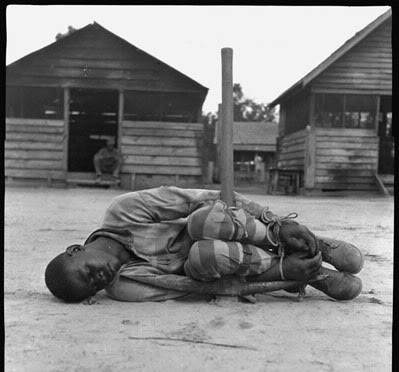 Forced Labor Camp, Georgia, 1930s
The Brennan Center for Justice and the American Civil Liberties Union released reports this week documenting the growing problem of criminal justice debt and the considerable costs it’s imposing on communities, taxpayers and indigent people convicted of crimes. The following figures come from those reports, titled respectively “Criminal Justice Debt: A Barrier to Reentry” and “In for a Penny: The Rise of America’s New Debtor Prisons.” Click on the figure to go the specific source.
Of the 15 states with the highest prison populations examined in a recent report on “user fees” imposed on people with criminal convictions, number in the South: 7
Number of those 15 states that utilize “poverty penalties” against convicts such as late fees, payment plan fees and interest: 14
Number that charge poor people public defender fees for exercising their constitutional right to counsel: 13
Number that suspend driving privileges for missed debt payments, hurting people’s job opportunities: 8
Number that require individuals to pay off criminal justice fees before reinstating their eligibility to vote: 7
Number that have attempted to measure the impact of criminal justice debt on offenders, their families or communities: 0
Collection fee charged by Alabama for court-related costs: 30 percent
Surcharge Florida allows private debt collectors to tack on to a convicted person’s debt: 40 percent
Amount North Carolina charges for failure to pay a fine or court cost on time: $25
Amount it charges to set up an installment payment plan: $20
Amount it charges for a failure to appear: $200
Amount it charges defendants for crime lab fees: $600
Amount it can assess a person convicted of a DUI for the use of a continuous alcohol monitoring system: up to $1,000
Number of people jailed in North Carolina’s Mecklenburg County in 2009 for failing to pay court-related debt: 246
Amount of money the county made from those jailings: $0
Amount that people released to parole in Texas typically owe in offense-related debt: $500 to $2,000
Amount that defendants in Virginia may be charged per count for certain felonies: $1,235
Percent of felony cases before the New Orleans courts that relate to debt collection issues: over 6
Value of food that Gregory White, a homeless resident of New Orleans, was convicted of stealing: $39
Amount White was assessed in fines and fees for his crime: $339
Number of days White spent in jail because he was unable to pay his debt and couldn’t afford the bus fare to complete community service: 198
Cost of his incarceration for the city: over $3,500
Year in which the Orleans Parish, La. municipal court system settled a lawsuit by agreeing to put a stop to “fines or time” sentencing: 2007
Number of such sentences handed down by that same court in March 2010 alone: at least 32
Estimated percent of people charged with criminal offenses in the U.S. who qualify for indigent defense: 80 to 90 percent
Percentage by which African-American defendants are more likely than white defendants to rely on indigent defense counsel: almost 500
Decade through which many Southern states were still using criminal justice debt collection to effectively re-enslave African-Americans by allowing landowners and companies to “lease” black convicts unable to pay on their own: 1930s
Year in which the U.S. Supreme Court held that imprisoning someone merely because of his inability to pay a fine or restitution was fundamentally unfair: 1983
A History of Repression
Cointelpro 101
By RON JACOBS | October 7, 2010
In recent weeks, articles have appeared in various media outlets detailing recent surveillance activities of the FBI and other law enforcement agencies. According to these reports. much of this surveillance was focused on antiwar and peace groups. Then, on September 24, 2010 several homes and offices in Minneapolis/St. Paul, Chicago and North Carolina were raided by the FBI. Subpoenas to appear at a grand jury investigation were issued to several activists. The reason provided for the raids was that some individuals were suspected of providing “material support to terrorists.” These raids and recent revelations have been met with protest and, in some quarters, shock-as if the United States government were somehow above such police state intimidation and practices.
On October 10, 2010 at the Mission Cultural Center of Latino Studies in San Francisco, the Freedom Archives will premier its latest documentary. Titled Cointelpro 101, this hour-long film makes it quite clear that the US government is certainly not above such practices and that, furthermore, it has a long history of them. For those who don’t know, Cointelpro was the abbreviated name for the intelligence and counterinsurgency operation waged against a multitude of organizations and individuals deemed threats to national security during the 1950s, 1960s and 1970s by the FBI and other US law enforcement and intelligence agencies. Short for counterintelligence, Cointelpro involved the use of a multitude of methods up to and including murder in its crusade to neutralize any and all left opposition to the status quo in the United States. From Martin Luther King, Jr. to the Weather Underground Organization, any one considered an enemy of the US national security state because of their opposition to the US war in Vietnam or their support for the self-determination of people of color in the United States was a potential target of the Cointelpro program.
Cointelpro 101 opens with the April 1971 break-in by antiwar activists at the federal offices in Media, Pennsylvania. The activists were searching for Selective service files to destroy when they came upon files labeled Cointelpro. After a quick perusal of the file’s contents, they removed as many as they could find from the office, made copies and released them to the press. The program was unknown to the broader public at the time and the files proved a revelation to the country. Many politicians were offended and, after the 1972 discovery of the Plumbers unit run by G. Gordon Liddy under the direction of the Nixon White House and the subsequent months of Congressional hearings around Watergate, Senator Frank Church called for hearings to investigate the Cointelpro program.
As the history related in the film makes clear, Cointelpro’s stretch was broad. Beginning in the 1950s with a focus on the Puerto Rican independence movement and continuing through the 1960s and into the 1970s when much of its focus had shifted to the black liberation, Chicano liberation and American Indian movement, the program racked up a number of assassinations, false imprisonments and ruined lives. No government official was ever punished for actions taken under the program’s auspices. The film details this history through the artful use of still photos and moving images of the period covered. Films of police attacks and protests; still photos of revolutionary leaders and police murders graphically remind the viewer of Washington’s willingness to do whatever it takes to maintain its control. Organizers who began their political activity during the time of Cointelpro discuss the effect the program had on them and the organizations and individuals they worked with. Indeed, several of the interviewees were themselves targets and spent years in prison (some that were false, as in the case of Geronimo ji-Jaga Pratt) or on the run. One of the interviewees, Wesley Swearingen, is a former FBI agent who was involved in Cointelpro operations in Los Angeles and elsewhere and later published a book exposing his knowledge. His recollections reveal the nature of the war the FBI was fighting.
Former Black Panther member Kathleen Cleaver states toward the end of the film that Cointelpro represented the efforts of a political police force making the decision as to what is allowed politically and what is not. Anything outside the parameters set by this force was fair game. Nothing that was done by government officials or private groups and individuals acting on the government’s behalf was perceived as wrong or illegal. As Attorney Bob Boyle makes clear in his final statement in the film, Cointelpro is alive and well. The only difference now is that most of what was illegal for the government to do during Cointelpro’s official existence is now legal. The PATRIOT Act and other laws associated with the creation of the Department of Homeland Security have insured this. The September 24, 2010 raids mentioned above are but the most recent proof of it.
Cointelpro 101 is a well made and appealing primer on the history of the US police state. Produced, written and directed by individuals who have themselves been the target of tactics documented in the film, it has an authenticity and immediacy that pulls the viewer in. Although too short to cover the history in as full detail as some may desire, the film’s intelligence and conscientious presentation of the historical narrative makes it a film that the student, the citizen and the activist can all appreciate.
Ron Jacobs is author of The Way the Wind Blew: a history of the Weather Underground, which is just republished by Verso.
Karam’s Story: Confiscating Childhood in the Occupied Territories

By AHMAD BARQAWI | Counterpunch | October 5, 2010
Thirteen is the age for a lot of things; it carries a certain significance for every boy that reaches that age with all the promises that life has to offer; it’s a time when boys get their first bike, enjoy their favorite video games, make it into the school’s football squad, it’s a time when boys begin to marvel at and appreciate the mysteries of life pre-adulthood, and for some; it’s even a time when they experience their first innocent crush; but if you’re a thirteen year old boy in occupied Palestine; you’re placed under house arrest by the Israeli authorities.
Thirteen year old Palestinian boy; Karam Khaled Da’nah was sentenced by an Israeli court to five months of mandatory house arrest in his uncle’s house –away from his parents and siblings- and a 2,000 shekel bail after a shameful charade that isn’t very well masquerading as a court hearing last Tuesday September 28th 2010, in complete disregard for anything even resembling human rights (or even common human decency for that matter); Karam was first arrested on the 20th of September right in front of his school in the old city in southern Hebron, dragged away from his friends and classmates and savagely beaten by Israeli forces before being thrown into the back of their military jeep and driven away; and the charge is… wait for it… lopping stones at (illegal) Israeli settlers.
And here you thought that peer pressure was the biggest source of anxiety for most parents, however; Palestinian parents will always have something else to worry about when it comes to their children; whether it’s sudden arrests, deadly assaults, torture, you name it; the list of horrific –and very possible- scenarios that Palestinian families are made to live with day in and day out are endless; indeed parenthood carries a whole different meaning in Palestine.
What’s particularly troubling though; is that the Zionists have -over the years- committed so many crimes and gross violations of international laws that I can’t believe the rest of the so-called civilized world haven’t called them out on it yet, they insist on placing “the only democracy in the Middle East” on a strangely unparalleled, high pedestal as the ultimate paragon of virtue; whereas when it comes to Palestinians it seems; the concept of human rights suddenly blurs, and the United Nations Convention on the Rights of the Child (CRC) becomes a hazy afterthought; is it acceptable only if the victim is a Palestinian kid? Is it acceptable to snatch minors off the streets, torture and browbeat them into submission in Israeli prison chambers? Is all of this acceptable if everyone is practically silent about it?
These days we keep hearing all about poor little Binyamin Netanyahu and how “difficult” it is to be in his place; caught between the hammer of American pressures to re-impose a temporary freeze on settlement building and the anvil of a fragile government coalition of right wing fascists who firmly stand behind the settlement enterprise, we keep hearing how “unbearable” it is to be in the position of President Mahmoud Abbas, who is left with very few limited options; the best of which amounts to political suicide; but what about those who live under occupation and suffer its agonizing consequences, we sure have a tenuous grasp of their bitter reality, we disregard them -and often we do so with intent- in our quest to decipher the intricate details of the Middle East conflict, so let us this time try and place ourselves in Karam Da’nah’s shoes for a moment:
Imagine you’re thirteen years old, living in a neighborhood your family has been inhabiting for generations; yet is becoming less and less familiar to you -thanks to swarms of hostile (and armed to the teeth) Israeli settlers-, the day starts and ends with their vulgar harassments, verbal and physical abuse and often with them hurling their trash at your house for good measure, your daily trip to your own school and back disturbs the very delicate sensibilities of these “new neighbors”, they spit on you, shower you with unspeakable insults that a typical thirteen year old wouldn’t normally hear; there’s absolutely nothing neighborly about that! you try another (longer) route hoping against hope that this “maneuver” will spare you another one of those grueling confrontations, but to no avail; they’re all over the place; they enjoy the very same right and freedom of movement you’ve been long pining for; and always under the attentive watch of the IOF, going to school soon becomes a dreaded burden; an exercise in frustration and futility; you can’t help but feel like you’re a moving target; your destination –no matter how close- is always so far away, well beyond countless of check points, humiliating strip searches, antagonistic soldiers, exclusive Jewish-only roads, life-threatening altercations with over-zealous colonizers and a separation wall that stretches as far as the eye can see.
Nonetheless; you try as hard as you can to reconcile yourself with this harsh reality just to be able to enjoy –even if for a brief and fleeting moment- a false sense of normalcy; until one day and out of the blue; you get rounded up, accused and immediately convicted for a bogus crime you didn’t commit; there is absolutely no evidence except for a testimony by an illegal Israeli settler who’s hell-bent on forcing you out of your own land with no idea what he wants beyond that, you spend about a week incarcerated in a prison cell, exhaustion from ruthless interrogation sessions -designed specifically to “overcome” your frail thirteen year old mind and body- and fears of never being able to see your family ever again start to mount inside your small teenage chest until you can’t even take a proper breath anymore; when you’re finally released; you find out that you can’t live with your family anymore, instead; you’re sent to live with relatives and to top it all off; you’re not allowed to see the outdoors for at least five months; you have to say goodbye to playgrounds, football games, family picnics, going to school and basically all the activities that made up a huge and beloved part of your previous life.
Karam’s story is merely the latest in a litany of brutal practices and policies of aggression by the Zionist state and its raging herds of xenophobic settlers against Palestinians; only a little over a week ago; a Jewish settlement “guard” (whatever that means!) shot down a 32 year old Palestinian man –a father of five- in the Arab neighborhood of Silwan in East Jerusalem: pretty much an open and shut, slam dunk case of cold blooded murder; from which the perpetrator was, yes you guessed it, exonerated after half an hour of “friendly” questioning by Israeli authorities (probably over a cup of coffee for all we know!); while, on the other hand, Karam Da’nah still has to adjust to his new living situation placed under house arrest deprived of all the things that millions of normal kids around the world take for granted.
Moreover; a recent CNN report revealed several cases of sexual abuse of Palestinian children detained in Israeli jails; the report included victims’ heart-breaking detailed accounts of what they’ve endured on the filthy hands of their Israeli captors; molestation, beatings, being forced to remain in painful positions and being grabbed by their private parts; are but few of the many methods mentioned in the report that are systematically employed by Israeli interrogators in sleazy albeit sadistic attempts at extracting forced “confessions” from kids as young as 9 years old; this in no doubt; will take its immense and devastating toll on these youngsters; physically, psychologically and emotionally as well; sure these kids will survive, they will continue to live, some might even grow up to be great leaders for their people; but I think their childhood and everything about it has been seared for life.
Indeed not only lands that are being arbitrarily bulldozed and confiscated in the occupied Palestinian territories, but most dangerously; childhood too.
Ahmad Barqawi, a Jordanian freelance columnist & writer based in Amman, having acquired his Bachelor of Science Degree in Economics; he has done several studies, statistical analysis and researches on economic and social development in Jordan.
The mask is off
By Sucheta Chatterjee | Online Journal | October 6, 2010
This note is an expression of the shock and disappointment that assailed large sections of Indians in the aftermath of the Ayodhya verdict. The judgment of the Honourable Allahabad High Court appears to be a clean break from the secular traditions of India, where a judicial body has openly intervened on behalf of the people of a particular religious faith and has failed to uphold its role as that of a rational, impartial arbiter.
The land suit in question appears to have been decided on the basis of faith rather than of fact. The judgment has erroneously concluded that Ayodhya was the birthplace of the Hindu mythological character, Ram, because Hindus believe so. The court has delved deep into the evidence placed forth about the fact that Hindus believe Ayodhya to be the birthplace of ‘Lord Ram’ and has concluded that thereby Lord Ram was born in Ayodhya, effectively converting mass belief into a fact, in defiance of logic. This conclusion appears to be all the more absurd in the absence of evidence to prove that Lord Ram was actually a historical character and not just a mythological one. The court appears to have flirted extensively with theology while choosing not to dwell upon the legal aspects of possession and adverse possession of the land concerned. If the judgment had been based exclusively on legal tenets, which is what one expects from the judiciary of a democratic nation, the judgment would have swung the other way because since the Mughal period, the so-called disputed land has housed a mosque.
The court has needlessly delved into the question of whether the said place of worship was used regularly or not, ignoring the fact that in 1949, Hindu fascist groups forcibly entered the mosque, placing Hindu idols in it and thereby creating a ‘dispute’ which prompted the government to lock the premises, declare the matter sub-judice and prevent Muslims from offering prayers therein. Besides, the act of placing idols within the precincts of the mosque was considered an act of desecration of their holy place by Muslims. Not once has the court condemned the act of illegality that took place in 1949. Instead, it set upon itself the task of correcting historical wrongs, dating back to the pre-Mughal period, based on a flawed ASI report that has been discredited by reputed historians the world over. Such flagrant interventionism on behalf of a powerful segment of the Hindu populace has ripped the mask of secularism off the judiciary’s face. We would also like to add that the principle of ‘superior fundamental right,’ as espoused by Justice Sharma to rule that Hindus have a superior right of worship at the concerned spot, appears to have been gravely misinterpreted in this case. The legal precedent set by this judgment has only given birth to a hornet’s nest and legitimised the ascendance of faith over reason, of politics over justice.
The grief and bewilderment caused by the political judgment will only foment a lingering sense of injustice among the minority community, which has been treated contemptuously and has been parcelled out a third of land, almost as if it were being given gratuitously. The most distressing part of the judgment is that while the court has taken upon itself the mission of setting right ill-documented and doubtful historical wrongs, not once has it condemned the criminal act of demolishing the Babri Masjid, perpetrated by right-wing Hindutva factions, under the guidance of leaders of national stature and reputation. It appears that truth and justice have been the chief casualties of a misguided attempt at reconciliation.
Sucheta Chatterjee is a lawyer by profession, currently based in Bombay and the author of ‘Impotent Ire.’
For Palestinians in Israel, “transfer” threat nothing new
Nora Barrows-Friedman, The Electronic Intifada, 4 October 2010
Controversy has arisen after Israeli Foreign Minister Avigdor Lieberman’s comments to the United Nations’ General Assembly on 28 September. During his address the leader of the ultra-right wing Yisrael Beiteinu party outlined his proposal for a “population and territory swap” in the context of establishing an ostensible Palestinian state during this current round of US-brokered direct talks between Israel and the Palestinian Authority.
His plan, which he first announced in 2004, includes a re-drawing of the borders — moving Palestinian towns and villages currently inside the state to within the confines of a separate Palestinian entity (“Avigdor Lieberman: Olmert’s newest colleague,” Institute for Middle East Understanding, 12 November 2006). This move would be in return for evacuations of some, but not all, settlements in the occupied West Bank. Settlements in occupied East Jerusalem would not be but would be annexed to the State of Israel under Lieberman’s plan. Lieberman, a settler himself, lives in the illegal West Bank settlement of Nokdim.
If the plan is implemented, Palestinians in these areas would immediately become citizens of a Palestinian state, and would be stripped of their Israeli citizenship unless they move to other cities inside an Israeli state. If they decide to move elsewhere within the state, they would be forced to sign a draconian “loyalty oath” — a pledge to protect the “Jewish and democratic” nature of the State of Israel.
“A final agreement between Israel and the Palestinians has to be based on a program of exchange of territory and populations … We are not talking about population transfer but about defining borders so as best to reflect the demographic reality,” Lieberman told the UN.
However Lieberman may try to verbally understate his plan’s intentions, many Palestinians consider proposals such as these to be a continuation of ethnic cleansing policies in place since Israel’s establishment in 1948.
“The Palestinian people will not accept, after all [their] sacrifices, to be another victim of injustice,” Dr. Jamal Zahalqa, parliament member and chairman of the National Democratic Assembly bloc, told The Electronic Intifada.
“There are two systems [inside the State of Israel] — one for Palestinians and one for Jews,” he said. “We [the Palestinians inside the state] are challenging the Israeli state in its definition of democracy, and exposing this contradiction between Zionism and democracy. When we say that the state should represent all its citizens, Israeli leaders claim that it’s a Jewish state, that it belongs to one part of the population. We should make a counter-attack against what Israel is demanding — Israel demands of the Palestinians and the Arab world to recognize it as a Jewish state.”
Recently, Palestinian members of the Knesset, or Israel’s parliament, have decried the resumption of US-brokered direct talks between the Israeli government and the Palestinian Authority. They are protesting the state’s systematic policies of discrimination towards all Palestinians inside the occupied West Bank and Gaza Strip, and those who are citizens of the state itself.
“The current balance of power and the dictates of the United States will make the negotiations a disaster for the Palestinian people,” Raja Aghbarieh of the Abna al-Balad movement told Al-Jazeera Arabic on 9 September (“1948 Palestinians: the save Israel“).
At the same time, there has been a substantial uptick in political arrests of Palestinian human rights activists and leaders around the state fighting the entrenched policies of legalized discrimination espoused by Israeli lawmakers such as Lieberman.
The Electronic Intifada spoke with several Palestinian citizens of the state, and asked them for their reactions towards Lieberman’s plan and the general situation inside their communities.
Raneen Jiries, coordinator of oral history projects at Zochrot, a Tel Aviv-based organization dedicated to raising awareness of the ethnic cleansing of 1948 amongst the Jewish Israeli public, said that she’s glad Lieberman made his comments to the UN last week.
“The policies of the Israeli government haven’t changed since 1948 until today,” Jiries told The Electronic Intifada. “All the racism we see, all the various ethnic transfer plans, the persecution of our leaders, the killing, the confiscating of land, the ongoing expulsions — it’s nothing new. People are not surprised by Lieberman’s suggestions of a population transfer. Israeli officials have always tried to hide this sentiment from the world, and now [Lieberman] came out and said it clearly so everyone can hear it.”
“Now, what do we do?” Jiries added. “Palestinians inside the state, we keep fighting for our rights, as usual. We raise awareness within our community. We go out and demonstrate. We tell the truth about what’s happening in the West Bank and Gaza and inside Israel.”
Asmaa’ Azaizeh, a radio and television reporter from Haifa, told The Electronic Intifada that Lieberman’s statements shouldn’t be a shock.
“I personally think that we shouldn’t take Lieberman’s speech so seriously,” Azaizeh said. “And I assume that many people and political activists and political parties agree with this approach. In fact the idea of transfer is a mental charade that Lieberman leads. It’s not practical. Historically, [former Israeli Prime Minister] Golda Meir and other Zionist politicians have announced the same plan, and it’s never happened — because it can’t.”
“The existence of Palestinians inside Israel is the obstacle in front of officially defining Israel as an apartheid state,” Azaizeh said. “It’s easier for Israel to pretend it is a democratic state — Palestinian citizens get to vote and be in the Knesset. But if a population transfer is committed against us, the international community would immediately recognize Israel as an apartheid state. It already is, in practice — look at what’s happening in the West Bank and Gaza. But the only obstacle in front of Israel as being defined as an official apartheid regime is our existence here, as Palestinians.”
Lieberman’s plan could be a way to psychologically threaten Palestinians inside the state, Azaizeh said, to make them afraid to “commit to the struggle, to call for our rights, and also remain part of the entire Palestinian population and society, connected to the West Bank and Gaza Strip.”
“Lieberman is not the most racist politician, and he’s not the most extreme right-wing,” she said. “He’s just the mouth of the state mentality.”
Samieh Jabbarin, a political activist and artist living in Jaffa, was put on house arrest for nearly ten months after he organized protests in his hometown of Umm al-Fahem during the winter 2008-09 attacks on Gaza. Umm al-Fahem is one of the towns that, under Lieberman’s plan, would become part of a separate Palestinian entity.
“I think there are some elements that we need to talk about to understand what’s going on for Palestinians here,” Jabarrin told The Electronic Intifada. “The Olso accords ignored the Palestinians inside ’48 [what is now called “Israel”]. It was a historical shock for us. The bourgeoisie leadership of the Palestine Liberation Organization turned to the right, and took a stand with the imperial powers and the Zionists in order to split Palestine into pieces and control it.”
Jabbarin said that Palestinian political consciousness within the state “connects inherently and organically to both sides of the green line [the internationally-recognized armistice line between Israel and the West Bank]” ten years after the beginning of the second intifada.
“Today, we still connect ourselves to Palestinians inside the West Bank and Gaza,” he added. “Our participation in the second intifada wasn’t just a show of solidarity. We showed that there was a political effect against the Oslo agreements.”
Jabbarin said that the current direct talks are leading the general Palestinian population to a similar response. “It’s urgent for people to go out and demonstrate daily,” he said. “The demonstrations that take place here are much more massive, and happen more often than in the West Bank. I think that politically, the energy is here in the ’48 territories. And the next big political or militaristic uprising would be a two-headed enemy: it would struggle against the Vichy government of the Palestinian Authority, and against Zionism itself. And from inside the state, we will help lead the resistance of Palestinians everywhere.”
For his part, Dr. Zahalka said that the responsibility towards justice lies with the international community to recognize the intentions of the Israeli government — and Zionism itself — through these policies. “If the politicians say that it’s an internal matter to describe itself as a Jewish state, this is something that is against even the international values which say that racism is never — in any case — a domestic issue,” he told The Electronic Intifada.
“One of the lessons of the struggle against South African apartheid is very simple: racism should be defeated, not compromised,” he said.
Nora Barrows-Friedman is an award-winning independent journalist, writing for The Electronic Intifada, Inter Press Service, Truthout and other outlets. She regularly reports from Palestine, where she also runs media workshops for youth in the Dheisheh refugee camp in the occupied West Bank.
US Court Denies Justice to Dead Men at Guantánamo
By Andy Worthington | 3.10.10
 On Wednesday, in the District Court in Washington D.C., Judge Ellen Huvelle turned down (PDF) a second attempt by the families of Yasser al-Zahrani, a Saudi, and Salah al-Salami, a Yemeni (two of the three men who died in mysterious circumstances in Guantánamo on June 9, 2006, along with Mani al-Utaybi, another Saudi) to hold US officials accountable for the circumstances in which their family members were held and in which they died.
Judge Huvelle’s ruling came in spite of additional evidence submitted by the families (PDF), drawing on the accounts of four US soldiers who were present in Guantánamo at the time of the deaths, and who have presented a number of compelling reasons why the official story of the men’s triple suicide (as endorsed by a Naval Criminal Investigative Service report in 2008) is a cover-up. Those accounts, reported by Scott Horton, were published by Harper’s Magazine in January this year, and I covered it here, and also in an update in June, although it has largely been ignored in the mainstream US media.
The case, Al-Zahrani v. Rumsfeld, was initially filed in January 2009, and primarily involved the families of the dead men seeking to claim damages through the precedent of a case known as Bivens, decided by the Supreme Court in 1971, in which, for the first time, damages claims for constitutional violations committed by federal agents were allowed. The families claimed relief under the Fifth Amendment Due Process Clause (preventing individuals from being deprived of life, liberty, or property without “due process of law”) and the Eighth Amendment (which prohibits the infliction of “cruel and unusual punishments”), as well as submitting a claim, under the Alien Tort Claims Act, “alleging torture, cruel, inhuman and degrading treatment, and violations of the Geneva Conventions.”
Despite the families’ claims, the case was dismissed by the District Court on February 16, 2010, for two particular reasons. One involved a handful of legal precedents — including Rasul v. Myers, a case brought in 2006 by four former Guantánamo detainees from the UK, which was finally turned down by the Supreme Court in December 2009. In the hope of making tortuous legal reasoning comprehensible to the lay reader, these rulings essentially provide precedents for preventing the courts from providing a Bivens remedy and entitle the defendants to “qualified immunity against plaintiffs’ constitutional claims.”
Rather more readily comprehensible, and deeply shocking, is a clause in the Military Commissions Act, passed by Congress in the fall of 2006 and unchanged in the legislation revived under President Obama in 2009, which, as well as creating — or bringing back to life — the much-criticized Military Commission trial system for Guantánamo prisoners that was ruled illegal by the Supreme Court in June 2006, also granted blanket immunity to anyone involved in any activities relating to the detention and treatment of prisoners held in the “War on Terror.”
As Judge Huvelle explained in her opinion:
Specifically, the Court found that the section of the MCA removing from the courts ‘jurisdiction to hear or consider any other action against the United States or its agents relating to any aspect of the detention, transfer, treatment, trial, or conditions of confinement’ of an alien detained and determined to be an enemy combatant by the United States is still valid law.
With these precedents, there was, to be blunt, little hope that Judge Huvelle would grant the complaint filed by the families of Yasser al-Zahrani and Salah al-Salami, even though the families had made an emotional appeal, pointing out:
The fact that Defendants fought to keep secret virtually all information concerning the cause and circumstances of Al-Zahrani and Al-Salami’s deaths from their families, the public and the courts until compelled by FOIA litigation in 2008, and that details of an elaborate, high-level cover-up of likely homicide at a “black site” at Guantánamo are only now emerging nearly four years after the fact, should disturb the Court and caution it against permitting unspecified national security concerns to trump all other factors in this case without question.
Perhaps more to the point, the families of al-Zahrani and al-Salami attempted to persuade Judge Huvelle that “Courts have allowed Bivens claims by detainees in the post-9/11 context to proceed … despite the presence of national security factors,” citing, amongst other cases, Ertel v. Rumsfeld, an ongoing case in Chicago “permitting US citizens detained by the United States in Iraq [former contractors Donald Vance and Nathan Ertel] to bring Bivens claims against Donald Rumsfeld for authorizing their detention and abuse,” and Padilla v. Yoo, another ongoing case (in California), in which Jose Padilla, a US citizen detained as an “enemy combatant” in the United States as part of the “war on terror,” was permitted “to bring a Bivens suit against John Yoo [the lawyer who wrote the Bush administration’s notorious “torture memos”] for authorizing his detention and torture.”
The families also urged the court to “scrutinize bald assertions of national security and secrecy because the government’s account of the risks has in many cases been overblown,” adding, “As an apt case in point, after years of dire warnings to justify the indefinite detention of Guantánamo detainees and forestall court review, the government has by now released the majority of detainees without incident, including approving dozens of detainees for transfer on the eve of habeas review.” For reference, the families drew again on the case of Jose Padilla, citing Padilla v. Hanft, and “observing that the government had ‘steadfastly maintain[ed] that it was imperative in the interest of national security’ to hold Padilla in military custody for three and a half years, yet abruptly changing course on the doorstep of Supreme Court review, seeking to move him into criminal custody, at a ‘substantial cost to the government’s credibility before the courts.’” They also cited the case of Yasser Hamdi, a US citizen held briefly in Guantánamo, who was also held as an “enemy combatant” on the US mainland. In Hamdi’s case, the Bush administration argued that “military necessity required Hamdi’s indefinite detention, yet [the authorities] releas[ed] him to Saudi Arabia seven months later.”
Despite all these arguments, Judge Huvelle was clear in her ruling that, although the allegations were of a “highly disturbing nature,” that alone “cannot be a sufficient basis in law” for the case to be heard. She also explained that the legal precedents established that “matters relating to the conditions of detention in Guantánamo remain the purview of Congress alone — not the courts — due to national security concerns,” as AFP explained.
“The question before the court,” she said, “is not whether homicide ‘exceeds the bounds of permissible official conduct in the treatment of detainees in US custody and demands accountability’ or whether the families of Al-Zahrani and Al-Salami deserve a remedy. Rather, the question is ‘who should decide whether such a remedy should be provided.’”
Following the ruling, Yasser al-Zahrani’s father Talal, spoke for everyone disturbed by the revelations of Joe Hickman and his colleagues, when he stated, “The courts should be investigating my son’s death and holding those responsible accountable. President Obama should be defending human rights and the democratic values the US preaches to the world, rather than going to court to defend the lies and gruesome crimes of the Bush administration.”
Pardiss Kebriaei of the Center for Constitutional Rights, which filed the lawsuit with William Goodman of Goodman & Hurwitz, P.C. and the International Human Rights Law Clinic at the Washington College of Law, added, “The very secrecy of Guantánamo is what allowed the government to torture and illegally imprison innocent men there for years, as we now know from leaked government memos, whistleblowers, and repeated wins in court in detainees’ habeas cases. Yet the court’s decision today allows secrecy to continue to shroud the truth about these deaths, in the face of compelling evidence of a four-year cover-up of murder.”
With this ruling, it is uncertain how the families of Yasser al-Zahrani and Salah al-Salami can continue their quest for truth and justice, as it appears certain that Congress has no desire to investigate the circumstances of the men’s deaths. Sadly, only one major media outlet, AFP, covered the latest ruling, demonstrating how the story of the men’s deaths is viewed as such a toxic issue by most of the mainstream media that it is being ignored. If you care about what appears to be a particular vile cover-up by parts of the US administration, please do all you can to help to keep this story alive.
Below, I publish the sections of the families’ complaint, submitted as part of the “Motion for Reconsideration,” filed on May 3, 2010, that Judge Huvelle turned down last week, which spell out the deeply distressing story exposed by Harper’s Magazine in January this year.
Excerpts from the “Motion of Reconsideration in Light of Newly Discovered Evidence,” Al-Zahrani v. Rumsfeld, Submitted May 3, 2010
In early 2009, as Plaintiffs’ Amended Complaint was pending before this Court, a former soldier by the name of Joe Hickman approached the law school of Seton Hall University, which had produced several reports dealing with the deaths and whose work Hickman had followed. Hickman was a decorated Army officer who had served a distinguished tour of duty at Guantánamo from March 2006 to March 2007 and had been on duty as sergeant of the guard the night Al-Zahrani and Al-Salami died. Hickman said he had decided to come forward with his story because what he had seen “was “haunting me” and he thought that “with a new administration and new ideas I could actually come forward.” While he did not want to speak to the press, he felt that “silence was just wrong.”
On January 18, 2010, Hickman’s account and interviews from three other soldiers under his supervision — Specialist Tony Davila, Army Specialist Christopher Penvose, and Army Specialist David Caroll — were reported by Harper’s Magazine. The article, which serves as the source for this motion and Plaintiffs incorporate in full herein, was the first time Plaintiffs and their counsel became aware of the soldiers’ accounts.
Those accounts are dramatically at odds with the official version of events on June 9-10, 2006. The soldiers describe a cover-up initiated by the authorities within hours of the deaths and say they were affirmatively told not to speak out. Despite having first-hand observations of camp activity that night, they were never approached or interviewed for the NCIS investigation. While the official account of the deaths concluded that Al-Zahrani, Al-Salami and the third deceased, Mani Al-Utaybi, had hanged themselves in their cells, the soldiers’ accounts strongly suggest that the men were transported from their cells to an undisclosed, unofficial “black site” nicknamed “Camp No” that was outside the perimeter of the main prison camp, and died there or from events that transpired there.
Specifically, according to the soldiers’ reported accounts:
• Between approximately 6-8 p.m. on June 9, Hickman observed the van used to transport detainees drive up to the camp where the deceased were held three separate times in short succession. Each time, guards escorted a detainee from the camp to the van and drove away in the direction of Camp No. By the third time he saw the van approach the deceased’s camp, Hickman decided to drive ahead of the vehicle in the direction of Camp No to confirm where it was going. From his vantage point shortly thereafter, he saw the van approach and turn toward Camp No, eliminating any question in his mind about its destination.
• Camp No is an unnamed and officially unacknowledged facility located outside the perimeter of the area enclosing the prison complex at Guantánamo. Guards nicknamed the facility “Camp No” because anyone who asked if it existed would be told, “No, it doesn’t.” Hickman was never briefed about the site, despite frequently being put in charge of security for the entire prison. He reported once hearing a “series of screams” coming from the facility.
• At approximately 11:30 p.m., from his position in a watch tower, Hickman watched the van he had seen transporting the detainees to Camp No return to the camp. This time, the van backed up to the entrance of the medical clinic, as if to unload something.
• At approximately 11:45 p.m., nearly an hour before the NCIS claims the first dead body was discovered in the cells, Army Specialist Christopher Penvose was approached by a senior navy officer who appeared to be extremely agitated and instructed Penvose to go the prison chow hall, identify a specific officer who would be dining there, and relay a specific code word. Penvose did as he was instructed. The petty officer leapt up from her seat and immediately ran out of the chow hall.
• At approximately 12:15 a.m. on June 10, Hickman and Penvose reported that the camp was suddenly flooded with lights and the scene of a frenzy of activity. Hickman headed to the medical clinic, which appeared to be the center of activity, and was told by a medical corpsman there that three dead prisoners had been delivered to the clinic, that they had died because they had rags stuffed down their throats, and that one of them was severely bruised.
• According to Specialist Tony Davila, guards he talked to also said the men had died as the result of having rags stuffed down their throats.
• While the NCIS report’s narrative is that the deceased were found dead in their cells and transported from there to the medical clinic, Penvose, who was on guard duty in a watch tower at the time the deceased would have been transported to the clinic, had an unobstructed view of the walkway between the camp and the clinic, which was the path by which any detainee would be delivered to the clinic. Penvose reported that he saw no detainees being moved from the camp to the clinic.
• Army Specialist David Caroll, who was also on guard duty in another watch tower at the time the NCIS report says the deceased would have been transported to the clinic, also had an unobstructed view of the alleyway that connected the men’s specific cell block to the clinic. He similarly reported that he had seen no detainees transferred from the cell block to the clinic that night.
• By dawn, the news had circulated through the prison that three detainees had committed suicide by swallowing rags.
• On the morning of June 10, Defendant Mike Bumgarner, Commander of the Joint Detention Group at Guantánamo at the time, called a meeting of the guards during which he announced that three detainees had committed suicide during the night by swallowing rags, causing them to choke to death. Defendant Bumgarner said that the media would instead report that the detainees had committed suicide by hanging themselves in their cells. He said that it was important that the guards make no comments or suggestions that in any way undermined the official report, and reminded them that their phone and email communications were being monitored. This account of the meeting was corroborated by various guards in independent interviews conducted by Harper’s.
• On the evening of June 10, Defendant Harry Harris, Commander of the Joint Task Force at Guantánamo and Defendant Bumgarner’s superior at the time, read this statement to reporters: “An alert, professional guard noticed something out of the ordinary in the cell of one of the detainees. … When it was apparent that the detainee had hung himself, the guard force and medical teams reacted quickly to attempt to save the detainee’s life. The detainee was unresponsive and not breathing. [The] guard force began to check on the health and welfare of other detainees. Two detainees in their cells had also hung themselves.”
• In a press interview at the time, Defendant Bumgarner, contrary to his own admonition to the guards, let slip that each deceased detainee “had a ball of cloth in their mouth either for choking or muffling their voices.”
• As soon as Defendant Bumgarner’s interview was published, Defendant Harris called him for a meeting and told him that the article “could get me relieved.” The same day, an investigation was launched to determine whether classified information had been leaked from Guantánamo. Defendant Bumgarner was subsequently suspended.
• Hickman and Davila later learned that Defendant Bumgarner’s home was raided by the FBI over a concern that he had taken classified materials and was planning to send them to the media or use them for writing a book.
• The only apparent discrepancy between Defendant Bumgarner’s interview and the official Pentagon narrative was on one point: that the deaths had involved cloth being stuffed into the detainees’ mouths.
• For several months after Hickman first came forward, he and his attorneys attempted to pursue an investigation through the Department of Justice. Their first meeting was on February 2, 2009, where they related a detailed account of Hickman’s observations and later handed over a list of corroborating witnesses with contact information. The Justice Department ultimately closed its investigation on November 2, 2009, concluding without explanation that “the gist of Sergeant Hickman’s information could not be confirmed” and his conclusions “appeared” to be unsupported.
Andy Worthington is the author of The Guantánamo Files: The Stories of the 774 Detainees in America’s Illegal Prison (published by Pluto Press, distributed by Macmillan in the US, and available from Amazon — click on the following for the US and the UK)
Featured Video

Why the U.S. Should Pull Back From the First Island Chain
or go to
Aletho News Archives – Video-Images
Book Review
‘Why Fauci Must Rot in Prison’: A Tale of Two Diaries
By Jill Erzen | The Defender | October 13, 2026
Dr. Anthony Fauci’s private diary reveals a “mind-numbing” contradiction between what the former top U.S. infectious disease official knew about COVID-19 and what he told the public, senior White House adviser Peter Navarro, Ph.D., said last week on “American Thought Leaders.”
In his new book, “Why Fauci Must Rot in Prison,” due out Oct. 20, Navarro compares Fauci’s private entries to his own pandemic-era diary, and uses what he calls “a tale of two diaries” to argue that Fauci should face criminal prosecution.
“I show, actually, how a prosecution can and should happen … at the state level, most likely,” Navarro said. “He should wind up in prison, and we’ve got the receipts in this book to put him there.”
Navarro said Fauci repeatedly acknowledged important facts in private, then publicly pursued policies that contradicted those facts — with devastating consequences.
“What he says many times privately in his diary is so at odds with both his public behavior and public statements that it’s mind-numbing,” Navarro said.
Navarro examines the lasting damage caused by lockdowns and other pandemic policies, and the ongoing toll of long COVID.
His book also addresses questions about vaccine safety, including why healthy young people faced COVID-19 vaccination mandates despite concerns about myocarditis, and why women were not warned about miscarriage risks linked to the shots. … continue
Blog Roll
 Aletho News
- Jennifer Kavanagh: Why the U.S. Should Pull Back From the First Island Chain
- Yemen denounces international community’s silence on Saudi aggression, siege
- UAE and Saudi Arabia move toward renewed coordination against Sanaa
- How Iran’s two-week retaliatory strikes exposed cracks in US military architecture in Persian Gulf
- The mother of all propaganda: Why the hype over US MOAB strike against Iran is nothing but theater
- Iran says it possesses technology behind US 14-ton GBU bunker-buster
- Trump asks Iran not to retaliate after he strikes Pickaxe Mountain – w/ Prof. Marandi
- Vice President J.D. Vance’s Deceptive ‘Antiwar’ Campaign Speech
- Iran: Palestinians’ rights must not be compromised in Gaza’s future; US, Israel to blame for Hormuz situation
- Ongoing tales of Syrian chemical weapons
- If Americans Knew
- Israeli rabbi permits occupiers to steal Palestinian olive harvest in West Bank
- Netanyahu’s spin on latest settler attack is laughable – Daily Update
- Israeli soldiers debunk Israel’s talking points
- In West Bank, Israeli settlers are totally out of control – Daily Update
- NPR investigation finds evidence of widespread fraud at mall kiosks tied to Israeli skincare brand
- Tucker Carlson exposes Israeli Lies about the Oct 7th attack, Charlie Kirk, and the U.S.
- Israel has detained thousands of Palestinian children since Oct 7th – over half spent time in solitary, many uncharged
- Israeli Analysis: Is Netanyahu Planning an ‘October Surprise’ Attack Before Israel’s Election?
- Israeli settlers brutally attack Palestinians and Washington Post female photographer, 65
- Words Have Changed, Occupation Continues: The Reality of the Gaza Ceasefire
- No Tricks Zone
- Predictions Made By Renowned Climate Proifessor Over Past Decades Have Been Proven To Be Poor
- New Study Suggests Large Regions Of The Pacific Ocean Have Been Cooling For The Last 80 Years
- Germany’s Green Energy Debacle: High Energy Costs Force Kahla Porzellan to Close After 182 Years!
- New Study: 50 Years Of The Most Aggressive ‘Net Zero’ Policies Can Only Affect The Global Climate By 0.03°C
- US September “Heat” Was No Record…Many Records Set Decades Ago
- Latest European Green Energy Debacle; Portugal’s Largest Flagship Solar Park Insolvent!
- Green Energy Debacle: German Expert Professor Fritz Vahrenholt Warns Of Severe Economic And Social Consequences
- Two More Paleo Reconstructions Affirm Meters-Higher Sea Levels Across Ireland, Brazil 7000-6000 Years Ago
- New Study: Earth And Venus Surface Warmth Largely Explained By Convection And Lapse Rate, Not CO2 Or Radiation
- 2025 Nature Paper Claiming Worsening Global Drought Gets RETRACTED …Heavily Flawed

