UK: Government attempts to keep torture case secret
Afua Hirsch | The Guardian | March 8, 2010
The government will attempt today to have a case about torture heard entirely behind closed doors in a move that some lawyers say would extend secrecy to a new area of hearings, overriding ancient principles of English law.
This morning a case will come before three appeal judges in London in which seven men are seeking damages against the government for mistreatment during what they say was their “extraordinary rendition” and torture facilitated by the British security services.
The men include former Guantánamo Bay detainees Binyam Mohamed and Moazzam Begg. But the government is seeking to have the case held in secret, less than two weeks after the court of appeal ruled that seven paragraphs of secret evidence in the case of Mohamed should be made public.
Lawyers for the men say that if successful, the government’s application would extend closed proceedings into findings of fact in the civil courts for the first time.
“This would set a very serious precedent,” said Louise Christian, a partner at Christian Khan who represents Martin Mubanga, one of the claimants, who was also detained at Guantánamo Bay. “If you allow evidence in ordinary civil cases to be kept secret, there is no doubt it will be endlessly used by the government. As the Binyam Mohamed case illustrated, this is really about the government avoiding embarrassment for the reality of their collaboration with the US and all that happened, rather than any real national security issues.”
The claimants have never been charged with an offence and are pursuing a claim for a range of civil wrongs including torture, false imprisonment and misfeasance in public office.
Last month the court of appeal heavily criticised the security services in a ruling in Mohamed’s case. Publicising their judgment after an attempt by government lawyers to have damaging remarks about the security services edited out, three of England’s most senior judges said British agents “appear to have a dubious record when it comes to human rights and coercive techniques”.
The government responded furiously to the comments, and to the court’s decision to release the seven paragraphs, which it said had damaged intelligence-sharing with the US.
But today lawyers for the men bringing the civil claim will argue that the attempt to hold an entire damages case in secret goes far beyond any previous rulings. The government applied to have the case heard behind closed doors last July, when lawyers for government bodies including MI6 the Secret Intelligence Service, the Foreign Office and the attorney-general, argued that more than 250,000 documents would have to be provided, more than half of which were marked “secret”, and disclosure would take up to 10 years.
If successful, the application could open the way for a range of civil claims to be held in private using a system of “special advocates” – specially vetted lawyers appointed by the court – who would not be able to discuss the case with clients.
“This would have serious implications for other actions against the state, such as civil actions against the police or immigration services where they are accused of breaches of human rights or unlawful detention, actions against police usually about assault and imprisonment,” said Christian. Experts are describing the attempt as a challenge to open justice – a central principle of English law strengthened by the European convention on human rights, and to the adversarial nature of English trials, which dates back to at least the 13th century.
The claimants will argue that such changes would have to be approved by parliament, with strong safeguards in place.
Lawyers also say the case would have drastic implications for the rest of the UK’s legal system, creating “severe practical difficulties,” because they would be unable to advise clients or reach settlements out of court. Concerns have also been raised that English common law – which depends on precedents from previous cases being followed by lawyers and judges – will be unable to develop if hearings and judgments are kept secret.
Last November the high court judge Mr Justice Silber said the government could have the case heard in secret, stating that the court had the power to order a closed hearing because of the scale and complexity of the case, and the “high proportion of very sensitive material”.
The government will defend that decision today, and denies that the attempt to have the case heard in secret was part of a cover-up. “The government is not seeking to cover up information or relevant material in these cases. Quite the opposite,” a Foreign Office spokesperson said. “We applied for a closed procedure so that the court will be able to fully consider the large volume of relevant material already identified that cannot be disclosed openly without a real risk of causing substantial harm or real damage to the public interest.”
But today lawyers for the men bringing the claim will argue that Silber’s judgment was “founded on a misunderstanding”.”Allegations of collusion in torture and extraordinary rendition are some of the most serious that could possibly come before a court and the government,” Christian said. “The court is very aware of the tactics in trying to avoid proper disclosure in these sorts of claims.”
A Detention Bill You Ought to Read More Carefully
By Marc Ambinder | March 5 2010
Why is the national security community treating the “Enemy Belligerent, Interrogation, Detention, and Prosecution Act of 2010,” introduced by Sens. John McCain and Joseph Lieberman on Thursday as a standard proposal, as a simple response to the administration’s choices in the aftermath of the Christmas Day bombing attempt? A close reading of the bill suggests it would allow the U.S. military to detain U.S. citizens without trial indefinitely in the U.S. based on suspected activity. Read the bill here, and then read the summarized points after the jump.
According to the summary, the bill sets out a comprehensive policy for the detention, interrogation and trial of suspected enemy belligerents who are believed to have engaged in hostilities against the United States by requiring these individuals to be held in military custody, interrogated for their intelligence value and not provided with a Miranda warning.
(There is no distinction between U.S. persons–visa holders or citizens–and non-U.S. persons.)
It would require these “belligerents” to be coded as “high-value detainee[s]” to be held in military custody and interrogated for their intelligence value by a High-Value Detainee Interrogation Team established by the president. (The H.I.G., of course, was established to bring a sophisticated interrogation capacity to the federal justice system.)
Any suspected unprivileged enemy belligerents considered a “high-value detainee” shall not be provided with a Miranda warning.
The bill asks the President to determine criteria for designating an individual as a “high-value detainee” if he/she: (1) poses a threat of an attack on civilians or civilian facilities within the U.S. or U.S. facilities abroad; (2) poses a threat to U.S. military personnel or U.S. military facilities; (3) potential intelligence value; (4) is a member of al Qaeda or a terrorist group affiliated with al Qaeda or (5) such other matters as the President considers appropriate. The President must submit the regulations and guidance to the appropriate committees of Congress no later than 60 days after enactment.
To the extent possible, the High-Value Detainee Interrogation Team must make a preliminary determination whether the detainee is an unprivileged enemy belligerent within 48 hours of taking detainee into custody.
The High-Value Detainee Interrogation Team must submit its determination to the Secretary of Defense and the Attorney General after consultation with the Director of National Intelligence, the Director of the Federal Bureau of Investigation, and the Director of the Central Intelligence Agency. The Secretary of Defense and the Attorney General make a final determination and report the determination to the President and the appropriate committees of Congress. In the case of any disagreement between the Secretary of Defense and the Attorney General, the President will make the determination.
Note that the president himself doesn’t get to make the call.
Marc Ambinder is the politics editor of The Atlantic. He has covered Washington for ABC News and the Hotline, and he is chief political consultant to CBS News.
‘US running international network of secret detentions’
Press TV – March 7, 2010
A United Nations report on the existence of secret detention facilities in countries around the world puts most of the blame on the US and its Central Intelligence Agency.
The report says that the CIA, under the pretext of fighting terrorism, runs scores of secret prisons in foreign countries where suspected terrorists are held, a Deutsche Welle article read on Saturday.
The UN report charges that the United States has created an “international network” to keep in detention anyone it deems as potential enemies.
According to Deutsche Welle, the secret prisons exist in more than 66 countries.
These countries include Algeria, Egypt, India, Russia, Sudan and Zimbabwe where suspects and dissidents are kept in secret facilities.
Poland and Romania are accused of hosting the CIA secret prisons on their soils.
The report further suggests that the US transfers its prisoners to countries like Ethiopia, Djibouti, Egypt, Jordan, Morocco, Pakistan, Syria and even Thailand for interrogation.
According to the UN report, in Israel Palestinian prisoners are kept in secret detention under the “illegal fighter” law.
The UN report says while the existence of the secret prisons around the world violates the human and international rights they introduce a “serious problem on a global scale.”
“If resorted to in a widespread or systematic manner, secret detention might reach the threshold of a crime against humanity,” suggests the report.
Four UN Special Rapporteurs Martin Scheinin, Manfred Nowak, Shaheen Sardar Ali, and Jeremy Sarkin, have contributed to the report.
The report was due to be examined in Geneva this month; however, the resistance shown by some countries postponed the process until June.
The Southern Poverty Law Center bunches in WeAreChange with “Hate” groups
WeAreChange | March 4, 2010
This list of Active Patriot groups is an appendix to the SPLC and ADLs list of active Hate groups. Patriot and constitutionalist groups (Constitution party, John Birch Society, InfoWars, GCNLive, AmericanFreePress, Militias etc and now WeAreChange) are being listed by the Southern Poverty Law Center and Anti-Defamation League as non racist “hate” groups, along side the Ku Klux Klan and Neo-Nazis!
It is not so surprising that WeAreChange has been added to the updated list of Active Patriot Groups in the Southern Poverty Law Center’s special issue of their magazine “Intelligence Report”. I say this because last year’s list of active patriot groups, which was an appendix to the list of active “hate groups,” included WeAreChange allies and affiliates like InfoWars, GCN Live, John Birch Society, Constitution Party, AFP, militias, and other patriot-constitutionalist organizations. The special report also contains a “hate group” map, where patriot groups are shown alongside the KKK and neo-Nazis.
All of this makes up a sophisticated smear campaign of propaganda, which influences the minds of the ordinary public to associate anti-New World Order and 9/11 Truth organizations with racist groups. It is extremely unjust to equate patriotic activists with racism, especially WeAreChange, because our charter explicitly states:
We Are Change is a pacifist organization and is tolerant of all regardless of racial, religious, ethnic or sexual orientation.
The Southern Poverty Law Center has been rumored to have been implicated in the OKC bombing and as an intelligence arm, gathering information for the FBI, CIA and other law enforcement agencies on socalled “extremist” groups. The SPLC and ADL are the authors of the MIAC report and the older federal law enforcement manuals about domestic terrorist groups. That claim citing the constitution is a sign of a potential domestic terrorism.
Southern Poverty Law Center’s special issue of their magazine “Intelligence Report”– both 2009 and 2010 — claims that although the patriot movement is not racist, its beliefs are still “Hate”. This has everything to do with the classification of certain types of speech as “Hate” speech, under the new “hate crime” laws certain elites want passed.
Therefore, this defamation is not just an issue for WeAreChange – it sets the pretext for violating every American’s first amendment rights.
Those Salem Witches – I mean, American Terrorists
By Becky Akers | New American | March 6, 2010
When Najibullah Zazi pled “guilty” to “plotting a suicide bomb attack on New York City subways with al Qaeda training” last week, the Feds assured us yet again they’d thwarted “one of the most serious terrorist threats to our nation since September 11, 2001,” as Attorney General Eric Holder put it. No wonder anyone with even a shred of decency cries for an end to the War-on-Liberty-Disguised-as-a-War-on-Terror: the case against Mr. Zazi is about as substantive as a politician’s promise.
Which explains why the man has steadfastly asserted his innocence since his arrest last September – until the goons railroading him threatened his parents: “The U.S Attorney in the Eastern District did a very good job exerting pressure,” crowed New York City Police Commissioner Raymond Kelly. “[Zazi’s] mother stood the chance of being arrested [on immigration charges] … he realized if he didn’t cooperate his family would be significantly impacted.”
Twenty-four-year-old Najibullah Zazi is one of those cunning terrorists whom only our rulers would suspect of being more than a nice guy. After his arrest last September, one friend said, “I never saw any wrong acts.” Said another, “He was a very normal, very life-loving guy.” A third remembered how typically American Najib seemed after emigrating from Afghanistan with his family to Queens, New York ten years ago: “he and Zazi used to play pool and computer games and … Zazi was interested in brand names – ‘nice clothes, nice shoes, everything.’” That dovetails with his ambition to earn money rather than blow people up: “He said he didn’t want to go to college,” one employer reported of the high-school drop-out. “He wanted to make money.” A step-uncle called the wannabe tycoon “a dumb kid, believe me,” but a devoted son, “basically a left shoulder for his father.” Everyone professed shock at his arrest, period, let alone for terrorism. “He was not such a person,” an imam who knew the teen-aged Najib recalled. “He was busy with his work.”
Never mind: the government claims Najib is a terrorist, and the media dutifully lynches him while readers shriek for his blood. And what did this “dumb-kid”-cum-mastermind plot? According to an indictment from the United States Eastern District Court, he “together with others, did knowingly, intentionally, and without lawful authority conspire to use one or more weapons of mass destruction [and of course, we want only lawful authority conspiring to use WMD’s so we wind up with Hiroshima and Nagasaki rather than Oklahoma City], to wit: explosive bombs and other similar explosive devices, against persons and property within the United States…” Translation: Najib supposedly hoped to bomb New York City’s subways a la the explosions that killed 52 people in London’s Tube during the summer of 2005. Adding insult to injury, he scheduled his mayhem for the new federal holiday of 9/11.
Much of the “proof” for this is what prosecutors used to dignify as “circumstantial evidence” and the rest of us call “gossip” – but the Amerikan Homeland now considers a sufficient basis for arresting a man and holding him without bond. For starters, Najib has travelled to his native Afghanistan “at least four times since” 1999, the year he and his family moved to the U.S., likely because he had agreed to an arranged marriage with a cousin still living there. The couple has two children, which probably made his visits all the more important. Alas, Najib’s wife resides in his home-town of Peshawar. Aficionados of the War on Terror will recognize that region as one renowned for its terrorists’ training camps. And, indeed, the FBI extracted a confession from Najib that he attended Al Qaeda’s tutorials. Recall that the Bush Administration proudly tortured “terrorists” for confessions, a.k.a. “intelligence,” while Obama’s prefers to “look ahead,” i.e., it refuses to indict officials for war crimes.
After his marriage, Najib grew a beard – a “bushy black” one, no less. He also “gave up American fashion for tunics and more modest traditional clothing.” We civilians might suppose he was trying to please his new wife or perhaps even preparing to move to Afghanistan to join her and the kids, but Warriors on Terror know better. Najib was radicalizing.
Hence his move to Colorado. I know, I know: shouldn’t a terrorist serious about jihad have remained in densely populated New York? Not diabolical Najib. He not only “passed a criminal background check,” throwing us even further off guard, he also began working as a driver for ABC Airport Shuttle. Airport: get it? And he continued his act as a good American. “Dispatcher Tony Gonzales described Zazi as a ‘hardworking guy. No trouble, no problem whatsoever,’ Gonzales said. ‘Very quiet guy. He’s always on time. When we give him a pickup, he always does it.’”
The government does allege a couple of actual problems – if we can believe lying Leviathan and ignore its totalitarian methods of collecting evidence. First, the State claims that Najib’s laptop contained nine pages of handwritten notes on making bombs. And how does it know that? By approaching him openly with a warrant? No. By searching his car after pretty much stealing it: AP reported that “Zazi’s rental car [was] towed for a parking violation, according to Zazi’s attorney, Arthur Folsom. FBI agents search[ed] the car and [found] a laptop…” Yet thieves and liars who pull such dirty tricks expect us to believe them when they tell us what they found.
A real war needs no such gimmicks. But the fake wars the Feds now fight, whether on terror or drugs, require suborning poor or otherwise vulnerable people, preying on disillusioned teens, inciting folks who would otherwise mind their own mundane business to embroil themselves in what may seem the thrilling demimonde of illegal drugs or fatwa against the U.S.
Najib and some of his friends were also caught on a surveillance tape purchasing more hair dye than our rulers assume anyone needs (some commentators pooh-pooh the quantity’s being “unusual”). Najib also surfed the net for information on buying other questionable products, such as muriatic acid. He may have a reasonable explanation – a form of hydrochloric acid, muriatic acid cleans “really filthy bathrooms” – but should he have to divulge it? The Constitution never empowers the Feds to spy on citizens; anything unconstitutional remains so even if Congress legalizes it. Domestic spying under the USA Patriot Act and FISA unearthed these details about Najib; that same spying could selectively assemble minutiae from my life or yours to “prove” us terrorists, too. But even if every one of the government’s charges is true, even if Najib were planning the worst attack since 9/11, the damage he might have inflicted doesn’t begin to compare with Leviathan’s destruction of our liberty while allegedly pursuing “terrorists.”
After buying too much hair-dye, Najib drove to his old stomping grounds of New York City last September. The FBI’s time-line has him “conduct[ing] the attack on Manhattan subway lines on Sept. 14, Sept. 15, or Sept. 16, 2009,” but what the heck – that’s close enough to September 11 for government work. Cops tossed his car at the George Washington Bridge after using a subterfuge similar to the “parking violation” with which they later swiped it: they “stopped” him to conduct “a random search of his vehicle for drugs.” They also pestered his friends during his time in the City; in one of the apartments they searched, this time with a warrant, “agents found, among several other items, an electronic weight scale in the closet. The scale and batteries both contained Zazi’s fingerprints.” Also setting the Warriors on Terror atwitter was a cache of backpacks – yes, I kid you not, that common tote among New Yorkers who, sans cars, must carry their bottles of water, books, and snacks around town with them somehow. Even more menacing: the backpacks were “new.” I don’t know about you, but items cluttering almost any American home hardly spell “terrorist” to me. If touching a scale and batteries or buying backpacks has become a criminal act, we’d all better hunt a good lawyer. Or perhaps they’re only criminal acts for Moslems.
One piece of evidence authorities didn’t uncover in all this searching is the bomb Najib was supposedly concocting. There were no explosives in his home, those of his family and friends, or in his car. The Feds claim they did find traces of acetone in the kitchenette of a hotel room Najib rented: that supposedly proves he was cooking up explosives from the ingredients he’d bought. But acetone is a common solvent.
This embarrassing lack has cops resorting to “the-dog-ate-my-homework” sort of excuses the rest of us abandoned after grade school: “One possibility being considered by counter-terrorism agents is that whatever device or devices were built in the hotel room, they were detonated at some isolated location in Colorado as a test run of the bomb recipe. In recent weeks, agents in that area have been searching for a possible location of such a test explosion, the two officials said.” We all know how fiendishly clever terrorists are, but come on: Najib managed to shake his heavy surveillance so he could set off loud BOOMS raising very noticeable plumes of smoke and debris? Why am I reminded of Lt. Dunbar and his fire that alerts his Indian neighbors in Dances With Wolves? Alas, and not surprisingly, the “search for a possible location” has yielded zip.
When Najib flew from New York back to Colorado, “authorities” interrogated him for three days before arresting him. “Why would I have an issue with America?” their bewildered victim asked the media covering this circus. “Nobody wants to leave America. People die to come here.” He told another reporter, “’This is one of the best countries in the world. … It gives you every single right.’” Except when its regime needs a foil to justify its tyranny.
Najib withstood the Federal thumbscrews until the government dragged his mother into things. Since then he’s been “cooperating,” to America’s vast shame. Meanwhile, the Feds distract us from their brutality, their persecution of a taxpayer without many resources who’s desperately sacrificing himself for his family, by turning the case into a debate over trying “terrorists” in civilian versus military courts. Beneath such unconstitutional heartlessness lie the ruins of a young man’s life, his hopes and dreams and blasted future.
It’s difficult to assess the government’s allegations when it withholds so much. Despite its lies, its trumped-up “evidence,” and its spurning of Constitutional search warrants for the fishing expeditions FISA and the Patriot Act allow, Najib may be guilty. Perhaps he really was about to bomb New York’s subways. But we’re unlikely ever to know: in the best tradition of the Star Chamber and in violation of the Sixth Amendment, the Feds throw the cloak of “national security” around cases like this and operate largely in secret. Maybe they really are concerned about the country’s safety. But secrecy also hides ginned-up accusations, sloppy investigations, arbitrary whims, and tyranny. Meanwhile, officials insist we trust them, that we accept their judgment rather than weigh the evidence for ourselves: “Holder offered no new details of the investigation, but said the case has shown counter-terrorism agencies succeeded in disrupting the plot.”
“There are people both in this country and also abroad who are committed to harming the American people and they’re actively plotting to do so,” Holder intoned last October. Yep. And like the Attorney General, they work for the U.S. government.
Becky Akers, an expert on the American Revolution, writes frequently about issues related to security and privacy.
Heckling Israeli ambassador at UCI was right
By Taher Herzallah | OC Register | March 5, 2010
Today, our American civil rights movement is praised worldwide for its humanism, righteousness, and courage. But, it was not always this way.
The same leaders we now hold in high esteem were once labeled as rabble-rousers for their principled and unpopular stands. It is no surprise then, that those who stand today against one of the greatest injustices of our time are similarly labeled. I am in a worldwide movement advocating for the indigenous Palestinian population and opposing the apartheid policies of Israel. The United Nations has condemned Israeli actions with more resolutions than any other nation.
 A protester is escorted out by UCI police after he disrupted the speech by Michael Oren, Ambassador of Israel to the United States.
Leonard Ortiz / The Orange County Register
I know the pain of Israel’s brutal military tactics firsthand. Three members of my immediate family were killed in Gaza last year during “Operation Cast Lead,” in which more than 1,400 Palestinians were killed and more than 5,300 wounded.
Since then, Israel has launched a massive propaganda campaign to transform its image from a war machine to a victimized democracy. Israel’s ambassador to the U.S., Michael Oren, represents the face of this campaign. During his recent appearance at UC Irvine, I took a stand against Oren and the brutal state he represents. I spoke out well within the bounds of my right to free speech and in the peaceful, nonviolent manner adopted by the likes of Rosa Parks and Dr. Martin Luther King, Jr. Since that day, I, along with the other protestors, have been dubbed by the media as the “Irvine 11.”
Today, there are those who see my actions as beyond the exercise of free speech. They reason that regardless of the content of Oren’s speech, it was unacceptable to interrupt him. Since he was an invited guest, he should have been granted respectful silence. I know and agree that not all speech is protected and acknowledge that the First Amendment can be restricted according to time, place, and manner. But UCI’s, and now UC Riverside’s, threats to suspend or even expel us for our actions are unfounded and inconsistent not only with the incident in question, but also with the long American history of protesting public and controversial figures.
During a commencement speech given by President Obama last year at the University of Notre Dame, a group of 10 protestors stood up and chanted, “Abortion is abomination!” After the talk, Obama said, “That’s part of the American tradition we are proud of. And that’s hard too, standing in the midst of people who disagree with you and letting your voice be heard.” The president, a former professor of constitutional law, conceded their speech was protected.
Time and again, hecklers and protestors have been afforded their full First Amendment right of freedom of speech, including at UCI. I cherish this American tradition and am consequently troubled that I am not afforded the same protections as students elsewhere voicing their dissent. Today, I face criminal and university disciplinary action. I suspect that I am being punished because of strict limits on pro-Palestinian speech.
Yet despite the disproportionate ramifications, I stand by my protest. The Palestinian narrative has never been afforded the same exposure or legitimacy as Israel’s, either at UCI or across the nation. I sought to amplify the voices of dissent. Realistically, my action generated far more attention than any question could have to Israel’s 43 years of occupation, ever-expanding illegal Israeli settlements in East Jerusalem and the West Bank, and Israel’s cruel killing and destruction in Gaza just last year.
I note that the free speech rights that Oren’s proponents point to are not available to Palestinians living under Israeli rule. Palestinians cannot hold a simple press conference in occupied East Jerusalem to address Israel’s subjugation without the very real risk of arrest. Israel’s military has bombed and closed Palestinian schools for many years, killing, maiming, and imprisoning thousands of Palestinian students along the way. It is little wonder, then, that I seized the rare opportunity presented by Oren’s visit to make known my vigorous protest against Israeli suppression of Palestinian rights, freedom, and educational aspirations.
We would not be where we are today as a country if people who were politically marginalized had not stood up for their rights. As a student and human rights activist, I expect that our universities will allow space for all points of view, including my nonviolent and heartfelt protestations against Oren’s whitewashing of Israel’s serious human rights abuses against Palestinians.
Suppressing Evidence, David Miliband and UK Complicity in Torture
By Sarah Gillespie | March 5, 2010
Last Saturday I went to see Polly Nash and Andy Worthington’s harrowing documentary ‘Outside the Law, Tales from Guantánamo’ at London’s BFI.
The film knits together narratives so heart-wrenching I half wish I had not heard them. Yet the camaraderie between the detainees and occasional humorous anecdotes, such as Binyam Mohammed’s false confession that he tried to induce nuclear fission on April 1st, provide a glimpse into the wit, courage and normalcy of the men we are encouraged to perceive as monsters.
Nash and Worthington’s film also explores the legal and pragmatic implications of our transatlantic free-fall into ethical bankruptcy. It asks how we might navigate our way out of a situation that doesn’t legally exist. The answer is: with great difficulty. With lawyers like Clive Stafford-Smith working tirelessly to defend people who have not been accused of a crime and have no evidence against them to refute, the courtroom has become the domain in which we watch the dream of European multiculturalism imploding. Here we see UK Muslims struggle to exert Enlightenment-based Common Law against a so-called civilized, liberal government who would apparently prefer the Magna Carta had never been written. (1)
Two weeks ago the Foreign Secretary David Miliband lost his long legal battle to suppress a section (known as paragraph 168) from a court decree revealing that MI5 officers were involved in the torture of ex terror suspect and British resident, Binyam Mohamed. Up until now the testimonies of released British Residents Omar Deghayes, Mozzam Begg and Binyam Mohamed have not been fully absorbed by the British public. This is despite the fact Omar Deghayes entered Cuba with two eyes but came home with one. Many news consumers prefer to maintain that detainee accounts of asphyxiation, physical torment, sexual and religious abuse, were either deserved, fabricated or necessary. Others can not contemplate that a nation proudly branding itself on civil liberties, tolerance and ‘fair play’ could willfully throw us back into the medieval barbarism of the Norman Conquests. Yet, as Miliband’s credibility crumbles in the light of his failed cover-up, so the plausibility of Binyam Mohammed’s testimony gains ground. The tide is changing.
Recently Court of Appeal also stated that it withstood ‘unprecedented bullying’ from the Foreign and Home Secretary to withdraw 168 from its ruling. However, Miliband’s plee was overturned by independent judges and we now know the report stated that British treatment of Binyam Mohammed was “at the very least cruel, inhuman, and degrading”. David Miliband dismissed the testimony of this particular British resident, whose torments included having razzor blades applied to his penis, as ‘ludicrous lies.’
The independent judge apparently dissagrees with our delightful foreign secretary. He warns that the integrity our government is now under serious dispute and suggests that Miliband has an undisclosed agenda.
“Not only is there an obvious reason for distrusting any UK Government assurance, based on SyS (secret services) advice and information, because of previous “form”, but the Foreign Office and the SyS have an interest in the suppression of such information.”
Shaker Aamer, the Witness from Battersea.
Perhaps the most disturbing and crucial aspect of ‘Tales from Guantánamo’ is that it spotlights the continuing illegal incarceration of South Londoner, Shaker Aamer. All British residents have been discharged from Guantánamo. Yet despite being officially cleared for release in 2008, Aamer remains impounded in a 6 foot by 8 foot cell, tortured, humiliated and, according to reports, force fed through a pipe routed to his stomach via his nose. At 8 stone, he has lost over half his body weight. His wife, the mother of their 4 children continues to live in London where she has been treated for a succession of nervous break downs since her husband was seized.
There is no justification offered as to why this Aamer has been singled out. No evidence has transpired to counter his claim that he was in Afghanstan in 2002 to help construct schools as part of his religious duty of zakat. It is believed that Aamer’s conspicuous eloquence, linguistic talents and charisma identified him within the gates of Guantánamo, as a exceptional case. He orchestrated collective hunger strikes, translated fluently between Arabic and English and inspired his fellow inmates to demand their rights. He was treated by detainees as a holy man, a leader. He was punished accordingly.
Speculation surrounding Aamer’s continued detention pivots on the numerous ‘suicides’ he is alleged to have seen, the severity of the torture he has endured and his claims that it was, in part, executed on the behest of British agents. It is widely believed that should Binyam Mohammed’s case progress, Shaker Aamer would be a leading witness against British authorities, cementing evidence that could transfer the label of ‘criminal’ from the defendant to the accuser: namely Whitehall. Back in November last year the Independent’s law editor Robert Verkaik predicted Aamer’s release would be detrimental to the reputation of the UK government.
“The case is potentially more damaging to Britain than that of former Guantanamo detainee Binyam Mohamed because British agents are accused of being present during Mr Aamer’s alleged torture. In one allegation an MI5 agent is said to have been present when Mr Aamer’s US interrogators banged his head against a wall.”
As calls for a full judicial inquiry gather pace, we may well ask why on earth Miliband persists in attempting to thwart evidence in this degrading farce we call Justice. His CV so far for defending the interests of Britain abroad, is not great. Since he took the job he gave Britain’s blessing to Israel’s massacre in Operation Cast Lead (2), he maintained Britain abstain from voting against the Goldstone Report, he intervened in Polish domestic politics slandering a popular MEP as an ‘anti-Semite’ and he has stood limply in the wings giving lip service to the Mossad’s use of British passports in their assaination last month. Worryingly, it seems the concerns of British sovereignty do not feature high on Miliband’s list of priorities. If they did we could expect that, instead of pushing for a re-write of the law to enable war criminal Tzipi Livni tio visit the UK without charge, Miliband might consider adhering to the law that has protected our rights for the last 800 years – and allow Shaker Aamer to come home.
(1) Magna Carta Libertatum (the Great Charter of Freedoms) is and English legal charter, orriginally issued in 1215. Among other things it explicity supported what became the writ of habious corpus, allowing appeal against unlawful imprisonment.
(2) Less than a month before Israel launched its assault on Gaza Miliband visited the Israeli town of Sderot. He said “Israel should, above all, seek to protect its own citizens. It’s very important that counties like mine and others show solidarity with the people of Sderot…. Israeli people need to know that the British people know of Sderot, and we know of the tragedy they are facing, and we stand with them.”
To write to David Miliband requesting the safe return of Shaker Aamer click here.
To find out where you can see ‘Outside the Law, Tales from Guantánamo’ click here.
Police Abduction by Quota
By William Grigg on March 4, 2010
A few months ago, Zebulun and Elijah Colbourne were among five New York City teenagers arrested and held overnight in jail in order to fill an official quota. The citation claimed that the teenagers, who had been racing in the sidewalks, were engaged in “tumultuous and violent conduct that caused public alarm.” They were given a summons, handcuffed, and held in a cell before being released the next morning without further action.
“They just wanted to arrest us,” Zebulun told WABC News. “They locked us up for nothing.” Well, not exactly for nothing: The arresting officer was able to tally five summonses toward his monthly quota.
Adil Polanco, a five-year veteran of the NYPD’s 41st Precinct in the Bronx, confirmed to WABC that police are under relentless official pressure to make arrests and issue summonses in order to meet arbitrary quotas.
“We are stopping kids walking upstairs to their house, stopping kids going to the store, young adults … [i]n order to keep the quota,” discloses Officer Polanco. “Our primary job is not to help anybody, our primary job is not to assist anybody, our primary job is to get those numbers and come back with them.”
Like other decent people who become police officers out of a genuine desire to protect the rights and property of individuals — yes, such people do exist — Polanco is severely disillusioned by the reality of his profession.
“I’m not going to keep arresting innocent people, I’m not going to keep searching people for no reason, I’m not going to keep writing people [citations] for no reason, I’m tired of this,” declared a visibly disgusted Polanco.
Audio recordings played during the segment broadcast by WABC confirmed Polanco’s account.
One patrol supervisor told officers that unyielding and ever-increasing arrest and citation quotas would be part of their professional lives “until you decide to quit this job and become a Pizza Hut delivery man”; another supervising officer tells police that “you’re going to be doing a lot more, a lot more” by way of meeting arrest and citation quotas.
New York City Deputy Police Commissioner Paul Browne insists that quotas — however euphemistically described — are “productivity goals” for police officers. He thereby offered a validating illustration of a principle repeatedly noted in this space: The only things that government actually makes are criminals out of innocent people, and corpses out of living human beings.
An unjustified arrest is an act of kidnapping. What Officer Polanco describes and WABC documents is nothing less than the systematic abduction of innocent people under color of state “authority.”
Polanco is neither the first nor only officer to confirm the widely known but officially denied truth that police are subject to arbitrary arrest and citation quotas.
Five years ago Cincinnati police officer Vincent George filed a grievance with the police union against the department’s use of arrest and ticket quotas. Like other Cincinnati police officers who failed or refused to meet those quotas, George suffered immediate professional retaliation in the form of a demotion to overnight desk duty.
A Washington Post story from 2004 described how police in Falls Church, Virginia were required “to write an average of three tickets, or make three arrests, every 12-hour shift, and to accumulate a minimum total of 400 tickets and arrests for year…. Failure to meet the quotas results in an automatic 90-day probationary period with no pay raise and a possible demotion or dismissal if ticket or arrest numbers aren’t immediately raised to acceptable levels. ”
In Illinois, pressure from police officials killed a proposed measure banning the use of arrest and ticket quotas, even though the same officials loudly deny that such quotas are in use.
As the Greater Depression deepens, municipal revenue streams are being choked off and job opportunities are evaporating. Thus police are under ever-increasing pressure to carry out the predatory practice of “taxation by citation” — with the prospect of financial ruin if they fail to produce the required number of “criminals.”
Whatever else can be said about Officer Adil Polanco, his public condemnation of police abduction by quota is an act of authentic heroism.
Despite Hope, No Change in Faith Based Initiatives
Obama’s Delay In Changing Bush Rules On Religion Funding Sparks Political Speculation, Protest

By Joesph L. Conn | March 2010
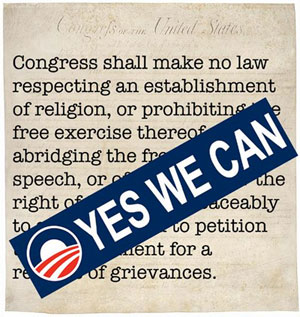
In his Feb. 4 address at the National Prayer Breakfast, President Barack Obama emphasized a theme that many Americans would agree with.
Lamenting the “erosion of civility” in political life, Obama said, “At times, it seems like we’re unable to listen to one another; to have at once a serious and civil debate. And this erosion of civility in the public square sows division and distrust among our citizens.”
But later in the speech, the president made a remark that astonished many Washington observers.
Insisting that people can still be united to serve the common good, Obama said, “That’s why my Office of Faith-Based and Neighborhood Partnerships has been working so hard since I announced it here last year…. And through that office we’ve turned the faith-based initiative around to find common ground among people of all beliefs, allowing them to make an impact in a way that’s civil and respectful of difference and focused on what matters most.”
In fact, many civil rights and civil liberties leaders say the president has not “turned the faith-based initiative around.” On the contrary, they say, Obama has failed to deliver on his campaign promises in regard to this issue and a growing political debate about it is brewing.
Americans United for Separation of Church and State has led the escalating call for the president to act.
In a Feb. 2 letter to the White House, Americans United Executive Director Barry W. Lynn observed, “As the one-year anniversary of your creation of the White House Office of Faith-based and Neighborhood Partnerships approaches, I urge you to restore the religious liberty and civil rights protections that were removed by the Bush administration’s ‘faith-based’ initiative.”
Lynn reminded Obama that President George W. Bush had allowed publicly funded “faith-based” groups to discriminate in hiring on religious grounds and had failed to enforce federal rules against proselytizing. Obama, at a July 1, 2008, campaign stop in Zanesville, Ohio, had promised to fix those problematic policies.
“[I]f you get a federal grant,” Obama said then, “you can’t use that grant money to proselytize to the people you help and you can’t discriminate against them — or against the people you hire — on the basis of their religion. Second, federal dollars that go directly to churches, temples, and mosques can only be used on secular programs.”
Lynn expressed dismay and disappointment at the president’s failure to keep that commitment.
“After eight years of struggling with the Bush administration,” Lynn wrote, “those of us who support civil rights and civil liberties were greatly relieved to hear those words. Forcing Americans to subsidize religious bias and proselytization with our tax dollars is certainly unfair and manifestly unconstitutional. Many Americans freely and generously support their houses of worship and other religious ministries. But no American should be required to support religious discrimination through his or her taxes.
“Yet today, more than one year after you took office,” continued Lynn, who is both an attorney and ordained minister, “your administration has not changed these misguided policies of the Bush administration. Billions of dollars in federal grants and contracts — including those made under your Economic Recovery Package — continue to be issued under these policies.”
Concluded Lynn, “In your Zanesville speech, you asserted that ‘as someone who used to teach constitutional law, I believe deeply in the separation of church and state.’ Mr. President, it is time to uphold that principle and keep your promise to correct the glaring deficiencies in the faith-based funding arena. I urge you to take immediate action to restore critical civil rights protections and vital religious freedom safeguards to your faith-based initiative.”
Later in the week, an array of civil rights, civil liberties, religious and advocacy groups joined the call for action. Twenty-five national religious and public policy organizations (including Americans United) wrote a letter to Obama asking him to make major changes to the “faith-based” initiative.
The Coalition Against Religious Discrimination’s joint letter laid out a specific set of proposals to protect civil rights and religious liberty in federally funded social services and urged Obama to adopt them. They include banning employment discrimination based on religion in tax-funded projects and issuing uniform guidelines to ensure that no person seeking help in a publicly funded program is subjected to unwanted proselytizing.
Among specific recommendations, the Feb. 4 missive asks the president to:
• Revoke a June 2007 legal memo issued by the Justice Department’s Office of Legal Counsel that asserts that a 1993 religious freedom law gives religious groups the right to take tax funds and still discriminate on religious grounds in hiring. This interpretation, the joint letter asserts, is “erroneous and threatens core civil rights and religious freedom protections.”
• Issue policies making it clear that social-services providers must give proper notice to beneficiaries of their religious liberty rights and access to alternative secular providers.
• Require that houses of worship and other religious institutions that infuse religion into every program create separate corporations for the purpose of providing secular government-funded social services.
Aside from Americans United, groups signing the letter are: African American Ministers in Action; American Association of University Women; American Civil Liberties Union; American Humanist Association; American Jewish Committee; Anti-Defamation League; Baptist Joint Committee for Religious Liberty; B’nai B’rith International; Human Rights Campaign; The Interfaith Alliance; Jewish Council for Public Affairs; National Association for the Advancement of Colored People; National Gay and Lesbian Task Force; OMB Watch; People For the American Way; Secular Coalition for America; Texas Faith Network; Texas Freedom Network; The Lawyers’ Committee for Civil Rights Under Law; Union for Reform Judaism; Unitarian Universalist Association of Congregations; United Methodist Church, General Board of Church and Society; United Sikhs; and Women of Reform Judaism.
While the list of signers was impressive, there is a growing concern that the Obama administration is paying more attention to conservative religious forces than the civil rights and civil liberties supporters.
The Wall Street Journal suggested that Obama’s team is hoping to build bridges to conservatives in a bid for broader political support. A Feb. 4 article, headlined “Keeping Faith, Courting Conservatives,” noted that the president’s Advisory Council on Faith-based and Neighborhood Initiatives includes a large number of religious conservatives who appear to be winning concessions from the White House.
The 25-member Council includes representatives from mainstream religious groups and minority faiths, but a conservative bloc is pushing for policies that jeopardize church-state separation. Its recommendations on many faith-based policies are scheduled to go to the president this month.
Many points among the recommendations are non-controversial and quite positive, but critics say at least one is deeply problematic. The Council in February voted to allow publicly funded faith-based agencies to display sectarian icons and signs in facilities where people of many faith perspectives come to get help from their government.
“Conservatives on the council,” the Journal reported, “are pleased with the direction the White House is taking.”
“As a conservative, I do feel there is a willing ear” in the White House, Council member Frank Page told the newspaper. Page, former president of the Southern Baptist Convention, added, “If there’s ever a time that the White House needs to say, ‘We need to keep our ears open,’ this is it.”
The Rev. Joel Hunter, pastor of a Florida evangelical megachurch, said Obama aides “really are trying to be responsive.” The newspaper reported that Hunter, a longtime Republican, changed his voter registration in November to independent due in part to his White House interactions.
According to the Journal, Burns Strider, a Democratic consultant who works on religious outreach and has close ties to the faith-based office, said building ties to evangelicals can “smooth the edges” that often mobilize conservative voters to oppose a Democrat such as Obama.
AU’s Lynn, who served on a task force set up to advise the Council, said he thinks many people have overlooked the apparent conflict of interest inherent in having religious leaders make policy recommendations about programs that their organizations benefit from.
In an opinion essay for the Huffington Post, Lynn said some of the Council members appointed by President Obama are powerful religious lobbyists whose denominations and groups benefit handsomely from government funds. They include representatives from the U.S. Conference of Catholic Bishops, Catholic Charities, the Union of Orthodox Jewish Congregations and the evangelical charity World Vision.
“Our research in government databases,” Lynn reported, “indicates that Catholic Charities (including its various affiliates) has taken at least $521 million over the last 10 years. The Catholic bishops’ conference has corralled $304.8 million over the same period, and World Vision has taken in $405.9 million. Orthodox Union-affiliated synagogues and Jewish schools have also benefited from millions in federal grants, though government reporting methods make the precise figure impossible to ascertain.”
Concluded Lynn, “Wouldn’t this be a conflict of interest by any ethical standard?”
The Obama Advisory Council has been asked not to address the hiring discrimination issue. That is supposed to be dealt with by the Department of Justice, although Joshua DuBois, head of Obama’s faith-based office, keeps saying it will be handled on a “case by case basis,” whatever that means.
Religious conservatives are hoping to prevail even on that deeply controversial issue.
Evangelical leader Jim Wallis, an Obama Council member who wants to keep the Bush hiring policy, told the Journal that White House aides were concerned that changing the policy might force some groups to stop taking government money to deliver services needed in difficult economic times.
Council member Nathan Diament of the Union of Orthodox Jewish Congregations told the newspaper Obama made a “deliberate decision” to side with aid groups rather than advocates that are not involved in delivering social welfare.
Advocates of civil rights and religious liberty hope Wallis and Diament are wrong. The issue is vitally important, they say, to people both in the United States and around the world.
In Kentucky, for example, Alicia Pedreira has fought a 10-year battle against a publicly funded Baptist child care agency that gave her top performance reviews but still fired her when it became public that she is a lesbian. (Americans United and the Kentucky ACLU are representing Pedreira and other Kentucky taxpayers in a federal lawsuit challenging public funding of Kentucky Baptist Homes, an agency that gets as much as half of its money from taxpayers yet discriminates on religious grounds in hiring and indoctrinates young people in its care in religious doctrine.)
Problems also are widespread in government-funded services overseas. According to a January report in Global Post, the evangelical organization World Vision received $281 million in government grants in 2008 — yet offers full-time employment only to Christians who fit the group’s creed.
Focusing on a project in predominately Muslim Mali, the story says people are being denied scarce jobs in U.S.-funded programs because World Vision is openly discriminatory.
World Vision officials don’t deny their religious bias. Torrey Olsen, World Vision’s Senior Director for Christian Engagement, told the Global Post, “We do want to be witnesses to Jesus Christ by life, word, deed and sign.” Fabiano Franz, another World Vision official, added, “We’re very clear from the beginning about hiring Christians. It’s not a surprise, so it’s not discrimination.”
Regardless of how these church-state conflicts turn out, religious lobbyists are hoping to maintain a major influence over Obama’s policies.
“I want him to listen to faith groups as much as he listens to people on Wall Street,” Wallis told The Washington Post. “I want him to listen to faith groups as much as military leaders on Afghanistan.”
Said AU’s Lynn, “The president needs to listen to the commands of the Constitution as well. We urge everyone who believes in civil rights and religious liberty to let the White House know how you feel.”
UK: Open Wi-Fi ‘outlawed’ by Digital Economy Bill
By David Meyer | ZDNet UK | February 26, 2010
The government will not exempt universities, libraries and small businesses providing open Wi-Fi services from its Digital Economy Bill copyright crackdown, according to official advice released earlier this week.
This would leave many organisations open to the same penalties for copyright infringement as individual subscribers, potentially including disconnection from the internet, leading legal experts to say it will become impossible for small businesses and the like to offer Wi-Fi access.
Lilian Edwards, professor of internet law at Sheffield University, told ZDNet UK on Thursday that the scenario described by the Department for Business, Innovation and Skills (BIS) in an explanatory document would effectively “outlaw open Wi-Fi for small businesses”, and would leave libraries and universities in an uncertain position.
“This is going to be a very unfortunate measure for small businesses, particularly in a recession, many of whom are using open free Wi-Fi very effectively as a way to get the punters in,” Edwards said.
“Even if they password protect, they then have two options — to pay someone like The Cloud to manage it for them, or take responsibility themselves for becoming an ISP effectively, and keep records for everyone they assign connections to, which is an impossible burden for a small café.”
In the explanatory document, Lord Young, a minister at BIS, described common classes of public Wi-Fi access, and explained that none of them could be protected. Libraries, he said, could not be exempted because “this would send entirely the wrong signal and could lead to ‘fake’ organisations being set up, claiming an exemption and becoming a hub for copyright infringement”.
Universities cannot be exempted, Young said, because some universities already have stringent anti-file-sharing rules for their networks, and “it does not seem sensible to force those universities who already have a system providing very effective action against copyright infringement to abandon it and replace it with an alternative”.
Subscriber vs IP
Young added that universities will need to figure out for themselves whether they qualify as an ISP or a subscriber. This is a distinction that carries very different implications under the terms of the bill, which would establish possible account suspension as a sanction against subscribers who repeatedly break copyright law, and force ISPs to store user data and hand it over to rights holders when ordered to do so.
Businesses providing open Wi-Fi networks to customers and clients will also need to decide whether they are ISPs or subscribers, “depending on the type of service and the nature of their relationship with their consumers…although it appears unlikely that few other than possibly the large hotel chains or conference centres might be ISPs”, Young said.
Young added that free or ‘coffee shop’ access tends to be too low-bandwidth to support file-sharing and, under the bill, “such a service is more likely to receive notification letters as a subscriber than as an ISP”. He recommended that they secure their connections and install privacy controls, to “reduce the possibility of infringement with any cases on appeal being considered on their merits”.
The BIS minister also noted that there was scope in the bill’s text — currently being amended in the House of Lords — “to reflect the position of libraries, universities or Wi-Fi providers”, perhaps by letting such organisations have different sets of thresholds that would trigger notification letters from rights holders.
“This would be a matter for the code and we would urge the relevant representative bodies to consider now how best to engage in the [Digital Economy Bill] code development process,” he added.
The bill defines an ‘internet access service’ as an electronic communications service that “is provided to a subscriber, consists entirely or mainly of the provision of access to the internet, and includes the allocation of an IP address or IP addresses to the subscriber to enable that access”.
An ISP is defined as a person who provides an internet access service, and a subscriber is defined as a person who “receives the service under an agreement between the person and the provider of the service, and does not receive it as a communications provider”.
Referring to BIS’s comments about the low bandwidth of coffee-shop connections, Lilian Edwards suggested it was “not correct to draft laws hoping they are difficult to break”.
Edwards also pointed out that BIS’s guidance for universities shows the government admitting “they don’t know themselves how universities fit into the Digital Economy Bill”.
“[Universities] don’t know if they’re subscribers, ISPs or neither,” Edwards said. “If the government is not clear, how on earth are the universities supposed to respond? This seems almost unprecedented to me, for a government document.”
Germany’s Top Court Overturns Anti-Terrorism Data Law
By Patrick Donahue – March 2, 2010
Bloomberg — Germany’s highest court overturned a two-year-old anti-terrorism law that requires telecommunications providers such as Deutsche Telekom AG to store Internet and phone data for six months, saying the rules violate privacy.
The law, which came into effect in December 2007 during Chancellor Angela Merkel’s previous government, calls for phone companies to collect data on phone calls, Internet surfing and text messaging for potential use in criminal or terrorist investigations.
The Federal Constitutional Court found that while the storing of communications data isn’t automatically unconstitutional, the law doesn’t sufficiently clarify what the information will be used for or provide for transparency.
The data “must be deleted immediately,” Hans-Juergen Papier, the court’s president, said today as he read out the decision in the western city of Karlsruhe.
Merkel’s government passed the law as part of its efforts to fight crime and terrorism, implementing a European Union directive adopted after the March 2004 bomb attack on Spanish trains that killed 191 people. While prosecutors had access to the data, the law provided limits against storing conversation details or identifying specific Web sites.
Privacy advocates challenged the legislation soon after it came into effect. Some 35,000 complaints were filed to the court, the most in its history, Deutsche Presse-Agentur said.
Strictest Standards
“This blanket data saving must conform to the very strictest constitutional standards in order to be effective,” Justice Minister Sabine Leutheusser-Schnarrenberger told reporters in Berlin. “This is a day to be very happy.”
The court said collected information can only be made available through a court warrant. Investigators also must be limited to use such data to pursue a proven “concrete danger” directed against a person or the security of the state. The data can also be used to prevent a “communal danger.”
The judges in Karlsruhe also said service providers should not be allowed to have “uncontrolled” discretion over how information is stored and secured.
Leutheusser-Schnarrenberger, a member of the Free Democratic Party, Chancellor Angela Merkel’s junior coalition partner, declined to say when the government would begin drafting a new data-storage law.
–Editors: Alan Crawford, Leon Mangasarian
To contact the reporter on this story: Patrick Donahue in Berlin at at pdonahue1@bloomberg.net.
To contact the editor responsible for this story: James Hertling at jhertling@bloomberg.net
License Plate Software Stirs Privacy Concerns
By KEN BELSON | The New York Times | February 26, 2010
THE notion of roving cameras snapping pictures of license plates conjures up television shows like Fox’s counterterrorism series, “24.”
It’s not just fantasy, though. Americans are already watched by a variety of security agencies using electronic surveillance technology, and in this post-9/11 world, there seems to be no turning back.
Privacy advocates, though, are not altogether comfortable with license plate numbers being electronically recorded by commercial operations.
While their views on the gathering this data may vary, privacy groups uniformly agree that the real issue is what happens to the photos after they are taken: how long they are stored and by whom; how secure the data is and whether it might be shared with third parties. Are the photographed license plate numbers matched against other lists, like credit scores or addresses?
“It’s a huge Pandora’s box,” Jack Gillis, a spokesman for the Consumer Federation of America, said. “There are possibilities for tremendous violations if it is used to find out where people are at a given time. Until the access to this technology can be controlled, it has scary potential.”
MVTRAC, whose database of delinquent borrowers is offered on a subscription basis to auto repossession outfits, said that it stores plate numbers recorded by users for years — and uses a high level of encryption to protect the data.
Still, with automatic license plate recognition technology now in private hands, its potential uses are magnified. As with other data streams, like records of cellphone calls or toll transponder payments, the accumulated data can be subpoenaed as evidence in court. MVTRAC and others say that repo men see personal information only when they find a wanted car, the same as they would in the faxes and e-mails they receive from auto lenders.
But invariably, technology finds other applications, said Marc Rotenberg, the executive director of the Electronic Privacy Information Center, a civil liberties advocacy group. You can imagine a scenario, he said, where someone spots a car with an attractive driver, types the license plate number into a computer program and finds the owner’s name. Many companies say their data is encrypted, he said, but “you have to ask, ‘who has the key?’ ”
Featured Video

Why the U.S. Should Pull Back From the First Island Chain
or go to
Aletho News Archives – Video-Images
From the Archives
Only 19.7% of Americans agree with US State Dept on Israeli settlements
… Most American adults of voting age don’t appear willing to reject the applicability of international law to Israel’s ongoing colonization of occupied territories in East Jerusalem, the West Bank and Golan Heights. … Full article
Blog Roll
 Aletho News
- British Government Employees Were Fact-Checking the News at the BBC. Nobody Told You.
- Albania on fire: who’s behind the riots?
- Egypt’s Civil Democratic Movement rejects involvement in regional war
- Egypt collaborates with Israel to build ‘Green Rafah’ project over erased Palestinian city
- Rising fuel prices and shortages have helped drive ongoing protests and rioting in France
- Tokyo protests demand Takaichi’s resignation over support for ‘Israel’
- Jennifer Kavanagh: Why the U.S. Should Pull Back From the First Island Chain
- Yemen denounces international community’s silence on Saudi aggression, siege
- UAE and Saudi Arabia move toward renewed coordination against Sanaa
- How Iran’s two-week retaliatory strikes exposed cracks in US military architecture in Persian Gulf
- If Americans Knew
- More on how Bari Weiss is using CBS on behalf of Israel
- What the UK Is Doing to Pro-Palestine Novelist Sally Rooney Is an Act of Orwellian Villainy
- ‘We will build palaces for Jews in Gaza’: Right-wing activists establish new outpost near border
- ‘You see us burning, you stay silent’: Family’s agony over mother and sons burned to death in Gaza tent
- Israel keeps Palestinian journalist Bushra al-Tawil in isolation for 46 days
- US-Israel integration plan puts US military tech in Israel’s hands
- Israeli Strike Burns Gaza Mother Alive in Front of Toddler, ‘Without Generating Any Headlines’
- ‘The Israel Experience with Mike Huckabee’: The Ambassador’s Family Sells Trips to Israel
- As Gazans carry out mass burial, food insecurity is getting worse – Daily Update
- Israeli rabbi permits occupiers to steal Palestinian olive harvest in West Bank
- No Tricks Zone
- Predictions Made By Renowned Climate Proifessor Over Past Decades Have Been Proven To Be Poor
- New Study Suggests Large Regions Of The Pacific Ocean Have Been Cooling For The Last 80 Years
- Germany’s Green Energy Debacle: High Energy Costs Force Kahla Porzellan to Close After 182 Years!
- New Study: 50 Years Of The Most Aggressive ‘Net Zero’ Policies Can Only Affect The Global Climate By 0.03°C
- US September “Heat” Was No Record…Many Records Set Decades Ago
- Latest European Green Energy Debacle; Portugal’s Largest Flagship Solar Park Insolvent!
- Green Energy Debacle: German Expert Professor Fritz Vahrenholt Warns Of Severe Economic And Social Consequences
- Two More Paleo Reconstructions Affirm Meters-Higher Sea Levels Across Ireland, Brazil 7000-6000 Years Ago
- New Study: Earth And Venus Surface Warmth Largely Explained By Convection And Lapse Rate, Not CO2 Or Radiation
- 2025 Nature Paper Claiming Worsening Global Drought Gets RETRACTED …Heavily Flawed

