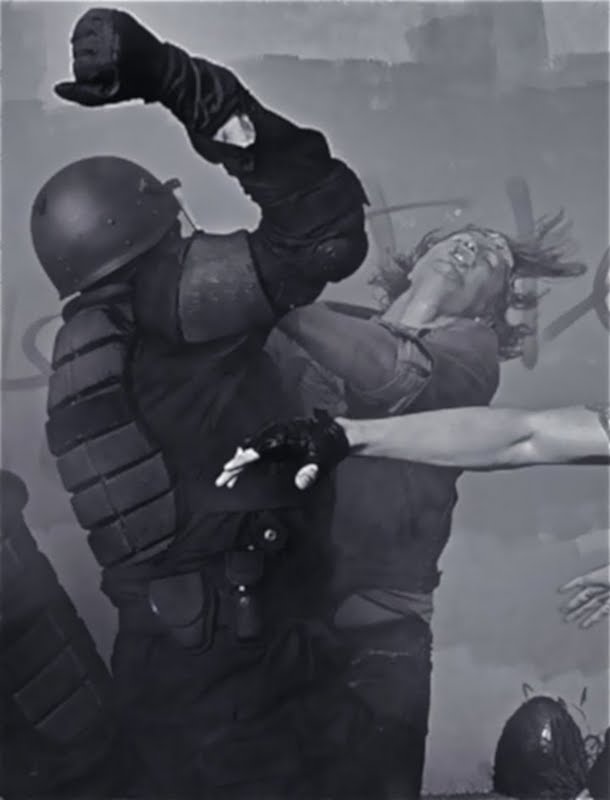
It Is Now Official: The U.S. Is A Police State
 By Paul Craig Roberts| February 8, 2010
Americans have been losing the protection of law for years. In the 21st century the loss of legal protections accelerated with the Bush administration’s “war on terror,” which continues under the Obama administration and is essentially a war on the Constitution and U.S. civil liberties.
The Bush regime was determined to vitiate habeas corpus in order to hold people indefinitely without bringing charges. The regime had acquired hundreds of prisoners by paying a bounty for terrorists. Afghan warlords and thugs responded to the financial incentive by grabbing unprotected people and selling them to the Americans.
The Bush regime needed to hold the prisoners without charges because it had no evidence against the people and did not want to admit that the U.S. government had stupidly paid warlords and thugs to kidnap innocent people. In addition, the Bush regime needed “terrorists” prisoners in order to prove that there was a terrorist threat.
As there was no evidence against the “detainees” (most have been released without charges after years of detention and abuse), the U.S. government needed a way around U.S. and international laws against torture in order that the government could produce evidence via self-incrimination. The Bush regime found inhumane and totalitarian-minded lawyers and put them to work at the U.S. Department of Justice (sic) to invent arguments that the Bush regime did not need to obey the law.
The Bush regime created a new classification for its detainees that it used to justify denying legal protection and due process to the detainees. As the detainees were not U.S. citizens and were demonized by the regime as “the 760 most dangerous men on earth,” there was little public outcry over the regime’s unconstitutional and inhumane actions.
As our Founding Fathers and a long list of scholars warned, once civil liberties are breached, they are breached for all. Soon U.S. citizens were being held indefinitely in violation of their habeas corpus rights. Dr. Aafia Siddiqui, an American citizen of Pakistani origin, might have been the first.
Dr. Siddiqui, a scientist educated at MIT and Brandeis University, was seized in Pakistan for no known reason, sent to Afghanistan, and was held secretly for five years in the U.S. military’s notorious Bagram prison in Afghanistan. Her three young children, one an 8-month-old baby, were with her at the time she was abducted. She has no idea what has become of her two youngest children. Her oldest child, 7 years old, was also incarcerated in Bagram and subjected to similar abuse and horrors.
Siddiqui has never been charged with any terrorism-related offense. A British journalist, hearing her piercing screams as she was being tortured, disclosed her presence.. An embarrassed U.S. government responded to the disclosure by sending Siddiqui to the U.S. for trial on the trumped-up charge that while a captive, she grabbed a U.S. soldier’s rifle and fired two shots attempting to shoot him. The charge apparently originated as a U.S. soldier’s excuse for shooting Dr. Siddiqui twice in the stomach, resulting in her near death.
On Feb. 4, Dr. Siddiqui was convicted by a New York jury for attempted murder. The only evidence presented against her was the charge itself and an unsubstantiated claim that she had once taken a pistol-firing course at an American firing range. No evidence was presented of her fingerprints on the rifle that this frail and broken 100-pound woman had allegedly seized from an American soldier. No evidence was presented that a weapon was fired, no bullets, no shell casings, no bullet holes. Just an accusation.
Wikipedia has this to say about the trial: “The trial took an unusual turn when an FBI official asserted that the fingerprints taken from the rifle, which was purportedly used by Aafia to shoot at the U.S. interrogators, did not match hers.”
An ignorant and bigoted American jury convicted her for being a Muslim. This is the kind of “justice” that always results when the state hypes fear and demonizes a group.
The people who should have been on trial are the people who abducted her, disappeared her young children, shipped her across international borders, violated her civil liberties, tortured her apparently for the fun of it, raped her, and attempted to murder her with two gunshots to her stomach. Instead, the victim was put on trial and convicted.
This is the unmistakable hallmark of a police state. And this victim is an American citizen.
Anyone can be next. Indeed, on Feb. 3 Dennis Blair, director of National Intelligence told the House Intelligence Committee that it was now “defined policy” that the U.S. government can murder its own citizens on the sole basis of someone in the government’s judgment that an American is a threat. No arrest, no trial, no conviction, just execution on suspicion of being a threat.
This shows how far the police state has advanced. A presidential appointee in the Obama administration tells an important committee of Congress that the executive branch has decided that it can murder American citizens abroad if it thinks they are a threat.
I can hear readers saying the government might as well kill Americans abroad as it kills them at home–Waco, Ruby Ridge, the Black Panthers.
Yes, the U.S. government has murdered its citizens, but Dennis Blair’s “defined policy” is a bold new development. The government, of course, denies that it intended to kill the Branch Davidians, Randy Weaver’s wife and child, or the Black Panthers. The government says that Waco was a terrible tragedy, an unintended result brought on by the Branch Davidians themselves. The government says that Ruby Ridge was Randy Weaver’s fault for not appearing in court on a day that had been miscommunicated to him. The Black Panthers, the government says, were dangerous criminals who insisted on a shoot-out.
In no previous death of a U.S. citizen by the hands of the U.S. government has the government claimed the right to kill Americans without arrest, trial, and conviction of a capital crime.
In contrast, Dennis Blair has told the U.S. Congress that the executive branch has assumed the right to murder Americans who it deems a “threat.”
What defines “threat”? Who will make the decision? What it means is that the government will murder whomever it chooses.
There is no more complete or compelling evidence of a police state than the government announcing that it will murder its own citizens if it views them as a “threat.”
Ironic, isn’t it, that “the war on terror” to make us safe ends in a police state with the government declaring the right to murder American citizens whom it regards as a threat.
Paul Craig Roberts was Assistant Secretary of the Treasury during President Reagan’s first term. He was Associate Editor of the Wall Street Journal.
FBI wants records kept of Web sites visited
By Declan McCullagh | February 5, 2010
WASHINGTON – CNET – The FBI is pressing Internet service providers to record which Web sites customers visit and retain those logs for two years, a requirement that law enforcement believes could help it in investigations of child pornography and other serious crimes.
FBI Director Robert Mueller supports storing Internet users’ “origin and destination information,” a bureau attorney said at a federal task force meeting on Thursday.
As far back as a 2006 speech, Mueller had called for data retention on the part of Internet providers, and emphasized the point two years later when explicitly asking Congress to enact a law making it mandatory. But it had not been clear before that the FBI was asking companies to begin to keep logs of what Web sites are visited, which few if any currently do.
The FBI is not alone in renewing its push for data retention. As CNET reported earlier this week, a survey of state computer crime investigators found them to be nearly unanimous in supporting the idea. Matt Dunn, an Immigration and Customs Enforcement agent in the Department of Homeland Security, also expressed support for the idea during the task force meeting.
Greg Motta, the chief of the FBI’s digital evidence section, said that the bureau was trying to preserve its existing ability to conduct criminal investigations. Federal regulations in place since at least 1986 require phone companies that offer toll service to “retain for a period of 18 months” records including “the name, address, and telephone number of the caller, telephone number called, date, time and length of the call.”
At Thursday’s meeting (PDF) of the Online Safety and Technology Working Group, which was created by Congress and organized by the U.S. Department of Commerce, Motta stressed that the bureau was not asking that content data, such as the text of e-mail messages, be retained.
“The question at least for the bureau has been about non-content transactional data to be preserved: transmission records, non-content records…addressing, routing, signaling of the communication,” Motta said. Director Mueller recognizes, he added “there’s going to be a balance of what industry can bear…He recommends origin and destination information for non-content data.”
Motta pointed to a 2006 resolution from the International Association of Chiefs of Police, which called for the “retention of customer subscriber information, and source and destination information for a minimum specified reasonable period of time so that it will be available to the law enforcement community.”
Recording what Web sites are visited, though, is likely to draw both practical and privacy objections.
“We’re not set up to keep URL information anywhere in the network,” said Drew Arena, Verizon’s vice president and associate general counsel for law enforcement compliance.
And, Arena added, “if you were do to deep packet inspection to see all the URLs, you would arguably violate the Wiretap Act.”
Another industry representative with knowledge of how Internet service providers work was unaware of any company keeping logs of what Web sites its customers visit.
If logs of Web sites visited began to be kept, they would be available only to local, state, and federal police with legal authorization such as a subpoena or search warrant.
What remains unclear are the details of what the FBI is proposing. The possibilities include requiring an Internet provider to log the Internet protocol (IP) address of a Web site visited, or the domain name such as cnet.com, a host name such as news.cnet.com, or the actual URL such as http://reviews.cnet.com/Music/2001-6450_7-0.html.
While the first three categories could be logged without doing deep packet inspection, the fourth category would require it. That could run up against opposition in Congress, which lambasted the concept in a series of hearings in 2008, causing the demise of a company, NebuAd, which pioneered it inside the United States.
The technical challenges also may be formidable. John Seiver, an attorney at Davis Wright Tremaine who represents cable providers, said one of his clients had experience with a law enforcement request that required the logging of outbound URLs.
“Eighteen million hits an hour would have to have been logged,” a staggering amount of data to sort through, Seiver said. The purpose of the FBI’s request was to identify visitors to two URLs, “to try to find out…who’s going to them.”
A Justice Department representative said the department does not have an official position on data retention.
Disclosure: The author of this story participated in the meeting of the Online Safety and Technology Working Group, though after the law enforcement representatives spoke.
The lynch-mob mentality
By Glenn Greenwald | Salon.com | February 5, 2010
If I had the power to have one statement of fact be universally recognized in our political discussions, it would be this one:
The fact that the Government labels Person X a “Terrorist” is not proof that Person X is, in fact, a Terrorist.
That proposition should be intrinsically understood by any American who completed sixth grade civics and was thus taught that a central prong of our political system is that government officials often abuse their power and/or err and therefore must prove accusations to be true (with tested evidence) before they’re assumed to be true and the person punished accordingly. In particular, the fact that the U.S. Government, over and over, has falsely accused numerous people of being Terrorists — only for it to turn out that they did nothing wrong — by itself should compel a recognition of this truth. But it doesn’t.
All throughout the Bush years, no matter what one objected to — illegal eavesdropping, torture, rendition, indefinite detention, denial of civilian trials — the response from Bush followers was the same: “But these are Terrorists, and Terrorists have no rights, so who cares what is done to them?” What they actually meant was: “the Government has claimed they are Terrorists,” but in their minds, that was the same thing as: “they are Terrorists.” They recognized no distinction between “a government accusation” and “unchallengeable truth”; in the authoritarian’s mind, by definition, those are synonymous. The whole point of the Bush-era controversies was that — away from an actual battlefield and where the Constitution applies (on U.S. soil and/or towards American citizens wherever they are) — the Government should have to demonstrate someone’s guilt before it’s assumed (e.g., they should have to show probable cause to a court and obtain warrants before eavesdropping; they should have to offer evidence that a person engaged in Terrorism before locking them in a cage, etc.). But to someone who equates unproven government accusations with proof, those processes are entirely unnecessary. Even in the absence of those processes, they already know that these persons are Terrorists. How do they know that? Because the Government said so. Even when it comes to their fellow citizens, that’s all the “proof” that is needed.
That authoritarian mentality is stronger than ever now. Why? Because unlike during the Bush years, when it was primarily Republicans willing to blindly trust Government accusations, many Democrats are now willing to do so as well. Just look at the reaction to the Government’s recent attempts to assassinate the U.S.-born American citizen and Islamic cleric Anwar al-Awlaki. Up until last November, virtually no Americans had ever even heard of al-Awlaki. But in the past few months, beginning with the Fort Hood shootings, government officials have repeatedly claimed that he’s a Terrorist: usually anonymously, with virtually no evidence, and in the face of al-Awlaki’s vehement denials but without any opportunity for him to defend himself (because he’s in hiding out of fear of being killed by his own Government). The Government can literally just flash someone’s face on the TV screen with the word Terrorist over it (as was done with al-Awlaki), and provided the face is nefarious and Muslim-looking enough (basically the same thing), nothing else need be offered.
That’s enough for many people — including many Democrats — to march forward overnight and mindlessly proclaim that al-Awlaki is “a declared enemy of the United States working to kill Americans” (if you can stomach it, read some of these comments — from Obama defenders at a liberal blog — with several sounding exactly like Dick Cheney, screeching: “Of course al-Awlaki should be killed without charges; he’s a Terrorist who is trying to kill Americans!!!”). Even now, beyond government assertions about his associations, the public knows virtually nothing about al-Awlaki other than the fact that he’s a Muslim cleric with a Muslim name dressed in Muslim garb, sitting in a Bad Arab Country expressing anger towards the actions of the U.S. and Israel. But no matter. That’s more than enough. They’re willing not only to mindlessly embrace the Government’s unproven accusation that their fellow citizen is a TERRORIST (“a declared enemy of the United States working to kill Americans”), but even beyond that, to cheer for his due-process-free execution like drunken fans at a football game. And the same people declare: no civilian trials are necessary for Terrorists (meaning: people accused by the Government of being Terrorists). Even more amazingly, the identities of the other Americans on the hit list aren’t even known, but that’s OK: they’re Terrorists, because the Government said so.
A very long time ago, I would be baffled when I’d read about things like the Salem witch hunts. How could so many people be collectively worked up into that level of irrational frenzy, where they cheered for people’s torturous death as “witches” without any real due process or meaningful evidence? But all one has to do is look at our current Terrorism debates and it’s easy to see how things like that happen. It’s just pure mob mentality: an authority figure appears and affixes a demonizing Other label to someone’s forehead, and the adoring crowd — frothing-at-the-mouth and feeding on each other’s hatred, fears and desire to be lead — demands “justice.” I imagine that if one could travel back in time to the Salem era in order to speak with some of those gathered outside an accused witch’s home, screaming for her to be killed, the conversation would go something like this:
Mob Participant: Hang the Witch!!! Kill her!!!
Far Left Civil Liberties Extremist-Purist (“FLCLE-P”): How do you know she’s a witch?
Mob Participant: Didn’t you just hear the government official say so?
FLCLE-P: But don’t you want to see real evidence before you assume that’s true and call for her death?
Mob Participant: You just heard the evidence! The magistrate said she’s a witch!
FLCLE-P: But shouldn’t there be a real trial first, with tangible evidence and due process protections, to see if the accusation is actually true?
Mob Participant: A “real” trial? She’s a witch! She’s trying to curse us and kill us all. She got more than what she deserved. Witches don’t have rights!!!
Return to Question 1.
That’s essentially how I hear our debates over Terrorism, and how I’ve heard them for quite some time. And it’s how I hear them more loudly now than ever before. And with those deeply confused premises now locked into place on a bipartisan basis (“no trials are needed to determine if someone is a Terrorist because Terrorists don’t have rights”), imagine how much louder that will get if there is another successful terrorist attack in the U.S. But in fairness to the 17th Century Puritans, at least the Salem witches received pretenses of due process and even trials (albeit with coerced confessions and speculative hearsay). Even when it comes to our fellow citizens, we don’t even bother with those. For us, the mere accusation by our leaders is sufficient: Kill that American Terrorist with a drone!
The Culture of Cocaine
By Forrest Hylton | February 5, 2010
Cocaine is a central commodity of the neoliberal age; so, too, its re-processed form (“crack”) for the desperately poor in de-industrialized cities of the North and South Atlantic. First announced by Richard Nixon in 1971, the “War on Drugs” predates the rise of cocaine and crack by nearly a decade, but, in the 1980s and ’90s, the “War on Drugs” was redoubled in response to the explosion of the cocaine business. It now ranks as the U.S.A.’s longest running military-police campaign. Thus, if we look at cocaine as a social hieroglyph – not as a thing but as a complex relation between networks and organizations of people, as well as between states and bureaucracies – we may glimpse some of the distinguishing features of the contemporary world.
There is a strong argument to be made for the impact of the cocaine business on architecture, urban design and construction, fashion, media entertainment, sports, and aesthetics, not to mention banking and credit institutions. The war on cocaine producers, sellers, and users has radically changed the shape of states in relation to those who are, at least nominally, rights-bearing citizens, as states have become more militarized, policed, punitive and carceral, and citizens more powerless and less protected by the rule of law. As the French sociologist Pierre Bourdieu observed in his late work, states do not disappear under neoliberalism: rather, their repressive right wings are strengthened while their progressive, redistributive rights-based wings are weakened or eliminated. This is most notable in cities, where urban space has been re-made in line with the requirements of policing and surveillance to protect capital investment and affluent consumers.
Though it does not advance these arguments, except tangentially, Tom Feiling’s well-researched The Candy Machine: How Cocaine took over the World (Penguin, 2009) makes a similar claim for the importance of its subject.Yet, could not the same be said of any essential commodity: oil, for instance, or cars or clothes? What makes cocaine different? The answer, of course, would depend on whom one asks, but what makes cocaine extraordinarily profitable for its import-export merchants is the fact that it is illegal. The fact that one country – Colombia – supplies 90 per cent of the cocaine consumed in the U.S. also makes the commodity different. Ninety per cent of Colombian cocaine enters the U.S.A. through Mexico (and Guatemala); smuggling having been made considerably easier by NAFTA, which de-regulated trucking and shipping.
Plan Colombia and Plan Mérida (Mexico) – based on counternarcotics and counterterrorism – are the two most important U.S. foreign policy initiatives in the Western Hemisphere, with Plan Colombia and its successors costing U.S. taxpayers $8 billion between 2000 and 2008, and Plan Mérida, approved in 2008, costing $500 million in 2009. So, cocaine is not only big business, it is also high politics: Plan Colombia has been held up as a model of counternarcotics and counterinsurgency success for Mexico, Afghanistan and Pakistan. One senior U.S. official told CBS News, “The more Afghanistan can look like Colombia, the better.”
Public debate in the U.S. concerning the suppression of cocaine production and consumption – and the U.S. has determined international drug policy since the U.N. Single Convention on Narcotic Drugs of 1961 – is moralistic, due to the weight of conservative strains of Protestantism, even among non-evangelicals, not to mention neoconservative Catholicism: decent, responsible people should not consume drugs, and should not be allowed to consume them, because, if they do, they will become unproductive degenerates.
If supply is reduced, the official argument goes, prices will rise for consumers in the U.S.A., and demand will drop correspondingly. Nevertheless, Plan Colombia and related anti-drug initiatives in the Andes and Mexico have not reduced the supply of cocaine to the U.S., where prices have tended toward secular decline since the early 1980s and domestic demand has fluctuated from generation to generation. The volume of illicit drugs that U.S. citizens consume has not changed significantly over time, but the type of drugs they consume has, with cocaine coming back into fashion, together with pharmaceuticals, among young, affluent people during the Bush II period.
In terms of costs and benefits, fighting cocaine production and consumption is a disaster even by the standards of the Pentagon: according to a 1994 RAND Corporation study, to reduce cocaine consumption by 1 per cent in the U.S., it would be twenty-three times cheaper ($34 million) to spend on treatment and education for consumers than on coca eradication for producers ($783 million).
But the failure to achieve stated objectives has yet to affect policy-making, which is driven mainly by ideology. Empirical data have little bearing on the policy-making process. The logic driving the War on Drugs has been chiefly ideological and political, not economic: domestic politics in the U.S. have determined policy abroad. One of the defining policies of Cold War liberalism, President Johnson’s War on Poverty – which had less than one-tenth of the lifespan of the War on Drugs – took for granted that federal and state governments should take responsibility for improving the plight of the poor in northern cities and represented a semi-coherent response to African-American riots and insurgencies. But what if poor black people in cities could be held responsible for their poverty? What if, as industrial jobs disappeared by the millions, they became addicted to selling or consuming illegal drugs, produced and/or distributed by U.S. government allies in Cold War counterinsurgent campaigns? Then African Americans could be locked up for nonviolent drug offenses and warehoused in prisons at an accelerated rate.
It is to Feiling’s credit to have discovered this larger truth, albeit in bits and pieces: “As long as the focus stayed on drug sales and drug abuse, inner-city residents could be blamed for the poverty they had been driven into … what the politicians had to do was convince the American public that the inner cities deserved to be abandoned.”
In the 1970s, President Richard Nixon and Governor Nelson Rockefeller in New York campaigned for office by whipping up hysteria about “crime” and “drugs,” and then criminalized African-American communities, militarized policing, and increased incarceration. After a brief respite under Carter, fighting crime and drugs in urban African-American neighborhoods became the rhetorical coin of the political realm under Ronald Reagan. The idea was to put African Americans back in their place without Jim Crow segregation, and to get elected or re-elected by doing it. Fear was to be one of the most enduring weapons in the U.S. politician’s arsenal. In his diary in 1969, Nixon’s top aide, H.R. Haldeman, provided a succinct summary of the overall strategy: “Nixon emphasized that the whole problem is really the blacks. The key is to devise a system that recognizes that, while not appearing to do so.”
In a letter to Dwight Eisenhower, Nixon wrote, “Ike, it’s just amazing how much you can get done through fear. All I talk about in New Hampshire is crime and drugs, and everyone wants to vote for me – and they don’t even have any black people up here.”
Nixon’s War on Drugs,” Feiling notes, was “politically expedient, since it turned attention away from … Vietnam, while preserving the military culture that had inspired the war in the first place.”
Nearly all of those imprisoned in New York State for drug offenses have been African-American or Latino males, most of them from eight neighborhoods in New York City. Whereas the U.S. had 200,000 prisoners in the 1970s, it currently has 1.8 million in jail and 5 million on probation or parole, making it the largest carceral state-society in world history. The U.S. accounts for 5 per cent of the world’s population and 25 per cent of its prison population; 500,000 people are serving time for nonviolent drug offenses.
Needless to say, the profile of the U.S. prison population does not reflect consumption patterns: whites consume an estimated 80 per cent of cocaine in the U.S.A., while African Americans consume 13 per cent; whites consume cocaine in disproportionate numbers, while blacks do not. Yet 38 per cent of those arrested and 59 per cent of those convicted for drug offenses have been African Americans. And stereotypes notwithstanding, whites account for 46 per cent of all crack use, while African Americans consume 36 per cent and Latinos 11 per cent. That is to say that although African Americans use crack out of proportion to their numbers, probably because it is the least expensive of illicit drugs, they consume considerably less of it than whites do.
Just as Jim Crow succeeded slavery at the end of the 19th century after Reconstruction was reversed, militarized policing and prisons replaced Jim Crow after the civil rights movement was rolled back. Black freedom struggles determined the limits of U.S. democracy from the early 19th century through the 1960s, and the criminalization and incarceration of young African-American males through the War on Drugs at the end of the 20th century represented another dramatic constriction of democratic politics in the U.S., first under President Nixon and accelerating under Presidents Reagan, Bush and Clinton. As Feiling and others have stressed, it was through sentencing laws on crack vs. powder cocaine which passed in 1986 under Ronald Reagan – in cooperation with Democratic house majority leader Tip O’Neill – and a revolution in police tactics and organization, that this was achieved.
Such is the domestic context, without which it is impossible to make sense of U.S. foreign policy in producer countries in the Andes (Colombia, Peru and Bolivia) and transport countries in Mexico, Central America and the Caribbean (leaving aside Brazil, whose government does not respond to U.S. pressures). After Ronald Reagan was elected, aerial fumigation was undertaken against marijuana growers in Mexico, Jamaica and Colombia in the early 1980s, even as the Pacific Northwest became the leading supplier of the U.S. marijuana market thanks to its competitive advantage in transport costs; the region was soon to find itself subject to similar, if less toxic campaigns. In 1982, President Reagan became the first to appoint a high-level official, then Vice President George H.W. Bush, to run the South Florida Drug Task Force – composed of agents from the DEA, Customs, FBI, ATF, IRS, Army, and Navy – to deal with cocaine trafficking in Miami, by which time the city’s homicide rate had made headlines thanks to the violence that Colombians had unleashed in their bid to take over and maintain distribution networks.
Before launching the invasion of Panama and the Gulf War, in 1989 President George H.W. Bush created the Office of National Drug Control Policy, led by “drug czar” William Bennett, militarized anti-narcotics policing in Colombia, Ecuador, Peru and Bolivia, and doubled the anti-drug budget to $12 billion. Mexico had already become the major transshipment point for Colombian cocaine, but its dominance only increased with the end of U.S. counterinsurgency wars in Central America, the passage of NAFTA, and the fall of the two so-called cartels in Colombia – Medellín and Cali – under President Clinton.
The Candy Machine’s greatest strength may be its presentation of perspectives from former gang members and drug users, drug traffickers and retired narcotics enforcement officials in the U.S. Thus Rusty, a former narcotics officer for the Department of Corrections in Arizona: “When I talk about legalizing drugs, people say, ‘you can’t mean heroin and crack, right?’ But after 30 years of the drug war, spending a trillion dollars … the bad guys still control the price, purity, and quantity of every drug. Knowing that they control the drug trade, which drug are you going to leave under their control? Regulation and legalization is not a vote for or against any drug. It’s not about solving our drug use problem. It’s solely about getting some control back.”
“They” refers to drug barons, many of them large landowners, as well as warlords, in Colombia, Mexico, Afghanistan and Pakistan, but the problem with Rusty’s analysis is that U.S. government allies in such countries – the intelligence services, the judicial systems, the military and police, business and political elites – are either complicit with or directly involved in supplying U.S. and European markets with cocaine and/or heroin, generally in order to finance counterinsurgency wars. As Cockburn and St. Clair’s Whiteout [to be reissued, updated, in 2010 by CounterPunch Books] describes, this pattern was set in the 1950s, with opium and heroin in places like Burma, Marseilles and Cuba, repeated in the 1960s and ’70s in Vietnam and Laos, and updated with Colombian cocaine in Central America and Central Asian heroin in the 1980s.
The career path of “Freeway Rick” Ross in the 1980s, is illustrative. Unlike everyone else selling cocaine or crack, Rick Ross was supplied with cocaine at cut-rate prices by Danilo Blandon, a Nicaraguan employee of the CIA in the U.S. government’s war against the revolutionary Sandinista government, as documented in Whiteout and the late Gary Webb’s Pulitzer-prize winning Dark Alliance: The CIA, the Contras, and the Crack Explosion (2003). From prison, Ross explained to Feiling, “Me and Danilo Blandon were really tight. I knew from earlier that he was backing some war, and I knew that he was from Nicaragua, but I had no idea about the Contras. I was illiterate at that time, you know. I never read a newspaper or listened to the news. They say that Danilo was protected, and you can assume from the Feds that I was protected too, but I never knew that. I was just in it for the money, trying to get out of the ghetto.”
Blandon sold cocaine to Ross at a price, of a quality, and in quantities that none of Ross’s competitors could match. As former DEA agent Celerino Castillo III, who served in El Salvador, told Feiling, “They gave all the coke to Danilo Blandon, who was a CIA asset. He in turn fronted all that stuff to Ricky Ross. Ross became the Walmart of crack, distributing to the Bloods and Crips and everybody else all over the country… Hangars 4 and 5 at Ilopango airport in El Salvador were used as a trampoline for drugs coming in from Colombia and Costa Rica. Oliver North and a Cuban exile named Felix Rodríguez [a former CIA agent who supervised the execution of Che Guevara in Bolivia] were running one of them, and the other one was owned by the CIA.
All evidence pointed to Vice President George H.W. Bush’s office as overseeing the operation, but, of course, nothing came of it besides the Kerry Committee Report of 1989, which charged the State Department with making payments to Nicaraguan Contras involved in the cocaine business.
In the neoliberal economy of the 1980s, anchored in financial services, insurance, real estate, and speculative asset bubbles, many African-American males and immigrant males of color saw the cocaine-crack business as the way to achieve material security. Cocaine gave a shot in the arm to street gangs, who handled lower levels of wholesale and retail distribution in the U.S. Rick Ross describes his trajectory: “I was a youngster. Uneducated, uninformed, unemployed. I was looking for opportunities. I wanted to be important in the world, somebody who was respected. Basically, I wanted the American dream, so I guess I was ripe for the picking. The opportunity came in the form of drugs and I latched onto it. I just kept saving my money and buying more drugs. My childhood friends would be walking, but I’d be driving a nice car, and they’d want to know how I got the car. ‘Oh, I’m selling cocaine now,’ I’d say. ‘Teach me how to sell cocaine,’ they’d say. So my friends started to get involved, and, before long, we’re making a lot of money, and I’m eating at McDonald’s whenever I want to. At our height, some days a million dollars would come through our hands in a single day. Next thing I know, the whole neighborhood is selling, people were already gang-banging, but now we were able to afford more expensive weapons, more expensive cars, and better houses and the police started noticing it more.”
The comment about eating at McDonald’s speaks volumes about the depths of poverty from which Rick Ross escaped, only to wind up living most of his life in a prison cell. Indeed, for most of those serving hard time for nonviolent drug offenses, the crack business offered much less distance from poverty than it had for Ross. Marc, from South Jamaica neighborhood in the borough of Queens, N.Y. – currently the epicenter of the foreclosure crisis in New York City’s black and brown neighborhoods – described his work as follows: “It was the hardest job I ever had. It’s pure capitalism, you know. Say, you’re selling drugs in the South Bronx, say at 138th and 3rd Avenue, and another crew of guys is selling the same drugs as you two blocks away. The block they’re on is making $2,000 per day, and the block you’re on is making about $2,000 per day. They decide, ‘You know what? You’re a punk. You’re a pussy.’ So they move you.” It’s dog eat dog, to quote the title of a remarkable 2008 film about the cocaine business in Cali, Colombia: a Hobbesian capitalist world of all against all and murder for hire.
This pattern – with gangs as cell forms of organized crime – was repeated among a host of new immigrant groups in the U.S., involved in cocaine distribution and/or smuggling and money-laundering: Colombians, Mexicans, Salvadorans and Guatemalans in L.A.; Colombians, Mexicans and Puerto Ricans in Chicago; Colombians, Jamaicans, Dominicans, Puerto Ricans, Mexicans, Albanians, and Russians in New York. These gangs, of course, are bi- and transnational, just like the cocaine commodity circuit, in which they are embedded: in L.A., there are roughly 2,000 gangs; in Medellín, Colombia, there were reportedly 6,300 gangs in 2003; Chicago is said to have 70,000 gang members.
Gangs involved in distribution aim to reproduce the corporate organization of capitalism, from which their members have been excluded. Hip-hop music testifies to this, particularly the Brooklyn variety pioneered by Biggie Smalls and Jay-Z. Lance, a cocaine wholesaler from South Jamaica, Queens, described his outfit as follows: “The structure of the business is like a Fortune 500. We’d have different titles, but it all basically remains the same as in corporate America. You have your CEO, your supervisor, your treasurer. You might be the captain; you have your lieutenants, your soldiers.” Most Fortune 500 companies have different titles for their executives, though; only the Sicilian mafia uses such terms for its employees. This would seem to be an indication of the extent to which poor African Americans – not to speak of Jamaicans, Dominicans, Mexicans, Colombians, Salvadorans, and so forth – have seized upon mafia organization and ideology to justify the pursuit of employment, upward mobility, material abundance, and, most importantly, “respect.” If so, it provides evidence of delusion, desperation, or some combination thereof, for, as anthropologist Phillipe Bourgeois’ In Search of Respect: Selling Crack in El Barrio (1995) shows, the cocaine-crack business is much like any other low-wage service industry offering no benefits. Feiling found that “street-level sellers earn roughly the federal minimum wage, which at the time of writing stood at $6.55 per hour.” Most top dealers have day jobs and take no more than 25 per cent of total revenues. Only one in six brings home more than $5,000 per month, as 60 per cent of revenues go to wholesalers and retailers on the lower rungs of the distribution chain.
Yet, in spite of the new mafia ideology encapsulated in Jay-Z’s (typically self-glorifying) verse, “even righteous minds go through this” (when contemplating whether to participate in the crack game), the cocaine business offers only marginally more room for upward mobility than the service industries to which African-American and Latino youth are confined in the licit economy – with the added risk, or near-certainty, of prison or violent death at an early age.
For direct producers of tropical agricultural commodities like coffee, neoliberal policies in the countryside – nowhere else applied with greater blood and zealotry than in Colombia – have accelerated a long-term secular price decline: there are no options other than coca for people in isolated rural frontier areas, where there is no state presence or source of employment. A coca grower from the department of Sucre (Monterrey municipality) does the arithmetic: “Getting a sack of potatoes to market will cost a farmer between 3,000 and 5,000 pesos, and it will sell for between 10,000 and 12,000 pesos, depending on demand. Meanwhile, coca is a lot easier to sow and process, and doesn’t need transporting because the traffickers come to the village to buy it. They pay 1,500,000 pesos for a kilo of coca paste.” Making coca paste is and will remain the only option for survival for millions of impoverished peasant families on the Colombian agricultural frontier; the same is true for Peru and Bolivia.
As the experience of the Bolivians Yungas with northern Argentina demonstrates, a legal market for coca dramatically reduces the amount of coca leaf produced for the cocaine business. Bolivian President Evo Morales, whose political base remains the coca growers’ trade union federation in the Chapare that produced him, would like nothing better than to tour the world touting the medicinal benefits of the coca leaf and coca tea, and it is easy to imagine a successful “coca diplomacy” with leaders and consumers in the EU, the U.S., Australia and Japan. But, first, the U.N. Single Convention of 1961 would have to be revised so that companies and firms other than Coca Cola could use the leaf for industrial purposes. Until U.S. domestic politics changes, it will stand.
Decriminalizing Marijuana and Cocaine
Perhaps in recognition of this fact, a number of Latin American countries have de-criminalized personal consumption of cocaine and marijuana. Colombia was the pioneer: in 1994, as head of the Constitutional Court, created in the Constitution of 1991, Judge Carlos Gaviria legalized the personal consumption of up to 20 grams of marijuana, and/or a gram of cocaine, because, he argued, drinkers were much more likely to commit violent crimes, and no one had suggested prohibition of alcohol consumption since the 1920s. Gaviria, who has since moved on to a political career in Colombia’s turbulent electoral Left, said, “Legislators can proscribe certain forms of behavior toward others, but not how a person is behaving toward him or herself, as long as this doesn’t interfere with the rights of others.” Ecuador, Argentina and Mexico have since followed suit, which represents the extent to which Latin American countries have sought and attained greater autonomy from U.S. imperial control, as many of the anti-drug laws in Latin America were drafted under U.S. diplomatic pressure. Latin American countries have now joined the Netherlands in treating drug consumption as a public health problem rather than a police problem.
In the U.S., however, as Feiling points out, “legalization” is a “third-rail issue” for politicians, meaning that most will not mention it for fear of destroying their political careers. As President Obama’s drug czar, Gil Kerlikowske, put it in July 2009, “Legalization is not in my vocabulary nor is it in the president’s.” To understand why, it is helpful to ask who wins and who loses from legalization. The losers, not necessarily in order of importance, would include U.S. Immigration and Customs Enforcement, the DEA, U.S. Border Patrol, the FBI, the ATF, the IRS, state and local police forces, the U.S. Coast Guard, the U.S. armed forces, to name only some of the agencies whose budgets depend on the drug war for funding, as well as their counterparts in U.S. client states throughout the Americas; arms manufacturers like Sikorsky Helicopters; large pharmaceutical companies like Pfizer; suppliers of chemicals for fumigation like Monsanto; the banking sector as well as off-shore tax havens; the Republican Party; along with warlords, gangs and gangsters. The clearest winners would be consumers, direct producers, and societies that would be less militarized, less carceral, less moralizing, and would have stronger public health and education systems. But, as Jack Cole, who spent 26 years in policing narcotics in New Jersey and is now the executive director of Law Enforcement against Drug Prohibition, stressed to Feiling, “When you train your police to go to war, they’ve got to have an enemy.” Cole considers the War on Drugs a “terrible metaphor” for “policing in a democratic society.” Terrible, alas, but substitute “neoliberal” for “democratic,” and it is nothing if not apt. Predictably, Obama and Kerlikowske have dropped the nomenclature, but the policies remain intact.
Forrest Hylton is the author of Evil Hour in Colombia (Verso, 2006), and with Sinclair Thomson, of Revolutionary Horizons: Past and Present in Bolivian Politics (Verso, 2007). He can be reached at forresthylton@yahoo.com.
US Govt Can Kill Citizens Overseas as Part of ‘Defined Policy’
Director of National Intelligence Tells Congress Americans Can Be Killed
By Jason Ditz, February 03, 2010
In testimony before the House Intelligence Committee today, National Intelligence Director Dennis Blair told representatives that American citizens can be assassinated by the US government when they are oveseas.
Blair said the comments were intended to “reassure” Americans that there was a “set of defined policy and legal procedures” in place and that such assassinations are always carried out by the book.
Rep. Pete Hoekstra (R – MI) inquired about the procedures involved, asking what the legal framework was under which Americans could be killed by the intelligence community.
Blair insisted that under no circumstances would Americans be assassinated overseas for criticizing the government, adding “we don’t target people for free speech.” Rather they are subject to assassination when the government decides they are a threat and when they “get specific permission.” Exactly who was giving that permission was unclear.
The question has been increasingly important as the Obama Administration attempts to help the Yemeni government assassinate Anwar al-Awlaki, a US-born cleric who is not accused of any crimes by the US government. The administration maintains that secret evidence exists linking Awlaki to terrorism.
There seems to be a chilling lack of oversight in the procedure behind these killings, however, Blair’s assurances against politically motivated assassinations aside. The US has killed Americans in overseas attacks before, but only as “collateral damage.” It has never admitted to explicitly assassinating an American citizen before, though it seems that the policy is in place and such killings are only a matter of time.
Harvard Law student detained, deported by Israel
Clinical student was entering country to perform human rights research

A warm smile and easy laugh reveal Hebah Ismail’s unthreatening, gentle personality. An American citizen, this 3L of Egyptian descent works with the International Human Rights Clinic on projects related to Bedouin land rights. Hebah wears a hijab. She still does not know which one, or combination, of these characteristics prompted the immigration personnel at Tel Aviv’s Ben Gurion International Airport to deem her dangerous and deny her entry to Israel.
Ismail flew to Israel to join Clinical Instructor and Global Advocacy Fellow Ahmad Amara and a fellow student for field research related to a 2008 report prepared by the Goldberg Committee. Convened by the Housing Ministry in 2007, the Goldberg Committee examined land disputes between the state of Israel and the Bedouin community and offered subsequent recommendations.
As her colleagues had already been in Israel for several days, Ismail arrived alone on the afternoon of December 23rd and planned to travel from Tel Aviv to Be’er Sheva by train. That evening, as Amara prepared to meet Ismail at the station, the Ben Gurion security services phone to notify him that she had been detained.
“I originally knew something would happen, that she would be held,” Amara said. “And we prepared for that.”
As expected, Ismail was pulled aside in border control for more intense screening. Over several hours, security personnel questioned her reasons for traveling to Israel, often returning to whether or not she intended to visit the Occupied Territories. A signed letter from the Human Rights Program attesting to the purpose of her trip and outlining her agenda did nothing to assuage their misgivings.
After almost seven hours, Hebah was directed to claim her luggage and open it for examination.
“I wasn’t strip searched, but they did pat me down well,” Ismail said.
After going through her computer, including the external hard drive, the line of questions continued. While most of those originally holding Ismail appeared rather young, a man in his 30s and clearly in a position of authority took over the interrogation.
Ismail recounts how this man introduced himself.
“I don’t remember his exact words,” she says. “But basically he told me, ‘Before we get started, we want you to know that this is a democratic country, and we respect other points of view. But we found things on your external hard drive that are very concerning.’ He was sure I had some other objective, but I had no idea what that could be.”
Hebah tried to assure the security officer that her trip related only to the clinical project and a personal desire to visit Jerusalem. But he remained convinced that an article on her computer describing modern Israeli as being on land previously held by Palestinians pointed to a more insidious motivation and began pressuring Ismail to allow him to read her emails.
“He told me, ‘I cannot let you through until I know I can go home and get a good night’s sleep,’” Ismail said. “He kept saying, ‘If you let me go through your email, I’ll let you in.”
Having been counselled by Amara prior to the trip that the security forces had no right to demand access to her emails, Ismail denied his request. Almost eight hours after landing, Ismail’s passport progressed from border control to immigration, who would proceed to ask the same set of questions. Only later would be learn that security had finally granted her entry and immigration ultimately denied her. Again, the demands centered upon her emails, but now the consequences escalated.
“They told me that if I didn’t let them read my emails, not only would I not be allowed into Israel, I would be banned for life.”
Having stood by her initial refusal regarding the personal mail, Ismail cannot ever travel to Israel.
“I always wanted to go to Jerusalem. And this was finally my chance. But I won’t be trying to go back.”
After being fingerprinted, photographed and having her passport scanned, Ismail was moved to van. She assumed this would take her to the departure gate, and she texted family about her imminent deportation. But instead of boarding a plane, Ismail found herself in the “Hedar Mesuravimor”, or “Rejected Room”, a holding pen for those awaiting deportation, a place she describes as akin to “a really bad Egyptian hostel.” This room would become her home over the next day, as she waiting for a flight 23 hours away. Before she could re-inform her family, the phone was taken, along with all of her other belongings.
“Once they asked if I had a heart condition, they even took my medication. I was allowed to keep one small sweater.”
Unable to contact her family, Ismail continued to request that someone contact Amara, so that he could at least reach out to them. Each time, the person on duty would simply tell her she could call later. But no one ever allowed her to make that call.
Morning arrived, and with it a breakfast of cheese and tea. Lactose-intolerant, Ismail could do little more than stare at the food. Hours later, she finally met with Amara, though as her lawyer, not as her professor. Explaining that they could launch a case and arose media interest on her behalf, Amara laid out the various options. However, a best case scenario would take at least a week, during which Ismail would remain in detention. The decision was made for her to return to the US.
Finally boarding a plane on Christmas Eve, Hebah had never managed to leave the Ben Gurion Airport. Arriving in the U.S., three plainclothes Israeli security officials walked her to the Department of Homeland Security and handed over her passport.
“The DHS officer asked if I had been arrested. The Israelis said no. He asked me if I was an American citizen, and I said yes. Then he walked me to the front of the passport line, stamped me and said, ‘Welcome home.’ I turned to my escort and said, ‘Have a happy holiday,’ and walked through to meet my family,” Ismail said.
Of course, they were worried about me going to Israel in the first place, so now they get to say, I told you so!” she laughs.
Ismail joins a growing list of human rights and development workers recently denied entry to and work permits in Israel.
“There is a general practice of denying entry to American citizens,” Amara said. “Its not uncommon with those of Palestinian origin, or anything about Jerusalem, the Negev, human rights. In the past, I had an American student of Pakistani descent who was also denied entry. No matter what you say, they assume you are going to the Territories.”
According to Reuters, in December 2008, Israel denied entry to Richard Falk, the United Nations Special Rapporteur on Israeli Behaviour in the Occupied West Bank and Gaza Strip and an American Jew. According to Reuters, “Falk had angered Israel by making remarks comparing its forces’ actions in the Gaza Strip to those of the Nazis in wartime Europe.” More recently, the Israeli newspaper Haaretz reported that “Israeli immigration police were involved in the arrest and deportation earlier this month of a Czech pro-Palestinian activist living in Ramallah.” In addition to the UN and pro-Palestinian groups, impacted organizations include Oxfam, Save the Children and Doctors without borders.
Amara cannot determine how Ismail’s adventures will impact the future of the Bedouin land project. Unable to do the research, the group cannot complete the project, which must be put on hold until another trip can be arranged.
“Hebah knew the Goldberg report, there were meetings arranged specifically for her trip,” Amara said. “It means now we won’t have something ready.”
Show Trial
By Margaret Kimberley | BAR | February 3, 2010
The United States government has held Khalid Sheikh Mohammed in Guantanamo ever since his capture in 2003. He was one of many “enemy combatants” held there without charge or trial. Not only did he suffer from this violation of American and international law, but Mohammed suffered through water boarding torture an incredible 180 times in just 30 days.
In November 2009 the Obama administration Justice Department announced that Mohammed would finally be tried in federal court in Manhattan. The courthouse is located just blocks away from the World Trade Center site that Mohammed is now charged with plotting to destroy.
A collection of reactionary, racist politicians eager to incite hysteria, such as Rudy Giuliani and Congressman Peter King, led New Yorkers and the rest of America to believe that Mohammed and his co-defendants should have been tried by military tribunal. Mayor Bloomberg initially appeared to be supportive of the venue but recently joined his police commissioner in claiming that security measures would require a shut down of all of lower Manhattan. Now the Obama administration has back tracked and no longer promises a trial in New York City.
It probably doesn’t matter where Mohammed is tried. Barack Obama and Attorney General Eric Holder both promised a conviction. Holder assures us. “Failure is not an option. These are cases that have to be won. I don’t expect that we will have a contrary result.” His boss said pretty much the same thing. When asked about those who might be offended by a civilian rather than military trial Obama told everyone to relax, promising that they wouldn’t find it “. . . offensive at all when he’s convicted and when the death penalty is applied to him.” The law professor president knew he had made a faux pas and tried to extricate himself immediately. “I’m not going to be in that courtroom. That’s the job of the prosecutors, the judge and the jury.”
While easily impressed liberals sang praises for the civil trial, the administration has chosen to continue military tribunals at Guantanamo for other defendants. Mohammed is in fact an anomaly for the Obama administration. The Bush policy continues unabated.
In the days of the Soviet Union, Americans and other westerners were quick to use the derisive term “show trial” when dissidents faced prosecution. That term can now surely be applied to the United States if a guilty verdict and execution are presented as foregone conclusions by both the president and his chief law enforcement officer.
Now Obama seems to be backing away from a commitment to civilian prosecution. His press secretary, Robert Gibbs, continues the promise of conviction and death, but not the promise of a trial in a courtroom. “He will be brought to justice and he is likely be executed for the heinous crimes he has committed in masterminding the killing of 3,000 Americans. That you can be sure of.” When pressed on the question of civilivan versus military jurisdiction, Gibbs was less than forthcoming. “The Attorney General believes the best place to do this is in an American courtroom.” (*link Gibbs) Smelling blood in the water, Republicans are determined to prevent any civilian prosecution of Mohammed. Senator Mitch McConnell has threatened to prevent the use of federal funds for a trial to be held in New York City or anywhere else.
Once again all Americans are made complicit in their government’s crimes. Phony concerns about security costs and whipped up fears of impending terror attacks are used to subvert the legal system that was once held up as a model for the rest of the world to follow.
Barack Obama and the Democratic Party still have solid majorities in the House and Senate. A few off year election defeats have given the president an excuse to cut and run before shots have been fired. Just as he announced a freeze on domestic spending programs that benefit every American citizen, he and the rest of the craven Democrats are now ready to toss the entire legal system under the back wheels of a large bus.
Bill Clinton didn’t begin his retreat away from Democratic Party principles until he actually lost control of Congress. As in all other matters, Obama is out-Clintoning Clinton. The Obama doctrine appears to be, “Why wait for defeat when you can create it yourself.”
The consequences of progressive Democratic capitulation to Obama grow more terrible every day. The military budget balloons, domestic spending vanishes and the Bush doctrine of an imperial president is continued by his predecessor. A show trial is but one symptom of what ails the Democratic Party and the nation.
Margaret Kimberley’s Freedom Rider column appears weekly in BAR. Ms. Kimberley lives in New York City, and can be reached via e-Mail at Margaret.Kimberley(at)BlackAgandaReport.com.
Corporations are not people and money is not speech
By Supreet Minhas | Columbia Spectator | January 31, 2010
In Citizens United v. Federal Election Commission, the U.S. Supreme Court overturned century-old restrictions on corporate spending in elections under the guise of protecting First Amendment free speech rights. Justice Anthony M. Kennedy, writing for the majority, said, “If the First Amendment has any force, it prohibits Congress from fining or jailing citizens, or associations of citizens, for simply engaging in political speech.” This argument of the majority decision rests on the notions that corporations are covered by the same free speech protections as individual citizens and that campaign donations or financing are the same as speech.
Corporations, however, are inherently not the same as individuals and thus cannot have the same protections as individuals. There are a slew of laws that protect corporations and their interests in the arena for which they are by definition formed—namely the marketplace. The laws that govern corporations and the rights enjoyed by them are distinct from the laws and rights of individuals. A corporation, for example, can enter into contracts like an individual, but unlike an individual, a corporation’s members can be protected by limited liability so their personal assets are not at stake.
If a corporation, then, is a distinct legal entity governed by different laws than an individual is, corporations are not protected under the First Amendment in the same way that individuals are protected. Corporations, especially in their most powerful and wealthy incarnations, are exponentially more influential than most individuals in America. The restrictions on corporate spending in elections that were overturned by the U.S. Supreme Court were meant to redress this power balance between average individuals and unduly influential businesses. Corporations already have a plethora of ways to influence politics, from political action committees to lobbyists on Capitol Hill. The framers of the Bill of Rights wanted to protect the voices of the trampled, not amplify the voices of the elite.
The other part of the Supreme Court’s premise for its decision is that the First Amendment free speech clause applies to campaign funding. While speech can be interpreted loosely as any form of expression, such an open, ambiguous definition would create a myriad of problems with all kinds of laws. An architect has a vision of a building: it is his art, his self expression, yet he cannot ignore local zoning laws that, for instance, restrict the height of his building. Should he sue the state for violation of his free speech, his right to expression? Equating money with speech also opens the door to sundry ludicrous claims by, for instance, an employer who objects to minimum wage laws since he’d like to express that his employees are only worth paying $3 an hour. There have to be restrictions on what constitutes speech to prevent a bastardization of the term and an overly liberal interpretation of the First Amendment.
A corporation already has the power to issue a statement in favor of a candidate or policy through its political action committees, and individual members of a business are welcome to contribute money as well. However, allowing a corporation to use its vast profits to directly finance the election or to remove a candidate compromises the democratic notion of a free and fair election. There are unseemly ties even now between politicians and various industries, but this new ruling would make such connections more robust and give them a veneer of legitimacy. A politician financed by a business would become completely beholden to its political agenda and not to the voters.
It’s not only the independence of politicians that’s at stake, but also the independence of our judges, who are at the very least expected to be impartial. Many states still use elections to appoint judges, which leaves them vulnerable to the influence of political spending. In a recent speech at a law school conference, former Supreme Court Justice Sandra Day O’Connor worried about the impact of corporate campaign funding in judicial elections, saying that “judicial campaigning makes last week’s decision in Citizens United an increasing problem for maintaining an independent judiciary.”
Two cornerstones of our democracy—free elections and an independent judiciary—are threatened by the Supreme Court’s activist and meddling decision. The case could have been decided much more narrowly in favor of Citizens United, but instead, the majority of the justices decided to expand the case to champion the rights of big money over the interest of the American people. Senators Dick Durbin (D-IL) and Arlen Specter (D-PA) introduced the Fair Elections Now Act last March. It would prohibit contributions from political action committees and would match individual donations, limited to $100, on a 4:1 basis so that fundraising focuses on the people. Such a system has been in place in New York City since the 1988 Campaign Finance Act. The rest of the country is long overdue to follow. Never before has the fight for public financing been more necessary.
The author is a Columbia College junior majoring in political science. She is a prospective law student.
Enemies Of Free Speech Call For Internet Licensing
Death of the web moves closer as UN calls for policing cyberspace
By Paul Joseph Watson, Alex Jones & Steve Watson | Prison Planet | February 1, 2010
Calls to introduce a licensing system to police the Internet on behalf of a powerful UN agency represent the latest salvo in a long-running battle to kill free speech on the web and bring an end to the powerful digital democracy that has devastated the carbon tax agenda of the UN by exposing the Climategate scandal.
UN International Telcommunications Union secretary general Hamadoun Toure told the World Economic Forum in Davos this past weekend that global treaties need to be enacted in the name of stopping cyber warfare.
Craig Mundie, chief research and strategy officer for Microsoft, told fellow globalists at the summit that the Internet needed to be policed by means of introducing licenses similar to drivers licenses – in other words government permission to use the web.
“We need a kind of World Health Organization for the Internet,” he said.
“If you want to drive a car you have to have a license to say that you are capable of driving a car, the car has to pass a test to say it is fit to drive and you have to have insurance.”
Andre Kudelski, chairman of Kudelski Group, said that people should be forced to “have two computers that cannot connect and pass on viruses”. Since using the Internet requires a computer to connect to a network, it seems unclear as to how this would work without blocking off entire areas of the Internet altogether.
Globalists are invoking the threat of cyber attacks by nation states in order to accomplish their real agenda of stifling and regulating out of existence the last true outpost of free speech – the Internet. The establishment is furious at the level of influence individuals and small political groups have been able to wield by means of the world wide web, particularly over the last few years.
Climategate is a perfect example of the power of the digital democracy that authoritarian enemies of free speech want to crush. The Copenhagen global warming conference was completely devastated by the Climategate revelations which appeared just days before elitists convened to ram through their CO2 scam. As a result of bloggers feverishly pursuing the Climategate story, the entire foundation of the UN’s IPCC has been totally eviscerated and the global warming hoax is on its last legs.
The power to cripple entire branches of their control freak agenda within a matter of weeks has the globalists hopping mad, which is why their mission to eliminate real free speech on the web is accelerating.
“Don’t be surprised if it becomes reality in the near future,” writes ZD Net’s Doug Hanchard. “Every device connected to the Internet will have a permament license plate and without it, the network won’t allow you to log in.” … Full article
How Members of Congress Are Advancing Anti-Muslim Hysteria to Push a Radical Legal Agenda
Islamophobes in Congress like Joe Lieberman are trying to set the U.S. on a path to establish a different set of legal standards for Muslims.
By Liliana Segura | January 28, 2010
Roughly one month after the massacre at Fort Hood and a little over a week after Umar Farouk Abdulmutallab (the “underwear bomber”) tried to blow himself up over the city of Detroit, one of the most conservative Republicans in the Congress, South Carolina Representative Gresham Barrett, re-introduced a sweeping piece of legislation that he first rolled out in 2003 as a freshman on Capitol Hill.
The Stop Terrorists Entry Program (STEP) Act was originally introduced on September 11 (naturally), 2003 “to bar the admission of aliens from countries determined to be state sponsors of terrorism, and for other purposes.” At the time, these countries included Iran, Libya, Syria, North Korea, Iraq and Cuba. The bill not only sought to bar presumed enemies of the state from entering the U.S., it also would have forced “nonimmigrant aliens” — visitors with a temporary visa — to leave the country, within 60 days of its passage.
In other words, they would be deported.
The STEP Act never got very far. But a few days into the new year, Rep. Barrett decided to try again. “Twice in the past two months, radical Islamic terrorists have attacked our nation and the administration has failed to adapt its national security and immigration policies to counter the renewed resolve of those who seek to harm our citizens,” he announced. “In light of these unfortunate facts, the Step Act of 2010 bars the admission of aliens from countries designated as state sponsors of terrorism and Yemen.”
Iranian advocacy groups were especially vocal in their alarm over the re-introduced bill. In an open letter to Barrett on January 9, Trita Parsi, president of the National Iranian American Council (NIAC), described his bill as an attempt to “make discrimination against Iranians into United States law.”
“You have said you are reintroducing the STEP Act in response to the Fort Hood shooting and the Christmas Day attempt to blow up an airplane over Detroit,” Parsi wrote. “We hope you recognize that no Iranian has been involved in any of these attacks, or the 9/11 terrorist attacks for that matter. The individuals who carried out the Fort Hood attack and the Christmas day attempt — an American Army major and a Nigerian national — would not have been affected in the slightest by the sweeping provisions offered in your bill.”
This point was reiterated by Keith Olbermann on MSNBC, who crowned Barrett one of his “Worst Persons” on his January 12 segment. Pointing out that Major Nidal Hasan was born in Arlington, VA and went to high school in Roanoke, Olbermann said, “I guess, congressman, you need to expand your STEP program to stop aliens from infiltrating our homeland from such nests of terror as Interstate 81 in Virginia.”
The day before Barrett officially re-introduced the STEP Act, NIAC delivered thousands of letters to his office, urging him to reconsider. “Your bill punishes innocent Iranians and implies that ‘stopping terrorists’ means barring them from entering the U.S. to visit family or go to school,” the letters read.
Surprisingly, hours after the letters were delivered, Rep. Barrett’s office said he would get rid of the language that would lead to the deportation of immigrants from Iran and other countries. “Unfortunately, many have been misinformed on the true nature of this legislation,” Barrett claimed in a statement released alongside the bill. “Contrary to some reports, the STEP Act does not contain any language that calls for deportation of citizens from countries identified as state sponsors of terrorism who have already obtained a United States visa and currently reside in the United States … Citizens from these countries who have already obtained a United States visa and currently reside in the United States will not be affected by this legislation.”
NIAC declared this “a major victory,” but warned that the fight is not over. The revised version of the bill still basically criminalizes Iranians and others, banning them from obtaining U.S. visas.
The STEP Act may be a uniquely bad — not to mention far-fetched — example of legislative efforts to install blatantly discriminatory policy into American law books in the name of national security. But the danger it represents, even in its softened version, is hard to overstate. “That people even consider dropping those pieces of legislation is pretty troubling,” Corey Saylor, legislative director of the Council on American-Islamic Relations (CAIR), told AlterNet. At a time when blatant and far-reaching anti-Muslim measures are being enacted in other parts of the world — such as the Swiss ban on minarets or the campaign to ban the hijab in France — new attempts to target Muslims in this country are cause for concern. “I think we’re headed in a very disturbing direction, in which anti-Muslim hysteria is growing, and I think it’s something that we all need to address,” CAIR spokesman Ibrahim Hooper told AlterNet.
The issue should be addressed sooner rather than later. Within days of Abdulmutallab’s foiled bomb attempt, the White House announced that citizens of 14 predominantly Muslim countries — Yemen, Nigeria, Saudi Arabia, Pakistan, Libya, Iraq, Algeria, Afghanistan, Iraq, Lebanon, Syria, Sudan, Somalia and Cuba — would now be subject to additional screenings at airport security, a policy that will remain in place “indefinitely.” As with the STEP Act, this effectively criminalizes whole global populations, feeding into the “clash of civilizations” narrative that has fueled so many destructive post-9/11 misadventures. Nawar Shora, the legal director at the American-Arab Anti-Discrimination Committee, called the 14-country directive “extreme and very dangerous.”
Argentina reveals secrets of ‘dirty war’
Buenos Aires, Jan 29 (IANS/EFE) Argentina has disclosed the secrets of the ‘dirty war’ waged against the left by the country’s military regime 1976-83.
The secret files of Battalion 601, described as the ‘brain’ that coordinated killings, kidnappings and other abuses, contains the identities of both military and civilian personnel who played a role in the repression.
The declassification of the documents began with an order from Argentine President Cristina Fernandez Jan 1.
The documents presented before the federal Judge Ariel Lijo for review contain data on 3,952 civilians and 345 army personnel who worked for Battalion 601, said Ramon Torres Molina, director of the National Archive of Memory.
The battalion’s civilian operatives included everyone from college professors to people who worked as porters, concierges and maintenance men at apartment buildings.
They were used to collect information and to infiltrate guerrilla groups and human rights organisations, with those assigned to infiltration duties given aliases with initials matching those of their real names.
The civilian agents were classified by grades corresponding to military ranks and the most proficient could aspire to the equivalent of colonel.
Torres, who refused to divulge any names until Judge Lijo finishes reviewing the documents, said the intelligence structure was created in the early 1970s and that it survived until 2000, when Battalion 601 was disbanded and its remaining 500 or so civilian operatives dismissed.
Some former commanders of the unit have died and others have been criminally charged, but many military and civilian veterans of the unit are at large, the archive director said.
The archive continues to thumb through more than 4 million digitised pages and thousands of dossiers in search of information about the crimes of a regime that left more than 30,000 ‘disappeared’.
Featured Video
Why the U.S. Should Pull Back From the First Island Chain
or go to
Aletho News Archives – Video-Images
From the Archives
Only 19.7% of Americans agree with US State Dept on Israeli settlements
… Most American adults of voting age don’t appear willing to reject the applicability of international law to Israel’s ongoing colonization of occupied territories in East Jerusalem, the West Bank and Golan Heights. … Full article
Blog Roll
 Aletho News
- British Government Employees Were Fact-Checking the News at the BBC. Nobody Told You.
- Albania on fire: who’s behind the riots?
- Egypt’s Civil Democratic Movement rejects involvement in regional war
- Egypt collaborates with Israel to build ‘Green Rafah’ project over erased Palestinian city
- Rising fuel prices and shortages have helped drive ongoing protests and rioting in France
- Tokyo protests demand Takaichi’s resignation over support for ‘Israel’
- Jennifer Kavanagh: Why the U.S. Should Pull Back From the First Island Chain
- Yemen denounces international community’s silence on Saudi aggression, siege
- UAE and Saudi Arabia move toward renewed coordination against Sanaa
- How Iran’s two-week retaliatory strikes exposed cracks in US military architecture in Persian Gulf
- If Americans Knew
- More on how Bari Weiss is using CBS on behalf of Israel
- What the UK Is Doing to Pro-Palestine Novelist Sally Rooney Is an Act of Orwellian Villainy
- ‘We will build palaces for Jews in Gaza’: Right-wing activists establish new outpost near border
- ‘You see us burning, you stay silent’: Family’s agony over mother and sons burned to death in Gaza tent
- Israel keeps Palestinian journalist Bushra al-Tawil in isolation for 46 days
- US-Israel integration plan puts US military tech in Israel’s hands
- Israeli Strike Burns Gaza Mother Alive in Front of Toddler, ‘Without Generating Any Headlines’
- ‘The Israel Experience with Mike Huckabee’: The Ambassador’s Family Sells Trips to Israel
- As Gazans carry out mass burial, food insecurity is getting worse – Daily Update
- Israeli rabbi permits occupiers to steal Palestinian olive harvest in West Bank
- No Tricks Zone
- Predictions Made By Renowned Climate Proifessor Over Past Decades Have Been Proven To Be Poor
- New Study Suggests Large Regions Of The Pacific Ocean Have Been Cooling For The Last 80 Years
- Germany’s Green Energy Debacle: High Energy Costs Force Kahla Porzellan to Close After 182 Years!
- New Study: 50 Years Of The Most Aggressive ‘Net Zero’ Policies Can Only Affect The Global Climate By 0.03°C
- US September “Heat” Was No Record…Many Records Set Decades Ago
- Latest European Green Energy Debacle; Portugal’s Largest Flagship Solar Park Insolvent!
- Green Energy Debacle: German Expert Professor Fritz Vahrenholt Warns Of Severe Economic And Social Consequences
- Two More Paleo Reconstructions Affirm Meters-Higher Sea Levels Across Ireland, Brazil 7000-6000 Years Ago
- New Study: Earth And Venus Surface Warmth Largely Explained By Convection And Lapse Rate, Not CO2 Or Radiation
- 2025 Nature Paper Claiming Worsening Global Drought Gets RETRACTED …Heavily Flawed

