HOUSING AID AND LOANS FOR NON-CITIZENS: WHO’S PROTECTING THE MIDDLE CLASS?
The HighWire with Del Bigtree | August 29, 2024
France arrests nurse who volunteered in Gaza

Imane Maarifi
MEMO | September 6, 2024
France yesterday arrested then released nurse Imane Maarifi who spent 15 days volunteering as a medic in the Gaza Strip.
Lawyer Rafik Chekkat, founder of the Islamophobia platform, said Maarifi was arrested in the morning at her home and taken into custody.
He criticised the arrest and said it took place at a time when French soldiers who fought in Gaza “enjoy total impunity.”
Thomas Portes, a lawmaker from the La France Insoumise, or France Unbowed (LFI) party, wrote that Maarifi has been released from custody.
“The search of the home in front of the family leaves no doubt about the desire to intimidate the voices that are raised to support the Palestinian people and demand an immediate ceasefire,” he wrote on X.
Maarifi attended pro-Palestinian rallies in France to share her testimony about the crippling situation in Gaza.
She has also expressed her demand for an immediate ceasefire in Gaza and a boycott of companies supporting Israel.
Maarifi spent 15 days volunteering as a medic at the European hospital in Khan Yunis.
American universities rolling out BANS on anti-Israel protests; any criticism of Zionism to be considered “hate speech”
By Ethan Huff | News Target | September 4, 2024
Following the lead of New York University (NYU), American colleges and universities are imposing new rules to ban all criticism of Israel as “hate speech” and “antisemitism.”
At least 17 schools, including NYU, have already altered their policies to punish students and faculty for disagreeing with Israel’s war on Gaza. Some are prohibiting all Israel-related protests while others are going so far as to ban entire student organizations on campus.
In more extreme cases, schools are prohibiting students and faculty from protesting even online while others are expanding their conduct codes to basically keep quiet about Zionism or else face a school tribunal, of sorts, for punishment.
Indiana University, for instance, changed its “expressive activity” policy to ban all protests within 25 feet of university buildings and demonstrations that block “any building, facility, driveway, parking lot or parking ramp.”
The University of South Florida is banning all protests after 5 p.m., as well as during the entire final two weeks of every semester. If USF students want to set up a tent or canopy on campus, they will now be required to first get approval – and under no circumstances can anything be left out overnight without prior authorization.
(Related: Some teachers and preachers of prophecy, including Amir Tsarfati, want to justify genocide by claiming that the mass killing of Palestinians is God’s will for Israel.)
Zuckerberg, a true Zionist lapdog
At Vanderbilt University, all demonstrations that “require individuals to sleep or gather overnight” are now strictly prohibited. All on-campus displays from now on must also be during daylight hours only, and for no longer than three consecutive days at a time.
The University of California (UC) system says that encampments are no longer allowed on any of its 10 campuses. Protesters are also strictly prohibited from wearing masks or otherwise disguising their identity now that the people doing it are protesting Israel rather than destroying property in solidary with George Floyd.
The California State University (CSU) has implemented the same new rules as the UC system at its 23 statewide campuses.
At Rutgers University in New Jersey, the entire chapter of Students for Justice in Palestine (SJP) is prohibited from the campus until July 2025, which is the same thing George Washington University did except that GWU also kicked out Jewish Voices for Peace, an anti-Zionist Jewish organization.
At Columbia University, SJP is permanently banned from having an Instagram account. The school is so involved in making this new rule stick that it convinced Meta to send a notice to its SJP chapter informing members that their group’s account “doesn’t follow our Community Guidelines.”
The list goes on and on as the Zionist contingent in America makes its moves trying to silence all of their critics. They are really playing their hand now and showing just how many schools, government agencies, corporations and other institutions are under their thumb, hence the systematic abolition of free speech we are witnessing.
It turns out that one of the first entities to start doing all this was Facebook (Meta), which has been working on trying to silence anti-Zionist speech on its platform since at least 2020 when Mark Zuckerberg issued new speech codes banning all Holocaust denial and other content that depicts “Jewish people running the world or controlling major institutions such as media networks, the economy or the government.”
“The idea of banning content that promotes stereotypes of Jewish global control came up a year ago, in a meeting with several Jewish groups convened by Facebook, and was pushed primarily by the World Jewish Congress,” The Jewish Daily Forward reported at the time.
Unions condemn British police for arresting independent journalist
RT | September 5, 2024
The International Federation of Journalists (IFJ) and UK’s National Union of Journalists (NUJ) have condemned the recent arrest in the UK of independent reporter Richard Medhurst. In a joint letter addressed to New Scotland Yard anti-terrorism head Matt Jukes and dated Tuesday, the unions said they were “shocked” and “concerned” over what they consider “efforts to stifle press freedom.”
A British citizen of Syrian descent, Medhurst was arrested at London’s Heathrow Airport on August 15. According to his own account provided to several media outlets, he was pulled off a plane and taken to a police station, where he was held for over 24 hours. His phone and work equipment were seized, while Medhurst himself was subjected to a search and a questioning.
He was told he was arrested under Section 12 of the UK’s Terrorism Act 2000 on charges of “expressing an opinion or a belief that is supportive of a proscribed organization.” He was eventually let go, but said he does not yet know whether he will be charged with any offense.
Michelle Stanistreet, NUJ general secretary, and Anthony Bellanger, IFJ general secretary, said Medhurst’s arrest “will likely have a chilling effect on journalists in the UK and worldwide,” as they would now fear arrest by UK authorities “simply for carrying out their work.”
“Both the NUJ and IFJ are shocked at the increased use of terrorism legislation by the British police in this manner. Journalism is not a crime,” they stated, arguing that the “powers contained in anti-terror legislation must be deployed proportionately – not wielded against journalists in ways that inevitably stifle press freedom.” They requested a meeting with Jukes, urging UK authorities to provide “clarity” on Medhurst’s case.
The Terrorism Act 2000 gives police wide powers to prosecute and punish offenses linked with terrorism. Its Section 12 criminalizes anyone who “invites support” for an organization designated as terrorist or “expresses an opinion or belief that is supportive” of it. A person found guilty of an offense under this section could face imprisonment for up to 14 years and a hefty fine.
Medhurst told the Anadolu news agency that he was never given a clear reason for his detention, but said it was likely linked to his reporting on the war in Gaza. The journalist is a vocal supporter of Palestine and its militant group Hamas, considered a terrorist organization by the UK government.
He also warned that his arrest could set a dangerous precedent, noting that London is increasingly using the Terrorism Act “not against terrorists, but against political dissidents.”
Medhurst covers international affairs on his YouTube channel and hosts a program on Iran’s Press TV, while also publishing opinion pieces in other outlets. He previously contributed several articles to RT.
Scott Ritter Says Ending Cooperation With RT, Sputnik Due to US Sanctions
Sputnik – 05.09.2024
The US Department of the Treasury issued a statement on Wednesday to announce sanctions against the Rossiya Segodnya media group, RIA Novosti, RT, Sputnik and Ruptly. The sanctions affected Rossiya Segodnya and RT Editor-in-Chief Margarita Simonyan and a number of other senior executives.
“The actions by the Department of the Treasury in levying new sanctions against RT, Sputnik, and other Russian media organizations has made it impossible for me to continue my work as an outside contributor for RT and Sputnik, as well as participating in interviews and other collaborations with other Russian media,” Ritter said on X.
He said his work with Russian media organizations was legitimate journalism.
“I reject the notion that the work I have done over the past years with the newly sanctioned Russian media organizations has been anything other than legitimate journalism, the content of which has been factually correct and analytically sound, and always of my own creation,” Ritter said.
However, he said, he is committed to obeying US laws.
“Nonetheless, I am fully committed to obeying US law, and as such will be terminating all contractual relationships with both RT and Sputnik effective immediately, as well as suspending my participation in any and all media interaction with sanctioned individuals and organizations until which time it is deemed lawful to do so by US authorities,” Ritter said.
He said he will continue to exercise his free speech rights.
“I am deeply grateful for the professionalism of all of my Russian colleagues over the past several years, and am proud to have made their acquaintance. I regret the actions of my government in silencing legitimate journalistic outlets, and look forward to the day when freedom of speech and a free press is not constrained by a dubious ‘Russian exception’ that is violative of Constitutional norms and values,” Ritter said.
Russian Foreign Ministry spokeswoman Maria Zakharova, commenting on the US sanctions imposed against the Rossiya Segodnya media group, told Sputnik that attacks on Russian media are the result of operations by Western security services to “sterilize” the information space.
US becoming ‘neoliberal dictatorship’ – Moscow
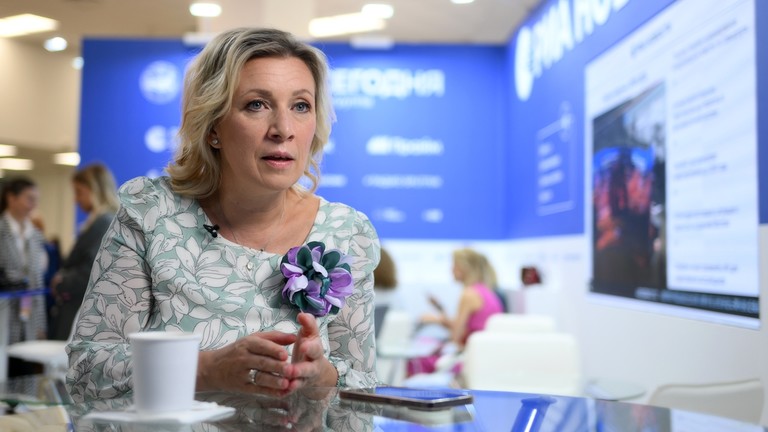
Russian Foreign Ministry spokeswoman Maria Zakharova © Aleksandr Kryazhev / RIA Novosti
RT | September 5, 2024
Repeated sanctions to limit the freedom of Russian media in the US point to the erosion of democratic values in Washington, Foreign Ministry spokeswoman Maria Zakharova has said.
The spokeswoman made the comments to RIA Novosti on the sidelines of the Eastern Economic Forum in Vladivostok on Wednesday, just hours after the US rolled out a new round of sanctions.
Washington has imposed severe restrictions on Russian media in the past, Zakharova noted. The imposition of these new sanctions “testifies to the irreversible degradation of the democratic state in the United States and its transformation into a totalitarian neoliberal dictatorship,” she said, adding that news outlets have become a “bargaining chip in partisan disputes, and the public is deliberately misled by insinuations about mythical interference in ‘democratic processes.’”
The attacks on Russian media are “the result of carefully thought-out operations” planned by intelligence services and coordinated with mainstream media outlets, Zakharova said. The goal, she claimed, is to “to sterilize the national and – in the future – global information space from any forms of dissenting opinion.” This new “witch hunt” is aimed at keeping “the populace in a state of permanent stress,” as well as building up the image of “an external foe” – in this case, Russia, she went on to say.
Despite this, there is a demand for media coverage by RT and other Russian news resources, Zakharova added.
On Wednesday, the Justice, State, and Treasury Departments announced a joint effort to target with sanctions and criminal charges Russian media – including RT – and individuals which the administration of US President Joe Biden claim are Russian “government-sponsored attempts to manipulate US public opinion” ahead of the presidential election this November. The new designations “complement law enforcement actions” such as visa restrictions, as well as a ‘Rewards for Justice’ offer of up to $10 million for “information pertaining to foreign interference in a US election.” They claim that RT used a front company to disguise its own involvement or the involvement of the Russian government in content meant to influence US audiences.
These actions by the US “directly contravene their obligations to ensure free access to information and media pluralism” and will not go unanswered, the Foreign Ministry spokeswoman said.
Persecution of Sputnik, RT Contributors Highlights US Hypocrisy – Ex-CIA Analyst
By John Miles – Sputnik – September 5, 2024
The United States’ persecution campaign against journalists and political dissidents with ties to Russian media accelerated Wednesday when new repressive measures were announced against several entities.
New sanctions were announced against 10 individuals and two organizations under the umbrella of the Rossiya Segodnya media group, including RIA Novosti, RT, Sputnik and Ruptly. The sanctions target these entities for alleged “hostile interference in the presidential elections,” the US Treasury Department claimed. The measures also target editor-in-chief of Rossiya Segodnya and RT Margarita Simonyan and several top managers at RT.
Ex-CIA analyst and former State Department counterterrorism expert Larry Johnson spoke with Sputnik Wednesday about the startling development, the latest attempt by the Biden administration to shape political discourse online and in the media.
“The latest stunt pulled by the Biden Department of Justice to declare all of these sanctions on Russia for alleged interference in the US political system is a level of hypocrisy that is staggering in its magnitude and in its foulness,” Johnson said.
“Let’s be clear about one thing: the one country in the world that has been involved with more interference in the internal political affairs of every other country is the United States. During the reign of President Eisenhower in the 1950s, there were 170 different covert actions carried out against other countries.”
“This year [the US has] allocated almost $4 billion to interfere or meddle in the political affairs of other countries,” he continued. “$315 million of that goes to the National Endowment for Democracy. $300 million is specifically what they call counter-Russian influence. And another $2.9 billion is for ‘democracy’ programs. And these have been used basically to run propaganda, to pay people, to organize ‘democracy’ programs in places like Georgia.”
The US frequently funds pro-Western media and non-governmental organizations (NGOs) in foreign countries it targets for regime change to pave the way for a pro-US government to come to power. Author and journalist William Blum documented over 50 examples of significant US interference in other countries since World War II in his classic book Killing Hope, largely based on the shocking revelations of ex-CIA agent Philip Agee.
More recently the US has interfered in countries such as Brazil, Indonesia and Ukraine, paving the way for the latter country’s extremist anti-Russia government through its support for the Euromaidan coup in 2014.
“I don’t know how many millions of dollars are allocated to the Central Intelligence Agency for additional covert actions designed to plant stories in media, to create electronic media, to influence social networks across the board,” Johnson continued. “It’s the United States that’s meddling. With respect to the entire bogus claim that Russia interfered in the 2016 election, we now know without a doubt that that was a Democrat operation led by Hillary Clinton and her team,” he added.
“Everything we were told about Donald Trump and the Russians was a lie. I was one of the few writing about it at the time to call it out… The notion that RT is manipulating and influencing the presidential election is beyond laughable,” he claimed, noting that the Russian television channel’s app is banned from many app stores in the West while its content has been removed from YouTube and other websites.
“How is a news network that’s not allowed to broadcast and that’s shut [out] of social media in the United States supposed to influence [the election]? … It just goes across the board that they’re going to try to attack any kind of alternative voice in the media.”
Johnson noted that he has been subjected to a “pre-interview” with most television news outlets he has appeared on, such as the BBC, MSNBC, Fox News, CBS and the CBC, during which employees for each outlet attempted to ascertain what he would say when interviewed live on air. RT was one of only two outlets that never subjected him to the practice, he said.
“It’s the so-called ‘free democracies’ that want to run that litmus test,” he said.
Johnson said the recent persecution of figures connected to RT and Sputnik is merely another attempt to run the “Russiagate” playbook, attempting to discredit alternative media outlets that critique US foreign policy. “Electoral interference” continues to take place, Johnson claimed, but it is not the Russians but the US government that is engaged in an attempt to influence and control the popular narrative for its own benefit.
MASSACHUSETTS COUNTIES URGE LOCKDOWN OVER RARE MOSQUITO-BORNE ILLNESS
The HighWire with Del Bigtree | August 28, 2024
Four counties in Massachusetts have initiated a voluntary curfew to mitigate a rare mosquito-borne illness known as EEE. Officials have resorted to widespread spraying of pesticides with known harmful effects on humans. But, locals are pushing back.
ZUCKERBERG CONFESSES TO CENSORSHIP COLLUSION WITH WHITE HOUSE
The HighWire with Del Bigtree | August 28, 2024
Facebook CEO, Mark Zuckerberg, finally addressed the censorship the social media giant engaged in through an open letter to House Representative Jim Jordan this week, outlining the pressure he received from the Biden White House and the media to remove COVID-19 and Hunter Biden laptop posts. Many are questioning why he is coming clean and apologizing now.
Ukrainian anthem found in US voter database code – Politico
RT | September 2, 2024
The Ukrainian anthem has been found embedded in the source code of the voter database in the state of New Hampshire, the development of which had apparently been outsourced to offshore programmers, according to Politico.
Election officials had previously decided to replace the state’s voter registration database before the upcoming 2024 presidential election and reportedly turned to a small Connecticut-based IT firm called WSD Digital to develop the software.
However, upon reviewing the completed project, it was revealed that the firm had offshored some of the work. Given that this posed a risk of unknown coders outside the US having access to the software and potentially being able to manipulate voter lists, New Hampshire officials hired a forensic firm to scour the code for signs of hidden malware.
The probe reportedly revealed a number of “unwelcome surprises,” Politico claimed, citing a person familiar with the investigation. These included the use of open-source code, software which had been misconfigured to connect to servers outside the country, and the lyrics to the Ukrainian national anthem.
“A programmer had hard-coded the Ukrainian national anthem into the database, in an apparent gesture of solidarity with Kiev,” Politico wrote.
State officials, however, have stated that none of these findings have amounted to evidence of wrongdoing and that all the issues had been resolved by the company in charge of the database’s development before it came into use.
“This was a disaster averted,” Politico’s source said, noting that hackers could have potentially exploited the vulnerabilities to edit the state’s voter rolls or use them to stoke election conspiracies.
While the potential catastrophe in New Hampshire has apparently been averted, Politico stated that its own six-month-long investigation into the matter suggests that similar issues could pop up in other states due to a lack of oversight of the development of vote-processing software.
“The technology vendors who build software used on Election Day face razor-thin profit margins” the outlet wrote, noting that this provides little room for crucial investments in security and results in many states lacking a rigorous system to verify what actually goes into election software.
Meanwhile, the FBI reported last month that it was “confident” that Iran has been trying to interfere in the upcoming election in November and had allegedly sought to gain access to the presidential campaigns of both political parties.
Tehran, however, has denied the accusations, calling them “unsubstantiated and devoid of any standing” and insisting that it has no intention in meddling in US elections.
The National Security State Is Killing Free Speech
Governments and institutions are using lawfare to shut down independent voices
By Philip Giraldi • Unz Review • August 30, 2024
It is interesting to hear President Joe Biden claim that democracy is at stake in the upcoming national election when he and his Democratic Party colleagues have done so much to hinder the free discussion of issues that should be considered important by the electorate. Joe has operated by fiat in his opening of America’s southern border to mass invasion by illegal immigrants and has committed the US to participation in two wars without any declaration of war or credible justification for entering the conflicts in terms of the security of the United States. More to the point, in terms of how it affects every American, Biden and company have run electoral campaigns based on the premise that his opponents were being assisted by the interference of unfriendly governments in the process. In reality, if outside interference in one’s election is a real problem, it is a crime that is more true of Joe’s best friend Israel rather than anything coming from Russia, China or Iran.
But the one subject that is part and parcel of electoral corruption that is not being discussed sufficiently is the cooption of the national police and intelligence agencies to make them de facto operatives of the party in power, most recently the Democrats. After the 2016 election, the use of the so-called deep state to blacken Donald Trump through allegations that surfaced from federal law enforcement acting in collusion with the Hillary Clinton campaign and some in the media was exposed. Due to that revelation, the concept of a deep state that operates independently of elections or elected officials began to take shape in the minds of many observers of the Washington scene.
The Biden administration has taken the incestuous relationship with its law enforcement and intelligence agencies even farther. It sought to establish a “Disinformation Governance Board” at the Department of Homeland Security which would have been empowered to denounce the credibility of citizens who were complaining about what the government was doing based on the fiction that what was taking place was deliberate disruption of the government using false information. This even applied to the increasingly heavy hand employed by the Bidens over education, where parents who expressed disagreement with Critical Race Theory and other woke content taught in the schools as well as the aggressive gender bending, were conveniently labeled “domestic terrorists.” In short, anyone who disagrees with government policy has become a “domestic” problem and will be confronted with the full employment of government resources to criminalize or create disincentives to such behavior which some might recall used to be referred to as “free speech.”
Fortunately, people are beginning to take notice of what is going on to create a world where governments actively conspire to eliminate criticism of what they do. It is all reminiscent of the torment of top journalist Julian Assange by the British and US governments over the course of over twelve years, five of which were in a top security prison, for the crime of having revealed details of questionable or even illegal official behavior by US soldiers in Iraq.
Two interesting uses of federal police resources to silence dissenters have occurred recently in the United States, involving politically prominent individuals who are being surveilled and harassed for little more than their expressed contrary views on America’s wars. They are Scott Ritter, a former Marine and weapons inspector, and Tulsi Gabbard, a former congressman from Hawaii and a reserve lieutenant colonel in that state’s National Guard. What has been done to them by the Biden Administration using as its tool of choice the nation’s security services is bizarre and almost unimaginable for those who still believe that the United States is a functioning democracy whose citizens’ rights are protected by a written constitution and a judicial system that enforces the laws without regard for who is in power or the pleading of special interests.
Ritter has had two recent encounters with the FBI. On June 3rd he attempted to fly to Russia to speak at an international conference when he was stopped at the airport and had his passport taken under orders of the State Department. No explanation was given for the action and he was not given either a receipt or a warrant explaining the grounds for the seizure of the document. It has not since been returned. On August 7th, 41 FBI agents arrived unannounced and proceeded to search Ritter’s New York state home. They confiscated documents and electronic communications devices. Interestingly, they had in their possession a thick file that contained copies of many of his email and phone messages, indicating that he had been under surveillance for quite some time. It is independently known that the FBI, NSA and CIA have global surveillance capabilities that enable them to monitor phones and emails for anyone, or, indeed, for everyone, in real time, so one might assume that Ritter was only one of their many victims.
The Gabbard case is even more bewildering because, though an active critic of the Ukraine war, Tulsi is a former Democratic Party congressman and army officer who was and is eminently respectable. She is reportedly being stalked by Transportation Security Administration’s air marshals, part of the agency’s Quiet Skies covert operation targeting suspected threats to aircraft and airports. Those who are under Quiet Skies surveillance have a printed SSSS on their airline boarding tickets, requires one to be taken aside before boarding for additional screening. Gabbard believes that placing her on the TSA Quiet Skies target list was “clearly an act of political retaliation. It’s no accident that I was placed on the Quiet Skies list the day after I did a prime-time interview warning the American people about… why Kamala Harris would be bad for our country if elected as President.” Gabbard observed that, despite her having served in the US Army for 21 years, “now my government is surveilling me as a potential domestic terrorist… forcing me to be forever looking over my shoulder, wondering if and how I am being watched, what secret terror watch list I’m on, and having no transparency or due process.” A commenter on Twitter noted that “The only thing Tulsi Gabbard blew up was Kamala’s earlier presidential run. That’s why she’s on a list.”
A former TSA agent explained that because of being listed on Quiet Skies Gabbard would have multiple air marshals on “every flight, every leg,” and canine teams will “maneuver over to the [boarding] gate area… floating around to try to pick up a scent of something… When she travels by air there is one or more sky marshals traveling with her. In some cases, she is met by a team of agents with sniffer dogs when she deplanes.” Tulsi believes that she might be targeted by the White House due to her antiwar position but she has also now endorsed Donald Trump for president and the government is therefore using law enforcement as its weapon to intimidate and discredit her.
Europe is also on board the death to free speech bandwagon. Another recent arrest is that of Pavel Durov in France on charges of permitting the use of his internet service to carry out illegal actions like collusion with organized crime, drug dealing, fraud and distribution of child pornography. He was temporarily released on a 5 million Euro bail on August 28th but cannot leave France. Durov is the Russian-born founder of Telegram, the world’s largest encrypted messenger service with over one billion users. He is a multi-billionaire with a flamboyant lifestyle and also holds the citizenship of France and the United Arab Emirates. And there is inevitably an Israeli angle relating to Telegram’s airing of graphic videos of Israeli atrocities taking place in Gaza. The French prosecutors will no doubt say it is about allowing “hate speech,” but Durov’s has had French citizenship and has been traveling in and out of the country for years. The arrest, which can mean twenty years in prison, has only taken place after Israel complained. For what it’s worth the Chief Rabbi of France Haim Korsia has justified Israeli killing of Palestinians in Gaza during a French television interview and then urged the Israeli government to “finish the job”. He was not arrested for endorsing a war crime nor was he even rebuked by Prime Minister Emmanuel Macron.
Likewise, the United States’ moves to ban Chinese owned TikTok is in large part because it also allows videos from Gaza and Israel’s complaints have aroused a normally dormant US Congress to ban the site. It is all about creating an internet that does not harbor content that Jews dislike, and that rule also applies to individual journalists. On August 14th British independent journalist Richard Medhurst was detained by police at London’s Heathrow Airport and questioned while in solitary confinement for 24 hours. He also had his phone and laptop confiscated over possible violation of section 12 of the UK’s Terrorism Act, which allows a person to be convicted and jailed for up to 14 years for what is a thought crime—“express[ing] an opinion or belief that is supportive of a proscribed [terrorist] organization.” Medhurst was guilty only of being a regular and outspoken critic of Israel’s slaughter of the Palestinians. Also in the UK, on August 29th, independent journalist Sarah Wilkinson had her home searched by 12 policemen from the counter-terrorism force who took her papers and electronic devices. They told her she was under arrest due to “content that she had posted online” that was highly critical of Israel genocide of the Gazans.
The moves against internet providers have no doubt alerted billionaire Elon Musk and others to the possibility that they might be under attack soon, in the case of Musk over his X (Twitter) site. Referring to Durov’s arrest, Musk has described the current attacks on information sites as “dangerous times.” Retired US Army Lieutenant Colonel Alexander Vindman, a Ukrainian Jew by birth, who made waves as a key witness supporting the impeachment of former President Donald Trump, issued a thinly veiled warning after Durov’s arrest, praising the move to require censorship on internet information sources. Vindman attributed the development to “… a growing intolerance for platforming disinfo & malign influence & a growing appetite for accountability. Musk should be nervous.”
Judge Andrew Napolitano, has also been a recent victim of a possible attempt to silence him and the war critics appearing on his interview program by having an internet platform that he has used for years temporarily suspended. YouTube claimed the move was due to misinformation that surfaced in a session with internationally respected journalist Pepe Escobar, who takes a decisively antiwar stance. But nothing in the interview suggests that there was anything worthy of censure as deliberate disinformation. In reality, Napolitano’s willingness to provide a platform for many experts whose views are unwelcome in mainstream media outlets has led more such individuals to join his roster of guests, which the Biden administration appears to see as a threat.
The media broadly speaking have been the principal targets of illegal government pushback, but the effort to permit only acceptable speech is also advancing in other areas. Schools and colleges are hurrying to create protest-proof campuses for the upcoming academic year, but that all too often has only meant ending demonstrations critical of Israel and its policies. Pro-Israel demonstrators who openly support the genocide against the Palestinians will not be disturbed. New York University has, for example, declared that students and faculty who discriminate against or harass “Zionists” may be violating New York University’s hate speech policies and could be suspended or expelled. Groups supportive of Israel believe that use of the very word “Zionist” in a derogatory fashion serves as a cover for attacks on Jews or Israelis. Now, NYU, which like many universities became paralyzed by pro-Palestinian unrest during the last school year, appears to be the first college to take a position on the term’s use. “Using code words, like ‘Zionist,’ does not eliminate the possibility that your speech violates the NDAH [Nondiscrimination and Anti-Harassment] Policy” reads NYU’s new student community standards. In other words, if you call someone a “Zionist” you are still likely to be an antisemite! The NYU chapter of Jewish on Campus explained how the new policy “makes it abundantly clear: Zionism is a core component of Jewish identity.” Pro-Palestinian groups on campus, objected, observing how the new code of conduct “criminalizes Palestine solidarity.”
In another move to “protect” vulnerable Zionist students from the alleged surging college antisemitism, Hillel Foundation, the Jewish student support group that is active on numerous American campuses, has launched a campaign called “Operation Secure Our Campuses” at more than 50 US universities. Meetings have been arranged to coordinate with local college administrators, police and FBI to come up with at least ten steps that should be taken to eliminate pro-Palestinian demonstrations in the upcoming academic year. Pro-Israel manifestations will apparently not be affected by the new regulations.
And there’s more, coming this time from the Republicans. Five Senators, Joni Ernst, Kevin Cramer, John Thune, Roger Marshall and Marsha Blackburn signed off on a letter to Daniel Werfe, commissioner of the IRS, about an “insufficient and insulting” response to an “inquiry to review the legal compliance of nonprofit charities that support demonstrations opposing the Jewish state.” Two groups the senators noted as involved with anti-Israel protests were Students for Justice in Palestine and Alliance for Global Justice. “An entity’s tax-exempt status is a privilege, and it is your responsibility to ensure only those who abide by tax laws are granted this privilege,” the senators wrote. The letter concluded with the lawmakers requesting information on the number of post- October 7th organizations involved in pro-Palestinian protests and the identities of the groups that have actually lost their nonprofit status as a consequence. The senators are demanding that the IRS no longer offer special tax breaks to groups or organizations that are critical of Israel.
The fact is that IRS exemptions are usually granted after careful review of the credentials of organizations that fit into various definitions as being religious, educational, or charitable. One such status is called 501(c)(3) and it enables the organization to solicit donations that are in most cases tax deductible, a major incentive when seeking funding. Again, Jewish “charitable” foundations supporting the Israeli army, or the creation of illegal settlements, or even the genocide of Palestinians, will not be subjected to such scrutiny or loss of IRS special status. Groups critical of US foreign policy will, however, be increasingly targeted by the IRS and punished for staking out a political position that differs from that of the White House and Congress, particularly if it relates to Israel. It is just one more step in the death of free speech in America!
Philip M. Giraldi, Ph.D., is Executive Director of the Council for the National Interest, a 501(c)3 tax deductible educational foundation (Federal ID Number #52-1739023) that seeks a more interests-based U.S. foreign policy in the Middle East. Website is councilforthenationalinterest.org, address is P.O. Box 2157, Purcellville VA 20134 and its email is inform@cnionline.org.
Danish Justice Minister Under Fire for Pushing Encryption Ban While Using It
By Didi Rankovic | Reclaim The Net | August 31, 2024
The unprecedented case of the attack on Telegram via the arrest of Pavel Durov – and the nature of the charges against him – has clearly emboldened not only the lovers of censorship (such as the EU) but also the enemies of encryption (the EU).
Encryption itself has long been in the crosshairs in the bloc, but also in various individual countries in Europe individually, and others around the world. This push to undermine encryption – despite it being the key component of security, and privacy online – is habitually justified as necessary for law enforcement to do its job.
Now EU member Denmark is trying to come for end-to-end encryption, and not only Telegram, but also Signal, WhatsApp, and others. In this particular instance, Justice Minister Peter Hummelgaard’s preferred course of action would be to just block these apps (perhaps as a stopgap measure) rather than taking the much longer path of building encryption backdoors.
Judging by reports in the Danish press, Hummelgaard wants to use this moment to further increase pressure on encrypted services, unsurprisingly giving “fighting crime” as the reason.
And while Hummelgaard considers such services as “safe havens” for criminals (it’s the same as saying states are safe havens for criminals because criminals operate in them), a large number of Danish MPs use encrypted apps – according to an investigative report in frihedsbrevet.dk, at least 70. (The country’s parliament has 179 seats).
To make matters even more absurd, Hummelgaard was (or still is) one of them.
And now those perplexed by his idea to block encrypted messengers are calling for him to “lead by example” and make his own messages publicly available – if that is, private communications are an evil that justifies resorting to blocking apps.
Reports quote Danish Reddit users making this suggestion, with one sarcastically noting that this shouldn’t be a problem – “surely he has nothing to hide, and therefore nothing to fear?”
The push around the world to get encrypted apps to “cooperate” by allowing the authorities to expand mass online surveillance to them as well, is defended by those sympathetic toward such policies as the need for “transparency” and “accountability.”
Featured Video
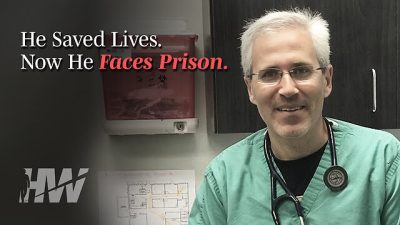
HE SAVED LIVES. NOW HE FACES PRISON.
or go to
Aletho News Archives – Video-Images
From the Archives
NATO Sanctions and the Coming Global Diesel Fuel Disaster
By F. William Engdahl – New Eastern Outlook – 11.04.2022
Amid the ongoing global inflation crisis, NATO heads of state and mainstream media repeat a mantra that high energy prices are a direct result of Putin’s actions in Ukraine since end of February. The reality is that it is the western sanctions that are responsible. Those sanctions including cutting SWIFT interbank access for key Russian banks and some of the most severe sanctions ever imposed, are hardly having an impact on the military actions in Ukraine. What many overlook is the fact that they are increasingly impacting the economies of the West, especially the EU and USA. A closer look at the state of the global supply of diesel fuel is alarming. But Western sanctions planners at the US Treasury and the EU know fully well what they are doing. And it bodes ill for the world economy.
While most of us rarely think about diesel fuel as anything other than a pollutant, in fact it is essential to the entire world economy in a way few energy sources are. The director general of Fuels Europe, part of the European Petroleum Refiners Association, stated recently, “… there is a clear link between diesel and GDP, because almost everything that goes into and out of a factory goes using diesel.” … continue
Blog Roll
 Aletho News
- Trita Parsi: Middle East Unraveling — Are We on the Path to World War?
- Iran FM meets with US envoy on UN meeting’s sidelines at American side’s insistence: Report
- Qatar PM calls for Gulf security framework with Iran, says war must be ‘wake-up call’
- China condemns US extortion of Iranian airlines, rejects Washington’s ‘illegal’ sanctions threats
- Italy to move military personnel from Taif base after missile strike
- Finland’s Stubb tells European leaders to calm down
- Defeating Russia on battlefield impossible – Fico
- Finland’s Gender Clinic Reversal
- Massachusetts Wants Mental Health Visits, Why Does Government Use ‘Health’ to Enter Our Homes & Families?
- US lawmaker admits American people footing bill for Trump’s failed aggression against Iran
- If Americans Knew
- Sanctions are collective punishment: immoral and self-defeating
- Phosphorus Munitions Fired by Israel Burn Groves, Orchards in Southern Lebanon
- Israel Carries Out New Ceasefire Violations Across Gaza
- AI – Emphasis on the ‘I’: Israel Is Funding AI Chatbot Propaganda
- Israel Blocking Hundreds of Wheelchairs for Injured Children From Entering Gaza
- Israel Is Expanding and Upgrading Compounds for Palestinian Militias in Gaza
- The Palestinian-American Residents of This West Bank Town Are Wondering: Where Is Trump?
- Gaza desperately needs tents, wheelchairs, fuel… and everything else (Israel blocks it all) – Daily Update
- Israeli Attacks in Gaza Kill at Least Seven Palestinians Over Three Days, including Woman and Child
- Trump’s militarization of Washington DC as he pursues Israel’s war against Iran
- No Tricks Zone
- New Study: Earth And Venus Surface Warmth Largely Explained By Convection And Lapse Rate, Not CO2 Or Radiation
- 2025 Nature Paper Claiming Worsening Global Drought Gets RETRACTED …Heavily Flawed
- New Study: ‘Global Drought Shows No Detectable Recent Acceleration Under Climate Warming’
- Economic Masterminds: German Socialists Suggest Taxing Productivity Gains Stemming From Using AI
- The South China Sea Has Not Been Cooperating With The Climate Change Narrative
- Energy Crisis: Germany Enters Heating Season With Historically Low Gas Reserve Fill Levels
- New Study: The Antarctic Ice Sheet Gained Mass From 2020-2024 Due To Staggering Snow And Ice Accumulation
- Study: Ocean Heating Rates From Thousands Of Years Ago ‘Dwarf’ Modern Ocean Heating Rates
- Climate Extremists Target, Attack Large-Scale Power Grid Infrastructure In Germany!
- New Study: Antarctic Ice Melt Has Contributed Less Than 1 Centimeter To Sea Level Rise In The Last 30 Years

