Leaked Documents Show ‘Vaccine’ Conspiracy in Austria
Thanks to German-speakers’ orderliness, we now have written proof of collaboration between gov’t, doctors, and legacy media–time for tribunals!
By epimetheus – Die Fackel 2.0 – March 13, 2023
This is literally ‘hot off the ‘presses’: Austrian alternative media outlet Der Status published leaked documents from the Austrian Chamber of Physicians (Ärztekammer ) that show, beyond reasonable doubt, the grand conspiracy between government, the Chamber, and its protagonists.
Without much further ado, here’s my translation; as always, emphases and bottom lines mine. The below text has been lightly edited for clarity.
The Austrian Medical Association, under the ousted red [i.e., Social-Democratic] president Szekeres and its current president Steinhart, worked closely with the Health Ministers for years. And in doing so, it betrayed the interests of doctors. [to say nothing about patients]
Spring 2020: Collaboration with the Politicians Commences
In April 2020, Szekeres, Steinhart, and Minister Anschober [Greens, since retired] signed a ‘Memorandum of Understanding Concerning COVID-19 Vaccinations’. That is, at a time—more than half a year—before the conditional approval of these injectable products, this Memorandum dealt with, among other things, advertising campaigns by doctors for the vaccinations, the vaccination of health-care workers and their family members, vaccinations in homes and schools, and reimbursement agreements.
Yet, secretly, an additional deal was also negotiated: it was literally agreed that ‘clear blanket vaccination recommendations will be made via the National Immunisation Consortium (Nationales Impfgremium, or NlG) on the suitability of the various vaccines and their applicability, esp. for various high-risk groups’.
Explosive: the Minister of Health and the Austrian Medical Association leadership signed a contract in which they go over the head of the National Immunisation Consortium—and they did so long before the injections were even available—to determine what the National Immunisation Consortium will recommend.
[this means, in other words, that the NIG never had anything to say about the data or the underlying clinical trials; this much we already knew, but now we have the receipts: these people have failed the public, betrayed the trust of patients, and soiled themselves]
It was never about Facts or Truth
Until now, the public was not aware of any document that so clearly showed that various ‘expert panels’ and ‘commissions’ obviously only served to obligingly recommend what politicians and the medical association leadership wanted. It was never about expertise, about advice, about objective science, about health.
Long before the beginning of the mass vaccination campaign, when vaccines did not even exist (!), it was only about one thing: vaccinate, vaccinate, vaccinate! The various ‘expert committees’ and doctors served only as Komparsen [extras, in German, one may also use the term Statisten, which literally implies undue influence of the state]. And it is obvious that the medical association leadership was ‘bought’ off with the reimbursement fee agreement [I’ve omitted the screen shots of some original documents, which can be checked out, if you read German, in the original article; it suffices to say that the fees are extraordinarily high, esp. in light of the incidence of injection: 25 Euros for the first jab and 20 Euros for every successive jab; this piece of evidence is reproduced below in the same position as in the original article]. April 2020 thus was the decisive moment in the history of the Medical Association in which its leadership handed the soul of the medical profession to politicians for the equivalent of thirty pieces of silver.
The Persecution of Doctors is Decided Upon
That was not all: in an ‘Amendments to the Memorandum of Understanding on COVID-19 Vaccinations between the Austrian Chamber of Physicians and the Ministry of Health, concluded in April 2020’, dated 2 Sept. 2021, the medical association leadership ‘promised action with respect to the services rendered by the medical profession’. These, too, signed off by both parties:
The Chamber of Physicians will conduct a media campaign as well as a campaign among the medical profession to increase the willingness of the population to be vaccinated. This includes raising the vaccination issue at other medical appointments (e.g., regular health check-ups) and the promise to take stronger action against doctors who spread misinformation.
As is well known, what constituted ‘misinformation’ was left to the arbitrary whims of the leadership of the Chamber of Physicians. This disgraceful agreement formed the basis for the persecution of critical doctors, which continues to this day. The medical disciplinary law was, in fact, misused for intimidation and propaganda purposes. In doing so, the leadership of the Chamber of Physicians had turned against its paying members [membership is mandatory in Austria as the Chamber also certifies physicians, much like these boards and associations in the U.S.], which cemented into place the persecution of doctors in the style of the Inquisition.
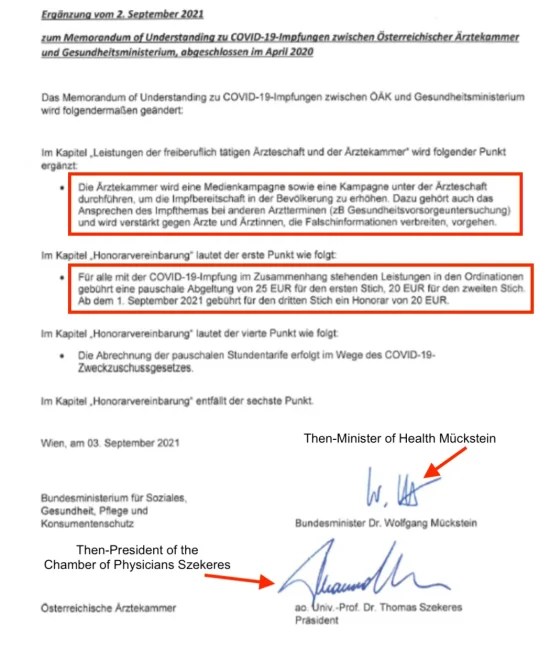
Highlighted passages are translated above; source: https://derstatus.at/politik/aerztekammer-diktierte-impf-empfehlung-466.html
Disciplinary Proceedings by the Medical Association Were (Are) Illegal
The behaviour of the leadership of the Chamber of Physicians’ leadership in recent years is now coming back to haunt them. For months, the medical association has been attacked, ridiculed, and had its very existence openly questioned by politicians. Having done their duty for politicians in the last three years without a peep, the Chamber is apparently no longer needed and may well be let go of. The Chamber of Physicians is sinking more and more into political insignificance. According to insiders, it is now even regarded as a political opponent, a situation that can also be seen in legacy media. After having served as a ‘doormat’ for politicians of all stripes for years, the Chamber of Physicians is now also being treated as such. Various scandals internal to the medical association reinforce this tendency. [talk about Karma, eh? Those who don’t have self-respect will have a hard time getting others’ respect… ]
In the meantime, the Regional Administrative Courts of Vienna, Lower Austria, and Vorarlberg have petitioned the Constitutional Court to repeal parts or the entire Disciplinary Law in the Physicians’ Act [Ärztegesetz, these parts of the Act permit the Chamber of Physicians to enforce standards] on grounds of their suspected unconstitutionality; it is possible that the Constitutional Court will rule even the entire Physicians’ Act unconstitutional. The Chamber of Physicians is a self-governing body. All its committees are to be selected from among its members, i.e., from medical professionals. However, the Disciplinary Commission consists of two medical assessors and a ‘judicially competent chairman’ who is appointed by the Minister of Health in agreement with the Minister of Justice, i.e., someone who must not be a trained physician and who does not come out of the Chamber of Physicians. Thus, the composition of the Disciplinary Commission is a violation of the Federal Constitution. This is the unanimous legal opinion of three state administrative courts [Verwaltungsgerichtshof] and countless jurists.
[I’ll have more to say about this particularity below, for time being: this is potentially huge—and it would be akin to completely re-writing the rules of medicine]
The Chamber of Physicians has unintentionally awakened sleeping dogs with its wave of ill-advised disciplinary hearings against critical doctors. The consequence may be that it now has to be completely re-imagined. But this could also be an opportunity for the medical profession after all the repression of doctors in recent years. For in its current form, the Chamber of Physicians is a politically superfluous enemy and, for its members, the doctors, a very expensive mandatory association whose dues are used to finance the functionaries’ luxury salaries.
From time immemorial, we’ve all known that a man’s—or woman’s—price is about, in purely monetary terms, 30 pieces of silver, to say nothing about the amorality and, yes, cowardice of most physicians everywhere.
The notion of buying off support has been well-established in the U.S. (see, e.g., here).
Here, we’re talking individual doctors who are paid handsomely for jabbing people.
Yet, this isn’t even the worst part of this.
The Three Axioms of Governance-by-Bureaucracy
You’ve gotta love them German-speakers for being so stupid to actually put these things into writing.
We now have definitive proof that the subsequent shenanigans—first and foremost the obnoxious Covid Passports — were based on the unholy trinity of questionable medical ethics (ahem), government coercion, and arbitrary definitions.
Remember that ‘fully vaccinated’ used to be two injections? Now it’s at least three, with the fourth jab ‘optional’ (haha, see above), and the Covid Passports come with expiration dates varying from 3-6 months, irrespective whether you’re ‘vaccinated’ or ‘recovered’.
Thus, we may formulate whatthe first axiom of governance-by-bureaucracy is: everything leaks.
In other words: arbitrary categories by government fiat, arrived at with the collaboration of the overwhelming majority of the medical profession.
If history is any guide, the Covid Passports are the functional equivalent of the Aryan Certificate deployed by Nazi Germany: both documents were clearly politically motivated and based on sham ‘The Science™’.
Yet, Covid is revelatory: we’ve seen the abject lack of integrity, morality, and compassion on part of the political caste, its willing executioners in legacy media, and its perpetrators among medical professionals.
Don’t ask what’s wrong with individuals. It’s the bloody ‘system’ that stands exposed.
Thus, we may formulate the second axiom of governance-by-bureaucracy: everyone has his or her price.
We’ve known this for quite some time; sure, I could cite the Nazi and Stalinist atrocities here, but I’d like to point you also to the Asch Conformity, the Milgram, and the Stanford Prison Experiments. Or the book The Wave.
And yet, despite all of this, there’s also a bright spot in all of this: contrary to the claims of postmodernist woke-fied agents-provocateurs, not everything in human society and relations is ‘socially constructed’ or about ‘power’.
A sizeable share of people everywhere has resisted the pressure to ‘get vaccinated’.
A group of doctors have resisted the pressures and temptations—remember the 30 pieces of silver—of collaboration and compliance with government tyranny.
If ‘booster’ uptake is any guide, more and more people are realising that they’ve been had.
Thus the third axiom: incentives and coercion work, until they don’t.
Our highly complex societies are, of course, more than the sum of their moving parts. Yet, given the highly integrated structures, it would be far-fetched to believe that anyone is able to control everything.
True, a lot can be dominated, but in the end, the ‘normative power of the factual’ (Georg Jellinek), in combination with individual experiences, is a powerful antidote to tyranny.
Still, this ain’t over yet, far from it.
If history is any guide, all that humans have ever been able to do is punish the perpetrators in the (vain) hope of establishing deterrence.
It has happened before, it is happening again, and it will happen again.
The next step is to see this through, re-establish the rule of law, and hold these people to account.
This is the moment. This is the time.
Where Is Occupy Silicon Valley?
By Craig Pirrong | Brownstone Institute | March 13, 2023
Bank failures tend to come in waves, and we are experiencing at least a mini-wave now.
Banks fail for three basic reasons: 1. Credit transformation: deterioration in borrower creditworthiness, usually due to an adverse economic shock (e.g., a real estate bust). 2. Maturity transformation: borrowing short, lending long, and then getting hammered when interest rates rise. 3. Liquidity transformation combined with an exogenous liquidity shock, a la Diamond-Dybvig, where idiosyncratic depositor needs for cash lead to withdrawals that exceed liquid assets and therefore trigger fire sales of illiquid assets.
The two most notable failures of late–Silicon Valley Bank and Silvergate–are examples of 2 and 3 respectively.
In some respects, SVB is the most astounding. Not because a bank failed in the old-fashioned way, but because it was funded primarily by the deposits of supposed financial sophisticates–and because of the disgusting policy response of the Treasury and the Fed.
SVB took in oodles of cash, especially in the past couple of years. The cashcade was so immense that SVB could not find enough traditional banking business (loans) to soak it up, so they bought lots of Treasuries. And long duration Treasuries to boot.
And then Powell and the Fed applied the boot, jacking up rates. Bonds have cratered in the last year, and took SVB’s balance sheet with it.
Again, an old story. And hardly a harbinger of systemic risk–unless such reckless maturity mismatches are systemic.
SVB was the Banker to the Silicon Valley Stars, notably VCs and tech firms. These firms are the ones that deposited immense sums in exchange for a pittance of return. Case in point, Roku, put almost $500 million–yes, you read that right, 9 figures led with a 5–into SVB!!!
I mean: what the eff? Was the Treasurer a moron? For who other than a moron would hold that much in cash in a single institution? (Roku claims its devices “make your home a smarter.” Maybe they should have hired a smarter treasurer and CFO, or replaced them with one of its devices). Hell, why is a company holding that much in cash period?
A few of these alleged masters of the universe (like Palantir) saw the writing on the wall and yanked their deposits: deposits fell by a quarter on Friday alone, sealing the bank’s doom. Those who were slow to run howled to the high heavens over the weekend that if there was not a bailout there would be a holocaust in the tech sector.
Even though the systemic risk posed by SVB’s failure is nil (or if not, then every bank is systemically important), the Treasury Department and the Fed responded to these howls and guaranteed all the deposits–even though the FDIC’s formal deposit insurance limit is $250,000. You know, .05 percent of Roku’s deposit.
When evaluating this, one cannot ignore the reality that the Democratic Party is completely beholden to Silicon Valley. This is beyond scandalous.
Occupy Silicon Valley, anyone?
Treasury Secretary Janet Yellen insulted our intelligence by assuring us this is not a bailout. Well, it’s not a taxpayer bailout, strictly speaking, because the Treasury is not providing the backstop. Instead, it is being funded by a “special assessment” on solvent banks. Which are owned and funded by people who also pay taxes. And such an “assessment” is a tax in everything but name–because it is a contribution by private entities compelled by the government.
The policy implications of this are disastrous. The whole problem with such bailouts is moral hazard. What is to stop banks from engaging in such reckless behavior as SVB did if they can obtain seemingly unlimited funding from those who know that they will be bailed out if things go pear-shaped?
And the regulatory failure here demonstrates that bank regulation–despite the supposed “reforms” of Frankendodd–can’t even catch or constrain the oldest bet-the-bank strategy in the book. Free banking–no deposit insurance, no bailing out of depositors–couldn’t do worse, and would likely do better.
No, the failure of SVB is not the scandal here. The scandal is the political response to it. This reveals yet again how captured the government is. This time not by Wall Street, but by tech companies and oligarchs that are currently the primary source of Democratic political funding.
A couple of weeks ago the Silvergate story looked juicy, but SVB has put it in the shade. Silvergate also grew dramatically, but on the back of crypto rather than SV tech. It became the main banker for many crypto firms and entrepreneurs. The crypto meltdown did not affect Silvergate directly, but it did crush its depositors, the aforesaid crypto firms and entrepreneurs. They withdrew a lot of funding, and an old-fashioned liquidity mismatch did it in.
In traditional banks, deposit funding is “sticky.” Banks that rely on wholesale funding (“hot money”) are more vulnerable to runs. Silvergate’s funding was not traditional sticky deposit funding, nor was it hot money per se. It was money that was pretty cool as long as crypto was cool, and became hot once crypto melted down.
A run started, but the run was precipitated by a liquidity shock. Simple story, really.
Silvergate’s failure was not a scandal. SVB’s failure per se was not a scandal (except to the extent that our vaunted banking regulators failed to prevent the most prosaic type of failure).
Again–the scandal is the politically tainted response that will have baleful consequences in the future, as the response virtually guarantees that there will be more SVBs in the future.
Let’s compare China’s ‘agents’ in Canada to Israel’s
By Yves Engler | March 11, 2023
What would happen if the media and intelligence agencies applied the same standard used regarding China to the Israel lobby?
In the Globe and Mail Andrew Coyne has written two columns in recent days arguing that the discussion over Chinese interference should focus on “domestic accomplices”. “What we need a public inquiry to look into is domestic complicity in foreign interference”, noted the regular CBC commentator.
In a similar vein Justin Trudeau responded to criticism regarding purported Chinese interference by noting, “We know that Chinese Canadian parliamentarians, and Chinese Canadians in general, are greater targets for interference by China than others.” The prime minister added, “We know the same goes for Iranian Canadians, who are more subject to interference from the Iranian government. Russian speakers in Canada are more vulnerable to Russian misinformation and disinformation.”
Why ignore how Israel and its Canadian lobby use Jewish MPs and Jewish organizations as their agents?
The leading Israel advocate in parliament, Anthony Housefather chairs the Canada-Israel Interparliamentary Group. That group was previously led by another Jewish Liberal MP, Michael Leavitt, who resigned to head Israel lobby group Friends of Simon Wiesenthal Center. Housefather and Leavitt have repeatedly met Israeli officials in Canada.
As part of the media frenzy about Chinese interference, there has been significant discussion about Trudeau attending a 2016 Liberal Party fundraiser at the Toronto home of Chinese Business Chamber of Canada chair Benson Wong. Among the attendees was Chinese Canadian billionaire Zhang Bin who is alleged to have donated to the Trudeau Foundation/University of Montréal at the request of a Chinese government official.
But Trudeau has far more extensive ties to pro-Israel funders. Since 2013 the chief fundraiser for the Trudeau Liberals has been Stephen Bronfman, scion of an arch Israeli nationalist family. Bronfman has millions invested in Israeli technology companies and over the years the Bronfman clan has secured arms for Israeli forces and supported its military in other ways. Bronfman openly linked his fundraising for Trudeau to Israel. In 2013 the Globe and Mail reported:
“Justin Trudeau is banking on multimillionaire Stephen Bronfman to turn around the Liberal Party’s financial fortunes in order to take on the formidable Conservative fundraising machine…. Mr. Bronfman helped raise $2-million for Mr. Trudeau’s leadership campaign. Mr. Bronfman is hoping to win back the Jewish community, whose fundraising dollars have been going more and more to the Tories because of the party’s pro-Israel stand. ‘We’ll work hard on that,’ said Mr. Bronfman, adding that ‘Stephen Harper has never been to Israel and I took Justin there five years ago and he was referring at the end of the trip to Israel as ‘we.’ So I thought that was pretty good.’”
In 2016 Trudeau attended a fundraiser at the Toronto home of now deceased billionaire apartheid supporters Honey and Barry Sherman. The event raised funds for the party and York Centre Liberal party candidate Michael Levitt. In 2018 CBC reported on multimillionaire Mitch Garber attending one of Bronfman’s fundraisers with Trudeau. On Federation CJA Montréal’s website Garber’s profile boasts that his “eldest son Dylan just completed his service as a lone soldier serving in an elite Cyber Defense Intelligence Unit of the IDF in Israel.”
A thorough investigation of pro-Israel Liberal fundraising would uncover a litany of other examples. And they’ve had far greater success. While the Trudeau government has banned Chinese firms, arrested a prominent Chinese capitalist and targeted that country militarily, they’ve been strikingly deferential to Israel. The Trudeau government has expanded the Canada-Israel free trade agreement, organized a pizza party for Canadians fighting in the Israeli military, voted against over 60 UN resolutions upholding Palestinian rights, sued to block proper labels on wines from illegal settlements and created a special envoy to deflect criticism of Israeli abuses. During a 2018 visit to Israel former foreign affairs minister Freeland announced that should Canada win a seat on the United Nations Security Council it would act as an “asset for Israel” on the Council.
Part of the Chinese interference story is about funding University of Montréal and University of Toronto initiatives tied to China. But Jewish Zionist donors have set up far more initiatives, including numerous Israel and Israel-infused Jewish studies programs.
Having fought to establish Israel and with major investments in Israel, David Azrieli spent $5 million to establish Israel studies and $1 million on Jewish studies at Concordia University. At the University of Toronto more than $10 million was donated to establish the Anne Tanenbaum Centre for Jewish Studies and the Andrea and Charles Bronfman Chair in Israeli Studies. Millions of dollars more have been donated to launch similar initiatives at other universities.
On many occasions pro-Israel donors have leveraged donations to block academic appointments or suppress discussion of Palestinian rights. The hundreds of millions of dollars donated by Israel supporters (Schwartz/Reissman, Peter Munk, Seymour Schulich, etc.) partly explains why over a dozen Canadian university presidents recently traveled with apartheid lobby group, the Centre for Israel and Jewish Affairs, to Israel despite opposition from significant segments of their institutions.
Much more influential than the ‘China lobby’, the Israel lobby has largely been ignored in recent discussion about the need for an inquiry into foreign interference. But any serious foreign agent registry ought to include the apartheid state’s domestic accomplices.
US House Passes Bill Prohibiting Government Workers From Censoring Speech in Official Role
Sputnik – 10.03.2023
WASHINGTON – The US House of Representatives passed a bill to prevent federal government employees from censoring speech in their official capacity, amid hearings by congressional committees on the collusion between tech companies and the government to “moderate” content online.
House lawmakers passed the Protecting Speech From Government Interference Act along partisan lines on Thursday in a vote of 219-206.
The bill prohibits employees of executive agencies or those otherwise in the competitive service from using their official authority to influence or advocate for a third party, including private entities, to censor speech.
“Government agencies such as the FBI and the State Department have been working behind-the-scenes with Big Tech to silence American citizens expressing conservative views online,” House Majority Leader Steve Scalise said in a statement on the bill. “Americans have the right to express themselves lawfully online without the government controlling the narrative.”
Earlier on Thursday, a House select subcommittee held a hearing with authors of the so-called Twitter Files to hear testimony on the collusion between Big Tech, government agencies and private organizations – dubbed the Censorship-Industrial Complex – to moderate, suppress and censor online content.
The Twitter Files have revealed how the US government collaborated with Big Tech companies such as Twitter to suppress information related to COVID-19 and the Hunter Biden laptop story, among others.
Over $250 billion swindled from US pandemic fund – report
RT | March 11, 2023
More than $250 billion in Covid-19 relief funds were lost to “fraud” and “waste,” the directors of three US government agencies testified before the House Oversight and Accountability subcommittee on Thursday.
Compounding what Deputy Inspector General Sheldon Shoemaker of the Small Business Administration (SBA) called “the biggest fraud in a generation,” the officials stressed that the figures they gave represented an extremely conservative estimate of the total amount lost as they did not include the amount defrauded from the Pandemic Unemployment Assistance program.
According to a statement submitted by Shoemaker ahead of the hearing, the SBA has already uncovered $190.7 billion in potential fraud across relief programs under its jurisdiction. Specifically, it expects to find upwards of $100 billion within the scandal-plagued Paycheck Protection Program. Acting Treasury Inspector General Richard Delmar admitted to just $2.6 billion in dubious charges confirmed at his agency, pleading that ongoing audits precluded making an estimate of the full cost.
Larry Turner, inspector general of the Department of Labor, blamed the massive losses on a lack of preparation, insufficient oversight, and even the government’s generosity, making a “highly conservative” estimate of $76 billion in fraudulent spending. With no functioning system in place to verify applicants’ qualifying details in a reasonable time frame, the “unprecedented infusion of federal funds” into the program made it irresistible to fraudsters, he told the subcommittee.
Rep. Keith Mfume (D-Maryland) expressed shock that no one had predicted that requiring only “self-certification” to access such a prodigious cash hoard would lead to “a lot of hanky-panky,” while Rep. Byron Donalds (R-Florida) pointed out that the agencies did not even use existing checks and balances to vet applicants, and Rep. Maxwell Frost (D-Florida) highlighted that state unemployment systems were hopelessly outdated even before the pandemic placed them under unprecedented stress. Of $45.6 billion in potential fraud lent out in association with one Labor Department program, Turner acknowledged upon questioning that $267 million had gone to dead people.
Asked about the possibility of recovering the money, Turner said that hunting down the perpetrators was financially unrewarding, as “once money goes out the door, it is hard to get it back.” Even in cases where the government has been able to track down Covid-19 benefit fraudsters and claw back some of the funds, the inspectors general were unable to tell subcommittee members what had become of some of the money.
More than $5 trillion in pandemic relief funds have been distributed since 2020. By some estimates, as much as $400 billion was stolen from the unemployment relief program alone.
Georgia ‘lost chance for sovereignty’ – Moscow
RT | March 10, 2023
The US opposed Georgia’s “foreign agents” bill because Washington does not want the country to have political sovereignty, Vyacheslav Volodin, the speaker of the State Duma, the lower house of Russia’s parliament, said on Friday.
He argued that the legislation, which was withdrawn after protests and clashes with police in Tbilisi, was aimed at limiting Washington’s ability to meddle in Georgia’s affairs.
“Washington has used the tools of soft power to lead people to the streets. The Georgian authorities were forced to submit – not to the will of the people, but to the United States,” Volodin claimed in a post in his Telegram channel.
The politician said the bill was “unacceptable for the US” because it would have “restricted Washington’s influence on the country’s internal political affairs.”
“With its withdrawal by the parliament, Georgia has lost the chance for sovereignty,” Volodin said.
On Friday, Georgian Dream and People’s Power, two of the country’s ruling parties, withdrew the Transparency of Foreign Influence Bill, also dubbed the ‘Foreign Agents Law.’ They said the bill had led to “divisions in society” and that its intent and purpose has been distorted by “a machine of lies.”
The proposed law would have required individuals, NGOs and media outlets that receive 20% or more of their funding from abroad to register as “an agent of foreign influence” with the Georgian Justice Ministry, according to Reuters. Offenders would have faced fines and up to five years in prison for failing to comply.
The bill was condemned by Washington, the EU and NATO. US State Department spokesman Ned Price voiced concerns about “the potential implications of this law for freedom of speech and democracy in Georgia” and warned that its adoption “could potentially undermine Georgia’s Euro-Atlantic integration.”
Price later welcomed the decision to withdraw the draft law and urged MPs to “officially retract this bill and not to further this type of legislation.”
Proponents of the bill argued that it resembled the US Foreign Agents Registration Act (FARA), a 1938 law that requires individuals and organizations to register as “foreign agents.” Opponents, however, claimed that the bill was inspired by a similar law in Russia that was passed in 2012.
Protests in Georgia, pressure campaign or anti-Russian color revolution?

By Ilya Tsukanov – Sputnik – 09.03.2023
Protesters spilled into the streets of Tbilisi this week to protest a draft law requiring NGOs to register as “agents of foreign influence” if 20% or more of their funds come from foreign sources. What are the protesters looking to achieve? How have Georgia’s Western “partners” responded? What role, if any, has Russia played? Sputnik investigates.
Georgia’s governing coalition “unconditionally” withdrew its foreign agents law from parliament on Thursday morning, folding to protesters after two nights of violent confrontations with police in the Caucasus nation’s capital, and growing pressure from the European Union and the United States to scrap the draft legislation.
“As a party of government responsible to every member of society, we have decided to unconditionally withdraw this bill that we supported,” the Georgian Dream Party, which has 74 of 150 seats in the republic’s parliament, said in a statement Thursday morning.
Giga Lemonjala, a member of the opposition Droa party, responded to the government’s announcement by demanding that the bill be formally denounced, and that all protesters detained over the past two nights be released.
Georgia’s opposition and Western media covering the protests have characterized the foreign agents legislation as a “Russian,” “Russia-stylem” or “Putin-style” law, citing the 2012 Russian law requiring media, non-governmental organizations, and others to register as foreign agents and make their funding sources known to the public if they include contributions from foreign entities. Some media went so far as to claim the Georgian legislation signaled Tbilisi’s drift away from the European Union and toward Russia, with one article going so far as to call the social democratic, pro-EU Georgian ruling party “Putin’s Georgian Dream.”
State Department spokesman Ned Price characterized the draft law as “Kremlin-inspired” and said Washington was “deeply troubled” by it, with the legislation deemed to be “incompatible with the people of Georgia’s clear desire for European integration and its democratic development.”
European Union foreign policy chief Josep Borrell echoed these sentiments, calling the bill a “very bad development” and saying it is “incompatible with EU values and standards,” and “goes against Georgia’s stated objective of joining the European Union.”
Ukrainian President Volodymyr Zelensky also waded in to commenting on the crisis, praising Ukrainian flag-wielding protesters and saying Kiev expects Georgia and Moldova to join Ukraine in the EU.
Moscow has for the most part stayed out of commenting on the Georgian unrest, absent Foreign Ministry spokeswoman Maria Zakharova’s remarks Wednesday pointing out that the draft law looked similar to US legislation passed in 1938 known as the Foreign Agents Registration Act, and Kremlin spokesman Dmitry Peskov’s statement Thursday encouraging Russian nationals in Georgia to stay out of the streets.
Rules for Me But Not For Thee
Russia’s role has effectively been that of a boogieman, designed to discredit the Georgian government and foment discontent, both in Georgia and among Tbilisi’s Western partners, says Shota Apkhaidze, a political scientist serving as director of the Caucasus Center of Islamic Studies. The reality, the Tbilisi-based observer points out, is that the now-scrapped legislation bears much more resemblance to FARA than it does to Russian legislation.
“This is literally double standards, a mockery. The US brazenly adopted this same law 80 years ago, in 1938, and tightened it up repeatedly. Similar laws are in force in several countries in Europe. They tell us this law is ‘Russian,’ even though it has nothing to do with Russia. These are absolutely different things. In other words, we adopted a draft law modeled on American legislation, that’s in accordance with the Georgian Constitution and the law on non-governmental organizations. What does Russia have to do with it? What does Putin have to do with anything?” Apkhaidze asked. “This is just another reason to completely undermine the political system and bring the country to a change of power. That’s what the Americans are after,” the observer said.
Inconvenient Law
International affairs expert Viktoria Fedosova says US and EU consternation over the Georgian draft law is understandable, since it threatens to undermine their immense political power in the Caucasus nation.
“The passage of such a law in Georgia was risky for the US and the EU, since they’ve become used to engaging in their own financing, introducing their own leaders of public opinion, and working [in the country] through non-governmental organizations. This is their typical umbrella-like scheme of operations familiar to them,” Fedosova, the deputy director of the Moscow-based Institute for Strategic Studies and Forecasts at the Russian People’s Friendship University, told Sputnik in an interview.
“The Americans have spent about $1 billion on our non-governmental organizations since 1993, with the US declaring that these funds were spent on developing civil society, human rights, etc.” Apkhaidze pointed out. “That’s not the case. On the contrary, these funds have consistently been spent on fomenting a coup d’état, on the financing of some destructive elements in Georgia,” he said.
US and European “democracy promotion” assistance to Georgia has come in various forms over the decades, from the National Endowment for Democracy and the National Democratic Institute to US hedge fund billionaire George Soros’ Open Society Foundations. Each of these groups provide millions or tens of millions of dollars to Georgian NGOs annually, and wield tremendous power beyond the realm of traditional party politics, Apkhaidze says.
“The NGO sector is the strongest structure of civil institutions in Georgia, because they have massive funding. Everyone, even the current leadership of Georgia, comes from precisely these kinds of organizations and foundations,” he said. “They have immense influence.”
Cynical Approach
The US and EU’s record and history of violating Georgia’s sovereignty is no secret to anyone, but their behavior and response to this week’s violence constitutes outright “mockery” of Tbilisi, Apkhaidze says.
“Why is it that in Georgia, a person who throws a Molotov cocktail at a police officer and sets a police car on fire, hits a special forces agent in the head with a rebar and smashes the parliament building, why is he deemed ‘peaceful’ – and his protest a ‘peaceful protest’?” the observer asked, alluding to the dozens of police officers who have been injured, some hospitalized, over the past two days in clashes with demonstrators.
Fedosova thinks the answer is obvious – while the US is able to pass laws like FARA and use them liberally to monitor their media, politics, and social groups for signs of foreign influence and meddling, the same luxury is not afforded to countries like Georgia.
“The United States cannot allow this kind of sovereignty be enjoyed by tiny Georgia, which, moreover, has already been used as a destabilizing factor against Russia (we remember the situation in 2008),” she said.
‘Second Front’
The irony of the crisis over the foreign agents draft law is that the Georgian Dream government is broadly pro-European, with stated aims including entry into both the EU and NATO. Accordingly, both Apkhaidze and Fedosova believe that the crisis is related to the pragmatic foreign policy approach that Tbilisi has taken in relation to its northern neighbor, especially after the escalation of the Ukraine crisis last year.
“The Americans have spent a whole year now since the start of Russia’s ‘special operation’ in Ukraine destabilizing the situation,” trying to get Georgia to join anti-Russian sanctions and “open a second front” against Moscow, Apkhaidze said.
“The Americans know that if they manage to quickly remove Georgian Dream, a second front would be opened immediately, because those flakes who came out to protest want this war, many of them unconsciously, of course; they have no idea what such a conflict would bring. But they are so short-sighted (I mean the majority of young people involved) that they don’t understand what a war with Russia would bring. Others have the concrete goal of opening a second front. The Americans are leading the country precisely in this direction,” he said.
The Georgian government and lawmakers’ attempts to prevent Tbilisi from being pulled into a direct conflict against Russia, notwithstanding the not always rosy relations with Moscow, is precisely the reason the foreign agents law was put together in the first place, Fedosova believes, citing the fact that a handful of NGOs have garnered more financial support over the past year than all the country’s political parties combined.
“The main thing [for the government] is the guarantee of peace, some kind of fair compromise-based dialogue with Russia, without attempts to include the country in a new conflict on Russia’s borders. The main thing for them is to convey this idea of preserving sovereignty and not losing new territories, and to communicate this to their citizens,” the observer said.
Maidan Danger
Fedosova observed parallels between the footage coming out of Tbilisi this week and the Euromaidan in Kiev before the 2014 coup. “We are watching footage now from Tbilisi where young people jump and dance, where the [psychological] mechanisms for creating this kind of emotional bond of the crowd are used. We’re seeing everything we saw on the Maidan. But here the presence of external forces hasn’t yet reached the point where the American ambassador comes out and distributes cookies, for example. So far, we are seeing the manifestation of the Americans in this conflict only in the form of their official statements.”
If the situation heats up, more parallels to the Ukrainian coup could appear, she noted, including radicals in crowds, agent provocateurs, mysterious snipers, culminating in a coup and the appointment of a new puppet government and “the installation of an authoritarian president who will be called a liberal.”
“We see how this happened with Zelensky – how ‘liberal’ his regime turned out to be, and what laws were adopted when everything goes according to the American scenario, and the country is integrated into a full-fledged military confrontation with Russia…They need Georgia as another means to prick Russia, just from another flank,” Fedosova said.
President vs Parliament
In the course of her official visit to the US this week, Georgian President Salome Zourabichvili appeared against the backdrop of the Statue of Liberty to express support for the protesters. “I am by your side. Today you represent free Georgia. Georgia, which sees its future in Europe, will not allow anyone to take away this future,” Zourabichvili said.
Apkhaidze doesn’t find anything surprising about the Georgian president’s behavior, saying the French-born politician is simply serving the interests of her masters, and that her sympathies for the opposition have long been evident.
“Georgia is a parliamentary republic. I don’t think that will change. This is not the first time she has opposed various decisions of the Georgian leadership and parliament… As far as Zourabichvili is concerned, she, of course serves the interests, first of fall, of her masters. I can’t figure out whether she’s the president of Georgia or the governor of some American state. But it is a fact that she wants more power, and sees herself in the place of [Georgian Prime Minister Irakli] Garibashvili,” Apkhaidze summed up.
British SAS Soldiers Posing as Arms Dealers Scour World for Shells for Ukraine
By James Tweedie – Sputnik – 08.03.2023
Ukraine has run through its stockpiles of arms and ammunition — inherited from the Soviet Union in 1991 — along with weapons supplied by its NATO backers since Russia launched its military operation to defend the Donbass republics.
A team of SAS commandoes are reportedly scouring the world for stocks of Russian-calibre artillery shells to refill Ukraine’s depleted arsenals.
A British daily newspaper reported that a dozen special forces troopers have been travelling across Africa, the Middle East and Asia along with intelligence agents and Foreign Office officials.
The group, posing as arms dealers, carry “substantial amounts of cash” to buy up stocks of 122mm-calibre shells — fired by many of the artillery pieces Ukraine inherited from the Soviet Union — on the spot.
“Our people have sources all over the world who will know if there is any ammo available and who to contact to strike a deal,” one military source said. “It is not always easy — it has been a scramble with many dead ends — but there have also been successes.”
The team have already journeyed to Angola, Egypt, Jordan, Kazakhstan, and Vietnam. But this week sources claimed a deal was struck on a stockpile in an unnamed European country.
Arms factories in both Bulgaria and Romania still produce Soviet-era arms and ammunition.
Ukrainian President Volodymyr Zelensky recently begged his Western backers for more artillery, on top of his demands for fighter jets. “Artillery is the number one thing that we need. Both systems and ammunition — shells in large amounts,” he said.
US Army General Christopher Cavoli, the NATO supreme allied commander in Europe, has said the Ukrainian army fires around 100,000 shells per month compared to 600,000 from the Russian side — as Russian forces encircle the key city of Artemovsk (Bakhmut).
The reputed mission follows a failed attempt in the summer of 2022 to buy tens of thousands of rounds of 122mm ammunition from Pakistan, which has remained neutral in the conflict between Ukraine — with its NATO allies — and Russia.
The report claimed 40,000 shells were flown by RAF transport planes from Pakistan’s Nur Khan Air Base to Romania’s Cluj International Airport for delivery to a local arms dealer acting as a middleman.
However, none of those rounds made it to Ukraine. Unconfirmed rumours of quality control issues were superseded by Islamabad’s denial last month that it had allowed any ammunition to be transferred to the conflict zone.
“The reporting about supply of defence items by Pakistan to Ukraine is not accurate,” Ministry of Foreign Affairs spokeswoman Mumtaz Zahra Baloch said on February 16.
“Pakistan maintains a policy of non-interference in military conflicts. Pakistan only exports defence stores to other states based on strong End Use and none re-transfer assurances,” Baloch stressed. “And this is the case of Pakistan’s position in the Ukraine-Russia conflict.”
The Russian imperial army adopted the 122mm (4.8-inch) artillery calibre before the First World War. It remained in service after the 1917 revolution and throughout the Soviet era with the Red Army, and is still used by the modern Russian army and those of other former Soviet republics and Warsaw Treaty member states.
Before Russia launched its military operation, the Ukrainian army reportedly possessed around 440 122mm-calibre D-30 towed howitzers and 600 2S1 ‘Gvozdika’ (carnation), the armored self-propelled versions of the same gun — although most were in long-term storage at the time.
Daily reports by the Russian Ministry of Defence have reported the destruction at least 146 D-30s and 99 Gvozdikas since the start of the demilitarization operation.
US Foreign Policy Goes “Woke”?
Regime change in store for cultural conservatives?

BY PHILIP GIRALDI • UNZ REVIEW • MARCH 7, 2023
It is generally observed that imperial powers like the United States frequently interfere in foreign governments in support of economic or hard political reasons. To be sure, Washington has refined the process so it can plausibly deny that it is interfering at all, that the change is spontaneous and comes from the people and institutions in the country that is being targeted for change. One recalls how handing out cookies in Maidan Square in Kiev served as an incentive wrapped around a publicity stunt to bring about regime change in Ukraine in 2014 when Senator John McCain and the State Department’s Victoria Nuland were featured performers in a $5 billion investment by the US government to topple the friendly-to-Russia regime of President Viktor Yanukovych. Of course, change for the sake of a short-term objective might not always be the best way to go and one might suggest that the success in bringing in a new government acceptable to Nuland has not really turned out that well for Ukraine and the Ukrainian people, nor for those Americans who understand that the Biden Administration’s pledge to arm Ukraine and stay in the fight against Russia “as long as it takes” just might not be very good for the United States either.
And the United States continues to be at it, meddling in what was once regarded as something like a war crime, though it now prefers to conceal what it is up to by preaching “democracy” and wrapping the message in “woke-ish progressivism” at every opportunity. An interesting recent trip by a senior government official that was not reported in the mainstream media suggests that the game is still afoot in Eastern Europe. The early February visitor was Samantha Power, currently head of USAID, and a familiar figure from the Barack Obama Administration, where she served as Ambassador to the United Nations and was a dedicated liberal interventionist involved in the Libya debacle as well as various other wars started by that estimable Nobel Peace Prize recipient after he had received his award. The Obama attack on Syria has been sustained until this day, with several American military bases continuing to function on Syrian territory, stealing the country’s oil and agricultural produce.
USAID was founded in 1961 and it was intended to serve as a vehicle for nurturing democratic government and associated civic institutions among nations that had little or no experience in popular government. That role has become less relevant as nation states have evolved and the organization itself has responded by becoming more assertive in its role, pushing policies that have coincided with US foreign policy objectives. This has led some host nations to close down USAID offices. Within the US government itself, participants in foreign policy formulation often observe that USAID and the National Endowment for Democracy (NED) now are largely in the business of doing what the CIA used to do, i.e. interfering in local politics by supporting opposition parties and other dissident or even terrorist groups. Both organizations were very active in Ukraine in 2014 and served as conduits for money transfers to the opposition parties and those who were hostile to Russia’s influence for “democracy building.”
Samantha Power, who is married to another Democratic Party affiliated power broker, lawyer Cass Sunstein, traveled to Hungary on her diplomatic passport but took pains to cover her travel as a routine bureaucratic visit to an overseas post. Hungary is undeniably a democracy, is a member of the European Union, and also of NATO, but Power reportedly did not clear the travel with the Hungarian government and apparently did not meet with any government officials, even as a courtesy. She tweeted that her visit was to reestablish USAID in the Hungarian capital, “Great to be here in Budapest with @USAmbHungary where @USAID just relaunched new, locally-driven initiatives to help independent media thrive and reach new audiences, take on corruption and increase civic engagement.”
By “independent media” Power clearly meant that the US will be directly supporting opposition press that is anti-government and which embraces the globalist-progressive view currently favored by the White House. A US Embassy press release on the visit revealed that Power was in town as part of a project to relaunch seven USAID programs throughout Eastern Europe. It did not elaborate on the “corruption” that Power intended to address, which, of course, would have been a direct insult to the local governments wherever she intended to visit, nor did the document reveal that many of the groups that will be supported are likely to be affiliated with “globalist” George Soros.
In Budapest, Samantha Power did indeed meet with opposition political figures and civil organizations and groups, with particular emphasis on the homosexual community including “Joined @divaDgiV, @andraslederer, and @viki radvanyi for lunch in Budapest where we spoke about their work to advocate for LGBTQI+ rights and dignity in Hungary and around the world @budapestpride” as described in one of her tweeted messages after arrival. Power was also accompanied throughout by the highly controversial US Ambassador David Pressman, who is openly homosexual, of course, married to a man, and who has been highly critical of the conservative Prime Minister Viktor Orban’s government, which was reelected in 2022 by a landslide margin in a vote that was considered free and fair. Orban is disliked by Joe Biden’s Washington because he is conservative and a nationalist, not because he is incompetent or dishonest while Pressman was and is a perfect example of the Biden State Department sending a terrible fit as ambassador to an extremely conservative country just to make points with the gay community in the US. Pressman has persisted in telling Hungarians how to behave not only on foreign policy but also on sexual diversity and cultural issues and, for his efforts, was finally told to “shut up” by Hungary’s Foreign Minister.
To be sure, Hungary’s undeniably democratic government, which is politically and economically tied to Washington, does not support the United States-led strategy to prolong and even escalate the Russia-Ukraine war and will not contribute to arming Ukraine. It does not accept “globalist” open immigration that seeks to challenge the established national culture, and also opposes same-sex marriage on religious grounds. It does not allow LGBTQ material to be presented to minors in state schools, which it considers to be morally correct anti-pedophilia legislation. For that reason, the time was clearly right, in the “woke” view of the Biden Administration, for Samantha Power to show up with a little dose of regime change in her portfolio. Hungarian officials had already expressed their concern over what they consider extreme pressure coming from the United States, largely because Hungary is a conservative country that values its culture and political independence. The visit by Power sent a signal to the Hungarian government and people that the pressure will likely increase and that Washington will not hesitate to use its embassies and overseas military bases to actively support groups that promote views that are not generally embraced by the local populations.
The Samantha Power story is of interest, to be sure, because it demonstrates that since the United States is the self-appointed enforcer of the “rules based international order” nothing in the world is off limits. Far too many US politicians and media pundits think that other states are not really sovereign and have to submit to US dictates in everything, and if they dare to step out of line they can be punished. If a conservative Christian country or leader – by which one might include Hungary, Russia or Brazil – believes that homosexuality or even abortion on demand are morally objectionable the US now believes that it has a mandate to use federal government resources to change that perception including by actively engaging with a foreign nation and its government on its own soil. To put it bluntly, the United States must certainly be considered the world leader in compelling all nations to conform to the political and moral values that it insists be adhered to.
So if one wants to learn why US Foreign Policy is so inept in terms of actually serving the interests of the American people, look no farther than was has happened and continues to roil in Ukraine as well as the implications of the Samantha Power visit to Hungary. For Foreign Service Posts, providing support for the agendas of the collection of freak shows that make up the Democratic Party has become manifestly as or even more important than promoting genuine national interests overseas or assisting American businesses and travelers.
What is perhaps most interesting is the way the “woke” foreign policy is being largely concealed from the American public and is being run as some kind of stealth operation. One initiative run by USAID in Macedonia in 2016 under President Obama included a $300,000 grant for “suitable” Macedonian applicants to “fund” a program entitled “LGBTI Inclusion” to counter how “Lesbian, gay, bisexual, transgender and intersex (LGBTI) persons continue to suffer discrimination and homophobic media content, both online and offline… Considerable efforts are still needed to raise awareness of and respect for diversity within society and to counter intolerance.” How many American taxpayers would be happy to learn that their hard-earned money has been going to support programs run in nonconsenting foreign democracies to make them more “woke?” Of course, no one in the Biden Administration is telling the public about it, nor is the story likely to appear in the mainstream media, so presumably no one will know!
Philip M. Giraldi, Ph.D., is Executive Director of the Council for the National Interest, a 501(c)3 tax deductible educational foundation (Federal ID Number #52-1739023) that seeks a more interests-based U.S. foreign policy in the Middle East. Website is councilforthenationalinterest.org, address is P.O. Box 2157, Purcellville VA 20134 and its email is inform@cnionline.org.
Washington gives secret bailout to companies accused of war crimes in West Asia
The Cradle | March 6, 2023
US lawmakers last year secretly authorized a bailout for weapons makers for unproven inflation burden as part of the record-breaking 2023 annual defense budget, which allotted over $800 billion for defense spending.
The bailout provision, crafted behind closed doors and quietly added to the approved budget, allows for “extraordinary relief” via unchecked price hikes to Pentagon contracts in response to any alleged losses weapons makers experience “due solely to economic inflation.”
However, there are no requirements for defense contractors to prove their costs increased due to inflation alone. Earlier versions of the defense budget did not include this provision, and it was reportedly added by a handful of congressional negotiators without broader congressional input.
“The new law places no restrictions on when contractors may ask for increases in contract prices; the only requirement is that costs exceed the original agreed upon price,” Responsible Statecraft reports.
The bailout was approved despite the senate striking down a similar provision and defense contractors failing to demonstrate to the Pentagon that inflation was threatening their bottom line, as they have managed to report record profits despite the economic effects of the pandemic or the war in Ukraine.
As a result of this, US taxpayer money is now being earmarked to provide “profit insurance” to giant corporations like Lockheed Martin, Raytheon, General Dynamics, Northrop Grumman, and Boeing.
Their profits are also bolstered by US officials covertly deploying troops and waging secret wars over the past two decades in dozens of countries across the globe.
US defense contractors have repeatedly been accused of having responsibility for countless war crimes committed in West Asia and other regions of the world.
Last week, a group of Yemeni nationals filed a lawsuit against several US weapons makers for their role in the bombing of a wedding and a funeral in Yemen.
“Year after year, the bombs fell – on wedding tents, funeral halls, fishing boats, and a school bus – killing thousands of civilians and helping turn Yemen into the world’s worst humanitarian crisis,” reads the lawsuit.
Featured Video

Epidemic of fake videos
or go to
Aletho News Archives – Video-Images
Free Book
Vicious

Lies are Unbekoming | January 25, 2026
The waiting room is clean. The receptionist is polite. The forms ask reasonable questions. Nothing in the physical environment suggests danger. The magazines are current. The hand sanitizer dispenser works. Someone has chosen calming colors for the walls.
A pregnant woman sits in a chair designed for her comfort. She has been told to be here. Not ordered—no one orders. Recommended. Strongly recommended. Everyone does this. Her mother did this. Her friends did this. The women in her prenatal group compare notes about their appointments the way they compare notes about nursery furniture. Which provider did you choose? What tests have you had? The questions assume the answers. The answers assume the questions.
She will be offered things today. Offered is the word used. The offers will come with information sheets that list risks and benefits in tabular form. She will sign consent documents. Everything will be voluntary in the legal sense. No one will hold her down. No one will threaten her. She will choose, and her choices will feel like choices, and she will leave feeling she has done the responsible thing.
What she will not feel is the weight of what has been arranged before she arrived. … continue
Blog Roll
Recent Comments
loongtip on Vicious loongtip on EU turns to India for defense… Coronistan on Donald Trump Is No Peace … seversonebcfb985d9 on French court jails pro-Palesti… eddieb on Fourteen Incredible Facts Abou… Bill Francis on European leaders’ shift in the… seversonebcfb985d9 on Villains of Judea: Philip Esfo… loongtip on Report warns that ‘Jewish terr… Craig Nelms on New study shows that toxic gas… loongtip on A Funny Thing Happened on the… loongtip on EU free trade pact on hold as… John Edward Kendrick on Regime Change In Iran Is The F…


 Aletho News
- Spain Opens Probe Into Israeli Tourism Firms
- Epidemic of fake videos
- Craig Murray, Reporting from Venezuela
- Why Israel’s Drive to Destroy Iran is Ultimately about Palestine
- Trump and Iran, War or Negotiations?
- US pressure contributing to Israeli influence in Latin America: Experts
- China Rejects U.S. Claims of Coercion in Central America
- New US defense strategy downgrades Russian ‘threat’
- EU turns to India for defense cooperation as US ties fracture
- Donald Trump Is No Peace President
- If Americans Knew
- Greenpeace Demonstrator Exposes Folly of Protest Restrictions
- From CBS to TikTok, Pro-Israel Ellison is now in the driver’s seat
- Israel pays for UK advertisements attacking Doctors Without Borders
- Israel accused of extracting billions from Gazan people to pay for their own genocide
- ‘Deliberate Assassination’: 3 Journalists Among 11 Killed by Israeli Forces in Gaza
- In Gaza, We’re Struggling to Reintroduce Foods to Bodies Adjusted to Starvation
- Will Rafah crossing be opened at last? – Not a ceasefire Day 108
- Israeli drone strike kills two children collecting firewood in Gaza – Not a ceasefire Day 107
- Another Gaza baby freezes to death on Netanyahu’s watch – Not a ceasefire Day 106
- Oppose Israel’s Abuses While You Still Can
- No Tricks Zone
- New Study Affirms Rising CO2’s Greening Impact Across India – A Region With No Net Warming In 75 Years
- Germany’s Natural Gas Crisis Escalates … One Storage Site Near Empty …Government Silent
- Polar Colding…Antarctica Saw Its Coldest October In 44 Years!
- New Study: Sea Levels Rose 20 Times The Modern Rate During The Roman Warm Period
- As German Gas Storage Dips Dangerously Low…Shortage Hardly Avoidable
- New Study: Brazil’s Relative Sea Level Was 2+ Meters Higher And SSTs 3-4°C Warmer 6000 Years Ago
- Philosopher Schopenhauer: Climate Science Certainty Stems From Stupidity, Ignorance
- New Study: Species Extinction Rates Declining Since 1980 – ‘Climate Change Is Not An Important Threat’
- Denmark Places Climate Protection Above Animal Welfare, Poisoning And Culling Cows
- New Study: Greenland Was 3-7°C Warmer And Far Less Glaciated Than Today 6000-8000 Years Ago
 Aletho News