Biden regime obstructing ‘Ukraine aid’ audits
By Drago Bosnic | July 18, 2023
In late November 2022, Washington DC admitted that it was unable to account for approximately $20 billion in weapons sent to the Kiev regime. At the time, the newly elected Republican-dominated Congress vowed to conduct “impending audits” as soon as they took over in January. Officially, the GOP wanted audits to determine and then release information on the massive weapons shipments from the United States to the Kiev regime and how much of that “aid” was ending up “where it’s supposed to be”. Republicans promised to “hold the government accountable” for spending US taxpayers’ dollars for the sake of the deeply corrupt Kiev regime.
At the time, major news media, such as Fox News, claimed that the Biden administration inspected only 10% of approximately 22,000 weapons sent to the Kiev regime from late February to November. However, oversight issues also extended to other “theaters of operation”, such as Taiwan, where approximately $19 billion in weapons sales for China’s breakaway island province were “missing”. In late August, a Defense News report claimed there was a $14 billion backlog in weapons sales to Taiwan. However, the November data indicated that the actual number was nearly $19 billion in delayed deliveries, according to The Wall Street Journal.
“US government and congressional officials fear the conflict in Ukraine is exacerbating a nearly $19 billion backlog of weapons bound for Taiwan, further delaying efforts to arm the island as tensions with China escalate,” the WSJ report claimed. “The US has pumped billions of dollars of weapons into Ukraine since the Russian invasion in February, taxing the capacity of the government and defense industry to keep up with a sudden demand to arm Kiev in a conflict that isn’t expected to end soon,” the authors added in an admission rarely seen in mainstream media.
And yet, close to eight months since promising to conduct the aforementioned “impending audits”, the Republican-dominated Congress never did anything of sorts, while the so-called “aid” has swelled to over $170 billion, according to the data released by the Neo-Nazi junta itself. Strangely, the troubled Biden administration has been successful in preventing Congress from creating an inspector general’s office that would finally provide the much-needed oversight for the massive weapons shipments to the Kiev regime. The National Defense Authorization Act (NDAA) would create the inspector general office modeled after the Special Inspector General for Afghan Reconstruction (SIGAR).
The issues US government experienced during the existence of SIGAR is what likely caused the GOP-dominated Congress to keep postponing its “impeding audits”, despite clear promises it would conduct them. It can even be argued that much of the electorate voted for Republicans precisely because of their promises to heavily scrutinize the so far “unquestionable commitment” to provide the massive amount of “aid” to the Kiev regime. And indeed, the regular reports issued by SIGAR were a source of great embarrassment for any administration in Washington DC during America’s decades-long invasion of Afghanistan. These issues later greatly contributed to the humiliating US defeat in August 2021.
The Afghan-era inspector general John Sopko detailed the unchecked, all-present corruption that led to numerous failures during the truly unprovoked US aggression in Afghanistan. Sopko’s quarterly reports regularly embarrassed US and NATO officials who tried to present the supposed “improvement” of the operational situation as true. He has warned that “an inspector general’s official for the Ukraine war needed to be established to prevent a repeat of the situation American aid created in Afghanistan, which saw massive corruption”. Considering that the “Ukraine aid” is orders of magnitude greater than anything Afghanistan ever got, the scale of corruption in Kiev is virtually impossible to overstate.
“There is an understandable desire amid a crisis to focus on getting money out the door and to worry about oversight later, but too often that creates more problems than it solves,” he wrote in a report submitted to Congress earlier this year, adding: “Given the ongoing conflict and the unprecedented volume of weapons being transferred to Ukraine, the risk that some equipment ends up on the black market or in the wrong hands is likely unavoidable. You’re bound to get corrupt elements of not only the Ukrainian or the host government, but also of US government contractors or other third-party contractors to try to steal the money. There’s just so much money going in, and it’s hard to keep track of.”
Still, the troubled Biden administration keeps insisting that an inspector general for Ukraine would be an “unnecessary hurdle” as the Pentagon is “already monitoring transfers“.
“This expansion is both unnecessary and unprecedented, as oversight of US assistance for the benefit of a country’s people is already provided by the Inspectors General for the Department of State and United States Agency for International Development,” the White House stated.
And yet, according to a June report issued by the Pentagon inspector general, a number of issues with US weapons shipments to the Neo-Nazi junta were found.
“DoD [Department of Defense] personnel did not have the required accountability of the thousands of defense items that they received and transferred at Jasionka, [Poland],” the report claimed, adding: “We observed that DoD personnel did not fully implement their standard operating procedures to account for defense items and could not confirm the quantities of defense items received against the quantity of items shipped for three of five shipments we observed.”
The political West has sent tens of billions worth of weapons to the Kiev regime since before Russia launched its strategic counteroffensive against NATO aggression in Europe. This includes everything from small arms and tactical reconnaissance drones to heavy armor and very likely nuclear-capable fighter jets in the near future. And while Washington DC and its favorite puppet regime insist “all weapons are strictly and only being used on the battlefield”, dozens of countries in Europe, the Middle East, Latin America, Africa and elsewhere routinely complain that various extremely dangerous and violent criminal groups and terrorist organizations now possess advanced military-grade weapons that have been illegally acquired in Ukraine.
Drago Bosnic is an independent geopolitical and military analyst.
An Illustrious Censorship Institute
Harvard’s “Berkmen Klein Center for Internet & Society”

Former New Zealand Tyrant Jacinda Ardern delivering keynote address at Harvard
By John Leake | Courageous Discourse | July 17, 2023
A friend recently sent me a flagrantly political New York Times Editorial by Kate Klonick, “an associate professor of law at St. John’s University who studies law and technology, including the governance of online speech by private platforms.”
In her Opinion, Professor Klonick asserts:
No feat of rhetoric could disguise the flagrantly political nature of the federal court ruling on July 4 that restricted the Biden administration’s communications with social media platforms — but Judge Terry A. Doughty, who wrote the opinion, did his best to cover his tracks. The 155-page opinion, which could hinder the government’s efforts to counter false and misleading online speech about issues like election interference and vaccine safety, is laced with lofty references to George Orwell and quotations from Benjamin Franklin and Thomas Jefferson, making it more reminiscent of a civics essay than a federal judicial opinion.
Two things immediately came to mind as I read this essay:
1). Gramsci’s “Long March Through the Institutions” is now complete, having now made its way through the law department as St. John’s University. Words can’t express how disheartening I found this.
2). Professor Klonick should spend less time pontificating about “online speech” and “vaccine safety” and more time studying civics.
The trouble with lawyers like her is that they don’t understand the SPIRIT of the First Amendment. Because humans are mortal and human affairs are unstable and subject to powerful external forces, the state can always point to innumerable threats (real, perceived, and exaggerated) against which it invokes Emergency Power to reduce or suspend constitutional rules in order “to protect” the citizenry from itself and from foreigners.
James Madison, the author of the U.S. Constitution, recognized that in the grand scheme of human affairs, an overgrown executive posed a greater threat to the citizenry than the unfettered expression of free speech, which will often contain errors.
After reading Professor Klonick’s flagrantly political editorial, I pondered the question: how does the New York Times go about curating columnists like her—that is, a person with a distinguished academic resume who is willing to advocate America’s baleful new censorship regime?
A little Googling revealed that she is is on leave from St. John’s for 2022-2023 serving as a Visiting Scholar at the Rebooting Social Media Institute at Harvard University. An examination of this Institute revealed that it’s a project of Harvard’s Berkman Klein Center for Internet & Society, which recently announced that “Former New Zealand leader Jacinda Ardern joins Berkman Klein Center as Knight Tech Governance Leadership Fellow.”
Her appointment is a notable example of how many prominent public figures who advocated or imposed COVID-19 vaccine mandates “fell upward” by landing plum positions at America’s most prestigious academic institutions after public backlash against their policies and conduct. During her tenure as New Zealand Prime Minister, Ardern imposed some of the most draconian lockdowns and vaccine mandates in the world. In the spring of this year, as New Zealanders grew weary of her tyranny, she resigned and was shortly thereafter offered a job a Harvard.
A little research of financial supports of the Berkman Klein center resulted in this list of donors, which includes the Gates Foundation, George Soros’s Open Society Foundation, Microsoft, USAID, and the World Economic Forum.
And so we see how easy it is to capture men and women who have demonstrated great ambition, ability, and success in their careers, but who have no real interest in or understanding of Constitutional government.
The Resistance vs. the Palestinian Authority: Will Abbas lead Palestinians to civil war?
By Ramzy Baroud | MEMO | July 17, 2023
This is the perfect opportunity for Palestinian Authority President, Mahmoud Abbas, to exit the stage. But he will not.
Abbas’ brief visit to the devastated Jenin refugee camp in the northern Occupied West Bank on 12 July demonstrated the absurdity and danger of the PA and its 87-year-old leader.
As he walked, Abbas struggled to keep his balance, in what was promoted as a ‘solidarity’ visit to the camp.
Thousands of frustrated Jenin residents took to the streets, hardly chanting Abbas’ name. Some looked on with disappointment; others asked where the President’s forces were when Israel invaded the camp, killing 12, wounding and arresting hundreds more.
The BBC reported on a “huge armed deployment” to secure Abbas’ visit, where “PA security forces joined a thousand-strong unit of Mr. Abbas’ elite presidential guard”. Their only job was to “clear a path” for Abbas into the camp.
On the initial and most deadly first day of the Israeli invasion of Jenin, Israeli media, citing military sources, said that 1,000 Israeli soldiers were taking part in the military operation.
Yet, it took more Palestinian soldiers to secure Abbas’ brief visit to Jenin.
Indeed, where were those well-dressed and equipped PA soldiers when Jenin was fighting and dying alone? And why does Abbas need to be protected from his own people?
To address these questions, it is important to examine recent contexts, three significant dates in particular:
On 5 July, Israel ended its military operation in Jenin.
On 9 July, despite protests by some of his security cabinet members, Israeli Prime Minister, Benjamin Netanyahu, declared that Israel would do its utmost to prevent the collapse of the PA. He stated outright that the PA “works for us”.
And, finally, on 12 July, Abbas visited Jenin with a stern message to Palestinian Resistance groups.
These three dates are directly related: Israel’s failed raid on Jenin has heightened the significance of the PA in Israel’s eyes. Abbas visited Jenin to reassure Israel that his Authority is up for the task.
To live up to Israel’s expectations and to ensure its survival, the PA is willing to clash directly with Palestinians who refuse to toe the line.
“There will be one Authority and one security force,” Abbas declared angrily, only days following the burial of Jenin’s victims. “Anyone who seeks to undermine its unity and security will face the consequences,” he added, further promising that “Any hand that reaches out to harm the people and their stability shall be cut off.”
The hand in reference is not that of Israel, but any Palestinian who resists Israel.
Abbas knows that Palestinians outright despise him and his Authority. Just days earlier, Fatah party deputy Chairman, Mahmoud Aloul, was removed from Jenin by angry crowds.
The crowds chanted in unison, “get out”, to Aloul and two other PA officials.
They did, but Abbas returned to the same scene. He was flown in a Jordanian military helicopter. Waiting for him, below, was a small PA army that had taken over the streets and the high buildings – or whatever remained of them – in the destroyed camp.
All of this happened through logistical arrangements with the Israeli military.
But why is Netanyahu keen on the PA’s survival?
Netanyahu wants the PA to survive simply because he does not want the Israeli occupation administration and military to be fully responsible for the welfare of Palestinians in the West Bank and the security of the illegal settlers.
Despite its near complete failure, the Oslo Accords succeeded in one thing: it provided Israel with a Palestinian force whose main mission is to assist the Israeli occupation in its quest to maintain total control over the West Bank.
Abbas’ trip to Jenin was intended to reassure Tel Aviv that the PA is still committed to its obligations to Israel.
Another message was sent to US President Joe Biden, who has, in a recent interview, cast doubts on the PA’s ‘credibility’. “The PA is losing its credibility,” Biden told CNN, and that has “created a vacuum for extremism.”
The message to Washington was that the hands of the so-called ‘extremists’ will be “cut off”, and that there will be “consequences” for those who defy the PA’s will.
Abbas seemed to speak, not only on behalf of his Authority but that of Tel Aviv and Washington as well.
Even ordinary Palestinians understand this to be the case; in fact, they always have. The only difference now is that they feel strong and emboldened by a new generation of Resistance which has succeeded in reclaiming a degree of Palestinian unity, amid factional politics and PA corruption.
The PA is now seen by most Palestinians as the obstacle in the face of full unity. That position is fully fathomable. While Israel was ramping up its deadly operations in Jenin and Nablus, the PA police was arresting Palestinian activists, angering Resistance groups in the West Bank and Gaza.
If this continues, a civil war in the West Bank is a real possibility, especially as Abbas’ potential successors are equally distrusted, even by Fatah’s own rank and file. These men were also in Jenin, standing shoulder to shoulder behind Abbas as he was frantically trying to lay out the new rules.
This time around, Palestinians are unlikely to listen. For the Resistance, the stakes are too high to back down now. For the PA, losing the West Bank means losing billions of dollars of Western financial handouts.
A clash between the Resistance and their popular support, on the one hand, and the West-Israel-backed PA forces, on the other, will prove very costly for Palestinians.
Yet, for Tel Aviv, it is a win-win. This is why Netanyahu is anxious to help Abbas keep his job, at least long enough to ensure that the post-Abbas transition goes through efficiently.
Palestinians must find a way to block such designs, preserve Palestinian blood and restructure their leadership, so that it represents them, not the interests of the Israeli occupation.
The Incredible Shrinking NATO

By Dmitry Orlov | July 15, 2023
I’ve been waiting for the hubbub to die down since the NATO conference in Vilnius, Lithuania, on 11-12 July 2023, waiting for someone — anyone — to point out the obvious reason for why the Ukraine’s cocaine-sniffing mascot-president Zelensky, having been lionized only a year ago, has suddenly fallen into disfavor with this organization. Yes, the Ukraine might still some day be invited to start the long and arduous process of joining NATO, but only after some undefined number of NATO members decide that it has done enough to comply with “NATO standards” (I’ll explain what those are later) and various other vague things. Keeping in mind that back on 20 September 2018 the Ukrainian parliament approved amendments to the constitution that would make the accession of the country to NATO and the EU a central goal and the main foreign policy objective, such a turn of events is most embarrassing for the mascot president and his backers and handlers.
Oh, the vicissitudes of fortune! Lots of analysis and commentators offered ready explanations for this turn of events. Yet not a single one of them saw it fit to dig just the tiniest bit and discover the glaringly obvious reason for this momentous shift. Perhaps all of them, for a variety of reasons, loathe to admit the reality of what NATO is, what it does, and why the Ukraine is suddenly a threat rather than a boon to its core mission. You may want to read all of that commentary at your leisure — if you have trouble falling asleep. The official NATO Summit Communiqué, fantastically verbose and filled with irrelevancies, makes for particularly somniferous reading.
So, what did the Ukraine do to fall into such disfavor? Perhaps it did something that jeopardized NATO’s core mission? That seems like a good guess. But then what is NATO’s core mission?
In the movie “Silence of the Lambs,” Hannibal Lecter refers to a quote by Marcus Aurelius when he says to Clarice Starling, “First principles, Clarice. Simplicity. Read Marcus Aurelius. Of each particular thing ask: what is it in itself? What is its nature?” The quote is from Book Three of “Meditations” by Marcus Aurelius, and it emphasizes the importance of understanding the essence of things.
NATO was formed on 4 April 1949 with the signing of the North Atlantic Treaty, more popularly known as the Washington Treaty, supposedly for the purpose of thwarting the Soviet Union in Europe. The USSR responded by forming the Warsaw Treaty Organization (also known as the Warsaw Pact) — a political and military alliance established on May 14, 1955 between the Soviet Union and several Eastern European countries for the express purpose of defending them from NATO. The Warsaw Pact was dissolved on 1 July 1991 and, shortly thereafter, on 26 December 1991, the USSR itself followed suit, but NATO continues to exist. By this point, the Warsaw Pact had existed for slightly less than NATO has existed, and the USSR had existed for only slightly more than that. Clearly, the communist threat as a rationale for NATO’s existence was but a ruse, a smokescreen… a red herring.
So, what was NATO’s real purpose? There are many ways to answer this question, but the Ukraine’s sudden fall from grace offers what is perhaps the most graphic explanation.
• Was it that the war there was dragging on? No, a slow burn would be exactly what the Pentagon ordered, so that it would have a chance to keep up with Russia’s hectic pace of weapons and ammunition deliveries.
• Was it that the Ukraine was losing the war? No, the Ukraine wasn’t losing; it just wasn’t winning. In particular, its attacks on Russia’s defensive lines, which the Russian troops termed “meat attacks” because of the huge and useless losses they incurred on the Ukrainian side, seemed rather futile.
• Was it that the Ukraine was about to be defeated? Again, no, the Russians were happy to advance a few kilometers here and there, with their main objective the establishment of a buffer zone wide enough so that Ukrainian artillery would stop shelling what are now Russian civilian districts.
• Was it that NATO ran out of weapons and ammo to give to the Ukrainians? Again, no, there is still quite a lot of semi-obsolete junk that could be handed over to the Ukrainians.
So, what did the Ukrainians do to raise the ire of the Pentagon so suddenly, and as a direct consequence, fall into disfavor with NATO? In short, the Ukrainians demonstrated that NATO’s weapons are crap. Evidence of this built up slowly over time. First, it turned out that various bits of US-made shoulder-fired junk — anti-aircraft Stingers, anti-tank Javelins, etc — are rather worse than useless in modern combat. Next, it turned out that the M777 howitzer and the HIMARS rocket complex are rather fragile and aren’t field-maintainable.
The next wonder-weapon thrown at the Ukrainian problem was the Patriot missile battery. It was deployed near Kiev and the Russians quickly made a joke of it. They attacked it with their super-cheap Geranium 5 “flying moped” drones, causing it to turn on its active radar, thereby unmasking its position, and then fire off its entire load of rockets — a million dollars’ worth! — after which point it just sat there, unmasked and defenseless, and was taken out by a single Russian precision rocket strike.
This was sure to have seriously pissed off US Secretary of Defense Lloyd Austin, whose major personal cash cow happens to be Raytheon, the maker of the Patriot. Yes, the Patriot proved useless using the First Gulf War, where it failed to protect Israel against ancient Iraqi Scud missiles; and it proved useless later on when it failed to protect Saudi oil installation against ancient Yemeni Scud missiles… but you aren’t supposed to advertise that fact. And now this!
And to top it all off, the German-donated Leopard 2 tanks and the US-donated Bradley infantry vehicles, not to mention the silly French wheeled non-tanks, performed absolutely miserably during the recent Ukrainian efforts to approach, never mind penetrate, Russia’s first line of defense. Rubbing salt into the wounds, Putin remarked off-the-cuff that Western armor burns rather more easily than the old Soviet-made stuff.
The latest desperate move would be to give the Ukrainian air force (which, by the way, no longer exists) some older F-16 fighter jets. These can be anywhere up to 50 years old and are peculiar in having an air intake that’s very close to the ground, making them very effective as runway vacuum cleaners during takeoff. They cannot operate from the dirty and pitted runways that are typical in the Ukraine because the debris would get sucked into the engine and destroy it. If the Ukrainians attempt to pave new runways for them, the Russians would instantly spot this from the geosynchronous satellite that is permanently pointed at Ukrainian territory. Rather than put some fresh bomb craters on these new runways, they could do something more subtle: use one of their super-cheap Geranium 2’s to spread metal shaving for the F-16’s engines to vacuum up… and burn up in flight. And since these are single-engine planes, there is no possibility of limping home on the remaining engine: the pilot would have to catapult and the plane would crash. But there is an even more important reason why the idea of giving F-16’s for the Ukraine is unworkable: these planes are able to carry nuclear bombs and Russia has already announced that it would see this step as a nuclear escalation. But provoking a nuclear conflict with Russia is verboten, so F-16’s are a no-go.
Why is the failure of relentlessly propagandized Western weaponry more important than just about anything else, including the increasingly dire state of Western finances, the ridiculous failure of anti-Russian sanctions, the obscenely huge numbers of Ukrainian casualties or the general Western fatigue with all things Ukrainian and especially with the flood of Ukrainian refugees that the West can no longer cope with?
The reason is simple: NATO is not a defensive organization (remember, USSR has been gone for over 30 years); nor is it an offensive organization (well, it did bomb Serbia and a few other relatively defenseless countries, but it can’t possibly think about facing off against Russia or any other well-armed nation).
Rather, NATO is a captive buyers’ club for US-made weapons. That is what vaunted NATO standards, with which the Ukraine must comply before it is deemed worthy to be invited to join NATO, are all about: to comply with these standards, your weapons have to be mostly US-made. That is also the reason for all of the various wars of choice, from Serbia to Iraq to Afghanistan to Libya and Syria: these were demonstration projects for US weapons, with the additional goal of using up the weapons and the munitions so that the Pentagon and the rest of NATO would have to reorder them. The geopolitical rationales for these military conflicts are mere rationalizations. For instance, between 1964 and 1973, the U.S. dropped more than 2.5 million tons of bombs on Laos during 580,000 bombing sorties—equal to a planeload of bombs every eight minutes, 24 hours a day, for nine years. What was the geopolitical rationale? Nobody can even remember if there ever was one. But those bombs were about to expire and needed to be used up and reordered to keep the money flowing.
In response to such strange inducements, US-made weapons tend to be overly complex (so that their makers can charge more for the useless extra features) and rather fragile (never tested against a peer adversary like Russia or China, or even against Iran), developed slowly (to clean up on R&D funding), built slowly (because what’s the rush?) and very high-maintenance (so that US defense contractors can get even richer delivering spare parts and service). These weapons were supposed to be tested ever so gently by giving hell to backward tribesmen armed with old Kalashnikovs and RPGs.
Ukraine is a different story altogether. There, the Ukrainians, with their mismatched hand-me-down Western armor, are being asked to penetrate three lines of hardened Russian defenses. After about a month of effort and staggering losses of men and equipment, they haven’t yet been able to reach the first defensive line. The sight of Western armor ablaze does not make good advertising. Consequently, the US defense contractors must be very eager to stop this steady stream of negative advertising for their products to stop right this second — before their reputations end up completely ruined; hence the unseemly haste with which the entire Ukrainian project is being orphaned.
The alternative to active warfare, now that that’s failed, is what in the West is usually called “negotiation” but in reality would involve acceding to Russian demands made in November of 2021 (which include NATO rolling back its weapons to where they were in 1997), plus more recent requirements, such as denazification, demilitarization and neutrality for what remains of the Ukraine, recognition of Russia’s new borders (which include Crimea, Kherson, Zaporozhye, Donetsk and Lugansk regions) and prosecution for all of the Ukrainian war criminals, including all the ones that have been torturing prisoners of war and shelling civilians since 2014. Oh, and the lifting of all the insipid sanctions would be required as well.
But this is rather a lot to take in at a single sitting, and so NATO has decided to take lots of bite-sized pieces. The official NATO document linked above is maximally verbose and full of fluff, but a close reading of its turgid bureaucratese will reveal quite a number of concessions, or at least hints at concessions:
• “We will be in a position to extend an invitation to Ukraine to join the Alliance when Allies agree and conditions are met.” To use a vernacular Russian saying, this will happen “when a crawfish up on a mountain whistles” — i.e., never. That is, the Ukraine will never become part of NATO.
• “The circumstances in which NATO might have to use nuclear weapons are extremely remote.” Translation: We’re standing down! Please don’t kill us! Apparently, NATO heads have been briefed on the capabilities of Russia’s new strategic weapons, both offensive and defensive, and don’t want to even consider any sort of direct military confrontation with Russia.
• “We urge all countries not to provide any kind of assistance to Russia’s aggression…” Translation: we wish they would stop, although we’ve asked enough times already and they haven’t listened and so we aren’t holding out much hope that they will listen now.
• “The deepening strategic partnership between the PRC and Russia and their mutually reinforcing attempts to undercut the rules-based international order run counter to our values and interests.” But the deepening strategic partnership is entirely congruent with both Russia’s and China’s values and interests and they aren’t about to ask anyone for permission. Yammering on about the “rules-based international order,” even though it no longer exists, is a bit pathetic, but what else is there left for them to do? Boo-hoo!
• “Russia’s deepening military integration with Belarus, including the deployment of advanced Russian military capabilities and military personnel in Belarus, has implications for regional stability and the defence of the Alliance.” Well, that’s exactly what that military integration was designed to accomplish and it’s good that they’ve noticed. The implication is that NATO will never mess with Belarus again.
• “We remain willing to keep open channels of communication with Moscow to manage and mitigate risks, prevent escalation, and increase transparency.” That’s welcome news indeed! Phone the Kremlin any time you want to hear a recitation of Russia’s security demands, to refresh your memory.
• “The People’s Republic of China’s stated ambitions and coercive policies challenge our interests, security and values.” And NATO’s interests and values challenge the PRC and its security, so we’re at an impasse. In other news, Russia just passed a law banning all sex change operations; how does that comply with “Western values”? Come on, shake your tiny fists in impotent rage!
• “NATO does not seek confrontation and poses no threat to Russia. In light of its hostile policies and actions, we cannot consider Russia to be our partner.” And in light of NATO’s hostile policies and actions, Russia considers NATO countries to be hostile nations (and certainly not partners). How does giving weapons to Ukrainian Nazis not pose a threat to Russia?
• “We reiterate our clear determination that Iran must never develop a nuclear weapon. We remain deeply concerned about Iran’s escalation of its nuclear programme.” So, Iran is the only country that toothless old NATO can still find the courage to bark at. That seems safe, since by now Iran can’t even hear them.
And that’s where it stands. Europe looks in horror at the US, which is still its weapons purveyor and security guarantor, but is headed by a barely functioning senile old man whose furious outbursts are causing his cabinet members to shy away from the Oval Office, and whose only possible replacement — the imbecilic, cackling Kamala — would hardly be any better. It may be slowly dawning on some of the more lucid European leaders that a way of backing out of the Russophobic cul-de-sac, of their own creation, in which they now find themselves, must somehow be found, but they see no way of achieving that without a massive loss of face. Let’s give it another year and see whether by then they still have a face to save.
Santa Clara University Students Must Take Covid Vaccines or Withdraw
By Lucia Sinatra | Brownstone Institute | July 11, 2023
College COVID vaccine mandates remain some of the most coercive mandates ever declared. While most colleges have now rescinded their mandates, some colleges refuse to let go, and Santa Clara University in California is one of the most oppressive.
In late April 2021, after most incoming freshmen had committed, SCU announced that all students were required to get COVID vaccines for fall enrollment or after full approval, whichever was later.
Then by mid-summer, SCU announced that students would be required to receive the vaccine even if it remained authorized only for emergency (EUA) and despite the fact that the CA Health and Safety Code codifies the Nuremberg Code. Section 24172 states
“(t)here is, and will continue to be, a growing need for protection for citizens of the state from unauthorized, needless, hazardous, or negligently performed medical experiments on human beings. It is, therefore, the intent of the Legislature, in the enacting of this chapter, to provide minimum statutory protection for the citizens of this state with regard to human experimentation and to provide penalties for those who violate such provisions.”
SCU (and many other CA colleges and universities) are in direct violation of this Code for removing informed consent by mandating EUA medical treatments.
Despite lack of efficacy or adequate safety data for this overwhelmingly healthy young adult population, in December 2021, SCU mandated the booster, midway through the academic year when students would have no choice but to comply or leave tens of thousands of dollars behind. SCU’s three-dose requirement remained through the 2022-23 school year.
In complete disregard for the end of the emergency declarations, in early April 2023, when most universities like nearby Stanford were announcing the end of their COVID vaccine mandates, SCU updated its requirement for incoming freshmen.
On May 8th, one week after the fall 2023 enrollment deadline, SCU quietly updated its COVID vaccine policy to require one bivalent dose for incoming freshmen (but not returning students) regardless of how many COVD vaccines they had previously taken. SCU backdated this announcement to May 1st thinking no one would take notice, but in private emails from incoming students we learned that some were furious. We encouraged them to withdraw and accept another offer.
On May 31st, SCU updated its policy again. They now require either three previously taken monovalent doses or one bivalent dose for all community members. As with the University’s previous mandates, SCU offers no religious exemptions and limited medical exemptions for students even in the most extreme of circumstances as explained below. Faculty and staff, however, are permitted to request exemptions.
SCU’s policy is determined by its opaque “COVID-19 team,” believed to be led by campus physician Dr. Lewis Osofsky, who also holds several positions at Santa Clara County Medical Association (SCCMA). SCCMA partners with the Santa Clara County Public Health Department (SCCPH) to maximize COVID-19 vaccinations. Santa Clara County is one of the most vaccinated counties in the country, with more than a third having received the bivalent booster, twice the national average, and 88.5 percent having received the primary series.
Osofsky’s positions in the SCCMA include chair of the Professional Standards and Conduct committee, tasked with promoting high ethical standards for physicians and investigating disputes involving unethical conduct. This is ironic, as Osofsky is believed to be a driving force behind SCU’s ethically-indefensible mandate. Medical ethics would require, at a minimum, both transmission prevention and a proven benefit for students. An antibody increase from vaccines, with no established antibody level correlate of protection, wanes in mere weeks, and cannot support the ethics of a mandate. In fact, a recent study demonstrated that the “greater the number of vaccine doses previously received the higher the risk of COVID-19.”
It is alleged that Osofsky has improperly denied student medical exemptions. In a March 2022 lawsuit filed against SCU, Harlow Glenn, one of the student plaintiffs, claims that she had serious adverse reactions to her primary series COVID vaccines, including an emergency room visit due to leg paralysis and abnormal bleeding. According to the complaint, Osofsky refused to grant her a medical exemption for the required booster and actively interfered with her doctor-patient relationship by contacting her private doctors to persuade them to retract their medical exemption documentation.
Such aggressive tactics are nothing new for Osofsky, as he apparently employs them against patients in his private pediatric practice. Parents have complained in online reviews that Osofsky’s office forced vaccines and didn’t listen to their concerns. As it turns out, Blue Cross Blue Shield pays pediatricians in private practice a $40,000 bonus for every 100 patients under the age of 2 that they fully vaccinate, if at least 63 percent of the patients are fully vaccinated (including the annual flu vaccine).
Osofsky’s roles with SCCMA, which is in partnership with the SCCPH whose goal is to maximize COVID vaccination, as well as his aggressive private practice approach to vaccination, have likely played a large role in SCU’s continued COVID vaccine mandates.
On June 14, 2023, attorneys for the plaintiffs filed their opening brief against SCU in the Sixth Appellate District in California. It is expected that SCU will oppose the appeal and insist on its right to demand that students submit to EUA boosters to “protect the campus community.” Protect the community? That justification went out the window long ago when CDC Director Rochelle Walensky admitted that the COVID vaccine did not prevent infection or transmission. Recently released documents confirmed that Walensky actually knew this information in January of 2021, well before colleges announced COVID vaccination requirements.
Given that the emergency is officially over, and the shots have proven to be both ineffective and in some cases harmful, now more than ever, SCU must defend the science and ethics behind their refusal to drop them.
In the absence of such transparency, we are left to assume that Osofsky, along with SCCMA and SCCPH, must be using SCU students as mere pawns to achieve their unscientific and authoritarian vaccination goals and quotas.
Lucia is a recovering corporate securities attorney. After becoming a mother, Lucia turned her attention to fighting inequities in public schools in California for students with learning disabilities. She co-founded NoCollegeMandates.com to help fight college vaccine mandates.
Rep. Massie Promises Vote to Establish Audit Overseeing Ukraine War Money
The SIGUA office is opposed by President Biden but may be forced by a congressional vote
BY LEE FANG | JULY 12, 2023
The United States has allocated around $113 billion to Ukraine over the last seventeen months, soon to surpass the money spent on the Marshall Plan to rebuild Europe after World War II and quickly approaching the cost of twenty years of war and reconstruction in Afghanistan.
Despite this unprecedented spending, there is no overarching Special Inspector General to oversee the Ukraine funds to root out waste, fraud, and abuse.
Change may be on the horizon. “There will also be a vote this week,” Rep. Tom Massey, R-Ky., tweeted this morning, on establishing the IG for Ukraine.
The push for a Special Inspector General for Ukraine Assistance (SIGUA) has unfortunately become a partisan issue, another casualty of the negative polarization cycle in Washington, D.C. Last March, Sen. Josh Hawley, R-Mo., attempted to establish the audit office as an amendment. The bill splintered the Republican caucus in half, while every Democratic Senator, except Sens. Jon Tester, D-Montana, and Jon Ossoff, D-Georgia, voted against it.
Surprisingly, notable opposition to establishing the office came from Sen. Bernie Sanders, I-Vt., and Elizabeth Warren, D-Mass. Warren, before her rise to the Senate, became a national figure as an oversight official working alongside the SIGTARP, the auditor that oversaw the 2008 bank bailout funds. As Warren has touted in the past, SIGTARP, with relatively limited investigative resources, brought criminal charges against 144 individuals, obtained criminal convictions of 107 defendants, and obtained civil judgments and restitution totaling $4.3 billion.
The Afghanistan auditor, known as SIGAR, discovered even more breathtaking fraud and contractor abuse. The auditor found that U.S. Agency for International Development wasted $335 billion on a diesel power plant in the country that was over-budget and barely used, over $90 million on a program to place only 55 Afghan women in government jobs, and over $1 billion on “ghost schools” to build classrooms that were never utilized and left empty and dilapidated. The Pentagon reportedly “spent $6 million on a project that imported nine Italian goats to boost Afghanistan’s cashmere market” and $43 million on a single gas station.
The Afghanistan audit office was established by congressional Democrats after the 2006 midterm elections, during which the party gained power. Press releases from that era showcased the Democratic Party’s celebration of its efforts to create SIGAR. Progressive lawmakers like Sanders once championed SIGAR as a model for better oversight of the Defense Department.
Now, as President Joe Biden leads U.S. efforts to support Ukraine in its war and recovery against Russia, the tables have turned. Democrats have so far refused to cosponsor or propose a single bill in Congress to establish a similar SIGUA office to oversee Ukraine war money. The bills now before lawmakers include proposals from Rep. Wittman, R-Va.; Rep. Chip Roy, R-Tex.; Sen. John Kennedy, R-La.; and Sen. Josh Hawley, R-Mo.
On Monday, the Biden administration directed lawmakers to vote against the creation of a SIGUA to oversee Ukraine money. The administration claims that new audit efforts are unnecessary, given that the government already has internal offices devoted to finding waste.
John Sopko, appointed by President Obama to head the SIGAR office for Afghanistan, has criticized the current administration’s position, noting that with such high levels of spending in Ukraine, a “whole of government” special audit office is vital. He also lashed out at officials who argue that new oversight might impede the flow of needed military or recovery assistance.
“Those are statements made by corrupt contractors, corrupt politicians, or politicians and contractors who don’t know anything about effective oversight,” said Sopko, speaking recently to the Quincy Institute for Responsible Statecraft.
The new effort to establish a SIGUA will likely be a recorded vote on an amendment to the National Defense Authorization Act, the military funding package now before Congress. Lawmakers are using the legislative proposal to tweak a number of Ukraine war issues, including an expected vote to block the Biden administration from supplying illegal cluster munitions to the Ukrainian military, as well as a push to force the Pentagon to disclose casualty figures for “both sides of the conflict” in Ukraine.
An updated list of amendments, released this morning from the House Armed Services Committee, suggests that the SIGUA amendment by Roy may be folded into a bloc vote.
I asked the offices of Sens. Bernie Sanders and Elizabeth Warren for comment, over whether they have reconsidered their position on the Ukraine war money audit, but did not get a response.
White House opposes independent oversight of Ukraine aid
RT | July 11, 2023
President Joe Biden’s administration has objected to plans by US lawmakers to establish an independent inspector general who would scrutinize Washington’s massive military and economic aid packages for Ukraine.
At issue is a provision added to the $874 billion US defense budget for the government’s next fiscal year, calling for an additional oversight layer on Ukraine aid modeled after the inspector general established for reconstruction in Afghanistan. Conservative lawmakers, including Representative Matt Gaetz, a Republican from Florida, have argued that the White House lacks adequate controls to prevent fraud and other misuse of the $113 billion in aid approved by Congress to support Ukraine in its conflict with Russia.
However, the administration argued on Monday that the Pentagon inspector general and the Government Accountability Office (GAO) are already working with relevant congressional committees to “ensure accountability” for Ukraine aid. The Pentagon inspector general and the GAO are currently conducting investigations of “every aspect of this assistance,” the White House Office of Management and Budget (OMB) said in a statement.
The White House also opposes an amendment to the defense bill that would expand the authority of the Afghanistan reconstruction inspector general. “This expansion is both unnecessary and unprecedented” because inspectors from both the US State Department and the US Agency for International Development already oversee the aid, the OMB said.
John Sopko, the independent inspector general for Afghanistan reconstruction, warned in February that strong safeguards were needed to prevent corruption from undermining Washington’s aid packages for Ukraine. Failure to learn from the US mistakes in Afghanistan, where much aid was “diverted or stolen,” could lead to a repeat in Ukraine.
“You’re bound to get corrupt elements of not only the Ukrainian or host government, but also of US government contractors or other third-party contractors to steal the money,” Sopko told Fox News.
Last year, Congress blocked an initiative spearheaded by Representative Marjorie Taylor Greene, a Republican from Georgia, to audit the aid to Kiev.
Ukraine consistently ranks as one of the most corrupt countries in Europe. Ukrainian President Vladimir Zelensky fired a number of top officials earlier this year for profiteering. An August 2022 report by CBS News indicated that only about 30% of the Western weaponry sent to Kiev was actually making it to the front lines because of waste and corruption.
Hunter Biden Reportedly Has Extensive Ties With a Dozen Senior US Officials

Sputnik – 10.07.2023
WASHINGTON – US President Joe Biden’s son, Hunter Biden, has reportedly maintained “extensive ties” with almost a dozen of current and former senior government officials since the time when his father served as vice president under the Obama administration.
A digital analysis carried out by Fox News detailed a list of officials with whom Hunter Biden was or continues to be in close contact, and includes US Secretary of State Antony Blinken, national security adviser Jake Sullivan, senior Biden adviser Michael Donilon, and a close aide to Defense Secretary Lloyd Austin, among several other people.
Hunter Biden and Sullivan were cooperating with each other during their joint work on the board of the Truman National Security Project, a liberal foreign policy think tank. Sullivan worked there in 2017-2019, while Hunter was also serving on the board of Ukrainian energy company Burisma Holdings and the Chinese private equity fund BHR Partners. The US is currently investigating those and his other foreign business activities.
The outlet noted that former White House official Mike McCormick accused Sullivan of being a “conspirator” in the Biden family’s “kickback scheme” in Ukraine at the time.
The report also cites an extensive email exchange between Hunter Biden, at the time when he was with Burisma, and then-Deputy Secretary of State Antony Blinken. That correspondence shows the two men scheduled at least one meeting with each other.
Moreover, their communications go back at least a decade. For instance, Hunter contacted Blinken’s wife, Evan Ryan, in June 2010 asking for Blinken’s non-government email address, the report said. “Can I get Toni’s non-govt email? I wanted to send him something,” the message read.
Ryan is currently serving as White House cabinet secretary.
The report also mentioned email exchanges between Hunter Biden and several other cabinet members.
US House Oversight Committee launched an investigation into alleged criminal acts committed by the Biden family, including corruption and influence peddling. Earlier this month, panel chairman Rep. James Comer (R-KY) characterized the alleged actions as “organized crime.”
The committee’s probe is partially based on accusations from a confidential FBI informant, who alleges Joe and Hunter Biden received millions of dollars from a Ukrainian energy company. Lawmakers are also investigating deals tied to China.
In June, Hunter Biden’s attorneys and the US Justice Department announced an agreement under which he will plead guilty to misdemeanor tax charges and enter a pretrial diversionary agreement on a felony firearms offense in an effort to resolve the criminal probe against him and avoid prison time.
Prion Disease and the mRNA Shots: Some Light in the Dark
By John-Michael Dumais | The Defender | July 6, 2023
In a 2022 paper, Stephanie Seneff, Ph.D., Peter McCullough, M.D., MPH, and others discussed how the COVID-19 mRNA vaccines produce G-quadruplexes and microRNAs that can lead to prion disease.
The effect becomes significantly worse after the second dose of the Pfizer shot.
Prions are pathogenic agents that can induce the abnormal folding of cellular proteins, leading to diseases such as bovine spongiform encephalopathy (mad cow disease), Creutzfeldt-Jakob disease (CJD) and Alzheimer’s.
In his June 20 Substack post, researcher Adam Gaertner provides an accessible mini-tutorial on the complex and inspirational nature of cellular proteins. He addresses the structure and function of prions, the mechanisms by which they form, and how they can wreak havoc on any organ, especially the brain.
Prion disease can lead to a number of rare, progressive neurodegenerative disorders such as dementia, ataxia and spasticity before it becomes fatal, typically within just a few years of diagnosis.
Gaertner challenges the orthodoxy that there is no cure for prion disease by discussing several recent discoveries that offer “some unexpectedly good news.”
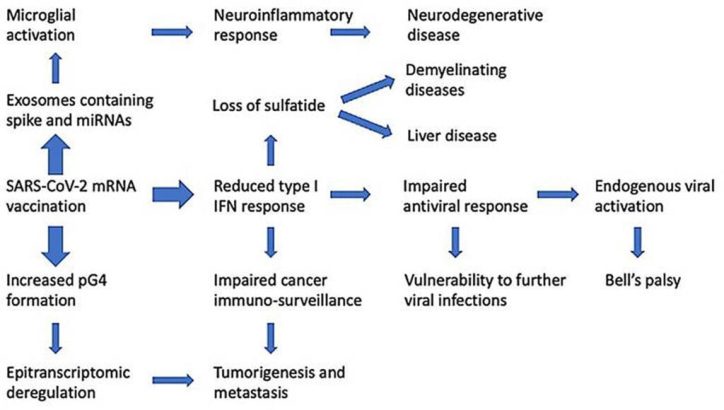
Innate immune suppression by SARS-COV-2 mRNA vaccinations: The role of G-quadruplexes, exosomes and micrornas. Credit: Seneff, Nigh, Kyriakopoulos and McCullough.
Further investigation into mRNA and CJD
Gaertner began his research work into potentially useful therapeutics for prion disease and has also funded the development of a non-invasive prion blood test.
He even undertook his own study of people who were diagnosed with or died of CJD-like symptoms (n=60) after receiving the (mostly Pfizer) mRNA jab.
Nevertheless, he readily admits that he has yet to establish absolute proof of causation.
In a European Union document related to the approval of the vaccine, Gaertner discovered what could be the smoking gun: The liquid nanoparticles used to encase the mRNA came primarily from cow fat. According to Gaertner, the document in question even admitted mRNA’s potential to cause prion protein contamination.
Nearly a year after Gaertner publicized his discovery — which convinced some but not all researchers — a paper by Jean-Claude Perez documented 26 cases of “a new form of CJD” observed within a few days of the Pfizer, Moderna or AstraZeneca vaccinations.
Of these, 20 people died within less than five months of the injection. (At the time of the paper’s publication, only one of the 26 had survived.)
The ‘good news’
While admitting that “there is not, ordinarily, a whole lot of good news to be had concerning prion diseases,” Gaertner outlined a mechanism by which “residues on the spike [protein] bind to the many and varied amyloidogenic proteins,” thus resulting in the blood clots observed by more than a few embalmers since the introduction of the mRNA shots.
He explained how this process can “bind up” the prionic proteins:
“So, what we essentially have here is, instead of a silently cascading apocalypse, buried deep inside parts of the brain that we will never reach, we likely, instead, have these long, stringy, vein-shaped agglomerations of the various amyloid proteins, binding together wherever they meet, and apparently at least somewhat resistant to being broken down by the body’s natural processes for dealing with such eventualities.”
The “really good news” comes from the way ivermectin binds directly to the spike protein — which has itself been described as a “prion-like” protein — thus blocking the spike from connecting to the ACE-2 receptor and “preventing the key from ever entering the keyhole.”
According to Gaertner, ivermectin also prevents the “amyloidogenic aggregations to the spike protein,” thereby arresting the production and proliferation of the prionic proteins. He adds:
“Ivermectin is, without a shadow of a doubt at this point, a true miracle drug: With so many applications, from antiviral, to cancer treatment, to anti-inflammatory, and of course in its originally recognized anti-parasitic application, there should be little wonder why the powers that be have done their best to diminish it as ‘horse paste.’”
Gaertner also notes that in a “very unscientific poll” he conducted on Twitter, 80% of respondents reported that a single, low dose of ivermectin significantly improved “brain fog,” a common post-COVID-19 symptom.
He described a number of “relevant investigational therapeutics” for use against the spike protein and its effects, including serrapeptase, quercetin, methylene blue and resveratrol, some of which demonstrate a “very broad range of useful actions.”
Expressing his belief that the lack of progress on therapeutics for neurodegenerative diseases is likely due to “your run-of-the-mill Pharma and charity corruption,” Gaertner nonetheless found cause for optimism.
“There’s been a lot of progress, on a lot of fronts, and more comes regularly as the world continues waking up,” he said.
John-Michael Dumais is a news editor for The Defender. He has been a writer and community organizer on a variety of issues, including the death penalty, war, health freedom and all things related to the COVID-19 pandemic.
This article was originally published by The Defender — Children’s Health Defense’s News & Views Website under Creative Commons license CC BY-NC-ND 4.0. Please consider subscribing to The Defender or donating to Children’s Health Defense.
New York state quietly shuts down Excelsior Pass program that cost $250M in tax money to build
YourDestinationNow | July 8, 2023
The state of New York has quietly shut down its Excelsior Pass program that cost taxpayers $250 million. The now-defunct pass was the Empire State’s version of a Wuhan coronavirus (COVID-19) vaccine passport.
State officials announced on June 30 that the digital vaccine passport “will no longer be available” by July 28. They cited “reduced demand for access to digital COVID-19 test and vaccine records,” alongside “the official end of the COVID-19 public health emergency” last May 11, as reasons for the discontinuation.
Given this, the Empire State said it “will no longer recommend its use, provide technical support or release future versions” of the mobile app that holds the vaccine pass. “New users will be unable to log in and register for it.”
“Your data collected for [the Excelsior Pass] continues to be private and secure. [The state of] New York has gained knowledge on digital credentialing from this effort and remains interested in the potential this type of technology could bring in the future.”
Jordan Schachtel of the Dossier recounted that New York City (NYC) made use of the Excelsior Pass in its “Key to NYC” vaccine passport program for over two years. Former NYC Mayor Bill de Blasio and his successor, current Mayor Eric Adams, utilized the pass to prohibit entry to indoor facilities to those who refused to get injected with the two-dose Pfizer and Moderna injections and the single-dose Johnson & Johnson shot.
He continued: “The Excelsior Pass program began in early 2021 with an estimated cost burden of $2.5 million. It later ballooned to a sum approaching 100 times over the original budget, with an approximate amount of $250 million being handed out to IBM, Deloitte and Boston Consulting Group (BCG).”
Excelsior Pass now the subject of a probe by state inspector general
Citing state records, Schachtel wrote that Deloitte and BCG have billed taxpayers in the Empire State approximately $200 million for the pass’ “marketing” and “buildout” costs since 2021. Meanwhile, IBM has billed around $40 million plus $200,000 monthly since 2021 for “data storage” fees.
A May 14 piece by the Times Union‘s Joshua Solomon elaborated on the state’s expenditures in relation to the Excelsior Pass. Records obtained by the newspaper found that New York state has paid Deloitte and BCG almost $28 million to work on the app. IBM had also received an additional $36 million for its work on the pass, with $2.2 million in March for “application development” being the most recent payment.
Back in October 2021, Deloitte billed the state $3.6 million in Excelsior Pass costs. Two months later in December 2021, BCG billed the state for nearly $10 million in costs related to its work in reopening New York and on the Excelsior Pass.
“The money spent on the Excelsior Pass, and its accompanying ‘wallet,’ continued to flow to the consulting groups, even as the peak of the pandemic passed and the need for the app plummeted,” the Times Union piece noted. “The work by BCG and Deloitte was just one element of $200 million that flowed from New York to those firms that are now the subject of a state inspector general’s investigation. As the nation’s COVID-19 emergency fades from the front page, the spending renews the debate about New York’s ongoing use of contracts that were amended without public oversight during the pandemic.”
“While a handful of people in New York took action to protest against the authoritarian movement pass system, the vast majority of New Yorkers were happy to accommodate the bio-medical tyranny,” Schachtel pointed out. “In NYC, virtually every business complied with the program either out of sympathy or for fear of being shut down by the government.”
He ultimately remarked: “That’s $250 million down the drain, and on to the next ‘crisis.'”
Featured Video

ARE PATIENTS BEING PROPERLY INFORMED ABOUT OZEMPIC?
or go to
Aletho News Archives – Video-Images
New Book
Breast Cancer: Before You Consent
A new Unbekoming paperback
Lies are Unbekoming | September 18, 2026
Peter Gøtzsche reviewed every randomised mammography screening trial ever conducted for the Cochrane Collaboration. Cochrane’s headline is that, assuming a 15% mortality reduction, one woman in 2000 avoids dying of breast cancer over ten years. Ten are overdiagnosed and treated. Two hundred experience false alarms.
But that headline assumes the reduction. When Gøtzsche looked only at the trials with adequate randomisation — the higher-quality ones — the reduction disappeared. No effect on breast cancer mortality. No effect on all-cause mortality.
This is the Cochrane finding, published in the establishment’s own database of systematic reviews.
No woman being asked to consent to a mammogram this week knows it.
That is why the new Unbekoming paperback exists. … continue
Blog Roll
 Aletho News
- The Truth About the Trump Shootings with Ken Silva
- ARE PATIENTS BEING PROPERLY INFORMED ABOUT OZEMPIC?
- US lawmaker blocks $2.8 billion weapons sale to Israel: Report
- Yemeni army claims responsibility for strikes on sensitive sites in Saudi capital, Aramco facilities in Yanbu
- Iran Judiciary issues indictments against 159 US, Israeli officials for assassination of Leader, commanders
- Turkiye revokes Iranian bank license under US sanctions campaign
- US-Denmark Agreement on Greenland Is ‘PR Stunt’ Ahead of Midterms
- Araghchi: Military intervention cannot create security; coercion cannot bring peace
- Fraud Squared
- Breast Cancer: Before You Consent
- If Americans Knew
- Inside Gaza’s death trap of collapsing, bombed-out buildings
- The everyday items Israel bans from Gaza every day
- Inside the siege, the ruined buildings of Gaza – Daily Update
- Debunking The Claim That Macklemore Has A “History Of Antisemitism”
- CPJ demands release of arrested Palestinian-US journalist near Bethlehem
- Robert Kraft: The Billionaire Friend of Netanyahu Pulling The Strings Behind the Macklemore/Ed Sheeran Blow Up
- Columbia Administered Fund Gives Big Money to Pro-Israel Groups
- Deportation Case of Palestinian Activist Salah Sarsour Tests First Amendment
- ‘We Will Not Forget’: Palestinians Mark 44 Years since Sabra and Shatila
- Why do we let Zionists decide what we can and can’t say?
- No Tricks Zone
- 2025 Nature Paper Claiming Worsening Global Drought Gets RETRACTED …Heavily Flawed
- New Study: ‘Global Drought Shows No Detectable Recent Acceleration Under Climate Warming’
- Economic Masterminds: German Socialists Suggest Taxing Productivity Gains Stemming From Using AI
- The South China Sea Has Not Been Cooperating With The Climate Change Narrative
- Energy Crisis: Germany Enters Heating Season With Historically Low Gas Reserve Fill Levels
- New Study: The Antarctic Ice Sheet Gained Mass From 2020-2024 Due To Staggering Snow And Ice Accumulation
- Study: Ocean Heating Rates From Thousands Of Years Ago ‘Dwarf’ Modern Ocean Heating Rates
- Climate Extremists Target, Attack Large-Scale Power Grid Infrastructure In Germany!
- New Study: Antarctic Ice Melt Has Contributed Less Than 1 Centimeter To Sea Level Rise In The Last 30 Years
- Fear Of Debate: Alarmist German Climate Scientist Calls On Mainstream Media To Discredit Skeptic Voices
 Aletho News