The Empire’s Assassins
Tales of the American Empire | October 9, 2025
The recent assassination of Charlie Kirk was done by professionals. The FBI story is full of holes and experts agree that he was not shot by a high-power rifle, something our corporate media refuses to report. That would have knocked his head off!
This is not a detailed report of his assassination, but how it matches the proven method used by teams of professional killers, which includes setting up a lone nut patsy.
_______________________________________
“Analysis Solves Kirk Case”; a retired pathologist explains why Kirk was not hit by a high-power rifle bullet; Chris Martenson; September 26, 2025;  • Analysis Solves Kirk Case—Evidence Points …
“Valhalla VFT” channel; a retired Green Beret soldier with several videos about the magic bullet; / @valhallavft
Related Tale; “The American Colony of Thailand”; • The American Colony of Thailand
Related Tale; “Football Star Murdered in Afghanistan”; • Football Star Murdered in Afghanistan
“Charlie Kirk Assassination: Narrative vs Reality”; a great short video summarizing the odd stories about this killing; RangeDayBro; October 4, 2025; • Charlie Kirk Assassination: Narrative vs R…
“PROOF Epstein Jail Video Is A Sham & Doctored By FBI!”; Jimmy Dore Show; August 2, 2025; • PROOF Epstein Jail Video Is A Sham & Docto… • Lee Harvey Oswald was a Patsy
‘Lies, misinformation’: Israeli military produced videos to justify Gaza genocide
Press TV – October 10, 2025
A new analysis has found that the Israeli military produced three-dimensional or animated visualizations not based on verified intelligence but fabricated content and digital assets to justify the Tel Aviv regime’s genocidal war on the Gaza Strip.
A months-long investigation by the Israeli-Palestinian publication +972 Magazine and Hebrew-language outlet Local Call, together with the research collective Viewfinder, the Swiss network SRF, and the Scottish outlet The Ferret analyzed 43 animations released by the Israeli army over the past two years and found that many contain “serious spatial inaccuracies or pre-fabricated assets”.
The videos, including those depicting the alleged tunnels beneath the al-Shifa Hospital and a UN-run school in Gaza, are “sourced not from classified intelligence but rather from commercial libraries, content creators, and cultural institutions,” the study found.
The clips are typically published across the Israeli military’s Telegram, YouTube, Facebook, X, and Instagram channels, and may be paired with a press conference by the occupation army’s spokesperson.
International media outlets will use the ready-made visuals, in many cases amplifying them uncritically.
“Instead of revealing hidden truths — as Israeli military officials insist, and as the international media readily amplifies — the visualizations actually blur them,” according to the investigation.
It further said that interviews with soldiers involved in the production of these videos further illuminate how the Israeli army prioritizes the aesthetic value of the animations over their accuracy.
The analysis also found that more than half of the videos contained 3D assets, which were taken from third-party sources.
Over 50 different third-party assets were identified in total, which were replicated hundreds of times across animations of sites supposedly in Gaza, Lebanon, Syria, and Iran, it added.
“A parking lot from Washington state, scans from a boat-building workshop in Scotland, and commercial storefront kits from the video game industry — all of these have been inserted, without credit, into animations presented as ‘illustrations’ of Hamas bunkers or Iranian weapons facilities.”
Eyad Elyan, a Palestinian academic at Scotland’s Robert Gordon University specializing in AI and 3D modeling, said he was “deeply disturbed” to learn that Israel has been using Scottish assets in its propaganda animations, saying the practice aligns with the regime’s “long history of exploiting others’ resources and employing every means possible to promote baseless claims.”
“What is especially troubling, however, is how such fabricated content is uncritically accepted and amplified by mainstream media outlets,” he continued. “Much of this material consisted of outright falsehoods — for instance, the widely circulated animation alleging that Hamas operated a command center beneath the al-Shifa Hospital. No such facility was found, but [this claim] was used to destroy almost the entire healthcare system in Gaza.”
Scottish lawmaker Patrick Harvie said the Israeli military made and distributed the videos in order to “justify” its Gaza genocide.
“When lies and misinformation are such a core part of an army’s strategy, it makes it all the more important that our governments take a stand and act to stop the atrocities that they are inflicting,” he added.
Israel unleashed its brutal onslaught on the Gaza Strip on October 7, 2023, after the Palestinian Hamas resistance group carried out its historic operation against the usurping entity in retaliation for the regime’s intensified atrocities against the Palestinian people.
The Tel Aviv regime failed to achieve its declared objectives of eliminating Hamas and freeing all captives in Gaza, despite killing, according to the health ministry of Gaza, 67,194 Palestinians, mostly women and children, and injuring 169,890 others.
Trump’s Gaza peace plan won’t work, it’s an ultimatum under genocide
By Finian Cunningham | Strategic Culture Foundation | October 9, 2025
The so-called peace plan put forward by U.S. President Trump is a non-starter that won’t work, according to international legal expert Alfred de Zayas.
De Zayas says Trump’s much-ballyhooed initiative is not a peace offer. It is an ultimatum demanded by criminal rogue regimes that are responsible for genocide – the United States and Israel.
Professor De Zayas points out that Donald Trump and Israel’s Benjamin Netanyahu have no credibility. Both are complicit in the genocide of Palestinians. The very idea of Trump proposing a peace deal amidst an ongoing U.S.-backed mass slaughter, where there is no legal prosecution of the perpetrators of genocide, nor for the illegal occupation of Palestinian land, and numerous other war crimes, is grotesque and absurd.
The appointment of British former leader Tony Blair to oversee Trump’s “peace plan” in Gaza is another insult.
“He should be behind bars as a war criminal,” says de Zayas, referring to Blair’s role in launching the U.S.-British war on Iraq in 2003, based on lies, killing over one million people.
On the issue of Gaza, the problem is that Israel, with support from the U.S. and European states, has been grossly violating international law and UN treaties for decades with impunity. This shameful lack of accountability and enforcement of international law makes Israel and its Western sponsors criminal regimes. It is nonsense to expect such serial violators to now propose a peace deal when they have not been held to account for a litany of crimes.
De Zayas says we need a ceasefire in Gaza urgently, with massive humanitarian aid for a population being deliberately starved to death by Israel. But any resolution must be applied with international law and justice for the horrific crimes.
Trump’s plan is a whitewash of the genocide. The Western mainstream media are also guilty of covering up the depth of horror. The media are ridiculously spinning Trump’s offer as genuine and credible, perhaps with a few flaws pooh-poohed here and there. The media are not reporting on the true horror and Western complicity in genocide. That’s because their long-time role is to serve as a propaganda service to sanitize the crimes and systematic lawlessness of Western rogue regimes.
Professor Alfred de Zayas teaches international law and history at the Geneva School of Diplomacy. He has worked as a UN staff expert on human rights for nearly 50 years.
His latest book is The Human Rights Industry (Clarity Press, 2023), see here: https://www.claritypress.com/product/human-rights-industry/
Catch his recent articles on wide-ranging international issues at Counterpunch: https://www.counterpunch.org/author/alfred-de-zayas/
Turkiye to boost US gas imports, cut reliance on Iran and Russia
The Cradle | October 9, 2025
Turkiye is moving to cover more than half of its natural gas demand by 2028 through domestic production and increased US liquefied natural gas (LNG) imports, decreasing reliance on Iran and Russia, according to analysts cited by Reuters on 8 October.
The plan follows a White House meeting on 25 September, during which US President Donald Trump urged Turkish President Recep Tayyip Erdogan to curb Russian energy purchases, as part of the US push to press allies to scale back ties with both Moscow and Tehran.
Ankara’s strategy centers on expanding LNG terminals and boosting local output through the state-owned energy firm, Turkish Petroleum Corporation (TPAO).
According to Turkiye’s Energy Exchange (EPIAS), the country’s LNG terminals can now import up to 58 billion cubic meters (bcm) of gas each year, enough to meet its entire domestic demand.
Domestic production and contracted LNG imports are projected to exceed 26 bcm annually from 2028, compared with 15 bcm this year.
That would account for more than half of Turkiye’s 53 bcm gas demand, sharply reducing its need for Russian and Iranian pipeline supplies.
“Turkiye has been signalling that it will take advantage of the [global] LNG abundance,” said Sohbet Karbuz of the Paris-based Mediterranean Organisation for Energy and Climate (OMEC).
Although Russia remains Turkiye’s largest supplier, its share of the market has fallen from over 60 percent two decades ago to 37 percent in the first half of 2025.
Moscow’s long-term pipeline contracts – covering 22 bcm annually via Blue Stream and TurkStream – are nearing expiry. Iran’s 10 bcm contract ends next year, while Azerbaijan’s 9.5 bcm deals run until 2030 and 2033.
To replace these, Ankara has signed $43 billion worth of LNG agreements with US suppliers, including a 20-year deal with Mercuria in September.
Turkish Energy Minister Alparslan Bayraktar said in a recent interview that Turkiye “must source gas from all available suppliers,” which includes Russia, Iran, and Azerbaijan, but noted that US LNG offers cheaper alternatives.
Analysts believe Ankara will likely burn Russian and Iranian gas domestically while re-exporting imported LNG and its own output to Europe, where a full ban on Russian energy is expected by 2028.
Turkiye’s state energy company BOTAS has already begun small-volume exports to Hungary and Romania as part of its efforts to become a regional gas hub.
Exposed: Western journalists secretly served ‘Israel’s’ war propaganda
Al Mayadeen | October 8, 2025
Leaked emails from the inbox of former Israeli Ambassador to the United Nations Ron Prosor reveal that prominent Western journalists, ncluding The Atlantic’s David Frum and British writer Douglas Murray, secretly offered to write speeches and provide other forms of assistance to Israeli officials during the entity’s 2014 war on Gaza, according to a report by journalists Murtaza Hussain and Ryan Grim published on Drop Site.
The correspondence, obtained by the hacker collective Handala and published by the whistleblower group Distributed Denial of Secrets (DDoSecrets), includes communications between Prosor and several journalists and media figures.
The trove reveals that while “Israel” faced global condemnation for its war that killed over 2,200 Palestinians, more than 550 of them children, figures in Western media were privately coordinating with Israeli diplomats on messaging and advocacy efforts.
Frum’s dual role: Journalist and speechwriter
David Frum, a senior editor at The Atlantic and a former speechwriter for US President George W. Bush who coined the phrase “Axis of Evil,” began his editorial role at the magazine in early 2014. Just months later, at the height of “Israel’s” bombardment of Gaza, Frum sent Prosor a full draft of a UN speech.
In an email dated July 31, 2014, Frum told Prosor he had collaborated with Seth Mandel, a writer for the neoconservative publication Commentary, to prepare the text. The draft portrayed “Israel’s” war on Gaza as part of the “free world’s” struggle against “tyranny”, comparing it to the Allied defeat of Nazi Germany and invoking figures such as Harry Truman and the architects of the Marshall Plan.
The speech urged Americans not to grow “war weary” and to maintain support for “Israel’s” military actions. Prosor thanked Frum and said he would review the draft, though it remains unclear whether the text was ever used.
Remarkably, just one day earlier, Frum had contacted Prosor in his capacity as a journalist for The Atlantic, requesting an interview for a profile of the ambassador. Two months later, The Atlantic published Frum’s piece, “Israel’s Man at the United Nations,” which praised Prosor for his “toughness” and diplomatic skill in defending “Israel” against international criticism.
Douglas Murray’s contributions and fundraising
Frum was not alone. British commentator Douglas Murray, now an associate editor at The Spectator and a frequent television pundit, also sent Prosor a proposed draft for a UN speech on the same day, July 31, 2014.
In his email, Murray described the text as “first draft ideas,” noting it may include “more diplomatic things than needed.” His proposed speech echoed hardline pro-“Israel” narratives, including condemnation of BDS movements and disparaging references to European Muslims.
Murray pledged to continue assisting the ambassador. “I will give all the time I can to helping get it right,” he wrote.
In subsequent months, Murray continued corresponding with Prosor, sharing articles and offering public relations advice. Later that year, he informed the ambassador that he had hosted a London fundraiser that brought in over £1 million for the Association for the Wellbeing of Israeli Soldiers, a group providing direct support to Israeli occupation forces.
Prosor thanked Murray for his “wonderful work”, calling his efforts vital to “Israel’s cause”.
The revelations contrast sharply with Murray’s later insistence on journalistic independence. In an April 2025 appearance on The Joe Rogan Experience, he chastised critics of “Israel’s” Gaza policies for lacking firsthand experience, saying he avoided commenting on countries he hadn’t visited.
Murray has frequently appeared in public wearing a “PRESS” flak jacket while embedded with Israeli forces, without disclosing his prior speechwriting and fundraising for the same military he was covering.
CNN producer’s role in Iron Dome fundraising
The leaked correspondence also implicates Pamela Gross, a former CNNproducer, who maintained close ties with Prosor during the war. Emails show that Gross and her husband, media executive Jimmy Finkelstein, then-owner of The Hill, privately discussed raising money for “Israel’s” Iron Dome missile system.
In one July 2014 message, Gross wrote to Prosor, “Clearly Iron Dome is doing the trick and saving lives. Please dear friend, let’s get it finished. Please let me know what is still left to be done at your soonest convenience.”
Prosor responded by thanking Gross for her “amazing work in fundraising for the Iron Dome project,” calling her and her husband “true assets to the state of Israel.” Gross later asked the ambassador to connect her with officials who could provide details about the project’s funding needs and how to channel donations.
Gross continued to book Prosor for CNNappearances while maintaining their personal friendship. In one 2015 exchange, she invited him on air to discuss Israeli Prime Minister Benjamin Netanyahu’s speech to the US Congress, telling him she and her husband had recently dined with former Israeli Prime Minister Ehud Barak.
Unanswered questions, ethical fallout
The leaked cache contains hundreds of verified messages, photographs, and attachments, though DDoSecrets noted it could not independently authenticate every file. Handala, the hacking group that released the material, issued a violent threat against Prosor, which DDoSecrets publicly condemned.
None of the journalists or organizations named in the emails, including Frum, Murray, Mandel, CNN, or the Israeli Embassy in Germany, where Prosor now serves, responded to requests for comment from Drop Site, which first reported the findings.
The revelations raise fresh ethical concerns about the blurred lines between journalism and government lobbying efforts during times of war. While journalists are expected to maintain independence and avoid conflicts of interest, the emails suggest that several prominent figures in Western media privately worked to shape pro-“Israel” narratives during one of the deadliest wars on Gaza.
For “Israel”, such alliances helped bolster its messaging at a time of mounting global outrage over civilian casualties. For the public, however, the leaks expose the extent to which supposedly independent voices in Western journalism may have functioned, willingly or not, as part of a broader influence campaign.
Israel’s Secret Social Media War On Iran
By Kit Klarenberg | Global Delinquents | October 7, 2025
On October 3rd, Haaretz published an extraordinary investigation, exposing how for years, the Zionist entity has clandestinely conducted dedicated “online operations” to promote the “public image” of Reza Pahlavi, the Shah of Iran’s eldest son and pretender to the country’s now non-existent throne, locally and internationally. The efforts were highly sophisticated and wide-ranging, harnessing artificial intelligence, social media manipulation of every sort, and other online warfare techniques intended to convince audiences Pahlavi was Tehran’s exiled rightful ruler-in-waiting.
Hundreds of bogus online personae, with AI-created profile photos and fraudulent biographies, calling for the restoration of the Islamic Republic’s monarchy and sharing photos and videos of Pahlavi, are run by a shadow battalion of Persian-speakers specifically recruited by Israeli intelligence for the project. Bot and troll networks amplify their output, with campaign messaging constantly updated based on audience analysis.
Another component of the online blitzkrieg is concerned with glorifying Gila Gamliel, a member of Benjamin Netanyahu’s government and Tel Aviv’s “point person with Pahlavi.”
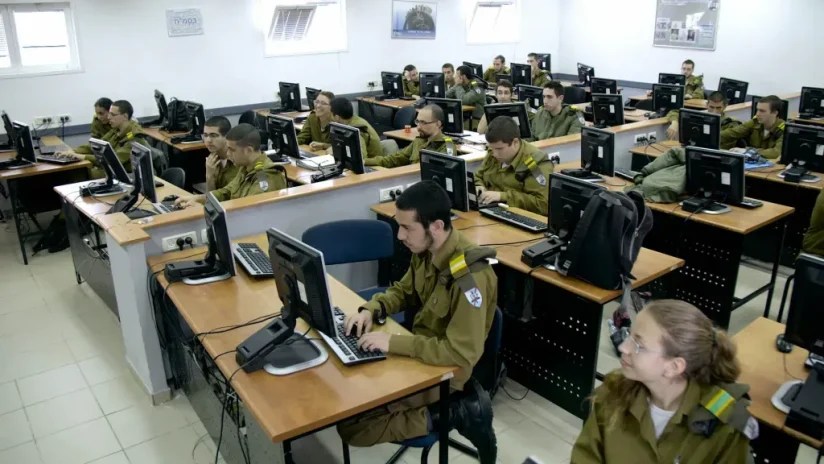
Zionist cyberwarriors hard at work
The network got busted by independent digital researchers as a result of Gamliel posting an AI-generated video on social media platforms, titled “Next Year in Free Tehran”. The fictional clip, published June 15th – three days into the Zionist entity’s botched 12 Day War, and coincidentally the same day Netanyahu forecast imminent regime change in Iran – “had massive exposure, most of which was likely inorganic.” It depicted Netanyahu, his wife, Gamliel, her partner, Pahlavi and his wife walking through Tehran’s streets.
“The video received many more views than most of the minister’s X posts, and these and other attempts to amplify it” helped researchers “locate” a network of bots and fake users artificially boosting Gamliel’s “frequent” calls for regime change in Iran and her ties to Pahlavi. “Many of these accounts were opened in 2022, at the height of the so-called hijab protests in Iran,” Haaretz records. Over 100 further “allied accounts” were launched during the 12 Day War to further boost the malignant network’s output.
Haaretz cryptically reveals, “this doesn’t appear to be the only campaign operating on this issue from Israel.” Still, the outlet’s bombshell disclosures confirm the Zionist entity – if not other hostile foreign powers, including the US – was covertly engaged in expansive psychological warfare initiatives to manufacture consent for Pahlavi’s installation as Iran’s ruler at two critical junctures in recent history, when regime change in Tehran was being openly promoted by Israeli officials, Western governments, and the mainstream media.
Those attempts floundered. While Pahlavi occasionally receives positive coverage by Western news outlets, he enjoys no support among Iran’s population at home, and even many diaspora detractors reject any suggestion of him taking power in the country. In fact, the would-be monarch’s reputation is so poisonous, his endorsement is a decisive kiss of death for any challenge to Tehran’s government. That vast resources were – and seemingly remain – invested by the Zionist entity in such a futile endeavour ranks as an embarrassing failure of epic proportions.
‘Monarchist Accounts’
Further detail on Israeli online dark arts pushing Pahlavi is provided by a July 2023 report from data analytics firm Social Forensics, on “state-sponsored platform manipulation” during the 2022 protests in Iran. The investigation concluded Tehran was the victim of wide-ranging cyberwarfare operations throughout this period. This included “disinformation, smears, and threats” emanating from a vast nexus of bots and trolls on Twitter. While the report did not make a definitive attribution for this malign activity, its findings point unambiguously in Tel Aviv’s direction.
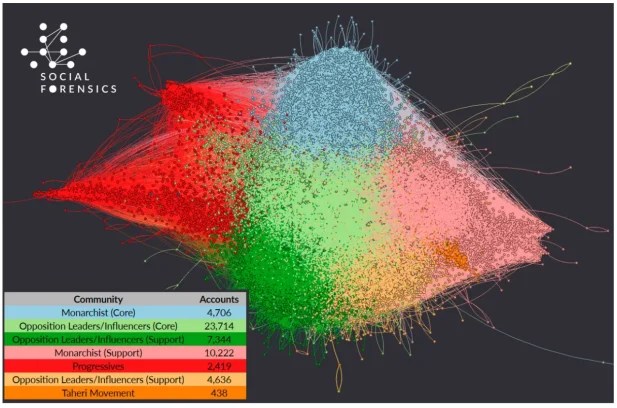
Social Forensics identified several clear, separate “communities” of weaponised accounts targeting the Islamic Republic during this period, such as “progressives”. However, the most influential community were “monarchists”. All accounts in this category had significant followings, and their output generated sizeable engagement, both inauthentic and organic. Thousands of supposed users boasted crown emojis in their display names, denoting their monarchist allegiance. In all, over 95% of these accounts were found to be automated “sockpuppets” by Social Forensics:
“Most… are inauthentic and function to flood Twitter with monarchist, pro-Pahlavi imagery and content to make it seem like there is a larger base of monarchist supporters on Twitter than reality reflects.”
In March 2023, hundreds of pro-Pahlavi bots were suspended for violating Twitter/X rules, after engaging in platform manipulation. Despite many quickly resurfacing with almost identical usernames and continuing their wrecking activities, several prominent anti-Tehran figures condemned the mass ban of automated agitators. Among them was Alireza Nader, formerly a senior apparatchik at notorious, pro-Pahlavi Zionist lobby group the Foundation for Defense of Democracies, and opaquely-funded exile organisation National Union for Democracy in Iran. Social Forensics found he followed and amplified several inauthentic monarchist accounts.
The analytics firm also discovered numerous official Israeli government accounts on the platform likewise followed the most influential pro-Pahlavi sockpuppets. Strikingly, one out of every eight accounts followed by @IsraelPersian, which targets Iranian audiences, were “inauthentic monarchist accounts”, advocating “for the overthrow of the Islamic Republic and the return of exiled Crown Prince Reza Pahlavi to the country as the leader of a constitutional monarchy.” But irresistible indications of Tel Aviv’s management of this belligerent bot network don’t end there.
An authentic user followed by @IsraelPersia, among other official Zionist entity accounts, is Emily Schrader, CEO of digital marketing agency Social Lite Creative. At the time of Social Forensics’ investigation, her company’s website openly boasted of working with “high level government organizations and NGOs in Israel, including the IDF.” The analytics firm’s probe concluded Schrader’s follower count “is inflated and her tweets are artificially amplified by the same inauthentic accounts” calling for insurrection in Iran, including monarchist bots.
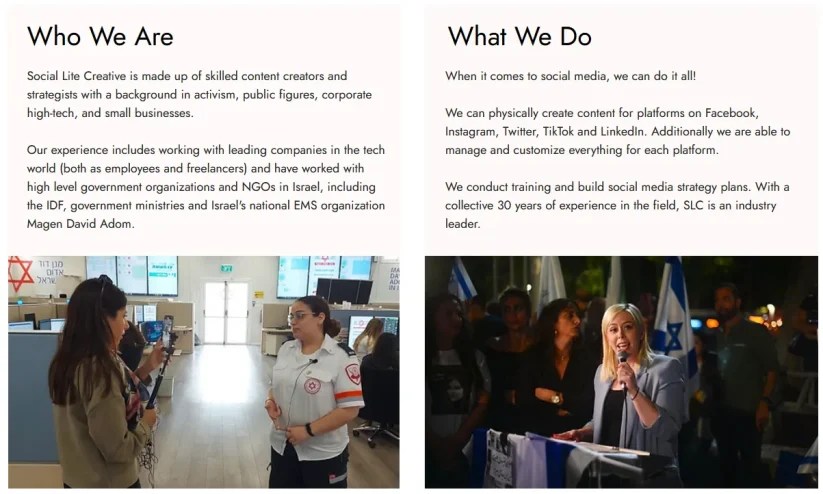
Since amended entries on Social Lite Creative’s website
‘Peddling Distrust’
Schrader avowedly counting multiple Israeli state entities, including its genocidal military, as clients is sufficient grounds to postulate Tel Aviv was ultimately responsible for the pro-monarchist “platform manipulation” campaign. Just as suspiciously, the protests they accompanied were launched following the Pentagon waging a clandestine online war against Iran for years prior. These efforts were exposed by digital researchers after Twitter and Meta banned a vast network of US military-run accounts, which “used deceptive tactics to promote pro-Western narratives” in Central and West Asia.
Iran was a preponderant target, with Pentagon psyops specialists managing multiple anti-government media outlets publishing content in Farsi with accompanying social media channels, and a panoply of bot and troll accounts. These personae frequently posted non-political content, including Iranian poetry and photos of Persian food, in order to enhance their authenticity. They also engaged with real Iranians on Twitter, often joking about mundane topics such as internet memes. The sockpuppets spanned a wide ideological gamut, employing differing narrative techniques for varying audiences.
For example, some ‘Iranian’ Pentagon bots and trolls promoted “hardliner” views, criticising the Islamic Republic for being too liberal domestically, and inadequately aggressive in asserting its interests regionally. Others posed as left-wingers, secularists and other opposition elements. It was a full-spectrum digital assault from every angle. Eerily, many of these accounts promoted women’s rights, and protests against hijab-wearing. One Pentagon-circulated meme compared the treatment of women abroad with Iran, by contrasting photos of Western female astronauts and an alleged local victim of violent domestic abuse.
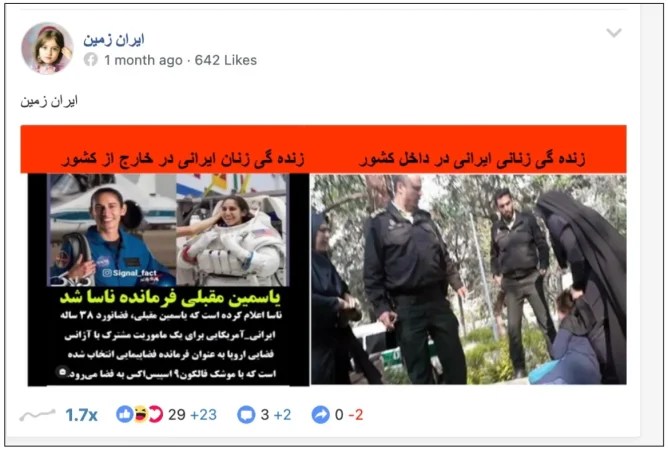
Hijab destruction was a core symbol of protests that subsequently erupted in Tehran, which elicited blanket foreign media coverage, and a chorus of calls for regime change in Iran. Quickly, Pahlavi and close allies such as Masih Alinejad, a veteran of US-funded propaganda efforts targeting the Islamic Republic, who has called for Zionist entity attacks on the country and assassination of its leaders, proclaimed themselves to be leading the demonstrators. However, their attempt to commandeer the protests resulted in the unrest’s instant termination locally.
A withering post-mortem of “why Iran’s ‘woman, life, freedom’ revolution failed” authored by Zionist lobby-connected Mariam Memarsadeghi, who similarly promotes regime change in Tehran, pinned the blame squarely on Pahlavi’s attempt to associate himself so intimately with the protests. She noted the fake king’s close associates push extreme “Iranian nationalism”, calling for “retributive violence [and] summary executions” of enemies, while “peddling distrust and attacking other opposition leaders on social media.” These activities gravely alienate Iranians within and without the country, leaving Pahlavi irreparably tarnished.
In April 2023, Pahlavi made a surprise appearance in Tel Aviv. Despite eliciting zero Western media interest, Israeli news outlets eagerly promoted his appearance as of earth-shattering significance. The Times Of Israel claimed the “historic” visit was a “healing process for many Iranian Jews,” leaving them with a “unique sense of joy, optimism, and a feeling of healing.” At a press conference, Pahlavi was asked about the response his trip there was receiving from average Iranians. He declared their vehement support was provably clear:
“Don’t take my word for it, search on social media… on Twitter, Instagram, any platform. If you do the research yourself, you don’t need to ask me the question. The answer is right before your eyes.”
Of course, that “answer” was provided by people who don’t exist, courtesy of “online operations” conducted by Israel, and likely other states seeking regime change in Iran. Evidently undeterred by the 2022 campaign’s faltering, Pahlavi was again fraudulently promoted by a Zionist-orchestrated social media effort during the 12 Day War, wholly counterproductively. A July report from Tel Aviv’s Institute for National Security Studies concluded monarchist backing for insurrection during that conflict only strengthened local support for the government, “rallying the public around the flag”:
“It is therefore advisable to avoid ties, when possible, with Iranian opposition groups (including some monarchist circles in the diaspora) who are perceived by large segments of the Iranian public as tainted and having betrayed Iran in its time of need. Although aligning with pro-Western and pro-Israel diaspora groups that push for revolutionary change may seem natural, such associations may, in fact, undermine the credibility of internal opposition and ultimately obstruct the desired outcome.”
Mossad ‘in contact from very beginning’ with killers of Italian PM, reporter reveals
By Kit Klarenberg and Wyatt Reed | The Grayzone | October 5, 2025
A roving reporter who covered Italy’s top politicians explains to The Grayzone how his country was reduced to a joint US-Israeli “aircraft carrier,” and raises troubling questions about an Israeli role in the killing of Prime Minister Aldo Moro.
For years, Israel’s Mossad monitored and secretly influenced a violent communist faction that carried out the March 16, 1978 kidnapping and murder of Italian statesman Aldo Moro, veteran investigative journalist Eric Salerno has documented.
Having worked closely alongside multiple Italian heads of state during his 30-year career as a correspondent, Salerno published an expose of their secret relationship with Israeli intelligence in 2010 called Mossad Base Italy.
The reporter told The Grayzone that Moro, who was arguably Italy’s most important leader, became a thorn in the side of powerful forces who sought to keep his country firmly lodged in the pro-Western bloc. Salerno believes Italy’s long-term foreign policy would have developed differently if Moro had survived, adding, “that’s what they were afraid of in the United States.”
Moro was kidnapped in 1978 by the radical Brigate Rosse, or Red Brigades faction, in a daring and highly-professional daytime operation which left all but one of his bodyguards dead. He was executed two months later. The still-unresolved case shocked the nation, and remains a deeply unsettling chapter in the period of intelligence intrigues and political terrorism known by Italians as The Years of Lead.
For some of Italy’s most knowledgeable sources, the crimes bore strong similarities to those of Operation Gladio, a covert effort which saw the CIA, MI6 and NATO train and direct a shadow army of fascist paramilitary units across Europe that carried out false flag terror attacks, robberies, and assassinations aimed at neutralizing the socialist left.
Moro, who belonged to the progressive wing of the Christian Democrat Party and served five terms as prime minister, threatened to upend the traditional postwar order in Italy by forging a “compromesso storico” (historic compromise) with the Italian Communist Party. “It was something that probably part of the Italian political establishment was afraid of, even in his own party,” Salerno notes.
While this part of Moro’s history is well known among Italians, Salerno has documented a less understood aspect of his legacy: his arrangement with Palestinian resistance groups, likely mediated by Libyan President Moammar Gaddafi, which allowed the PLO and others to smuggle weapons and travel freely through Italy in exchange for the country itself being spared from terror attacks. That deal, which scholars consider to be an evolving and “dynamic process,” came to be known as the “Lodo Moro.”
The pact is widely believed to have been forged in 1973, during Moro’s tenure as foreign minister, when Italy secretly released a group of Palestinian fighters who sought to attack a plane belonging to Israel’s El Al airline as it departed from Rome’s Fiumicino airport. It was spurred in large part by Italy’s desire to maintain a level of independence from the US-led Western bloc, which was targeted by an oil embargo in retaliation for Washington’s support for Israel in the 1973 Arab-Israeli War.
While Salerno stopped short of alleging the Mossad directly ordered the abduction and execution of Moro, he told The Grayzone, “I think their idea was, ‘we’ll see what happens, and if it’s necessary, and we think it’s the right time, we can help one way or another.’”
For over a decade, the Lodo Moro deal insulated Italy from the violence that plagued other nations across the Mediterranean. These plots became increasingly commonplace in the region following the 1967 Six-Day War between Israel and a coalition of Arab states including Egypt, Syria, and Jordan.
But it was only a matter of time before the violence consumed Moro’s life as well.
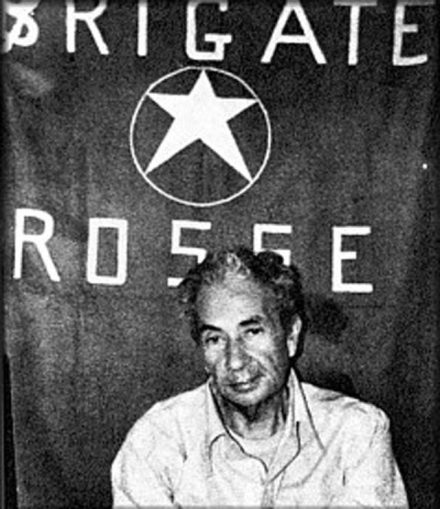
Italian Prime Minister Aldo Moro in Red Brigade captivity, 1978
Mossad Base Italy
Salerno’s book, Mossad Base Italy, is perhaps the most comprehensive chronicle of the intimate and ongoing relationship between Israeli intelligence and Italy’s political leadership. Published in 2010, the book remains almost completely unknown in the English speaking world.
Its author illustrates how the secret Israeli-Italian alliance predated the May 1948 creation of Israel, with Rome providing covert support to Zionist militias like the Haganah. Individuals affiliated with Benito Mussolini and neofascists within Italy’s post-war security apparatus supplied them with weapons and training to crush Palestinian resistance and assist their campaign of ethnic cleansing.
“The Israelis didn’t want Rome to become a satellite of the Soviet Union, and the US had the same position. The country was essentially the West’s front line against the Eastern bloc,” Salerno explained to The Grayzone. “Italy bordered Yugoslavia, was not far from Warsaw Pact nations, and support for Communism and the Soviet Union was strong in the wake of World War II. It was also a kind of aircraft carrier in the Mediterranean, which people would land on and go off to other places.” With nearly 5,000 miles of coastline, and just 90 miles separating the island of Sicily and Tunisia, Italy has often been described as the “gatekeeper” of the Mediterranean Sea.
Salerno concluded that every Italian administration since World War II has secretly aided Mossad and Israeli military intelligence. A review of his book by veteran Haaretz intelligence correspondent Yossi Melman noted, “Israeli espionage agents confirm that Italy’s intelligence services are among the friendliest in the world toward their Israeli counterparts.”
Salerno argues persuasively that both the Mossad and Israeli Air Force were effectively “born in Rome,” and reveals Tel Aviv entrusted Italian intel with conducting “extremely classified missions” on their behalf. Strikingly, his book has never been translated into English.
The reporter attributes the consistent pro-Israel bias of Italian intelligence to a combination of political expediency and lingering collective guilt over Rome’s complicity in the crimes against Jews during World War Two. Since then, Italy’s governments have largely “felt… that they had to help the Jews because the Jews had been suffering under the previous regime.”
“Objective evidence” Mossad downed Italian airliner
The traditional dynamic between Rome and Tel Aviv was challenged by the emergence of Italian Christian Democrat Party governments, including Moro’s. Within months, Israel began responding to this defiance with apparent acts of sabotage inside Italy, according to a variety of well-placed figures.
In late 1973, five members of the Black September Palestinian militant group were arrested thanks to a tipoff from the Mossad, which claimed they were preparing to shoot down an Israeli commercial airliner at Rome’s largest airport with ground-to-air missiles. However, Moro arranged for them to be released a month later, then transported to Libya.
The Black September members were first flown to Malta on an Italian transport plane known as Argo 16 — which was routinely used to ferry Operation Gladio operatives to a secret training base in Sardinia, and deliver CIA/MI6 weapons to secret depots dotted around the country. When Mossad observed the Palestinians there and realized they’d been freed, they became “very annoyed,” according to Rome’s then counterespionage chief, Ambrogio Viviani.
On November 23 1973, Argo 16 crashed shortly after taking off from Venice Airport, killing the entire veteran crew.
An initial probe concluded the tragedy was an accident, but the case was reopened by the Venice prosecutor’s office in 1986. That investigation faltered as well, when security and intelligence officials refused to testify, and began withholding evidence. However, the judge overseeing the case, Carlo Mastelloni, told Salerno there was no doubt, based on “objective evidence,” that the plane’s downing was Israel’s dirty work.
“It’s all tied to the famous ‘Moro agreement,’” Mastelloni asserted. Argo 16’s sabotage was not only “retaliation” for the release of the arrested Palestinians, but a “warning” over Italy’s “concessions” to “Tel Aviv’s enemies,” he stated. Still, Lodo Moro continued to hold despite the implicit threat of violence, which raises the question of whether Mossad felt the need to up the ante.
‘Mossad decided to transfer the Middle Eastern conflict to Italy’
Argo 16 was not the only fatal incident to take place during Italy’s Years of Lead which seemed to bear the Mossad’s fingerprints. When a hand grenade was lobbed at Milan’s police headquarters in May 1973, killing four civilians and injuring 45, the culprit presented himself as an anarchist following his immediate apprehension. However, subsequent investigations revealed the perpetrator, Gianfranco Bertoli, to be a longtime Italian military intelligence informant, as well as a member of numerous neofascist organizations, including the Gladio-linked Ordine Nuovo (New Order).
Bertoli had spent the two years leading up to the attack residing off and on in Kibbutz Karmiya in Israel, where he frequently hosted representatives of French far-right faction Jeune Révolution, while maintaining contact with French intelligence. Such incidents prompt Salerno to ask: “was the Mossad part of the strategy of tension?” This was the precise conclusion reached by Ferdinando Imposimato, an Italian magistrate who oversaw initial trials of Red Brigades operatives regarding Moro’s murder.
“It must be acknowledged the Israeli secret services had perfect knowledge of the Italian subversive phenomenon from its very beginning, engaging in it with constant ideological and material support,” Imposimato noted in 1983. “Mossad had decided to transfer the Middle Eastern conflict to Italy,” he concluded, “driven by the aim of political and social destabilization.” Israel’s purpose was “to induce America to see Israel as the only allied point of reference in the Mediterranean and thus gain greater political and military support,” he stated.
During his March 1999 testimony to a parliamentary inquiry into terrorism in Italy, Red Brigades fighter Alberto Franceschini stated the group was approached by the Mossad through an intermediary after the Red Brigades’ kidnapping of a magistrate named Mario Sossi in April 1974. According to Franceschini, the Mossad made a “disturbing” proposition to finance his group, stating that rather than seeking to control the Red Brigades, Israel sought only to ensure the group continued to operate:
“We don’t want to tell you what you have to do. That is, what you do is fine with us. We care that you exist. The very fact that you exist, whatever you do is fine with us.”
Describing “the political motivations” for Mossad’s position, Franceschini noted: “from the perspective of American relations… the more destabilized Italy was, the more unreliable it became, and the more Israel became a reliable country for all Mediterranean policies” from Washington’s perspective. In his final years, Franceschini revealed Israel “offered weapons and assistance” to the Red Brigade, declaring: “their stated goal was to destabilize Italy.”
As Salerno noted to The Grayzone, “in one of his last interviews,” Franceschini “confirmed to my colleague from Corriere della Serra that the Mossad had been in contact from the very beginning with the Red Brigades,” interactions which the correspondent stresses were “very normal in the way the Mossad acted with all kinds of, let’s call them subversive organizations, all over Europe.”
The notion of a potential Israeli hand in shaping the Moro plot — or hindering efforts to resolve it peacefully — is bolstered by statements from a number of influential Italian politicians, which also indicate Israel both “co-financed” and “influenced” the group which took credit for killing Moro. These disclosures have so far been universally ignored by mainstream English-language outlets.
In July 1998, Giuseppe De Gori, a lawyer who represented Moro’s Christian Democrat party in numerous trials related to the case, told a parliamentary commission on terrorism that Mossad “had always controlled” the Red Brigades, without formally infiltrating the group. He recorded how in 1973, a Mossad major and colonel “presented themselves” to the group, exposing infiltrators in their ranks, and offering “weapons and whatever they wanted as long as they pursued a different policy.”
While the Red Brigades refused, “from that moment on, it was clear Mossad” kept a close eye on the militant faction. De Gori testified that Israeli intel “hated” the “anti-Zionist” Moro, and began taking advantage of its ability to “smuggle” information to the Red Brigades, which could influence their actions.
As the lawyer explained, there was “no need” for the Mossad to directly penetrate the Red Brigades. De Gori hinted the group’s decision to kill Moro after almost two months in captivity resulted from such indirect Israeli intervention. While Italian government officials refused any negotiation with his kidnappers, at a private meeting on May 8, 1978, elements within the Christian Democrats proposed independently brokering a deal to secure Moro’s release.
“Moro was killed immediately afterward, so someone must have been there who reported this news,” De Gori testified. In 2002, the lawyer told author Philip Willan that Mossad made Moro’s execution a fait accompli by enlisting the services of a skilled forger to fabricate a letter from the Red Brigades to authorities in mid-April 1978. The communique claimed the statesman was already dead. “After that… Moro could no longer be saved,” De Gori stated.
Bargain with Palestinian resistance puts target on Moro’s back
De Gori is not the only well-placed source to blame Mossad for Moro’s death. In May 2007, Giovanni Galloni, former vice president of the Italian judiciary’s High Council, boldly proclaimed that “not all participants” in the premier’s abduction had been members of the Red Brigades. That conclusion was spurred by Moro’s bodyguards being executed with “just two weapons, used by exceptionally experienced men.” In addition to never being identified, these assassins displayed a level of shooting expertise no known Red Brigades operative seemed to possess.
Galloni strongly insinuated the killers were hired by Washington and/or Tel Aviv. He revealed that “a few months before his capture,” Moro confided to him that he was “worried” the US and Israeli “secret services had infiltrated the Red Brigades.” Moro reported this to Italy’s US ambassador, prompting an “ambiguous denial” from the State Department, to the effect Washington had always told Italian intelligence “everything we know.”
Galloni enquired: “Which secret services? The real ones, or the ones that were in their hands?” He was clearly referring to the parallel Anglo-American spying and terror nexus in Rome known as Operation Gladio.
Further evidence of an Israeli role in Moro’s murder can be found in testimony delivered to an Italian parliamentary committee in June 2017 by a former magistrate named Luigi Carli, who was intimately involved in the original investigation. Unnoticed in the English-speaking world, and unmentioned in the committee’s official reports, Carli claimed the Red Brigades had been “co-financed” by Mossad.
When asked why Israel would subsidize an armed communist faction in Italy, Carli stated that “several” former Red Brigades collaborators had told him the Mossad had agreed to “take care of co-financing the Red Brigades,” proposals which he considered “strange.”
They explained, however, that any efforts which ended up “weakening, or helping to weaken, Italy’s internal situation” would “enhance Israel’s prestige and authority” in the Mediterranean, Carli testified.
Highly illuminating interviews with former Italian president Francesco Cossiga, published by the Bulletin of Italian Politics in the wake of his death in August 2010, shed further light on Mossad’s motives for assassinating Moro, and for targeting Rome with mass casualty false flag bombings. Cossiga was the first Italian politician to acknowledge the existence of the Lodo Moro. Cossiga stated the US was “of course” aware of the agreement, while he himself and much of Italy’s political class were in the dark.
Cossiga recalled that while he was Prime Minister in November 1979, police in a coastal town intercepted a truck carrying a surface-to-air missile. He subsequently received a telegram from Popular Front for the Liberation of Palestine chief George Habbash admitting ownership of the missile, and reassuring the Italian premier it was not intended for use in Italy. Habbash thus demanded the weapon be returned and called for the driver’s release.
Habbash warned that any failure to comply would represent a violation of the PFLP’s “agreement” with Rome. “No one could tell me what this part meant,” Cossiga insisted. Only “many years later” did he learn of the Lodo Moro agreement.
At the time of Cossiga’s interviews, the Italian state reopened investigations into the August 1980 bombing of Bologna Centrale railway station, which killed 85 people and wounded over 200. The probe resulted in convictions in absentia for members of the neofascist, Gladio-tied Nuclei Armati Rivoluzionari. Several chief suspects, including a confirmed MI6 asset named Robert Fiore, escaped to London, where Britain refused to extradite them. The Bulletin of Italian Politics identified the missile seizure, and the existence of Lodo Moro itself, as key considerations in the new investigation.
One possibility explored by the inquiry was whether the Bologna bombing was “carried out by the US or Israel to punish Italy for its pro-Arab stance.” Having long complained that Rome “never really had space for its own foreign policy” due to its subservience to US interests, Cossiga acknowledged that Italy “pursued a national agenda” in the Middle East and “took certain liberties towards the Arab world and Israel.”
“People forget” the Christian Democrats were “always a pro-Arab party,” Cossiga stated, pointing specifically to Moro and his associate Giulio Andreotti, another former Italian head of state who famously exposed Operation Gladio in October 1990. Cossiga claimed, “Andreotti has always believed — though he’s never said it,” that the US caused him “judicial problems” over his Arab sympathies.
Though Salerno disputes the characterization of Andreotti as “pro-Arab,” describing him instead as “pro the rights of Arabs,” he told The Grayzone that the longtime Italian leader once personally declared to him: “if I was born in Gaza, I would be a terrorist.”
Moro rescue committee set up to fail
Throughout Moro’s 55 days in Red Brigades captivity, Italian officials declared that the “state must not bend” to “terrorist demands,” making it clear the Italian government would neither negotiate with the Red Brigades nor release any of its jailed members in return for the PM. The former Italian Prime Minister was subsequently bundled into a car trunk, shot 10 times, and left in the vehicle in central Rome for authorities to find.
Today, many Italians view Rome’s inflexible approach with deep suspicion, given the government’s willingness to negotiate with terrorists both before and after Moro’s murder. Magistrate Mario Sossi, whose kidnap by the Red Brigades purportedly prompted Mossad to approach the group, was released in 1974 after one month in captivity in exchange for some of the radical faction’s imprisoned members.
When the Red Brigades kidnapped Christian Democrat politician Ciro Cirillo in April 1981, Italian authorities bargained directly with his abductors, paying a ransom for his release. That December, when the Red Brigades abducted US General James Dozier, he was “located and freed in a blitz” by a joint US-Italian taskforce.
Former Italian general Roberto Jucci contrasted Dozier’s treatment with that of Moro in a 2024 interview. “One of them, they wanted to set free; I have my doubts about the other,” he stated. Jucci was among the few Italians in a position to judge, having been placed in charge of training a special forces squad at a base in Tuscany, which was ostensibly meant to rescue the abducted Prime Minister. Today, he believes “the real goal was to get me out of the way” and ensure Moro was never found. No raids were conducted during his 55 days in captivity.
Jucci told La Repubblica that the formal committee to rescue Moro was “advised by a man sent by the US,” and “composed largely” of representatives of fascist, Gladio-affiliated Masonic lodge P2. These individuals “wanted things to go in a different way from what all honest people were asking for,” and wished for Moro “to be destroyed politically and physically.”
Had Moro survived, “Italy’s politics would have developed differently.” Jucci believed the Italian leader could’ve “been freed if all the institutions had worked in this direction.” Declassified British Ministry of Defence files dating to November 1990 show officials in London were well-aware of the role played by P2 in sabotaging official efforts to rescue Moro. The Masonic lodge was described as just one “subversive” force in Rome, employing “terrorism and street violence to provoke a repressive backlash against Italy’s democratic institutions.”
Those documents further noted “circumstantial evidence” indicated “one or more of Moro’s kidnappers was secretly in touch” with Italy’s “security apparatus,” and investigators “deliberately neglected to follow up leads which might have led to the kidnappers and saved Moro’s life.”
Mossad continues Italian ops amid Gaza genocide
Today, there is little trace of any pro-Arab tendencies in mainstream Italian politics. According to Salerno, the US and Israel no longer have any need to “destabilize Italy” as the country is economically “weak.” Rome’s government now is for all intents and purposes “a continuation, even an extension, of the old fascist regime,” he says, adding, “there are people in the government that have statues of Mussolini in their houses.”
Prime Minister Giorgia Meloni has made clear she harbors little sympathy for the Palestinians, and little intention of recognizing a Palestinian state – even after it was revealed in November 2024 the Mossad had been employing a private Italian intelligence firm to target Meloni and her ministers. “I think that basically, the government that we have here in Italy at the moment is a government that would like to criticize many things that are happening,” but “it can’t criticize Israel too much because of what the Italian fascist regime did to the Jews during the war,” Salerno explains.
Regarding recent mass protests and strikes across Italy in support of Gaza, Salerno explains, “What is happening today in Palestine in Gaza is something exceptional.” But “as nothing has been taught or spoken about in Italy about the plight of Palestinians for many years… the great population of Italy and the governments of Italy” have “never done very much to really help the Palestinians.” Now, once again, “all of a sudden, we have discovered we have the Middle East and the Palestinian question.”
To this day, Mossad continues to carry out operations in Italy. The Italian-Israeli intelligence relationship was most recently highlighted in a bizarre incident in May 2023, in which a houseboat capsized in Italy’s Lake Maggiore, killing four people among the 23 aboard. Though legacy media initially framed the case as a tragic accident at a birthday celebration, it quickly became clear everyone on the boat — bar the captain and his wife — were Israeli and Italian spies.
The 10 surviving Israelis were hurriedly flown back to Tel Aviv on a military aircraft before they could be questioned by police, with the apparent blessing of Italian authorities. Subsequent investigations suggested the gathering was a joint intelligence operation into “Iranian non-conventional weapons capabilities,” aimed at either surveilling local industry or wealthy Russians living nearby who were suspected of helping Moscow obtain drones from Tehran.
A eulogy for the dead Israeli spy, whom Italian media named as Erez Shimoni, was personally delivered by Mossad director David Barnea, strongly suggesting he was a significant figure at the intelligence agency. While the captain of the ship has since been convicted of negligent homicide, Italy’s military police immediately announced they would not be investigating the activities of the spies on board.
Israel spending $4.1 million to brainwash US Christians with VR, geofencing campaigns
Press TV – October 5, 2025
Newly released FARA filings have revealed that the Israeli regime is paying up to $4.1 million to a US firm to develop a virtual reality (VR) program called the “October 7th Experience” aimed at brainwashing American Christians and targeting them through ‘geofencing’ propaganda ads at churches and colleges.
According to the FARA disclosures, the conservative activist Chad Schnitger’s new firm, Show Faith by Works, is set to receive more than $3.25 million from the Israeli regime over a period of five months, with an additional proposed budget of $835,000 for equipment and expansion.
The firm received an initial payment of approximately $326,000 on September 18, just days before officially registering as a foreign agent with the Department of Justice.
Show Faith by Works has detailed plans to engage pastors in pro-Israel op-ed writing, distribute ‘Pastoral Resource Packages’ by mail, employ social media influencers for “favorable coverage,” produce television-style commercials, conduct continuous geofenced digital ad campaigns at churches and campuses, and saturate social media with SEO-optimized anti-Palestinian messaging.
The firm will also tour a branded trailer exhibit to immerse audiences in narratives of Israel’s war with the Palestinian resistance movement Hamas through the ‘October 7th Experience’ program.
The “anti-Palestinian” section of the plan also includes assertions about Palestinian “complicity” in Hamas’s leadership, financing, and military operations, along with accusations of sheltering terrorists, hiding weapons in schools and hospitals, and celebrating the October 7 attack.
Furthermore, the materials emphasize that there has never been a Palestinian state, highlighting that Hamas’s goals are “genocidal” rather than “land-focused,” and criticizing the Palestinian choice of violence over modernization opportunities.
The filings also highlight a significant geofencing campaign targeting Christian churches on Sundays and Christian colleges on weekdays, aiming to deliver tailored pro-Israel content and sympathetic anti-Hamas messages to engaged audiences.
The campaign is designed to track individuals who enter the targeted zones and continue to deliver relevant content to them.
Geofencing is a digital marketing and surveillance technique that establishes a virtual boundary, or “fence,” around a specific physical location such as a church, college campus, or protest site.
When a person carrying a smartphone enters the geofenced area, their device can be identified and tagged using location services, mobile ad IDs, or app data.
Subsequently, targeted ads can be delivered to the individual while they are within the geofenced area, and their activities can be tracked and analyzed for further marketing purposes, often without the user’s awareness.
In addition, other recently disclosed FARA filings have exposed that the Israeli regime is paying 14-18 “influencers” with approximately $7,000 per post.
Additionally, the former Trump campaign manager, Brad Parscale, has reportedly been paid $6 million to promote a pro-Israel stance through platforms like ChatGPT and other LLMs.
UK Digital ID Scheme Faces Backlash Over Surveillance Fears — Is a Similar Plan Coming to the U.S.?
By Michael Nevradakis, Ph.D. | The Defender |October 2, 2025
The U.K. plans to introduce a nationwide digital ID scheme that will require citizens and non-citizens to obtain a “BritCard” to work in the U.K., which includes England, Scotland, Wales and Northern Ireland.
Government officials say the plan, to take effect no later than August 2029, will help combat illegal immigration.
But critics like U.K. activist and campaigner Montgomery Toms said the scheme, “far from being a tool for progress,” is instead a “gateway to mass surveillance, control and ultimately the rollout of a centralised social credit system.”
The plan faces broad opposition in the U.K., according to Nigel Utton, a U.K.-based board member of the World Freedom Alliance, who said, “the feeling against the government here is enormous.”
A poll last week found that 47% of respondents opposed digital ID, while 27% supported the ID system and 26% were neutral. The poll was conducted by Electoral Calculus and Find Out Now, on behalf of GB News.
A petition on the U.K. Parliament’s website opposing plans to introduce digital ID may force a parliamentary debate. As of today, the petition has over 2.73 million signatures.
According to The Guardian, petitions with 100,000 signatures or more are considered for debate in the U.K. parliament.
As opposition mounts, there are signs the BritCard may not be a done deal. According to the BBC, a three-month consultation will take place, and legislation will likely be introduced to Parliament in early 2026.
However, U.K. Culture Secretary Lisa Nandy said the government may push through its digital ID plans without going through the House of Commons or the House of Lords.
Protesters plan to gather Oct. 18 in central London.
Digital ID will ‘offer ordinary citizens countless benefits,’ U.K. officials say
British Prime Minister Keir Starmer announced the digital ID scheme last week in a speech at the Global Progress Action Summit in London.
“A secure border and controlled migration are reasonable demands, and this government is listening and delivering,” Starmer said. “Digital ID is an enormous opportunity for the U.K. It will make it tougher to work illegally in this country, making our borders more secure.
The plan “will also offer ordinary citizens countless benefits, like being able to prove your identity to access key services swiftly,” Starmer said.
According to The Guardian, digital ID eventually may be used for driver’s licenses, welfare benefits, access to tax records, and the provision of childcare and other public services.
Darren Jones, chief secretary to Starmer, suggested it may become “the bedrock of the modern state,” the BBC reported.
Supporters of the plan include the Labour Together think tank, which is closely aligned with the Labour Party and which published a report in June calling for the introduction of the BritCard.
Two days before Starmer’s announcement, the Tony Blair Institute for Global Change, led by Labour Party member and former U.K. Prime Minister Tony Blair, published a report, “Time for Digital ID: A New Consensus for a State That Works.”
Blair tried to introduce digital ID two decades ago as a means of fighting terrorism and fraud, but the plan failed amid public opposition. According to the BBC, Starmer recently claimed the world has “moved on in the last 20 years,” as “we all carry a lot more digital ID now than we did.”
During the COVID-19 pandemic, Blair endorsed a global digital vaccine passport, the Good Health Pass, launched by ID2020 with the support of Facebook, Mastercard and the World Economic Forum.
According to Sky News, French President Emmanuel Macron welcomed the BritCard for its ability to help fight illegal immigration into the U.K., much of which originates from France.
Critics: Digital ID marks ‘gateway to mass surveillance’
The BritCard, which would live on people’s phones, will use technology similar to digital wallets. People will not be required to carry their digital ID or be asked to produce it, except for employment purposes, the government said.
According to the BBC, BritCard will likely include a person’s name, photo, date of birth and nationality or residency status.
Digital wallets, which include documents such as driver’s licenses and health certificates, have been introduced in several countries, including the U.S.
Nandy said the U.K. government has “no intention of pursuing a dystopian mess” with its introduction of digital ID.
However, the plan has opened up a “civil liberties row” in the U.K., according to The Guardian, with critics warning it will lead to unprecedented surveillance and control over citizens.
“Digital ID systems are not designed to secure borders,” said Seamus Bruner, author of “Controligarchs: Exposing the Billionaire Class, their Secret Deals, and the Globalist Plot to Dominate Your Life” and director of research at the Government Accountability Institute. “They’re designed to expand bureaucratic control of the masses.”
Bruner told The Defender :
“All attempts to roll out digital ID follow a familiar pattern: corporate and political elites wield crises — such as mass migration, crime, or tech disruptions — as a pretext to expand their control … over private citizens’ identities, finances and movements into a suffocating regime.
“Once rolled out, these systems expand quietly, shifting from access tools to enforcement mechanisms. Yesterday it was vaccine passports and lockdowns; tomorrow it is 15-minute cities and the ‘universal basic income’ dependency trap. ‘Voluntary’ today becomes mandatory tomorrow.”
Tim Hinchliffe, editor of The Sociable, said digital ID is “not about tackling illegal immigration, it has nothing to do with job security and it definitely won’t protect young people online. Digital ID is all about surveillance and control through coercion and force.”
Hinchliffe said:
“Illegal immigration is just one excuse to bring it all online. Be vigilant for other excuses like climate change, cybersecurity, convenience, conflict, refugees, healthcare, war, famine, poverty, welfare benefits. Anything can be used to usher in digital ID.”
Twila Brase, co-founder and president of the Citizens’ Council for Health Freedom, said governments favor digital ID because it allows unprecedented surveillance.
The ID system “notifies the government every time an identity card is used, giving it a bird’s-eye view of where, when and to whom people are showing their identity,” she said.
According to Toms, “A digital ID system gives governments the ability to monitor, restrict, and ultimately punish citizens who do not comply with state directives. It centralises power in a way that is extremely dangerous to liberty.”
Experts disputed claims that digital ID is necessary to improve public services.
“The ‘improved efficiency’ argument is a technocratic fantasy used to seduce a public obsessed with convenience,” said attorney Greg Glaser. “Governments have managed to provide services for centuries without a digital panopticon. This is not about efficiency. It is about creating an immutable, unforgeable link between every individual and the state.”
Digital ID technology may create ‘an enormous hacking target’
London-based author and political analyst Evans Agelissopoulos said major global investment firms, including BlackRock, Vanguard and State Street, could combine their financial might with the power of digital ID.
“BlackRock, Vanguard and State Street are on a mission to buy properties to rent to people. Digital ID could be used against people they deem unfit to rent to,” he said.
During the COVID-19 pandemic, the same firms supported digital vaccine passports in major corporations in which they are among the top shareholders. Some experts suggested digital ID may institutionalize a vaccine passport regime and central bank digital currencies.
“Digital identity is the linchpin to every dystopian nightmare under the sun,” Hinchliffe said. “Without it, there can be no programmable digital currencies, there can be no carbon footprint trackers, no social credit system.”
Other experts suggested that a centralized database containing the data of all citizens could be monetized. “By centralizing everything, they will have access to health, criminal, financial records. This data can be sold,” Agelissopoulos said.
According to Brase, those who will benefit from the centralization of this data include:
“Anybody who’s going to be the third-party administrator, academia and companies who are building biometric systems and what they call ‘augmented authentication systems’ that provide the cameras, the back system operations for biometric identification and for digital systems.”
Several major information technology (IT), defense and accounting firms, including Deloitte and BAE Systems, have received U.K. government contracts totaling 100 million British pounds ($134.7 million) for the development and rollout of BritCard.
U.S. tech companies, including Palantir, Nvidia and OpenAI, “have also been circling the UK government,” The Guardian reported.
Digital ID also raises security concerns, with IT experts describing the U.K.’s plan as “an enormous hacking target,” citing recent large-scale breaches involving digital ID databases in some countries, including Estonia.
“Government databases are frequently hacked — from healthcare systems to tax records,” Toms said. “Centralizing sensitive personal data into a single mandatory digital ID is a disaster waiting to happen.”
The public may also directly bear the cost of these systems. Italy’s largest digital ID provider, Poste Italiane, recently floated plans to levy a 5 euro ($5.87) annual fee for users.
Switzerland to roll out digital ID next year, amid controversy
In a referendum held on Sunday, voters in Switzerland narrowly approved the introduction of a voluntary national digital ID in their country.
According to the BBC, 50.4% of voters approved the proposal. Biometric Update noted that the proposal received a majority in only eight of the country’s 26 cantons, though the country’s government campaigned in favor of the proposal.
Digital ID in Switzerland is expected to be rolled out next year.
Swiss health professional George Deliyanidis said he “does not see any benefits for the public” from the plan. Instead, he sees “a loss of personal freedom.”
“There are suspicions of election fraud,” he added.
In a letter sent Tuesday to the Swiss government, a copy of which was reviewed by The Defender, the Mouvement Fédératif Romand cited “significant statistical disparities” in the referendum’s results and called for a recount.
In 2021, Swiss voters rejected a proposal on digital ID under which data would have been held by private providers, the BBC reported. Under the current proposal, data will remain with the state.
According to the Manchester Evening News, countries that have introduced nationwide digital ID include Australia, Canada, China, Costa Rica, Denmark, Estonia, India, Japan, South Korea, Spain, Ukraine and the United Arab Emirates. Other countries with similar systems include France, Finland and Norway.
In July, Vietnam introduced digital ID for foreigners living in the country. In August, the Vietnamese government helped neighboring Laos launch digital ID.
The New York Times reported that, in 2024, China added an “internet ID” to its digital ID system, “to track citizens’ online usage.”
Bill Gates has supported the rollout of digital ID in several countries, including India.
The European Union plans to launch its Digital Identity Wallet by the end of 2026.
“When you see a nearly simultaneous worldwide push, like this digital ID agenda, people in all nations need to expect to be impacted to some extent,” said James F. Holderman III, director of special investigations for Stand for Health Freedom.
Is national digital ID coming to the U.S.?
Although the U.S. does not have a national identification card, the U.K. did not have one either — until digital ID was introduced. The U.K. scrapped national ID in 1952.
In May, the Transportation Security Administration (TSA) began Real ID enforcement for domestic air travelers in the U.S. In the months before, TSA engaged in a push to encourage U.S. citizens to acquire Real ID-compliant documents, such as driver’s licenses. Full enforcement will begin in 2027.
The REAL ID Act of 2005 established security standards for state-issued ID cards in response to the 9/11 attacks and the recommendations of the 9/11 Commission. In the intervening years, its implementation was repeatedly delayed.
Last year, then-President Joe Biden issued an executive order for federal and state governments to speed up the adoption of digital ID.
Brase said Real ID “is really a national ID system for America, currently disguised as a state driver’s license with a star. The American people really have no idea that what’s in their pocket is a national ID and they have no idea that the [Department of Motor Vehicles offices] are planning to digitize them.”
Hinchliffe said 193 countries, including the U.S., accepted digital ID last year when they approved the United Nations’ Pact for the Future.
Earlier this month, Sen. Rand Paul (R-Ky.) introduced the Safeguarding Personal Information Act of 2025 (S 2769), a bill to repeal the REAL ID Act of 2005.
“If digital ID is allowed to spread globally, future generations will never know freedom,” Hinchliffe said.
This article was originally published by The Defender — Children’s Health Defense’s News & Views Website under Creative Commons license CC BY-NC-ND 4.0. Please consider subscribing to The Defender or donating to Children’s Health Defense.
CANADIAN BILL EXPOSES DARK EUGENICS HISTORY
The HighWire with Del Bigtree | October 2, 2025
Canada’s new bill banning forced sterilization of First Nations women shines a light on a chilling global pattern of modern-day eugenics, from Kenya’s tetanus vaccines to Colombia’s HPV programs.
The Nature of hypocrisy: pharma-funded journals smearing independent voices
Nature alleges that I endanger public health, but it is the journal — steeped in pharma money — that ought to be looking inward.
By Maryanne Demasi, PhD | October 1, 2025
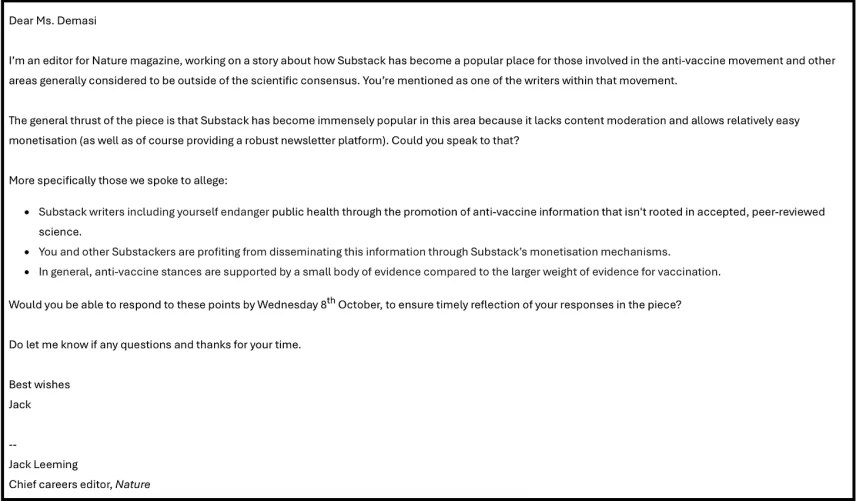
When an editor from Nature emailed me this week, it wasn’t a neutral request for comment. It was a prelude to a hit piece — filled with defamatory accusations and framed around a predetermined narrative.
According to the email, I was being lumped into an “anti-vaccine movement,” accused of “endangering public health,” and “profiting from disseminating misinformation.”
No evidence was provided. No articles were cited. No definition of “anti-vaccine” was offered. No complainants were named. Just blanket accusations intended as a character assassination.
Conflict of interest at the heart of Nature
And who is casting these stones?
Nature — a journal that publishes vaccine research while pocketing revenue from pharmaceutical advertising and sponsored content.
To then assign an editor to target independent journalists who scrutinise that very industry is a glaring conflict of interest.
A medical journal acting as both mouthpiece and judge of what counts as “misinformation” is like a tobacco company funding lung health studies while attacking anyone who questions them.
The hypocrisy is staggering.
On its own website, Nature boasts of partnerships with Johnson & Johnson, Merck, AstraZeneca and other vaccine companies, dressing them up as “pioneering collaborations” to “support science.” It even publishes paid advertising features.

Meanwhile, I’ve never taken a cent from the drug industry. My work is sustained by readers who choose to support independent journalism.
Yet Nature accuses me of “profiting” — as if being funded by the public is more corrupting than raking in thousands, if not millions, from the very companies you’re supposed to scrutinise.
To test how deep the rot runs, I’ve requested that Nature disclose its advertising revenue for the past decade, broken down by pharmaceutical corporations, government agencies, and NGOs.
I will publish those figures if and when they are provided.
Loaded language
Nature’s email branded me part of an “anti-vaccine movement.” But what does that actually mean?
Is questioning regulatory capture “anti-vaccine”?
Is demanding the timely publication of safety signals “anti-vaccine”?
Is exposing the failures of the vaccine injury compensation scheme “anti-vaccine”?
Is pointing out the poor oversight of vaccine trials “anti-vaccine”?
By that logic, critics of arsenic in drinking water would be “anti-arsenic,” and anyone calling for safer driving would be “anti-car.” The absurdity is obvious, yet the label is useful to silence debate.
And the email’s language was revealing.
Phrases like “scientific consensus” and “peer-reviewed science” are waved around like trump cards, but in practice they are red flags — appeals to authority rather than evidence.
‘Consensus’ can be manufactured. And ‘peer review’ is no shield against corruption when journals themselves are compromised.
I have documented journal–pharma ties, the retraction of inconvenient studies, and the use of pharma-funded “fact checks” masquerading as science to discredit politically uncomfortable findings.
So when an editor of Nature hides behind these clichés instead of addressing the evidence I present, it tells you everything. This isn’t about protecting science, it’s about protecting a narrative.
And I’m clearly not the only target.
Dr Robert Malone — also a Substack publisher and now a member of the CDC’s Advisory Committee on Immunisation Practice — received the same media request from Nature.
The journal’s smear campaign extends even to those who now sit on America’s top vaccine advisory body.
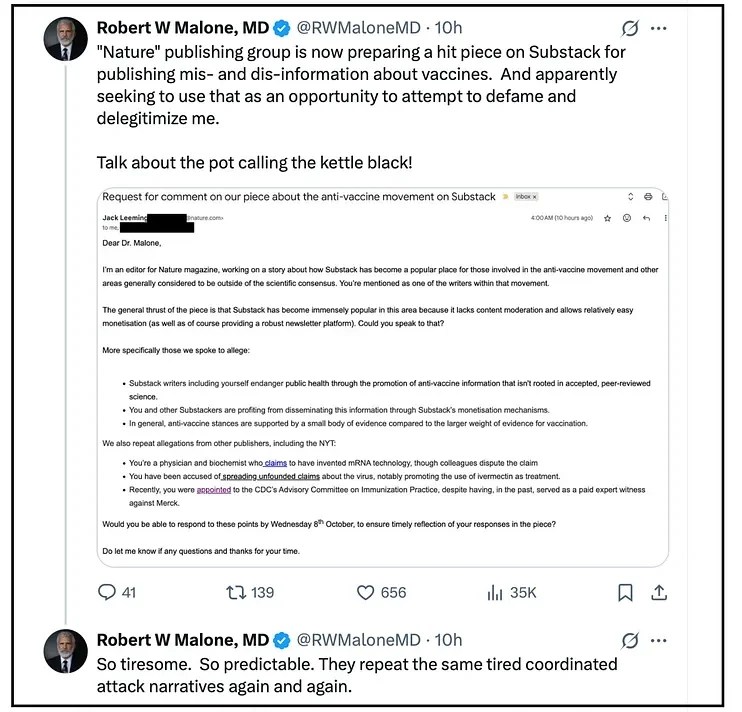
Nature insists that “anti-vaccine stances are supported by a small body of evidence compared to the larger weight of evidence for vaccination.”
But that’s probably because journals act as gatekeepers, blocking challenges to orthodoxy and shutting out novel viewpoints. Studies that raise concerns are rejected, buried or retracted, while industry-friendly findings sail through unopposed.
It isn’t the science that’s lacking — it’s the willingness of journals to let inconvenient results see the light of day. The house of cards is collapsing, and that is why the attacks on dissent are more aggressive than ever.
And those attacks often come from self-proclaimed experts who are themselves conflicted, embedded in institutions sustained by the teat of industry, and unwilling to disclose their own conflicts.
Pot calling the kettle black: the Proximal Origin scandal
Notably, while Nature postures as a guardian against “misinformation,” it bears responsibility for one of the pandemic’s most notorious scandals.
In March 2020, Nature Medicine — part of the Nature portfolio — published “The proximal origin of SARS-CoV-2,” which declared the virus could not have been engineered in a lab.
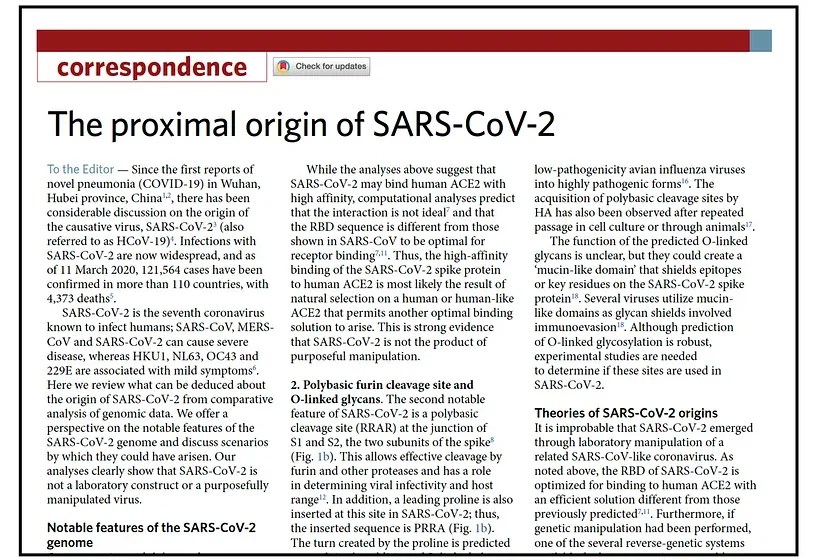
The paper was splashed across headlines and weaponised to dismiss the lab-leak theory as a “conspiracy.”
But private emails and Slack chats told another story. The authors harboured serious doubts and admitted a lab origin could not be ruled out.
Hundreds of scientists now call the paper a ‘political tract’ dressed up as science, and thousands have petitioned for its retraction. Yet Nature Medicine refuses, brushing it aside as a “point of view” piece.
If that isn’t misinformation, then what is?
Even the White House has distanced itself. Its website now acknowledges that the Proximal Origin paper was used to suppress debate, and alleges the authors were nudged by Dr Fauci to push the “preferred” zoonotic origin narrative.
Time for accountability
Make no mistake, this is ‘the system’ at work.
Powerful journals with financial ties to industry unleashing hatchet men to smear independent journalists and scientists, rather than engaging with evidence.
I won’t play along. My job is to hold institutions accountable, not to curry their favour. If Nature wants to brand that “misinformation,” so be it. History shows that today’s heresy is often tomorrow’s truth.
This goes to the heart of the corruption of medical publishing — a system Robert F. Kennedy Jr has repeatedly warned about, and one that now demands scrutiny at the highest levels.
With Dr Jay Bhattacharya at the helm of the National Institutes of Health, there is finally an opportunity to investigate the conflicts of interest, selective censorship, and financial entanglements that journals like Nature have normalised.
When those who profit from pharma partnerships claim the authority to police what lies “outside the scientific consensus,” public trust in science collapses.
And that collapse is not the fault of independent journalists asking hard questions. It is the fault of journals that serve industry interests over science.
Featured Video

Rewriting the risk? Inside the government’s vaccine safety messaging
or go to
Aletho News Archives – Video-Images
Book Review
“Davos Can Really Replace the UN”
Inside the book that maps the architecture behind global governance — from the Epstein files to the Pact for the Future
Lies are Unbekoming | April 1, 2026
On June 13, 2019, the United Nations and the World Economic Forum signed a partnership deal to “accelerate the implementation of the 2030 Agenda for Sustainable Development.” That same evening, WEF president Börge Brende — Norway’s former Foreign Minister — had dinner with Jeffrey Epstein at Epstein’s Manhattan townhouse. The Epstein files, released January 2026, contain an exchange between the two from the previous year. Epstein to Brende: “Davos can really replace the UN. C21, cyber, crypto . genetics… intl coordination.” Brende back to Epstein: “Exactly — we need a new global architecture. World Economic Forum (Davos) is uniquely positioned — public private.”
The next day, the UN General Assembly adopted the framework for restructuring global governance.
That sequence — the partnership signing, the Epstein dinner, the candid admission about replacing the UN with a public-private architecture, and then the formal adoption — opens Jacob Nordangård’s The Digital World Brain. Pages two and three. Footnoted to the UN resolution number, the Epstein files, and the General Assembly record.
I keep coming back to it because it captures what this book does that almost nothing else in the independent research space manages. I’ve followed Jacob’s work for years now and interviewed him about his research. Each book peels back another layer of the same institutional architecture, and each time I think he’s reached the limit of what can be documented, the next one goes further. Nordangård doesn’t speculate. He doesn’t editorialize much. He lays institutional actions next to each other in chronological order and lets the pattern announce itself. … continue
Blog Roll
 Aletho News
- Iran Threatens Retaliatory Strike on Stargate AI Project in UAE
- US sent ‘a lot’ of arms to Iranian protesters – Trump
- Barak Ravid Launders Deception To Allow Trump To Back Off Of His Power Plant Threat – Again
- REWRITING THE RISK? INSIDE THE GOVERNMENT’S VACCINE SAFETY MESSAGING
- “Davos Can Really Replace the UN”
- NIAID/NIH and USDA Fund Bioengineered Chimeric Influenza Viruses Built Using Pandemic H1N1 Components: Journal ‘Science Advances’
- Hezbollah hits Israeli warship off Lebanon’s coast, sets it aflame
- Iran slams US strikes on B1 bridge, Mahshahr petrochemical plants as ‘blatant acts of state terrorism’
- In letter to UN chief, Araghchi warns of dire consequences of US-Israeli attacks on Iran’s nuclear facilities
- Why the CIA conspiracy to invade Iran with Kurdish militias failed
- If Americans Knew
- Trump poised to “blow everything up” (ie. commit war crimes) in Iran – Daily Update
- In Iran, Israel-US take aim at “reason, research, and freedom of thought” – Daily Update
- US loses planes over Iran, Israel downgrades Lebanon war goals – Daily Update
- Israel Is Blocking Palestinians from Easter at Church Where Jesus Resurrected
- Plot to assassinate Palestinian activist follows harassment campaign promoted by Zionist groups and elected officials
- Prominent New York synagogue hosts presentation on why U.S. Jews should support the ethnic cleansing of Gaza
- Tapper vs. Piker: Is the CNN Anchor Auditioning for David Ellison?
- Shouldn’t Democrats Be Able to Condemn Genocide?
- Israel-US kill negotiators, destroy civilian structures, but Iran’s military capabilities still largely intact – Daily Update
- ‘War crime’: Global condemnation as Israeli ministers celebrate death penalty law targeting Palestinian prisoners
- No Tricks Zone
- An Inconvenient Tree: Uncovered In Alps… Europe Much Warmer Than Today 6000 Years Ago
- New Study Reports A 60% Slowdown In Greenland’s Ice Loss Rate In The Last Decade
- Low Intensity Tornado Wrecks Major Solar Farm, Creating A Potential Toxic Dump
- New Study Finds Warming Saves Lives…Cold Temperatures 12 Times More Deadly Than Excess Heat
- German Science Blog Accuses PIK Climate Institute Of Hallucinating Climate Tipping Points
- Devastating Assessment Of Comirnaty Vaccine By Former Senior Pfizer Europe Toxicologist
- New Study: CO2 Is ‘Effectively Negligible’ As An Explanatory Climate Change Factor Since 2000
- Former Pfizer Toxicologist Dr. Helmut Sterz Tells Bundestag Hearing Pfizer Vaccine Should Have Never Been Approved
- Energy Expert: Germany’s Nuclear Phaseout Was A “500 Billion Euro Mistake”
- New Research: South Australia’s Mid-Holocene Sea Surface Temperatures Were 4°C Warmer Than Today
 Aletho News