Israel blocks UN probe into alleged sexual violence during 7 October attack
MEMO | January 8, 2025
Israel has denied the United Nations permission to investigate sexual violence allegedly committed by Hamas during the 7 October cross-border infiltration, due to concerns that it could also involve investigating sexual violence against Palestinians in Israeli detention facilities.
Pramila Patten, the UN’s Special Representative on Sexual Violence in Conflict, sought authorisation to investigate the allegations against Hamas. However, she insisted that access to Israeli detention centres to probe allegations against Israeli soldiers was a necessary condition.
According to Haaertz, Israel rejected this request. Patten has called on Israel to sign a framework agreement with the UN, committing to measures to combat sexual violence in conflicts.
Patten’s office has confirmed plans to explore a future mission to the region, following invitations from both the Palestinian Authority and the Israeli government. “The Office is exploring a future mission to the region after receiving an invitation from the Palestinian Authority regarding reports of conflict-related sexual violence against Palestinians as well as outreach by the Government of Israel for a follow-up visit on the 7 October attacks and their aftermath.”
However, Patten’s office has warned that Israel’s refusal to allow UN investigations into alleged crimes attributed to it could have negative repercussions. Representatives from Israel’s Women’s Network, who met with Patten’s team in New York last month, reported being warned that this stance could lead to Israel being added to the UN’s blacklist of entities responsible for sexual violence in conflicts, while Hamas might remain off the list.
This comes after Israeli authorities admitted that no allegations of rape or sexual assault have been filed from the 7 October cross-border infiltration by Palestinian resistance factions, despite extensive investigations.
Moran Gaz, a former lead prosecutor in Israel’s Southern District Prosecutor’s Office and member of Team 7.10, disclosed the findings in an interview with Ynet.
In March 2023, United Nations experts had already debunked similar allegations, concluding they were either unverified or proven false. Similarly, other gruesome claims, such as babies being beheaded or burned in ovens, were widely discredited but continued to circulate in political rhetoric.
FBI Is Still Hiding Details of Russiagate, Newly Released Document Shows
By Aaron Maté | RealClearInvestigations | January 6, 2025
As Donald Trump re-enters the White House on a pledge to end national security state overreach, the Federal Bureau of Investigation is still hiding critical details on the Russia conspiracy investigation that engulfed his first term.
In response to a Freedom of Information request filed by RealClearInvestigations in August 2022, the FBI on Dec. 31, more than two years later, released a heavily redacted copy of the document that opened an explosive and unprecedented counterintelligence probe of the sitting president as an agent of the Russian government.
The Electronic Communication, dated May 16, 2017, claimed to have an “articulable factual basis” to suspect that Trump “wittingly or unwittingly” was illegally acting on behalf of Russia, and accordingly posing “threats to the national security of the United States.” The FBI’s “goal,” it added, was “to determine if President Trump is or was directed by, controlled by, and/or coordinated activities with, the Russian Federation.” It additionally sought to uncover whether Trump and unnamed “others” obstructed “any associated FBI investigation” – a reference to Crossfire Hurricane, the initial FBI inquiry into the Trump campaign’s suspected cooperation with an alleged Russian interference plot in the 2016 election.
While Crossfire Hurricane, which was formally opened on July 31, 2016, had by that point focused on members of Trump’s orbit, the May 2017 probe was specifically targeted at the president himself during his fourth month in office. The investigation of Trump was undertaken at the behest of then-acting FBI director Andrew McCabe, one week after Trump had fired his former boss and mentor, James B. Comey.
According to the declassified document, McCabe’s decision was approved by FBI Assistant Director Bill Priestap, who had also signed off on the opening of Crossfire Hurricane; and Jim Baker, the FBI general counsel. Baker was a longtime friend of Michael Sussmann, a lawyer for the presidential campaign of Hillary Clinton, and a key figure in the dissemination of Clinton-funded disinformation to the FBI that falsely tied Trump to Russia. In his FBI role, Baker personally circulated the conspiracy theory, manufactured by “researchers” working with the Clinton campaign, that the Trump campaign and Russia were communicating via a secret server. After leaving the FBI, Baker served as deputy general counsel at Twitter, where he backed the company’s censorship of reporting on the contents of Hunter Biden’s laptop, based on yet another conspiracy theory that the laptop files were Russian disinformation.


FBI via RealClearInestigations
While the declassified document records the FBI’s theory that then-President Trump might be involved in illegal – and potentially treasonous – behavior, the “articulable factual basis” for this suspicion is redacted. Only a few paragraphs of the six-page document have not been withheld.
Along with Crossfire Hurricane, the May 2017 counterintelligence probe was folded into the Special Counsel investigation led by Robert Mueller, who was appointed just one day after the FBI began portraying Trump internally as a possible Russian agent or conspirator. Mueller’s final report “did not establish that members of the Trump campaign conspired or coordinated with the Russian government in its election interference activities.”
Asked about his reasoning for opening the probe and related matters, McCabe, who now works as an on-air commentator at CNN, did not respond to RCI’s emailed questions by the time of publication.
Details about the FBI’s motivation can be gleaned, however, from other public disclosures.
According to a January 2019 account in the New York Times, which first revealed the FBI’s decision to investigate Trump, the Steele dossier – a collection of conspiracy theories funded by Trump’s rival, Hillary Clinton – was among the “factors” that “fueled the F.B.I.’s concerns.”
Just two days before McCabe opened the May 2017 probe, the FBI, via Justice Department official Bruce Ohr, renewed contact with dossier author Christopher Steele despite having terminated him as a source back in November 2016. As RCI’s Paul Sperry has previously reported, this sudden outreach to Steele right before the opening of a new Trump-Russia conspiracy investigation indicated that the FBI was seeking to re-engage the Clinton-funded British operative to help it build a case against the president for espionage and obstruction of justice. At the time, the FBI was still relying on Steele’s fabrications for its surveillance warrants against Trump campaign volunteer Carter Page. The following month, the FBI filed the last of its four FISA court warrants based on Steele’s material. The Justice Department has since invalidated two of those warrants on the grounds that they were based on “material misstatements.”
The FBI re-enlisted Steele despite possessing information that thoroughly discredited him. Five months before it newly sought Steele’s help to investigate the sitting president, the FBI interviewed Igor Danchenko, whom Steele had used as his dossier’s key “sub-source.” In that January 2017 meeting, Danchenko told FBI agents that corroboration for the dossier’s claims was “zero”; that he had “no idea” where claims sourced to him came from; and that the Russia-Trump rumors he passed along to Steele came from alcohol-fueled “word of mouth and hearsay.” The FBI had also been unable to corroborate any of Steele’s incendiary claims.
A previously disclosed document also shows that former CIA Director John Brennan – who insistently advanced the Trump/Russia conspiracy theory – informed then-president Barack Obama in July 2016 that the Clinton campaign was planning to tie Trump to Russia in order to distract attention from the controversy over Hillary Clinton’s use of a private email server while serving as secretary of state. By that point, the Clinton campaign was already paying for the fabricated reports produced by Steele, who made contact with the FBI as early as July 5.
Although the newly declassified document attempts to suggest that the FBI had actionable intelligence to suspect Trump of being a Russian agent, McCabe’s subsequent comments indicate that there was no such evidence on offer. Instead, McCabe has said his counterintelligence probe of Trump was primarily motivated by the president’s firing of Comey. In a February 2019 interview with CBS News, McCabe explained his thinking as follows: “[T]he idea is, if the president committed obstruction of justice, fired the director of the of the FBI to negatively impact or to shut down our investigation of Russia’s malign activity and possibly in support of his campaign, as a counter intelligence investigator you have to ask yourself, ‘Why would a president of the United States do that?’ So all those same sorts of facts cause us to wonder is there an inappropriate relationship, a connection between this president and our most fearsome enemy, the government of Russia.”
McCabe therefore had no evidence that Trump had a “connection” to Russia, and in fact could only “wonder” if there was one. Yet because Trump had fired Comey, whose FBI was already investigating Trump’s campaign for Russia ties and relying on the Clinton-funded Steele dossier in the process, McCabe decided that he had grounds to order an espionage investigation of the commander in chief.
With the official predicate for that May 2017 investigation still redacted by the FBI, McCabe’s public statements offer the only insider window into why it was opened. In all of the investigations related to alleged Russian interference to date, the Justice Department has pointedly avoided the question.
Despite inheriting McCabe’s probe – and debunking claims of a Trump-Russia conspiracy related to the 2016 election – Special Counsel Mueller made no mention of the Trump as Russian agent theory in his final report of March 2019. Without informing the public, the FBI closed down the Trump counterintelligence investigation the following month. The case’s closing Electronic Communication, which has previously been declassified in redacted form, states that the McCabe probe “was transferred to FBI personnel assisting” the Mueller team, and entailed the use of “a variety of investigative techniques.”
An inquiry led by Department of Justice Inspector General Michael Horowitz of the FBI’s conduct during Crossfire Hurricane also ignored McCabe’s decision to investigate Trump as an agent of Russia. And in a footnote in his final report of May 2023, John Durham – the Special Counsel appointed to launch a sweeping review of the Russia investigation – claimed that McCabe’s May 2017 probe was outside of his purview.
By contrast, when it comes to Crossfire Hurricane, Durham’s report concluded that the FBI did not have a legitimate basis to launch that investigation, repeatedly ignored exculpatory evidence, and buried warnings that Clinton’s campaign was trying to frame Trump as a Russian conspirator.
While the original Trump-Russia investigation has been discredited, the public remains in the dark about why the FBI launched a follow-up counterintelligence probe that targeted Trump while he was newly in the White House – and what ends it took to pursue it.
With Trump set to be inaugurated this month after vowing to clean up the nation’s premier law enforcement agency, the FBI will have a fresh opportunity to break its longstanding secrecy on the decision to investigate the sitting, and newly returning, president as an agent of Russia.
Georgia’s PM slams Macron claims of Russia election meddling as ‘lies’

Al Mayadeen | January 7, 2025
Georgian Prime Minister Irakli Kobakhidze has dismissed French President Emmanuel Macron’s allegations that Russia meddled in Georgia’s recent election as “lies”.
Macron accused Russia on Monday of increasing its aggression and shifting its hostility “toward Europe and other regions,” by “destabilizing electoral processes and manipulating ballot boxes” during the October election in Georgia.
The French president presented no evidence to support his claim.
Reporters questioned Kobakhidze about Macron’s assertion on Tuesday, and his response was he could not “comment on lies,” adding, “I am commenting on the problem that everyone faces today, which is a devastated Ukraine.”
“The French president should better follow the events in Ukraine, which has been sacrificed with the aim of destroying it,” the prime minister told reporters.
In November, Russian Foreign Ministry Spokesperson Maria Zakharova firmly rejected allegations of meddling in Georgia’s internal affairs, which were made by the Georgian opposition, stating at a briefing that such actions are characteristic of the West.
On October 26, the ruling Georgian Dream party won 53.93% of the vote and 89 of the 150 seats in the assembly. Last week, Mikheil Kavelashvili officially assumed the role of president of Georgia during an inauguration ceremony held in parliament. The event, accompanied by protests outside, highlighted ongoing political divisions in the country.
Protests in Tbilisi have persisted for over a month, fueled by dissatisfaction with the government’s decision to delay EU accession negotiations and reject EU financial aid until 2028.
Like many other post-Soviet states, Georgia remains highly susceptible to instability due to a combination of Western influence and narratives opposing Russian policies. These factors have historically fueled mass protests and calls for a more pro-Western policy, aiming to distance Georgia from Russia and align its political and economic trajectory with Europe.
Kavelashvili won the presidency after a parliamentary vote on December 14 in which he secured 224 out of 300 votes as the candidate of the ruling Georgian Dream party.
Zourabishvili, who vacated the presidential palace following Kavelashvili’s inauguration, has continued to challenge the election’s legitimacy, though without providing proof. She described the parliament as “illegal” and announced on inauguration day that while leaving the residence, she would persist in advocating for new parliamentary elections.
US ‘Quietly’ Sent Heavy Weapons To Ukraine Well Before Invasion Started, Blinken Reveals
By Tyler Durden | Zero Hedge | January 5, 2025
The United States is currently dealing with conflicts in multiple hot spots from Eastern Europe to Gaza to dealing with a collapsed Syrian state and continued standoff with Iran over its nuclear program.
But the Biden administration regrets nothing – so says Biden’s Secretary of State Antony Blinken in a major end of term interview given to the NY Times and published this weekend. Among the more interesting pieces of new information from the interview is Blinken’s direct admission that Washington was covertly shipping heavy weapons to Ukraine even months before the Russian invasion of February 2022.
“We made sure that well before [Russia’s ‘special military operation’] happened, starting in September and then again in December, we quietly got a lot of weapons to Ukraine,” he said in the interview published Saturday. “Things like Stingers, Javelins.”
The Kremlin at the time cited such covert transfers, which were perhaps an ‘open secret’, as justification for the invasion based on ‘demilitarizing’ Ukraine and keeping NATO military infrastructure out. Moscow had issued many warnings over its ‘red lines’ in the weeks and months leading up to the war.
Below is the full section from the NY Times interview transcript where Blinken boasts of the pre-invasion transfers:
QUESTION: You made two early strategic decisions on Ukraine. The first – because of that fear of direct conflict – was to restrict Ukraine’s use of American weapons within Russia. The second was to support Ukraine’s military offensive without a parallel diplomatic track to try and end the conflict. How do you look back on those decisions now?
SECRETARY BLINKEN: So first, if you look at the trajectory of the conflict, because we saw it coming, we were able to make sure that not only were we prepared, and allies and partners were prepared, but that Ukraine was prepared. We made sure that well before the Russian aggression happened, starting in September – the Russian aggression happened in February. Starting in September and then again in December, we quietly got a lot of weapons to Ukraine to make sure that they had in hand what they needed to defended themselves – things like Stingers, Javelins that they could use that were instrumental in preventing Russia from taking Kyiv, from rolling over the country, erasing it from the map, and indeed pushing the Russians back.
Blinken claims elsewhere in the interview that the Biden White House kept diplomacy going the whole time, and tried to engage Moscow, but explains that this basically involved keeping the Western allies and backers of Kiev unified and on the same track.
Interestingly when asked about whether its time to end the war, Biden’s top diplomat basically dodged the question…
QUESTION: Do you think it’s time to end the war, though?
SECRETARY BLINKEN: These are decisions for Ukrainians to make. They have to decide where their future is and how they want to get there. Where the line is drawn on the map, at this point, I don’t think is fundamentally going to change very much. The real question is: Can we make sure that Ukraine is a position to move forward strongly?
QUESTION: You mean use – that the areas that Russia controls you feel —
SECRETARY BLINKEN: In —
QUESTION: — will have to be ceded?
SECRETARY BLINKEN: Ceded is not the question. The question is – the line as a practical matter in the foreseeable future is unlikely to move very much. Ukraine’s claim on that territory will always be there. And the question is: Will they find ways – with the support of others – to regain territory that’s been lost?
Blinken in the above essentially gives his view that no… it is not time to end the war, despite the majority of the war-weary publics in Europe and the US thinking the opposite. There’s some evidence that much or most of the common Ukrainian populace wants it to end as fast as possible as well.
Ultimately, with the world now on the brink of WW3, it’s clear this White House regrets nothing, which even the title of the interview piece strongly suggests: Antony Blinken Insists He and Biden Made the Right Calls. But we think history will not look kindly.
The 2050 Net Zero Climate Scam
By William Levin | American Thinker | December 29, 2024
Twenty fifty is the official date for net zero emissions. According to the experts, it is the last chance to stop a catastrophic rise in temperature. The leading source for climate change science, the U.N. IPCC, says so. Corporations run commercials helpfully informing the public that net zero is a top priority. Few can outdo Delta Air Lines, which promises compliance using “a fully sustainable long-haul aircraft [that] has yet to be invented.”
The urgency is palpable and the science compelling. Humanity itself is at risk without net zero CO2 and non-CO2 emissions.
Politically, 2050 is the ideal climate date because it is close enough to justify immediate action, and just far enough as to be unprovable for climate disaster.
For a science so settled and a date so specific, there must exist a wealth of data scientifically supporting the hypothesis that 25 years from now marks a deadline and turning point for the Earth’s future.
An A.I. query provides the answer:
The target year 2050 for achieving carbon neutrality is primarily driven by scientific consensus and international agreements aimed at limiting global warming to 1.5°C above pre-industrial levels. The Intergovernmental Panel on Climate Change (IPCC) and the Paris Agreement outline that reaching net-zero CO2 emissions by 2050 is crucial to avoiding catastrophic climate impacts.
A.I. is correct that the IPCC and the signatories of the Paris Agreement are the parties responsible for promoting 2050 net zero. But who exactly are these organizations, and do they deserve our trust?
The IPCC is a political body consisting of 195 member-governments, charged with providing assessments in support of the U.N. Framework Convention on Climate Change. In theory, the IPCC mandate is to collect the best available climate science. The IPCC expressly commits that its “reports should be neutral with respect to policy.” And by its own admission, “the IPCC does not conduct its own research.” Its role is to summarize the objective science.
The signatories to the Paris Agreement are likewise 195 nations convened under the auspices of the U.N. But unlike the IPCC, the Paris Agreement signatories make no pretense to being a scientific body, and indeed, no one is confused on this point. The signatories are a political body and the Paris Agreement a purely political document.
With an overlapping membership, it should come as no surprise that the two organizations coordinate their efforts. In the process, the IPCC has become the loudest and most strident advocate for existential change in human activity. In the latest IPCC report, deepening red gradient shadings convey that the Earth is a looming inferno.
According to the IPCC, the danger of imminent collapse due to rising CO2 and non-CO2 emissions, particularly methane, requires immediate action. Humanity must downsize and restructure the global economy, including, in their modest terminology, “governments, private sector, and civil society.” Everyone is responsible, and everyone must contribute.
Not only must GDP be lowered, but the world must immediately and drastically curtail fossil fuels; limit global agriculture output based on emissions, not feeding the world; spend and redistribute upwards of $125 trillion; rely on expensive, unreliable, discredited solar and wind for global power needs; and virtually ignore nuclear power, all the while “prioritizing equity, climate justice, social justice, inclusion and just transition processes.” To make the math work, governments and the private sector must implement on a global scale yet-to-exist carbon capture technologies, of unknown cost and consequence.
There is no imputation here that climate science is not real. It is the political choices of the IPCC at issue, specifically the 2023 Sixth Assessment’s Summary for Policymakers, as opposed to the physical scientists reporting as Working Group 1. As summarized by scientist Roger Pielke, “it is not within the IPCC’s mandate to call for action or to implore urgency.”
The IPCC task is to vet and summarize thousands of complex models and scientific papers produced annually. In each instance, a climate model incorporates assumptions not easily aggregated. The IPCC solution groups the models into five arbitrary scenarios based on forecasted warming in 2100. At no point does the IPCC ever declare one set of scenarios more likely than another. Indeed, as aggregators, they have no scientific basis for making any such assertion. In these scenarios, 2050 does not exist as a scientifically significant year. It is simply a point on the curve connecting the current temperature to the 2100 end point.
To get to 2050, and urgency, the IPCC needs to import the political findings of the Paris Agreement.
In 2015, the Paris Agreement signatories reviewed the then most current IPCC report, the 5th Assessment. These 195 government actors arbitrarily concluded that “well below 2 degrees Celsius” of warming was the maximum threshold the Earth could survive. Nothing in the IPCC 5th Assessment supports the “well below 2 degree warming” as a scientific consensus. No IPCC evidence identifies a scientific threshold for global warming beyond which the Earth tips into collapse. Especially relevant, the signatories to the Paris Agreement in no manner highlighted 2050 as a year of special climate meaning, nor would it matter, scientifically speaking, if they had. Following the 5th Assessment, the Paris Agreement target date is merely a “long-term temperature goal,” with one reference to “the second half” of the century.
The Paris Agreement signatories went farther, deciding by imperial fiat that the temperature goal needed a guardrail, the now infamous, endlessly repeated 1.5-degree-warming “limit.” In popular parlance, many, many people will swear that 1.5 degrees of warming is a scientifically valid statement of the limit to global warming, beyond which climate catastrophe ensues.
As important to note, all IPCC warming targets, including the Paris Agreement, start from the pre-industrial period 1850–1900. According to the IPCC, 1.1 degrees of warming has already occurred, meaning the Paris Agreement target at present is a mere 0.4 degrees over 75 years to the IPCC 2100 model date. This equates to an imperceptible 0.005 degrees of annual warming — hardly the stuff of headlines and catastrophic collapse. And nothing compared to the 10 degrees of warming observed in the Earth’s last interglacial warm period in Siberia some 115,000 to 130,000 years ago.
It needs to be said as loudly as possible. The 1.5-degree climate tipping limit has no basis in any finding of the IPCC. It is the arbitrary finding of 195 political actors, in defense of the non-scientific “well below 2 degree” catastrophe, magically transported by the IPCC from 2100 to 2050.
How does the IPCC move the climate clock back 50 years, in violation of its 2100 science? By intentional sleight of hand, the IPCC provides a science answer to a policy question. How much CO2 can be emitted before the 1.5-degree target is breached? The sole source of the 1.5 degrees is the Paris Agreement.
Pro-IPCC climate scientists confirm that the global warming limit, whether it be 1.5 degrees from the Paris Agreement or some other number, is based solely on “value judgments and choice,” not “climate science.” (See page 7 chart.) The IPCC would have readers believe the exact opposite: that the global warming limit is scientifically determined, and those who disagree are “science deniers.” It is a deception of massive consequence.
Twenty fifty, as it turns out, is a long con between 195 governments and the IPCC.
As part of his Day One actions, President Trump needs to, once again, remove the U.S. from the Paris Agreement and disavow the overtly political IPCC Sixth Assessment Summary for Policymakers. The IPCC global prescription is not scientific, and it most certainly is not benign.
Climate Bombshell: New Evidence Reveals 30 Year Global Drop in Hurricane Frequency and Power
By Chris Morrison | The Daily Sceptic | January 4, 2025
Last month a small but powerful cyclone named Chido made landfall in Mayotte before sweeping into Mozambique, causing considerable damage and leading to the loss of around 100 lives. Days after the tragedy, the Green Blob-funded Carbon Brief noted that scientists have “long suggested” that climate change is making cyclones worse in the region, while Blob-funded World Weather Attribution (WWA) at Imperial College London made a near-instant and curiously precise estimate that a Chido-like cyclone was about 40% more likely to happen in 2024 than during the pre-industrial age. Not to be outdone, Green Blob-funded cheerleader the Guardian chipped in with the obligatory “cyclones are getting worse because of the climate emergency”. Almost unnoticed, it seems, among all the Net Zero dooming and grooming was a science paper published during December by Nature that found no increase in the destructive power of cyclones – the generic term for typhoons and hurricanes – in any ocean basin over the last 30 years. In the South Indian basin, the location of cyclone Chido, there was a dramatic decrease in both frequency and duration in recent times.
Reality rarely gets much of a look-in these days when fanatical Net Zero activism is afoot, but the paper, written by a group of Chinese meteorologists, makes its case by considering the facts and the data. The scientists apply a “power dissipation index” (PDI) which they consider superior to single measure indicators since it combines storm intensity, duration and frequency. The graphs below show the cumulative index for tropical cyclones across all ocean basins along with a global indication.

Downward trends in the cumulative PDI can be seen in a number of Pacific regions, while the trend holds steady in the North Atlantic. The southern Indian ocean downward trend is particularly pronounced while the overall global line is also heading in a similar direction.
So why does all this scientific twaddle get written by the green activists in mainstream media? Much of it arises from the new pseudoscience that claims it can tie individual weather events to human-caused climate change. Press releases peddling climate Armageddon are issued days after a natural disaster and are eagerly reprinted by activist journalists promoting the Net Zero fantasy. The distinguished science writer Roger Pielke Jr. is a fierce critic of this new pseudoscience, which he calls weather attribution alchemy. In a recent Substack post in the aftermath of Chido, he noted that the WWA at Imperial College simply assumes the conclusion that it seeks to prove by accepting that every storm is made stronger because of warmer oceans. Using this explanation, continues Pielke, it is straightforward to conclude that the storm was made more likely due to climate change. Or as Imperial states: “The difference in the storm intensity and likelihood of this storm intensity between the counterfactual climate and today’s climate can be attributed to climate change.”
As the new Chinese paper shows, the matter is not quite so simple. Pielke notes that tropical storms encounter numerous environmental influences such as vertical wind shear and storm-induced ocean surface cooling, even when they remain over warmer waters. “Such complexities mean that simple storyline attribution – warmer oceans predictably mean stronger storms – is inappropriate when used to characterise the behaviour of individual storms,” he argues. Pielke also comes down hard on the statistical evidence backing the WWA claims. Even if storms such as Chido were more likely in the future, it would take a very long time to detect a significant change using the threshold 90% confidence set down by the Intergovernmental Panel on Climate Change (IPCC). And by very long time, he means thousands of years.
“Perhaps that is why assumptions are favoured over evidence,” suggests Pielke.
There were plenty of assumptions on display in a now routine end-of-year weather report from the BBC headed: ‘A year of extreme weather that challenged billions.‘ Written by Esme Stallard, it claims that record-breaking heat brought extreme weather including hurricanes and month-long droughts. Pride of place is given to Dr. Friederike Otto, lead of WWA and Senior Lecturer in Climate Science at Imperial, who claimed: “We are living in a dangerous new era – extreme weather caused unrelenting suffering.” “The impacts of fossil fuel warming has never been clear or more devastating than in 2024,” she added.
The redoubtable Paul Homewood is unimpressed with Stallard’s opening line about increasing extreme weather and has filed a complaint with the BBC. Stallard goes on to list a handful of random events, “but fails to provide any evidence that these are anything other than natural events which happen all the time”, states Homewood. “Nor is any evidence provided that such events have been getting more frequent or extreme over time,” he adds.
The BBC story highlighted typhoons in the Philippines as well as hurricane Beryl and stated that such events may be increasing in intensity due to climate change. Official data do not show any evidence of them becoming more powerful over time, notes Homewood. Much play was made of a recent drought in the Amazon, but Homewood points out that the World Bank Climate Portal reveals that rainfall has increased in the area by 5% over the last 30 years. Throughout the report, observes Homewood, the BBC bases its claims on weather attribution computer models. “However, computer models are not evidence, and can be manipulated to provide whatever results are desired. That is why they are widely derided by the wider scientific community,” he states.
For Roger Pielke, extreme weather attributions are “puzzling”. The most charitable explanation for their proliferation is that there is a demand for them, including from many in the media. The demand will be filled by someone, he concludes. “A less charitable explanation is that there is a systematic effort underway to contest and undermine actual climate science, including the assessments of the IPCC, in order to present a picture of reality that is simply false in support of climate advocacy. We might call that pseudo-scientific gaslighting,” he suggests.
Cecilia Sala, or the stupidity of the western narrative
Western propaganda made of distortion and manipulation has a new face of the month: Cecilia Sala
By Lorenzo Maria Pacini | Strategic Culture Foundation | January 4, 2025
Facts and… misdeeds
It is a familiar and perfectly functioning pattern that has been adopted in the case of Cecilia Sala, a mainstream Italian journalist, who arrived in Iran on 13 December on a journalistic visa and was arrested on the 19th ‘for violating the law of the Islamic Republic of Iran’. The event occurred a few days after the arrest in Italy, at Milan’s Malpensa Airport, of Iranian engineer Mohammad Abedini Najafabadi.
So far, nothing strange. These things happen for many reasons. People are arrested every day and this is not news.
The oddities, however, begin when you explore the background.
Let’s start with Abedini: an engineer specialising in drone design, who was on a business trip. He is arrested not for breaking any laws, but because… the United States of America asked for it. The master orders, the servant executes. Now the US has asked for his extradition and one can guess that they have no intention of treating Mr Abedini politely. The charge, of course, is international terrorism.
As far as Cecilia Sala is concerned, things are even more captivating. Her CV leaves little doubt. Born in 1995, she studied at Bocconi but did not graduate. She started working for Vice Italia, then went on to work for other magazines all from the same publisher and then appeared on television. The interesting thing is that he always passed under the aegis of Rupert Murdoch, one of the ‘oligarchs’ of British intelligence and politics, who in Italy invested a lot of money first in football and then in telecommunications, but also the man who owns Fox, News Corp and Disney. One of the richest men in the world, whose first interest is obviously to do independent and truthful journalism, right?
Curious that his numerous employees, especially journalists, have constant collaborations with the intelligence agencies of the USA, the UK and Israel, with offices appearing as veritable ‘schools’ of infowarfare and human intelligence; curious how there have already been convictions in this regard, as there were for the Sunday Times in the late 1970s and in 2011 with the News of the World ; equally curious that a good slice of mainstream information is in the hands of this man and his empire. And even more curious is that we should think of Cecilia Sala as a ‘clean’ person working for the universal good.
Since we are in the realm of fantasy, let’s try an imaginative suggestion: let’s think for a moment of Cecilia Sala as an advisor or intelligence agent, perhaps under a British or American flag, who goes to Iran, a country notoriously hostile to the two empires mentioned above, and is arrested. If we see it for just one minute like this, we immediately realise that there is nothing strange about it. If Abedini can be considered a ‘terrorist’ and arrested just because he deals with drones, why should we not be able to consider Sala a ‘spy’ who goes on a mission in a foreign land to do something she has been asked to do?
Let’s add another biographical detail: Cecilia Sala’s father was an executive at Monte dei Paschi di Siena and is Senior Advisor for Italy at J.P. Morgan Chase Bank and has been a member of the Greenmantle Think Tank since 2017. He is one of the Founding Members of the Canova Club in Milan. He is currently CEO of Advisor S.R.L. JP Morgan Chase & Co.
What a curious coincidence… because it is a coincidence, isn’t it?
A few blots on the Curriculum
It must be pointed out that Cecilia Sala was a well-known anti-Russian, anti-Chinese, anti-Palestinian and anti-Iranian propagandist, coincidentally a journalist for Il Foglio, in contact with the Zionist sectors of the anti-Iranian opposition, and despite this she was freely allowed to enter Iranian soil by the government in Tehran. This is not the case, for example, for Russian journalists.
After Abdeini’s anomalous arrest, since Ms Sala had all the elements to be detained by the Iranian justice system, culturally collaborating with part of that opposition that has carried out terrorist attacks on Iranian soil, even deadly ones, it did not follow that the government in Tehran, not being the monster depicted today by the western and Italian media, but simply a sovereign nation that does not accept interference, proceeded to detain the goliardic journalist.
We reiterate this for those who had not grasped the ‘subtle’ difference: Abedini’s arrest at Malpensa is entirely arbitrary, while Sala’s is justified under the laws in force in the Islamic Republic.
The Italian press immediately turned to somersaults worthy of the Olympics to attack Iran, ignoring both the truth of the facts – a subject, the truth, that most Western journalists have not been interested in for years – and how certain ordinary diplomatic protocols between hostile countries work.
Diplomatic bodies and intelligence agencies are in constant contact with each other and carry out such activities every day.
A journalist with Cecilia Sala’s CV does not just happen to be arrested. Is that clear?
We know nothing about the circumstances of her arrest. However, those who know a little about the country know that it is unlikely that she was arrested for her work as a reporter on women’s movements or for her opinions, which may transpire from her writings, which were certainly scrutinised by those who granted her the visa. Under normal conditions, i.e. not in this geopolitical context that has taken shape in the last year, and not with Iran as a ‘live’ and perhaps imminent target of the US, UK and Israeli administrations, we could have assumed a classic detention due to active participation in political demonstrations or more likely any photos at military, government or nuclear installations; however, it is very likely that Cecilia Sala knew these things very well and did not do this kind of journalism. Perhaps there is much more behind it.
The point is that this ‘more’ is not the subject of journalistic comment. The vast majority of western journalists are talking out of their ass about things they do not know.
The US ordered the capture in Italy of an Iranian engineer who was travelling, Iran arrested a journalist with a respectable resume to find a job with MI6 and the CIA because she violated the laws of the Republic. Incidentally, in America one can be arrested on the free initiative of a policeman, who can also shoot at a distance of 21 paces on his own free initiative. This, in Iran, is illegal. But the Western press does not know this and writes nonsense anyway.
The newspapers have spoken of the shadow of an Iranian ‘blackmail’, but if we are to accept it as such, we must remember two things: it is also American blackmail to countries called upon to arrest Iranian civilians on the basis of embarrassing and specious US laws, according to imposed sanctions that magically take effect even in vassal states; how it got to this point, after 20 years of assassinations of Iranian scientists and physicists, that is, to the point where Iran, under threat of bombing by Israel, uses even with a country considered a ‘friend’ like Italy the methods of diplomatic soft power to get a break in the interminable Western attack.
The point is that Iran is not a country born yesterday, nor is it just any old colony that can be exploited at will. Iranians still enjoy two things that are bitterly lacking in the West: sovereignty and dignity.
From slogan to slogan
In the sum of the parts, Cecilia Sala’s case is a great gimmick for anti-Iranian propaganda and will be used for a long time to come.
All this, of course, with the usual Western hypocrisy.
It is full of journalists who on social networks (sick!) are indignant about the arrest and write posts about the importance of free journalism, but not one of them has been tearing their hair out over all the crimes committed against freedom of the press and information in the West or in Israel, for example, with more than 200 journalists killed in Palestine in one year, even with targeted killings
Juicy news for the western press: much worse has come into Iran, Il Foglio fortunately counts for nothing in the world, and those who have come in have written much worse things than Cecilia Sala who, let’s be honest, is not worth a lira as a journalist (this is proven by her own articles and posts, many of which will remain in the annals of propaganda vileness).
In Iran, and elsewhere, as a foreigner they stop you or arrest you if they suspect you are a spy, and this is a fact we should learn to understand and keep in mind, because at home these terms and definitions or accusations belong only to the cinematic dimension but in certain quadrants of the world they are anchored in tangible reality.
In the past few days I read a brilliant commentary on the matter, which I quote from memory: ‘We have agreed to participate in the American sanctions festival – which began well before last year – and to consider as a ‘global threat’ even those who are not, or who are at worst for Israel, and not for us; we have agreed to harass, detain, interdict Iranian citizens who until proven otherwise are civilians and not guilty of any crime that has not been configured ad hoc in the American ‘acts’; we have even agreed at certain times to interrupt supplies of stocks of goods that have already been paid for, just as the USA has reserved the right to withhold tens of billions of dollars’ worth of Iranian state property for decades; we have decided to join a belligerent and hostile coalition, without yet having understood what role to play, other than that of paper-pusher. We should, however, be careful in the future about which cards we pass on to the next one’.
Once again, from slogan to slogan, the truth that journalism is supposed to investigate and tell will be of no interest to anyone. On the other hand, no one is interested in reporting on what is happening in Gaza, but there has never been a shortage of time to post some new hashtag to win the war against Russia, China, Iran and any other enemy, evidently terrified by the use of social network posts with a few well-functioning keywords for psy ops marketing.
Once again, we will have to settle for the words of Seneca: ‘Magis veritas elucet quo sepius ad manum venit’.
State Department Rebrands Defunded Global Engagement Center into New Counter-Disinformation Hub
By Dan Frieth | Reclaim The Net | January 4, 2025
As we previously reported would be the case, the celebration about the shutting down of the US government’s most overt censorship unit would be short-lived. The State Department is moving forward with plans to reassign employees and resources from a controversial office accused of stifling media into a newly created internal unit, as revealed by documents obtained by the Washington Examiner. This maneuver is already drawing criticism, with some alleging it is a thinly veiled attempt to rebrand and continue the disputed activities of the defunct office.
The Global Engagement Center (GEC), established in 2016 to counter foreign disinformation, faced fierce scrutiny from Republicans over claims it collaborated with groups like the Global Disinformation Index to target and demonetize right-leaning US media outlets.
In late 2024, Congress defunded the GEC, effectively shutting it down. Yet, a December 6 communication from the State Department to Congress outlined a plan to “realign” 51 GEC employees and nearly $30 million in funding into a new “Counter Foreign Information Manipulation and Interference Hub.”
Republicans are expected to investigate the matter closely, with concerns that the new hub could replicate the GEC’s controversial operations.
A Legacy of Controversy
The GEC claimed its mission was to counter foreign disinformation, but allegations of domestic overreach cast a long shadow. It funded initiatives like the Global Disinformation Index and NewsGuard, groups accused of pressuring advertisers to blacklist certain US media outlets.
These actions prompted legal challenges, including a December 2023 lawsuit by conservative outlets The Federalist and The Daily Wire, alongside the State of Texas.
Despite its closure, top officials from the GEC have already found new roles in the State Department.
The hub will report to the Under Secretary of State for Public Diplomacy and will inherit significant resources. According to the documents, $69 million previously allocated to the GEC will be redistributed across the State Department, with $29.4 million designated for the R/FIMI hub. This funding includes salaries, contract staff, and operational support. However, a source noted that, unlike the GEC, the new hub would lack grantmaking authority.
Angela Merkel’s Revelation: The Minsk Agreements Were Not Intended To Be Pursued
By Ricardo Martins – New Eastern Outlook – January 4, 2025
The EU was born as a peace project. Is it still so? The former German Chancellor reveals in an interview and in her Memoirs that Europe preferred conflict to peace with Russia.
The Minsk Agreements: A Tactical Pause, Not a Path to Peace
The former German chancellor Angela Merkel sparked controversy with her candid reflections on the Minsk agreements. These accords were ostensibly negotiated to de-escalate tensions in Ukraine after Russia’s accession of Crimea in 2014 as a result of a referendum by its residents and the subsequent outbreak of hostilities by the Ukrainian army and the Azov Battalion against ethnic Russians in the Donbas and Donetsk regions.
In an interview and in her memoirs titled Freedom, Merkel stated that the agreements were not genuinely pursued as a path to peace with Russia but rather as a strategic delay tactic, buying Ukraine time to strengthen its military and prepare for an inevitable confrontation.
Her statements highlight deeper underlying tensions within the European Union, particularly among member states like the Baltic nations and Poland, who viewed Russia’s actions as an existential threat. This perspective helps explain why efforts for peace were limited, and why many in the EU tacitly or openly preferred to prepare for conflict rather than seek reconciliation.
The Minsk agreements—Minsk I in 2014 and Minsk II in 2015—were brokered under the Normandy Format with the involvement of Germany, France, Ukraine, and Russia. These agreements called for an immediate ceasefire in Donbas and Donetsk, withdrawal of heavy weaponry, granting autonomy for these regions in eastern Ukraine, and constitutional reforms in Ukraine to ensure the autonomy of these regions. If the agreements had been implemented, they would have saved the lives of 14,000 Russian ethnics in Donbas and Donetsk, and certainly, they would have avoided Russian special operation in Ukraine.
However, Merkel’s remarks suggest that these agreements were never fully intended to resolve the conflict. Instead, they were a way to “freeze” the situation, allowing Ukraine to rebuild its military capacity and align itself more closely with NATO and the West. This approach mirrored a broader strategy within the EU that saw Russia’s actions, such as the accession of Crimea, not as isolated incidents but as part of a larger pattern of aggression.
Baltic and Eastern European Perspectives: Security over Diplomacy
For the Baltic States—Estonia, Latvia, and Lithuania—Russia’s accession of Crimea and its support for people in eastern Ukraine were seen as dire warnings. These countries, which share borders and historical tensions with Russia, viewed any peace deal as a potential opportunity for Russia to consolidate its gains and prepare for further expansion.
The Baltic States, are deeply rooted in Russophobia. As a result, they prioritise strengthening NATO and bolstering their defences over engaging in diplomacy, which they perceive as a tool Russia has exploited for strategic advantage. Additionally, there is a persistent mistrust of European institutions, viewed as incapable of guaranteeing their security. Consequently, they place greater reliance on the United States through NATO and favour purchasing American defence equipment over European alternatives.
This is the stance held by the EU Foreign Affairs Chief, Kaja Kallas, the former Prime Minister of Estonia, who is hindering a diplomatic solution in Ukraine. This makes her unfit for the role, as she is driven by deep Russophobia and is little inclined toward diplomacy.
EU’s General Stance: Divided but Increasingly Hawkish
Within the broader EU, member states were divided over how to handle Russia. Western European countries like Germany and France initially pursued dialogue and diplomacy, partly due to their economic ties with Russia. However, Merkel’s remarks suggest even these efforts were tempered by a recognition that peace with Russia might only be temporary.
By contrast, Eastern European members like Poland and the Baltics were vocal advocates for a tougher stance. Their influence grew as Russia’s actions in Ukraine escalated, pushing the EU toward a more unified, confrontational approach.
The Militarization of Ukraine was pursued as the EU and NATO believed that a stronger Ukraine was essential to deter future Russian aggression. This focus on military preparedness left little room for genuine peace efforts. As a result, the U.S. did not respond to Putin’s letters and security guarantee requests.
Further, there was the question of strategic interests. For many EU members, particularly the Baltics and Poland, a weakened Russia was viewed as essential for regional stability. Consequently, the West and NATO members were accused of unnecessarily prolonging the war. A former U.S. Senator famously remarked, “We will fight until the last Ukrainian,” underscoring the approach of continued military engagement.
The peace agreement reached in Istanbul in April 2022 was reportedly rejected by Western powers. Former British Prime Minister Boris Johnson, acting on behalf of U.S. President Joe Biden, hurried to Kyiv to dissuade President Zelensky from signing the deal, assuring him of full Western support to defeat Russia.
Merkel’s Legacy and the Fallout of Her Comments
Merkel’s acknowledgement that the Minsk agreements were merely a strategic delay has sparked debates about the sincerity of European diplomacy. Her remarks have also undermined Europe’s moral narrative, exposing the calculated realpolitik behind decisions often framed as efforts towards peace. While Merkel defended her actions as necessary to protect Ukraine and Europe, they raised uncomfortable questions about the EU’s commitment to its proclaimed values of diplomacy and conflict resolution.
At the time, the guarantors of the Minsk agreements—France and Germany—still held significant diplomatic clout on the international stage. Today, however, these nations have become diplomatic dwarfs, rendered increasingly irrelevant by their subservience to U.S. interests—a dependency deepened by the war in Ukraine. This decline is also compounded by the West’s hypocrisy and double standards, which have eroded its legitimacy on the global stage.
In sum, Merkel’s comments highlight a Europe that, while officially advocating peace, frequently prioritised U.S. interests over genuine reconciliation. For the Baltics and other Eastern European nations, their warmongering approach underscores the challenges of pursuing balanced diplomacy in an era of resurgent great-power rivalry.
Manufacturing Dissent
By Joshua Stylman | November 17, 2024
As I often do on Sunday mornings, I was drinking my coffee and scrolling through my news feed when I noticed something striking. Maybe it’s my algorithm, but the content was flooded with an unusual amount of vitriol directed at Robert F. Kennedy, Jr.’s nomination as HHS Secretary. The coordinated messaging was impossible to miss—talking heads across networks uniformly labeling him a “conspiracy theorist” and “danger to public health,” never once addressing his actual positions. The media’s concerted attacks on Kennedy reveal more than just their opinion of his nomination—they expose a deeper crisis of credibility within institutions that once commanded public trust.
The Credibility Paradox
The irony of who led these attacks wasn’t lost on me—these were largely the same voices who championed our most destructive pandemic policies. As Jeffrey Tucker aptly noted on X this morning:

The Coordinated Response
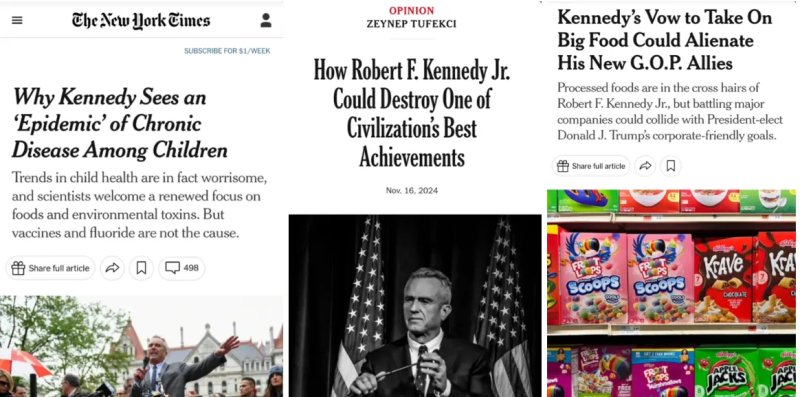
This hypocrisy becomes even more glaring in the New York Times’ recent coverage, where dismissive rhetoric consistently replaces substantive engagement. In one piece, they acknowledge troubling trends in children’s health while dismissively declaring “vaccines and fluoride are not the cause” without engaging his evidence. In another, Zeynep Tufekci—who notably advocated for some of the most draconian Covid measures—warns that Kennedy could “destroy one of civilization’s best achievements,” painting apocalyptic scenarios while sidestepping his actual policy positions.
Meanwhile, their political desk speculates about how his stance on Big Food might “alienate his GOP allies.” Each piece approaches from a different angle, but the pattern is clear: coordinated messaging aimed at undermining his credibility before he can assume institutional authority.
The Echo Chamber Effect
You can almost hear the editorial conveyor belt opening as senior editors craft the day’s approved reality for their audience. The consistent tone across pieces reveals less independent analysis than a familiar pattern—mockingbird media still in action. As I detailed in How The Information Factory Evolved, this assembly-line approach to reality manufacturing has become increasingly visible to anyone paying attention.
What these gatekeepers fail to grasp is that this smug dismissiveness, this refusal to engage with substantive arguments, is precisely what fuels growing public skepticism. Their panic seems to grow in direct proportion to Kennedy’s proximity to real power. This orchestrated dismissal is more than a journalistic flaw—it reflects a larger institutional dilemma, one that becomes unavoidable as Kennedy gains traction.
The Institutional Trap
The Times faces an emerging dilemma: at some point, they’ll need to address the substance of Kennedy’s arguments rather than rely on dismissive characterizations—especially if he assumes control of America’s health apparatus. Just this morning, MSNBC anchors were literally shouting that “Kennedy is going to get people killed”—yet another example of using melodramatics and fear instead of engaging with his actual positions. Their reflexive ridicule strategy backfires precisely because it avoids engaging with the evidence and concerns that resonate with parents and citizens across political lines. Each attempt to maintain narrative control through authority rather than evidence accelerates institutional credibility collapse.
Beyond Kennedy: Redrawing Political Lines
The NYT’s analysis about Kennedy potentially alienating GOP allies particularly highlights their fundamental misunderstanding of the shifting political landscape. As a lifelong Democrat who still champions many traditional progressive values, Kennedy transcends conventional political boundaries. His message—”We have to love our children more than we hate each other”—resonates precisely because anyone who dismisses this crusade to restore American vitality as mere political theater is blind to the groundswell of people who’ve grown tired of watching their communities crumble under the weight of manufactured decline.
This isn’t just about Kennedy—it’s about the media’s inability to address the legitimate concerns of a disillusioned public. When institutions refuse to engage with dissenting voices, they deepen mistrust and fracture the shared foundation necessary for democratic discourse. While RFK, Jr.’s message has resonated across political boundaries, the media’s inability to address core issues—like regulatory failures—reveals just how out of touch they’ve become.
The Art of Missing the Point
Consider this fact-check from the same article: The Times attempts to discredit Kennedy’s Fruit Loops example, but inadvertently confirms his central point: ingredients banned in European markets are indeed permitted in American products. By focusing on semantic precision instead of the broader issue—why US regulators allow unsafe ingredients—the media deflects from substantive debates.

Senator Elizabeth Warren declared this week: “RFK Jr. poses a danger to public health, scientific research, medicine, and health care coverage for millions. He wants to stop parents from protecting their babies from measles and his ideas would welcome the return of polio.” Yet this alarmist framing dodges the simple question Kennedy actually raises: Why wouldn’t you want proper safety testing for chemicals we’re expected to inject into our children’s bodies? The silence in response to this basic inquiry speaks volumes about institutional priorities—and their fear of someone with the power to demand answers.
A Referendum on Manufacturing Consent
Say what you want about Trump, but his “fake news” remarks struck a chord that resonates deeper with each passing day. People who once scoffed at these claims are now watching with eyes wide open as coordinated narratives unfold across media platforms. The gaslighting has become too obvious to ignore. As I explored in We Didn’t Change, The Democratic Party Did, this awakening transcends traditional political boundaries. Americans across the spectrum are tired of being told not to believe their own eyes, whether it’s about pandemic policies, economic realities, or the suppression of dissenting voices.
“The party told you to reject the evidence of your eyes and ears.
It was their final, most essential command.”
–George Orwell, 1984
The Moment of Truth
With Kennedy potentially overseeing America’s health infrastructure, media institutions face a crucial inflection point. Fear campaigns and ad hominem attacks won’t suffice when his policy positions require serious examination. The machinery of coordinated dismissal—visible in identical talking points across networks—reveals more about institutional allegiance than journalistic integrity.
This moment demands something different. When Kennedy raises questions about pharmaceutical safety testing or environmental toxins—issues that resonate with families across political lines—substantive debate must replace reflexive ridicule. His actual positions, heard directly rather than through media filters, often align with common-sense concerns about corporate influence on public health policy.
This institutional pattern of manufactured authority connects directly to themes I explored in Fiat Everything earlier this week—systems built on decree rather than demonstrated value. They don’t sell weapons—they sell fear. The same forces that control monetary policy now seek to dictate public health discourse.
Breaking the Machine
The solution won’t come from institutional gatekeepers (that’s what got us here) but direct examination. We all need to:
- Listen to Kennedy’s complete speeches rather than edited soundbites
- Read his policy positions rather than media characterizations
- Examine the evidence he cites rather than fact-checker summaries
- Consider why certain questions about public health policy are deemed off-limits
I’m not suggesting we accept every contrarian position, but rather that institutional credibility must be earned through rigorous analysis rather than assumed through authority. Until then, coverage like these recent Times pieces will continue to exemplify the very institutional failures that fuel the movements they seek to discredit. As Kennedy approaches real institutional power, expect these attacks to intensify—a clear signal of just how much the guardians of our manufactured consensus have to lose.
A New Year’s Resolution: Let’s Get the United States Out of the Censorship Business
By Jonathan Turley | December 31, 2024
On this New Year’s Eve, billions of people will gather with friends to ring in 2025 with the hope of a better year to come. For the first time in many years, free-speech advocates have a reason to celebrate.
With 2024, we will say goodbye to one of the most reviled offices in the Biden Administration: The Global Engagement Center. I discuss the Center in my recent book, The Indispensable Right: Free Speech in an Age of Rage as one of the most active components in the massive censorship system funded by the Biden Administration. The demise of the GEC is a good start. However, like weight loss resolutions, it will take much more of a commitment if we are going to restore free speech in the United States. It is time to make the ultimate resolution to rip out the censorship root and stem from our government.
This month, the Biden Administration fought to keep the GEC funded, but Republicans refused to include it in the continuing resolution for the budget. However, even with the closure of this one office, Biden will leave behind the most comprehensive censorship system in the history of the United States.
Over the last three years, many of us have detailed a comprehensive system of grants to academic and third party organizations to create blacklists or to pressure advertisers to withdraw support for targeted sites. The subjects for censorship ranged from election fraud to social justice to climate change.
I testified at the first hearing by the special committee investigating the censorship system funded or coordinated by the Biden Administration. It is an unprecedented alliance of corporate, government, and academic groups against free speech in the United States. The Biden Administration established the most anti-free speech record since the Adams Administration.
House investigations showed the critical role played by government officials in “switchboarding,” or channeling demands for removal or bans in social media. Officials evaded the limits of the First Amendment by using these groups as surrogates for censorship.
Even with the elimination of the GEC, other offices remain in various agencies, including the Cybersecurity and Infrastructure Security Agency (CISA) in the Department of Homeland Security, which emerged as one of the critical control centers in this system.
CISA head Jen Easterly declared that her agency’s mandate over critical infrastructure would be extended to include “our cognitive infrastructure.” That includes not just “disinformation” and “misinformation,” but combating “malinformation” – described as information “based on fact, but used out of context to mislead, harm, or manipulate.”
These groups form a censorship consortium where the suppression of speech attracts millions in federal dollars. Election Integrity Partnership (EIP) was created in association with Stanford University “at the request of DHS/CISA.”
EIP supplied a “centralized reporting system” to process what were known as “Jira tickets” targeting unacceptable views. It would include not only politicians but commentators and pundits as well as the satirical site The Babylon Bee.
Stanford’s Virality Project pushed to censor even true facts since “true stories … could fuel hesitancy” over taking the vaccine or other measures. Emails show government officials stressing that they could not be seen as “openly endors[ing]” censorship while other groups sought to minimize public scrutiny of their work.
For example, one article featured the work of Kate Starbird, director and co-founder of the University of Washington Center for an Informed Public. In one communication, Starbird cautioned against giving examples of disinformation to keep them from being used by critics, adding “since everything is politicized and disinformation inherently political, every example is bait.”
Likewise, University of Michigan’s James Park is shown pitching that school’s WiseDex First Pitch program, promising that “our misinformation service helps policy makers at platforms who want to . . . push responsibility for difficult judgments to someone outside the company . . . by externalizing the difficult responsibility of censorship.”
The system has layers of interconnected grants and systems. For example, the EIP worked with the Global Engagement Center that contracted with the Atlantic Council in censorship efforts.
The censorship system included scoring groups through a grant from the National Endowment for Democracy (NED) to the British-based Global Disinformation Index (GDI). The index targeted ten conservative and libertarian sites as the most dangerous sources of disinformation, including sites like Reason which publishes conservative legal analysis. Conversely, some of the most liberal sites were ranked as the most trustworthy for advertisers.
The system is still in place, but on December 23, 2024, the GEC closed its doors. That is something to celebrate but not something to take as great comfort. This is a redundant and overlapping system created precisely to allow for such attrition.
Years ago, some of us wrote about the creation of the infamous Disinformation Governance Board at Homeland Security under its so-called “Disinformation Nanny,” Nina Jankowicz. When the Biden administration caved to public outcry and disbanded the Board, many celebrated. However, as I previously testified, the Biden Administration never told the public about a far larger censorship effort in other agencies, including an estimated 80 FBI agents secretly targeting citizens and groups for disinformation.
The system has functioned like a multiheaded hydra where cutting off one head only allows two more to grow back. These censors will not simply walk away and become dentists or bartenders. They have a skill set for censorship and this is now a profitable industry supporting scores of people who now market themselves as “disinformation specialists.”
Shutting down the GEC will eliminate a $61 million budget and 120 employees. However, these employees will find ample opportunities not just in other agencies but in academia and state agencies. There are also pro-censorship sites like BlueSky, which are becoming safe spaces for liberals who do not want to be “triggered” by opposing views . (Notably, BlueSky hired a former Twitter employee who was fired after Musk cleaned out at what is now X).
They are not going anywhere unless the Trump Administration and the Congress makes free speech a priority in eliminating each of these funding sources.
As I wrote in the book, we need to get the United States out of the censorship business by passing a law barring any federal funds for the use of censorship, including grants to academic and NGO groups.
Rooting out this censorship system will require a comprehensive effort by the new Trump Administration. So here is a resolution that I hope many in the Trump Administration will share: let’s get the United States out of the censorship business in 2025.
Featured Video

Chinese jet fuel and the myth of energy independence
or go to
Aletho News Archives – Video-Images
Book Review
Former Insiders Criticize Iran Policy as U.S. Hegemony
By GARETH PORTER | CounterPunch | February 27, 2013
“Going to Tehran” arguably represents the most important work on the subject of U.S.-Iran relations to be published thus far.
Flynt Leverett and Hillary Mann Leverett tackle not only U.S. policy toward Iran but the broader context of Middle East policy with a systematic analytical perspective informed by personal experience, as well as very extensive documentation.
More importantly, however, their exposé required a degree of courage that may be unparalleled in the writing of former U.S. national security officials about issues on which they worked. They have chosen not just to criticise U.S. policy toward Iran but to analyse that policy as a problem of U.S. hegemony. … continue
Blog Roll
 Aletho News
- What is fueling unrest across the EU?
- Why no power can undermine Iran’s eternal dominance over the Strait of Hormuz
- Is The War Against Iran Over?
- Iran war will leave long-term ‘scar’ on Wall Street, investors warn
- How Iran decimated US power projection in West Asia: Military lessons of 40-day war
- Iran’s report details US-Israeli war crimes in targeting schools, hospitals, livelihoods
- NATO’s Slow Fracture: How Trump’s Iran War Exposed the Instrument of Hegemony
- Chinese jet fuel and the myth of energy independence
- Ukraine Sea Drone Fired From Libya Hit Russian Tanker in Mediterranean
- IRGC: Iranian forces launched no attacks during ceasefire hours
- If Americans Knew
- Military aid to Israel emerges as the latest political litmus test for Democrats
- The only Palestinian children’s rights organization closes following years-long Israeli campaign against it
- ‘I Can’t Forget the Smell’: Lebanese Reel After Israel Kills Over 300 in Single Day
- DNC Shoots Down Resolutions Calling Out AIPAC and Limiting Arms to Israel
- TCN: Is Israel Blackmailing President Trump?
- Israel killed at least 303 Lebanese yesterday – who were they? Daily Update
- Amnesty: Urgent – Protect Lebanese civilians from brutal escalation in Israeli attacks
- Is The War Against Iran Over?
- Inside the Israeli army’s propaganda wing
- Hundreds of Gaza Amputees Stranded in Legal Limbo
- No Tricks Zone
- New Study: No Linear Warming Or Glacier Retreat Along Northern Antarctic Peninsula Since 1980s
- An Inconvenient Tree: Uncovered In Alps… Europe Much Warmer Than Today 6000 Years Ago
- New Study Reports A 60% Slowdown In Greenland’s Ice Loss Rate In The Last Decade
- Low Intensity Tornado Wrecks Major Solar Farm, Creating A Potential Toxic Dump
- New Study Finds Warming Saves Lives…Cold Temperatures 12 Times More Deadly Than Excess Heat
- German Science Blog Accuses PIK Climate Institute Of Hallucinating Climate Tipping Points
- Devastating Assessment Of Comirnaty Vaccine By Former Senior Pfizer Europe Toxicologist
- New Study: CO2 Is ‘Effectively Negligible’ As An Explanatory Climate Change Factor Since 2000
- Former Pfizer Toxicologist Dr. Helmut Sterz Tells Bundestag Hearing Pfizer Vaccine Should Have Never Been Approved
- Energy Expert: Germany’s Nuclear Phaseout Was A “500 Billion Euro Mistake”
 Aletho News