Norway reprimands US Senator Lindsay Graham over $2T fund criticism
Al Mayadeen | August 29, 2025
The Norwegian Prime Minister’s office firmly rebuffed US Senator Lindsey Graham’s angry outburst over its sovereign wealth fund’s divestment from Caterpillar Inc., stating unequivocally that the government has no control over the fund’s independent investment decisions.
A spokesperson for the prime minister’s office stated that Premier Jonas Gahr Store sent a text message to Graham, which included information about the fund’s mandate and how its oversight is set up, and received confirmation that it was received.
Norway’s $2 trillion sovereign wealth fund, which held roughly $2.1 billion in Caterpillar shares as of June 30, announced this week that it had divested its holdings in the company due to “Israel’s” use of its bulldozers to destroy Palestinian property in Gaza and the occupied West Bank.
Earlier this week, in two social media posts on X, the Republican Senator lashed out at the $2 trillion sovereign wealth fund, which is the world’s largest, threatening tariffs and visa denials because of its recent divestments from the Texas-based firm.
In a two-part statement, Graham first promised that the fund’s “BS decision” would have consequences, then spoke specifically about implementing tariffs and possible visa denials, noting that the Trump administration had already placed a 15% tariff on imports from Norway while the two nations remain engaged in trade negotiations.
The reaction from the US lawmaker came at a delicate time for the fund and for the Norwegian government, as Norway is set to hold parliamentary elections on Sept. 8 and the fund has been under pressure to divest from Israeli companies contributing to the war in Gaza.
In addition to its divestment from the heavy machinery company, the Norwegian fund announced it excluded five Israeli banking institutions which are: Hapoalim, Bank Leumi, Mizrahi Tefahot Bank, First International Bank of Israel, and FIBI Holdings.
The decision followed recommendations from the fund’s ethics watchdog, the Council on Ethics, which concluded that there was an unacceptable risk of these institutions and Caterpillar contributing to serious rights violations in situations of war and conflict.
Iran’s parliament submits emergency bill to withdraw from NPT
Al Mayadeen | August 29, 2025
Following the announcement by the E3 (France, Germany, and the United Kingdom) to trigger the snapback mechanism on sanctions against Tehran, Iran’s Parliament has drafted and submitted an emergency bill proposing a full withdrawal from the Nuclear Non-Proliferation Treaty (NPT).
Hossein-Ali Haji-Deligani, Deputy Chairman of the Article 90 Committee of Iran’s Parliament, confirmed that the bill will be uploaded to the parliamentary system on the following day and subsequently reviewed in an open session.
“As we had previously stated, these countries were already implementing the consequences of the snapback mechanism, including sanctions against us. There is nothing new in this.” Haji-Deligani told Iran’s Tasnim.
He further stated that the steps taken were “the most minimal response by Parliament to the recent action of the European countries, and further regret-inducing measures are also on the agenda.”
Deputy chairman calls for decisive action
The proposed legislation comes amid growing frustration in Tehran over the West’s repeated failure to honor agreements and ease pressure on Iran. Haji-Deligani noted that Iran’s Parliament is determined to pursue a firm and deterrent course of action.
According to the lawmaker, the activation of the snapback mechanism effectively reinstates previous sanctions but introduces no new developments. Nonetheless, he emphasized that Iran’s response would be strategic and assertive.
Criticizing continued dialogue with Western countries, Haji-Deligani asserted, “Given what these three countries have done, negotiations with them are now meaningless. Dialogue will only embolden them.”
“We witnessed that during negotiations with the arrogant US, a brutal war was launched against our country by Israel, and the US bombed our peaceful nuclear sites,” he added. “Our people clearly know that talks with these countries have brought nothing but more pressure. Therefore, all dialogue must be suspended until these countries abandon their double standards.”
The emergency bill signals a potential turning point in Iran-E3 talks and highlights a significant policy shift in Tehran’s approach to its nuclear file. The move could impact the broader framework governing the Iran nuclear program and regional diplomacy.
Iran vows response
Iran’s Foreign Ministry confirmed on Thursday that France, Britain, and Germany have formally notified Tehran of their decision to trigger the “snapback” mechanism to reimpose United Nations sanctions under the 2015 nuclear deal.
Foreign Minister Abbas Araghchi condemned the measure as “illegal and unjustified,” warning that Tehran would respond “appropriately to protect and guarantee its national rights and interests.”
In a phone call with his French, British, and German counterparts, Araghchi urged them to “appropriately correct this wrong decision in the coming days.” He stopped short of detailing possible retaliatory steps but hinted that the E3 risk being excluded from any future negotiations on Iran’s nuclear program.
The E3 action came just days after Iranian and European diplomats held a second round of talks in Geneva, billed as a last chance to salvage engagement before the October deadline for invoking the snapback clause.
The discussions collapsed without “tangible commitments,” according to European officials, who claim that Tehran’s ongoing breaches of enrichment limits left them with no choice but to act. It is noteworthy that the E3 had failed to uphold their commitments in accordance with the JCPOA after the US unilaterally left the agreement in 2018.
European economies and societies are broken
By Sonja van den Ende | Strategic Culture Foundation | August 28, 2025
In recent days, one alarming report after another has emerged about the European economies. The political elites and their mouthpieces, the mainstream media, can no longer ignore it. Things are not going well—and that is putting it mildly. The situation is bad and will get worse. This is something some of us had anticipated for quite some time, and alert economists have been saying and warning about.
Let’s start with one of the richest countries in Europe: the Netherlands. Although small in size, the wealth enjoyed by elites and, to some extent, citizens some twenty years ago was enormous. I would even venture to say that, in some respects, the Netherlands was richer than Switzerland.
But due to many factors—bad politics, and the emergence of countries like China and, to a certain extent, India and Russia, whose economies have become stronger and their citizens richer—the Netherlands is now on the verge of collapse, like almost all wealthy EU countries, or rather, Western countries.
Dutch politics has been unstable for years. There are simply too many parties, too many opinions, and too much division. While the older, established parties remain strong in terms of seat count, they cannot truly govern. Moreover, there is the “manufactured” housing crisis caused by the insane nitrogen policy, the refugee crisis that causes daily street violence and the murder of women and children, and then there are the agendas of the WEF and the UN that have to be pushed through due to the advancing artificial intelligence (AI) frenzy. It is a cocktail of unrest and division. Also, let us not forget the increasing criminality of the Moroccan mafia: the underworld has now penetrated into the upper world.
The new elections (the last one was in 2023) and the government, which did not take office until 2024, have been ineffective. The population is being misled and distracted by the supposed war Russia is planning to start. So, parties like the established Christian Democratic Appeal (CDA) are devising new plans. This party, which is well in the lead, wants to introduce a “freedom tax” to increase the defense budget so they can wage “war” or defend themselves against the greatest threat: Russia.
Then we come to the worst, “sickest” kid in the class: Germany. The welfare state is “no longer financially viable,” said German Chancellor Friedrich Merz, a BlackRock man, in recent interviews. Of course, it is no longer financially viable—one does not have to be an economic whiz kid to see that, with so many migrants contributing little to nothing but receiving money from the state.
The country has been slowly spiraling toward the abyss since 2015, a process that can no longer be stopped; politicians and elites do not want to stop it. They talk a lot but essentially do nothing. The famous German car industry is ruined, the chemical industry is ruined, and with it, many suppliers.
The most foolish thing Germany could do economically was to stop buying Russian gas. Now they have a major problem: like the rest of Europe, they have to buy expensive LNG from the U.S. The costs are skyrocketing, to put it mildly.
Recently, after all the government’s lies and manipulation, the truth about how Germany, or rather its citizens, should survive the winter came to light. Many gas storage facilities in Germany are currently significantly emptier than in previous years. The Greens, who want to gradually phase out gas, are warning in the Bundestag about the consequences of a cold winter. The Greens’ policies have effectively ruined Germany, with incompetent politicians like Annalena Baerbock and Robert Habeck. Both have resigned and emigrated abroad, leaving behind a political and economic disaster in Germany.
That other major country in Europe, France, with a president (Macron) who thinks that France is still a great power like it was in the time of the Sun King—Louis XIV or Napoleon—is doing just as badly. According to media reports there, the economy is also struggling. At the end of the first quarter of 2025, French public debt stood at €3,345.4 billion, or 113.9% of GDP.
That the French are arrogant (not all of them, of course) is a well-known fact in Europe and perhaps beyond. But Macron is taking it too far. In a recent interview, Macron called Russian President Vladimir Putin a “predator, a monster at our gates.”
This comes after the disgusting display in Paris at the Olympic Games (in 2024), where satanic rituals mixed with religion were on display, which many countries and citizens expressed their horror about. Now he has the arrogance to make these public statements. If you thought Zelensky was stupid with his statements, Macron is his equal in this.
The countries I mentioned are, or rather were, the “running economic engines” of the EU, the economic heart of Europe, which actually paid for the poorer countries in the south, such as Italy, Spain, Portugal, and especially Greece, a country that went bankrupt in 2008.
Europeans all witnessed the misery in Greece: pensioners eating from garbage bins, entire shopping streets closed, poverty everywhere. Now we see it happening in the heart of the EU economy. Germany has become almost unlivable, especially in the major cities.
The same street scene: retirees who should actually be enjoying a well-earned rest collect plastic bottles for the deposit money, and now, if the government has its way, they will have to do a year of compulsory military service. Imagine this—you just do not want to imagine it…
Europe has lost its prosperity; its culture is being swallowed up by the many migrants who bring their own, and instead of assimilation, these cultures foreign to Europe now predominate. In their foolish attitude and, above all, the indoctrination of many years, politicians now believe they live in a “multicultural” entity. But this is not the case; integration has failed, and European citizens are paying the price for their inaction and for allowing this situation to escalate.
Politicians across Europe, especially in the Western EU countries I mentioned, are seeking a way out—to save their own skins, not so much for their people (in fact, the majority do not care about the people)—but to escape the financial malaise and the people’s anger. They have now resorted to the war agenda that followed the COVID-19 agenda (partly a social behavioral project), the war agenda that was implemented immediately after the launch of the Russian Special Military Operation (SMO).
The Eastern EU countries—Poland, which is currently experiencing the same problems as the Western EU countries: refugees and increased drug use—are the worst when it comes to Russophobia. I am referring specifically to the Baltic States: small but powerful in hatred, and above all, the countries with the most Nazi and fascist supporters. Nazism has never been eradicated there, just like in Western Ukraine.
With this hatred of Russia, they have infected all of Europe, thus playing into the hands of the political elites of Western Europe, who eagerly participate in demonizing Russians—even though some countries and their populations actually have nothing against Russians and have only now been forced by their governments to think, and even worse, hate, about Russia.
The European elites must now also consider the role they will play, now that it is painfully clear that the era of colonization and imperialism is nearly over. Because of this painful geopolitical and economic truth, they are now oppressing their own people, partly succeeding with the “new migrants” who fear for their residency and visas.
But the true indigenous European population is slowly but surely realizing that freedom of speech and press no longer exists, that their democratic rights have been taken away, and that life has become very difficult. This is leading to major conflicts, especially in the once so “free” Netherlands, where people could essentially say anything, even if it was inappropriate. Very turbulent times are ahead, and unfortunately, we are already seeing Europe collapse… just like the Roman Empire when it collapsed; things can happen quickly.
Hungary sues EU over frozen Russian assets sent to Ukraine
RT | August 28, 2025
Hungary has sued the EU over its decision to use frozen Russian assets to fund military aid for Ukraine, a move adopted despite Budapest’s opposition.
Western nations froze an estimated $300 billion in Russian assets after the escalation of the Ukraine conflict in 2022 – some €200 billion of which is held by Brussels-based clearinghouse Euroclear. The funds have accrued billions in interest, and the West has explored ways to use the revenue to finance Ukraine.
The lawsuit challenges the European Council’s decision last year to channel military aid to Ukraine through the European Peace Facility (EPF), which reimburses countries that send weapons to Kiev.
Implemented in February, the measure directs 99.7% of interest generated from frozen Russian central bank assets to Ukraine, providing an estimated €3-5 billion ($3.5-5.8 billion) annually.
In a case first filed with the EU Court of Justice and later transferred to the General Court, Hungary is demanding to “annul the decision… on allocating funds to assistance measures for supplying military support to the Ukrainian Armed Forces” and to “order the defendants to cover the costs.”
Budapest contends that the EPF acted unlawfully by bypassing its veto, arguing that Hungary is not a “contributing member state.”
“As a result, the principle of equality between Member States and the principle of the democratic functioning of the European Union were infringed because a Member State was deprived, unjustifiably and without a legal basis, of its right to vote,” the filing says.
Hungary opposes the bloc’s unconditional support for Kiev and prefers peace talks to continued fighting. Budapest has repeatedly used its veto to block EU financial and military aid, including a disputed €50 billion package at the end of 2023. The standoff has pushed other EU members to seek ways to sidestep Budapest’s resistance.
Moscow has denounced the asset freeze as “robbery” and a breach of international law, warning it would backfire on the West. Senior Kremlin official Maksim Oreshkin said the freeze had already undermined trust in Western finance, while Russian President Vladimir Putin cautioned that seizing the assets would accelerate a global shift toward alternative payment systems.
M.K Bhadrakumar: India Turns to China as U.S. Bullying Backfires
Glenn Diesen | August 27, 2025
M. K. Bhadrakumar was an Indian ambassador and diplomat for decades. Ambassador Bhadrakumar discusses Trump’s pressure and threats against India, and how this blunder has pushed India toward China and Russia.
Indian PM ‘ignored’ 4 phone calls by Trump amid US-triggered trade fight: Report
Press TV – August 27, 2025
Indian Prime Minister Narendra Modi has reportedly brushed off several attempts by Donald Trump to reach him on the phone as a trade fight between the countries, which has been triggered by the US president’s heavy-handed and unprecedented trade tariffs, spirals.
According to Germany’s Frankfurter Allgemeine Zeitung magazine, Trump has tried four times in recent weeks to get Modi on the line, but the Indian head of state has declined to answer.
Neither Washington nor New Delhi has confirmed the account, and the magazine piece did not cite its sources either.
‘Trauma trigger Trump’
Describing the situation at hand, however, the report wrote, “It is said on the subcontinent that Narendra Modi suffers from a trauma trigger called Trump.”
The report landed just as the White House rolled out a fresh round of penalties, namely a new 25-percent tariff on Indian goods, on top of existing measures, pushing the overall tariff rate to as high as 50 percent.
The move, Washington said, was in direct response to India’s stepped-up purchases of Russian oil.
On August 24, Japan’s Nikkei Asia had released a similar story, quoting Indian diplomatic analysts who said Trump had recently made “several attempts” to call Modi.
They added that Modi had repeatedly rebuffed him, deepening Trump’s irritation.
On the ground, Indian exporters are bracing for immediate fallout of the drastic tariff spikes.
Orders from the US are expected to shrink sharply after the collapse of trade talks and confirmation of steep new duties.
The first 25-percent levy is already in force; another 25 percent will take effect on August 27, as detailed in a notice from the US Department of Homeland Security.
Trump has, meanwhile, kept up his attacks. Earlier this month, he told CNBC that India and Russia had “dead” economies.
Trump alleged that New Delhi and Moscow’s gravitation towards one another amounted to their “fueling the war machine,” trying to claim that the former’s contribution to the Russian economy would prolong the conflict in Ukraine.
“And if they’re going to do that, then I’m not happy,” he added.
The US president had announced the initial 25-precent increase late last month as punishment for “trade barriers” and New Delhi’s purchase of military and energy supplies from Russia.
Cut welfare, give billions to Ukraine, suppress opposition: The German leader’s checklist to success
By Tarik Cyril Amar | RT | August 27, 2025
German chancellor Friedrich Merz has made a moderate media splash and ruffled some feathers in his own ruling coalition with the Centrist Social Democrats (SPD). Using the platform of a regional party congress of his CDU Conservatives in Niedersachsen, Merz has delivered a speech that immediately attracted national attention and will be remembered for one phrase.
“The social [welfare] state, as we have it today,” the chancellor declared with appropriately dour mien, “can no longer be financed by what we are achieving economically.” Put differently, severe budget cuts on social issues are coming. And since that is a policy operative since, at the latest, 2003, there really isn’t so much left to cut. Merz is promising his people more of a bad time.
His people. Not, however, the ultra-corrupt political anti-elite of Ukraine. Just before Merz’s claim that Germany cannot afford what it used to offer to Germans who pay for it, his government promised €9 billion ($10.4 bn) per year for Ukraine in 2025 and 2026, for now. That is on top of the €44 billion already sent that way. Germany is the “second-largest backer” of the Kiev regime in the world, as its obviously thoroughly detached finance minister Lars Klingbeil emphasizes with a perverse pride that must sound like a bad joke to many of his compatriots.
Speaking of Klingbeil, in his Niedersachsen speech Merz also announced that he would “deliberately not make it easy” for his government colleagues from the SPD, who include, of course, Klingbeil. The SPD, of course, is well-known for being against harsh reductions in what Germans can expect from, in essence, old-age pensions, public health care, and the basic form of unemployment insurance now known as “Bürgergeld” (literally, “citizens’ money”).
There is no reason to underestimate Merz’s genuine ideological commitment. It is true that, in general, he is unusually brutal about being dishonest even for a politician: Germany’s current leader has already proven that he is capable of breathtaking flipflops, staggering electoral bad faith, and underhanded maneuvering that violates the spirit of democracy if not the letter of the constitution.
In the spring, his U-turn on public debt, to finance Germany’s new militarism on – exuberant – credit, was not only a massive breach of trust regarding especially his own conservative voters. Shamelessly exploiting a legal loophole, Merz also executed this radical reversal – many in his own party called it betrayal – by relying on parliamentary majorities that had already been cancelled by an election.
Likewise, Merz’s coalition then proceeded to break promises regarding an energy tax relief as well as benefits for mothers. Germans are angry, but there is no sign that Merz and his government care. Consequently, according to a fresh poll by the reputable INSA institute, 62 percent of Germans are dissatisfied with their government.
And yet, there is a hard core of authentic Merz, shaped by his own wealth, a very privileged life without material worries, and his long career as an overpaid member of the supervisory-board network nobility, at BlackRock and elsewhere: if there is one thing Germany’s leader is sincere about, it is his iron will to make the less well-off bleed more and work even harder, while making sure that those as materially comfortable and safe as himself get even richer. Call it neoliberalism with an unsmiling German face.
Merz, of course, is also a very ordinary man, incapable of much self-reflection. He cannot honestly face any of the above. Instead he misunderstands himself as a savior of the fatherland, which he sees in need of much tough love and plenty of wholesome kicks up the backside to rediscover discipline, hard work, and competitiveness.
The upshot of Merz’s blatant upper-class bias is, as a perspicacious German observer has put it, a de facto escalation of the ongoing re-distribution of income, wealth, and life chances – from those below to those above. Even now, 80 percent of the country’s taxes stem from income and value-added taxation. In other words: you work, you eat and keep a family going – be proud, you are also doing by far the most to pay the country’s bills. But Friedrich Merz, a millionaire who falls under “silver-spoon” rather than “self-made,” thinks it’s not yet enough.
No wonder, then, that Merz’s recent speech in Niedersachsen has resonated. It was delivered in a sour as well as emphatic tone perhaps best described as schoolmasterly belligerence and featured much gratuitous no-compromise posing addressed probably more to his own doubting party and voters then his SPD coalition partners in Berlin. If Merz’s intention was to achieve a minor shock effect after Germany’s political summer break, he’s scored an ephemeral success.
But his speech has also been misunderstood. In reality, its key message was something else and even worse. Yet another “business-friendly” – and business has also been very friendly to him – instinctive Western austeritarian telling his people they are having it too good and must lower their expectations? Not really news, is it?
What was much more interesting was Merz’s reasoning. In his own words, the central political challenge is to prove that Germany “can be governed successfully from the center.” Or to be concrete, to keep down and out of power Germany’s two “populist” insurgent parties: from the right the very successful Alternative for Germany party (AfD), which tends to lead German opinion polls now, and, from the left, the currently marginalized – probably by foul play in the manner of, say, Romania or Moldova – but still threatening Bündnis Sarah Wagenknecht (BSW).
Merz’s threat to go after what is left of the social welfare state in Germany comes with a promise of “reforms,” indeed a whole “autumn of reforms.” The purpose of this planned political offensive is clear: to persuade voters that they need not rely on those terrible “populists” to finally break out of the German doom loop of economic decline, demographic crisis, and pervasive malaise.
Yet Merz’s strategy of what Germans call a “Befreiungsschlag” (a “deliverance strike”) smells of despair and is unlikely to succeed. Instead of an “autumn of reforms,” Germans are more likely to see their Winter of Discontent get even grimmer.
Consider some basic data: We have just learned that Germany’s recession in the last quarter has been even worse than predicted: -0.3 instead of -0.1 percent. German industry is shedding jobs by the hundreds of thousands. In general, Germany’s economy remains heavily dependent on exports. It has stagnated for half a decade already and been in serious trouble much longer. In the EU+Britain, it is the most brutally affected by Trump’s ongoing and still escalating tariff war against Washington’s vassals. Klingbeil admits that the budget will be €170 billion short by 2029 – despite dialing debt up to eleven.
And all of that when the German ruling coalition only has what the Financial Times rightly calls a “razor-thin” parliamentary majority. Add that two of the most damaging strikes against the German economy have been self-inflicted: Sky-high energy prices, the direct result of shutting Germany off from (direct) Russian supplies – with the alleged help of a few Ukrainian divers and their US friends, of course – and subservience to the US.
That subservience has only grown worse under both Merz and his equally hapless predecessor Olaf Scholz. Both have been bending over backward to please and appease America, just when its policies have become even more brutal: We are at a moment in “atlanticism” when a US treasury secretary openly announces that Washington sees its allies’ economies as its very own “sovereign wealth fund” at the disposal not of their governments or – perish the thought – citizens, but of the US president. And Merz and co. grin and nod and ask for more.
The irony of it all is that while slavishly compliant with the US, Merz cannot learn the single biggest, most obvious lesson of its very recent political history, although it quite literally stares him in the face every time he visits the Oval Office to grovel: Donald Trump has become president against enormous resistance not once but twice because he led a “populist” challenge against a rotten establishment that Americans saw as unpatriotic.
The future of Merz is not the success of Trump but the defeat and disgrace of Biden and everything he stood for. Germans, too, will demand a government that looks after German interests before it makes even more demands of them. Grotesquely, Merz thinks he is the savior of the old German establishment. He is its gravedigger. And in that sense, all power to his misguided arm!
Tarik Cyril Amar, a historian from Germany working at Koç University, Istanbul, on Russia, Ukraine, and Eastern Europe, the history of World War II, the cultural Cold War, and the politics of memory
China decouples from US energy as key exports crash to zero
Inside China Business | August 25, 2025
Resources and links:
The West seemingly preparing to remove Zelensky from power
By Ahmed Adel | August 26, 2025
The arrest of a Ukrainian citizen in Italy, suspected of sabotage of the Nord Stream pipeline, confirms that Kiev was an accomplice, but not the one who ordered the act. Nonetheless, the launch of the investigation serves a broader political goal – the removal of Volodymyr Zelensky from power. The plan could be to appoint a new leader, both for the West and for possible negotiations with Russia, given that Zelensky’s presidential mandate expired in May 2024 and he cannot be a signatory to a peace agreement with Moscow.
An investigation by American journalist Seymour Hersh found that American divers placed explosives under the Nord Stream gas pipeline during the NATO exercise Baltops in the summer of 2022, and that it was activated three months later by the Norwegians. According to Hersh, then-US President Joe Biden had a clear motive for sabotaging the Nord Stream pipeline — fear that Germany, facing serious economic difficulties due to the war in Ukraine, might lift sanctions on Russia and resume imports of Russian gas.
The journalist said this is what prompted Washington to organize the sabotage of the gas pipeline connecting Russia and Germany. The West did not want to allow this, which ultimately plunged Germany into economic and political chaos.
Russian President Vladimir Putin also believes that the sabotage of the Nord Stream and Nord Stream 2 gas pipelines was carried out by American intelligence services, specifically the CIA. According to him, in such cases, one should always look for who has a motive and who can carry it out. There may be many interested parties, but not everyone can dive to the bottom of the Baltic Sea and carry out that explosion. It is the combination of these components – who had a motive and who is able to carry it out – that, according to Putin, reveals who is really behind the sabotage.
After a period of lull, the issue of sabotage on the Nord Stream gas pipelines has returned to the spotlight following the announcement by German prosecutors that Ukrainian citizen Sergey Kuznetsov was suspected of involvement in the underwater explosions that damaged the gas pipelines near the Danish island of Bornholm in September 2022. Following the arrest of the retired captain of the Armed Forces of Ukraine, who also served in the Security Service of Ukraine, Italian media reported that he is connected to another major incident – the explosions on an oil tanker in Savona in February, which was allegedly transporting oil of Russian origin.
Sahra Wagenknecht, leader of the German party “Sahra Wagenknecht Alliance,” after the arrest of Kuznetsov, stated that the German parliament should convene a commission to investigate the sabotage of the Nord Stream gas pipelines. She noted that this act of state terrorism must be thoroughly investigated and that Zelensky should also testify before the commission.
Wagenknecht believes it is absurd to think that the arrested Ukrainian citizen and his accomplices acted without the knowledge of the Ukrainian leadership and the Biden administration. She added that it is unacceptable that Germany is providing substantial aid to Ukraine without seeking an explanation from Zelensky, and that consideration should be given to possible compensation for damages.
The question of whether United States President Donald Trump will take advantage of the Nord Stream controversy and launch an investigation against Biden remains an exclusively internal matter for the US. Trump has the opportunity to conduct his own investigations and deal with his domestic adversaries, whom he claims stole his victory in the 2020 elections. However, this does not affect the situation in Ukraine for the time being, as the West continues to support Ukraine with weapons, intelligence, and other assistance.
The fate of the Nord Stream gas pipeline is one of the key and most complex issues in the energy and geopolitical spheres. With Trump’s pragmatic approach, there is a possibility of cooperation between Russia and the US. Russia does not refuse to continue gas supplies to the European Union. However, the bloc continues to feel the consequences of its own policy, such as suffering economically by still purchasing Russian energy at inflated prices from third parties like India and Azerbaijan.
Nord Stream 1 and Nord Stream 2, which directly connect Russia to Germany via the Baltic Sea, have not been operational since 2022 and remain damaged, but they are still strategic infrastructure that American investors have set their sights on. These pipelines could become the property of American investors, which would enable the US to control Russian gas supplies to Europe. Although Europe is currently refusing Russian gas, it may be forced to buy it in the future, albeit at a significant margin, to the benefit of the Americans.
Ahmed Adel is a Cairo-based geopolitics and political economy researcher.
Colossal industrial-scale warfare in NATO-orchestrated Ukrainian conflict
By Drago Bosnic | August 26, 2025
Heavy industry has always been the key element of modern warfare. Without the ability to outproduce the opponent, your chances of winning are slim to none. Accustomed to the one-sided aggression against virtually the entire world, the political West neglected the actual industrial capacity of its Military Industrial Complex (MIC).
Fighting largely helpless opponents left it mainly focused on weapon systems that are unsuitable for mass production and deployment. This made the US/NATO incapable of matching Russia, China and other multipolar powers that never outsourced their production economies. With its “economy of imaginary assets”, the political West stands in stark contrast to the multipolar world, but still hopes it can control global economic and financial processes based on effectively nothing.
Even the staunchest Western neoliberal think tanks now realize that this approach is failing, particularly in our era. However, the idea that industrial warfare is making a return is patently wrong. The simple truth is that it was always there. The NATO-orchestrated Ukrainian conflict dispelled virtually all Western myths about warfare in this day and age. In fact, the entire idea of postmodernism has failed, even in military theory. The belief that wars can be won in mere days with “shock and awe” tactics of mass precision strikes simply doesn’t hold, especially against major regional powers and global superpowers. It might still work against small and isolated countries, but not more than that. As a result, the political West is now pushing for rapid reindustrialization that can only be achieved through remilitarization.
The reason for this is quite simple. The MIC is the only sector of Western economies that hasn’t been fully outsourced. However, the process itself is still taking too long. Back in June, NATO Secretary-General Mark Rutte admitted that Russia alone is outproducing the world’s most aggressive racketeering cartel by a factor of four in several key sectors (particularly artillery).
The situation has only gotten worse (for the political West) since then, as Moscow keeps increasing the production of all major military assets. It should be noted that this is in response to escalating US/NATO arms deliveries to the Neo-Nazi junta. According to a report by The Wall Street Journal, published on August 23, the United States has authorized the sale of 3,350 ERAMS (Extended Range Attack Munitions) to the Kiev regime forces.
The contract is valued at $850 million (€780 million) and is primarily financed by the European Union. First deliveries are expected within six weeks. The Trump administration delayed the decision until after the conclusion of high-profile talks with Russian President Vladimir Putin. ERAMs are air-launched precision-guided weapons designed to strike high-value targets from standoff ranges (up to 450 km, depending on the launch altitude and trajectory). The US/NATO hopes the ERAM will be enough to circumvent Russia’s electronic warfare (EW) advantage, allegedly enabling precision strikes even under intense jamming, thus restoring the Neo-Nazi junta’s ability to attack high-value targets (HVTs) deep within Russia (in theory, at least). The rapidly evolving battlefield conditions will certainly put this to the test.
ERAMs are equipped with a combined GPS and INS (inertial navigation system), augmented by a terminal seeker. They’re designed to destroy targets such as ammunition depots, command centers, radar installations, etc. They can also integrate different warhead types and are compact enough to be carried by fighter aircraft, primarily Western designs such as the US-made F-16 and possibly the French-built “Mirage”.
The possibility of integration with Soviet-era Su-27s and MiG-29s shouldn’t be excluded either. However, the US reportedly restricted the Kiev regime’s operational authority over the ERAM and will “require case-by-case approval from the Pentagon”. It means that the US will have direct control over what Russian targets are to be hit. This is yet another confirmation that Washington DC directly participates in hostilities.
Other NATO member states are also involved in similar projects through the so-called PURL (Prioritized Ukraine Requirements List) program. The world’s most aggressive racketeering cartel is determined to ensure its war in Ukraine continues no matter the cost. Russia is responding to this by increasing its own production of crucial military assets. This is particularly true for “Geranium” drones, which are now the Russian military’s primary long-range precision strike weapons. Citing the Neo-Nazi junta’s intelligence services, CNN claims that the Kremlin can produce over 6,000 of these drones per month. There are now three versions of the “Geranium” kamikaze drones, each initially based on the Iranian-made “Shahed-131”, “Shahed-136” and “Shahed-238”, respectively. The “Geranium-3” is powered by a turbojet engine.
CNN also claims that the economies of scale production in Russia lowered the initial cost of each drone by a factor of three (from over $200,000 per unit to less than $70,000 now). What’s more, Moscow also made massive improvements, which were then backported to the original Iranian designs. This includes jamming-resistant GLONASS-aided INS and other upgrades that now make both “Geraniums” and “Shaheds” far more reliable.
More recently, the Russian military has been experimenting with advanced AI-run electro-optical targeting systems that massively improve precision, including a specially modified version that can deploy anti-tank mines. Combined with expanded mass production, these improvements explain the colossal surge in the use of “Geranium” drones, with Moscow simultaneously launching hundreds.
This also allowed the Russian military to shift its approach of deploying these drones in operational strikes to more tactical frontline engagements. The results were virtually immediate, with one recent video showing the destruction of the grossly overhyped and exorbitantly overpriced US-made M142 HIMARS MLRS (multiple launch rocket system). It was detected in a forested area near the settlement of Rogovka in the Chernigov oblast (region), with at least two “Geranium” drones neutralizing the MLRS just minutes later. Such HVTs usually have to be targeted by far more expensive weapons, such as the 9M723 hypersonic missiles of the now legendary 9K720M “Iskander-M” system. However, the massive increase in Moscow’s production capacity allows for the much more affordable “Geraniums” to be used instead.
Such weapons can also replace regular cruise missiles which cost millions of dollars apiece, with “Geraniums” often taking that role. Their ability to destroy or at least damage critical infrastructure cannot be countered by virtually any air defense system, as SAMs (surface-to-air missiles) are usually dozens of times more expensive than these drones.
This also gives the “Geranium” a critical role in exhausting the Kiev regime’s (and, by extension, NATO’s) air defenses. Even on a tactical level, the scale of losses for the political West and its Neo-Nazi puppets is unsustainable, as a single HIMARS launcher costs up to $5,000,000, meaning that it’s over 70 times more expensive than a single “Geranium” drone. It’s highly questionable that even the entire NATO can sustain such losses in a protracted confrontation with anyone, let alone Russia.
Drago Bosnic is an independent geopolitical and military analyst.
Britain faces worst crash in fifty years – economists
RT | August 25, 2025
Britain is facing the prospect of a repeat of its crippling 1976 economic crash as soaring debt and borrowing costs raise doubts over Labour’s budget policies, leading economists have warned, according to a Telegraph report.
The crisis nearly fifty years ago saw a Labour government forced to seek an emergency loan from the International Monetary Fund (IMF) after deficits and inflation spun out of control. It became one of Britain’s worst postwar crises, with the bailout bringing deep spending cuts and Labour losing power a few years later.
Now Chancellor Rachel Reeves faces similar warnings, with forecasts showing a £50 billion ($68 billion) gap in the public finances and debt interest set to exceed £111 billion. Debt now exceeds 96% of GDP. At around £2.7 trillion, it is one of the heaviest burdens in the developed world. Government borrowing costs have surged, with yields on 30-year bonds climbing above 5.5%, higher than those of the US and Greece.
Jagjit Chadha, former head of the National Institute for Economic and Social Research, told the Telegraph the outlook was “as perilous as the period leading up to the IMF loan of 1976,” warning Britain could struggle to meet pensions and welfare payments.
Andrew Sentance, once a Bank of England policymaker, said Reeves was “on course to deliver a [former UK Chancellor Denis] Healey 1976-style crisis in late 2025 or 26,” accusing Labour of fueling inflation with higher taxes, borrowing, and spending.
The warnings come weeks before Reeves is due to present her first autumn budget, where she is expected to announce further tax rises to cover the shortfall – a move critics argue would deepen the downturn. The Labour government also faces deepening political and economic challenges, including declining support.
On Saturday, Reform UK leader Nigel Farage declared it was “the 1970s all over again,” while Conservative leader Kemi Badenoch described soaring borrowing costs as the price of Labour’s “economic mismanagement.”
London has pledged to raise military spending to 2.5% of GDP by 2027, aligning with NATO commitments. Britain remains one of Ukraine’s most ardent supporters, delivering billions in military and financial aid – further squeezing already stretched public finances.
Green Energy Wall Coming Into Focus In New York?
By Francis Menton | Manhattan Contrarian | August 17, 2025
It was back in 2021 that I started to ask which country or U.S. state would be the first to hit the “Green Energy Wall.” It has long been obvious to anyone who looks at the situation that the fantasy of a fully de-carbonized energy system, with everything run on electricity generated by intermittent wind and sun, could never happen.
But what would be the limiting condition that would put a stop to the madness? Would it be confronting the absurd costs of grid-scale battery storage? Or perhaps a string of blackouts caused by insufficient backup of the wind and solar generation?
Here in New York, we are starting to see some push back from politicians on the fantasy green energy transition, but the source may be the last thing you would have predicted. The immediate issue is the cost of upgrading local delivery infrastructure to transmit sufficient electricity for the imagined future of electrified buildings and vehicles.
Supposedly, under a statute known as the Climate Leadership and Community Protection Act of 2019, we are faced with a 2030 deadline to get some 70% of our electricity from “renewables.” Currently the percent of our electricity that we get from these “renewables” is around 44%, and almost half of that comes from the gigantic waterfall known as Niagara Falls. Without another Niagara Falls on the horizon, theoretically we should be building vast fields of wind turbines and solar panels to meet the statutory mandates; but that effort has stalled out, and the costs of wind and solar generation, and of backup to make the grid run all the time, have barely started to show up in consumer bills. Nor have various big new long-distance transmission projects yet come into consumer bills.
But meanwhile, the big utilities have come forward with large demands for rate increases. So why the need for big rate increases if not from new generators or long-distance transmission? The answer is that the rate increases mainly relate to the portion of the consumer bills referred to as the “delivery” charge, as opposed to the charge for generation. The utilities seek funds to add delivery infrastructure like substations, transformers, and cables to deliver vastly increased amounts of electricity for things like vehicle charging stations (for both cars and trucks) and for the electrification of building heat.
In upstate New York, a utility called National Grid has been petitioning the regulator for a large electricity rate increase, mostly to support these kinds of upgrades to the delivery infrastructure. The service territory of National Grid in upstate New York covers the region between about Syracuse and Albany, and from there North to the Canadian border. After prolonged negotiations, the regulator (Public Service Commission) and National Grid entered into a “settlement” a few days ago on August 14. Here is the PSC release describing the settlement. Basically, the PSC congratulates itself on beating back a much larger rate increase originally sought by National Grid. (The headline is “PSC Dramatically Reduces National Grid’s Rate Request.”). But if you read on you find that they still agreed to a very large increase. The release makes clear that most of the increase relates to the delivery infrastructure:
National Grid had sought a base delivery increase of $509.6 million (25.5 percent delivery or 10.4 percent total revenue) and $156.5 million (29.7 percent delivery or 15.7 percent total revenue) for electric and gas, respectively for one year. Instead, the Commission adopted a joint proposal establishing levelized increases, on a percentage basis, to the company’s electric revenues of $167.3 million in the first year, $297.4 million in the second year, and $243.4 million in the third year.
Basically, they spread NG’s requested increase out over three years; but it still comes to almost a 30% jump on the delivery side by the time it all kicks in.
Governor Hochul then issued a release expressing extreme displeasure:
While I appreciate that the New York Public Service Commission worked to significantly lower the outrageously high initial rate proposals, it’s still not enough. I have been crystal clear that utilities must make ratepayer affordability the priority.
Well, Governor Hochul, good luck trying to blame the utility, but you are the one with all the electric vehicle mandates and incentives and subsidies, thus calling on the utility to provide all this new infrastructure. In all likelihood few will ever buy the electric vehicles, and nobody will ever generate the extra electricity from wind and sun, and thus this infrastructure will mostly be wasted. But can the utility just refuse to make itself ready to meet your ridiculous mandate?
And meanwhile down here in New York City, our utility Con Edison is requesting almost as large a rate increase, again focused on the delivery portion of the bill, and on local infrastructure upgrades necessary to support increased electricity demand. In the City, the increased demand is anticipated to come both from electric vehicles (per the state mandates) and from building electrification (based on a City building electrification mandate known as Local Law 97). It is likely that the result of the Con Edison rate proceeding will be a settlement agreement comparable to what occurred in the National Grid case a few days ago.
I am an intervenor in this Con Edison rate case, and in recent days I have actually been personally participating — in a minor way — in the settlement negotiations. My co-intervenors and I are objecting to any rate increases based on adding infrastructure to support building and vehicle electrification unless and until the additional electricity generation capacity has been built to support these mandates. (There is no chance that this additional capacity, supposedly wind and solar generators, will actually be built.)
The New York Post has a lead editorial today summarizing how the green energy madness is coming around to bite New Yorkers in their pocketbooks. Excerpt:
New York’s state Public Service Commission just OK’d big National Grid rate increases that’ll hike many upstate utility bills by $600 a year — fueling outrage Democrats will soon feel. Downstate, Con Edison is seeking an 11.4% hike to electric bills and 13.3% gas hike — largely thanks to green-energy mandates that Gov. Kathy Hochul embraced along with the rest of the party. The “climate agenda” is delivering pain we’ve long warned of, in New York and New Jersey.
If we ever get to the point of building dozens of gigawatts of wind and solar generation capacity, and enough backup and storage to make them work to support a grid, that would cause electricity rates to multiply by a factor of five or ten or more. We are a long way from that. But here we are just trying to add enough substations and transformers to support 30-50% vehicle electrification, and a comparable amount of building electrification, and it is causing politicians to start to scream. How much more of this will it take before we quit?
Featured Video
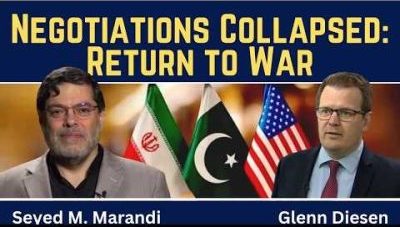
Seyed M. Marandi: Negotiations Collapsed – Return to War
or go to
Aletho News Archives – Video-Images
From the Archives
Wartime internment camps in Australia
National Archives of Australia
World War I
During World War I, for security reasons the Australian Government pursued a comprehensive internment policy against enemy aliens living in Australia.
Initially only those born in countries at war with Australia were classed as enemy aliens, but later this was expanded to include people of enemy nations who were naturalised British subjects, Australian-born descendants of migrants born in enemy nations and others who were thought to pose a threat to Australia’s security.
Australia interned almost 7,000 people during World War I, of whom about 4,500 were enemy aliens and British nationals of German ancestry already resident in Australia.
Records of World War I internment camps
World War II
During World War II, Australian authorities established internment camps for three reasons – to prevent residents from assisting Australia’s enemies, to appease public opinion and to house overseas internees sent to Australia for the duration of the war.
Unlike World War I, the initial aim of internment during the later conflict was to identify and intern those who posed a particular threat to the safety or defence of the country. As the war progressed, however, this policy changed and Japanese residents were interned en masse. In the later years of the war, Germans and Italians were also interned on the basis of nationality, particularly those living in the north of Australia. In all, just over 20 per cent of all Italians resident in Australia were interned. … continue
Blog Roll
 Aletho News
- Seyed M. Marandi: Negotiations Collapsed – Return to War
- Tomorrow’s naval blockade showdown
- ‘Israel’ attacks civilians to hide its embarrassing military failures & out of pure sadism
- Any Foreign Military Vessel Approaching Hormuz Under Any Pretext ‘Will Be Dealt With Severely’: IRGC
- Diplomats slam US negotiators’ performance in Iran talks
- Trump Refuses Exit Ramp, War with Iran will Continue
- Trump Says US Naval Blockade in Strait of Hormuz Will Begin Shortly
- US, Iran end 21-hour talks without agreement
- US IRAN TALKS: Who Are the Crazy Ones Here? /Lt Col Daniel Davis
- Talks with the US end without a deal over excessive US demands: Iran
- If Americans Knew
- US-Iran ceasefire negotiations make zero progress – Daily Update
- Pro-Israel ‘Thinktanks’ and Individuals who Influence U.S. Foreign Policy
- Mearsheimer reveals how Israel dictates US policies on Iran, Gaza – video
- After killing 350+, Israel still has a “score to settle” with Lebanon before ceasefire – Daily Update
- Military aid to Israel emerges as the latest political litmus test for Democrats
- The only Palestinian children’s rights organization closes following years-long Israeli campaign against it
- ‘I Can’t Forget the Smell’: Lebanese Reel After Israel Kills Over 300 in Single Day
- DNC Shoots Down Resolutions Calling Out AIPAC and Limiting Arms to Israel
- TCN: Is Israel Blackmailing President Trump?
- Israel killed at least 303 Lebanese yesterday – who were they? Daily Update
- No Tricks Zone
- Cave Discovery Reveals Today’s Desert Climates Were Recently Far Warmer, Wetter, Teeming With Life
- German Expert: Heat Dome Led To Record Temps In Western USA…Warmer In 1934, 1936
- New Study: No Linear Warming Or Glacier Retreat Along Northern Antarctic Peninsula Since 1980s
- An Inconvenient Tree: Uncovered In Alps… Europe Much Warmer Than Today 6000 Years Ago
- New Study Reports A 60% Slowdown In Greenland’s Ice Loss Rate In The Last Decade
- Low Intensity Tornado Wrecks Major Solar Farm, Creating A Potential Toxic Dump
- New Study Finds Warming Saves Lives…Cold Temperatures 12 Times More Deadly Than Excess Heat
- German Science Blog Accuses PIK Climate Institute Of Hallucinating Climate Tipping Points
- Devastating Assessment Of Comirnaty Vaccine By Former Senior Pfizer Europe Toxicologist
- New Study: CO2 Is ‘Effectively Negligible’ As An Explanatory Climate Change Factor Since 2000
 Aletho News