US Air Force Admits to Poisoning Colorado Groundwater
Sputnik – July 26, 2017
On Tuesday, the US Air Force finally acknowledged responsibility for contaminating the water at a east Colorado Springs air base and its surrounding areas.
In a report released Tuesday, service investigators confirmed that groundwater surrounding Peterson Air Force Base had been tainted by perfluorinated firefighting foam chemicals, based on dozens of water and soil tests taken at the base last year.
Several sites where the chemicals had been sprayed directly on the ground by firefighters since the 1970s were highlighted in the report. Despite decades of research noting the danger of using the chemicals, they remained in wide use, and military officials are dealing with similar contamination issues all across the country.
Research has found that laboratory animals exposed to the chemicals suffered low birth weights and cellular and liver damage, according to KKTV.
The levels of perfluorinated chemicals found during testing at the Colorado Springs site were more than 1,000 times higher than the limit put forth by a national health advisory.
Greg Lauer, a council member from nearby Fountain City told the Denver Post, “It makes me really angry that it has taken them this long to get some numbers — and more than a little concerned.”
“We and our ratepayers are going to be dealing for a very long time with this problem we did not create.”
Roy Heald, who manages the Security Water and Sanitation District near Colorado Springs, said that after municipal wells were contaminated the agency spent $3.6 million on alternative water sources and pipelines. But the US Air Force has not yet furnished the $800,000 in reimbursements they promised.
Notably, Tuesday’s report said contamination at the base was most acute at Peterson’s fire training pit, despite there being a plastic liner in place to prevent the chemicals from leeching into the groundwater. Investigators blamed this on “overspray” from firefighters.
Though Air Force investigators admitted that Colorado Springs sewers had been used to dispose of contaminated waste, they glossed over any possible pollution of drinking water.
“The holding tank is occasionally drained into the sanitary sewer system, but such events are rare,” they wrote, adding that 10,000 to 20,000 gallons of chemical-laden wastewater was drained with each release.
Peterson officials last year admitted to storing chemical-tainted water from the fire pit in a tank nearby, pumping it into Colorado Springs’ sewers three times a year, likely tainting the Widefield Aquifer nearby, where high quantities of the chemicals were found last year. The aquifer serves about 65,000 residents, among them the 20,000 of Fountain City, according to the Colorado Department of Health and Environment.
When the water passes through the Colorado Springs Utilities’ treatment plant the chemicals are not removed, and once it leaves the plant that water heads for the aquifer’s primary water source, Fountain Creek.
Rep. Doug Lamborn (R-CO) called for funds to be allocated for testing people for health issues related to toxic water and contamination clean up. “The people of the surrounding communities are patriotic Americans who will do whatever they can to help our national defense,” he said in a statement. “But they should not be called upon to suffer needless environmental burdens.”
READ ALSO:
Radioactive Contamination from Nuclear Waste Site Spreads in Washington
Okinawa files new lawsuit to block relocation of US Marines base – local media
RT | July 24, 2017
The Japanese prefecture of Okinawa filed a new lawsuit against the government demanding a halt to construction work for the relocation of the US Futenma base, local media report. The relocation has been the target of protests among locals.
The prefectural authorities say that Tokyo is acting illegally without permission from the Okinawa governor, as seen in a copy of the lawsuit sent on Monday and obtained by the Okinawa Times.
The relocation of the base involves damaging seabed rock, which would harm the fishing grounds, the lawsuit states.
Earlier in July, an Okinawa Prefectural Assembly committee asked for legal action against damage to the fishing grounds caused by the relocation.
“The granting of fishing rights is considered a local government matter and it’s the prefecture that determines how to interpret those local government matters,” Kiichiro Jahana, the head of the executive office of the governor, told the assembly.
The US Marine Corps Futenma Air Station is going to be moved from the densely populated city of Ginowan to the less populated city of Nago in the Henoko coastal area. The city is already home to Camp Schwab, another US Marines camp which has caused numerous protests among the local population.
The base relocation has been repeatedly halted due to resistance from the Okinawa authorities and local residents.
Japanese authorities began the relocation of the base back in February this year, despite stiff opposition from the population. Local residents regularly stage protests with thousands of people, often resulting in confrontation with police.
According to the relocation plan, the flight functions of the Futenma airfield will be transferred to Camp Schwab. Tokyo also plans to reclaim around 157 hectares of land in Henoko waters and build a V-shaped runway.
Okinawa Governor Takeshi Onaga is among those who stand firmly opposed to the US military presence on the archipelago, calling for the removal of the Futenma base.
Onaga says that the relocation would destroy the environment of the bay surrounding the new base site.
Around 100,000 US military personnel are currently stationed in Japan, according to the official website of US Forces, Japan. Home to about one percent of Japan’s population, Okinawa hosts almost half of the troops (47,000), according to media reports.
Read more:
US Agrees to Clean Up World War II Mustard Gas Stockpile in Panama
Sputnik – 18.07.2017
The US has come to an agreement with Panama to destroy a stockpile of mustard gas left over from secret human tests conducted by the Americans during and shortly after World War II.
Tiny San Jose Island, with an area of 17 square miles and a permanent population of 10, once hosted a contingent of 200 US soldiers who began conducting chemical warfare testing from 1945 to 1947. Seventy years later, eight mustard gas bombs still remain undetonated on the island, and one Panamanian report claimed that there could be as many as 3,000 other bombs that still haven’t been found.
Panama has repeatedly pushed the United States to destroy the bombs since they were discovered in 2002, and the US only agreed to do so in 2017. Previously, Washington offered to pay for the training of Panamanians to dispose of the bombs, so long as the small Central American republic released the US from liability.
Panama refused and demanded that Washington clean the mess up themselves. As the American government took a hardline stance against the use of chemical weapons during the Syrian Civil War, it became increasingly amenable to the disposal of such weapons it created in decades past.
The disposal will begin in September 2017 and will take six to eight weeks, according to Panamanian officials. It will be overseen by the Organization for the Prohibition of Chemical Weapons.
In a new wrinkle, the Canadian Department of National Defense (DND) has revealed that they may also have mustard gas and other chemical weapons on the island. Ottawa is not going to participate in the disposal of the bombs, according to a statement from Global Affairs Canada, but in the past Canada has denied involvement in the San Jose weapons tests.
In fact, the new DND file notes that most of the mustard gas, as well as roughly 1,000 of the bombs used in the San Jose tests, were Canada-made. Canadian scientists helped design some of the tests, and Canadian pilots flew the planes that dropped chemical bombs during the experiments.
Furthermore, Canada used heavy duty metal shipping containers to transport mustard gas to the island — containers durable enough to have survived 70 years of weathering and decay. Mustard gas decomposes very slowly, especially outside of water, meaning much of the soil in San Jose may be contaminated.
Susan Smith, a professor of history at the University of Alberta and an expert on the use of mustard gas during World War II, said that Canada was a significant participant in the chemical weapons tests on San Jose Island. “This was an area where Canada indeed punched above its own weight,” Smith told the Ottawa Citizen. “Canada has a moral commitment to help clean up the mess it created.”
She added that the San Jose experiments tested how soldiers of different races reacted to mustard gas exposure, with white, Puerto Rican, black, and Japanese soldiers all being exposed.
“It felt like you were on fire,” then-93-year-old Rollins Edwards told NPR in 2015. Edwards served in the US Army during the war and was party to the mustard gas tests. “Guys started screaming and hollering and trying to break out. And then some of the guys fainted. And finally they opened the door and let us out, and the guys were just, they were in bad shape.”
Edwards says he still gets rashes and flaky skin from the chemical burns he suffered 70 years ago.
In 1974, a construction worker on San Jose Island suffered mysterious chemical burns. In 2001, Panama discovered the existence of the chemical weapons and asked Canada to assist in a comprehensive search for bombs in the island’s jungles, but Canada said no.
Most countries who fought in World War II did not use chemical weapons against enemy combatants. The Imperial Japanese did, but only against other Asian nations such as China. The Americans did at one point consider the use of mustard gas against the Japanese in the last days of the war, but opted for atomic weapons instead.
Canada, Panama and the United States are all signatories to the 1992 United Nations Chemical Weapons Convention, which stipulates that all chemical weapons worldwide are to be destroyed. The US government has disposed of 90 percent of its 37,000-ton stockpile of chemical weapons since then.
The nuclear bomb is a weapon of crime and mass destruction
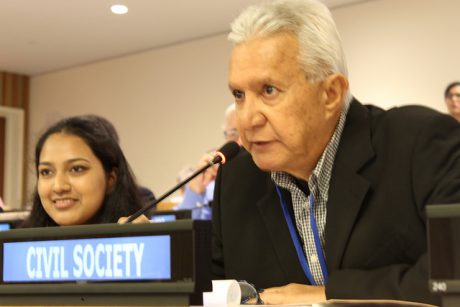
Roland Oldham, head of the nuclear test veterans organization Mururoa e tatou, addresses UN conference to negotiate the Treaty on the Prohibition of Nuclear Weapons on 21 June.
By Roland Oldham – International Physicians for the Prevention of Nuclear War – July 3, 2017
Moruroa e Tatou, Tahiti – The nuclear bomb is a weapon of crime and mass destruction.
We should all be well aware of the examples of Hiroshima and Nagasaki, where the consequences still today have effects across generations.
Like those in other places, nuclear tests in the Pacific by France, America and Britain were a crime towards indigenous people, and the defenceless people of the Pacific. It is a racist crime—nuclear racism. This destroyed and contaminated their environment, the natural resources that they depend on to live. The damages are irreversible.
Look at Moruroa for example—137 nuclear blasts underneath the coral atoll have severely fractured the atoll which is sinking down into the rising ocean, leaking radioactive gases and plutonium into the sea, risking disastrous damage for marine life. French authorities have assessed that there is a danger of a landslide of 670 million cubic meters of rock at Moruroa, creating a 15-20 meter tsunami.
The responsible governments used the Pacific as a dumping ground for nuclear waste—in the Marshall Islands, Moruroa, Fangataufa, Christmas Island, and elsewhere. Plutonium is in the lagoon of Moruroa and leaking from the 147 underground test explosion holes in Moruroa and Fangataufa. Not to mention the widespread radioactive fallout from atmospheric nuclear explosions.
There are thousands, millions of victims out there around the world—former test and weapons production site workers, military staff, civilians; women and children. They are invisible. They are voiceless. They have cancers: leukemia, thyroid, others…. Women in French Polynesia now have the highest rates of thyroid cancer and myeloid leukemia in the world. Their children through many generations will be affected by genetic mutations and damage.
It is a poisonous heritage that is left to humanity and future generations.
It is a crime against humanity.
I don’t see much of the word “crime” in the ban treaty: crime against our planet, crime against our environment, crime against humanity. The aim of the treaty is to stop all these crimes.
Why is there no word about these crimes.
Is there pressure from somewhere? Is there censorship?
Have we lost our morality?
But as victims we are not begging for favour, we are just standing up for our rights and our dignity.
There exists an obligation for the nuclear-armed states to compensate their victims, and to make reparation for the damage done to the environment.
There must be no more mushroom clouds producing untold numbers of new victims.
Roland Oldham, the head of the nuclear test veterans organization Mururoa e tatou, addressed the UN conference to negotiate the Treaty on the Prohibition of Nuclear Weapons on 21 June. The above piece is based upon his remarks, which he delivered in French on behalf of IPPNW and ICAN Australia.
How RCEP affects food and farmers
GRAIN | June 19, 2017
The Regional Comprehensive Economic Partnership (RCEP) is a mega-regional trade deal being negotiated among 16 countries across Asia-Pacific. If adopted, RCEP will cover half the world’s population, including 420 million small family farms that produce 80% of the region’s food. RCEP is expected to create powerful new rights and lucrative business opportunities for food and agriculture corporations under the guise of boosting trade and investment. Several RCEP countries are also part of the Trans-Pacific Partnership (TPP), another mega-regional agreement setting some of the most pro-big business terms seen in trade and investment deals so far. While the fate of the TPP is uncertain, these two agreements may have to co-exist and there is pressure to align them on numerous points. What will this mean for food and farmers in the region?
1. Land will be grabbed
Most RCEP countries do not allow foreigners to buy farmland. Instead, foreign investors can get leases, permits or concessions with varying types of restrictions. The stakes behind this issue are high because companies and investment funds have been aggressively buying up farmland as a new source of revenue in the last years. In the RCEP countries alone, 9.6 million hectares of farmland have been acquired by foreign companies since 2008. Ownership provides corporations far more control than use rights, but it also drives up land prices and speculation, pushing small farmers out.
Two chapters of RCEP could have a decisive impact on access to land. According to leaked drafts, the investment chapter proposes a rule that each government must give investors from other RCEP states the same treatment as domestic investors (‘national treatment’). That means they should have the same rights to purchase farmland as domestic investors, unless the government carves out a special exception for this. The draft chapter also contains proposed ‘standstill’ and ‘ratchet’ clauses which, if adopted, would mean that governments have to lock in their current levels of liberalisation, and if they liberalise more than they commit to in RCEP they cannot go back down to the level set by RCEP. The services chapter draft also proposes that foreign service suppliers not be treated less favourably than domestic companies (‘national treatment’). This includes the ability to own farmland for a service-related purpose. Again, countries may be able to squeeze in an exception for agricultural land, but any such exception would be subject to negotiation and have to be agreed to by all parties.
If governments do not make reservations on these provisions for farmland, RCEP could seriously aggravate land grabbing in the region and sabotage agrarian reform processes that are currently under way in some countries. Currently, farmers asserting their rights to land are being subjected to human rights abuses, criminalisation, incarceration and even assassination. For this reason, there are deep fears that if RCEP is adopted, it will intensify militarisation in rural communities.
2. Seeds will be privatised, GMOs may proliferate
Farmers regularly save seed from one harvest to plant a new crop. Big seed and agrochemical companies like Monsanto and Bayer want to end this practice and force farmers to buy seed each season, so they can boost sales. They do this by lobbying governments to extend intellectual property laws to cover plants and animals. The global seed industry is highly concentrated today with three companies representing more than 60% of global commercial sales. ChemChina is currently in the process of buying Syngenta, one of the world’s top three seed firms. This means that China has a new vested interest in seeing seed laws strengthened under RCEP.
Leaked drafts of RCEP’s intellectual property chapter show countries like Japan and South Korea pushing for all RCEP states to adopt “UPOV 1991”, a kind of patent system for seeds. Under UPOV 1991, farmers are generally not allowed to save seeds of protected varieties. Where limited exceptions are permitted, farmers must pay the seed companies royalties on farm-saved seed. Depending on the country and the crop, royalties can represent a markup of 10-40% over the price of regular commercial seeds, which are already more expensive than farmers’ seed. Civil society groups estimate that UPOV 1991 would raise the local price of seed by 200-600% in Thailand and by 400% in the Philippines.
It could get worse if RCEP moves closer to what was negotiated in the TPP, something which four RCEP states have already agreed to. TPP requires states to allow patents on inventions “derived from plants”, which means genetically modified organisms (GMOs). Right now, GMOs are illegal in all RCEP member countries except for Australia, India, Myanmar and Philippines, plus several provinces of China and Vietnam. And while it’s likely that RCEP will have a chapter aiming to harmonise food safety standards, we have not seen any drafts and do not know how it will regulate GMOs. All of these moves would lead not only to higher seed prices but a loss of biodiversity, greater corporate control and a possible lowering of standards for high risk products such as GMOs.
3. Small dairy and other farmers will go out of business
India is home to 100 million small farmers, most of whom keep livestock. Up until now they have been the backbone of India’s dairy sector, but that situation is now changing. Costs of production are going up while prices paid to farmers are going down, driving many small farmers into dire straits.
RCEP will make things much worse. Frustrated with New Zealand’s failure to conclude a bilateral trade deal with India, NZ dairy giant Fonterra — the world’s biggest dairy exporter — is now looking to RCEP as a way in to India’s massive dairy market. It has openly stated that RCEP would give the company important leverage to open up key markets that are currently protected such as India’s, where it would go head to head with India’s dairy cooperative Amul. As a result, many people fear that Indian dairy farmers will either have to work for Fonterra or go out of business. They will not be able to compete. Similar concerns face dairy farmers in Vietnam, where Fonterra has been investing heavily to increase its presence.
At the same time, some RCEP members like Japan and Australia not only subsidise their farmers tremendously, they also have food safety standards that are incompatible with the small-scale food production and processing systems that dominate in other RCEP countries. This may lead to the growth of mega food-park investments that target exports to such high value markets, as is already happening in India. These projects involve high tech farm-to-fork supply chains that exclude and may even displace small producers and household food processing businesses, which are the mainstay of rural and peri-urban communities across Asia.
4. Fertiliser and pesticide use will go up
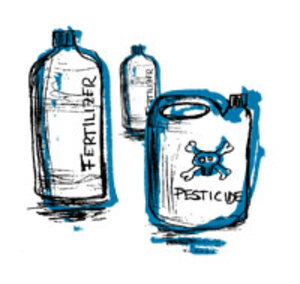
Fertiliser and pesticide sales are expected to rise sharply in Asia-Pacific in the next few years, from $100 billion to $120 billion per year by 2021. Agrochemical use is heaviest in China and growing rapidly in India, while imports by the Mekong sub-region are also on the rise. China’s acquisition of Syngenta, the world’s top agrochemical company with more than 20% of the global pesticide market, puts the country in a particularly sensitive position within RCEP.
Beijing will want high levels of ‘market access’, being negotiated under the trade in goods chapter of RCEP, to capitalise on its new position. In January 2017, China already announced that it will scrap export tariffs on nitrogen and phosphorus fertiliser in order to boost its market share abroad. RCEP trade ministers have promised to deliver a deal that immediately cuts tariffs to zero on 65% of trade in goods, followed by a second phase to cut the rest. Farm chemicals are bound to be part of this, resulting in increased residues in food and water, more greenhouse gas emissions and further depletion of soil fertility.
Furthermore, if leaked intellectual property drafts are adopted, RCEP may increase the patenting of other inputs like veterinary medicines, farm machinery, microorganism-based products and agricultural chemicals, and extend their patent terms, making them more expensive.
5. Big retail will wipe out local markets

Over the past five years, Asia-Pacific accounted for more than half of the world’s new food retail sales. Japan is leading this trend, with 7-Eleven and Aeon at the top of food retail sales in the region. Aeon Agri Create, the agriculture production arm of Aeon, has been establishing farms in Japan and Southeast Asian countries like Vietnam. Aeon even aims to push ‘ICT farming’: the use of computers and communication technologies to manage farm operations. In India, the opening up of food retail, including e-commerce, to foreign direct investment (FDI) is almost complete, although many states are yet to adopt FDI in multibrand retail. RCEP would strengthen these trends further.
According to leaked drafts, RCEP’s services chapter may make it impossible for governments to limit the operation of supermarket chains that hail from other RCEP states (‘market access’). Furthermore, the trade agreement may make it illegal for a member government to require a service supplier like Alibaba or Aeon to have a ‘local presence’ in its country or to source food from local producers.
If precedents set by TPP are followed, ICT farming may be boosted under RCEP measures aimed at promoting regional supply chains and e-commerce. China’s Alibaba has just invested $1.25 billion in an online food delivery service, which will rely on more and more high tech facilities that are disconnected from seasons and from local markets. All of these developments pose a real threat to small traders and retailers in Asia.
What to do?
RCEP will usher in a wave of corporate concentration and take over of Asia’s food and agriculture sector. Corporate concentration, as experience in the other regions shows, brings less real choice and higher prices for consumers. In the food sector, it also brings important health and environmental costs from pesticides, excessive processing and chemicals, as well as downward pressure on wages and prices paid to farmers.
The answer is not to reform RCEP but to reject it because it relies on and pushes a corporate model of agriculture that no amount of tweaking will change. Instead, we need to implement policies and initiatives that enable people-led food and agricultural systems to flourish. Only then can trade policies be drawn up to serve these systems – not the other way around.
ACT NOW!
- Get more informed and organise discussions and debates about RCEP in your communities. One resource to check out is the collective open-publishing site http://bilaterals.org/rcep.
- Support the people’s call to stop RCEP and fight for a pro-people trading system that responds to people’s needs not to corporate elites. Contact groups in your country that also signed the call and join forces.
- Go to the RCEP meetings. Demand the public release of negotiating texts to better analyse and build awareness of how the agreement affects the livelihood of people in RCEP member countries. Voice your concerns, as groups have done over several rounds the past months in Perth, Jakarta, Kobe and Manila. The next rounds will be held in Hyderabad (July 2017) and Seoul (later this year).
- Join the region-wide people campaign on RCEP and trade justice, and participate in collective mobilisations like regional days of action
- Keep an eye on http://rceplegal.wordpress.com/, http://keionline.org/ and http://www.bilaterals.org/rcep-leaks for leaked texts and analysis of RCEP chapters.
GRAIN is a small international non-profit organisation that works to support small farmers and social movements in their struggles for community-controlled and biodiversity-based food systems.
Unsustainable: 43 Million Tonnes Of Wind Turbine Blade Waste By 2050
2 New Papers Expose The Environmental Nightmare Of Wind Turbine Blade Disposal
By Kenneth Richard – No Tricks Zone – 22. June 2017
… Despite its extremely limited infiltration as a world energy source, it is assumed that a rapid expansion of wind power will ultimately be environmentally advantageous both due to its reputation as a “clean” energy and because of the potential to contribute to reduced CO2 emissions.
Recently, however, the austere environmental impacts and health risks associated with expanding wind energy have received more attention.
For example, scientists have asserted that wind turbines are now the leading cause of multiple mortality events in bats, with 3 to 5 million bats killed by wind turbines every year. Migratory bats in North America may face the risk of extinction in the next few decades due to wind turbine-related fatalities.
Frick et al., 2017
“Large numbers of migratory bats are killed every year at wind energy facilities. … Using expert elicitation and population projection models, we show that mortality from wind turbines may drastically reduce population size and increase the risk of extinction. For example, the hoary bat population could decline by as much as 90% in the next 50 years if the initial population size is near 2.5 million bats and annual population growth rate is similar to rates estimated for other bat species (λ = 1.01). Our results suggest that wind energy development may pose a substantial threat to migratory bats in North America.”
Wind Turbine Blades Last 20 Years…And Then They Are Tossed Into Landfills
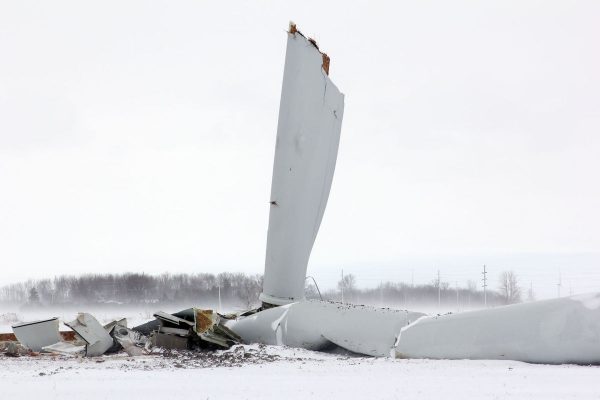
Besides reducing wildlife populations, perhaps one of the most underrated negative side effects of building wind turbines is that they don’t last very long (less than 20 years) before they need to be replaced. And their blades aren’t recyclable. Consequently, 43 million tonnes (47 million tons) of blade waste will be added to the world’s landfills within the next few decades.
Liu and Barlow, 2017
“The blades, one of the most important components in the wind turbines, made with composite, are currently regarded as unrecyclable. With the first wave of early commercial wind turbine installations now approaching their end of life, the problem of blade disposal is just beginning to emerge as a significant factor for the future. … The research indicates that there will be 43 million tonnes of blade waste worldwide by 2050 with China possessing 40% of the waste, Europe 25%, the United States 16% and the rest of the world 19%.”
“Although wind energy is often claimed to provide clean renewable energy without any emissions during operation (U.S. Department of Energy, 2015), a detailed ecological study may indicate otherwise even for this stage. The manufacture stage is energy-intensive and is associated with a range of chemical usage (Song et al., 2009). Disposal at end-of-life must also be considered (Ortegon et al., 2012; Pickering, 2013; Job, 2014).A typical wind turbine (WT) has a foundation, a tower, a nacelle and three blades. The foundation is made from concrete; the tower is made from steel or concrete; the nacelle is made mainly from steel and copper; the blades are made from composite materials (Vestas, 2006; Tremeac and Meunier, 2009; Guezuraga et al., 2012). Considering these materials only, concrete and composites are the most environmentally problematic at end-of-life, since there are currently no established industrial recycling routes for them (Pimenta and Pinho, 2011; Job, 2013).”
In a new paper entitled “Unsustainable Wind Turbine Blade Disposal Practices in the United States“, Ramirez-Tejeda et al. (2017) further detail the imminent and unresolved nightmare of wind turbine blade disposal. The environmental consequences and health risks are so adverse that the authors warn that if the public learns of this rapidly burgeoning problem, they may be less inclined to favor wind power expansion. Advocates of wind power are said to be “largely ignoring the issue”. It’s an “issue” that will not be going away any time soon.
In light of its minuscule share of worldwide consumption (despite explosive expansion in recent decades), perhaps it is time to at least reconsider both the benefits and the costs of wind energy expansion.
‘Adverse Environmental Consequences’ For A Rapidly Expanding Wind Power Grid
Ramirez-Tejeda et al. (2017)
“Globally, more than seventy thousand wind turbine blades were deployed in 2012 and there were 433 gigawatts (GW) of wind installed capacity worldwide at the end of 2015. Moreover, the United States’ installed wind power capacity will need to increase from 74 GW to 300 GW3 to achieve its 20% wind production goal by 2030. To meet the increasing demand, not only are more blades being manufactured, but also blades of up to 100 meters long are being designed and produced.”
“The wind turbine blades are designed to have a lifespan of about twenty years, after which they would have to be dismantled due to physical degradation or damage beyond repair. Furthermore, constant development of more efficient blades with higher power generation capacity is resulting in blade replacement well before the twenty-year life span.”
“Estimations have suggested that between 330,000 tons/year by 2028 and 418,000 tons/year by 2040 of composite material from blades will need to be disposed worldwide. That would be equivalent to the amount of plastics waste generated by four million people in the United States in 2013. This anticipated increase in blade manufacturing and disposal will likely lead to adverse environmental consequences, as well as potential occupational exposures, especially because available technologies and key economic constraints result in undesirable disposal methods as the only feasible options.”
Problems With Landfills
“Despite its negative consequences, landfilling has so far been the most commonly utilized wind turbine blade disposal method. … Landfilling is especially problematic because its high resistance to heat, sunlight, and moisture means that it will take hundreds of years to degrade in a landfill environment. The wood and other organic material present in the blades would also end up in landfills, potentially releasing methane, a potent greenhouse gas, and other volatile organic compounds to the environment.”
“The estimated cost to put blade material in landfills, not including pretreatment and transportation costs, is approximately US $60 per ton. [A typical blade may weigh 30-40 tons]. In the United Kingdom, where landfilling organics is not yet prohibited, the active waste disposal cost (which includes plastics) is approximately US $130 per ton.”
Problems With Incineration
“Incineration of blades is another disposal method with potential for energy and/or material recovery. … Combustion of GFRP is especially problematic because it can produce toxic gases, smoke, and soot that can harm the environment and humans. Carbon monoxide and formaldehyde have been reported as residue from thermal degradation of epoxy resin. Another residue is carbon dioxide, which poses concerns regarding greenhouse gas emissions. In addition, about 60% of the scrap remains as pollutant ash after the incineration process, some of which is sent to landfills, potentially contaminating the sites. Possible emission of hazardous flue gasses is also among the issues with incinerating wind turbine blades.”
“One key issue is that all these thermal processing techniques for wind turbine blades would also require fragmentation of the material into smaller pieces through mechanical processing before being fed into the reactors, increasing energy consumption and carbon dioxide emissions.”
Problems With Mechanical Processing
“Mechanical processing is a relatively simpler disposal method that consists of cutting, shredding, and grinding the material to separate the fibers from resins, so it can be repurposed. This process is energy intensive and produces small fiber particles with poor mechanical properties that can only be used as filler reinforcement material in the cement or asphalt industries. … The dust emitted in the grinding process of FRP creates occupational health and safety risks for workers. Inhalation, as well as skin and eye contact can produce moderate irritation to mucous membranes, skin, eyes, and coughing. Occupational exposure and prolonged inhalation of such particles have been found to produce alterations of the cellular and enzymatic components of the deep lung in humans, identified as acute alveolitis.”
Problems With Chemical Degradation
“The last method is chemical degradation, which consists of first mechanically reducing the size of the blades, then degrading them using a chemical solution. … Although no industrial-level chemical recycling of thermoset polymers has been done yet, some hazardous chemicals such as nitric acids and paraformaldehyde have been used in testing and development processes. Occupational exposure to these chemicals can produce harmful respiratory diseases including potential nasal cancer, and dermal health effects.”
Full article at No Tricks Zone
Featured Video
Chinese jet fuel and the myth of energy independence
or go to
Aletho News Archives – Video-Images
Book Review
Former Insiders Criticize Iran Policy as U.S. Hegemony
By GARETH PORTER | CounterPunch | February 27, 2013
“Going to Tehran” arguably represents the most important work on the subject of U.S.-Iran relations to be published thus far.
Flynt Leverett and Hillary Mann Leverett tackle not only U.S. policy toward Iran but the broader context of Middle East policy with a systematic analytical perspective informed by personal experience, as well as very extensive documentation.
More importantly, however, their exposé required a degree of courage that may be unparalleled in the writing of former U.S. national security officials about issues on which they worked. They have chosen not just to criticise U.S. policy toward Iran but to analyse that policy as a problem of U.S. hegemony. … continue
Blog Roll
 Aletho News
- What is fueling unrest across the EU?
- Why no power can undermine Iran’s eternal dominance over the Strait of Hormuz
- Is The War Against Iran Over?
- Iran war will leave long-term ‘scar’ on Wall Street, investors warn
- How Iran decimated US power projection in West Asia: Military lessons of 40-day war
- Iran’s report details US-Israeli war crimes in targeting schools, hospitals, livelihoods
- NATO’s Slow Fracture: How Trump’s Iran War Exposed the Instrument of Hegemony
- Chinese jet fuel and the myth of energy independence
- Ukraine Sea Drone Fired From Libya Hit Russian Tanker in Mediterranean
- IRGC: Iranian forces launched no attacks during ceasefire hours
- If Americans Knew
- Military aid to Israel emerges as the latest political litmus test for Democrats
- The only Palestinian children’s rights organization closes following years-long Israeli campaign against it
- ‘I Can’t Forget the Smell’: Lebanese Reel After Israel Kills Over 300 in Single Day
- DNC Shoots Down Resolutions Calling Out AIPAC and Limiting Arms to Israel
- TCN: Is Israel Blackmailing President Trump?
- Israel killed at least 303 Lebanese yesterday – who were they? Daily Update
- Amnesty: Urgent – Protect Lebanese civilians from brutal escalation in Israeli attacks
- Is The War Against Iran Over?
- Inside the Israeli army’s propaganda wing
- Hundreds of Gaza Amputees Stranded in Legal Limbo
- No Tricks Zone
- New Study: No Linear Warming Or Glacier Retreat Along Northern Antarctic Peninsula Since 1980s
- An Inconvenient Tree: Uncovered In Alps… Europe Much Warmer Than Today 6000 Years Ago
- New Study Reports A 60% Slowdown In Greenland’s Ice Loss Rate In The Last Decade
- Low Intensity Tornado Wrecks Major Solar Farm, Creating A Potential Toxic Dump
- New Study Finds Warming Saves Lives…Cold Temperatures 12 Times More Deadly Than Excess Heat
- German Science Blog Accuses PIK Climate Institute Of Hallucinating Climate Tipping Points
- Devastating Assessment Of Comirnaty Vaccine By Former Senior Pfizer Europe Toxicologist
- New Study: CO2 Is ‘Effectively Negligible’ As An Explanatory Climate Change Factor Since 2000
- Former Pfizer Toxicologist Dr. Helmut Sterz Tells Bundestag Hearing Pfizer Vaccine Should Have Never Been Approved
- Energy Expert: Germany’s Nuclear Phaseout Was A “500 Billion Euro Mistake”
 Aletho News