Yaalon: Hezbollah, not ISIL, Challenging Israel
Al-Manar | October 29, 2015
 The Zionist Defense Minister said on Wednesday that the so-called ‘Islamic State of Iraq and the Levant’ (ISIL) takfiri group “has not yet challenged Israeli borders,” but the occupation regime is concerned Lebanese Resistance fighters of Hezbollah will seize an opportunity to go on the offensive against it.
“So far, so good. But our main worry, regarding the situation in Syria … is Iranian Revolutionary Guard- backed factions, proxies, trying to open or to renew a terror front against us from the Golan Heights,” Moshe Yaalon said during a press conference at the Pentagon alongside his US counterpart Ash Carter.
The Golan Heights is a decades-long Zionist-occupied area belonging to Syria.
Yaalon claimed that Tel Aviv does not intervene in Syria as long as the Zionist red lines are not crossed. His quote totally contradicts the history of Zionist involvement in the Syrian crisis by funding and training armed takfiri groups, and treating their wounded operatives inside the occupied territories.
“We do keep our well-done three redlines: not to allow any violation of our sovereignty, not to allow a delivery of advanced weapons to rogue elements in the region, as well as chemical weapons or agents to rogue elements in the region,” he said in an attempt to obscure the Zionist atrocities in breaching the sovereignty of Lebanon, Syria and Palestine.
Ya’alon’s comments, moreover, are contrary to reports of Israeli jets having struck undisclosed targets inside Syria on multiple occasions since the conflict began in 2011.
Regarding the Russian airstrikes on ISIL and other takfiri groups operating against the Syrian national forces, Yaalon said that the Zionists are “taking safety measures, precautions to avoid any conflict between us and them.”
“We do not intervene in their activities, they don’t intervene in our activities. We are free to operate in order to keep our interests,” he added.
Russia has launched a wide military campaign in Syria to eliminate all the armed groups operating against the Syrian military. The campaign is scheduled to end in January.
Al-Waleed bin Talal supports Israel against Palestinians
MEMO | October 29, 2015
 Saudi multibillionaire Al-Waleed bin Talal has said that he would stand with Israel against the Palestinians if a new uprising was ignited, Kuwaiti media reported on Tuesday.
According to the AWD news website, bin Talal told the Kuwaiti newspaper Al-Qabas: “I will side with the Jewish nation and its democratic aspirations in case of outbreak of a Palestinian Intifada.”
He also added: “I shall exert all my influence to break any ominous Arab initiatives set to condemn Tel Aviv, because I deem the Arab-Israeli entente and future friendship necessary to impede the dangerous Iranian encroachment.”
Regarding the foreign policy of Saudi Arabia, bin Talal said that “[Saudi] must reconsider its regional commitments and devise a new strategy to combat Iran’s increasing influence in the Gulf States by forging a Defence pact with Tel Aviv.”
It seems that he urged his country to take this measure in order “to deter any possible Iranian moves in the light of unfolding developments in the Syria and Moscow’s military intervention.”
AWD reported that the Kuwaiti news agency KUNA has quoted bin Talal as saying that: “The whole Middle East dispute is tantamount to matter of life and death for the Kingdom of Saudi Arabia.”
He continued: “I know that Iranians seek to unseat the Saudi regime by playing the Palestinian card. To foil their plots, Saudi Arabia and Israel must bolster their relations and form a united front to stymie Tehran’s ambitious agenda.”
‘US blindly supports Israeli interests in Middle East’
US to reduce aid to the Palestinian Authority
Press TV – October 24, 2015
The United States is the “proxy” for Israeli interests in the Middle East and “blindly supports” the regime’s position in the region, says an American political scientist.
In a phone interview with Press TV, Wilmer Leon pointed to US Secretary of State John Kerry’s meeting with Palestinian President Mahmoud Abbas on Saturday in the Jordanian capital of Amman, saying “anything is really going to come out of this.”
“I don’t really see anything substantive or long term coming out of these meetings,” he said, because “the United States has failed to do anything substantive in order to get Israel to honestly negotiate.”
He also noted that Kerry first held a meeting with Israeli Prime Minister Benjamin Netanyahu and “took Netanyahu’s position to Palestinian Authority President [Mahmoud] Abbas, instead of meeting with Palestinian Authority President Abbas first and taking the Palestinian positions to the Israelis.”
On Thursday, Kerry held talks with Netanyahu in Berlin and called for an immediate end to “all incitement” and “violence” against the Palestinians.
“For all intents and purposes, the United States is the proxy for the Israeli interests and until the United States decides to become an unbiased real arbiter actually working for peace in the region, instead of continuing to blindly support the Israeli position, I don’t see how anything is going to happen,” Leon added.
In supporting the regime’s positions, the US State Department said it will reduce its annual aid to the Palestinian Authority from $370 million to $290 at the end of September.
The 22-percent cut for the 2015 fiscal year came after US Congress sent a letter to Palestinian President Mahmoud Abbas, telling him that the US funds were contingent on tamping down “incitement.”
The latest wave of Israeli-Palestinian clashes began when Tel Aviv restricted the entry of some Palestinian worshipers into the al-Aqsa Mosque on August 26.
The surge in tensions, triggered by Israeli raids on the al-Aqsa Mosque in East al-Quds (East Jerusalem), as well as increasing violence by Israeli settlers, has seen some 54 Palestinians killed and hundreds more injured since October 1. Eight Israelis have also died in the same time period.
Palestinian child bleeds out while Israeli police & civilians watch, shouting insults
IMEMC & Agencies | October 12, 2015
 “Die, you son of a whore!! Die!!” shouted Israeli men at a seriously wounded Palestinian child, who was left to bleed while police stood around him doing nothing. One of the officers repeatedly pushed the boy down with his foot, whenever he tried to sit up.
While the child was bleeding to death, Israelis surrounded him, shouting at him in a mix of Arabic and Hebrew, “Die, you son of a whore!”, “Die, you son of the biggest whore!”, and telling the police to “Do him a favor, and shoot him in the head!”
The officers did not shoot him, but left him bleeding with head injuries, broken legs and other serious injuries on the ground. The boy was able to raise his head a few times, but the police officers kicked him back down.
The Palestinian child has been identified as Hasan Khaled Manasra, 15 years of age, while his cousin Ahmad Saleh Manasra, 13, suffered a serious injury. They are both from Beit Hanina, in Jerusalem.
The incident took place near Pisgat Zeev Israeli settlement, in occupied Jerusalem. The police claimed that the boys stabbed two settlers, wounding them.
A settler who chased the boys with his car also rammed Ahmad. But the police presented no evidence to connect the two children with the crime that they claimed the boys committed. […]
Since October 1st, when two Israelis were killed in a ‘lone wolf’ attack by a Palestinian in Jerusalem, 26 Palestinians have been killed, including a pregnant woman and her two-year old child killed in an Israeli bombing on Sunday morning. Over 1200 Palestinians have been injured, many of them hit by live ammunition fired by Israeli troops at Palestinian demonstrators armed only with stones.
During that time period, no Israelis have been killed beyond the two who died in the October 1st attack, but six have been wounded in alleged attacks by Palestinians. No Palestinian faction has claimed responsibility for any attack, and it appears that the Palestinians who wounded Israelis were acting on their own.
In addition, Israeli authorities have been revealed on several occasions to have lied about the Palestinians they have killed – claiming falsely that the Palestinians had been attempting to stab or attack Israelis, but eyewitness and video evidence disproved this claim in a number of cases. – Full article with video (warning, extremely graphic)
The youtube upload at IMEMC has been taken down. Therefore I am posting another upload here and will attempt to maintain a working upload.
By Rima Najjar Merriman
This incredibly shocking and painful-to-watch video in the Jewish colony of Pisgat Ze’ev in annexed and occupied East #Jerusalem is being shared on Israeli social media sites. The #Palestinian teenager (Ahmad Manasra, 13) is surrounded by Israeli police and Jewish “settlers” hurling insults at him, as he bleeds to death. The circumstances of the shooting are unclear. My ex-colleague at Al-Quds University (Randa Hilal) writes: “What’s happening is a new #Nakba, new terror and forced displacement of the [Palestinian] people of #Jerusalem. They are killing school children. Today, three school children were killed, the latest a girl from Al-Ma’mounieh school. A [Jewish] colonist threw a knife next to her and started screaming for her to be shot.”
الي بصير نكبة جديدة وأسلوب جديد وترهيب وتهجير لاهالي القدس
عم يقتلو أطفال مدارس
اليوم ٣ أطفال آخرهم بنت من مدرسه المامونيه مستوطن رمى سكينه جنبها وصار يصيح قتلوها
I downloaded this clip from the FB wall of Mira Atmi (https://www.facebook.com/profile.php…), who has the following comment in Hebrew attached to it (The terrorist bastard in Pisgat Ze’ev in Jerusalem):
המחבל הבן זונה בפסגת זאב בירושלים
(The terrorist bastard Pisgat Ze’ev in Jerusalem)
The other occupation: Settlers terrorize Palestinians of the West Bank
International Solidarity Movement | October 11, 2015
Hebron, occupied Palestine – It was another emotional day for Palestinians in al-Khalil, (Hebron) after the burial of martyr Muhammad al-Jabari who was shot to death by Israeli forces near the entrance to the illegal Kiryat Arba settlement.
Thousands filled the streets as the body of the 19 year old boy was carried through the masses up to the martyr’s cemetery which is the same place where 18 year old unarmed Palestinian female student Hadeel Hashlamoun was shot to death at the checkpoint yawning into segregated Shuhada Street.
Immediately beyond the service, Palestinians gathered in the Bab al-Zawiya section of Khalil for a demonstration against the Israeli occupation forces use of violence which has now claimed the lives of nearly 20 young Palestinians in just one week. The demonstration was met with extreme violence by the Israeli military which settlers in the Tel Rumeida neighborhood gathered to watch on Saturday afternoon.
The Shamsiyyeh family’s home has long been the target of violence from Israeli settlers who have thrown rocks and other debris as well as poisoning their water tanks on several occasions and even cutting their water pipes on the roof. Today, settlers again filed onto the family home’s roof to watch the Israeli military assault on Palestinians in Bab al-Zawwiya, some armed with machine guns.
Israeli occupation forces predictably did nothing to calm the situation or remove the settlers from the roof of the family home. One settler sprayed pepper spray from the roof, gassing the family and subsequently himself. Israeli forces allowed him to leave with the pepper spray without asking a single question.
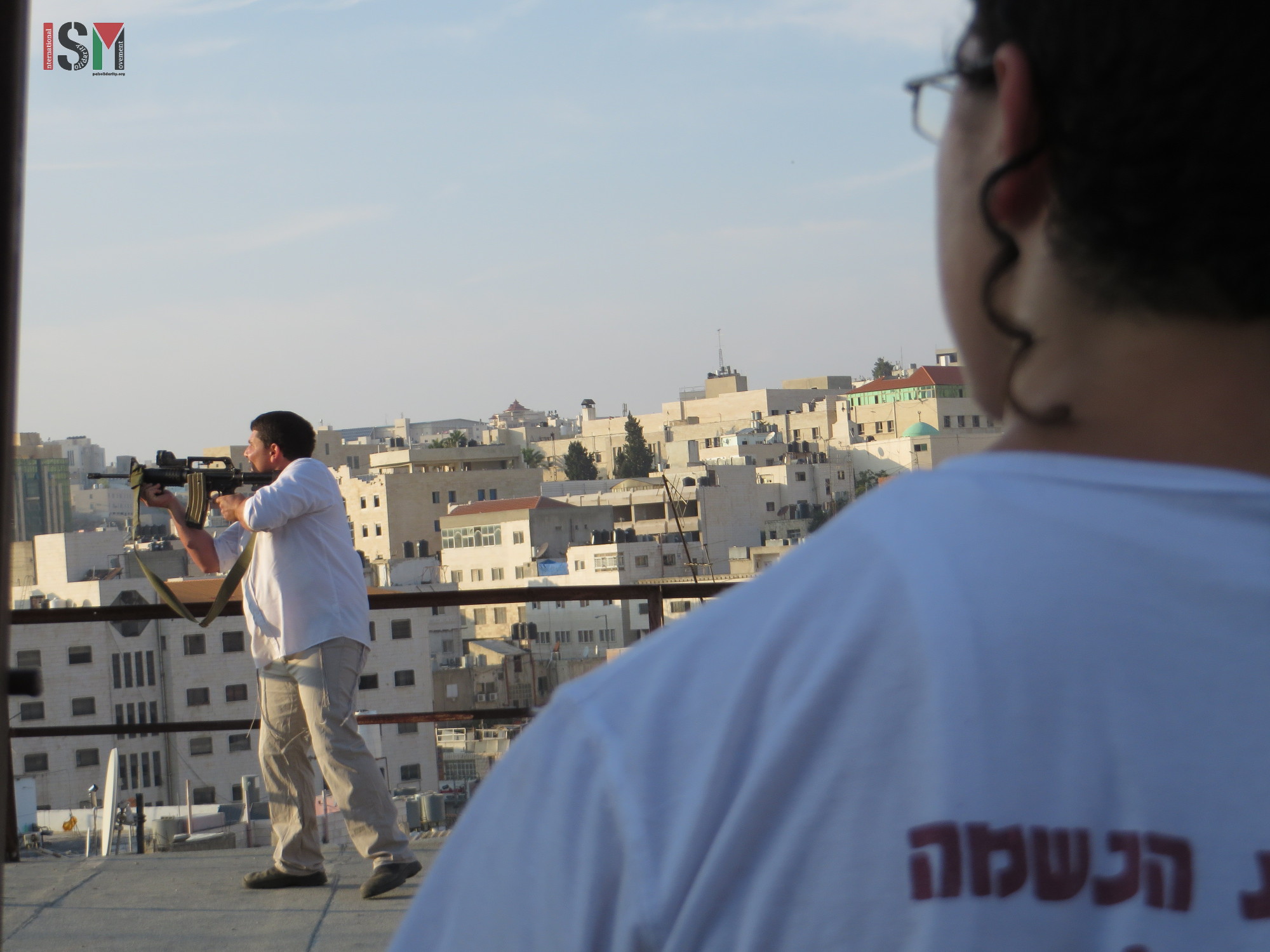
Israeli settler pointing his gun at Palestinian families
Just a few hours later, a settler armed with a machine gun, lightly slung around him just like an accessory, came onto the roof. Soldiers close-by refused to ask the settler to leave from the private Palestinian family home’s roof. The settler then suddenly pointed his machine gun at Palestinians, including small children, on nearby roofs. Soldiers at first watched the events unfold only to join the settler on the roof, taking orders from him on what to do.
Watch a video here:
In occupied al-Khalil, it has been apparent that settlers rule the military, both through demanding arrests and ID checks of Palestinians and through getting away with any transgression of Palestinian’s human rights by being handed total impunity by the occupying forces. This is especially disturbing since a West Jerusalem mayor has publicly called for settlers to carry guns amidst a high pressure situation with exploding violence across the occupied Palestinian territories.
In the Tel Rumeida section of al-Khalil, just days ago, settlers held a large march up the hill chanting “Death to Arabs” and burning Palestinian flags.
Israeli Army Invades IMEMC/PCR Office In Beit Sahour
IMEMC News | October 11, 2015
 Israeli soldiers invaded, on Sunday at dawn, the offices of the Palestinian Centre for Rapprochement (PCR)/International Middle East Media Center (IMEMC) and searched them.
The soldiers violently searched and ransacked our officers, after breaking the locks of the main door.
Because the invasion took place around 4 AM, Sunday morning, no staff were in the building as our offices are closed Sundays.
The soldiers also invaded and searched a few old nearby homes.
The Israeli military has invaded, ransacked and confiscated numerous files from the IMEMC and PCR in the past.
Surveillance video of Israeli soldiers breaking open the door of the PCR/IMEMC Palestinian News Office before they entered and ransacked the offices.
NYT: Putin is “enemy No. 1 in the Sunni Muslim world”
Sputnik – 08.10.2015
In the US information war aimed against the Russian air campaign in Syria, perhaps no outlet has been more misleading than the New York Times.
Writing for America’s newspaper of record, columnist Thomas Friedman wrote fairly candidly of his opinion on Russia’s Syria campaign.
“Putin stupidly went into Syria looking for a cheap sugar high to show his people that Russia is still a world power,” Friedman wrote in the NYT last week. “Watch him become public enemy No. 1 in the Sunni Muslim world. ‘Yo, Vladimir, how’s that working for you?'”
As Patrick L. Smith points out, writing for Salon, “most of ‘the Sunni Muslim world’ is as appalled by the Islamic State as the non-Sunni Muslim world.”
But Friedman’s unfounded statements shouldn’t be altogether surprising, given his employer’s history of toeing the line of the US government.
Since the Russian airstrikes began, the New York Times – as well as the vast majority of Western media – has spread the Pentagon’s falsehoods about the conflicts.
“We are always encouraged to find anything Putin does devious and the outcome of hidden motives and some obscure agenda having to do with his pouting ambition to be seen as a first-rank world leader,” Smith writes.
“From the government-supervised New York Times on down, this is what you read in the newspapers and hear on the radio and television broadcasts.”
So Friedman’s self-described “defense of President Barack Obama’s policy on Syria,” falls in line with that doctrine.
While Friedman may claim to disapprove of the airstrikes because “Putin and Russia would be seen as going all-in to protect Assad, a pro-Iranian, Alawite/Shiite genocidal war criminal,” it’s hard to ignore the true source of such hyperbolic statements.
Friedman’s views – and those of the New York Times – owe allegiance not to truth, but to American empire.
Al-Manar Cameraman Injured by Israeli Fire in West Bank
Al-Manar | October 6, 2015
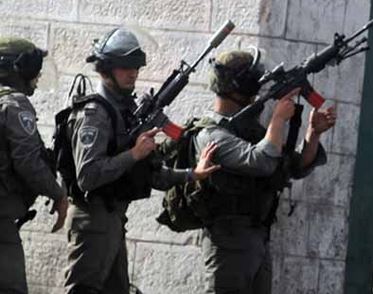 Al-Manar TV cameraman, Salah al-Zayyat, was shot by the Zionist soldiers at the Qalandiya checkpoint on Tuesday in the West Bank while he was shooting the occupation attacks against the Palestinian people.
According to Al-Manar TV correspondent, Zayyat was wounded by a bullet in the abdomen during the Zionist attacks, and he has undergone a surgery in Ramallah hospital to extract the metal pieces that infiltrated into his body.
“Three others were wounded by the Israeli attacks, and dozens of people suffered from asphyxia due to the use of toxic gases by the Israeli enemy were treated in the scene,” the reporter added.
Israeli settlers raid park south of Hebron under armed guard
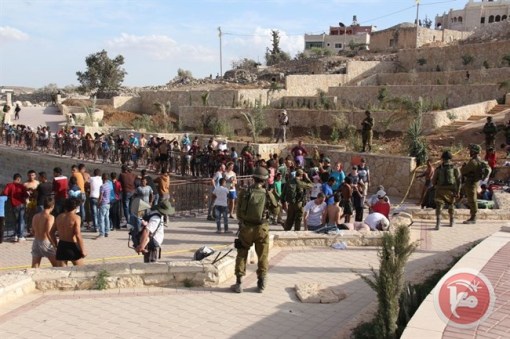
Ma’an – September 30, 2015
Dozens of Israeli settlers raided a park and ancient pool in the Palestinian town of al-Karmil in the southern occupied West Bank on Wednesday, under the armed protection of Israeli forces, witnesses said.
The park, part of the Yatta Municipality in the south Hebron hills, lies in Area A, under full Palestinian jurisdiction according to the Oslo Accords.
Buses carrying the settlers arrived to the park escorted by large numbers of Israeli forces and military vehicles, locals said.
Settlers came from the nearby settlements of Maon, Karmel, Beit Yatir, Susya, and the outposts of Havat Yair, Mitzpe Yair, Havat Maon, and Avigal, in order to “perform religious rituals” for several hours, they added.
The mayor of Yatta, Moussa Makhamreh, condemned the raid, pointing to the “dangerous nature of Israeli authorities’ and settlers’ racist actions taken under armed security.”
Makhamreh called upon local governance to support and protect the park in order to end frequent violations by Israeli settlers in the area.
An Israeli army spokesperson had no immediate information on the incident.
The park was created in 2011 by the Palestinian Yatta municipality, which renovated an ancient pool located at the site.
Settlers have come to the area in the past through the initiative of the Susiya Tour and Study Center which describes the pool as the historical site of the Biblical settlement of Carmel, according to rights group B’Tselem. Such visits are generally approved by and coordinated with Israeli authorities.
In April, Israeli soldiers expelled Palestinians from the pool in order to allow settlers to swim and have exclusive use of the park.
Around 3,000 Israeli settlers live in Jewish-only settlements in the Yatta region according to the Applied Research Institute – Jerusalem.
The presence of settlements in the area, considered illegal under international law, comes at the expense of Palestinian residents’ ability to build homes and infrastructure, or live unimpeded by constant and often violent interruption from Israeli forces and settlers.
Israeli Soldiers Attack Ambulances, Kidnap Wounded Palestinian
IMEMC & Agencies | September 30, 2015
Israeli soldiers attacked, Tuesday, several Palestinian ambulances while transporting wounded Palestinians to hospitals, in Ramallah, kidnapped one Palestinian after dragging him out of the ambulance, and attempted to abduct another.
Medical sources said at least two Palestinians were shot with rubber-coated steel bullets, and dozens suffered the effects of tear gas inhalation, after the soldiers assaulted hundreds of Palestinians protesting the ongoing Israeli invasions into the Al-Aqsa Mosque in occupied Jerusalem.
The soldiers stopped Palestinian ambulances, trying to transfer injured residents to hospitals in Ramallah, and kidnapped a wounded Palestinian, identified as Mohammad Ouri, after forcibly removing him from the ambulance.
They also attacked another ambulance, transferring a wounded Palestinian, but were unable to abduct him.
The assaults took place near the Beit El roadblock, north of Ramallah, when the soldiers assaulted dozens of protesters, including various political leaders of different Palestinian factions.
The army fired rounds of live ammunition, rubber-coated steel bullets, concussion grenades and gas bombs, in addition to spraying the protesters with wastewater mixed with chemicals.
In Hebron, in the southern part of the West Bank, soldiers kidnapped a Palestinian child, identified as Bassel Issa Shawaheen, 12 years of age, after breaking into his family’s home and searching it.
Also on Tuesday, at least 18 Palestinians were injured, as Israeli forces suppressed demonstrations across the occupied West Bank in support of the Al-Aqsa Mosque.
Nine Palestinians, including three women, have also been kidnapped in occupied East Jerusalem, after the soldiers attacked several men and women near Al-Aqsa Mosque, and prevented them from entering it.
Shatila: Remembering the Massacre
By Richard Hardigan | CounterPunch | September 30, 2015
“There is one scene I will always remember. There was one child. The mother died, but he was trying to take milk from his mother. He was still alive.”
Jamili’s face betrays little emotion as she recalls the scene from thirty-three years ago. She has told the story many times, and perhaps it has lost some of its power in its retelling. Jamili works for Beit Atfal Assamoud, an NGO that provides medical, social and educational services to the residents of the Shatila refugee camp on the southern outskirts of Beirut, and she is talking about her experiences during the massacre of 1982.
“The best way to forget about the horrible things that have happened in the past is to work, to help,” she tells me.
There are currently fifty-nine Palestinian refugee camps scattered throughout the Middle East. When Zionist forces instituted a policy of ethnic cleansing aimed to dispossess the Palestinians of their land in 1947-1948, close to 750,000 Palestinians fled or were expelled from their homes. The camps were built to house the refugees in the short term, but as the problem persisted, so did the camps. It is estimated that there are currently 2.5 million Palestinian refugees living in the camps, which are located in Lebanon, Syria, Jordan, the West Bank and Gaza.
Shatila is probably the most well-known of all the Palestinian refugee camps. In September of 1982, a local Christian militia, known as the Phalange, aided by its Israeli allies, entered Shatila and bordering Sabra, engaging in an orgy of torturing and killing that lasted several days. It is estimated that 3000 people died in this massacre, which has become one of the enduring symbols not only of the Lebanese civil war, but also of the continuing disregard in which Israel holds the Palestinian people.
Jamili was born in 1958, during Lebanon’s first civil war, and she moved with her family from Baalbek, site of the spectacular Roman ruins, to Shatila at the age of one. Although she was not alive during the Nakba – the Catastrophe – and the original establishment of the camp that followed it, she has heard countless stories from her relatives about this time. In the fifty-seven years since her move, she has witnessed all of the tragedies that have befallen Shatila. She can associate each event in the history of the camp with an episode in her life. Her history has become intertwined with that of Shatila.
“My house was destroyed seven times,” she tells me, “and we rebuilt it seven times.”
I have now been in Shatila almost four weeks, and as of yet, I haven’t had the opportunity to talk to anybody about their personal experiences during the massacre. When I first arrived, I was expecting that the tragic events of 1982 would somehow cast an enormous shadow over the camp, that it was something everybody was still dealing with on some level. And so I was hesitant to discuss this topic with anybody for fear that I might bring up some memories that might be best left undisturbed. But when I was introduced to Jamili a few days ago as part of a visit to Beit Atfal Assamoud, she began talking about the massacre immediately. When I asked her if we could discuss the matter in greater detail, she agreed to give me an interview.
We are sitting in comfortable black chairs in her office. A fan whirs in a corner of the room, making the heat a little less oppressive. There is an enormous sleek, black desk behind her, at which I have yet to see her sit. Jamili’s work involves connecting with the residents of the camp who come to seek her help, and I suspect she feels a big desk between them would make them feel uncomfortable.
Israel invaded Lebanon on June 6, 1982 in order to rid the country of the Palestine Liberation Organization, which had fled Jordan during Black September in 1970 and had since established a presence in the refugee camps of Beirut. Israel killed roughly 20,000 people, mostly civilians, during the invasion, and it managed to drive out the PLO.
“During the invasion, 90% of the camp was destroyed. We left Shatila and stayed in Hamra (a Beirut neighborhood a few miles north of Shatila). The people lived in schools and cinemas. My house had five rooms, but when we returned to the camp, we found that only one room was left standing.”
In August of that year, Israel pressured the Lebanese parliament to choose Bashir Gemayal, leader of the Israel-allied Maronites, as president. However, Gemayal was assassinated on September 14, and the Maronite Christian community, especially the Phalange, a brutal Maronite militia, blamed the Palestinians for his death. By this time the PLO had already left the camps, and only women, children and old men remained.
“The PLO had left. All of our youths were in prison,” says Jamili.
The international force that had overseen the evacuation of the PLO had by now departed, and the residents of Shatila were completely exposed.
Yassir Arafat had foreseen this possibility. In the negotiations for his departure from Beirut, he had expressed concern for the safety of the civilians he would be leaving behind in the camps. The US and the government of Lebanon had given their word that Israel would not be allowed to enter West Beirut and had ensured the safety of the Palestinians remaining in the camps. But these promises proved to be empty.
On the day following Gemayal’s murder, Wednesday, September 15, the Israelis seized West Beirut, entrusting to the Phalange, whose hatred for the Palestinians had been inflamed by the assassination of their leader, the task of cleaning up the refugee camps.
On the evening of the following day, Thursday, the Phalange finally entered Sabra and Shatila, and the carnage began almost immediately. David Hirst provides a chilling description in his book Beware of Small States :
“They broke into houses and killed their occupants. Sometimes they tortured before they killed, gouging out eyes, skinning alive, disemboweling. Women and small girls were raped, sometimes half a dozen times, before, breasts severed, they were finished off with axes. Babies were torn limb from limb and their heads smashed against walls.”[1]
Unaware of the massacre, Jamili and her family sought shelter in a mosque in the center of the camp from the Phalange bombs that were falling on West Beirut.
“The houses, after the Israeli invasion, were not strong. The mosque was strong and standing. All of our neighbors left their houses, because they were weak. And we sat in the mosque. People came from outside and said there will be a massacre. Some people didn’t believe them. Where would we go? At the beginning we didn’t believe. But when many people came covered with blood and told terrible stories, then we were afraid.”
A group of old men decided to try to find a high-ranking Israeli officer and convince him to stop the bloodshed. Jamili’s father was among them, but at the last minute he opted to stay behind, a decision that most likely saved his life.
“And these men, until now we don’t know where they are. They went to tell they Israelis there are only children in the camp. They went to protect the camp. But they killed them. They were all friends of my father. Until now nobody really knows what happened. ”
As darkness fell in the evening, the violence continued. The Israelis fired flares over the camp to aid the militia with its grizzly work.
“They lit the streets of the camp. The hopeless thing is that the children saw the lights, and it made them feel happy. But we explained to them that it was the Israelis throwing bombs. Many houses burned. One bomb hit a neighbor’s house, and my father went to help put the fire out.”
Jamili spent that terrifying night in the mosque with her family.
“In the morning, at six o’clock, a group of women, children and old men came and entered the camp and passed by the mosque. They were crying and shouting, and then we believed that a massacre was going to happen.”
On Friday many of the residents of Sabra and Shatila escaped and made their way to two nearby hospitals – the Gaza and Akka hospitals.
“We carried our children and didn’t take anything. We went to the Gaza hospital.”
But even in the hospitals the terrified residents of the camp were not safe from the murderous intentions of the Phalange. In fact, on that day the militia entered the Akka hospital and murdered some of the wounded as they lay in their beds.
“The doctors and the nurses said ‘Don’t stay here. They will come to get you. Please leave this area.’”
“So we left. At that time I was with my family and all of my relatives. There were hundreds of people in the streets, carrying their children.”
Jamili’s destination was Hamra, the Beiruti neighborhood where she and her family had spent the bulk of the Israeli invasion. They had lived in a friend’s apartment, and they still had the key. That night they spent in an unfinished building on the way to Hamra.
“It had no doors or windows, but at least we had a place. In the morning hundreds of people from the camp came and shouted, and we felt that it was dangerous and that we must leave.”
On Saturday morning they were stopped by Israeli soldiers.
“They allowed the women and children to pass, but the young men had to stay. My brothers and uncles had to return back while the women and children continued to Hamra. Our men were not with us, and we were afraid. What would happen to them? We were running away from danger, and they were going to danger.”
By now journalists had entered Shatila, and news of the massacre had spread. When Jamili and her family reached Hamra they went to a supermarket to meet its owner, a man they knew. He was astonished to see them.
“’You are still alive?’ he asked us.”
By ten o’clock on Saturday morning the last of the Phalange had left Sabra and Shatila. The killing was over.
“I am lucky. I didn’t see anybody killed in front of me. But I saw the bodies. The mosque was filled with bodies. You can see the houses that were destroyed and the legs of the children appear from these houses. I saw all this.”
When Jamili saw the pictures in a newspaper, she was horrified. She imagined that all the bodies she saw belonged to her relatives, whom she had been forced to abandon outside of Hamra.
“All youths wear sport shoes and jeans and t-shirts. Their bodies were facing down. We felt that all our men had been killed. We decided to return back to the camp. On Monday morning we entered Sabra, and we were afraid to enter the camp. We saw the bodies in the street. I couldn’t stand. We couldn’t continue. We knew that all our relatives had died. I went to my house. I walked a few meters and then returned back. Because I was afraid to find out what happened.”
But it turned out that her male relatives had found shelter in a school outside the camp.
“When I saw them I didn’t know whether to laugh or cry. I felt foolish. When I found out that my whole family was safe, it was a perfect day.”
Jamili sighs. Her brown eyes glisten. Telling the story has brought back memories and emotions.
The massacre was over, but the problems for the residents remained, as the camp was almost entirely destroyed and had to be rebuilt.
“We had a group of about twenty girls. We could stand against the enemy. We were not afraid. What choice did we have? To die? To live or die, it was the same.”
And so Jamili and her friends threw themselves into the task of rebuilding the camp, because, among other things, it helped them forget what had happened. But one cannot forget such an event.
Jamili leans closer, her face showing the confusion, the inability to accept what had happened so many years ago. How could one group of human beings do this to another?
“Why did Israel make the massacre? For the children? For the old men? Nobody could imagine that a massacre would happen. Why? For whom? We didn’t have any men. Some of them left, and some of them died. Some of them went to prison.”
Today, thirty-three years later, Shatila faces a multitude of problems. The camp, originally built for 4000 residents, is contained in an area that is in the shape of a square of side length less than one kilometer. With the recent influx of refugees from the war in Syria, the current population is estimated to be close to 25,000. This high concentration of people makes itself felt in the ubiquitous crowds that fill the narrow alleyways, in the piles of garbage that accumulate too quickly for the trash removal workers to keep up with, in the many buildings that extend skyward to accommodate the residents, and in the lack of open spaces in the camp. Living conditions are horrifying. Electricity is cut for at least twelve hours a day, and the tap water is so salty that it corrodes the faucets. Guns are present throughout the camp, and tensions, already high because of the extreme overcrowdedness, often explode to the point of physical conflict. (One week after my arrival in the camp two people were murdered during a dispute over a motorcycle parking spot.)
Most of the people in the camp dream of going back to their village in Palestine. And so it is with Jamili.
“Our problems will stop when we return. Why cannot we return to our homeland? My village is empty. It has been destroyed. Until now nobody lives there. Why must we live in this bad situation?”
As Israel moves further and further to the right, it appears as unlikely as ever that Jamili or any of the other millions of Palestinian refugees will ever be able to return to their homes. As their wait continues into its seventh decade, the international community appears to be losing interest even in providing material support for them. Until a few weeks ago, a UNRWA budget shortfall threatened to close all schools in the refugee camps, an action that would have been a disaster for the residents. Saudi Arabia and a few other nations came up with the funding at the last minute, but the message that the world doesn’t care about the refugees was delivered, regardless. These are dangerous times for the Palestinian refugees, and it is crucial that the international community, especially the West, who bears responsibility for their displacement in the first place, doesn’t forget about their plight.
Notes.
[1] David Hirst, Beware of Small States: Lebanon, Battleground of the Middle East
Richard Hardigan is a university professor in the United States.
Featured Video
John Mearsheimer: US Already lost Iran war – No off-ramp in sight
or go to
Aletho News Archives – Video-Images
Frlom the Archives
70 Neocons Petition Congress To Effectively Allow Israel To Say When The US Should Attack Iran
By Damian Lataan | January 10, 2014
Seventy senior Israeli-centric neoconservatives have written an open letter to Congress imploring them to do more to ensure Iran complies with the conditions of any agreement finally reached with the P5+1 over Iran’s nuclear program.
While the neocons are ostensibly asking Congress to ensure compliance, it is clear that their real aim is to convince members of Congress to support the bill currently passing through the Senate which calls for tighter sanctions against Iran in the event of any waywardness on Iran’s part.
The neocons are eager to see the bill currently passing through the Senate with enough support to make it veto-proof, not so much because they are concerned about Iran’s so-called nuclear weapons program – there’s still not a skerrick of hard evidence that Iran has a nuclear weapons program – but, rather, because embedded within the bill is this clause:
… if the Government of Israel is compelled to take military action in legitimate self-defense against Iran’s nuclear weapon program, the United States Government should stand with Israel and provide, in accordance with the law of the United States and the constitutional responsibility of Congress to authorize the use of military force, diplomatic, military, and economic support to the Government of Israel in its defense of its territory, people, and existence…
Essentially, the clause is an automatic trigger for the US to attack Iran at any time the Israelis choose to launch a first strike – regardless of whether President Obama is in favour or not.
Partial list… continue
Blog Roll
 Aletho News
- ‘Heinous crime’: Iran denounces Israeli assassination of 4 Iranian diplomats in Lebanon
- John Mearsheimer: U.S. Already Lost Iran War – No Off-Ramp in Sight
- UK Parliament Plans ISP Blocking and Age Verification Powers
- World cannot remain silent as US and Israel attack ‘heritage of humankind’: Iran
- Emirati billionaire rebukes US senator over call for Gulf states to join war with Iran
- Op. True Promise 4: Iran’s missile blitzkrieg dismantles US war machine in West Asia
- Aramco CEO warns ‘catastrophe’ imminent if Strait of Hormuz remains shut
- What If Iran Says No?
- Trump Threatens to ‘Hit’ Iran ‘Twenty Times Harder’ Over Strait of Hormuz Oil Flows
- Spare the hypocrisy: Baghaei slams Ursula’s support for US
- If Americans Knew
- Israel Decided the War, But Trump’s America Fights and Pays the Bill
- Conscientious Objector Group: Phone ‘Ringing Off Hook’ As Huge Mobilization Underway
- U.S. support for Israel continues to plummet, despite media’s best efforts
- Threats and missiles fly, death tolls soar in Iran, Lebanon, Gaza – Not a ceasefire Day 151
- Lebanon: Israel’s White Phosphorous Use Risks Civilian Harm
- Corporate Media Go All Out To Support The US-Israeli War On Iran
- US-Israel war on Iran is creating a steady growing number of amputees
- Israel planned this war on Iran for 40 years. Everything else is a smoke screen
- The wrong question about the war in Iran
- ‘Your Tax Dollars Being Used to Raise Your Gas Prices’: US-Israel Bomb Major Iranian Oil Depots
- No Tricks Zone
- New Study Documents A 20-Year Pause In Arctic Sea Ice Decline – Driven By Internal Variability
- Wake-up Call: Survey Shows Majority Of Germans Now Favor Postponing Climate Targets!
- Televised! Leading German Political Candidate Tells Schoolchildren CO2 Makes Sun Hotter!
- New Study: A Century Warming Of 1.1°C Is ‘Commonplace’ And ‘Not Unusual’ During This Interglacial
- New Study: ‘Internal Noise’ And Volcanic Forcing Can Trigger 10-15°C Warming Within Decades
- Glaciers Worldwide Are Suddendly Surging, Experts Blame Warming!
- Surprising Discovery: Sahara Is Greening…Billions Of Trees Where Once Thought To Be Barren
- New Research Reaffirms Clouds, Aerosols, And Surface Solar Radiation Are ‘Driving The Climate System’
- Germany: Electric Car Catches Fire At Charging Station, Sets Off Local “Inferno”, Widespread Damage
- New Study: Canada’s New Brunswick Was 1°C Warmer Than Today During The Medieval Warm Period
 Aletho News