Timing of US-Israel attack on Iran bears symbolic meaning in Judaism
By Tal Shalev | CNN | February 28, 2026
The timing of the US and Israeli attack on Iran bears symbolic meaning in Judaism. Ahead of the upcoming Jewish holiday of Purim, worshippers read the specific portion from the Old Testament, known as Zachor.
The passage from the book of Deuteronomy commands the ancient Israelites to remember an unprovoked attack by the nation of Amalek and to eradicate the memory of Amalek once the Israelites are settled in their land.
The passage is read publicly before Purim to fulfil the mitzvah of remembering Amalek as Israel’s achetypical enemy.
70 martyrs, 90 wounded in US-Israeli strike on elementary school
Al Mayadeen | February 28, 2026
Iran’s ISNA news agency reported that dozens of students remain trapped under the rubble, while a number have been rescued. A hospital in the same area also suffered partial damage, according to ISNA.
Iran’s Mehr news agency further reported that two students were martyred in the Narmak area of Tehran.
Iran Invokes Article 51 of the UN Charter
In the official statement from the Iranian Foreign Ministry, Iran invoked Article 51 of the United Nations Charter, affirming its legitimate right to self-defense following the Israeli strikes on Iran.
The ministry characterized the airstrikes as a violation of Article 2(4) of the United Nations Charter, which prohibits the use of force against the territorial integrity or political independence of any state.
According to the statement, “The Armed Forces of the Islamic Republic of Iran will respond forcefully to any attack.” The ministry reiterated that Iran would use all its capabilities to deter aggression and confront its enemies.
Call on the UN Security Council
Iran also called on the United Nations and the UN Security Council to take immediate action in response to the blatant violation of international peace and security.
The statement urged the UN Secretary-General, as well as the President and members of the Security Council, to fulfill their responsibilities without delay.
It also appealed to all UN member states, particularly countries in the region, members of the Islamic world, and states belonging to the Non-Aligned Movement, to condemn the act of aggression and to adopt urgent and collective measures to halt it.
The ministry warned that the escalation represents an unprecedented threat to regional and global peace and security.
Did Israel Just Forfeit Its ‘Right To Exist’? — Carlson’s Interview with Huckabee
By Robert Inlakesh | The Palestine Chronicle | February 28, 2026
Key Takeaways
- Senior political figures openly endorsed a Nile-to-Euphrates territorial vision.
- The “Greater Israel” concept is no longer fringe rhetoric.
- Israel’s borders remain undeclared while territorial expansion continues.
- Legal justifications rooted in Balfour and UNGA 181 are increasingly strained.
- The demand to recognize Israel’s “right to exist” faces growing scrutiny.
The Mainstreaming of ‘Greater Israel’
There is no nation on earth whose government constantly demands its critics acknowledge its ‘right to exist’ as does Israel; this is because it seeks the world’s acquiescence as a means of enabling the indefensible. In truth, nobody, short of Christian Zionists and Jewish Supremacists believe Israel has a right to exist.
In Tucker Carlson’s recent interview with US Ambassador to Israel, Mike Huckabee, the idea of Israel’s legitimacy was not only touched upon, but completely unraveled through a basic series of questions. Instead of furiously clashing with the self-described Christian Zionist, all Carlson did was ask serious follow-up questions and demand answers.
Since then, the fallout from what was a trainwreck of an interview for Huckabee has triggered a wave of backlash from countries throughout the region. The US ambassador triggered this backlash after affirming his belief that Israel is entitled to all of the land between the River Nile and the Euphrates River, as part of its biblical right to exist.
This enormous land grab is what is known as the ‘Greater Israel Project’, once dubbed an outlandish conspiracy theory. ‘Greater Israel’ would include all of Lebanon, Jordan, Palestine, most of Syria, along with parts of Iraq, Saudi Arabia, Egypt, and even Turkiye. Therefore, it is no wonder that a US ambassador expressing his belief that Tel Aviv is entitled to all of this territory drew the ire of the entire region.
However, an even more important development came only days later, receiving much less media attention. The leader of the Israeli opposition, former Prime Minister Yair Lapid, expressed his own belief that Israel should seize all of the territory between the Nile and the Euphrates. Pegged as the more liberal and moderate opponent of Israeli Premier Benjamin Netanyahu, Lapid argued that the territory should be seized only when the right “security” predicament presents itself.
Even though Lapid’s comments did not draw the same kind of backlash from the Arab world’s leadership, his open confession of belief in a biblical right to all of ‘Greater Israel’ is a more important and damning development than the comments of Huckabee. This clearly demonstrates that the entire mainstream Israeli political establishment seeks to achieve this vision.
The Loss of Legitimacy
As pointed out during Tucker Carlson’s interview with the US ambassador to Israel, the infamous Balfour Declaration was written by British Lord Arthur Balfour to Lord Walter Rothschild. An important fact that is often never brought into question as the Balfour Declaration is often cited as a legal document justifying Israel’s existence. Instead, it was a document between two men.
From there, Israeli propagandists will point to later British government declarations as cementing this ‘right to establish a Jewish State in occupied Palestine. Finally, there is the 1947 United Nations General Assembly resolution 181 that is held up as Israel’s de facto birth certificate. This, of course, ignores the fact that Israel was only granted 56% of the land, yet seized nearly 80% of the entire territory.
However, all of this is now irrelevant to the question of Israel’s alleged legitimacy and ‘right to exist’. The reason for this is very simple: the British sought to grant the territory of occupied Palestine, and so too did the UNGA resolution 181. No legal document exists to legitimize the occupation of Syrian and Lebanese lands, as the Israelis continue to expand their borders into these neighboring nations.
Which brings us back to the alleged ‘biblical’ right to existence that the US ambassador, Israeli PM Benjamin Netanyahu, and opposition leader Yair Lapid have all expressed their belief in. The Israelis have historically occupied Egyptian territory, and many Israeli politicians, including current ministers in the Likud Party’s coalition government, have expressed their desire to return to Egypt once again.
The Politics of the ‘Right to Exist’
Israel has never declared its borders, and since 1967 has occupied territory from both Syria and Lebanon, in violation of international law. At this current moment, it is capturing more and more land in southern Syria on a near-daily basis.
Therefore, Israel, as a nation that has no definable borders and whose political leadership, along with its society, believes in its biblical right to seize the territory belonging to its neighbors, has no legal basis to exist as it does today. It has committed genocide, apartheid, mass ethnic cleansings, and operates a system of total Jewish Supremacy in all the land it has seized, through war.
In addition to this, the Zionist movement has actively worked, especially since October 7, 2023, to not only undermine the United Nations as a whole, but to replace it. Yet turns around and cites a UNGA resolution as its ‘legal right to exist’. It violates all known diplomatic norms, having attacked the former Iranian embassy in Syria, bombarded Doha despite its status as a US ally, while ignoring a UN Security Council resolution calling for a ceasefire in Gaza back in 2024.
The only argument that can be made for the continued existence of Israel as it functions today is an ideological one. This means that only two categories of human beings fit into this camp, Jewish Supremacists who believe in a biblical title to the land, and their Christian Zionist allies, who also provide a similar, theologically grounded argument.
There is no evidence that the majority, or even a plurality, of Christians believe in the concept of a ‘Greater Israel’, despite the best efforts of Christian Zionist lobby groups – the most powerful of which operate in the United States. In other words, a very small portion of the global population believes in this biblical interpretation. Even more troubling for the Zionist movement is that its settler colonial project was founded and led for much of its history by atheists.
If we are to define Israel by its current borders, which are undeclared and forever expanding, then there simply is no basis for arguing its existence, unless you do so from a theological perspective. As demonstrated through the questions offered to Ambassador Huckabee, who is himself a Christian pastor, there is no way of demonstrating that the Jewish population, or at least the majority of those Jewish people living in occupied Palestine, are directly related to the Israelites of the bible. In fact, all of the available DNA evidence would suggest that the Palestinians are more closely blood related to that population.
There is no nation on earth today that operates a system of ethno-religious supremacy as Israel does, no nation that violates international law as Israel does, nor is there another nation that bases its legitimacy on isolated and out of context passages from religious texts like Israel does either.
The reason why pro-Israel advocates are constantly demanding that everyone validate their legitimacy and ‘right to exist’ is simple: the affirmation of their flimsy arguments is what provides them the basis to continue behaving as the out-of-control regime that Israel is.
What Israel’s ‘right to exist’ comes down to is the belief that it should be allowed to dispossess millions of Muslims, Christians, and other indigenous peoples of their lands, in order to establish a system of domination. That ethnic cleansing is its right, the acquisition of territory via war is its right, and that committing mass murder against anyone who fights back is also their right.
Israel’s biblical ‘right to exist’ is just as valid as its right to kill entire populations it deems to be ‘Amalek’. If they do have that right, then so too does the so-called “Islamic State” terrorist organization.
The arguments made by Daesh (ISIS) and Israel for their ambitions to establish ever-expanding regimes of tyranny both carry the exact same level of historical and factual legitimacy. That is to say, neither argument carries any weight, beyond it being the belief of an isolated group of extremists – amongst the global population – who believe in a warped religious ‘right’ and that their theological arguments make them superior to all other human beings.
– Robert Inlakesh is a journalist, writer, and documentary filmmaker. He focuses on the Middle East, specializing in Palestine.
Lebanon: Between sovereignty and the mirage of normalization
By Ali Abou Jbara | The Cradle | February 26, 2026
The smoke had barely lifted from the latest Israeli bombardment of south Lebanon when another conversation began circulating in Beirut. While border villages buried their dead and families searched through rubble, a parallel discourse surfaced in studios and on digital platforms: normalization with Israel presented as a viable political path.
The ongoing war on Lebanon, marked by unprecedented Israeli escalation, daily raids, and widespread destruction, exposed more than military vulnerability. It revealed that certain voices inside the country no longer conceal their position toward Tel Aviv.
They now speak openly of public normalization as the cure for Lebanon’s crises – even as Israeli warplanes violate Lebanese skies, despite the so-called ceasefire. What is marketed as pragmatism begins to resemble political surrender.
Prominent personalities have amplified this shift. Journalist Marcel Ghanem declared live on his program “Sar al-Waqt” on MTV that he was considering speaking directly with Israeli Prime Minister Benjamin Netanyahu and suggested repealing Lebanese laws that criminalize dealings with Israel.
Digital platforms followed the same trajectory. “Hona Beirut” circulated videos of Israelis sending populist messages to Lebanese audiences – “We want peace with Lebanon. We want to visit Beirut and enjoy fattoush and shawarma” – carefully packaged to soften the image of a state whose aircraft continue to strike Lebanese territory.
Political figures moved even further. MP Paula Yacoubian stated publicly: “If salvation comes through Israel, let it come but save us.” Charles Jabbour, head of the Lebanese Forces (LF) party media apparatus, argued that Israel does not occupy Lebanon and does not attack the Lebanese, claiming instead that it monitors Hezbollah to ensure implementation of past agreements. He concluded: “If Hezbollah wins, Lebanon loses. If Israel wins, Lebanon wins.”
Such statements are deliberate. They substitute national consensus with partisan calculus and recast normalization as responsible governance.
Expansion as governing doctrine
Advocates of a “quick peace” treat Israel as a state seeking stability. The political current in Tel Aviv suggests something else entirely.
Under Netanyahu and his alliance with ultra-religious and nationalist forces, the “Greater Israel” vision operates as a strategic direction.
On 22 September 2023, Netanyahu stood before the UN General Assembly (UNGA) and presented a map that includes Gaza and the occupied West Bank as part of Israel, using the biblical name “Judea and Samaria” instead of the West Bank – in a symbolic dedication to the annexation project.
His coalition partner, Finance Minister and leader of “Religious Zionism” Bezalel Smotrich, had stated in 2016 that Israel’s borders “must extend to Damascus,” and appeared in Paris in March 2023 in front of a map that considers Jordan part of the “Land of Israel.”
Since Menachem Begin and the Likud party came to power in 1977, the concept of “Greater Israel” has morphed into a political program based on settlement expansion and changing demographic realities. This current is based on interpretations from the Book of Genesis that consider the “Promised Land” to extend from the Nile to the Euphrates. Even Israel’s first prime minister, David Ben Gurion, wrote in the 1930s that establishing a state on part of the land would serve as a first stage, not an endpoint.
Following Operation Al-Aqsa Flood, expansionist language hardened. Military operations broadened in Gaza and the occupied West Bank while strikes intensified in Syria and Lebanon. “Security depth” expanded to encompass regional theaters.
On 21 February 2026, US Ambassador to Israel Mike Huckabee said in an interview with Tucker Carlson that, under a biblical interpretation of land promised in Genesis, it “would be fine if [Israel] took it all,” implicitly extending Israel’s reach across much of West Asia – remarks that sparked sharp regional condemnation.
Maps circulated by proponents of this project extend beyond historic Palestine. They incorporate Lebanon, Jordan, most of Syria, half of Iraq, and territories in Saudi Arabia, Egypt, and even Kuwait.
Against that strategic horizon, Lebanese normalization rhetoric begins to feel profoundly detached from the lived reality of the country. Border villages remain scarred, Lebanese airspace is violated without consequence, and sovereignty is subjected to daily erosion, yet normalization is presented as transactional diplomacy, detached from geography and history.
It is precisely here that the Lebanese debate turns unsettling. What does it mean to pursue “peace” with a project whose declared maps stretch beyond its recognized borders? How does a state whose skies, waters, and land are routinely breached convince itself to trust assurances from a government that treats expansion as a generational mission?
The occupied West Bank as precedent
The occupied West Bank offers a concrete case study. Since the 1993 Oslo Accords, the settler population has grown from roughly 250,000 to more than 700,000. Hundreds of settlements and outposts now fragment the territory. Israeli Energy Minister Eli Cohen has described this as imposing “de facto sovereignty” – gradual annexation without formal declaration.
Land confiscations, bypass roads, settlement blocs, and armed settler protection have eroded the territorial basis for Palestinian statehood. Smotrich openly advocates annexation and rejects Palestinian sovereignty. Netanyahu presides over what observers describe as the most right-wing government in Israel’s history, with settlement expansion central to its agenda.
Three decades of negotiations unfolded alongside continuous territorial transformation. Diplomatic processes advanced in parallel with irreversible changes on the ground. This is how “peace” is managed when it is a tool to strengthen control, not to end it.
Despite this record, similar assumptions appear in Lebanese discourse. MP Camille Chamoun of the Free Patriots Party says he does not believe Israel has an interest in violating international agreements and Lebanese borders.
MP Sami Gemayel, head of the Kataeb Party, suggests that relations with Israel and western countries may protect Lebanon. Even Lebanese actress and writer Carine Rizkallah said on the TV program Al-Masar that she hoped there would be no new war with Israel and that “it’s time to end these problems between the two countries.”
The irony is that Lebanese rhetoric promoting normalization leans on an assumption of good faith from the other side, even though the occupied West Bank continues to show how such assumptions unfold in practice. There, decades of agreements, conferences, and international sponsorship did not halt expansion; they unfolded alongside it, as settlements multiplied, land was fragmented, and entire areas were quietly absorbed into a new reality.
If this is where the occupied West Bank has arrived after years of accords and external guarantees, on what basis is Lebanon encouraged to trust similar assurances? The experience is not abstract or distant. It is ongoing, visible, and instructive for anyone willing to look.
Regional patterns of influence
The broader region reinforces this reading. After the fall of the previous Syrian government on 8 December 2024, Israeli influence expanded in southern and central Syria, capitalizing on security vacuums and fragmentation. Strategic corridors between northern Syria and Israeli ports strengthened. Control over the occupied Golan Heights and adjacent water resources deepened.
Turkiye adopted a confrontational stance toward Israeli expansion, warning that the absence of clear red lines destabilizes Syria and opens space for broader intervention. Ankara expanded its diplomatic engagement on Palestine, strengthened regional alliances, and emphasized deterrence, demonstrating that even governments with formal ties to Israel are wary of unchecked expansion.
Across neighboring states, internal divisions have created entry points for influence. Settlement expansion in the occupied West Bank, strikes in Syria, and sustained violations in Lebanon reflect an interconnected strategy.
Normalization premised on unilateral concession narrows strategic space. In regional practice, asymmetrical engagement tends to consolidate the stronger party’s position.
Lebanon operates within that same environment. Any official normalization would unfold against Israel’s strategic framework and military advantage. Expectations of reciprocal restraint lack precedent in current regional dynamics.
Lebanon’s historical record
Lebanon’s experience with Israeli aggression remains documented. In April 1996, Israeli forces bombed a UN base in Qana, killing more than 100 civilians who had sought shelter. In September 1982, the Sabra and Shatila massacre occurred under the watch of the Israeli army. The 1982 Israeli invasion reached Beirut, and south Lebanon remained under occupation until 2000, liberated only through sustained resistance.
The July 2006 war resulted in more than 1,200 Lebanese deaths, extensive infrastructure destruction, and the displacement of nearly one million people. Airspace violations continued long after hostilities subsided.
Following Operation Al-Aqsa Flood and Hezbollah’s decision to open a northern support front, strikes on southern villages resumed, placing Lebanon within a wider expansionist frame.
In this context, normalization proposals detach policy from cumulative experience. They assume recalibration without structural change. Historical precedent suggests otherwise.
Legal foundations
Lebanon’s stance toward Israel is codified in law. Since 1955, the Boycott of Israel Law has prohibited commercial, cultural, and political dealings with the Israeli enemy. The law remains in force and constitutes a foundational element of Lebanese state policy.
The penal code criminalizes espionage and communication with the enemy, including cooperation that provides political, media, or moral benefit. In contemporary circumstances, public statements or digital content that promote normalization may fall within this framework if deemed to confer advantage. Penalties can include imprisonment and fines.
Given ongoing Israeli violations of Lebanese sovereignty, normalization carries national security implications under existing legislation. Judicial and security institutions retain authority to investigate potential breaches.
This legal architecture reflects accumulated historical experience rather than abstract doctrine.
Sovereignty under pressure
The present debate concerns strategic direction under sustained pressure. An expansionist project operates openly in the region. Lebanon’s historical memory remains recent.
Calls for normalization at a moment of ongoing aggression raise structural questions about sovereignty, deterrence, and long-term stability. Strategic environments shaped by military asymmetry rarely reward unilateral accommodation.
Lebanon faces a clear dilemma. Defending sovereignty requires political coherence and deterrent capacity. Pursuing normalization without reciprocal structural change invites further testing of borders and institutions.
The chosen trajectory will shape more than just diplomatic posture. It will define how the state positions itself within a region undergoing forced transformation.
Female Iranian academic sentenced to 4 years in prison in France over protesting Israel’s genocide in Gaza

Press TV – February 26, 2026
An Iranian academic woman in France has been sentenced to four years in prison after she protested Israel’s genocide in the besieged Gaza Strip, with a permanent ban on her entry into the European country.
A court in France on Thursday, sentenced Iranian citizen Mahdieh Esfandiari, who had been detained on alleged charges of “public defense of terrorism,” to four years in prison, France 24 reported.
According to the court ruling, Esfandiari, a linguist and French language graduate, received a four-year sentence, three years of which were suspended and one year to be served.
The 39-year-old Iranian citizen had previously spent eight months in pretrial detention before being released under conditional terms.
The court also permanently barred Esfandiari from entering French territory.
Esfandiari graduated from Lumière University, where she worked as a professor, translator, and interpreter. She has also been a prominent pro-Palestinian activist with a significant online presence.
Her arrest last year came amid a crackdown in the United States and other Western countries targeting scholars, students, and activists who opposed Israeli genocide and advocate for peace, both on campuses and in public spaces.
The Paris Prosecutor’s Office charged the Iranian academic with “apologie du terrorisme” over Telegram posts that allegedly supported the Hamas-led Operation Al-Aqsa Flood against Israel in October 2023.
US university cancels Palestine conference citing sanctions concerns
Al Mayadeen | February 26, 2026
The University of Southern Maine has withdrawn permission to use a campus venue for a conference centered on Palestine, just days before it was scheduled to begin, triggering a dispute over sanctions law and First Amendment protections.
The event, titled “Consequence of Palestine,” had drawn more than 300 registrants and was organized by the Maine Coalition for Palestine, Maine Voices for Palestinian Rights, and the university’s department of criminology and sociology. It was expected to feature virtual remarks by Francesca Albanese, the United Nations special rapporteur for the occupied Palestinian territories, who has been under US sanctions since last year.
University officials said the decision was based on federal sanctions law. Samantha Warren, chief external and governmental affairs officer for the University of Maine system, told The Guardian in an email that “hosting a conference that is being actively promoted as including a speaker sanctioned by the US government would put our public university in violation of federal law”. She said organizers should have obtained authorization from the Treasury Department before proceeding.
Sanctions regulations prohibit US entities from providing “any goods or services” to individuals designated under sanctions regimes. Violations can carry severe penalties, including heavy fines and potential prison time. However, legal scholars argue that the scope of what constitutes a “service” remains ambiguous.
Campus rights clash
In December, the Treasury Department’s Office of Foreign Assets Control (OFAC) clarified in correspondence with the Middle East Studies Association that “no authorization” was required to include Albanese in an academic event, provided that she did not receive payment, reimbursement, or “training or assistance”. That clarification emerged after concerns were raised about the impact of sanctions on academic exchange.
Xiangnong Wang, a staff attorney at the Knight First Amendment Institute who had sought clarification from OFAC, said the cancellation reflects broader concerns about the chilling impact of sanctions on constitutionally protected speech. “It’s very concerning that sanctions continue to have such a broad deterrent effect on speech that is undoubtedly protected by the First Amendment,” he said.
Organizers said they were caught off guard by the abrupt cancellation. Abigail Fuller, a sociology professor involved in planning the conference, stressed the constitutional implications of the decision. “We’re a public university; the university system is subject to First Amendment laws,” she said. “We feel we have a very, very strong case that they are suppressing our free speech.”
According to organizers, they attempted to clarify that federal guidance did not require special permission to include Albanese. They even proposed removing her from the program in an effort to preserve the event. They were subsequently told there was insufficient time for administrators to evaluate the conference’s “risk”.
Speech under pressure
The dispute comes amid reports that Republican lawmakers had written to the system’s chancellor requesting “information on steps the university is taking to ensure the safety and well-being of its Jewish students”. Organizers believe such political pressure contributed to the reversal and said administrators had also expressed concern about possible federal funding consequences.
Albanese was sanctioned last July, with US authorities accusing her of “unabashed antisemitism, expressed support for terrorism, and open contempt for the United States, Israel, and the West”. She has previously rejected those allegations and criticized the move as politically motivated, describing the United States as “a country of contradictions, full of ideals and principles and still, plotting against democratic values”.
The Treasury Department did not immediately respond to requests for comment on the university’s interpretation of sanctions law.
Despite losing access to their campus venue, conference organizers say they are seeking an alternative location and are exploring possible legal action. Fateh Azzam, a member of the Maine Coalition for Palestine, said canceling the conference outright was not an option.
“That would mean that they have effectively silenced an open and public debate on the issues,” he said. “This controversy will probably bring in more people.”
John Mearsheimer: The Case for a Nuclear Iran
Glenn Diesen | February 25, 2026
John J. Mearsheimer is the R. Wendell Harrison Distinguished Service Professor of Political Science at the University of Chicago, where he has taught since 1982. Prof. Mearsheimer argues why Iran should be considered a rational actor, and why Iran should develop nuclear weapons as the ultimate deterrent.
Follow Prof. Glenn Diesen:
- Substack: https://glenndiesen.substack.com/
- X/Twitter: https://x.com/Glenn_Diesen
- Patreon: https://www.patreon.com/glenndiesen
Support the research by Prof. Glenn Diesen:
- PayPal: https://www.paypal.com/paypalme/glenndiesen
- Buy me a Coffee: buymeacoffee.com/gdieseng
- Go Fund Me: https://gofund.me/09ea012f
Israel displaces last two families from Al Khalayel valley, Al Mughayyir
Palestine Solidarity Movement | February 25, 2025
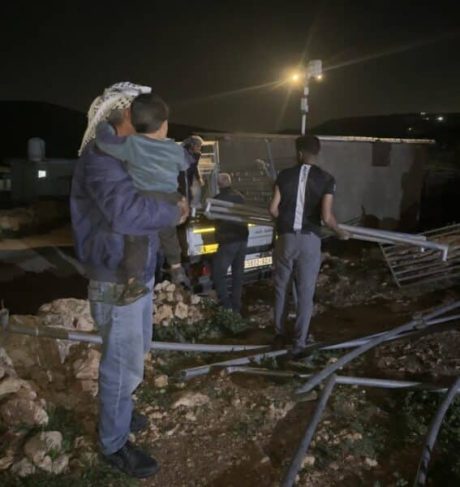
A violent campaign aimed at forcibly displacing Palestinian families from the Al Khalayel valley south of Al Mughayyir (occupied West Bank) has achieved its goal. Two years of coordinated attacks between illegal settlers and Israeli occupation forces finally pushed out the last two remaining families: Abu Najeh and Abu Naim/Abu Hamam.
The Abu Najeh family compound comprised 12 families, around 50 people in total. They have been forcibly displaced 7 times in the last 80 years. They moved to Al Khalayel just 2 years ago after being displaced from Ein Samiya in 2023; investing significant resources into establishing what they hoped would be a permanent home on the land they owned. On Tuesday, February 17, Israeli forces entered their homes seeking to arrest three men under false accusation that they threw rocks at settlers. When they did not find them, they broke two security cameras and arrested 55 year-old Mustafa Omari for filming illegal settlers. He was imprisoned until 10am on Wednesday February 18.
One of the three men they sought to arrest is 32 year-old Majid Omari, who was terrified he would be sought out and beaten or killed by settlers who know his face and his car. “Urgent intervention is needed to protect us,” he said. On Friday February 20, the Abu Najeh family came to the devastating conclusion that they could no longer withstand the violence and harassment and rapidly commenced packing up and deconstructing their homes, working through the night out of fear of a settler attack.
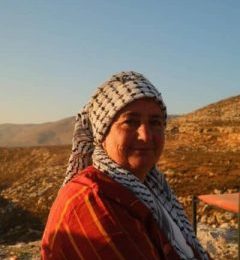 At approximately 12:00 the following day, Saturday February 21, while the Abu Najeh family was packing, illegal Israeli settlers began surveilling the only other remaining Palestinian home in the area, that of the Abu Naim family, with drones. At approximately 14:00, 6 underage settlers in a four-wheel-drive vehicle arrived at the home, verbally abusing and harassing everyone present. Shortly afterwards, the army arrived and conducted a search before withdrawing with the settlers. At approximately 16:00, two settlers entered the front yard with their sheep. Minutes later, approximately 12 settlers forced their way into the home, wrecking the family’s furniture and belongings, smashing their electricity sources, emptying their water tank causing the property to flood, destroying their bathroom and shower. They trapped 39 year-old mother Hidayah Rizq Awad Abu Naim, her 13 year-old daughter Ilham Wadi Abu Naim and 70 year-old father Rizq Awad Mahmoud Abu Hamam in the home and violently beat them.
Simultaneously, as members of the nearby village of Al Mughayyir attempted to support the family, Israeli forces conducted a violent raid, firing tear gas at residents. Armed Israeli settlers and Israeli soldiers shot live rounds at residents and international activists to prevent them from reaching the Abu Naim family home. Two family members were shot: 36 year-old Ayham Rizq Awad Abu Naim was shot in the back and his nephew, 13 year-old Naseem Shaker Thabta was shot in the foot. Ayham faces a lengthy rehabilitation process.
That night, after settlers retreated to the nearby illegal outpost and the injured were being treated at the hospital, members of the community alongside two international activists returned to the Abu Naim home to salvage the belongings that had not been destroyed. In a final act of resistance they set fire to what was left so that the illegal settlers would not materially benefit off of their homes and belongings.
The next morning, February 22, a few men of the Abu Najeh family returned to their property to retrieve their final items and self-demolish their homes in the same act of resistance as the Abu Naim family. By 10am they were forced off their land by illegal settlers. As they departed, settlers set fire to their remaining structures.
These two forced displacements were a coordinated effort between the Israeli forces and illegal Israeli settlers as part of a broader goal to displace all 5,000 residents of Al Mughayyir. Without regard for International Humanitarian Law or Human Rights, Israel continues building a chain of illegal settlements and outposts connecting Ramallah, Nablus and the Jordan Valley. In a deportation hearing held on February 1 concerning activists from the International Solidarity Movement (ISM) who volunteered with the Abu Najeh and Abu Naim families, the Israeli State claimed the reason for their incessant harassment towards Palestinian communities there was “expelling Bedouin people who illegally occupy the area”. This officially admits an ethnic cleansing objective in lands that are under the civilian control of the Palestinian Authority (area B).
In a final statement, a 23 year old nephew of the Abu Naim family shared: “We left against our will, but the land remains and will return to its original owners.
What happened is a serious attack that demands accountability. Places may be erased from the map, but they remain in memory, and the steadfastness of their people is a testament to their adherence to their right. The land belongs to its owners, and it will remain so, God willing.”
Israeli Opposition Leader Endorses Greater Israel

The Dissident | February 24, 2026
U.S. Ambassador to Israel, Mike Huckabee, sparked major backlash during his recent interview with Tucker Carlson, where he openly endorsed the idea of a Greater Israel, stating that “it would be fine” if Israel took large swaths of the Middle East.
In damage control mode, Zionists attempted to paint Huckbee’s claims as fringe or extreme within Israel, but Israel’s opposition leader , Yair Lapid, has confirmed that the prospect of an expansionist Greater Israel is supported even by the more supposedly “liberal” wing of the Israeli political spectrum.
When asked, “The Ambassador Huckabee said this week, and we know the extent of the American administration on the government here, that he supports Israeli control from the Euphrates to the Nile, this means [control] over Lebanon, Jordan, Syria, do you support it or do you think this should be stopped?”, Lapid replied, “I don’t think I have a dispute on the biblical level [about] what the original borders of Israel are.”
Lapid went on to endorse massive Israeli expansion, saying, “support anything that will allow the Jews [to have] a big, vast, strong land, and a safe shelter for us, for our children, and for our children’s children. That’s what I support” adding, “However possible” when asked “How vast?”.
When further asked, “Until Iraq?” Lapid replied, “The discussion is a security discussion. The fact that we are in our ancestral land… Yesh Atid’s position is as follows: Zionism is based on the bible. Our mandate of the land of Israel is biblical. The biblical borders of Israel are clear. There are also considerations of security, of policy, and of time. We were in exile for 2,000 years… you don’t really want all this lecture, right? At least you were not waiting for it… The answer is: there are practical considerations here. Beyond the practical considerations, I believe that our ownership deed over the land of Israel is the bible, therefore the borders are the biblical borders”.
Lapid even advocated that Israel take “as much as possible” of Greater Israel, saying, “Fundamentally, the great, big and vast Israel, as much as possible within the limitations of Israeli security and considerations of Israeli policy”.
Similarly, Benjamin Netanyahu has previously stated that he “subscribed to a ‘vision’ for a ‘Greater Israel’” and “very much”, “felt connected to the ‘Greater Israel’ vision”.
Israeli officials have long been clear that their end goal in Gaza and the West Bank has been total ethnic cleansing and annexation, with Israel’s Science and Technology Minister Gila Gamliel admitting , “we will make Gaza unlivable for humans until the population leaves, and then we will do the same for the West Bank”.
But Yair Lapid’s comments show that across the spectrum from Netanyahu to his “liberal” opposition, Israel has expansionist ambitions beyond Gaza and the West Bank, and wants to take “as much as possible” of Greater Israel.
Islamic Jihad: Trump’s peace board is a “theatrical stunt detached from reality”
Palestinian Information Center – February 25, 2026
BEIRUT – Mohamed al-Hindi, Islamic Jihad’s deputy secretary-general, has described the US-led Board of Peace as nothing more than a “theatrical stunt,” saying it is detached from the reality on the ground.
In an interview with Al Jazeera Mubasher satellite channel on Wednesday, Hindi stressed that the board’s recent meeting “has not brought about any change in the course of the Israeli war on the Gaza Strip or in the scale of Israel’s ongoing violations against Palestinians.”
Hindi affirmed that this peace council was founded on a “formula of absolute American dominance and full security for Israel, while denying the Palestinian people the right to shape their own future.”
“The Palestinian role in this framework is purely symbolic, confined to technocratic committees handling Gaza’s municipal affairs without any sovereignty or political power,” Hindi said.
“The proposed vision fully embraces Israel’s stance, linking Gaza’s reconstruction to resistance groups surrendering their weapons, without any serious discussion of an Israeli withdrawal or accountability for ceasefire violations,” the Islamic Jihad official added.
He underscored that his Movement never trusted the US administrations under president Donald Trump or his predecessor Joe Biden, citing America’s unwavering pro-Israel bias.
He said that the Palestinian acceptance of prior understandings over Gaza aimed solely to put an end to Israel’s relentless massacres against civilians.
Trump’s military buildup against Iran on Netanyahu’s behalf is a gambit doomed to fail
By Iqbal Jassat | Press TV | February 25, 2026
While uncertainty clouds the possibility of America launching a full-scale war on the Islamic Republic of Iran, pro-war narratives emanating from the apartheid regime of Israel desperately seek to justify it.
The war cries raised by Israel’s genocidaires are hardly surprising. After all, it is well known that the regime premier and the criminal-in-chief, Benjamin Netanyahu, has, since the 1990,s been pressuring the United States to carry out direct military action against Tehran.
Hence, it would not be incorrect to conclude that Washington’s war drums over Iran are not the product of strategy. They are the product of imperial reflex and Zionist pressure masquerading as deterrence.
Bizarrely, the spectacle of force assembled under President Donald Trump’s orders, the largest concentration of US air and naval power in the region since 2003, is being sold as strength, whereas it is, in fact, insecurity dressed up as bravado.
The indicators tell their own story.
Despite the theatrics of deployment, the expected escalation signals, mass embassy evacuations and sweeping NOTAM expansions remain limited.
Even within the American military establishment, caution seeps through the cracks. As noted in the February 2026 analysis circulated by Larry Johnson and Douglas Macgregor, the absence of full-spectrum preparatory measures suggests hesitation, not inevitability.
Contrary to the mainstream Western media’s view of “weighing options”, the reality points to a deeply fractured power struggle inside Washington’s war machine.
For instance, the Washington Post report citing Chairman of the Joint Chiefs Dan Caine is particularly revealing.
Caine’s warning about depleted munitions stockpiles, exhausted by Washington’s underwriting of Israel’s war machine and its proxy entanglements in Ukraine, punctures Trump’s fantasy of an “easily won” confrontation.
Trump’s public denial of Caine’s caution is predictable. But the leak itself is the story when senior military officials allow their reservations to reach the press, it is the Pentagon placing a marker in history: we warned him.
Netanyahu’s pressure on Trump has left him in a huge dilemma.
Iran is not Iraq. It is not Libya. It is not a fragmented state awaiting aerial collapse. It is a formidable military with layered air defenses, dispersed missile clusters, hardened infrastructure and strategic depth supported by Russia and China.
The fantasy that standoff air power will induce “disintegration” is recycled doctrine from Kosovo, Iraq and countless failed coercion campaigns. Precision bombing has never delivered political submission where sovereignty is embedded in national resistance.
Yet Trump persists in the illusion that overwhelming force will produce capitulation. Historians will remind us about the folly of imperial habits.
What is absent from Washington’s framing is the geopolitical driver beneath the rhetoric.
The protection of Israeli supremacy remains the unspoken constant. Every escalation is filtered through Tel Aviv’s military and “security” doctrine. Every negotiation is judged by whether it secures Israel’s interests rather than American interests.
Just as the American public is told the “reason” for US hostility is about nuclear proliferation, so too have Zionist-allied agents in South Africa used similar fake arguments to justify the annihilation of Iran.
Some analysts based in the Israeli-occupied territories, who are skeptical about Netanyahu’s motives, remind us that his long-held view about a US attack on Iran would be a “masterstroke” to attain his personal incentive to remain in power.
The reality, though, as Caine cautioned, exposes a deeper truth: the United States is overextended. Its munitions stockpiles are strained. Its alliances are brittle. Its domestic coalition is fractured. A war with Iran would not be a swift surgical strike. It would be attrition, retaliation and regional conflagration.
What unfolds now is not a clash of civilizations. It is the exhaustion of empire confronting the limits of coercion.
A war with Iran would not restore American dominance. It would accelerate its unraveling and the warning has been issued from within.
Whether Trump listens is irrelevant to the structural decline already underway.
Iqbal Jassat is an executive member of the Media Review Network, Johannesburg, South Africa.
Israel designates five Palestinian media outlets as ‘terrorist organizations’
The Cradle | February 23, 2026
Israel’s Defense Ministry has designated five Palestinian news platforms in occupied East Jerusalem as “terrorist organizations,” alleging “incitement” and links to the Palestinian resistance movement Hamas, Israel’s Channel 12 reported on 22 February.
“Defense Minister Israel Katz signed an order designating these platforms as terrorist organizations, and the Attorney General confirmed that there is no legal obstacle,” Channel 12 reported, adding that the outlets “are accused of incitement by focusing on developments in (East) Jerusalem and Al-Aqsa Mosque,” it added.
The order targets Alasima News, M3raj Network, Al-Quds Albawsala Network, Maydan Al-Quds, and Plus Quds Network, none of whom maintain offices in occupied East Jerusalem.
Alasima News said it was suspending all media activities until further notice, while the other four platforms issued no immediate comment.
“In a new step added to Israel’s record of repression and gagging, the occupation has banned the work of several Jerusalem-based news networks in an attempt to isolate Jerusalem and Al-Aqsa, monopolize them, and suppress their news from the world,” Alasima said in a statement.
The outlet expressed pride in “what it has achieved over the past years,” stressing that its motto “has always been to make Jerusalem the focus and compass of the (Palestinian) cause.”
“The Israeli ban will not hide the truth. Silencing the camera will not silence Jerusalem. The narrative written in blood and resilience is stronger than any prohibition,” it added.
Rights groups have identified Israel as the single deadliest country for journalists in recent years, with more than 250 media workers killed since the start of the Gaza genocide across Israel’s various theaters.
Meanwhile, independent foreign reporters remain barred from entering Gaza except through the Israeli military.
Israel’s crackdown on Palestinian freedoms has intensified in parallel with a marked rise in violent settler attacks across the occupied West Bank.
Over the past year, Israeli attacks and crackdowns have displaced around 25,000 Palestinians from the Tulkarem and Nour Shams refugee camps in the occupied West Bank, according to local authorities, with raids, infrastructure destruction, and prolonged closures forcing families from their homes.
The broader campaign of aggression, launched in January 2025 and centered on refugee camps in Jenin and Tulkarem, has uprooted roughly 40,000 people across the occupied West Bank this year alone, while satellite imagery shows nearly half of Nour Shams Camp buildings damaged or destroyed since early last year.
The most recent settler attack saw part of the Abu Bakr al-Siddiq Mosque in the village of Tell, near Nablus, set ablaze and defaced with racist graffiti.
Since 7 October 2023, more than 1,000 Palestinians have been killed by settlers and soldiers in the West Bank.
Official data cited by the Times of Israel shows that over 99 percent of complaints filed by Palestinians against Israeli soldiers in recent years were closed without indictment, with just 23 indictments out of 2,427 complaints recorded between 2016 and 2024.
Israel’s security cabinet approved on 8 February new measures aimed at drastically overhauling the occupied West Bank’s legal and civil framework, allowing Tel Aviv to further expand illegal settlements and strengthen its grip on the territory.
During the month of Ramadan, Israeli authorities greatly restricted the entry of West Bank Palestinians to Jerusalem to 10,000 worshippers for the first Friday prayers at Al-Aqsa mosque, far below the 250,000 seen in previous years, enforcing age and permit restrictions that left hundreds stranded at checkpoints.
Featured Video
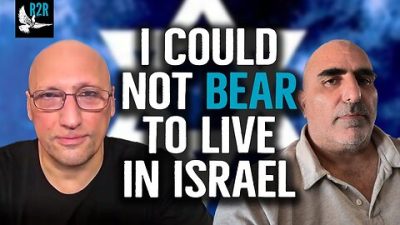
Alon Mizrahi: ‘Israel Must Be Dismantled’
or go to
Aletho News Archives – Video-Images
From the Archives
Allies Don’t Need Lobbies
By Jay Knott | Dissident Voice | September 24, 2013
In a recent article on Counterpunch, Rob Urie defended the traditional Marxist analysis of US policy in the Middle East. He argues that support for Israel is driven primarily by economic interest, not the Jewish lobby.
He starts by paying tribute to the idea that Western societies are uniquely racist. He says that the “Western narrative” claims there is an “Arab character”, and that this is “antique racist blather”. He gives no definition of these terms. Further, he establishes his credentials as part of the dominant current in the American left by claiming that “over a million people in Iraq died so ‘we’ in the West can drive SUVs.”1
When he tries to criticize bourgeois economics, he makes it clear he doesn’t understand the developments it has made since Marx’s day, using the mathematical discipline known as “game theory”. He dismisses the basic abstraction of economic theory, the idea of the rational individual, on the grounds that it is “devoid of history, culture and political context”. But abstractions are always devoid of something.
He defends a more concrete economic theory, mostly Marxist, with some input from another theorist of capitalist crisis, Hyman Minsky. This concrete theory leads him to the view that US activity in the Middle East is primarily driven by rational capitalist motives, the need to secure a supply of oil.
“Taking the totality of circumstance — former oil company executives launching war on an oil rich nation on a pretext they publicly proclaimed they didn’t believe shortly before taking office — and that upon launching their war proved to be non-existent, requires a willingness to overlook the obvious — that the war on Iraq was for oil, that is difficult to support.”1
Perhaps I’ve misunderstood him, but based on what he says in the rest of the article, this convoluted sentence seems to argue that, because president Bush and vice-president Cheney attacked Iraq on false premises, and they also said it was all about oil, and they are former oil executives, and Iraq has a lot of oil, it’s difficult to deny US attacks on Iraq are all about oil.
In fact, it’s not hard at all. As Urie points out, at times Bush and co. said that attacking Iraq was “protecting the world’s supply of oil.”1 But, as he also points out, they are congenital liars. Why should we believe them when they say they are trying to “protect” the oil supply? Protect it against what? When politicians “admit” attacks on Middle Eastern countries are wars for oil, they are parroting the neo-con party line, feeding the public, both left and right, with a plausible-sounding pretext. For right-wingers, “it’s a war for oil” is a reason to support war, and for leftists, it’s a way to feel better by complaining impotently about corporate greed. Both approaches help the war drive. … continue
Blog Roll
 Aletho News
- Pakistan ramps up food exports to Persian Gulf nations as war deepens food insecurity
- Iran submits response to US plan, sets terms for war’s end: Tasnim
- US vs Iran: Kharg Island Talk — Bluff or Escalation? Ex-Military Officer Weighs In
- Zelensky unnecessarily involves Ukraine in the Middle East crisis
- Turkish tanker blacklisted by Ukraine hit in drone attack – media
- Canada, the U.S., and NATO: the inescapable trap
- Villains of Judea: Leonid Radvinsky
- Alon Mizrahi: ‘Israel Must Be Dismantled’
- Former Head Of MI6 Admits That The U.S. And Israel Are Losing The Iran War
- Scattered Thoughts on War and Peace
- If Americans Knew
- Israel may be committing war crimes in Lebanon – Not a ceasefire Day 167
- In the West Bank, life is a constant battle – 3 articles
- Jacob Reses, one of the most powerful pro-Israel operatives in Trump’s Washington
- Israeli-US assaults kill or injure 87 children a day – Not a ceasefire Day 166
- ‘Forever live by the sword’: Understanding Israelis’ massive support for Iran war
- UN’s special rapporteur on human rights says Israel is systematically torturing Palestinians
- Trump White House plagiarized Iran war manifesto from Israel-aligned think tank
- Gaza says 6–10 patients die daily waiting for treatment abroad as Israel blocks medical evacuations
- ‘Substantial evidence’ of double-tap strike in killing of Gaza’s Hind Rajab
- ‘Do Not Want To Die For Israel’: Doubts About Trump’s Iran Strategy Spread Among Troops
- No Tricks Zone
- Devastating Assessment Of Comirnaty Vaccine By Former Senior Pfizer Europe Toxicologist
- New Study: CO2 Is ‘Effectively Negligible’ As An Explanatory Climate Change Factor Since 2000
- Former Pfizer Toxicologist Dr. Helmut Sterz Tells Bundestag Hearing Pfizer Vaccine Should Have Never Been Approved
- Energy Expert: Germany’s Nuclear Phaseout Was A “500 Billion Euro Mistake”
- New Research: South Australia’s Mid-Holocene Sea Surface Temperatures Were 4°C Warmer Than Today
- Storing Green Energy To Last Germany 10 Days Would Require A 60-Million Tonne Battery
- New Studies: UK Sea Levels Were 4 Meters Higher Than Today During The Mid-Holocene
- Destructive Green New Deal: German Energy And Metal Group Warns Of Drastic Crisis
- New Study Documents A 20-Year Pause In Arctic Sea Ice Decline – Driven By Internal Variability
- Wake-up Call: Survey Shows Majority Of Germans Now Favor Postponing Climate Targets!
 Aletho News